INTRODUCTION
Assessing linguistic and communicative abilities during the first three years of life has been an especially problematic endeavour. One challenge that researchers in this area have to face is that of finding practical, reliable, cost-effective and non-intrusive assessment tools. Parent reports are one of the best alternatives for meeting these conditions, and their usefulness is based on the extensive and representative knowledge parents have regarding their children's language skills (Dale & Goodman, Reference Dale, Goodman, Tomasello and Slobin2005). Parent report reflects the child's performance in a wide range of contexts and situations. This method allows the collection of very large samples at low cost in terms of human resources and time investment.
One of the most popular parent reports is the MacArthur-Bates Communicative Development Inventories (CDI) (Fenson, Dale, Reznick, Bates, Thal & Pethick, Reference Fenson, Dale, Reznick, Bates, Thal and Pethick1994; Fenson, Marchman, Thal, Dale, Reznick & Bates, Reference Fenson, Marchman, Thal, Dale, Reznick and Bates2007). The CDI, in its original design, consists of two forms designed for children between ages 0 ; 8–1 ; 3 and 1 ; 4–2 ; 6 respectively. The first form, CDI: Words and Gestures, assesses the size and nature of children's receptive and expressive lexicon, along with their abilities to use communicative gestures and take part in routines, social games and cultural learning situations. The form for older children, CDI: Words and Sentences, assesses productive vocabulary and some aspects of early grammatical development as well: frequency of word combinations, mean length of the three longest sentences (M3L), early morphological development and syntactic complexity of children's current language.
A few years ago, Pérez-Pereira and colleagues (Pérez Pereira & García Soto, Reference Pérez Pereira and García Soto2003) developed the Inventario do Desenvolvemento de Habilidades Comunicativas (IDHC), the Galician adaptation of the CDI. Normative data were obtained from a quite diverse sample of 722 Galician-speaking parents, as well as indexes of internal consistency and reliability (Pérez Pereira & García Soto, Reference Pérez Pereira and García Soto2003). More recently, the short forms of the Galician IDHC were developed (Pérez Pereira & Resches, Reference Pérez Pereira and Resches2007) in order to create an even easier to apply and less time consuming instrument than the long version of the IDHC. The results of this normative study, conducted on a sample of 1,150 subjects, have shown a close similarity between the short forms' psychometric properties and those of the long forms.
The developmental trends and variability found in Galician children's early lexical and grammatical development closely resemble those described in the original CDI adaptation (Fenson et al., Reference Fenson, Dale, Reznick, Bates, Thal and Pethick1994; Reference Fenson, Marchman, Thal, Dale, Reznick and Bates2007) and in other non-English adaptations (Bleses et al., Reference Bleses, Vach, Slott, Wehberg, Thomsen, Madsen and Basbell2008a). In addition, preliminary comparisons suggest that the developmental patterns observed in Galician children are especially similar to those obtained in other CDI adaptations for typologically similar languages, such as Spanish and French (Jackson-Maldonado, Thal, Fenson, Marchman, Newton & Conboy, Reference Jackson-Maldonado, Thal, Fenson, Marchman, Newton and Conboy2003; Kern, Reference Kern2007; López Ornat, Gallego, Gallo, Karousou, Mariscal & Martínez, Reference López Ornat, Gallego, Gallo, Karousou, Mariscal and Martínez2005).
Features of the Galician language
Galician is a Romance language close to both Spanish and Portuguese, with important influences from Spanish throughout the last 500 years. Galician has morphological gender marking and gender agreement (determiner–noun–adjective). Plural morphological marking is simple and regular (two specific allomorphs, with very few exceptions). There is also augmentative and diminutive marking on nouns and adjectives. Verb morphology is rich, with person, number, tense–aspect and mood marking. In contrast to Spanish, no composite past verbal forms exist. Galician is a pro-drop language, with non-obligatory specification of subject, thanks to its rich verbal morphology. Subject–verb agreement is a common characteristic with other Romance languages (os nenos subiron á árbore/o neno subiu á árbore ‘the children climbed up the tree’/‘the child climbed up the tree’). The pronoun usually follows the verb (enclitic pronoun) in simple declarative or interrogative sentences, although in other clauses (negative, subordinate, etc.) the pronoun precedes the verb. In this respect, Galician is different from modern Spanish (el deu lleun libro in contrast to Spanish él ledio un libro ‘he gave him/her a book’), and closer to Portuguese.
CDI concurrent and predictive validity
The goal of this paper is to test the concurrent and predictive validity for both long and short adaptations of the Galician IDHC. Studies of concurrent and predictive associations between parent reporting and other language measures are very much needed to validate the instrument.
The first validity study of the original CDI: Words and Sentences was carried out by Dale (Reference Dale1991). Dale compared CDI lexical and grammatical scores with spontaneous language scores (lexical diversity and MLU) obtained by typically developing children aged 2 ; 0. Concurrent relationships were strong both for the lexical and syntactic domains (r=0·73 and r=0·79, respectively). Further validity studies are summarised by Fenson et al. (Reference Fenson, Marchman, Thal, Dale, Reznick and Bates2007).
Other longitudinal studies have come to confirm not only the concurrent validity of parent reports, but also the stability of CDI scores over time and their long-term predictive power in relation to other related linguistic measures. Corkum & Dunham (Reference Corkum and Dunham1996) established the concurrent and predictive validity of the CDI short forms with a sample of 32 children evaluated at ages 1 ; 6, 2 ; 0 and 4 ; 0. Moderate and significant associations were found between vocabulary size according to parental report and the number of different words from a sample of spontaneous language at ages 1 ; 6 and 2 ; 0 (r=0·51 and 0·73, respectively). Finally, the predictive validity of the CDI lexical scores for a general measure of cognitive development (WPPSI-R) at age 4 ; 0 was determined. Moderate and significant associations were found between both the CDI lexical scores at ages 1 ; 6 and 2 ; 0 and the Verbal IQ scores at age 4 ; 0, although no significant correlation was found for Performance IQ scores. Later on, Bornstein & Haynes (Reference Bornstein and Haynes1998) and Reese & Read (Reference Reese and Read2000), among others, provided further support for these results.
The above-mentioned patterns of concurrent and predictive validity of the English CDIs have been replicated in atypical populations (Miller, Sedey & Miolo, Reference Miller, Sedey and Miolo1995; Thal, O'Hanlon, Clemmons & Fralin, Reference Thal, O'Hanlon, Clemmons and Fralin1999; Dale, Price, Bishop & Plomin, Reference Dale, Price, Bishop and Plomin2003), as well as in minority and/or low SES groups (Pan, Rowe, Spier & Tamis-Lemonda, Reference Pan, Rowe, Spier and Tamis-Lemonda2004).
Studies of validation of the CDI in languages other than English are relatively scarce. Jackson-Maldonado et al. (Reference Jackson-Maldonado, Thal, Marchman, Bates and Gutierrez-Clellen1993) studied the concurrent validity of a previous version of the Mexican-Spanish CDI with a sample of seventeen children between the ages of 1 ; 4 and 2 ; 6. One week after applying the CDI, a 30-minute sample of the participants' spontaneous language was obtained in the laboratory. The correlation obtained between the CDI vocabulary scores and the different number of words used spontaneously by the children was high (r=0·84).
Thal, Jackson-Maldonado & Acosta (Reference Thal, Jackson-Maldonado and Acosta2000), examined the concurrent validity of the Mexican-Spanish CDI (also abbreviated IDHC) (Jackson-Maldonado et al., Reference Jackson-Maldonado, Thal, Fenson, Marchman, Newton and Conboy2003). The authors obtained correlations between three CDI scores (vocabulary, M3L and sentence complexity) and several spontaneous language measures (number of different words, scores in a naming task and MLU) in two groups of children aged 1 ; 8 and 2 ; 4. Significant correlations were found between CDI vocabulary scores and spontaneous lexical diversity at ages 1 ; 8 (r=0·66) and 2 ; 4 (r=0·56). Significant correlations between M3L and MLU scores (r=0·68) and between sentence complexity and MLU (r=0·88) were also obtained at age 2 ; 4. Grammar scores could not be compared at age 1 ; 8 because the children obtained very low scores (floor effect).
López Ornat et al. (Reference López Ornat, Gallego, Gallo, Karousou, Mariscal and Martínez2005) calculated the concurrent validity of the sentence complexity section of the European Spanish adaptation. Spontaneous language samples were obtained from thirty-two children between the ages of 1 ; 5 and 2 ; 4, and a procedure for categorizing and scoring grammar development was applied to those samples. The correlation between the grammar scores obtained and those obtained in the sentence complexity section of the CDI was strong (r=0·87).
Eriksson (Reference Eriksson2001) studied the concurrent and predictive validity of the Swedish adaptation of the CDI-Words and Sentences (SECDI-W&S) through the use of narratives. Eriksson (Reference Eriksson2001) studied thirty-two children from two cohorts when they were aged 1 ; 10 and 2 ; 4, respectively. At that time (T1) three measures were obtained from the SECDI-W&S: total vocabulary score, MLU in morphemes of the three longest sentences (MaxLU) and grammar score. The children were assessed again 14 months later (T2) with different measures: grammar score and MaxLU score derived from the SECDI-W&S, and a series of measures derived from narratives produced by the children using the frog story. Finally the children were assessed 26 months after the first assessment point, at ages 4 ; 0 and 4 ; 6 (T3), through the narrative task. At T2, concurrent validity of the SECDI using narrative measures was relatively strong, with most correlations ranging between 0·48 and 0·69. Predictive validity of SECDI scores at T1 on SECDI scores at T2 and on narrative measures at T2 reached significance in nearly all measures, with significant correlations ranging between 0·33 and 0·63. Surprisingly, vocabulary score at T1 was not found to be a strong predictor of grammar or narrative scores at T2. Grammar and MaxLU scores at T1 were better predictors of linguistic scores at T2. Grammar scores at T1 seemed to be better predictors of narrative scores at T3 than vocabulary scores at T1, although correlations were modest.
Recently, Bleses et al. (Reference Bleses, Vach, Slott, Wehberg, Thomsen, Madsen and Basbell2008b) studied the concurrent validity of the Danish adaptation of the CDI. The authors compared the cumulative number of word types observed in the spontaneous speech of two sets of Danish twins from the age of 1 ; 1 to 2 ; 6, with vocabulary size as measured by CDI reports filled out by the children's parents. The results indicate an adequate correlation between CDI vocabulary measures and spontaneous speech measures, although the number of children studied was limited.
Up until now, studies of the long-term predictive validity for CDI adaptations are few and scarce. However, given the strong concern nowadays to identify early signs of possible later delays, it is important to have information on the predictive validity of assessment instruments. Therefore, the establishment of predictive validity for the Galician CDI would be a first step in this direction.
Relationships between lexical and grammatical development
Longitudinal studies, such as this one, also permit the examination of developmental relationships between components of language, such as the relationship between early lexical growth and the emergence of grammar. A recurrent finding with both the original CDI and several adaptations has been the strong relationship between vocabulary size and grammatical development (Marchman & Bates, Reference Marchman and Bates1994; Fenson et al., Reference Fenson, Dale, Reznick, Bates, Thal and Pethick1994; Caselli, Casadio & Bates, Reference Caselli, Casadio and Bates1999; Jackson-Maldonado et al., Reference Jackson-Maldonado, Thal, Fenson, Marchman, Newton and Conboy2003; Pérez Pereira & García Soto, Reference Pérez Pereira and García Soto2003; Dale & Goodman, Reference Dale, Goodman, Tomasello and Slobin2005). In addition, longitudinal studies have provided results that reveal not only covariation but also the existence of predictive links between lexical and grammatical development. As an example, Bates, Bretherton & Snyder (Reference Bates, Bretherton and Snyder1988) documented a high correlation (r=0·83) between children's vocabulary size at age 1 ; 8 and their MLU at age 2 ; 4, the initial lexicon being the best predictor of later grammatical development. Subsequent analysis showed that this close interdependence between vocabulary and grammar continues to be strong even after controlling for the effect of age and excluding lexical items with grammatical function from the vocabulary count (Bates & Goodman, Reference Bates and Goodman1997). These results seem to indicate that these domains maintain a relationship of interdependence not attributable to general linguistic or cognitive abilities that could mediate between them (Dale, Dionne, Eley & Plomin, Reference Dale, Dionne, Eley and Plomin2000; Marchman, Martínez-Sussmann & Dale, Reference Marchman, Martínez-Sussmann and Dale2004). Instead, they seem to support a lexicalist view of grammar (Marchman & Bates, Reference Marchman and Bates1994). According to this explanation, the productive use of grammar requires a minimal number of lexical items before the emergence of grammar and, as a result, early lexical acquisition would support later grammatical development.
Recent studies of the relationships between lexical and grammatical development of Spanish–English bilingual children suggest that specific links exist between vocabulary size in a given language and grammatical development in that particular language, but not relationships across languages (Marchman, Martínez-Sussmann & Dale, Reference Marchman, Martínez-Sussmann and Dale2004; Conboy & Thal, Reference Conboy and Thal2006; but see Pérez-Pereira, Reference Pérez-Pereira, Pérez-Vidal, Juan-Garau and Bel2008, for different results with children learning two closely related languages). At the same time, it has been suggested that the use of particular grammatical structures may be initially constrained by specific lexical items the children have acquired (Lieven, Pine & Baldwin, Reference Lieven, Pine and Baldwin1997; Tomasello, Reference Tomasello2003). Therefore, future studies of the relationships between lexical and grammatical development should analyze in a more precise way which particular types of words serve as foundational precursors for the abstraction of specific grammatical constructions (Dixon & Marchman, Reference Dixon and Marchman2007). However, this type of analysis is beyond the scope of the present paper.
AIMS
The purpose of this research is to investigate the concurrent and predictive validity for the Galician adaptation of the CDI: Words and Sentences (IDHC: Palabras e Oracións). A validation process has been performed on both long and short forms with the intention of establishing their respective psychometric properties, as well as defining the scope and limits of each of these instruments. In order to fulfil this purpose, the lexical and grammatical scores of forty-two children obtained through the Galician IDHC at ages 1 ; 6 and 2 ; 0 were compared with measures of the same constructs drawn from these children's spontaneous speech samples. Given the fact that a rapid increase in the rate of lexical growth, together with the emergence of first word combinations, is usually observed around ages 1 ; 6–2 ; 0, the relationship between the lexical and grammatical skills of these Galician-speaking children was studied as well. The children's general cognitive and linguistic abilities were also assessed at age 4 ; 0, so that the long-term predictive validity of the IDHC could be evaluated. To summarize, the main aims of the present study were:
(1) To compare the long and short forms of the Galician version of the CDI (IDHC) and how they correlate.
(2) To establish the concurrent validity of the long and short forms of the IDHC by contrasting the results obtained through the CDI with spontaneous language measures of the same children at ages 1 ; 6 and 2 ; 0.
(3) To study the short term developmental relationships between early vocabulary and grammar and to test if lexical and grammatical development can predict later lexical and grammatical development.
(4) To obtain the long-term predictive validity of the long and short forms of the IDHC by comparing the results obtained through the IDHC at ages 1 ; 6 and 2 ; 0 with linguistic measures at age 4 ; 0.
(5) To compare the results obtained using both IDHC forms at ages 1 ; 6 and 2 ; 0 to the IQ scores of the same participants at age 4 ; 0. This comparison aims to replicate previous results (Corkum & Dunham, Reference Corkum and Dunham1996; Bornstein & Haynes, Reference Bornstein and Haynes1998; Reese & Read, Reference Reese and Read2000), which had found correlations between CDI scores at earlier ages and later verbal IQ, but no correlation with performance IQ.
METHOD
Participants
The participants were 42 Galician-speaking parents and their children (23 girls and 19 boys). There were 31 first-born children, 28 of which were single-born. The mothers' level of education was divided equally among primary (14), secondary (15) and university (13) studies. Most of the children (30) came from bilingual, Spanish-Galician-speaking families, and 12 of the children lived in Galician monolingual families.
The participants were contacted through a non-governmental organization, Preescolar na Casa, which operates an early childhood home education programme. Parents whose children were aged 1 ; 6 at the beginning of the study were asked to participate in a longitudinal research programme which would involve two home visits in a six-month period (at ages 1 ; 6 and 2 ; 0), and a final visit when the children were aged 4 ; 0.
Instruments and measures
(1) The long and short adaptations of the Galician CDI-Words and Sentences (IDHC-Palabras e Oracións) were used to assess the participants at ages 1 ; 6 and 2 ; 0
The entire description, normative results and psychometric characteristics of these instruments may be found in Pérez Pereira & García Soto (Reference Pérez Pereira and García Soto2003) and Pérez Pereira & Resches (Reference Pérez Pereira and Resches2007), respectively. A description of IDHC components is available for English readers in Pérez-Pereira (Reference Pérez-Pereira, Pérez-Vidal, Juan-Garau and Bel2008). A minimal description is presented here.
The long form of the Galician IDHC Palabras e Oracións (‘Words and Sentences’) has two parts: Part I, Primeiras palabras (‘First words’) is composed of two sections, the first and most important being a vocabulary checklist of 719 words divided into 22 semantic categories. The other section Como usa e entende o neno a linguaxe (‘how children use words’) comprises five items, which are identical to those of the original CDI (Fenson et al., Reference Fenson, Dale, Reznick, Thal, Bates and Hartung1993). Part II, Oracións e Gramática (‘Sentences and Grammar’), has five sections. The first three sections explore particular aspects of early morphological development in Galician: nine regular morphemes, the use of irregular morphemes and over-regularizations, respectively. In the fourth section, parents are asked about the emergence and frequency of first word combinations, and asked to write the three longest utterances recently produced by their children. Mean length of utterances in morphemes (M3L) was obtained from these recorded utterances. The last section, Complexidade das frases (‘Sentence Complexity’) consists of 38 pairs of phrases. In each of them, parents must indicate which of the two phrases is the most similar to the way their children are speaking at the moment. Just as in the original version (Fenson et al., Reference Fenson, Dale, Reznick, Thal, Bates and Hartung1993), one of the examples given was always more grammatically complex than the other.
The short version of the IDHC Palabras e Oracións has two parts. The first and most important part explores the children's level of productive vocabulary from a list of 100 words. These words are of different complexity levels. They were drawn from the long form on the basis of their frequency by age while keeping a similar proportion of words from the different semantic categories to that used by the children in the long form. The second part explores whether or not the children combine words, and how frequently they do so. This is in contrast to the original CDI short forms (Fenson, Pethick, Renda, Cox, Dale & Reznick, Reference Fenson, Pethick, Renda, Cox, Dale and Reznick2000) but similar to the Mexican-Spanish short forms. Children's morphosyntactic complexity was also explored by asking the parents for examples of the three longest sentences produced by the children.
Two scores were obtained from the IDHC at ages 18 and 24 months of age. First, productive vocabulary for each participant was obtained by counting the number of words produced from the vocabulary lists in both the long and short forms of the IDHC. Second, the mean length in morphemes of the three longest sentences (M3L) produced by each child was calculated from the IDHC parent report. The M3L has been widely used as a measure in other validation studies (Eriksson, Reference Eriksson2001; Jackson-Maldonado et al., Reference Jackson-Maldonado, Thal, Fenson, Marchman, Newton and Conboy2003). The sentence complexity score of the long form could not be used as a variable because of a substantial ‘floor effect’ at 18 months (37 out of the 42 subjects had a score of 0) and very limited variability even at 24 months.
(2) Spontaneous language measurements were used for validation purposes
Two scores were obtained from 30-minute spontaneous language samples at ages 1 ; 6 and 2 ; 0. First, lexical diversity was obtained for each child by counting the number of the different intelligible and non-imitative words produced in the transcription (each form of every root was counted). Second, the child's mean length of utterance (MLU) was calculated. The MLU scores were counted in morphemes, following a pre-established specific set of norms used in previous studies. These norms do not count every morpheme, but only those which are developmentally relevant.
(3) The Spanish version of the Weschler intelligence scales for preschool children (WPPSI-R) (Weschler, Reference Wechsler2001), was used to assess children's cognitive development at 48 months of age
The WPPSI-R provides both verbal and performance IQ scores, which are appropriate to address one of the aims of the study, as well as general IQ score.
(4) The Reynell Developmental Language Scales (RDLS-III), Spanish version (Edwards, Fletcher, Garman, Hughes, Letts & Sinka, Reference Edwards, Fletcher, Garman, Hughes, Letts and Sinka1997), were used to measure the children's linguistic development at age 4 ; 0
The RDLS-III is a relatively recent and widely used instrument, and its reliability and validity scores indicate good psychometric properties. The RDLS-III assesses both language comprehension and production capacities, and is suited for children between ages 1 ; 6 and 7 ; 0. Underlying lexical, morphological and syntactic abilities are assessed in the Expressive language scale, and these same abilities along with pragmatic abilities in the Comprehension language scale. Raw scores obtained by the participants in the RDLS-III were used for purposes of validation, given that no norms exist for the Spanish version.
The scores used at age 4 ; 0 were verbal IQ (VIQ), performance IQ (PIQ) and total IQ, from the WPPSI-R; and raw scores in the Comprehension scale (maximum 60) or Expressive scale (maximum 52, since one section was eliminated) of the RDLS-III. Of the 42 participants of the study, 39 completed all the sections of the Verbal scale and 41 all the sections of the Performance scale of the WPPSI-R. The scores of the Comprehension scale of the Reynell test were obtained for 41 children, and the scores of the Expressive scales were calculated for 37 children.
Procedure
A trained research assistant visited each home around the date on which the children were aged 1 ; 6 (±1 month). She gave one of the parents (mainly the mother) one of the forms (the long or the short form) of the IDHC Palabras e Oracións. Detailed instructions concerning how to complete the forms were offered to the mothers. Once any questions the mothers had were resolved, they were asked to fill out the inventory. The mothers filled out the other IDHC version the next day. The presentation of the different forms (long or short) was counterbalanced. The same procedure was repeated when the children were aged 2 ; 0.
During this same first day session, the mothers were asked to go with the child to the playroom. There, the research assistant showed the participants a standard set of toys (a farm house with people, animals and farm accessories) to play with. The toys were specially selected to establish a standard situation for all children, with items familiar and attractive for children of these ages, and were chosen to promote play and verbal interaction. Half an hour of free play interaction was video-recorded and later transcribed using the CHILDES system (MacWhinney, Reference MacWhinney2000). The transcription was performed by the same research assistant who had been present during the session, and who had been previously trained in the use of the CHILDES program. The entire procedure was repeated when the children were aged 2 ; 0.
At age 4 ; 0, the children were assessed in their homes through two standard tests: the Spanish version of the Weschler intelligence scales for preschool children (WPPSI-R) (Weschler, Reference Wechsler2001), and the Reynell Developmental Language Scales (RDLS-III), Spanish version (Edwards et al., Reference Edwards, Fletcher, Garman, Hughes, Letts and Sinka1997). The language used in all assessments and interactions was Galician.
RESULTS
All variables were examined with regard to their distribution and possible marginal scores. Cases diverging more than 2·5 SD from the mean were given a trimmed score of ±2·5 SD. In all, two marginal scores for the IDHC long form vocabulary score and one marginal score for the M3L at age 1 ; 6 were trimmed. At age 1 ; 6, logarithmic transformations were performed on lexical variables because of positive skew. In addition, the limited variability observed for both grammar variables forced their dichotomous transformation: MLU=0 (without lexical combination) vs. MLU=1 (with lexical combination). At age 2 ; 0, a skewed distribution was observed only for the grammar measures, so that logarithmic and square root transformations were respectively performed for M3L and spontaneous MLU. At age 4 ; 0, the score distribution of standard measures was fairly symmetrical and without outliers. Logarithmic transformation had to be performed only on the Comprehension scale of the RDLS-III. However, in order to make interpretation of the results easier, we will present the descriptive measures in their non-transformed values.
Descriptive measures
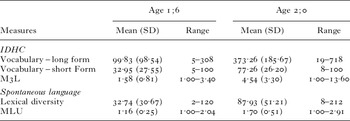
Table 1 presents the mean, standard deviation (SD) and range for each of the language measures at ages 1 ; 6 and 2 ; 0. First of all, a substantial variability was observed in all scores of both forms of the IDHC, in keeping with the wide individual variability already observed in previous normative studies of the long and short forms of the IDHC (Pérez Pereira & García Soto, Reference Pérez Pereira and García Soto2003; Pérez Pereira & Resches, Reference Pérez Pereira and Resches2007). The means for vocabulary size obtained with this sample were within the values described in their respective normative samples, slightly lower at age 1 ; 6 and above the expected values at age 2 ; 0, although within the standard deviation range at both ages. Regarding morphosyntactic complexity, the mean length of the three longest sentences (M3L) showed a level of grammatical development similar to that of the normative results, although again a bit lower at age 1 ; 6 and above the expected mean at age 2 ; 0, although well within the standard deviation range in both cases.
Mean, standard deviation (SD) and range of parent report and spontaneous language measures at ages 1 ; 6 and 2 ; 0

When considering the spontaneous language measures, both number of different words and MLU were close to those reported in other studies with Spanish-speaking (Marchman & Martínez-Sussmann, Reference Marchman and Martínez-Sussmann2002; Thal et al., Reference Thal, Jackson-Maldonado and Acosta2000) and Galician-speaking children (Pérez Pereira, Reference Pérez Pereira2004) within the same age range. As expected, significant growth between the two ages was observed for lexical diversity (t (41)=11·43, p<0·001) as well as for MLU (t (41)=9·76, p<0·001).
For both vocabulary and grammar scores, no significant differences were found for demographic variables such as gender or maternal education, at either age 1 ; 6 or 2 ; 0. For this reason, these factors will not be considered in the subsequent analyses.
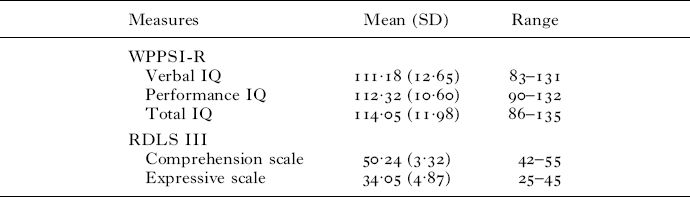
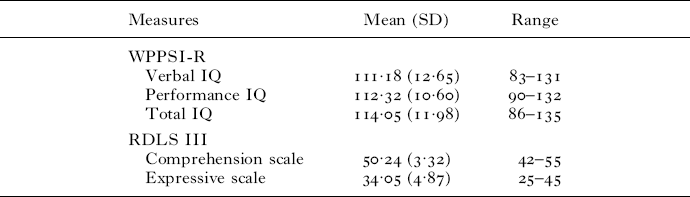
Table 2 shows the descriptive results (mean, SD and range) obtained by the participants in the standard tests at age 4 ; 0. First, the mean scores obtained by our sample in the WPPSI-R were slightly above the mean of the normative sample (Wechsler, Reference Wechsler2001). Second, the mean scores obtained in the Reynell scales were comparable to the mean scores for the subjects between ages 4 ; 0 and 5 ; 0 of the normative sample (M=51·55, SD=4·34 for the Comprehension Scale, and M=36·22, SD=6·21 for the Expressive Scale) (Edwards et al., Reference Edwards, Fletcher, Garman, Hughes, Letts and Sinka1997).
Mean, standard deviation (SD) and range on language measures at age 4 ; 0
Comparisons between the long and short forms
Pearson correlations were performed to measure the relationship between the scores obtained through the long and short forms of the IDHC. Relationships between vocabulary and M3L scores coming from the long and short forms of the IDHC at the same point in time were very strong and significant (p<0·001) at both age 1 ; 6 and 2 ; 0, which indicate that both forms assess vocabulary and grammar in an extremely similar way. The correlations found between scores obtained in the long and short forms of the IDHC were r=0·97 for vocabulary production at age 1 ; 6, r=0·95 for vocabulary production at age 2 ; 0, r=0·99 for M3L at age 1 ; 6, and r=0·86 for M3L at age 2 ; 0. Given these strong correlations between the scores obtained through the long and short forms of the IDHC, for the sake of brevity the following analyses are performed with the M3L scores obtained with the long form of the IDHC.
Concurrent validity of the IDHC
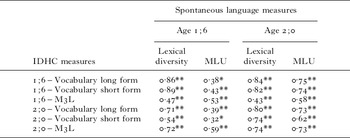
Table 3 displays the correlations obtained between IDHC measures at ages 1 ; 6 and 2 ; 0 and spontaneous language measures at the same ages. At age 1 ; 6, the results indicate strong and significant relationships between the size of vocabulary reported by the parents and the number of different words observed in the spontaneous language samples (0·86 and 0·89 for the long and short form, respectively). At age 2 ; 0, high correlations were found between the same variables (0·80 and 0·74, respectively) pointing to similarly high concurrent validity.
Concurrent and short-term predictive correlations between parent report and spontaneous language measures at ages 1 ; 6 and 2 ; 0

* p<0·05; ** p<0·001.
The length of the three longest utterances (M3L) according to parents' reports showed significant correlation with the MLU observed in spontaneous language at the same age, at both age 1 ; 6 (0·53) and age 2 ; 0 (0·73), very similar to that reported by other studies (Dale, Reference Dale1991; Thal et al., Reference Thal, O'Hanlon, Clemmons and Fralin1999; Thal et al., Reference Thal, Jackson-Maldonado and Acosta2000; Marchman & Martínez-Sussmann, Reference Marchman and Martínez-Sussmann2002; Fenson et al., Reference Fenson, Marchman, Thal, Dale, Reznick and Bates2007). These results indicate that concurrent validity of the M3L grew with age.
Concurrent relationships between lexical and grammatical scores, as measured through the IDHC and spontaneous language, are shown in Table 3. In every case, the correlations between spontaneous or IDHC vocabulary size and grammatical measures (MLU, or M3L) are always lower, although significant, at age 1 ; 6 than at age 2 ; 0, which probably reflects the lower variability of grammar scores at age 1 ; 6. While those correlations were around 0·40 at age 1 ; 6, they grew to scores of around 0·75 at age 2 ; 0 (with the exception of the correlation between IDHC vocabulary short form and MLU).
Developmental relationships between early vocabulary and grammar
Across time correlations may also be observed in Table 3. The correlations between IDHC vocabulary measures at age 1 ; 6 and spontaneous lexical diversity at age 2 ; 0 are high and significant (over 0·80). However, the correlations between grammatical scores across time (M3L at age 1 ; 6 and MLU at age 2 ; 0) were lower (0·58), although significant. In contrast, the correlations between IDHC vocabulary scores at age 1 ; 6 and MLU at age 2 ; 0 are high (0·75 for the long form and 0·74 for the short form). However, correlations between IDHC grammatical measures (M3L) at age 1 ; 6 and lexical diversity at age 2 ; 0 reached lower levels (0·43). These results may mean that IDHC lexical measures at age 1 ; 6 are better predictors of either lexical diversity or MLU at age 2 ; 0 than grammatical measures (M3L) obtained at age 1 ; 6, probably due to the reduced variability obtained in grammatical measures at age 1 ; 6 (floor effect).
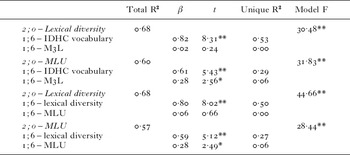
To test this hypothesis, standard multiple regression analyses were performed to assess if the IDHC lexical and grammar scores contribute, and to what degree, to the short term prediction of spontaneous language, beyond the substantial correlation between each of these variables. In the first two models, both vocabulary and M3L at age 1 ; 6 were entered as predictive variables, while the dependent variables (criteria) were spontaneous language measures at age 2 ; 0. In the last two models predictive variables were spontaneous scores at age 1 ; 6, while dependent variables were, again, spontaneous scores at age 2 ; 0.
Table 4 shows the predictive power of IDHC and spontaneous language scores at age 1 ; 6 for spontaneous lexical diversity and MLU scores at age 2 ; 0. The first model shows that IDHC vocabulary and MLU3 at age 1 ; 6 jointly explain 68% of the variance of lexical diversity at age 2 ; 0. The IDHC lexical scores at age 1 ; 6 is the sole significant predictor responsible for the observed variability in lexical diversity at age 2 ; 0 (unique R2: 53%). IDHC measures at age 1 ; 6 jointly explain 60% of the observed variance in the spontaneous MLU at age 2 ; 0. In contrast to the prediction of lexical diversity, both MLU3 and vocabulary contribute in a significant and independent way to the prediction of spontaneous MLU six months later. However, IDHC vocabulary at age 1 ; 6 contributes in a stronger way than MLU3 to the explanation of spontaneous MLU (29% vs. 6%, respectively, of unique R2).
IDHC and spontaneous language scores at age 1 ; 6 as predictors of spontaneous lexical and grammatical measures at age 2 ; 0 (standard multiple regression)

* p<0·05; ** p<0·001.
Finally, the purpose of the last two models was to compare the predictive capacity of the IDHC scores in relation to spontaneous language scores obtained at age 1 ; 6. Parent report scores at age 1 ; 6 predicted lexical diversity as well as grammar development (MLU) six months later in a way very similar to that of spontaneous language scores obtained at age 1 ; 6. Total R2 and unique R2 scores parallel those found for the IDHC scores as predictive variables.
Long-term predictive validity
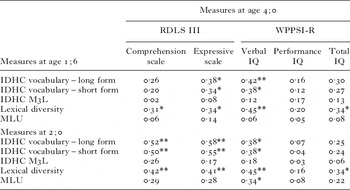
Table 5 shows the relationships found between lexical and syntactic scores at ages 1 ; 6 and 2 ; 0 and linguistic abilities at age 4 ; 0. These results indicate the predictive validity of the IDHC. On the left side of Table 5, the correlations between the linguistic scores obtained at ages 1 ; 6 and 2 ; 0 and linguistic measures (RSLD III) obtained by the children at age 4 ; 0 are shown. Moderate and significant relationships were found between lexical scores from spontaneous language and IDHC and the scores obtained in the Expressive Scale at age 4 ; 0, although the correlations at age 2 ; 0 are stronger than at age 1 ; 6. Correlations between lexical scores and scores obtained in the Comprehension Scale reached significance only at age 2 ; 0, with the sole exception of spontaneous lexical diversity at age 1 ; 6. At no time were grammatical scores correlated with language measures (RDLS III) at age 4 ; 0. It is interesting to note that the predictive correlations for RDLS measures from scores of the long and short forms were very similar.
Pearson's correlations between early lexical growth and grammar, and language and general cognitive abilities at age 4 ; 0

* p<0·05; ** p<0·001.
IDHC scores and IQ
As the right side of Table 5 shows, moderate and significant correlations were found between IDHC vocabulary scores, spontaneous lexical diversity at ages 1 ; 6 and 2 ; 0 and Verbal IQ scores at age 4 ; 0. No significant relationship was found between IDHC vocabulary scores at ages 1 ; 6 and 2 ; 0 and Performance IQ and Total IQ at age 4 ; 0. This pattern of results is similar to that found in previous studies (Corkum & Dunham, Reference Corkum and Dunham1996; Bornstein & Haynes, Reference Bornstein and Haynes1998), and shows not only the long-run predictive validity of the IDHC, but also its language domain specificity. However, lexical diversity scores at ages 1 ; 6 and 2 ; 0 showed not only stronger correlations with Verbal IQ but also significant correlations with Total IQ at age 4 ; 0.
IDHC grammatical scores (M3L) at ages 1 ; 6 and 2 ; 0 did not show significant correlations with cognitive abilities at age 4 ; 0. The same was true for MLU scores at age 1 ; 6. However, MLU scores at age 2 ; 0 showed significant correlations with Verbal IQ.
DISCUSSION
The descriptive results obtained by the participants in the different instruments and measures at different ages indicate that the sample scores were similar to normative data mean scores. Therefore, the children seemed to be following a normal pattern of development.
(1) With regards to the first research objective, strong associations were found between concurrent lexical and grammatical measures obtained in the long and short forms of the IDHC. Therefore, both forms assess vocabulary and grammar in an extremely similar way. These results point to the short form's adequate selection of the 100 vocabulary items.
(2) In relation to the second aim, concurrent validity of the IDHC, the correlations found at age 1 ; 6 between IDHC vocabulary and lexical diversity (0·86 and 0·89 for the long and short forms, respectively) are higher than those obtained by Corkum & Dunham (Reference Corkum and Dunham1996) and by Thal et al. (Reference Thal, Jackson-Maldonado and Acosta2000) at similar ages, but similar to those reported by Bates, Bretherton & Snyder (Reference Bates, Bretherton and Snyder1988), Jackson-Maldonado et al. (Reference Jackson-Maldonado, Thal, Marchman, Bates and Gutierrez-Clellen1993), and by Miller et al. (Reference Miller, Sedey and Miolo1995) and Thal et al. (Reference Thal, O'Hanlon, Clemmons and Fralin1999) with atypical populations of similar ages. Variations in methods may also have contributed to those differences, since the Corkum & Dunham (Reference Corkum and Dunham1996) and Thal et al. (Reference Thal, Jackson-Maldonado and Acosta2000) studies obtained language samples in the laboratory, while in the present study (as well as in the Bates et al., Reference Bates, Bretherton and Snyder1988) the samples were obtained in the children's homes, which increases ecological validity. The correlations obtained at age 2 ; 0 are high as well, and very close to those reported for this age by Dale (Reference Dale1991), Jackson-Maldonado et al. (Reference Jackson-Maldonado, Thal, Fenson, Marchman, Newton and Conboy2003), Corkum & Dunham (Reference Corkum and Dunham1996) and Thal et al. (Reference Thal, O'Hanlon, Clemmons and Fralin1999), among others.
Correlations between IDHC grammar scores and spontaneous MLU are lower at age 1 ; 6 than at age 2 ; 0 because of the limited variability found at age 1 ; 6, when morphosyntactic development is just starting. In the same vein, correlations found between lexical measures and grammatical measures at age 1 ; 6 are lower than those found at age 2 ; 0. Results found at age 2 ; 0 were similar to those found by Bates et al. (Reference Bates, Bretherton and Snyder1988) at age 2 ; 4. The increase in correlations probably reflects the non-linear relationship between lexical and grammatical development (Bates & Goodman, Reference Bates and Goodman1997; Dale et al., Reference Dale, Dionne, Eley and Plomin2000; but see Dixon & Marchman, Reference Dixon and Marchman2007, for a criticism of this position).
Overall, the results obtained indicate that the Galician adaptation of the CDI shows good levels of concurrent validity, similar to those obtained with other adaptations, and therefore seems to evaluate linguistic capacity in young Galician children in an appropriate way.
(3) In relation to the third aim, across-time correlations between lexical and syntactic measures indicate that at age 1 ; 6 IDHC lexical measures are better predictors of both lexical diversity and MLU at age 2 ; 0 than IDHC grammatical measures (M3L). Low morphosyntactic development and consequent scarce variability in M3L and MLU measures at age 1 ; 6 may be responsible for these results, although they may also point to the necessity of a certain amount of lexical development before grammatical development starts. These results coincide with the predictions derived from those approaches that claim interdependencies between lexical and grammatical development (Marchman & Bates, Reference Marchman and Bates1994; Bates & Goodman, Reference Bates and Goodman1997; Bassano, Reference Bassano2000; MacWhinney, Reference MacWhinney, Broeder and Murre2002; Conboy & Thal, Reference Conboy and Thal2006).
In addition, multiple regression analysis confirmed the uneven contribution of lexical and syntactic measures to the short-term prediction of spontaneous language. IDHC lexical score at age 1 ; 6 was the only score which predicted spontaneous lexical diversity six months later, and was the most decisive factor for the explanation of later grammatical development (MLU). Similar results were obtained with spontaneous language measures as predictors of lexical diversity and MLU of children at age 2 ; 0, which strengthens the idea that IDHC measures have the same validity and short-term predictive power as spontaneous language measures, with an advantage of time savings using the IDHC.
(4) The fourth aim was that of examining the long-term predictive validity of IDHC scores for the children's linguistic abilities at age 4 ; 0. Moderate associations were found between IDHC lexical scores at age 2 ; 0 and receptive and expressive linguistic capacities measured with the Reynell Scales when the children were aged 4 ; 0; weak, although significant, associations were observed between lexical IDHC scores at age 1 ; 6 and expressive language at age 4 ; 0. Significant correlations between language comprehension (RDLS-III) and IDHC vocabulary were observed only with IDHC long and short form scores taken at age 2 ; 0, but not at age 1 ; 6.
The correlations found between IDHC vocabulary production and measures of language comprehension and expression at age 4 ; 0 indicate a more direct relation between vocabulary production and language production than between vocabulary production and language comprehension. IDHC (M3L) or grammatical measures did not show long-term links with language development at age 4 ; 0, and spontaneous MLU showed a weak link only at age 2 ; 0. Those results indicate that lexical development as measured by the IDHC shows adequate predictive validity, similar to that found by other authors with other adaptations of the CDI at similar ages (Corkum & Dunham, Reference Corkum and Dunham1996; Bornstein & Haynes, Reference Bornstein and Haynes1998; Pan et al., Reference Pan, Rowe, Spier and Tamis-Lemonda2004). However, our finding that lexical diversity is the best predictor of later language measures does not coincide with that found by Eriksson (Reference Eriksson2001), probably because of differences in the language measures taken and data-gathering procedures.
(5) Finally, regarding the last research aim, moderate and significant correlations were found between IDHC (and spontaneous language) lexical scores at ages 1 ; 6 and 2 ; 0 on the one hand, and WPPSI-R verbal IQ scores on the other. No significant relationships were found between early lexical scores and Performance IQ at age 4 ; 0, as previous studies had shown (Corkum & Dunhan, Reference Corkum and Dunham1996; Bornstein & Haynes, Reference Bornstein and Haynes1998; Reese & Read, Reference Reese and Read2000). The results found indicate that the predictive effect of the IDHC vocabulary is restricted to the linguistic domain and linguistic-related performance, but not Performance IQ scores.
CONCLUSION
Throughout this paper new results on the validity of the Galician adaptation of the MacArthur-Bates CDI have been presented. In light of these results it is possible to conclude that both the long and short adaptations of the Galician IDHC show good concurrent and predictive validity, and provide adequate, representative assessment of lexical and grammatical abilities of children at the ages studied. These results agree, in general terms, with those found in English and other languages, and they offer new support for the relationships between early lexical abilities and the short-term emergence of first grammar; they also support the connection between early lexical abilities and later verbal intelligence and specific linguistic capacities in the preschool years.
Further studies could evaluate the validity of the IDHC at other ages as well as to aspects not studied in the present research, such as vocabulary comprehension or use of gestures. Further studies could also cover other types of validity, such as content validity.