

In the summer of 1923, a young Cambridge chemistry student named Robert Hill (nicknamed ‘Robin’) pasted a newspaper article into his sketchbook and cloud journal. It calls for public contributions to a scientific project of French origin: ‘Meteorology is a science that needs international cooperation more than perhaps any other’, it exhorts the British reader, ‘[a]s the number of official [meteorological] stations is limited it is proposed to ask professional and amateur photographers … to cooperate voluntarily.’ Participating photographers, professional and amateur alike, are asked to take ‘five photographs at each [appointed] hour, one facing each of the cardinal points and one with the camera pointing to the zenith’.Footnote 1 The International Survey of the Sky, as the programme was called, sought to compile photographic records of the sky in order to map the entire European cloud sheet. It was organised in Britain by Captain C. J. P. Cave, then ex-President of the Royal Meteorological Society. Hill answered Cave’s call for amateur contributions with gusto. Within months his name and several cloud photographs, shot with a camera of his own invention, appeared in a range of prominent weather-related journals and magazines.
Hill’s fame derived from the enthusiastic reception of his cloud camera and its novel distinguishing feature: the fish-eye lens. His photographs of cloud formations over Cambridge provided Cave’s survey with an unbroken perspective of the sky, from horizon to horizon in all directions. The homemade, wood-bodied cameras that Hill used to take those first photos now reside in the Whipple Museum of the History of Science, alongside later prototypes for a commercial version produced by R. & J. Beck Ltd.Footnote 2 The words ‘Robin Hill 180° Cloud Camera’ are printed on the commercial version’s brass rim. Small, circular photographs of clouds that survive with these artefacts (Figure 12.1) illustrate the distortive effect of the lens.
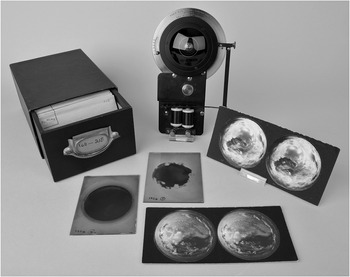
The many versions of Hill’s cloud camera that now reside in the Whipple Museum survive thanks to its inventor’s long career as biochemistry researcher at the University of Cambridge.Footnote 3 Later versions of the camera held in the Whipple Museum are no longer marked as ‘cloud cameras’Footnote 4 – Hill’s original was by the middle of the century out of use in cloud study, employed instead primarily by ecologists rather than meteorologists. Most such analogue techniques were phased out of meteorology by the 1950s, with technological innovations – many of military origin – having ushered in methods of quantitative, as opposed to photographic or visual, weather prediction.Footnote 5 The style of cloud research underlying both the International Survey of the Sky and Hill’s cloud camera became hopelessly antiquated.Footnote 6
This chapter examines the reception of new photographic perspectives enabled by Hill’s camera. In doing so, it indirectly reveals the imagined futures of meteorological research on clouds shortly after the First World War. My analysis captures a snapshot of the institutional, social, and technological dynamics within the field of meteorology during that period. The reception of Hill’s camera shows how it coincided with attempts to remake cloud study, namely by considering clouds primarily in relation to weather systems at the scale of the ‘whole sky’ rather than individual specimens. Entwined with those initiatives was an attempt to reform the patterns of communication between centralised meteorological offices and their dispersed contributors, many of whom were amateur volunteers.Footnote 7 Before 1923, professional meteorologists circulated exemplary images of each cloud type in order to standardise contributors’ records of cloud occurrences, generally communicated by correspondence or telegram. The Hill Cloud Camera earned recognition for its role in a project that instead collected photographic data from peripheral contributors, thereby assigning those observers a purely technical role and reserving challenges of classification for experts in centralised meteorological offices, especially those in Greenwich and Kew. By contextualising the camera’s reception within these social and institutional networks, we can relate its technological capacities to the field’s broader problems of representation and communication. The scientific and political stakes of cloud photography come into focus. A connection may be drawn between this chapter’s approach and synoptic uses of the cloud camera itself: it aims to represent less the early history of the camera and its photographs than the dynamic networks of research, communication, and instrumentation that shaped its reception.
I first provide an outline of events and controversies in cloud study during the forty years preceding the Hill Cloud Camera’s invention. I then describe how Hill’s new instrument promised to mediate visual representations of different kinds of meteorological data. Finally, I relate the camera’s reception to practical problems in meteorological knowledge, namely the use of verbal versus visual communication and the role of amateurs in research. In this way, I show how the Hill Cloud Camera’s novel capabilities represented a potential solution to two problems in meteorological practice: one observational and representational, the other pertaining to social organisation and the circulation of knowledge. Cloud photography’s impact on central meteorological projects such as the International Cloud Atlas (first published in 1891, revised often) and the International Survey of the Sky (1923) is an important thread throughout this story. The designs of these projects reflect conceptions of the role of photography and organisation of cloud study in social and instrumental ensembles. By examining the camera’s reception in relation to such projects, answers to an important question emerge: how did Hill’s camera represent an ingenious solution to a whole host of problems that scientists would soon cease to recognise and, in doing so, how does it register some conceptual discontinuities of early-twentieth-century science of the atmosphere?
Clouds and ‘Synoptic’ Meteorology
Why was Hill’s cloud camera considered particularly suited to photographing clouds? The history of cloud knowledge and the problems it faced prior to Hill’s invention provide insight into the perceived promises of his camera.
When late-nineteenth- and early-twentieth-century meteorologists talked about clouds, they utilised Luke Howard’s concise Linnean classification – consisting of cirrus, stratus, cumulus, and nimbus – which he first developed in 1803.Footnote 8 Problems emerged, however, when emphasis shifted from the correctness of Howard’s names to more practical concerns regarding communication within an international meteorological community. ‘[T]he name of a cloud is of far less importance than that the same name should be applied to the same cloud by all observers,’ the British cloud expert Ralph Abercromby wrote in 1887.Footnote 9 Cloud study was among the last and most stubbornly resistant of the many initiatives to standardise the production of meteorological knowledge.Footnote 10 A few key efforts inaugurated the international standardisation of Howard’s cloud theory. They are central in understanding how the clouds pictured by Hill’s cloud camera came to be valued in relation to their meteorological context: the ‘whole sky’.
Abercromby, a key figure in fin-de-siècle cloud study, presented photographs and a lecture to the Royal Meteorological Society in 1887 in which he detailed his travels throughout the world and attempted to ‘illustrate the fact of the identity of the forms of clouds’.Footnote 11 By travelling to exotic locales and documenting their cloud forms, Abercromby demonstrated that clouds everywhere could be classified by Howard’s vocabulary. His celebrated cloud photographs secured the global legitimacy of terms like nimbus, cirrus, and stratus. Cloud forms’ universality posed as many problems as it solved, however – as Abercromby noted, ‘shape alone is not sufficient to give a true prognostic value. Clouds always tell a true story, but one which is difficult to read; and the language of England is not the language of Borneo. The form alone is equivocal; the true import must be judged by the surroundings, just as the meaning of many words is only known by the context.’Footnote 12 Abercromby thus showed meteorology based on cloud-watching to be a global form of knowledge, but one nonetheless premised on the local adaptation of a universal vernacular. Local context for him and his contemporaries largely consisted of other meteorological phenomena measurable by barometers, thermometers, or anemometers. He forecast by positioning cloud forms on diagrams like that in Figure 12.2, which shows where certain cloud types form within ‘cyclonic’ systems, represented by isobaric lines derived from barometric readings.Footnote 13 This was the characteristic late-nineteenth- and early-twentieth-century approach to cloud observation.Footnote 14 Abercromby described the state of the art clearly in 1878:
Two methods have to be combined to obtain a complete idea of Cyclone or Anticyclone Weather. The first, or synoptic method, consists in drawing an isobaric map, and marking on it the position of rain, clouds, &c., by which their position relatively to each other, and to the cyclone or anticyclone centres, can be ascertained … The second method consists in recording the sequence of phenomena which occur to a single observer, as a cyclone or anticyclone passes over him.Footnote 15
Katharine Anderson shows how both these modes reflect a visual sensibility that seeks to distill complex meteorological phenomena into images of immediate, graphic clarity, open to interpretation ‘at a glance’. The second mode motivated greater use of photography for cloud analysis.Footnote 16 The photographic record of an individual observer’s perspective, however, proved difficult to reconcile with Abercromby’s other mode of visualisation and analysis, namely synoptic isobaric maps. As he noted, ‘These two methods, the plan and section as it were, are so different that it is difficult practically to combine them, and to realize how a difference in a cyclone, on a synoptic map, will affect the sequence of weather as it passes over an observer.’Footnote 17

The meteorological projects of Hill’s time placed his cloud photographs in direct dialogue with those mapping practices. The camera’s importance to the International Survey of the Sky (1923) was tied to that project’s intent to revise the International Cloud Atlas, which was first published in 1891 as the standard of cloud knowledge and classification.Footnote 18 Meteorology’s prevailing information order attempted to ensure the reliability of vast research networks of amateur contributors by distributing exemplary cloud photographs. The International Cloud Atlas comprised the central focus of this effort. The earliest form of the revised cloud atlas – and a direct inspiration for the International Survey of the Sky – was a treatise published by the Office National Météorologique de France entitled Les systèmes nuageux.Footnote 19 It defines each cloud type not only by form, but also by its relation to larger pressure systems, or ‘cyclones’, using barometric pressure gradients, narrative description of formation processes, and photographic representation. A review of the text, published by the Royal Meteorological Society, situates the project clearly:
With the development of synoptic meteorology, attention was naturally directed to the relation between clouds and weather and travelling systems of isobars, and in our own country the work of Abercromby and Clement Ley was especially prominent … It was recognized that the synoptic charts explained most of the local weather signs and to a large extent superseded them … In consequence the interest in cloud structure as an aid to forecasting appears to have declined.Footnote 20
The French project aimed to halt that perceived decline in interest in cloud structure by defining the complementary relation between cloud knowledge and the synoptic understanding afforded by isobaric mapping.
Here we see the hybrid approach to cloud analysis growing in complexity, scope, and institutional support. The individual cloud form, identified visually, is situated in relation to unseen phenomena such as wind and pressure. Schematic diagrams mediate that gap. Les systèmes nuageux attempts to represent a cloud’s role in larger ‘cloud systems’ by triangulating text, photograph, and diagram: text performs narrative work, diagrams show systematic relationships between measurable weather phenomena, and photographs render such phenomena visible and identifiable. Such divisions of labour reflect distinct valuations of instrumental ensembles, situating cameras amongst barometers and anemometers.
Hill conducted his photographic experiments in this atmosphere of ever more socially, technically, and scientifically complex cloud study. His early cloud cameras, however, were simple and low-tech. The Whipple Museum holds two wood-bodied, pinhole cameras that Hill used for his earliest wide-angle photographs, which depict him before his Cambridge home. In later versions, like that produced by R. & J. Beck, automatic shutters replaced manual, brass replaced clumsy wooden bodies, and the lens was refined for enhanced range and clarity. Nonetheless, Hill used the earlier versions to produce the photos that he submitted to the International Survey of the Sky and that subsequently so impressed the European meteorological community.
Colonel Delcambre, director of the French meteorological office, noted his international survey’s ambitions and linked them directly to Hill’s new cloud camera. He wrote to Hill in late 1923, remarking that ‘The very interesting photographs that you attached will soon be put under consideration in the complete revision of the Cloud Atlas.’Footnote 21 Hill’s camera represented a new way to depict clouds at the scale afforded by such measurements of pressure, wind, and temperature. The distributed measurement of those phenomena had provided data for producing synoptic weather maps for decades prior, and caused the lapse of cloud research in the years preceding 1914.Footnote 22 The outbreak of war, according to commentators, heightened the need for meteorological exactness achievable only by coordination of cloud knowledge with quantitative measurement.Footnote 23
C. J. P. Cave, the coordinator of Britain’s contribution to the international survey, praised Hill in his summary of the survey’s results by noting that his camera provided ‘a far better representation of the cloud distribution than can be obtained with an ordinary camera unless a prohibitive number of plates are exposed’.Footnote 24 The Quarterly Journal of the Royal Meteorological Society’s review of Les systèmes nuageux in 1924 noted the usefulness of Hill’s camera for its ability to capture rapidly changing phenomena across the whole sky. The author remarks that
In the first volume [of Les systèmes nuageux] it is rightly emphasized that the important features from the forecasting point of view are the appearance of the whole sky and the changes over a period of some hours. The details of cloud structure change so quickly that a complete photographic reproduction, even for a short period, would require the expenditure of an inordinate number of plates, though the use of Mr. R. Hill’s lens would reduce this difficulty considerably.Footnote 25
The place of individual clouds in cyclonic systems could be seen at a glance. Photographs challenged diagrams’ superior ability to represent visible weather phenomena at the scale of the whole sky, rather than the individual specimen. Relations between visual and non-visual phenomena – usually cloud types and pressure gradients – demanded representational compromise. The language of the camera’s reception reflects enthusiasm for combining the geographical advantages of, say, isobaric mapping with the naturalism of photography. Hill’s camera landed amongst meteorologists keen to expand photographic records to a synoptic scale, and so mediate between Abercromby’s ‘two modes’ of analysis.
If Hill’s camera promised to transform the visible record of cloud phenomena, how did he prove the camera’s compatibility with existing modes of identifying and defining clouds? After all, his camera produced hugely distorted images, utterly unlike those of the International Cloud Atlas. On comparing Hill’s fish-eye lens with those of two contemporaries, Wood and Bond, whose designs provoked no reaction from the meteorological establishment, we uncover an important difference in the cameras’ public presentation and construction that may explain the enthusiastic reception of Hill’s invention. In an article of 1906, and a revised edition of his book, Physical Optics (1911), R. W. Wood showed how the ‘external world appears to a fish below the surface of smooth water’ by way of a pinhole camera filled with water.Footnote 26 In 1922, Wilfred Noel Bond published a brief article in the Philosophical Magazine describing an adapted version of Wood’s camera, in which he first suggested its use for photographing clouds.Footnote 27 Bond’s camera closely resembled that developed by Hill only a year later, but Bond used one hemispherical lens situated below a pinhole, while Hill’s version placed another convex lens above the pinhole in order to more clearly capture images near the horizon.
Why did Hill’s camera garner acclaim, while Bond’s publication went largely unnoticed? We cannot say for sure. Hill may have simply enjoyed superior timing, and more actively communicated his results to coordinators of the International Survey of the Sky. We should note, however, that their designs and their techniques for representing visual distortion differ in one important respect. Bond adequately describes the real nature of the camera’s effect, but also misrepresents it visually. Figure 12.3 shows how concentric bands divide the image, but also deceptively frame the picture-plane as a globe with receding lines of latitude and longitude.
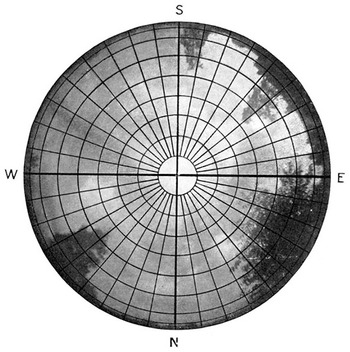
Hill, in contrast, applied a huge amount of effort towards correcting for the lens’ distortion, with far better results. He wrote to a nearby optical physicist requesting a ray diagram for representing the lens’ distortion, but eventually settled for a more practical solution: merely photographing illuminated grids. The camera’s fabricator, R. & J. Beck, used those photographs to assure the Royal Air Force of the camera’s value for photographic surveys from the underside of planes.Footnote 28 In an article for the Quarterly Journal of the Royal Meteorological Society, Hill also calculated the precise distortion relative to the image’s central point.Footnote 29
Another one of Hill’s most important marketing tactics, highlighted in R. & J. Beck catalogues and in his own article for the Quarterly Journal of the Royal Meteorological Society, was to stress the camera’s ability to translate between the distorted, synoptic image produced on the plate and a direct, conventional, flat image. The primary means of doing so entailed projecting the image back through the lens and onto a flat surface, thereby reversing the distortive effect (Figure 12.4).Footnote 30
Hill’s diagram depicting the translation from photographs produced by his cloud camera to a conventional camera format. The outlined portion of the image would, in principle, produce the image on the right when backlit and projected through the lens in reverse direction. Plate VI in R. Hill, ‘A Lens for Whole-Sky Photographs’, Quarterly Journal of the Meteorological Society, 50, no. 211 (1924), pp. 228–9.

Hill’s outermost, curved lens, absent in Wood and Bond’s designs, enabled this reversal of perspective. The camera’s physical construction not only registered information with capabilities beyond those of the human eye, but also allowed it to translate them back. The need to discern crucial information in primarily non-naturalistic representations (such as isobaric diagrams) ‘at a glance’ defined the preferred observational practices and units of meteorological analysis. The capacity of Hill’s camera to translate between cloud specimens and cloud sheets, a new unit of observation commensurate with isobaric diagrams, endeared it to meteorologists.Footnote 31 Hill emphasised that ‘each small area of the whole is a faithful representation of the corresponding part of the sky … When the nature of the distortion is realised, there is no difficulty in interpreting the results.’Footnote 32 He repeatedly emphasised the modified lens’ ability to secure simultaneous synoptic visibility and local fidelity. Photographic representation could clearly identify familiar cloud types, even while the photographs’ unfamiliar visual forms afforded ‘at a glance’ knowledge of ‘whole-sky’ phenomena. Representations of that translation, like Figure 12.4, proved the camera’s commensurability with existing technologies of photography and visualisation.
Hill’s cloud photographs were published in a moment when the future of cloud study and of meteorological prognosis relied on one’s ability to envision the interrelations of visual and non-visual components in large-scale weather systems.Footnote 33 Hill’s camera extended the vividness, visual clarity, and objectivity of photographic depiction to analysis over geographical scales rivalling those of traditional weather mapping.Footnote 34 It did so without compromising perceptions of its representational faithfulness of the single specimen. Hill’s camera surpassed the eye, but did not betray it.Footnote 35
Beyond Clouds: Photographs and Photographers
The history of cloud knowledge shows how meteorologists struggled to reconcile synoptic charts of non-visual data (derived from barometers and anemometers) with photographs. That struggle entailed the coordination of many different meteorological observers with varying levels of scientific status and technical proficiency. Did the Hill cloud camera, which promised to alter photography’s place in the field’s representational ensemble, in turn affect these social aspects of cloud research? One way to answer this question is by examining how the uses of different media – in this case, photographs and lexical data communicable by telegraph – were delegated to or controlled by different members of the meteorological polity. This section relates the reception of Hill’s cloud camera by meteorologists keen to reorganise social dynamics in meteorological research and communication. Its place within the International Survey of the Sky is an instructive case. The novelty of that survey lay in its attempt to exploit the camera on this grand, popular scale: it was the first major meteorological effort that requested the contribution of photographs from non-professionals. Amateur contributions had long played a central role in other kinds of meteorological research. Symons’ Meteorological Magazine, one of the field’s most important organs of communication by the late nineteenth century, began as a publication by and for amateur meteorologists.Footnote 36 R. H. Hooker, then President of the Royal Meteorological Society, wrote in 1922 that ‘[i]t has been almost traditional in this country to regard scientific progress as necessarily associated with voluntary effort.’Footnote 37 Professional offices made do with whatever volunteer contributions they could attract.Footnote 38 With ever greater amateur access to cameras, large-scale meteorological dynamics over the course of a week could thus be photographically reconstructed with unprecedented geographical scope. Looking at the meteorological community’s composition alongside its techniques of communication and standardisation – especially how they organise circulation and delegate control of words and images, naming and observing – reveals the professional and political stakes of cloud photography in meteorological practice.
The professional–amateur relation even shaped the language of meteorology itself. Standardising the vocabulary of cloud classification, and thus synchronising a community sufficiently large for synoptic analysis, presented nineteenth-century cloud scientists with a major problem. In the 1880s a controversy stimulated by the English don of fin-de-siècle cloud knowledge, the Reverend Clement Ley, focused on the complexity of Howard’s cloud classifications. Ley situated the problem of classification clearly:
Before the dawn of synoptic meteorology Luke Howard’s system filled a need, though it did little to promote inquiry. Since that era it may safely be made the basis of a carefully discriminating and eclectic system of terminology. But any endeavour to restrict ourselves to its use, cuts off the possibility of obtaining what becomes more and more necessary, viz. the power of either communicating from distant localities the actual aspect of the sky, so that this may be represented synoptically, or of recording such an aspect in a journal so as to call up any vivid idea of the observed phenomena to the reader of the journal.Footnote 39
Ley’s contemporaries disliked his more vivid and synoptically accurate system due to its excess of terms. D. W. Barker called for something simpler than Ley’s classification ‘for the use of ordinary observers’, and H. Toynbee echoed the same idea.Footnote 40 G. M. Whipple, Superintendent of Kew Observatory (and father of the Whipple Museum’s founding donor Robert Stewart Whipple), suggested in response the formation of a committee ‘to inquire into the question of cloud classification’ and to produce standard photographs of cloud forms that could be distributed to an audience beyond those in regular contact with the Meteorological Office.Footnote 41 That committee’s work would provide the basis for the International Cloud Atlas, which was first published in 1891. The negotiation of a descriptive language for clouds thus emerged in relation to controversies over the role of non-professional observers in meteorological research. It had enormous stakes: Ley and his fellows assumed that only lexical communication could produce ‘synoptic’ understanding. In this exchange and others, the material character of cloud knowledge was considered in relation to two problems. Photographs legitimised the universal application of Howard’s terminology, but their role in the communication of cloud data across the vast distances and durations studied by modern meteorology remained subservient to that of imprecise verbal transmission (due largely to the nature of telegraphic communication). Meanwhile, the limits of that verbal lexicon reflect a reliance on amateur contributors.
Professional and amateur meteorologists alike had to be taught how to distinguish, say, cirro-stratus from strato-cirrus clouds in their own research. The meteorological community circulated drawings, paintings, and photographs that could serve as exemplary renderings of cloud forms. In 1887, Abercromby responded to Ley by calling for the circulation of photographs: ‘One difficulty in the way of any accordance of nomenclature arises from the impossibility of expressing the varying forms of clouds in words, and I have long been driven to the conclusion that no international accordance of cloud names can be obtained till typical photographs could be circulated at a moderate price.’Footnote 42 Four years later, that idea justified the creation of an International Cloud Atlas. The International Cloud Atlas embodies Ley’s assumption that meteorological observations must be communicated by the circulation of written tables, and Abercromby’s conviction that accuracy can be secured only by way of shared, standard images. The accurate circulation of words, in the form of tables that recorded total and proportional counts of different cloud types at particular locations, would require a reverse circulation of standard images. Only then could distant contributors be adequately trained, and their observations considered reliable. Even that strategy of centrally standardising visual references for cloud classification, however, came with problems: ‘Some attempts I made to get fleecy clouds engraved were expensive failures; and the photographs were often of unsuitable size,’ wrote Abercromby.Footnote 43 The definitive visual standard for cloud types, namely the International Cloud Atlas, contained some paintings due to difficulties in procuring acceptable photographs of some clouds. The camera’s reliability was not absolute, even in the hands of expert technicians.
Hill advertised his camera’s central role in attempts to subvert the Cloud Atlas’ approach. His camera was celebrated for its innovative contribution to the International Survey of the Sky, which attempted a major reorientation of photography’s place in the relation between professional and amateur meteorologists. That survey’s novelty lay less in its scope and community of contributors than in its technological substructure. Cloud photography had previously been used to prove the homology of cloud forms throughout the world and represent classificatory differences, but never to produce visual data for synoptic modelling of large-scale systems. There simply weren’t enough willing cloud photographers to be enlisted, within or without institutional ranks. The project outstripped the meagre resources of meteorological institutions: ‘As the number of official stations is limited it is proposed to ask professional and amateur photographers who are willing to cooperate voluntarily in the work to take photographs at the appointed times.’Footnote 44 The need for enthusiastic, volunteer photographers derived, as a bulletin from the Royal Meteorological Society noted, from the absence of cameras from most meteorological observatories’ instrumental arsenals.Footnote 45
Volunteer observers were asked to contribute satisfactory photographic records in numbers that were not tenable before the interwar period, a point acknowledged by Cave in his summary of the survey’s results.Footnote 46 Professionals could rely on amateur photographic contributions after the First World War, when photography was transformed by its surge in popularity, affordability, and convenience.Footnote 47 Hill’s camera promised to further democratise photography, as its reception shows. A crucial benefit of Hill’s camera was its economy. When Cave’s British chapter of the International Survey of the Sky called for five photographs of the sky per appointed hour, Hill submitted only one, which was actually deemed sufficient, even preferable. This was a significant improvement on an expensive technology in a rapidly expanding meteorological research infrastructure, which remained reliant on the generosity of volunteers.Footnote 48 Descriptions of the camera consistently emphasise this crucial material benefit.Footnote 49
Hill’s camera was received by meteorologists intent on reversing Abercromby’s earlier claim that stabilising cloud classifications required the free circulation of photographs from centre to periphery. Whereas late-nineteenth- and early-twentieth-century members of the Royal Meteorological Society distributed photographs to serve as visual standards, thus extending cloud literacy to a broad community, that community of amateurs was now asked to communicate photographic evidence to their local meteorological office. Doing so limited the need for cloud literacy to a small, elite, largely homogeneous group of experts. Where non-professional volunteers once produced tables recording the hourly occurrence of cloud types, they were now to take only photographs, thus centralising the practice of classification. Untrained observers wielding cameras could be even more assimilated into meteorological research without risk of error due to the camera’s objective gaze. Thorny problems regarding proper classification no longer left the Royal Meteorological Society’s door.
Hill, himself an amateur (albeit with scientific training), provided an innovative solution to a serious material problem. That solution seemed to promise the future success of the synoptic photographic survey, and in turn to restructure relations of power in meteorology. Recognition of this goal can be discerned in an essay by Sir Richard Gregory, President of the Royal Meteorological Society in 1929. Gregory praised amateurs for their contributions to meteorology, but emphasised the qualitative differences between amateur and professional knowledge: the former is non-expert, enthusiastic, and expressive of a ‘love of the subject’, while the latter is abstruse, mathematical, and analytic.Footnote 50 Professional meteorological meetings, he argued, must be conducted in a sufficiently accessible language to be understood by amateurs, lest their passion for the subject wane. In Gregory’s tenure, Hill’s camera promised to resolve debates about the accessibility and ease of cloud terminology – debates conducted by the likes of Ley and Whipple – by exploiting the camera’s mechanical discipline to rein in amateurs’ willful enthusiasms.
Conclusion
Meteorologists’ vision of amateurs supplying thousands of sharp photographs to centralised surveys never came to pass. The International Survey of the Sky was a failure, short on photographic submissions and even shorter on usable images.Footnote 51 Hill’s cloud camera met a similar fate: few meteorologists, much less amateurs, used it after 1935. Trust in photographs wavered, and ultimately proved unequal to the promise of newer technologies such as radar that even further excluded amateurs from the intellectual work of meteorology. Since then, the cloud camera’s function has become increasingly alien to our notions of meteorological practice.
The Whipple Museum has many such objects. While the use of many artefacts is obvious and intuitive to our present scientific sensibilities – objects like early microscopes, calculators, and globes – others speak to encounters between scientists, their instruments, and nature that appear bizarre and inexplicable. Why would early inventors of the fish-eye lens all identify clouds as its proper object of depiction? Why did meteorologists care so much about the taxonomy of clouds, those most formless and ephemeral of things, in the first place? Although they may speak to historical dead-ends, our most anachronistic, whimsical, and weird objects attest to an important fact: the choreography of encounters between scientists, their tools, and nature is momentary, mutable, and justified by reference to changing contexts. By examining Hill’s cloud camera and seeking to explain its origins, its successes, and the conditions under which it achieved brief fame, connections between clouds, photographs, synoptic maps, meteorologists, and amateur volunteers are brought into focus.


 Open access