Introduction
Recent disasters, such as the events of September 11, 2001, Hurricanes Katrina and Rita, and the Haiti earthquake, have brought attention to the importance of disaster preparedness, response, and recovery. Most fatalities, injuries, and damage caused by disasters are preventable.Reference Falkiner 1 Adequate emergency preparedness could significantly reduce the risk of damage and injury, also ensuring that people are able to care for themselves and their families following a disaster.Reference Paton, McClure and Bürgelt 2 Though previous efforts have focused on vulnerability and emergency preparedness, recent work has shifted to focus on disaster resilience, or the capacity of affected communities to recover with little or no external assistance.Reference Walter 3 Resilience is often viewed as a more proactive and positive expression of community engagement with hazard reduction.Reference Cutter, Barnes and Berry 4 Disasters can have long-lasting effects on a community because of the loss of infrastructure, mass casualties, and ongoing disruption of normal functions.Reference Born, Briggs and Ciraulo 5 In 2010 alone, disasters left more than 42 million people homelessReference Guha-Sapir, Vos, Below and Ponserre 6 bringing the importance of resilience to light.
One lesson learned from disaster events since 2001, especially from Hurricane Katrina in 2005, is that traditional methods of communication often fall short of the goal of reaching everyone in a community. 7 Health promotion initiatives in faith-based organizations (FBOs) have been recognized as valuable strategies to reduce health disparities because of the status of FBOs within their communities and the ability of FBOs to reach broad populations.Reference DeHaven, Hunter, Wilder, Walton and Berry 8 , Reference Campbell, Hudson, Resnicow, Blakeney, Paxton and Baskin 9 The church has been described as an important ally in efforts to provide preventive health and social services to populations at risk, such as: the economically disadvantaged; groups with limited English proficiency or low literacy; those with certain medical issues or disabilities; or groups characterized by cultural, geographic, or social isolation.Reference Sutherland, Hale and Harris 10 Additionally, faith-based communities are among the most significant sources of social capital in the United States.Reference Putnam 11 Putnam defined social capital as “social organization such as networks, norms, and social trust that facilitates coordination and cooperation for mutual benefit”.Reference Putnam 12 Studies have suggested that disaster planners should consider social capital as a resource for preparing for and responding to disasters.Reference Aldrich 13 , Reference Aldrich 14 Thus, there is substantial interest in understanding the capacity of FBOs to engage in health promotion and disease/injury prevention activities.Reference Asomugha, Derose and Lurie 15
FBOs represent a source of stability and have an established presence in a community. They frequently serve their community following disasters by providing shelter, food, and prayer; giving financial contributions; and rebuilding structures.Reference Stajura, Glik, Eisenman, Prelip, Martel and Sammartinova 16 FBOs are generally active in the preparedness, response, and recovery phases of disasters. They are not formally included or identified as an existing system with unique resources that can be harnessed before, during, and after disasters. There is an opportunity to increase the effectiveness with which FBOs prepare for, respond to, and recover from disasters. Previous studies have demonstrated the importance of extended supportive networks and social capital in facilitating recovery and sustaining emotional well-being.Reference Ekanayake, Prince, Sumathipala, Siribaddana and Morgan 17 A step towards this goal is to understand the perceptions of FBOs about disaster preparedness and resiliency, which the current pilot study aimed to assess. To the authors’ knowledge, no other study has assessed the perceptions of FBOs about disaster preparedness and resiliency.
Methods
Study Sample and Recruitment
Institutional Review Board (IRB) approval was obtained for this study. Faith-based organization leaders were contacted about participation in this pilot study through telephone and e-mail. Potential study participants had to speak English and belong to a congregation in South Los Angeles.
Survey
Participants were administered a Qualtrics (Version 52004, Provo, Utah, USA) survey at the end of the interview. The survey consisted of questions about congregation demographics, public affairs, community involvement, and social behavior. The survey questions were adapted from the Social Capital Community Benchmark Survey developed by the Saguaro Seminar at Harvard University. 18 In addition, participants were asked to provide demographic information for the congregation as a whole.
Interview
The investigators also created an instrument that guided the semistructured interviews. The framework of the interview tool was adapted from the “Community and Congregation Project,” a collaborative project with University of Southern California (USC) and Loyola Marymount University.Reference Flory and Sager 19 Respondents were also allowed to describe other issues and concerns as they arose during the interview process.
The interview guide addressed the key themes related to FBOs' preparation and readiness to manage disaster victims. These themes included: descriptions of their organization's written emergency plans; implementation and testing of plans (eg, disaster drills); disaster training conducted by the institutions or outside sources; disaster-related resources, collaboration with external agencies; and barriers that might prevent adequate preparedness.
Data Collection and Analysis
Frequency distributions for survey data were calculated for questions of interest. All statistical analyses were performed using SAS (v9.2, Cary, North Carolina USA).
Interviews were audiotaped, with respondents’ permission, and transcribed into Microsoft Word (Microsoft, Redmond, Washington USA) files to be later used for content analysis. The investigators verified transcriptions for accuracy and analyzed the data using ATLAS.ti (v5.0, Berlin, Germany), a qualitative analytical software program.
The qualitative analysis was based on a thematic analysis approach, which classifies themes and patterns revealed in each of the interview topics described earlier (eg, experience, preparedness, emergency drills, and disaster response).Reference Glaser and Strauss 20 , Reference Aronson 21 Various patterns were identified in the responses. Subsequently, codes were created and reviewed that reflected corresponding themes (eg, disaster plans, social services provided by the organizations, and past disaster experiences). New codes were created as novel patterns and themes emerged. Themes were catalogued and collectively became the information base for a meaningful conceptual framework and analysis.
Results
Social Capital Survey
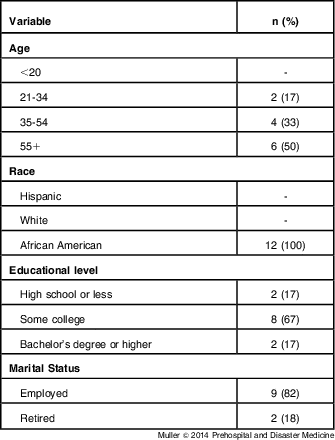
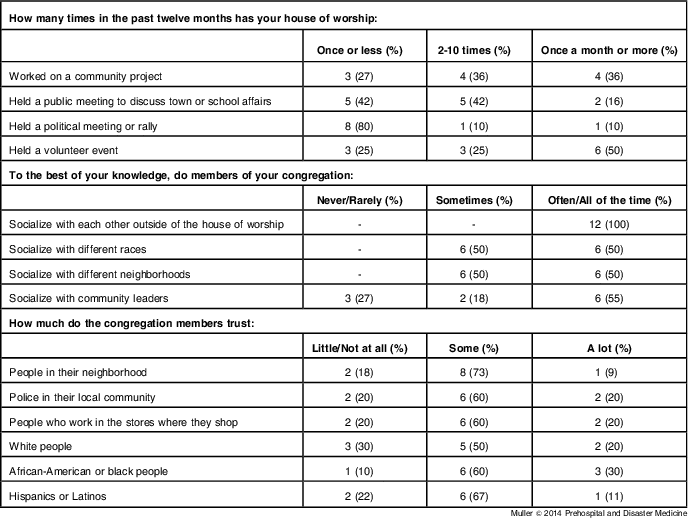
Interviews and surveys were conducted at six churches, one with a church leader and one with a staff member, for a total of 12 interviews and surveys. All congregations included in the present study were Baptist churches. Congregation members were primarily African-American. Most members had received some college education and were currently employed (Table 1). Results of the survey showed that all of the participating congregations often worked on some type of community project and held volunteering events (Table 2). Some of the congregations had held public meetings to discuss neighborhood or school affairs but most had not held political meetings or rallies. Most of the participants indicated that members of their congregation socialize with each other outside of the house of worship and with their community leaders. Approximately half of the members indicated that they do not often socialize with other races and other neighborhoods. Additionally, trust of other groups of people was generally low.
Demographic Information for Congregation Members

Frequency Distribution of Participant Answers to the Social Capital Survey

Interviews
The main findings of the interviews were provided in five sections: (1) perceived disaster preparedness and resiliency; (2) barriers to community preparedness and resiliency; (3) lessons learned from past disasters; (4) social services and networks; and (5) willingness to be prepared.
Perceived Disaster Preparedness and Resiliency
Participants reported that there was no disaster plan or mission statement in place at their congregations. A few participants noted that there had been some discussion about what to do in the event of a disaster, but no formal plan had been developed. Few participants also reported participating in disaster trainings, such as fire drills, at their places of employment. However, they had not completed any training or education at church or at home. They felt that members of their congregation and community were not prepared for a disaster; however, they strongly believed that their members and the community would come together to help each other and rebuild if a disaster were to occur. For example:
That's one thing about community, we are a family, we love one another and we're going to help you.
You know the congregation will come together and we'll get foodstuff or whatever and we put it together and do what we have to do.
I believe strength comes in conflict and usually when something happens people will come together. As far as officially labeled volunteers I think everyone at the church considers themselves a volunteer.
Barriers to Community Preparedness and Resiliency
Participants noted barriers that they faced while trying to prepare for disasters, such as lack of knowledge and resources, lack of finances, and low risk perception. For example:
You know what, to a certain degree, sometimes it's like out of sight, out of mind you know if people are not thinking about it and especially in regards to the economic struggles that a lot of people are dealing with. It's hard for some people just to make ends meet and then furthermore to kind of prepare for something that may not even come. So I think that's where the major barrier is; but I think that if we could make people aware of the possibility of it. You know, maybe that could be a way to get them sparked, you know spurred on doing it. But I think the major barrier is the level of uncertainty.
When we put together a punch list for what we thought our needs were we recognized that the cost factor was much more than what we knew and really it was about money issues that have not allowed us to move forward. We have a general plan, we have direction where we can actually move, I know which direction to go but it takes finance, it takes resources. So that's the big question so—I mean that's the big—if there was anything to hinder it that's what it would it would be.
There was also an expression of a connection between disasters and their faith. For example:
I think what we've been relying on is that we're not going to have one [disaster] and God's going to keep us safe.
We were in the middle of service and an earthquake happened. It was in a new facility too and we had just built it, we were in service and an earthquake happened. And we started shouting and praising God more.
Lessons Learned From Past Disasters
Participants identified several types of disasters that they experienced in the past, including the Northridge Earthquake in 1994, the Los Angeles riots in 1992, and a major flood at one of the churches. Participants felt that they were not prepared for these past disasters and learned some important lessons from their experience. For example:
Just to be prepared. Be prepared in regards to having the supplies. Having the supplies because-well when I was 12 that church was actually an old church and had been there for a long time so even growing up I don't recall where a first aid kit was, where anything was.
One of the things that I learned personally as a leader is that you can't put all your eggs in one basket, you have to have some exit plan. There has to be an exit plan, something that will carry you through in case of devastation.
I think the lesson learned from that is we can do it, we can do more, but it's not something that's just momentarily it's something that we have to continuously work at.
Social Services and Networks
Participants emphasized the desire “to position ourselves to be the church that the community goes to.” They discussed the social services, community development, and neighborhood organizing projects that they provide for their community. The services that were discussed include: daycare services, food services, clothing drives, marriage or family counseling, language classes, tutoring or education classes, volunteering opportunities with outside organizations, and joint worship with other churches and communities. For example:
[We want] to be able to provide that all the way across the table, not only to just this community but to be a model community for other communities, so if you don't have that service in your community then come on over here and we can guide you to-you know once we have our foundation set we can guide you and you can set that up in your community as well so.
There was a feeling among the FBOs of wanting to do more for their members and communities, such as providing more of these services regularly and more frequently. However, barriers such as lack of space and finances made it difficult to do so.
Participants also discussed the lack of agreements with other organizations, such as American Red Cross and local disaster organizations, which might be able to provide help in the event of a disaster. However, they strongly felt that their congregation, community members, and other churches would be willing to help each other.
Willingness To Be Prepared
Participants felt that their congregation and community members were not adequately prepared for disasters. However, they realized the importance of the church to its members and members of the communities and expressed willingness to put together a disaster plan in order to be a resource. For example:
…most people would want to go to the church, you know what I mean if something has happened, you know most people are going to go to the church because that's where they feel safe at so we would have to have that set up like that.
…we're trying to commit ourselves with as many resources as we can to at least be a resource for the community. And whatever we need to do we're ready to do it.
Participants seemed to have a good understanding of what their congregation and community members would need in the event of a disaster. They expressed a desire to provide such necessities as food, personal hygiene products, clothing, shelter, and medical assistance. For example:
Well because of the size of our campus or because of different buildings that we have on our campus, I would like emergency shelter and with the size of our kitchen maybe if possible if we needed it for food. And if need be, because I'm thinking, in this area I don't know how close the nearest hospital is or even medical clinic, so if the proper personnel were there to man it maybe even medical assistance if possible.
Discussion
The results of this study suggest a low level of disaster preparedness and resiliency among the FBOs, but all suggest the potential and willingness of FBOs to become a system with resources that can be harnessed before, during, and after disaster. The willingness of participants to be a resource for their communities was consistent with studies that suggested the potential for FBOs to promote health and well-being among both congregation and community members.Reference DeHaven, Hunter, Wilder, Walton and Berry 8 , Reference Ellison and Levin 22 , Reference Maton and Wells 23 The current study adds disaster preparedness and resiliency as a topic that also needs to be promoted among FBOs and the communities they serve. A similar study assessed perceptions of community- and faith-based organizations about partnering with local health departments for disasters.Reference Stajura, Glik, Eisenman, Prelip, Martel and Sammartinova 16 However, the current study assesses the perceptions of FBOs on their own preparedness and resiliency, as well as that of their members and community.
Participants felt that members of the congregation and community were not adequately prepared for a disaster. This is problematic as adequate preparedness could significantly reduce the negative consequences from disasters and ensure that people can care for themselves and their families following a disaster.Reference Paton, McClure and Bürgelt 2 Some of the barriers that were identified by participants included: lack of knowledge and resources, low risk perception, and lack of finances. A literature review on household emergency preparedness found that homeowners had sufficient knowledge of how to prepare for household emergency situations, but many did not feel fully prepared or had not completed some common preparedness measures,Reference Diekman, Kearney, O Neil and Mack 24 likely due to the same barriers faced by congregation and community members in this study. Participants of this study also recognized from previous disasters the importance of being prepared and having a plan. However the stated barriers hindered their ability to act on these lessons.
The catastrophic aftermath of Hurricanes Katrina and Rita presented a challenge of recovery and rebuilding along the Gulf Coast. Residents anxious to get back to their homes and businesses feel pressure to return to normalcy after a disaster.Reference Berke and Campanella 25 Studies have shown that well conceived and comprehensive plans prepared prior to a disaster have a positive influence on facilitating more robust mitigation practices and reduction in damage.Reference Olshansky and Kartez 26 - Reference Berke and Beatley 30 However, these studies also found that plans are frequently of low quality, or even nonexistent.
These recent disasters have brought attention to the need for disaster preparedness and resiliency; however, barriers, such as the ones identified by participants of this study, hinder the ability for these measures to be completed. This is a gap that can be filled by FBOs. FBOs are recognized as an important resource in the promotion and dissemination of heath initiatives for several reasons: they are often leading humanitarian organizations within the communities that they serve; they may be better able to reach populations at risk; they are often recognized as trusted agents for the communities that they serve; and they possess or have access to resources for the community (volunteers, a donor base, etc). 7 FBOs may serve as an important ally in raising awareness about disaster preparedness and resiliency.
A study conducted among survivors of the 2004 Asian tsunami found that survivors’ accounts emphasized the importance of extended supportive networks, religious faith and practices, and cultural traditions in facilitating recovery and sustaining emotional wellbeing.Reference Ekanayake, Prince, Sumathipala, Siribaddana and Morgan 17 This was a common goal expressed by participants in this study: to be an important resource for their community for preparation, response, recovery and sustaining well-being after a disaster. Studies have shown that social networks influence behavior among members of the network,Reference Valente, Fujimoto, Chou and Spruijt-Metz 31 , Reference Fujimoto and Valente 32 and perhaps this is how preparation and planning for disasters among these FBOs and their communities can be facilitated. The social services, community development, and neighborhood organizing projects that the FBOs provided for their community were important in establishing a network among the FBOs, their members, and the communities they serve. Additionally, volunteering opportunities at outside organizations and joint worship with other churches and communities also contribute to the social networks for these FBOs. Participants felt that the members of their social networks would contribute to their ability to prepare, respond, and recover from a disaster. Despite the barriers identified by the participants, they felt that congregation members, community members, other churches, and local businesses would come together to help each other in the event of a disaster.
The social capital survey showed that the congregations have participated in community projects and events and frequently socialize with each other and their community leaders. However, participants also reported they do not often socialize with members of other races and other neighborhoods. Additionally, trust of other communities was low among participants. Studies have demonstrated that neighborhoods with higher social capital have better health outcomes.Reference McCulloch 33 - Reference Veenstra, Luginaah, Wakefield, Birch, Eyles and Elliott 35 Social capital research on disaster preparedness and response has also demonstrated that social capital is a resource that should not be disregarded by disaster planners.Reference Aldrich 13 , Reference Aldrich 14 Thus, low levels of trust and relationships with communities outside of their own may be a hindrance to developing strong disaster networks for these congregations. These networks may be able to provide them with critical information and resources before, during, and after a disaster has occurred.
The social networks of these FBOs are also lacking in relationships with organizations that respond to disasters. Several studies have suggested that social networks among organizations that respond to disasters and community- and faith-based organizations can significantly improve disaster preparedness, response, and recovery in these communities.Reference Wineman, Braun, Barbera and Loeb 36 - Reference Kapucu 38 One study assessed the integration of health centers into community preparedness and found that the lack of community-based planning among health centers leaves these centers and the communities they serve vulnerable in the event of disaster.Reference Wineman, Braun, Barbera and Loeb 36 Another study demonstrated that pandemic flu exercises improve local health department relationships with the community partners who participated.Reference Paige, Jones and D'Ambrosio 37 Another study used a similar argument, pointing out how communities repeatedly exposed to the threat of hurricanes benefited from improved relationships among local government agencies and community- and faith-based organizations as a result of repeated and extensive planning.Reference Kapucu 38 Participants of the current study reported lessons that they learned from previous disasters, such as the importance of being prepared and having a plan. Relationships with disaster response organizations may be able to help these FBOs carry out these lessons in future disasters.
A study by DeHaven et alReference DeHaven, Hunter, Wilder, Walton and Berry 8 provided recommendations to improve the contributions of FBOs to the health of their communities. The three recommendations were: 1) increase collaboration between FBOs and health professionals for the evaluation of health activities and disseminating findings, 2) place more emphasis on interventions that are practical, and 3) devote more attention to building relationships with racially and ethnically diverse populations. The need for the application of these recommendations was also demonstrated by the current study. FBOs and their communities can greatly benefit from collaborations with health and disaster preparedness professionals. Additionally, proposed interventions should be able to eliminate or diminish barriers and take into consideration the practicality and appropriateness of the interventions for the populations of interest.
Limitations
The study authors recognize the limitation that is inherent to conducting qualitative research. The current study's population only reflects a convenience sample of South Los Angeles churches, in which their characteristics may be different than that of other locations. Therefore, the results cannot be generalized to other FBOs. Nonetheless, efforts should be made in other geographic locations to explore concerns unique to communities that may or may not align with these findings when addressing the needs of FBOs and disaster preparation and resiliency. Moreover, further research is warranted. The findings are formative to the development of a measure that can be validated and assess not only deficiencies in disaster preparedness, but also identify areas that are amenable to interventions, such as drafting disaster preparedness plans, disaster preparedness training, and expanding the disaster preparedness social network. These elements must be in place to enable faith-based organizations to effectively prepare for the impact of a disaster.
Conclusion
The face of disasters is changing. Growing urban populations, environmental degradation, poverty, and disease may create situations of chronic adversity following a disaster. New approaches are needed to improve people's resilience to disasters. Local adaptation strategies, culture, heritage, knowledge, and experiences are the building blocks for boosting disaster resilience.Reference Manyena 39 A shift from short-term relief to longer-term support for communities in danger is critical in enhancing community resilience.
Faith-based organizations have the potential to be an important resource for disaster preparedness and resiliency for the community, but the barriers they face hinder their ability to best serve their community in the event of a disaster. The results of this study suggest a low level of disaster preparedness and resiliency among these organizations. FBOs recognize that the community and congregation members will likely look to them for resources in the event of disaster and are willing to be such a resource. FBOs have been recognized as an attractive venue for health promotion activities because congregation members and the communities already have a connection and relationship with the FBO.Reference DeHaven, Hunter, Wilder, Walton and Berry 8 , Reference Campbell, Hudson, Resnicow, Blakeney, Paxton and Baskin 9 FBOs are also significant sources of social capital for their members and communities;Reference Putnam 11 thus, there is potential to utilize them for promoting and sustaining disaster preparedness and resiliency in their communities. Furthermore, FBO leaders can have significant impact on the knowledge, attitudes, beliefs, and behaviors of their congregations and communities. Understanding the perceptions of FBOs on their disaster preparedness and resilience is the first step in raising awareness and improving their ability to prepare, respond, and recover from disasters.