I. Introduction
French has long been considered to be a language in which wh-movement is optional in matrix wh-questions, allowing both fronted and in-situ wh-phrases. In a framework in which there is little space for optionality, as in the Minimalist Program (Chomsky Reference Chomsky1995), the idea of an optional wh-movement has been considered to be problematic. It has led researchers to intensify investigations of French in-situ and fronted wh-questions and to look for possible differences between the two types that would explain their co-occurrence in one and the same grammar. The present study concentrates on the ‘Spoken’ (de Cat Reference De Cat2007), ‘non-Standard’ (Lambrecht Reference Lambrecht1981) or ‘Demotic’ (Massot Reference Massot2003) dialect spoken in Paris and its extended area, Ile-de-France, namely ‘Francilian’ French (Zribi-Hertz Reference Zribi-Hertz2006).
The aim of the present paper is to show that in this dialect the difference between the two types of wh-questions does not lie in their answerhood conditions but in their information structure. Adopting Reinhart's (Reference Reinhart1995, Reference Reinhart2006) interface approach to stress and focus and, building upon Chang's (Reference Chang1997: ii) famous claim that in-situ wh-questions are felicitous in ‘strongly presupposed contexts’ (see also Coveney Reference Coveney1988, Reference Coveney1995), I will argue that in-situ and fronted wh-questions are distinct with respect to their focus-set. More precisely, my contention is that the difference between the two types of questions lies in the status of their non-wh portion with respect to discourse. On the one hand, in the case of in-situ wh-questions, only the wh-phrase is contained within the question's focus, hence its location in the position in which phonology assigns sentence stress in Francilian French, namely the right edge of an Intonational Phrase. On the other hand, in the case of fronted wh-questions, the non-wh portion is typically non-given and it consequently belongs to the focus of the question along with the wh-phrase, hence the location of the sentence stress within the non-wh portion.Footnote 2
From a formal perspective, I adopt Samek-Lodovici's (Reference Samek-Lodovici2005) Optimal Theory (OT) approach (Prince & Smolensky Reference Prince and Smolensky2004) to the interaction of prosody and syntax in the expression of focus. I propose that wh-questions provide evidence that, in Francilian French, the constraint that requires that a wh-phrase be fronted (OP-SPEC, Grimshaw Reference Grimshaw1997) is outranked by the constraint that requires that sentence stress be kept rightmost within the Intonational Phrase (HI, Truckenbrodt Reference Truckenbrodt1995), by the constraint that requires that focused items be stressed (stress–focus, Truckenbrodt Reference Truckenbrodt1995) and by the constraint that requires that discourse-given items do not carry stress (destress–given, Féry & Samek-Lodovici Reference Féry and Samek-Lodovici2006). The proposed hierarchy accounts for the fact that fronted wh-questions emerge whenever the satisfaction of stress–focus and destress–given does not create a conflict between syntax and prosody. Whenever the wh-phrase is the only non-given item in the clause, op-spec and hi make conflicting demands. In the present language, prosody gets the upper hand and the wh-phrase consequently stays in situ.
The paper is organized as follows. Section 2 introduces Francilian French, and concentrates on the semantic properties of in-situ and fronted wh-questions in this dialect. Section 3 concentrates on wh-questions information structure. It lays out the proposal, gives a brief outline of previous studies of focus in declaratives and introduces Reinhart's notion of focus-set. It also offers to capture the difference between the two types of wh-questions within OT. Section 4 closes the paper.
2. The semantics of different types of wh-questions in Francilian French
2.1 Francilian French
As previously discussed in the literature (among others, Côté Reference Côté1999, Reference Côté, Almgren, Barrena, Ezeizabarrena, Idiazabal and MacWhinney2001; Massot Reference Massot2003; Zribi-Hertz Reference Zribi-Hertz2006; de Cat Reference De Cat2007), there is considerable variation among the numerous dialects of French and the label ‘French’ often refers to a hybrid language not really spoken by any French speaker. In order to avoid this issue as well as unnecessary confusion, the present study focuses on one specific variety of French spoken in Paris and its suburbs: Francilian French. The present paper assumes the diglossic approach to French defended most notably by Massot (Reference Massot2003) and Zribi-Hertz (Reference Zribi-Hertz2006), according to which all French native speakers have (at least) two separate grammars of French whose intersection is non-empty. ‘Demotic’ French, is the language learned outside school, on ‘one's mother's lap’, on playgrounds and in sandboxes. It is spoken and written in casual/informal contexts. The more studied ‘Standard’ or ‘Late classical’ French is the variety of French taught at school and it is as close as possible to what prescriptive grammars advocate in its written as well as in its spoken form. Although the latter variety is not the one spoken in most average-people's every day life, all French speakers are still frequently exposed to it through different forms of read speech, for instance at school and in the media.
The dialect of French discussed here has much in common with some of the dialects previously discussed in the literature. For instance, Francilian French (henceforth FF) shares with Spoken Belgian French (de Cat Reference De Cat2007) the fact that nous ‘we’ is replaced by the otherwise third person singular pronoun on and that the first half of the negation ne is almost always omitted. It also exhibits a considerable use of left and right dislocation and a frequent use of ‘c'est XP qui/que YP’ (cleft sentences) or ‘(il) y a XP qui YP’ (presentational sentences). In addition, it shares with non-standard French (Lambrecht Reference Lambrecht1981) the property that it is characterized by a loss of Subject–Verb/Aux inversion. As a consequence, wh-questions exhibiting a Subject–Verb/Aux inversion will be left out of the present discussion, as they do not belong to the investigated dialect.
The label frontedwh-question here refers to constituent questions with an initial wh-phrase such as in the comment ‘how’ and combien de N ‘how much/many’ questions in (1) and (2). It also refers to fronted wh-questions in which the wh-phrase is followed by the ‘complex interrogative C0’ est-ce qu- (Rooryck Reference Rooryck1994).Footnote 3 Both types of question are illustrated below.
(1) Comment vous allez le montrer?how you go it show‘How are you going to show it?’
(2) Combien de temps ça dure?how.much of time it lasts‘How long does it take?’
(3) Qui est-ce qui se réveillait en premier?who is.it who SE woke.up in first‘Who use to be the first to wake up?’
(4) Qu'est-ce que tu fais?what.is.it that you do‘What are you doing?’
(5) Où est-ce que je peux l'acheter, ce livre?where is.it that I can buy this book‘Where can I buy this book?’
(6) Quand est-ce que vous pensez être vraiment libre?when is.it that you think to.be truly free‘When do you start thinking that you are really free?’
As emphasized by Rooryck, est-ce qu- is not to be analyzed as an intervening clause containing an inflected form of ‘be’, as est-ce qu- does not allow changes of tense. From a prosodic perspective, it is simply not possible to insert a prosodic boundary between ce and que without triggering a cleft interpretation with genuine Subject–Verb inversion. As was already mentioned above, Subject–Verb inversion – although possible in other dialects of French – is not part of the grammar of FF. In the present dialect's fronted wh-questions, the est-ce qu- complementizer is compulsory with the inanimate and animate direct object que/qui as well as the adjunct quand ‘when’. It is becoming obligatory with où ‘where’, as indicated by the limited distribution of bare où and its lack of productivity in basic/authentic requests for information. The subject wh-phrase qui without est-ce qui is possible but in contexts in which the speaker is calling for candidates, such as in the example in (7). This type of call for candidates questions will be excluded from the present discussion.
(7)
A: Qui veut effacer le tableau?who wants to.erase the blackboard‘Who wants to erase the blackboard?’
B: Moi (je veux l'effacer).me I want it.to.erase‘I (want to erase it).’
The label in-situwh-questions is here used to refer to wh-questions of the type illustrated below, in which the wh-phrase is not clause-initial.Footnote 4 I purposely avoid to define an in-situ wh-question as a question in which the wh-phrase simply remains in the corresponding argument/adjunct canonical position. As will be made clear in Section 3, for an in-situ wh-question to be well formed in the present dialect, the wh-phrase needs to be rightmost in its syntactic clause/Intonational Phrase or, in other words, clause-final. Only the items that cannot be right-dislocated can separate it from the right edge of the Intonational Phrase.
(8) Vos parents ils faisaient quoi?your parents they did what‘What did your parents do?’
(9) Vous étiez habillé comment?you were dressed how‘What were you wearing?’
(10) Vous avez combien d'enfants?you have how.many of.children‘How many children do you have?’
(11) Vous êtes de quel pays?you are of which country‘Which country do you come from?’
From a syntactic perspective, what is crucial here is that on the surface the wh-phrase is not located in a specifier position that c-commands the extended projection of the verb (IP/TP) – possible empty or inaudible syntactic elements as well as possible covert movements play no role in the present account.
The analysis of wh-questions presented in Section 3 is based on my own intuitions as a native speaker of FF as well as the intuitions of my informants. It is currently being checked on a corpus of approximately 30 hours (close to 200 questions) of field interviews from a French daily radio show, Là-bas si j'y suis (France Inter channel). All the interviews are led by the same female reporter who consistently uses (non-media and non-read) spontaneous Demotic French. I will provide some examples taken from this corpus when necessary and I will call it the Là-bas corpus.
The remainder of this section aims at clarifying which of the interpretive properties that have been previously reported to hold for in-situ or fronted wh-questions in other dialects apply in FF.
2.2 Wh-questions in Francilian French and presupposition
As briefly discussed above, when it comes to wh-questions, French allows both wh-movement, as in (12a) and wh-in-situ, as in (12b).
(12)
(a) Qu'est-ce que tu vas lui offrir?what.is.this that you will her offer‘What are you going to offer her?’
(b) Tu vas lui offrir quoi?you will her offer what‘What are you going to offer her?’
Aoun, Hornstein & Sportiche (Reference Aoun, Hornstein and Sportiche1981) and Lasnik & Saito (Reference Lasnik and Saito1992) account for the apparent optionality of French wh-movement by suggesting that French has a ‘mixed’ system with regard to the formation of wh-interrogatives. On the one hand, it is like English in that wh-phrases raise to the left periphery of the clause; on the other hand, it is like Chinese in that wh-phrases remain in situ. Building upon the claim of Chang (Reference Chang1997: 45), that in-situ wh-questions seek ‘details on an already established (or presupposed) situation’, several analyses have been developed over the years concluding that the two versions of the wh-question are not in fact equivalent semantically, in that they do not have the same answerhood conditions. Boeckx (Reference Boeckx1999), for instance, reports that in the dialect of French on which his study is based, in-situ constituent questions are comparable to cleft questions in that ‘Nothing’ constitutes a felicitous answer to question (13) and is not a felicitous answer to the questions in (14) and (15) (# indicates infelicity).
(13)
A: Qu'est-ce que t(u) as acheté?what.is.it that you have bought‘What did you buy?’
B: Un livre/une voiture/rien.a book/a car/nothing‘A book/A car/Nothing.’
(14)
A: T(u) as acheté quoi?you have bought what‘What did you buy?’
B: Un livre/une voiture/#rien.a book/a car/nothing‘A book/A car/#Nothing.’
(15)
A: C'est quoi que t(u) as acheté?it.is what that you have bought‘What is it that you bought?’
B: Un livre/une voiture/#rien.a book/a car/nothing‘A book/A car/#Nothing.’
This claim has since been challenged (see, among others, Mathieu Reference Mathieu2004), suggesting that not all dialects of French make a difference between questions (13) and (14) in terms of presupposition in the sense of Boeckx (Reference Boeckx1999) and for which the possibility/impossibility to answer by ‘Nothing’ is taken to be a test. In FF, there is no presuppositional difference between (13) and (14), that is, both types of questions can be felicitously answered by ‘Nothing’. In both cases the speaker does assume that the addressee has bought something, otherwise he/she would probably not ask the question.Footnote 5, Footnote 6 The questions in (13) and (14) being genuine requests for information, the speaker cannot know in advance whether he is right about what the addressee did and whether the addressee actually bought something or not. Imagine, for instance, that the addressee mentions that she is back from the grocery store. Any naturally curious individual could directly ask her what she bought without previously making sure that she has indeed bought something by first asking a yes/no question such as ‘Did you buy something?’. However, different types of events could have precluded her from buying anything, such as the store's employees being on strike, the store being closed, the loss of her purse, etc., hence the fact that both types of questions can be answered by a negative answer of the ‘Nothing’ type. In order to account for this fact, I propose that the questions in (13) and (14) ask ‘for the set of individuals such that you bought them’ (or ‘Which set is the extension of the property of having been bought by you?’). In this case, replying by ‘Nothing’ simply amounts to saying that the set of individuals is empty – most probably against the expectations of the person who is asking the question, be it a fronted or an in-situ wh-question.
By way of illustration, consider the discourse fragments from the Là-bas corpus in (16). It is extracted from a discussion between the reporter (R) and one of her interviewees (M), a man belonging to the Roma community, whose father was born in Macedonia and used to live in Italy before coming to France. The man was himself born in Italy and now lives in the South of France.Footnote 7
(16)
R: et vous, votre père, il faisait quoi?
M: lui il travaillait au black au noir parce qu'il possède pas de papiers il a travaillé la ferraille, voitures d'occasion ces choses là. Moi aussi je travaillais en Italie je faisais mes travail comme toujours comme je travaille avec mon père.
R: et vous avez quoi comme papiers alors?
M: zéro, je suis en train de faire [inaudible].
R: vous êtes en train de faire les papiers pour l'apatride?
M: oui j'ai jamais demandé les papiers. Rom sans papiers.Footnote 8
Here, the topic of the discussion is the man's father and his occupation. The reporter first asks the man what his father used to do for a living (‘votre père, il faisait quoi?’). The man replies that his father used to be a moonlighter as he had no ID card (‘il possède pas de papiers’). The man mentions that he used to work with his father, after which the reporter asks him what kind of ID card he has (‘et vous avez quoi comme papiers alors?’). His answer is that he has none (‘zéro’), that he is now doing the paperwork in order to obtain a legal status as a stateless person (‘apatride’) and that before that, he had never undergone the administrative procedures in order to obtain an ID card (‘j'ai jamais demandé les papiers’).
In this context, it is not semantically odd to substitute a fronted wh-question for the in-situ one, as illustrated in (17). However, as is shown in (18), one cannot substitute the in-situ wh-question with a wh-cleft question of the type illustrated in (15)A.
(17) Qu'est-ce que vous avez comme papiers?what.is.it that you have as papers‘What kind of identity papers do you have?’
(18) #C'est quoi que vous avez comme papiers? it.is what that you have as papers‘What (kind) are the papers that you have?’
The question in (18) is semantically appropriate in a context where the speaker already knows that the addressee has some kind of ID card and wants the addressee to specify what kind. Such a context is provided in (19), where B says that she has some of her papers with her and wants to know if they are the right ones for A to give her some administrative authorization.
(19) A: Je dois voir vos papiers d'identité pour vous donner ce permis.
B: J'ai certains de mes papiers sur moi, est-ce que ça va suffire?
A: Ca dépend. C'est quoi que vous avez comme papiers?Footnote 9
The impossibility to answer a question such as the one in (15)A or the one in (19) by ‘Nothing’ comes from the fact that a cleft sentence, be it an interrogative or a declarative, contains a discontinuous definite description the form of the demonstrative-like pronoun and the relative-like clause (see Clech-Darbon, Rebuschi & Rialland Reference Clech-Darbon, Rebuschi, Rialland, Rebuschi and Tuller1999 for a detailed account based on French and see Hedberg Reference Hedberg2000 on English). Informally, the question in (15) amounts to inquiring about the value of ‘x such that x is the individual such that you bought it/them’ and (19) about the value of ‘x such that x is the identity paper(s) that is such that the addressee has x with her’,Footnote 10 hence its ‘specificational nature’. Such questions do not allow for an answer such as ‘Nothing’ because replying to (15)A by ‘Nothing’ leads to a contradiction. It amounts to saying that ‘the individual x such that you bought x equates to nothing’ or ‘the identity papers such that the addressee has them with her are nothing’. So in FF, the semantics of wh-cleft questions generally prevents them from having the same distribution as fronted and in-situ wh-questions.Footnote 11 Information structure aside, what is worth noting is that the contexts that semantically license wh-cleft questions include the ones licensing both in-situ and fronted wh-questions – but not the opposite, as witnessed by the fact that an in-situ or a fronted wh-question can ‘replace’ a wh-cleft question but a wh-cleft question cannot ‘replace’ an in-situ or a fronted wh-question.
2.3 Francilian French wh-questions and exhaustivity
Another semantic difference between in-situ and fronted wh-questions that has been reported is in terms of exhaustivity. Zubizarreta (Reference Zubizarreta, Nuñes Cedeño, López and Camero2003), for instance, claims that whereas a fronted question can receive a non-exhaustive answer, its in-situ version cannot. This is also an argument in favor of a unified analysis for wh-cleft and in-situ questions (for a detailed account, see Boeckx Reference Boeckx1999). Whether or not wh-phrases can be modified by par exemple ‘for instance’ is taken to be a test for this exhaustivity requirement. This is illustrated in the following examples adapted from Zubizarreta.
(20)
(a) Qu'est-ce que tu lui as acheté par exemple?what.is.it that you him have bought for instance‘What did you buy him for instance?’
(b) #Tu lui as acheté quoi par exemple? you him have bought what for instance‘What did you buy him for instance?’
(c) #C'est quoi que tu lui as acheté par exemple? it.is what that you him have bought for instance‘What is it that you bought him for instance?’
Again, this feature of the in-situ constituent question is not shared by all dialects of French, as the question in (20b) is well-formed in FF. The dialogue in (21) with a wh-phrase in-situ modified by par exemple comes from the Là-bas corpus. The reporter (R) spends the day with her two interviewees, a woman (W) and a man (M) in their sixties. The topic of the interview is ‘on the way to school’. They all walk to the man and woman's primary school while the reporter inquires about what used to happen on their way to school. When they finally stand in front of the school's playground, the following dialogue takes place.
(21)
R: et vous, vous jouez à quoi par exemple? Dans la cour, puisque là on est devant la cour et que c'est la récréation, vous jouez à quoi?
W: à la marelle
M: ah ba les filles elles jouaient à la marelle
W: et au mouchoir
M: et on jouait aux billes. Moi j'ai connu même le jeu avant avant les billes: les boutons …Footnote 12
Here the reporter asks the woman and the man to give her examples of the games they used to play (‘vous jouez à quoi par exemple?’) and the interviewees name a few – hopscotch (‘à la marelle’), marbles (‘aux billes’), etc.
As mentioned above, fronted and in-situ wh-questions have in common that they ask for the identification of a set of individuals. Modifying the wh-phrase with par exemple explicitly tells the addressee that a partial answer is sufficient, that giving some of the individuals is enough or, in other words, that a representative subset of the set asked for will ‘do the job’. The in-situ wh-question appearing in (21) cannot be replaced by a wh-cleft question as is shown by the following:
(22) *C'est à quoi par exemple que vous jouez? it.is at what by example that you play‘What games do you play for instance?’
Considering the wh-cleft question's semantics indicated above, any answer to this type of constituent question is exhaustive due to the presence of the definite description which, by definition, is exhaustive. Lifting the exhaustivity is, hence, not an available option.
2.4 Summary of Section 2
To sum up this section, so far it has been shown that Francilian French speakers have far less freedom in forming their wh-questions than what has sometimes been reported in the literature on other French dialects. First, they make no use of Subject–Verb/Auxiliary inversion and, secondly, the presence of the interrogative particle est-ce qu- is compulsory for a subset of wh-phrases – the monosyllabic ones.
An analysis like the one proposed by Boeckx (Reference Boeckx1999) or the one assumed by Zubizarreta (Reference Zubizarreta, Nuñes Cedeño, López and Camero2003), in which in-situ questions are analyzed as covert cleft sentences does not hold for FF, as in this dialect in-situ wh-questions do not pattern like wh-cleft questions in terms of presupposition and exhaustivity. Wh-cleft questions, unlike in-situ and fronted wh-questions, contain a definite description and ask for it to be equated with an individual (which can be inanimate or plural, à laLink Reference Link, Bäuerle, Schwarze and Stechow1983). This characterization has enabled us to account for the fact that this type of constituent question can neither be answered by a negative word such as ‘Nothing’ nor be modified by ‘for instance’.
Contrary to what has been reported for other dialects of French, it has been argued that replying to an in-situ wh-question by a negative answer such as rien ‘nothing’ can be felicitous because it simply means that the set of individuals asked for turns out to be empty. The speaker can also specify that he will be satisfied with a partial answer by modifying the wh-phrase in situ with ‘for instance’. In-situ wh-questions are thus similar to fronted wh-questions in terms of presupposition and exhaustivity. I have proposed that in FF the two types of questions ask for the identification of a set of individuals. The main argument in favor of a unified semantic analysis of in-situ and fronted wh-questions is that, so far, any congruent answer to one type of wh-question constitutes a congruent answer to the other type.
Now that it has been shown that in Francilian French the difference between in-situ and fronted wh-questions does not lie in their answerhood conditions, let us turn to what distinguishes the two types of wh-questions and explains their co-occurrence in one and the same grammar: their respective focus-set.
3. A closer look at wh-questions' information structure
3.1 Wh-questions, focus and givenness
It has often been claimed in the literature on wh-questions that wh-phrases are like focused phrases in that they constitute the non-presupposed part of the sentence (among others, Zubizarreta Reference Zubizarreta1998) or that they introduce a set of alternatives (Rooth Reference Rooth1992, Beck Reference Beck2006, Krifka Reference Krifka, Féry, Fanselow and Krifka2007). In his recent work on intervention effects in Japanese wh-questions, Tomioka (Reference Tomioka2007: 1575) considers it to be a ‘relatively uncontroversial assumption’, that ‘the non-wh portion of a question is discourse-old (in the sense of Prince Reference Prince and Cole1981) or given (in the sense of Schwarzschild Reference Schwarzschild1999), whereas the Wh-element acts as the sentence focus’. In relation to the claim that the wh-phrase is the question's focus, wh-phrases and focused constituents have often been argued to occupy the same syntactic focus position (among others, É. Kiss 1981 for Hungarian, Ortiz de Urbina 1989 for Basque, Jayaseelan Reference Jayaseelan2001 for Malayalam). However, what has often been considered as puzzling is that, in languages like English, the wh-phrase tends not to attract main prosodic prominence, contrary to focused items in declarative sentences (among others, Ladd Reference Ladd1996, Zubizarreta Reference Zubizarreta1998, Mycock Reference Mycock, Butt and King2005).
In the present study, it is assumed that wh-phrases are inherently focused, in the sense that alternatives play a role in their interpretation. While an important part of the literature concentrates on the syntactic/morphological, semantic, discourse or prosodic properties of the wh-phrase itself (among others, Pesetsky Reference Pesetsky, Reuland and Meulen1987; Mathieu Reference Mathieu2004; Baunaz Reference Baunaz2005, Reference Baunaz2008), I depart from this view by concentrating on the remaining part of the wh-question, namely on the non-wh part of the sentence.
My proposal is the following: the principles of information structure and prosody that apply in declaratives and discussed in a number of recent studies of focus (Reinhart Reference Reinhart1995; Szendrői Reference Szendrői2001, Reference Szendrői2003; Samek-Lodovici Reference Samek-Lodovici2005; Féry & Samek-Lodovici Reference Féry and Samek-Lodovici2006; Reinhart Reference Reinhart2006) also apply to constituent questions. Although it seems quite obvious that the reverse, namely that constituent questions function differently from declaratives, would be surprising, this claim has not been much explored (however, for a similar claim in a different framework, see Lambrecht & Michaelis Reference Lambrecht and Michaelis1998). I claim that the difference between in-situ and fronted wh-questions lies in the discourse status of the non-wh portion of the sentence and as a consequence on the content of the question's focus-set: in-situ wh-questions are possible only if their non-wh portion contains no information which is presented as discourse-new. This claim is thus along the lines of Engdahl's (Reference Engdahl, Bonami and Cabredo-Hofherr2006: 93) proposal, namely that ‘different contexts require different realizations of questions’. It is also close to Chang's (Reference Chang1997: ii) original claim except that – in order to avoid confusion – it has no relation to the standard notion of presupposition put forward in subsequent works related to French dialects distinct from FF, discussed in Section 2.
The difference between the two types of wh-questions can be captured within the OT framework (Prince & Smolensky Reference Prince and Smolensky2004), through the interplay of syntactic, prosodic and information structural constraints, in the spirit of analyses that have recently been proposed for focus in Italian or English declaratives (Szendrői Reference Szendrői2001, Samek-Lodovici Reference Samek-Lodovici2005, Féry & Samek-Lodovici Reference Féry and Samek-Lodovici2006). The next section gives a brief outline of Samek-Lodovici's analysis and introduces Reinhart's notion of focus-set as well as some of the syntactic, prosodic and information structural constraints that will be used in Section 3.2.
3.2 Focusing strategies in declaratives: an OT approach
French has in common with English and Italian that it is an SVO language in which sentence stress can be said to be ‘neutrally’ assigned to the right edge of the clause. This is illustrated in the following all-focus examples in which sentence stress is indicated in full capitals.
(23)
A: What happened?
B: My sister brought the FLOWERS. (English)
B: Mia sorella ha portato i FIORI. (Italian)
B: Ma soeur a apporté les FLEURS. (French)
It has long been claimed that the focus interpretation of a sentence is crucially related to the location of sentence stress (among others, Jackendoff Reference Jackendoff1972). The requirement that focus bear main stress within a certain (prosodic or semantic) domain has been expressed in many ways. For instance, Reinhart (Reference Reinhart1995, Reference Reinhart2006) proposes the following Focus Rule (also called Stress–Focus Correspondence Principle, Szendrői Reference Szendrői2001, Reference Szendrői2003).
(24) Focus Rule or Stress–Focus Correspondence Principle
The focus of a clause is a(ny) constituent containing the main stress of the Intonational Phrase, as determined by the stress-rule.
Through this Focus Rule, Reinhart captures the fact that in the languages mentioned above, a sentence with rightmost main stress is ambiguous and can be associated with different focus interpretations. This is illustrated in the following question–answer pairs, in which the sentence (23)B can be a felicitous answer to three different questions.
(25)
A: What happened?
B: My sister brought the FLOWERS. Focus: TP
(26)
A: What did your sister do?
B: My sister brought the FLOWERS. Focus: VP
(27)
A: What did your sister bring?
B: My sister brought the FLOWERS. Focus: DPobject
In sentences (25)B and (26)B the focus is projected from the item carrying main stress, flowers, to the entire TP and the entire VP, respectively. Reinhart proposes to call the set of all potential foci of a sentence its focus-set. The above sentence's focus-set appears below.
(28)
(a) My sister brought the FLOWERS.
(b) Focus-set: {IP, VP, DPobject}
With sentence stress on its right edge, this sentence cannot, however, be interpreted as having the DPsubject in its focus-set or, in other words, it cannot be interpreted as having narrow focus on its subject. The fact that sentence (28a) is infelicitous as an answer to a subject constituent question is illustrated in the following question–answer pair.
(29)
A: Who brought the flowers?
B: #My sister brought the FLOWERS.
There are actually two aspects that make (29)B inappropriate in this context: first the subject is not among the constituents that carry main stress and, secondly, an item which is discourse-given, flowers, is assigned prosodic prominence. The issue of givenness is further discussed in Section 3.3.
The inappropriateness of a sentence such as (29)B as an answer to a subject wh-question also applies in Italian and in French. However, the three languages vary in the way they actually express narrow focus on the subject (for a detailed account, see Samek-Lodovici Reference Samek-Lodovici2005). In order to express narrow focus on the subject, English gives priority to syntax in keeping its canonical SVO order and shifting sentence stress to the DPsubject. This is illustrated in the following example:
(30)
A: Who brought the flowers?
B: My SISTER brought the flowers./My SISTER did.
It is worth mentioning that considering Reinhart's Focus Rule stated in (24) the above sentence with sentence stress on the preverbal subject has both the DPsubject and the whole TP My sister brought the flowers within its focus-set. However, in Reinhart's approach, shifting main stress to the left edge of the clause is a ‘costly operation’, as it amounts to an alteration of the neutral pattern. Since TP is in the focus-set of the candidate with rightmost main stress, a sentence like the first one in (30)B with a broad focus interpretation is simply non-economical and does not emerge as an actual product of the grammar of English.
Italian gives priority to prosody in keeping rightward sentence stress and locating the focused subject in clause-final position, right before the clitic right-dislocated object.
(31)
A: Who brought the flowers?
B: Le ha portato mia SORELLA, i fiori.them has brought my sister the flowers‘My SISTER brought them.’
As for FF, it resorts to an (often reduced) cleft sentence, such as in (32)B.
(32)
A: Who brought the flowers?
B: C'est ma SOEUR (qui les a apportées).it.is my sister that.subj them has brought‘My SISTER brought them.’
Samek-Lodovici (Reference Samek-Lodovici2005) proposes that the strategy adopted by each of the languages mentioned above reflects the way the following stress–focus constraint – which is in effect similar to Reinhart's Focus Rule – interacts with the alignment constraints in (34) and (35) as well as with the syntactic constraints in (36) and (37).
(33) stress–focus
For any XPF and YP in the focus domain of XPF [=the entire clause], XPF is prosodically more prominent than YP.
Samek-Lodovici's stress–focus constraint directly penalizes candidates that locate sentence stress outside the focus of the clause. According to him, stress–focus interacts with prosody in order to determine the location of main stress.
The following alignment constraints (see McCarthy & Prince Reference McCarthy and Prince1993, Truckenbrodt Reference Truckenbrodt1995, Samek-Lodovici Reference Samek-Lodovici2005) govern the position of heads (stress) in prosodic phrases and push sentence stress toward the right edge of the clause:Footnote 13
(34) Head-P (hp): Align (P, R, Head(P), R)
Align the right boundary of every Phonological Phrase with its head.
(35) Head-I (hi): Align (I, R, Head(I), R)
Align the right boundary of every Intonational Phrase with its head.
Following previous accounts of the syntax–phonology interface, it is assumed that prosodic domains correspond to syntactic phrases: lexical XPs are parsed into phonological phrases, and clauses (here CPs) into Intonational Phrases (among others, Downing Reference Downing1970, Pierrehumbert Reference Pierrehumbert1980, Selkirk Reference Selkirk1984, Truckenbrodt Reference Truckenbrodt2005).Footnote 14
The syntactic constraint stay (Grimshaw Reference Grimshaw1997) is in the same spirit as Chomsky's (Reference Chomsky and Freidin1991, 1992, 1995) economy of movement and is violated by each trace (or copy).
(36) stay: No traces.
epp is equivalent to Grimshaw's (Reference Grimshaw1997) subject constraint and equals to Chomsky's Extended Projection Principle.
(37) epp: Clauses have subjects.
Samek-Lodovici (Reference Samek-Lodovici2005: 698) follows Grimshaw (Reference Grimshaw1997) in assuming that this constraint requires that ‘the highest A-specifier – or the specifier of I-related heads such as T0, Agr0, Neg0 – be overtly filled’. As for English and Italian focusing strategies, he proposes the ranking of constraints in (38) and (39).
(38) English
stress–focus, epp ≫stay ≫hp ≫hi
(39) Italian
stress–focus ≫hi ≫hp ≫epp ≫stay
In the OT approach adopted here, a candidate such as (30)B – a canonical sentence which shows sentence stress on the subject – is in competition with the candidate in (25)B – a canonical sentence with rightmost sentence stress – as a potential reply to a question such as ‘What happened?’. Candidate (30)B does not emerge in this context because in addition to satisfying stress–focus, stay and epp, candidate (25)B better satisfies hi and wins the competition.
In order to account for Francilian French – which is not the dialect of French discussed in Samek-Lodovici – Hamlaoui (Reference Hamlaoui2008) proposes that in this language epp and hi are unranked. In this approach, clefting enables satisfying the stress–focus requirement while keeping main stress to the right edge of an Intonational Phrase (corresponding to the matrix clause) as well as having an overtly realized preverbal subject in both clauses in the form of the demonstrative-like pronoun c' in the matrix clause and the suffixed -i in the relative-like clause.
Whether a subject can or cannot be focused in its preverbal subject position in French, such as in (40) from Delais-Roussarie (Reference Delais-Roussarie2005), is a controversial issue.
(40)
A: Who made the tart?
B: JEAN-FRANCOIS a fait la tarte.Jean-François has done the tart‘[Jean-François]focus baked the tart.’
While some studies dealing with French focusing strategies systematically use constructed example sentences in which subjects are focused in situ (among others, Beyssade et al. Reference Beyssade, Delais-Roussarie, Doetjes, Marandin, Rialland, Corblin and de Swart2004, Delais-Roussarie Reference Delais-Roussarie2005), others mention them as being controversially accepted (Samek-Lodovici Reference Samek-Lodovici2005) or absolutely ill-formed (Lambrecht Reference Lambrecht2001, Hamlaoui Reference Hamlaoui2008). The fact is that if in-situ subject focusing is well-formed in French, it is only well-formed in Standard French and not in Francilian French. The example in (41), from Delais-Roussarie (Reference Delais-Roussarie2005: 59), is also an illustration of some data which is not part of the intersection between Standard and Demotic French; it only belongs to Standard French.Footnote 15
(41)
A: How many novels did he write?
B: Il a écrit dix-SEPT romans.he has written seventeen novels‘He wrote [seventeen]focus novels.’
In FF, the following structure, with rightmost main stress at the Intonational Phrase level, is favored.
(42)
A: How many novels did he write?
B: Il en a écrit dix-SEPT, (de romans).he of.them has written seventeen of novels‘He wrote [seventeen]focus novels.’
To summarize so far, it has been shown that what FF has in common with better studied languages like Italian and English is that it is an SVO language that neutrally assigns sentence stress rightmost. We have laid out the fact that these three languages vary in the way syntax and prosody interact in order to express focus and that this is particularly visible in the expression of narrow focus on the subject. On the one hand, what FF has in common with English is that it strongly requires an overtly realized preverbal subject in every clause. The two languages, however, differ in that the ranking of hi does not preclude sentence stress from appearing leftmost in English whereas it does in FF. On the other hand, FF shares with Italian a strong requirement on sentence stress to be kept rightmost but it differs from it in that Italian simply locates the focused subject rightmost whereas French needs to resort to a more complex (bi-clausal) structure in order to achieve this goal. Finally, I have proposed that the controversy related to the possibility of focusing a subject in its preverbal position in French is related to the fact that in-situ subject focusing is not part of the intersection between Standard French and Demotic (Francilian) French. It only belongs to Standard French, which in this respect is similar to English in its low ranking of hi.
At least in the case of French and English, I believe that the key to a better understanding of the syntax and prosody of wh-questions is found in the expression of focus in declaratives. The subsequent section turns to wh-questions and how their realization is also determined by the interaction of the constraints that have been introduced.
3.3 An OT approach to focus and givenness in Francilian French and English wh-questions
Fronted wh-questions, in English as well as in French, typically exhibit a rightmost primary stress and a secondary stress on the wh-phrase (Ladd Reference Ladd1996). Although the wh-phrase is often considered to be the focus of the wh-question, in these languages' fronted wh-questions, the non-wh portion is generally neither deaccented nor dephrased as is typically the case for post-focal items.
In the case of English, Engdahl (Reference Engdahl, Bonami and Cabredo-Hofherr2006: 101) observes that although fronted wh-phrases tend not to carry main stress, they sometimes do. By way of illustration, consider the following dialogue taken from Engdahl's paper, in which A, B and C have been discussing a possible trip to Edinburgh and B and C are side-tracked.
(43) A: So WHEN are we going to Edinburgh?
A1: #So, when are we going to EDINBURGH?
Engdahl's (Reference Engdahl, Bonami and Cabredo-Hofherr2006: 101) observation is that ‘speakers may modify questions in subtle ways to make them fit in with the current stage of conversation’. This is the case in (43)A, in which ‘by stressing the initial when’, the speaker ‘conveys that the issue she is introducing is one that has already been raised in the conversation, but not been resolved’ (Engdahl, ibid.). What indicates that the introduced issue has already been raised is, in my view, not the stressing of the wh-phrase, but the deaccenting of the non-wh portion, which is responsible for the main stress ending up on the wh-phrase. The deaccenting of these items indicates that the non-wh portion is outside the sentence's focus – in other words, that it is given. In the present study, any item that was mentioned in the immediately preceding context (Krifka Reference Krifka, Féry, Fanselow and Krifka2007), as well as any conversational implicature to what has been mentioned (Tancredi Reference Tancredi1992) is considered as given.Footnote 16 As all the other items of the question are given, in (43)A the wh-phrase ends up being the narrow focus of the clause.Footnote 17 As for the question in (43)A1, it is felicitous in a conversational context in which ‘we are going to Edinburgh’ has not yet been raised in the conversation or, within Tancredi's (Reference Tancredi1992) approach to discourse-felicity, the focus-related topic ‘we are going to Edinburgh’ is not instantiated/has not recently been added to the context/is not ‘taken to be “active” in the mind of the discourse participants’ by the speaker. Such context is provided below. A and B are now in Balloch (Scotland) and are discussing their coming days' excursions. Before coming to Scotland, they had planned to visit many cities, including Edinburgh.
(44)
A: I suggest that we stay here at Loch Lomond for a few days.
B: So when are we going to EDINBURGH?
The question in (44)B is very much like the broad focus/all-focus in (23)B: sentence primary stress appears rightmost because the whole CP is the focus.
As was discussed in Section 3, FF exhibits a strong requirement on main stress to be kept rightmost at the Intonational Phrase level. The option of assigning main stress to the leftmost item is marked in this language, in the sense that it is only available as a last-resort strategy, if no other structure is available that satisfies the same semantic, syntactic and information structural requirements while at the same time satisfying hi by keeping main stress rightward.
French in-situ wh-questions are similar to the type of fronted wh-question in (43)A in which main stress is not located on an item within the non-wh portion but on the wh-phrase. In-situ wh-questions are felicitous in contexts where the non-wh portion is given. This is illustrated in the following dialogues, where the wh-question is a reply to a yes/no question containing the non-wh portion of the subsequent question:
(45)
A: I faudrait que j'm'achète une couette.expl should that I.to.myself.buy a duvet‘I should buy myself a duvet.’
B: Tu sais où j'l'ai achetée moi ma couette?you know where I.it.have bought me my duvet‘Do you know where I bought mine?’
C: Non, tu l'as achetée où?no you it.have bought where‘Where did you buy it?’
D: #Non, où est-ce que tu l'as achetée? no where is.it that you it.have bought‘Where did you buy it?’
(46)
A: Tu sais qui il a vu ce matin?you know who he has seen this morning‘Do you know who he saw this morning?’
B: Non, il a vu qui?no he has seen who‘Who did he see?’
C: #Non, qui est-ce qu'il a vu? no who is.it that.he has seen‘Who did he see?’
(47)
A: Tu sais comment il a fait ça?you know how he has done that
B: Non, il a fait ça comment?no he has done that how‘How did he do that?’
C: #Non, comment il a fait ça? no how he has done that‘How did he do that?’
A fronted wh-question with rightmost main stress – as it is associated with a all-focus reading – is not completely impossible in these contexts, as it expresses the same informational need as an in-situ wh-question and it correctly includes the wh-phrase in the focus of the clause. However the in-situ wh-question is more appropriate in the sense that it is less redundant as it does not assign stress to a given item. The reverse is true for in-situ wh-questions: they are less appropriate than their fronted counterparts in contexts in which the non-wh portion is not given information. Consider again example (21), from the Là-bas corpus, repeated here for convenience.
(48)
R: et vous, vous jouez à quoi par exemple? [pause: 372ms] Dans la cour, puisque là on est devant la cour et que c'est la récréation, vous jouez à quoi?
W: à la marelle
M: ah ba les filles elles jouaient à la marelle
W: et au mouchoir
M: et on jouait aux billes. Moi j'ai connu même le jeu avant avant les billes: les boutons…Footnote 18
R, W and M are standing in front of the school's playground during a break. M is explaining that this school is the one where girls used to go and that when he went there, he was already a teenager. By asking them what games they used to play (‘et vous, vous jouez à quoi par exemple?’), the reporter changes the topic of conversation and introduces a new one. This change of topic is here felt to be abrupt, as indicated by the silent pause of 372 ms that follows the question and the fact that the reporter has to make explicit why she is bringing up that topic: because they are standing in front of the playground and that the pupils are having their break and playing (‘Dans la cour, puisque là on est devant la cour et que c'est la récréation’). To her, but obviously not to her hearers, what she is referring to in the non-wh portion of her question is situationally given. I take this to explain why she uses an in-situ wh-question instead of a fronted one in this context.
Another context in which wh-phrases naturally occur in situ is with contrastively topicalized items. In Francilian French, contrastively topicalized items are typically left-dislocated and realized within a separate prosodic constituent. They typically exhibit an important lengthening as well as an F0 rise and they are almost inevitably followed by a pause (for a detailed prosodic account, see de Cat Reference De Cat2007). What is crucial in the two dialogues in (49) and (50) is that the wh-question's predicate is given/instantiated in the utterance's context.
(49)
A: Dorothée et moi on va pas au même endroit cet été. Elle elle va à l'île Maurice.
B: Et TOI, tu vas OÙ?Footnote 19
The dialogue in (50) is the same as the one in (44) except that (50)A suggests that after spending a few days at Loch Lomond, A and B spend a few days in Glasgow. Edinburgh is here contrasted with Glasgow.
(50)
A: On reste au Loch Lomond et demain on ira à Glasgow pour quelques jours.
B: Et à EDIMBOURG, on y va QUAND?Footnote 20
From a formal perspective, I propose to capture the difference between FF and English using the constraints stress–focus, hi and stay – introduced in Section 3.2 – in addition to Grimshaw's (Reference Grimshaw1997) op-spec constraint and Féry & Samek-Lodovici's (Reference Féry and Samek-Lodovici2006) destress–given constraint.Footnote 21 In a nutshell, in English, the ranking of op-spec above stay and the ranking of hi below these two constraints are responsible for the emergence of fronted wh-questions with main stress on the wh-phrase instead of in-situ wh-questions when the non-wh portion is discourse-given. On the other hand, in FF, the ranking of hi above op-spec and stay is responsible for the emergence of the in-situ wh-phrase to the detriment of a fronted wh-phrase carrying main stress in the same context. The proposed rankings of constraints are as follows:
(51) Francilian French
stress–focus, destress–given, hi≫op-spec≫stay
(52) English
stress–focus, destress–given, op-spec≫stay≫hi
In order to be satisfied, the constraint op-spec requires that wh-phrases be located in a specifier position.
(53) op-spec: Syntactic operators must be in specifier position.
This constraint is satisfied in fronted wh-questions as the wh-phrase overtly occupies ‘a Specifier position from which it c-commands the verbal extended projection’ (Grimshaw Reference Grimshaw1997: 389) – taken to be Spec, CP (Chomsky Reference Chomsky1986) – and violated in in-situ wh-questions as the wh-phrase is not overtly realized within the same type of specifier position.Footnote 22 The ranking of op-spec above stay gives way to the possibility of the occurrence of wh-movement in French, contrary to languages in which all wh-phrases appear in situ.
As for the constraint destress–given appearing in (54), it is satisfied whenever none of the discourse-given items carries stress (phrasal stress and a fortiori sentence stress).
(54) destress–given: A given phrase is prosodically non-prominent.
French and English vary in how they satisfy this constraint: in similar environments, French resorts to clitic right dislocation of discourse-given DPs – and thus expresses givenness in the form of an inherently unstressed clitic pronoun – whereas English simply fails to realize the head of discourse-given phonological phrases.Footnote 23 Following De Cat's (2007) analysis, dislocated DPs are adjoined to the clause – the CP level in the present case. The lowest syntactic segment of CP is mapped onto an Intonational Phrase to which they attach (Truckenbrodt Reference Truckenbrodt1999, Szendrői 2003).
The definition of the stress–focus constraint given in (33) above, adopted in this paper, is repeated in (55) for convenience.
(55) stress–focus
For any XPF and YP in the focus domain of XPF, XPF is prosodically more prominent than YP.
In the present study, this constraint is violated whenever a non-given item fails to realize a phrasal stress.Footnote 24
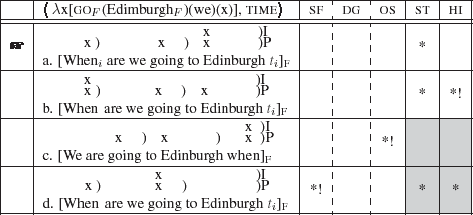
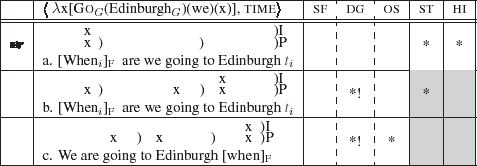
The proposed ranking for English is illustrated in Tableaux 1 and 2. In Tableau 1, in which the wh-question's focus consists in the content of the whole CP (see example (44)B), candidate a is the optimal candidate.
Wh-question with a new non-wh portion in English

Wh-question with a given non-wh portion in English

All the candidates in Tableau 1 vacuously satisfy destress–given (henceforth dg). Candidates a, b and c satisfy stress–focus (sf), as every non-given item is stressed. Candidate d – which is harmonically bound by candidate a – violates this constraint, as to Edinburgh fails to realize a phrasal stress. This candidate is consequently eliminated. Both candidates a and b satisfy op-spec (os) as they both move the wh-phrase to Spec,CP. The trace/copy left in this process violates stay (st). However, this violation is not fatal as st is relatively low-ranked. The only candidate that satisfies st in Tableau 1 is candidate c. Although candidate c satisfies st by leaving the wh-phrase in situ, it fails to satisfy os and is consequently eliminated. The constraint that breaks the tie between candidate a and candidate b here is hi. By locating sentence stress leftmost, candidate b – which is also harmonically bound – fares worse on this constraint than candidate a and is thus eliminated.
In Tableau 2, the focus of the clause is the wh-phrase, as the non-wh portion is discourse-given (cf. example (43)A discussed in Section 3.1). In order to satisfy sf and dg, sentence stress and wh-phrase must match. Candidate a, the winning candidate, satisfies sf as the wh-phrase is stressed. It also satisfies dg as the given items are correctly destressed. os is satisfied at the expense of st by the wh-phrase's location in the left periphery of the sentence. Finally, sentence stress on when violates hi as the head of the Intonational Phrase is not aligned with its right edge.
The location of sentence stress on Edinburgh and the stress on going in candidate b violate dg, as these items are given. This violation is fatal to candidate b. Candidate a's wh-in-situ counterpart in c also violates dg, as it shows stress on discourse-given items. Above all, it fares worse than candidate a on os, as leaving the wh-phrase in situ violates this constraint. This fatal violation causes its elimination.
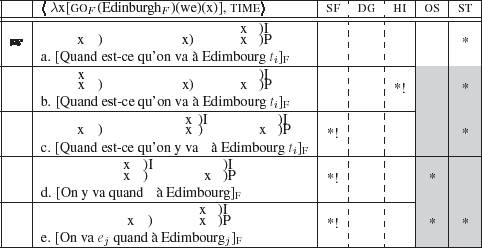
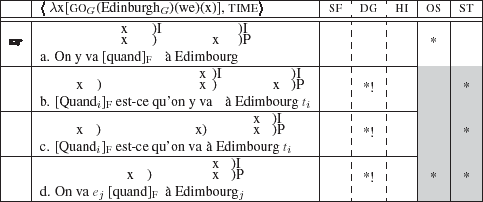
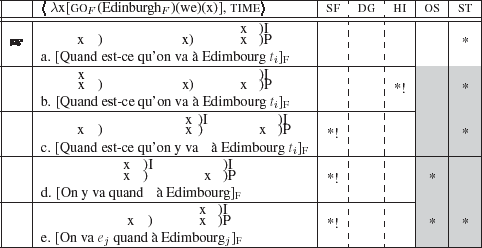
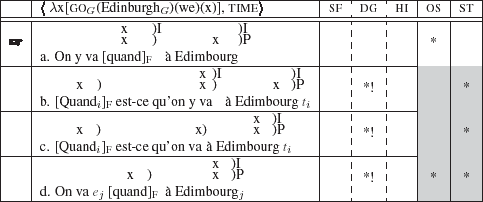
Let us now turn to the Francilian French data. The ranking of constraints presented in (51) is illustrated in Tableaux 3 and 4. A few more candidates than in English have to be considered as FF resorts to clitic right dislocation of discourse-given phrases. Although the candidates in Tableaux 3 and 4 present more syntactic variety than the ones considered in English, they all realize the same predicative structure.
Wh-question with a new non-wh portion in Francilian French
Wh-question with a given non-wh portion in Francilian French
In Tableau 3, the winning candidate – candidate a – is the counterpart of candidate a in Tableau 1: it satisfies all the constraints except st. Candidate b – which is harmonically bound by candidate a – is candidate a's equivalent, except that main stress is carried by the fronted wh-phrase. This configuration causes a fatal violation of hi, hence the elimination of candidate b. Candidate c – also harmonically bound by a – is the optimal candidate in a context in which à Edimbourg is given but not va, as in the following example.
(56) On (n') arrête pas d'en parler, mais quand est-ce qu'on y VA, à Edimbourg?we NE stop not of.it speak but when is.it that.we there go to Edinburgh‘We keep talking about Edinburgh, but when are we going there?’
However, in the context proposed in Tableau 3, this candidate fails to satisfy sf as à Edimbourg is wrongly expressed in the form of the intrinsically stressless clitic pronoun y. This violation of sf leads to the elimination of this candidate. Candidate d is the winning candidate in the context in which on va à Edimbourg is discourse-given, as in Tableau 4. In the present context, in which neither aller ‘go’ nor à Edimbourg is given, this candidate violates sf and is consequently eliminated. Finally, candidate e is the (harmonically bound) wh-in-situ version of candidate a, with the extraposition of à Edimbourg due the preference for ‘heavy’ constituents to come last (on the End Weight Principle, see for instance Arnold et al. Reference Arnold, Wasow, Losongco and Ginstrom2000). This candidate satisfies dg as well as hi. The lack of fronting of the wh-phrase violates os and the extraposition of à Edimbourg causes a violation of st (if one considers that any type of movement violates this contraint). However, the violation that is fatal to this candidate is the one caused by the lack of stressing of the non-given item va. It is worth noting that although this candidate is syntactically and prosodically well-formed, it never surfaces as a genuine request for information in FF.
Tableau 4's optimal candidate – candidate a – is the in-situ wh-question with clitic right dislocation of à Edimbourg. This candidate fares well on the three high-ranked constraints sf, dg and hi by ensuring that the wh-phrase is stressed (destressing the wh-phrase would violate sf), by correctly destressing/unstressing every given item and by aligning the head of the Intonational Phrase with its right edge. The location of sentence stress on va shown by candidate b, although it satisfies hi, violates dg and leads to the elimination of this candidate. Candidate c differs from candidate b in that it does not exhibit a clitic right dislocation of à Edimbourg. This candidate also violates dg in that it exhibits stressed given items. Finally, candidate d, in which the wh-phrase stays in situ and the phrase à Edimbourg is extraposed, fails to satisfy dg, os and st, and is consequently eliminated.
3.4 Summary of Section 3
Assuming that in a wh-question, a wh-phrase is intrinsically focused, I have argued that not all wh-questions have the same focus-set – contra most accounts of wh-questions, which consider that the wh-phrase (and only the wh-phrase) equals to the focus of the wh-question. I have proposed that what English wh-questions with initial main stress and French in-situ wh-questions have in common is that the wh-phrase carries main stress and that their focus-set only consists of the wh-phrase. What English wh-questions with rightmost main stress and French fronted wh-questions have in common is that their focus-set consists of the entire interrogative CP. Unlike declarative sentences with rightmost main stress discussed by Reinhart (Reference Reinhart2006), FF wh-questions are thus unambiguous: fronted wh-questions are cases of broad focus (that is, broader than the wh-phrase) and in-situ wh-questions are cases of narrow focus on the wh-phrase. However, one should keep in mind that an in-situ wh-question's focus-set is a subset of its fronted counterpart's focus-set (see Section 3.3 above). Using a fronted wh-question in a context in which the non-wh part is discourse-given is just not the most economical way to express the question, but it is still possible as they both express the same informational need. Using an in-situ wh-question in a context in which the non-wh portion is discourse-new is also possible but requires a type of accommodation on the part of the hearer.
In French, the location of main stress on the wh-phrase is a consequence of the discourse-given status of the non-wh portion and this is the only aspect that makes the wh-phrase more ‘focused’ in in-situ wh-questions than in fronted ones.
4. Closing remarks
In this paper I have argued that in Francilian French, fronted and in-situ wh-questions express the same informational need and have the same answerhood conditions. They are nonetheless distinct with respect to their focus-set: in fronted wh-questions the non-wh portion (or at least a part of it) is included in the question's focus whereas in wh-in-situ questions, it is excluded from the focus. This proposal is thus reminiscent of Chang's (Reference Chang1997) original proposal that in-situ wh-questions are felicitous in ‘strongly presupposed contexts’ and of Engdahl's (Reference Engdahl, Bonami and Cabredo-Hofherr2006) claim that wh-questions are comparable to declaratives in that they may be slightly modified in order to fit their discourse context. I have proposed to capture the difference between the two types of questions within Optimality Theory (Prince & Smolensky Reference Prince and Smolensky2004), using a set of constraints that have recently been proposed in order to account for focus and givenness in declaratives (Szendrői Reference Szendrői2001, Samek-Lodovici Reference Samek-Lodovici2005, Féry & Samek-Lodovici Reference Féry and Samek-Lodovici2006). It has been argued that prosody plays a role in constituent linearization in wh-questions. More precisely, prosody helps to choose among several wh-structures made available by the grammar. The emergence of in-situ wh-phrases in Francilian French is an effect of the ranking of hi above op-spec, which favors rightmost main stress over wh-phrase fronting when the context requires the non-wh part to be destressed, namely when the non-wh portion is discourse-given. English is distinct from Francilian French in that its ranking of hi below op-spec allows main stress to be situated on a fronted wh-phrase when required by the discourse context.
By laying out the semantic similarity between the two types of French wh-questions, this paper offers an explanation of their well-known seemingly free interchangeability. By highlighting their differences with respect to information structure, it accounts for why in-situ and fronted wh-questions co-occur in one and the same grammar. It also makes the location of sentence stress in French and English wh-questions more consistent with what has long been observed in these languages' declarative sentences.
Finally, if one believes that in order to account for the widesprread phenomenon of ‘intervention effects’ in wh-questions ‘an important key lies in the information structure of Wh interrogatives’ (Tomioka Reference Tomioka2007: 1575), the present paper offers a new perspective on this phenomenon. In his recent pragmatic account of ‘intervention effects’ in Korean and Japanese, Tomioka (Reference Tomioka2007) argues that in these languages, an ‘intervention effect’ occurs whenever an intervener is wrongly located outside the ground/given portion of the wh-question. Several types of items can act as interveners depending on the language (Beck Reference Beck2006). In French wh-questions, any nominal or adverbial quantifier, negation, modal-adverbs and focused items of any sort (with or without a focusing particle) are prohibited from c-commanding/linearly preceding a wh-phrase left in situ.Footnote 25 The present account of wh-questions, if it is on the right track, shows that, at least in FF, an ‘intervention effect’ occurs whenever an intervener is located within the ground/given portion of the wh-question. When the intervener is an acknowledged focused item, the ungrammaticality of the wh-questions in which it precedes a wh-phrase in situ might be caused by the focused item and the wh-phrase being in competition with each other to carry main stress. Keeping sentence stress rightmost, namely on the wh-phrase, leaves a narrowly focused item – the intervener – unstressed, which violates stress–focus, whereas shifting sentence stress leftward onto the narrowly focused item has the effect of destressing the wh-phrase as well as violating hi. As the wh-phrase is inherently focused, appearing outside the sentence's focus is not an available option for it.
How do ‘intervention effects’ created by a focus-sensitive item relate to ‘intervention effects’ created by the presence of negation, a nominal quantifier, an adverbial quantifier, or a modal adverb,Footnote 26 such as in the following examples?
(57)
(a) Qu'est-ce qu'il a pas mangé?what.is.it that.he has not eaten‘What didn't he eat?’
(b) #/*Il a pas mangé quoi? he has not eaten what‘What didn't he eat?’
(58)
(a) Où est-ce que certains étudiants ont mangé?where is.it that some students have eaten‘Where did some of the students eat?’
(b) #/*Certains étudiants ont mangé où? some students have eaten where‘Where did some of the students eat?’
(59)
(a) Qu'est-ce qu'elle mange souvent?what.is.it that.she eats often‘What does she often eat?’
(b) #/*Elle mange souvent quoi? she eats often what‘What does she often eat?’
(60)
(a) Qu'est-ce qu'il a probablement mangé?what.is.it that.he has probably eaten‘What did he probably eat?’
(b) #/*Il a probablement mangé quoi? he has probably eaten what‘What did he probably eat?’
To the best of my knowledge, none of the previous accounts of ‘intervention effects’ have discussed the type of context in which questions such as the ones from (57a) to (60a) would fit – and, hence, the prosodic realization of such questions and the location of main stress in them. None of the previous accounts have discussed the informational need expressed by the speaker or the type of mental operation or knowledge required from the addressee in order for him/her to be able to answer such a question. In my view, what seems worth noting and what probably needs more investigation is that all these items are scalar items of some sort. The nominal quantifiers 〈‘all’, ‘most’, ‘many’, ‘some’〉 constitute a Horn scale and so do 〈‘always’, ‘often’, ‘sometimes’〉. This is also the case of ‘probably’, which can be seen as part of a scale with at least ‘certainly’ and ‘possibly’ (〈‘certainly', ‘probably’, ‘possibly’〉). By selecting one of these items in expressing her informational needs, the speaker excludes the other items of the scale or, in other words, other alternatives, which should remind us of focusing. However, as this topic is beyond the scope of the present paper, I leave it open for future research.