Non-technical Summary
Trace fossils from Cambrian strata found in central Wisconsin have taught us much about the animal life inhabiting the tidal flats in this region a half billion years ago. In this study the authors reveal additional diversity of these trace fossils and multiple inferred new taxa including a new ichnogenus, a new ichnospecies of an existing ichnogenus, and a trace fossil that may have been made by a polychaete worm. What may be the first fossil evidence of an animal feeding on a jellyfish at this or equivalent Cambrian tidal flats is also reported. Other examples of trace fossils not previously known from these tidal flats are also described. This expansion of the ichnotaxonomic diversity further illustrates the early exploitation of tidal flats.
Introduction
The middle to late Cambrian siliciclastic tidal flat deposits of the Elk Mound Group at Blackberry Hill, Marathon County, Wisconsin (bounding coordinates: minLon −89.535, minLat 44.693, maxLon −89.499, maxLat 44.714; herein, Blackberry Hill) preserve a great abundance and diversity of trace fossils. Earlier studies described the arthropod trackways in general (Hoxie, Reference Hoxie2005), new insights on large winding trails and resting traces made by a giant slug-like animal (Getty and Hagadorn, Reference Getty and Hagadorn2008, Reference Getty and Hagadorn2009), specific arthropod burrows and trails—some associated with body fossils (Collette et al., Reference Collette, Hagadorn and Lacelle2010)—and unusual traces that shed light on the first animals to make subaerial excursions (Hagadorn and Seilacher, Reference Hagadorn and Seilacher2009; Collette et al., Reference Collette, Gass and Hagadorn2012). These studies, combined with others made possible by the discovery of mass strandings of scyphozoans (Hagadorn et al., Reference Hagadorn, Dott and Damrow2002) and a euthycarcinoid and phyllocarid (Collette and Hagadorn, Reference Collette and Hagadorn2010), provided major advancements in understanding the biology and taphonomy on Cambrian tidal flats.
The aim of this study is to highlight trace fossils uncovered more recently and the insights they provide. This includes: re-diagnosing Protichnites, untangling the confusion surrounding Protichnites eremita Hagadorn and Seilacher, Reference Hagadorn and Seilacher2009 (necessitating the establishment of Seilacherichnus n. igen.); providing what may be the first fossil evidence of an animal possibly feeding on a scyphozoan on a Cambrian tidal flat; establishing Climactichnites blackberriensis n. isp.; describing ichnotaxa either not previously reported from Blackberry Hill or other Cambrian tidal flats (Siskemia isp., Stiallia pilosa Smith, Reference Smith1909, Cochlichnus? isp.) or not previously illustrated from Blackberry Hill material (Diplopodichnus isp.); and providing trace fossil evidence that may indicate the presence of an aglaspidid and a polychaete.
Geologic setting
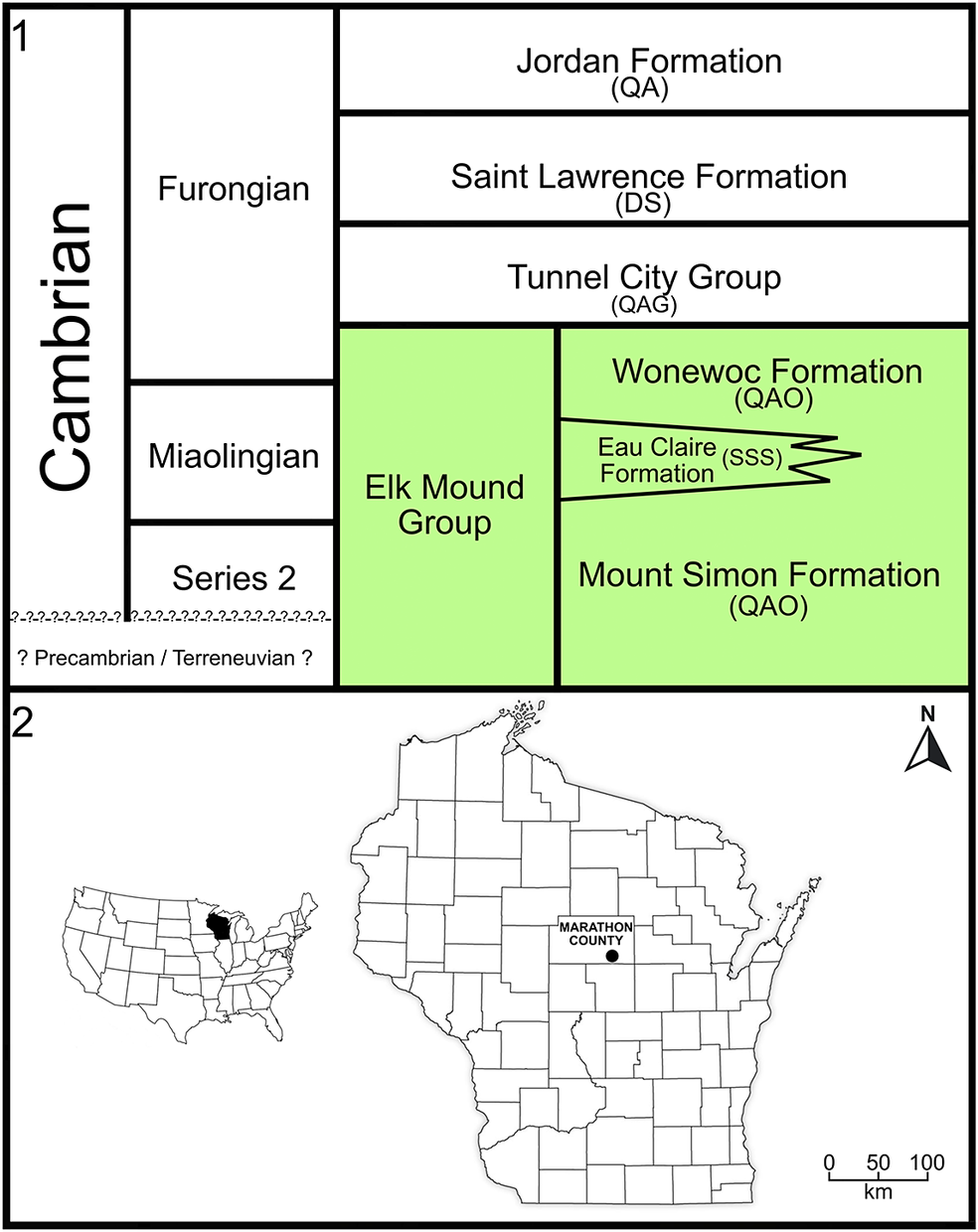
The quartzose, sandy sediments of Blackberry Hill were deposited in the tidal flats of the supercontinent Laurentia (Collette and Hagadorn, Reference Collette and Hagadorn2010). The deposits are of middle to late Cambrian age (late Series 2 to early Furongian) within the Elk Mound Group. Due to the lack of adequate stratigraphic and biostratigraphic indicators and the similar lithology of the Mount Simon and Wonowoc formations, it is difficult to determine whether this sequence of strata belongs to the Mount Simon Formation (late Series 2 to Miaolingian), Wonowoc Formation (Miaolingian to early Furongian), or both (Fig. 1.1). The distinctive Eau Claire Formation, which lies between the Mount Simon and Wonowoc formations at other localities, is absent from the strata at Blackberry Hill (Collette and Hagadorn, Reference Collette and Hagadorn2010; Collette et al., Reference Collette, Hagadorn and Lacelle2010; MacNaughton et al., Reference MacNaughton, Hagadorn and Dott2018). Yochelson and Fedonkin (Reference Yochelson and Fedonkin1993) indicated that the material from the Northern Stone Company quarry (also known as Nemke quarry, one of the Blackberry Hill quarries) was almost certainly quarried from the Mount Simon Formation.
Stratigraphic and geographic maps of Blackberry Hill. (1) Generalized stratigraphic map for the Cambrian strata of Wisconsin; strata exposed at Blackberry Hill in green. Note that the Eau Claire Formation is not distinguishable at Blackberry Hill, hampering exact stratigraphic placement; after MacNaughton et al., Reference MacNaughton, Hagadorn and Dott2018, fig. 1B. (2) Location of Blackberry Hill, Marathon County, Wisconsin, USA. Bounding coordinates: minLon −89.535, minLat 44.693, maxLon −89.499, maxLat 44.714. Abbreviations: QA, quartz arenites; DS, mostly dolostone and siltstone; QAG, quartz arenites with glauconite; QAO, quartz arenites and orthoquartzite; SSS, feldspathic and glauconitic sandstone, siltstone, and shale

Figure 1. Long description
Panel 1 is a stratigraphic diagram. On the far left, a vertical bar is labeled Cambrian. To its right, the Cambrian is divided into three vertical segments: Furongian at the top, Miaolingian in the middle, and Series 2 at the bottom. Below these is a dashed line labeled Precambrian forward slash Terreneuvian. To the right of these segments are specific formations. The top three are Jordan Formation Q A, Saint Lawrence Formation D S, and Tunnel City Group Q A G. Below these, highlighted in green, is the Elk Mound Group. The Elk Mound Group is further subdivided on the right into the Wonewoc Formation Q A O at the top and the Mount Simon Formation Q A O at the bottom. A thin wedge labeled Eau Claire Formation S S S is shown pinching out between the Wonewoc and Mount Simon formations.
Panel 2 contains two maps. On the left is a small inset map of the U S A with Wisconsin highlighted in black. To the right is a larger map of Wisconsin showing county borders. Marathon County is labeled in the north-central part of the state, marked with a black dot. A north arrow is in the top right corner, and a scale bar indicating 0 to 100 kilometers is in the bottom right corner.
The Blackberry Hill strata include sedimentary structures typical of siliciclastic tidal flats, dominated by oscillation ripple marks, indicating very shallow water for the majority of the strata. Polygonal desiccation cracks, aeolian ripple marks, adhesion structures, foam marks, and raindrop impressions generally indicate subaerial exposure (Hoxie, Reference Hoxie2005; Getty and Hagadorn Reference Getty and Hagadorn2009; Gass, Reference Gass2015; MacNaughton et al., Reference MacNaughton, Hagadorn and Dott2018; Braddy et al., Reference Braddy, Gass and Gass2022), as do microfaults when present in intertidal regions (MacNaughton et al., Reference MacNaughton, Hagadorn and Dott2018). Many surfaces are covered with microbial mats, mat chips, and other microbially induced sedimentary structures (MISS) (Bottjer and Hagadorn, Reference Bottjer, Hagadorn, Scheiber, Bose, Eriksonn, Banerjee, Altermann and Catuneau2007; Hagadorn and Seilacher, Reference Hagadorn and Seilacher2009; Noffke, Reference Noffke2010; Collette et al., Reference Collette, Gass and Hagadorn2012; Gass, Reference Gass2015). The abundant microbial mat structures record episodic storms and subaerial exposure (Noffke and Gass, Reference Noffke and Gassin press). It has long been assumed that microbial mats assisted the registration and preservation of many Blackberry Hill trace fossils (Hagadorn and Seilacher, Reference Hagadorn and Seilacher2009; Wang et al., Reference Wang, Davies, Liu, Minter and Rahman2024).
The rock is mostly composed of well-bedded, whitish to orange-brown quartz arenites and orthoquartzites. Strata are relatively flat and horizontal. Light green clay veneers can be seen in some areas, generally in the vicinity of shrinkage cracks or channels (Collette and Hagadorn, Reference Collette and Hagadorn2010).
The Elk Mound Group strata and depositional environment at the Blackberry Hill site are more or less equivalent to those of the Potsdam Group (Quebec and Ontario, Canada, and the state of New York, USA), the Lamotte and Gunther Sandstones (Missouri, USA), and the Hickory Sandstone (Texas, USA), where some of the same trace fossils are found (Owen, Reference Owen1852; Summerson, Reference Summerson1951; Cornish, Reference Cornish1975; Yochelson and Fedonkin, Reference Yochelson and Fedonkin1993; Hoxie, Reference Hoxie2005; Collette and Hagadorn, Reference Collette and Hagadorn2010; Braddy, Reference Braddy2023).
Materials and methods
A Canon EOS Rebel T3i camera with an EFS 60 mm lens was used to photograph most of the fossils. Terminology follows Trewin (Reference Trewin1995) and Braddy (Reference Braddy, Briggs and Crowther2001) for arthropod trackways, Bertling et al. (Reference Bertling, Braddy, Bromley, Demathieu and Genise2006, Reference Bertling, Buatois, Knaust, Laing and Mángano2022) for trace fossils in general, and Yochelson and Fedonkin (Reference Yochelson and Fedonkin1993) and Getty and Hagadorn (Reference Getty and Hagadorn2008) for Climactichnites.
Supplementary materials
Additional images of the type material of Climactichnites blackberriensis n. isp. and their broader ecological context are deposited as Supplemental Data 1, 2 and 3.
Repositories and institutional abbreviations
Prefixes of specimen numbers are as follows: GSE = British Geological Survey, Edinburgh; MPM = Milwaukee Public Museum, Milwaukee, Wisconsin; PRI = Paleontological Research Institute, Ithaca, New York.; UWGM = University of Wisconsin Geology Museum; WM/P = Weis Earth Science Museum, Menasha, Wisconsin; YPM = Peabody Museum of Natural History, Yale University. The holotype and paratype of Seilacherichnus eremita n. igen. n. comb. and other specimens for which registration numbers are not given are field specimens. Illustrated specimens are preserved in epirelief unless otherwise stated.
Systematic ichnology
Ichnogenus Protichnites Owen, Reference Owen1852
Type ichnospecies
Protichnites septemnotatus Owen, Reference Owen1852 [corrected from Protichnites septem-notatus].
Diagnosis
Trackway with ≥ 7 tracks per series, and a medial impression.
Remarks
Owen (Reference Owen1852) established Protichnites to include six ichnospecies, all from what are now called Cambrian strata of the Potsdam Group of Quebec. These included Protichnites septemnotatus, P. octonotatus, P. latus, P. multinotatus, P. lineatus, and P. alternatus. Other specimens having a similar range of characteristics were subsequently discovered in quartz arenites and orthoquartzites deposited in subtidal, intertidal, or supratidal sand flats or in eolian deposits within the Potsdam Group of Ontario and New York state, the Elk Mound Group of Wisconsin, the Lamotte and Gunter sandstones of Missouri, and the Hickory Sandstone of Texas (Owen, Reference Owen1852; Summerson, Reference Summerson1951; Cornish, Reference Cornish1975; MacNaughton et al., Reference MacNaughton, Cole, Dalrymple, Braddy, Briggs and Lukie2002; Collette et al., Reference Collette, Gass and Hagadorn2012).
Since that time, the diagnosis of Protichnites has evolved (Hitchcock, Reference Hitchcock1858; Seilacher, Reference Seilacher1955; Häntzschel, Reference Häntzschel and Teichert1975; Keighley and Pickerill, Reference Keighley and Pickerill1998; Burton-Kelly and Erickson, Reference Burton-Kelly and Erickson2010), and the distinction among Owen’s original ichnospecies has come into question (Braddy and Gass, Reference Braddy and Gass2023), largely due to taphonomic processes that heavily affected Owen’s diagnoses, as well as an abundance of intermediate forms from the same sites. While researchers frequently identify new material as P. septemnotatus (Burton-Kelly and Erickson, Reference Burton-Kelly and Erickson2010; Rose et al., Reference Rose, Harris and Milner2021), few identify new material as any of Owen’s five other ichnospecies. Consequently, all six ichnospecies are herein synonymized under the type ichnospecies, Protichnites septemnotatus.
In the absence of a consensus as to a diagnosis of Protichnites, and to help prevent the broadening of this taxon to the point of including excessively disparate forms, Braddy and Gass (Reference Braddy and Gass2023) suggested restricting the diagnosis to trackways with seven or more tracks per series and a medial impression. This is consistent with the current aim of avoiding diagnostic criteria other than overall morphology of the trace. That view is extended to the present work, as reflected in the emended diagnosis. A result of this synonymization and restricted diagnosis is a more compact Protichnites that should facilitate recognition of Protichnites and any of its potentially new ichnospecies.
Multiple ichnospecies have been assigned to Protichnites, but have since been removed from that ichnogenus, either prior to this study or because of the new diagnosis. Protichnites carbonarius Dawson, Reference Dawson1873, P. gallowayi Sharpe, Reference Sharpe1932, and P. scoticus Salter in Harkness, Reference Harkness1856, have fewer than seven tracks per series. Protichnites logananus Marsh, Reference Marsh1869, lacks a medial impression and was reassigned to Diplichnites. Protichnites eremita Hagadorn and Seilacher, Reference Hagadorn and Seilacher2009, is reassigned to Seilacherichnus n. igen. in the present work. Much additional material, not listed in the synonymy, from Cambrian and younger strata of other geographic regions have also been identified as Protichnites; however, due to taphonomic factors, track series of most of the trackways identified as Protichnites are not distinguishable. The number of tracks in a series may therefore be unknowable for such material. Many of those trackways are consequently unidentifiable to the level of ichnospecies and possibly ichnogenus. It is likely that further analyses of the material identified as Protichnites isp., particularly that from post-Cambrian strata, will reveal that it belongs to other ichnogenera.
Protichnites septemnotatus Owen, Reference Owen1852
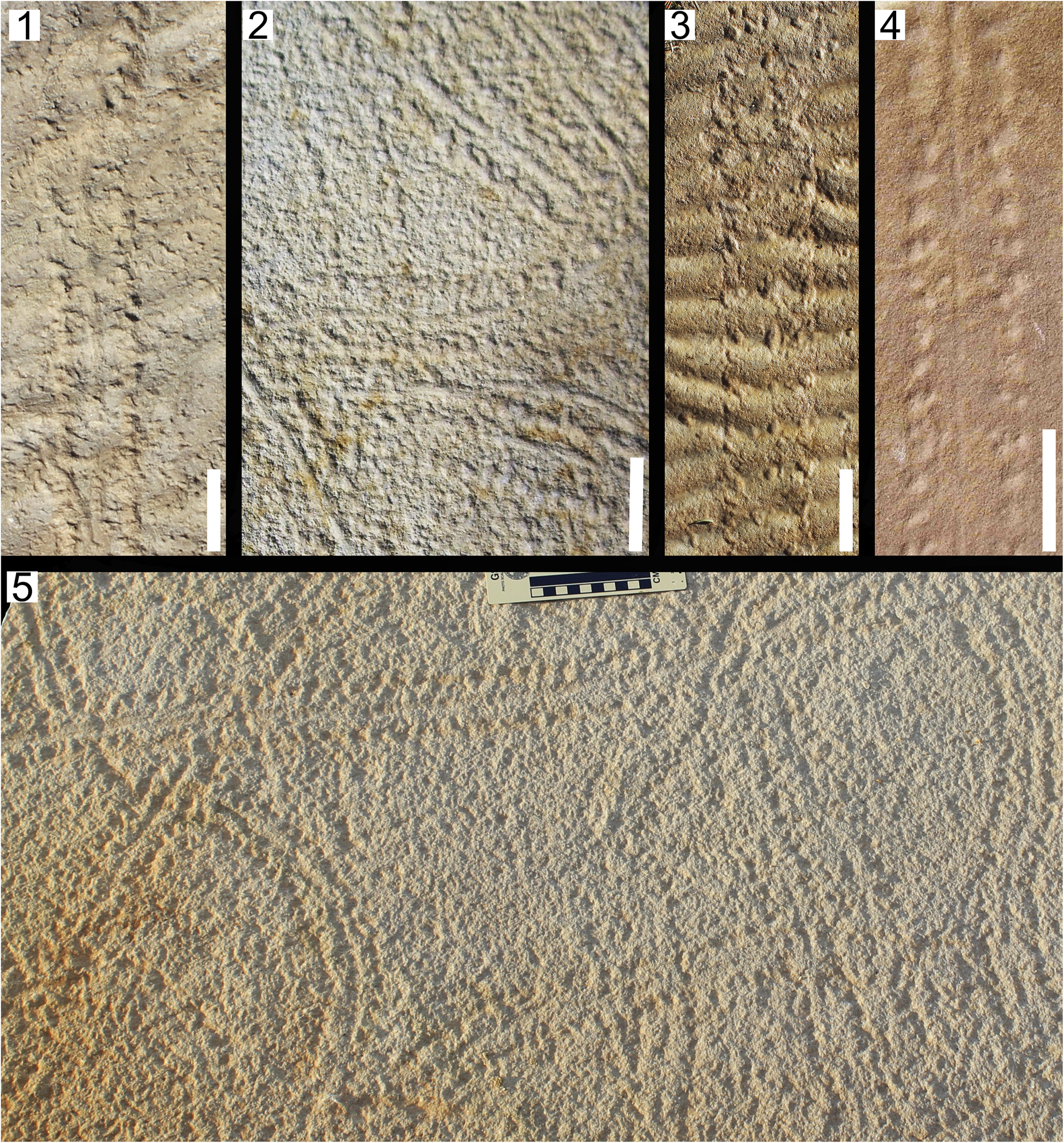
Protichnites septemnotatus from Blackberry Hill. (1) Weathered trackway on lightly ripple-marked surface; (2) multiple trackways with distinct medial impressions, positive hyporelief; collected by William Nemke; (3) trackway preserved on ripple-marked surface, positive hyporelief; (4) WM/P 982, trackway with shallow, discontinuous medial impression; collected by Joshua Gass; (5) portion of large surface with multiple trackways having continuous medial impressions. Scale bars = 5 cm.

Figure 2. Long description
The figure is divided into two rows. The top row contains four narrow vertical panels, and the bottom row contains one wide horizontal panel. Each panel includes a white scale bar representing 5 cm.
* Panel 1 (Top-Left): A weathered, light-tan sandstone surface with faint ripple marks. A vertical trackway runs through the center, consisting of small, paired imprints.
* Panel 2 (Top-Middle-Left): A greyish-white surface showing multiple overlapping trackways. These tracks feature distinct medial impressions (central grooves) and are preserved in positive hyporelief.
* Panel 3 (Top-Middle-Right): A tan surface with prominent, horizontal ripple marks. A vertical trackway crosses the ripples, showing deeply impressed lateral footprints and a central groove.
* Panel 4 (Top-Right): A smooth, reddish-brown sandstone surface. A vertical trackway labeled W M / P 982 shows two parallel rows of circular footprints with a very shallow, broken medial line.
* Panel 5 (Bottom): A large, wide slab of textured sandstone. It contains a high density of multiple intersecting trackways, most of which exhibit continuous, well-defined central medial impressions. A physical ruler is placed at the top center for scale.
Reference Owen1852 Protichnites septemnotatus Owen, p. 214–217, pl. IX.
Reference Owen1852 Protichnites octonotatus Owen [corrected from Protichnites octo-notatus], p. 217–218, pl. X.
Reference Owen1852 Protichnites latus Owen, p. 218–219, pl. XI.
Reference Owen1852 Protichnites multinotatus Owen, p. 219–220, pl. XII.
Reference Owen1852 Protichnites lineatus Owen, p. 220–221, pl. XIII.
Reference Owen1852 Protichnites alternatus Owen, p. 221–222, pl. XIV.
Reference Hoxie2005 Protichnites; Hoxie, figs. 5C, 8, 9A, 11, 28C.
Reference Burton-Kelly and Erickson2010 Protichnites septemnotatus; Burton-Kelly and Erickson, fig. 3.
Reference Gass2015 Protichnites; Gass, figs. 27–29.
Reference Gass2025 Protichnites; Gass, figs. 19–28.
Holotype
Lost; original plaster cast resides at Amherst College Museum of Natural History (ACMNH 59/3); silicone rubber mold taken from Amherst cast and two plaster casts taken from the mold reside at the Geological Survey of Canada (GSC 124166); trackway; upper unit of the Cairnside Formation, Potsdam Group, Cambrian, Beauharnois, Quebec.
Diagnosis
Trackway with ≥ 7 circular or oval tracks per series, paired across the midline, and a single continuous or discontinuous medial impression; track series may overlap.
Occurrence
Quartz arenites and orthoquartzites in Wisconsin (Elk Mound Group), Missouri (Lamotte and Gunter sandstones), Texas (Hickory Sandstone), Quebec, Ontario, and New York (Potsdam Group).
Description
Trackway external width ≤ 20 cm; ~90% of trackways are between 2 and 10 cm. Trackway path straight, curved or meandering. Seven or more circular, oval, or tapered discrete tracks per series, generally without pushback mounds. Series length 5–15 cm; external width versus series length ~0.6. Medial impression intermittent or constant, of lesser, equal, or greater depth than tracks.
Trace producer
Due to the distinction of possibly being the trackways of the first animals to set foot on dry land, learning the identity of that animal was of great interest to researchers. Beginning with Owen (Reference Owen1852), many researchers suggested what would now be called an arthropod as the tracemaker of Protichnites septemnotatus and the other ichnospecies that were then referred to Protichnites. This was mainly due to the resemblance of their track characteristics and patterns to those of extant arthropods. Most of the debate that ensued centered around which kind of arthropod was responsible, with trilobites (Billings, Reference Billings1870), aglaspidids (Hall, Reference Hall1862), horseshoe crabs (Dawson, Reference Dawson1862), eurypterids (Sharpe, Reference Sharpe1932), and euthycarcinoids (MacNaughton et al., Reference MacNaughton, Cole, Dalrymple, Braddy, Briggs and Lukie2002) being the main subjects. This culminated in the discovery of body fossils of the euthycarcinoid, Mosineia macnaughtoni Collette and Hagadorn, Reference Collette and Hagadorn2010, in the same Blackberry Hill quarry that preserved numerous Protichnites septemnotatus (Collette et al., Reference Collette, Gass and Hagadorn2012). Its morphology is consistent with that of Protichnites. The only other arthropod body fossils identified from Blackberry Hill belong to the phyllocarid Arenosicaris inflata Collette and Hagadorn, Reference Collette and Hagadorn2010, which has too few walking limbs to have produced Protichnites.
Remarks
Trackway external width, series length, and external width versus series length given in the Description were derived from Hoxie (Reference Hoxie2005, figs. 12A, 12B, 16A).
Ichnogenus Seilacherichnus new ichnogenus
Type ichnospecies
Protichnites eremita Hagadorn and Seilacher, Reference Hagadorn and Seilacher2009 (YPM IP 204961) from the Elk Mound Group, middle to late Cambrian, Blackberry Hill, east of Mosinee, Marathon County, Wisconsin.
Diagnosis
Large trackway (7–12 cm wide) consisting of symmetrical tracks and discrete medial imprints. The latter are always shingled to the side and may contain up to five or six diagonal segments. One or two narrower imprints may also be present near each of the wider ones. The tracks may be situated in a continuous trough.
Occurrence
Elk Mound Group, middle to late Cambrian, Blackberry Hill, east of Mosinee, Marathon County, Wisconsin; 44.71250, −89.51277; YPM Locality D6550, PRI Station 3421.
Etymology
After Dolf Seilacher, an ichnologist who had a particular interest in Protichnites eremita, which he coauthored (Hagadorn and Seilacher, Reference Hagadorn and Seilacher2009).
Remarks
The diagnosis is based largely on that of Protichnites eremita. The original diagnosis of that ichnospecies was, “Large arthropod trackways consisting of symmetrical footprints and discrete medial markings. The latter are always shingled to the side and may contain up to four diagonal segments and a deeper groove at their front end” (Hagadorn and Seilacher, Reference Hagadorn and Seilacher2009, p. 297). The diagnosis of Seilacherichnus more accurately accounts for the observed characteristics of the material, quantifies “large,” and deletes “arthropod” to avoid producer-related ichnotaxonomy (Bertling et al., Reference Bertling, Braddy, Bromley, Demathieu and Genise2006). Collette et al. (Reference Collette, Gass and Hagadorn2012, p. 443) updated the number of diagonal segments on the medial imprints from “up to four” to “up to five (possibly six),” after further examination of the material. The diagnosis of Collette et al. (Reference Collette, Gass and Hagadorn2012) had been written so broadly as to limit the taxonomic usefulness of P. eremita, necessitating a more concise diagnosis.
The possession of shingled medial imprints is the primary ichnotaxobase (see Bertling et al., Reference Bertling, Buatois, Knaust, Laing and Mángano2022, for concept of ichnotaxobases) for Seilacherichnus n. igen. (Simon Braddy, personal communication, 2025). In contrast, Protichnites lacks this feature, but instead has an ichnotaxobase of tracks grouped in a series of at least seven. Because Seilacherichnus n. igen. may have multiple tracemakers, they are discussed under the two ichnospecies.
Seilacherichnus eremita (Hagadorn and Seilacher, Reference Hagadorn and Seilacher2009) new combination
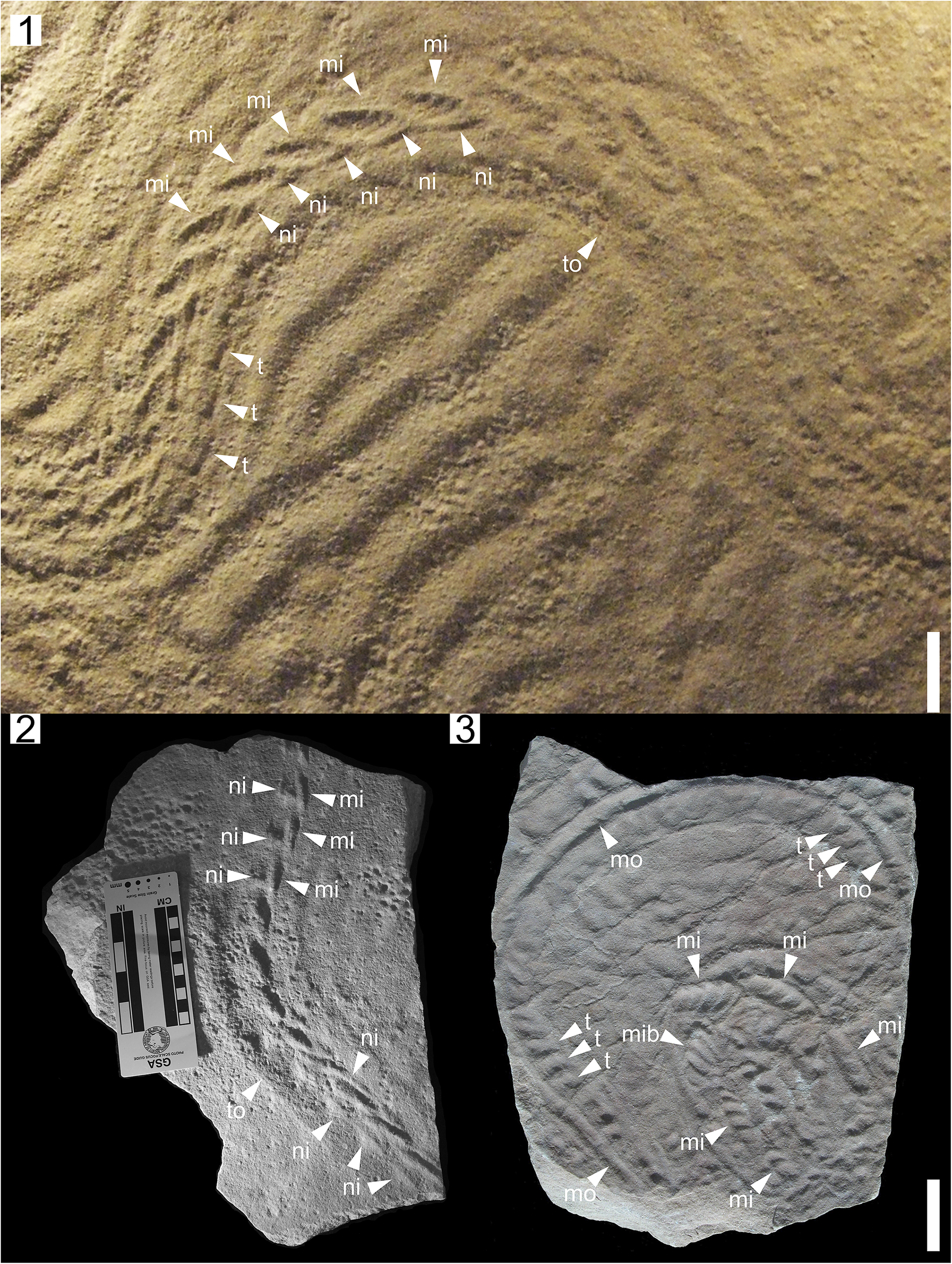
Seilacherichnus n. igen., Blackberry Hill. (1) Seilacherichnus eremita n. igen. n. comb., portion of holotype YPM IP 204961; courtesy of the Division of Invertebrate Paleontology, Peabody Museum of Natural History, Yale University; photographed by Susan Butts; slab donated to the Peabody by Dolf Seilacher; (2) Seilacherichnus eremita n. igen. n. comb., paratype PRI 8467, positive hyporelief; (3) Seilacherichnus isp., PRI 10143; collected by Todd Gass. Abbreviations: mi, medial imprint; mib, medial imprint at beginning of sharp clockwise turn; mo, medial impression; ni, narrow impression; t, track; to, trough. Scale bars = 5 cm.

Figure 3. Long description
A multi-panel figure containing three photos of fossilized tracks on stone slabs. A 5 cm scale bar is present in the bottom right of panels 1 and 3.
* Panel 1: A close-up of a sandy-textured slab showing a series of concentric, curved ridges. Along the upper curve, six white arrows point to m i (medial imprints) and five arrows point to n i (narrow impressions) located just below the m i. On the left side, three arrows point to t (tracks) following the curve downward. A single arrow points to t o (trough) on the right side of the central curve.
* Panel 2: A vertical rock slab with a G S A scale card on the left. A linear trackway runs vertically. At the top, three pairs of arrows point to n i and m i. Further down the slab, three more arrows point to n i and one to t o near the bottom left edge.
* Panel 3: A wide rock slab featuring a circular or spiral track pattern. At the center, an arrow points to m i b (medial imprint at beginning of sharp clockwise turn). Surrounding this center are six arrows pointing to m i (medial imprints). On the outer perimeter, four arrows point to m o (medial impressions) at the top, bottom, and right edges. Two clusters of arrows point to t (tracks) on the left and upper right sections of the outer ring.
Reference Hoxie2005 Protichnites sp. Hoxie, figs. 6B, 22A–D.
Reference Seilacher2007 Hermit Protichnites Seilacher, p. 24, 28, pl. 10, fig. E.
Reference Seilacher2008 Protichnites; Seilacher, fig. 6B.
Reference Hagadorn and Seilacher2009 Protichnites eremita; Hagadorn and Seilacher, p. 295, fig. 1, 2A–2C.
Reference Collette, Gass and Hagadorn2012 Protichnites eremita Form 1 Collette et al., fig. 2.4–2.6.
Reference Gass2015 Protichnites eremita Form 1; Gass, p. 3 (unnumbered), p. 21, 64–67.
Reference Wang, Davies, Liu, Minter and Rahman2024 Protichnites eremita; Wang et al., p. 4, supplementary material, appendix D.
Reference Gass2025 “Protichnites” eremita; Gass, fig. 32.
Type specimens
Holotype: Two-part slab, YPM IP 204961. Paratypes: Slabs, PRI 8464–8468. Plastotypes: Silicone molds of large uncollectable bedding surfaces, PRI 8469–8474. Elk Mound Group, middle to late Cambrian, late Series 2–early Furongian, Blackberry Hill, east of Mosinee, Marathon County, Wisconsin; 44.71250, −89.51277; YPM Locality D6550, PRI Station 3421.
Diagnosis
Large trackway (~7–12 cm) consisting of wedge-shaped tracks that lie in a continuous, flat to shallow (~1–3 mm) trough and discrete medial imprints. The latter are always shingled to the side and contain up to five or six diagonal segments. One or two narrower imprints are also present near each of the wider ones. Trough widths vary between trackways but remain fairly constant within a trackway.
Occurrence
Elk Mound Group, middle to late Cambrian, late Series 2–early Furongian, Blackberry Hill, east of Mosinee, Marathon County, Wisconsin; 44.71250, −89.51277; YPM Locality D6550, PRI Station 3421.
Description
Trackway width 7–12 cm, remaining constant along the trackway, in spite of frequent loops and turns. The main (wider) medial imprints are shingled to the left, tilted 0–20° in straight sections and up to 45° at turns; may contain up to six segments, all inclined to the right. One or two narrower imprints that may be deeper or shallower than the wider ones and lack observable segmentation are present near the wider imprints; their positioning relative to the wider imprints may change along the length of the trackway. A row of evenly spaced, linearly arranged, wedge-shaped tracks lie in a continuous, shallow (~1–3 mm) trough along the trackway. Other measurements (n = 5): medial imprint length 3.3–4.8 cm; medial imprint width 1.0–1.2 cm; composite imprint width 2.8–4.2 cm, where width of composite imprint is the width of the region that includes the main medial imprint and its adjacent narrower ones. Clear visibility of the tracks and the segmentation of the medial imprints are only present in a short span of the holotype, which is probably preservational.
Trace producer
Hagadorn and Seilacher (Reference Hagadorn and Seilacher2009) tentatively referred Protichnites eremita to a heteropodus stem-group chelicerate that hid its dorsally bent tail in a dextrally coiled abandoned shell to keep its gills moist, thus exhibiting the earliest example of hermit behavior. Considering the absence of reports of sufficiently large mollusk shells from Cambrian rocks, together with the results of experimental model-based neoichnology showing that shingled medial imprints with angled segmentation can be produced using an object having the morphology of the postabdomen of the euthycarcinoid Mosineia macnaughtoni later found at the same site, Collette et al. (Reference Collette, Gass and Hagadorn2012) suggested that their P. eremita Form 1 could have been produced by a mating pair of euthycarcinoids in amplexus. In that scenario, the female held her postabdomen to the side to avoid interference with external fertilization, thus creating a reproductive advantage, and the deeper groove (herein “narrower imprint”) was the impression of the smaller male’s postabdomen.
Braddy et al. (Reference Braddy, Gass and Gass2022) and Braddy (Reference Braddy2024) thought it more likely that S. eremita n. igen. n. comb. represents mortichnia, whereby the looping paths of the trackways and peculiarities of the medial imprints were results of a disoriented and possibly dying solitary euthycarcinoid, as the animal tried to return to water to avoid desiccation. Finally, Wang et al. (Reference Wang, Davies, Liu, Minter and Rahman2024, p. 4 and supplementary material, appendix D) suggested that Protichnites eremita was produced by a mollusk with a coiled shell, based on that ichnospecies’ distinctive shingled medial imprints and the existence of a trail produced by the extant gastropod Rapana, which includes medial imprints roughly similar to those of P. eremita. Although discrete medial imprints like those of this ichnospecies could have been produced by a euthycarcinoid, as described above, their similarity to the shell imprints of gastropods such as Rapana provides strong evidence for a possible shelled mollusk producer of Seilacherichnus eremita n. igen. n. comb. Perhaps the shelled mollusk only lived on the tidal flats and resisted preservation for the same reasons that other hard parts do on these tidal flats. This would also explain the fact that the medial imprints of all S. eremita found to date are tilted in the same direction, as would be expected from a sinistral mollusk shell (Hagadorn and Seilacher, Reference Hagadorn and Seilacher2009). In further support of that interpretation, the troughs could have been the work of the mollusk’s wide foot as the animal moved across the substrate, and the lack of circular or oval tracks would not be problematic (Gass, Reference Gass2025). The mollusk could have made the wedge-shaped tracks by manipulating the edges of its foot. The extreme time gap (ca. 500 Myr) between Seilacherichnus n. igen. and Rapana is noteworthy; however, the co-occurring large trail Climactichnites wilsoni, which is generally attributed to a mollusk or a mollusk-like metazoan (Seilacher, Reference Seilacher2007; Getty and Hagadorn, Reference Getty and Hagadorn2008, Reference Getty and Hagadorn2009), suggests that large mollusk-like animals capable of producing distinct traces were present on these tidal flats. The only other body fossils known from the Elk Mound Group strata of Blackberry Hill are the phyllocarid Arenosicaris inflata and un-named scyphozoans; neither appear capable of producing these traces.
Remarks
Seilacherichnus eremita n. igen. n. comb. is rare, limited primarily to the material referred to in the type specimens section. After over 80 visits to the Blackberry Hill quarries, between 2006 and 2025, the majority to the quarry where all of the known specimens of S. eremita were collected, KCG has not seen any recognizable specimens of this distinctive ichnospecies. In contrast, he has observed over 100 specimens each of Protichnites, Diplichnites, and Climactichnites. Hagadorn and Seilacher (Reference Hagadorn and Seilacher2009, p. 295) considered whether S. eremita n. igen. n. comb. could represent an individual or population of individuals having a malformed tail; however, they concluded this was unlikely, “because similar trackways of different widths occur on the same bedding plane and because such trackways occur on more than one horizon.” This rarity may be related to what beds are chosen to be quarried at a given time, and whether sampling of those beds was conducted before the material was removed from the site.
Seilacherichnus isp.
Reference Collette, Gass and Hagadorn2012 Protichnites eremita Form 2, Collette et al., fig. 1.1, 1.2.
Reference Gass2015 Protichnites eremita Form 2, Gass, p. 78–79.
Reference Braddy, Gass and Gass2022 Protichnites eremita Form 2, Braddy et al., fig. 3(d)
Reference Gass2025 “Protichnites” eremita Form 2, Gass, fig. 33.
Occurrence
Elk Mound Group, middle to late Cambrian, Blackberry Hill, east of Mosinee, Marathon County, Wisconsin.
Description
The only specimen that clearly shows the features of this ichnospecies is a portion of a 6.8- to 7.5-cm-wide spiraling trackway located where the trackway turns sharply (Fig. 3.3). It has between three and five angled segments on its six medial imprints. The medial imprints at the apex of the turn swing out and overlap, creating a shingled appearance. The tracks are circular to ovate in shape. The flattened troughs seen in Seilacherichnus eremita n. igen. n. comb. are absent. Where the trackway path straightens, the shingled medial imprints transition into a continuous medial impression, and the tracks remain circular to ovate in outline. Medial imprint length 3.2–6.9 cm; width 1.0–2.0 cm, widest and deepest (4.3 mm deep) at apex of turn.
Trace producer
The taxonomic position of the Seilacherichnus isp. tracemaker is ambiguous, as is the case with so many Cambrian trace fossils. This ichnospecies appears to have resulted from an arthropod that made a sharp turn, yet it possesses a distinctive feature—shingled, segmented medial imprints—that it shares with the likely mollusk trail, Seilacherichnus eremita n. igen. n. comb. Climactichnites and S. eremita, as well as experiments with extant gastropods, indicate that mollusks are capable of producing a wide variety of traces with their shells and feet (Getty and Hagadorn, Reference Getty and Hagadorn2009; Wang et al., Reference Wang, Davies, Liu, Minter and Rahman2024). It is conceivable that a large, high-spired gastropod or monoplacophoran may have produced S. eremita as well as Seilacherichnus isp., perhaps shaping its foot in different ways to produce the tracks of each, as well as the troughs of S. eremita n. igen. n. comb. Alternatively, as suggested by experimental and fossil evidence, the medial imprints and tracks of Seilacherichnus isp. may have been produced by the postabdomen and appendages of a euthycarcinoid (Collette et al., Reference Collette, Gass and Hagadorn2012). Settling this question will require additional material and analyses.
Remarks
Three other slabs that contain trackways attributed to Protichnites eremita Form 2 have also been figured (Collette et al., Reference Collette, Gass and Hagadorn2012, figs., 1.3, 2.1; Gass, Reference Gass2015, p. 80, 81; Gass, Reference Gass2025, fig. 36). These were not included in the synonymy, because their medial imprints are not well developed. These trackways all bear segmented medial imprints that are slightly tilted, but some have tracks that are circular rather than ovate, similar to many of the Protichnites and Diplichnites from this site. Because only one known specimen of Seilacherichnus isp. clearly shows shingled medial imprints, this form of the new ichnogenus is retained in open nomenclature.
Ichnogenus Siskemia Smith, Reference Smith1909
Type ichnospecies
Siskemia elegans Smith, Reference Smith1909.
Other ichnospecies
Siskemia latavia Smith, Reference Smith1909 [corrected from S. lata-via]; Siskemia bipediculus Smith, Reference Smith1909.
Diagnosis
Trace consisting of parallel rows of grouped tracks on either side of two parallel, paramedial impressions. Each group of tracks consists of up to four imprints arranged in series, transversely or obliquely to the midline of the trackway.
Siskemia isp.
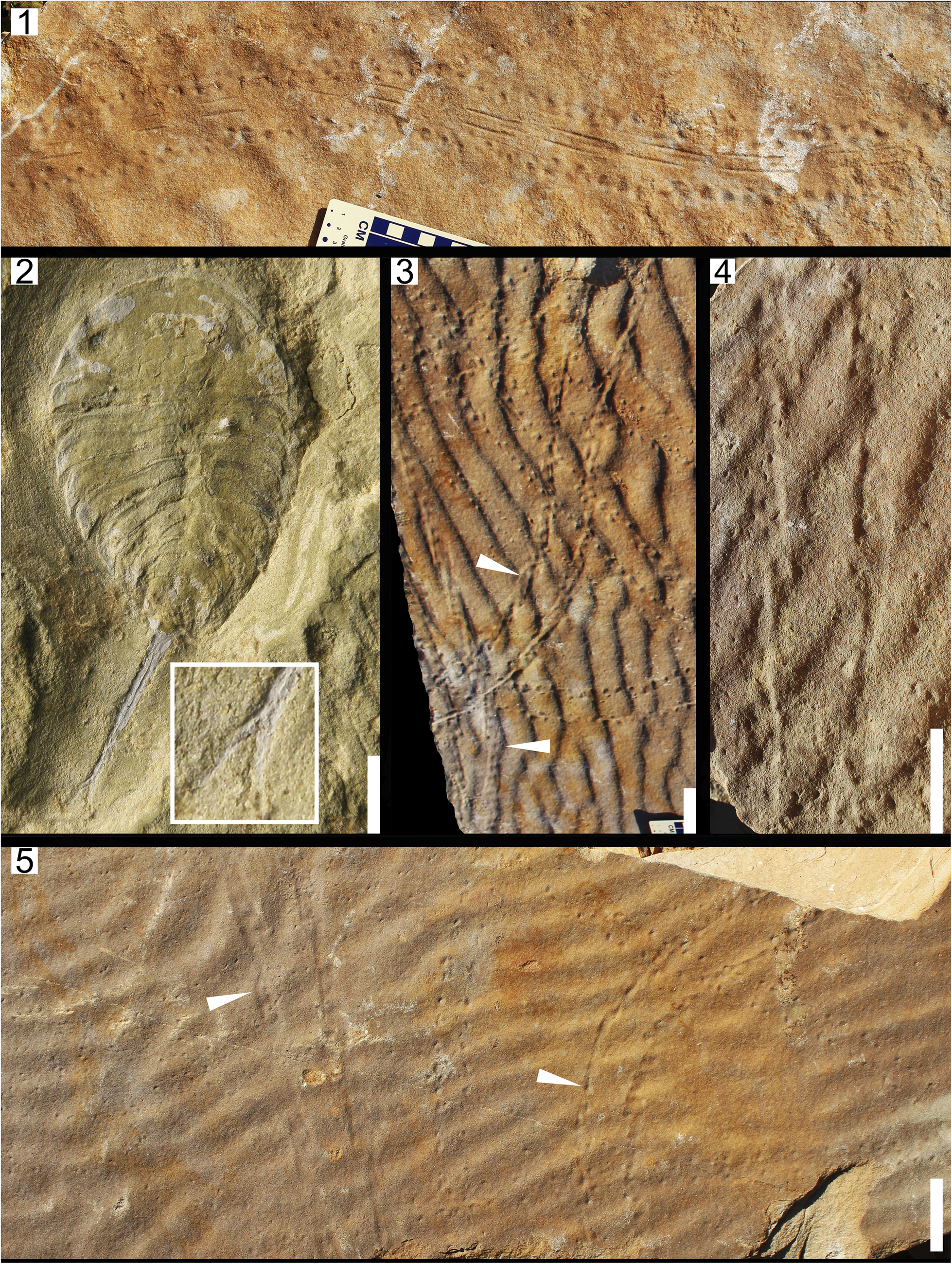
Fossils from the Cambrian of Wisconsin. (1) Siskemia isp., Blackberry Hill; (2) unidentified aglaspidid with detail view of bifurcated telson, UWGM 7714, Saint Lawrence Formation, Furongian, quarry SW of Muscoda, Wisconsin; collected by Gerald Gunderson; (3) two Diplopodichnus isp. (at arrows) sharing a ripple-marked surface with multiple Diplichnites, Blackberry Hill; (4) Diplopodichnus isp., Blackberry Hill; (5) two Diplopodichnus isp. (at arrows) and multiple small Diplichnites, Blackberry Hill. Scale bars = 5 cm.

Figure 4. Long description
A multi-panel display of five photographs numbered 1 through 5.
* Panel 1 at the top shows a wide view of Siskemia isp. trace fossils on a tan rock surface with a blue and white scale bar at the bottom center.
* Panel 2 at the middle-left features a large, oval-shaped aglaspidid fossil, U U G M 7714. It has a segmented body and a long, thin tail called a telson. A white square inset at the bottom right of the fossil provides a detail view of the bifurcated telson tip. A vertical white scale bar is at the bottom right.
* Panel 3 in the middle shows a vertical slab with heavy ripple marks. Two white arrows point to Diplopodichnus isp. tracks that cross the ripples. Multiple smaller Diplichnites tracks are also visible. A vertical white scale bar is at the bottom right.
* Panel 4 at the middle-right shows a vertical view of Diplopodichnus isp. tracks on a textured surface with a vertical white scale bar at the bottom right.
* Panel 5 at the bottom is a wide horizontal view of a ripple-marked surface. Two white arrows point to distinct Diplopodichnus isp. tracks. Numerous small Diplichnites tracks are scattered across the surface. A vertical white scale bar is at the bottom right.
All scale bars represent 5 centimeters.
Description
The external and internal widths of the figured trackway are 4.8 cm and 2.3 cm, respectively (Fig. 4.1). The paramedial impression of the Blackberry Hill specimens are shallow and discontinuous, present mainly at the crests of the ripples. It moves off-center at a bend in the figured trackway, where it extends almost to the trackway margin. The two impressions of the pair are approximately 0.8 cm apart.
Tracemaker
The fact that the paramedial impression moves close to the lateral margin at trackway bends suggests that the structure that produced the paramedial impression was probably a tail-like structure that bifurcated near its posterior extremity. The euthycarcinoid from Blackberry Hill, Mosineia macnaughtoni, as with the euthycarcinoids from other occurrences, lack fossil evidence of a bifid postabdomen or telson (Collette et al., Reference Collette, Gass and Hagadorn2012; Braddy, Reference Braddy2024).
Other occurrences of Siskemia have been attributed to various arthropods, including insects and crayfish-like arthropods (Getty et al., Reference Getty, Sproule, Wagner and Bush2013; Rose et al., Reference Rose, Harris and Milner2021), but they are from much higher stratigraphic positions. Additionally, some phyllocarids have two furci at their posterior extremity. The posterior extremity of the phyllocarid from Blackberry Hill, Arenosicaris inflata (Collette and Hagadorn, Reference Collette and Hagadorn2010), is not preserved in the published specimens; however, even if this phyllocarid had two furci, the estimated width of that species (~1.4–4.2 cm; n = 19) indicates an animal too small to have produced this 4.8-cm-wide trace.
Finally, a Cambrian aglaspidid exoskeleton from Wisconsin (UWGM 7714) has a telson that bifurcates near its posterior extremity capable of producing a paramedial impression (Fig. 4.2). That specimen is from the Furongian Saint Lawrence Formation, which occupies a higher stratigraphic position than the Elk Mound Group at Blackberry Hill (Fig. 1); however, aglaspidids have been reported from the Guzhangian (late Miaolingian) Weeks Formation of Utah (Lerosey-Aubril et al., Reference Lerosey-Aubril, Ortega-Hernández, Kier and Bonino2013). It is possible that Siskemia isp. specimens from the Elk Mound Group at Blackberry Hill were in fact produced by an aglaspidid; however, this determination would require additional fossil evidence, such as body fossils or an unambiguous number of tracks per series that is consistent with that expected from aglaspidids (i.e., <7).
Remarks
The specimen shown in the figures and similar ones from Blackberry Hill are considered to fall within Siskemia due to their possession of paramedial impressions. They are most similar to Siskemia latavia; however, the tracks of the material from this site lack the regular spacing and arrangement of the tracks of that ichnospecies and the others belonging to Siskemia.
Ichnogenus Diplopodichnus Brady, Reference Brady1947
Type ichnospecies
Diplopodichnus biformis Brady, Reference Brady1947.
Diagnosis
Elongate, straight to gently winding, paired furrows. Furrows separated by a distance equal to or greater than the width of the individual furrows and ornamented with indistinct striae or tracks.
Remarks
Minter et al. (Reference Minter, Braddy and Davis2007) suggested that Diplopodichnus and Diplichnites are preservational variants that probably have the same tracemaker. The diagnosis was emended by Keighley and Pickerill (Reference Keighley and Pickerill1996, Reference Keighley and Pickerill1997).
Diplopodichnus isp.
Occurrence
Elk Mound Group, middle to late Cambrian, Blackberry Hill, east of Mosinee, Marathon County, Wisconsin.
Description
Trackway consists of a pair of furrows with a row of shallow to obscure circular tracks located along the furrows. The mean trackway external width is 5.1 cm (sample size 10). The furrows are typically discontinuous, each resulting section being straight, slightly nested within the one behind it, and converging about 13° to the posterior (Fig. 4.4).
Tracemaker
The presence of circular tracks in these specimens suggests that Diplopodichnus isp. was probably produced by an arthropod. The tracks of the apparent mollusk-like producer of Seilacherichnus eremita n. igen. n. comb. are of a distinctively different shape (wedge-shaped).
Remarks
The presence of nested track-bearing furrows as described above has not been reported for other occurrences of Diplopodichnus (Brady, Reference Brady1947; Keighley and Pickerill, Reference Keighley and Pickerill1997; Minter and Braddy, Reference Minter and Braddy2009; Lucas and Lerner, Reference Lucas and Lerner2010; Getty et al., Reference Getty, Sproule, Stimson and Lyons2017). No examples of this form less than 4.2 cm wide are known, yet trackway widths less than 2.0 cm are common for Diplichnites at this site (Gass, Reference Gass2025). Where both ichnogenera are found in the same substrate conditions, as indicated by their close proximity on the same surface, Diplichnites is consistently narrower than Diplopodichnus isp. from this site. None of the Diplopodichnus isp.-bearing surfaces exhibit desiccation or other signs of changed substrate conditions between incidents of trackway production. This suggests that the differences are more likely ontogenetic or taxonomic, as opposed to resulting from sediment properties or taphonomy. Diplopodichnus biformis is the only currently recognized member of that ichnogenus.
Ichnogenus Stiallia Smith, Reference Smith1909
Type ichnospecies
Stiallia pilosa Smith, Reference Smith1909.
Other ichnospecies
Carrickia berriana Smith, Reference Smith1909.
Diagnosis
Trackway consisting of rows of very elongate, wispy striae oriented parallel or subparallel to each other and longitudinally to the axis of the trackway.
Remarks
Walker (Reference Walker1985) moved Carrickia berriana Smith, Reference Smith1909 to Stiallia, due to its presence of striae similar to those of S. pilosa.
Stiallia pilosa Smith, Reference Smith1909
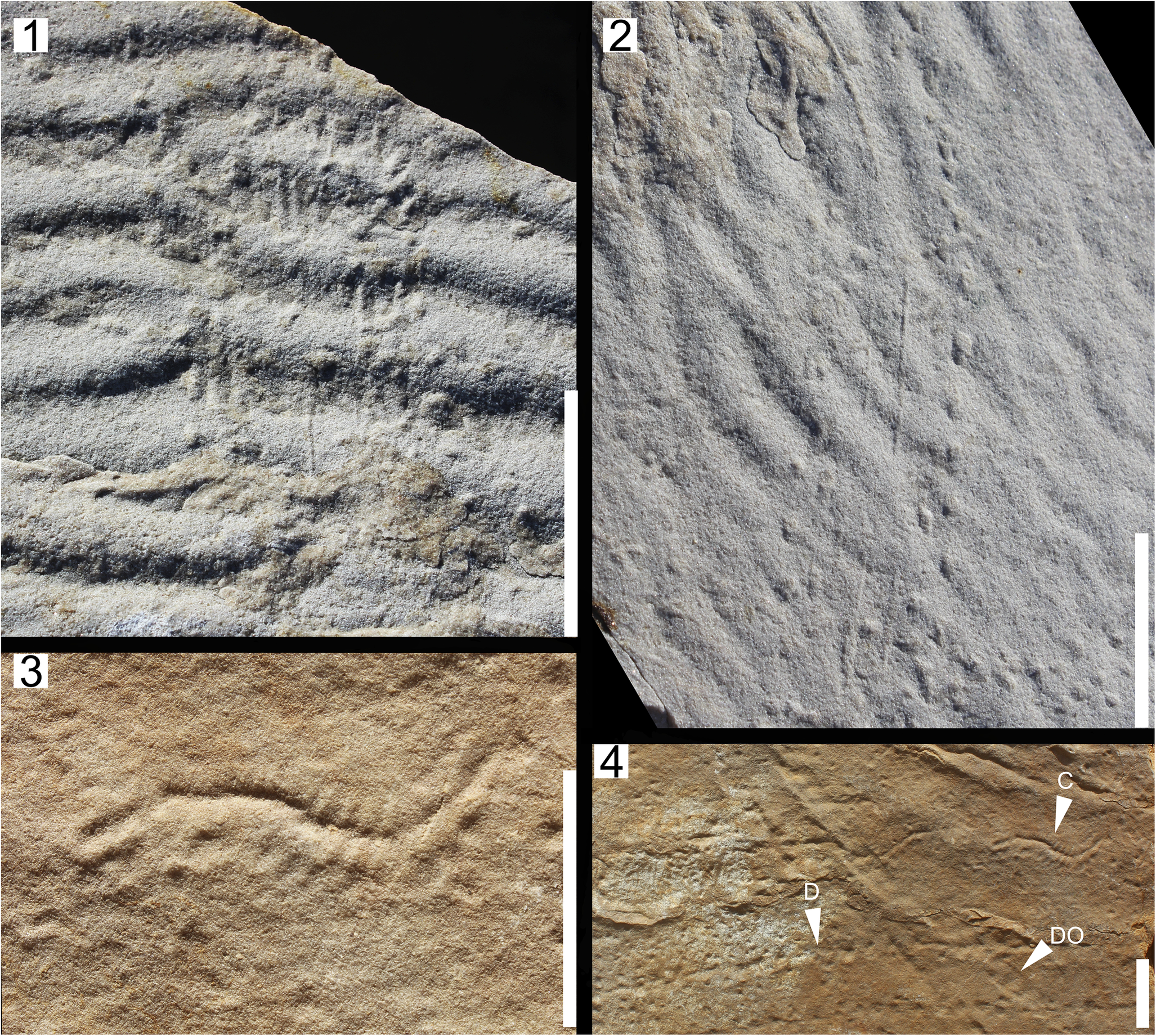
Stiallia, Siskemia, Cochlichnus?, Diplichnites, and Diplopodichnus, Blackberry Hill. (1) Stiallia pilosa, positive hyporelief; (2) Siskemia isp., from same slab as (1), positive hyporelief; (3) Cochlichnus? isp.; (4) slab containing the Cochlichnus? isp. shown in (3) for context; note the substrate disturbances that may be wrinkles in microbially mediated sediment; Abbreviations: C, Cochlichnus? isp.; D, Diplichnites isp.; DO, Diplopodichnus isp. Scale bars = 5 cm.

Figure 5. Long description
A multi-panel photo containing four distinct views of trace fossils.
* Panel 1 at the top-left shows Stiallia pilosa as a positive hyporelief on a grey sandstone surface with horizontal rippled textures. A vertical white scale bar is on the right.
* Panel 2 at the top-right displays Siskemia isp. on the same slab as panel 1, featuring a series of small, aligned indentations running diagonally across a textured surface. A vertical white scale bar is on the right.
* Panel 3 at the bottom-left shows a close-up of Cochlichnus? isp., appearing as a single, sinuous, snake-like trail in tan-colored sediment. A vertical white scale bar is on the right.
* Panel 4 at the bottom-right provides context for the slab in panel 3. It contains three labeled trace fossils. At the top-right, a white arrow labeled C points to the sinuous Cochlichnus? isp. trail. In the center-left, a white arrow labeled D points to Diplichnites isp. At the bottom-right, a white arrow labeled D O points to Diplopodichnus isp. The substrate shows wrinkled textures. A small vertical white scale bar is at the bottom-right corner.
All scale bars represent 5 cm.
Reference Smith1909 Stiallia pilosa Smith, p. 15, fig. 23.
Reference Walker1985 Stiallia pilosa, Walker, p. 294, fig. 9 (a).
Reference Buatois, Mángano, Maples and Lanier1998 Stiallia pilosa, Buatois et al., fig. 14.
Reference Getty, Sproule, Stimson and Lyons2017 Stiallia pilosa, Getty et al., p. 197, fig. 11c, d.
Neotype
GSE 14129 (hypichnon), Old Red Sandstone, Lower Devonian, Scotland.
Diagnosis
A trace consisting of rows of closely spaced, parallel to subparallel grooves.
Occurrence
The Blackberry Hill specimen is from the Elk Mound Group, middle to late Cambrian, east of Mosinee, Marathon County, Wisconsin. Stiallia pilosa has also been reported from the Old Red Sandstone (Smith, Reference Smith1909), the Tonganoxie Sandstone (Stranger Formation), Pennsylvanian, eastern Kansas (Buatois et al., Reference Buatois, Mángano, Maples and Lanier1998), the Rhode Island Formation, Pennsylvanian, Massachusetts (Getty et al., Reference Getty, Sproule, Stimson and Lyons2017), Lower Devonian lacustrine deposits, Scotland (Smith, Reference Smith1909; Pollard and Walker, Reference Pollard and Walker1984; Walker, Reference Walker1985), and Lower Triassic playa lake deposits, Germany (Knaust and Hauschke, Reference Knaust and Hauschke2005), among other occurrences.
Description
The single trace from Blackberry Hill is 5 cm wide and consists of a series of parallel to subparallel striae. A medial impression is lacking.
Tracemaker
The present trace is preserved near one resembling Siskemia, which has about the same width and elongate tracks that are oriented longitudinally to the axis of the trace (Fig. 5.2), suggesting those two Blackberry Hill traces may have had the same producer. If that is the case, then an arthropod tracemaker of this presumptive Stiallia is strongly suggested, such as the euthycarcinoid Mosineia macnaughtoni or the phyllocarid Arenosicaris inflata, which are both found at Blackberry Hill. Euthycarcinoids have been suggested as potential producers of Stiallia (Braddy, Reference Braddy2024). The maximum external width of this specimen (5 cm) is close to the estimated width range (5.1–6.7 cm) of the Blackberry Hill euthycarcinoid M. macnaughtoni, but larger than the estimated width range (1.4–4.2 cm) of the phyllocarid Arenosicaris inflata. Origins proposed for other occurrences of Stiallia have insects or other arthropods as the tracemaker, engaging in swimming (Smith, Reference Smith1909; Walker, Reference Walker1985), a combination of resting and feeding (Buatois et al., Reference Buatois, Mángano, Maples and Lanier1998), and clawing to free themselves when stuck in the mud (Getty et al., Reference Getty, Sproule, Wagner and Bush2013, Reference Getty, Sproule, Stimson and Lyons2017).
Remarks
The description is based on the only known specimen from Blackberry Hill. It closely resembles the specimen of Stiallia pilosa figured by Buatois et al. (Reference Buatois, Mángano, Maples and Lanier1998, fig. 14 center). As with other S. pilosa material, this specimen lacks the medial impressions diagnostic of Stiallia berriana. This is the oldest occurrence of Stiallia on record. Unfortunately, the slab containing this specimen was sold to a private party and shipped out of state before a mold could be produced.
Ichnogenus Cochlichnus Hitchcock, Reference Hitchcock1858
Type ichnospecies
Cochlichnus anguineus Hitchcock, Reference Hitchcock1858.
Other ichnospecies
Cochlichnus annulatus Orlowski, Reference Orlowski1989, Cochlichnus antarcticus Tasch, Reference Tasch1968.
Diagnosis
Regular, sinusoidal, smooth, horizontal trails and burrows resembling a compressed and stretched corkscrew. The overall width of an individual trace may change progressively.
Remarks
The diagnosis has been emended by Häntzschel (Reference Häntzschel and Teichert1975), Keighley and Pickerill (Reference Keighley and Pickerill1997), and Uchman (Reference Uchman1998).
Cochlichnus? isp.
Occurrence
Elk Mound Group, middle to late Cambrian, Blackberry Hill, east of Mosinee, Marathon County, Wisconsin.
Description
A surface trace from Blackberry Hill (Fig. 5.3 and 5.4) consists of a sinusoidal furrow with a series of shallower short furrows projecting outwardly from it on both sides of the trace (Fig. 5.3). A rim of displaced sediment is present at one end. The trace is 8.5 cm long, a maximum of 1.6 cm wide including the outward projections, and a maximum of two millimeters deep. The outward projections are 3–5 mm apart, and they are not present at the ends of the trace, where the trace width is approximately one centimeter. The wavelength is 3.3 cm.; amplitude including outward projections 0.8 cm. Approximately 4 cm from this trace is a somewhat sinusoidal furrow (Fig. 5.4) aligned with and of a similar width and depth as that of the other sinusoidal furrow. It is situated within a region of the surface that appears cracked, wrinkled, and/or bioturbated. The path and termination of that furrow is thus obscured.
Tracemaker
The sinusoidal form and outwardly projecting furrows of the 8.5-cm trace suggest a vermiform body and multiple pairs of appendages, such as the parapodia of polychaetes. Some polychaetes are known to produce sinusoidal traces (Watson and Watson, Reference Watson and Watson2025). No other animals known from the Elk Mound Group beds (a euthycarcinoid, a phyllocarid and scyphozoans) are likely tracemakers. The more obscure furrow described is interpreted to be a possible trail from the same individual.
Remarks
The 8.5-cm trace fossil is considered to be a resting trace, as indicated mainly by its blunt terminations and the rim of displaced sediment present at one end. This specimen shares the surface with multiple Diplichnites and Diplopodichnus isp., but it was produced by a much smaller individual. Cochlichnus, a trace often attributed to nematodes and annelid worms, is also sinusoidal in form; however, it normally ranges from less than 1 mm to 5.6 mm in width (Won and Kong, Reference Won and Kong2023), and the outwardly projecting furrows like those seen in the presumed resting trace have not been reported for that ichnogenus. Furthermore, unlike Cochlichnus, this fossil appears to be a resting trace. For these reasons, and in the absence of other ichnogenera that resemble this trace, the designation of Cochlichnus? isp. is applied herein.
Ichnogenus Climactichnites Logan, Reference Logan1860
Type ichnospecies
Climactichnites wilsoni Logan, Reference Logan1860.
Other ichnospecies
Climactichnites youngi Todd, Reference Todd1882.
Diagnosis
A trail or burrow consisting of undulating bars and furrows oriented at an angle to the direction of travel.
Occurrence
Quartz arenites and orthoquartzites in Wisconsin (Elk Mound Group), Missouri (Lamotte and Gunter sandstones), Texas (Hickory Sandstone), Quebec, Ontario, and New York (Potsdam Group).
Tracemaker
Having previously been attributed to various invertebrates, most authors now think that Climactichnites was produced by the foot of a mollusk-like animal, such as a gastropod (Getty and Hagadorn, Reference Getty and Hagadorn2009; Gass, Reference Gass2015).
Remarks
Climactichnites is represented by two ichnospecies: C. wilsoni (a trail that generally includes lateral ridges); and C. youngi (a burrow that lacks lateral ridges). The variation in morphology is considerable, with many specimens showing gradation between the two ichnospecies and some lacking one of the diagnostic features (Getty and Hagadorn, Reference Getty and Hagadorn2008, Reference Getty and Hagadorn2009; Gass, Reference Gass2015, Reference Gass2025). The diagnosis was emended by Getty and Hagadorn (Reference Getty and Hagadorn2008).
Climactichnites blackberriensis new ichnospecies
Figures 6, 7; Supplemental Data 1, 2 and 3
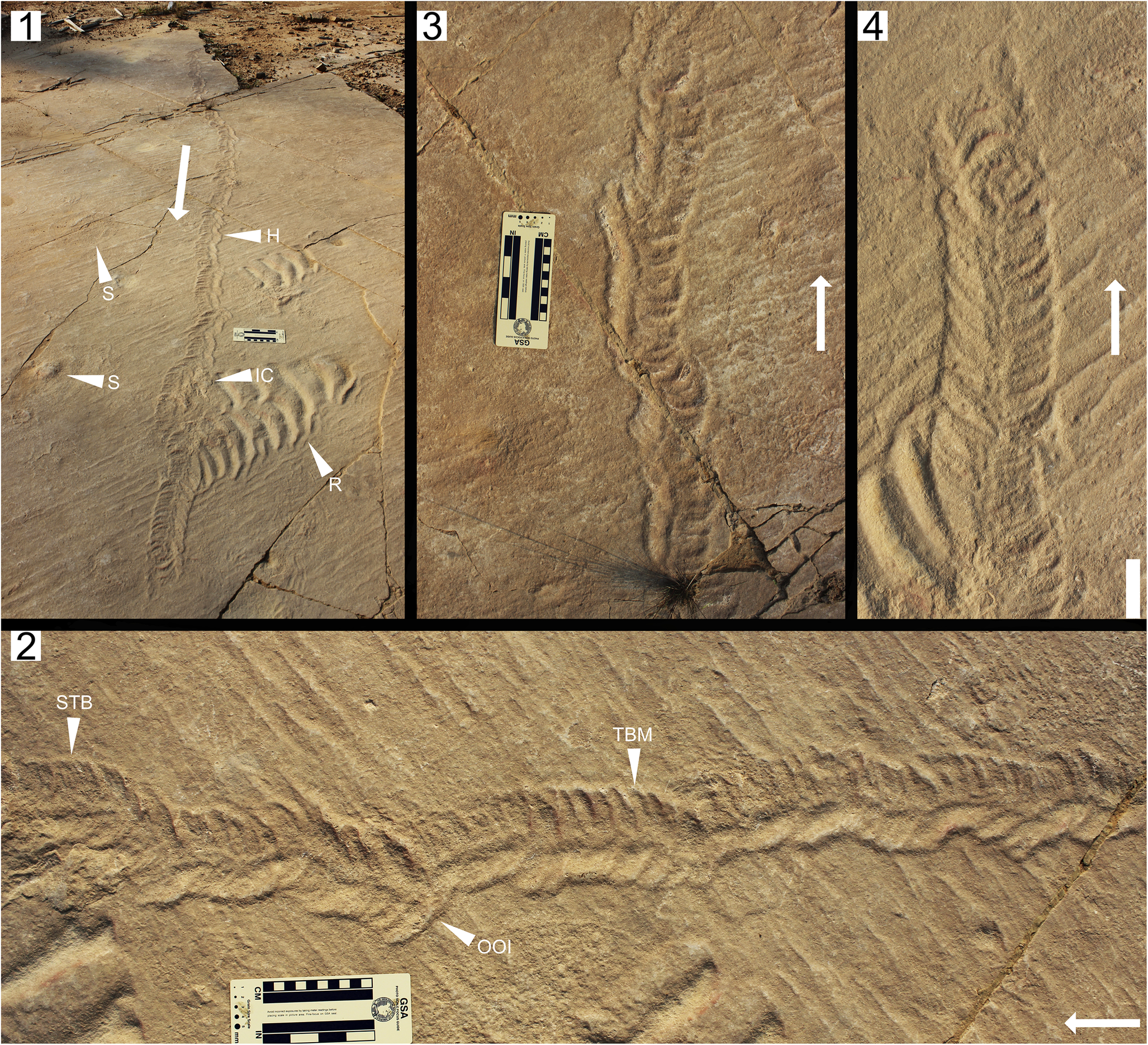
Climactichnites blackberriensis n. isp., holotype (field specimen), Nemke Quarry, Blackberry Hill; arrows indicate direction of travel. (1) Entire trail; anterior termination is at bottom; (2) section of trail showing shifting path and transverse bars that reach lateral margins; (3) section of trail showing strongly curved transverse bars and lack of symmetry; (4) detailed view of presumed anterior termination; scale bar = 5 cm. Abbreviations: H, holotype; IC, irregular clasts; OOI, exceptionally offset overlapping impression; R, ripple marks; S, scyphozoan; STB, short transverse bars where trail contacts ripple marks; TBM, transverse bars reaching lateral margin of trail.

Figure 6. Long description
A multi-panel figure containing four photographs of fossilized trails in a sandy substrate.
* Panel 1 (Top-Left): A wide-angle view of a long, narrow trail on a flat rock surface. A large white arrow points downward toward the trail's anterior termination. Labels include H for the holotype trail, S for two circular scyphozoan impressions to the left, IC for irregular clasts near the center, and R for ripple marks on the right. A 5 cm scale bar is placed near the center.
* Panel 3 (Top-Middle): A vertical close-up of a section of the trail showing strongly curved transverse bars. A white arrow points upward. A G S A scale card is placed to the left of the trail.
* Panel 4 (Top-Right): A high-detail view of the presumed anterior termination of the trail, showing a rounded, bulbous end with overlapping V-shaped ridges. A white arrow points upward and a small white scale bar is in the bottom right.
* Panel 2 (Bottom): A horizontal wide-view panel showing a shifting path. Labels include S T B for short transverse bars on the far left, O O I for an exceptionally offset overlapping impression at a bend in the trail, and T B M for transverse bars reaching the lateral margin. A G S A scale card is at the bottom left and a white arrow points to the left in the bottom right corner.
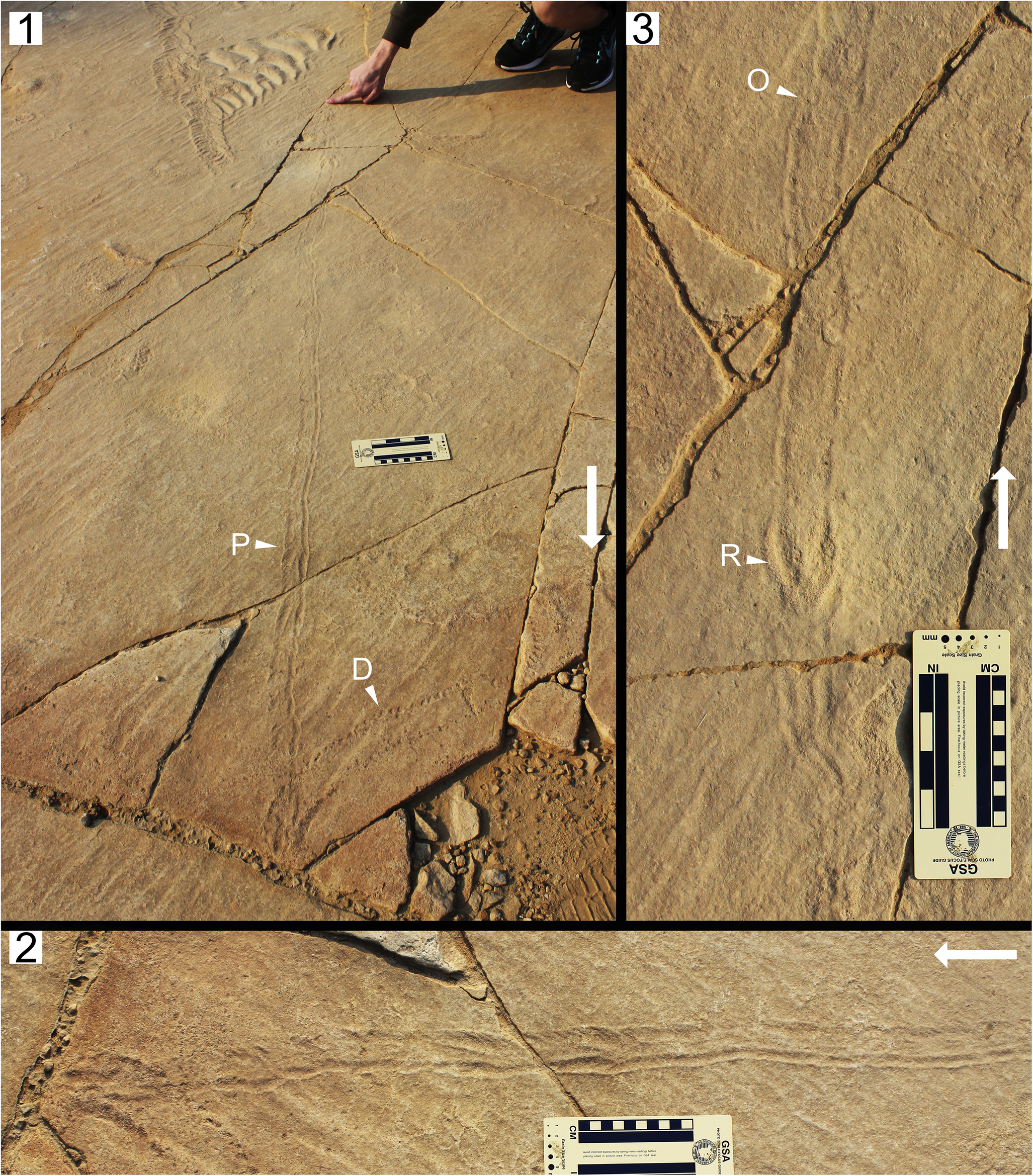
Climactichnites blackberriensis n. isp., paratype (field specimen), Nemke Quarry, Blackberry Hill. (1) Entire trail; finger points to presumed beginning (posterior) of trail; portion of holotype is seen at top; (2) section of trail showing furrows as well as the anteriorly narrowing medial region of trail; (3) presumed beginning of trail is at bottom of image; arrows indicate presumed direction of travel. Abbreviations: D, Diplichnites; O, slight offsetting of trail; P, paratype; R, semi-rusophyciform structure.

Figure 7. Long description
Panel 1 at the top-left shows a wide view of a long, narrow trail on a cracked sandstone surface. A researcher's finger points to the posterior beginning of the trail at the top. A white arrow on the right points downward, indicating the direction of travel. Label P points to the paratype trail. Label D points to a separate Diplichnites trackway. A scale bar is positioned in the center-right.
Panel 3 at the top-right provides a closer view of the trail. A white arrow on the right points upward. Label O indicates a slight offsetting of the trail near the top. Label R points to a semi-rusophyciform structure, which is a wider, more textured impression in the trackway. A G S A scale bar is at the bottom-right.
Panel 2 at the bottom shows a horizontal section of the trail. A white arrow at the top-right points to the left. The trail features distinct lateral furrows and a medial region that narrows toward the anterior. A scale bar is located at the bottom-center.
Type specimens
Elk Mound Group, middle to upper Cambrian, Nemke Quarry (aka, Northern Stone Company quarry), Blackberry Hill, east of Mosinee, Marathon County, Wisconsin, 44.69428, −89.53245. Holotype: 4.4 m trail on an uncollectable bedding surface. Paratype: 2.0 m trail on the same uncollectable bedding surface as the holotype. Plastotypes: Two silicone molds and plaster casts of the key positions of each of the type specimens, as follows: holotype position #1, MPM P39662 (mold) and MPM P39663 (cast); holotype position #2, MPM P39664 (mold) and MPM P39665 (cast); paratype position #1, MPM P39666 (mold) and MPM P39667 (cast); paratype position #2, MPM P39668 (mold) and MPM P39669 (cast).
Diagnosis
Trail consisting of transverse bars and furrows extending to the lateral margins and interrupted along the midline by one or two low longitudinal ridges or a flattened area of inconsistent width along the trace length.
Occurrence
Elk Mound Group, middle to late Cambrian, Nemke Quarry, Blackberry Hill, east of Mosinee, Marathon County, Wisconsin.
Description
The holotype is 4.4 m long and 8 cm wide (Fig. 6.1; Supplemental Data 1; Supplemental Data 3). The presumed posterior extremity of the trail ends abruptly at a fracture in the trace-bearing layer. The trail extends 3.8 m from the posterior extremity to a patch of asymmetrical ripple marks. The trail in that section resembles a series of offset, overlapping impressions, each between 5 and 25 cm long, producing irregular, step-like left and right margins of the trail (Fig. 6.2). The medial ridge is off-center in much of this section, where the transverse bars tend to curve more strongly backward on one side, each having the shape of a “C” in extreme cases (Fig. 6.3), and the opposite side of the trail is inflated. Where passing the ripple marks, the trail deviates slightly from its path, the transverse bars are initially shortened, and parts of the trail and ripples are covered by irregular clasts of material (Fig. 6.1 and 6.2). Anterior to that the trail straightens and becomes more symmetrical, extending for another 25 cm, beyond which it fades out. A few centimeters before termination, the last three transverse bars curve in the opposite direction, which, combined with the posterior transverse bars, create the appearance of incomplete concentric circles (Fig. 6.4).
The paratype is two meters long and ~3.8 cm wide (Fig. 7.1; Supplemental Data 2; Supplemental Data 3). The transverse bars and furrows are generally directed more sharply posteriorly from the central region to the lateral margins than those of the larger trail, and the furrowless central region lacks a medial ridge (Fig. 7.2). The obscure presumed beginning (i.e., presumed posterior extremity) of the trail assumes a trilobate form that continues for approximately 12 cm, at which point lies a blunt, bilobate, arrow-shaped impression pointing posteriorly (Fig. 7.3). This impression somewhat resembles a rusophyciform cubichnion (resting trace). Anterior to that structure the trail has the form of two longitudinal furrows separated by a ridgeless and furrowless region that decreases in width from one-half to on-third the total trail width, as the transverse bars and furrows widen and become more distinct (Fig. 7.2). The trail ends bluntly at a crack in the substrate, where it is met by the trackway Diplichnites (Figs. 7.1 and 7.2). As with the holotype, this trail resembles a series of offset, overlapping impressions (Fig. 7.2 and 7.3), but with less misalignment for most of its course.
Etymology
After Blackberry Hill, the site where the type material was found.
Tracemaker
Having a relatively large width, as well as transverse bars and furrows oriented at an angle to the direction of travel (albeit interrupted in the middle), this ichnotaxon is considered to fall within Climactichnites. As stated earlier, that ichnogenus probably had a mollusk-like tracemaker; however, the highly unusual morphology of these two trails in relation to known Climactichnites, such as its resemblance to a series of offset, overlapping impressions, and the continuation of its bars and furrows to the lateral margins of the trail, might indicate a different tracemaker. The bilobate form of this ichnospecies, in addition to the semi-rusophyciform impression near one end and Diplichnites at the other end of the paratype, are features often shared with Cruziana, which is an arthropod trackway (Seilacher, Reference Seilacher2007); however, the transverse bars and furrows of Climactichnites blackberriensis n. isp. are more robust than the striae of Cruziana. Furthermore, the large amount of energy that would be required to displace this much sediment, particularly for the holotype, seems excessive for an arthropod, whereas the dense muscular foot of the mollusk theorized to have produced Climactichnites appears to have moved approximately the same amount of sediment while producing C. wilsoni. For these reasons, we conclude that the tracemaker of C. blackberriensis n. isp. was most likely a mollusk.
Remarks
The stated orientation of this trail is based on two factors: (1) the V- or U-shaped transverse bars of Climactichnites wilsoni generally open toward the anterior (Getty and Hagadorn, Reference Getty and Hagadorn2008); and (2) as indicated above, each “impression” of the holotype partially overlaps the one behind it. Whichever “impression” of a trail overlaps the adjacent one can be assumed to have been produced later, and therefore lies anteriorly to the one that is overlapped.
Concentric circular rings associated with Climactichnites have been reported previously (Yochelson and Fedonkin, Reference Yochelson and Fedonkin1993, p. 27, fig. 34). In that case they were present within a partial Musculopodus (i.e., the resting trace of the Climactichnites tracemaker) and adjacent to Climactichnites, preserved on a slab from the Potsdam Group of Quebec. Getty and Hagadorn (Reference Getty and Hagadorn2009) suggested that the concentric structures associated with Climactichnites may be collapsed sand volcanos, because they are also found on other areas of the same slabs, not associated with the trails. However, the “circular” structure in the holotype of Climactichnites blackberriensis n. isp. does not resemble a collapsed sand volcano, instead matching the morphology of the transverse bars and furrows in that region. The noted structure may either mark the animal’s point of entry into the substrate, whereby the small portion of the trail that extends past the circular structure may be where the animal touched the substrate as it worked its way into the sediment, or it may mark the region of transition to a partial Musculopodus (Getty and Hagadorn, Reference Getty and Hagadorn2009). Getty and Hagadorn (Reference Getty and Hagadorn2009, p. 761, text-fig. 6F) reported cases in which one or two bars of a Climactichnites trail are oriented opposite the rest of the bars.
The unusual method of advancement of Climactichnites blackberriensis n. isp. has not been reported previously for Climactichnites. This may represent a feeding strategy different from the one reported previously for that ichnogenus. In the case of the holotype, the close spacing of the transverse bars as the animal entered the region of the large ripple marks could represent a slowing of advancement as it fed on a scyphozoan (Fig. 6.2, left). The irregular clasts of material seen as the animal entered that region could be the remnants of a scyphozoan partially consumed by the trail-maker, as apparent scyphozoans are present on the sediment to the left and right of the trail (Fig. 6.1; Supplemental Data 1; Supplemental Data 3).
Yochelson and Fedonkin (Reference Yochelson and Fedonkin1993), Seilacher-Drexler and Seilacher (Reference Seilacher-Drexler and Seilacher1999), and Getty and Hagadorn (Reference Getty and Hagadorn2009) interpreted Climactichnites wilsoni to be a grazing trace, but that was on the basis of its smooth, meandering paths, and it is assumed that microbes in microbial mats provided the food source. If C. blackberriensis n. isp. does in fact include evidence of feeding on a scyphozoan, it would be the first recognized fossil evidence of this, and it would support the idea that feeding on stranded scyphozoans was an incentive for certain animals to come ashore, as it is for certain extant mollusks, such as the marine gastropod Bullia (Harris et al., Reference Harris, Harris and Nel2019). It should be noted, however, that the fragments may instead be clasts of microbially bound sediment. Further analysis of this material is needed to confirm or falsify this hypothesis. It is uncertain whether C. blackberriensis’ n. isp. unusual features and method of advancing forward were due to a specific behavior or a different tracemaker, and to what extent environmental or taphonomic conditions may have affected these features.
Conclusion
The diversity of the traces found at Blackberry Hill shows that tidal flats formed an important transition zone that allowed aquatic animals to venture onto dry land regularly. This may have been an important step towards complete terrestrialization. Here the tracemakers could avoid the pressures of deeper-water predators and facilitate their access to other food sources. The presence of Protichnites, Diplopodichnus isp., Stiallia pilosa, Siskemia isp, Seilacherichnus n. igen., and Climactichnites ispp. suggests a fauna dominated by arthropods and mollusks, while other ichnotaxa, such as Cochlichnus? isp., indicate the possible presence of polychaetes. Further study of the Blackberry Hill strata is likely to reveal additional trace fossils and ichnotaxa that will clarify and develop understanding of the identities and behaviors of the biota of Cambrian siliciclastic tidal flats.
Acknowledgments
The Krukowski and Nemke families, M. Biller, and J. Cadman granted access to the sites. J. Tellekson, K. Gass, and L. Gass assisted in the field. S. Braddy provided many helpful comments on an earlier draft of the manuscript. Collections management of MPM, PRI, UWGM, WM/P, and YPM provided access to material in their institutions. J. Hendricks coordinated MPM’s accession and processing of materials. A. Lerner and J.-P. Zonneveld provided some of the references. L. Buatois, M. Burton-Kelly, and A. Rindsberg reviewed the manuscript. We thank all of these individuals for their assistance.
Competing interests
The authors declare none.
Data availability statement
Data available from the Zenodo Digital Repository: https://doi.org/10.5281/zenodo.18476277, https://doi.org/10.5281/zenodo.18476589, https://doi.org/10.5281/zenodo.18476686.