INTRODUCTION: SHAPING POLITICS IN CONTEMPORARY AFRICAN CITIES
Studying the sources of power in urban Africa and the systemic changes that they bring about is even more important today than it was at the time of publication of the earliest inquiries into African urban politics (Banton Reference Banton1957). The challenge of how to govern burgeoning, perennially underfunded African cities grows with every urban birth and in-migrant. And yet such urban centres also hold promise for political action and locally driven democratic change. The continent's on-going urbanisation thus raises a broader question about the kinds of local governance that are fiscally and politically possible in deprived urban settings. From a developmental perspective, such environments require prioritisation and therefore a focus on efficient service provision. This conceptualisation, however, renders governance virtually indistinguishable from the core tasks of urban management (Myers Reference Myers2011: 104–9). Conversely, a less reductionist notion of governance for the African urban spectrum withstands the technocratic temptation to exclude politics as a source of interference, and acknowledges that the distribution of power in cities is a critical determinant not only for service outcomes but for the practice of democracy more generally, especially in the case of primate cities that host a significant percentage of the country's population and historically, as well as in the present, have determined the political heartbeat of the rest of the country. This broader notion of governance necessitates an analysis of political systems of checks and balances that enable or constrain the provision of urban services. At the same time, it needs to ask critical questions about inclusion, agenda setting and power by investigating the sources and use of resources of political agency, and thus ‘getting at the shifting power dynamics of decision-making in an era when the roles of states [in Africa] are in flux’ (ibid.: 106).
Historically, governance in and of these cities was driven by colonial municipal administrations controlled remotely from capital cities in the global North, thus ‘playing a critical role in the process of colonial political domination and in the extraction of profit by colonial business enterprise’ (Harrell-Bond et al. Reference Harrell-Bond, Howerd and Skinner1978: 309). However, the emergence of formally independent states has brought about local political constellations that are not only more diverse in their constituencies but also more fluid and muddled. These political realities have often forced urban dwellers to rely on informal networks, not only to gain access to the most basic level of services but also as a means to exercise voice. Although such micro-level coping practices vis-à-vis state structures – often seen as incapable and unwilling to respond to residents' demands – arguably exemplify the resourcefulness of Africa's urban dwellers (Simone Reference Simone2006), they have hardly been successful in transforming urban political economies at the systemic level. How is it that in spite of half a post-colonial century's local as well as international efforts to improve their fates, most African cities remain stuck in a ‘limited voice, limited services' trap?
In a recent article, Resnick (Reference Resnick2011) has analysed the challenges faced by the City Council of Lusaka, Zambia in delivering services. She argues that these result primarily from incomplete fiscal decentralisation whereby a devolution of responsibilities is not matched by a downward reallocation of resources. Resnick explains that the City Council's struggles have predominantly been the result of inter-party power politics, with the national party in power actively constraining the opposition-led City Council in order to prevent it from developing successful initiatives, and thus creating a springboard for future electoral victory at the national level (ibid.: 142–3). She suggests that such cross-scalar political competition, combined with incomplete decentralisation, is emblematic of African politics today, and that donors' current preference for direct budget support to national governments allows parties in power to choke their opposition by minimising its ability to satisfy voter demands (ibid.: 161–2).
I wholeheartedly agree that ‘autonomy is not so much a legal status as a real practice’, as Batley and Larbi (Reference Batley and Larbi2004: 105) have suggested, which renders the politics of gaining or preventing real autonomy an important object of urban inquiry. I also agree that ‘cities are sites of contestation [marked by] deeply contested politics’, which in turn also frame policy outcomes (Robinson Reference Robinson2006: 166). It is true that decentralisation – arguably one of the ‘ephemeral aid trends’ of the past decade (Périn & Attaran Reference Périn and Attaran2003: 1218) – is often constrained by central governments' primary interest in political stability, including the preservation of its own rule; externalising, or localising, responsibility for poor performance; and preventing the creation of local political platforms that could foster oppositional politics (Eaton & Connerley Reference Eaton, Connerley, Connerley, Eaton and Smoke2010; Rakodi Reference Rakodi2002: 57). Moreover, I concur that such dynamics frequently characterise urban politics in Africa, and that a logical extension of this insight is that studying the ‘politics of place’ is at least as critical as inquiries into the ‘place of politics’ (Burns et al. Reference Burns, Hambleton and Hogget1994). Where I disagree, however, is that I fear that a focus on local–national dynamics risks underestimating the role of international agencies in the process, especially in capital cities of the poorest African nations and those emerging from armed conflict. These cities provide new clues to understanding the inherent frictions between local and global agendas of urban development. Whereas the case of Lusaka suggests that international agencies frame political outcomes in cities indirectly, as a result of giving direct support to national rather than local governments, I posit that their role is, in fact, much more tangible and direct.
In order to understand the impact on the urban poor of such cross-scalar politics within the same geographic locale, we need to focus our analysis on the sources of political leverage that donor agencies exert over urban institutions, as well as the conflicts which result from competing interests and agendas at different scales of the political system and over time. The historical trajectory of Freetown, the capital city of Sierra Leone, provides an opportunity for doing so. Over a century after Freetown had been praised as ‘a charming town’ by European envoys in 1899 (Utzinger & Keiser Reference Utzinger and Keiser2006: 518), the British weekly The Economist argued that the city – one of a ‘few cases [of] complete urban breakdown’ (Clapham Reference Clapham2006: 102) as the result of a decade-long war – ‘symbolises failure and despair on the African continent’ (see Jones & Chant Reference Jones and Chant2009: 194). The last remaining United Nations (UN) troops left the country at the end of 2005 (Doyle Reference Doyle2005), leaving behind a ‘postconflict capital … for a region that is not yet postconflict’ (Hoffman Reference Hoffman2007: 404). Unlike Lusaka, the city that Resnick analyses in depth, Freetown today remains one of many economically isolated urban centres on the African continent (Onyebueke Reference Onyebueke2011). When the UN troops left, ‘donors provided around 50% of [the Sierra Leonean] Government revenue’ (Jackson Reference Jackson2005: 50), and although resources external to the country have always mattered greatly in shaping the city's political economy throughout the last century, the magnitude of foreign aid poured into Sierra Leone's political system (notably not into its economy) in the aftermath of the country's armed conflict was unprecedented. Neither the prominence of anti-corruption (rather than service delivery) as a central tenet of public policy, nor the reinstitution of chieftaincy as a pillar of local governance would have been possible without donors' fiscal leverage over domestic politics. Indeed, never before in Sierra Leone's post-colonial history have external actors wielded so much control over the country's political agenda as during the past decade.
In the remainder of the article, I illustrate how as a result of this fiscal leverage, the post-conflict conduct of politics in Freetown has been determined primarily neither locally nor jointly by local and national entities, but more commonly through collusion between national and international entities. This collusion reduced Freetown city council to a merely performative role, conveying to outsiders that while local government had been revived under international stewardship, in reality it remained crippled with respect to its ability to actually respond to residents' demands. I argue that this disempowerment of local governance resulted directly from donor agencies' implementation of the perceived panacea of decentralisation on the one hand, and their simultaneous horror of local politics on the other. I begin by tracing the urban history of Freetown that underpins these dynamics and also illustrates parallels between colonial and contemporary influences on local politics. I then offer an overview of cross-scalar post-war politics and explain how these have affected development agendas for Freetown, with a focus on the emergence of decentralisation as a central component of the post-war reconstruction agenda. I present a case study of urban waste management in Freetown to anchor these arguments in the politics of a specific urban service. I conclude by revisiting a central question in the urban politics literature (‘who governs?’) which in light of the findings of this research, I argue, needs to be extended spatially in order to provide a suitable framework for studying urban politics in Africa.Footnote 1
HISTORICAL ANALYSIS OF URBAN INSTITUTIONAL CHANGE
Freetown's origin as a human settlement is commonly attributed to the arrival in Sierra Leone of 1,200 freed black slaves from Nova Scotia in January 1792. In 1796, the colonial British rulers ‘imported’ Africans from Jamaica (Maroons) to enforce taxation and governance structures, which safeguarded, at least temporarily, the functioning of what was to become a vibrant trading community. In 1807, the Temne tribe, from which the land had been purchased, were prohibited from settling within an eleven mile radius of the city, and native houses were subject to destruction (Doherty Reference Doherty1985: 150). In 1808, the Freetown Colony – the rest of what today is known as Sierra Leone was a British Protectorate – was chosen as the place of liberation for former slaves who had been freed after the capture of trader vessels transporting this human commodity along the African coast. First constituted in 1799 through a Charter to the Sierra Leone Company, Freetown Municipality vanished shortly afterwards, when the colonial administration cancelled its magisterial rights in 1821. It took over seventy years for Freetown to officially re-emerge as an administrative entity, owing to the ever-increasing importance of the city as an economic centre. Following the re-establishment of the Freetown Municipal Council in 1892, the city's first mayor was finally elected in 1895, and only three years later Freetown was made the capital of the Sierra Leonean hinterland (Banton Reference Banton1957: 10).
By the time Sierra Leone gained independence from the United Kingdom in 1961, roughly 70% of the Freetown electorate consisted of Creole voters, many of whom sympathised with the newly founded All Peoples Congress (APC), set to challenge the national government formed by the Sierra Leone People's Party (SLPP). Echoing pre-independence Colony versus Protectorate politics, the outcome of the first post-independence municipal elections in the spring of 1964 was therefore not surprising, with eleven of the eighteen seats going to the APC. This resulted in the election of Siaka Stevens as the new APC mayor of Freetown. In response, SLPP Prime Minister Margai vowed to diminish the influence wielded by the APC in the capital city by setting up additional local party organisations and youth groups outside Freetown, and focusing political efforts on SLPP-governed provinces where he urged even stronger ties with traditional chieftaincy institutions (Cartwright Reference Cartwright1970: 191, 200). A crucial bifurcation point in the institutional history of Freetown politics followed a few months later when, in September 1964, a member of the APC challenged the legality of the city council, arguing that the SLPP had nominated a candidate from a ward in which he was not a resident. Seizing the opportunity, Margai dissolved the Council and demanded new elections. National politics thus for the first time directly altered the structure of Freetown's government (Cartwright Reference Cartwright1970).
The turbulent first half of the 1960s was followed by short-lived alliances of constantly changing cliques of military leaders in Sierra Leone between 1966 and 1971 (Barrows Reference Barrows1976: 217, 225–6). APC politicians increasingly succeeded in instrumentalising youth societies for their political purposes (Nunley Reference Nunley1987: 215; cf. Keen Reference Keen2005: 58–9). A dramatic change occurred in 1972 when the newly elected national leader – and former Freetown mayor – Stevens began suspending town councils across the country. In an effort to consolidate APC control, President Stevens abolished Freetown city council in 1984 and in its place appointed a Management Committee by installing several of his political allies as councillors, a move that marked the final chapter of subsidiarity in pre-war Sierra Leone. During the remaining years until the outbreak of the civil war in 1991, Freetown's infrastructure declined and the perpetual reduction in social services and public revenues led to increased ghettoisation, and an intensification of housing competition to the detriment of hundreds of thousands of the city's more vulnerable residents (Abdullah Reference Abdullah2002: 206; Baland et al. Reference Baland, Moene and Robinson2010: 4614; Zack-Williams Reference Zack-Williams2002: 298).
Although foreign aid monies continued flowing during the 1980s, in spite of growing international concerns about a lack of accountability in Stevens's one-party state, the IMF eventually stopped lending in 1990, causing the already dilapidated administrative apparatus in Freetown to fail altogether (Abrahamsen Reference Abrahamsen2001: 89). In April 1992, a group of junior army officers staged a coup and installed themselves as the National Provisional Ruling Council (NPRC). Although the international community at first appeared to accept the coup, it developed a more critical position in response to the execution of twenty-six alleged organisers of a countercoup in November the same year. Within Freetown, however, the junta initially enjoyed strong support, not least because it instituted a monthly clean-up and beautification campaign (‘Cleaning Day’) in Freetown and other provincial centres (Conteh-Morgan & Dixon-Fyle Reference Conteh-Morgan and Dixon-Fyle1999: 131; Opala Reference Opala1994).
During the following three years, about 600,000 internally displaced persons sought refuge in Freetown in order to evade the violence raging in the country's eastern districts, temporarily inflating the city's population from a pre-war level of 731,000 to an estimated 1.3 million (Conteh-Morgan & Dixon-Fyle Reference Conteh-Morgan and Dixon-Fyle1999: 129).Footnote 2 When in 1995 a new mayor was finally appointed under Management Committee legislation, the central government contributed a mere US$50,000 to the 1996 municipal budget (Rosenbaum & Rojas Reference Rosenbaum and Rojas1997: 535), and the only significant income, US$2.5 million, was derived from property taxes based on a 1952 property appraisal (ibid.). Neither the 1996 national elections, won by the SLPP, nor the subsequent coup by the Armed Forces Ruling Council (AFRC) in May 1997, had any impact on governance mandates or budgets for Freetown. City government at the time was merely an empty shell and most offices of the Municipality were abandoned.
In January 1999, a rebel attack on Freetown marked a turning point with regard to international attention paid to the conflict. Zack-Williams (Reference Zack-Williams2002: 308) points out that ‘it was only after rebels breached the defences of the capital that the world of press took notice of the horrors and widespread violation of human rights by both sides in the civil war’. Before that, Freetown, despite some acts of extortion and looting, had remained a ‘bubble of relative normality’ (Keen Reference Keen2005: 168). Suddenly, violence was imminent. In addition to over 7,000 civilian casualties within two weeks (Keen Reference Keen2005: 228; Sesay & Hughes Reference Sesay and Hughes2005: 56), the attack left 1,400 houses reduced to rubble and led to the displacement of tens of thousands of residents, with estimates ranging from 22,000 to 51,000 people (ACF 2001: 19; Keen Reference Keen2005: 247; NRC 2003: 3; Zack-Williams Reference Zack-Williams2002: 310). Although several West African states had troops stationed in and near the capital city under an Economic Community of West African States Monitoring Group (ECOMOG) mandate, these were no match for the rapidly advancing, oftentimes drugged and inebriated bands of rebel fighters. In response to a ‘panicstricken report’ from the UN claiming that Freetown was poised to fall to the rebels and a similarly alarming dispatch by the newly appointed British High Commissioner (Williams Reference Williams2001: 153–4), the UK deployed a small expeditionary force. About 250 British soldiers thus helped end the war within a year, and a peace agreement was signed in 2002. In the same year, presidential elections, urged by the international donor community, again rendered the SLPP the clear winner and officially reinstated Ahmad Tejan Kabbah as the country's democratically legitimised leader.
ENTER THE AGENCIES: FREETOWN AS AN INTERNATIONAL ARENA
Within weeks of the repulse of the 1999 attack and the subsequent return of relative normalcy in the capital city, bilateral and multilateral aid agencies based in Freetown converged on decentralisation as the recipe for both post-war transition and long-term development, as most of them ‘agreed that the highly centralised system of government was a major contributing factor to the war during the 1990s and the World Bank, the United Nations Development Programme (UNDP), and DFID (the UK's Department for International Development) in particular, placed a strong emphasis on decentralisation as part of their post-war reconstruction efforts' (Jackson Reference Jackson2005: 51). Workman (Reference Workman2011: 53) offers a similar interpretation, noting that ‘the rapid decentralisation of power in Sierra Leone in 2003–04 was legitimised by an emerging narrative about the causes of the civil war, which characterised the centralised state's exclusion of the majority of Sierra Leoneans from the political process and its failure to provide local public goods as drivers of violent dissent’. Donors' furtherance of decentralisation thus dovetailed ‘with government officials’ [perception of the] pre-war period as some kind of perfect system that need[ed] to be rebuilt’ (Jackson Reference Jackson2005: 56). Remarkably, this strategy also entailed the centralisation of decision-making in the areas of education and health, as well as the reinstitution of paramount chiefs as pivotal agents in local governance. Although these moves arguably undermined donors' alleged commitment to strengthening local democracy – chiefs were appointed, not elected, community representatives – they were considered necessary concessions to check the leverage of political parties at the sub-provincial level and forge nationally coherent policies. Indeed, donor agencies were able to claim legitimacy for selective decentralisation by linking their agenda to demands from emerging civil society groups such as the Network Movement for Justice and Development, which argued for a fairer distribution of chiefdom level resources.
International agencies thus capitalised on local expectations while reshaping local institutions in accordance with a vision of depoliticised, technocratic development, rather than allowing these expectations to feed into a dynamic process of domestic policy formulation. ‘In early 2003, that was when we launched the government's agenda, and when we realised the potential of decentralisation’, a senior staff member of an international agency told me in November 2004 (foreign staff, MLA 1, 2004 int.). The national government's agenda was being characterised as having been ‘launched’ by donors, after the latter had ‘realised the potential’ of reorganising the country's political system. Another aid official working for a bilateral agency explained what he considered the typical deliberative process in post-war Freetown as follows:
A lot of communication here is very informal: [Name of bilateral agency head] will call up [country representative of multilateral agency], or so. It's a bit of a microcosm … I mean, to justify the situation, there are so few donors … Two years ago we and the [World] Bank went out on two different things: central reform and decentralisation. The deal was struck to work both on each. So when they left Freetown that was the deal, but then a presentation was made to the Bank's board, and they decided to focus on decentralisation. So we were caught on the back foot. So we then said, okay, we are going to focus on government reform through direct budget support. And we also knew that the European Union was coming along with a EUR 8 m package for decentralisation reform support, and the Bank was really blasting away with all their work on local councils.
(Foreign staff, bilateral agency 1, 2004 int.)Not only were major political reforms thus conceived by international agencies, but responsibilities ensuring that these reforms were put into practice were also divided among them, without any significant consultation with Sierra Leonean stakeholders. Following a Multi-Donor Governance Roundtable Meeting held in August 2002, the national government in collaboration with UNDP and DFID established a task force on Decentralisation and Local Government Reform to combine efforts and, with the support of the office of the president, increase pressure on government ministries. The government also approved the creation of a Decentralisation Secretariat funded by the World Bank and DFID, complementing the work of the country's Ministry of Local Government and Community Development (MLGCD), created in 1998 as a concession to the ‘good governance’ agenda favoured by the World Bank and other influential donors (Fanthorpe Reference Fanthorpe2001: 381). In consultation with the Secretariat and the Ministry, the task force then produced an internal policy paper (UNDP 2003), which was, according to a senior international official interviewed in November 2004, the ‘foundation on which the donor agenda for the decentralisation process in the country was built’ (Foreign staff, MLA 2, 2004 int.). The paper justified the urgency of moving forward with decentralisation as the ‘cornerstone for stimulating economic growth and development in the rural areas’ (UNDP 2003: 8, emphasis added). Even though the authors admit an ‘infrequent presence of some important line ministries’ during the drafting process, they concluded that the national government had been committed ‘in order to forge a national consensus on local government matters’ (ibid.). Nonetheless, Jackson (Reference Jackson2005: 51) has argued that ‘given the internal politics of the [national] government … it is difficult to say categorically that all [ministerial] officials were in favour of decentralisation. However, officials knew that this was a route to obtaining external funding. There may, therefore, have been an incentive for officials to “say the right things” to external donors, particularly the World Bank and UNDP.’ The paper argued further that ‘local government institutions are expected to play a leading role in all aspects of post-conflict development in Sierra Leone’ (ibid.: 14), and recommended indirect elections of mayors and chairpersons of local councils (ibid.: 29). It subsequently served as the draft for the 2004 Local Government Act, written without any input by sub-national political stakeholders. Freetown's chief administrator at the time complained that ‘the Freetown City Council is governed by an Act that was passed by [national] parliamentarians, and almost all of these parliamentarians are SLPP’ (SL staff 1, city administration, 2004 int.).
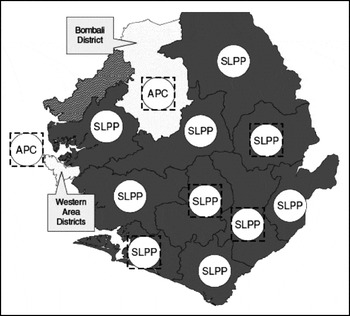
Whenever donors thus considered Sierra Leonean stakeholders in the context of major political reforms, this consultation focused on national rather than local stakeholders. Although dozens of meetings were organised and held with villagers in the run-up to the first local elections in decades, these meetings reportedly had more of a ‘validating’ character, with the key aspects of the new governance structure already set in advance (SL CSO 1, 2004 int.). One of the few issues that had not been determined in advance was the question of whether or not local elections should be held on a partisan basis. The 1991 constitution made explicit provisions for presidential elections, parliamentary elections and local council elections alike to be conducted in a partisan manner. Arguments in favour of upholding this provision, brought forward mainly by the parties themselves, posited that it would be unrealistic to separate local candidates from their existing party affiliations and, more broadly, that excluding parties would harm the nascent democracy. The APC strongly supported this view. Counter-arguments against partisanship, championed by most international agencies, emphasised the political risk of a marginalised opposition and, in the words of a high-level UNDP representative, a ‘belief that Freetown would otherwise dictate candidates and policies’ (ICG 2003: 19). The SLPP-dominated administration had strong incentives to support the international position, since it was in the national government's interest to preserve the status quo and deny the APC a political platform for opposition politics. Although their motives were entirely different, the question of partisan politics thus became another area of interest convergence between international and national stakeholders; but it pitted this coalition against the national constitution, and the latter ultimately prevailed. Local government elections in May 2004 were held on a partisan basis. The APC lost in all but two districts of the country, but won Freetown proper by a large margin and appointed Winstanley Bankole Johnson as mayor. Figure 1 illustrates this outcome. Table 1 summarises the resulting composition of the Freetown city council in the Western Area District (Urban).
District-level election outcomes


Despite the history of APC dominance in the capital city and its ethnic underpinnings (Stirling Reference Stirling2011: 237), explanations for this outcome among informants centred on a widely shared perception that Freetown voters had greater access to information. ‘People were being discouraged to go out on the street, so they expressed their protest in voting for the APC’, an employee of a non-governmental organisation argued. ‘Cost of living has risen significantly recently here in Freetown, so people really felt the burden’ (Foreign staff, NGO 1, 2004 int.). ‘This was a protest vote’, a local youth leader confirmed. ‘At the time of the elections, the national government was not performing. The price of fuel went up twice, and costs of basic foodstuff also increased. So the people protested against the government and sent a message to them … This was a Western Area phenomenon; because the bulk of the [city's] population is literate, they could exercise their right, as opposed to those in the provinces who are mainly voting on tribal lines’ (SL CSO 2, 2004 int.). APC rank and file were, not surprisingly, eager to endorse this interpretation. As their chairman said at the time:
The people in Freetown … are the barometer of the country; they represent the true picture. The people in the hinterland do not have much education. Sometimes they do not even understand the interests of their communities … The chiefs are governing the provinces, but they are the manipulators of the SLPP and the elections … Here in Freetown, you have all the education … People are more aware here in Freetown. So when it came to the Freetown City Council elections, there was very little the SLPP could do’.
(SL opposition leader, 2004 int.)Such references to a long-standing discourse upheld by the urban Creole population vying for power under British colonial rule were complemented by statements that related the APC's victory to acute post-war concerns. ‘The [SLPP] government is stealing more now than before’, one civil society organiser in Freetown lamented, ‘now that there is a lot of donor money coming in … Within six months you could see all over the city how houses are being built … Where is all this money coming from? This is what the people ask’ (SL CSO 1, 2004 int.). Another respondent working in the non-governmental sector added:
The ministers, they are building houses for millions of Leones, on the hillsides … They should set up factories for the youths, but for their self-interest they are just building a house, and then they go to Mecca and drive around in vehicles, while the rest is going to suffer. Even though our country has been experiencing war, our government has no interest in us.
(SL CSO 3, 2004 int.)Expressing frustration about the unequal distribution of wealth in the country, these statements also exemplify the persistent divide between national politicians and the people, especially in the eyes of the latter, thus illustrating the key rationale for decentralisation as a promising political reform agenda for Sierra Leone. The task, then, was to implement this reform in ways that would deliver better futures for its constituents. National politicians at the time understood this challenge. In a statement to the international media released immediately after the announcement of the results, the national APC chairman had already emphasised that the victory in Freetown should be seen as a first step towards eventually taking over the government at the national level (ARB 2004). In December 2004, he then provided an emphatic explanation during a recorded conversation at the APC headquarters:
The APC is not a new party; we are performers. The people know us; they know what we can do. We held the city in 1968 … The city knew that things were happening. [Former President Siaka Stevens] had been given power through the ballot box, and within one year things were happening … We are out to set an example. We are optimistic. We are committed to decentralisation. We are committed to devolution’.
(SL opposition leader, 2004 int.)Not surprisingly, the national government was displeased with losing control of the capital city, as it saw the risk of losing a major stage for political support. A senior official at MLGCD interviewed in November 2004 argued:
Let me first of all say that our ministry … really supervises these City Councils … Their primary objective of being in these councils is to bring about development in their localities. Therefore, when they go to deliberate on developmental issues for their localities, they should not retain the concept of political parties … The overall objective is to bring about development to the nation.
(SL staff, national administration, 2004 int.)Similarly, another high-ranking SLPP member also tried to downplay the importance of the loss of power in Freetown:
The Freetown population are floating voters … They change sides all the time … It depends on how you are able to reach them. We keep saying to the donors, you have to be careful how far you are pushing the government. If you push us too far the people will protest. We are a reformist government!
(SL party leader, 2004 int.)The message sent to donor agencies by national government officials was clear: the only way donors would be able to retain their national counterparts was by not formulating overly ambitious demands for the national government, and shielding it from similar pressures by the electorate and the political opposition. Apart from its anti-democratic undertones, this message also circumscribed the dilemma that donor agencies faced as a result of purportedly pushing democracy in the Sierra Leonean polity. Doing so wholeheartedly would have required sincere engagement with different parties, while also accepting the risk of changes in national counterparts and plans, thus jeopardising the international timeline for the country's return to stability. Conversely, by trying to leave sub-national politics out of the equation as much as possible, donor agencies hoped to achieve major political reform without getting bogged down in domestic debates.
Despite donor agencies' attempts to thus depoliticise sub-national governance, a tug of war over actual control of the capital city went into full force soon after the May 2004 local elections. A department director working in the Freetown mayor's office described the resulting situation as follows:
There's the reluctance by the [national] government because they do not control the councils in the Western Area. And because they do not control these councils, they think that there should be no support given to the local councils here … The government is saying that Freetown and the rest of the country are the same. Is that possible? That is not possible. The reason why they say this is because they're not in control.
(SL staff 2, city administration, 2004 int.)Although this power struggle between local and national levels of government did not go unnoticed by international agencies, to most international interviewees it did not seem problematic. One foreign aid worker, for instance, argued that as a result of the Local Government Act the national government's leverage over local politics had effectively been constrained:
There is really no issue in this country today of importance to local communities that is not covered by representatives in the local council. This problem is being solved … In terms of [city] government, national parliament was never relevant to them before, and it is definitely not relevant now.
(Foreign staff 1, MLA 3, 2004 int.)Similarly, an election adviser working for UNDP at the time characterised the capital city as a special case that therefore should be held to different standards, while also downplaying the opposition the Council faced from national bodies:
The thing with Freetown is that because it is the capital, I don't think it is ever going to be a representative model of local government … People say, ‘Oh, the Mayor of Freetown has such a hard job.’ Well, actually, I would say it's much easier to be Mayor of Freetown than it is to be the chairman of a local rural council, where holistic solutions are expected … You know, Freetown is really more an instrument of national governance, in a sense. I would venture to say you should not consider Freetown City Council as a local government.
(Foreign staff 2, MLA 3, 2004 int.).The statement captures how local governance was characterised as a technical task that required resources; governance and service delivery in Freetown allegedly called for less holistic solutions than rural areas. Consequently, concerns about a lack of representative government in Freetown – hosting almost 20% of the country's total population – were secondary to donors' national development plans and timelines. This stance was particularly problematic as it affected the delivery of critical services in the capital city. The failure of waste management in post-invasion Freetown is analysed in the following section in order to illustrate the local–national frictions caused by the donor-led decentralisation agenda around a specific urban service, as well as the deteriorating conditions in the city brought about by these cross-scalar politics.
DECENTRALISATION TURNED DIRTY
Post-invasion Freetown was, and continues to be, by far the largest urban agglomeration in Sierra Leone. As with population movements in other war-ridden countries in the global South, rapid urban growth was attributable mainly ‘to excessive rural–urban migration as a result of the decade-long civil war that plagued the country’ (Forkuor & Cofie Reference Forkuor and Cofie2011: 1018; cf. Sommers Reference Sommers2003: 3). Table 2 illustrates the development of this trend over the course of the past five decades.

As a result of this population pressure, but also due to the legacy of erratic service provision during the decade-long conflict, urban service provision in Freetown was patchy, unreliable, and in many areas of the city simply non-existent (Konteh Reference Konteh2009; Shepler Reference Shepler2010). The failure of urban waste disposal in particular recreated quasi pre-colonial sanitation conditions in the city (Banton Reference Banton1957: 86), and exacerbated health risks among the city's residents (Sood Reference Sood2004; cf. Friedrich & Trois Reference Friedrich and Trois2011: 1588). Previously a function of the Management Committee, in 1996 the provisional national government entrusted the national Ministry of Health and Sanitation with garbage collection and disposal in the capital city. In 2003, however, this responsibility was passed from the Ministry of Health and Sanitation to the Ministry of Youth and Sports, which had been created only one year earlier. Meanwhile, municipal officials were keen to take over from national entities: ‘You see mountains of garbage in the city’, a senior Freetown bureaucrat told me, ‘this should be our responsibility’ (SL staff 3, city administration, 2004 int.). In the spirit of decentralisation, such demands made sense, and in April 2004 the Council commissioned a feasibility study (Elliott & Gilpin Reference Elliott and Gilpin2004) requesting a budget of US$320,000 from international donors to upgrade the Council's infrastructure, including basic utility vehicles, in order to enable it to take charge of cleaning the city. The proposal argued that the implementation of the scheme should have ‘wider implications and cross cutting impact that would spill over to the country, as a whole, since Freetown is the Capital City’ (ibid.: 2). Yet, the proposal failed to attract international agencies' attention. A participant in a focus group of civil rights activists explained:
Traditionally, it is the role of the City Council to take care of garbage collection. The [national] government is looking at it from another perspective. If they allow the City Council to handle the issue, and if they handle it effectively, people will say, ‘the APC dominated City Council is doing so well’. The SLPP cannot see to let that happen.
(SL CSO 4, 2004 int.)In their conversations with donor representatives, SLPP politicians made it clear that empowering the City Council would likely create a more volatile political landscape which, in turn, could endanger the timeline for political reforms set by the donors (SL party leader, 2004 int.). Although none of the staff members of donor agencies interviewed for this research was able to confirm this, it seems reasonable to assume in light of the statements cited in the previous sections that a politically leveraged City Council was not in these agencies' interest. Less than a year after commissioning the feasibility study, in February 2005, the Council conceded that it would be unable to execute the task due to a lack of basic logistics and funding (quoted in UNAMSIL 2005). Only two weeks later, the World Bank released a US$2.8 m ad hoc grant to the central government in support of cleaning activities in the city. The City Council refused to collaborate on the grounds that financial control would remain with the Ministry. On the same day, the mayor complained in public about the practical inaccessibility of an additional tranche of US$350,000, earmarked as an emergency waste fund, because of central government control over it (Concord Times 28.2.2005; Standard Times 28.2.2005). In January 2006, the city's Chief Administrator revealed that the Council's Development Plan had been rejected by the national government's Decentralisation Secretariat, thus denying the Council access to approximately US$250,000 in emergency funds. The head of the Secretariat explained this rejection as caused by the inertia of the local institution, saying: ‘City Council never participates in anything. Even their own development plan, they had not cooperated with any [national] ministry’ (quoted in Christian Monitor 18.1.2006). That the donor agencies had, in fact, left the City Council out to dry, despite their alleged commitment to furthering effective decentralisation, remained unaddressed.
CONCLUSION: WHOSE POLITICS COUNT?
A multi-scalar investigation of political processes in post-war Freetown demonstrates why difficulties in service delivery in post-war Freetown can only partly be explained by political competition between local and national agendas. By insisting on decentralisation, yet championing national leadership and keeping local politicians at bay, international agencies hampered the provision of services in the capital and, at the same time, stymied possibilities for urban politics to play out in ways that could have amplified the voices of local constituents. This role of international agencies in local politics by way of active neglect is what distinguishes Freetown from cities like Lusaka. Of course, frictions between national and urban interests in the global South are the norm whenever an instrumentalisation of primate cities as central sites of state-building (Fourchard Reference Fourchard2011), and resulting modernist ‘politics of erasure’ (de Boeck Reference De Boeck2011), clash with the predominantly informal realities of urban life, which often characterise these urban centres. The ways in which these conflicts evolve, however, is a specific reflection of local political dynamics.
The call for a more nuanced approach to urban development among international donors, in Zambia and beyond (Resnick Reference Resnick2011: 162), appears well taken against the backdrop of these contextual specificities. But whether it is actually heeded is a different matter altogether. By adhering to what Le Billon and Levin (Reference Le Billon and Levin2009: 707; cf. Maconachie Reference Maconachie2010), in a recent paper on the merger of security and development agendas in Sierra Leone, have termed ‘consultant-driven centralisation’, donor agencies keep the country gridlocked in a ‘state of administration’ (Grainger & Konteh Reference Grainger and Konteh2007: 75), while simultaneously perpetuating the inherently anti-political tendency of externally driven democracy promotion (cf. Pickering & Peceny Reference Pickering and Peceny2006). The same experience has been reported from other internationally invaded urban centres such as Dili in East Timor (Hohe Reference Hohe, Junne and Verkoren2005), Monrovia in Liberia (Unruh Reference Unruh2009), and Goma in the Democratic Republic of the Congo (Büscher & Vlassenroot Reference Büscher and Vlassenroot2010).
What exacerbates this phenomenon is that international agencies often lack the contextual knowledge that would be necessary to understand why the ‘postconflict city fails to rebuild’ (Hoffman Reference Hoffman2007: 406), rendering the chances rather slim of embracing ‘a more empirically grounded strategy for supporting local councils … which recognises that councils are fundamentally political actors whose motives are likely to be power-seeking and whose success in public goods provision is highly context-dependent’ (Workman Reference Workman2011: 61). In the case of post-war Freetown politics, donors promoted decentralisation and local elections, not primarily in response to Sierra Leonean demands, but because they were considered a panacea for improved governmental responsiveness more broadly (Paris Reference Paris2004). If donors had acted more in accordance with local interests, mindful of the national constitution and supportive of a notion of national ownership and local preferences, then the question of whether local elections should be partisan or non-partisan would have been a moot point. Instead, the post-war practice of ‘techno-politics’ (Mitchell Reference Mitchell2002: 42) from above shaped an urban parallel to the broader dilemma described in Mamdani's (Reference Mamdani1996) work: spatially and administratively disconnected local governance structures which, reinforced by economic and social exclusion, leave large parts of the population, not only rural but also within cities, voiceless and without political leverage over their own destinies. Moreover, the internationally driven institutionalisation of this intra-urban divide as a by-product of post-war reconstruction echoes concerns about capitalist governance in cities more broadly (Smith Reference Smith1996: 149), thus connecting even remote urban centres like Freetown to a global logic of economic primacy.
And yet there is hope. Mayor Bankole Johnson stayed in office long enough to see his party emerge as the national victor of the 2007 presidential and parliamentary elections (Ohman Reference Ohman2008). Although he was eventually sacked by members of the City Council in early 2008 for allegedly spreading biased stories to the media and ‘endangering the political stability of Creoles and the APC’ (Awareness Times 17.1.2008), his successor as mayor, Herbert George-Williams, survived his first political test. He was confirmed as Freetown's mayor in the subsequent local government elections in July 2008, making Freetown one of only three areas in the country which has been governed by the same party since the end of the civil war. While one can only speculate to what extent the APC's national victory in 2007 was driven by the party's record in the capital city, it seems likely that the partisan basis for the 2004 local government elections was indeed a blessing rather than a curse for catalysing the first peaceful transfer of power in Sierra Leone's post-colonial history. This political trajectory deftly challenges the demonisation of partisan voting in post-war settings, and demonstrates that change is possible in spite of anti-political aid practices in the presence of international agencies. Rather than reigniting conflict, partisanship has proven to be a source of change driven by Sierra Leonean preferences instead of international blueprints. It also reminds us that a rigidly bipolar conceptualisation of urban politics in Africa – city government versus national government – is too static. Adapting the question by one of Resnick's (Reference Resnick2011: 153) informants in Lusaka (‘Whose town is it?’), the answer in Sierra Leone still is, ‘ultimately the people's’. The current political constellations in Bo and Kenema, Sierra Leone's second and third largest cities, respectively, offer opportunities to study these dynamics further. Both Bo's and Kenema's City Councils and mayors are SLPP, and it remains to be seen how they will fare in an APC-led national polity.
The case of Freetown teaches us at least two important lessons. First, the conduct of international agencies in the post-war urban arena provides a novel illustration of Mouffe's (Reference Mouffe1993: 140) dictum that ‘to negate the political does not make it disappear; it only leads to bewilderment in the face of its manifestations and to impotence in dealing with them’. The effectiveness of institutional reforms pushed onto national agendas by international agencies is compromised by the latter's reproduction of a ‘virtual world of inauthentic reality’ (Apthorpe Reference Apthorpe and Mosse2011: 200), which either fails to appreciate or deliberately denies the inherently political character of urban life. Depoliticisation as an effect of furthering liberal principles in advanced capitalist democracies – the context in which Mouffe (Reference Mouffe1993: 139) criticises the concept of ‘the well-ordered society as one exempt from politics’ – is thus directly connected to the depoliticisation that occurs as dominant interests in these societies expand and apply their liberal ideology to less consolidated states in the global peripheries. We already know that international aid invasions have indeed championed this ideology as a panacea for the creation of better-ordered societies (Paris Reference Paris2004); however, by studying the cross-scalar politics of local governance in post-invasion capital cities, we can arrive at a more fine-grained understanding of why this strategy is so deeply problematic.
Moreover, Freetown's post-war experience also provides renewed momentum to Jonas's (Reference Jonas and Lauria1997: 228) proposition that the main question in urban political analysis today ‘is not so much one of “who governs cities?”’ as one of “at what spatial scale?”’. Highlighting the spatial dimension of aid effectiveness concerns, this case illustrates how the notion of country ownership promoted by donor agencies for over a decade commonly denotes central-recipient government ownership. This was true not only in Freetown: it also applies to Resnick's analysis of Lusaka. Stressing an even more fundamental dilemma of foreign assistance for local development, a critical question for the promise of urban politics in resource-poor settings is then whether and how such remote control can be avoided. Although significant external resources create opportunities for action, they also increase the political clout of outside interests in the content and sequence of local institutional reforms. Following this logic, the contraction of resources and waning international interest in the country's fate following the foreign aid industry's proclamation of Sierra Leone's post-invasion experience as an exemplary success story of donor-assisted war-to-peace transition (RFI 2010) may not, in fact, be such bad news. As Sierra Leone prepares for its next presidential and parliamentary elections, there is reason for hope that rather than taking cues from the central government's foreign paymasters, candidates will instead focus on articulating their visions for improving local living conditions through locally accountable political action.