INTRODUCTION
To overall check the dose delivered to the patient and for a perfect quality assurance programme, in vivo dosimetry is a suitable and comprehensive practice in radiotherapy.Reference Hirokazu, Yutaka and Atsushi 1 – Reference Perry, Broeders and Wolf 6 There are four different techniques for intraoperative radiotherapy (IORT) during breast-conserving treatment: an inflatable balloon with a central high-dose-rate (MammoSite, University of Maryland, Marlene), interstitial brachytherapy, a miniature orthovoltage system (Intrabeam, ZEISS, USA) and intraoperative electron radiotherapy (IOERT).Reference Olaf, Heinz and Michael 7 Among these methods, IOERT is more popular in breast cancer radiotherapy and it is employed in several clinical centres all over the world. One valuable feature of IOERT that makes it popular is homogeneity of dose distribution.Reference Nairz, Deutschmann and Kopp 8 Different linear accelerators are used for IOERT treatment such as Mobetron, Novac7 and LIAC (brand of IORT device; Sordina SPA, Galleria del Pozzo Rosso, Italy). 9 Compared with other medical accelerators, LIAC has two special characteristics: high dose per pulse (roughly the range is 0·2–8 cGy/p) and the lower repetition frequency (typically 10–30 Hz but the maximum range is 5–50 Hz). Beam calibration at such high dose per pulse values is quite a complex task; the increased uncertainty in the determination of correction factor for ion recombination makes the use of ionisation chambers difficult.
For in vivo dosimetry in high dose per pulse radiation beams, two different types of dosimeters show a response independent of dose-per-pulse, namely; chemical Fricke dosimeter and radiochromic film. It seems dosimetry during intraoperative irradiation needs special considerations. Some of these characteristics are energy independency, minimum effect of body temperature to the response and beam angle independency. Carrasco et al. reported both EBT (gafchromic EBT is a self developing film produced by International Specialty Products for dosimetry in radiotherapy) and EBT-2 films have inhomogeneities <1%, in relation to mean pixel value.Reference Hirokazu, Yutaka and Atsushi 1 , Reference Carrasco, Perucha, Luis, Baeza and Herrador 10 EBT-2 films are a new version of EBT films that have been available since 2009. Some superior features of this model are higher tolerance to light exposure and more uniformity. Thanks to the marker dye implemented into the EBT-2 structure its non-uniformity is lower than the conventional EBT film.Reference Carrasco, Perucha, Luis, Baeza and Herrador 10 – Reference Van Wieringen, van Herten, van de Kamer, Erogluer, Bel and Wiersma 12
In the present work, a further step was made to improve the effectiveness of in vivo dosimetry during IOERT with radiochromic EBT-2 films. The aim of this study was to verify dose delivered to the patients undergoing IOERT for the tumour bed of breast cancer.
MATERIALS AND METHODS
Radiochromic EBT-2 film in vivo dosimetry
The sheets of EBT-2 radiochromic film (International Specialty Products) were used for in vivo dosimetry. EBT-2 films were cut into pieces of 1×1·5 cm2 and appropriate protection disk sized.
Film response was first assessed within all three colours red, green and blue (RGB) channels of the film scanner. The green channel showed the highest change in response per unit change in dose in the range of 8–24 Gy irradiation dose, therefore, it was selected as the most convenient channel for subsequent readings. EBT-2 films have also a near flat response to different energies of 6–12 MeV are used in the present study.Reference Todorovic, Fischer, Cremers, Thom and Schmidt 13 , Reference Rink, Vitkin and Jaffray 14
The water equivalent effective atomic number (Zeff=6·98) of the film is another important factor, making it suitable for in vivo dosimetry.Reference Todorovic, Fischer, Cremers, Thom and Schmidt 13
A total of 22 breast cancer patients underwent IOERT to the tumour bed after wide excision in this study. Both 12 and 21 Gy electron doses were normalised to the 90% isodose level for the tumour bed as boost and/or radical treatment, respectively. IOERT was performed using electron beams with nominal energies of 6, 8, 10 and 12 MeV. Quality assurance was undertaken by our team, including long-term stability, symmetry, flatness of the field and beam quality (R50). Round poly methyl methacrylate (PMMA) applicators of 3, 4, 5, 6, 8, 10 cm diameters in straight or 15, 30, 45 beveled angle-ended are routinely used for hard-docking beam collimation at 713 mm source to skin distance (SSD) after sterilisation. The appropriate size protection disk is used for sparing organs at risk during irradiation. Protection disks are usually selected 1 cm bigger than applicator diameter. Monitor units (MU) are also calculated according to beam energy, applicator size and bevel angle as well as the target thickness and the prescribed irradiation dose.
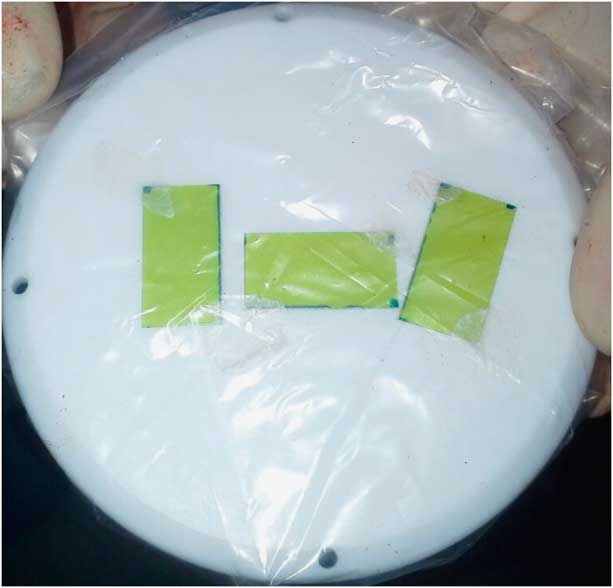
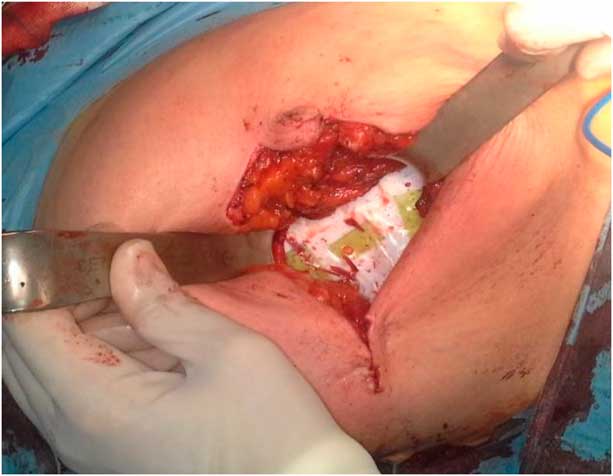
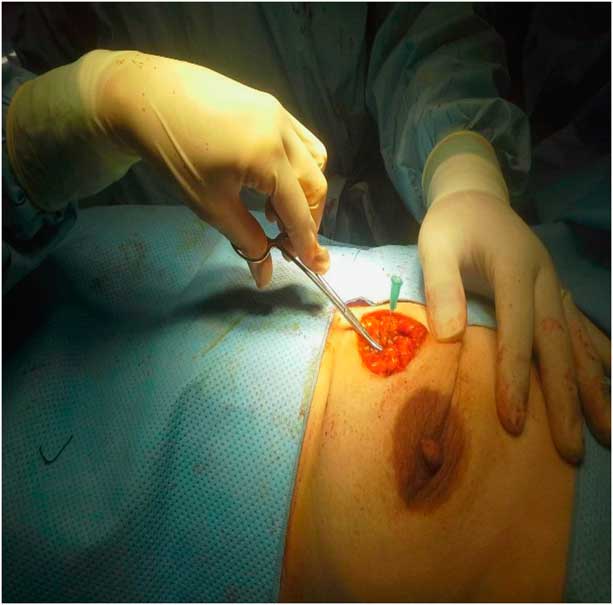
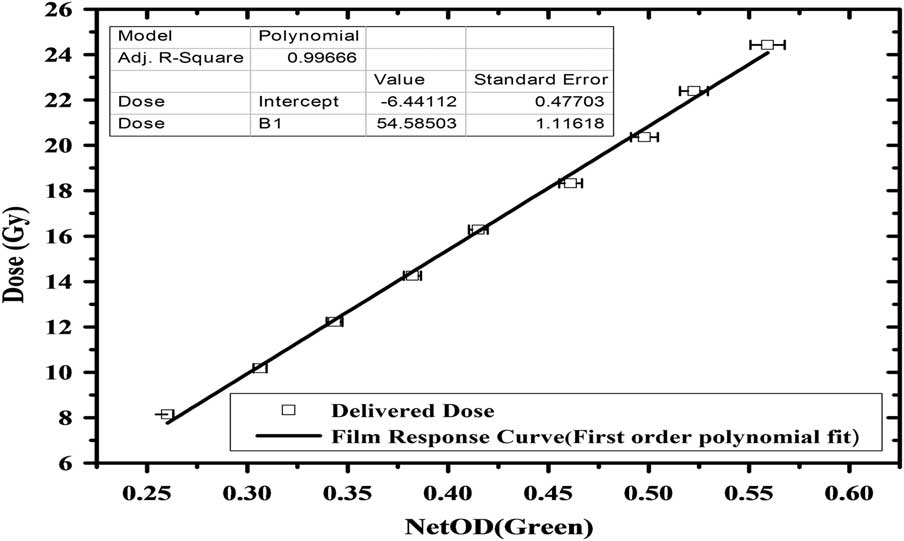
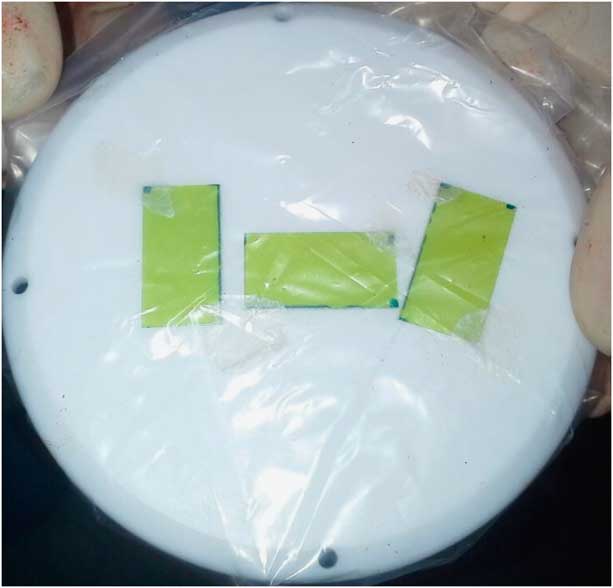
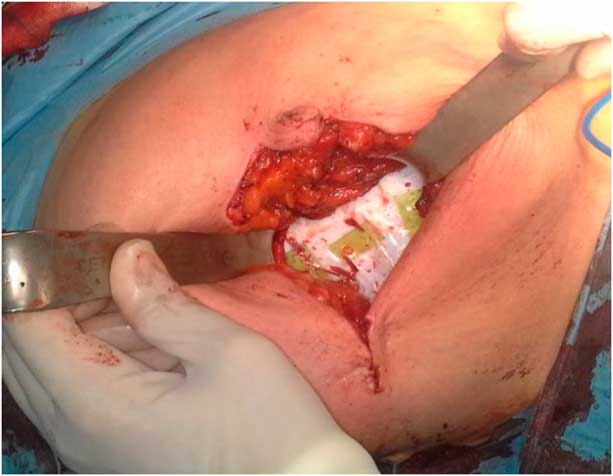
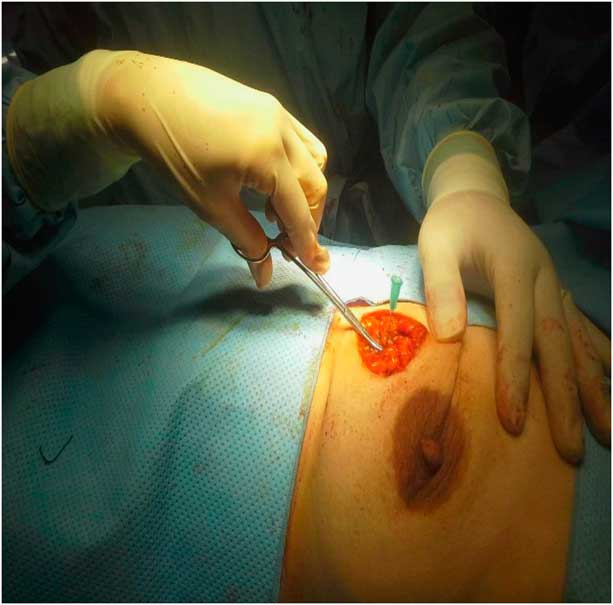
For 11 patients, before the IORT procedure, three pieces of EBT-2 film were fixed on the top of the protection disk. Then the protection disk was wrapped in a thin sterile envelope (Figure 1) and it was placed beneath the breast tissue flap by the surgeon (Figure 2). Perturbation caused by the envelope was negligible. After determining the thickness of the breast tissue over the disk (Figure 3) and MU calculation, the irradiation procedure was delivered. Films were analysed 38–42 hours after the irradiation.Reference Girard, Bouchard and Lacroix 17 After film scanning and image processing, then can gain calibration curve as shown in Figure 5.
Three pieces of EBT-2 film cut into 1×1·5 and on top of protection disk and wrapped by sterile envelope.
Protection disk containing three pieces of detector under tumour bed for in vivo dosimetry.
Depth tumour measurement.
Film scanning procedure
EBT-2 film can be read with a film scanner or digitiser. Films were scanned by a Microtek 9800 XL CCD (charge coupled device; Microtek International, Inc., Hsinchu, Taiwan) wizard pro.V7.021 flatbed panel in transmission mode. 9 , Reference Lynch, Kozelka, Ranade, Li, Simon and Dempsey 15 , Reference Sim, Wong and Ng 16 A suitable resolution and colour depth is 72 dots per inch and 48-bit RGB 16-bit per channel, respectively. The scanning procedure was repeated three times for each film and the average was obtained.
Since both sides of the film are not identical, the film should be scanned from its front side therefore the film orientation has to be considered during scanning.Reference Carrasco, Perucha, Luis, Baeza and Herrador 10
When measuring film on most scanners, the response of the scanner is not perfectly flat over of the scan field. The differences may be up to about 2% in magnitude, and are greatest within 2–3 cm of the lateral edges of the scan field. It is critical always to scan EBT-2 films in the same orientation on Vidar, Epson, Microtek and other CCD scanners. The front of the film must be put on the scanner because of the asymmetrical configuration of the two sides of EBT-2 films, because of the different response of each side. Therefore it is essential to mark the film pieces in some way to indicate their orientation with respect to the original sheet.
Image processing
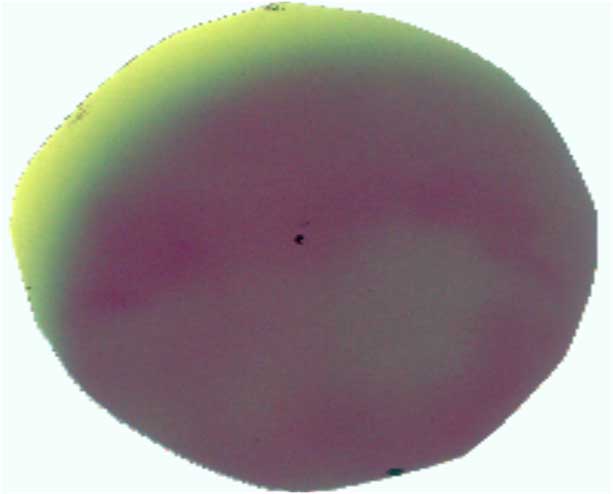
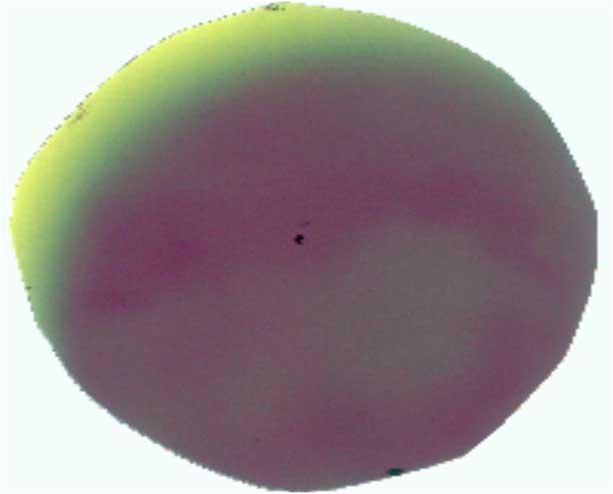
The films were scanned and analysed 38–42 h after irradiation.Reference Girard, Bouchard and Lacroix 17 We used both Matlab and ImageJ softwares for image processing to extract the pixel values of RGB images in the green channel for the high dose region. The region of interest (ROI) contained 325 (16×22) and 600 (24×25) pixels for the small and circular films, respectively, to avoid artefacts from the cuts (Figure 4). By means of the above softwares, essential information was obtained such as mean, median, maximum and minimum pixel values. The effects of scanner non-uniformity and also artefacts of the sterile envelope were negligible during readout and analysis of the irradiated films. Net optical density (net OD) of the irradiated film was calculated according to following equationReference Reinhardt, Hillbrand, Wilkens and Assmann 18 :
 $$\eqalignno{{\rm netOD {\equals}ODirradiated}{\minus}{\rm ODunirradiated{\equals}} \cr {\minus}\log 10{{{\rm PVR}_{{{\rm irradiated}}} } \over {{\rm PVR}_{{{\rm unirradiated}}} }}$$
where is the average pixel value of the ROI after irradiation (PVRirradiated) and the average pixel value of the ROI before irradiation (PVRunirradiated) are parameters.
Circular films cut at the same size of protection disk after irradiation.
Calibration curve
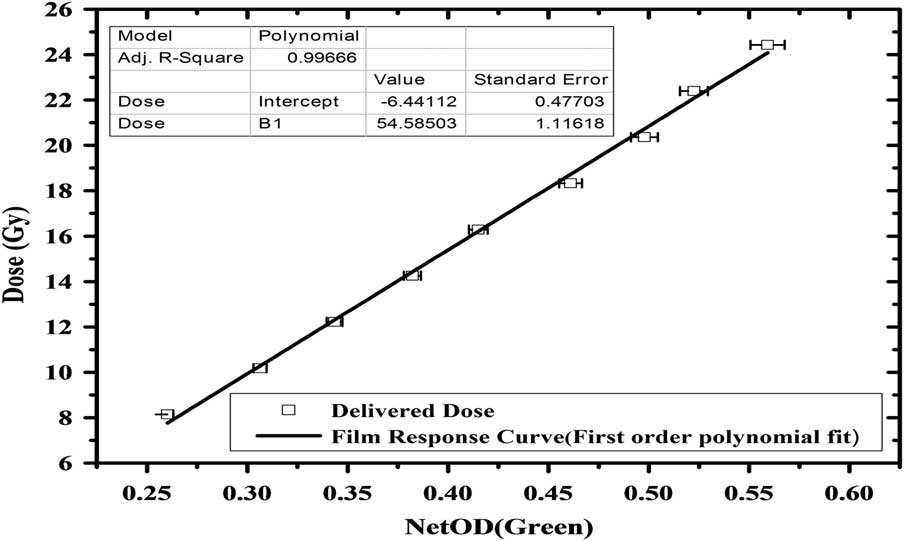
Irradiation was repeated three times to obtain the calibration curve. In a 25×25 field size, films were placed at the reference depth of the 9 MeV electron beam in a PMMA phantom at an SSD of 100 cm. The ion chamber measurements were used to determine the dose delivered by the monochromatic beams at different depths into the PMMA phantom. The PMMA phantom is made from 10×10 cm2 plates, and the film pieces were sandwiched between these plates for irradiation. The front surface of each piece of film was considered as the effective point of measurement. The dose values of the calibration films were plotted against Net OD to obtain the calibration curve. The calibration curve of EBT-2 film in IORT dose range has been shown in Figure 5.
Response curve for 8–24 Gy.
RESULTS
First order polynomial was obtained for dose conversion from Net OD values, as shown in Equation (2).
 $${\rm Dose}{\equals}{\rm a}\left( {{\rm netOD}} \right){\rm {\plus}b}$$
where a=54·58503, b=−6·44112 are the coefficients. This equation shows a linear response of dose to net optical density in the range of energy between 8 and 24 Gy.
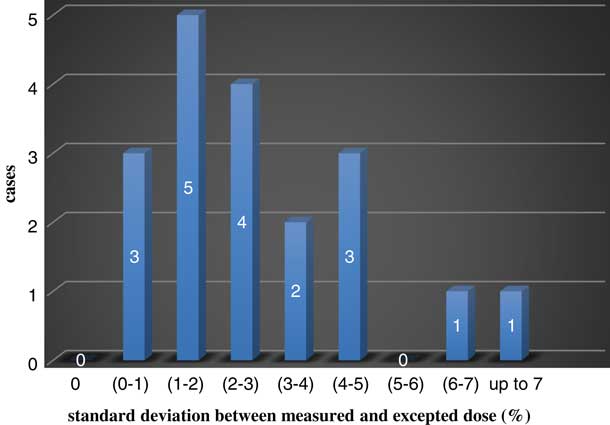
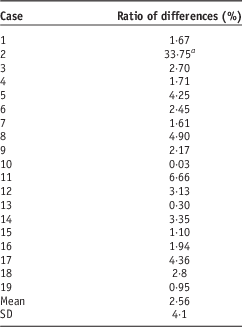
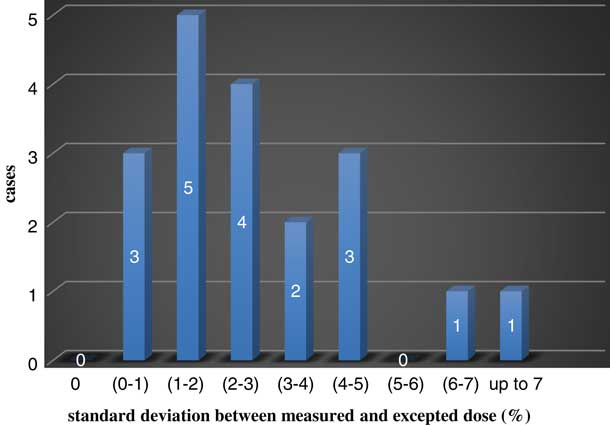
Delivered dose was measured by means of Equation (2) from in vivo film dosimetry data. The mean deviation between measured and excepted dose was calculated and it was equal to 2·56±4·1%. As shown in Table 1, the ratio of the differences between measured and expected doses for all treated cases were in the range of 0·03–6·66% (except for the case no. 2). In case no. 2, difference ratio was 33·75% and was very different from other results. The most important reason for this was barometer miscalibration. Frequency distribution of the deviation between measured and expected dose for all cases depicted in Figure 6.
Frequency distribution of the deviation between measured and expected dose.
Ratio of differences between measured and excepted dose

a Excluded data.
DISCUSSION
In vivo dosimetry by EBT-2 films seems to be a convenient method for end to end IORT procedure verification. The film reading time after 38–42 hours post irradiation is about 25 minutes by means of scanning and image processing software.Reference Girard, Bouchard and Lacroix 17 Moreover, EBT-2 dosimetry film can be easily cut to the required shape and size. For scanning procedures, suitable resolution is 72 dots per inch.Reference Carrasco, Perucha, Luis, Baeza and Herrador 10 , Reference Lynch, Kozelka, Ranade, Li, Simon and Dempsey 15 , Reference Sim, Wong and Ng 16 , Reference Hartmann, Martišíková and Jäkel 19 – Reference Martisikova, Ackermann and Ja¨kel 21 The best response is obtained if the film is scanned in transmission mode, and the spectral response of the scanner matches to the absorbance of the film. Radiochromic films are useful for routine quality control of linear accelerators.Reference Lorenz, Nalichowski, Rosca, Kung, Wenz and Zygmanski 22 , Reference Fontana Rosa, Orlandini, Andriani and Bernardi 23 The post-irradiation darkening of the film was investigated, and the relative response was found to be dose dependent with higher doses stabilising earlier than lower doses. After 13 hours all dose levels had stabilised to within 1% of their value at 24 hours. Uniformity of irradiated EBT-2 films was within 0·8 and 1·2% (2 SD of signal), in reflection and transmission modes, respectively. 24
The disadvantage of film dosimetry is the film cannot be sterilised because of its thermal sensitivity. Using film as a dose measurement tool during high dose per fraction technique in IORT is valid to accurate calibration procedure. Film should be calibrated against a parallel plate ion chamber which its own calibration has to be traceable to a primary or secondary standard dosimetry laboratory, in terms of special procedure for saturation correction factor in a high dose per pulse irradiation field.Reference Righi, Karaj and Felici 25 It is recommended to mark the film pieces to indicate orientation because the response of film back and front sides are different.Reference Carrasco, Perucha, Luis, Baeza and Herrador 10 , Reference Sim, Wong and Ng 16 , Reference Hartmann, Martišíková and Jäkel 19 , Reference Rink, Vitkin and Jaffray 20
Our results show dose differences between measured and expected values are between 1 and 3% for nine out of 19 patients is in the acceptable criteria limit for tumour control probability. Because of the very high absorbed dose in a single fraction IORT all dosimetry accessory should be calibrated and validated. Film data can also be used for reporting the shielding disk position under the tissue and applicator, which is useful for guiding the surgeon with the applicator insertion. Film provides relatively good information about dose map right beneath the flap tissue.
In vivo dosimetry using radiochromic films, although not giving immediate dose information appeared useful not only as treatment documentation, but also to gain more confidence with the routine clinical use of an unconventional linear accelerator.
Reliability of the described dosimetry procedure encouraged us to continue this practice, to extend it to other cancer sites and, similarly to the case of external radiotherapy, to recommend in vivo dosimetry as an important tool in IOERT too, particularly when clinical trials are activated.
CONCLUSION
This study showed radiochromic EBT-2 film can be an applicable multipurpose detector during breast intraoperative electron radiotherapy. There was a good agreement between measured and expected doses for breast cancer in this study.
In vivo dosimetry using radiochromic EBT-2 films give the idea useful not only as treatment documentation, but also to determine the systematic and random errors in patient dose delivery. This approach gets more assurance with the routine clinical use of IORT for breast cancer. This reliability of mentioned dosimetry encouraged us to extend our investigation to other kind of cancers treated by intraoperative electron radiotherapy. More research is needed to improve absorbed dose distribution in high dose per fraction radiotherapy.
Acknowledgements
The authors would like to express their appreciation to the surgery team of Khatam Hospital for their constructive suggestion during the planning and development of this research work. His willingness to give his time so generously has been very much appreciated.
Financial support
This research received no specific grant from any funding agency, commercial or not-for-profit sectors.
Conflicts of Interest
None.
Ethical Standard
The authors assert that all procedures contributing to this work comply with the ethical standard of relevant national guidelines on human experimentation and with the Helsinki Declaration of 1975, as revised in 2008.