


Introduction
India is one of Indonesia's most important trade partners. In 2019, total trade between the two countries reached USD 16 billion, with Indonesia's exports to India recorded at USD 11.7 billion and imports from India recorded at USD 4.3 billion (Indonesia Statistics Agency 2020). This positions India as Indonesia's fourth-largest export destination and its ninth-largest source of imports.
In recent years, palm oil has become a crucial product driving economic relations between the two countries. In 2018, India ranked as Indonesia's largest palm oil export destination after the European Union (EU) and China (GAPKI 2019). In addition, palm oil exports make the second-largest financial contribution after coal, with an export value of USD 22.97 billion in 2020 (Foresthints 2021).
In January 2019, Indonesia's palm oil exports to India was hindered by the India's imposition of a new tariff policy on the import of crude palm oil (CPO) and refined, bleached, deodorised, new palm oil (RBDPO) on its trading partners. This established tariffs of 40% for CPO and 50% for RBDPO, valid until the end of 2019. All members of the Association of Southeast Asian Nations (ASEAN) under the ASEAN–India Free Trade Agreement (AIFTA) scheme would receive a 50% RBDPO tariff rate. However, Malaysia alone was subject to a lower RBDPO rate of 45%, as a result of the India–Malaysia Comprehensive Economic Cooperation Agreement (IMCECA), resulting in a 5% RBDPO tariff gap between Indonesia and Malaysia.
As Malaysia is Indonesia's main competitor in palm oil exports to India, this new tariff weakened Indonesia's competitiveness, causing a decline in Indonesia's export volume and value. In the first half of 2019, Malaysian palm oil exports to India surged by 99.93% to 3.04 million tons, while palm oil exports from Indonesia to India fell by 17% (Gumilar Reference Gumilar2019).
The Indonesian government responded by proposing a trade-off strategy through the AIFTA scheme. This is a feature of Indonesian economic diplomacy whereby a particular sector (that may be considered less important) is sacrificed to enhance its position with another more valuable sector (Vetschera Reference Vetschera2013). In this case, Indonesia offered to reduce import tariffs on raw sugar in exchange for a reduction in India's RBDPO import tariffs. Initially, both countries have mutually agreed to this settlement and the Indonesian government hoped that it would offer a solution to achieving a permanent tariff reduction from India.
Indonesia has already implemented the tariff reduction on India's raw sugar. However, India has yet to reduce the tariff on Indonesia's RBDPO as per the agreement. Accordingly, this article explains why Indonesia's trade-off strategy did not work. To answer this question, the concept of reluctance developed by Sandra Destradi (Reference Destradi2017) will be applied. By mobilising this concept, this article argues that India's reluctance is the main factor in the failure of Indonesia's trade-off strategy. This reluctance is demonstrated through hesitation and recalcitrance, resulting in delays and reversal of policy as well as ignoring Indonesian requests regarding the trade-off strategy.
In the study, we employed a qualitative method with theory-guided case studies, in which analysis and findings were guided by a conceptual framework developed from the outset (Levy Reference Levy2008). A tracing process was conducted to identify, validate, and test our argument, enabling us to explain the interaction between Indonesia and India in their efforts to address the tariff issue. Analysis was conducted from October 2018 to March 2020. We also drew upon the first-hand experience of Indonesian trade negotiators through interviews to elaborate on their perspective regarding Indonesia's interaction with India throughout the period under investigation. We interviewed policymakers working in the Directorate General of International Trade Negotiation, the Ministry of Trade of the Republic of Indonesia (particularly officials from the Sub-Directorates of East, Middle, and South Asia regions) and the Directorate of Bilateral Negotiations. To triangulate the interviews, we analysed official documents, regulations, and media reports. Given the nature of our data, we focus here specifically on the Indonesian perspective toward the case under investigation.
The aim of this article is to contribute to two strands of literature. First, we aim to contribute to the understudied topic of Indonesia–India relations. Despite being emerging powers from the global south (Fitriani Reference Fitriani, Aspinall, Mietzner and Tomsa2017; Jemadu and Lantang Reference Jemadu and Lantang2021; Karim Reference Karim2021), surprisingly, few in-depth studies examine Indonesia–India bilateral relations. Most studies focus on India–Australia, Sino–Indian, and India–Gulf relations (Engh Reference Engh2016; Quamar Reference Quamar2018; Sundaramurthy Reference Sundaramurthy2020). Discussions on Indonesia–India bilateral relations focus more on security and political fields (Brewster Reference Brewster2011; Gill and Mitra Reference Gill and Ryan2018; Supriyanto Reference Supriyanto2013). This article aims to fill this gap by focusing on the dynamics between both countries in relation to tariff issues on Indonesian palm oil products. Second, this article contributes to the growing number of studies on Indonesia's economic diplomacy. Most such studies emphasise its regional and global role the tendency of a domestic audience to contest such strategies (Karim Reference Karim2020; Margiansyah Reference Margiansyah2020; Sabaruddin Reference Sabaruddin2017; Syarip Reference Syarip2020). Few studies try to examine how Indonesian economic diplomacy works at the bilateral level. This article aims to fill such a gap.
The article is organised thus. In the next section, we discuss the notion of reluctance to develop an understanding of India's response to Indonesia's trade-off strategy. In the third section, we explain the reason behind Indonesia opt-in for a trade-off strategy. The fourth section illustrates the theoretical framework through the case of Indonesia's trade-off strategy. In this section, we examine interactions between Indonesia and India through the notion of reluctance. The concluding section of this article provides the broader implications of our findings to Indonesian and Indian relations.
Conceptualising Reluctance in Trade Relations
In general, literature relating to India's trade economic policy shows it to be a reluctant trade liberaliser. Schaffer and Schaffer (Reference Schaffer and Howard B.2016) explain India's reluctance to accept pressure from developed countries, requiring them to incorporate new rules in aspects of multilateral trade. India's refusal to open discussions regarding plans to create new rules at the World Trade Organization (WTO) is arguably driven by its fear of opening up the Indian domestic market (Hopewell Reference Hopewell2018). Furthermore, Palit (Reference Palit2014) argues that many of India's trading partners in the Asia Pacific region view India as a reluctant trade ‘liberaliser’. India has always emphasised a very defensive approach to opening access to its domestic market. This impression arises from its often inflexible attitude as a WTO member.
Moreover, India is considered the most globalisation-phobic of the four developing economies of Brazil, Russia, India, and China (BRIC) (Beausang Reference Beausang2012), with the Indian government presiding over a low level of exposure to globalisation as its economic policies are based on the goal of self-reliance. This has led to many considering India a negative influence in global governance (Narlikar Reference Narlikar2017).
It could be argued that India's domestic politics might be the cause of its seeming reluctance in liberalising its domestic market. Although free trade might create an opportunity, India may choose to reject it, given concerns about the competitiveness of Indian manufacturing if it were opened up to trade. Rothacher (Reference Rothacher2016) shows how societal pressures—mainly domestic economic actors—drive the government's trade preferences and policies to be more protectionist.
It could also be argued that India's reluctance could be best described as pragmatic globalisation. Hopewell (Reference Hopewell2018) suggests that India has experienced a paradigm shift regarding the trade of services, from its previously defensive stand toward outwardly-oriented support for the liberalisation of services. However, with regard to the agricultural sector, India is still reluctant to adopt free trade, despite the fact that it is its most sensitive domestic sector. This mix of offensive and defensive trade interests demonstrates India's trade strategy of pragmatic globalisation, whereby free trade that enhances domestic economic actors is supported, while rejecting free trade that threatens its domestic market.
Most studies focus on India's reluctance to engage in north–south cooperation, such as with the EU or other developed countries or in a multilateral setting such as the WTO (Kavalski Reference Kavalski2016; Narlikar Reference Narlikar2011). How such reluctance is enacted in relationships with other emerging powers from the global south remains relatively understudied. In this article, we are particularly interested in examining how Indian reluctance hindered Indonesia's trade-off strategy. The concept of reluctance is thus relevant for analysing obstacles facing Indonesia's economic diplomatic strategy with India in its effort to reduce RBDPO import tariffs.
Many scholars of international relations and political economy have applied the notion of reluctance with various definitions and operational indicators (Bulmer and Paterson Reference Bulmer and William E.2013; Feigenbaum Reference Feigenbaum2017), and the concept has been mobilised to enhance understanding of the behaviour of emerging powers (Bishop and Xiaotong Reference Bishop and Zhang2020; Bruera Reference Bruera2015). For instance, within the context of trade relations, reluctance can be considered deliberate hesitancy by one state to bring its power resources to bear on re-energising trade relations (Bishop and Xiaotong Reference Bishop and Zhang2020). This article engages with Destradi's (Reference Destradi2017) concept of reluctance to understand India's response to its trading partners’ policies toward India. Destradi's conceptualisation enables us to investigate the different degree of reluctance demonstrated by India toward Indonesia's trade-off strategy. Through this approach, reluctance can be understood as a style of engaging in foreign policy that involves a hesitant attitude and certain recalcitrance about conforming to the expectations articulated by others (Destradi Reference Destradi2017: 317). Thus, reluctance has two constitutive dimensions: hesitation and recalcitrance. Together, these two dimensions define reluctance.
Hesitation refers to an ambivalent and incoherent attitude, the opposite of determination, which is defined by a firm and consistent attitude (Destradi Reference Destradi2017). Hesitation can be identified by the presence of at least one of the following indicators:
1. Lack of initiative: where a state stands on the side-lines and lets other actors take the lead. In this case, the reluctant state not only fails to contribute resources according to its capability, but is also does not produce policies and solutions and does not take part in active implementation of particular bilateral, regional, and global cooperation.
2. Delaying: the state does not keep to a previously agreed time frame, thereby postponing important decisions in dealing with a specific issue or crisis.
3. “Flip-flopping” (reversal of policy decisions): the most evident form of hesitation that can be observed if statements or policy on a specific issue are neither consistent over time nor coherent, or if they result in contradictions in statements or policies among different representatives of the same government on a specific issue (Destradi Reference Destradi2017: 327).
Recalcitrance refers to a lack of responsiveness to demands made by others, and can be identified by involving at least one of the following indicators: ignoring requests, rejecting requests, and obstructing others’ initiatives.
1. Ignoring requests: where the state does not respond to requests made by other actors. Such requests do not reflect the first state's expressed preferences.
2. Rejecting requests: the state explicitly refuses to fulfil wishes in any form fulfilled by other actors.
3. Obstructing others’ initiatives: the state deliberately and actively impedes the activities of other actors (Destradi Reference Destradi2017: 328).
Based on this explanation of reluctance, we examine the indicators of delaying and flip-flopping as features of hesitation (given such indicators are the most relevant), as indicative of India's policy in trade-off cooperation with Indonesia. We contend that delaying and flip-flopping are the primary forms of behaviour demonstrated by India in explaining our case study. Here, ‘lack of initiative’ is less relevant in our case, given Indonesia's initiative was accepted as mutually implemented by both countries at the beginning.
By operationalising recalcitrance, we examine the ‘ignoring request’ indicator as the most relevant indicator to describe India's policies in trade-off cooperation with Indonesia. Other indicators (‘rejecting requests’ and ‘obstructing others’ initiatives’) are less relevant here, given that in our case study, India does not explicitly reject and actively block or stop Indonesia's efforts. Table 1 summarises our operationalisation of reluctance.
Concept Operationalisation

Source: Authors’ compilation
Indonesia's Trade-off Strategy towards India
On 1 January, 2019, India imposed a 50% tariff import on RBDPO from Indonesia. This new import tariff policy was determined in the AIFTA schedule of concessions (which changes once every year according to the results of reviews conducted by AIFTA countries). In 2019, the schedule for import tariffs for CPO and RBDPO (as stipulated by AIFTA) was 40% and 50%, respectively. The tariff schedule was valid for one year (from 1 January to 31 December, 2019) according to the provisions in the AIFTA schedule of concessions, after which, the rate was changed for the following year.
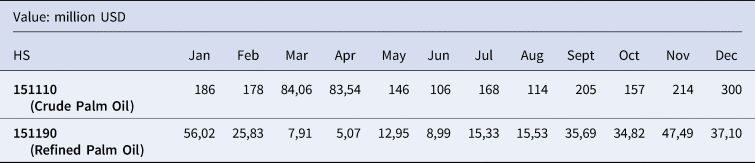
A problem arose when Malaysia was subject to a 45% import tariff for the same product (a 5% difference), which led to a decline in Indonesia's palm oil exports, especially RBDPO. The value of Indonesia's RBDPO (HS 151190) exports declined from February 2019 to USD 25.83 million (see Tables 2 and 3), with the lowest exports experienced in April, when it reached only USD 5 million. Accordingly, Indonesia needed to reduce import tariffs to increase the competitiveness of its RBDPO products (Andri Reference Andri2019a).
Indonesia's Palm Oil Exports to India in 2019

Source: Indonesian Ministry of Trade 2020 (Indonesian Ministry of Trade 2020a)

To reduce the disparity, the Indonesian government decided to offer India a trade-off—a strategy in which a state offers something with the highest utility value that is attractive to other states in exchange for something it values highly (Mansour and Kowalczyk Reference Mansour, Ryszard, Wang and Li2012). Thus, offering a trade-off can be interpreted as a desire to make an exchange to attain benefits of greater value with some acceptable level of loss.
To offer such a trade-off, the Indonesian government considered the raw sugar sector a potential high-value offering to India. Indonesia annually imports approximately four million tonnes of sugar in total. In October 2018, India had previously proposed that Indonesia could buy its raw sugar stock to meet its annual import needs. This was beneficial to India because its 2019 sugar production had increased by 4.2%, reaching 33.8 million metric tonnes. This created an excess national stock of 6 million metric tonnes, meaning a solution through export was required (Aradhey Reference Aradhey2018). The Indonesian government sensed that by expressing its willingness to buy India's excess raw sugar, it could ask India to lower the tariff on RBDPO. In 2019, the Indonesian Coordinating Ministry for the Economy decided that Indonesia would import 495,000 tonnes of raw sugar for consumption (non-industrial) needs. The volume of sugar imports was taken from the unrealised import allocation for 2019.
To be able to import sugar from India, the Indonesian government first needed to lower the Indian import tariff for raw sugar, given that India's raw sugar was at the time subject to a 10% higher import duty. In comparison, raw sugar from Thailand and Australia was subject to only 5% duty. Moreover, Indian sugar did not meet the standards of the International Commission for Uniform Methods of Sugar Analysis (ICUMSA), meaning that purchasing Indian raw sugar required the Indonesian government to change several domestic regulations relating to raw sugar standardisation.Footnote 1 With the trade-off strategy, Indonesia and India were expected to reduce import tariffs in sectors of respective interest. In this case, Indonesia's interest was to reduce India's RBDPO import tariffs while India's interest was to lower Indonesia's import tariffs on raw sugar.
From the outset of discussions, Indonesia aimed to utilise the trade-off strategy as a permanent solution to reducing tariffs through the AIFTA scheme. Indonesia's preference to use a trade-off strategy also stemmed from the absence of institutionalised bilateral economic cooperation that could accommodate the reduction of palm oil import tariffs. Within just one year, trade-offs could reduce tariffs quickly while being resource efficient because there is no need to make new agreements. To create such institutionalised cooperation, Indonesia and India would need to agree on many provisions, requiring a longer completion time. However, a trade-off could utilise the existing AIFTA scheme, as there is a clause stating that the parties involved can unilaterally reduce tariffs for other parties through the issuance of ministerial-level regulation.Footnote 2
Consequently, if both Indonesia and India were to modify the preferential tariff for a certain product through the issuance of a new Minister of Finance regulation, both states would be required to report these tariff changes to ASEAN, which would then automatically update the AIFTA schedule of concessions. This rate change would apply until the conclusion of renegotiations through the issuance of a new regulation. Moreover, this trade-off strategy could offer a permanent solution, given that any tariff that has been reduced cannot be raised again: The AIFTA scheme stated that tariff changes should not be greater than the initial concession.Footnote 3
Despite the solution whereby both Indonesia and India could benefit through the trade-off scheme between RBDPO and raw sugar, India did not fulfil the agreement, instead showing hesitation and recalcitrance towards Indonesia's demand to reduce RBDPO tariff even though Indonesia had lowered the tariff for Indian raw sugar.
India's Reluctance toward the Trade-off Scheme
As suggested by Destradi, to define reluctance in international politics, the variables of hesitation and recalcitrance cannot be separated. According to Destradi, hesitation refers to a state's incoherence and ambivalence when responding to a particular issue. A hesitant state can delay the initiative proposed by other actors while flip-flopping its policies. Recalcitrance, according to Destradi, refers to a lack of responsiveness to the demands made by other actors. In the following discussion, we demonstrate how both hesitation and recalcitrance constitute India's response to Indonesia's trade-off strategy.
India's Delay in Implementing the RBDPO Import Tariff Reduction
On the side-lines of the 4th India–ASEAN Expo and Summit on 22 February, 2019, the Indonesian and Indian Ministers of Trade held a bilateral meeting to discuss how to increase economic cooperation. Moreover, they sought to negotiate a reduction in import duties on Indonesia's RBDPO to India (ASEAN National Secretariat 2019). Indonesia expressed its objection to the RBDPO import tariff policy established by India, and requested that the Indonesian RBDPO import duty tariff to India be reduced through the AIFTA scheme to be equivalent to that applied to Malaysia: 45% (ASEAN National Secretariat 2019).
In return, Indonesia was willing to open market access for raw sugar from India, while India requested that import tariffs on Indonesian raw sugar be reduced from 10% to 5%, equal to those for Thailand and Australia.Footnote 4 The two countries then agreed to open access to their respective markets by conducting trade-offs, with a verbal agreement to reduce tariffs as soon as possible before the end of 2019.Footnote 5 At the time, India's response was very positive, even instructing relevant technical officials to take immediate steps to meet Indonesia's demand (Indonesian Ministry of Trade 2019a).
Indonesia fulfilled its commitment by issuing the 2019 Regulation of the Minister of Finance No. 96 (on 22 June, 2019) concerning changes to the import duty on raw sugar. This came into effect on 5 July, 2019 (Indonesian Ministry of Finance 2019) with a reduction of 5% on the import tariff of Indian raw sugar. This policy meant raw sugar from India was no longer subject to tariffs according to the most favoured nation (MFN) of Rp550/kg or as low as 10% (Andri Reference Andri2019b).
At a bilateral meeting in the ASEAN Troika on 12 July, 2019, Indonesia again made a request that India immediately reduce the RBDPO import tariff. India responded to this request by calling Indonesia's attention to the difficulties faced by Indian exporters in entering the Indonesian market (Indonesian Ministry of Trade, 2019b). India also requested that as well as lowering import tariffs on raw sugar, Indonesia's ICUMSA standards be lowered in line with the Indian ICUMSA of 600–800 IU (International Unit scale). In India, factories and home industries still produce raw sugar with an ICUMSA below 800. As a result, Indian producers find it challenging to follow Indonesia's provisions when exporting raw sugar to Indonesia, which uses an ICUMSA standard of 1,200 (Indonesian Ministry of Trade 2020b). To accommodate Indian sugar imports, Indonesia agreed to India's request and began a regulatory process to amend the Minister of Trade's Regulation. This decision was supported by the revocation of the Decrees of the National Standardization Agency for Indonesia (BSN) Number 100 of 2008 and Number 159 of 2011 that regulate the standard for raw crystal sugar.
Despite Indonesia's move to lower the ICUMSA standard for Indian raw sugar, India still failed to meet Indonesia's demand. From June to September 2019 at every opportunity and at various levels, Indonesian representatives repeatedly asked about the implementation of India's commitment. India reportedly continued to be evasive in answering and did not provide clear steps on how tariff reductions were progressing.Footnote 6 The Indian representatives simply said that the central government had already formulated the tariff reduction.
From the Indonesian perspective, it was evident India was delaying implementation of the import tariff reduction (even after Indonesia had lowered the import tariff on raw sugar) as soon as the agreement was made. The Indonesian Minister of Trade described the situation as rather disappointing because, based on the initial deal, the tariff reduction should have been implemented in 2019. However, even by September 2019, no response had been given by the Indian government (Andri Reference Andri2019b). Even if the tariff reduction had been made near the end of 2019, Indonesian officials noted that this was essentially useless.Footnote 7
Based on this explanation of events, India's delay indicates hesitation toward a trade-off solution. It is evident that India was actively delaying the reduction of RBDPO import tariffs, despite the agreement between the two countries; moreover, it failed to inform Indonesia about its progress with regard to tariff reduction efforts. Conversely, the Indonesian government was quick to implement a reduction in raw sugar rates for India.
India's Flip-flopping Policy
In this section, India's flip-flopping policy regarding Indonesia's demand to reduce RBDPO import tariffs is demonstrated. At the bilateral meeting between both countries at the 51st ASEAN Economic Ministers’ Meeting (AEM) in Bangkok on 8 September, 2019, Indonesia again expressed its concerns to India and requested the tariff be reduced immediately.
At this meeting, Enggartiasto Lukita, then Indonesian Minister of Trade, asked the new Indian Minister of Trade, Piyush Goyal, about India's plan to reduce the RBDPO import tariff. India's policy reversal became evident at this meeting in the contradictions between trade policies issued by consecutive Ministers of Trade serving in Prime Minister Narendra Modi's government.
At an initial meeting on 22 February, 2019, the previous Minister of Trade, Suresh Prabhu, agreed to a trade-off as a solution to Indonesia's request to lower RBDPO import tariffs (Anggraeni Reference Anggraeni2019). In addition, India reportedly responded by instructing relevant parties to fulfil Indonesia's demand (Indonesian Ministry of Trade 2019a). However, at a meeting on 8 September, 2019, India's Piyush Goyal issued a different policy, stipulating that India would not reduce the RBDPO import tariff (Andri Reference Andri2019b). India further stated that it was still considering the trade-off deal and had not yet decided on a plan to implement a tariff reduction through the AIFTA scheme.Footnote 8 From Indonesia's perspective, it appeared the Indian government had agreed to the trade-off strategy through the AIFTA scheme during the initial meeting, even though the agreement was only made verbally. However, under Prabhu's ministership, India seemed to implement a delaying strategy, while under Goyal, the policy seemed more assertive in showing India's hesitance to reduce tariffs.Footnote 9
It could be a reasonable assumption by Indonesia that this policy reversal by India could undermine its future credibility to strike deals or commitments on trade. India's early commitment to agree to a trade-off in the AIFTA scheme had become the basis for Indonesia's reduced tariff on Indian sugar. However, after Indonesia acted to lower the tariff, India's changed attitude left the trade-off agreement unfulfilled, indicating India's hesitancy in fulfilling the agreement that ultimately hampered Indonesia's trade-off strategy.
Ignoring Indonesia's Request
India showed hesitation toward Indonesia's demand by delaying the reduction of RBDPO import tariffs. Interestingly, in response to repeated requests from Indonesia, the Indian Ministry of Trade under Piyush Goyal issued a notification on 4 September, 2019, regarding the safeguarding policy for Malaysia through the framework of the IMCECA. In the notification, India increased Malaysia's RBDPO import tariff by 5% from 45% to 50% (Jadhav & Verma, Reference Jadhav and Verma2019), equivalent to Indonesia's tariff.
India can impose safeguards on Malaysia through the IMCECA because there is a clause that allows this in the case of an uncontrolled surge in imports. While India conducted its safeguard investigation process on Malaysia's RBDPO, they could also continue to delay the reduction of RBDPO import tariffs towards Indonesia.
At a meeting between Indonesia and India on 8 September, 2019, India officially informed the Indonesian government that it had raised Malaysian tariffs, even though its policy had been issued a few days before.Footnote 10 The policy also took several days to be uploaded to the website to become accessible to the public.
Instead of lowering Indonesia's tariff—as requested from the beginning by Indonesia—India actually increased Malaysia's tariff. This policy step was not something the Indonesian government had anticipated and showed that India ignored Indonesia's requests.Footnote 11 From the beginning, the trade-off was conceived as a solution. This is why Indonesia used the tariff reduction method through AIFTA and hoped that India would also do the same.Footnote 12 It was thought that using AIFTA would bind the parties together in not raising the same tariff in the future. This could be a reason why India was so reluctant to lower tariffs on Indonesia's RBDPO. However, Indonesia had already fulfilled India's demands by reducing raw sugar tariff rates as soon as possible and agreed to lower ICUMSA standards.
From the Indonesian perspective, this trade-off effort presented a win–win solution in the long run, even for India. Arguably, India could gain even more because it could ‘force’ Indonesia not only to reduce tariffs on raw sugar but also to change domestic regulations on raw sugar standards.Footnote 13 India's move to increase tariffs on Malaysia instead can be considered a shortcut for India to escape Indonesia's constant demand to reduce the RBDPO tariff.
By implementing safeguards against Malaysia, India's policy only provided a temporary solution, valid only until March 2020.Footnote 14 By doing so, India implicitly rejected Indonesia's offers for trade-offs. This created a negative perception towards India among Indonesian trade officials.Footnote 15 However, the deal was sufficient as the preferable outcome for Indonesia. This is because the issue for Indonesia was the tariff difference between Indonesia and Malaysia rather than the tariff itself. To this end, Indonesia's trade-off strategy has arguably met Indonesia's minimum negotiation objective.Footnote 16
Although Indonesia had not received a tariff reduction, the increased tariff on Malaysia's RBDPO products had actually resulted in an increase in Indonesia's palm oil exports to India, which had increased sharply by 51% by September 2019 on the previous month's 481,000 tonnes (Andri Reference Andri2019c). In 2020, India reduced the RBDPO import tariff for Indonesia to 45%. This was not due to Indonesian pressure; it was in accordance with the agreement on the tariff concession schedule that was regulated by AIFTA. India also returned Malaysia's RBDPO tariff to its original rate of 45% once the safeguard against Malaysia had ended as regulated in IMCECA (see Table 4). However, the IMCECA means that the import tariff on RBDPO from Malaysia could be lowered at any time by India, which could harm Indonesia's palm oil industry.
Data on CPO and RPO Tariffs under IMCECA and ASEAN-India FTA

Source: Indonesian Ministry of Trade 2020
Given the equal treatment of Indonesia and Malaysia's RBDPO to date, the Indonesian government decided not to pursue India's commitment towards lowering Indonesia's RBDPO any further. Indonesia continues to equate India's sugar tariffs in accordance with the applicable tariffs in ASEAN and to lower its ICUMSA standards. India also felt that the issue brought by Indonesia had been resolved with India applying the same tariffs to Indonesia and Malaysia's RBDPO products.
Table 5 summarises the interactions between Indonesia and India regarding Indonesia's efforts to reduce India's import tariffs on RBDPO from the inception of the idea to the completion of this collaboration. Table 6 presents India's reluctance towards the trade-off strategy.
Timeline of Indonesian and Indian Trade-off Strategies

Summary of India's Reluctance Response to Trade-off Strategy

Conclusion
In this article, we have demonstrated how the Indian government's lack of response toward an initiative proposed by Indonesia indicates reluctance from India. This reluctance can be seen in India's delay in implementing tariff reductions, its reversal of policy (flip-flopping), and ignoring Indonesia's requests by increasing Malaysian tariffs. This study shows that the trade-off offered by Indonesia was a failure, despite the previous verbal agreement. Based on our study, the Indonesian government and negotiators should make agreements in writing to ensure a clear basis before proceeding with the implementation of such agreements. This is because, in a verbal agreement, the partner country might have different interpretations to those of Indonesia. This would enable the partner country to change its policies and delay implementation.
This presents several policy implications for trade and economic relations between the two states. First, the failure in Indonesia's trade-off has resulted in the Indonesian government pushing the inclusion of tariff reduction on palm oil imports onto other platforms, such as the Regional Comprehensive Economic Partnership (RCEP) agreement. Indonesia has already asked India to reduce palm oil tariffs as a provision within RCEP, although India insisted on excluding the product during negotiations. Despite the importance of palm oil for Indonesia, India would appear to be reluctant to discuss the topic. In fact, in early November 2019, India said it would not join the RCEP. Ultimately, the latest RCEP agreement included the reduction of the palm oil tariff. However, without India's participation in RCEP, Indonesia would not be able to fully utilise RCEP to expand its RBDPO exports (considering the biggest buyers of RBDPO in Asia are China and India). Given the difficulty in Indonesia entering the Indian market, Indonesia is looking for new alternative markets for its palm oil among other Asian countries such as Thailand. Since February 2020, Indonesia has also tried to take advantage of the Indonesia–Australia Comprehensive Economic Partnership Agreement to promote palm oil products to enter the country.
Second, India's reluctance could reduce Indonesia's enthusiasm to seek deeper cooperation with India in other sectors. From our interviews, it is clear that India's reluctance toward Indonesia's trade-off strategy has affected Indonesia's trade strategy towards India overall. Such experience in negotiating the trade-off gave rise to a pessimistic view among Indonesian trade policymakers in an effort to deepen trade cooperation between both countries. It will be difficult for Indonesia to negotiate deals with India given its reluctance in giving concession in trade in goods while pushing forward in liberalising service sectors that it has vigorously sought.
Third, India's reluctance toward Indonesia's trade-off strategy in the case of RBDPO might offer a glimpse regarding the future of ongoing efforts to institutionalise India–Indonesia bilateral economic cooperation. As of June 2021, Indonesia and India had no institutionalised bilateral cooperation, leaving Indonesia with temporary trade-off cooperation should there be any sudden tariffs imposed by India. This is the main reason why both countries have been committed to enhancing their bilateral relations through the initiation of negotiation of the India–Indonesia Comprehensive Economic Cooperation Agreement (India–Indonesia CECA) in 2018. While the economic issue is at the heart of the India–Indonesia CECA, such negotiation is also driven by strategic concerns from both countries. India's decision not to join RCEP also intensifies Indonesia's urgency to have a bilateral trade agreement with India. It is therefore unsurprising that the India–Indonesia CECA negotiation is highly endorsed by Indonesia's Ministry of Foreign Affairs and Indonesian business actors. However, from our study, we can infer that such initiative may not lead to more concrete cooperation in the trade sector as long as there are no concessions offered by India, particularly to Indonesia's palm oil sector.
Moreover, given the complexity of CECA's scope of cooperation and India's anticipated reluctance to provide a perceived win–win solution, there is a tendency for Indonesia's trade policymakers to opt for a preferential trade agreement (PTA) instead. Such an agreement is more straightforward given that the goods and services being negotiated are limited (the most important goods and services that are in the best interest of both countries). The India–Indonesia CECA negotiation will be time-consuming without any assurance of agreed outcomes, and a PTA might provide a faster and more focused deal.
This article specifically focuses on the impact of India's reluctance on Indonesia–India economic cooperation, particularly in the palm oil sector, but does not go further to investigate the dynamic relations between Indonesia and Malaysia (as the two biggest exporters of palm oil) and India (as the largest importer of palm oil). While Indonesia's trade-off strategy failed to lower the tariff on Indonesia's palm oil, the outcome was the tariff increase on Malaysian palm oil. It would be interesting to examine the complex pattern of competition and cooperation dynamics among the three countries in regard to palm oil.