





1. Introduction
At present time, the propagation of laser pulses in gas-filled hollow capillary fibres (HCFs) is attracting the attention of many research groups. This is due to the possibility of using HCFs for the generation attosecond pulses (Xiao et al. Reference Xiao, Chen, Liu, Huang, Pang, Leng and Feng2025), generation of frequency-tuneable ultraviolet radiation (Smith et al. Reference Smith, Moltke, Adamu, Michieletto, Bowen, Moselund, Markos and Bang2020; Chen et al. Reference Chen2025), nonlinear compression of femtosecond laser pulses to several or even single cycles (Kötting et al. Reference Kötting, Schade, Koehler, Russell and Tani2020), acceleration of electrons (Flegentov et al. Reference Flegentov, Safronov, Gavrilov, Kakshin, Pkhaiko and Potapov2021) and generation of higher harmonics (Markos et al. Reference Markos, Travers, Abdolvand, Eggleton and Bang2017). In addition, it is possible to use a capillary fibre in critical areas such as communications, sensing, bio-photonics, ultrafast science and quantum optics (Markos et al. Reference Markos, Travers, Abdolvand, Eggleton and Bang2017). At the same time, gas-filled HCFs can be used to generate radiation in the terahertz (THz) frequency range when femtosecond laser pulses propagate through them. The interest in the generation and detection of THz radiation is related to the prospects of its use in scientific research and practical applications (Song & Nagatsuma Reference Song and Nagatsuma2015). In this article, for the first time, we consider the generation of THz radiation when a laser pulse propagates in a gas-filled HCF. It is shown that as a result of the ponderomotive action of laser radiation on the electrons of the plasma column which is formed during optical ionisation of gas in the hollow core of the fibre, excitation of THz plasma fields and their Cherenkov emission takes place.
This paper has the following structure. Section 2 examines the propagation of a laser pulse in a gas-filled HCF. The excitation of THz fields in a plasma column, which is formed as a result of optical ionisation of gas in the hollow core of a fibre, under the ponderomotive action of laser radiation on electrons, is considered. The boundary value problem for THz fields was solved and the field in the plasma column and in the surrounding dielectric fibre was found. Section 3 examines the spectral, angular and energy characteristics of the THz pulse emitted from the plasma column into the surrounding fibre. It is shown that the emission of a THz signal occurs when the Cherenkov condition is fulfilled, that is, when the group velocity of the laser pulse exceeds the phase velocity of electromagnetic waves in a fibre. In this case, the angle of the Cherenkov cone depends on the refractive index of the fibre: the higher the refractive index, the smaller the cone angle. The dependence of the THz radiation energy on frequency was investigated and it was shown that the emission spectrum contains a broad line near a frequency comparable to the reciprocal duration of the laser pulse. By integrating over the spectrum, the THz energy emitted per unit path length in the radial direction was calculated and the optimal laser pulse duration was found at which the THz signal energy has a maximum value. The spatiotemporal structure of the electromagnetic field in a THz radiation pulse was investigated and it was shown that the THz signal has one oscillatory cycle, and its duration is comparable to the duration of the laser pulse. The intensity of the THz radiation pulse was calculated and its contour lines were constructed, which have the form of a Cherenkov cone. It is shown that the angle of the Cherenkov cone is smaller, the higher the refractive index of the fibre. Section 4 formulates the main results of the article, conditions of the theory applicability and provides estimates for the characteristics of THz radiation under the conditions of modern laser-plasma experiments.
2. Excitation of THz fields in a gas-filled HCF under the action of laser radiation
Let a laser pulse with a carrier frequency
 ${\omega} _{0}$
and a time duration
 ${\tau} ({\tau} \gt \gt 1/{\omega} _{0})$
propagate in a gas-filled HCF of cylindrical shape with a radius of hollow core
 $a$
. We assume that when a laser pulse propagates in a gas-filled HCF, due to optical ionisation of the gas, a plasma is formed in the hollow core with an electron density of
 $N_{0e}$
, which is less than the critical value of
 $N_{cr}=m_{e}{{\omega} }_{0}^{2}/(4{\pi} e^{2})$
, and the fibre itself has a refractive index of
 $n_{d}=\sqrt{{\varepsilon} _{d}}$
, where
 $e,\,m_{e}$
are the charge and mass of the electron and
 ${\varepsilon} _{d}$
is the dielectric constant of the optical fibre. Therefore, it can be assumed that the laser pulse propagates in a column of fully ionised plasma of radius
 $a$
, surrounded by the fibre with permittivity
 ${\varepsilon} _{d}$
. If a laser pulse propagating along the axis of an HCF (
 $z$
-axis) has a Gaussian intensity distribution over spatial coordinates and time, then its electric field in the plasma column can be represented in the following form:
 \begin{align} \boldsymbol{E}_{L}(\boldsymbol{r},t)=\frac{1}{2}\boldsymbol{E}_{0L}\exp \!\left\{-i{\omega} _{0}t+ik_{0}z-\frac{{\rho} ^{2}}{2R^{2}}-\frac{1}{2{\tau} ^{2}}\left(t-\frac{z}{V_{g}}\right)^{2}\right\}+c.c.,\, \end{align}
where
 $\boldsymbol{E}_{0L}$
is the vector amplitude of the laser field,
 ${\rho} =\sqrt{x^{2}+y^{2}}$
is the transverse coordinate,
 $R$
is the transverse size of the laser pulse,
 $k_{0}=({\omega} _{0}/c)\sqrt{{\varepsilon} ({\omega} _{0})}$
is the wave number,
 $V_{g}=c\sqrt{{\varepsilon} ({\omega} _{0})}$
is the group velocity of the laser pulse,
 ${\varepsilon} ({\omega} _{0})=1-{{\omega} }_{p}^{2}/{{\omega} }_{0}^{2}=1-N_{0e}/N_{cr}$
is the dielectric constant of the plasma at the frequency of the laser radiation,
 ${\omega} _{p}=\sqrt{4{\pi} e^{2}N_{0e}/m_{e}}$
is the plasma frequency and
 $c$
is the speed of light.
Let us consider the excitation of THz fields in a plasma column under the action of ponderomotive forces of a laser pulse (2.1). For this, we will use the time-averaged Maxwell’s equations for the electric
 $\boldsymbol{E}(\boldsymbol{r},t)$
and magnetic
 $\boldsymbol{B}(\boldsymbol{r},t)$
fields (see, for example, Frolov Reference Frolov2024)
 \begin{align} r\kern-1pt ot\kern-1pt\boldsymbol{B}(\boldsymbol{r},t)=\frac{1}{c}\frac{\partial }{\partial t}\boldsymbol{E}(\boldsymbol{r},t)+\frac{4{\pi} }{c}e\,N_{0e}\boldsymbol{V}(\boldsymbol{r},t),\quad r\kern-1pt ot\kern-1pt\boldsymbol{E}(\boldsymbol{r},t)=-\frac{1}{c}\frac{\partial }{\partial t}\boldsymbol{B}(\boldsymbol{r},t), \end{align}
and the equation for the electron velocity
 $\boldsymbol{V}(\boldsymbol{r},t)$
, which takes into account the ponderomotive effect of laser radiation, has the form
 \begin{align} \frac{\partial }{\partial t}\boldsymbol{V}(\boldsymbol{r},t)=\frac{e}{m_{e}}\left[\boldsymbol{E}(\boldsymbol{r},t)-\boldsymbol{\nabla }{\Phi} (\boldsymbol{r},t)\right], \end{align}
where the ponderomotive potential
 ${\Phi} (\boldsymbol{r},t)$
is expressed through the velocity of electrons
 $\boldsymbol{V}_{L}(\boldsymbol{r},t)$
in the laser radiation field (2.1) by the following relation:
 \begin{align} {\Phi} (\boldsymbol{r},t)=\frac{m_{e}}{2e}\left\langle {\boldsymbol{V}}_{L}^{2}(\boldsymbol{r},t)\right\rangle ,\end{align}
and the speed
 $\boldsymbol{V}_{L}(\boldsymbol{r},t)$
is determined from the equation
 \begin{align} \frac{\partial }{\partial t}\boldsymbol{V}_{L}(\boldsymbol{r},t)=\frac{e}{m_{e}}\boldsymbol{E}_{L}(\boldsymbol{r},t), \end{align}
where the brackets
 $\langle \ldots \rangle$
in (2.4) denote time averaging. Using the Fourier transform for electromagnetic fields in time
 $t$
and longitudinal coordinate
 $z$
, which, for example, for the component
 $B_{{\varphi} }(\boldsymbol{r},t)$
, has the form
 \begin{align} B_{{\varphi} }(\boldsymbol{r},t) & ={\int }_{-\infty }^{+\infty }\frac{{\rm d}{\omega} }{2{\pi} }\exp \!\left(-i{\omega} t\right){\int }_{-\infty }^{+\infty }\frac{{\rm d}k_{z}}{2{\pi} }\exp \!\left(ik_{z}z\right)B_{{\varphi} }({\omega} ,k_{z},{\rho} ),\nonumber\\[5pt] B_{{\varphi} }({\omega} ,k_{z},{\rho} ) & ={\int }_{-\infty }^{+\infty }{\rm d}t\exp (i{\omega} t){\int }_{-\infty }^{+\infty }{\rm d}z\exp \!\left(-ik_{z}z\right)B_{{\varphi} }(\boldsymbol{r},t), \end{align}
from (2.2), (2.3), (2.5), we find the following equation for the Fourier image of the magnetic field
 $B_{{\varphi} }({\omega} ,k_{z},{\rho} )$
in the plasma column (for
 $\rho \leq a$
):
 \begin{align} \frac{\rm d}{{\rm d}{\rho} }\left\{\frac{1}{{\rho} }\frac{\rm d}{{\rm d}{\rho} }[{\rho} B_{{\varphi} }({\omega} ,k_{z},{\rho} )]\right\}+\left[\frac{{\omega} ^{2}}{c^{2}}{\varepsilon} ({\omega})-{k}_{z}^{2}\right]B_{{\varphi} }({\omega} ,k_{z},{\rho} )=0, \end{align}
and the components of the electric field
 $E_{z}({\omega} ,k_{z},{\rho} ) , E_{{\rho} }({\omega} ,k_{z},{\rho} )$
have the form
 \begin{align} E_{z}({\omega} ,k_{z},{\rho} ) & =\frac{ic}{{\omega} {\varepsilon} ({\omega})}\frac{1}{{\rho} }\frac{\rm d}{{\rm d}{\rho} }[{\rho} B_{{\varphi} }({\omega} ,k_{z},{\rho} )]-i k_{z}\frac{1-{\varepsilon} ({\omega})}{{\varepsilon} ({\omega})}{\Phi} ({\omega} ,k_{z},{\rho} ),\nonumber\\[4pt] E_{{\rho} }({\omega} ,k_{z},{\rho} ) & =\frac{ck_{z}}{{\omega} {\varepsilon} ({\omega})}B_{{\varphi} }({\omega} ,k_{z},{\rho} )-\frac{1-{\varepsilon} ({\omega})}{{\varepsilon} ({\omega})}\frac{\rm d}{{\rm d}{\rho} }{\Phi} ({\omega} ,k_{z},{\rho} ), \end{align}
where
 ${\varepsilon} ({\omega} )=1-{{\omega} }_{p}^{2}/{\omega} ^{2}$
is the low-frequency permittivity of the plasma and
 ${\Phi} ({\omega} ,k_{z},{\rho} )$
is the Fourier transform of the ponderomotive potential (2.4).
The solution of (2.7) for THz electromagnetic fields, limited at
 $\rho =0$
, is written as
 \begin{align} B_{{\varphi} }({\omega} ,k_{z},{\rho} ) & =A({\omega} ,k_{z})I_{1}({\kappa} {\rho}),\ E_{z}({\omega} ,k_{z},{\rho} )=\frac{ic{\kappa} }{{\omega} {\varepsilon} ({\omega})}A({\omega} ,k_{z})I_{0}({\kappa} {\rho})\nonumber\\[5pt]& \quad - ik_{z}\frac{1-{\varepsilon} ({\omega})}{{\varepsilon} ({\omega})}{\Phi} ({\omega} ,k_{z},{\rho} ),\ E_{{\rho} }({\omega} ,k_{z},{\rho} )=\frac{ck_{z}}{{\omega} {\varepsilon} ({\omega})}A({\omega} ,k_{z})I_{1}({\kappa} {\rho})\nonumber\\[5pt]& \quad -\frac{1-{\varepsilon} ({\omega})}{{\varepsilon} ({\omega})}\frac{\rm d}{{\rm d}{\rho} }{\Phi} ({\omega} ,k_{z},{\rho} ), \end{align}
where
 $I_{0,1}({\kappa} {\rho} )$
are modified zero- and first-order Bessel functions,
 ${\kappa} =\sqrt{{k}_{z}^{2}-{\omega} ^{2}{\varepsilon} ({\omega} )/c^{2}}$
, and
 $A({\omega} ,k_{z})$
are some constant value that can be found from the boundary conditions.
The equations for electromagnetic fields in the fibre (for
 $\rho \geq a$
) have a form similar to (2.7), (2.8), but with the replacement of
 ${\varepsilon} ({\omega} )\Rightarrow {\varepsilon} _{d}$
and taking into account
 ${\Phi} ({\omega} ,k_{z},{\rho} )\equiv 0$
,
 \begin{align} & \qquad\qquad \frac{\rm d}{{\rm d}{\rho} }\left\{\frac{1}{{\rho} }\frac{\rm d}{{\rm d}{\rho} }[{\rho} B_{{\varphi} }({\omega} ,k_{z},{\rho} )]\right\}+\left[\frac{{\omega} ^{2}}{c^{2}}{\varepsilon} _{d}({\omega})-{k}_{z}^{2}\right]B_{{\varphi} }({\omega} ,k_{z},{\rho} )=0,\nonumber\\[5pt]& E_{z}({\omega} ,k_{z},{\rho} )=\frac{ic}{{\omega} {\varepsilon} _{d}}\frac{1}{{\rho} }\frac{\rm d}{{\rm d}{\rho} }[{\rho} B_{{\varphi} }({\omega} ,k_{z},{\rho} )],\ E_{{\rho} }({\omega} ,k_{z},{\rho} )=\frac{ck_{z}}{{\omega} {\varepsilon} _{d}}B_{{\varphi} }({\omega} ,k_{z},{\rho} ). \end{align}
We will look for a solution (2.10) in the form of a wave moving away from the plasma–dielectric interface. Then, THz fields in the dielectric fibre can be written as
 \begin{align} B_{{\varphi} }({\omega} ,k_{z},{\rho} ) & =C({\omega} ,k_{z}){H}_{1}^{(1)}(k_{d}{\rho} ),\quad E_{z}({\omega} ,k_{z},{\rho} )=\frac{ick_{d}}{{\omega} {\varepsilon} _{d}}C({\omega} ,k_{z}){H}_{0}^{(1)}(k_{d}{\rho} ),\nonumber\\[5pt] E_{{\rho} }({\omega} ,k_{z},{\rho} ) & =\frac{ck_{z}}{{\omega} {\varepsilon} _{d}}C({\omega} ,k_{z}){H}_{1}^{(1)}(k_{d}{\rho} ), \end{align}
where
 $k_{d}=\sqrt{({\omega} ^{2}/c^{2}){\varepsilon} _{d}-{k}_{z}^{2}} , {H}_{0,1}^{(1)}(k_{d} {\rho} )$
are Hankel functions of the first kind of zero and first order, and
 $C({\omega} ,k_{z})$
is some indefinite constant. Using the tangential components of the electromagnetic field continuity conditions at the plasma–fibre interface, we find the following values for constants
 $A({\omega} ,k_{z})$
and
 $C({\omega} ,k_{z})$
:
 \begin{align} C({\omega} ,k_{z}) & =\frac{{\omega} k_{z}}{c}\frac{1-{\varepsilon} ({\omega})}{{\varepsilon} ({\omega})}\frac{I_{1}({\kappa} a)\,{\Phi} \!\left({\omega} ,k_{z},a\right)}{D({\omega} ,k_{z})},\nonumber\\[5pt] A({\omega} ,k_{z}) & =\frac{{\omega} k_{z}}{c}\frac{1-{\varepsilon} ({\omega})}{{\varepsilon} ({\omega})}\frac{{H}_{1}^{(1)}\left(k_{d}a\right){\Phi} \!\left({\omega} ,k_{z},a\right)}{D({\omega} ,k_{z})}, \end{align}
where the function
 $D({\omega} ,k_{z})$
is determined by the formula
 \begin{align} D({\omega} ,k_{z})=\frac{{\kappa} }{{\varepsilon} ({\omega})}{H}_{1}^{(1)}\left(k_{d}a\right)I_{0}({\kappa} a)-\frac{k_{d}}{{\varepsilon} _{d}}{H}_{0}^{(1)}\left(k_{d}a\right)I_{1}({\kappa} a). \end{align}
Taking into account the relations (2.12), the Fourier image of the magnetic field of THz radiation at
 $\rho \geq a$
has the form
 \begin{align} B_{{\varphi} }({\omega} ,k_{z},{\rho} )=\frac{{\omega} k_{z}}{c}\frac{1-{\varepsilon} ({\omega})}{{\varepsilon} ({\omega})}\frac{I_{1}({\kappa} a)\,{\Phi}\! \left({\omega} ,k_{z},a\right)}{D({\omega} ,k_{z})}{H}_{1}^{(1)}(k_{d}{\rho} ). \end{align}
We assume that the condition
 $k_{d}a\gt \gt 1$
is fulfilled, then using the asymptotic representation of the Hankel functions for large values of the argument (Olver Reference Olver1974),
 \begin{align} {H}_{n}^{(1)}\left(z\right)\approx \sqrt{\frac{2}{{\pi} z}}\exp \!\left\{i\!\left(z-\frac{{\pi} n}{2}-\frac{{\pi} }{4}\right)\right\} \end{align}
from (2.14), we find
 \begin{align} B_{{\varphi} }({\omega} ,k_{z},{\rho} )=\frac{{\omega} k_{z}}{c}\frac{1-{\varepsilon} ({\omega})}{{\varepsilon} ({\omega})}\frac{I_{1}({\kappa} a)\,{\Phi}\! \left({\omega} ,k_{z},a\right)}{({{\kappa} }/({{\varepsilon} ({\omega})}))I_{0}({\kappa} a)-i({k_{d}}/{{\varepsilon} _{d}})I_{1}({\kappa} a)}\sqrt{\frac{a}{{\rho} }}\exp \!\left[ik_{d}({\rho} -a)\right]. \end{align}
The obtained expression for the Fourier image of the magnetic field (2.16) describes a diverging cylindrical wave in far-field zone and allows us to analyse the characteristics of the THz signal emitted from the plasma column region into the surrounding fibre.
3. Spectral, angular and energy characteristics of THz radiation
Using the inverse Fourier transform in spatial coordinate (2.6), we write the magnetic field of THz radiation (2.16) in the following form:
 \begin{align} B_{{\varphi} }({\omega} ,\boldsymbol{r}) & ={\int }_{-\infty }^{+\infty }\frac{{\rm d}k_{z}}{2{\pi} }\exp \!\left(ik_{z}z\right)\frac{{\omega} k_{z}}{c}\frac{1-{\varepsilon} ({\omega})}{{\varepsilon} ({\omega})}\nonumber\\[5pt]& \quad \times \frac{I_{1}({\kappa} a)\,{\Phi}\! \left({\omega} ,k_{z},a\right)}{({{\kappa} }/({{\varepsilon} ({\omega})}))I_{0}({\kappa} a)-i({k_{d}}/{{\varepsilon} _{d}})I_{1}({\kappa} a)}\sqrt{\frac{a}{{\rho} }}\exp \!\left[ik_{d}({\rho} -a)\right], \end{align}
where the Fourier image of the ponderomotor potential
 ${\Phi} ({\omega} ,k_{z},a)$
, taking into account the expression for the electric field of the laser pulse (2.1) and (2.4), (2.5), has the form
 \begin{align} {\Phi} ({\omega} ,k_{z},{\rho} )=\frac{e{E}_{0L}^{2}\sqrt{{\pi} }{\tau} }{4m_{e}{{\omega} }_{0}^{2}}\exp \!\left(-\frac{{\omega} ^{2}{\tau} ^{2}}{4}-\frac{{\rho} ^{2}}{R^{2}}\right)\left(2{\pi} \right){\delta} \!\left(k_{z}-\frac{{\omega} }{V_{g}}\right), \end{align}
where
 ${\delta} (x)$
is the Dirac delta-function. Integration over the wavenumbers in (3.1), taking into account expression (3.2), leads to the following result:
 \begin{align} B_{{\varphi} }({\omega} ,\boldsymbol{r})& =\frac{{{\omega} }_{p}^{2}}{cV_{g}}\frac{\sqrt{{\pi} }{\tau} e{E}_{0L}^{2}}{4m_{e}{{\omega} }_{0}^{2}}\frac{I_{1}({\kappa} a)}{{\kappa} I_{0}({\kappa} a)-ik_{d}(({{\varepsilon} ({\omega})})/{{\varepsilon} _{d}})I_{1}({\kappa} a)} \nonumber\\[5pt] & \quad \times \sqrt{\frac{a}{{\rho} }}\exp \!\left\{i\frac{{\omega} }{V_{g}}z+ik_{d} ({\rho} -a)-\frac{{\omega} ^{2}{\tau} ^{2}}{4}-\frac{a^{2}}{R^{2}}\right\}, \end{align}
where the expressions for
 ${\kappa}$
and
 $k_{d}$
, taking into account the condition
 $k_{z}={\omega} /V_{g}$
, take the following form:
 \begin{align} {\kappa} =\frac{{\omega} }{V_{g}}\sqrt{1-{\varepsilon} ({\omega}){\varepsilon} ({\omega} _{0})}, k_{d}=\frac{{\omega} }{V_{g}}\sqrt{{\varepsilon} _{d}{\varepsilon} ({\omega} _{0})-1}. \end{align}
From (3.3), (3.4), it follows that the emission of THz waves from a plasma column occurs only when it is surrounded by the fibre with a dielectric constant satisfying the condition
 \begin{align} {\varepsilon} _{d}\gt 1/{\varepsilon} ({\omega} _{0}) ,\end{align}
since only in this case, the wavenumber in the radial direction
 $k_{d}$
is a real value. Inequality (3.5) also follows from the condition
 $V_{g}=c\sqrt{{\varepsilon} ({\omega} _{0})}\gt c/\sqrt{{\varepsilon} _{d}}$
, which means that the group velocity of the laser pulse
 $V_{g}=\partial {\omega} _{0}/\partial k_{0}=c\sqrt{{\varepsilon} ({\omega} _{0})}$
exceeds the phase velocity of electromagnetic waves in the fibre
 $c/\sqrt{{\varepsilon} _{d}}$
, and this corresponds to the Cherenkov condition of wave emission. Let us recall that the group velocity of a laser pulse follows from the dispersion law of electromagnetic waves
 $({{\omega} }_{0}^{2}/c^{2}){\varepsilon} ({\omega} _{0})={k}_{0}^{2}$
if both parts are differentiated with respect to the wavenumber. Then, we obtain the following expression for the group velocity:
 $V_{g}=c^{2}k_{0}/{\omega} _{0}=c\sqrt{{\varepsilon} ({\omega} _{0})}$
. In the opposite case, when the inequality
 ${\varepsilon} _{d}\lt 1/{\varepsilon} ({\omega} _{0})$
is fulfilled, the low-frequency field is localised near the boundary of the plasma column and propagates along its axis in the form of a surface wave, since the radial component of the wavenumber becomes a purely imaginary quantity. Such a case was considered in a previous publication (Gorbunov, Mora & Ramazashvil Reference Gorbunov, Mora and Ramazashvil2003), where it was assumed that the plasma column is surrounded by a vacuum, the dielectric constant of which is equal to unity; therefore, the condition
 ${\varepsilon} _{d}\lt 1/{\varepsilon} ({\omega} _{0})$
was fulfilled. Since the phase velocity of electromagnetic waves decreases with increasing dielectric constant
 ${\varepsilon} _{d}$
, at a certain value of
 ${\varepsilon} _{d}$
, it will become less than the group velocity of the laser pulse and this leads to the appearance of a radiating wave due to the Cherenkov effect.
From (3.3), (3.4), we can find the ratio of the radial component of the wavenumber
 $k_{d}=({\omega} /V_{g})\sqrt{{\varepsilon} _{d}{\varepsilon} ({\omega} _{0})-1}$
to its axial component
 $k_{z}={\omega} /V_{g}$
, and the angle
 ${\alpha}$
relative to the normal to the plasma–fibre interface at which the THz wave propagates,
 \begin{align} \frac{k_{d}}{k_{z}}=\sqrt{{\varepsilon} _{d}{\varepsilon} ({\omega} _{0})-1},{\quad}{\alpha} =\arcsin \!\left(\frac{1}{\sqrt{{\varepsilon} _{d}{\varepsilon} ({\omega} _{0})}}\right). \end{align}
From relations (3.6), it follows that when condition
 \begin{align} {\varepsilon} _{d}\gt 2/{\varepsilon} ({\omega} _{0}) \end{align}
is fulfilled, the component of the wavenumber in the radial direction is greater than the axial component
 $k_{d}\gt k_{z}$
, and this corresponds to the emission of THz waves at large angles relative to the axis of propagation of the pulse. In the opposite case, when the inequality
 \begin{align} {\varepsilon} _{d}\lt 2/{\varepsilon} ({\omega} _{0}) \end{align}
is fulfilled, the axial component of the wavenumber exceeds the radial component and the THz signal is emitted at small angles relative to the axis of the plasma column. If we calculate the sum of the wave vector components squares, we obtain, as expected, the law of dispersion of a transverse electromagnetic wave in a fibre,
 \begin{align} {k}_{z}^{2}+{k}_{d}^{2}=\frac{{\omega} ^{2}}{c^{2}}{\varepsilon} _{d} .\end{align}
Thus, when a laser pulse propagates in a plasma column, Cherenkov emission of THz waves occurs when condition (3.5) is fulfilled. At the same time, the angle of the Cherenkov cone (3.6) is determined mainly by the value of the dielectric constant of the capillary fibre if the plasma density is constant. Under condition (3.7), the angle of the Cherenkov cone is less than
 $45^{\circ }$
and when the opposite inequality (3.8) is fulfilled, the angle of the Cherenkov cone exceeds
 $45^{\circ }$
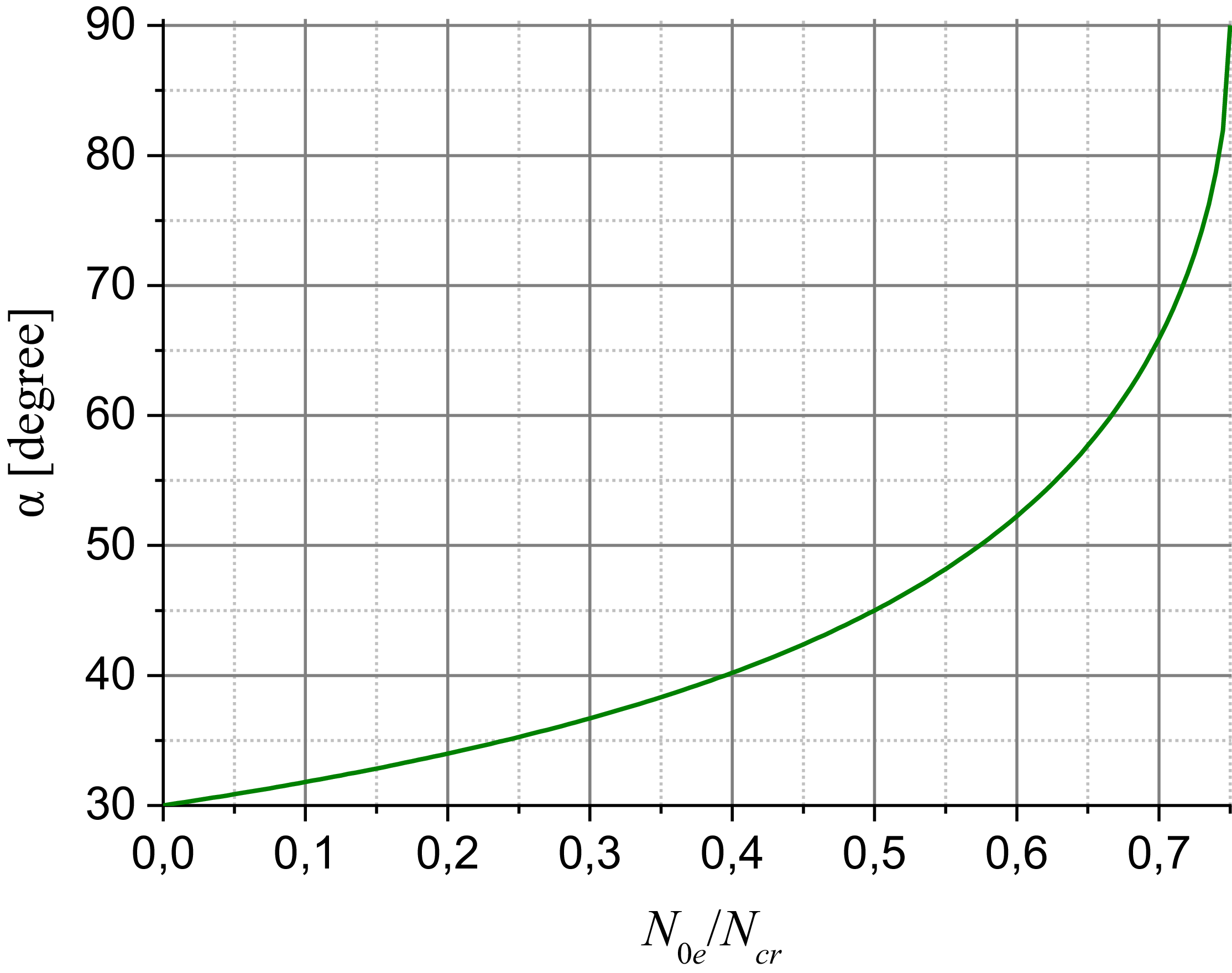
. Let us consider how the Cherenkov cone angle depends on the plasma density. The dependence of the Cherenkov cone angle on the electron density of the plasma cylinder is shown in figure 1 for a given value of the dielectric constant of the hollow capillary fibre
 ${\varepsilon} _{d}$
.
Cherenkov cone angle as a function of the electron density (3.6) for
 ${\varepsilon}_{d}=4$
.

From figure 1, it follows that for rarefied plasma
 $N_{0e}\lt \lt N_{cr}$
, the Cherenkov cone angle is close to
 $30^{\circ }$
and this value is determined by the given value of the dielectric constant
 ${\varepsilon} _{d}=4$
. With increasing electron density, the angle
 ${\alpha}$
increases and at
 $N_{0e}=0.75N_{cr}$
, the Cherenkov cone angle approaches
 $90^{\circ }$
, and this corresponds to the propagation of THz radiation along the axis of the HCF since in this case, the transverse wavenumber according to (3.6) becomes zero. From (3.6), it also follows that the angle of the Cherenkov cone can be small only for very large values of the dielectric constant of the capillary fibre.
In accordance with (2.11), we find the components of the electric field of THz radiation at
 $\rho \geq a$
,
 \begin{align} E_{z}({\omega} ,\boldsymbol{r})=-\frac{\sqrt{{\varepsilon} _{d}{\varepsilon} ({\omega} _{0})-1}}{{\varepsilon} _{d}\sqrt{{\varepsilon} ({\omega} _{0})}}B_{{\varphi} }({\omega} ,\boldsymbol{r}),\ E_{{\rho} }({\omega} ,\boldsymbol{r})=\frac{1}{{\varepsilon} _{d}\sqrt{{\varepsilon} ({\omega} _{0})}}B_{{\varphi} }({\omega} ,\boldsymbol{r}), \end{align}
where (3.4) and (3.6) for wavenumbers are taken into account.
Let us consider the THz radiation flux density integrated over time,
 \begin{align} \boldsymbol{P}(\boldsymbol{r})={\int }_{-\infty }^{+\infty }{\rm d}t\frac{c}{4{\pi} }\left[\boldsymbol{E}(\boldsymbol{r},t)\times \boldsymbol{B}(\boldsymbol{r},t)\right]={\int }_{\kern-3pt 0}^{\infty }{\rm d}{\omega} \,\boldsymbol{p}({\omega} ,\boldsymbol{r}), \end{align}
where the spectral energy flux density is determined by the formula
 \begin{align} \boldsymbol{p}({\omega} ,\boldsymbol{r})=\frac{c}{8{\pi} ^{2}}\{[\boldsymbol{E}({\omega} ,\boldsymbol{r})\times \boldsymbol{B}^{\ast }({\omega} ,\boldsymbol{r})]+c.c.\}, \end{align}
where
 $c.c.$
denotes the complex conjugate quantity. We will consider the energy flux in the radial direction, then from (3.12), taking into account relations (3.10), we obtain
 \begin{align} p_{{\rho} }({\omega} ,\boldsymbol{r})=\frac{c^{2}k_{d}}{4{\pi} ^{2}{\omega} {\varepsilon} _{d}}\left| B_{{\varphi} }({\omega} ,\boldsymbol{r})\right| ^{2}. \end{align}
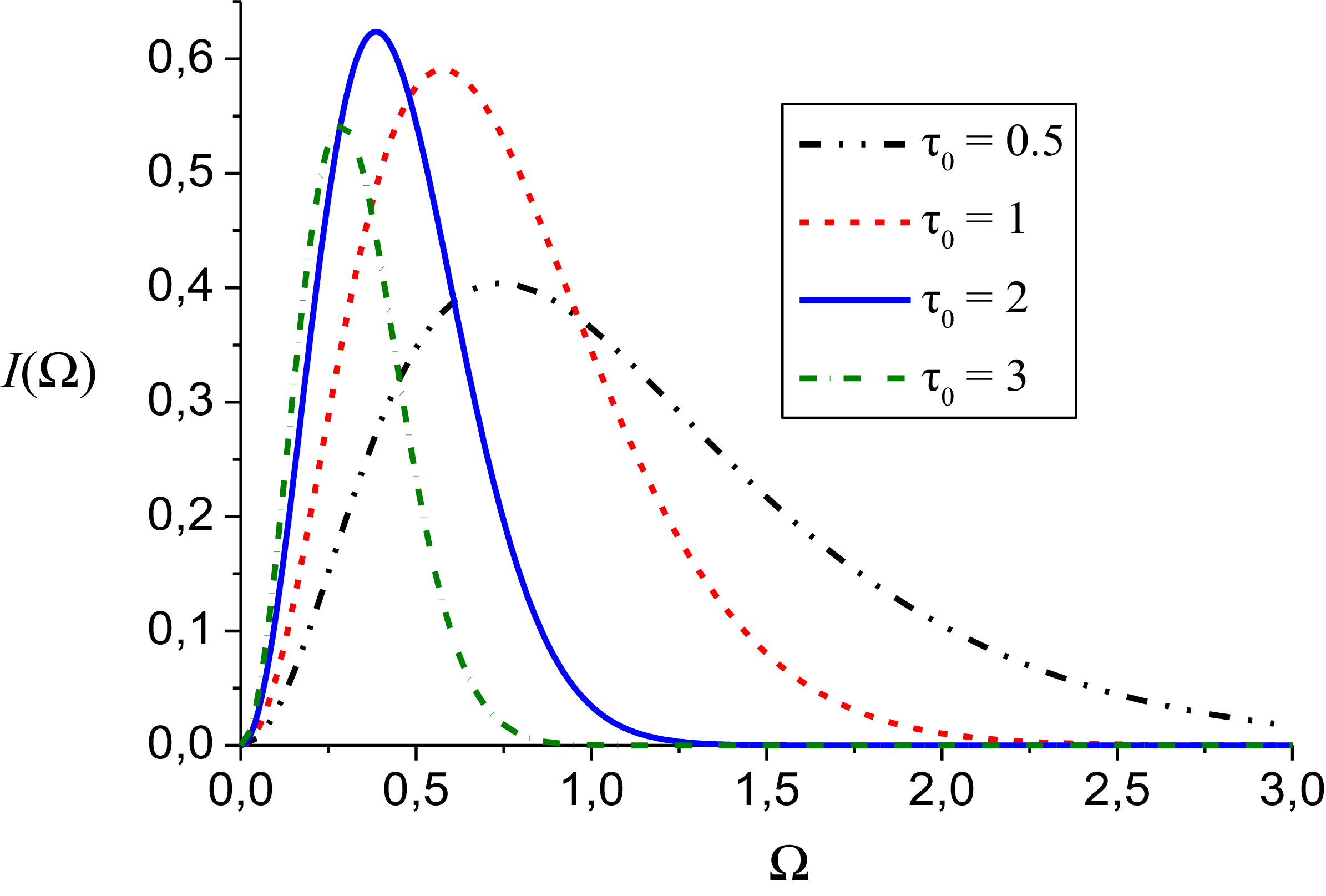
Energy of THz radiation (3.16) as a function of the dimensionless frequency
 ${\Omega} ={\omega} /{\omega} _{p}$
for different values of the parameter
 ${\tau} _{0}={\omega} _{p}{\tau} /\sqrt{2}$
, which characterises the dimensionless duration of the laser pulse.

The energy radiated in the radial direction through a cylindrical area
 $2{\pi} {\rho} {\rm d}z$
, in accordance with (3.11), takes the form
 \begin{align} {\rm d}W_{T\kern-1.2pt Hz}=2{\pi} {\rho} {\rm d}z{\int }_{\kern-3pt 0}^{\infty }{\rm d}{\omega} \,p_{{\rho} }({\omega} ,\boldsymbol{r}) .\end{align}
Then, the energy radiated from a unit path length
 ${\rm d}z$
into a unit frequency interval
 ${\rm d}{\omega}$
, in accordance with (3.13), (3.14), (3.3), can be represented in the following form:
 \begin{align} \frac{{\rm d}W_{T\kern-1.2pt Hz}}{{\rm d}{\Omega} {\rm d}z}=\frac{\sqrt{{\varepsilon} _{d}{\varepsilon} ({\omega} _{0})-1}}{{\varepsilon} _{d}}\frac{{{\omega} }_{p}^{2}}{{{\omega} }_{0}^{2}}\frac{{V}_{E}^{2}}{4{V}_{g}^{2}}\sqrt{\frac{2}{{\pi} }}\frac{a}{R^{2}}W_{\kern-0.5pt L}\exp \!\left(-\frac{2a^{2}}{R^{2}}\right)I({\Omega}), \end{align}
where the dependence of the radiation energy on the dimensionless frequency
 ${\Omega} ={\omega} /{\omega} _{p}$
is determined by the formula
 \begin{align} I({\Omega})=\frac{{\omega} _{p}{\tau} }{\sqrt{2}}\frac{{\Omega} ^{2}{I}_{1}^{2}({\kappa} a)\exp \!\left(-\big({{\Omega} ^{2}{{\omega} }_{p}^{2}{\tau} ^{2}}\big)/{2}\right)}{{\Omega} ^{2}[{\Omega} ^{2}-({\Omega} ^{2}-1){\varepsilon} ({\omega} _{0})]{I}_{0}^{2}({\kappa} a)+\big(({{\varepsilon} _{d}{\varepsilon} ({\omega} _{0})-1})/{{{\varepsilon} }_{d}^{2}}\big)({\Omega} ^{2}-1)^{2}{I}_{1}^{2}({\kappa} a)},\nonumber\\[4pt] \end{align}
where
 $V_{E}=eE_{0L}/(m_{e}{\omega} _{0})$
is the velocity of electron oscillations in the laser radiation field (2.1), and the energy of the laser pulse has the form
 \begin{align} W_{\kern-0.5pt L}=\frac{{E}_{0L}^{2}{\pi} ^{3/2}R^{2}V_{g}{\tau} }{8{\pi} } .\end{align}
The THz radiation energy as a function of frequency (3.16) is shown in figure 2 for different values of the parameter
 ${\tau} _{0}={\omega} _{p}{\tau} /\sqrt{2}$
, when a laser pulse with a wavelength
 ${\lambda} _{0}=3.9\,\unicode{x03BC}{\rm m}$
propagates in a plasma column with a radius
 $a=30\,\unicode{x03BC}{\rm m}$
and electron density
 $N_{0e}=0.1N_{cr}$
, surrounded by a capillary fibre with a dielectric constant
 ${\varepsilon} _{d}=4$
. An increase in the dimensionless duration of the laser pulse (parameter
 ${\tau} _{0}$
) leads to a shift of the spectral line to the region of lower frequencies. For a large value of the parameter
 ${\tau} _{0}\gt \gt 1$
, from (3.16) under the condition
 ${\kappa} a\gt \gt 1$
, one can find an analytical expression for the position of the spectral line,
 \begin{align} {\omega} _{\max }\approx \frac{\sqrt{2}}{{\tau} } .\end{align}
If we integrate in (3.15) over frequencies, we obtain the THz energy emitted by the laser pulse per unit path length
 \begin{align} \frac{{\rm d}W_{T\kern-1.2pt Hz}}{{\rm d}z}=\frac{\sqrt{{\varepsilon} _{d}{\varepsilon} ({\omega} _{0})-1}}{{\varepsilon} _{d}}\frac{{{\omega} }_{p}^{2}}{{{\omega} }_{0}^{2}}\frac{{V}_{E}^{2}}{4{V}_{g}^{2}}\sqrt{\frac{2}{{\pi} }}\frac{a}{R^{2}}W_{\kern-0.5pt L}\exp \!\left(-\frac{2a^{2}}{R^{2}}\right)w, \end{align}
where
 \begin{align} w={\int }_{\kern-3pt 0}^{\infty }{\rm d}{\Omega} I({\Omega}) .\end{align}
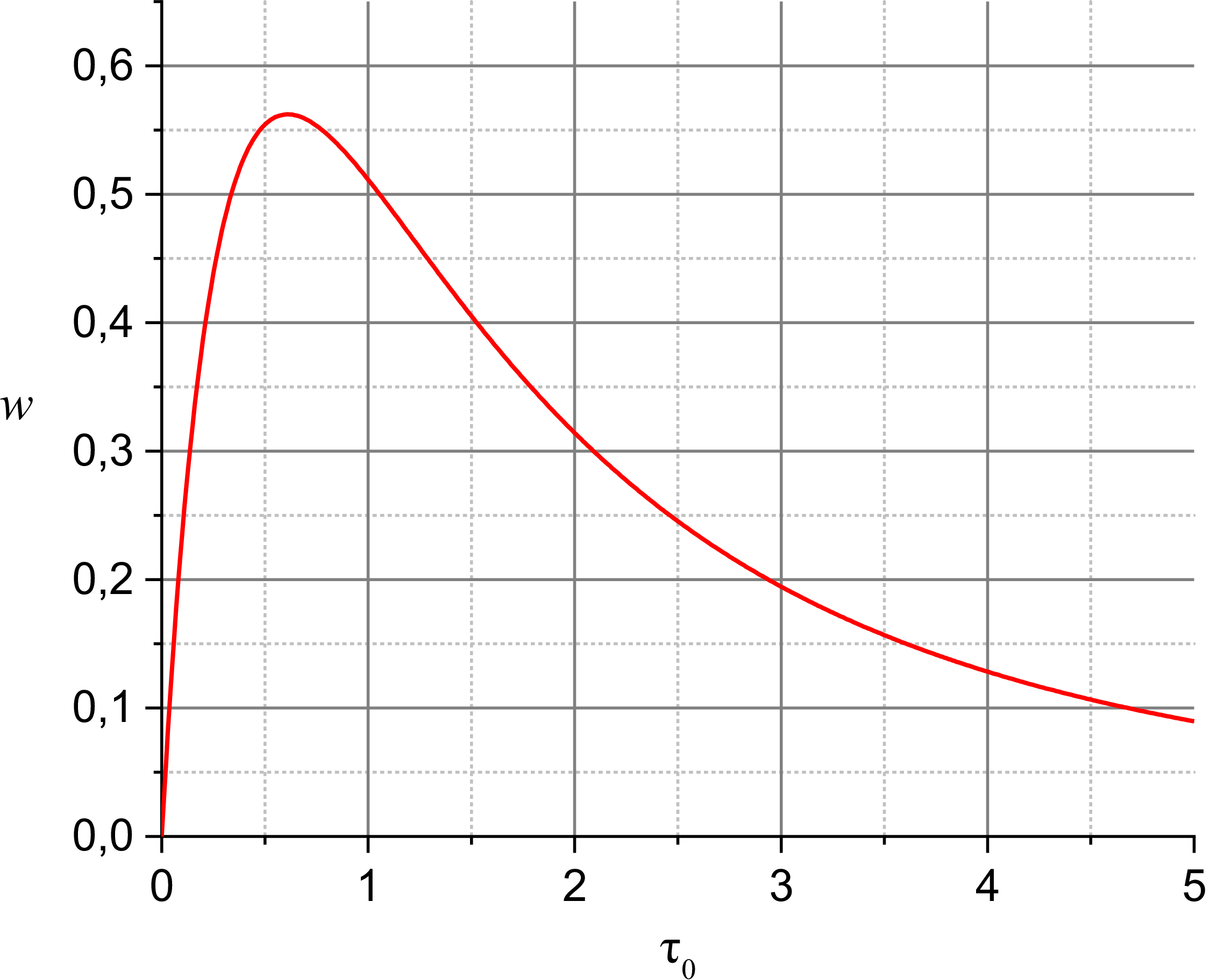
The dimensionless energy of THz radiation (3.20) as a function of the parameter
 ${\tau} _{0}={\omega} _{p}{\tau} /\sqrt{2}$
is shown in figure 3 for the same laser pulse and plasma column parameters as indicated earlier. From figure 3, it follows that the energy has a maximum value of
 $w_{\mathrm{max}}\approx 0.562$
for
 ${\tau} _{0}\approx 0.61$
, that is, for a laser pulse duration comparable to the reciprocal plasma frequency,
 ${\tau} \approx 0.86/{\omega} _{p}$
.
Dimensionless total energy of THz radiation (3.20) as a function of the parameter
 ${\tau} _{0}={\omega} _{p}{\tau} /\sqrt{2}$
, which characterises the dimensionless duration of the laser pulse.

Note that if the laser pulse duration differs from the optimal value, the corresponding THz radiation energy becomes smaller. For example, a decrease in energy by almost three times occurs for the following values of dimensionless duration:
 ${\tau} _{0}\approx 0.1$
and
 ${\tau} _{0}\approx 3$
, that is, with a decrease or increase in duration by 5–6 times.
Let us analyse the dependence of the THz radiation energy (3.19) on the parameters of the plasma column, laser pulse and HCF. It follows from (3.19) that the first multiplier on the right-hand side is maximum when the condition
 ${\varepsilon} _{d}=2/{\varepsilon} ({\omega} _{0})$
is fulfilled, that is, when the components of the wave vector in the radial and axial directions, according to (3.6), coincide. From (3.19) also, it follows that for a fixed radius of hollow core
 $\,a$
, the energy of THz radiation depends exponentially on the size of the laser pulse focal spot. Therefore, for tight focusing, the energy of the THz signal will be small, and optimal conditions for the emission of THz waves are realised when the size of the laser pulse focal spot and radius of hollow core are related by the formula
 $R=\sqrt{2}a$
, as follows from (3.19). Therefore, the maximum energy of THz radiation when these two conditions are fulfilled has the form
 \begin{align} \frac{{\rm d}W_{T\kern-1.2pt Hz}}{{\rm d}z}=\frac{{{\omega} }_{p}^{2}}{{{\omega} }_{0}^{2}}\frac{{V}_{E}^{2}}{8c^{2}}\frac{W_{\kern-0.5pt L}}{\sqrt{2{\pi} }a \mathrm{e}}w, \end{align}
where
 $\mathrm{e}$
is the base of the natural logarithm. From (3.21), it follows that the energy of THz radiation increases with increasing electron density, but it is limited by the condition
 ${\varepsilon} _{d}=2/{\varepsilon} ({\omega} _{0})$
, since
 ${\varepsilon} _{d}$
usually has a value close to 4. In this case, the maximum value of the multiplier
 ${{\omega} }_{p}^{2}/{{\omega} }_{0}^{2}$
in (3.21) is equal to
 $1/2$
.
Using the inverse Fourier transform (2.6), we find the spatiotemporal distribution of the magnetic field in a THz radiation pulse
 \begin{align} B_{{\varphi} }(\boldsymbol{r},t)=\frac{{\omega} _{p}}{{\omega} _{0}}\sqrt{2{\pi} }\frac{V_{E}}{4c}E_{0L}\sqrt{\frac{a}{{\rho} }}\exp \!\left(-\frac{a^{2}}{R^{2}}\right)H({\xi} ), \end{align}
where
 \begin{align} H({\xi} )=\frac{{\omega} _{p}{\tau} }{\sqrt{2}{\pi} }\mathrm{Re}{\int }_{0}^{+\infty }{\rm d}{\Omega} \frac{{\Omega} I_{1}({\kappa} a)\exp \!\big(i{\Omega} {\xi} -{\Omega} ^{2}{{\omega} }_{p}^{2}{\tau} ^{2}/4\big)}{{\Omega} \sqrt{{\Omega} ^{2}-({\Omega} ^{2}-1){\varepsilon} ({\omega} _{0})}I_{0}({\kappa} a)-i(({\sqrt{{\varepsilon} _{d}{\varepsilon} ({\omega} _{0})-1}})/{{\varepsilon} _{d}})({\Omega} ^{2}-1)I_{1}({\kappa} a)},\nonumber\\[4pt] \end{align}
here,
 \begin{align} {\xi} =k_{p}\left[\sqrt{{\varepsilon} _{d}{\varepsilon} ({\omega} _{0})-1}({\rho} -a)+z-V_{g}t\right]. \end{align}
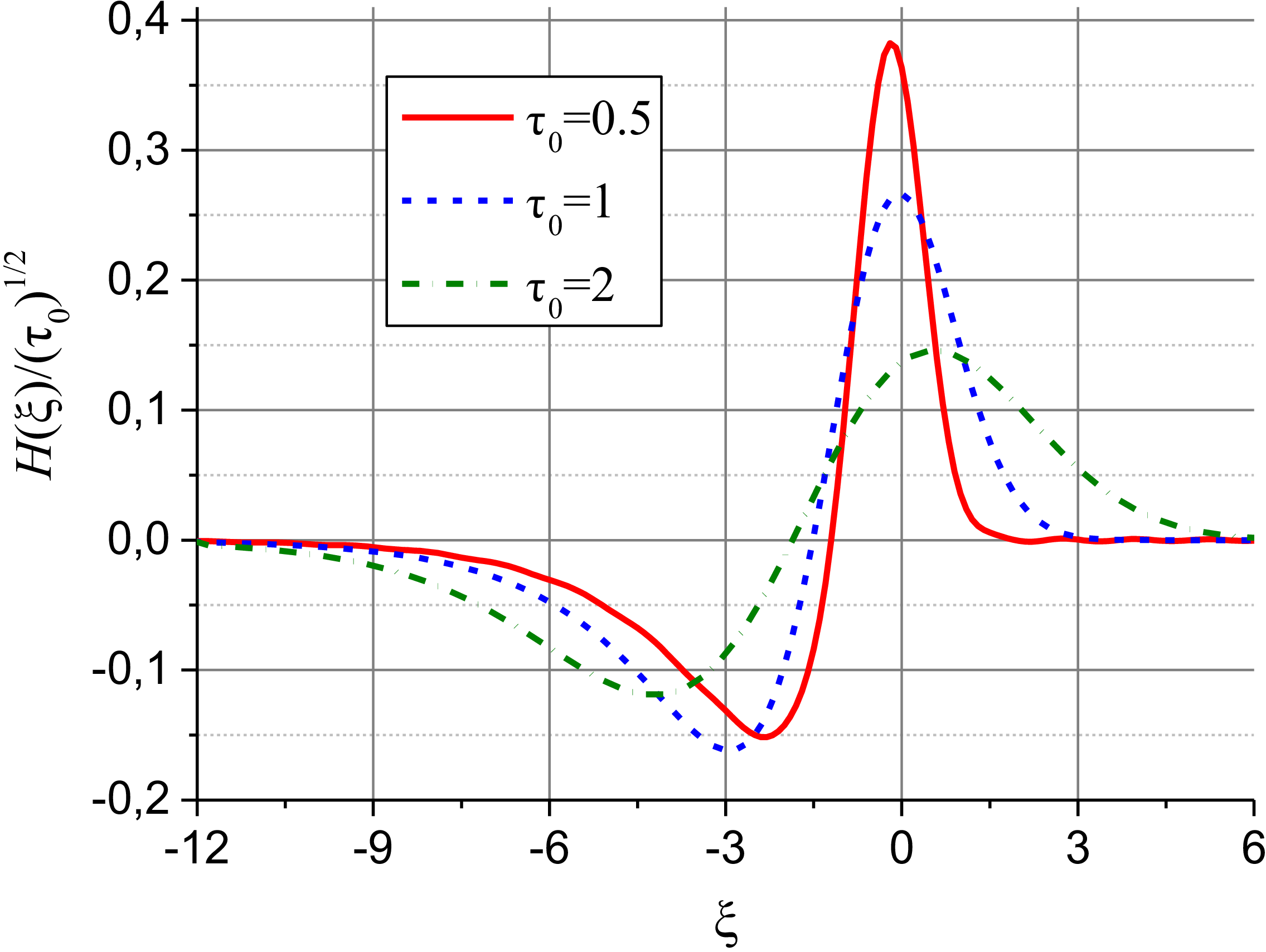
The spatiotemporal distribution of the THz signal magnetic field (3.23) is shown in figure 4 for different values of the laser pulse duration (other parameters of the laser pulse and plasma column are indicated earlier). For large values of the variable
 ${\xi}$
, the integral (3.23) is calculated analytically using the saddle-point method (Olver Reference Olver1974), and the distribution of the magnetic field under the condition
 $| {\xi} | \gt \gt {{\omega} }_{p}^{2}{\tau} ^{2}{\varepsilon} _{d}/\sqrt{{\varepsilon} _{d}{\varepsilon} ({\omega} _{0})-1}$
has the form
 \begin{align} H({\xi} )=\sqrt{\frac{2}{{\pi} }}\frac{{\varepsilon} _{d}}{\sqrt{{\varepsilon} _{d}{\varepsilon} ({\omega} _{0})-1}}\frac{{\xi} }{({{\xi} ^{2}}/{a^{2}})+a^{2}}\exp \!\left\{-\frac{{\xi} ^{2}}{{k}_{p}^{2}L^{2}}\right\}, \end{align}
where
 $L=V_{g}{\tau}$
is the longitudinal size of the laser pulse. From figure 4 and (3.25), it follows that the electromagnetic field of the THz pulse has one oscillation cycle and its duration is comparable to the duration of the laser radiation. As the laser pulse duration increases, the THz signal duration increases and the amplitude of its magnetic field decreases.
Spatiotemporal distribution of the magnetic field in a pulse of THz radiation
 $H({\xi} )/({\tau} _{0})^{1/2}$
for various values of the dimensionless duration of the laser pulse
 ${\tau} _{0}={\omega} _{p}{\tau} /\sqrt{2}$
, where
 ${\xi} =k_{p}[\sqrt{{\varepsilon} _{d}{\varepsilon} ({\omega} _{0})-1}({\rho} -a)+z-V_{g}t]$
is a co-moving coordinate.

To calculate the THz radiation intensity, we consider the Poynting vector
 \begin{align} \boldsymbol{S}(\boldsymbol{r},t)=\frac{c}{4{\pi} }\left[\boldsymbol{E}(\boldsymbol{r},t)\times \boldsymbol{B}(\boldsymbol{r},t)\right]\!, \end{align}
which, taking into account (3.10), takes the form
 \begin{align} \boldsymbol{S}(\boldsymbol{r},t)=\big[\boldsymbol{e}_{z}+\boldsymbol{e}_{{\rho} }\big(\sqrt{{\varepsilon} _{d}{\varepsilon} ({\omega} _{0})-1}\big)\big]\frac{c^{2}}{4{\pi} {\varepsilon} _{d}V_{g}}{B}_{{\varphi} }^{2}(\boldsymbol{r},t), \end{align}
where
 $\boldsymbol{e}_{{\rho} },\boldsymbol{e}_{z}$
are unit vectors in a cylindrical coordinate system. Comparing (3.27) and (3.24), we conclude that the electromagnetic energy, as it should be, is carried in the direction of the wave vector of the THz pulse. Using (3.27), (3.22), (3.23) for the intensity of THz radiation in the radial direction, we obtain
 \begin{align} I_{T\kern-1.2pt Hz}(\boldsymbol{r},t)=\frac{{{\omega} }_{p}^{2}}{{{\omega} }_{0}^{2}}\frac{{\pi} \sqrt{{\varepsilon} _{d}{\varepsilon} ({\omega} _{0})-1}}{{\varepsilon} _{d}}\frac{{V}_{E}^{2}}{4{V}_{g}^{2}}I_{L}\frac{a}{{\rho} }\exp \!\left(-\frac{2a^{2}}{R^{2}}\right)H^{2}({\xi} ), \end{align}
where
 $I_{L}=V_{g}{E}_{0L}^{2}/(8{\pi} )$
is laser pulse intensity and
 $H({\xi} )$
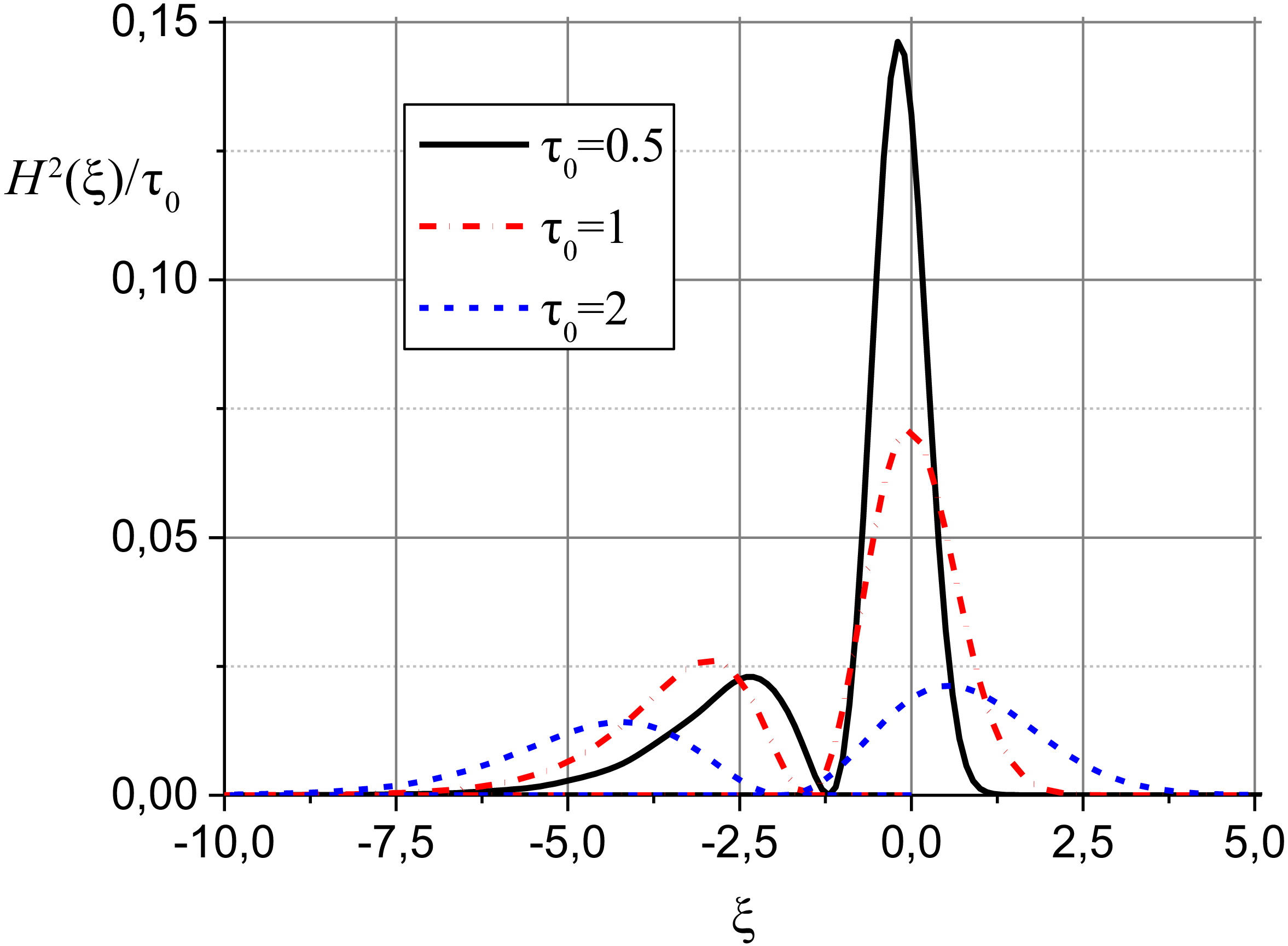
is determined by (3.23). The spatiotemporal distribution of the dimensionless intensity of THz radiation at different laser pulse durations for the parameters indicated earlier is shown in figure 5. From figure 5, it follows that the intensity of the THz signal has two peaks, each of which corresponds to the maximum and minimum of the magnetic field (see figure 4), one of which, at a short duration of the laser pulse, significantly exceeds the second. Increasing the duration of laser radiation leads to the fact that the maxima of the THz signal intensity become comparable to each other in absolute value.
Spatiotemporal distribution of the THz signal intensity
 $H^{2}({\xi} )/{\tau} _{0}$
for different values of the dimensionless laser pulse duration
 ${\tau} _{0}={\omega} _{p}{\tau} /\sqrt{2}$
, where
 ${\xi} =k_{p}[\sqrt{{\varepsilon} _{d}{\varepsilon} ({\omega} _{0})-1}({\rho} -a)+z-V_{g}t]$
is a co-moving coordinate.

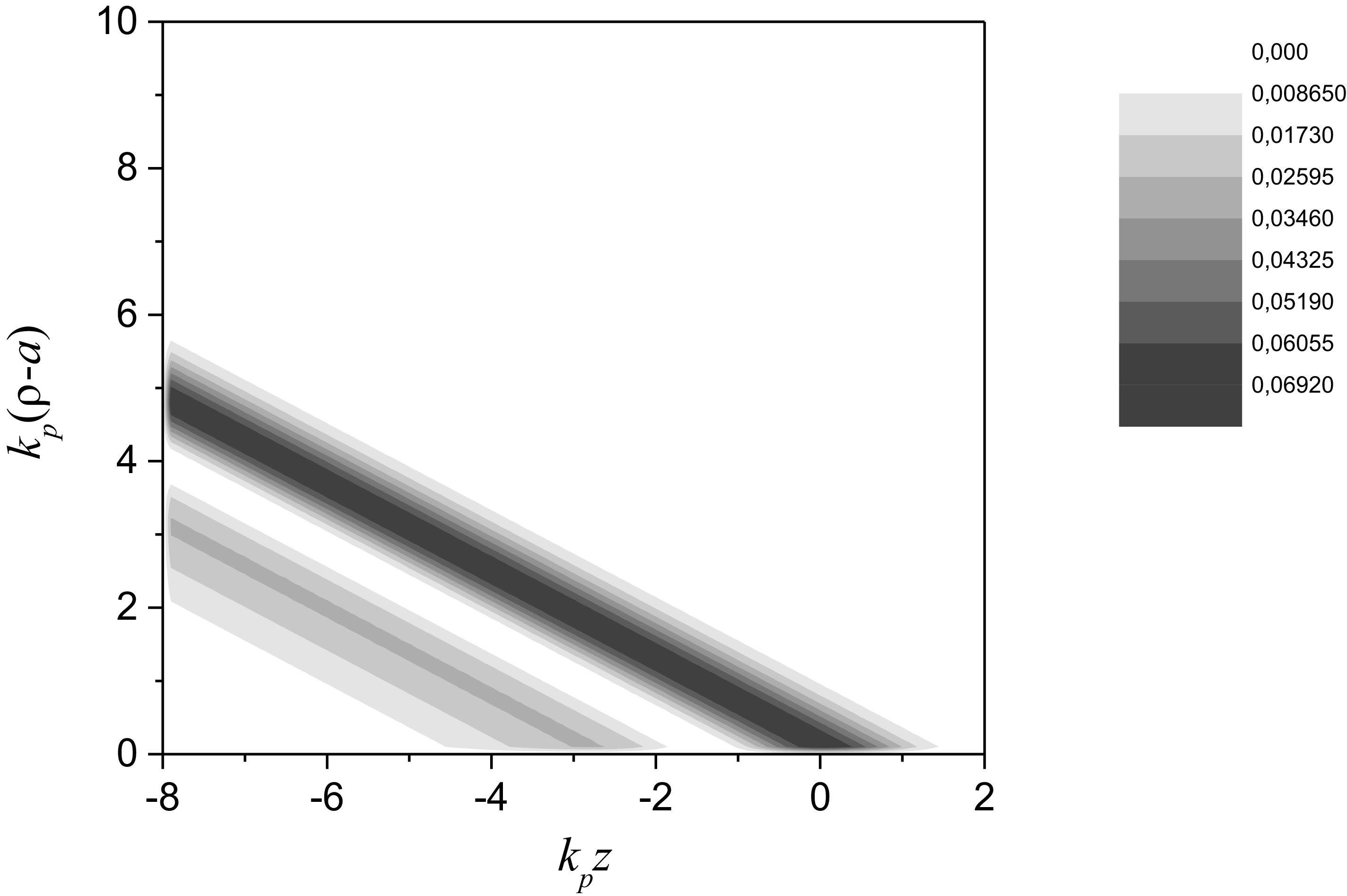
Figure 6 shows the contour lines of the dimensionless intensity
 $H^{2}({\xi} )/{\tau} _{0}$
at the time
 $t=0$
in the plane
 $x=0$
for
 $x\geq a$
at the laser pulse duration
 ${\tau} =\sqrt{2}/{\omega} _{p}$
. The Cherenkov cone for the intensity of THz radiation, shown in figure 6, has an opening angle that is determined by (3.6) and for parameters
 ${\varepsilon} _{d}=4,{\varepsilon} ({\omega} _{0})=0.9$
, it is equal to approximately
 $32^{\circ }$
.
Contour lines of the THz radiation intensity at the time
 ${\omega} _{p}t=0$
in the plane
 $k_{p}x=0$
at
 $x\geq a$
, constructed for the duration of the laser radiation
 ${\tau} =\sqrt{2}/{\omega} _{p}$
.

Let us consider internal THz plasma fields excited by the action of ponderomotive forces of laser radiation. From (2.9), (2.12), (2.13), we find the following expression for the magnetic field Fourier image at
 ${\rho} \lt a$
:
 \begin{align} B_{{\varphi} }({\omega} ,\boldsymbol{r})=\frac{{{\omega} }_{p}^{2}}{cV_{g}}\frac{\sqrt{{\pi} }{\tau} e{E}_{0L}^{2}}{4m_{e}{{\omega} }_{0}^{2}}\frac{I_{1}({\kappa} {\rho})}{{\kappa} I_{0}({\kappa} a)-ik_{d}(({{\varepsilon} ({\omega})})/{{\varepsilon} _{d}})I_{1}({\kappa} a)}\exp \!\left\{i\frac{{\omega} }{V_{g}}z-\frac{{\omega} ^{2}{\tau} ^{2}}{4}-\frac{a^{2}}{R^{2}}\right\}\!.\nonumber\\[5pt] \end{align}
From (3.29), it is clear that THz magnetic field vanishes on the axis of symmetry (
 $\rho=0$
) and increases up to the boundary with the HCF. From (3.29), we conclude that the excited internal fields are not eigenmodes of the plasma column, since the denominator in (3.29) is not resonant and cannot be equal to zero due to the presence of an imaginary unit in front of the second term. Therefore, the internal THz field in the plasma, excited by the action of ponderometric forces of laser radiation, exists only during the time these forces act. Consequently, the THz fields emitted from the plasma column also have only one oscillation cycle with a duration comparable to the duration of the laser pulse.
It should be noted that if the HCF has a strictly cylindrical shape, then for THz radiation at the outer boundary of the fibre, if it borders, for example, with air (the refractive index is approximately equal to unity), the condition of total internal reflection is fulfilled. This is due to the fact that in this case, Snell’s law
 $\sqrt{{\varepsilon} _{d}}\sin{\alpha} =\sin{\alpha} _{0}$
cannot be satisfied due to the inequality
 $\sqrt{{\varepsilon} _{d}}\sin{\alpha} \gt 1$
, where
 ${\alpha} _{0}$
is the emission angle in air relative to the normal to the fibre–air boundary, the refractive index of air is taken to be equal to unity and angle
 ${\alpha}$
is determined by (3.6). After specular reflection from the fibre–air interface, the THz pulse falls on the fibre–plasma interface and here, its total internal reflection also occurs, since Snell’s law
 $\sqrt{{\varepsilon} _{d}}\sin{\alpha} =\sqrt{{\varepsilon} ({\omega} _{0})}\sin{\alpha} _{1}$
also cannot be fulfilled due to the condition
 ${\varepsilon} ({\omega} _{0})\lt 1$
, where
 ${\alpha} _{1}$
is the emission angle in the plasma column relative to the normal to the fibre–plasma interface. Therefore, the THz pulse propagates inside the fibre along a zigzag trajectory, reflecting alternately from the inner and outer boundaries of the HCF, and can be emitted only at the end of the optical fibre. If the outer radius of the fibre is equal to
 $b$
, then the intensity of the outgoing THz radiation can be estimated using the formula
 $I_{T\kern-1.2pt Hz}\approx W_{T\kern-1.2pt Hz}/[{\pi} (b^{2}-a^{2}){\tau} _{T\kern-1.2pt Hz}]$
; it follows that the larger the outer radius of HCF, the lower the intensity of THz radiation.
Note that if the outer boundary of the HCF has the shape of a cone tapering in the direction of propagation of the laser pulse, then THz radiation can be emitted into the surrounding air. The angle of this cone
 ${\beta}$
can be found from the condition
 \begin{align} \sqrt{{\varepsilon} _{d}}\sin ({\alpha} -{\beta})\lt 1 ,\end{align}
which, taking into account (3.6), can be rewritten as
 \begin{align} {\beta} \gt \arcsin \!\left(\frac{\sqrt{{\varepsilon} _{d}-1}-\sqrt{{\varepsilon} _{d}{\varepsilon} ({\omega} _{0})-1}}{{\varepsilon} _{d}\sqrt{{\varepsilon} ({\omega} _{0})}}\right) .\end{align}
When condition (3.31) is fulfilled, THz waves will be radiated into the air at an angle
 ${\alpha} _{0}$
relative to the normal to the conical surface of the fibre, which is determined from the following relation:
 \begin{align} \sqrt{{\varepsilon} _{d}}\sin ({\alpha} -{\beta})=\sin{\alpha} _{0} .\end{align}
The angle relative to the normal to the plasma–fibre interface at which the THz signal is emitted will then be equal to
 ${\gamma} ={\alpha} _{0}+{\beta}$
or
 \begin{align} {\gamma} =\arcsin \!\left[\sqrt{{\varepsilon} _{d}}\sin ({\alpha} -{\beta})\right]+{\beta} .\end{align}
For the parameters of the plasma column and the refractive index of the dielectric medium indicated earlier for the cone angle from (3.31), we find the condition
 ${\beta} \gt 1.81^{\circ }$
. At this cone angle, the THz signal will be emitted from the HCF into the surrounding air. To calculate what fraction of the THz pulse energy is radiated from the fibre into the air, we use the following relation for the transmission coefficient (Landau & Lifshitz Reference Landau and Lifshitz1984):
 \begin{align} \frac{{W}_{T\kern-1.2pt Hz}^{air}}{{W}_{T\kern-1.2pt Hz}^{\textit{fibre}}}=T({\beta})=\frac{4\cos({\alpha} -{\beta})\sqrt{{\varepsilon} _{d}\left[1-{\varepsilon} _{d}\sin ^{2}({\alpha} -{\beta})\right]}}{\Big\{\cos({\alpha} -{\beta})+\sqrt{{\varepsilon} _{d}\left[1-{\varepsilon} _{d}\sin ^{2}({\alpha} -{\beta})\right]}\Big\}^{2}} .\end{align}
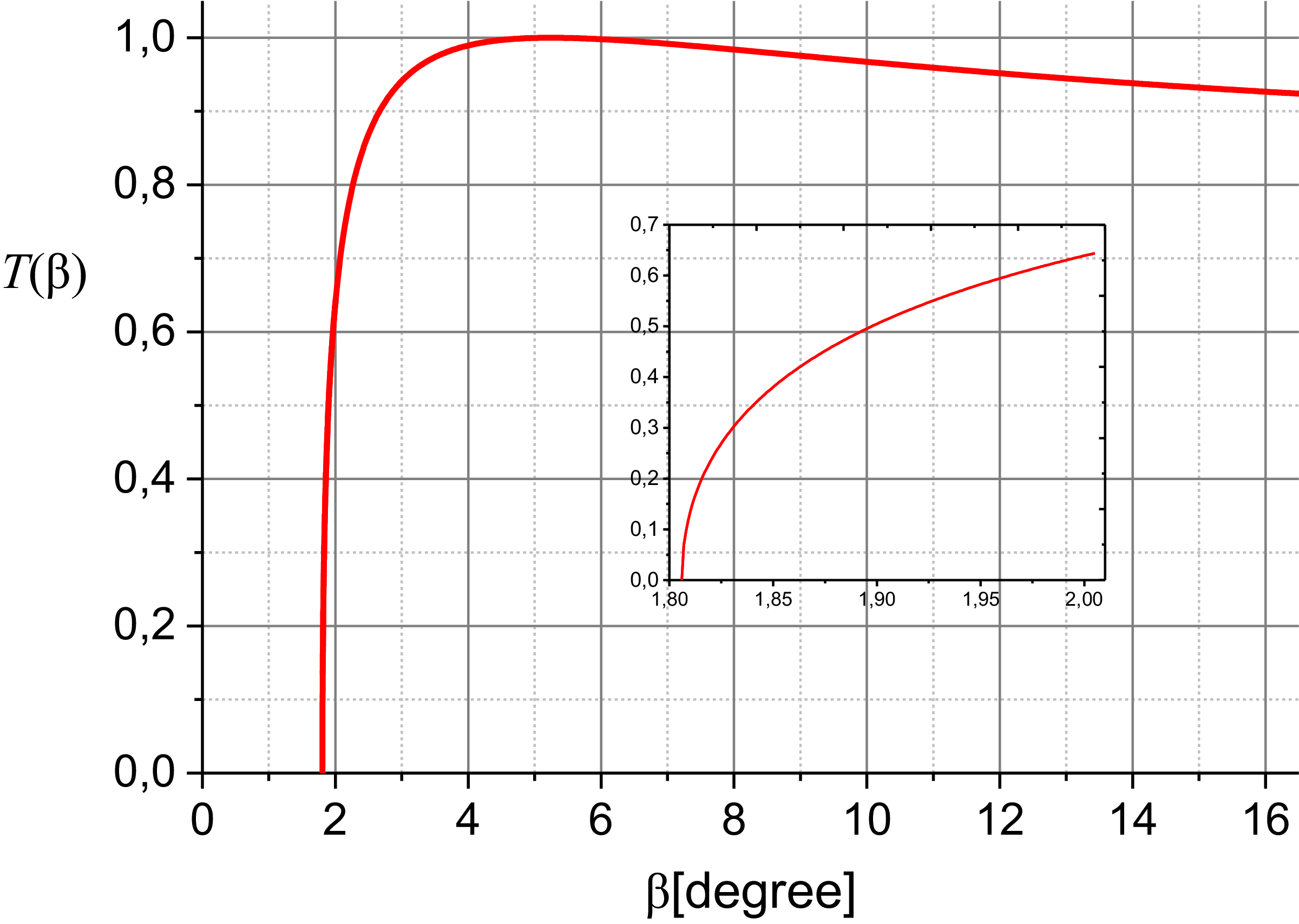
The transmission coefficient as a function of the conical angle of the fibre (3.34) is shown in figure 7 for
 ${\varepsilon} _{d}=4,{\varepsilon} ({\omega} _{0})=0.9$
.
Dependence of the transmission coefficient of the THz signal energy from the HCF into air on the fibre cone angle for
 ${\varepsilon} _{d}=4,{\varepsilon} _{0}=0.9$
. The inset shows the dependence of the transmission coefficient at small angle values.

At
 ${\beta} \leq 1.81^{\circ }$
, the effect of total internal reflection occurs and THz plasma fields are not emitted into the air, but propagate inside the HCF. If
 ${\beta} \gt 1.81^{\circ }$
, THz waves are emitted into the air and their energy rapidly increases with increasing angle
 ${\beta}$
(see inset in figure 7). For example, if the cone angle is
 ${\beta} =2^{\circ }$
, then approximately 64 % of the THz energy is emitted into the air at an angle
 $86^{\circ }$
relative to the normal to the axis of the fibre or almost along its axis and the Cherenkov cone angle is approximately equal to
 $86^{\circ }$
. At
 ${\beta} \approx 5.24^{\circ }$
, the transmission coefficient is equal to unity and this means that the energy of the THz fields is totally radiated into the surrounding air. This effect is explained by the fact that under these conditions, the THz wave falls on the fibre–air interface at the Brewster angle
 $\tan ({\alpha} -{\beta} )=\sqrt{1/{\varepsilon} _{d}}$
and the reflection coefficient is zero. In this case, in air, THz radiation propagates at an angle of
 $69^{\circ }$
relative to the normal to the fibre axis and the Cherenkov cone solution is also equal to
 $69^{\circ }$
. With a further increase in the cone angle of the HCF, the transmission coefficient gradually decreases and at
 ${\beta} \approx 10^{\circ }$
, the energy of the THz radiation into the air is approximately 97 % of the THz energy in the fibre. In this case, THz radiation propagates at an angle of
 $58^{\circ }$
relative to the normal to the fibre axis and the angle of the Cherenkov cone is also equal to
 $58^{\circ }$
.
4. Conclusion
This article examines the propagation of a laser pulse in a gas-filled hollow capillary fibre. It was assumed that the leading edge of an intense laser pulse ionises the gas in the hollow core of the capillary fibre. As a result, the pulse itself propagates in a column of fully ionised plasma, the density of which is less than the critical value. The ponderomotive action of laser radiation on plasma electrons leads to the excitation of THz electromagnetic fields in the plasma column. It is shown that if the group velocity of the laser pulse exceeds the phase velocity of electromagnetic waves in the capillary fibre surrounding the plasma column, then THz waves are emitted by the Cherenkov mechanism. The spectral, angular and energy characteristics of the THz signal were studied. It was shown that the emission spectrum contains a broad spectral line, the position of which is determined by the reciprocal of the laser pulse duration. The energy of the THz signal emitted per unit path length was calculated and the optimal duration of the laser pulse at which the THz energy is maximum was found. The spatiotemporal distribution of the electromagnetic field in a THz radiation pulse is examined. It is shown that the THz signal has a single field oscillation cycle and its duration is comparable to the duration of the laser radiation. The intensity of the THz signal was calculated and its contour lines were constructed, which have the form of a Cherenkov cone, the opening angle of which is determined by the plasma density and the refractive index of the fibre. It has been established that the angle of the Cherenkov cone decreases with an increase in the refractive index of the dielectric and a decrease in the electron density.
Let us discuss the conditions of applicability of the obtained results. The formula for the Fourier transform of the magnetic field of THz radiation (2.16) and all subsequent results (3.1), (3.3), (3.15), (3.16), (3.19)–(3.25), (3.28) are obtained under the condition
 $k_{d}a\gt \gt 1$
, which, taking into account (3.4), (3.18), can be rewritten as
 $a\gt \gt L/\sqrt{2[{\varepsilon} _{d}{\varepsilon} ({\omega} _{0})-1]}$
. This inequality means that all the above-mentioned results for the energy and intensity of THz radiation are applicable when the radius of the hollow core
 $a$
significantly exceeds the longitudinal size of the laser pulse
 $L=V_{g}{\tau}$
, which, according to (3.25), is comparable to the characteristic scale of change of the THz field. Let us consider what percentage error appears when using the asymptotic expansion of the Hankel function (2.15) instead of the exact value of this function. Comparing the exact value of the Hankel function with the asymptotic value, for example, at
 $k_{d}a=3$
, we find that for the squares of their absolute values (it is this value, according to (3.13), that determines the energy of THz radiation), the difference is 3.6 %, and this is quite an acceptable accuracy. In the previous example, for a laser pulse duration of
 ${\tau} =6\,\rm fs$
, the parameter
 $k_{d}a$
is significantly larger and is approximately 40, then the percentage error is 0.02 %.
In this paper, the plasma was assumed to be collisionless; therefore, we have neglected electron collisions in (2.5). This means that the condition
 ${\nu} _{ei}{\tau} \lt \lt 1$
is satisfied and the time between electron collisions
 ${\tau} _{ei}=1/{\nu} _{ei}$
significantly exceeds the duration of the laser radiation, where
 ${\nu} _{ei}$
is the frequency of electron–ion collisions. If the plasma is in a field of intense high-frequency radiation, then the frequency of electron–ion collisions is determined by not the thermal velocity of electrons
 $V_{Te}=\sqrt{T_{e}/m_{e}}$
, but by the speed of oscillations of electrons in the high-frequency field
 $V_{E}$
, where
 $T_{e}$
is the electron temperature. When the condition
 $V_{E}\gt \gt V_{Te}$
is fulfilled, then the frequency of electrons with ions collisions has the form (Silin Reference Silin1965)
 \begin{align} {\nu} _{ei}=\frac{16Ze^{4}N_{0e}}{{m}_{e}^{2}{V}_{E}^{3}}\left\{1+\mathrm{ln} \left(\frac{V_{E}}{2V_{Te}}\right)\right\}\ln\!{\Lambda} ,\end{align}
where
 $Z$
is charge of ions,
 $ \ln\!{\Lambda} =\mathrm{ln} \{{T}_{e}^{3/2}/(\sqrt{8{\pi} } | e| ^{3}{N}_{0e}^{1/2})\}$
is Coulomb logarithm. Also, recombination effects were not taken into account in this paper. If the condition
 ${\tau} _{\textit{recom}}\gt \gt {\tau}$
is satisfied, then recombination does not occur during the duration of the laser pulse, where
 ${\tau} _{\textit{recom}}$
is the recombination time, which, according to Sprangle et al. (Reference Sprangle, Penano, Hafizi and Kapetanakos2004) has the form
 ${\tau} _{\textit{recom}}=1/({\beta} _{\textit{recom}}N_{0e})$
, and the recombination coefficient is determined by the formula
 ${\beta} _{\textit{recom}}[{\rm cm^{3}\,s^{-1}}]\approx 2\times 10^{-8}/\sqrt{T_{e}[\rm eV]}$
. For densities
 $(10^{16}{-}10^{18})\,\rm cm^{-3}$
and temperatures
 $(1{-}100)\,\rm eV$
, the recombination time is in the nanosecond range and it is many orders of magnitude longer than the duration of a femtosecond laser pulse.
Note that the sufficiently high values for the radiation energy and the conversion rate are obtained due to the fact that the multiplier
 $\sqrt{{\varepsilon} _{d}{\varepsilon} ({\omega} _{0})-1}$
included in (3.19) is not small compared with unity due to
 ${\varepsilon} _{d}=4$
. Another scenario takes place when THz waves are emitted from a plasma filament that forms in air during the propagation of a femtosecond laser pulse. In this case, the multiplier
 $\sqrt{{\varepsilon} _{d}{\varepsilon} ({\omega} _{0})-1}$
is a small value due to the fact that the dielectric constants of air and the plasma filament are close to unity. For the first time, the emission of THz waves from a plasma filament, which is formed during the ionisation of air by a femtosecond laser pulse, was observed in an experiment (Tzortzakis et al. Reference Tzortzakis2002). Since then and up to the present time, this phenomenon has been studied both experimentally and theoretically in many works (see, for example, Rizaev et al. Reference Rizaev, Dick, Levus, Pushkarev, Khasiiatullov and Seleznev2026 and the references cited there). As for the physical mechanism that explains the emission of THz waves from a plasma filament, there are different points of view on this issue. As, for example, was noted in the article by Sprangle et al. (Reference Sprangle, Penano, Hafizi and Kapetanakos2004), ‘for steady state laser pulse propagation, the flux of THz energy is non-radiative and axially directed’. The emission of plasma fields excited by the ponderomotive action of a laser pulse from a filament is possible only for non-steady state or transient laser pulse propagation (Sprangle et al. Reference Sprangle, Penano, Hafizi and Kapetanakos2004), when, for example, there are density modulations in the plasma. In contrast to the previous work (Sprangle et al. Reference Sprangle, Penano, Hafizi and Kapetanakos2004), the presented article examines another mechanism for generating THz radiation, which consists of transforming internal plasma fields, excited by the ponderomotive action of laser radiation on plasma electrons, into electromagnetic waves at the plasma–dielectric interface. Thus, if the condition
 ${\varepsilon} _{d}{\varepsilon} ({\omega} _{0})\gt 1$
or
 \begin{align} \frac{N_{0e}}{N_{cr}}\lt \frac{{\varepsilon} _{d}-1}{{\varepsilon} _{d}} \end{align}
is satisfied, then according to (3.19), THz waves are emitted due to the transformation of plasma fields into electromagnetic waves at the plasma–dielectric interface. If the plasma is denser and the condition
 \begin{align} \frac{N_{0e}}{N_{cr}}\gt \frac{{\varepsilon} _{d}-1}{{\varepsilon} _{d}} \end{align}
is satisfied, then there is no radial energy flux and the THz signal propagates along the plasma filament in the form of a surface wave, which was previously discussed in a publication (Gorbunov et al. Reference Gorbunov, Mora and Ramazashvil2003). A recently published paper this year (Zhao et al. Reference Zhao, Yuan, Yang, Xie, Peng and Zhu2026) considered the excitation of THz surface waves propagating along the axis of a plasma filament formed during the propagation of a femtosecond laser pulse in air, and this apparently occurs in a sufficiently dense plasma when condition (4.3) is satisfied. If we consider the refractive index of air to be equal to
 $n_{d}=\sqrt{{\varepsilon} _{d}}\approx 1.0003$
(Sprangle et al. Reference Sprangle, Penano, Hafizi and Kapetanakos2004), then, in accordance with (4.2), (4.3), from the rarefied plasma of the filament at
 $N_{0e}\lt 6\times 10^{-4}N_{cr}$
, THz waves will be emitted into the air, and in the denser plasma of the filament at
 $N_{0e}\gt 6\times 10^{-4}N_{cr}$
, THz surface waves will propagate along its axis.
In conclusion, we present numerical estimates for the spectral, angular and energy characteristics of THz radiation that can be obtained in modern laser-plasma experiments. Let an infrared laser pulse with wavelength
 ${\lambda} _{0}=3.9\,\unicode{x03BC}{\rm m}$
(Mitrofanov et al. Reference Mitrofanov2016), duration
 ${\tau} =6f\kern-1pt s$
, transverse size
 $R=30\,\unicode{x03BC}{\rm m}$
and intensity
 $I_{L}=6.2\times 10^{15}\,\rm W\,cm^{-2}$
(energy and power at these parameters are equal to
 $W_{\kern-0.5pt L}\approx 1.7\,\rm mJ$
and
 $P_{L}\approx 0.17\,\rm TW$
) propagate in a plasma column with radius
 $a=30\,\unicode{x03BC}{\rm m}$
and electron density
 $N_{0e}=0.1N_{cr}\approx 7.4\times 10^{18}\,\rm cm^{-3}$
, surrounded by a capillary fibre with a dielectric constant
 ${\varepsilon} _{d}=4$
. Note that although the duration of the laser pulse is equal approximately to half the period (
 $T_{0}=2{\pi} /{\omega} _{0}\approx 13\,\rm fs$
), the condition
 ${\tau} \gt \gt 1/{\omega} _{0}$
can be considered fulfilled with a satisfactory approximation since under these conditions,
 ${\omega} _{0}{\tau} \approx 3$
. In addition, compression of laser pulses to sizes of the order of the oscillation period can also be achieved using gas-filled hollow capillary fibre (Kötting et al. Reference Kötting, Schade, Koehler, Russell and Tani2020). Then, the emission of THz waves occurs at an angle of approximately
 $58^{\circ }$
relative to the axis of the plasma column at a frequency of
 ${\nu} _{T\kern-1.2pt Hz}\approx 18\,\rm THz$
, which corresponds to a wavelength equal to
 ${\lambda} _{T\kern-1.2pt Hz}\approx 17\,\unicode{x03BC}{\rm m}$
. If helium is used to fill an HCF, then at its total ionisation (
 $Z=2$
) for electron temperature
 $T_{e}=100\,\rm eV$
, the collision frequency according to (4.1) is equal to
 ${\nu} _{ei}\approx 6\times 10^{8}\,1\,\rm s^{-1}$
and the recombination time is approximately
 $0.1\,\rm ns$
; therefore, during the duration of the laser pulse, there are no electron collisions or recombination processes in the plasma. For the indicated parameters, the energy radiated over the length
 $z$
, in accordance with (3.19), (3.20), is equal to
 $W_{T\kern-1.2pt Hz}\approx 4.8\times 10^{-5}(z/R)W_{\kern-0.5pt L}$
. In the conditions under consideration, the laser pulse propagates in the plasma column in the self-channelling mode, since its power is close to the critical value for self-focusing
 $P_{cr}\approx 17.4({\omega} _{0}/{\omega} _{p})^{2}GW\approx 0.174\,\mathrm{TW}$
(see, for example, Esarey, Schroeder & Leemans Reference Esarey, Schroeder and Leemans2009). Since the previous intensity value is almost four times greater than the threshold value for total ionisation of helium,
 $I_{L,th}\approx 1.5\times 10^{15}\,\rm W\,cm^{-2}$
(Emelina, Emelin & Ryabikin Reference Emelina, Emelin and Ryabikin2014), a relatively uniform distribution of the electron density in the radial direction will take place. This density distribution guarantees the stability of the self-channelling of the laser pulse, since the critical power for self-focusing will also be constant over the HCF cross-section. Therefore, at a length of
 $z=10\,\rm cm$
, the energy of THz radiation is equal to
 $W_{T\kern-1.2pt Hz}\approx 0.27\,\rm mJ$
and the conversion rate is equal to
 $W_{T\kern-1.2pt Hz}/W_{\kern-0.5pt L}\approx 15\,\%$
. These estimates show the possibility of generating high-energy pulses of THz radiation with a sufficiently high conversion rate, which exceeds previously achieved values (Vicario et al. Reference Vicario, Ovchinnikov, Ashitkov, Agranat, Fortov and Hauri2014, Reference Vicario, Jazinsek, Ovchinnikov, Chefonov, Ashitkov, Agranat and Hauri2015).
Thus, when using a cylindrical fibre shape, the THz signal propagates inside the fibre and is emitted from its end face. If the outer radius of HCF is equal to
 $60\,\unicode{x03BC}{\rm m}$
, then for the above-mentioned laser and plasma parameters as an estimate of the intensity of the outgoing THz radiation, we have the value
 $5\times 10^{14}\,\rm W\,cm^{-2}$
. Experimentally, this can be realised if laser radiation is focused into the end face of a gas-filled HCF so that the size of the focal spot approximately coincides with the diameter of the hollow core, and placing a laser absorber and a lens for focusing the THz signal at some distance from the other end face. The difficulty of the experimental realisation apparently lies in achieving the coincidence of the fibre axis and the axis of the laser pulse propagation. The disadvantage of this method of generating THz radiation is the long path of its propagation inside the HCF with possible energy losses. A more promising scenario seems to be the use of a conical shaped fibre. In this case, if we use a cone-shaped HCF that tapers in the direction of propagation of the laser pulse, then at a certain angle of this cone, the THz signal is emitted from the plasma column into the surrounding air with high efficiency.
Acknowledgements
Editor Louise Willingale thanks the referees for their advice in evaluating this article.
Declaration of interests
The author reports no conflict of interest.
 εd=4
 Ω=ω/ωp
 τ0=ωpτ/2
 τ0=ωpτ/2
 H(ξ)/(τ0)1/2
 τ0=ωpτ/2
 ξ=kp[εdε(ω0)−1(ρ−a)+z−Vgt]
 H2(ξ)/τ0
 τ0=ωpτ/2
 ξ=kp[εdε(ω0)−1(ρ−a)+z−Vgt]
 ωpt=0
 kpx=0
 x≥a
 τ=2/ωp
 εd=4,ε0=0.9

 Open access

