INTRODUCTION
In 2010, Morris and Leung elucidated complexities in understanding the differences between Eastern and Western creativity by proposing two different kinds of psychological mechanisms: personal values and cultural norms. Inspired by this approach, the current article seeks to understand the cultural dynamics of creativity in Singapore. Singapore is a nation that, from its founding, has explicitly acknowledged and celebrated multiple ethnic communities: Chinese, Malay, Indian, and Western. Extant research has shown that exposure to multiple cultures enhances creativity (Leung & Chiu, Reference Leung and Chiu2010; Leung, Maddux, Galinsky, & Chiu, Reference Leung, Maddux, Galinsky and Chiu2008; Maddux & Galinsky, Reference Maddux and Galinsky2009). Therefore, one would expect that Singaporeans would demonstrate a relatively high level of creativity. Surprisingly, on the contrary, research reveals that Singaporeans do not demonstrate higher creativity than their Western counterparts (Ng, Reference Ng2003). For instance, in 2016, while Singapore achieved a high Global Innovation Score (ranking 6th out of 128 countries), it ranked much lower (ranking 78th among the same 128 countries) in terms of innovation efficiency (i.e., innovation output over innovation input ratio), suggesting that the innovation performance of Singapore is relatively low given the amount of innovation input it has invested (Cornell University, INSEAD, & WIPO, 2016). If anything, Singaporeans are lagging behind (Miles, Reference Miles2013). What are the hindering factors? We take the approach inspired by Leung and Morris (Reference Leung and Morris2015), the situated dynamics framework of cultural influence, to examine this intriguing question by investigating the roles of both pertaining values and norms in Singapore.
THEORETICAL BACKGROUND AND HYPOTHESES
Singapore and Creativity
Creativity, defined as the ability to generate ideas that are both original and feasible, is often essential for personal and professional success (Amabile, Reference Amabile1986; Sternberg & Lubart, Reference Sternberg, Lubart and Sternberg1999). Creativity has been recognized as one of the most critical personal characteristics for business success (Chua & Zremski, Reference Chua and Zremski2016). An IBM survey of 1,500 CEOs from 60 countries found that they believed creativity to be the most important leadership quality (IBM, 2010). More recently, a survey of 500 managers asked about challenges in the next three to five years and qualities needed to meet them; it found that drive, creativity, and open-mindedness are the most desired personal qualities (Hyper Island, 2014). Moreover, creative ideas are the starting point for innovation (Amabile, Reference Amabile, Staw and Cummings1988), and in the modern business world characterized by advanced technology and global competition, success stems from innovation (see Senge & Carstedt, Reference Senge and Carstedt2001).
While the pursuit of creativity has become a trend in business across continents, East Asians are often perceived – by others as well as themselves – to be less creative than Westerners (Morris & Leung, Reference Morris and Leung2010). In fact, the creativity problem has grown into a salient topic of public discourse and policy in several East Asian societies, including Singapore. For instance, Morris and Leung (Reference Morris and Leung2010: 313) reported that: ‘In Singapore, [book] titles such as Why Asians Are Less Creative than Westerners (Ng, Reference Ng2001) and Can Asians Think? Understanding the divide between East and West (Mahbubani, Reference Mahbubani2002) hit the bestseller list amid educational reforms designed to encourage creativity and economic policies aimed at developing creative industries in Singapore (Tan & Law, 2004)’. Indeed, despite the splendid history of artistic and scientific innovation in ancient China and Japan (see Murray, Reference Murray2003), today East Asians still tend to be regarded as traditional, imitative, and less creative than their Western counterparts.
This is especially true in Singapore. Singaporeans do not show a high level of creativity in general, according to previous cross-cultural studies (Lau, Reference Lau2007; McElhinney, Reference McElhinney2008). A recent Straits Times report, titled ‘PISA and the creativity puzzle’, discussed the discrepancy between Singaporeans’ high academic achievement and low creative performance (Davie, Reference Davie2016). PISA, the Programme for International Student Assessment, is a long-running study of the educational attainment of 15-year-old students across many countries. In 2016, Singapore had the highest proportion of top performers in math and science, and has ranked very highly for decades. But Singapore has produced few top-ranked scientists and inventors (Davie, Reference Davie2016). The head of PISA, Dr. Andreas Shleicher, commented that, ‘If Singapore wants to nurture innovation, then it has to encourage risk-taking and failure’ (Davie, Reference Davie2016).
If this is indeed the case, then what gets in the way of risk-taking and creativity in Singapore? Kiasu, an indigenous or folk construct used to describe a mentality or syndrome prevalent in Singapore, may be the answer. Kiasu translates to ‘fear of losing out’, and this fear-based mentality contributes to a prevention-focused form of competitiveness. In 2012, a survey polling 2,000 Singaporean residents about the nation's characteristic values and traits found that Kiasu ranked first (Chan, Reference Chan2012), a finding that dramatically illustrates the prevalence of Kiasu in Singapore. Although Kiasu is not all bad for Singaporeans, it is commonly perceived as an obstacle to Singaporeans’ creative performance (Vasagar, Reference Vasagar2016). Shiao-Yin Kuik, a member of parliament in Singapore, recently contended that Kiasu culture is stifling originality in Singaporean business (Chua, Reference Chua2016). While these lay opinions may be generally correct, it is important to test how Kiasu works psychologically if we are to better understand and manage this problem. The current research seeks to fill this knowledge gap.
Kiasu and Creativity
‘Kiasu’ (驚輸) originates from Hokkien (a Chinese dialect), and literally translates to ‘fear of losing out’ (c.f. Ho, Ang, Loh, & Ng, Reference Ho, Ang, Loh and Ng1998). The variant term ‘Kiasuism’ refers to a value, trait, or disposition; for some individuals, Kiasu is not just an occasional lapse but a modus operandi. Kiasuism has been defined as ‘obsessive concern with getting the most out of every transaction and a desire to get ahead of others’ (Hwang, Ang, & Francesco, Reference Hwang, Ang and Francesco2002: 75). For example, the following is a summarized description from a focus group interview of how Singaporeans felt ‘Kiasu’:
I am often concerned that I will come off second best to others. If others have an opportunity and I do not, I am worried that I will lose out to them. When doing something, I feel anxious about the thought of others outperforming me. Finally, I am also often concerned that there will not be enough for me if others go first. (Goh, Reference Goh2015: 43)
In addition, Kiasuism is manifested in behaviors such as piling food on one's plate at a buffet in case there is no more food later, waiting until the last moment to merge out of a traffic lane that is ending, and queuing overnight to ensure that one successfully gets a place for one's child in a prestigious kindergarten (Ho et al., Reference Ho, Ang, Loh and Ng1998; Kirby & Ross, Reference Kirby and Ross2007). Kiasuism also motivates mindless competitiveness, much like Aesop's ‘Dog in the Manger’ fable, in which the dog stops the ox from eating the hay despite having no personal use for the hay. These behaviors imply a strong fixed-pie mindset, which is to say that people assume the pie of resources is fixed and gaining competitive advantage over others is critical for survival.
To the extent that Kiasu is driven by fear, self-interest, and self-protection (Ho et al., Reference Ho, Ang, Loh and Ng1998), it should also encourage a self-regulatory prevention focus, which in turn hampers creativity. Self-regulatory focus theory differentiates two distinct motivational systems: promotion and prevention systems (Higgins, Reference Higgins1997). While the promotion system seeks accomplishment and advancement and strives to attain ‘gains,’ the prevention system seeks security and strives to avoid ‘losses’. Because Kiasu-oriented individuals are afraid of losing out, they are likely to endorse a prevention focus.
Importantly, research has shown that prevention focus is linked to risk-aversion and less extensive information-seeking, which in turn impede creativity (Friedman & Förster, Reference Friedman and Förster2001, Reference Friedman and Förster2002). Consistently, Li and Karakosky (Reference Li and Karakosky2002) found that, due to risk-aversion, Singaporean companies are significantly less aggressive and less creative in their strategies of promoting international business than are Hong Kong and Taiwanese companies. Similarly, research in industrial innovation has found that striving to avoid failure is a barrier to innovation in Singaporean organizations (Ng & Bligh, Reference Ng and Bligh2010).
Based on this research, taken as a whole, we hypothesize that:
Hypothesis 1: Endorsement of Kiasu as a value will negatively predict creativity.
Hypothesis 2: The negative relationship between the endorsement of the Kiasu value and creativity will be mediated by a prevention-focused orientation.
Kiasu as Cultural Norm
Drawing upon the situated dynamics framework (Leung & Morris, Reference Leung and Morris2015), we proposed to further examine the interplay between the endorsement of Kiasu as a personal value and Kiasu as a shared cultural norm. According to the situated dynamics framework, personal values/beliefs and cultural norms exert different influences on individuals’ judgments and behaviors depending on social contexts (Leung & Morris, Reference Leung and Morris2015). Specifically, individuals may rely more on cultural norms that they perceive to be shared within their cultural groups to guide their social judgments and behaviors than on their own personal values/beliefs, especially when the cultural norms are made salient by situational cues and are considered applicable. In comparison, individuals will follow their own values/beliefs to make social judgments and decisions when there are no salient situational cues.
In this case, Kiasu is not only a value endorsed by some individuals, it is also a characteristic of Singaporean society. As noted before, Kiasuism was named the top characteristic of Singaporeans in a national survey conducted in 2012 (Chan, Reference Chan2012). Reports of egregious Kiasu behavior are mocked in the newspapers. A local cartoon character called ‘Mr. Kiasu’ was popular for his amusingly extreme Kiasu behaviors (Ho et al., Reference Ho, Ang, Loh and Ng1998). As such, Kiasu is indeed a shared cultural norm in Singapore. The implications of this understanding are two-fold. First, Kiasu can be situationally activated (primed) using cultural artifacts such as the ‘Mr. Kiasu’ cartoon character – the underlying mechanism should follow the principle of knowledge activation (Higgins, Reference Higgins, Higgins and Kruglanski1996; Wyer & Srull, Reference Wyer and Srull1989). Also, Hong and colleagues (e.g., Hong, Morris, Chiu, & Benet-Martinez, Reference Hong, Morris, Chiu and Benet-Martínez2000; see review by Hong & Khei, Reference Hong, Khei, Benet-Martínez and Hong2014) have shown that cultural cues can temporarily increase the accessibility of the corresponding cultural constructs and render the constructs more likely to be applied to the task at hand. However, the strength of activation should also be moderated by individuals’ personal endorsement of the Kiasu value. This is because prior research has shown that the priming effect is stronger among individuals who value or endorse the primed concept or identity (see Hogg, Reference Hogg, McKeown, Haji and Ferguson2016 for a review). For example, the research of Zou and her colleagues (Zou, Morris, & Benet-Martínez, Reference Zou, Morris and Benet-Martínez2008) showed that Chinese-American biculturals’ personal identification with Chinese vs. American cultures determined the extent to which cultural primes (i.e., Chinese vs. American primes) influenced their conformity to the corresponding cultural norms. Specifically, high Chinese identifiers exhibited higher group attribution (i.e., a normative Chinese attribution style) when exposed to Chinese primes than did low Chinese identifiers. A symmetrical pattern was found for American identifiers and American primes. Therefore, we predict that Singaporeans with high Kiasu endorsement should be more susceptible to Kiasu primes than those with low Kiasu endorsement.
The second implication of Kiasu's role as a shared cultural norm in Singaporean society is that, when Kiasu is primed, it becomes an available cultural heuristic that will be readily seized by individuals who have a high need for cognitive closure. Need for cognitive closure (NFCC) refers to an epistemic motivation to avoid ambiguity and achieve epistemic security (Kruglanski, Reference Kruglanski, Higgins and Sorrentino1990; Roets, Kruglanski, Kossowska, Pierro, & Hong, Reference Roets, Kruglanski, Kossowska, Pierro and Hong2015; Webster & Kruglanski, Reference Webster and Kruglanski1994). High NFCC individuals are more susceptible to the influence of priming than their low NFCC counterparts (Ford & Kruglanski, Reference Ford and Kruglanski1995). Individuals with high NFCC also use cultural knowledge to guide their information processing to a greater extent than do those with low NFCC. In addition, NFCC has been identified as a motivator for cultural conformity (Chiu, Morris, Hong, & Menon, Reference Chiu, Morris, Hong and Menon2000; Fu, Morris, Lee, Chao, Chiu, & Hong, Reference Fu, Morris, Lee, Chao, Chiu and Hong2007; Ip, Chen, & Chiu, Reference Ip, Chen and Chiu2006). For example, Fu et al. (Reference Fu, Morris, Lee, Chao, Chiu and Hong2007, Study 3) showed that individuals with high NFCC assimilated to primed cultural norms more and made more norm-consistent judgments than their low NFCC counterparts. In addition, both Asians and Americans made more norm-consistent attributions corresponding to their own culture when their NFCC is enhanced (Chiu, Morris, Hong, & Menon, Reference Chiu, Morris, Hong and Menon2000, Study 2).
Therefore, we proposed that NFCC would moderate the extent to which Singaporeans comply with the Kiasu value when it was primed. Specifically, given that Kiasu is a salient cultural norm for Singaporeans, high NFCC individuals should rely on Kiasu when it is primed. This reliance should be accentuated for those who personally endorse the Kiasu value as well. To the extent that Kiasu is negatively linked to creativity, we expected to observe different creativity levels as a function of individuals’ personal Kiasu endorsement, need for cognitive closure level, and whether or not Kiasu was primed. Specifically, we hypothesized that:
Hypothesis 3: There will be a three-way interaction between Kiasu priming, personal Kiasu endorsement, and NFCC on individual creativity. When Kiasu is situationally primed, there will be a significant two-way interaction of Kiasu value and NFCC – those who have high Kiasu endorsement and high NFCC will exhibit lower creativity than others. When Kiasu is not primed, there will be a significant main effect of personal Kiasu endorsement – they will exhibit lower creativity than others regardless of the level of NFCC.
The Singapore Paradox
At the outset, we mentioned that it is paradoxical that, although Singapore is ethnically and culturally diverse, it has seemingly not benefited creatively. This paradox is related to two literatures on creativity: one shows that multiple cultural exposure enhances creativity, whereas the other shows that prevention focus (which we have hypothesized to be linked to Kiasu) dampens creativity.
On the one hand, a growing literature indicates that exposure to multiple cultures enhances individual creativity (Leung & Chiu, Reference Leung and Chiu2010; Leung et al., Reference Leung, Maddux, Galinsky and Chiu2008; Maddux & Galinsky, Reference Maddux and Galinsky2009; Morris & Leung, Reference Morris and Leung2010). One reason for this is that acquiring a diverse pool of knowledge systems aids in the generation of creative solutions to problems (Finke, Ward, & Smith, Reference Finke, Ward and Smith1992; Ward, Smith, & Vaid, Reference Ward, Smith, Vaid, Ward, Smith and Vaid1997). Even brief reminders of one's past experiences with multiple cultures can temporarily heighten creativity, as the activation of diverse ideas provides an opportunity to integrate them in novel ways (Cheng, Sanchez-Burks, & Lee, Reference Cheng, Sanchez-Burks and Lee2008; Maddux & Galinsky, Reference Maddux and Galinsky2009; Tadmor, Galinsky, & Maddux, Reference Tadmor, Galinsky and Maddux2012).
While exposure to multiple cultures can occur via living abroad, it can also occur just by living in a society with multiple cultural communities. Singapore recognizes and celebrates its three primary cultural groups, namely Chinese, Indians, and Malays, as well as smaller groups including Eurasians (i.e., individuals of mixed European and Asian descent) and other ethnic groups. Holidays associated with each of these cultural traditions are officially recognized and celebrated, and discrimination based on culture is against the law in Singapore (Constitution of the Republic of Singapore, 2011). Singapore has four official languages: Mandarin, Tamil, Malay, and English (Republic of Singapore Independence Act, 1997). The vast majority of Singaporeans live in public housing, where the three major ethnic groups are mixed by law. Integration-based policies such as these seem to be effective, since there have been no reported cases of confrontations or tension between the different ethnic groups in recent years.Footnote [1] All this suggests that Singapore should be a seedbed of creativity. If this is true, Singaporean participants should exhibit a higher level of creativity when they are reminded of Singaporean culture than when they aren't.
On the other hand, we also noted that Kiasu is a widely shared cultural norm, so much so that a reminder of Singaporean culture could bring Kiasu to mind as well. If that happens, the Singaporean participants’ creativity should be dampened because Kiasu should orient the participants toward prevention focus, which in turn leads to lower creativity. Taken as a whole, we predicted that:
Hypothesis 4: Priming Singaporean culture should foster creativity, but this advantage will be canceled in those for whom the priming also evokes the Kiasu value.
To summarize, we have proposed four hypotheses to test the dynamic influences of Kiasu value on creativity in the culturally diverse country of Singapore. To this end, we have conducted four studies to test each of the hypotheses.
STUDY 1
We tested the prediction that Singaporeans who endorse stronger Kiasu values will exhibit lower creativity (H1).
Method
Participants
Eighty-eight Singaporeans (i.e., born and raised in Singapore) were recruited from the subject pool at a university in Singapore (28 males, mean age = 21.27, SD age = 1.96). All participants had less than one year of experience of living abroad. Participants received partial course credit for their participation.
Materials and procedure
To measure their level of creativity (the dependent variable), participants first completed the Remote Associates Test (RAT), a commonly used measure of creative potential (Mednick, Mednick, & Mednick, Reference Mednick, Mednick and Mednick1964). In the RAT we used, participants were presented with seventeen items; for each, they were given three words and had to provide a fourth word that fit into the same category (e.g., peas, envy, golf, _____; the correct answer is ‘green’). The percentage of correct answers is the index of creativity. To measure their endorsement of the Kiasu value, participants were asked: ‘To what extent do you think the cultural tendency of “Kiasu” describes you’? In addition, to validate our assertion that Kiasu is a widely shared cultural value in Singapore, we asked participants: ‘How much do you understand this cultural tendency, “Kiasu”’?, and, ‘To what extent do you think the cultural tendency of “Kiasu” describes a typical Singaporean’? The participants indicated their responses on a 5-point Likert scale.
Results and Discussion
Preliminary considerations
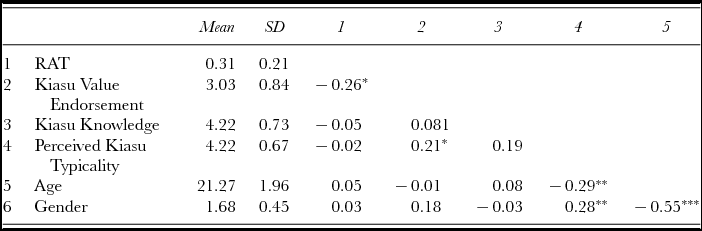
Table 1 lists the descriptive statistics and correlations of the major variables. All the variables, including personal creative performance measured by the RAT, Kiasu knowledge, perceived Kiasu typicality in Singapore, and endorsement of Kiasu value, were normally distributed (skewness statistics < 1). Participants’ Kiasu knowledge and perception of Kiasu typicality in Singapore were both significantly above scale midpoint (3), t(87) = 15.54, p < .001, and t(87) = 17.06, p < 0.001, respectively. This is consistent with our assertion that Kiasu is a shared cultural norm.
Descriptive statistics in Study 1

Notes: N = 88. Gender was coded as male = 1, female = 2. *p < 0.05, **p < 0.01, ***p < 0.001.
Hypothesis testing
In terms of zero-order correlation, as predicted, endorsement of Kiasu value was negatively associated with the RAT creativity score, r = −0.261, p = 0.014. This relationship remained significant after we regressed Kiasu endorsement on RAT score with age and gender as covariates, B = −0.073, SE = 0.027, t(84) = − 2.69, p = 0.009. These results supported H1.
STUDY 2
This study tested if prevention focus mediates the negative relationship between the endorsement of Kiasu value and creativity (H2).
Method
Participants
Eighty-five Singaporeans (born and raised in Singapore) were recruited from the subject pool at a university in Singapore (33 males, mean age = 21.58, SD = 1.41). Participants received partial course credit for their participation in the study.
Materials and procedure
First, to measure their creativity, participants completed the Remote Associates Test (RAT, Mednick et al., Reference Mednick, Mednick and Mednick1964) as used in Study 1. However, due to time limit, participants were given only five items to work on. Then, to measure their tendencies toward promotion focus and prevention focus, participants completed the 11-item Regulatory Focus Questionnaire (RQF; Higgins, Friedman, Harlow, Idson, Ayduk, & Taylor, Reference Higgins, Friedman, Harlow, Idson, Ayduk and Taylor2001); the Cronbach alphas were 0.60 and 0.79, respectively. Third, participants filled out the three Kiasu questions from Study 1 to evaluate their endorsement of the Kiasu value, Kiasu knowledge, and perceived typicality. Last, participants filled out demographic questions.
Results and Discussion
Preliminary considerations
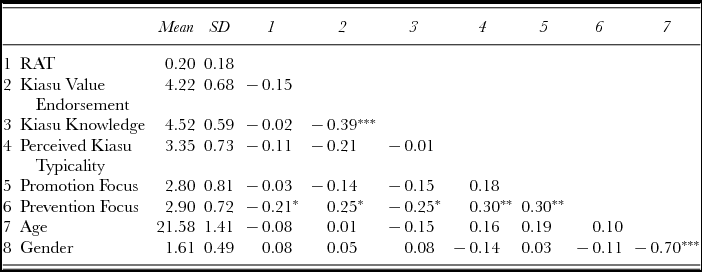
Table 2 lists the descriptive statistics and correlations of the major variables. All the variables – including RAT score, prevention and promotion focus, and Kiasu ratings – were normally distributed (skewness statistics fell between −0.78 and 0.54). Similarly to Study 1, Kiasu knowledge and perceived Kiasu typicality averaged above the scale midpoint (3), t(84) = 22.90, p < 0.001, and t(84) = 4.40, p < 0.001. This again supports our assertion that the Kiasu value is a shared cultural norm in Singapore.
Descriptive statistics in Study 2

Notes: N = 85. Gender was coded as male = 1, female = 2. *p < 0.05, **p < 0.01, ***p < 0.001.
Hypothesis testing
In terms of zero-order correlations, as predicted, endorsement of Kiasu value was positively associated with prevention focus, r = 0.30, p = 0.005, and not significantly associated with promotion focus, r = −0.14, p = 0.21. In addition, prevention focus was negatively associated with RAT creativity, r = −0.214, p = 0.049. The association between endorsement of Kiasu value and RAT creativity was in the predicted negative direction but fell short of significance, r = −0.15, p = 0.16. This suggests that in Study 2, we did not find a direct link between endorsement of Kiasu value and creativity. Nonetheless, research has shown that two variables can be indirectly linked via a mediator even if they are not directly linked (see Zhao, Lynch, & Chen, Reference Zhao, Lynch and Chen2010). Therefore, we tested the proposed mediation model using PROCESS (Model 4, Hayes, Reference Hayes2012) with endorsement of Kiasu value as the predictor, prevention focus as the mediator, and RAT creativity as the outcome variable, controlling for age, gender, and NFCC. The results showed that, as predicted, the indirect effect of prevention focus was significant; the bootstrapping result (N = 1000) suggests that prevention focus intervenes between Kiasu endorsement and creativity, B = −0.02, SE = 0.01, CI: [-0.04, −0.002]. In sum, the results indicated that the effect of Kiasu value on creativity runs through prevention focus, supporting H2.
Although endorsement of Kiasu value was negatively associated with RAT creativity, the relationship was not significant as in Study 1. One reason may be restricted variance in this sample; the mean score of Kiasu endorsement (M = 4.22, SD = 0.68) was much higher than those in Study 1 (M = 3.03, SD = 0.84). Another reason may be a less reliable creativity index in Study 2 because we included only five RAT items as opposed to seventeen in Study 1. Nevertheless, the crucial mediation model (H2) was still supported.
STUDY 3
In Study 3, we tested the proposed three-way interaction of Kiasu prime, Kiasu endorsement, and NFCC on creativity (H3). To recap, we predicted that in the Kiasu priming condition, those who have high Kiasu endorsement and high NFCC would exhibit lower creativity than others. In the no-Kiasu priming condition, there would be a significant main effect of Kiasu endorsement. Those with higher endorsement of Kiasu value, regardless of NFCC, would exhibit lower creativity than do those who have lower Kiasu endorsement.
Method
Participants
One hundred ninety-one Singaporeans were recruited from the subject pool at a university in Singapore (52 males, mean age = 21.14, SD = 1.84). All participants had less than one year of experience of living abroad. Participants received monetary compensation (S$12 ~ US$8.76) for their participation.
Materials and procedure
Participants were randomly assigned to evaluate six images on how colorful and likable they were on a 5-point Likert scale. In the Kiasu priming condition, the even-numbered images were related to the notion of ‘Kiasu’. Three images – a cartoon drawing of Mr. Kiasu, a picture of a toy ‘Mr. Kiasu’Footnote [2] holding a ‘Kiasu burger’ sold by Singaporean McDonald's, and a cartoon depicting a man piling up food at a buffet – were selected in a pilot study as potent reminders for Singaporeans of the Kiasu cultural norm. The odd-numbered images were neutral (e.g., a drawing of flowers). In the no-Kiasu priming condition, the contents of the even-numbered images were matched but without reference to Kiasu (e.g., a cartoon depicting a man eating in a buffet but not piling up food) and the odd-numbered pictures were the same as those in the Kiasu priming condition.
Next, the participants worked on a gift idea task adopted from Leung and Chiu's (Reference Leung and Chiu2010) research. Participants were asked to write down the first six gift ideas that came to their mind if they were to prepare gifts for school alumni. The results were coded following the Barsalou (Reference Barsalou1985) and Battig and Montague (Reference Battig and Montague1969) coding systems: First, all different responses – except those that reflect minor variations in inflection (e.g., mug and mugs) and responses that were close synonyms of others (e.g., thumb drive and USB drive) – were coded as distinct gift ideas. Second, for each gift idea, the number of participants who listed it was counted. This score is referred to as the output dominance score (Ward, Patterson, Sifonis, Dodds, & Saunders, Reference Ward, Patterson, Sifonis, Dodds and Saunders2002). Third, each gift idea's ordinal position on its author's list was recorded and the average output position across all participants who listed this gift idea was taken to form its rank. Fourth, the dominance score of an idea was divided by its rank to yield a dominance/rank score. An idea with a high dominance/rank score is one that many participants generated, implying that it is less creative. Participants then completed a 16-item measure of NFCC (Kruglanski & Webster, Reference Kruglanski and Webster1996), the Cronbach alpha was 0.78. They also answered three questions regarding Kiasu on a 5-point Likert scale, just as in Studies 1 and 2. Last, participants filled out demographic questions.
Results and Discussion
Preliminary considerations
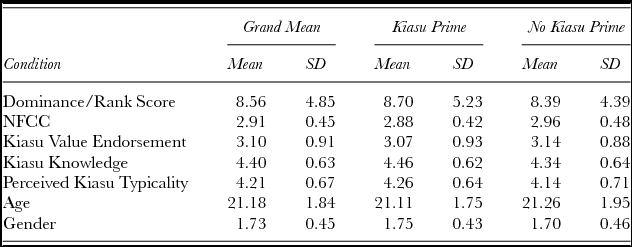
Table 3 lists the descriptive statistics. All the variables were normally distributed (skewness statistics < 1). Participants’ Kiasu knowledge and perception of Kiasu typicality in Singapore were both significantly above scale midpoint (3), t(187) = 30.35, p < 0.001, and t(187) = 24.57, p < 0.001, respectively. This again supports our assertion that Kiasu value is a shared cultural norm in Singapore.
Descriptive statistics in Study 3

Notes: N = 191. Gender was coded as male = 1, female = 2. Higher dominance/rank scores indicate lower creativity.
The ratings of the pictures in the priming task were compared across the two priming conditions. The results showed that the images in the Kiasu priming condition were more colorful but were not more preferred than those in the no-Kiasu priming condition. Furthermore, the ratings of the three Kiasu questions did not differ between the two priming conditions. The distributions of the dominance score and NFCC were both normally distributed (skewness statistics were 0.30 and 0.34, respectively).
Hypothesis testing
A regression model was used to test the proposed hypothesis. In the first step, gender and age were regressed on the dominance/rank score. No significant effects were revealed. In the second step, priming condition (Kiasu condition was coded as 1 and no-Kiasu condition was coded as −1), NFCC (mean-centered), Kiasu endorsement (mean-centered), all three two-way interaction terms, and the three-way interaction were further regressed on the dominance/rank score. The results showed that the main effect of Kiasu endorsement was significant, B = 1.25, S. E. = 0.40, t(191) = 3.14, p = 0.002, such that the greater participants’ endorsement of Kiasu value, the lower their creativity. As predicted, the three-way interaction of the Kiasu priming condition, NFCC, and Kiasu endorsement was significant: B = 1.62, S. E. = 0.76, t(191) = 2.14, p = 0.034.
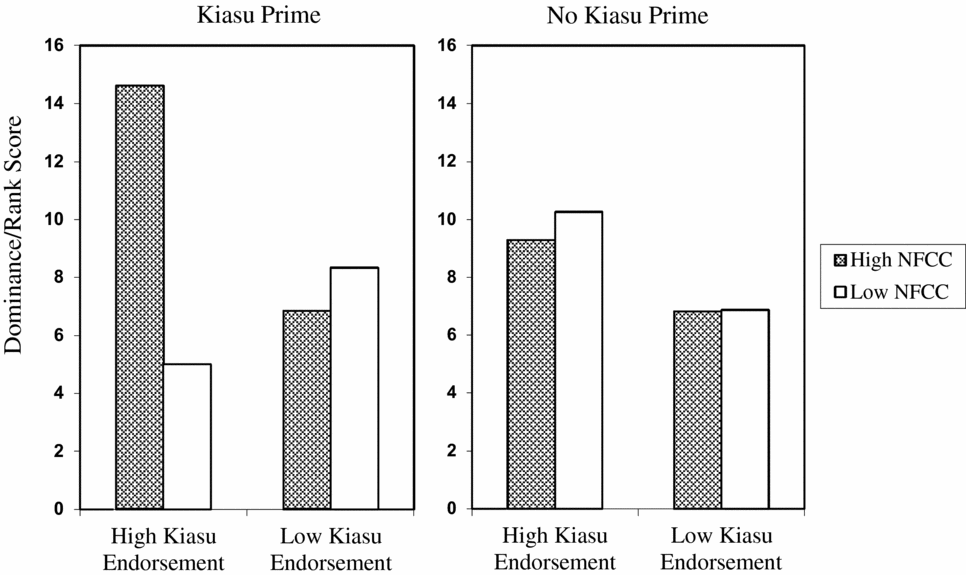
To further examine the proposed hypothesis, the data was split into Kiasu priming and no-Kiasu priming conditions and the same regression analysis was applied. The results showed that in the Kiasu priming condition, only a significant two-way interaction was revealed, B = 2.81, S.E. = 1.15, t(100) = 2.45, p = 0.016. As predicted, the results in Figure 1 indicate that, when primed with Kiasu, individuals with high NFCC and high Kiasu endorsement exhibit the highest dominance/rank score (i.e., lowest creativity) of the four conditions. The planned contrast analyses showed that dominance/rank score in the high NFCC and high Kiasu endorsement condition was significantly higher than in the other three conditions, Bs > 1.61, S.E.s < 0.77, ts > 2.10, ps < 0.038 (see Figure 1).
Interaction of Kiasu prime, Kiasu value, and Need for Cognitive Closure (NFCC) on Creativity in Study 3.

In the no-Kiasu priming condition, the results revealed only a significant main effect for the Kiasu endorsement, B = 1.54, S. E. = 0.53, t(91) = 2.90, p = 0.005, such that those with high endorsement of Kiasu value exhibited lower creativity than their low-Kiasu counterparts, regardless of their NFCC level (see Figure 1), which replicated the findings of Study 1. Taken as a whole, the results support H3.
Two limitations need to be addressed in this study. Firstly, while the Kiasu priming was evidently successful according to the results, a manipulation check should be included to validate the effectiveness of the priming method in future research. Secondly, participants’ Kiasu endorsement and NFCC were measured after exposure to Kiasu primes. Although the results did not suggest that Kiasu priming influenced these two individual tendencies, future research can instead measure these variables before participants are primed with Kiasu, in order to avoid any potential confounding effect.
STUDY 4
Given extant research that has shown exposure to multiple cultures increases creativity (Cheng, Leung, & Wu, Reference Cheng, Leung and Wu2011; Leung et al., Reference Leung, Maddux, Galinsky and Chiu2008), exposure to the multi-faceted Singaporean culture – and even temporary exposure to symbols or reminders of it – should provide a creative advantage. However, given that Singaporean culture is also associated with Kiasu, exposure to symbols of Singaporean culture may evoke the Kiasu norm, which conversely hampers creativity. We therefore tested the hypothesis (H4) that exposure to symbols of Singapore would affect Singaporean participants by boosting their creativity, unless they trigger the Kiasu value.
To adequately test our hypothesis, we needed to show that the Singaporean culture prime can indeed evoke the Kiasu value among Singaporeans. To this end, we conducted a pilot study that asked 100 Singaporeans to describe 10 characteristics of ‘Singaporean culture’ or ‘Singapore as a country’. Interestingly, 50% of Singaporeans mentioned Kiasu in the former situation, while only 6% mentioned Kiasu in the latter situation. This is most likely because Kiasu is strongly associated with the cultural heritage of Singapore, but not with the political entity of Singapore as a nation. Based on these findings, we included in the main study the target priming condition of Singaporean culture, plus two others for comparison: Singapore nation and favorite sports (control). We expected that participants in the Singaporean culture prime condition would display the highest creativity, except for those who mentioned Kiasu value.
Method
Participants
One hundred seventy-seven Singaporeans (born and raised in Singapore) were recruited from the subject pool of a university in Singapore (53 males, mean age = 21.83, SD = 1.77). All participants had less than one year of experience of living abroad. Participants received monetary compensation (S$12 ~ US$8.76) for their participation.
Materials and procedure
The priming task involved describing one's culture, country, or favorite sports to a friend. Participants were asked to write down 10 sentences they would say to a new friend. Half the participants were randomly assigned to the culture-describing condition, and the other half were randomly assigned to either the country or sports condition. Next, participants completed the RAT to measure creative performance (Mednick et al., Reference Mednick, Mednick and Mednick1964). Specifically, to better gauge participants’ creativity level, we used a 15-item RAT that was graded in three difficulty levels, which is to say, it included five items each for the easy, moderate, and difficult levels of questions. Four RAT scores were then calculated: percentage accuracy overall (total RAT) and that at each level of difficulty (easy RAT score, moderate RAT, and difficult RAT).
Results and Discussion
Preliminary considerations
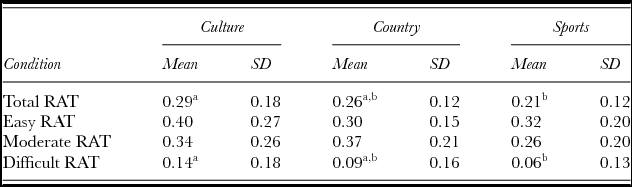
Table 4 lists the descriptive statistics. We counted the number of participants who mentioned Kiasu in their descriptions; as found in the pilot study, 48 out of 93 participants (51.6%) in the culture prime condition mentioned Kiasu as one of Singapore's cultural characteristics. In contrast, only three out of 47 participants (6.4%) in the country prime condition mentioned ‘Kiasu’ as one of the nation's characteristics. The distributions of the total, easy, and moderate RAT scores were normally distributed (skewness statistics fell between 0.38 and 0.71) whereas the distribution of difficult RAT scores was positively skewed (skewness = 1.37). The positively skewed distribution of the difficult RAT score indicated that the RAT items in this category are indeed more challenging, but the skewness level fell into the acceptable level (ranges between −2 and +2) for normal distribution statistical testing (Gravetter & Wallnau, Reference Gravetter and Wallnau2014).
Descriptive statistics in Study 4

Notes: N = 177. Means in the three conditions within the same row marked with different letters were different at a p < 0.05 level.
Hypothesis testing
A one-way ANOVA with the priming manipulation (describing culture vs. country vs. sports) as the IV and the total RAT score as DV was conducted. The results revealed a significant main effect of the priming conditions, F(1, 171) = 3.17, p = 0.04. As predicted, Singaporeans exhibited highest creativity when describing Singaporean culture (M = 0.29, SD = 0.18) as compared with describing Singapore as a country (M = 0.26, SD = 0.12) or their favorite sports (M = 0.21, SD = 0.12). The post-hoc comparisons using Fisher LSD showed a significant difference between the cultural condition and the favorite sports condition; no significant difference was revealed between the culture and the country conditions. When replicating the same ANOVA analysis with the three component RAT scores, priming condition did not affect easy or moderate RAT, Fs < 2, ps > 0.2, but did affect difficult RAT, F(1, 171) = 3.35, p = 0.038. As with difficult RAT, participants exhibited highest creativity when describing Singaporean culture (M = 0.14, SD = 0.18) in comparison to describing Singapore as a country (M = 0.09, SD = 0.16) or their favorite sports (M = 0.06, SD = 0.13). Similarly, the post-hoc comparisons using Fisher LSD only revealed a significant difference in creativity between the conditions of culture and sports, but not between the conditions of culture and country. In short, we found that participants showed the highest creativity level (on difficult RAT items) when reminded of the Singaporean culture, which is known for its high cultural diversity (multi-ethnic and multi-lingual population). As such, our findings support a now well-documented correlation between multiple cultural exposure and enhanced creativity.
To test H4, we separated participants in the culture condition into those who mentioned Kiasu and those who did not, and conducted a t-test to compare the two groups. The results revealed significant difference on difficult RAT, t(1, 87) = 2.60, p = 0.011. Participants who mentioned Kiasu exhibited lower creativity (M = 0.19, SD = 0.20) compared with those who did not mention Kiasu (M = 0.09, SD = 0.15) in the culture condition. No difference was revealed when using easy, medium, or total RAT scores.
As a follow-up analysis, we compared the four groups of 1) culture, no Kiasu mentioned; 2) culture, Kiasu mentioned; 3) country; and 4) favorite sports on different RAT scores. A one-way ANOVA with the four groups as IV and the difficult RAT as DV showed a significant main effect, F(1, 170) = 4.68, p = 0.004. Post-hoc comparisons using the Fisher LSD test showed that, as predicted, participants in the culture-describing, no-Kiasu condition exhibited significantly higher difficult RAT scores than the other three conditions, while there was no difference between any pair of the other three conditions, ps < 0.005. This pattern of findings in general supports H4.
It is noteworthy that the predicted effect was evident only for difficult RAT items in Study 4, possibly because the difficult RAT items were more challenging and thus performing well on those items requires an enhanced creativity evoked by the Singaporean culture prime. However, mentioning Kiasu undermined creativity to a level that was insufficient to cope with the difficult RAT items. By contrast, performance on the moderately difficult and easy RAT items was not hurt much by self-mentioned Kiasu values because those items were relatively manageable given the Singaporean culture prime.
GENERAL DISCUSSION
In four studies, we provided the first set of empirical evidence to illustrate the dynamic impact of Kiasu, both as a personal value and a cultural norm, on Singaporeans’ creativity. Study 1 showed that high endorsement of Kiasu value is negatively associated with creativity. Study 2 further showed that the link between endorsement of Kiasu value and lower creativity was mediated through prevention-focused orientation. That is, the higher the Singaporean participants endorsed Kiasu, the more they focused on preventing losses (prevention focus), thereby undermining their creativity. But Kiasu is not only a personal value; Study 3 further examined how Kiasu functions as a shared cultural norm and can be primed with Kiasu cultural artifacts. When Kiasu was primed, Singaporean participants with high Need for Cognitive Closure seized it readily. Results of Study 3 indeed revealed that, when exposed to the Kiasu prime, Singaporean participants who endorsed Kiasu value and had high NFCC showed the lowest creativity level. Without the Kiasu prime, only the participants’ own endorsement of Kiasu value predicted their creativity level. As a whole, this suggests that Kiasu functions not only as a personal value, but also as a cultural norm. Finally, Study 4 examined the Singaporean paradox – while its diverse ethnic and cultural heritage should enhance Singaporeans’ creativity, the shared Kiasu value undermines the advantage. Findings from Study 4 have indeed shown that participants in the Singaporean culture prime showed the highest creativity, but only if they did not mention Kiasu. Those who mentioned Kiasu, by contrast, did not benefit from the Singaporean culture prime.
Taken as a whole, our findings provide supportive evidence for the proposed situated dynamics framework of cultural influence such that individual differences, cultural norms, and situational cues interact to influence cultural behaviors (Leung & Morris, Reference Leung and Morris2015). Specifically, this research reveals that the Kiasu value is prevalent in Singapore as both an individual value and a shared cultural norm, and both exhibit a negative impact on individual creativity. Prior research conceptualized the Kiasu value as an extreme type of competitiveness (Kirby & Ross, Reference Kirby and Ross2007), while our research demonstrated that it is a defensive type of competitiveness driven by prevention focus that strives to have no ‘losses’. This Kiasu value might be beneficial for some tasks that require perseverance (e.g., academic performance), but is harmful for creativity. According to the current understanding of the Kiasu value and its psychological mechanism, future research could further investigate the construct of Kiasu and explore the influence of this value on different tasks in Singapore. In particular, in Studies 1 to 3, Kiasu value endorsement, Kiasu knowledge, and Kiasu typicality were measured by single-item measures; future research can further investigate the psychological construct of Kiaus and develop multi-items measures. Furthermore, multiple creativity measures can be administered to replicate current findings in future research. In particular, the two measures of creativity used in our studies – RAT (in Study 1, 2, and 4) and gift ideas (in Study 3) – captured convergent thinking vs. divergent thinking, respectively (Cropley, Reference Cropley2006). Future research can utilize other types of creativity measures to further investigate the impact of Kiasu on domain-specific creativity.
The current research can shed light on an integration of etic and emic approaches to understand cultural phenomena. On the one hand, the etic approach takes an outsider's perspective (Pike, Reference Pike1967), which emphasizes ‘universals’, or ‘core similarities’ in human behaviors (Sue, Reference Sue1983). On the other hand, the emic approach takes an insider's perspective (Pike, Reference Pike1967), which endorses a ‘cultural-specific orientation’ to make sense of the behavioral manifestation in a given cultural group (Sue, Reference Sue1983). While these two approaches have long been considered as contradictory and distinctly separate, a new trend that integrates the two approaches has emerged and been promoted by cross-cultural scholars (e.g., Berry, Reference Berry, Headland, Pike and Harris1990; Morris, Leung, Ames, & Lickel, Reference Morris, Leung, Ames and Lickel1999). Morris and colleagues (Reference Morris, Leung, Ames and Lickel1999) used justice judgment to illustrate that people always start by selecting principles for judging fairness, before they repeat their behavior based on those principles to substantialize fairness within their cultural groups. However, they found that the selected principles and behavioral repertoire can vary significantly across different cultural groups. By adopting both the emic and etic perspectives, Morris et al. (2008) demonstrated that synergy may be generated to account for cultural influence on justice judgment, which could generate a better framework for capturing justice concerns in diverse organizations. The merits of using both etic and emic approaches became apparent through a research study involving an indigenous Chinese personality construct (Cheung et al., Reference Cheung, Leung, Zhang, Sun, Gan, Song and Xie2001). By comparing and combining the etic and emic personality factors obtained from Western and Chinese cultural groups, Cheung and her colleagues provided a six-factor, interpersonal-relatedness generated from this indigenous Chinese personality construct that can be confirmed with Western subjects (e.g. Hawaiian residents). Their findings highlighted the sixth personality factor, Interpersonal Relatedness, a personality factor that might have been missed out or discounted by the dominant Western independent self-construal, which overemphasizes intrapersonal characteristics. Hence, it is evident that the etic and emic perspectives should both be deployed concurrently to draw the most significant and comprehensive conclusions on cultural impact.
While our research adopted an emic approach to studying Kiasu and its impact on creativity by adopting insiders’ (i.e., Singaporeans’) understanding of the phenomenon, Kiasu can also be studied as an etic cultural construct. Since the Kiasu value is not unique to Singapore and is also characteristic of people residing in Hong Kong, Australia, and the US (Kirby & Ross, Reference Kirby and Ross2007; Kirby, Kirby, Bell, & Shafer, Reference Kirby, Kirby, Bell and Schafer2010), it may be important to see if Kiasu as a prevention-focused type of competitiveness is equally relevant in other cultural contexts. In addition, because the Kiasu value originated in a Chinese dialect and is steeped in Chinese values (e.g., ‘寧為雞首, 不為牛後’, the literal English translation being, ‘Better to be the head of a rooster than the tail of an ox’, a saying very similar to the English proverb, ‘Better to be the head of a dog than the tail of a lion’), it is likely that the Kiasu value can also be found in other Chinese societies, including the PRC, Hong Kong, Taiwan, and Macau. For example, a popular Chinese parenting motto is: ‘Don't let your kids lose in the beginning’. Acting upon this motto, Asian parents, including Chinese parents, send their children to all kinds of tutoring schools from a young age and the length of learning hours appalls Western parents (Dizik, Reference Dizik2014). Kano, a top-selling and award-winning 2014 Taiwanese baseball film, depicts the Kano baseball team from southern Taiwan overcoming extreme odds to represent the island in the 1931 Japanese High School Baseball Championship at Koshien Stadium. Performing beyond all expectations, the underdog team advanced to the championship game in the tournament. The spirit that inspired the team throughout the tournament was the coach's teaching, ‘Don't think about winning; think that you mustn't lose’. Future research could adopt both the etic and emic perspectives to investigate the prevalence of the Kiasu value in Chinese societies and the extent to which it accounts for the observed Chinese participants’ lower creative performance in comparison with Westerners’ (Morris & Leung, Reference Morris and Leung2010; Zhou & Su, Reference Zhou and Su2010).
Second, a multi-level analysis of the Kiasu value could be applied to further investigate the situated dynamics framework of cultural influence on behavior. Our findings in Study 3 show that the Kiasu value influences creative performance as an individual value and as a shared cultural norm, but both on an individual level. Future research might further investigate whether the Kiasu cultural norm measured on a group level exhibits similar or more impact on creative performance. In addition, the interaction effects of Kiasu primes, Kiasu value endorsement, and NFCC might exhibit different influences on creative performance depending on the nature of the task, such as an individual or group task, and the type of creative performance required, such as problem solving, idea generation, idea elaboration, or idea selection. The nature of the task might enhance or dampen the applicability of the Kiasu norm (Liou & Lan, Reference Liou and Lan2017) and lead to different performance outcomes. Future research should look into the boundary conditions for the reported three-way interaction effect on creativity. Furthermore, future research may also look into the role of prevention focus as a mediator between the interaction effect of individual difference, cultural norm, and situational cues on creativity to further validate the underlying psychological processing investigated in Study 2. We also predicted that situationally stimulated NFCC would increase the reliance on the Kiasu norm, especially when it is made accessible, and will in turn lead to lower creativity via enhanced prevention focus. Future research needs to empirically test this causal relationship via experimental manipulation.
Third, the higher creativity exhibited by individuals in the Singaporean culture prime condition in Study 4 provides preliminary evidence to show that living in a multi-ethnic, multilingual culture like Singapore may benefit creativity in ways similar to exposure to foreign cultures, as found in previous multicultural exposure-creativity research (e.g., Leung et al., Reference Leung, Maddux, Galinsky and Chiu2008; Maddux & Galinsky, Reference Maddux and Galinsky2009). This implies that the definitions of bicultural or multicultural experiences/identities will no longer be restricted by exposure to foreign cultures or identification with cultures other than one's own. People can be multicultural without leaving their hometown if they were raised in a cultural swirl. Future research will investigate the effects of individuals’ multicultural experiences from living in multicultural enclaves on individual creativity and other performance outcomes.
Fourth, our findings provide implications for the understanding of the dynamics of a growing cosmopolitan culture and the potential influence of the Kiasu value on creative performance in East Asian and Southeast Asian countries. More and more cities in East Asia and Southeast Asia – including Beijing, Shanghai, Seoul, Taipei, Kuala Lumpur, and Jakarta – have grown into cosmopolitan cities like Singapore in the past two decades. Our findings shed light on the phenomenon that acquiring multicultural experiences from living in one single cosmopolitan city originally dominated by traditional Asian cultures and values can breed creative benefits, as long as the multicultural knowledge sets are activated. Therefore, all the newly developed East Asian and Southeast Asian multicultural cities have the potential to become hubs for creativity. Our findings further shed light on how shared cultural norms and personal values, especially those related to Kiasu, might mitigate the creative impact of multicultural exposure on individual creativity. To overcome this creative barrier, potential interventions can be made by a) blocking or reducing the activation of the Kiasu value when conducting creative tasks, or b) creating new social norms pursuing less fear of losing out in institutions and organizations. The former could be done by portraying Kiasu as a cultural stereotype rather than a cultural norm, cautioning Singaporeans against stereotyping all Singaporeans as being Kiasu. The latter could be achieved by establishing or applying norms that enhance psychological safety from the fear of losing out. For example, Chen, Leung, Li, and Ou (Reference Chen, Leung, Li and Ou2015) demonstrated that Chinese employees’ creative performance can be increased by enhancing interpersonal harmony. This is because a strong harmony-enhancement motive will allow employees to be open to diverse and opposing views, to reconcile their interpersonal differences, and to thereby increase their creative effort toward establishing genuinely harmonious relationships (Leung, Koch, & Lu, Reference Leung, Koch and Lu2002). In conjunction with our findings of the mediation effect of prevention focus, a high harmony-enhancement motive might also enhance promotion focus and shift one's emphasis to ‘gains’ rather than ‘losses’. As a result, higher creative performance will be produced. The notion that norms often become institutionalized within groups of people means that they are performed ritually as an end in themselves (Scott, Reference Scott1998), and this makes it possible to make a harmony-enhancement motive the shared norm in an organization and thereby counter the negative impact of the Kiasu value on creative performance.
CONCLUSION
In sum, this research explores the effects of a shared cultural norm and personal value, namely, Kiasu, on individual creativity in Singapore. The findings lend support to the notion of the situated dynamics framework of cultural influence on behavior, which holds that cultural influence on human behavior is dynamic and that individual differences, cultural norms, and situational cues work together to create cultural impact in daily life.