Implications
The results indicated that barley and corn grains can be used interchangeably in dairy calf starter feed diets until 3 months of age, allowing dairy producers more choices of feed ingredients. Irrespective of type of grain fed, chromium (Cr) had the potential to increase feed intake and weigh gain.
Introduction
The source of grains (barley v. corn) in starter feeds has resulted in inconsistent feed intake and growth performance in different research experiments which has created confusion as to which grains to use to manufacture starter feed diets. Khan et al. (Reference Khan, Lee, Lee, Kim, Kim, Ki, Park, Ha and Choi2007) reported that an equal amount of starch supplied by barley grain instead of corn grain decreased feed intake, weight gain, feed efficiency and skeletal growth in calves. This was attributed to lower ruminal pH and decreased physically and metabolically functional rumen in calves on barley grain (Khan et al., Reference Khan, Lee, Lee, Kim, Kim, Park, Baek, Ha and Choi2008). More recently, Mirzaei et al. (Reference Mirzaei, Khorvash, Ghorbani, Kazemi-Bonchenari and Ghaffari2017) reported that in iso-caloric but not iso-starch starter diets, the calves fed barley-based diet (BBD) had greater feed intake, weight gain and skeletal growth as compared with calves fed corn-based diet (CBD) with no changes in feed efficiency and ruminal pH. This discrepancy may partly be explained by differences in the forage source, level, and particle size, the physical form of starter, level of starch and amount of starch intake in BBD calves. However, it is not still clear how different grain sources affect feed intake and contribute to meeting the energy requirements of the developing calves. Therefore, it is important to understand the mechanism(s) by which the feed intake and growth performance are affected when calves are fed starter diets containing different grain sources.
Chromium is known as a nutritionally or pharmacologically beneficial element for animals and humans (EFSA (European Food Safety Authority) Panel on Dietetic Products, Nutrition, and Allergies, 2014). Chromium in trivalent form is a component of low-molecular weight Cr-binding substance (chromodulin) involved in the signal auto-amplification mechanism of insulin, and appears to affect carbohydrate and lipid metabolism through insulin action (Pechova and Pavlata, Reference Pechova and Pavlata2007). Under stress conditions or when carbohydrate-rich diets are fed, urinary Cr excretion increases by 10 to 300 times (Pechova and Pavlata, Reference Pechova and Pavlata2007), and thereby increases Cr requirements (Ghorbani et al., Reference Ghorbani, Sadri, Alizadeh and Bruckmaier2012; Mousavi et al., 2018; Kargar et al., Reference Kargar, Mousavi and Karimi-Dehkordi2018a and Reference Kargar, Mousavi, Karimi-Dehkordi and Ghaffari2018b). Inconsistent effects of Cr on feed intake and growth performance was reported in previous studies. Some studies reported positive effects (Ghorbani et al., Reference Ghorbani, Sadri, Alizadeh and Bruckmaier2012; Kargar et al., Reference Kargar, Mousavi and Karimi-Dehkordi2018a and Reference Kargar, Mousavi, Karimi-Dehkordi and Ghaffari2018b), whereas other investigators showed no effects on feed intake and weight gain (Yari et al., Reference Yari, Nikkhah, Alikhani, Khorvash, Rahmani and Ghorbani2010; Mousavi et al., 2018). Therefore, investigation of feeding behavior when calves are supplemented with Cr is required to clarify its regulatory mechanism(s) in feed intake.
To the best of our knowledge, the effect of grain source in combination with Cr supplementation in the calf starter feeds has not been investigated. Corn grains are fermented more slowly in the rumen, and increase the amount of starch reaching the small intestine (Kargar et al., Reference Kargar, Ghorbani, Khorvash, Kamalian and Schingoethe2013 and Reference Kargar, Ghorbani and Khorvash2014a). Digestion of starch in the small intestine (glucose as the end-product) v. rumen (volatile fatty acids as the end-products) supplies more energy for calf performance (Khan et al., Reference Khan, Lee, Lee, Kim, Kim, Ki, Park, Ha and Choi2007). Accordingly, we hypothesized that supplemental Cr would increase growth performance in calves fed CBD v. BBD, possibly through increased feed intake. The objective of this experiment was to determine the effects of and interactions between, grain source and Cr supplementation on feed intake, meal pattern and growth performance in Holstein dairy calves.
Material and methods
Calves, treatments and management
This study was performed from 11 July to 18 November 2015, at a local dairy farm (Zagros Milk and Meat Co., Shahrekord, Chaharmahal and Bakhtiari Province, Iran). Animal procedures were approved by the Animal Care Committee of Shahrekord University as outlined by the Iranian Council of Animal Care (1995). A total of 48 Holstein female calves (3 days of age; 39.0±1.21 kg BW) were housed in a naturally ventilated barn with individual pens (1.2m×1.0m×1.0 m; length×width×height). Rubber mattresses, used as the bedding which were washed every 2 days with manure being removed daily. The calves were enrolled in the trial 3 days after birth, weaned on day 73, and remained in the study until day 94 of age. Each calf was fed 5 l of colostrum between 2 and 8 h after birth. Colostrum was fed for the first 2 days of life. Calves were then individually fed pasteurized (72.5°C for 30 min) waste milk (containing 3.22±0.22% fat and 2.96±0.19% CP) in steel buckets in two equal meals (at 0700 and 1600 h). Milk was fed using the step-up/step-down procedure, and all calves were offered 4 l/day milk from days 3 to 10, 5 l/day from days 11 to 20, 6 l/day from days 21 to 40, 7 l/day from days 41 to 50, 6 l/day from days 51 to 60, 5 l/day from days 61 to 63, 4 l/day from days 64 to 66, 3 l/day from days 67 to 69, and 2 l/day from days 70 to 73 of age.
The calves were assigned randomly to four experimental diets (n=12 per diet) in a 2×2 factorial arrangement: (1) CBD−Cr=CBD with no supplemental Cr, (2) CBD+Cr=CBD with supplemental Cr (0.05 mg/kg BW0.75), (3) BBD−Cr=BBD with no supplemental Cr and (4) BBD+Cr=BBD with supplemental Cr (0.05 mg/kg BW0.75; Table 1). Grains were ground using a hammer mill with 2 mm screen size (model 5543 GEN; Isfahan Dasht, Isfahan, Iran). Chromium (MicroPlex 1000, supplied 1000 mg Cr/kg as Cr-Met (90% Met and 10% Cr, wt/wt); Zinpro Corporation Inc., Eden Prairie, MN, USA) was mixed with 300 ml milk and fed to calves by bottle up to week 10 to supply 0.05 mg Cr/kg of BW0.75. The remaining milk was fed according to the milk feeding program. After weaning (day 73), the same dosage of Cr was mixed into 300 ml pre-warmed water (39°C) and fed to calves by bottle until the end of the experimental (day 94). Calves not supplemented with Cr received 300 ml milk and pre-warmed water by bottle during the pre- and post-weaning periods, respectively. Chromium supplementation was adjusted based on weekly BW (Ghorbani et al., Reference Ghorbani, Sadri, Alizadeh and Bruckmaier2012; Mousavi et al., 2018; Kargar et al., Reference Kargar, Mousavi and Karimi-Dehkordi2018a and Reference Kargar, Mousavi, Karimi-Dehkordi and Ghaffari2018b). Calves had unlimited access to fresh drinking water and were fed starter feed diets (formulated to meet their nutrient requirements (NRC, 2001)) to provide at least 10% refusals.
Ingredients and chemical composition of the experimental diets on a dry matter (DM) basis fed to calves

CBD=corn-based diet; BBD=barley-based diet.
1 Contained per kilogram of supplement: 240 g of Ca, 65.7 g of Mg, 20 g of Zn, 10 g of Mn, 5.29 g of Cu, 200 mg of I and 100 mg of Co.
2 Contained per kilogram of supplement: 1 500 000 IU of vitamin A, 250 000 IU of vitamin D, 10 000 IU of vitamin E, 0.2 g of biotin, 1.56 g of organic Zn, 0.84 g of organic Mn, 0.54 g of organic Cu and 40 mg of organic Se.
3 NFC=100 −(CP+NDF+EE+Ash) (National Research Council (NRC), 2001).
4 Calculated from NRC (2001).
Data collection, sampling and analyses
The amount of starter feed intake was computed based on the weight of feed offered and refusal collected daily. The calves were weighed at birth and once weekly thereafter using an electronic scale. Average daily gain (ADG, kg/day) and feed efficiency (kg BW gain/total dry matter intake (DMI=milk dry matter (DM)+starter feed DM)) were computed. In addition, the heart girth (circumference of the chest), withers height (distance from base of the front feet to the withers) and hip width (distance between the points of hook bones) were recorded weekly (Pazoki et al., Reference Pazoki, Ghorbani, Kargar, Sadeghi-Sefidmazgi, Drackley and Ghaffari2017). Behavioral data including eating, ruminating, resting, standing, lying and non-nutritive oral behaviors (NNOB; when the animal licked any surface, tongue rolled and etc.) were monitored visually over a 12-h period for 3 consecutive days during the pre-weaning (days 59 to 61) and post-weaning (days 88 to 90) periods (Kargar et al., Reference Kargar, Mousavi and Karimi-Dehkordi2018a and Reference Kargar, Mousavi, Karimi-Dehkordi and Ghaffari2018b; Mousavi et al., 2018). All activities were recorded every 5-min and each activity was assumed to persist for the entire 5-min interval between observations (Kargar et al., Reference Kargar, Mousavi and Karimi-Dehkordi2018a and Reference Kargar, Mousavi, Karimi-Dehkordi and Ghaffari2018b; Mousavi et al., 2018). Eating period was defined as at least one observation of eating activity occurring after at least 5 min without eating. Meal frequency was defined as the number of bouts during a 12-h period. The meal duration (min/meal) was calculated as the time from the beginning of the 1st feeding event until an interval between events, and averaged for each calf. Intervals (min) between feeding events were calculated from the end of a feeding event to the beginning of the next, and averaged for each calf. The speed of eating (g of starter DM/min) was calculated as the total amount of starter DM ingested during a 12-h period divided by time devoted to eating, and averaged for each calf. The meal size (g starter DM/meal) was the total amount of starter DM ingested during each meal. The same procedure was used to compute the rumination pattern. The Cr content of the starter feeds (n=26; one sample per diet per week) was analyzed using flame photometry (GBC Integra EXL ICP, Melbourne, Australia).
Statistical analyses
Data were analyzed using the MIXED MODEL procedure (SAS 9.4; SAS Inc., Cary, NC, USA) with time (day or week) as repeated measures for nutrient intake, ADG, feed efficiency and skeletal growth. Calf was considered as the random effect, and grain source (G; corn grain v. barley grain), Cr supplement (Cr; 0 v. 0.05 mg/kg BW0.75), G×Cr, time (T), G×T, Cr×T and G×Cr×T as fixed effects. Initial BW and skeletal measurements were considered as covariates for the weight (days 73 and 94) and skeletal growth analyses, respectively. Data on BW and feeding and chewing behavior were analyzed using a similar model without the time effect. Differences between treatment groups were declared significant at P⩽0.05. The P values>0.05 and⩽0.10 were considered as trends.
Results
Grain effect
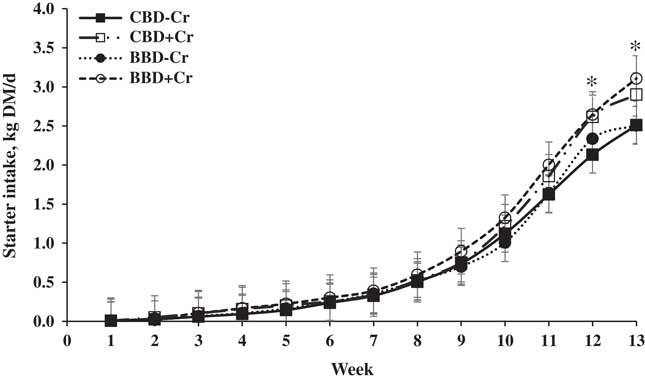
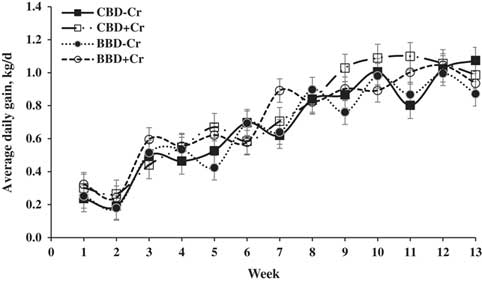
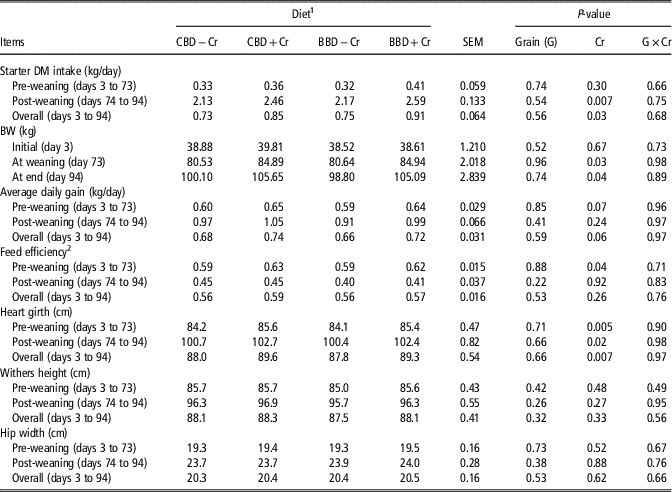
There were no differences in starter feed intake and variables related to calf growth between grain sources throughout the study (Table 2). As calves aged and consumed more DM (Figure 1; week effect: P<0.001), ADG also increased progressively (Figure 2; week effect: P<0.001).
Daily starter intake (±SE; kg dry matter (DM)/day) of calves fed either corn-based diet (CBD) or barley-based diet (BBD) supplemented with (CBD+Cr or BBD+Cr) or without chromium (Cr; CBD−Cr or BBD−Cr), respectively, over 13 weeks of age. The SEM=0.06. Effects in the model: grain (G): P=0.56; Cr: P=0.03; G×Cr: P=0.68; week (W): P<0.001; G×W: P=0.87; Cr×W: P=0.01; G×Cr×W: P=0.01. For each time point, * denotes significant difference at P⩽0.05.

Average daily gain (±SE; kg/day) of calves fed either corn-based diet (CBD) or barley-based diet (BBD) supplemented with (CBD+Cr or BBD+Cr) or without chromium (Cr; CBD−Cr or BBD−Cr), respectively, over 13 weeks of age. The SEM=0.03. Effects in the model: grain (G): P=0.59; Cr: P=0.06; G×Cr: P=0.97; week (W): P<0.001; G×W: P=0.64; Cr×W: P=0.36; G×Cr×W: P=0.89.

Feed intake, BW, average daily gain, feed efficiency and skeletal growth of calves fed corn- based diet (CBD) v. barley-based diet (BBD) supplemented with or without chromium (Cr)

1 Diets were either CBD or BBD supplemented with (CBD+Cr or BBD+Cr) or without chromium (CBD−Cr or BBD−Cr), respectively, at 0.05 mg/kg of BW0.75.
2 Feed efficiency was calculated by dividing average daily gain by average total daily dry matter (DM) intake (milk DM+starter feed DM).
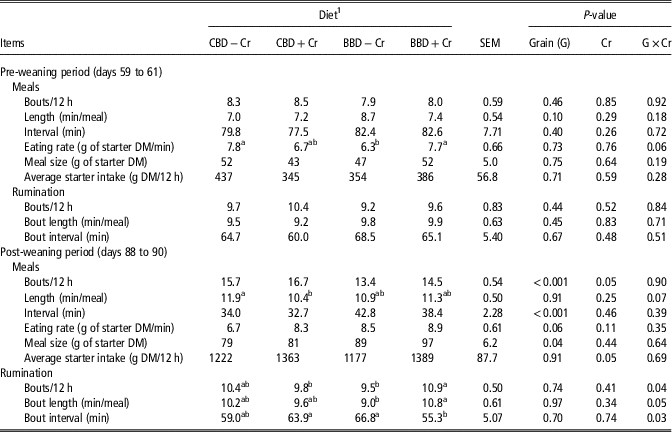
Feeding CBD v. BBD (7.1 v. 8.1 min/meal) tended to decrease (P=0.10) meal length but not other variables related to meal pattern during the pre-weaning period (Table 3). During the post-weaning period, meal frequency was greater for calves fed CBD than those fed BBD (16.2 v. 14.0 bouts/12 h; P<0.001); however, inter-meal interval (33.4 v. 40.6 min; P<0.001), eating rate (7.5 v. 8.7 g of starter feed DM/min; P=0.06), and meal size (80 v. 93 g of starter feed DM; P=0.04) decreased in CBD v. BBD. Behavioral variables during the pre-weaning period, and the times spent on standing, lying and NNOB during the post-weaning period were not different between CBD and BBD (Table 4).
Meal and rumination patterns of calves fed corn-based diet (CBD) v. barley-based diet (BBD) supplemented with or without chromium (Cr)

a,bMeans within a row with different superscripts are significantly different (P⩽0.05).
1 Diets were either CBD or BBD supplemented with (CBD+Cr or BBD+Cr) or without chromium (CBD−Cr or BBD−Cr), respectively, at 0.05 mg/kg of BW0.75.
Eating and ruminating times (min/12 h), and time spend resting, standing, lying, and non-nutritive oral behaviors of calves fed corn-based diet (CBD) v. barley-based diet (BBD) supplemented with or without chromium (Cr)

a,bMeans within a row with different superscripts are significantly different (P⩽0.05).
1 Diets were either CBD or BBD supplemented with (CBD+Cr or BBD+Cr) or without chromium (CBD−Cr or BBD−Cr), respectively, at 0.05 BW0.75.
2 Non-nutritive oral behaviors are referred to licking any surface, tongue rolling, and etc.
Chromium effect
Chromium supplementation increased the starter feed intake during the post-weaning and overall periods (Table 2). Chromium increased starter feed DMI during week 10 (Cr×W effect: P=0.07), week 12 (Cr×W effect: P=0.002) and week 13 (Cr×W effect: P=0.002). Supplementation with Cr resulted in greater BW at weaning (84.9 v. 80.6 kg; P=0.03) and at the end of trial (105.4 v. 99.5 kg; P=0.04) compared with un-supplemented calves. Calves supplemented with Cr tended to have greater ADG during the pre-weaning (P=0.07) and overall (P=0.06) periods. Chromium increased feed efficiency only during the pre-weaning period (P=0.04), and increased the heart girth throughout the study.
Chromium supplementation increased meal frequency (15.6 v. 14.6 bouts/12 h; P=0.05) and starter feed DMI (+ 177 g/12 h; P=0.05) during the post-weaning period (Table 3). Chromium supplemented calves tended (P=0.08) to have lower NNOB during the pre-weaning period (Table 4).
Grain by chromium interaction
Calves fed CBD+Cr and BBD+Cr had greater starter feed DMI compared with calves fed CBD-Cr during wk 12 (Figure 1; G×Cr×W effect: P=0.01). Furthermore, during week 13, calves fed BBD+Cr ate greater starter feed DM compared with calves fed CBD-Cr and BBD-Cr (Figure 1; G×Cr×W effect: P=0.01).
During the pre-weaning period, the eating rate was increased (by 1.4 g of starter feed DM/min) when Cr was added to the BBD but unchanged when Cr was added to the CBD (G×Cr effect: P=0.06; Table 3). During the post-weaning period, meal duration decreased (by 1.5 min/meal) when Cr was added to the CBD but not when was added to the BBD (G×Cr effect: P=0.07; Table 3). Chromium increased the rumination frequency (+ 1.4 bout/12 h; G×Cr effect: P=0.04) and rumination duration (+1.8 min/bout; G×Cr effect: P=0.05) in BBD but not in CBD during the post-weaning period (Table 3). During the post-weaning period, the inter-bout interval decreased (by 11.5 min) when Cr was added to the BBD and was unchanged when Cr was added to the CBD (G×Cr effect: P=0.03; Table 3).
During the post-weaning period, the eating time increased when calves were fed CBD v. BBD and when calves were fed CBD-Cr and CBD+Cr v. BBD-Cr (G×Cr effect: P=0.01; Table 4). During the post-weaning period, the time devoted to rumination increased when Cr was added to the BBD but was unchanged when Cr was added to the CBD (G×Cr effect: P=0.02). During the post-weaning period, calves rested less when Cr was added to the BBD but resting time was unchanged when Cr was added to the CBD (G×Cr effect: P<0.001).
Discussion
In the present study, we investigated the effect of grain source (corn grain v. barley grain) in combination with Cr supplementation in the calf starter feeds on feed intake, growth performance, and skeletal size with emphasizing on meal and rumination patterns and NNOB. An increase in meal size for BBD during the post-weaning period was counteracted with increased inter-meal interval and decreased meal frequency which led to no changes in feed intake and growth performance between grains (Kargar et al., Reference Kargar, Ghorbani, Khorvash, Kamalian and Schingoethe2013 and Reference Kargar, Ghorbani, Khorvash, Sadeghi-Sefidmazgi and Schingoethe2014b).
During the post-weaning period, an increase in starter feed intake of calves supplemented with Cr was at least attributable to increases in meal frequency (7%). If supplementing Cr improves glucose effectiveness or insulin sensitivity as reported by others (Yari et al., Reference Yari, Nikkhah, Alikhani, Khorvash, Rahmani and Ghorbani2010), then greater feed intake by increasing meal frequency would be predictable. Accordingly, we postulated that Cr supplementation increased glucose disappearance rate resulting in shorter intervals between meals and increased feed intake. Chromium supplementation had inconsistent effect on starter feed intake where some studies reported increases (Chang and Mowat, Reference Chang and Mowat1992; Kargar et al., Reference Kargar, Mousavi and Karimi-Dehkordi2018a and Reference Kargar, Mousavi, Karimi-Dehkordi and Ghaffari2018b) or decrease (Yari et al., Reference Yari, Nikkhah, Alikhani, Khorvash, Rahmani and Ghorbani2010) in starter feed intake, whereas others found no changes in intake (Ghorbani et al., Reference Ghorbani, Sadri, Alizadeh and Bruckmaier2012; Mousavi et al., 2018). Increased intake of starter diets rich in carbohydrate in response to Cr supplementation may be partially attributed to Cr deficiency because of increased urinary excretion and depleted body reserves of Cr (Chang and Mowat, Reference Chang and Mowat1992; Pechova and Pavlata, Reference Pechova and Pavlata2007).
Increased feed intake in response to Cr supplementation increased BW (both at weaning and at the end of trial), ADG (during the pre-weaning and overall periods), feed efficiency (during the pre-weaning period) and heart girth (during all periods). The positive effect of Cr supplementation on BW and ADG was reported earlier in stressed feeder calves (Chang and Mowat, Reference Chang and Mowat1992), environmentally heat-loaded dairy calves (Kargar et al., Reference Kargar, Mousavi, Karimi-Dehkordi and Ghaffari2018b) or calves raised under thermal neutral condition (Ghorbani et al., Reference Ghorbani, Sadri, Alizadeh and Bruckmaier2012). Ghorbani et al. (Reference Ghorbani, Sadri, Alizadeh and Bruckmaier2012) and Kargar et al. (Reference Kargar, Mousavi, Karimi-Dehkordi and Ghaffari2018b) observed the positive effect of supplementing Cr on ADG, feed efficiency, heart girth and hip width growth as well as a tendency for increased weaning BW, suggesting more efficient tissue accretion in calves supplemented with Cr.
The NNOB are often considered as an index of poor welfare because they are believed to be associated with frustrated feeding behavior (Mirzaei et al., Reference Mirzaei, Khorvash, Ghorbani, Kazemi-Bonchenari and Ghaffari2017). Increased urinary excretion of Cr or its subclinical deficiency in calves fed starter feeds rich in carbohydrate (Pechova and Pavlata, Reference Pechova and Pavlata2007) may induce an increase in NNOB. de Passille´ et al. (Reference de Passille´, Christopherson and Rushen1993) reported that calves with higher NNOB had a greater secretion of cholecystokinin and insulin, both of which have been implicated in satiety. This might promote greater degree of relaxation in calves and allow them to show NNOB. Overall, it seems that Cr has a welfare enhancing effect possibly through enhanced insulin sensitivity and improved glucose utilization.
In the present study, eating rate increased during the pre-weaning period when Cr was added to the BBD. Correspondingly, an increase in eating rate was coincided with a decrease in meal length (18%) in calves fed BBD+Cr, suggesting that calves fed BBD+Cr had a stronger physiological drive to eat. During the post-weaning period, meal length decreased due to a 24% increase in eating rate when Cr was added to the CBD. The reason for slower deceleration rate (a reduction in speed of eating) in calves fed BBD+Cr and CBD+Cr during the pre- and post-weaning periods, respectively, is unclear, but may be attributed to greater desire to eat due to improved insulin sensitivity and increased glucose uptake from circulation and into the peripheral tissues.
An interesting finding of the present study was increased rumination time due to increased rumination frequency and duration, and/or decreased rumination bout interval in calves fed the BBD+Cr during the post-weaning period. The mechanism(s) by which Cr affects the rumination time and pattern remain unclear. However, it is known that Cr is part of an insulin-potentiating pathway and there is evidence that insulin has a stimulatory effect on rumination activity by increasing glucose entry to cells and thereby reticulo-ruminal motility (Nicholson, Reference Nicholson1979; Bareille and Faverdin, Reference Bareille and Faverdin1996). A reduction in resting time in calves fed BBD+Cr v. BBD-Cr was a result of increased time devoted to rumination.
Conclusions
Starter feed intake was not influenced by the type of grain and an increase in meal size in BBD was neutralized by concurrent increases in inter-meal interval and thus grain source did not affect the calf growth performance. Therefore, barley and corn grains can be used interchangeably when the price is competitive. Chromium supplementation decreased NNOB and increased starter feed intake via increasing meal frequency and thereby improved the calf growth performance. The results also indicated that the beneficial effect of Cr supplementation on increasing ruminating time may depend on the type of grain, which was shown in time devoted to rumination in calves fed the BBD+Cr.
Acknowledgements
The authors thank Shahrekord University (Shahrekord, Iran) for partially funding this research and providing facilities. The authors express their kind appreciation to the farm staff at Zagros Milk and Meat Company (Shahrekord, Iran) for diligent animal care, and to Sana Dam Company (Tehran, Iran) for donating Cr-Met supplement. The authors also express their appreciation to Mohammad Javad Zamiri (Shiraz University) for editing the final English version of this manuscript.
Declaration of interest
The authors declare no conflicts of interest.
Ethics statement
All animal procedures were approved by the Animal Care Committee of Shahrekord University as outlined by the Iranian Council of Animal Care (1995).
Software and data repository resources
Authors declare that no data or models are deposited in an official repository.