





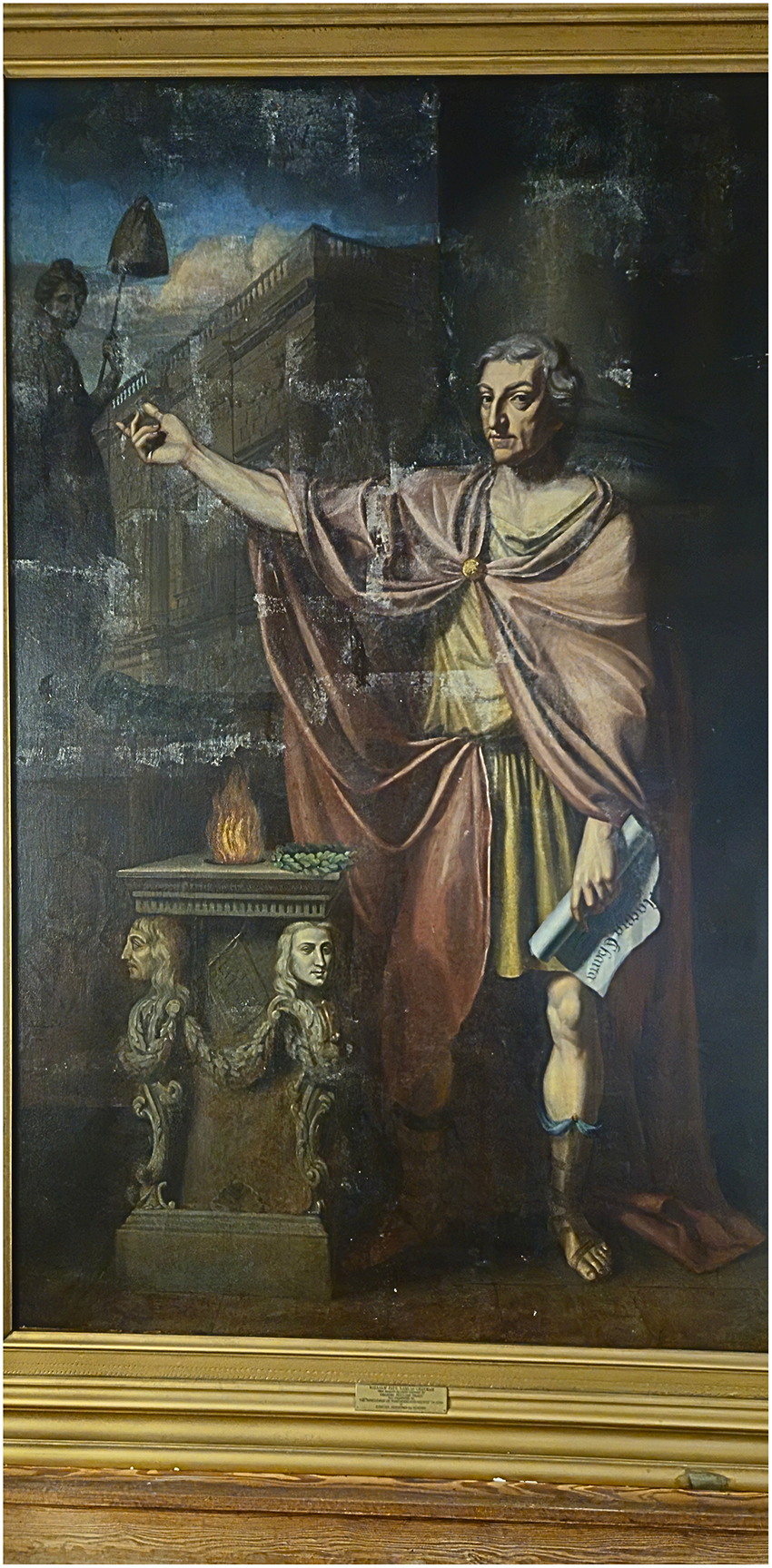
In 1776, as Americans declared their independence, they often did so under the gaze of a British politician: William Pitt, Earl of Chatham. A statue of Lord Chatham stood in Charleston, South Carolina, at the intersection of Broad and Meeting streets.Footnote 1 His portrait hung at the home of Richard Henry Lee, a signer of the Declaration (Figure 1).Footnote 2
Charles Willson Peale, William Pitt, Earl of Chatham, ca. 1768, the portrait that hung at the home of Richard Henry Lee. Courtesy of the Westmoreland County Museum, Montross, Virginia.

In New York City, one jeweler advertised swords ornamented with Lord Chatham’s head to “Those GENTLEMEN who are forming themselves into COMPANIES in defence of their LIBERTIES.”Footnote 3 In Philadelphia, tourists could visit the waxworks of one Mrs. Wells to gawk at the life-sized “Figures of Chatham, [Benjamin] Franklin… and several others.”Footnote 4 His name was more common still. It adorned American towns such as Chatham, Connecticut; Chatham, Massachusetts; Pittsboro, North Carolina (in Chatham County); Pittsfield, Massachusetts; and of course, Pittsburgh, Pennsylvania. “Chatham” served as a password for the Continental Army so that its lines could not be infiltrated by Loyalist spies.Footnote 5 Chatham was even the name of a famous stud horse in Queen’s County, New York, whose breeding services cost “forty shillings a mare.”Footnote 6
At a time when Americans were severing their ties to the British political establishment, they retained remarkable goodwill toward Lord Chatham, a former British prime minister and current peer in the House of Lords. American publications in 1776 described him as a “patriot lord,” a “great [man],” and “our [friend] in England.”Footnote 7 In one gloomy meditation on the moral collapse of the British Empire, the Essex Journal compared Britain to the biblical Sodom and Gomorrah, prophesying that Britain too “[tottered] on the verge of destruction.” Even so, the journal gave Britain credit for producing at least one worthy man: “What if thou can’st boast of a Chatham … and a few other virtuous? Thou sins are great, thou must produce more righteous to stem the torrent of ruin.”Footnote 8 As evidenced by such immoderate praise, many Americans viewed Lord Chatham as the one good Briton, the exception to the rule of British tyranny.
Why, at the very moment of national independence, did Americans still celebrate a British politician in such fulsome terms? Why did they call him a “Patriot”? And when and why did this hero worship end? Most of the voluminous scholarship on American independence focuses (understandably) on how American political loyalties to Britain were severed—the seismic shift from resistance to revolution.Footnote 9 Far fewer histories are interested in the bonds that remained.Footnote 10 But Lord Chatham’s popularity in 1776 proves that American Patriots did not abandon all their British political ties the moment John Hancock’s ink had dried. As recent work has shown, Patriotism as a political movement had its roots in transatlantic partisanship; many of its core ideas, organizational strategies, and political figureheads were British in origin.Footnote 11 For Americans, loyalty to their Patriot allies abroad proved stickier than even their once-powerful love of the British king.Footnote 12 In 1776, in fact, the most recognizable “Patriot” in the Atlantic world was not George Washington nor Benjamin Franklin, but rather, William Pitt, Lord Chatham.
Just two years later, however, the transatlantic Patriot alliance was showing serious strain. In May 1778, Lord Chatham died. When this news made its way to revolutionary America, the response was tepid: no bells were rung, no statues were raised, and no new townships bore his name. On both sides of the Atlantic, contemporaries struggled with how to mourn a man who had dedicated his life to bringing Britons and Americans together through a shared vision of imperial greatness, a vision that in 1778 already seemed likely to fail. British Patriotism had survived imperial wars, taxes, and a tea party, but it would not outlast the revolution. And ultimately, independence was the issue that drove British and American Patriots apart. The death of William Pitt, Lord Chatham spelled the end of an ideological movement: with him died the British Patriot project of creating a transatlantic empire founded equally on civil liberty and militant expansion.
…
The label “Patriot” was first adopted in the 1720s–30s by a group of British politicians who stood opposed to Britain’s first prime minister, Sir Robert Walpole. From the first, Patriots championed the idea of a reformed British Empire that would be both expansionist and free: in their battles against Walpole, Patriots strove to extend the empire’s borders, to bolster its trade, and to better protect the rights of its subjects. The early Patriots had a few notable victories, including the defeat of an Excise Tax in 1733, and won a small, but dedicated base of urban Britons to their cause. But the British Patriot party reached its greatest strength in the 1750s, due in large part to the political rise of William Pitt.Footnote 13
William Pitt, then a young Patriot member of Parliament known best for his incandescent skill at oratory, had managed to ascend to the British Ministry in 1756, just as the Seven Years’ War was taking off. His wartime strategy in North America was simple and effective: Pitt sought to engage colonists as active participants in the war’s direction. He reformed the system of military rank to make it easier for American officers to advance; he secured funding for American infrastructure such as bridges, forts, and roads; most importantly, he provided American legislatures with the immense financial resources necessary to win against France.Footnote 14 Alongside these military reforms, Pitt, together with Patriot leaders William Beckford and Charles Pratt, spearheaded a legislative program to secure Britons’ constitutional liberties on both sides of the Atlantic. This program included bills to expand habeas corpus and to secure independent elections. Most notably, Pitt strong-armed through Parliament a Militia Bill intended to protect Britons from the dangers of a domestic standing army.Footnote 15
Although these twin Patriot policies—military expansion and constitutional liberty—might seem a strange pairing, to Patriots like Pitt they were inextricably linked. War was vital for empire, but it could easily threaten liberty if not kept in check. As the London Patriot newspaper The Monitor wrote in 1758 in support of Pitt’s legislative program, constitutional restraints on the military were necessary to “[discourage] every attempt publickly to invade, or privately to distinguish away the just rights of the people.”Footnote 16 Without public trust in the constitutional system, wars could not be fought, commerce could not spread, and imperial glory could not be secured.
William Pitt’s military plans in North America succeeded beyond Britons’ wildest dreams, winning Pitt and the Patriot party he led enormous popularity in Great Britain, at least for a time.Footnote 17 But it was in the North American colonies where Pitt’s star power burned brightest. For perhaps the first time, a British official seemed to value North America as a partner in imperial governance instead of a subordinate to be commanded. And Americans responded to Pitt’s respect with political adulation. As the Rhode Island minister Ezra Stiles wrote to Benjamin Franklin in 1761, “we almost idolize him.”Footnote 18 It was at this time that Americans began using Pitt’s face as a marketable commodity, and naming their towns, counties, and forts—many of them recently seized from France—in his honor.
Pitt’s reputation as North America’s champion only solidified in the decades to come. When the American colonies exploded into protest during the Stamp Act Crisis of 1765, Pitt emerged from his sick bed to support his American Patriot allies in their quest for a repeal. In a powerful speech to the Commons, he declared that “the Am[erica]ns are Sons, not Bastards of England.” As England’s sons, he asserted, Americans had all the rights accorded by “the Constitution of this free Country,” including “the Constitutional Right of giving and granting their own Money.”Footnote 19 When the Stamp Act was subsequently repealed, many Americans viewed Pitt’s speech as responsible for Parliament’s about-face.Footnote 20 In the 1770s, as the Anglo-American relationship deteriorated further, Pitt, now Earl of Chatham, was increasingly plagued by chronic illness and therefore unable to attend Parliament regularly. Still, when his health allowed it, Chatham worked furiously to encourage a general reconciliation between Britain and North America. In January 1775, just months before Lexington and Concord, Chatham proposed a motion to withdraw all troops from Boston and repeal “these violent and oppressive acts,” namely, the Boston Port Act, Quartering Act, and Quebec Act. In the motion, Chatham continued to praise American Patriots in effusive terms, arguing that “for solidity and reasoning, force of sagacity, and wisdom of conclusion … no nation or body of men can stand in preference to the general Congress at Philadelphia.”Footnote 21
Lord Chatham had thus earned his popularity through decades of political advocacy on North America’s behalf. This begs some obvious questions: why did Chatham care about the interests of colonists an ocean away? Why was North America so important to the British Patriots? As he made clear during the war’s first years, Chatham saw North America as the key to British economic prosperity. In one 1777 debate over ending hostilities, Chatham argued that North America was a “double market”: “the market of consumption, and the market of supply.”Footnote 22 The American colonies were valuable for the natural resources they provided Britain, but North America was perhaps more valuable still for what its people bought. Largely prohibited by the Navigation Acts from producing their own manufactures, Americans consumed British textiles, British pottery, British glassware, and British books at a truly prodigious rate. In the Patriots’ view, it was shortsighted to tax Britain’s best consumers to poverty: the enrichment of North America ultimately amounted to the enrichment of Britain. As important as North America was for Britain’s economy, it was of even greater importance for the British Patriots’ model of constitutional imperialism. Chatham seemed genuinely angered by Parliament’s “arbitrary system of taxation,” in which Americans were taxed under different principles than Englishmen or Scotsmen. In one 1775 speech, he linked American tax resistance to a historical tradition of English battles for civil liberty, including the English Civil War and Glorious Revolution: “The spirit which now resists your taxation in America, is the same which formerly opposed loans, benevolences, and ship-money, in England: the same spirit which called all England on its legs, and by the Bill of Rights vindicated the English constitution.”Footnote 23 To Chatham and his British Patriot allies, Americans were not rejecting British authority, but acting as true Britons should—opposing tyranny to preserve Britain’s constitution on both sides of the Atlantic.
In all his advocacy for North America’s cause, however, Lord Chatham made it clear that there was one line that could not be crossed: Americans were subject to British sovereignty. As he explained in a parliamentary speech in 1777, “I always looked upon that country [America] to be as much a part of Great Britain, to every purpose but that of taxation, as Devonshire, Surrey, or Middlesex.”Footnote 24 To Chatham, British subjecthood granted Americans the liberties guaranteed by Britain’s constitution, but it also demanded that they fulfill certain political responsibilities. As British subjects, he explained in an earlier speech, “the Americans justly owe obedience to us in a limited degree”—most notably, in following British laws that regulated trade and navigation. Imperial trade was a “great and various machine” that required central direction “for the good of the whole.” To support this public good, he contended, Americans must obediently trade their wares on British ships, halt their illicit traffic with British imperial rivals, and perhaps even pay a customs tax or two, though he was confident that such duties could be “skillfully drawn” so as not to impede on “their private, internal property.”Footnote 25 Most importantly, Lord Chatham asserted that British sovereignty must remain undivided: as he declared in 1777, he “was an avowed enemy to American independency.” Though he “abhorred” the North Ministry’s arbitrary governance of North America, he continued, “he was as earnestly and zealously contended for a Whig government, and a Whig connection between both countries, founded in a constitutional dependence and subordination.”Footnote 26 So long as Americans recognized that they were subject to British authority, Chatham would do his utmost to ensure that their rights were protected and their cause advanced. But in the British Patriots’ conception, Britain and North America could not be separated: they were permanently yoked by historical tradition, constitutional law, and mutual self-interest. Quite simply, British Patriots like Chatham could not imagine a British Empire without North America at its heart.
By 1778, American and British Patriots found themselves at an impasse. Independence was the core of what American Patriots were fighting to achieve, but it was anathema to British Patriots who still envisioned British imperial sovereignty expanding across the Atlantic world. Lord Chatham, who had devoted his career to strengthening imperial bonds between Britain and North America, was the most horrified of all. In April 1778, Chatham, though obviously unwell, returned to the House of Lords to pressure other peers not to publicly acknowledge American independence. Clothed in flannel and supported by crutches, Chatham raised his now-feeble voice to protest “the dismemberment of this ancient and most noble monarchy.” Once known for defending North America against imperial overreach, Chatham now stood to defend Britain’s dominion over its colonial subordinate: “As long as he could crawl down to that House,” he proclaimed with emotion, “he would vote against the giving up the dependency of America on the sovereignty of Great Britain.”Footnote 27 On this occasion, however, Chatham’s oratorical powers failed him in dramatic fashion. Upon attempting to rise and speak for a second time, he collapsed to the floor. Although he revived somewhat the next day, Lord Chatham’s grand gesture against American sovereignty would be his last public act: he died the following month.
American Patriots received news of Lord Chatham’s death at almost the same time that they received news of his final speech, a speech that condemned American independence in no uncertain terms. This timing helps explain Americans’ confused reactions toward their former hero’s demise. Boston’s Independent Ledger offered only faint praise for Chatham’s contributions to American Patriotism in decades past: “America respects his memory, though in the present stage of our contest she will loose [sic] nothing by his death.”Footnote 28 Other opinions were much harsher. Major John Grizzage Frazer reported to George Washington that “[Chatham’s] Death was lamented but by very few” and speculated that the British Patriot leader was “Non Compus [sic]” at the time of his “unfavourable” speech.Footnote 29 Benjamin Franklin too allegedly claimed that “this great man doted before he died.”Footnote 30 To American Patriots, only mental decline could explain why their former champion would take such an unequivocal stand against their right of self-determination. The Boston Gazette perhaps went furthest in its anger, responding to news of Chatham’s death by declaring that it was “High Time: his Country is lost! and he with it, has lost every Idea of Liberty and Justice, and become an Advocate for Dominion and Empire.”Footnote 31 But in fact, Lord Chatham’s stand against independence was not quite the ideological betrayal that the Gazette portrayed it to be: Chatham and the British Patriots had been advocates for “Dominion and Empire” all along. However, they had also believed that expanding Britain’s imperial hegemony was compatible with protecting Americans’ constitutional liberties. The revolution exposed how precarious that balancing act had always been.
In Britain too, Lord Chatham’s death prompted more division than one might expect for a man who had led the nation to grand feats of imperial conquest. The parliamentary debate over granting Chatham’s heirs an annuity turned surprisingly fierce, raising serious questions about the Patriot leader’s political legacy. On one side, the Patriot Charles Pratt, Lord Camden, eulogized his friend for creating a British empire on which the sun never set: “from the extremest east, where the sun rose, to the setting of that glorious luminary in the western horizon … all bear testimony to the services of the noble earl.” Others had a less rosy view of Chatham’s imperial accomplishments. The Tory Lord Chancellor Henry Bathurst, 2nd Earl Bathurst, argued blithely that “he saw no reason for the nation to despond because the earl of Chatham was no more.” Lord Ravensworth’s assessment was more biting still: “though not the immediate, he [Chatham] was the mediate cause of all our subsequent misfortunes.”Footnote 32 At least some Britons, then, clearly blamed Chatham for the revolutionary war they were now fighting to suppress. To them, Chatham should be remembered not as the empire’s savior, but as the man responsible for straddling it with debt and coddling its colonists to rebellion. These attacks notwithstanding, the annuity passed by a comfortable margin. And Parliament also voted in favor of giving Chatham a state funeral at Westminster Abbey. However, the House of Lords voted against attending the funeral as an assembly; apparently, not enough peers could be persuaded to journey to London “at this season of the year, when the major part of them would be in the country.”Footnote 33
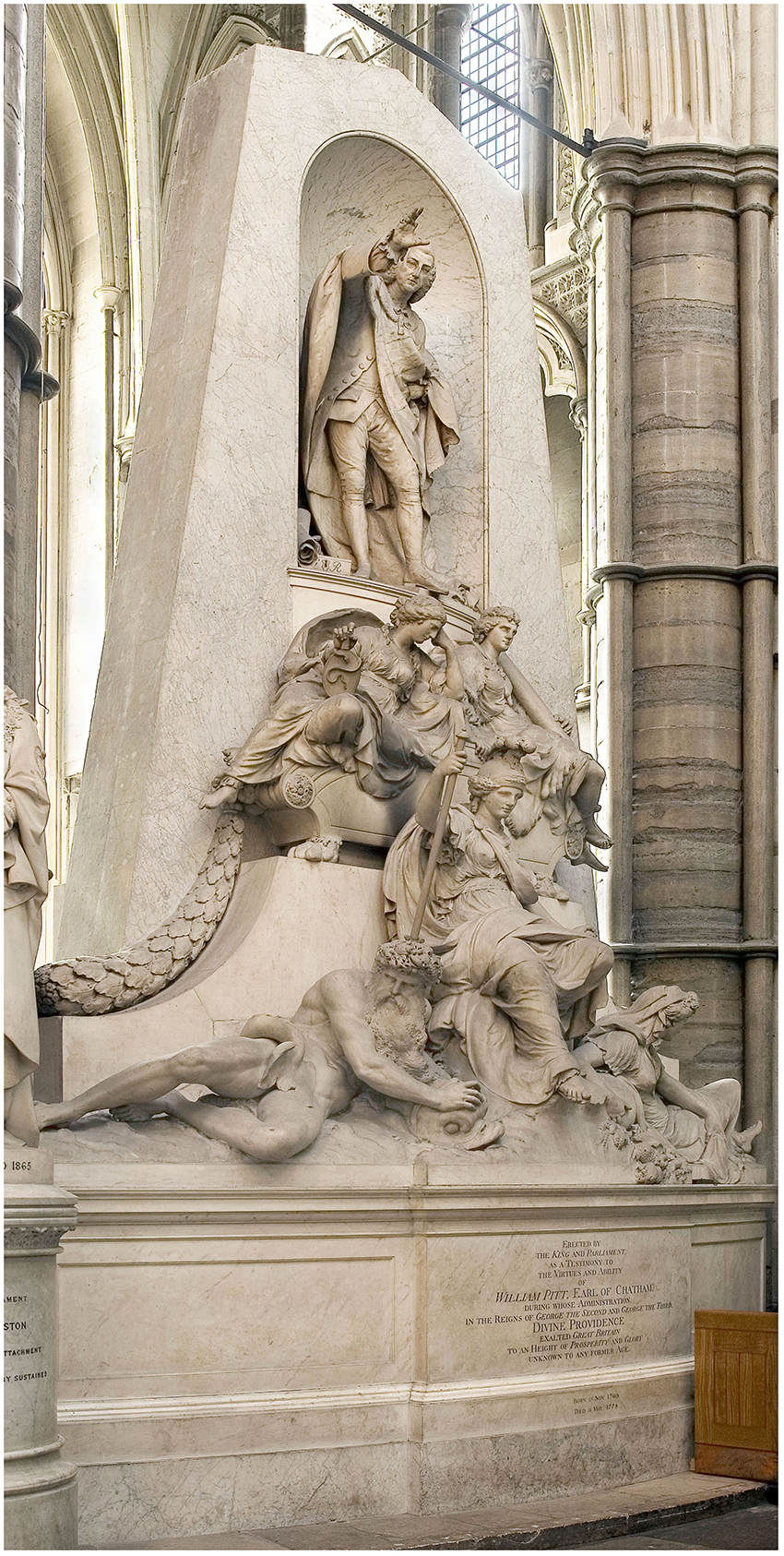
William Pitt, Earl of Chatham, was interred in the north transept of Westminster Abbey on 9 June 1778. On his monument, Pitt is portrayed gesticulating mid-speech over a figurative image of Britannia with her trident and shield (Figure 2).
John Bacon, “William Pitt the Elder Monument,” white marble, ca. 1780s, approximately 33 feet (10.1 meters), Westminster Abbey. © Dean and Chapter of Westminster, London.

He was therefore memorialized as a war minister, the man who brought the British Empire, as the monument’s inscription reads, “TO AN HEIGHT OF PROSPERITY AND GLORY UNKNOWN TO ANY FORMER AGE.”Footnote 34 Notably missing from the monument is any reference to William Pitt’s other great cause: securing the empire’s constitutional liberty. By the time of his death, it was clear that American liberty had never been the British Patriot leader’s paramount goal. When forced to decide between American political autonomy and British imperial sovereignty, Lord Chatham had chosen empire without the least hesitation.
Laid to rest alongside William Pitt was a British Patriot experiment fifty years in the making. The British Patriot party had promised its adherents that they could fashion an empire that would spread civil liberties across the globe, an empire that would enrich Britons and colonists alike, an empire that would be both militant and free. In Britain, however, the lesson most politicians took from the revolution was that such an empire could not be realized without destabilizing the bonds of British subjecthood. In future decades, the British state would openly pursue a hierarchical, two-tiered imperial system, in which Britain’s constitutional rights applied only to Britons of the “governing race.”Footnote 35 In the new United States, some continued to preach the Patriot message of an “empire for liberty,” setting their sights on the West as a space for American settlers to expand both the young nation’s territory and its republican values. However, American politicians too had a strictly limited definition of who should enjoy the empire’s promised freedoms: not the Indigenous, not women, and certainly not the enslaved.Footnote 36 The Patriot vision of empire was always hollow at its center. American independence merely laid bare the great contradictions—between military might and constitutional freedom, between imperial sovereignty and self-determination—that made an empire of liberty impossible to achieve.
Amy Watson is an Assistant Professor of History at the University of Alabama at Birmingham. She is the author of Patriots Before Revolution: The Rise of Party Politics in the British Atlantic, 1714–1763 (Yale University Press, 2025). Please address any correspondence to: watsonae@uab.edu.

 Open access

