Introduction
Umbilicaria Hoffm. is a well-known genus of umbilicate, foliose, lichen-forming fungi comprising c. 90 currently accepted species with a worldwide distribution (Feuerer Reference Feuerer2008), which occur almost exclusively on siliceous rocks in the polar, alpine and high-alpine biomes. One of the most important morphological and anatomical characters used to separate species is apothecium morphology (Frey Reference Frey1933; Scholander Reference Scholander1934; Llano Reference Llano1950). However, many individuals of Umbilicaria grow exclusively as anamorphs, and the important taxonomic characters for species identification are found on the asexual propagules, such as thalloconidia (Hasenhüttl & Poelt Reference Hasenhüttl and Poelt1978; Hestmark Reference Hestmark1990) or isidia and soredia (Krog & Swinscow Reference Krog and Swinscow1986; Codogno et al. Reference Codogno, Poelt and Puntillo1989; Wei et al. Reference Wei, Jiang and Guo1995–96; Sancho et al. Reference Sancho, Schroeter and Valladares1998). Other important characters are the type of rhizinomorphs and subsequent structure of the upper and lower cortices of the thallus (Poelt Reference Poelt1977). Valladares & Sancho (Reference Valladares and Sancho1995) considered the structure of the medulla, such as differences in the degree of cohesion of hyphae and their spatial orientation within the medulla, as additional useful taxonomic characters for these lichens. However, taxonomic characters used for other lichen genera, such as secondary metabolic products, are of limited use for the identification of Umbilicaria species. According to Narui et al. (Reference Narui, Culberson, Culberson, Johnson and Shibata1996), most of the chemical variation in Umbilicaria is due to the presence of small quantities of additional satellite compounds biosynthetically related to gyrophoric acid, such as umbilicaric, ovoic and hiascic acids. Most Umbilicaria species accumulate high concentrations of the tridepside, gyrophoric acid, always accompanied by smaller amounts of its depside precursor lecanoric acid. However, in the case of U. cylindrica (L.) Delise ex Duby the quantities of gyrophoric and lecanoric acids can differ between specimens, as well as the quality of other secondary products detected mainly by HPLC method (Narui et al. Reference Narui, Culberson, Culberson, Johnson and Shibata1996; Seriña et al. Reference Seriña, Arroyo, Manrique and Sancho1996; Kantvilas & Louwhoff Reference Kantvilas and Louwhoff2007).
In Europe, 31 species of Umbilicaria have been recognized (Feuerer Reference Feuerer2008); 26 species occurring in the continental part of the Mediterranean region (Llimona & Hladun Reference Llimona and Hladun2001; Nimis & Martellos Reference Nimis and Martellos2003), 21 in the Carpathians (Bielczyk et al. Reference Bielczyk, Lackovičova, Farkas, Lőkös, Liška, Breuss and Kondratyuk2004), and 25 in Fennoscandia (Santesson et al. Reference Santesson, Moberg, Nordin, Tønsberg and Vitikainen2004). The most variable species in the genus is U. cylindrica, and up to 6 varieties have been described from the Iberian Peninsula (Llimona & Hladun Reference Llimona and Hladun2001), 5 from the Tatra Mountains in Poland (Krzewicka Reference Krzewicka2004), and 2 from Fennoscandia (Santesson et al. Reference Santesson, Moberg, Nordin, Tønsberg and Vitikainen2004). The characters used to distinguish these varieties are the frequency of rhizines and cilia, the concentration of wrinkles and folds on the upper surface, and the colour of the underside, as well as the occurrence of mono- or polyphyllous thalli. On the other hand, all the varieties of U. cylindrica have the same type of stipitate and gyrodisc apothecia and thalli with ciliate margins. Hitherto, in Europe only U. cylindrica has been characterized by the ciliate margin of the thallus and this feature has been used in many keys for European lichens as a good character for this species. For this reason, specimens occurring in the Tatra Mountains with a sparsely ciliate thallus and atypical sessile apothecia were previously considered by Krzewicka (Reference Krzewicka2004) as U. cylindrica.
Specimens lacking rhizines and with multi-cellular thalloconidia, among other characteristic features, have been traditionally included under the name U. polyphylla (L.) Baumg. However, some specimens have some morphological modifications similar to typical specimens of U. polyphylla; for example, in the Iberian Peninsula one of us (LGS) has recorded two morphological forms of this species, the first with a monophyllous, dark brown thallus and white central part on the upper side, occurring mainly in mountainous regions, and the second with a polyphyllous, medium brown and uniformly coloured thallus, growing at both higher and lower altitudes. In the Carpathians, one of us (BK) has observed, together with polyphyllous uniformly brown coloured specimens, other morphotypes with a greyish brown, polyphyllous thallus, slightly areolate around the umbilicus. In all these cases, however, other characters mentioned above and typical of U. polyphylla are maintained.
Molecular data provide additional characters to test the validity of species circumscriptions. Nuclear ITS and large subunit ribosomal genes (LSU) have been used to examine relationships between closely related species of lichen-forming fungi, including Umbilicaria (e.g. Romeike et al. Reference Romeike, Friedl, Helms and Ott2002; Ott et al. Reference Ott, Brinkmann, Wirtz and Lumbsch2004; Divakar et al. Reference Divakar, Molina, Lumbsch and Crespo2005; Arup Reference Arup2006; Søchting & Figueras Reference Søchting and Figueras2007). Furthermore, the molecular phylogenetic relationships of the Lecanoromycetes (which includes the family Umbilicariaceae) were discussed by Wedin et al. (Reference Wedin, Wiklund, Crewe, Döring, Ekman, Nyberg, Schmitt and Lumbsch2005), Miądlikowska et al. (Reference Miądlikowska, Kauff, Hofstetter, Fraker, Grube, Hafellner, Reeb, Hodkinson, Kukwa and Lücking2006) and Hofstetter et al. (Reference Hofstetter, Miądlikowska, Kauff and Lutzoni2007).
The present study aims to improve understanding of the variation in U. cylindrica and U. polyphylla using a combination of morphological data and DNA sequence data. Group I introns have been frequently reported in lichen-forming ascomycetes at a number of insertion sites in both the small (SSU) and large (LSU) subunits of the nuclear ribosomal genes (Martín et al. Reference Martín and Johansen2003). The presence and location of group I introns found in the SSU in Umbilicaria, representing their consensus secondary structure, are also reported.
Materials and Methods
Materials
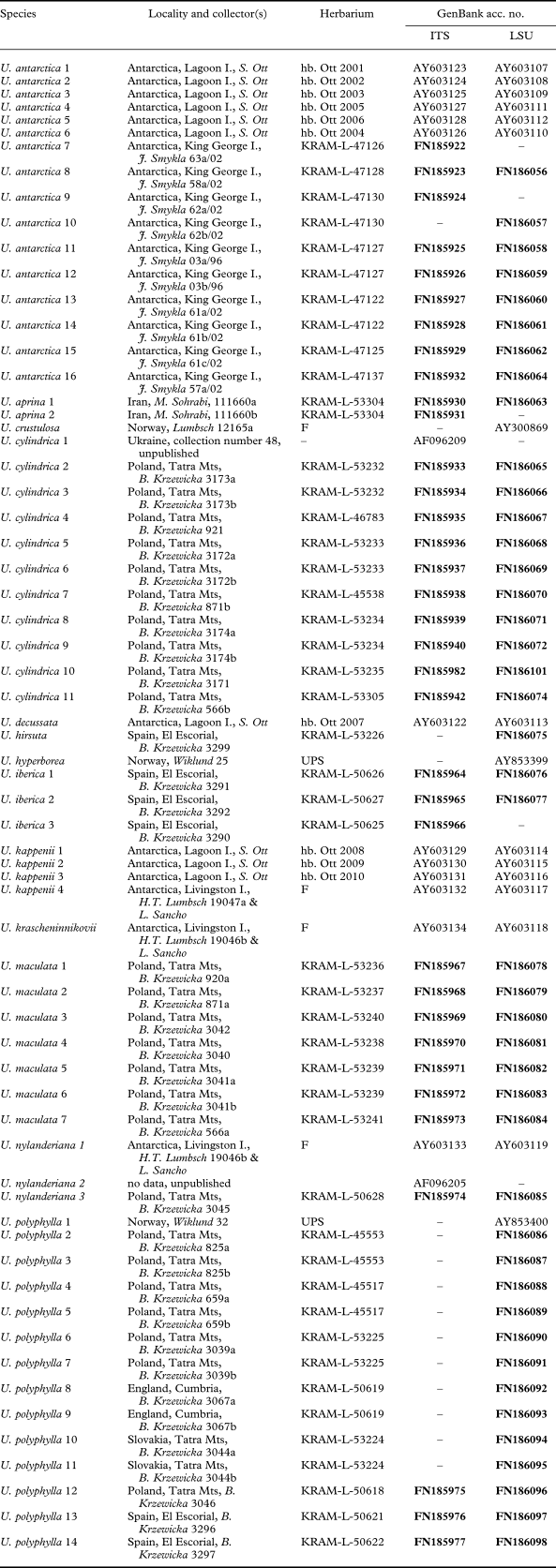
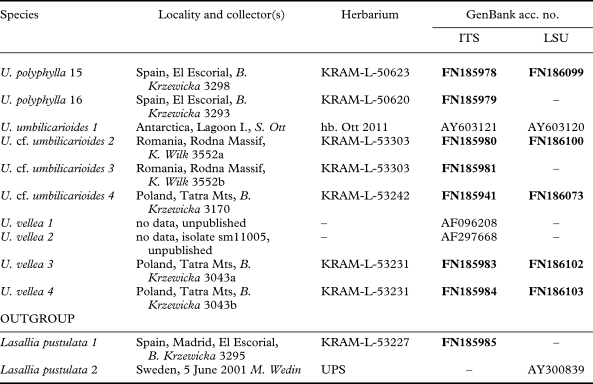
Type and other lichen material were examined from KRAM–L and MAF herbaria. Ascomata and thallus material for nuclear ITS rDNA and nuclear LSU rDNA sequence analyses were obtained from 79 specimens representing 14 species of Umbilicaria and one species of Lasallia, used as an outgroup. Specimens for DNA analysis were air-dried at room temperature. Details of the materials and GenBank accession numbers are presented in Table 1.
Specimens used in the study, with location, reference collection detail and GenBank accession numbers. Sequences obtained from GenBank are in bold

The choice of Lasallia pustulata (L.) Mérat as an outgroup was based on the study by Ivanova et al. (Reference Ivanova, DePriest, Bobrova and Troitsky1999). Lasallia is a closely related sister group to the paraphyletic genus Umbilicaria and both genera are placed in the Umbilicariaceae (Miądlikowska et al. Reference Miądlikowska, Kauff, Hofstetter, Fraker, Grube, Hafellner, Reeb, Hodkinson, Kukwa and Lücking2006; Hofstetter et al. Reference Hofstetter, Miądlikowska, Kauff and Lutzoni2007).
Morphological and anatomical studies
Hand-cut sections of moist thalli were mounted in water containing a small amount of detergent and spot test reactions made with 10% KOH (K), a solution of sodium hypochlorite (C), and an alcoholic solution of paraphenylenediamine (Pd). Spore measurements and observations on ascomata structure were made on sections mounted in water or in c. 5% KOH. Chemical examination included response to ultraviolet light (UV) and thin-layer chromatography (TLC) which was performed in solvent system A and C (after Orange et al. Reference Orange, James and White2001).
DNA extraction, PCR amplification
Total DNA was extracted from fresh, frozen and herbarium material. Small samples prepared from herbarium specimens were ground with sterile pestles in sterile Eppendorf tubes and extracted in acetone for 1 h to remove secondary lichen products. The acetone was discarded and the samples were dried at room temperature to allow the remaining acetone to evaporate. Total genomic DNA was extracted using E.Z.N.A. Fungal DNA Kit (OmegaBiotech) following the manufacturer's instructions.
Dilutions of the total DNA were used for PCR amplification of the nuclear ITS and LSU rDNA regions. Primers for amplification were (a) for the nuclear ITS rDNA: nu–SSU–1752–5′ (ITS1F) (Gardes & Bruns Reference Gardes and Bruns1993) and nu–LSU–0041–3′(ITS4) (White et al. Reference White, Bruns, Lee, Taylor, Innis, Gelfand, Sninsky and White1990), and (b) for the nuclear LSU rDNA: nuLSU–0042–5′ (LROR), nuLSU–0638–5′ (LR3), nuLSU–00952–3′ (LR5), LR7 – nuLSU–1422–3′ (LR7) (Vilgalys & Hester Reference Vilgalys and Hester1990). Individual reactions to a final volume of 25 μl were carried out using Ready-To-Go®PCR Beads (Amershan-Phamacia Biotech) with a 10 pmol μl−1 primer concentration (Martín & Winka Reference Martín and Winka2000). The reactions were run with the following parameters for the nuclear ITS rDNA: initial denaturation at 95°C for 5 min, then 5 cycles of denaturation at 95°C for 30 sec, annealing at 54°C for 30 sec, and extension at 72°C for 1 min, followed by 33 cycles of denaturation at 95°C for 30 sec, annealing at 48°C for 30 sec, and extension at 72°C for 1 min, with a final extension at 72°C for 10 min and a 4°C soak; for the nuclear LSU rDNA: initial denaturation at 94°C for 5 min, then 36 cycles of denaturation at 94°C for 30 sec, annealing at 52°C for 30 sec, and extension at 72°C for 1 min and 30 sec, with a final extension at 72°C for 10 min, and a 4°C soak. The PCR products were subsequently purified using the QIAquick Gel PCR Purification (Qiagen) according to the manufacturer's instructions. The purified PCR products were sequenced using the same amplification primers.
Sequencher 4.2 (Gene Codes Corporation, Ann Arbor, Michigan, USA) was used to obtain the consensus sequence from the two strands of the ITS and/or the LSU nrDNA of each isolate.
Alignments and phylogenetic analyses
The ITS and LSU nrDNA sequences obtained were aligned separately using SeqApp (Gilbert Reference Gilbert1993) for multiple sequences. Sequences obtained were compared with homologous sequences of Umbilicaria spp. retrieved from the EMBL Nucleotide Sequence Database included in Table 1. Where ambiguities in the alignment occurred, the one generating the fewest potentially informative characters was chosen. Alignment gaps were marked “–”, unresolved nucleotides and unknown sequences were indicated with “N”. Introns were not included in these analyses, but were studied separately to examine their distribution, secondary structure and phylogenetic origin.
From each data set, a maximum parsimony analysis (MP) was carried out; minimum length Fitch trees were constructed using heuristic searches with tree-bisection-reconnection (TBR) branch swapping, collapsing branches if maximum length was zero and with the MulTrees option on in PAUP*4.0b10 (Swofford Reference Swofford2003). Gaps were treated as missing data. Nonparametric bootstrap support (Felsenstein Reference Felsenstein1985) for each clade, based on 10 000 replicates using the fast-step option, was tested. The consistency index, CI (Kluge & Farris Reference Kluge and Farris1969), retention index, RI (Farris Reference Farris1989), and rescaled consistency index, RC (Farris Reference Farris1989) were obtained.
A combined matrix of ITS and LSU nrDNA sequences was analysed by parsimony using PAUP* and by a Bayesian approach (Larget & Simon Reference Larget and Simon1999; Huelsenbeck et al. Reference Huelsenbeck, Ronquist, Nielsen and Bollback2001) using MrBayes 3.1 (Ronquist & Huelsenbeck Reference Ronquist and Huelsenbeck2003). The combined matrix included sequences of those specimens from which both regions were obtained. As a measure of congruence between the ITS and the LSU data sets, the incongruence length difference (ILD) test (Farris et al. Reference Farris, Källersjö, Kluge and Bult1995) was performed in PAUP* with 10 000 replicates of the partition homogeneity test using the default search parameters except the MulTrees option off, keeping the best tree per analysis.
The model used for the Bayesian analyses was determined according to the Akaike Information Criterion (AIC) as implemented in Modeltest 3.7 (Posada & Crandall Reference Posada and Crandall1998). For the combined ITS-LSU matrix, a General Time Reversible model with a gamma shaped distribution of rates across sites and a proportion of in invariable sites (GTR+I+Γ) was selected. Two independent and simultaneous analyses starting from different random trees were run for 2 000 000 generations with four parallel chains and trees and model scores saved every 100th generation. The default priors in MrBayes were used in the analysis. Every 1000th generation tree from the two runs was sampled to measure the similarities between them and to determine the level of convergence of the two runs. The potential scale reduction factor (PSRF) was used as a convergence diagnostic and the first 25% of the trees were discarded as burn-in before stationarity was reached. Both the 50% majority-rule consensus tree and the posterior probability of the nodes were calculated from the remaining trees with MrBayes. Phylogenetic trees were drawn using TreeView (Page Reference Page1996).
Finally, secondary structures of the group I introns were based upon sequence alignments taking into account detailed, but general, features (Michel & Westhof Reference Michel and Westhof1990; Martín et al. Reference Martín and Johansen2003; Wikmark et al. Reference Wikmark, Haugen, Haugli and Johansen2007). Secondary structure diagrams were drawn using the Adobe Illustrator package (CS3-Version 9). A maximum parsimony analysis (MP) was carried out from the introns with the same parameters used for the ITS nrDNA, LSU nrDNA and ITS-LSU nrDNA analyses.
Results
Morphology
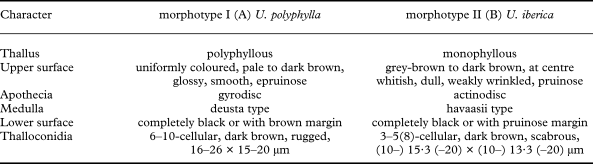
Two morphotypes (I and II) in the U. polyphylla group were distinguished (Table 2). Morphotype I was characterized by its polyphyllous, rarely monophyllous thallus; upper surface uniformly coloured, pale to dark brown, glossy, smooth, epruinose; lower surface sooty black, smooth, covered with a fine layer of black, multicellular thalloconidia, lacking rhizines; gyrodisc apothecia. This morphotype corresponds with typical specimens of U. polyphylla. Additional information on its morphological features can be found in Llano (Reference Llano1950), Hestmark (Reference Hestmark1990), Krzewicka (Reference Krzewicka2004) and Kantvilas & Louwhoff (Reference Kantvilas and Louwhoff2007). Morphotype II differs from typical specimens of U polyphylla by its monophyllous thallus; upper surface grey-brown to dark brown, whitish at the centre, dull, slightly scabrous and pruinose, elevated and white areolate in the centre; lower surface sooty black, smooth, covered with a fine layer of black, multicellular thalloconidia, lacking rhizines; actinodisc apothecia. This morphotype corresponds with the new species described here as U. iberica (for a complete description see below).
Principal differences between Umbilicaria polyphylla and U. iberica (clades A and B)

Three morphotypes (I, II and III) were distinguished in the U. cylindrica group (Table 3). Morphotype I was characterized by its ciliate, mono- or polyphyllous thallus, upper surface pale to dark grey, lower surface pale brown to pinkish-beige, smooth, rhizines sparse to dense, concolorous with the lower cortex; apothecia gyrodisc, black, with smooth or slightly cracked margin, stipitate, 0·5–2·0(–4·0) mm diam., disc black, gyrose. This morphotype corresponds with typical U. cylindrica; for more detailed descriptions see Llano (Reference Llano1950) and Narui et al. (Reference Narui, Culberson, Culberson, Johnson and Shibata1996), Krzewicka (Reference Krzewicka2004) and Kantvilas & Louwhoff (Reference Kantvilas and Louwhoff2007). Morphotype II differs from typical U. cylindrica by: a monophyllous thallus with sparse, flattened cilia, upper surface smooth, grey to brownish-grey with white irregular smudges sometimes appearing UV+ white (structural effect), lower surface smooth, pale cream to whitish, with sparse to dense rhizines concolorous with the lower cortex; apothecia omphalodisc, black, with crenate margin, sessile to slightly stipitate, up to 0·5–0·8(–1·2) mm diam., disc black, smooth with one large or a few smaller sterile fissures. This morphotype corresponds with the new species described here as U. maculata (see below for complete description). Morphotype III is characterized by: a polyphyllous or rarely monophyllous thallus with margin covered by dark brown to black rhizines, upper surface grey to brown-grey, lower surface scabrous, medium brown, rhizines in marginal zone, concolorous with the lower cortex or darker, multicellular thalloconidia on rhizines (not observed in material studied from Europe). This morphotype is recognized here as U. cf. umbilicarioides (Stein) Krog & Swinscow due to the small number of samples, lack of thalloconidia on European materials and disjunct distribution. For additional descriptions of U. umbilicarioides see Krog & Swinscow (Reference Krog and Swinscow1986), Hestmark (Reference Hestmark1990), Øvstedal & Lewis Smith (Reference Øvstedal and Lewis Smith2001), Krzewicka & Smykla (Reference Krzewicka and Smykla2004) and Kantvilas & Louwhoff (Reference Kantvilas and Louwhoff2007).
Principal differences between the morphotypes of the Umbilicaria cylindrica complex (clades C, D and E)

Molecular analyses
Nuclear ITS rDNA
The new 44 fungal ITS nrDNA sequences were aligned with 18 sequences availablein Genbank to produce a matrix of 895 unambiguously aligned nucleotide position characters. The first 337 characters were eliminated in the phylogenetic analyses since there is a group I intron inserted after position 1506 in the SSU rRNA gene (Escherichia coli numbering system). These intron sequences are analysed separately (see below). From the 558 characters, 388 were constant, 64 variable and parsimony uninformative, and 106 parsimony informative. Maximum parsimony (MP) analysis under heuristic search gave 100 most parsimonious trees with a length of 326 steps, CI= 0·6442, RI= 0·8759 and RC= 0·5643. The alignment of 62 sequences and the strict consensus tree obtained from the MP analysis are available in TreeBASE (http://www.treebase.org/).
Nuclear LSU rDNA
The new 49 fungal LSU nrDNA sequences were aligned with 18 sequences available in Genbank to produce a matrix of 950 unambiguously aligned nucleotide position characters, of which 769 were constant, 97 variable were parsimony uninformative, and 84 parsimony informative. Maximum parsimony (MP) analysis under heuristic search gave 100 most parsimonious trees with a length of 281 steps, CI = 0·7153, RI = 0·9018 and RC = 0·6451. The alignment of 67 sequences and the MP strict consensus tree are available in TreeBASE.
Combined ITS and LSU nrDNA
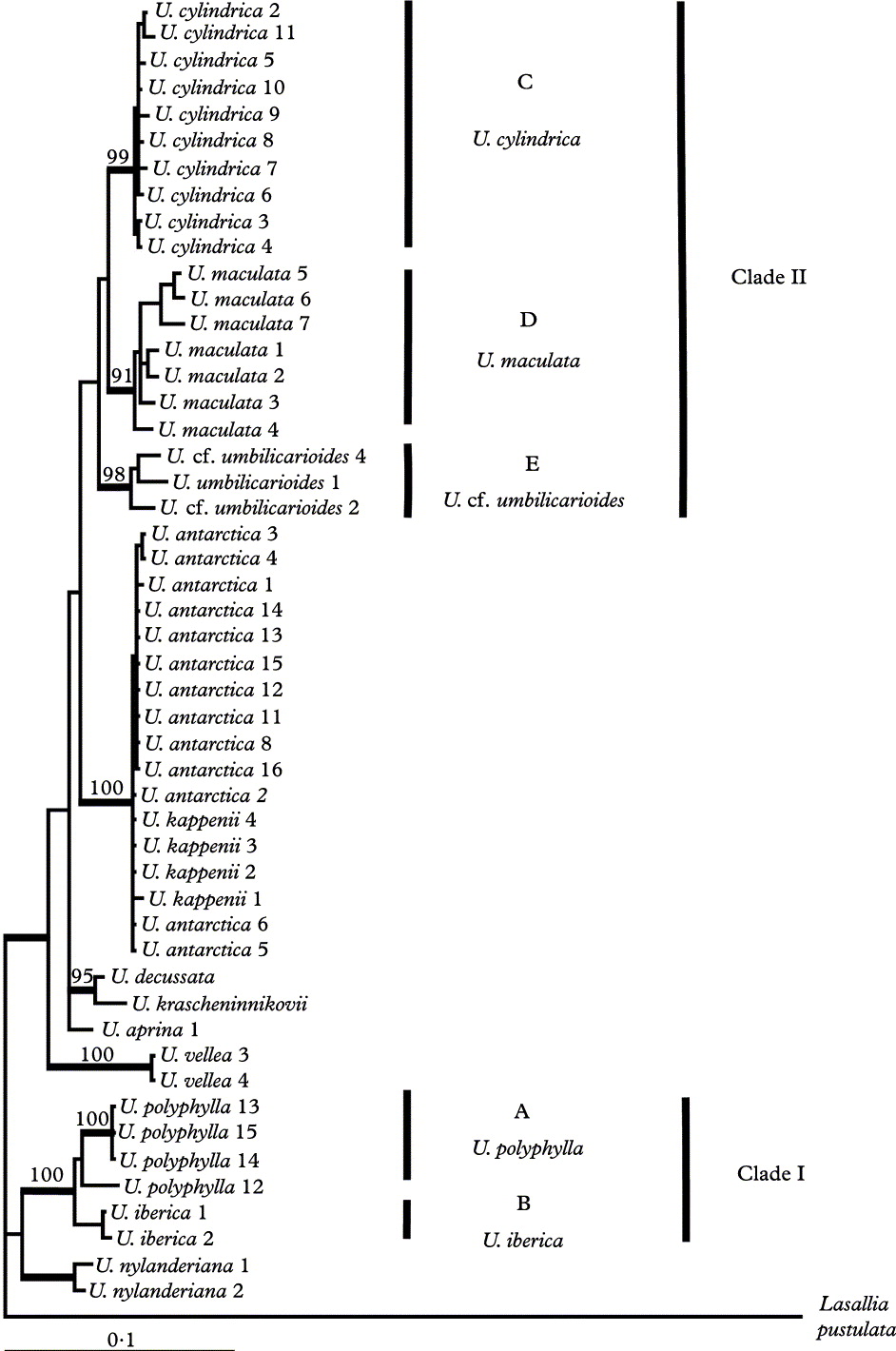
The partition homogeneity test (ILD test) revealed significant congruence between the ITS and LSU data partitions (P = 0·7905) and therefore both data sets were combined for further analyses. The combined matrix had 1533 unambiguously aligned nucleotide position characters, of which 1203 were constant, 158 variable were parsimony uninformative, and 172 parsimony informative. The alignment of 51 sequences is available in TreeBASE. Maximum parsimony (MP) analysis under heuristic search gave 100 most parsimonious trees with a length of 529 steps, CI = 0·7183, RI = 0·8736 and RC = 0·6276. The trees obtained from the MP and Bayesian analyses gave similar topologies; thus only the Bayesian tree from the combined analysis is shown in Fig. 1. Branches with posterior probabilities (pp) are indicated in bold. The bootstrap support values (bs) equal or above 85% are indicated on the branches.
Phylogeny of Umbilicaria spp. as inferred from a nuclear ITS and LSU rDNA combined data set. This is a 50% majority–rule consensus tree from a B/MCMC tree sampling procedure. Bold branches with posterior probabilities equal to or above 0·99. MP bootstrap support values above 85% are indicated on the branches.

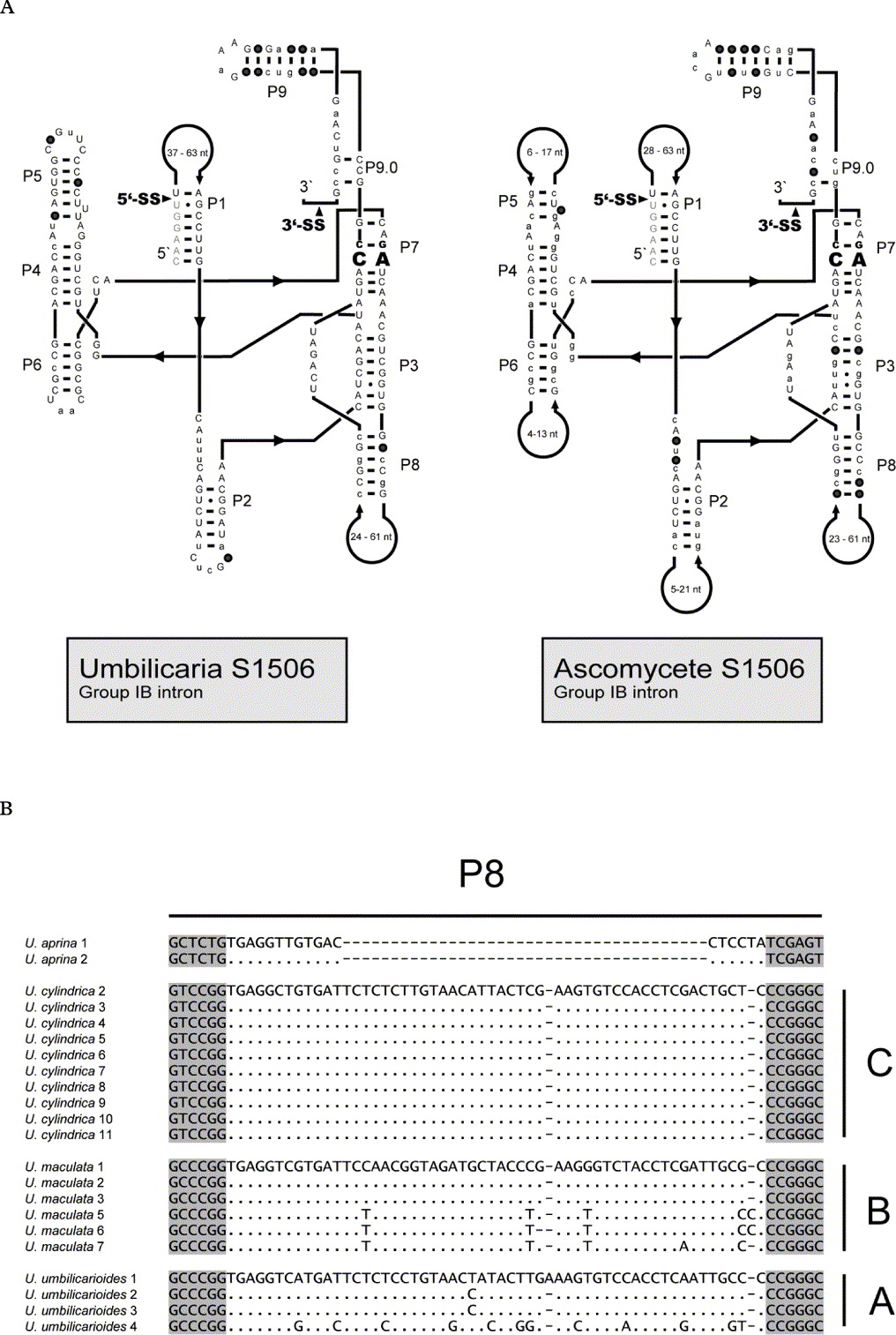
Analysis of Umbilicaria group IB intron secondary structure and variability. A, consensus secondary structure diagram based on 22 Umbilicaria introns sequences (left) and corresponding ascomycete introns (right). Paired elements (P1–P9) are indicated, and 100% invariable nucleotide positions are shown in uppercase letters. The atypical A : C pair in P7 is indicated in bold characters. For the Umbilicaria structure (left), variable positions present in 75% or more of the sequences are shown in lowercase letters, whereas those less than 75% conserved are indicated by solid circles. Similarly, positions common to two of the three genera (Umbilicaria, Teloschistes, and Symbiotaphrina) are shown in lowercase letters. Nucleotide positions present in all the genera, but different types, are shown as solid circles. B, sequence alignment of the P8 extension region. Nucleotides representing the six base pairs shown in Fig. 2A are marked as grey boxes. The A, B, and C clades are shown (right).

In the majority-rule consensus tree of the combined data set (Fig. 1), clade I comprising the Umbilicaria polyphylla complex is strongly supported. Its sister group relationship to U. nylanderiana (Zahlbr.) H. Magn., however, is not well supported (pp = 0·56, bp = 50). All the remaining taxa are included in a group with low bp support (60). In the upper part of the tree, the supported group includes the two collections of U. vellea (L.) Hoffm. examined in this study; this group appears as the sister-group to the remaining taxa, however, without support. These taxa are clustered in three clades: one comprising the sequences of U. antarctica Frey & I.M Lamb and U. kappenii Sancho, Schroeter & Valladares obtained from GenBank, and the new sequences of U. aprina Nyl.; a second clade, which is very well supported, has sequences of U. decussata (Vill.) Zahlbr. and U. krascheninnikovii (Savicz) Zahlbr. from GenBank; and a third clade comprising sequences obtained in this study under the U. cylindrica complex and the U. umbilicarioides sequence from GenBank (clade II). Only clades I and II will be discussed.
Clade I contains clades A (pp = 0·63, bs = 61) and B (pp = 1·00, bs = 100) (Fig. 1). In the analyses of the nrLSU rDNA sequences (not shown), the collection U. polyphylla 12 forms a well–supported clade together with 10 new sequences and one sequence from GenBank (AY853400). Clade A contains specimens which are recognized here as morphotype I, representing the typical specimens of U. polyphylla. Clade B comprises sequences from two collections that correspond to morphotype II of the U. polyphylla group (Table 2). In our analyses, this morphotype is highly supported as monophyletic (pp = 1·00, bs = 100; Fig. 1) and is described here as U. iberica (Fig. 4).
In Clade II, three groups (C, D and E) are very well supported: Clade C (pp = 1·00, bs = 92) comprises 10 sequences from specimens that fit the morphology of the typical U. cylindrica (Morphotype I; Table 3); Clade D (pp = 1·00, bs = 92) contains seven sequences that correspond to morphotype II, here recognized as U. maculata (Fig. 5; Table 3); Clade E (pp = 1·00, bs = 87) includes two sequences previously identified as U. cylindrica and one from GenBank named as U. umbilicarioides. The analyses of the ITS nrDNA also included a GenBank sequence (AF096209) from a specimen collected in Ukraine (not shown). The morphology of the specimens of Clade E fit morphotype III (Table 3), recognized here as U. cf. umbilicarioides.
SSU rDNA intron
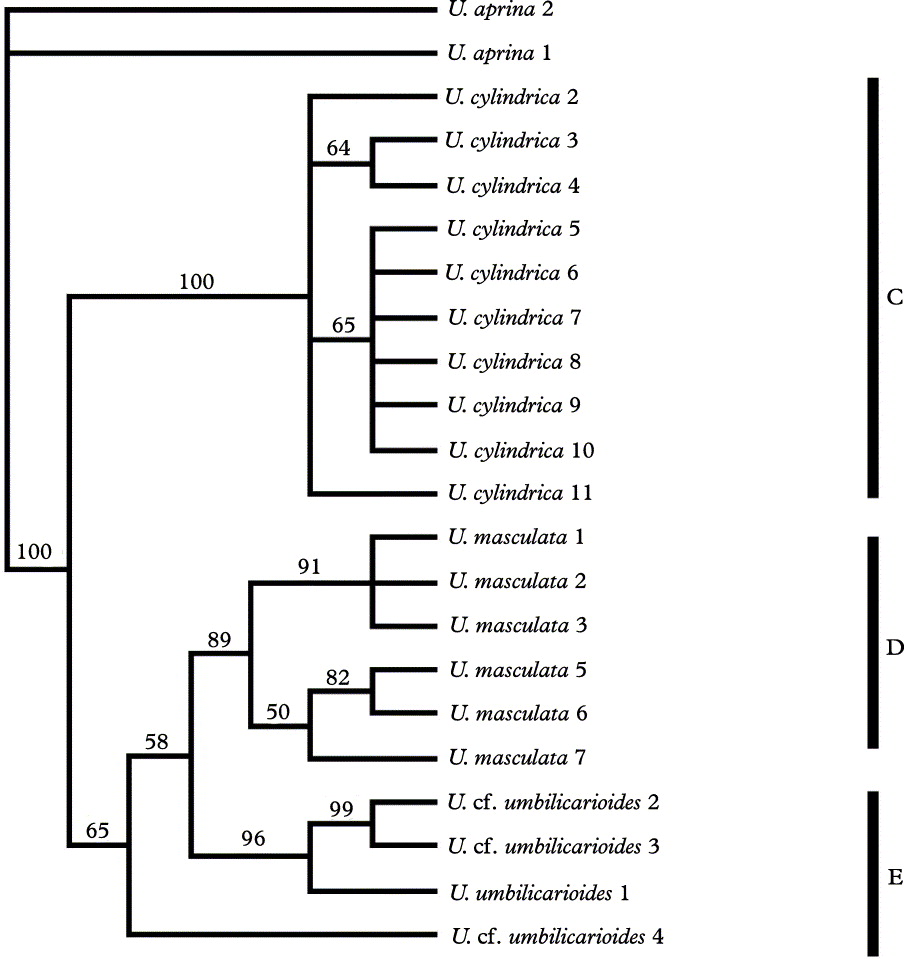
An insertion at the SSU rDNA position 1506 was found in U. aprina and Umbilicaria sequences included in clade II (except U. cylindrica 1 and U. maculata 4). The insertion represents a typical group IB intron. These introns are small (less than 300 bp), and a consensus secondary structure diagram is presented in Fig. 2A (left). From the 313 unambiguously aligned nucleotide position characters, 213 were constant, 13 variable were parsimony uninformative, and 86 parsimony informative. Maximum parsimony (MP) analysis under heuristic search gave 100 most parsimonious trees with a length of 133 steps, CI = 0·8647, RI = 0·9421 and RC = 0·8146. The alignment of 22 sequences and the MP strict consensus tree (Fig. 3) are available in TreeBASE.
Strict consensus tree of the maximum parsimony analysis of Umbilicaria group IB intron. MP bootstrap support values above 50% are indicated on the branches.

Discussion
Based on morphological and molecular data, the morphotype II of U. polyphylla (Clade I, B) and morphotype II of U. cylindrica (Clade II, D) are described here as new species, U. iberica and U. maculata respectively.
Umbilicaria iberica is well supported as monophyletic, and is morphologically clearly distinguished from typical specimens of U. polyphylla (Table 2). The other collections in Clade I do not form a well-supported monophyletic group. It is interesting to note that Clade A (Fig. 1, Clade I) includes only sequences of collections of U. polyphylla from Spain, whereas the other sequences of specimens from temperate and boreal parts of Europe (e.g. Norway, Britain, Poland and Slovakia) form, together with U. polyphylla 12 and the GenBank (AY853400) sequence of U. polyphylla from Norway (not shown), a sister clade to the Spanish specimens.
In Clade II, three monophyletic groups are present among samples previously referred to as U. cylindrica (morphotype I – C, morphotype II – D, morphotype III – E). Our study agrees with previous studies in showing that U. cylindrica is probably a species complex including several cryptic species; for instance, chemical differences among specimens of this taxon were observed by Narui et al. (Reference Narui, Culberson, Culberson, Johnson and Shibata1996), morphological differences by Crespo & Sancho (Reference Crespo and Sancho1978), and Krzewicka (Reference Krzewicka2004), and physiological differences by Fahselt et al. (Reference Fahselt, Alstrup and Tavares1995). Interesting information is provided by the position of the sequences of U. cylindrica var. corrugatoides Frey (U. cylindrica 10) and var. delisei Nyl. (U. cylindrica 7) on the phylogenetic tree (Fig. 1). Although these varieties have a very different morphology, such as structure and colour of upper and lower sides of the thallus, their sequences are grouped in Clade C together with those of typical U. cylindrica. Morphologically, these three groups (C–E) are very similar, but all of them are highly variable. However, some of them are well-recognized by their sexual propagules, for example U. maculata (Table 3). Furthermore, molecular characters clearly distinguish these three groups (C–E) in the analyses of both ITS and LSU nrDNA sequence data and the presence of a group I intron in the position 1506 of the SSU nrDNA (Fig. 2).
The relationship of the specimens in Clade E is most unexpected since it comprises sequences of the morphotype III of U. cylindrica and the GenBank AY603120 sequence of U. umbilicarioides from Antarctica (Ott et al. Reference Ott, Brinkmann, Wirtz and Lumbsch2004). To date, U. umbilicarioides was known only from the Southern Hemisphere, namely Antarctica (Øvstedal & Lewis Smith Reference Øvstedal and Lewis Smith2001), Africa (Krog & Swinscow Reference Krog and Swinscow1986), South America (Llano Reference Llano1950) and the Australian region where it was mostly known under the name U. propagulifera (Vain.) Llano (Galloway Reference Galloway1985). This species is easily distinguished by its multicellular thalloconidia produced by multidivided rhizines, which are missing on specimens of U. cylindrica. The specimens studied of morphotype III are characterized by upper and lower surfaces similar to U. umbilicarioides in colour and structure, and also in the distribution of rhizines. However, they lack the multicellular thalloconidia that are an important taxonomic character in many keys (e.g. Øvstedal & Lewis Smith Reference Øvstedal and Lewis Smith2001; Krzewicka & Smykla Reference Krzewicka and Smykla2004). Phylogenetic analyses show that asexual propagules are not reliable taxonomic characters in Umbilicaria (Ott et al. Reference Ott, Brinkmann, Wirtz and Lumbsch2004). The morphotypes, with and without thalloconidia, form one phylogenetic species that exhibits a high plasticity in developmental morphology and reproductive strategy. Furthermore, the specimens of morphotype III from Europe occasionally form thallyles on the top of rhizines, which are characteristic of U. umbilicarioides and have never been reported from U. cylindrica. The thallyles are situated on rhizines which differ from the regular rhizines in being unbranched, longer and thicker, being similar to those described on U. umbilicarioides by Krog & Swinscow (Reference Krog and Swinscow1986). On the basis of morphological and molecular data of nuclear ITS and LSU rDNA, the sequences in clade E probably belong to U. cf. umbilicarioides.
SSU rDNA intron
The introns found in Umbilicaria represent typical group IB intron folds, which are highly unusual in nuclear rDNA but present in some lichen-forming ascomycetes (see Martín et al. Reference Martín and Johansen2003). Comparison of group IB introns at SSU rDNA position 1506 from Umbilicaria, Teloschistes, and the non-lichen forming Symbiotaphrina identify a highly conserved catalytic core region within an almost identical intron fold (Fig. 2A, right). Group IB introns are generally valuable genetic markers among closely related isolates due to strong vertical inheritance patterns (Martín et al. Reference Martín and Johansen2003; Wikmark et al. Reference Wikmark, Haugen, Haugli and Johansen2007). The unusually small and compact core structure depends on host factors for self-splicing, and thus the group IB introns are more integrated into the host genetic systems than most other nuclear group I introns. This idea is further supported by an unconventional A : C basepair adjacent to the catalytical essential G : C basepair in the P7 segment (indicted by large bold characters in Fig. 2A), which probably affects catalysis.
Similar to the previously reported group IB introns in Teloschistes, the Umbilicaria cognate introns have size and sequence variations within the P8 segment. These sequences appear too short to be included in regular phylogenetic analysis, but may represent an informative synapomorphy among the Umbilicaria isolates. A closer inspection of the P8 region strongly supports this hypothesis (Fig. 2B). Whereas the two intron sequences from U. aprina possess a P8 of only c. 35 nucleotides, all the U. cylindrica isolates contain c. 70 nucleotides at this region. Furthermore, three sequence groups are recognized by simple alignments among U. cylindrica and correspond quite well to the C, D, and E clades (Fig. 3) obtained with the ribosomal RNA genes and ITS sequences. We conclude that the group IB introns represent an important and valuable molecular marker which gives additional support to the ITS and LSU sequence phylogeny presented above.
The Species
Umbilicaria iberica Sancho & Krzewicka sp. nov
Thallus monophyllus, umbilicatus, orbiculatus, 1–3(–5) cm diametro, margine saepe incise–lobato. Superficies superior laevis vel tenuiter scabrida, fuliginosa, ad centrum pruinosa ac elevata. Superficies inferior laevis, omnino nigra vel fusca ad margine. Apothecia sessilia, actinodiscus. Ascosporae ellipsoideae, 11–13 × 6·0–7·5 μm. Thalloconidia 3–5(8)–cellularia, subglobosa vel ellipsoidea, (10–) 15·3 (–20) × (10–) 13·3 (–20) μm.
Typus: Spain, El Escorial near Madrid, on a hill above the town, on shaded rocks, 1070 m alt., 17 September 2006, B. Krzewicka 3292 (KRAM–L 50627—holotypus; MAF & hb. M.R.D. Seaward 115716—isotypi).
(Fig. 4)
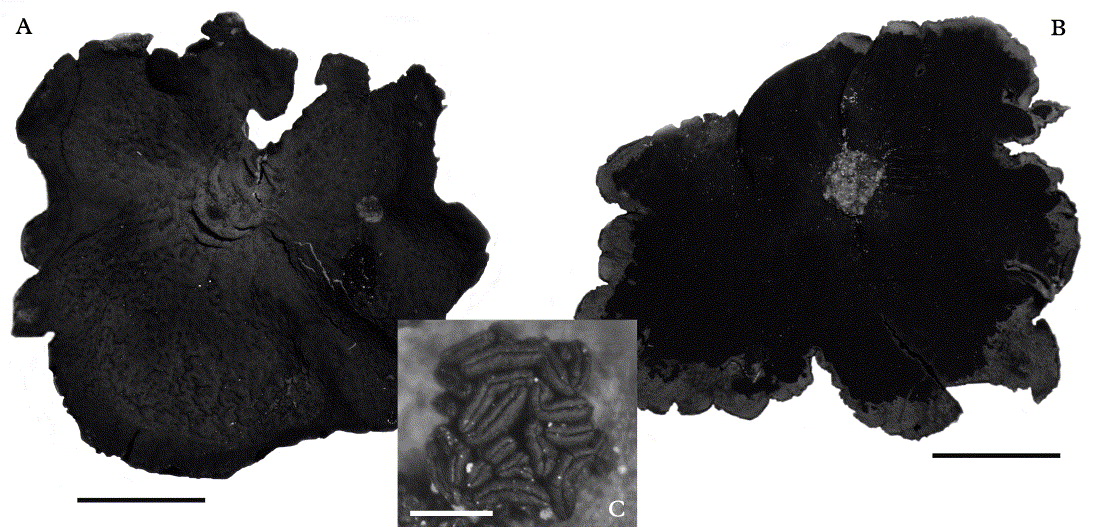
Thallus monophyllous, up to 3(–5) cm diam., margins revolute, entire or somewhat lacerate. Upper surface dull, smooth to weakly wrinkled, grey-brown to dark brown, at the centre elevated, slightly radially wrinkled, white areolate-scabrid and pruinose. Medulla white, one-layered, plectenchyma scarcely branched, hyphae loose, with many open intercellular spaces, rarely occupied by gelatinous matter. Lower surface completely sooty black, or with paler marginal zone (often pruinose), or mottled, smooth. Rhizines absent.
Apothecia occasionally present, sparse, black, sessile to substipitate, up to 0·7–1·5 mm diam., actinodisc. Epihymenium dark brown, up to 15 μm thick. Hymenium hyaline, up to 75 μm thick. Paraphyses usually simple, non-septate, up to 2·5 μm thick. Asci clavate, 35–40 × 10–13 μm. Ascospores 8 per ascus, simple, hyaline, 11–13 × 6·0–7·5 μm.
Pycnidia occasional to frequent, dark brown to black, punctiform, 0·1–0·2 mm diam. Conidia bacillar 3·5–5·0 × 1·0 μm. Thalloconidia common, multicellular, 3–5(8)-cellular, spherical to ellipsoid, (10–) 15·3 (–20) × (10–) 13·3 (–20) μm, covering lower surface completely or in black patches.
Chemistry. TLC: gyrophoric and umbilicaric acids; medulla C+ red, K−, Pd−, KC−, thallus UV−.
Ecology and distribution. At present, this species is known only from Spain where it occurs on vertical surfaces of blocks of siliceous rocks in shaded places. Umbilicaria iberica has been observed by L. Sancho in many places in the Iberian Peninsula, and it probably also grows in Mediterranean and sub-Mediterranean regions of Europe and Africa.
Note. The new species is distinguished from U. polyphylla by its monophyllous thallus, elevated and white areolate part over the umbo, actinodisc apothecia and a different type of medulla (Table 2).
Selected material examined. Spain: Bajada del Pto. de la Morcuera Canchal, NE exposition, 1450 m, 10 x 2006, L. G. Sancho (hb. M.R.D. Seaward; KRAM; MAF); El Escorial near Madrid, on a hill above the town, on shaded rocks, 1070 m, 2006, B. Krzewicka 3290, 3291 (KRAM).
Umbilicaria maculata Krzewicka, M. P. Martín & M. A. García sp. nov
Thallus parvus, monophyllus, maculiformis, umbilicatus, orbiculatus, 1–3 cm diametro. Superficies superior ad margines laevis, centrum versus vel areolato–scabrida. Superficies inferior laevis, albescens. Rhizinomorphae plerumque albescens, ramosae vel perrarae simplices, applanatae vel cylindricae irregulariter dispersae. Apothecia sessilia, omphalodiscus. Ascosporae latae ellipsoideae, 10–12 × 5–6 μm.
Typus: Poland, Western Carpathians, High Tatra Mts, Mały Kozi Wierch Mt., 49°13′12″N, 20°01′13″E, on granite rock, 2220 m alt., 10 September 2005, B. Krzewicka 3040 (KRAM-L 53238—holotypus; hb. M.R.D.Seaward 115717—isotypus).
(Fig. 5 )
Umbilicaria iberica (KRAM–L 50627). A, upper surface of thallus; B, lower surface of thallus; C, actinodisc apothecium. Scales: A & B = 5 mm; C = 0·5 mm.

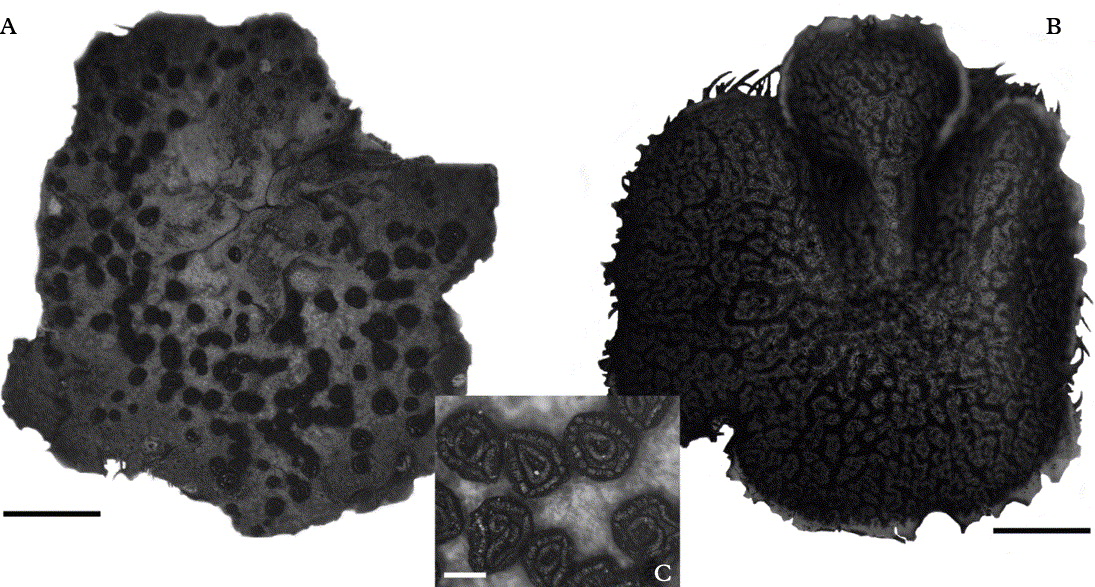
Umbilicaria maculata. A, upper surface of thallus with apothecia (KRAM–L 53238); B, upper surface of sterile thallus (KRAM–L 53239); C, omphalodisc apothecia. Scales: A & B = 3 mm; C = 0·5 mm.

Thallus monophyllous, flattened, adhering to the substratum, up to 3 cm diam., with or without sparse marginal cilia on young lobes. Upper surface smooth, dull, grey to grey–brown, white in the places where the cortex is thinner giving a maculate appearance and UV+ (structural effect), in the centre white and scabrous to areolate. Medulla white, two–layered, the upper part loose, with an arachnoidal plectenchyma, the lower part with compact plectenchyma. Lower surface smooth, dull, pale creamy to white, darker towards the margin. Rhizines concolorous with the lower cortex, simple to branched, mainly dichotomously to moderately divided, flattened, rarely cylindrical, area around the umbilicus without rhizines, towards the margin rhizines more abundant, scattered.
Apothecia frequent, sparse, black, sessile to substipitate, up to 1(–2) mm diam., omphalodisc with large sterile fissure in the centre or with a few sterile fissures, disc margin with characteristic marginal incisions. Epihymenium dark brown, up to 20 μm thick. Hymenium hyaline, up to 50 μm thick. Paraphyses usually simple, non–septate, up to 2·5 μm thick. Asci clavate, 40–45 × 10–15 μm. Ascospores 8 per ascus, simple, hyaline, 10–12 × 5–6 μm.
Pycnidia common, moderately numerous, distributed in the marginal zone, immersed, onion–shaped, with brown wall and dark brown ostiole, conidiophores unbranched, septate. Conidia cylindrical, 4·0 × 0·8 μm. Thalloconidia absent.
Chemistry. TLC: no lichen substances detected; medulla C−, K−, Pd−, KC−, thallus UV−.
Ecology and distribution. This species occurs on vertical surfaces of large blocks of siliceous rocks in rather shaded and wind–exposed places. To date it has been reported only from the Tatra Mts in Poland, where several populations have been observed at higher altitudes by the first author. The species grows in alpine and subnival belts, but probably occupies a wider area where it may have been overlooked or have been misidentified as U. cylindrica.
Notes. Umbilicaria maculata is characterized by having a monophyllous, flattened, maculate thallus adhering to the substratum, with sparse or lacking cilia, and sessile omphalodisc apothecia with crenulated margin. Umbilicaria cylindrica can be distinguished from this species by its stipitate gyrodisc apothecia and the thallus more or less revolute-convolute with dense and long cilia. However, its juvenile forms of apothecia look like those of U. maculata.
Selected material examined. Poland: Western Carpathians: High Tatra Mts below Rysy summit, on granitic rock, 2225 m, 1999, B. Krzewicka 920a (KRAM); High Tatra Mts, Mięguszowiecka Przełęcz pod Chłopkiem pass, on granitic rock, 2307 m, 1999, B. Krzewicka 871a (KRAM); High Tatra Mts, Mały Kozi Wierch Mt, 2220 m, on granitic rock, 2005, B. Krzewicka 3042 (KRAM); High Tatra Mts, Kozia Przełęcz Pass, 2137 m, on granitic rock, 2005, B. Krzewicka 3041 (KRAM, MAF); High Tatra Mts, Hala Gąsienicowa alp. Żółta Turnia Mt, on W slope, 1860 m, on granitic block, 1999, B. Krzewicka 566a (KRAM).
We are much obliged to Prof. M. R. D. Seaward who generously read the manuscript, revised the English and made a number of valuable comments. We are grateful to Dr W. Paul (Institute of Botany PAS, Krakow) for correcting the Latin diagnosis. Financial support of the European Community's Programme “Structuring the European Research Area”, under a SYNTHESYS grant to BK (ES–TAF 1431) at the Real Jardín Botánico (CSIC) and a Spanish grant, CGL2005–06549, are gratefully acknowledged.