Chronic spontaneous urticaria (CSU) is characterised by the experience of recurrent pruritic wheals for at least a 6-week period and is typically accompanied by itching, flaring skin reactions, and/or angioedema (Grattan, Sabroe, & Greaves, Reference Grattan, Sabroe and Greaves2002). CSU is a common skin disease (Grattan et al., Reference Grattan, Sabroe and Greaves2002; Weller et al., Reference Weller, Viehmann, Bräutigam, Krause, Siebenhaar, Zuberbier and Maurer2012) that often has a major negative impact on quality of life (Engin, Uguz, Yilmaz, Özdemir, & Mevlitoglu, 2007; Özkan et al., Reference Özkan, Oflaz, Kocaman, Özşeker, Gelincik, Büyüköztürk and Çolakoğlu2007; Staubach et al., Reference Staubach, Eckhardt-Henn, Dechene, Vonend, Metz, Magerl and Maurer2006). Given the unpredictable nature of individual urticaria episodes (i.e., frequency, duration, intensity) and the adverse impact they can have on an individual's life, it is not surprising that chronic urticaria is associated with symptoms of depression (Engin et al., Reference Engin, Uguz, Yilmaz, Özdemir and Mevlitoglu2008; Özkan et al., Reference Özkan, Oflaz, Kocaman, Özşeker, Gelincik, Büyüköztürk and Çolakoğlu2007). Likewise, the experience of depression may also increase risk for various urticarial episodes, including CSU, potentially resulting in a vicious cycle (Shenefelt, Reference Shenefelt2010). In light of such evidence, researchers have suggested the potential utility of psychological interventions for targeting depression among patients with chronic urticaria (Gupta & Gupta, Reference Gupta and Gupta2003; Staubach et al., Reference Staubach, Eckhardt-Henn, Dechene, Vonend, Metz, Magerl and Maurer2006). However, no studies to date have examined a psychological intervention for CSU patients with depression. Lack of recognition of symptoms of depression by allergy-immunology clinicians, as well as the negative stigma associated with a depression diagnosis, are some of the factors that may inhibit optimal therapeutic plans for urticaria patients with depression. Psychological interventions that may hold the most promise in this regard are those that are brief, able to be effectively taught by non-mental health professionals (such as nurses or medical assistants) in allergists’ offices, and are easily transportable. Brief behavioural activation treatment for depression may hold promise as such a therapeutic approach (Lejuez, Hopko, Acierno, Daughters, & Pagoto, Reference Lejuez, Hopko, Acierno, Daughters and Pagoto2011).
Grounded in a behavioural theory of depression (Ferster, Reference Ferster1973; Hopko, Lejuez, Ruggiero, & Eifert, Reference Hopko, Lejuez, Ruggiero and Eifert2003), behavioural activation is designed to counter the environmental contingencies that maintain depression. Specifically, behavioural activation aims to assist patients in identifying and engaging in meaningful activities (thus increasing accessibility of, and contact with, positive reinforcement) while also decreasing depressed behaviour (e.g., isolation) and the negative reinforcement associated with such behaviour. Behavioural activation is efficacious in reducing depression symptoms across various populations and settings (Cuijpers, van Straten, & Warmerdam, Reference Cuijpers, van Straten and Warmerdam2007; Lejuez et al., Reference Lejuez, Hopko, Acierno, Daughters and Pagoto2011), tends to be less expensive than some other therapeutic options, and is associated with better long-term outcomes relative to pharmacologic anti-depressant treatment (Dobson et al., Reference Dobson, Hollon, Dimidjian, Schmaling, Kohlenberg, Gallop and Jacobson2008). Behavioural activation is also considered a time-efficient and straightforward treatment to deliver. Moreover, most forms of behavioural activation do not require a preset number of sessions, allowing the treatment to be flexibly applied across various clinical settings (Lejuez et al., Reference Lejuez, Hopko, Acierno, Daughters and Pagoto2011).
Therefore, behavioural activation may be more easily implemented in settings, including medical clinic visits, where opportunities for direct psychological intervention can be limited due to time constraints (Lejuez, Hopko, & Hopko, Reference Lejuez, Hopko and Hopko2001). Indeed, evidence suggests even a one-session behavioural activation treatment is associated with reductions in depression and anxiety in undergraduate students (Gawrysiak, Nicholas, & Hopko, Reference Gawrysiak, Nicholas and Hopko2009) and HIV-infected patients (Tull, Berghoff, Bardeen, Schoenleber, & Konkle-Parker, Reference Tull, Berghoff, Bardeen, Schoenleber and Konkle-Parker2018). A one-session behavioural activation treatment may be particularly useful in clinics where patients with depression are unable to obtain longer term psychological care due to financial constraints, transportation difficulties, limited access to mental health providers, or other external barriers.
In this article, we report the results of an uncontrolled open pilot trial of a one-session behavioural activation treatment for depression designed for patients with CSU (BATD-CSU) at a university allergy and immunology clinic. As this study was designed to provide proof of concept, emphasis was placed on ensuring the treatment was tolerable to CSU patients and could be administered by healthcare professionals without an extensive background in the delivery of psychological interventions. It was expected that BATD-CSU would be associated with decreased depression, anxiety, and stress symptoms one month post-intervention. It was also predicted that BATD-CSU would be associated with improvements in behavioural activation and urticaria control one month post-intervention.
Method
Participants
Female patients (N = 11) with CSU were recruited from a university-based allergy and immunology clinic in the southern United States. Although located in an urban area, the clinic largely serves a rural population that often travel long distances to receive care. One patient actively withdrew from the study at follow-up and another did not attend the follow-up assessment. The remaining nine patients (M age = 47.11, SD age = 9.03, range = 26–57 years) reported the following racial/ethnic background: 66.7% African-American, 11.1% White, 11.1% Asian-American, and 11.1% did not provide a response. Most patients had a college degree or completed some graduate study (77.8%), were employed or retired (66.6%), and earned $20,000 per year or more (77.8%). Five (66.7%) patients were single. Three (33.3%) patients reported prior treatment for depression, including psychotherapy and pharmacotherapy. Self-reported CSU symptom persistence ranged from ‘1.3 months’ to ‘>6 years. One patient reported a co-occurring diagnosis of asthma.
Measures
All measures described below were administered prior to BATD-CSU and one month post-treatment.
The Urticaria Control Test
(UCT; Weller et al., Reference Weller, Groffik, Church, Hawro, Krause, Metz and Maurer2014) is a four-item measure designed to assess the level of disease control among individuals with chronic urticaria within the past 4 weeks. Items assess level of suffering as a result of the physical symptoms of urticaria, the impact of urticaria on quality of life, the effect of treatment on urticaria symptom control, and overall perceived urticaria control. Higher scores on the UCT are indicative of better disease control. The UCT has adequate test–retest reliability and has demonstrated convergent validity, as well as the ability to discriminate between individuals with varying levels of urticaria control (Weller et al., Reference Weller, Groffik, Church, Hawro, Krause, Metz and Maurer2014). Pretreatment and follow-up assessment internal consistency was adequate in the present sample (αs = .63 and .85).
The Depression Anxiety Stress Scales-21
(DASS-21; Lovibond & Lovibond, Reference Lovibond and Lovibond1995) is a 21-item questionnaire that differentiates among core symptoms of depression, anxiety, and perceived stress. The DASS-21 has adequate test–retest reliability and construct and discriminant validity (see Roemer, Reference Roemer, Antony, Orsillo and Roemer2001). Higher subscale scores represent more severe symptoms (Crawford et al., Reference Crawford, Garthwaite, Lawrie, Henry, MacDonald, Sutherland and Sinha2009). Pretreatment and follow-up assessment internal consistency for depression (αs = .843 and .838) and stress (αs = .661 and .859) subscales were adequate in the present sample, though follow-up anxiety was questionable (αs = .659 and .522).
The Behavioral Activation for Depression Scale
(BADS; Kanter, Mulick, Busch, Berlin, & Martell, Reference Kanter, Mulick, Busch, Berlin and Martell2006) assesses four domains of behaviour (i.e., activation, avoidance of negative aversive events/rumination [instead of active problem-solving], work/school impairment, and social impairment) that contribute to increased contact with response-contingent positive reinforcement as a result of a behavioural activation intervention (Kanter et al., Reference Kanter, Mulick, Busch, Berlin and Martell2006; Martell, Addis, & Jacobson, Reference Martell, Addis and Jacobson2001). A total score can also be obtained, with higher scores representing greater overall engagement in adaptive behaviours. The BADS has adequate test–retest reliability and construct and discriminant validity (see Kanter et al., Reference Kanter, Mulick, Busch, Berlin and Martell2006). Internal consistency was adequate for the BADS total score (αs = .602 and .852), avoidance / rumination (αs = .712 and .825), and social impairment (αs = .741 and .804) subscales. Low internal consistency was found for pretreatment activation (αs = .427 and .745) and follow-up work/school impairment (αs = .816 and .449) subscales.
BATD-CSU
BATD-CSU was based on a one-session behavioural activation treatment used by Gawrysiak et al. (Reference Gawrysiak, Nicholas and Hopko2009) and Tull et al. (Reference Tull, Berghoff, Bardeen, Schoenleber and Konkle-Parker2018). In a single, in-person session, participants were provided with psychoeducation on (a) the symptoms of depression, (b) the role of depression in health-risk behaviours, such as medication non-adherence, and (c) the negative consequences associated with these behaviours. Afterwards, the theoretical rationale underlying BATD-CSU was presented, including the utility of identifying and engaging in meaningful and positively reinforcing activities consistent with one's values. Patients were then presented with a form describing different life domains (e.g., family relationships, physical health, education) and asked to identify activities consistent with their values and goals in each area. An emphasis was placed on: (1) identifying a variety of activities, (2) choosing activities that varied in difficulty, and (3) identifying activities that were relevant to their urticaria (e.g., attending physician appointments, taking any medication as recommended). The BATD-CSU provider then assisted patients in choosing 5–8 activities they could accomplish and monitor on their own for weeks 1–2 post-treatment, and set goals regarding the frequency and duration of each activity.
Patients were instructed to continue to use this same process to identify and engage in activities during weeks 3–4 post-treatment and were provided with monitoring forms to assist with the tracking of their behaviour. Finally, the BATD-CSU provider assisted patients in identifying and problem solving around potential barriers for completing behavioural activation activities. After this single session, patients no longer had contact with the BATD-CSU provider. Instead, for the next 4 weeks, patients were sent a once-weekly standardised text message reminding them to engage in previously identified activities and instructing them to identify new activities (e.g., ‘Each day, do something in line with your values. Think about who you want to be and the life you want to live. Commit to take action.’). Each weekly text message was different and was delivered at the same time each week.
Procedure
The authors assert that all procedures contributing to this work comply with the ethical standards of the relevant national and institutional committees on human experimentation and with the Helsinki Declaration of 1975, as revised in 2008.
Patients with poorly controlled CSU were identified through chart review. Treating physicians then approached the potential participant either by phone or in person at the clinic to inform them about the study and its procedures to determine the patient's interest in participating. If interested, the potential participant was asked to provide their contact information and to complete the UCT. Patients scoring less than 12 on the UCT (a cut-off score that best balances specificity and sensitivity; Weller et al., Reference Weller, Groffik, Church, Hawro, Krause, Metz and Maurer2014) were told they were qualified to learn more about the study. Those who did not meet this criterion were told that they did not qualify for the study, and their screening forms were shredded. For patients who qualified for the study and were interested in participating in the study, an appointment time was scheduled for the patient to learn more about the study, obtain informed consent, complete pretreatment questionnaires, and receive BATD-CSU.
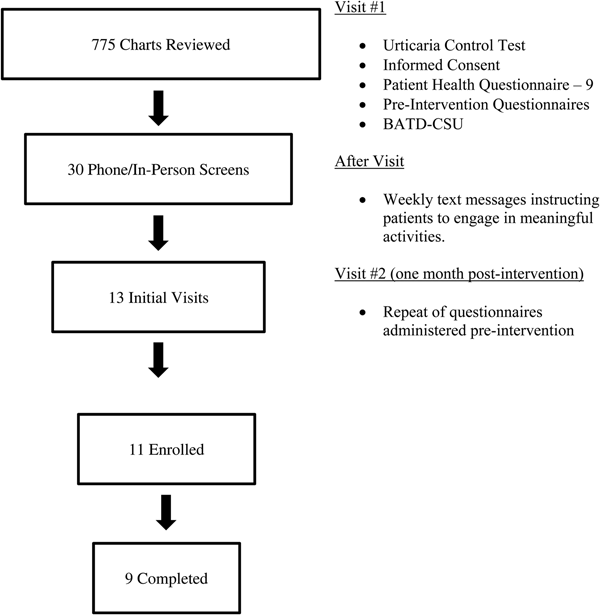
Upon arrival at the research site, patients were provided with a description of the study and its procedures, as well as asked to provide informed consent. Participants then completed the Patient Health Questionnaire (PHQ-9; Kroenke, Spitzer, & Williams, Reference Kroenke, Spitzer and Williams2001), a nine-item, self-report measure commonly used to screen for symptoms of depression. The PHQ-9 was administered in person due to the ethical considerations of assessing depression symptoms (e.g., thoughts of death and/or suicidal ideation) by phone. Patients reporting >4 depression symptoms at a severe level (i.e., more than half the days in the previous two weeks) on the PHQ-9 were then administered a questionnaire packet including the measures described above. Patients not meeting this criterion on the PHQ-9 were told that they were not eligible for the study at this time (see Figure 1).
Flowchart describing recruitment and enrollment of patients into BATD-CSU.

After completing the questionnaire packet, the one-hour BATD-CSU was delivered by a clinical psychology doctoral student, a postdoctoral fellow in the field of clinical psychology, a medical student, or an allergy and immunology fellow. All were trained and supervised in the delivery of BATD-CSU by a licensed clinical psychologist. After delivery of BATD-CSU, participants were compensated with a $15 gift card and their one-month, follow-up session was scheduled. At the follow-up session, participants again competed a battery of questionnaires consisting of the same measures completed prior to BATD-CSU. Participants were again compensated $15 after the questionnaires were completed.
Analytic Strategy
Pretreatment to follow-up assessment changes in UCT, DASS-21, and BADS scores were examined via dependent t tests conducted using SPSS Statistics 22.0.0.2 for Mac. Results were evaluated as directional tests with α = .05. In light of limitations of these procedures to detect significant results in small samples, Cohen's d for repeated measures (Dunlap, Cortina, Vaslow, & Burke, Reference Dunlap, Cortina, Vaslow and Burke1996) was interpreted for all appropriate analyses.
Reliable change and clinically significant change (Evans, Margison, & Barkham, Reference Evans, Margison and Barkham1998; Jacobson & Truax, Reference Jacobson and Truax1991) for UCT, DASS-21, and BADS scores were examined using Microsoft Excel for Mac 2011, version 14.7.7. Reliable change is the change in score needed to surpass what may be expected due to variability in the measures. Clinically significant change, computed for those who evidenced reliable change only, assesses the probability that an individual moved from a clinical population to a normative population following treatment (i.e., Criterion C; Jacobson & Truax, Reference Jacobson and Truax1991). Comparison samples used to examine clinically significant change for the present study were: urticaria patients who reported mild complaints for the UCT (Weller et al., Reference Weller, Groffik, Church, Hawro, Krause, Metz and Maurer2014); a community sample for the DASS-21 (Crawford et al., Reference Crawford, Garthwaite, Lawrie, Henry, MacDonald, Sutherland and Sinha2009); and an undergraduate sample (females only) for the BADS (Kanter et al., Reference Kanter, Mulick, Busch, Berlin and Martell2006, Study 2).
Results
One participant did not respond to one item from the pretreatment BADS activation, work/school impairment, and social impairment scales. Each item response was replaced with within-patient subscale item mean scores. All variables approximated normal distributions based upon visual and statistical inspection.
Urticaria Control
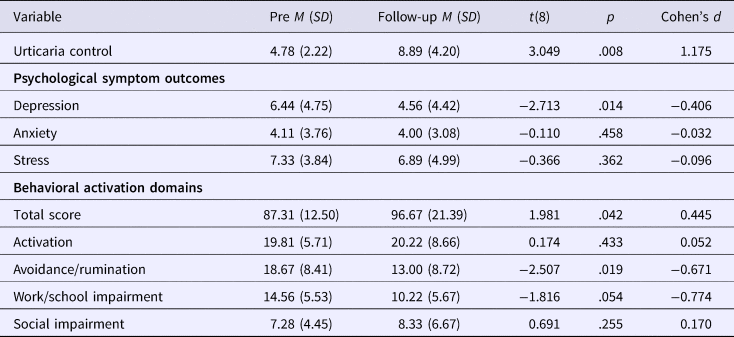
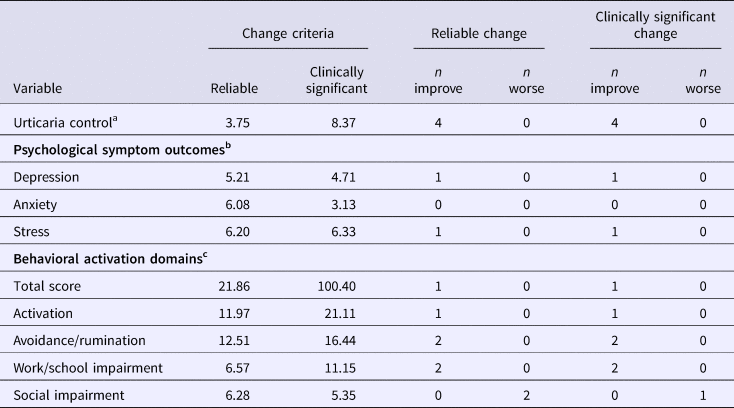
Descriptive and inferential statistics and effect sizes are provided in Table 1. On average, participants reported poorly controlled urticaria symptoms (i.e., ≤12; Weller et al., Reference Weller, Groffik, Church, Hawro, Krause, Metz and Maurer2014) prior to, and large and significant increases in urticaria symptom control following, BATD-CSU delivery. Table 2 provides reliable change and clinically significant change. Four (44.4%) participants reported reliable and clinically significant disease control improvements. One participant reported a non-reliable worsening of symptoms.
Pretreatment and Follow-Up Descriptive Statistics, Tests of Significance, and Effect Sizes for Urticaria Control, Psychological Symptoms and Behavioural Activation Domains

Note: Urticaria control assessed by the Urticaria Control Test. Depression, anxiety, and stress assessed by the Depression Anxiety Stress Scales 21. Behavioral activation total and subscale scores assessed with the Behavioral Activation for Depression Scale. Tests of significance were conducted as one-tailed tests.
Reliable Change and Clinically Significant Change Criteria for Urticaria Control, Psychological Symptoms, and Behavioral Activation Domains

Note: Urticaria control assessed by the Urticaria Control Test. Depression, anxiety, and stress assessed by the Depression Anxiety Stress Scales 21. Behavioral activation total and subscale scores assessed with the Behavioral Activation for Depression Scale. Tests of significance were conducted as one-tailed tests.
a Comparison sample: Urticaria patients reporting mild complaints (Weller et al., Reference Weller, Groffik, Church, Hawro, Krause, Metz and Maurer2014).
b Comparison sample: Community sample (Crawford et al., Reference Crawford, Garthwaite, Lawrie, Henry, MacDonald, Sutherland and Sinha2009).
c Comparison sample: Females (Kanter et al., Reference Kanter, Mulick, Busch, Berlin and Martell2006, study 2).
Depression, Anxiety, and Stress Symptoms
Participants reported mild symptoms of depression (≥10) and anxiety (≥8; see Roemer, Reference Roemer, Antony, Orsillo and Roemer2001), and normal levels of perceived stress (≥15), as assessed by the DASS-21 at pretreatment (see Table 1). Following BATD-CSU delivery, patients reported depression symptoms in the normal range, which was a small and significant decline. Neither anxiety nor stress evidenced significant pretreatment to follow-up assessment changes. Depression, anxiety, and stress-related change and clinically significant change are displayed in the middle portion of Table 2. One patient (11.1%) reported reliable and clinically significant reductions in depression symptoms. One participant (11.1%) also reported reliable and clinically significant reductions in perceived stress. No participants reported reliable worsening on any DASS-21 subscale.
Behavioural Activation Domains
Participants reported an average medium significant increase in total behavioural activation from pretreatment to follow-up assessment (see Table 1). This improvement appeared to be driven by a medium size significant pretreatment to follow-up decline in avoidance/rumination and work and school impairment. Reliable and clinically significant change for behavioural activation and related domains is presented at the bottom of Table 2. One participant (11.1%) reported reliable and clinically significant behavioural activation improvement. One participant (11.1%) reported reliable and clinically significant improvement in activation. Two participants (22.2%) reported reliable and clinically significant declines in avoidance/rumination. Likewise, two participants (22.2%) reported reliable and clinically significant decreases in work/school impairment. One participant (11%) evidenced reliable and clinically significant worsening of social impairment.
In sum, five of nine (55.5%) participants reported reliable and clinically significant pretreatment to follow-up improvement for at least one outcome, whereas just one (11.1%) participant reported reliable and clinically significant worsening. Two (22.2%) participants reported improvement on three scales and two (22.2%) participants reported improvement on two scales.
Discussion
The goal of this study was to provide proof of concept for the potential feasibility and utility of BATD-CSU in a university-based allergy and immunology clinic in the management of CSU patients with symptoms of depression. This was accomplished through an uncontrolled trial where BATD-CSU was largely delivered by non-mental health professionals in the clinic. Overall, results suggest that BATD-CSU deserves further investigation as a brief treatment for CSU patients in a standardised, controlled trial. Findings also suggest that BATD-CSU can be delivered by professionals with limited background in psychological interventions, thus speaking to its feasibility and transportability.
One month following receipt of BATD-CSU, patients exhibited significant reductions in depression symptom severity, avoidance/rumination, and work/school impairment. BATD-CSU was also associated with improvements in urticaria control post-treatment. Moreover, five of nine patients reported reliable and clinically significant pretreatment to follow-up improvement on at least one outcome. Although BATD-CSU was designed to increase behavioural activation, significant changes in behavioural activation were not observed. In addition to increased engagement in goal-directed behaviour, the activation subscale of the BADS measures contentment with activities, engagement in a wide variety of activities, and confidence in one's ability to choose meaningful and rewarding activities. In order to increase the likelihood of success and build motivation, patients were advised to start with a limited number of activities and choose activities that were not too challenging. Given this, it would be expected that changes in behavioural activation would be gradual, especially with regard to the number and diversity of activities that participants engage in. Consequently, large changes in behavioural activation may not be observable in this limited sample size within our brief follow-up period. Future studies would benefit from longer follow-up periods.
Inconsistent with another study of a one-session BATD for HIV-infected patients (Tull et al., Reference Tull, Berghoff, Bardeen, Schoenleber and Konkle-Parker2018), BATD-CSU was not associated with significant improvements in anxiety symptom severity despite evidence that the treatment was associated with reductions in avoidance behaviour, a primary mechanism underlying the development and maintenance of anxiety (Barlow, Reference Barlow2002). This may have been due to the initial mild levels of anxiety reported by patients and that patients were selected based on depression and not anxiety. Likewise, initial perceived stress levels were in the normal range and thus had little room to reduce. Future studies could also recruit participants with elevated levels of perceived stress.
It also warrants mention that participants reported an increase in social impairment from pretreatment to one month post-treatment. While there is no reason to expect that BATD-CSU would be iatrogenic in this regard, this finding does require further exploration. Although participants were instructed to identify and engage in meaningful activities, it is possible that they may have avoided the selection of social activities, as patients with chronic urticaria have been reported to be at elevated risk for social anxiety disorder and restrictions in their social life (Engin et al., Reference Engin, Uguz, Yilmaz, Özdemir and Mevlitoglu2008; Hergüner et al., Reference Hergüner, Kılıç, Karakoc, Tamay, Tüzün and Güler2011). Further investigations of BATD-CSU would benefit from exploring the impact of social anxiety on outcomes and specifically instructing participants to select and engage in socially-oriented activities.
Findings must be considered in light of limitations present. First, this study was an uncontrolled, open trial of BATD-CSU in a small sample of CSU patients. The small sample size would have reduced power to find significant differences, increasing risk for type II error. In addition, the uncontrolled design of the study does not allow one to determine whether any observed changes in outcome measures were simply due to the passage of time instead of a reflection of an active treatment. Therefore, results must be viewed as preliminary and interpreted with caution. Future studies are needed that involve larger samples of participants with CSU, utilise a longer follow-up period, and compare BATD-CSU to an active control condition. In addition, all outcome measures were self-reported, which may be open to bias, such as social desirability or limited awareness of internal states. Thus, future studies would benefit from the inclusion of more objective measures of disease severity and control, such as immune biomarkers (Ferrer, Reference Ferrer2015; Takahagi et al., Reference Takahagi, Mihara, Iwamoto, Morioke, Okabe, Kameyoshi and Hide2010), as well as the use of diagnostic interviews. In addition, although participants were determined to be eligible for this study based on their report of elevated symptoms of depression on the PHQ-9, pretreatment assessment of depression symptom severity using the DASS-21 resulted in the report of mild symptoms of depression, on average, across participants. The use of diagnostic interviews to verify the presence of elevated depressive symptoms may address this limitation in future studies. Researchers also did not have access to medical records beyond initial screening for eligibility. As such, we lack knowledge regarding changes in medical care or urticaria-directed health behaviours (e.g., intake of antihistamines, existing medication changes) or any effects such changes may have had on the outcome measures. Evaluating and controlling for such variables remains an important consideration for future investigations of BATD-CSU.
Although preliminary, findings provide initial support for the further evaluation of BATD-CSU. With additional research, BATD-CSU may be a treatment that offers an efficient and easily transportable method for reducing depression and improving disease control among patients with chronic urticaria.
Author ORCIDs
Matthew T. Tull, 0000-0002-1382-117X.
Acknowledgments
This research was supported, in part, by the R. Faser Triplett Sr. MD Chair of Allergy and Immunology at the University of Mississippi Medical Center.
Declaration of interest
None.