INTRODUCTION
Soybean is one of the most important legumes grown in most tropical countries. Its cultivation is increasing in the savannas of Nigeria because it is a major cash crop widely used in food and feed (Brader, Reference Brader1998; Sanginga et al., Reference Sanginga, Okogun, Vanlauwe and Dashiell2002). It contributes to improving soil fertility and reducing Striga infestation on farmers’ fields (Sanginga et al., Reference Sanginga, Okogun, Vanlauwe and Dashiell2002; Franke et al., Reference Franke, Schulz, Oyewole and Bako2004). Farmers have adopted new cultivars developed at the International Institute of Tropical Agriculture (Okogun et al., Reference Okogun, Otuyemi and Sanginga2004) that store well and, unlike cowpea (Vigna unguiculata), do not yet need chemical pest control. They also nodulate freely with native rhizobia strains and take care of a large proportion of their nitrogen (N) requirement through biological N fixation once the plants are established (Okogun et al., Reference Okogun, Otuyemi and Sanginga2004; Singh et al., Reference Singh, Carsky, Lucas and Dashiell2003).
Although development and introduction of several varieties of soybean have resulted in a tremendous increase in production in the Nigerian savannas, sustainable production is constrained by prevailing poor soil fertility (Ogoke et al., Reference Ogoke, Carsky, Togun and Dashiell2003). As noted by Carsky and Iwuafor (Reference Carsky and Iwuafor1995) most of the soils in the savanna of northeast Nigeria have organic carbon ≤5 g kg−1 and are deficient in N. Also available phosphorus (P) levels in the Nigerian savannas are below the critical levels (10–15 mg kg−1) required for soybean (Auna and Lal, Reference Auna and Lal1997; Kwari et al., Reference Kwari, Nwaka and Mordi1999). Kwari (Reference Kwari2005) reported soil P levels of 0.3–10.4 mg kg−1 in the southern Guinea savanna, 1.4–9.5 mg kg−1 in the northern Guinea savanna and 0.3–7 mg kg−1 in the Sudan savanna of northeast Nigeria. He attributed these low P levels to the suboptimal amounts of P applied by farmers and/or P-sorption particularly in the southern and northern Guinea savanna where the soils are derived from basalt. As noted by Singer (Reference Singer1987), such soils are rich in Fe and Al oxides and generally exhibit high P sorption. Valkama et al. (Reference Valkama, Uusitalo, Ylivainio, Virkjarvi and Tórtola2008) reported lower response to P fertilization on clay soils than on coarse-textured mineral soils. Phosphorus has been reported as the most limiting nutrient for soybean production (Ogoke et al., Reference Ogoke, Carsky, Togun and Dashiell2003; Kamara et al., Reference Kamara, Kwari, Ekeleme, Omoigui and Abaidoo2008). Some studies have shown that P deficiencies may decrease whole plant fresh and dry mass, restrict rhizobia development in the rhizosphere, limit growth of host plant, and impair nodulation and nodule function (Danso, Reference Danso, Mulongoy, Gueye and Spencer1992; Tsvetkora and Georgiev, Reference Tsvetkora and Georgiev2003).
Although N is limiting in the savannas of northeast Nigeria, the application of N to soybean elsewhere has given limited or inconsistent improvements in seed yield. Some studies found that application of fertilizer N increased yield and N utilization potential of soybean (Helms and Watts, Reference Helms and Watts1991; Wesley et al., Reference Wesley, Almond, Martin and Duncan1998). Some reports indicate that N levels as low as 15–20 kg N ha−1 can bolster N fixation and increase productivity of soybean (Sanginga et al Reference Sanginga, Abaidoo, Dashiell, Carsky and Okogun1996). Boroomandan et al. (Reference Boroomandan, Khoramivafa, Haghi and Ebrahimi2009) found that applying 40 kg ha−1 starter-N increased seed yield by 19% compared with no added N fertilizer. Similarly, Osborne and Riedell (Reference Osborne and Riedell2006) reported that starter-N boosted soybean yield from 2.2 to 2.5 t ha−1 in South Dakota, USA. Other research suggests that there is no benefit in applying N to soybean (Schmitt et al., Reference Schmitt, Lamb, Randall, Orf and Relm2001; Rehm et al., Reference Rehm, Schmitt, Lamb and Eliason2009). Schmitt et al. (Reference Schmitt, Lamb, Randall, Orf and Relm2001) reported that in-season application of N fertilizer did not improve soybean yield over non-fertilized plots in 12 sites in Minnesota, USA.
Some studies have shown that soybean requires substantial amounts of both N and P to maintain rapid growth and produce a high seed yield (Morshed et al., Reference Morshed, Rahman and Rahman2008; Rehm et al., Reference Rehm, Schmitt, Lamb and Eliason2009). Research has been shown that soybean nodulation and yield are affected by the interaction of N and P in the soil (Singh et al., Reference Singh, Singh and Dheer1994; Sanginga et al., Reference Sanginga, Abaidoo, Dashiell, Carsky and Okogun1996) thus making these essential for exploiting maximum yield potential of the crop (Harper et al., Reference Harper, Gidens, Langdale and Sharpe1989). Several studies found that soybean positively responded to P fertilization in the Nigeria savannas (Kamara et al., Reference Kamara, Abaidoo, Kwari and Omoigui2007; Ogoke et al., Reference Ogoke, Carsky, Togun and Dashiell2001; Reference Ogoke, Carsky, Togun and Dashiell2003; Sanginga et al., Reference Sanginga, Abaidoo, Dashiell, Carsky and Okogun1996). There is little information though on the influence of N alone or the combined effect of N and P on soybean growth and yield in the savannas of Borno State, Nigeria. The objective of the present study was to determine the interactive effect of N and P on soybean productivity in the savannas of northeast Nigeria.
MATERIALS AND METHODS
Site description
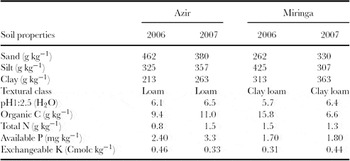
Field experiments were conducted in Miringa (10°73′N; 12°14′E) in the northern Guinea savanna and in Azir (12°87.78′N; 11°1.8′E) in the Sudan savanna in 2006 and 2007 to evaluate the response of two soybean cultivars to phosphorus and nitrogen fertilizers. Kwari et al. (Reference Kwari, Nwaka and Mordi1999) described the soil at both experimental sites as Alfisols, formed on basalt in Miringa and on argillaceous sediment in Azir. Soil chemical and physical characteristics of the topsoil (0–15 cm) of plots used for the experiment in each location in 2006 and 2007 are shown in Table 1. The soil sample was analysed for texture and chemical composition as described by Mehlich (Reference Mehlich1984) and Van Reeuwijk (Reference Van Reeuwijk1992).
Characteristic of soils in Azir and Miringa (0–15 cm depth).

Treatments and experimental design
The treatments were arranged as a split-split plot in a randomized complete block design with three replicates. The main plots were assigned to the N treatments (0 and 20 kg N ha−1). The P treatments (0, 20 and 40 kg P ha−1) were assigned to the subplots and soybean cultivars (TGX 1830–20E, early maturing; TGX 1448–2E, late maturing) were assigned to the sub-sub plot treatments. Each subplot measured 5 m × 6 m and sub-sub plot, 5 m × 3 m. To avoid confounding residual effects from applied P, separate but adjacent plots within each site were used in each year. Before the experiments were established, the land was cleared, tilled with a disc harrow and ridges prepared using draught animals (bulls) and mouldboard ploughs. In 2006, plots were sown on 6 July in Miringa and 10 July in Azir. In 2007, planting was carried out on 11 June in Miringa and 22 June in Azir. In each plot, five seeds of soybean were sown hill−1 at a spacing of 0.20 m to give a population of 333 333 plant ha−1 at sowing. Each plot received a basal application of 30 kg ha−1 as muriate of potash. N fertilizer was applied in the form of urea immediately after soybean emergence. Immediately after sowing, paraquat (1:1-diamethly-4,4′-bipyridinium dichloride) was applied at the rate of 276 g active ingredient l−1 to control weeds. This was followed by hand weeding three weeks later.
Data collection and analysis
Data collected were seed yield and pods plant−1. Five plants were randomly selected from the two middle rows at physiological maturity to determine the number of pods per plant. At harvest maturity, plants within a 4 m length of two central rows in each plot were cut at the base just above the ground. The pods were separated from the stem and shelled. After shelling, seed moisture was determined using a Dickey John moisture meter (Dickey-John Co., Auburn, IL, USA). Yields were corrected to 12% moisture content.
Statistical analyses were conducted using the PROC Mixed procedure (Littell et al., Reference Littell, Milliken, Stroup and Wolfinger1996) of SAS (SAS Institute, 2001) with replicate treated as a random effect and site, year, N and P levels, and cultivars treated as fixed effects. Where two-way or three-way interactions were significant (p < 0.05) between main effects, simple effects difference were evaluated among treatments using the least square means (LSMEANS) SLICE option in PROC MIXED (SAS Institute, 2001). Mean separation was performed using Tukey tests. Pearson's correlation coefficient between seed yield, pods plant−1 and 100-seed weight was also computed using PROC CORR of SAS (SAS Institute, 2001).
RESULTS AND DISCUSSION
Seed yield
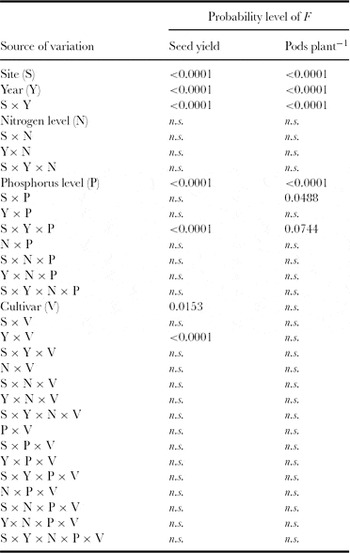
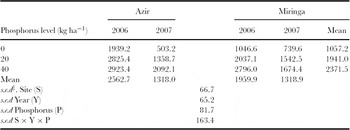
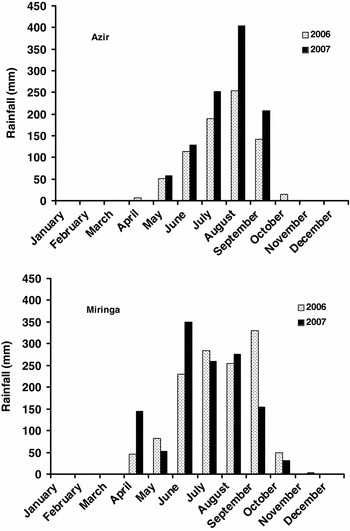
There were significant (p < 0.0001) effects of site (S), year (Y), phosphorus level (P) and cultivar (V) on seed yield (Table 2). Nitrogen level (N) × V, P × V, S × Y × N and N × P × V interactions were not significant. Y × V and S × Y × P interactions were significant (p < 0.0001). The SLICE option was used by year to explain the interactions. At both sites, seed yield at all P levels was significantly (p < 0.0001) higher in 2006 than in 2007 (Table 3). This partly may be due to differences in the soil fundamental fertility index in the two years and partly due to rainfall. Monthly rainfall distribution during the study period in 2006 and 2007 at the two sites is presented in Figure 1. In Azir, the rain was poorly distributed and stopped abruptly in September in 2007. There was no yield response to N in both sites. The lack of yield response to N fertilizer at the two sites is consistent with findings by Schmitt et al. (Reference Schmitt, Lamb, Randall, Orf and Relm2001). Previous research found that although N fertilizer created greater levels of available soil N during soybean pod filling, yield was not improved in the N treatments compared with unfertilized control treatment in 12 sites studied in Minnesota, USA. Our findings also corroborate those of Sij et al. (Reference Sij, Turner and Craigmiles1979) and Terman (Reference Terman1977) who found no response of soybean to N application in USA. Scharf and Wiebold (Reference Scharf and Wiebold2003) established that a positive response to N is likely if the following conditions are present: i) yield is above 4000 kg ha−1, ii) residual soil nitrate is less than 85 kg ha−1, iii) soil pH ≤ 7.5 and iv) the crop is irrigated. While the soils in the study sites were low in N with a pH ≤ 7.5, they were not irrigated and seed yields were always less than 3000 kg ha−1. None of the other conditions were met in any of the sites. Our results show that farmers do not need to apply N to soybean as starter N in the savannas of northeast Nigeria. There is however, no information on the response of soybean to in-season fertilizer N application. Further studies are needed to determine the in-season fertilizer N requirement of soybean in these ecologies.
Analysis of variance from Mixed Model procedures for seed yield and pods plant−1, as influenced by year, nitrogen and phosphorus levels and cultivar in 2006 and 2007 at Azir and Miringa, Nigeria.

Interaction effect of site, year and phosphorus on seed yield of soybean in the northern Guinea and Sudan savanna of Nigeria.

‡ s.e.d. = Standard error of difference of least square mean.
Monthly rainfall distribution during the study period in 2006 and 2007 at Azir and Miringa.

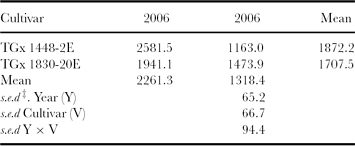
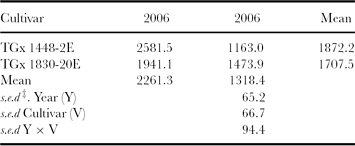
There was a linear seed yield response to P fertilizer application for the two growing seasons at both sites (Table 3). In Azir, seed yield was 1939.2 kg ha−1 when no P was applied in 2006. Application of 20 and 40 kg P ha−1 produced seed yield of 2825.4 and 2923.4 kg ha−1, respectively. In 2007 seed yield when no P was applied was 503.2 kg ha−1. Application of 20 kg P ha−1 produced seed yield of 1358.7 kg ha−1; application at 40 kg P ha−1 produced seed yield of 2092.1 kg ha−1. At Miringa, seed yields at 0, 20 and 40 kg P ha−1 were 1046.6, 2037.1 and 2796 kg ha−1, respectively in 2006. In 2007, seed yield when no P was applied was 739.6 kg ha−1. Seed yields of 1542 kg ha−1 and 1674.4 kg ha−1 were produced with application of 20 kg P ha−1 and 40 kg P ha−1, respectively. Similar seed yield increases after P fertilizer application at rates that ranged from 20 to 60 kg P ha−1 have been reported in the Guinea savanna of Nigeria (Kamara et al., Reference Kamara, Abaidoo, Kwari and Omoigui2007; Ogoke et al., Reference Ogoke, Carsky, Togun and Dashiell2003). Ogoke et al. (Reference Ogoke, Carsky, Togun and Dashiell2003) reported 60–113% increase in yield at three sites when P was applied at the rate of 30 kg P ha−1 where available soil P was low. In Azir, seed yields obtained at 20 kg P ha−1 and 40 kg P ha−1 were comparable in 2006, but in 2007 there was a significant yield difference when P was applied at the two rates. At 40 kg P ha−1 seed yield was increased by 54% compared with the yield obtained at 20 kg P ha−1. In Miringa, seed yield was increased by 37% in treatments that received 40 kg P ha−1 compared with 20 kg P ha−1 in 2006. In 2007, the yield difference between 20 and 40 kg P ha−1 was not significant. Averaged across years, seed yield was more than 20% higher when 40 kg P fertilizer was applied compared with 20 kg P ha−1. Although soil-test P was lower at the sites in Miringa than Azir (Table 1), seed yield response was slightly higher in Azir than Miringa possibly due to differences in soil physical characteristics of the two sites. The two cultivars produced higher seed yields in 2006 than in 2007 mainly due to the relatively poor plant growth in 2007 which resulted in fewer pods plant−1 on each cultivar in 2007 compared with 2006 (Table 4). Seed yield of TGX 1448–2E was greater than yield of TGX 1830–20E for the 2006 growing season but the difference was reversed in 2007. Rainfall was more evenly distributed in 2006 than in 2007 (Figure 1). There was sufficient moisture in 2006 to support the growth of the late maturing cultivar TGX 1448–2E thereby producing higher yield. Rainfall distribution was poor in 2007 with no rains during early grain development in October in Azir and little rain in Miringa in the same month. Consequently the TGX 1448–2E experienced moisture stress during the grain-filling period which reduced yield. The early maturing cultivar, TGX 1830–20E matured and escaped the moisture stress in October.
Interaction effect of year and cultivar on seed yield of soybean in the northern Guinea and Sudan savanna, Nigeria.
‡ s.e.d. = Standard error of difference of least square mean.
Number of pods per plant
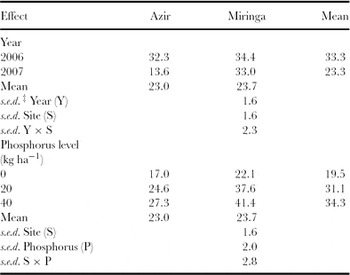
The pods plant−1 was not significantly influenced by N fertilization. Phosphorus fertilization however, had a significant (p < 0.0001) effect on number of pods plant−1 in both sites (Table 2). Y × P interaction was not significant. There was a significant S × P interaction (p = 0.0488). At Azir, number of pods plant−1 was more than twice higher in 2006 than in 2007 (Table 5) probably due to the more even distribution of rain in 2006. Averaged across years, number of pods plant−1 increased linearly with increase in P levels in both sites. In both years application of P fertilizer increased number of pods plant1 by 40–66% compared with zero P treatment. The difference in number of pods plant−1 between 20 and 40 kg P ha−1 was not significant. The significant increase in pods plant−1 is consistent with the reports of Kamara et al. (Reference Kamara, Abaidoo, Kwari and Omoigui2007), and Garside and Fulton (Reference Garside and Fulton1986) who reported that increasing P levels increased the number of pods plant−1. The number of pods plant−1 was generally higher in Azir than Miringa. In Azir, seed yield was positively and significantly correlated with number of pods plant−1 (r = 0.58, p = 0.0001, n = 36). Similarly, at Miringa, seed yield was positively and significantly correlated with number of pods plant−1 (r = 0.54, p = <0.0001, n = 36). The positive association with seed yield suggests that soil nutrient management practices such as P application that increases the number of pods of soybean should be recommended to farmers.
Interaction effect of year and phosphorus on number of pods plant−1 of soybean in the northern Guinea and Sudan savanna, Nigeria.

‡ s.e.d. = Standard error of difference of least square mean.
CONCLUSIONS
Environmental conditions during the growing season had some effect on soybean seed yield, with 2006 having a higher yield than 2007. N application did not increase seed yield and number of pods per plant. The application of P did increase seed yield. Response to 40 kg P ha−1 was substantial confirming the importance of P for the production of soybean in the Nigerian savannas. Our results suggest that N application to soybean at the beginning of cropping season may not be recommended. Further studies are, however, needed to determine in-season N fertilizer requirement of soybean in the Nigerian savannas.
Acknowledgements
The authors would like to thank the Canadian International Development Agency (CIDA) for funding the Project, Promoting Sustainable Agriculture in Borno State (PROSAB), which sponsored this study. The field technicians at IITA/PROSAB are acknowledged for managing the research fields and R. Umelo for editorial assistance.