Introduction
Who supports public childcare in Germany and why? This article investigates the dynamics of individual-level support for public childcare in unified Germany, i.e. support for public authorities offering childcare services with or without charge. From a policy perspective, it is very relevant to look at citizens’ attitudes because they shape voting decisions, they are sought by policy-makers via public opinion polls and because, arguably, a policy regime at odds with public opinion faces problems with implementation and long-term stability.
In Germany, with institutions mainly in the conservative welfare state tradition, where the family is traditionally constructed as the locus of childcare, the recent expansion of public childcare provisions is probably one of the most intensifying social policy activities. It mirrors the common European trend towards the greater availability of childcare outside of the family for 0–3 year olds and 3–6 year olds. At the 2000 Barcelona summit, the EU set the target for 2010 at 33 per cent of coverage for the first and 90 per cent for the second age group, the first of which Germany still failed to meet in 2009 with only 20.4 per cent (Böttcher et al., Reference Böttcher, Krieger and Kolvenbach2010: 161). Inspired by the ideas that better public availability of childcare would increase fertility and female labor market participation, the German social-democratic government began a re-orientation of family policy in 2002. New instruments such as the more generous parental leave allowance (Elterngeld) and new rules for the duration of parental leave (Elternzeit), both designed to reduce the child-bearing opportunity costs among well-educated middle-class citizens, were implemented in the successive grand and then in the conservative–liberal coalitions. The unexpectedly high take-up rate for these policy instruments has forced the Ministry for Family Affairs to top up their budget several times since the implementation of the Elterngeld in 2007 (Ministry of Finance, 2010).
Whereas the increasing availability of childcare did enhance female labor market participation (Gaulthier, Reference Gaulthier2007; Ghysels, Reference Ghysels2004), the expected effect on fertility did not materialise (Brewster and Rindfuss, Reference Brewster and Rindfuss2000; Hank and Kreyenfeld, Reference Hank and Kreyenfeld2003). Nevertheless, the German government continued on its path of broadening and expanding family policy programs. One explanation for this continuation is the strong support for public childcare facilities provided by the state (see Ellingsaeter and Gulbrandsen, Reference Ellingsaeter and Gulbrandsen2007; Goerres and Vanhuysse, Reference Goerres, Vanhuysse, Vanhuysse and Goerres2012; Vanhuysse and Goerres, Reference Vanhuysse and Goerres2012). Current transformations of post-industrial labor markets and family structures are generating new demands for programs fostering the reconciliation of work and family life (Bonoli, Reference Bonoli2005, Reference Bonoli2007). These developments are presumed to be particularly challenging in the context of a conservative welfare regime (Tepe and Vanhuysse, Reference Tepe and Vanhuysse2010). In this respect, exploring the determinates of individual attitudes towards public childcare provision in Germany, which is broadly considered as a conservative welfare state (Esping-Andersen, Reference Esping-Andersen1990), to improve our understanding of public support for public childcare in this regime context proves particularly telling. A second reason for choosing GermanyFootnote 1 to explore the causal effect of regime socialisation on welfare attitudes lies in its earlier history. Since unification, it harbors three groups of citizens: one that was still socialised in a communist regime where the state deeply intervened into the private sphere, a second that developed in a conservative welfare state where the male bread-winner model with the mother as the home-maker was very prominent at least until the 1990 and a third group who were socialised after unification receiving a mixed bag of institutional signals. A third reason is that Germany also experienced a paradigmatic shift in childcare policy as described above. If policy changes affect attitudes, the effect of such a policy shift should have become apparent in Germany in the first decade of the twenty-first century.
Prior studies on family policies in Germany primarily focused on trajectories of childcare development (Jensen, Reference Jensen2009), attitudes towards gender and work (Lewis et al., Reference Lewis, Knijn, Martin and Ostner2008) and family policy changes within Bismarckian systems (Morel, Reference Morel2007). In order to explain whether people differ in their attitudes towards public childcare, we consider four different kinds of causal mechanisms: regime socialisation, political ideology, family involvement and material self-interest. Each mechanism has rather different implications for policy-makers: (1) regime socialisation assumes that growing up in a certain institutional context of childcare provisions shapes attitudes in later life towards public childcare. Thus, expectations towards the welfare state are rigid and difficult to amend by politicians. (2) Political ideology postulates that differences in political values explain an individual's attitude because public childcare is simply a matter of redistribution by the state and is subsumed in the general political competition. (3) Family involvement picks up the notion that interest in social policies does not only flow from personal material self-interest, but also from the ways in which individuals are entangled in family networks with other generations. Politicians can thus not easily identify the target constituency of supportive voters. Finally (4), self-interest refers to the fact that the personal situations of individuals – such as having, or soon to be having, small children – gender in a gendered conservative welfare state and income approximate the urgency with which individuals are likely to be benefiting from public childcare and therefore would be more likely to be supportive of such provision.
Since these four mechanisms are likely to be inter-dependent to some degree, we conceptualise their joint and conditional impact on attitudes toward public childcare as a causal sequence with regime socialisation as the temporally earliest dynamics. We test the impact of these four mechanisms by applying binary logit regression to the German General Social Survey 2002 (ALLBUS) and replicate our findings on the German component of the 2008/9 European Social Survey (ESS).
Theory
Even though the implementation and effect of new family policy instruments in Germany is increasingly heeded by social scientists (Henninger et al., Reference Henninger, Wimbauer and Dombrowski2008) and economists alike (Borck and Wrohlich, Reference Borck and Wrohlich2008), there is, thus far, little systematic research about the formation of attitudes towards public childcare across Germany.Footnote 2 Whether or not the state should take responsibility in providing public childcare is an attitude about the extensity of welfare state activities whereas opinions about how much the state should spend on public childcare can be interpreted as being about the intensity of welfare state activities (Andreß and Heien, Reference Andreß and Heien2001; Andreß et al., Reference Andreß, Heien and Hofäcker2001; Roller, Reference Roller1992). Seen from this broader perspective, the four different causal mechanisms described above, i.e. regime socialisation, political ideology, family involvement and self-interest, can explain whether people differ in their attitudes towards public childcare.
Regime socialisation
The logic of regime affiliation and preference formation might help to explain differences in public childcare preferences among East and West Germans. Each type of welfare regime is believed to socialise citizens into demanding a level and quality of welfare state activities that mirrors the institutional framework (Andreß and Heien, Reference Andreß and Heien2001; Blekesaune and Quadagno, Reference Blekesaune and Quadagno2003; Gelissen, Reference Gelissen2000; Jaeger, Reference Jaeger2006, Reference Jaeger2009; Svallfors, Reference Svallfors1997, Reference Svallfors2003). Various socialisation agents such as schools, the media, friends and, most importantly, family shape preferences towards the welfare state. Thus, in essence, democratic welfare states recreate themselves by influencing the demand for welfare state policies of the next generation of citizens (see Brooks and Manza, Reference Boix2007); this influence being most effective when these citizens are still young adults. As a consequence, differences between individuals are mainly a function of the welfare state that they were socialised into. Within-country differences play a minor role in this perspective, although they are repeatedly reported (see Brooks and Manza, Reference Brooks and Manza2007). Differences within a welfare regime can, for instance, result from policy-makers using specific frames to justify their childcare policies (Hiilamo and Kangas, Reference Hiilamo and Kangas2009).
For Germany, this theoretical strand creates very interesting expectations because, since 1990, the country has mainly been comprised of three types of individuals: those who were still socialised in the East under a communist regime, those whose preferences were shaped by the old West German conservative welfare state (Cooke, Reference Cooke2006; Corneo, Reference Corneo2001) and the growing number of citizens who grew up in a United Germany in the East and in the West. The East German welfare state provided a comprehensive system of public childcare support.Footnote 3 Its provisions followed the ideals of gender equality in the working place and of training the next generation of socialists. After unification, childcare services declined but were still very extensive compared to the West. In contrast, in West Germany, public childcare was mostly restricted to the 3–6 year olds who mostly attended half-day kindergartens and were otherwise typically cared for by mothers and grandmothers. Since unification, public childcare has been expanded in the West, but was still at a very low level in 2002 when the first survey in use here was carried out. The geographic pattern of public infrastructure thus still followed a historical logic rather than, for instance, a demand-driven one (compare for the Netherlands Noailly and Visser, Reference Noailly and Visser2009). Early analysis after unification demonstrated that East Germans had remarkably different attitudes towards the welfare state than West Germans (Roller, Reference Roller1996, Reference Roller1999), with East Germans generally supporting a broader scope and more intense welfare state activities; a more recent exploration (Alesina and Fuchs-Schündeln, Reference Alesina and Fuchs-Schündeln2007) suggested that welfare preferences in East and West Germany had already converged.
According to the regime logic, we expect East Germans to be more supportive of public childcare provisions than all other groups. The reason is that East Germans who grew up under the communist regime learned a comprehensive system with the state taking responsibility for public childcare whereas West Germans grew up with a very lean system of public childcare support. Those socialised after 1990 we expect to have demand levels between the two extremes since they received a mixed set of institutional signals from two welfare worlds.
Political ideology
Attitudes towards public childcare can also be determined by political ideology, i.e. a general political value system (Sears et al., Reference Sears, Lau, Tyler and Allen1980). The political ideology approach predicts that left-wing governments will pursue a more state interventionist position, while right-wing governments primarily aim to keep state inference at a minimum (Boix, Reference Boix1997). The provision of public childcare in Germany is a typical redistributive policy that is financed by means of taxation and subsidised fees. Along the classical left–right continuum, individuals who are more to the left are more likely to support a strong state that takes an active role in redistribution than individuals who are more to the right. The political ideology argument assumes that the issue of providing childcare is an issue that can clearly be attributed across the ideological positions of political parties.
There are two types of prior studies exploring the relationship between political ideology and public childcare provision; macro-level studies linking the partisan composition of the government to family expenditure and micro-level studies focusing on individual attitudes toward welfare provision. Montanari (Reference Montanari2000) analysed marriage subsidies and child benefits in eighteen OECD countries: confessional parties, whose members and, to a lesser extent, voters belonged to a specific religious denomination, caused an increase in family expenditure during the 1950–70 period, but not in the later period (1975–90). Garand and Monroe (Reference Garand and Monroe1995) explored the adoption of family leave policies in the American states during the late 1980s and proposed that conservative governments were less likely to adopt family leave legislation. Bolzendahl (Reference Bolzendahl2009) helps to make sense of these rather contradictory findings as her analysis of gender influences on social expenditure entails that instead of left-wing governments as such, it is the level of women as legislators in left parties that matters for the size of social expenditure. At the micro-level, there has been very little systematic research into individual preference formation toward childcare policies (for exceptions see Bolzendahl and Olafsdottir, Reference Bolzendahl and Olafsdottir2008; Ellingsaeter and Gulbrandsen, Reference Ellingsaeter and Gulbrandsen2007). West (Reference West1984) explored how ideological positions of left and right relate to attitudes towards the family, expecting respondents possessing a more right-wing ideology to hold more conservative family values. He found very limited support for the notion that attitudes towards the state/family nexus are organised along partisan lines.
In contrast to the regime thesis, the formation of attitudes toward public childcare on the basis of political ideology predicts inter-individual differences within each part of Germany. Causally speaking, regime socialisation thus partially accounts for the distribution of political values.
Family involvement
Individuals are not atomised; they live in social contexts in which they develop relationships based on reciprocal exchange. The extraordinary levels of solidarity in the family were already observed by Émile Durkheim (Reference Durkheim1893: 27) who described the family as a compact form of society impacting on our religious, political, and other behaviors. Bengtson and Roberts (Reference Bengtson and Roberts1991) proposed a multi-dimensional model of family solidarity that has since been extensively tested and revised, mostly with the outcome of a reduced number of dimensions (Daatland and Lowenstein, Reference Daatland and Lowenstein2005; Szydlik, Reference Szydlik2000). These studies teach us that the family network can be considered as a network of exchanges of money and time, especially between family generations. In this respect, we hypothesise that individuals who may not have a direct interest in public childcare, because they themselves do not have small children, can support the demand for public childcare because they feel obliged to members of the family who are in need for public childcare.
We reduce the concept of family solidarity to three testable dimensions: the normative importance of family ties, the intensity of contact to family members and the flows of help among family members. The first dimension refers to the idea that there is a moral obligation to care for family members before caring for others who are in need. This moral obligation is supposed to increase support for public childcare because individuals want to ease the burden on the family by supporting a relief mechanism in the form of a public service that parents can draw on.Footnote 4 Concerning the second dimension, we hypothesise that more intense the involvement with other family members the greater on average the support for public childcare. The motivation for such an increased support for public childcare could be either altruism because people simply care for other family members and want them to be helped by the state, or it could be the investment in a reciprocal relationship with family members, trusting that family members will reciprocate in the future. Reciprocity is thereby understood as conditional altruism, namely the propensity to cooperate and share with others, even at personal cost, and a willingness to punish those who violate cooperative norms, even when punishing is personally costly (Bowles and Gintis, Reference Bowles and Gintis2000: 37). The last dimension circumscribes the degree to which help flows between generations in the family. With a larger extent of help among family members, we suppose the development of a stronger preference for public childcare out of a sense of mutual obligation.
Material self-interest
Still the most prominent approach to explain individual attitudes toward public policies is embodied in the homo oeconomicus, a rational, self-interested utility maximiser. In this regard, attitudes toward public childcare are a derivative either of the material situation or of anticipated risks that individuals may encounter over the life course (Busemeyer et al., Reference Busemeyer, Goerres and Weschle2009). Material self-interest makes individuals demand redistributive policies to an extent and quality that supports their own personal situation. For example, the endowment with general or specific skills together with the risk of unemployment determines individual preferences for unemployment spending (Cusack et al., Reference Cusack, Iversen and Rehm2006; Iversen and Soskice, Reference Iversen and Soskice2001). From this perspective, individuals regard public childcare as an insurance mechanism against having to give up jobs with its ensuing economic repercussions (see also Corneo and Grüner, Reference Corneo and Grüner2002; Cusack et al., Reference Cusack, Iversen and Rehm2006; Iversen and Soskice, Reference Iversen and Soskice2001; Rehm, Reference Rehm2009).
Public childcare directly benefits parents and parents to be of young children. Also, women are more likely to support public childcare provisions than men because they live in a gendered world in which the private care expectations weigh more heavily on women than on men (Alwin et al., Reference Alwin, Braun and Scott1992). In addition, richer individuals have less of an interest in the state providing childcare because these individuals are more likely to be able to afford to pay for childcare themselves.
An integrated framework of childcare preference formation
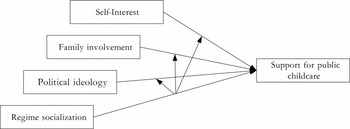
The four mechanisms could be interpreted as fully separate from each other; but, more interestingly, they can also be put into a causal sequence with regard to their likely effects (Figure 1). The causally most prior determinant of support for public childcare is surely regime socialisation. This causal mechanism has its roots in the early socialisation and experiences of an individual. This experience may partially affect the acquisition of a particular political ideology that the individual learns relatively early and that is relatively rigid. Next, there is family involvement. The social networks in the family are also relatively rigid and stable. Closest to support for public childcare is self-interest, some of which is determined by short-term changes to someone's social situation whereby we would expect the gender effect – since it is based on the experience of a gendered world – to capture a more stably formed self-interest.
Temporal sequence of four causal determinants of public childcare

Besides these direct effects, we hypothesise that the impacts of political ideology, family involvement and self-interest on preferences for public childcare are conditioned by regime socialisation. The impact of political ideology might vary between those with and without communist regime socialisation in the former German Democratic Republic (GDR, East Germany before 1990) because, for instance, being ‘left’ can mean something different for those with a socialist upbringing than for those with a liberal-democratic one. The same might apply to the impact of family solidarity because the Eastern socialisation could be strong enough to shrink the impact of family involvement on childcare attitudes to nil. Finally, the impact of self-interest on attitudes towards public childcare provision is likely to vary between the two socialisation groups, as respondents with a communist regime socialisation could possess a different perception of the importance and legitimacy of behavior motivated by self-interest.
Data and methods
We use two surveys: for the main analysis, the German General Social Survey (ALLBUS) from 2002, and for the replicated analysis, the German component of the European Social Survey 2008/9. The ALLBUS 2002 includes a question on the state's responsibility for public childcare (as part of the 2001 ISSP Social Networks II survey) and a multitude of information about household composition in terms of family.Footnote 5
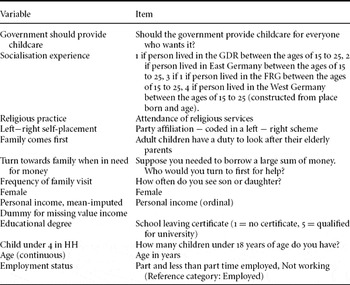
The dependent variable in the ALLBUS 2002 is a dichotomy that captures agreement or disagreement to the following question: ‘On the whole, do you think it should or should not be the government's responsibility to . . . Provide childcare for everyone who wants it?’ The four answer categories in the original survey were ‘definitely should be’, ‘probably should be’, ‘probably should not be’ and ‘definitely should not be’, and these have been collapsed into two categories (see the penultimate section for explanations for replication analysis). This item is an imperfect indicator since respondents are not asked how much they are willing to pay (e.g. in tax increases) for expanding existing public childcare services. Asking for welfare preferences without a ‘price tag’, however, is a common issue in public policy research relying on survey data. The wording of the item is broad as it just asks about one desired function of the welfare state and not about a specific type of public childcare program with regard to types of services, costs and accessibility. This observation is very important with regard to the regime thesis. Respondents in East and West Germany were likely to have different interpretations of what constituted ‘public childcare’ due to different organisational inheritances. In East Germany in 2002, public childcare primarily took place in full-day nursery schools (Krippe/Hort), whereas public childcare in West Germany tended to be provided in half-day kindergartens (Kindergarten). Thus, we are measuring attitudinal differences with regard to the general notion that the state should provide childcare services, not with regard to a specific form.
The empirical approach consists of a series of binary logistic regressions covering four blocks of variables. The first block of variables contains just the regime socialisation variables. It captures whether a person lived in the GDR between the ages of fifteen to twenty-five – the so-called ‘impressionable years’ in terms of political preferences (Alwin et al., Reference Alwin, Cohen and Newcomb1991), whether s/he was socialised in the East after 1990, in the West before 1990 or in the West after 1990. This variable seeks to come closest to the theoretical notion of regime socialisation.Footnote 6 The second block of variables represents political ideology. It contains the classical left–right self-placement on a ten-point scale and the intensity of church attendance. In general, we also expect that more intensely practicing individuals are more conservative in their attitudes towards public childcare (Scheve and Stasavage, Reference Scheve, Stasavage, Donno, Shapiro and Swenson2008), although the validity of this generalisation to the German context is as yet unproven.
The third block of variables captures family involvement. It consists of three variables: one variable that measures family salience (a dichotomy that scores 1 if the respondent agrees with the statement that the family comes first before helping others and 0 otherwise), one variable that captures the quality of help flows within the family (whether the respondent turns to someone inside the family when in need for help) and one that approximates the intensity of contacts within the family (a summative index between 0 and 27 of contact frequencies with siblings, children, mother and father).Footnote 7
The final block includes four variables of self-interest: (1) gender, because it captures the personal interest that women have in state-provided childcare to have the option ease their socially constructed childcare duties; (2) personal income in Euro with the imputed mean for missing values and an additional indicator variable capturing this imputation; (3) age in three age categories that roughly approximates the modern family life course (18–29, 30–59, 60+) and (4) a dichotomy which captures whether there is a child below the age of four living in the household of the respondent. In addition, we include the control variable education, highest level of education obtained, that captures additional effects and characteristics of the respondent's working life (not working, part-time working, full-time working).Footnote 8
Empirical results
Bivariate analysis
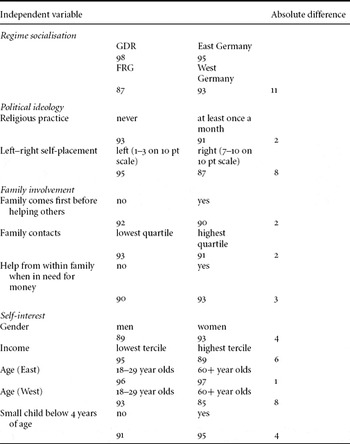
Table 1 introduces the bivariate associations between the dependent and the independent variables. The numbers represent the percentages of agreement with the notion that the state should provide childcare. So, for instance, 98 per cent of adults who had been living in the GDR before 1990 at the ages of fifteen to twenty-five, and 87 per cent of adults with socialisation experience in the Federal Republic of Germany (FRG, West Germany before 1990) support that notion, which is a difference of 11 percentage points. Those groups who were socialised in the East (95 per cent) and in the West (93 per cent) after unification show support levels in between the extremes, suggesting a convergence of the demand levels.
Percentage of agreement that the state should provide childcare

Note:% levels of agreement in the specific sub-group.
Besides the large differences between different socialisation groups, we see sizeable differences of 8 percentage points for the left–right self-placement. People more to the left are more supportive (95 per cent) than people to the right (87 per cent) because a more rightist value base includes a more conservative view of the family as a subsidiary system and more traditional understanding of raising children. Along similar lines, people who are more religious and people who think that the family should come first also show slightly higher levels of support. For income, we see that individuals in the lowest quantile group are more supportive of public childcare (95 per cent) than those in the highest quantile group (89 per cent). Among the smaller differences, some are quite surprising. There is slightly higher support for public childcare in the East at higher age, with the 60+ age group showing 97 per cent of support compared to 96 per cent of the 18–29 year olds. In the West, however, there is a rather strong difference in the other direction with the old showing only 85 per cent of support and the young having 93 per cent. Thus, the elderly in the East and in the West differ by 12 percentage points, whereas the young only differ by 3 percentage points. This is so remarkable as public childcare is a policy area of no direct interest to older people who are very unlikely to have small children themselves and as cohort differences in welfare state attitudes within West Germany are negligible (Goerres, Reference Goerres2009; Goerres and Tepe, Reference Goerres and Tepe2010).
These bivariate results lend ambiguous credence to some of the four causal mechanisms. Different socialisation in the East and the West still exists as Easterners show much higher support for the state taking an active role in public childcare provisions than Westerners. Political ideology also seems to matter with more conservative individuals being less supportive. Family involvement, however, does not unequivocally show the expected relationship. Self-interest indicators do show the expected bivariate relationship with the exception of age in the East. Women, people with more income, those who have small children living in their household as well as younger people in general are more supportive than the comparison groups. However, overall the differences are small. So, let us turn to multiple regression techniques to disentangle some confounded effects.
Regression analysis
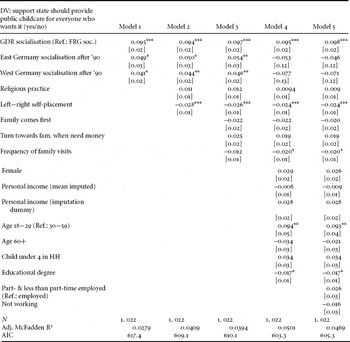
Table 2 shows a series of five regressions with coefficients as average marginal effects (Bartus, Reference Bartus2005; Mood, Reference Mood2010), i.e. the mean change in probability if the independent variable is increased by one unit. Model 1 confirms the pattern that we saw in the bivariate analysis. Clearly, adults with communist regime socialisation are much more supportive of the state providing public childcare than people with West German regime socialisation. On average, the former will have a 9.5 per cent higher likelihood than the latter. Model 2 also includes the second block with religious practice and left–right self-placement. Only left–right self-placement has a systematic impact with individuals on the right being less supportive of public childcare than those on the left. Since all continuous variables have been z-transformed, we can deduce that a change in one standard deviation of left–right self-placement has a much smaller effect on the attitude towards public childcare (on average a minus of 2.8 per cent) than GDR regime compared to FDR regime socialisation (on average a plus of 9.4 per cent). Interestingly, the socialisation dummies hardly change their coefficients, meaning that the political ideology variables do not change the impact of the socialisation ones. In addition, the two goodness-of-fit indices (adjusted McFadden R2 and AIC) show improvement, meaning that the inclusion of the political ideology variables increased the overall fit of the model. Model 3 also contains the three variables capturing family involvement. However, no variables have statistically significant effects, and the overall goodness-of-fit indices worsen, implying that having the information about family involvement does not statistically warrant the greater complexity of model 3 over model 2.
Models of attitudes towards public childcare in Germany, 2002

Notes: Ref. = Reference group. Cell entries represent average marginal effects. Standard errors in brackets. *** p < 0.01, ** p < 0.05, * p < 0.10. Using sample weights.
Model 4 adds predictors of self-interest into the picture and the first control variable, education.Footnote 9 Only age shows a significant coefficient. Being a woman and sharing the house with a small child have, as expected, positive, albeit insignificant, coefficients. Being a young respondent (age 18–29) has a rather strong and positive impact on public childcare provision (on average a plus of 9.4 per cent). Moreover, the intermediate socialisation categories of those socialised in the East or in the West after 1990 lose significant coefficients, leaving only the difference between those socialised in the GDR and all other socialisation groups significant. In addition, the goodness-of-fit indices (adjusted McFadden R2 and AIC) show improvement of Model 4 over Models 2 and 3. Moreover, we find that a larger number of family visits decreases support for public childcare provision (on average a minus of 2.0 per cent, but only significant at the 0.10 level). Finally, Model 5 also adds further controls for the employment situation, but this information does not capture any effects.
Overall, these first series of regressions suggest that only three variables have systematic expected influences: socialisation in the East before 1990, left–right self-placement and age. Theoretically, they entail that socialisation processes differentiated by East and West, political ideology captured by the left–right values and age-related self-interest explain attitudes towards public childcare in Germany. Of these three, the communist regime socialisation and the dummy for young age have the biggest impact. However, the strength of the socialisation effect could also suggest that the dynamics altogether work differently for the two parts of the country. Recall the high level of support in the East compared to the West from the bivariate analysis. Therefore, we run Model 4 with a full set of interaction terms with the variable ‘experience of the East as communist regime’.Footnote 10
Conditional effect analysis
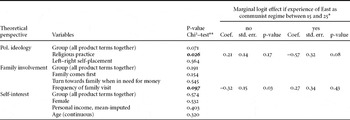
With respect to political ideology, we find that the left–right self-placement does not systematically vary between respondents with and without communist regime socialisation (see Table 3). For religious practice, however, we see systematic differences between the two groups. Whereas more religious respondents without GDR regime socialisation are more likely to favor public childcare (coefficient 0.21, p-value 0.17), the opposite can be observed with more religious respondents with GDR regime socialisation. More religious respondents with communist regime socialisation are less likely to support public childcare provision (coefficient –0.57, p-value 0.08). This could be due to the different social meaning of religiosity in the East than in the West. In the East, there are fewer religious adherents and those who are very religious are likely to be more conservative than those in the West.
Models of attitudes towards public childcare in East and West Germany, 2002 (conditional effects)

Notes: **P-Value: Likelihood that the model with the product term or the group of product terms describes the same model as in the simpler model without any product terms.
Interaction with child not possible because of perfect predictions * from model with product terms East socialisation X (religious practice, family comes first, frequency of family visits). Example: The model that includes both product terms religious practice X GDR soc. and left–right X GDR soc. is likely not to improve the model with a 7.1 per cent chance. The model that only includes the product term religious practice X GDR soc. is likely not to improve the model with a 2.6 per cent chance. In this model, the marginal effect of religious practice is 0.21 with a standard error of 0.14 for those with a Post-GDR socialisation and –0.57 with a standard error of 0.32 for those with an East socialisation.
Adding the block on family involvement reinforces the image of different dynamics in public childcare support between the two socialisation groups. Decomposing the product terms shows that the coefficients of frequency of family visits (p-value of 0.097) vary between those with and without East regime socialisation. The number of family visits has hardly any effect on public childcare provision preferences among those with communist regime experience (coefficient 0.27 and a p-value of 0.43), whereas more family visits decrease support for public childcare provision among those with a non-GDR socialisation (coefficient –0.32 and a p-value of 0.03).Footnote 11 This piece of evidence runs counter to our expectations as we expected a positive effect throughout. It may be consistent with the notion that there is a certain trade-off between childcare managed by the welfare state and childcare provided by the family. If anything, this notion of a ‘substitution effect’ is more likely to apply to respondents with a non-communist socialisation (Daatland, Reference Daatland2001). So, we have to amend our theory with regard to family involvement. Those who participate in a denser network of visits within the family and those more likely to receive practical help from within the family and who did not grow up in the communist GDR show slightly lower levels of support for public childcare than all other groups (see also Goerres and Tepe, Reference Goerres, Tepe, Vanhuysse and Goerres2012).
Theoretically, this means that the impact of communist regime socialisation was still strong even 13 years after the fall of the Berlin Wall when the survey was carried out. In West Germany, the general impact of socialisation which leads to less support for public childcare provision seems to be in accordance with the conservative welfare regime thesis, indicating that there is more room for political ideology and self-interest to explain why some people do not support public childcare.
Replicating the analysis for 2008/9 after the paradigmatic policy change
There was a paradigmatic change in the German government's approach to public childcare with the onset of large-scale expansion of facilities for the 0–3 year olds in the West from 2005 onwards. The German component of the European Social Survey (ESS), also a face-to-face survey, gives us the ideal opportunity to check whether the individual-level dynamics measured for the ALLBUS from 2002 were still similar in 2008/9. Besides differences in the wording of questions, the ESS does not contain any indicators of family involvement or place of birth. The replication analysis on the ESS sample ought thus to be considered complementary and with caution (the detailed results are available online in Appendix Tables 1 and 2).
In 2008/9, respondents were asked: ‘And how much responsibility do you think governments should have to ensure sufficient childcare services for working parents?’ Answer categories ranged from none at all 0 to very much 10. Not only is the question wording different, so are the answer categories. Other small differences also occur for the independent variables. For example, we know whether children live in the household but not how old they are. What we cannot measure at all is family involvement. However, its indicators proved to have no significant coefficients in the 2002 analysis except for a small impact of the frequency of family visits among those who had not been socialised in the GDR. Thus, not replicating these dynamics seems permissible. What weighs more heavily is that we cannot measure the socialisation experience as well as in the 2002 survey since we only have information in 2008/9 about the place of residence, not the place of birth. Thus, we only discuss the models for all of Germany (as shown in Table 2 for 2002), not for the interaction analysis.
In a nutshell, the replicated models for 2008/9 support the findings from 2002. The underlying individual dynamics of support for public childcare are basically the same. All variables have effects in the same direction. Some have significant coefficients in the 2008/9 models, but not in the 2002 models. These differences are due to the continuous dependent variable in the 2008/9 survey that can be approached with OLS analysis and the much bigger sample size (2422 observations compared to 1022). By far the strongest impact comes from East regime socialisation, followed by political ideology (left–right self-placement) and indicators of the self-interest perspective (being female, being younger than 30). The major difference is that the 2008/9 results reveal more precise effects of gender. Women take on average a 0.23 higher position on the 0 to 10 scale than men. To compare with some other effects: individuals on the very left of the left–right spectrum on average take a 1.13 higher value than individuals on the very right; those living in the East take a 0.95 higher value than those living in the West; individuals below 30 on average take a 0.27 higher scale value than those aged 60 and more.
This replication exercise implies that the fundamental dynamics of support for public childcare remained the same in the intervening six years between the two surveys: socialisation, political ideology and self-interest continue to matter. This is remarkable given the paradigmatic policy change in between. More broadly, it implies that people's expectations towards social policy are sticky as far as inter-individual differences are concerned, and people do not react – at least in the short term – to strong changes to what governments provide.
Concluding remarks
This study analyses determinants of attitudes towards public childcare in East and West Germany. Estimation results from the 2002 German General Social Survey and replicated in the 2008/9 European Social Survey can be condensed into three statements: (1) Regime socialisation is the single most important determinant of attitudes toward public childcare followed by young age as an indicator of self-interest and political ideology. Family involvement does not have any sizeable impact. (2) Regime socialisation conditions the impact of some indicators of political ideology and family involvement on attitudes toward public childcare. (3) Despite a paradigmatic shift in policy, the dynamics of 2008 mirror those of 2002, highlighting the stability of inter-individual differences in support. Overall, the results suggest that German policy-makers are still confronted with two different electorates as to the provision of public childcare. The ‘shadow of communism’ still stretches over what people in the East expect from the welfare state as well as over how they differ among one another vis-à-vis this important area of social policy. The inertia of institutional infrastructure as well as the high temporal stability of inter-individual differences make the demand for public childcare in Germany highly path-dependent.
The theoretical contribution of this study is twofold. First, confronted with macro-level studies on family expenditure, we developed a micro-level framework and empirical exploration of this framework on preference formation towards public childcare. In contrast to West (Reference West1984), the analysis indicates that attitudes towards the state/family nexus do form along partisan lines as respondents who reported to be more left-leaning in their political views are more likely to support an active role of the state in childcare. While this observation is consistent with the idea of partisan cycles in public childcare expenditure (Montanari, Reference Montanari2000), it has to be left to further in-depth macro-level research to figure out whether left-wing governments actually increase public childcare either in terms of spending or benefit generosity. In any case, there is a certain disparity between voters’ partisan attitudes towards public childcare among voters and government's behavior. It was a social-democratic minister (Renate Schmidt, SPD Federal Minister for Family Affairs from 2002–2005) who conceptualised the policy instruments for a re-orientation of German family policies, but it was Schmidt's successor from the conservative party (Ursula von der Leyen, CDU Federal Minister for Family Affairs 2005–2009) who implemented and further promoted this re-orientation. In this respect, it seems like family policy in Germany does increasingly take place beyond the narrow world of partisanship.
Second, the conditional effect analysis seeks to contribute to the growing literature on the ‘shadow of communism’ hypotheses (e.g. see for a review Tucker, Reference Tucker2002). Alesina and Fuchs-Schündeln (Reference Alesina and Fuchs-Schündeln2007: 1513) showed that Germans with communist regime socialisation are more likely to believe that the state should be responsible for the financial security of the family. Our findings from the regression analysis support this observation. Hence, there is a strong notion that the communist legacy affects attitudes towards public childcare. In more substantive terms, however, the question remains through which mechanisms the communist legacy affects attitudes. It seems that the popular demand for what the state should do to help families is highly path-dependent and sticky because of long-past learning processes in people's minds and the organisational continuities of the state-provided infrastructure.
Politically, it is clear that this ‘shadow of communism’ creates two different electorates for politicians, one with a universal high support for public childcare among those socialised in the GDR with little room for inter-individual differences and another in which differences can be understood with regard to political ideology and the self-interest of voters.
Acknowledgement
The dataset are the 2002 German General Social Survey that is publicly available from GESIS (ZA3700) and the German component of the European Social Survey 2008/9 (available at www.europeansocialsurvey.org). We would like to thank Karsten Hank, the two JSP reviewers and the editors for helpful suggestions. Our Stata do files are available for replication purposes. There is a supplementary online appendix available from Cambridge Journals Online at journals.cambridge.org/JSP as well as from the authors.
Definition and source of variables

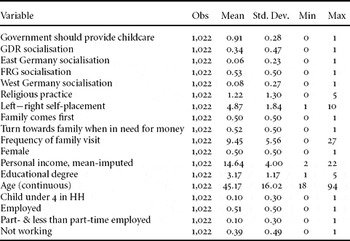
Descriptive statistics