Patients with single-ventricle physiology now routinely undergo staged palliations. Initial stage I palliation typically includes systemic-to-pulmonary shunts such as the Blalock–Taussig shunt or right ventricle-to-pulmonary artery conduit. Those who are deemed to be at high risk with other significant morbidities may undergo a hybrid procedure, which consists of patent ductus arteriosus stent placement with pulmonary artery banding Reference Algra, Breur and Evens1–Reference Petrucci, O’Brien and Jacobs7 . Those who are unable to undergo a single-stage complete repair due to other comorbidities or borderline physiology will also undergo the above-mentioned initial palliation procedures while their candidacy for single or biventricular repair is being determined. Despite the remarkable improvement in survival and quality of life for patients with CHD especially those with single-ventricle physiology, interstage mortality remains considerably high, with mortality rates ranging from 6 to 20% Reference Algra, Breur and Evens1,Reference Petrucci, O’Brien and Jacobs7–Reference Tabbutt, Ghanayem and Ravishankar9 . One significant contributing factor towards interstage morbidity and mortality is thrombosis. Patients with cyanotic heart disease are at increased risk of thrombotic events including central venous line-associated thrombosis and sometimes catastrophic shunt thrombosis, which raises the overall risk for morbidity and mortality Reference Fenton, Siewers and Rebovich8–Reference Manlhiot, Menjak and Brandao13 .
Currently, aspirin is the most widely used antiplatelet agent for shunt thrombosis prophylaxis and studies have shown that the use of aspirin is associated with a reduced risk of shunt thrombotic events and death Reference Li, Yow and Berezny14–Reference Al Jubair, Al Fagih and Al Jarallah16 . However, it has been reported that aspirin resistance is common in patients with CHD and that patients with aspirin resistance are at a higher risk of thrombotic events Reference Cholette, Mamikonian and Alfieris11,Reference Emani, Trainor and Zurakowski17,Reference Mir, Frank and Journeycake18 . Various testing modalities are available to assess aspirin response, which has helped to guide aspirin therapy Reference Rand and Kuhle19,Reference Sambu and Curzen20 . VerifyNow™ is a point-of-care test with good specificity and sensitivity that has been used in patients with CHD to determine aspirin responsiveness Reference Emani, Trainor and Zurakowski17,Reference Hussein, Emiru and Georgiadis21–Reference Cholette, Rubenstein and Alfieris23 . Investigation of the prevalence of aspirin resistance exclusively in infants (<12 months old) with single-ventricle physiology has been very limited, even though there were reports of a higher incidence of aspirin resistance amongst those with young age (neonates) and cyanotic heart disease Reference Emani, Trainor and Zurakowski17,Reference Mir, Frank and Journeycake18 , thereby increasing their overall morbidity and mortality.
The objective of this study was to evaluate the prevalence of aspirin resistance in infants who required initial stage I palliation. We then further investigated the characteristics of a cohort of infants who are identified to be aspirin resistant using the VerifyNow™ test and assessed if aspirin resistance is dose responsive. Thrombotic events or mortality risks related to aspirin resistance were also investigated. We hypothesised that patients with lower birth weight would have a higher incidence of aspirin resistance due to overall immaturity and that the resistance could be overcome with dose adjustment.
Materials and methods
Study design and patient selection
This was a single-site retrospective study at the Cincinnati Children’s Hospital Medical Center and the study protocol was approved by the Investigational Review Board. All infants who underwent a Norwood procedure with a shunt (BT or RV-PA shunt), BT shunt alone, or hybrid procedure and received an aspirin resistance test using the VerifyNow™ test between 1 June, 2013 and 31 December, 2016 were identified for inclusion. All data were extracted from the hospital’s electronic medical record.
All patients were started on low-dose heparin infusion post-operatively once appropriate haemostasis was achieved and transitioned to aspirin (5–10 mg/kg/dose) once enteral feeding was tolerated as per ICU protocol. The use of additional anticoagulation such as enoxaparin or other antiplatelet agents was documented. Documented thrombotic events by vascular ultrasound (venous or arterial) during the admission period were collected.
Aspirin resistance test
Aspirin resistance was tested using the VerifyNow test, which is a point-of-care platelet aggregation blood test performed in a cartridge containing fibrinogen-coated microbeads. Platelets bind to fibrinogen-coated beads when activated by agonist which leads to increased light transmission. The test result is reported in aspirin response units and represents a patient’s response to aspirin. Reference Emani, Trainor and Zurakowski17–Reference Rand and Kuhle19,Reference Nielsen, Kristensen and Thygesen22 Patients with >550 ARUs are deemed to be aspirin resistant according to the test protocol Reference Emani, Trainor and Zurakowski17,Reference Mir, Frank and Journeycake18,Reference Nielsen, Kristensen and Thygesen22 . The primary end point of this study was the prevalence of aspirin resistance. Secondary end points were the incidence of thrombosis and in-hospital mortality.
Statistical analysis
Descriptive statistics are reported as median with range for continuous variables and frequency and percentages for categorical variables. Comparisons between patients who are aspirin resistant and non-resistant were carried out using the chi-squared test (χ2) or Fischer’s exact test, according to expected counts for categorical values and the t-test or Mann–Whitney U-test, as appropriate, for continuous variables. All statistical analyses were performed using SPSS version 22 (IBM Corporation, New York, NY, United States of America) with a p-value less than 0.05 being considered as statistically significant.
Results
Patient characteristics
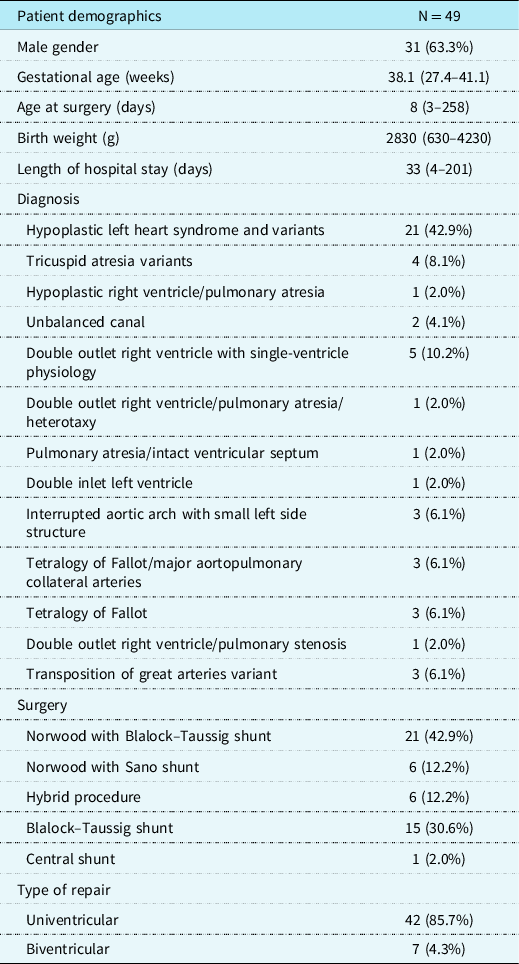
There were a total of 49 infants who met the eligibility criteria and were included in the study. Forty-one patients (84%) were neonates at the time of aspirin initiation. The median gestational age and birth weight were 38.1 weeks and 2830 grams, respectively. The most common diagnosis was hypoplastic left heart syndrome (43%). There were 42 patients who followed the single-ventricle pathway and 7 patients who eventually had a biventricular repair. Patient demographics are summarised in Table 1.
Patient demographics.

All data are presented as N (%)
Aspirin administration and resistance
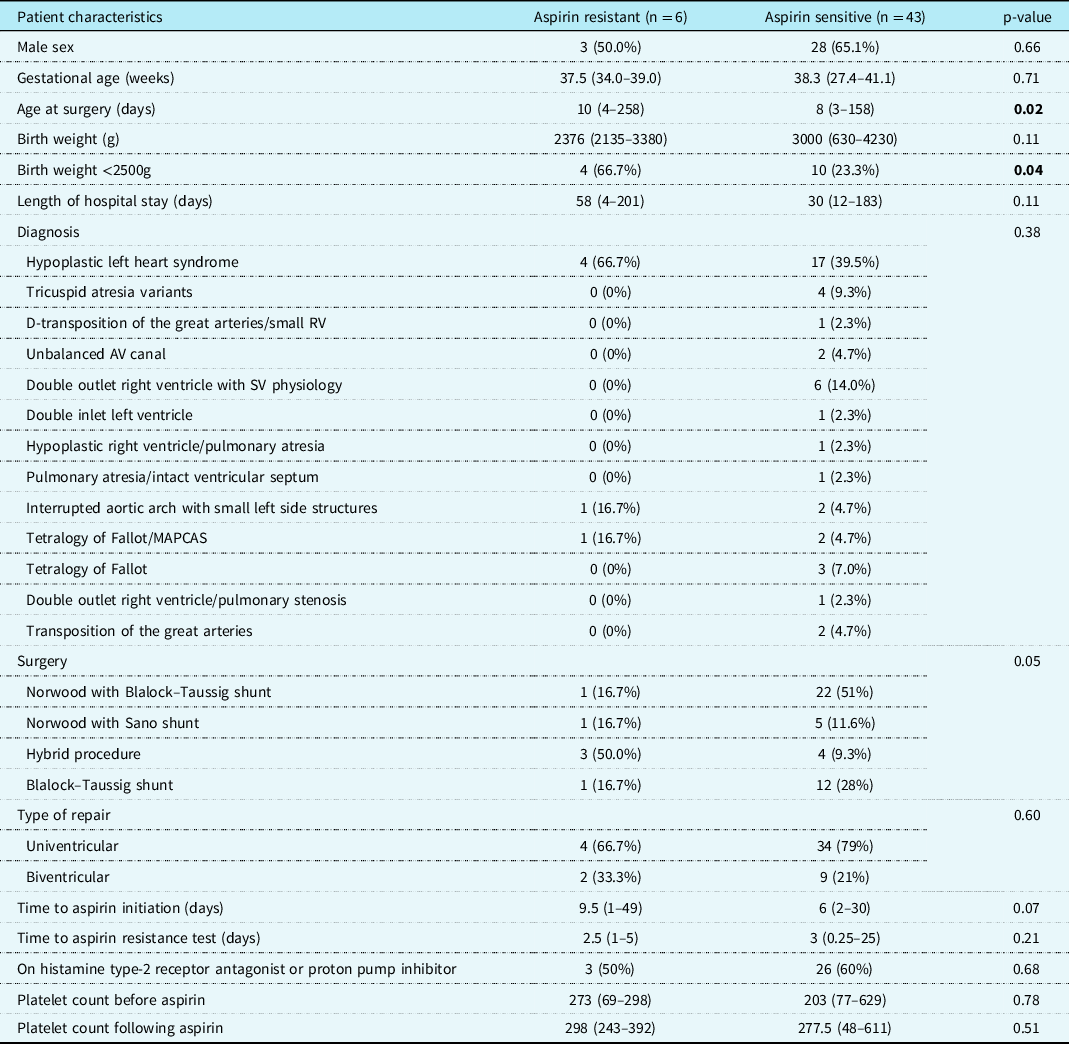
The days to aspirin initiation from surgery ranged from 1 to 49. Our protocol for enteral aspirin dosing during this study period was 5–10 mg/kg/dose once daily with an effort to round to the nearest measurable tablet size: 20.25 mg, 40.5 mg, or 81 mg. This resulted in a dose range of 5–15mg/kg/dose. The initial aspirin dose administered was 10mg (1 patient), 20.5mg (31 patients), and 40.5mg (17 patients) [Table 2]. Aspirin resistance evaluated using the VerifyNow™ test was performed between 6 hours and 25 days following the first aspirin dose administration. A total of six patients (12%) were identified as aspirin resistant. There was no significant statistical difference in gestational age (median gestational age 37.5 versus 38.3), length of hospital stay (median hospital stay 58 versus 30 days), aspirin initiation days from the surgery (median 9.5 versus 6 days), or time to aspirin resistance test following aspirin initiation (median 2.5 versus 3 days) between aspirin-resistant and non-resistant patients. Four out of six patients with aspirin resistance were neonates with birth weight less than 2500 grams. A birth weight < 2500 grams was associated with a 43.4% higher incidence of aspirin resistance (p < 0.05). The remaining two patients were a neonate with birth weight greater than 2500 grams and a 7-month-old infant. The most common diagnosis amongst patients with aspirin resistance was HLHS and/or its variant (66.7%). Diagnosis or type of repair did not have any statistically significant effect on aspirin resistance. Aspirin-resistant patients also had a median age older by 2 days than aspirin non-resistant patients at the time of surgery (p < 0.05). There was no significant effect on aspirin resistance with the concurrent administration of medications that are known to decrease aspirin absorption such as histamine type-2 receptor antagonist or proton pump inhibitor Reference Hu, Tong and Kuang24,Reference Lev, Ramabadran and Guthikonda25 .
Characteristics of aspirin-resistant versus aspirin non-resistant patients.

All data are presented as N (%) or median (range)
The incidence of aspirin resistance was compared amongst the three different initial aspirin doses, which is summarised in Table 3. Three out of four patients (75%) with aspirin resistance after receiving 20.25 mg aspirin had weights greater than 2500 grams at the time of aspirin initiation. One resistant infant weighing 2120 gm received the initial aspirin dose of 10 mg as per our institutional protocol. All six patients with aspirin resistance received an aspirin dose less than 9 mg/kg/dose. All six patients with an initially positive aspirin resistance test showed aspirin responsiveness with either a dose increase (five patients) or a repeated aspirin resistance test following administration of the second aspirin dose (one patient; the initial test was performed 6 hours following the first aspirin dose). We observed no significant side effects of antiplatelet agents such as gastrointestinal bleeding or intracranial bleeding.
Initial aspirin dose.

All data are presented as N (%) or median (range)
Prevalence of thrombotic events and mortality
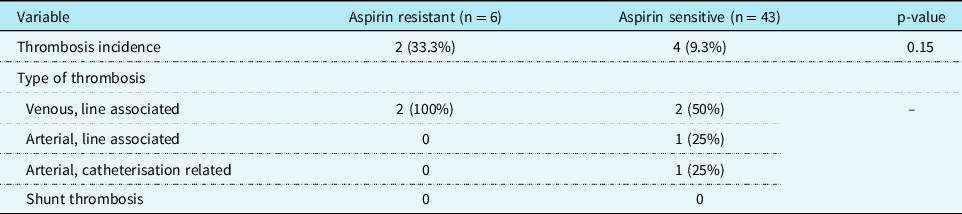
The hospital length of stay ranged from 4 to 201 days (median 33 days). There were six patients with thrombotic events (12%): five line-associated thromboses (four venous and one arterial) and one arterial thrombosis following pre-Glenn catheterisation [Table 4].
Thrombosis in aspirin-resistant versus aspirin non-resistant patients.

All values are presented as N (%)
The overall incidence of thrombosis was 24% higher amongst those with aspirin resistance (33%; 2/6 patients) compared to those with non-aspirin resistance (9%; 4/43 patients); however, the difference was not statistically significant [Table 4]. However, both patients with central line-associated thromboses who were aspirin resistant died during the interstage period (100%; 2/2 patients). There was no documented shunt thrombosis during the interstage period.
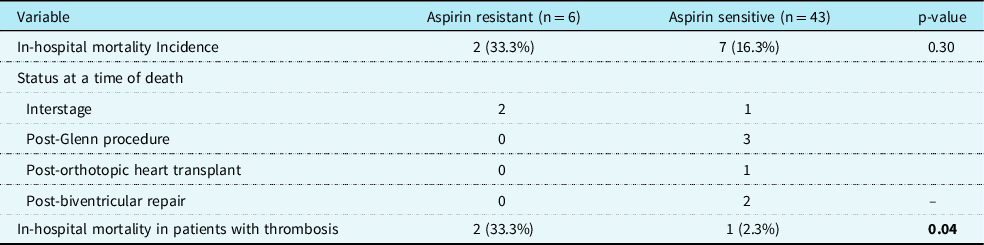
There were overall nine in-hospital mortalities, mostly associated with non-cardiac congenital anomalies and related complications. One mortality was due to an aspiration-related event. There was no statistically significant difference in the in-hospital mortality rate between the aspirin resistance (33%; 2/6 patients) and non-resistance groups (16.3%; 7/43 patients) [Table 5]. However, the incidence of in-hospital mortality with documented thrombotic events was significantly higher in the aspirin-resistant group compared to that in the aspirin non-resistant group (33.3 versus 2.3%; p = 0.04) [Table 5].
In-hospital mortality.

All values are presented as N (%)
Discussion
In this single-institution retrospective study, we found that the overall incidence of aspirin resistance was 12% in infants with single-ventricle physiology using the VerifyNow™ test. A majority (67%) of our patients with aspirin resistance were neonates with low birth weight less than 2500 grams. Our findings reiterate previous findings showing a high incidence of aspirin resistance amongst neonates Reference Cholette, Mamikonian and Alfieris11,Reference Emani, Trainor and Zurakowski17 . However, the incidence of aspirin resistance in neonates in our population was ˜10%, which is lower than previously reported Reference Emani, Trainor and Zurakowski17,Reference Mir, Frank and Journeycake18 . The difference could be due to the different assay modalities for assessing aspirin resistance, as shown previously. We use the VerifyNow™ test for its easy-to-use point-of-care laboratory method. It is a platelet aggregation test based on light transmittance changes using arachnoid acid as the platelet agonist. The VerifyNow™ test provides the same amount of information as a traditional light transmission aggregometry and its cut-off ARU level needs further evaluation; nevertheless, it has shown high sensitivity and specificity and its rapid testing time allows for quick dose adjustment and subsequent repeat testing Reference Sambu and Curzen20–Reference Nielsen, Kristensen and Thygesen22,Reference Yee, Dinu and Sun26 . The variability in timing of when the VerifyNow™ test was performed following aspirin initiation could have contributed to the prevalent difference in aspirin resistance. Another factor could be differences in an aspirin administration route (oral versus gastric feeding tube versus post-pyloric feeding tube versus rectal) and its effect on absorption. When investigating the possible impact of concurrent administration of medications that are known to interact with aspirin absorption, we did not see any evidence of their effect on aspirin resistance.
All six patients with aspirin resistance in our study received an initial aspirin dose of <9 mg/kg/dose. All our patients with initial aspirin resistance became aspirin responsive after either a dose increase or a repeat testing following additional dose administration. This suggests that the aspirin resistance observed in our patient population is likely related to inadequate dosing rather than true platelet resistance to aspirin. Overall immaturity associated with low birth weight neonates including an underdeveloped haemostasis system and gastrointestinal absorption could be related to a higher incidence of aspirin resistance with a lower dose of aspirin Reference Revel-Vilk27 . This further supports that the aspirin resistance seen in our patient population is likely related to inadequate aspirin amount due to insufficient initial dose or delayed absorption rather than intrinsic aspirin resistance. Based on these findings, we changed our aspirin dose practice to administer 20.25 mg for patients weighing less than 2500 grams, and 40.5 mg for those weighing more than 2500 grams and less than 10 kg. Those weighing more than 10 kg receive 81 mg aspirin. These changes ensured that neonates who are known to be susceptible to aspirin resistance receive a minimum aspirin dose of 8 mg/kg/dose.
Previous studies have reported up to 45% incidence of central line-associated thrombosis amongst patients with CHD Reference Agarwal, Firdouse and Brar10,Reference Cholette, Mamikonian and Alfieris11,Reference Manlhiot, Menjak and Brandao13,Reference Cholette, Rubenstein and Alfieris23 . The overall rate of thrombotic events in our single-ventricle patient population was 12% with line-associated venous thrombosis being the most common. The occurrence of venous thrombosis while on aspirin therapy is likely multifactorial including underlying cyanotic heart disease, low flow stasis in venous vessel, vessel wall abnormality, etc. We did not observe any shunt thrombosis. All patients with venous thrombosis were treated with enoxaparin for their thrombotic events. The incidence of a thrombotic event was higher amongst those with aspirin resistance although not statistically significant. However, the incidence of in-hospital mortality in the presence of thrombosis was significantly higher in the aspirin-resistant group versus the non-resistant group. Our findings suggest that our group of neonates/infants who experienced both an initial aspirin-resistant response and thrombotic events are at a higher risk of mortality, though their mortalities were not directly related to thrombotic events. Although underlying causes of mortality varied amongst our patients, our findings suggest that aspirin-resistant patients who subsequently develop thrombotic events may benefit from closer monitoring given their overall increased risk of mortality.
To the best of our knowledge, this is the first study investigating aspirin resistance exclusively in the larger group of both neonates and infants with single-ventricle physiology. Previous investigations have limited the patients to a very small number of neonates with single-ventricle physiology or included all age groups of children with various CHDs Reference Cholette, Mamikonian and Alfieris11,Reference Emani, Trainor and Zurakowski17,Reference Mir, Frank and Journeycake18,Reference Romlin, Wahlander and Stromvall-Larsson28 . Our study provides further insights on the relationship amongst aspirin resistance, thrombotic events, and in-hospital mortality in the neonate/infant cohort with single-ventricle physiology as previous studies had suggested that neonates and infants with single-ventricle physiology have higher occurrences of aspirin resistance and thrombotic events Reference Emani, Trainor and Zurakowski17,Reference Mir, Frank and Journeycake18,Reference Romlin, Wahlander and Stromvall-Larsson28 . Some limitations for this study include non-standardised aspirin-resistant testing time, a limited sample size especially with those with aspirin resistance restricting the statistical power, and retrospective review limited to one hospital stay.
Conclusion
Our incidence of aspirin resistance in neonates/infants with single-ventricle physiology, measured using the VerifyNow™ test, was ∼10% which is lower than what had been previously reported. Whether similar findings are to be observed when using different test modalities to assess aspirin response is to be further investigated. Additionally, further study with a larger sample size would be helpful to validate our findings. Findings from this study have altered our aspirin dose practice in neonates with single-ventricle physiology following their initial palliation operation. We will pursue a follow-up study to determine whether our practice change has improved the incidence of aspirin resistance and its associated thrombotic events in neonates/infants with single-ventricle physiology.
Acknowledgements
None.
Financial support
This research received no specific grant from any funding agency, commercial, or not-for-profit sectors.
Conflicts of interest
The authors declare that they have no conflicts of interest with respect to this work.
Ethical standards
The authors assert that all procedures contributing to this work comply with the ethical standards of the relevant national guidelines on human experimentation and with the Helsinki Declaration of 1975, as revised in 2008, and has been approved by the institutional review board at the Cincinnati Children’s Hospital Medical Center.