Why do organizations at the center of transnational advocacy networks select particular issues for attention but not others? This is an important question because advocacy matters in developing new global norms and focusing political attention on global social problems. Yet the advocacy agenda varies, and we know little about how actors in these networks determine which norms to promote in the first place. We build on recent research showing that the decisions of advocacy organizations at the center of issue networks are crucial for agenda setting and investigate the determinants of these advocacy “gatekeeper” preferences by studying agenda setting in the area of human security, broadly defined.
We first captured variation in the salience of human security issues and mapped the network of human security organizations through surveys with practitioners and content analysis of organizational websites. Second, we identified a population of issues that practitioners in this network believe should be on the human security agenda but which (according to our measures) are not. Third, we explored the differences between high-salience and low-salience (neglected) issues through a series of focus groups with practitioners from leading organizations in the network. Finally, we collected participants' reactions to a variety of low-salience candidate issues as well as their practical understandings of what made the high-salience issues successful.
We found that participants emphasized five sets of factors: issue attributes, entrepreneur attributes, adopter attributes, the broader political context, and intranetwork relations. However, the first and last of these categories were much more consistently invoked than others in evaluations of specific candidate issues. Because intranetwork relations among organizations, entrepreneurs, and issues help constitute perceptions of issues' and actors' attributes, network structure has significant direct and indirect effects on structuring gatekeeper preferences within transnational advocacy space.
Significance
Advocacy networks play critical roles in creating new global policies and standards.Footnote 1 In the area broadly associated with human security, advocacy outcomes have included the 1989 Convention on the Rights of the Child, the 1997 Landmine Treaty, and the 2002 Rome Treaty of the International Criminal Court.Footnote 2 Besides agenda setting, advocacy groups also play important roles in monitoring and enforcing standards once states have agreed to them.Footnote 3 Yet while the relationship between transnational advocacy networks and global policy-making has been established, we know less about why transnational networks mobilize around certain problems and not others.
Organizations in such networks appear to be highly selective in the issues they choose to champion and the populations whose grievances they choose to frame as human security problems. For example, landmines and cluster munitions have been the subject of widespread campaigns, but explosive weapons and depleted uranium have attracted less opprobrium.Footnote 4 Internal wars are an important concern for conflict-prevention analysts, but gangs and urban violence are on the margins of the global security agenda.Footnote 5 While HIV/AIDS is championed as a health issue, other communicable diseases such as pneumonia and diarrhea, despite the number of lives they claim, get limited attention.Footnote 6 While discrimination against indigenous groups has attracted global attention, the same level of attention is only recently developing against caste-based discrimination.Footnote 7
As these examples suggest, many problems are articulated by norm entrepreneurs in varying policy domains but are not promulgated as issues within transnational civil society networks.Footnote 8 Recent literature suggests that to kick-start the issue forward in its life cycle, entrepreneurs must not only “construct” an issue but also attract support from organizations central to specific advocacy networks.Footnote 9 These advocacy “gatekeepers” pick and choose among a range of possible emerging claims, launching some issues to prominence while sidelining others.Footnote 10 Several recent studies have shown that leading organizations' issue adoption within a network correlates strongly with that issue's salience both within the network (issue diffusion) and on the global agenda (agenda-setting success).Footnote 11 But what causes these advocacy elites to select—or reject—issues?
Despite the evidence that “gatekeepers” matter, there has been little systematic research on how they decide. Although a number of implicit hypotheses can be drawn from the vast case literature on successful cases of transnational agenda setting, very little has been done to test which combination of those explanations most closely structures practitioners' decisions.Footnote 12 Instead, gatekeeper preferences are generally assumed or described inductively on a case-by-case basis without providing a systematic analysis across cases.Footnote 13 This limits generalizability across issue areas, and makes it difficult to determine which factors matter most. Most of the literature focuses on issues that were selected, rather than documenting the processes by which actors at the center of advocacy networks vet candidate issues for consideration.Footnote 14
Aiming to refine our understanding of what advocacy gatekeepers want by studying the reactions of practitioners in a conversational setting, we tried to distinguish their narratives about what they want from their actual evaluative behavior. This approach yields better insights for norm entrepreneurs seeking to win their approval as well as a more nuanced set of testable hypotheses for further research on agenda setting and agenda vetting in transnational politics.
Much of the existing literature on transnational activist networks either treats organizational networks as homogenous actors or as a mass of dense, reciprocal ties that lead to collaborative outcomes.Footnote 15 By contrast, we make no such assumptions when examining networks at two levels of analysis. At the macro level, we looked at organizational websites to determine which organizations link to other organizations and how issues are networked on and across organizational agendas. We used these mappings to demonstrate that both the networks of organizations and the networks of issues are much sparser and more hierarchical than assumed. At the individual level, we conducted small focus groups to examine the effects of these networks' structure as one among several potential determinants of issue selection.
Hypotheses
A popular explanation in the literature on issue selection relates to the intrinsic aspects of issues (or people's perceptions of those aspects) that make them more or less likely to be selected for advocacy. Examples of issue attributes drawn from the literature include the nature of the victims (are they, or are they likely to be perceived as, innocent or vulnerable?),Footnote 16 the nature of the harm caused (bodily integrity rights violations versus social harms),Footnote 17 the nature of the perpetrators (some are more politically acceptable than others),Footnote 18 the nature of the causal chain between victim and perpetrator,Footnote 19 and whether or not the issue is culturally sensitive.Footnote 20
Another strand of research emphasizes the attributes of norm entrepreneurs, many of whom come from outside gatekeeping organizations.Footnote 21 Busby calls this dynamic “messenger effects,” arguing that entrepreneur attributes—like credentials, celebrity, or similarity to gatekeepers—help ensure access and enhance credibility.Footnote 22 Bob also suggests that marketing savvy makes all the difference: entrepreneurs who can package their issues to match potential adopters' mandates will have an edge.Footnote 23 In either case, as Busby puts it: “the attributes of advocates can be as important—if not more so—than the content of the message.”Footnote 24
A third popular strand of recent research states that these preferences are related more to adopter attributes than to the qualities of issues or entrepreneurs themselves. Advocacy organizations pick and choose among possible issues according to how well they mesh with the organization's need to survive and thrive.Footnote 25 In this sense, transnational organizations function like domestic interest groups.Footnote 26 Organizations consider whether there is space on their agenda for an additional issue, whether an issue fits their mandate and programming culture, and whether it will be marketable and enhance organizational resources and prestige.Footnote 27
Other authors stress the broader political context in which advocacy attempts occur or, as Cooley and Ron put it, “the incentives and constraints produced by the transnational sector's institutional environment.”Footnote 28 Similarly, theorists of political opportunity structures assign explanatory value to “the broader institutional context that provides opportunities for or imposes constraints on NGOs” which are crucial to “understanding a movement's emergence and to gauging its success.”Footnote 29 This context primarily includes factors outside the advocacy network itself: government preferences, donors' and media's moods, and trigger events beyond actors' control inside the network.Footnote 30
By contrast, a final strand of literature focuses on relationships within advocacy networks, or intranetwork relations. Rather than examining the individual characteristics of adopting organizations or of entrepreneurs, the intrinsic attributes of issues, or the nature of the external environment, this set of explanations focuses on relationships between advocacy organizations and among issues. In the human rights area, Hertel and Bob have found that significant contestation may exist among advocacy groups either opposing one another's causes or opposing their specific framings.Footnote 31 Hadden's work on climate politics found that organizations mobilized around a specific cause may disagree on tactics, altering the agenda-setting process.Footnote 32 Carpenter's work on civilian protection and gender-based violence shows that intranetwork contestation, as well as intersubjective understandings about how issue turf is compartmentalized across networks, affect advocates' understandings of whether and how to adopt new issues.Footnote 33 We find these “intranetwork relations” to be a significant motivating factor for issue selection.
Methodology
This project used multiple research methods including surveys, hyperlink analysis, content analysis of websites, interviews, and focus groups. Our aim was threefold: to identify a specific transnational network of organizations and operationalize its issue agenda; to draw on practitioners' insights to develop a population of issues missing from that agenda; and to explore hypotheses about the differences between present and absent issues through conversations with network practitioners.
Case Selection: The Human Security Network
We sought to refine a theory of gatekeeper preferences by analyzing a network of organizations working in human security.Footnote 34 Although the phrase has many meanings and is contested within global civil society, our research showed that this network is composed of several subnetworks in human rights, humanitarian affairs, peace and security, arms control, the environment, and development. It may therefore be most appropriate to think of this “global policy network” as encompassing a variety of distinct though interlinked “issue networks.”
Identifying the network and network agenda
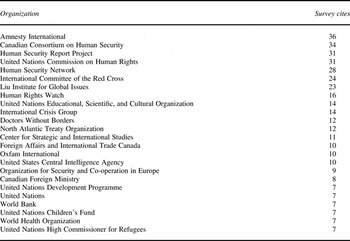
We identified a population of organizations closely associated with human security through two methods. First, we conducted an analysis of websites using Issue-crawler in 2007 to determine the cluster of organizations associated with the concept of human security connected to one another through hyperlinks (see Figure 1). Second, we disseminated an online snowball survey in spring 2008, beginning with the mailing list of what was then a leading information portal in the human security network: the Liu Institute at the University of British Columbia.Footnote 35 One of the questions asked respondents to name “three or more organizations that come to mind when you think of human security.” Responses to this question gave us a population of organizations cited and a frequency count that enabled us to identify the organizations most closely associated with the network by the most practitioners (see Table 1).Footnote 36 We averaged the two centrality measures to arrive at an overall ranking for in-degree centrality.
Hyperlinked human security organizations.

Most-mentioned organizations in human security

Source: Responses to the survey question: “Name three or more organizations that come to your mind when you think of human security.”
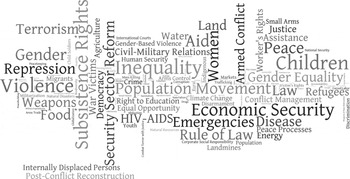
We then collected mission statements and issue lists from the websites of the organizations in the hyperlinked network, coding them according to issues named on human security web pages. We also asked survey respondents to “name three issues that come to mind when you think of human security.” These open-ended questions were aggregated and coded using the same code scheme as the websites. The results from the link analysis and the survey responses were closely related on the issue agenda, though somewhat different on issue salience.Footnote 37 We averaged these measures to create an overall measure of issue salience within the network (Figure 2).
Issue salience in the human security network.

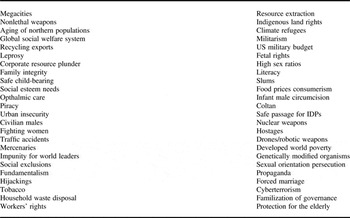
We were especially interested in low-salience issues because we wanted to know what factors might prevent an issue from getting traction to better understand what factors enabled other issues to get attention from transnational networks. Therefore, we also asked survey respondents to name human security problems that were not very prominent as issues within the human security movement. Table 2 contains problems that were reported missing from the human security agenda at the time the data were collected.
Human security “nonissues” identified by survey and focus group respondents

Source: Issues identified through survey and focus group responses to the question: “Sometimes problems exist in the world that get little or no attention from transnational activists. What human security problems can you think of that are not very prominent as issues in the human security movement?”
Explaining issue salience
We drew on the experience and insights of forty-three senior officials from organizations central to the human security network. Focus groups, as conversational settings, provide an environment in which to examine what ideas, assumptions, or discourses advocates across issue networks hold in common: they are “particularly suited to the study of attitudes and experiences around specific topics” and to how those topics are articulated in social settings.Footnote 38 Thus, in addition to substantive information on how advocates explain their issue selection decisions, the transcripts of such sessions provide data on how particular issues are currently conceptualized, constructed, or discussed among practitioners themselves; which issues are conceptually linked to which other issues; and the extent to which advocates can agree that particular nonissues lack some factor required for advocacy.Footnote 39
Our goal was to spearhead a discussion about why some issues gain attention and why others do not and to compare practitioners' narratives to their reactions to actual candidate issues and to scholarly understandings of these dynamics. Six focus groups were completed by University of Massachusetts Amherst researchers at Tufts University's Fletcher School of Law and Diplomacy in fall 2009. Participants were recruited based on their positions within organizations identified in both the surveys and hyperlink analysis. Although all 110 organizations in the network received a letter of invitation and a follow-up phone call, we recruited most aggressively from organizations with the highest centrality scores in the network because they have the greatest influence over the network agenda.Footnote 40
We made efforts to recruit from the most senior ranks in each organization to hear from individuals with influence over each organization's internal agenda. This resulted in the participation of forty-three individuals from thirty-nine different organizations, including practitioners from eighteen nations, based in five world regions, with representation from most of the major thematic clusters, organizational types, and geographical regions.Footnote 41 We also aimed to create a diverse cohort of practitioners in each focus group, combining individuals operating in different thematic fields hailing from different types of organizations.
Each focus group began with a brainstorming session on issues missing from the network. Participants were asked to list any issues that were not getting enough attention from human security specialists. The brainstorming session led into a larger discussion of why certain issues make it onto the advocacy agenda, and others do not. After a coffee break, the final segment of the focus group centered on thought experiments. The moderator presented issues that have not yet garnered international attention, drawn from a pool of candidate issues, and asked participants to analyze why these issues lack saliency. At the end of the focus-group sessions there was a more general discussion.
We analyzed the transcripts from the focus-group sessions using Atlas.ti 6.0. The project coordinator and four research assistants developed the thematic categories using a grounded theory review of the transcripts. We then developed codes for focus-group participants' substantive arguments about the determinants of the issue agenda and for discursive patterns we observed during each set of conversations. We coded with an eye toward the responses that would lend support to each of the five hypotheses. For example, if the broader political context hypothesis holds, we would expect to see a preponderance of references to the constraints imposed by donors, the media, and government interests; if the issue attributes hypothesis holds, we would expect to see references to the intrinsic aspects of issues, such as the magnitude of the problem, the number or type of people affected, or the problem's amenability to empirical measurement.
These analytical categories were applied to each passage of codeable text by between two and four undergraduate student coders through a succession of coding waves to determine which codes could be applied most reliably and which were most subject to interpretation. Interrater reliability for each code was measured using Fleiss' Kappa, and each code list was refined at least three times to derive the maximum degree of reliability among the coding team.Footnote 42 While some codes were easier to apply than others because of the complexity of the data set and the coding scheme, we achieved an average interrater reliability score of 0.47 for the entire data set.Footnote 43 Remaining disagreement among coders was then adjudicated by the PI using the Coding Analysis Toolkit.Footnote 44
Findings
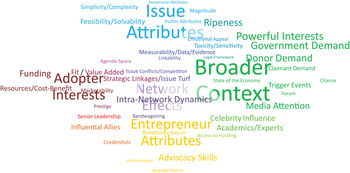
Responses from the general discussion about issue selection fell into five broad categories roughly mapping onto the typology of relevant factors described in the literature (see Figure 3), with some claims (particularly the broader political context) far more frequently mentioned than others. However, we also observed two other dynamics.
Reported factors affecting issue salience.

First, the significance of these different categories was very different when practitioners were thinking abstractly about issue selection (before a coffee break) than when they were asked to evaluate specific low-salience issues (after a coffee break). In other words, their general narratives about issue selection differed from their actual behavior in evaluating candidate issues.
Second, we noticed a general emphasis on factors related to perceived relationships within networks, rather than to the features of actors or issues or the broader political context. This was evident not only from the higher salience of intranetwork relations in practitioners' responses to actual candidate issues but also from claims regarding relational rather than intrinsic attributes of actors and issues. This suggests a need for a greater emphasis on social ties and social perceptions in understanding issues, actors, and the structure of advocacy networks than has been evident in past scholarship.
Issue Selection: Abstract Explanations Versus Evaluative Behavior
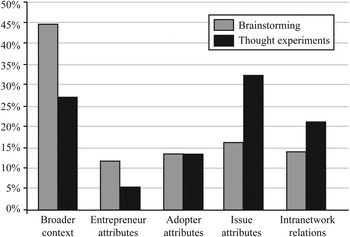
Given that many hypotheses about issue selection have been derived from case studies built on elite interviews with practitioners in advocacy networks, support for all five of these causal hypotheses was evident to some extent in practitioners' narrative explanations. However, some of these categories were more frequently mentioned than others and within each category of responses, some specific causal claims were dominant (see Figure 4).
Respondents placed only a limited emphasis on actor attributes. Entrepreneur attributes included personal charisma, credentials, an extensive personal network, Internet and social media skills, advocacy skills, and a mastery of the English language, although access to funding was the most important. A few comments suggested that entrepreneurship by an “unlikely leader” was helpful; the recent promotion of the nuclear disarmament cause by former Cold War hawks was mentioned as an example.Footnote 45 However, such references were only about 12 percent of the total in the brainstorming section, and dropped to fewer than 6 percent of references in evaluations of candidate issues. Similarly we found some evidence that organizations see themselves as constrained by adopter attributes: in weighing candidate issues, organizations are said to consider their mandates, resources, and organizational prestige.Footnote 46 Yet while this thematic concern was consistent across both sections of the focus groups, it constituted less than 14 percent of the discussion in each.
Intranetwork relations were relevant in both sessions: when evaluating candidate issues, practitioners often stressed the issue's relationship to other issues, their relationships with other partner organizations, and the issue's or entrepreneur's relationship with other organizations inside or outside the human security network. There was somewhat more commentary about the importance of issue attributes, particularly if there is a vulnerable victim and an obviously guilty perpetrator. Participants suggested that issues that are “too complex” or seem to have impossible or unachievable solutions are less likely to gain advocacy attention. Issues that were subjective and emotional, “scary,” or that “tug at heartstrings,” are more likely to be picked up because emotional appeals are assumed to be helpful when marketing issues. But systemic, quantifiable evidence to supplement the shocking testimonies is crucial in communicating the severity of the problem to advocacy gatekeepers, many of whom pride themselves on their objective technical expertise.Footnote 47 Relatedly, advocates emphasized the problem's inherent measurability—a function of the issue itself as well as the tools available to advocates.
We heard even more talk (45 percent in the first session) about how the advocacy agenda is driven by the broader political context. Our respondents described how historical shifts create or shrink space for advocacy, affecting organizations' sense that specific issues may succeed.Footnote 48 Issues have life cycles: “Often ideas will percolate for decades before the moment arrives.” This moment might be caused by a trigger event such as a natural disaster, genocide, or an industrial accident. The case literature suggests such events have a “cognitive punch effect”Footnote 49 which provides an opportunity for the advocates to “push for their pet solutions.”Footnote 50 Some participants argued that donors set the agenda, handpicking which issues will be funded, and which will not.Footnote 51 Others argued that governments play a leading role in setting the global advocacy agenda, and that the most powerful states play the most powerful roles.Footnote 52 Expert, media, and celebrity attention to an issue were also regularly mentioned as important contributing factors.
However, the dominance of the broader political context appears to be attributable to its overrepresentation in the abstract brainstorming section: it carried much less weight when practitioners were asked to evaluate the neglect of specific issues (Figure 4). When asked to comment about the absence of international advocacy around specific low-salience issues (collateral damage control, autonomous weapons, infant male circumcision, forced conscription, and military basing), these explanations dropped from 45 to 27 percent, while the emphasis placed on issue attributes jumped significantly, from 16 to 33 percent of the total. Similarly, intranetwork relations were far more salient here, increasing from 14 to 21 percent of these comments.
Explanations of issue non-salience in focus groups before (Brainstorming) and after (Thought Experiments) coffee break

This greater emphasis on the broader political context when thinking abstractly is consistent with attribution theory, which suggests both that actors are likelier to attribute outcomes they like to their own agency and outcomes they dislike to the broader environment, and vice versa for others.Footnote 53 When we disaggregated causal claims in the evaluative section according to the speaker's relative enthusiasm or skepticism about the issue in question, we discovered the relative emphasis on the broader political context versus adopter attributes was inverted (see Figure 5). Those who favored neglecting these particular issues were likelier to attribute the issues' absence from the agenda to organizational agency, rather than to the factors beyond activists' control; those who preferred that the issue get attention were likelier to blame constraints by donors or governments.
Explanations of issue neglect based on affect

However, evaluative arguments stressing issue attributes and intranetwork relations increased in the evaluative section, and were very significant across respondents' affect for the issue in question. This suggests that these variables, operating in tandem, are particularly important in practitioners' evaluations of candidate issues, regardless of how sympathetic they are to an issue. Based on the consistency of intranetwork relations as a cross-cutting explanation in the data set, the most important factors affecting practitioner judgment on which issues are “worthy” of advocacy may be those pertaining to intranetwork relationships, rather than the intrinsic attributes of either issues or actors, since it is through intranetwork relations that actor or issue attributes such as “credibility,” “fit,” and “do-ability” are given meaning by practitioners.
Issue Selection: Intrinsic Versus Relational Factors
We looked for references to social ties among organizations and issues as constraints on or facilitators of issue adoption or proliferation and considered reported ties among practitioners and their colleagues in other issue areas. Although the early transnational activist (TAN) literature assumed that dense networks constitute a resource for activists, practitioner narratives suggest that the trend can work the other way: ties between issues, issue areas, and organizations can result in conflict or competition among issues, and how issues are packaged and mapped onto different organizations' issue “turf” affects the network's receptivity to certain ideas.
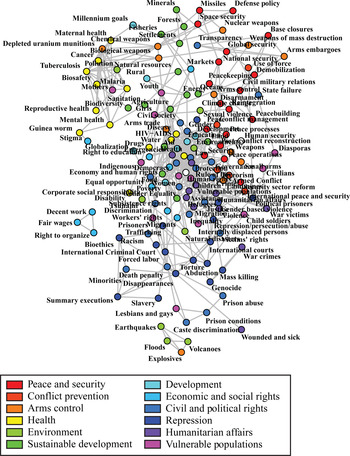
A network analysis of the co-occurrences of issues on websites and in survey responses suggests that issues themselves have a network structure (Figure 6). Practitioners were concerned about relationships among issues, especially the nature of the relationship between the emerging issue and their organization's existing issue agenda.Footnote 54 As Bob's notion of “substantive matching” predicts, respondents spoke of issue attributes in relational terms, claiming there was only so much space for advocacy, both within an organization and in the broader networks. Sometimes issues are perceived as being in competition with one another, sometimes as conflicting entirely:Footnote 55
We don't want more issues. You want to push them out, keep them away, because we've got enough to work on already. We will only take them on if we see the possibility of them helping the issues that we already have, rather than seeing them as competing issues that draw away from our pet issues that we've been working on.Footnote 56
Co-occurrences between issues named on human security websites.

Additionally, participants suggested that organizations often consider relationships among organizations when determining whether to sign onto a new campaign or adopt a new issue because issue adoption can compromise important alliances with other organizations in the network. For that reason, they feel the need to “negotiate” their various involvements in calculating their interest in supporting an issue.Footnote 57 Meritorious issues may be eliminated if they conflict with partners' preferences. Conversely, intranetwork relations can facilitate diffusion of an issue once it is adopted by an organization central to that network: practitioners reported that issues quickly proliferate within the network most closely associated with the organization that legitimized it. Indeed, some practitioners acknowledge that an expectation of creating just such a ripple effect sometimes drives their issue-adoption decisions. In addition to network composition, density also matters. It is not necessarily believed that denser networks increase the likelihood of issue adoption: practitioners report that this effect hits a tipping point after a short initial bout of issue proliferation. Potential adopters must gauge whether an issue is still at an early enough stage that they can be seen to be making a significant contribution rather than simply bandwagoning:
You're not going to be able to attract the funds if already too many people are doing it. So, there is a tipping point, the kind of bell curve where at the bottom there's not enough money yet, because there's not enough interest. And then as interest gains, you can get more money. But then once you hit the top, if there's too many people doing it, then funders are going to be like well, what's the point? So, there's that sweet spot that you have to kind of hit.Footnote 58
Perceived relationships among issue areas also matter. Issues in the human security network cluster into thematic domains in terms of ties between issues and organizations (see Figures 1 and 6).Footnote 59 The ties between these issue clusters shape practitioners' judgments about whether it is a fit for them relative to some other organization.Footnote 60 The disaggregation of the human security network into subnetworks and the increasingly cross-cutting nature of issues also generate the potential for buck-passing—some issues fall between the cracks. This dynamic arises from the compartmentalization of issue turf within the network. There may be a sense of which organization, or which type of organization, an issue belongs to and other organizations may not pick up an issue if they feel it has a better home elsewhere.Footnote 61
The mandates are giving us problems right now . . . they make us work in silos and the communications are not very good. There was a food conference recently. Not one word about climate or environmental change was mentioned in the food conference. And the people who are going to meet over the climate are not going to talk about food prices and oil prices and all these things, yet increasingly they impact forced migration. And what we are not finding right now is the right form to start putting the dots in between these silos.Footnote 62
The concept of intranetwork relations as a set of explanations distinct from the external political opportunity structure suggests that relational factors within networks may be as or more important than factors intrinsic to organizations, issues, or their environment. But the concept also answers remaining puzzles about issue and actor attributes. Many factors treated as attributes of issues or actors are socially constructed through perceptions about ties to other issues or actors.
For example, participants placed relatively little emphasis on the individual characteristics of issue entrepreneurs. However, respondents emphasized entrepreneurs' social ties to other actors as indicators of their (and therefore their ideas') merit. Entrepreneur “credibility,” for example, appears to be based on the entrepreneur's choice of allies and relationship to the claimant population. Adopters look to the density and composition of the entrepreneur's network ties as a clue to what sort of crowd they are joining if they acknowledge the campaign, and what sort of frame is embedded in the issue.
The merit of the cause entrepreneurs champion is also judged by issue attributes such as “linkability” or “toxicity" that are less about the issue itself than about what else is already on the agenda or which relationships may be compromised by a certain framing. These types of concerns form a crucial part of practitioners' estimate of whether an issue “fits” their organizational culture. Relationships—to new issues, new coalitions, new partnerships within the network—help constitute gatekeepers' understanding of their own organizational interests. These types of factors are front and center in practitioners' judgments about the merit of new human security claims.
Conclusion
Decisions of organizations at the center of advocacy networks are crucial, yet how these gatekeepers know a worthwhile issue when they see one has been understudied. While our findings support some of the major arguments in the literature regarding important factors, they also reveal new insights into the role intranetwork relations play. Future research could code specific transnational campaigns to determine which combination of these factors most typically leads to agenda-setting success or failure.
Gatekeepers' actual preferences differ between an abstract, general context, and specific issue areas. Disaggregating these contexts revealed an increased emphasis on issue attributes and intranetwork relations and a decreased emphasis on the broader political context. Further research is needed to tease out precisely which factors matter most in which contexts.
Intranetwork relations should be distinguished from the broader political context and, in general, ties between issues, actors, and issue areas matter at least as much in structuring gatekeeper preferences as factors intrinsic to issues or actors themselves. This suggests a need for studies of advocacy networks to take networks as structures far more seriously. As Hafner-Burton, Kahler, and Montgomery have argued, the TAN literature has long appropriated the “network” metaphor as a way to describe the nonstate political sector, yet has rarely examined how relationships within networks shape political outcomes.Footnote 63 Although Keck and Sikkink's seminal work on TANs acknowledge them as both structural and agentic, both that book and much of the work that followed focused primarily on networks as actors vis-à-vis states, rather than incorporating a sociological understanding of networks as structures composed of nodes of various actors connected by ties of different types and strengths.Footnote 64 “Networking” was seen as a generic verb to describe the various activities of global civil society, and “networks” used as a metaphor to distinguish such activity from the hierarchical structures associated with states. Such analyses fail to theorize how advocacy network structures affect outcomes, mask power relations within networks, and imply a false distinction between states and networks.Footnote 65 Newer studies call for a closer examination of the effects that network structures have on actors and issues in transnational networks.Footnote 66
Methodologically, a combination of surveys, web analysis, and focus group methods were a highly useful way to gather data on agenda-setting failures. The disconnect we observed between practitioners' abstract ideas and their responses to concrete cases of issue entrepreneurship bears close consideration, particularly insofar as elite interviews constitute a core methodology for scholars of transnational networks. Because practitioners may overestimate the significance of the broader political context relative to other factors, thereby discounting their own power within networks, it is important for scholars of transnational spaces to adopt a variety of methods in exploring the determinants of issue selection, campaign evolution, and norm development and implementation.
Our study suggests insights for organizations in a position to vet advocacy claims. We identified a perception among practitioners, particularly in the abstract, that their hands are largely tied by states, donors, and the media, yet this perception flies in the face of many successful advocacy campaigns by advocacy networks in recent years. Within these networks central organizations have a powerful legitimating effect on new issues, while those operating at the intersection of networks or ideas can bridge the distance between “silos” in new ways.