Introduction
Blueberries, Vaccinium corymbosum Linnaeus (Ericaceae), grown in eastern North America are at risk of infestation by two late season Diptera pests, the new invasive pest spotted-wing drosophila, Drosophila suzukii (Matsumura) (Diptera: Drosophilidae), and the native blueberry maggot fly, Rhagoletis mendax Curran (Diptera: Tephritidae). Both insects can infest fruit from the period of first ripening through the harvest period, so active management is essential for growers to be able to harvest insect-free berries.
The blueberry maggot overwinters as a pupa within the soil, and adult emergence typically begins in late June in the north-central and northeastern United States of America after the accumulation of 750 growing degree days, base 10 °C (Teixeira and Polavarapu Reference Teixeira and Polavarapu2001). After emergence, the female fly requires ~7–10 days to become sexually mature, and then mates after which she begins laying eggs in fruit. Eggs are laid under the skin of ripening blueberries and hatch in approximately five days. Blueberry maggot larvae feed and make tunnels through the flesh of the fruit until mature, then exit the fruit and enter the soil to pupate. There is one generation per year.
Spotted-wing drosophila is a small insect of East Asian origin that can lay eggs in intact fruit using its serrated ovipositor, unlike most vinegar flies that require wounds to access fruit tissues (Kanzawa Reference Kanzawa1939). This species also has a very high reproductive potential, completing a generation every two to three weeks during the summer (Kanzawa Reference Kanzawa1939). Spotted-wing drosophila was first detected in California, United States of America in 2008 (Bolda et al. Reference Bolda, Goodhue and Zalom2010) and is already widespread in the United States of America (Walsh et al. Reference Walsh, Bolda, Goodhue, Dreves, Lee and Bruck2011) and in Europe (Grassi Reference Grassi, Palmieri and Giongo2009; Calabria et al. Reference Calabria, Maca, Bachli, Serra and Pascual2012). This pest was first detected in the Great Lakes region in 2010 (Isaacs Reference Isaacs2011) and it has now been trapped here in plantings of blueberry, raspberry, blackberry, juice and wine grape, and cherry. It is also commonly detected in non-crop habitats and in rest stops and urban gardens, indicating that this pest is widespread. In the 2012 season, the first major economic damage from this pest was experienced in Michigan, United States of America blueberries, with multiple farms experiencing significant losses (R.I., personal observation).
In most commercial blueberry markets there is zero tolerance for live larvae in fruit at harvest, and this has created a need for high levels of pest control against blueberry maggot. With the recent invasion by spotted-wing drosophila, this requirement results in berry producers needing even more effective management programs to meet this standard. Blueberry integrated pest management (IPM) programmes rely primarily upon baited traps and foliar-applied insecticides to monitor and control adult spotted-wing drosophila and blueberry maggot, as a means to prevent fruit infestation (Wise et al. Reference Wise, Schilder, Zandstra, Hanson, Gut and Isaacs2012). Conventional organophosphate and synthetic pyrethroid insecticides have generally been shown to have high levels of acute toxicity on spotted-wing drosophila and blueberry maggot adults (Liburd et al. Reference Liburd, Finn, Pettit and Wise2003; Beers et al. Reference Beers, Van Steenwyk, Shearer, Coates and Grant2011; Bruck et al. Reference Bruck, Bolda, Tanigoshi, Klick, Kleiber and DeFrancesco2011; Van Timmeren and Isaacs Reference Van Timmeren and Isaacs2013). Adulticidal activity of the spinosyn and diamide chemistries against Diptera fruit pests appears to be more ingestion-active, and maximal lethal action is achieved with higher doses (Teixiera et al. Reference Teixeira, Gut, Wise and Isaacs2009; Beers et al. Reference Beers, Van Steenwyk, Shearer, Coates and Grant2011).
Neonicotinoids represent a major new class of insecticides with outstanding potency and systemic action for crop protection against a wide range of piercing-sucking pests, and some Coleoptera and Diptera (Tomizawa and Casida Reference Tomizawa and Casida2005). Neonicotinoid insecticides have tended not to perform as well as broad-spectrum contact poisons in adult-targeted bioassays against spotted-wing drosophila (Bruck et al. Reference Bruck, Bolda, Tanigoshi, Klick, Kleiber and DeFrancesco2011). Recent studies, however, have shown these compounds to hold plant penetrative attributes that can provide opportunity for post-infestation control of the eggs or larvae in fruit for some arthropod pests (Wise et al. Reference Wise, Kim, Hoffmann, Vandervoort, Gocke and Whalon2007; Mota-Sanchez et al. Reference Mota-Sanchez, Cregg, Hoffmann, Flore and Wise2012). Curative activity is the lethal action of an insecticide on a pest post-infestation, caused by the transitory penetration of the compound into plant tissue (Wise and Whalon Reference Wise and Whalon2009). Neonicotinoid and organophosphate insecticides showed curative control of apple maggot, Rhagoletis pomonella (Walsh) (Diptera: Tephritidae) in apples and Rhagoletis indifferens Curran (Diptera: Tephritidae) in cherries (Yee and Alston Reference Yee and Alston2006; Wise et al. Reference Wise, VanderPoppen and Vandervoort2009). Similar patterns of curative activity were seen on plum curculio, Conotrachelus nenuphar (Herbst) (Coleoptera: Curculionidae), in apples, cherries, and blueberries (Wise et al. Reference Wise, Kim, Hoffmann, Vandervoort, Gocke and Whalon2007; Hoffmann et al. Reference Hoffmann, Vandervoort and Wise2009; Rodriguez-Saona et al. Reference Rodriguez-Saona, Wise, Polk, Leskey and Vandervoort2013). Curative activity of neonicotinoid and other insecticides has not been tested for spotted-wing drosophila or blueberry maggot in blueberries, but these earlier studies suggest the possibility of such action. Curative activity may be an important mechanism by which insecticides achieve overall control of larval infestation of berries. Understanding the relative ability of different insecticides to provide control in this manner will help support effective pest management programmes and will enhance decision making for control of the Diptera pest complex potentially infesting blueberries.
The objectives of this study were to measure and compare the degree of curative activity of organophosphate, neonicotinoid, pyrethroid, oxadiazine, and spinosyn insecticides on blueberry maggot and spotted-wing drosophila in blueberries. In addition, the duration of time post-infestation that a curative spray can be delayed and still be effective was tested on spotted-wing drosophila.
Materials and methods
Materials tested
The insecticides tested were: phosmet (Imidan 70W; Gowan Corporation, Yuma, Arizona, United State of America), imidacloprid (Provado 1.6F; Bayer Corporation, Kansas City, Missouri, United State of America), thiamethoxam (Actara 25WG; Syngenta, Greensboro, North Carolina, United State of America), acetamiprid (Assail 30SG; United Phosphorous Inc., Abingdon, Virginia, United State of America), indoxacarb (Avaunt 30WG; DuPont, Wilmington, Delaware, United State of America), fenpropathrin (Danitol 2.4EC; Valent USA, Walnut Creek, California, United State of America), and spinetoram (Delegate 25WG; Dow AgroSciences LLC, Indianapolis, Indiana, United State of America), and were all registered for use in blueberries. Treatment concentrations were selected based on labelled field rates applied with 467.5 L/ha (50 gallons per acre) water diluent. Treatment concentrations were phosmet 2231 ppm (1.04 kg [AI]/ha equivalent), imidacloprid 180 ppm (84 g [AI]/ha equivalent), thiamethoxam 150 ppm (70 g [AI]/ha equivalent), acetamiprid 180 ppm (84 g [AI]/ha equivalent), indoxacarb 270 ppm (126 g [AI]/ha equivalent), fenpropathrin 718 ppm (336 g [AI]/ha equivalent), and spinetoram 169 ppm (78.8 g [AI]/ha equivalent). The surfactant Latron B-1956 was added at 0.125% by volume to all treatments, and to the water-only untreated control. In the temporal-delay SWD trial described below, the pyrethroid fenpropathrin was replaced with zeta-cypermethrin (Mustang Max .8EC; FMC Corp., Philadelphia, Pennsylvania, United States of America) at 60 ppm (28 g [AI]/ha equivalent) because it is more commonly used by blueberry growers for spotted-wing drosophila (R.I., personal observation).
Blueberry maggot trials
Semi-field studies were conducted in 2008 and 2009 at the Michigan State University Trevor Nichols Research Center (TNRC) in Fennville, Michigan, United States of America (42.5951°N, 86.1561°W), using blueberry bushes, Vaccinium corymbosum Linnaeus (Ericaceae) cultivar “Jersey”, with a history of high resident populations of blueberry maggot. During the study period a minimal fungicide, herbicide, and fertilisation programme was applied to maintain adequate bush vigour. In early June three 14×23 cm ammonium acetate baited Pherocon AM sticky traps (Great Lakes IPM, Vestaburg, Michigan, United States of America) were distributed within the field to monitor emergence of blueberry maggot flies. These traps were checked a minimum of once per week and were replaced every two weeks. Within 48 hours of the first fly capture in traps, 53.3×91.4 cm sleeve cages made of polyester netting (0.8 mm mesh mosquito netting, American Home & Habitat Inc., Squires, Missouri, United States of America) were placed over fruiting blueberry branches (~9000 fruit across 32 bushes), in order to physically prevent premature egg laying from blueberry maggot flies into fruit. Bags were later removed from the fruit for a seven-day period to allow for blueberry maggot oviposition and a uniform cohort of eggs and larvae. These periods (20–27 July 2008 or 21–28 July 2009) were chosen based on plentiful numbers of flies captured in monitoring traps, and local weather forecasts of warm, humid weather conditions to support blueberry maggot egg laying activity.
Following a modified protocol developed by Wise et al. (Reference Wise, VanderPoppen and Vandervoort2009), fruit were harvested immediately after the seven-day oviposition period, and green or undersized fruit were removed. Remaining fruit were sorted into trays with hardware mesh bottoms, and held for two days before treatment applications. In both years, four replicate batches of 250 fruit for each treatment were randomly selected and sprayed with one of the insecticide treatments using a 946 mL ProSafe all-purpose sprayer (Bridgeton, Missouri, United States of America), set to a fine mist to uniformly cover fruit clusters. After treatment, fruit were placed on clean mesh racks over sand in a shaded facility at ambient air temperature. Emerged larvae that fell into the sand and pupated were counted after 45 days. Fruit samples were held seven days beyond the last emerged larva to ensure completion of development to pupation.
Spotted-wing drosophila trial
In July of 2011, sleeve cages were placed over fruiting blueberry cultivar “Bluecrop” shoots at TNRC to prevent insect infestation or damage from birds. Once the berries were ripe, 32 blueberry shoots with at least 10 ripe berries were collected and placed directly into 0.95 L (32 oz) plastic containers with the shoots inserted into water picks attached to the bottom of the containers. Shoots were brought back to campus and set up on racks. On the same day, five male and five female spotted-wing drosophila were added per container. All flies were removed from the containers after 24 hours. At one day after infestation, four replicate batches of shoots were treated with each of the treatments listed above (n=4 per treatment), by using three spray-pumps from a 946 mL spray bottle totaling in 1.3 mL of treatment solution being dispensed uniformly onto each shoot. Shoots were then left to dry in the assay container in the fume hood and the lid was then placed on each container. The fruit clusters were assessed for infestation 10 days later, and the number of pupae, and small (~2 mm length) and large larvae (⩾2 mm length) were recorded. The assessment was done by first transferring the fruit from each arena to a corresponding 946 mL container and adding 236 mL of deionised water. Each container was heated in a microwave for three minutes to allow the water-blueberry mixture to boil. Once the mixture came to a boil, the contents were poured through a 0.5 cm screen onto a dark plastic tray. The blueberries on the top of the screen were compressed using a spoon and clean deionised water was poured over the berries to be collected in the tray. The number of blueberries on the shoot and the number of small and large Drosophila larvae, and any Drosophila pupae, were recorded.
Temporal delay spotted-wing drosophila trial
In July of 2012, sleeve cages were placed over fruiting blueberry shoots cultivar “Bluecrop” at TNRC to prevent insect infestation or damage from birds. Once the berries were ripe, 96 blueberry shoots with at least 10 ripe berries were collected. Each shoot was placed into a bioassay arena described above. Fifteen hours after the shoots were collected, five male and five female spotted-wing drosophila flies were released into each arena. The flies were removed after 24 hours of exposure to unsprayed shoots and arenas were split randomly into one, three, and five-day post-exposure groups (n=4 per treatment per post-exposure set-up). The one-day post-exposure containers were split randomly into eight treatment groups of four shoots and the shoots were removed from the containers. Each replicate batch of four shoots was treated one day after exposure to flies with one of the insecticides, and the final group of shoots was treated with deionised water as the control. The insecticides were applied as described above in the spotted-wing drosophila trial, except the pyrethroid fenpropathrin was replaced with zeta-cypermethrin as that had become a more commonly used pyrethroid. After application of the insecticides, shoots were returned to their corresponding arenas and allowed to dry. This process was repeated for the three and five-day post-exposure treatments. For each of the fruit clusters, the berries were assessed 10 days after exposure to adults for spotted-wing drosophila infestation as described above.
Residue analysis of insecticide penetration in fruit
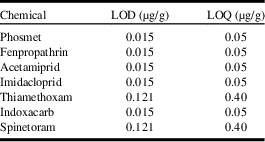
Blueberry cultivar “Jersey” fruit (minimum of 20 fruit per replicate) were collected from treated batches of fruit from the blueberry maggot trial described above, and held for 24 hours before being frozen as composite samples per treatment compound for residue analysis (Table 1). Preceding residue analysis, berries were dissected in a −2 °C cold room to separate the skin, outer (1-mm layer) flesh, and inner (1-mm layer) flesh near the centre. Frozen fruit were cut in half with a razor blade, and a 5 mm diameter cork borer was used to cut cores from the inside of the berries out through the skin. Flesh sections were cut with a razor blade. Approximately 0.5 g of material from four to five fruits was dissected for each section for each treatment compound. After sectioning, samples were held in 10 mL of dichloromethane at −20 °C until residue analysis modified from the protocol developed by Wise et al. (Reference Wise, VanderPoppen and Vandervoort2009). Dichloromethane and fruit samples were homogenised (model Pro200; Proscientific Inc., Monroe, Connecticut, United States of America), rinsed with additional dichloromethane (3 by 20 mL) and run through a sodium sulfate column to remove water. The column was rinsed with two 20 mL volumes of dichloromethane. Each collected extract was rotary evaporated to reduce the volume to 2-mL and placed in a 2.5-mL gas chromatography (GC) vial.
The limit of detection (LOD) and limit of quantitation (LOQ) values for each treatment compound in 2009 residue analysis.
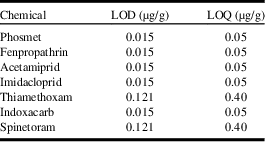
Note: The LOD and LOQ recoveries ranged from 50% to 150%.
Thiamethoxam, imidacloprid, and spinetoram residues were determined using a 2690 separator module high-performance liquid chromatograph, with a 2487 dual-wavelength absorbance detector (Waters, Milford, Massachusetts, United States of America). The column was a C18 reversed-phase column with 4.6-mm bore and 5-mm particle size. Flow rates were set at 1 mL/minute. The mobile phase started at 90:10 water:acetonitrile with formic acid (0.01%) and reduced to 70:30 between 12 and 13 minutes at 35 °C. The detector was set at 255 nm. Gas chromatography analysis was used for phosmet, fenpropathrin, acetamiprid, and indoxacarb. The equipment used was a Hewlett Packard 6890 GC with a 5973 N mass spectra detector (Agilent Technologies, Santa Clara, California, United States of America). The column was a Zebron ZB-5ms 30 m, 0.25 mm i.d. with 0.25-µm film thickness. The oven temperature program was five minutes at 115 °C, ramp of 9 °C/minute to 280 °C, and ramp of 30 °C/minute to 310 °C. The inlet was kept in pulsed splitless mode at 200 °C, with 78 324 Pa and a pulse pressure of 103 421 Pa. The purge flow (helium) was 50 mL/minute. The mass detector was set to scan at a minimum of 28 daltons up to the maximum molecular mass of the molecule of interest. Areas under the chromatographic curve were integrated for the compounds of interest. Standard curves and initial sample masses were used to determine ppm recoveries (micrograms of analyte per g of sample). Limit of detection and limit of quantitation and their recoveries are described in Table 1.
Data analysis
For all of the insect bioassays with one time of assessment, the comparison of treatments was done using analysis of various (ANOVA) under a complete randomised experimental design, and mean separations using Tukey’s honest significance test (α=0.05) (JMP Version 8; SAS Institute 2010, Cary, North Carolina, United States of America). For the spotted-wing drosophila trials with different treatments and time steps, the data were analysed using a two-way ANOVA (JMP Version 8; SAS Institute 2010). In the spotted-wing drosophila trials different larval sizes were analysed separately, and as the total number of spotted-wing drosophila (sum of the small larvae, large larvae, and pupae). For comparisons of total recovered blueberry maggot pupariae, data were square root (x+0.05) transformed before analysis.
Results
Blueberry maggot trials
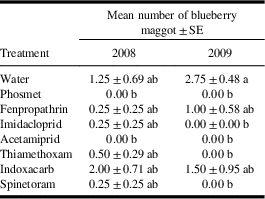
In 2009, topical treatments of phosmet, acetamiprid, clothianidin, imidacloprid, acetamiprid, thiamethoxam, and spinetoram to blueberry maggot infested fruit significantly reduced larval emergence compared with the water control (F=5.69, df=7, 24, P=0.0006) (Table 2). Due in part to the variability in our water control, none of the materials tested in 2008 showed significant reductions, although phosmet and acetamiprid treatments resulted in zero larval emergence. Fruit treated with indoxacarb or fenpropathrin did not reduce blueberry maggot larval emergence in either of the two trial years.
Lethal activity of insecticides on blueberry maggot, Rhagoletis mendax, from topically treated fruit one-day post-harvest.

Note: Values are the cumulative total recovered puparia over the 45-day emergence period. Values in a column followed by the same letter are not significantly different (P<0.05).
Spotted-wing drosophila trial
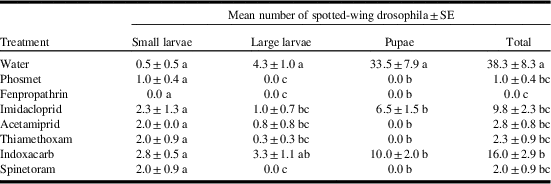
Topical treatments of phosmet, fenpropathrin, acetamiprid, clothianidin, imidacloprid, acetamiprid, thiamethoxam, and spinetoram to spotted-wing drosophila infested fruit significantly reduced the incidence of large larvae, compared to the water control (F=6.34, df=7, 24, P=0.0003) (Table 3). Only phosmet, fenpropathrin, and spinetoram treatments resulted in zero large larvae being recorded in the evaluation. None of the materials tested reduced the number of small larvae, compared to the water control. All treatments significantly reduced the numbers of spotted-wing drosophila pupae, compared with the water control (F=15.46, df=7, 24, P=0.0001). All treatments significantly reduced the total number of spotted-wing drosophila compared with the water control (F=15.68, df=7, 24, P=0.0001). Only fenpropathrin-treated fruit resulted in zero incidence of any spotted-wing drosophila life-stage being found in the evaluation.
Infestation of highbush blueberry berries with spotted-wing drosophila, Drosophila suzukii, larvae of different stages after insecticides were applied to berries one day after exposure to adult flies.
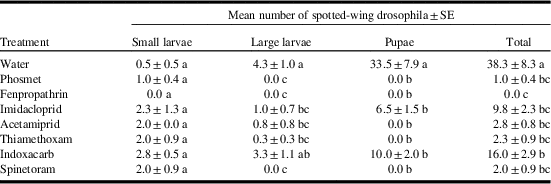
Values within the same column that are followed by the same letter are not significantly different (P>0.05).
Temporal delay spotted-wing drosophila trial
The two-way ANOVA indicated a much stronger effect of insecticide treatment on the number of spotted-wing drosophila (F=121.4, df=7, 72, P<0.0001) than the effect of time since infestation (F=2.1, df=2,72, P=0.13). There was no evidence of an interaction between treatment and time since infestation (F=0.24, df=14, 72, P=0.99), indicating that the treatment effect was similar whether the flies had infested the berries one, three, or five days before the treatment.
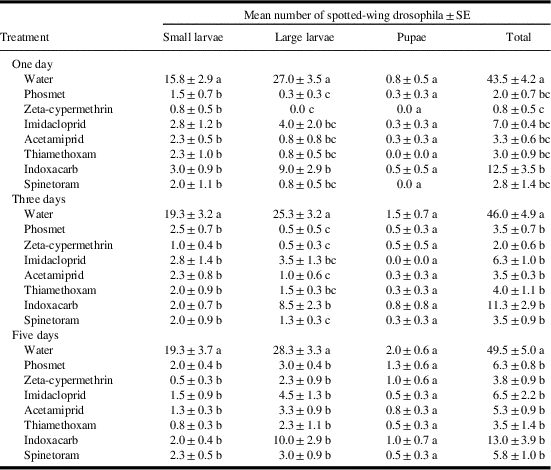
In the one-day post-exposure fruit evaluation, all treatments significantly reduced the numbers of spotted-wing drosophila small larvae, compared with the water control (F=14.08, df=7, 24, P=<0.0001) (Table 4). All treatments significantly reduced the numbers of large spotted-wing drosophila larvae, although higher numbers were recorded in indoxacarb-treated fruit than for phosmet and zeta-cypermethrin (F=26.7, df=7, 24, P=<0.0001). All treatments significantly reduced the overall incidence of spotted-wing drosophila life-stages, although higher numbers were recorded in indoxacarb-treated fruit than for zeta-cypermethrin (F=37.7, df=7, 24, P=<0.0001).
Infestation of highbush blueberry berries with spotted-wing drosophila, Drosophila suzukii, larvae of different stages after insecticides were applied to berries one, three, or five-days post-exposure to adult flies.

Values within the same column and time after infestation duration that are followed by the same letter are not significantly different (P>0.05).
In the three-day post-exposure fruit evaluation, all treatments significantly reduced the numbers of small spotted-wing drosophila larvae, compared with the water control (F=19.3, df=7, 24, P=<0.0001) (Table 4). All treatments significantly reduced the numbers of spotted-wing drosophila large larvae, although higher numbers were recorded in indoxacarb-treated fruit than for phosmet, zeta-cypermethrin, acetamiprid, and spinetoram (F=31.8, df=7, 24, P=<0.0001). All insecticides also reduced the overall incidence of spotted-wing drosophila life-stages (F=47.3, df=7, 24, P=<0.0001).
In the five-day post-exposure fruit evaluation, all treatments significantly reduced the incidence of small spotted-wing drosophila larvae, compared with the water control (F=20.2, df=7, 24, P=<0.0001) (Table 4). All treatments significantly reduced the numbers of large spotted-wing drosophila larvae (F=26.4, df=7, 24, P=<0.0001). All treatments significantly reduced the overall incidence of spotted-wing drosophila life-stages (F=38.2, df=7, 24, P=<0.0001).
Insecticide penetration in fruit
Fruit penetration patterns varied among insecticides tested (Fig. 1). The active ingredient recovered (µg AI/g of blueberry substrate) for each compound were as follows: phosmet 0.84 (skin – 0.477, outer – 0.147, inner – 0.219); fenpropathrin 0.93 (skin – 0.925, outer – 0.003, inner – 0.001); imidacloprid 0.94 (skin – 0.277, outer – 0.052, inner – 0.611); acetamiprid 0.44 (skin – 0.161, outer – 0.073, inner – 0.209); thiamethoxam 0.8 (skin – 0.4, outer – 0.1, inner – 0.3); indoxacarb 0.03 (skin – 0.03); spinetoram 0.88 (skin – 0.536, outer – 0.214, inner – 0.133). For fenpropathrin and indoxacarb, the vast majority of active ingredient was recovered in the blueberry skin, with only minimal residues of fenpropathrin detected in the fruit flesh. For the neonicotinoids imidacloprid, acetamiprid, and thiamethoxam, 50% or more of the recovered residues were found in the flesh regions of the fruit. For phosmet and spinetoram even though the largest proportions of active ingredient were recovered in the skin, considerable amounts of residues were also detected in all inner and outer flesh regions of the fruit.
Penetration of insecticides into blueberry fruit, presented as the proportion of mean active ingredient recovery in the skin, outer 1 mm of flesh, inner 1 mm flesh. The actual values of active ingredient recovered (µg AI/g of blueberry substrate) for each compound are provided in the results section.
Discussion
This study demonstrates varying degrees of curative insecticidal activity of Diptera pests in blueberry fruit provided by insecticides, depending on the compound and target pest. The three neonicotinoids as well as phosmet and spinetoram showed a consistent capacity to kill blueberry maggot and spotted-wing drosophila post-infestation, independent of the timing of their application relative to when fruit were infested. Residue profiles support these results with clear evidence of active ingredient being present in the blueberry flesh regions necessary to provide toxicity to eggs or larvae of these pests. Wise et al. (Reference Wise, VanderPoppen and Vandervoort2009) reported a similar pattern of activity when testing insecticides against apple maggot (post-infestation) in apples, except that spinetoram did not penetrate fruit sufficiently to provide control. In this study, fenpropathrin and indoxacarb did not show curative effects on blueberry maggot, again matching the results for apple maggot in apples (Wise et al. Reference Wise, VanderPoppen and Vandervoort2009).
In contrast to the results for R. mendax, fenpropathrin (and zeta-cypermethrin) showed high levels of post-infestation activity on spotted-wing drosophila in our blueberry study, emphasising that not all insecticides with activity against one of these pests will be active against the other. Indoxacarb also showed limited activity in the temporal delay spotted-wing drosophila trial, although often at statistically lower levels than the top performing treatments. Since for fenpropathrin and indoxacarb the residue profiles showed active ingredients to be limited primarily to the fruit epidermis, there may be other explanations for the results. Oviposition by spotted-wing drosophila results in eggs being deposited below the fruit skin, but the egg filaments generally protrude out of the fruit (Okada Reference Okada1968). The hole made during oviposition and the position of these filaments may allow topically applied residues to partition more easily to the main part of eggs in the subsurface region of the flesh. Therefore, the degree of fruit penetration by the insecticide needed to attain toxic exposure may be less for spotted-wing drosophila than for blueberry maggot.
The temporal delay study provides some practical insights into how late a grower’s spray may be applied and still provide curative activity on spotted-wing drosophila. Even though all compounds showed statistically significant curative effects at one, three, and five-day delays after treatment, there was no significant effect of time post-infestation. There was, however, a trend for increasing incidence of large larvae surviving across all treatments as the post-infestation application was delayed, suggesting that the risk of contamination detection would increase the longer post-infestation that treatments were applied. This is likely a consequence of larger spotted-wing drosophila being deeper in the tissue but we also expect that as larval mass increases a higher proportion of larvae will survive the insecticide residues in the fruit flesh. Hoffmann et al. (Reference Hoffmann, Vandervoort and Wise2009) showed similar diminishing effects of curative sprays on plum curculio in cherries, but with some neonicotinoid compounds continuing to kill large larvae up to 14 days post-infestation. Thus, when inclement weather conditions or other unforeseen circumstances prevent an optimally timed spray to protect berries from these pests, there can still be some potential for reducing the incidence of live larvae in harvested fruit.
A curative spray for blueberry maggot or spotted-wing drosophila is not recommended as a first choice stand-alone tactic for blueberry IPM, and when used must follow the labelled pre-harvest intervals to assure residues at harvest fall within tolerance. But when real-world factors disrupt timely applications to prevent infestation of the crop, using the penetrative and curative capabilities of these insecticides can hold value for commercial blueberry producers. Our results indicate that a delayed spray will not result in completely insect-free fruit, but it can prevent survival of larvae and reduce the likelihood that larval contamination will be detected. For blueberry growers who farm under a zero-tolerance mandate for insects or insect parts in fruit that is enforced by processors or buyers, this could save them from rejection of a load of fruit. Growers selling to the smaller farm market type of customer would also be able to reduce the likelihood of customer complaints. These findings also highlight that an insecticide’s contribution to IPM is not limited to its direct lethal activity on the adult life stage, but also to other modes of activity that ultimately reduce the pest population, protect the crop from injury, and lower the risk of load rejection due to contamination by native or invasive insect pests.
Acknowledgements
The authors thank Jason Seward and the farm staff of the Michigan State University Trevor Nichols Research Center, Elizabeth Monarch for preparing fruit samples for residue analysis, and Craig Roubos and Steve Van Timmeren of the Department of Entomology at Michigan State University for their technical assistance in carrying out this research. We also acknowledge the contribution of test substances from the following agrichemical companies: Bayer CropScience, Syngenta Crop Protection, Dow AgroSciences, FMC Corp., United Phosphorous Inc., Valent USA, and DuPont Crop Protection. This research was supported in part by funding from Project GREEEN (Generating Research and Extension to meet Economic and Environmental Needs) at Michigan State University, The Blueberry People - MBG Marketing, and by United States Department of Agriculture Crops at Risk grant 2009-51100-20105 to R.I.