

Do economic perceptions affect voters’ electoral preferences? There exists overwhelming evidence showing that voters tend to punish or reward incumbents based on how they perceive the state of the national economy (Kinder, Adams and Gronke 1989; Alvarez and Nagler 1995; Duch and Stevenson Reference Duch and Stevenson2008; Nadeau, Lewis-Beck and Bélanger 2013). Of the over 400 studies on economic voting conducted, the large majority have found that voters are more likely to take into account the national economic situation (sociotropic voting) than their own personal well-being (egotropic voting) when selecting a candidate (Lewis-Beck and Stegmaier Reference Hellwig and Samuels2007).
Despite the abundant and consistent evidence supporting the sociotropic voting hypothesis, this argument has been called into question in the last decade. A causal link between national economic perceptions and political preferences may be mistakenly identified for three main reasons. First, there might be a reverse causality issue: specifically, political preferences can influence how voters evaluate the current national economic situation (Erikson Reference Erikson2004). For example, Evans and Andersen (Reference Evans and Pickup2006) find that retrospective macroeconomic perceptions are conditioned by prior opinions of the incumbent party. Second, regression models tend to adjust for a set of independent variables that predict the outcome (voting for the incumbent), but rarely include covariates that predict treatment assignment (reporting a deterioration or improvement of national economic conditions). For instance, the main specification proposed by Nadeau, Lewis-Beck and Bélanger (2013) is based on voters’ class, religion, ideology, and economic perceptions. However, it fails to include a large number of covariates that can make voters more vulnerable to economic shocks such as working in the informal sector, age, education, gender, etc. Though the omitted variable problem is always a threat in observational studies, it can be more harmful when specifications tend to disregard factors that might affect the probability of receiving the treatment. Finally, most of these studies are based on survey data; therefore covariates, treatment, and outcomes are captured at the same time. This leads to post-treatment biases. The covariates used to adjust a regression line can be affected by the treatment. For example, traditional specifications control for voter social class, which can be affected by periods of economic booms or busts.
Most of these problems have been already identified by the literature, and two main solutions have been implemented. The revisionists of economic voting have used structural equation models to show how political views affect economic perceptions (Evans and Andersen Reference Evans and Pickup2006; Evans and Pickup Reference Evans and Andersen2010). Meanwhile, defenders of economic voting have based their responses on the use of instrumental variables and/or panel data using lagged voters’ political views (Lewis-Beck, Nadeau and Elias 2008; Hansford and Gomez Reference Hansford and Gomez2015).
Some of these approaches are based on statistical models that require very strong assumptions. Freedman summarizes the perils of using mathematical equations to adjust for confounding: “these equations may appear formidably precise, but they typically derive from many somewhat arbitrary choices” (Reference Freedman2005, 19). An alternative to this is a design-based approach, which emphasizes design rather than statistical modeling (Keele Reference Keele2015).
A randomized control experiment is the most powerful method to identify causal effects. However, economic voting cannot be investigated by assigning negative financial conditions to voters to then see their electoral choices. Therefore, one of the alternatives is a carefully designed observational study.
In observational studies the threat to validity from unobserved covariates is always present; however, it is possible to reduce sensitivity to hidden biases by controlling certain aspects of the design (Rosenbaum Reference Rosenbaum2011). I follow two recommendations provided by the statistical theory of design sensitivity to select a study design expected to be less sensitive to unobserved biases: reducing unit heterogeneity and using an extreme exposure to the treatment.
I focus on Brazil as a case study using the Two City Panel Study (Baker, Ames and Renno 2006; Baker et al. 2015), whose first wave was conducted in March 2002. The geographic constraints of this study allows for a more credible comparison of different voters since they are coming from the same natural blocks.
I study the role economic perceptions play in voters’ electoral choices, and in particular, how a change in their economic evaluations can make them punish the incumbent. Most previous studies have focused on egotropic and sociotropic evaluations as the independent variables of interest. In contrast, I use the change in people’s perceptions about the economy as the treatment, rather than their plain evaluations. Why would voters modify their impressions about the economy in only three months (time between the first and second wave)? There are multiple factors that might change citizens’ evaluations, such as recent unemployment, deterioration of income, a decrease in macroeconomic indicators, or exposure to mass media. I do not focus on possible explanations for the variation in perceptions, but rather on the change itself.
I use recent advancements in optimal multivariate matching to generate comparable groups of voters balanced on a large number of observed covariates. Additionally, I include a sensitivity analysis for unmeasured biases to assess the magnitude of this problem (see Supplementary Appendix). I pay close attention to the research design, attempting to generate a credible comparison of voters from the same natural blocks, with similar distributions of observed covariates and under very different treatment conditions. However, a change in voters’ economic perceptions (treatment) can still be explained by a change in their political preferences (outcome). I check the implications of this reverse causality problem in sixth section.
According to previous literature on economic voting in Latin America, national economic considerations are a very relevant factor when explaining voters’ electoral decisions. Lewis-Beck and Ratto (Reference Lewis-Beck and Ratto2013) and Singer and Carlin (Reference Singer and Carlin2013) find strong sociotropic voting in the region. Ames, Baker and Renno (Reference Ames, Baker and Renno2008, 164), using the Two City Panel Study, find that sociotropic voting is “statistically significant but only mild in substantive impact,” while “pocketbook assessments had no effects on any candidacies” in the 2002 presidential race in Brazil. In this paper I use the same data, but by using a design that attempts to address the endogeneity concerns and to reduce validity threats from unmeasured biases, I find the exact opposite results. Regarding personal economic perceptions (egotropic voting), a change from “remained the same” to “much worse” decreases the chances of voting for the incumbent by 12 percentage points. Meanwhile, the same change in the national economic perceptions (sociotropic voting) has an effect indistinguishable from 0. Additionally, when checking for reverse causality issues, I find that a change in voters’ political preferences (a defection from the incumbent) does not have an impact on voters’ egotropic considerations, but does affect their sociotropic evaluations.
This article’s findings contribute to the economic voting literature, and in particular they show the importance of egotropic considerations in the developing world. Citizens from lower socioeconomic contexts should be more sensitive to changes in their income than citizens from developed countries because these events are likely to have a more meaningful effect on their living conditions. The findings challenge the empirical consensus that sociotropic evaluations are more relevant than egotropic perceptions when explaining voters’ electoral choices (Duch Reference Duch2007; Lewis-Beck and Stegmaier Reference Hellwig and Samuels2007; Singer and Carlin Reference Singer and Carlin2013). This paper also contributes to the discussion about how to address endogeneity problems, and in particular how research design can help to reduce sensitivity to biases from unmeasured sources. Additionally, it adds to a growing literature that fosters the use of design-based approaches.
This paper is organized as follows. First, I discuss the endogeneity problem between political preferences and economic perceptions, and the solutions proposed by the literature. Second, I present the theoretical expectations about the role of economic perceptions in Latin America. Third, I present the research design, and the matching technique used in this analysis. Fourth, I show the results for both treatments, the empirical implications of the reverse causality problem, and the results using a traditional approach. Fifth, I provide evidence from the Mexico 2012 Panel Study (Greene Reference Greene2012) to improve external validity. Additionally, I conduct in the Supplementary Appendix a sensitivity analysis for unmeasured biases, and a robustness check using a different sample.
Economic Voting and Endogeneity Problems
Most empirical findings show that the economy has a significant effect on electoral outcomes. The causal mechanism is quite simple: citizens vote “for the government if the economy is doing all right; otherwise, the vote is against” (Lewis-Beck and Stegmaier Reference Lewis-Beck and Stegmaier2000, 18). However, economic voting is contingent on countries’ institutional design, voter sophistication, and the context in general, since these factors might blur the attribution of responsibilities or modify the issue salience (Powell and Whitten 1993; Duch, Palmer and Anderson 2000; Anderson 2007; Hellwig and Samuels 2008; Alcañiz and Hellwig 2011; Singer Reference Singer2013).
The main methodological challenge when studying the effects of economic perceptions and electoral choices is the endogeneity problem. In particular, reverse causality and omitted variables can introduce biases. Traditional analyses are based on the assumption that voter evaluations of the economy are exogenous to the vote choice (Erikson Reference Erikson2004). However, political preferences can influence respondents’ perceptions about the economy (Evans and Andersen Reference Evans and Pickup2006). Adding controls to the regression equation will not solve this problem because economic evaluations will keep being endogenous to voters’ electoral choices.
The use of instrumental variables has emerged as a possible solution to the endogeneity problem. Lewis-Beck, Nadeau and Elias (Reference Lewis-Beck, Nadeau and Elias2008) construct an instrument for party identification using race, age, gender, education, income, religion, religion observance, and union membership. They argue that “when party identification is properly measured, under conditions approximating pure exogeneity, its impact on the vote barely surpasses that of national economic evaluation.” The authors also generate an instrument for national economic perceptions using demographic and socioeconomic variables, political interest, and pocketbook evaluations. Meanwhile, Hansford and Gomez (Reference Hansford and Gomez2015) use real economic conditions (county income and unemployment rates) as an instrument of economic perceptions. However, it is hard to believe that the exclusion restriction assumption can be held in these situations. The instrument can only affect the outcome through the endogenous independent variable. Nevertheless, demographic characteristics, socioeconomic variables, and economic conditions can have a direct effect on the outcome. In other words, there are multiple back-door paths from the instrumental variable to the dependent variable (Sovey and Green Reference Sovey and Green2011). For example, unemployment can affect the vote choice by modifying how people evaluate the economy (Hansford and Gomez Reference Hansford and Gomez2015), but also by increasing support for welfare policies (Margalit Reference Margalit2013).
A second empirical strategy for addressing the endogeneity problem is to use structural equations models (SEM) (Evans and Andersen Reference Evans and Pickup2006; Evans and Pickup Reference Evans and Andersen2010). This approach is useful for observing the reverse causality between economic evaluations and political preferences. Evans and Andersen (Reference Evans and Pickup2006) find that economic perceptions are strongly conditioned by prior opinions of the incumbent party, which is an important contribution. However, SEM are not the ideal approach if we want to study how economic evaluations affect the vote choice since these equations are quite sensitive to critical assumptions (Little 1985; Angrist, Imbens and Rubin 1996; Steiger 2001) and “do not aim to establish causal relationships from associations alone” (Bollen and Pearl Reference Bollen and Pearl2013, 12). In particular, when using SEM, unobserved biases are still an important threat to the estimation. As Freedman argues: “it is impossible to tell just from data on the variables in it whether an equation is structural or merely an association. In the latter case, all we learn is that the conditional expectation of the response variable shows some connection to the explanatory variables” (Reference Freedman1987, 103).
Finally, experimental evidence has emerged as the best alternative to solve the problems previously described. Tilley and Hobolt (Reference Tilley and Hobolt2011) randomly assign information about economic performance and attribution of responsibilities to survey respondents. Alt, Marshall and Lassen (2016) provide similar evidence by randomly varying whether voters receive an aggregate unemployment forecast from the central bank, government, or main opposition party. Both survey experiments generate credible results since they provide unbiased estimates of the treatment effects. However, they estimate the effect of extra pieces of information about the performance of the economy, but not the effect of a change in voters’ economic evaluation. In this paper, I do not study how citizens react to new information or knowledge (which can be randomized), but what the effects of a change on their perceptions are (which cannot be randomized). Therefore, a carefully designed observational study using panel data is an alternative for learning about this particular treatment.Footnote 1
Sociotropic and Egotropic Perceptions in Latin America
In Latin America, the economy plays a crucial role in voters’ political choices. A plurality of respondents tend to select the economy as the most important problem in their respective countries (Singer Reference Singer2013; Gélineau and Singer Reference Gélineau and Singer2015), and empirical evidence strongly supports the existence of sociotropic voting (Lewis-Beck and Ratto Reference Lewis-Beck and Ratto2013; Cabezas Reference Cabezas2015; Navia and Soto Reference Navia and Soto2015). For example, Gélineau and Singer (Reference Gélineau and Singer2015) show that a respondent who thinks the economy is improving is 35 percent more likely to vote for the incumbent than one who thinks the economy is deteriorating. In a similar vein, Singer and Carlin (Reference Singer and Carlin2013) find that Latin American voters tend to emphasize the national economy over personal finances.Footnote 2 These findings are congruent with evidence from the developed world showing that sociotropic evaluations tend to trump egotropic economic considerations (Duch Reference Duch2007; Duch and Stevenson Reference Duch and Stevenson2008).
However, I expect the opposite pattern for a developing country such as Brazil. Voters living in places with less economic development are more sensitive to an increase in or reduction of their income because this change is likely to have a more meaningful impact on their lives. They have on average less savings and a weaker welfare network than residents of developed countries. Consequently, voters from poorer countries should tend to prioritize pocketbook considerations. Additionally, they constantly experience changes in their egotropic perceptions, mainly explained by frequent economic shocks such as unemployment and the volatility of household income (Rodrik Reference Rodrik2001).
Additional examples help us understand why egotropic economic perceptions are a relevant factor for electoral decisions in Latin America. For instance, there is evidence that the distribution of conditional cash transfers in Brazil has affected citizens’ electoral decisions. Zucco (Reference Zucco2013) shows that conditional cash transfers are positively associated with the vote share received by the incumbent presidential candidate. Bolsa Familia improved the purchasing power of poorer voters in Brazil (Hunter and Power Reference Hunter and Power2007), which by definition should imply better egotropic economic perceptions. A second example can be found when studying clientelism. In particular, vote buying is a common phenomenon in Brazil (Hidalgo and Nichter Reference Hidalgo and Nichter2015), which means that citizens exchange their votes for private goods delivered by candidates or parties. Consequently, the logic of vote buying is also based on the assumption that pocketbook considerations motivate voters’ electoral decisions. They will reward the candidates who provide them discretionary benefits that can improve their living conditions.
Why does the literature tend to find evidence of sociotropic rather than egotropic voting in Latin America? This primarily occurs because traditional research designs overstate the influence of sociotropic economic evaluations on voting due to endogeneity problems. Voters’ political preferences are not independent from how they perceive the current state of the national economy. In other words, a citizen that supports the incumbent is more likely to think that the economy is good than a non-supporter. A study that accounts for this methodological problem should obtain different results.
What is at stake in this debate between sociotropic and egotropic perceptions? First, we might be misunderstanding the link between economic perceptions and electoral decisions. More specifically, we might be understating the importance of pocketbook considerations in developing countries. Second, if the previous statement is true, an economic crisis does not necessarily mean an erosion of support for the president if she has the capacity to provide financial aid to citizens whose income has deteriorated.
This paper highlights the role of citizens’ pocketbook considerations when making electoral decisions in the developing world, a conclusion that aligns with recent evidence that shows that the decline in Latin American voters’ household income has a negative impact on electoral support of incumbent presidential candidates (Murillo and Visconti Reference Murillo and Visconti2017).
Research Design
Design-Based Approach
Causal inferences can be drawn from observational data, but it is always a hard task and there is not a clear set of rules to follow. One alternative is to use statistical models, but they require strong assumptions (Freedman Reference Freedman2005; Freedman Reference Freedman2006) or tend to rely on extrapolation (Ho et al. 2007). A second alternative is a design-based approach, which represents “a set of techniques that can make identification more credible without the use of parametric statistical models and without using outcomes” (Keele Reference Keele2015, 314). This approach pays close attention to addressing endogeneity concerns (Imbens Reference Imbens2010) and stresses the importance of separating the design from the outcome analysis (Rubin Reference Rubin2008).Footnote 3
To begin, the research design should eliminate biases from measured sources. In the absence of random assignment, the use of adjustment techniques to select comparable groups might reduce or eliminate overt biases (Rosenbaum Reference Rosenbaum2002b). One alternative is to use matching to equate the distributions of observed covariate x between two samples (Cochran Reference Cochran1965). The main goal of matching is to improve or produce balance, which is the degree to which the treatment and control covariate distributions resemble each other (Ho et al. 2007). Like randomized experiments, matching can produce comparable groups in terms of observed covariates, but unlike random assignment, it does not guarantee comparability in terms of unmeasured covariates (Rosenbaum Reference Rosenbaum1998).
After eliminating overt biases, the research design should attempt to reduce biases from unmeasured sources. Individuals that have similar observed covariates prior to any treatment might have systematic non-observed differences. I follow two main recommendations from the statistical theory of design sensitivity, which analytically shows that certain aspects of the design can help reduce sensitivity to biases from unmeasured covariates (Rosenbaum Reference Rosenbaum2004; Rosenbaum Reference Rosenbaum, Ross and Silber2005; Rosenbaum Reference Rosenbaum2010; Rosenbaum Reference Rosenbaum2011).
First, I select individuals from a similar environment to reduce heterogeneity between units. The logic behind this can be illustrated by Mill’s method of difference, which is based on the comparison of two very similar units that differ in one main characteristic. For example, Norvell and Cummings (Reference Norvell and Cummings2002) estimate the effects of using helmets in motorcycle accidents. Their design exploits situations in which two people were riding a bike and only one of them was wearing a helmet. The comparison between these two individuals allows the reduction of the impact of hidden biases coming from failing to control for the characteristics of the accident or the environment.Footnote 4
In the attempt to reduce heterogeneity, and so to improve comparability, I use the data from the Two City Panel Study in Brazil. This survey was conducted in two cities: Juiz de Fora and Caxias do Sul. Both cities have similar levels of educational attainment, wealth, size of electorate, and race (Baker, Ames and Renno 2006).Footnote 5 Therefore, treated and control individuals will only come from these two cities, instead of having a national sample where treated and control individuals might come from multiple cities and from very different social contexts. Brazil is a large and heterogeneous country; therefore focusing on two particular geographic sites might help reduce sensitivity to hidden biases. Matching will allow the achievement of balance not just at the city but also at the neighborhood level.
Additionally, I exploit the structure of the data to reduce heterogeneity. The treatment is generated using the following question: “in relationship to the national economic situation, in the last 12 months this has: (1) improved a lot, (2) improved a little, (3) remained the same, (4) worsened a little, (5) worsened a lot.”Footnote 6 I subset the sample to only voters that answered “remained the same” in time t (or wave 1) to increase comparability.Footnote 7
Second, I select very different treatment conditions to reduce sensitivity to hidden biases. A change in economic perceptions can be interpreted as a dose–response relationship since there exist different levels of exposure among people that report a little, to people that report a much greater deterioration of national or personal economic conditions. The use of a dose–response relationship can produce a largest design sensitivity (Rosenbaum Reference Rosenbaum2011).Footnote 8 For example, Zubizarreta, Cerdá and Rosenbaum (2013) effect study the effects of an earthquake on posttraumatic stress. They define the treatment as living in a county affected by an earthquake with a peak ground acceleration (PGA) above a particularly high threshold. Meanwhile, the control group is composed of counties with a PGA below a low cutoff. This decision generates two extreme treatment conditions, which should produce results that are less sensitive to unmeasured biases. On the other hand, the incorporation of marginal exposures (affected counties but by medium levels of PGA), would generate exactly the opposite effect: making the conclusions more sensitive to hidden variables.
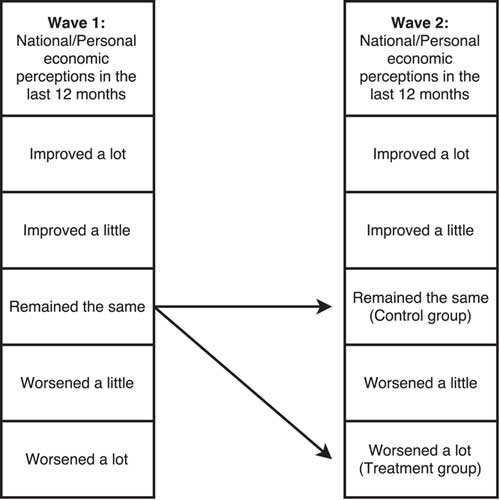
In this paper, I exploit two very different treatment conditions rather than a continuum or a mild treatment that includes small effects. The pre-matching sample for the sociotropic treatment is only composed of voters that claimed that their national economic conditions remained the same in the last 12 months in the first wave. If they answered “worsened a lot” in the second wave they are classified in the treated group, and if they answered “remained the same” they are placed in the control group; all the other observations are discarded. I do not use “worsened a little” to be able to exploit the dose–response relationship of the question. I follow the same strategy with the egotropic question, which instead of asking about the national economic situation asks about personal economic conditions. Therefore, both treatments correspond to a change of opinion from unchanged to much worse from time t to t+1. Meanwhile, the control is composed of people that answered remained the same in time t and time t+1.Footnote 9 The Figure 1 summarizes the research design.
Research design

Additionally, I implement a sensitivity analysis in the Supplementary Appendix. This asks what the unmeasured covariate would have to be like to modify the conclusions of the study (Rosenbaum Reference Rosenbaum2010). In particular, it provides a parameter that measures a hypothetical level of departure from random assignment to see how the conclusions would change as a consequence (Keele Reference Keele2010).
Optimal Multivariate Matching
The goals of matching is to produce treated and control groups that, in aggregate, have similar distributions of some observed covariates x (Rosenbaum Reference Rosenbaum1998). I include 43 covariates from wave 1 in the matching procedure (pretreatment covariates). They can be related to the outcome (voting for the incumbent in wave 2) or treatment assignment (reporting a change in national or economic perceptions from wave 1 to wave 2). For example, I adjust for neighborhood, sociotropic considerations (when using the egotropic treatment),Footnote 10 confidence in politicians, political knowledge, voting for the incumbent, attitudes toward multiple political, social, and economic actors, ideology, previous voting behavior, party identification, age, gender, race, income, education, job type, religion, etc. The details for each covariate are included in the Supplementary Appendix.
I use a recent optimal matching technique called cardinality matching (Zubizarreta, Paredes and Rosenbaum Reference Zubizarreta and Keele2014; Zubizarreta and Keele Reference Zubizarreta2016). This method selects the maximum number of observations that achieve covariate balance. In other words, its main goal is to find the largest matched sample that satisfies the balance constraints imposed by the researcher. The result is an one-to-one pair matched sample that achieves covariate balance by design and not by multiple iterations (Kilcioglu and Zubizarreta Reference Kilcioglu and Zubizarreta2016). The selection of the matched sample might imply discarding the smallest possible number of units required to obtain balance (Zubizarreta, Paredes and Rosenbaum Reference Zubizarreta and Keele2014).Footnote 11
Cardinality matching makes it possible to achieve different types of covariate balance, and certain ones are more restrictive than others. The decision of what type of balance has to be achieved should be based on prior substantive knowledge (Zubizarreta Reference Zubizarreta and Kilcioglu2012), and on the expected relationship between the observed covariates and the outcome (Resa and Zubizarreta Reference Resa and Zubizarreta2016). Some covariates might have more relevance than others; therefore a stronger balance might be recommended for them. Or, some covariates might have a non-linear relation with the outcome; accordingly the balance constraint cannot only focus on the means.
The best, but also more restrictive, approach for balancing nominal or categorical covariates is exact matching. The logic behind this technique is to match every treated unit to one control with the same value of a nominal covariate while exactly balancing the marginal distribution of that covariate (Rosenbaum Reference Rosenbaum2010). However, when the covariates are high dimensional, exact matching will imply a large pruning of observations. Strict requirements to obtain a matched sample often leads to many units not being matched (Stuart Reference Stuart2010). Similarly, fine balance entails balancing the marginal distributions of the treated and control groups exactly in aggregate, but without constraining who is paired with whom (Rosenbaum, Ross and Silber Reference Rosenbaum2007). When exact matching or fine balance are not feasible, it is possible to obtain near-exact and near-fine balance (Zubizarreta Reference Zubizarreta and Kilcioglu2012).
The ideal, but also more restrictive, matching for continuous covariates is the Kolgomorov–Smirnov balance, which attempts to make the entire distribution of the covariates close to each other (Zubizarreta Reference Zubizarreta and Kilcioglu2012). When this type of balance is too restrictive, it is possible to conduct a mean balance, which constrains the standardized differences in means between both groups.Footnote 12
Because of the large number of pretreatment covariates and the small number of observations (912 for personal economic conditions and 453 for national economic conditions), I use mean balance for 36 covariates.Footnote 13 I use exact matching for the most important predictor of the outcome: voting for the incumbent. Meanwhile, I use near-fine balanceFootnote 14 for all the nominal covariates to have similar frequencies (neighborhood, party identification, race, religion, who do you think will win the election, and how did you vote in the last presidential election).Footnote 15
After obtaining two matched samples, I test the treatment effects of a change in national economic perceptions (the sociotropic hypothesis), and on personal economic perceptions (the egotropic hypothesis), using the following specification with cluster standard errors at the neighborhood level:
 $$Y_{{it{\plus}{\rm 1}}} {\rm {\,\equals\,}}\alpha {\plus}\beta _{{\rm 1}} T_{{it{\plus}{\rm 1}}} {\plus}\beta _{{\rm 2}} X_{{it}} {\plus}\sigma _{n} {\plus}{\varepsilon}_{i} ,$$
Y is a binary indicator that represents the vote for the incumbent candidate José Serra in wave 2; X describes a set of covariates from wave 1 that might be predictors of the outcome (i.e., voting for the incumbent, ideology, and incumbent’s feeling thermometer); and T depicts the treatment (a change in economic perceptions from wave 1 to 2). Finally,
 $$\sigma _{n} $$
are neighborhood fixed effects. Additionally, I also provide the unadjusted estimates to show that results do not depend on the specification.Footnote
16
Results Design-Based Approach
The first goal is to obtain two matched samples. For the egotropic sample, there are 797 subjects in the control group and 115 in the treated group. The matching procedure generates a matched sample with 109 individuals in each group. Meanwhile, for the sociotropic sample, there are 259 subjects in the control and 194 in the treated. The matching procedure generates a matched sample with 158 individuals in each group. Cardinality matching maximizes the size of the sample that achieves the mean, exact, and near-fine balance constraints imposed beforehand.Footnote 17
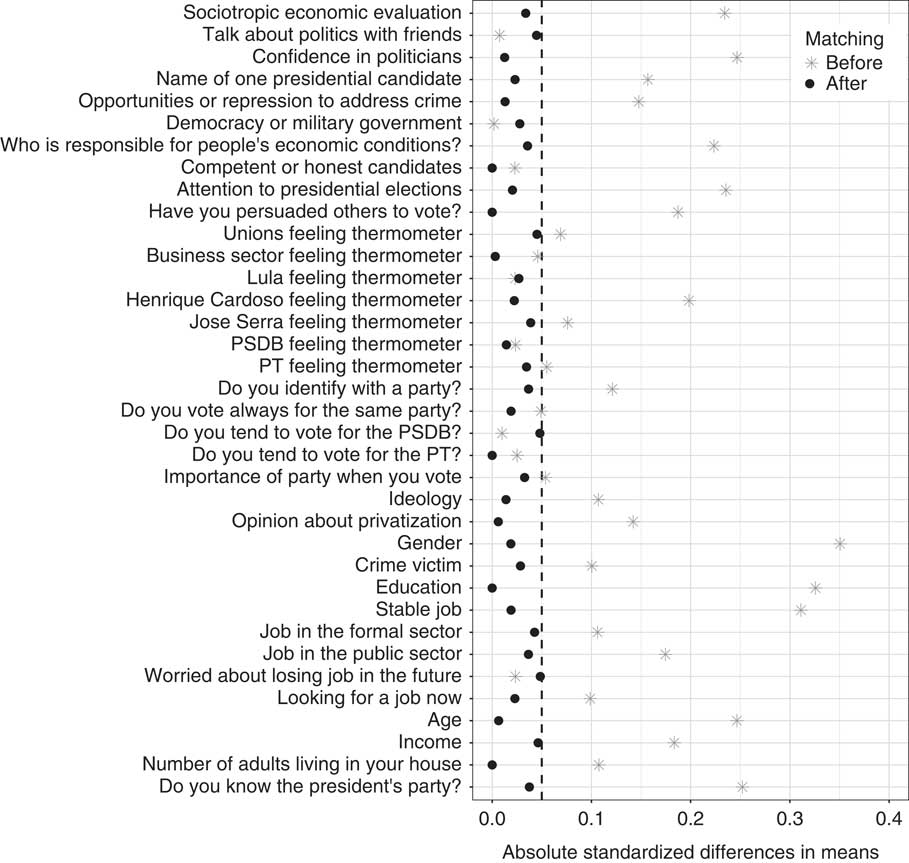
The Figure 2 represents the absolute standardized differences between treated and control groups before and after matching for all the pretreatment covariates mean-balanced (in the egotropic sample).Footnote 18 The tolerance for imbalances does not allow differences >1/20 of a standard deviation.
Mean balance (egotropic sample) PSDB, Brazilian Social Democratic Party; PT, Workers’ Party

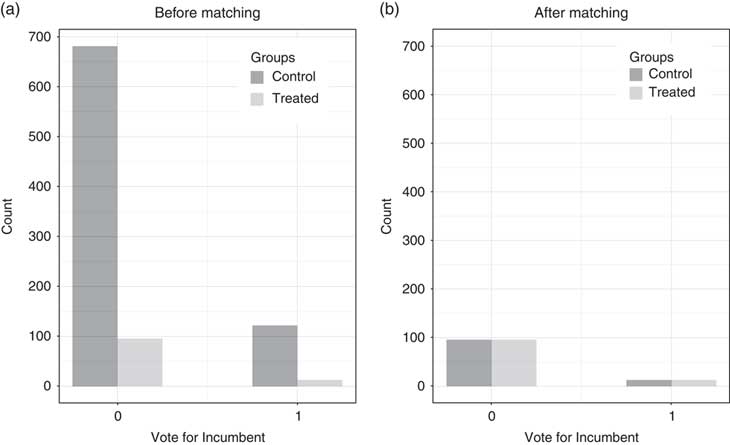
I use exact matching for the binary indicator of voting for the incumbent (pretreatment) in the next election; therefore I balance the marginal distribution exactly in aggregate but also pair individuals with the same preferences. The plot 3 shows how the treated and the control groups have the same number of subjects per category after matching. Exact matching implies pairing subjects with the same attributes, and therefore balancing their means and distributions (Figure 3).
Exact matching for “voting for the incumbent” (egotropic sample)

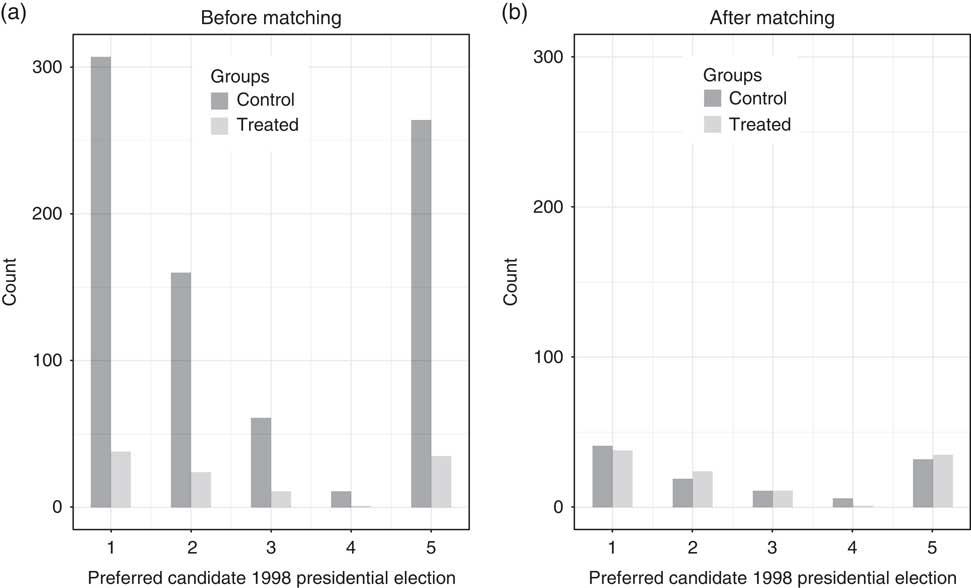
The design includes some nominal pretreatment covariates that cannot be incorporated into the mean balance constraints. One option is to use fine balance; however, this is too costly in terms of pruning observations.Footnote 19 A more flexible alternative is near-fine balance, which tolerates some discrepancies between categories. I use this type of balance for all the nominal covariates, such as race, religion, etc. The graph 4 illustrates how near-fine balance is working for voters’ electoral choices in the 1998 presidential election (1: Fernando Henrique Cardoso, 2: Luiz Inácio Lula da Silva, 3: Ciro Gomes, 4: Enéas Carneiro, 5: Other) (Figure 4).Footnote 20
Near-fine balance for “Who do you think will be the next president” (egotropic sample)

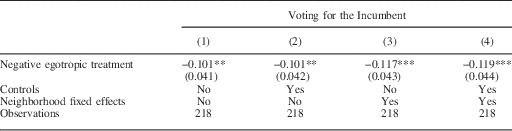
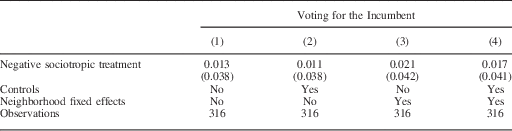
After obtaining two matched samples, I implement the specification previously described to estimate the effects of the egotropic and sociotropic treatments. The following tables report the outcome analyses. Column 4 shows the results for the main specification. Meanwhile, column 1 does not include controls and fixed effects; column 2 only includes controls; and column 3 only include fixed effects. All the models have cluster standard errors at the neighborhood level (Table 1).
Regression Results Egotropic Treatment

Note: *p<0.1, **p<0.05, ***p<0.01.
The egotropic treatment has a negative effect on the probability of voting for the incumbent in the next election (Table 2).
Regression Results Sociotropic Treatment

Note: *p<0.1, **p<0.05, ***p<0.01.
However, there is no evidence of the same effect for the sociotropic treatment. These findings challenge those of a previous study that tested the same hypotheses using the same data (Ames, Baker and Renno Reference Ames, Baker and Renno2008). That study found evidence that supported sociotropic, rather than egotropic voting, by using a traditional research design.
Reverse Causality
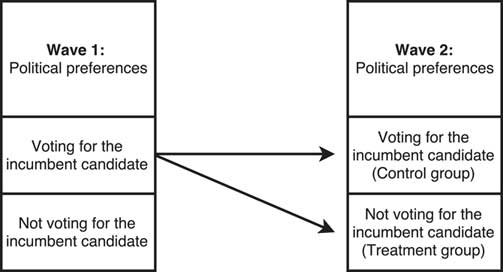
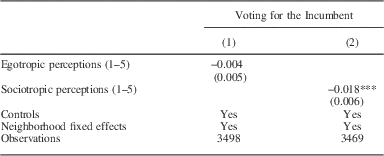
Even though this study focuses on voters with neutral economic perceptions in wave 1 and uses exact matching for voting for incumbent in wave 1, it is still possible that the outcome (voting for the incumbent in wave 2) is explaining the treatment (change in perceptions between wave 1 and 2). To check the implications of this concern I estimate the effects of defecting from the incumbent between wave 1 and 2 on egotropic and sociotropic perceptions in wave 2. If the treatment has a significant effect on the outcomes, it means that both variables are endogenous.
The Figure 5 describes the design used to evaluate the reverse causality problem. The treatment is a change in voters’ political preferences: in particular, for defeating the incumbent.
Research design reverse causality

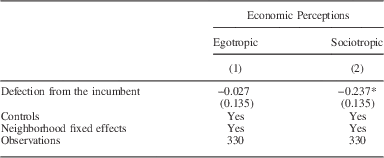
After obtaining a matched sample, I use a variation of the Equation 1 to estimate the effect of the treatment on respondents’ economic evaluations (Table 3).Footnote 21
Regression Results Defection From the Incumbent

Note: *p<0.1, **p<0.05, ***p<0.01.
Defecting from the incumbent is not having a significant effect on voters’ egotropic economic perceptions. Therefore, the results from fifth section are more credible since they should not be explained by a reverse causality problem. However, the treatment is having a substantive and significant effect on voters’ sociotropic economic evaluations. This reinforces the concerns about using perceptions of the state of the national economy as an explicative variable since it is highly correlated with voters’ political preferences.
Traditional Approach
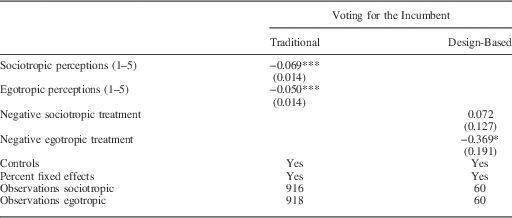
The research design attempts to directly reduce sensitivity to hidden biases by decreasing heterogeneity and using extreme doses. What happen if we do not follow that approach? A traditional design would test the effect of sociotropic and egotropic perceptions without focusing on voters that changed their opinion from wave 1 and using mild treatments (e.g., worsened a little). That comparison is very likely to be endogenous because it incorporates voters that never had neutral views about the economic conditions. The economic evaluations used in the analysis are: 5: “Worsened a lot,” 4: “Worsened a little,” 3:“Remained the same,” 2: “Improved a little,” and 1: “Improved a lot.” This traditional approach does not rely on matching to achieve covariate balance and uses the specification described in Equation 1 to estimate the effects of economic perceptions (Table 4).
Regression Results Traditional Approach

Note: *p<0.1, **p<0.05, ***p<0.01.
The results are exactly the opposite than those obtained using a design that attempts to reduce sensitivity to hidden biases. The negative sociotropic perception significantly decreases the probability of supporting the incumbent, while the negative egotropic perception does not have a significant effect on the same outcome. Results from the traditional approach are congruent with the Ames, Baker and Renno (Reference Ames, Baker and Renno2008) findings using this data, and with the general expectations of economic voting literature in Latin America (Ratto Reference Ratto2013; Singer and Carlin Reference Singer and Carlin2013).
External Validity
Is there something different about the matched samples or about the year the Two Cities Panel Study was conducted? In this section, I attempt to provide answers to these questions by studying the electoral consequences of economic perceptions using the Mexico 2012 Panel Data (Greene Reference Greene2012).
I use a traditional and a design-based approach to show the impact of sociotropic and egotropic perceptions when voting for the incumbent. The results show, as expected, that sociotropic considerations are overstated by a traditional approach (when not focusing on reducing heterogeneity, not exploiting extreme exposure to the treatment, and not achieving covariate balance), and that egotropic perceptions have a relevant impact on citizens’ electoral preferences when using a design-based approach (see more details in the Supplementary Appendix). It is important to remember that coefficients from the traditional and design-based approach are not directly comparable because the treatments are different (ordinal versus binary indicator) (Table 5).
Mexico 2012 Panel Study

Note: *p<0.1, **p<0.05, ***p<0.01.
Conclusions
An observational study is an attempt to estimate the effects of a particular treatment when randomization is infeasible or unethical (Cochran Reference Cochran1965). Matching will allow removing overt biases, but unobserved biases will always be a threat in any observational study. However, there are different tactics to address the problems associated with the existence of unmeasured sources of biases. In this paper, I focus on reducing the heterogeneity of the sample, and on using a dose–response relationship.
The literature on economic voting has found consistent evidence of a correlation between sociotropic perceptions and electoral choices. However, I find evidence that supports egotropic, rather than sociotropic, voting. These results align with what Anson and Hellwig hold: “without accounting for this potential endogeneity, we may be strongly overstating the magnitude of economic voting across a diverse set of electoral contexts” (Reference Anson and Hellwig2015, 6). This could have substantive consequences for understanding the impact of economic conditions on voters’ electoral choices, since the economic voting literature has been built upon the effects of sociotropic perceptions on political preferences.
Pocketbook considerations are particularly relevant in countries with less economic development. Residents of these countries are constantly exposed to income volatility, and a negative shock should have greater consequences when there is not a strong welfare state that covers them or when victims do not have a high enough income to protect them during bad times. On the contrary, evidence regarding sociotropic perceptions shows that a change in the evaluation of the national economy does not always imply punishing the incumbent. This can be explained by the fact that such changes might be mainly idiosyncratic since voters have difficulty understanding the dynamics of the national economy (Campello and Zucco Reference Campello and Zucco2016).Footnote 22 However, sociotropic voting might become more relevant during clear periods of economic boom or bust.Footnote 23
What can we learn from the results of this study? One possible answer to this always complicated question is the one provided by Rosenbaum: “a new observational study reduces uncertainty about unobserved biases if and only if it adequately addresses some aspect not addressed in previous studies; it need not address every aspect” (Reference Rosenbaum2006, 574). Consequently, this study furthers the discussion about the role of sociotropic and egotropic economic perceptions when studying economic voting in the developing world by focusing on aspects of the research design that contributes to the reduction of sensitivity to hidden biases.
There are many research questions where we cannot randomize the treatment. Some strategies that have proliferated in the attempt to answer these kind of questions are instrumental variables or highly parametric models. However, they tend to require assumptions that are very hard to hold. A design-based approach, which emphasizes study design rather than statistical modeling, emerges as an alternative to this problem.