Introduction
Major natural disasters such as hurricanes, tornados, fires, and earthquakes affect communities across the United States on a regular basis. Manmade disasters such as industrial accidents and acts of terrorism are also recurrent risks. Whether natural or manmade, these events can cause extensive injuries, deaths, and disease, as well as widespread damage to physical structures and the environment, often prolonging emergency response time. Given this likelihood, governmental agencies and nongovernmental organizations advise that individuals be prepared to take care of themselves for three to seven days following a major emergency event.Reference Levac, Toal-Sullivan and O'Sullivan 1 Despite federal and local efforts to educate the public to prepare for natural and manmade disaster events, there is a lack of household preparedness in the US according to the Institute for Catastrophic Loss Reduction for the Red Cross.Reference Falkiner 2
Previous research suggests that the elderly, those with low income, women (including those who are pregnant), individuals with low literacy, those with physical and mental disability, new immigrants with language barriers, and racial and ethnic minorities are at a greater risk than the general population during a major disaster.Reference Enarson and Walsh 3 – Reference Kim and Kang 18 Another group that is most likely to be affected by major disasters is chronically-ill people who are dependent on medications.Reference Kaufman, Kelly, Rosenberg, Anderson and Mitchell 19 This inclusion criterion for vulnerable groups extends to the veteran population.Reference Kaufman, Kelly, Rosenberg, Anderson and Mitchell 19 In particular, veterans who utilize Veterans Health Administration (VHA) services tend to be older and more likely to have multiple health conditions.Reference Koepsell, Reiber and Simmons 20 – Reference Agha, Lofgren, Van Ruiswyk and Layde 23 Thus, emergency preparedness is even more critical for these veterans, as they may be more seriously affected by adverse health effects and breakdowns in the health care system resulting from a disaster. As VHA's Fourth Mission addresses the issue of emergency management for veterans and the general population,Reference Dobalian, Callis and Davey 24 this study poses two questions: (1) how prepared are veterans and nonveterans for emergencies; and (2) are veterans more likely to be prepared than nonveterans?
Information on general household emergency preparedness comparing veterans and nonveterans is limited. Heslin et al,Reference Heslin, Gin, Afable, Ricci and Dobalian 25 using the 2009 California Health Interview Survey (CHIS), report a relatively higher level of medication preparedness among veterans living in California compared to nonveterans. Using the Behavioral Risk Factors Surveillance Survey (BRFSS) data from 2006 through 2010, this study expands on Heslin et al's studyReference Heslin, Gin, Afable, Ricci and Dobalian 25 and compares general preparedness between veterans and nonveterans by focusing on seven household emergency preparedness items (including medication preparedness) in a state-representative, random sample of adults aged 18 and older living in 14 states.
Methods
Data from the 2006 through 2010 BRFSS were used for this study. The BRFSS is a state-based surveillance system, operated by state health departments in collaboration with the Centers for Disease Control and PreventionFootnote * with the goal of collecting uniform, state-specific data on preventive health practices and risk behaviors that are linked to chronic diseases, preventable infectious diseases, and injuries in the adult population. Data are collected on a monthly basis using a standardized questionnaire and an independent probability sample of households with landline telephones in the non-institutionalized US adult population. The BRFSS questionnaire includes three parts: (1) core questions asked in all 50 states, the District of Columbia (DC), Puerto Rico, Guam, and the US Virgin Islands; (2) supplemental modules that states can choose to include in their surveys (a series of questions on specific topics, for example adult asthma history, intimate partner violence, mental health); and (3) questions added by the states individually. The overall response rate for the period studied was 49.1% and was computed as the number of completed interviews divided by the total number of known or probable households.Footnote †
General Preparedness Module Questions
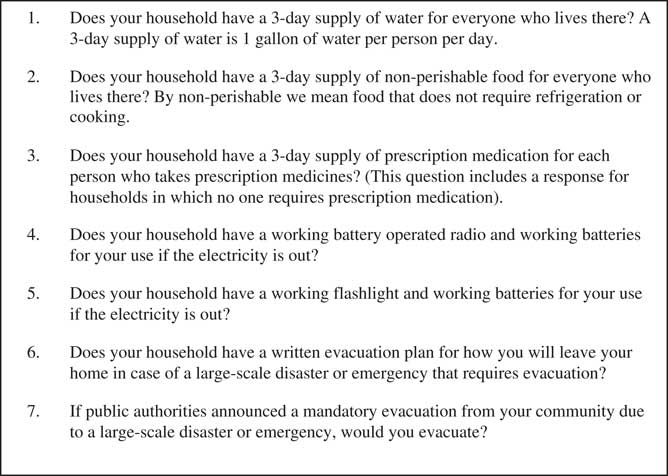
The General Preparedness module was included in the BRFSS from 2006 through 2010 for the following 14 states: Connecticut, Montana, Nevada, and Tennessee in 2006; Delaware, Louisiana, Maryland, Nebraska, and New Hampshire in 2007; Georgia, Montana, Nebraska, New York, and Pennsylvania in 2008; Mississippi in 2009; and Montana and North Carolina in 2010. The BRFSS General Preparedness module questionnaire included the following seven items: having a 3-day supply of non-perishable food, water, and prescription medications;Footnote ‡ a working, battery-powered radio and batteries; a working, battery-powered flashlight and batteries; an evacuation plan, and a willingness to evacuate during a mandatory evacuation. Figure 1 lists the selected questions from the general preparedness module.
Selected BRFSS Disaster Preparedness Module questions, 2006-2010. Notes: See ftp://ftp.cdc.gov/pub/Data/Brfss/2010_Summary_Data_Quality_Report.pdf for complete details. All BRFSS questionnaires, data, and reports are available at http://www.cdc.gov/brfss/.

Veteran Status
Veteran status was assessed using the following yes/no question: “Have you ever served on active duty in the United States Armed Forces, either in the regular military or in a National Guard or military reserve unit?” If yes, respondents were considered a US Armed Forces veteran.
Other Measures
In addition to veteran status and the seven general preparedness outcome measures, this study also included age (18-24, 25-34, 35-44, 45-54, 55-64, 55+), sex (male, female), race/ethnicity (White, African American, Other; and one Hispanic group), marital status (currently married, previously married, never married), education level (less than high school, high school diploma, and greater than high school), employment status (currently employed, unemployed, retired, unable to work, and housewife/student), number of children under 18 years of age living in the household (none and one or more), general health status (fair/poor vs good/very good/excellent), and disability status. Respondents who answered “yes” to either of the following questions were coded as having a disability, and respondents who answered “no” to both questions were considered not to be disabled: (1) are you limited in any way in any activities because of physical, mental, or emotional problems?; and (2) do you now have any health problem that requires you to use special equipment, such as cane, a wheelchair, a special bed, or a special telephone?
Statistical Analysis
All analyses were conducted with Stata/SE software (Version 12.1, StataCorp LP, College Station, Texas USA). The BRFSS weighting methodology accounts for the probability of selection of the adult, where the design weight undergoes poststratification to state-level population control totals using age group, gender, and race/ethnicity variables. First, cross- tabulations were conducted using weighted data and significance tests to compare the distribution of sociodemographic characteristics and other relevant study variables between veterans and nonveterans. Unadjusted (bivariate) logistic regression analyses were conducted separately for each of the seven general household preparedness outcome measures resulting in odds ratios (ORs), 95% confidence intervals (CIs), and percentages by veteran status. Multiple logistic regression analyses were conducted where household preparedness items were the dependent outcome measures with veteran status as the independent variable while controlling for age, sex, race/ethnicity, marital status, education level, employment status, children<18 in household, general health status, and disability status. These seven models were then jointly estimated (using the Stata “suest” command) to adjust for nonindependence of errors across the seven equations. Adjusted odds ratios (ORs), and 95% confidence intervals (CIs) were reported by veteran status from the “suest” analyses and adjusted percentages were calculated and reported by veteran status using the Stata “margins” command, following multiple logistic regression analyses. The level of significance for all analyses was set at .05.
Results
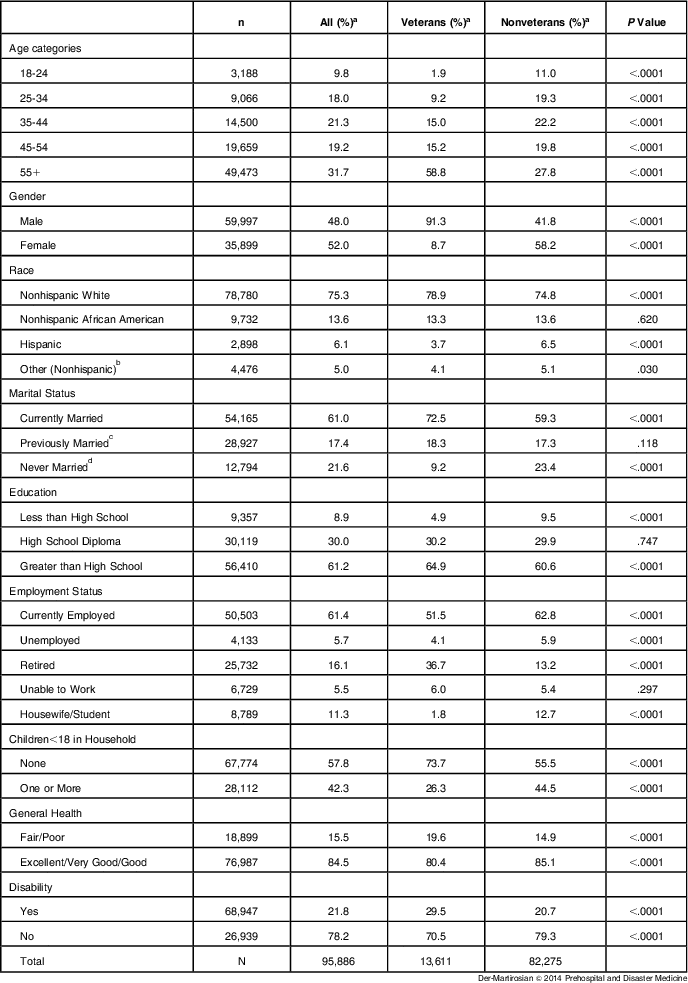
The characteristics of the study population overall and by veteran status in the 14 states from 2006 through 2010 are shown in Table 1. The analytic sample consisted of 95,886 observations with nonmissing data for all predictors; 13,611 veterans and 82,275 nonveterans. Compared to nonveterans, veterans were statistically more likely to be 55 years of age or older (59% vs 28%), male (91% vs 42%), nonhispanic white (79% vs 75%), married (73% vs 59%), retired (37% vs 13%); to have no children (74% vs 56%), to have greater than high school education (65% vs 61% ), to have a disability (30% vs 21%) and to report fair/poor general health (20% vs 15%).
Characteristics of the Study Population by Veteran Status in the 14 States, 2006-2010Footnote e

aWeighted predicted percents of the study population.
bAsian/Nonhispanic; Native Hawaiian/Pacific Islander/Nonhispanic; American Indian/Alaska Native/Nonhispanic; Other Race/Nonhispanic; Multirace/Nonhispanic.
cPreviously married includes divorced, widowed, or separated.
dNever married includes never married or living with a partner.
e 14 states include: Connecticut, Montana, Nevada, and Tennessee in 2006; Delaware, Louisiana, Maryland, Nebraska, and New Hampshire in 2007; Georgia, Montana, Nebraska, New York, and Pennsylvania in 2008; Mississippi in 2009; and Montana and North Carolina in 2010.
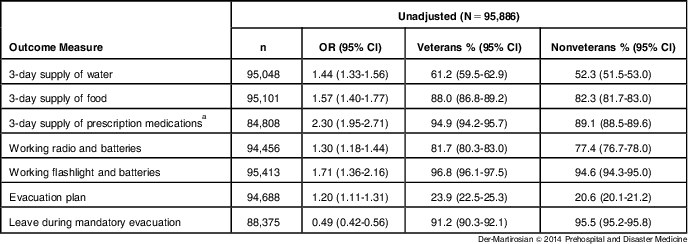
Table 2 examines the seven preparedness measures by veteran status and includes unadjusted odds ratios (ORs), 95% confidence intervals (CIs), percentages (and 95% CIs). Based on the unadjusted logistic regression analyses, veterans and nonveterans varied in their level of household preparedness across all seven measures, with statistically significant odds ratios varying from 0.49 to 2.30 (see Table 2). Overall, according to unadjusted percentages, the majority of veterans and nonveterans households had a 3-day supply of food (88% vs 82%, respectively); prescription medications (95% vs 89%, respectively); a battery operated radio (82% vs 77%, respectively) and flashlight (97% vs 95%, respectively); and expressed a willingness to leave during a mandatory evacuation (91% vs 96%, respectively), but were far less likely to have 3-day supply of water (61% vs 52%, respectively) and a written evacuation plan (24% vs 21%, respectively) (see Table 2).
Unadjusted Odds Ratios and Percentages of Emergency Household Preparedness by Veteran Status

aPrescription medication was asked of everyone, however, only those who required prescription medications were included in the analysis.
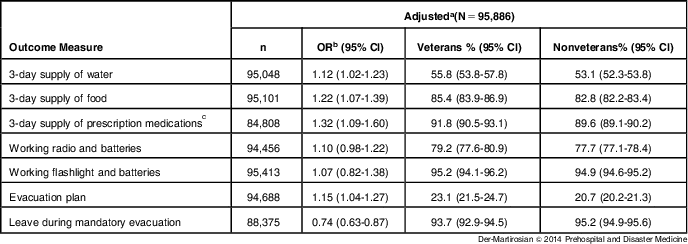
Table 3 presents adjusted odds ratios (ORs), 95% confidence intervals (CIs), percentages (and 95% CIs) for the seven household preparedness measures by veterans status. After adjusting for age, sex, race/ethnicity, marital status, education level, employment status, children < 18 in household, general health status, and disability status, there were significant differences between veterans and nonveterans for five of the seven general preparedness outcome measures. As compared to nonveterans, veteran households were significantly more likely to have a 3-day supply of water (OR = 1.12), a 3-day supply of food (OR = 1.22), a 3-day supply of prescription medications (OR = 1.32), and an evacuation plan (OR = 1.15). Veteran households were significantly less likely than nonveteran households, however, to indicate that they would leave during a mandatory evacuation (OR = 0.74), and were equally as likely as nonveteran households to have a working, battery-operated radio (OR = 1.10) and flashlight (OR = 1.07) (see Table 3). Overall, according to adjusted percentages, a majority of both veteran and nonveteran households were prepared for a disaster with a 3-day supply of food (85% vs 83%, respectively) and prescription medications (92% vs 90%, respectively); a battery-operated radio (79% vs 78%, respectively), a flashlight (95% for both), and would leave during a mandatory evacuation (94% vs 95%, respectively), but far less likely to have 3-day supply of water (56% vs 53%, respectively) and a written evacuation plan (23% vs 21%, respectively) (see Table 3).
Adjusted Odds Ratios and Percentages of Emergency Household Preparedness by Veteran Status

aAdjusted for age, sex, race/ethnicity, marital status, education level, employment status, children <18 in household, general health status, and disability status.
bSeemingly unrelated estimation (SUEST) was used to compute the odds ratio (and 95% CI) to account for the non-independence of errors across the seven equations.
cPrescription medication was asked from everyone, however, only those who required prescription medications were included in the analysis.
Discussion
The recommended 3-day supply of water (one gallon of clean water per person per day for drinking, cooking, and hygiene) for each member of the household delays the onset of dehydration which can lead to serious health consequences. 26 , 27 Given that less than 63% of households had a 3-day supply of water, more targeted efforts from emergency management agencies and other outreach programs to communicate and educate the public on these issues are warranted. Such efforts would include reminding everyone to keep clean stored water and how to do so without contaminating it. Organizations like the Department of the Veterans Affairs, Veterans Services Organizations, and others could also supplement such efforts with additional efforts aimed at fostering improved preparedness among veterans. Effort should also focus on encouraging the public to have at least a 3-day supply of non-perishable, ready-to-eat food (ie, food that does not require cooking), and a non-electrical can opener, in case there is an electrical or gas outage related to the disaster. Similarly, it is important to make sure that households are stocked with various types of working batteries (or renewable energy sources) for radios, flashlights, and other electronic devices (or other survival equipment) that may be needed during a disaster.
As for prescription medications, this study inquired about having a 3-day supply. Some health agencies such as the Mayo Clinic and Florida Division of Emergency Management advise having a 14-day to 30-day supply of prescription medications, especially for the elderly and those who suffer from multiple conditions. Given the prolonged response periods for some more recent disasters such as Hurricanes Katrina and Sandy, perhaps a more conservative recommendation of having at least a 14-day supply of prescription medications should be considered. Finally, less than a quarter of both veterans and nonveterans reported developing an evacuation plan. More effort should be dedicated to educating the public about the benefits of having a plan, as it can minimize the risk of injury and death.Reference Greenberger 28
The present study also showed that after adjusting for sociodemographic characteristics, general health status, and disability status, there were differences between veterans and nonveterans for five of the seven household emergency preparedness measures. Compared to nonveterans, veterans households were more likely to have a 3-day supply of prescription medications. This finding supports Heslin et al's study,Reference Heslin, Gin, Afable, Ricci and Dobalian 25 which found that veteran men and women in California were more likely to have extra supplies of medication than their nonveteran counterparts and had a high level of emergency medication preparedness. For the other six preparedness measures, this study is the first to provide population-based estimates of household preparedness for veterans and nonveterans among adults aged 18 and older living in multiple (14) states. Compared to nonveteran households, veteran households were also more likely to have 3-day supplies of water and food, and a written evacuation plan; less likely to leave during a mandatory evacuation; and equally likely to have a working, battery-operated radio and flashlight. Heslin et alReference Heslin, Gin, Afable, Ricci and Dobalian 25 point out that the intense military training programs for service in combat zones and other emergency situations might instill in veterans a culture of preparedness, as readiness is a key goal in the military environment. It is also possible that those who choose to enlist in the military might be a select group of individuals who differ from the general population in ways that might make them more likely to be prepared for disasters. In the case of mandatory evacuations, however, veterans might feel that they have handled worse situations during their training or deployments and are therefore not as willing to participate in a mandatory evacuation compared to the general population that has not confronted such dangerous situations.
The 2006 through 2010 BRFSS contains standardized data from a representative sample of the adult population from 14 states, providing comparable household emergency preparedness data for both veterans and nonveterans, which is one of the strengths of this study. Moreover, the “suest” regression technique used in the analyses appropriately adjusts for non-independence of errors across the seven general household preparedness outcome measures by veteran status.
Limitations
The study has several limitations. First, since the general household preparedness module data were not collected by all states, the data are not nationally representative. Second, previous research suggests that factors such as past experience, hazard awareness, risk perception, communication from local media, and participation in community and neighborhood organizations have an effect on personal preparedness.Reference Mileti, Bourque, Wood and Kano 29 – Reference Jackson 34 Unfortunately, this information is not available in BRFSS. Future studies should include measures of these concepts. Nonetheless, the seven included items were intended to be surrogates for an overall concept of “preparedness.” As such, this study suggests that the veteran population is generally better prepared than other groups, but underscores the need for more programs specifically aimed at improving preparedness around water and evacuation plans. Preparedness is a complex, multidimensional construct and efforts to improve it, particularly around aspects like water availability and evacuation plans, may need to reflect that complexity.
Future research should examine other groups that are traditionally defined by public health professionals as vulnerable, such as subgroups of the veteran population. Many of these populations are underrepresented in general preparedness research. Persons living with spinal cord injuries, individuals suffering from severe mental illness, and the homeless are among those who are generally considered vulnerable. 35 These particular physical, psychological, and economic factors describe a significant segment of the veteran population as well as many nonveterans. Although focusing on the level of household preparedness among these subgroups is beyond the scope of the current study, future research on emergency preparedness among veterans and others should examine levels of household preparedness among the most vulnerable, including those with spinal cord injuries,Reference Lasfargues, Custis, Maorrone, Cars and Nguyen 36 those with moderate or severe psychological disorders,Reference Seal, Bertenthal, Miner, Sen and Marmar 37 and those experiencing homelessness.Reference Fargo, Metraux, Byrne and Munley 38 For the homeless, the concept of household preparedness might differ, as for this group other issues such as having access to a shelter, capacity of the shelter, and/or having a friend of family member with a home should be considered. By first understanding whether differences in household preparedness exist across different groups and then seeking to understand why those differences exist, public health preparedness professionals will eventually be able to develop programs that are targeted to address those differences and thus improve the nation's overall level of preparedness.
Conclusion
The findings suggest that veteran households appear to be better prepared for emergencies than do nonveteran households, although the lower expressed likelihood of veterans households to evacuate when ordered to do so may place them at a somewhat greater risk of harm during such events. Further research should examine household preparedness among other vulnerable groups including subgroups of veterans populations and the reasons why their preparedness may differ from the general population.
Acknowledgment/Disclaimer
This material is based upon work supported by the Department of Veterans Affairs, Veterans Health Administration, Office of Public Health, and The Office of Public Health Preparedness and Response, Centers for Disease Control and Prevention. The findings and conclusions in this article are those of the authors and do not necessarily represent the views or policies of the Department of Veterans Affairs, the Centers for Disease Control and Prevention, or the US government.