Introduction
Antibiotic growth promotants (AGP’s) have significant economic and animal welfare benefits for the food animal production industry (Brorsen et al., Reference Brorsen, Lehenbauer, Ji and Connor2002) because of their effectiveness in resolving clinical disease and for prevention of subclinical bacterial infections (Committee on Drug Use in Food Animals, Panel on Animal Health, Food Safety, and Public Health, National Research Council (CDUFA), 1999). In addition, many of the antibiotics that prevent subclinical infections also enhance growth rate and feed efficiency (George et al., Reference George, Quarles and Fagerberg1982; Elsasser et al., Reference Elsasser, Kahl, Steele and Rumsey1997; CDUFA, 1999); however, the mode of action for growth promotion has not been fully elucidated (Walton, Reference Walton1982; Leser et al., Reference Leser, Lindecrona, Jensen, Jensen and Møller2000). In some instances, it has been shown that AGP’s inhibit the growth of pathogenic bacteria, which may cause enteritis and a reduction in feed efficiency (George et al., Reference George, Quarles and Fagerberg1982; Hofacre et al., Reference Hofacre, Froyman, Gautrias, George, Goodwin and Brown1998). On the other hand, because some AGP’s are antibacterial, their growth-promoting effects might be due to alterations in the density and composition of the bacterial community in the intestine (Decuypere et al., Reference Decuypere, Henderickx and Vervaeke1973; Vervaeke et al., 1976 and Reference Vervaeke, Decuypere, Dierick and Henderickx1979; Henderickx et al., Reference Henderickx, Vervaeke, Decuypere and Dierick1982; Walton, Reference Walton1982).
The intestinal microbiota is part of a complex ecosystem that contributes substantially to the health of animals (Falk et al., Reference Falk, Hooper, Midtvedt and Gordon1998; Cresci et al., Reference Cresci, Orpianesi, Silvi, Mastrandrea and Dolara1999). In fact, gnotobiology has shown that certain members of the intestinal bacterial community stimulate development of the intestine and enhance perfusion and innervation (Hooper et al., Reference Hooper, Bry, Falk and Gordon1998). Many strategies are currently being used to strengthen host defenses and improve weight gain by supplementing animal feed with ingredients that promote the growth of beneficial bacteria in the intestine. The common modulators of gastrointestinal tract ecology are prebiotics (oligosaccharides that promote the growth of beneficial bacteria), probiotics (the beneficial bacteria themselves, such as lactobacilli and bifidobacteria) and growth-promoting antibiotics. In order to understand the mechanism of action of these products and to develop more effective formulations and applications, their effects on the intestinal microbial community structure must be understood.
We were interested in evaluating how some AGP’s affect the intestinal bacterial community since we had used molecular methods to describe age-related changes occurring in broiler chickens fed a corn-soy diet devoid of feed additives (Lu et al., Reference Lu, Idris, Harmon, Hofacre, Maurer and Lee2003) and the effect of monensin on ileal community structure (Lu et al., Reference Lu, Hofacre and Lee2006). In this study, we used T-RFLP (terminal restriction fragment length polymorphism) analysis combined with 16S rDNA clone libraries to compare the ileal bacterial community structure of broiler chickens fed an AGP formulation.
Material and methods
Intestinal samples
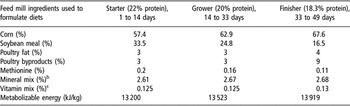
In all, 120 one-day-old commercial Ross broiler chicks were raised in three groups on fresh softwood shavings, and used as the source of ileal bacteria for analysis. The groups were fed different diets ad libitum; the specific composition of the diets is shown in Table 1. Group 1 was fed a commercial corn-soy diet as a control, Group 2 with corn-soy feed containing a common AGP regimen and Group 3 was fed corn-soy feed containing 90 g/t monensin (Coban, ELANCO, Greenville, IN, USA). Monensin is an ionophore antimicrobial used for the prevention of coccidiosis (Reid et al., Reference Reid, Kowalski and Rice1972). The AGP diet contained 50 g/t bacitracin-methylene disalicylate (BMD; Alpharma Animal Health, Fort Lee, NJ, USA) for the first 2 weeks of age (14 days), at 15 to 33 days of age the birds were fed 20 g/t virginiamycin (Phibro Animal Health, Fairfield, NJ, USA) then from 33 to 49 days of age the birds were fed 10 g/t virginiamycin. Ten chicks were sacrificed at 3 and 7 days of age; at 14, 21, 28 and 49 days of age five chicks were sacrificed and their intestinal contents pooled. The contents from the birds were pooled to reduce individual bird variation. The ileum was removed, aseptically transected and the contents were placed in sterile tubes containing 3 ml brain heart infusion broth. These were kept on ice until the bacteria were collected.
Composition of corn-soy poultry feed (% of feed mill ingredients) used to assess the ileal bacterial communities of growing broiler chickensFootnote a

a The starter, grower and finisher diets contained levels of protein, fats, vitamins and minerals commonly used in US commercial broiler production (Subcommittee on Poultry Nutrition, National Research Council, 1994).
b The mineral mix percentage was a summation of the following feed mill ingredients: phosphate, lime, salt and trace minerals.
c The vitamin mix percentage was a summation of the following feed mill ingredients: broiler vitamins and choline.
Recovery of bacteria, cell lysis and DNA isolation
The bacterial fraction was recovered from the contents through multiple rounds of dilution, high-speed centrifugation, and washing with phosphate-buffered saline (PBS) as described previously (Apajalahti et al., Reference Apajalahti, Sarkilahti, Maki, Heikkinen, Nurminen and Holben1998). The bacteria were pelleted by high-speed centrifugation (3650 × g for 15 min), re-suspended in freezer stock solution (1% peptone and 15% glycerol in water) and stored at −80°C. Genomic DNA was isolated from the bacterial cells and quantitated as previously described (Lu et al., Reference Lu, Idris, Harmon, Hofacre, Maurer and Lee2003).
Analysis of T-RFLPs and clone libraries
16S rRNA clone libraries and T-RFLP analyses were performed as previously described (Lu et al., Reference Lu, Idris, Harmon, Hofacre, Maurer and Lee2003 and Reference Lu, Hofacre and Lee2006). In order to compare the data from the different groups, outputs from ABI Genescan were transferred to Microsoft Excel where the area under each peak was expressed as a percentage of the total integrated area under the electropherogram. The Shannon–Wiener index (H) and Simpson’s index (D) were calculated as previously described (Legendre and Legendre, Reference Legendre and Legendre1998) according to the following equations:

where Pi is the fraction of the total integrated area in each peak. Pairwise similarities between whole communities were analyzed by calculating Jaccard coefficients (S j) and Whittaker’s index of association (S w) (Whittaker, Reference Whittaker1952) using the following equations (Legendre and Legendre, Reference Legendre and Legendre1998):

where bi 1 and bi 2 are the percentage contributions of amplified DNA of the ith species in samples 1 and 2, respectively; W is the number of species shared between two samples; and a 1 and a 2 are the total species numbers present in samples 1 and 2, respectively. Statistical analysis and calculations were conducted using SAS package (v. 8.20; SAS Institute, Cary, NC, USA) and Microsoft Excel. LIBSHUFF v. 1.2 (http://www.arches.uga.edu/~whitman/libshuff.html) was used to detect differences in the composition of the cloned libraries (Singleton et al., Reference Singleton, Furlong, Rathbun and Whitman2001). T-RFLP community compositions were compared by correspondence analysis (SAS v. 6.12; SAS Institute; Vista Visual Statistics System, http://forrest.psych.unc.edu/research/).
Accession numbers
Representative clone sequences were deposited in GenBank with accession numbers AY237182 to AY237208.
Results
Compositional analysis of ileal bacterial communities
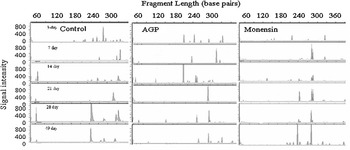
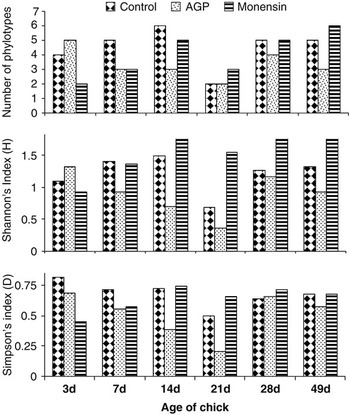
T-RFLP analysis (Figure 1) of the 16S rDNA amplicons detected over 20 different fragments among the ileal communities of the control and two treatments. The fragments were determined to comprise 14 bacterial phylotypes (⩾91% similarity with cultivable species) by DNA sequence analysis of the clone libraries although several terminal restriction fragments represented variants of the same species. The numbers of phylotypes detected varied considerably with age of the chicks (Figure 2). The average richness of phylotypes in the control, AGP treatment and monensin treatment were 5, 3 and 4, respectively.
Terminal restriction fragment length polymorphism (T-RFLP) electropherograms produced after digestion of 16S rRNA amplicons produced from the ileal bacterial communities of chickens fed a common AGP regimen or monensin.

Richness and diversity indices of ileal bacterial communities of chickens fed a common antibiotic growth promotant (AGP) regimen or monensin.

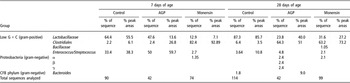
In order to obtain additional compositional information about the bacterial community structure of the ileum, comparative DNA sequence analysis of the clone libraries was conducted on samples from 7- and 28-day-old birds and T-RFLP analysis was applied to all samples. We wanted to evaluate phylotype distributions by the two methods because three more cycles of PCR were necessary to improve detection of peaks in the T-RFLP. PCR bias, enhanced by increased cycling, could possibly skew the abundance predictions. In order to estimate the abundance of each species or phylotype, we calculated the proportion of signal represented by each terminal restriction fragment and compared this to the proportion of 16S rDNA clones represented by each species or phylotype (Table 2). The same high-abundance species and phylotypes were detected by both methods; however, the relative abundance somewhat varied. Species that were not detected by T-RFLP were generally present in the clone libraries at less than 5% of the total clones. The clone libraries contained up to six species of bacteria whose abundance was greater than 5%. It is probable that T-RFLP may not detect the low-abundance ribotypes, if there are multiple dominant species in the community. In order to determine whether the methods correlated, we compared the frequency of sequences (%) and percent T-RFLP peak areas in each sample using regression analysis. The relationship between the methods was as follows:
Composition of the ileal bacterial community as determined by 16S rDNA clone libraries and T-RFLP analysisFootnote a

a Abundance of phylotypes were calculated from the distribution of 16S rDNA sequences among clone libraries (% of sequence) and by distribution of terminal restriction fragment peak areas (% of peak areas) of each sample. Although different numbers of clones were used for the analysis, the clone libraries exhibited comparable levels of coverage. The control, AGP and monensin groups were fed a corn-soy-based diet. The AGP group received a bacitracin/virginiamycin feed additive regimen; the monensin group received monensin in the feed.

While there were differences, both methods were consistent in reflecting the dominant ileal community.
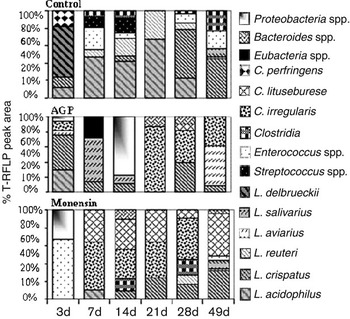
The most abundant bacteria, detected in each group by T-RFLP, are shown in Figure 3. The control group possessed the highest relative abundance of Lactobacillus (73%) while the monensin group exhibited the lowest (19%). The bacterial community of birds fed monensin consisted of an abundance of Clostridia but the monensin and AGP groups also had the highest relative abundance of Bacteroides. The presence of other bacteria, such as Enterococcus/Streptococcus and Proteobacteria, was highly variable. The composition of the ileal community of the AGP group was highly variable from 3 to 14 days of age but exhibited low-diversity indices at all samplings and low richness (2 to 5 species). For example, the ileal community of 14-day-old AGP birds was dominated by an abundance of Escherichia coli while the communities of older birds (21 to 28 days of age) were composed primarily of Clostridium irregularis. The variations in abundance in the birds fed the AGP did not appear to be due to the shift from bacitracin to virginiamycin because the ileal samples from 14-day-old birds were collected before the grower feed replaced the starter feed.
Distribution of relative abundance of ileal bacterial phylotypes of chickens fed a common antibiotic growth promotant (AGP) regimen or monensin as determined by terminal restriction fragment polymorphism (T-RFLP) analysis. Data representing the control and monensin groups have been previously described (Lu et al., Reference Lu, Hofacre and Lee2006).

Ileal community structure
The Shannon and Simpson diversity indices, which weigh species richness and evenness slightly differently (Magurran, Reference Magurran1988; McCaig et al., Reference McCaig, Glover and Prosser1999), showed that the lowest mean diversity values (Shannon/Simpson 0.90/0.51) occurred in the AGP-treated ileal communities that ranged from 0.37/0.21 to 1.32/0.68. The mean highest Shannon diversity index (1.65) occurred in the monensin treatment (range 0.92 to 2.1). The mean highest Simpson index (0.68) occurred in the control group (range 0.5 to 0.81). However, the highest diversity indices were detected when the birds were young and decreased with increasing age; analysis of variance (ANOVA) confirmed this significant difference (P = 0.02). In fact, the composition of the bacterial communities of the 3-day-old chicks was very different from the communities present at the other sampling times. In general, more bacterial phylotypes were detected in the ileum of young birds than at other ages and many of the bacteria were not detected at other times in the study. These results suggested that the ileal bacterial community of young birds was quite transitional. However, from 14 to 21 days of age, chickens in all the groups demonstrated a drop in diversity indices, and possessed few abundant species (2 to 3), suggesting another period of transitional ileal communities. These findings are significant because enteritis is most likely to occur in birds prior to 3 weeks of age (Wierup, Reference Wierup2001) and, in fact, Clostridium perfringens-mediated necrotic enteritis occurs most commonly in 2- to 3-week-old broilers (Long, Reference Long1973; Wages and Opengart, Reference Wages and Opengart2003). These findings suggest that transitional communities may predispose the gastrointestinal tract to colonization or increase the expression of toxin by pathogens.
Comparative analysis of ileal bacterial communities
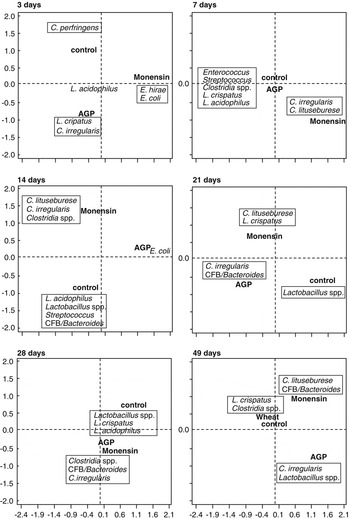
In order to compare the effects of feed additives on the composition of the ileal bacterial community, LIBSHUFF analysis was used to compare the composition of the cloned libraries from each treatment. LIBSHUFF analysis of the cloned libraries showed that the AGP and control group were significantly different (P = 0.001) at both 7 and 28 days of age and a two-factor ANOVA (comparing the distribution of DNA sequences) confirmed the significant differences (P = 0.0006). In addition, the group receiving monensin was different from the control at the 90% level (P = 0.0847). Correspondence analysis of the T-RFLP data was used to correlate the abundance of phylotypes with certain diet formulations at the different ages (Figure 4). The correspondence analysis confirmed that the ileal communities of birds fed monensin were consistently different from the control group in all the ages primarily due to differences in the relative abundance of clostridial phylotypes. However, the relationships among the other groups varied by age of the chick. For example, the community of the 14-day-old AGP group was distinct in its abundance of E. coli. Similarly, at 21 days of age the control group was distinct in its abundance of L. acidophilus and L. reuteri. Therefore, the antibiotics selected for a uniquely different ileal bacterial community than the diet lacking these additives.
Correspondence analysis of the ileal bacterial communities of chickens fed a common antibiotic growth promotant (AGP) regimen or monensin. Positioning of the groups is based on the bacterial composition of the community and their relative abundance. Correspondence analysis was used to show multi-dimensional associations between diet and bacterial genera. The analysis confirmed that some bacteria were more likely to be detected among the bacterial community of birds fed certain diets. Bacteria shown in boxes were strongly associated with certain quadrants; others were positioned near the vertical or horizontal axis indicating that they grouped with more than one quadrant.

Similarity analysis of ileal bacterial communities
Pairwise comparisons between treatments and the control were analyzed using Jaccard coefficients (S j) and Whittaker’s index of association (S w) along each age (Table 2). The Jaccard coefficients (S j) mainly consider species compositions, while Whittaker’s index (S w) is calculated using both compositional and relative abundance data. For both comparisons, the indices scale from 0 (completely different) to 1 (identical). The pairwise comparisons detected significant differences between the treatments and the control. The Jaccard coefficient ranged from 0 to 0.5 between the AGP group and the control, and from 0 to 0.43 between the monensin group and the control. Similarly Whittaker’s index ranged from 0 to 0.5 between the AGP treatment and the control, and from 0 to 0.48 between the monensin group and the control. Completely different communities were detected between the control and treatments for the transitional ages (day 3 and day 21). These data further support that antibiotics selected for a different ileal bacterial community structure than the diet lacking these additives (Table 3).
Similarity analysis of ileal bacterial communities using Jaccard coefficients (S j) and Whittaker’s index of association (S w)Footnote a

a Jaccard coefficient (S j) is calculated using species distribution, while Whittaker’s index (S w) is calculated using both species distribution and their relative abundance. For both methods, the indices scale from 0 (completely different) to 1 (identical).
Discussion
Strategies that modulate intestinal communities have experienced a resurgence in interest because of the desire to reduce the use of non-therapeutic antibiotics. While AGP’s may indeed promote intestinal health and feed conversion by their inhibitory effects on bacteria, it is also possible that they promote the development of an intestinal bacterial community that enhances intestinal function. The ileal microbial communities of chickens fed AGP’s were significantly different from the control, indicating that the antibiotics affected some phylotypes that composed the normal ileum microbial community. The effect of the antibiotics on abundance of lactobacilli, especially L. acidophilus, was more significant than on the other abundant phylotypes. Previous culture-based studies also found that antibiotics caused alterations of the microbial community (Decuypere et al., Reference Decuypere, Henderickx and Vervaeke1973; Walton, Reference Walton1982). These alterations included significant decreases in cultivatible Micrococcaceae, lactobacilli and C. perfringens (Decuypere et al., Reference Decuypere, Henderickx and Vervaeke1973; Vervaeke et al., 1976) and the changes were accompanied by a reduction in ammonia in the small intestines (Vervaeke et al., 1976). Henderickx et al. (Reference Henderickx, Vervaeke, Decuypere and Dierick1982) also observed compositional changes in the small intestinal bacterial community after virginiamycin treatment. In an in vitro continuous cultivation system of ileal contents, virginiamycin caused a significant reduction in the carbohydrate breakdown of intestinal contents by bacteria (Vervaeke et al., 1976 and Reference Vervaeke, Decuypere, Dierick and Henderickx1979), suggesting that the mechanism of growth enhancement by antibiotics may be due to bacterial community changes resulting in increased availability of energy for the animal. For example, pigs fed virginiamycin (50 ppm) experienced a 10% improvement in growth rate and 7% enhanced feed conversion compared with controls (Henderickx et al., Reference Henderickx, Vervaeke, Decuypere and Dierick1982). The data resulting from our study indicated that the bacitracin/virginiamycin AGP formulation did not enhance the abundance of commonly accepted ‘beneficial’ bacteria. Rather the antibiotics decreased the abundance of lactobacilli and this finding concurs with previous reports (Decuypere et al., Reference Decuypere, Henderickx and Vervaeke1973; Vervaeke et al., 1976). The reduction of lactic acid reported by Vervaeke et al. (1976 and Reference Vervaeke, Decuypere, Dierick and Henderickx1979) may also indicate decreased abundance of lactobacilli. Another antibiotic feed additive, monensin, an ionophore antimicrobial, has been shown to alter ruminal bacterial communities by inhibiting gram-positive bacteria (Callaway et al., Reference Callaway, Adams and Russell1999). Stahl et al. (Reference Stahl, Flesher, Mansfield and Montgomery1988) reported that the relative numbers of some ruminal phylotypes, detected using 16S probe hybridization, were depressed approximately two-fold during monensin treatment. However, of the abundant gram-positive bacteria detected in our chicken ileal communities, L. acidophilus populations appeared to be reduced by monensin but C. irregularis relative abundance was not affected.
Our previous studies (Lu et al., Reference Lu, Idris, Harmon, Hofacre, Maurer and Lee2003) revealed that the bacterial community of the ileum of broiler chickens is primarily composed of gram-positive bacteria such as lactobacilli, streptococci and enterococci. However, Clostridia also comprised a large portion of the bacterial population at various times during the life of the broiler (Lu et al., Reference Lu, Idris, Harmon, Hofacre, Maurer and Lee2003 and Reference Lu, Hofacre and Lee2006). While we detected 16S sequences with ⩾95% similarity to cultivable species of Clostridia including C. perfringens, C. irregularis and Clostridium lituseburense, many of the DNA sequences exhibited low similarity to cultivated clostridial species, indicating that these phylotypes represent new members of the family. The majority of the ileal clostridial sequences were closely related to cluster XI, which includes non-pathogenic species such as C. lituseburense, C. irregularis, and environmental Clostridia (Lu et al., Reference Lu, Idris, Harmon, Hofacre, Maurer and Lee2003 and Reference Lu, Hofacre and Lee2006). However, some sequences were most similar to Faecalibacterium (Actinobacterium) prausnitzii, cluster XIX, but too dissimilar to be considered members of the Faecalibacterium genus. Phylogenetic cluster XI contains a few pathogenic species, such as Clostridium difficile; however, both the XIX and XI clusters are very diverse because of the discovery of numerous new members (Salzman et al., Reference Salzman, de Jong, Paterson, Harmsen, Welling and Bos2002). 16S rRNA sequences with high similarity to SFB, which are Clostridia of uncertain phylogeny, were frequently detected in the ileum; however, bacteria related to C. perfringens were only detected in the untreated control group (Lu et al., Reference Lu, Idris, Harmon, Hofacre, Maurer and Lee2003).
Clostridia are a diverse group of anaerobic bacteria that primarily acquire energy by hydrolyzing macromolecules such as proteins, lipids and carbohydrates. They are found in many environments but are frequently members of the intestinal microbiota of animals (Collins et al., Reference Collins, Lawson, Willems, Cordoba, Fernandez-Garayzabal, Garcia, Cai, Hippe and Farrow1994). The pathogenic Clostridia are notable because of their ability to produce disease in many different species of animals and because they can produce a variety of toxins. The cytotoxic activities of pathogenic Clostridia have been well studied (Rood, Reference Rood1998; Karasawa et al., Reference Karasawa, Wang, Maegawa, Michiwa, Kita, Miwa and Nakamura2003). C. perfringens is particularly interesting in that the type of disease it produces and the affected host species depends on its array of toxins (Petit et al., Reference Petit, Gibert and Popoff1999). The α-toxin is important for the pathogenesis of gangrene in humans and necrotic enteritis in chickens; additional toxins are needed to produce necrotic enteritis in lambs, piglets and calves. However, few studies have addressed whether some intestinal Clostridia may contribute to the health and performance of animals. Umesaki et al. (Reference Umesaki, Setoyama, Matsumoto, Imaoka and Itoh1999) reconstituted gnotobiotic mice with segmented filamentous bacteria (Clostridia) and demonstrated that they induced intestinal development similar to that of the putative intestinal symbiont Bacteroides thetaiotaomicron (Hooper et al., Reference Hooper, Bry, Falk and Gordon1998). The capillary network is rudimentary in adult gnotobiotic mice; however, angiogenesis is stimulated when the mice are colonized with B. thetaiotaomicron (Stappenbeck et al., Reference Stappenbeck, Hooper, Manchester, Wong and Gordon2002). This finding indicates that certain commensal bacteria may be necessary for the development of the intestine to its full absorptive capacity. B. thetaiotaomicron also directs the increased expression of terminal α-linked fucose by enterocytes positioned in the distal small intestine (Bry et al., Reference Bry, Falk, Midtvedt and Gordon1996). These changes in host glycan expression allow the bacterium to expand its colonization niche to additional areas along the small intestine and also augment colonization by other commensal members of the microbiota.
Therefore, novel Clostridia species detected within the ilea of chickens fed AGP’s and monensin may not contain the required array of clostridial virulence determinants and are potentially beneficial to intestinal development. In addition, these clostridial communities may act as a competitively suppressive ecosystem effectively reducing the abundance of C. perfringens in the small intestine. Future studies should focus on characterizing the important bacterial species needed to stabilize the intestinal bacterial community and identifying those commensals that stimulate and enhance development of intestinal function. New tools that allow the detection of intestinal responses to the presence of symbiotic bacterial will allow the rational design of antibiotic-free animal production strategies.
Acknowledgment
The study was augmented by the substantial expertise of our dear departed colleague, Dr Barry Harmon. It was also supported in part by the United States Department of Agriculture, Epidemiology of Food Safety program (Hofacre), USDA Formula Funds (M.D.L.) and the Food and Drug Administration (M.D.L.).