


Introduction
Mental health problems have been found to be more prevalent in prison than community populations and worldwide current rates of post-traumatic stress disorder (PTSD) in sentenced populations range from 4% to 21.4% (Goff, Rose, Rose and Purves, Reference Goff, Rose, Rose and Purves2007). Looking to the UK and London prisons specifically there is little data on rates of PTSD in prison and there is limited evidence-base to guide effective assessment and treatment specifically within an adult prison setting. A review (Heckman, Cropsey and Olds-Davis, Reference Heckman, Cropsey and Olds-Davis2007) looking at treatment of PTSD in correctional facilities found eight studies each using different treatments and outlined methodological weaknesses and disappointing outcomes. Recommendations stated that the progress of evidence-based PTSD treatment in the general population must be transferred and empirically supported into the prison system. This paper illustrates how current evidence-based treatments can be adapted for a prison population.
Case illustration
Red was a 22-year-old Black African male, who had escaped to the UK when he was 10 years old following a civil war in his country of birth. Red described positive early attachment experiences, however between the ages of 8 and 10 he experienced multiple traumas, including witnessing the massacre of innocent people, being captured by rebels, and the death of a family member next to him from a gun wound. His teenage years in the UK included aggressive outbursts, school exclusion and serving three prison sentences. On his fourth prison sentence Red came to the attention of the London Early detection And Prevention (LEAP) team, an innovative early detection service in a prison setting (Jarrett et al., Reference Jarrett, Craig, Parrott, Forrester, Winton-Brown and Maguire2012), after scoring positive during routine screening by the team and undergoing second stage assessment. Red reported suffering from re-experiencing symptoms (nightmares, flashbacks and intrusive memories). He actively blocked out trauma memories and avoided reminders. Symptoms of hyper-arousal included hyper-vigilance, which understandably increased in prison, irritability and problems with concentration. Red also described experiencing what he called “mad paranoia” and believed that “everybody” had the intention of being out to harm him. Red said he had used cannabis as a coping strategy to relax and manage physiological symptoms triggered by memories. Red stayed awake till the early hours of the morning to try and avoid having nightmares. His distress was exacerbated further by interpreting his symptoms as a sign that he was losing his sanity.
Assessment
Although PTSD is thought to be highly prevalent in prisons, the typology may differ: across prisons, (e.g. inner city); by types of prisoner held (e.g. foreign national); by types of trauma experienced (e.g. developmental, civil wars, gang involvement); and by early attachment relationships (e.g. disrupted). Without further research it is hard to know if this would be a “typical” presentation; however, these factors must be considered to ensure effective assessment and conceptualization of traumatic responses so the appropriate intervention is offered.
The following measures were used: Comprehensive Assessment of the At-Risk Mental State (CAARMS), the PTSD module of the Structured Clinical Interview for DSM-IV Disorders (SCID); The Patient Health Questionnaire-9 (PHQ9); Generalized Anxiety Disorder Assessment-7 (GAD7), the Clinical Outcomes of Routine Evaluation (CORE-10), the Impact of Events Scale Revised (IES-R) and the Green et al. Paranoid Thought Scales (GPTS), a 32-item self-report measure that separates out ideas of social reference and persecution. Completion of the Distress Tolerance Scale (DTS), a 16-item self-report measure, helped to identify Red's perceived ability to tolerate, reappraise, absorb and regulate distress. Red met DSM-IV criteria for PTSD whilst also scoring on measures relating to paranoia (CAARMS, GPTS).
Treatment
Overview
Red attended bi-weekly 45-minute sessions over 10 months with a LEAP clinical psychologist, with the more frequent sessions hoping to facilitate learning and retention, overcome self-reported problems with concentration, and to increase opportunities for emotional processing (given that sound recording devices are prohibited within prisons so narratives cannot be listened to between sessions). As the DTS indicated difficulties with distress tolerance, treatment took a two-phased approach with stabilization work taking place first, focusing on skill development around regulating distress, including both trauma specific strategies (e.g. grounding and stimulus discrimination) and more general emotion regulation strategies (Levitt and Cloitre, Reference Levitt and Cloitre2006). The second trauma focused phase was informed by culturally appropriate ideas from narrative exposure therapy (NET) given the multiple traumatic events from war and conflict (e.g. development and narration of a time line), followed by cognitive restructuring and updating hotspots using TF-CBT. Initial narration sessions did attempt to be longer but could be affected by prison unpredictability (see below).
Formulation
Ehlers and Clark's (Reference Ehlers and Clark2000) cognitive model of PTSD was used to formulate Red's presenting symptoms. An adapted vicious flower formulation (Moorey, Reference Moorey2010) was developed collaboratively in sessions to identify key maintaining factors seen to be triggering his “threat system” (see extended version). Symptoms were also understood within a prison context where the need to “be on guard” was to some extent functionally appropriate given the risks of the environment (e.g. gang problems).
Psycho-education
As a result of Red's concentration difficulties and limited literacy skills more time was needed to explain concepts such as “fight or flight”, and visual handouts were employed to explain his anxiety as the “burglar alarm” of the body.
Memory work
NET guided the development of a timeline, documenting Red's complex trauma history and helped the therapist orientate chronologically to the multiple traumas. It also gave Red the opportunity to educate the therapist about his country of origin, explaining cultural beliefs and traditions, which helped during cognitive restructuring. Remaining hotspots were targeted using TF-CBT strategies including elaboration, to facilitate further processing, and cognitive restructuring, allowing identified appraisals (some influenced by cultural beliefs) to be explored and updated, reducing the sense of current threat.
Treatment outcome
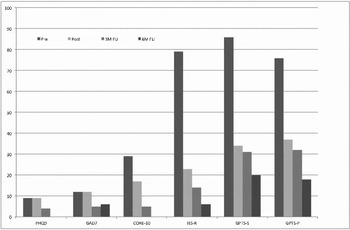
After 10 months of treatment Red showed a decline in his PTSD symptoms, with changes on the IES-R (see Figure 1) and with him no longer meeting the DSM-IV criteria. Subjectively, Red reported changes in intrusions, distress and behaviour. Changes included no longer having nightmares and unwanted memories, feeling “more in control of my threat system” and feeling less “paranoid” (see Figure 1). His involvement in fights dropped dramatically, evidenced by him not only receiving enhanced status, but by becoming a wing cleaner, a role reserved for those more trusted by officers.
Outcome measures at pre, post, 3-month and 6-month follow-up Notes: PhQ9 = Patient Health Questionnaire-9; GAD7 = Generalized Anxiety Disorder Assessment-7; CORE-10 = Clinical Outcomes in Routine Evaluation; IES-R = Impact of Events Scale Revised; GPTS-S = Green et al., Paranoid Thought Scales social reference; GPTS-P = Green et al., Paranoid Thought Scales persecution

Qualitative feedback on the acceptability of memory work in prison
To evaluate the process of doing memory work in prison Red was asked for feedback on how he found treatment: “Prison is the most suitable place to do this because you have a clear mind”; “If you really need help you will get things done in prison”; “I wouldn't have turned up to sessions in the community”. When asked what he would advise others about approaching memory work in prison, he responded: “It will be difficult, you may need to be pushed, but I felt good about myself after”; “You also need to feel comfortable with the person you are going to do this work with”. On asking what he found difficult Red said that “it is hard to talk about the memories”; however, we agreed that this would be applicable both in the community and in prison. When asked if he thought it was hard returning to the wing after sessions Red said “some days you feel low, some days you feel sad, some days you feel good that you have got it out of your head”. Again this appeared not to be prison specific, but more related to trauma work itself. When asked what helped to return to the wing he said “I noticed that you always made me laugh at the end of sessions”.
Discussion and reflections
This case study highlights the possibility of successfully treating PTSD within a prison setting using adaptations to conventional TF-CBT. As many challenges to treatment are present within the prison it is important that the decision to proceed with memory work is collaborative. A clear rationale for treatment will need to be shared, ensuring the individual can give their full consent to engaging with memory work. More time may need to be spent on explaining certain psycho-educational concepts, and session length and materials should be tailored to the individual's needs. Measuring distress tolerance can inform the design of treatment and when stabilization may be indicated. In this case integrating ideas from NET provided a useful approach to conceptualizing Reds’ multiple traumas in their sociocultural context, which enhanced the effectiveness of TF-CBT strategies.
Time restrictions around access to offenders can lead to constraints on predictable treatment sessions. Unplanned lock-downs on the wings result in scheduled therapy sessions not taking place. Unpredictable transfers between prisons can lead to abrupt and unplanned endings to therapy. Finding a relatively therapeutic environment for memory work to take place can also present a challenge, with options including the wing or appointments in Healthcare, with the latter leading to time spent in “holding areas” with other offenders. For individuals who are hyper-aroused, with lingering trauma memories from treatment sessions, this environment may be considered anti-therapeutic. Despite the challenges for therapy in prison, it also presents many opportunities. Prison allows individuals to engage therapeutically at a time when they are more likely to be substance free, enabling therapists to offer alternatives to their community based coping strategies. Obtaining detailed personal history helps to develop a comprehensive formulation that can include early attachment experiences and protective factors. Formulating complexities in supervision around disrupted attachments, mistrust of others and emotion regulation abilities allows the therapeutic relationship to offer a calm and containing space, with the therapist attuning to their needs, which is in sharp contrast to the prison environment. This helps to facilitate engagement. Obtaining consent to work with the wider system can enhance care provision. Prison wing staff and multi-disciplinary healthcare staff can provide monitoring and care between memory work sessions, allowing individuals to feel emotionally supported.
Future implications
Given the multiple traumas that many young men in prison may have endured, expert supervision is needed to oversee high quality treatment delivered by trained therapists. Complexity will need to be formulated appropriately, so allowing care to be tailored to individual need. Current service provision and evidence base within the prison setting is poor and needs to be addressed urgently. Further research is needed to validate appropriate assessment measures in the prison setting, where literacy levels can be low, and further research is also required into the need for stabilization before trauma focused work, guided by early attachment experiences and regulation abilities. Establishing early detection and prevention mental health teams will be paramount in effectively identifying and addressing the needs of offenders who should receive an equivalence of care in prison. Equipping individuals with skills to enhance the management of their emotional wellbeing can lead to an increase in confidence, less reliance on substances to cope, and more control over possible hypersensitive threat systems developed from exposure to multiple traumas. Applying this on their release may help them access the opportunities available to them to engage in a life without re-offending.
Acknowledgments
Our special thanks go to the staff and prisoners of the prison, in particular Red who showed incredible courage throughout treatment and kindly gave permission for this write-up.
OASIS in Prion (now called The London Early detection And Prevention team; LEAP) was financially supported by generous grants from the Guy's and St. Thomas’ Charitable Foundation and the Maudsley Charitable Foundation Trust. We also acknowledge the NIHR Biomedical Research Centre for Mental Health at the South London and Maudsley NHS Foundation Hospital Trust and the Institute of Psychiatry, Psychology and Neuroscience, Kings College London for their financial support.




Comments
No Comments have been published for this article.