INTRODUCTION
You go to war with the Army you have, not the Army you might want or wish to have at a later time.
- Donald H. RumsfeldIn December 2004, the U.S. defense secretary was asked by a soldier preparing to deploy to Iraq why a majority of vehicles in the theater were not operating with full armor.Footnote 1 Donald H. Rumsfeld responded with the now immortal quote above, echoing what many scholars of national security had been writing for decades: the American military, especially the army, is far too resistant to change, too protective of its parochial interests, too risk averse.Footnote 2 However, while Rumsfeld was lamenting the army's supposed resistance to reform, the institution was transforming its conception of its core missions and capabilities—a development that Rumsfeld likely knew little about and had very little control over. Two months before the defense secretary's notorious question-and-answer session with troops in Kuwait, the army drafted an interim field manual for counterinsurgency operations, a type of military action at odds with Rumsfeld's vision of a high-tech, mobile force.Footnote 3 Two years later, the army would fully commit itself to nation building in Iraq—and Rumsfeld would be gone.
This process resulted in a new army paradigm. Instead of fighting with as few forces as possible to defeat enemies on a battlefield, this army would deploy in large numbers to secure foreign populations and rebuild societies. It might unleash lightning-quick strikes, but it would win conflicts through long-term commitment. Most important, the army might be technologically advanced, but it would tackle deep political and social problems as part of its regular duties.
What explains this transformation? The literature of international relations and civil-military politics suggests three potential factors in stability and change: international political conditions, civilian intervention, and the imposition of new initiatives from institutional leaders. Realists, for instance, argue that change is driven by developments in international politics.Footnote 4 The problem with this explanation is that many other scholars have shown that the military, especially the U.S. Army, does not necessarily change according to external developments.Footnote 5 It is also not clear which exogenous shocks are sufficient to drive specific changes. After the Soviet Union's demise, army leadership held fast to its way of war; after the 9/11 attacks, the United States tried more than one strategy to counter international terrorism. Exogenous conditions do not always spark transformation, nor do they mandate specific changes.
Intervention by civilian or army leaders is also not sufficient to explain the recent changes.Footnote 6 Rumsfeld failed to mold the institution in his image, and the Bush administration did not fully endorse military-led nation building until after the army embraced it.Footnote 7 In addition, the impetus for change did not come from the top leadership of the army. For decades, since at least 1976, the institution had formally resisted involvement in asymmetric conflicts, defining its central mission as defeating conventional enemies on the field of battle. If the civilian leadership wished to intervene in small wars, such as in Central America during the 1980s, then the army would play only a limited role—until guerrillas developed conventional capabilities that could be countered by regular forces.Footnote 8 The army's leadership in the 2000s was no more likely than its predecessors to embrace counterinsurgency warfare or nation building.
Indeed, preliminary evidence suggests that the impetus for change came not from outside, nor from the top; it came from the middle of the institution. Many lower-level officers in the field, perceiving that the army's paradigm did not address the problems they encountered, argued early on that the institution needed to change its way of war.Footnote 9 General David H. Petraeus helped to forge a broad-based coalition of these junior officers, as well as nongovernmental experts, in order to shift the discourses of top leaders and consolidate these changes as new doctrine.Footnote 10 The relatively open process through which these officers wrote the 2006 counterinsurgency field manual helped to cultivate support, inside and outside the institution, for a transformation of the army.
In this article, I show that this bottom-up process of change is typical for the army. I first provide a theoretical basis for this claim, using literatures of historical institutionalism and American political development as a guide. I then analyze a period of reform in the army similar to the recent embrace of nation building: the decade after the Vietnam War, when the army moved away from a paradigm of countering insurgencies in the developing world and toward preparing for large-scale conventional war in Europe. My analysis of public writings by and oral-history interviews with officers, as well as declassified internal letters and memoranda, shows that the U.S. Army's transformation in the late 1970s and early 1980s—which endured for two decades until it was recently overthrown—was not imposed from the top. It grew out of agitation for change at the middle. Lower-level officers, as well as outside experts, sought to change the institution by shifting the discourses that the army's leaders used to explain the institution's core missions and capabilities. Once they succeeded in this indirect process of change, official reforms followed.
EXPLAINING INSTITUTIONAL TRANSFORMATION
Some major works of historical institutionalism show that institutions endure by creating structures and incentives that restrict the potential for change.Footnote 11 These studies suggest that institutions are unlikely to transform without some exogenous shock that opens new paths of development. However, critics argue that institutions are not as rigid as this punctuated-equilibria model suggests, and that endogenous change is possible.Footnote 12 Some contend that incremental shifts can add up to major reforms.Footnote 13 Others point to the potential for minority factions to persist within institutions and to struggle for change at certain times.Footnote 14 A third group shows that institutional boundaries are porous, allowing entrepreneurs to work with other agents inside and outside of government to build support for their reform agendas.Footnote 15 This diverse literature suggests that institutional transformation may be slow and incremental, and it can be driven by internal agents working with reformers across boundaries.
Given the ways that institutions frustrate transformation, how might such endogenous change work? I argue that to answer this, we should conceive of institutions not as organizations that produce outcomes but as organizations that produce people. When an institution is stable, it is because agents not just at the top, but also at lower levels, act according to a paradigm. The paradigm is the official discourse through which an institution conceives of its core missions and capabilities.Footnote 16 According to J.G.A. Pocock, a paradigm
gives priority to certain organizations of the field and the activity, while tending to screen out others; it encourages the presumption that we are situated in a certain reality and are called on to act, speak, or think in certain ways and not others. It exerts authority, and it distributes authority, so as to favour certain modes of action and those said to be engaged in them.Footnote 17
Thus, a paradigm shapes agents' behavior, and their behavior reinforces the paradigm.Footnote 18
Institutional leaders have many ways of ensuring that subordinate agents act according to the paradigm, especially through recruitment, training, and promotion. As well, they can monitor and punish lower-level agents who do not comply with the paradigm. But in a large institution, this is an inefficient way to maintain continuity. Such an institution will function most effectively when it produces agents who echo the paradigm in their own, unofficial discourses. These agents then understand their jobs through the paradigm and perform their tasks according to it. This reduces the need for the relatively expensive practice of micromanaging subordinates.
Still, unofficial discourses are malleable. Mid-level agents within an institution are constituted by multiple discourses, official and unofficial, in addition to the institution's paradigm.Footnote 19 They have many incentives to follow the paradigm, including career building. But in times of stability, they do not need incentives to follow the paradigm. For the most part, their unofficial discourses match it, and through it they understand the institution's core missions and capabilities.
However, because these mid-level agents are further from power, they are also more likely than leaders to shift their unofficial discourses in ways that conflict with the paradigm. These agents have different motivations from those at a higher level. They are likely to be more concerned with accomplishing their tasks than with preserving the paradigm. If they encounter problems whose solutions seem to fall outside the paradigm, then they may shift their discourses in order to understand or perform their jobs. Because these agents are also motivated to preserve their careers, they are not likely to directly challenge authority. David Petraeus, for instance, argued in the 1980s that those who disagreed with the army paradigm held back their criticisms because of the way internal dissidents were treated.Footnote 20 But over time, if the mainstream of mid-level agents alters their unofficial discourses, this may empower reformers to seek to change the institution.
Reformers are a subset of mid-level agents. They are pragmatic enough to maintain their careers, but their commitment to strengthen the institution leads them to look for opportunities to change it. While they avoid directly challenging the leadership, they can take a more indirect path toward change. Would-be reformers who recognize the growing gap between the discourses at the top and middle of the institution may perceive that the costs of pursuing change are reduced. Reformers will then work across institutional lines, with experts outside the institution, to try to press the leadership to shift their unofficial discourses. These informal efforts—combined with the eroding support at the middle level—compel the leadership to open itself up to these voices in order to rebuild support for the institution. This openness of the leadership to voices from below and outside provides mid-level reformers opportunities to shift the unofficial discourses of their leaders. If these actors can take advantage of this and change the terms that leaders use to understand and describe the institution's core missions and capabilities, then official consolidation of a new paradigm is likely.
It is true that discursive changes can be driven from the top. Indeed, I assume that as leaders recruit, train, and promote officers, they are trying to influence the unofficial discourses of mid-level agents. However, I expect that major changes are driven not by leaders but by these lower-level agents, who defect from the paradigm by altering their unofficial discourses. As well, reformers succeed in changing the institution when they are able to shift the discourses of their superiors. It is also possible for the top leadership to ignore the gap between middle and bottom, and to impose their own discourses as the paradigm. But as I show in the case of the army, generals who ignore the unofficial discourses of junior-level officers risk losing crucial support for their initiatives.
I emphasize the micro nature of this process for two reasons. First, the impetus for change is driven from below rather than above, and it involves informal interactions between agents across institutional boundaries. Second, the shifts in the unofficial discourses of leaders are likely to be incremental. So, in order to understand a major change, I argue, we must pay attention to shifts in the components of an actor's or institution's discourse. Small shifts can spur later changes and, eventually, transformation. In this sense, leaders are important to the story of change. But mid-level agents are the catalysts, and discourse is the medium through which reformers try to effect institutional transformation.
The case study I present below suggests the efficacy of the micropolitical approach: discourses and ideas are key sources of stability but are malleable; and mid-level actors, working with agents across institutional boundaries, are the catalysts of change. Many scholars have found that the behaviors and policies of military institutions are often driven by their organizational cultures.Footnote 21 Because they limit the time horizons in most of their studies, these scholars find that culture frustrates change; they tend not to examine how a military paradigm itself might change over time and who might drive those changes. The micropolitical approach to the army suggests that, while paradigms are key to stability, we should closely examine how agents can work to change those paradigms.
Will this approach yield insights into the nature of change in other contexts and in nonmilitary institutions? There are some reasons to believe that it will. For instance, Victoria Hattam and Joseph E. Lowndes have found, in separate studies of U.S. racial and ethnic classification and of the rise of modern conservatism, that early attempts to shift elite discourse paid off in later, formal changes.Footnote 22 Studies of nonmilitary organizations also suggest the importance of culture, ideas, and mid-level actors. James Q. Wilson contends that the culture of the Federal Bureau of Investigation led it to resist investigating drug traffic. For example, the FBI's paradigm discouraged agents from undercover work, which could expose the institution to embarrassment or corruption.Footnote 23 This was not a matter of micromanagement, Wilson says: “FBI agents behaved as if J. Edgar Hoover were looking over their shoulders in part because the agents believed that was the right way to behave.”Footnote 24 This finally changed once FBI agents began to intermingle with agents from the Drug Enforcement Administration during the Reagan years. As a result of this penetration by a different organizational culture, Wilson says, the FBI loosened its centralized control of agents, allowing for undercover work, and it redefined its conception of its “core tasks.”Footnote 25
This shift that Wilson identifies was initiated by the Reagan administration, but a crucial element was the infusion of new agents into the organization. Daniel P. Carpenter and Colin D. Moore argue similarly that bureaucracies often change because of the arrival of outsiders.Footnote 26 These new agents may import discourses and intellectual commitments, and their interactions with others in their cohort, across institutional lines, may spark new policies and behavior.Footnote 27 Carpenter and Moore show that in the 1950s, a set of reformers steeped in pharmacology arrived in a number of divisions of the Food and Drug Administration.Footnote 28 These actors communicated largely informally and did not necessarily press for new policies. Instead, they interpreted existing rules to mean that safety and efficacy were central to considerations about the introduction of drugs.Footnote 29 Thus, a diverse group that was not necessarily organized but shared understandings of the proper direction of policy interacted informally, altering institutional behavior.Footnote 30
But this example does indicate potential differences between the army and nonmilitary institutions. Militaries have a degree of autonomy from outside authorities, they concentrate power in the top leadership, and their agents must pass a high bar to enter and tend to enjoy relatively long tenure.Footnote 31 For these reasons, the “new blood” that Carpenter and Moore argue can be a key to change is not likely to course through the army's veins. An organization that is more closely ruled by external authorities or that has greater turnover, especially among upper-level agents, might see more reform initiatives from outside or above. Still, the new blood in the army may come from the movement of ideas, rather than people, across institutional boundaries.
Another potential difference is that modern, Western-style militaries, in order to act efficiently and effectively, require soldiers to act on their own initiative and try to discourage micromanagement by superiors.Footnote 32 This means mid-level officers often exercise independent judgments and may over time deviate from the institutional paradigm, creating some of the conditions necessary for change. For this reason, military institutions, perhaps more than others, rely on paradigms to reproduce order and are more susceptible to change from the middle. However, given the examples from nonmilitary organizations, it would be a mistake to say that this process of change applies only to relatively closed institutions.
THE OFFICIAL ARMY PARADIGM, 1968–1982
In this section I examine the U.S. Army paradigm—its official discourse, through which it understands its core missions and capabilities—to identify how it transformed between the end of the Vietnam War and the beginning of the 1980s. I do this by comparing the army's 1968 capstone doctrinal manual (the final version it published during the war) to the revisions of that manual that it released in 1976 and 1982. The army's capstone doctrine is issued by the chief of staff and, as such, carries the weight of institutional authority. Donn A. Starry, who wrote parts of the 1976 capstone manual and was responsible for the 1982 revision, sees doctrine as the conclusions drawn from “intellectual activity and theoretical study” of strategy, tactics, equipment, and training.Footnote 33 It then shapes education and training, and it guides the development of organizations, technology, and weapons.Footnote 34 The U.S. Army after World War II increased its emphasis on doctrine, and today it considers itself “doctrinally based”: its 2008 operations manual claims to outline how the army “will organize, train, equip, and conduct operations.”Footnote 35
Therefore, the army's capstone doctrine represents the paradigm. Through it, we can understand the institution's conception of its missions and capabilities. Once we understand specifically how the official discourse shifted over time, we can then consider the influences that led to these changes.
In the decade after the Vietnam War, the U.S. Army transformed its paradigm from emphasizing the achievement of political goals in the developing world to stressing the disruption and defeat of enemy forces in Central Europe. But between 1968 and the consolidation of the new paradigm in 1982, the army issued a manual that differed from both its predecessor and the version that followed. This 1976 version of FM 100-5 was dubbed “Active Defense” because it laid out in detail the way commanders should move troops into position to destroy enemy forces overrunning Western Europe. While Active Defense marked the end of the army's Vietnam-era paradigm, it was immediately challenged by actors inside and outside the institution because of its defensive orientation, its elevation of firepower and the annihilation of enemy forces over indirect ways to destroy the enemy's will and capacity to fight, and its silence on the relationship between civilian political goals and the army's waging of war. As we will see, this backlash from below and outside spurred the leadership to create a new paradigm of “AirLand Battle.” That doctrine, established in 1982, largely set the terms for the Weinberger criteria and the way of war typified by the Persian Gulf War of 1991.
The 1968 version of FM 100-5, Operations, emphasized the army's role in creating and preserving stability, and securing political objectives.Footnote 36 This manual featured only two instances of the word “win” and one of “victory”—and they were never used in reference to what the army should do.Footnote 37 The field manual also stressed the primacy of national, rather than military, goals. These civilian political goals, not battlefield conditions, set the terms for both the army's conduct and “the employment of certain weapons.”Footnote 38 As for how the army would fight the enemy, the manual emphasized using defensive positions to create possibilities for offense, as well as moving troops rapidly to unleash firepower.Footnote 39
The first post-Vietnam publication of FM 100-5 overturned much of the 1968 version. The 1976 manual focused not on Third World contingencies but on a potential mid- or high-intensity war with the Soviet Union in Central Europe.Footnote 40 This Active Defense doctrine contended that because of the increased lethality of modern weaponry—demonstrated by the substantial destruction of men and machines in just a few weeks of conflict between Arab states and Israel in 1973—the United States would not have time to mobilize for war as it had in the past.Footnote 41 Instead, the next major conflict would require immediate positioning of well-trained troops to defend West Germany against the Soviet main attack. With generals ensuring the proper ratio of defenders to enemy attackers, and colonels taking advantage of mobility and firepower to move troops from flank and rear areas to meet the assault head-on, the army could win the first battle of the next war—even if on the defensive.Footnote 42
This approach was necessary, the manual said, because the battle would be so destructive that domestic and international pressures were likely to force a settlement before a second battle could ensue.Footnote 43 Such conditions apparently were so unique that the manual did not reprint the army's traditional principles of war, which had stressed offensive action. With this conception of modern war as sui generis, as well as the manual's emphases on new defensive tactics, on realistic training of competent units, and—crucially—on winning the first battle irrespective of the political goals of civilian authorities, the 1976 manual represented a clean break from the Vietnam-era army paradigm.
The Active Defense doctrine, approved by the army's chief of staff, was supposed to establish the institution's core missions and capabilities. But little more than five years later, the army almost completely overturned it. The 1982 revision of FM 100-5 accepted the claim that modern war had grown increasingly lethal, and that technology may provide some advantages to the defender.Footnote 44 It also echoed the 1976 manual's emphasis on winning—though not the first battle. Indeed, the 1982 field manual, which made official the army's AirLand Battle doctrine, contended that the army's focus must be not on battles but operations—that is, how simultaneous and successive engagements add up to winning wars.Footnote 45 In this focus on winning wars rather than battles, as well as in many other areas examined below, AirLand Battle supplanted Active Defense.
AirLand Battle envisioned combat extending far beyond the frontlines, emphasizing strikes on reserve forces and the dislocation of command and control—both deep in the enemy's rear—concurrently with the frontline defensive battle against Soviet invaders.Footnote 46 To win campaigns, the manual asserted, soldiers must seize the initiative, maneuver to create and exploit enemy weaknesses, and go on the offensive—to destroy not necessarily troops and equipment but the enemy's ability or will to fight.Footnote 47 This was far different from the 1976 manual, which assumed that if the political goal was to defend Europe, then the army must fight defensively.
In addition, the manual eliminated nearly all of the quantitative data on weapon lethality and force ratios that the 1976 version used to prove that modern battle was the most destructive in military history. Instead, the 1982 revision used historical examples and principles of war to explain how lessons of the past could apply to future conflict.Footnote 48 In this way, it emphasized the continuity rather than the differences between modern conflict and the history of warfare. It also stressed civilian responsibility for creating militarily achievable goals and ensuring the public's will for war, issues on which the 1976 manual was silent.Footnote 49 This paradigm, represented by the 1982 manual, endured because, as I show in later sections, it was based on several components of officers' unofficial discourses.
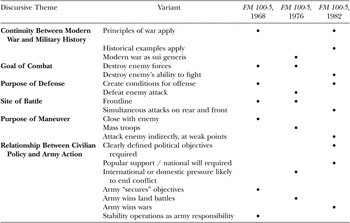
Table 1 outlines the key differences across the three capstone doctrinal manuals. The changes can be grouped into three general areas: the continuity between modern war and military history; the army's way of war; and the relationship between civilian policy and army action. In the first area, the 1976 manual emphasized the differences between past and current warfare, while the 1968 and 1982 versions stressed continuity. The manuals from the Vietnam era and early 1980s reprinted the army's longstanding principles of war—though, as we will see, they were substantially edited as the army developed AirLand Battle. The 1982 version also used an array of historical vignettes to show the continuity between its new way of war and the history of armed conflict. The 1976 version went in the opposite direction, using quantitative data to show that modern weaponry was devastatingly lethal, and it used no historical examples. This implied that warfare in the last quarter of the twentieth century had no antecedents. As we will see, this diverged sharply from the unofficial discourses of mid-level army officers in the early 1970s.
Discursive Themes of Army Doctrine, 1968–1982

The next general area is the army's vision of future battle, illustrated by four discursive themes: the goal of combat, the purpose of defense, the site of battle, and the purpose of maneuver. The 1982 manual saw the goal of combat as not necessarily the destruction of enemy forces but, rather, of the enemy's will to fight. This means it may be more effective to attack soft targets that support enemy combat troops, like command and control or fuel-supply lines, rather than to meet the opposing army head-on. By contrast, the 1976 manual appears to be a doctrine of attrition.
The 1982 version also restored the army's emphasis on offense, which can best be seen in its conception of the purpose of defense. Where the 1976 manual stressed that the army could win battles on the defensive by feeding in soldiers from flanks and reserves to meet the main enemy attack, both the 1968 and 1982 versions emphasized that the purpose of the defense was to create conditions necessary to go on the offensive. In order to do this, the 1982 manual envisioned the army attacking the opponent simultaneously in the rear and the front (Site of Battle) in order to create and exploit enemy weaknesses through rapid maneuver along what the manual termed “indirect approaches” (Purpose of Maneuver).Footnote 50 The earlier manuals clearly differed with the 1982 version, seeing the battle as mostly on the frontline and emphasizing the use of maneuver mostly to move forces into close combat rather than to attack areas of enemy weakness.
The final but perhaps most important area of comparison is the army's conception of how the strategic and tactical levels of war interact—that is, the relationship between civilian policy and military action. The 1982 capstone doctrine emphasized that civilian authorities must clearly define the political objectives of war before ordering troops to battle, and they must marshal public support both before and throughout the conflict. Neither of these themes appeared in the 1968 or 1976 manuals. Indeed, as the table shows, the 1976 manual assumed that international or domestic pressure would end the conflict before the army had a chance to win; therefore, the army would just try to hold ground until civilians could reach a political settlement. As we will see, this contrasted sharply with the unofficial discourses of army officers.
The 1982 manual also stressed the winning of wars rather than the winning of battles (as in the 1976 manual) or the securing of political objectives (as in the 1968 version). This was a crucial change. While the 1982 version brought the political context of war back in, it differed from the 1968 manual in stressing that military power would not necessarily solve all possible foreign-policy problems. Military power is used to defeat enemies on the battlefield; if this helps to achieve policy objectives, then it can be used. Indeed, the table shows that the two post-Vietnam manuals left out any hint that the army would participate in stability operations. This silence implies that some political imperatives require civilians to apply nonmilitary forms of state power, leaving the military to fight on the conventional battlefield when necessary to U.S. interests.
This discussion shows that while the army paradigm was transformed after Vietnam, its consolidation was not accomplished by the initial rewriting of the army's capstone doctrine. While some elements of the 1976 manual—especially the importance of realistic training—endured, many important ones did not.Footnote 51 The 1982 version of capstone doctrine differed from its immediate predecessor in many areas, notably in its emphasis on continuity with military history, on fighting offensively and attacking enemy weaknesses rather than strengths, and on demanding that civilian authorities take responsibility for the war effort. The key questions for analysts of political change are why the Vietnam-era paradigm broke down and why the 1976 manual never took hold as the official paradigm. The rest of the article addresses these questions, showing how officers' unofficial discourses differed from both the Vietnam-era paradigm and from Active Defense. This lack of support from mid-level agents created the conditions necessary for reformers to influence the discourses of army leaders.
DIVERGENCE AND DEFECTION FROM THE PARADIGM, 1972–1976
The micropolitical perspective holds that the transformation we see between 1968 and 1982 was driven by reformers who capitalized on the opportunity provided by a shift in the discourses of mid-level officers. In this section, I analyze five years of articles from army journals to indicate where the unofficial discourses of officers deviated from the paradigm. This defection of mid-level officers is important for two reasons: it signaled to reformers that there was a broad base of support for a new paradigm, and many of the themes of the discourses of these officers would eventually become part of it.
It is true that the paradigm was also undermined by civilian authorities. I will briefly show the shape of their discourses in order to acknowledge their divergence from the paradigm. However, it is important to note that, while this helps to explain why the army was able to change its paradigm in 1976, it does not show why we see the overhaul of the 1976 version of capstone doctrine in favor of AirLand Battle. To understand that change, we must look to the work of internal and external reformers. The combination of the defection of mid-level officers and the success of reformers in shifting the discourses of leaders drove the changes we observe in the 1982 capstone doctrine.
In the summer of 1969, President Richard Nixon announced that the United States would no longer intervene directly to help Asian allies defend themselves against internal or external threats.Footnote 52 This policy, termed the Nixon Doctrine, soon became the basis for a reworking of domestic and national-security budgeting, as well as U.S. security policy.Footnote 53 Although the Nixon Doctrine was not universally accepted across the government, Congress similarly diverged from the army paradigm through its attempts to defund the war effort and force the president to withdraw combat troops from Vietnam.Footnote 54 Nixon resisted these attempts, but by the early 1970s there were few voices—even among defense intellectuals—sharing discursive themes with the paradigm.Footnote 55 Soon, Henry Kissinger would declare 1973 the “Year of Europe.”Footnote 56
It is important to observe that, even though civilians diverged from the army paradigm, they did not mandate the specific changes we see in the 1976 or 1982 manuals. The transformation codified by the 1982 manual was shaped by the mid-level agents who defected from the Vietnam-era paradigm and helped to press for a new one.
In order to understand whether and how the unofficial discourses of officers deviated from the paradigm, I first inventoried five years of articles published in Military Review and Parameters to understand the subjects U.S. Army intellectuals discussed most. The former journal is published by the Command and General Staff College at Fort Leavenworth, Kansas, and it includes articles by intellectuals both inside and outside the U.S. Army; Parameters is similarly oriented, produced by the U.S. Army War College. I then analyzed a sample of one hundred articles published between 1972 and 1976 to determine which discursive themes were prevalent just after the U.S. Army left Vietnam. As we will see, many of these themes diverged from the Vietnam-era paradigm and from the 1976 manual as well.
One caveat about analyzing the unofficial discourses of officers is that we cannot be sure the venues through which they speak (journals, oral-history interviews) are not controlled in some way by the leadership. However, this sample suggests that there were many discourses used in the army journals. As well, the discourses these officers used diverged from the 1976 Active Defense doctrine. It is not likely that these publications were used by the leadership in order to disseminate a discourse that would overturn a doctrine that was just going to press.
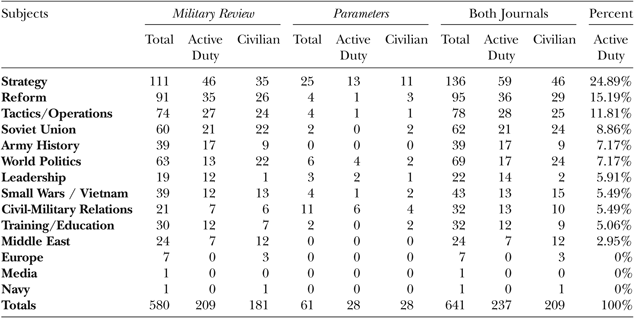
For the full inventory of articles published between 1972 and 1976, I created broad categories in order to capture general interests like strategy, world politics, and the Soviet Union, rather than breaking these areas into specialties like logistics and artillery, or into narrow geographical areas. If the article concerned U.S. interests, then the subject was strategy; if the article focused on an important region but did not focus on the United States, then the subject was world politics. It was important to keep the subject areas relatively broad so that I could see whether within the most common subjects there were varieties of discourse.
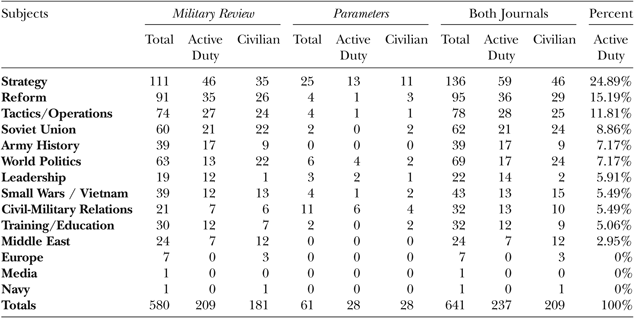
The three most prevalent subjects in Military Review, among both active-duty officers and civilians, were strategy, tactics and operations, and army reform (see Table 2). Officers publishing in Parameters had a similar concern with strategy, which far outpaced subjects like civil-military relations and world politics, though the percentage of civilians writing articles on strategy is similarly overwhelming. This inventory of subjects suggests army officers after Vietnam were interested in analyzing the relationship between military action and political strategy—which the above discussion shows was missing from the 1976 operations manual.
Subjects of Journal Articles, 1972–1976
The range and popularity of subjects does not necessarily shed light on the unofficial discourses of the army officers writing articles for these journals. In order to get a better sense of common discursive themes and their combinations, I sampled one hundred articles written by active-duty officers over this five-year period. I selected them in rough proportion to the number of articles published by each journal: eighty-seven articles from Military Review and thirteen from Parameters. In order to evaluate the prevalence of different discursive themes, I chose to sample only articles in the top three categories of Military Review, with the number weighted according to the percentages of the subjects. Had I sampled from every subject area, I would have potentially given more weight to minority discourses tied directly to the less-popular subjects. Because the Parameters subject matter was far less diverse—and because strategy was the only category under which at least one article appeared each year between 1972 and 1976—I chose to examine all thirteen articles on strategy.
In reading these articles, I analyzed the discursive themes of these writers, then calculated the percentages of articles employing these themes. I tried when reading each article to take into account its context. For instance, I would not count a discursive theme as being used if it was obvious the author disagreed with that theme. However, I also tried not to interpret an author's silence. If he (I believe all of the authors in the sample to be male) did not use a discursive theme, this counted as not using it—even if other indicators suggest he would have been likely to use such a theme in another article or in everyday speech. As well, I did not weight the use of a discursive theme according to the frequency of its appearance in an article. If it appeared, it was coded 1; if not, then 0. What matters here is to understand the discursive themes in play during the first half decade or so after the army's involvement in Vietnam, and whether and how these themes deviated from the army paradigm. The results are intended not as a definitive measure but rather an indicator of the most prevalent discursive themes among army officers.
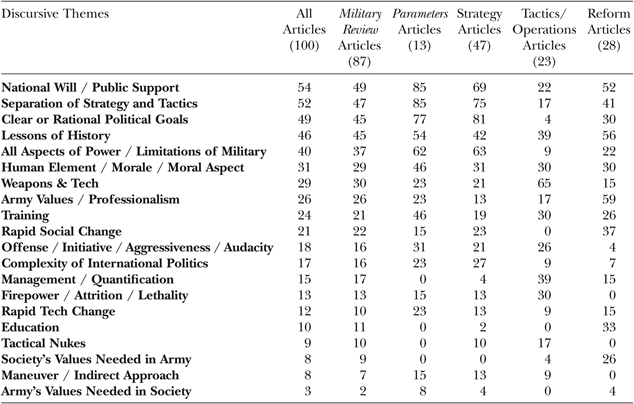
The subject matter of the articles written by officers between 1972 and 1976 is not the only indicator of internal defection from the army paradigm, as Table 3 shows. The two discursive themes that appear in more than half of the sample are far different from those found in the 1968 army operations manual: the division between political strategy and military operations, and the requirement for national will or public support in the event of war. It is telling that the appearance of these two themes is not influenced solely by the prevalence of articles on strategy. For instance, not all articles on strategy feature these themes: some focus on other aspects, ignoring national will or the division between political strategy and military tactics. More important, even among articles in Military Review on the subject of army reform, I found a majority emphasizing the necessity of national will.
Discursive Themes in Military Journals, 1972–1976

The numbers in parentheses are the total number of articles for each category. Numbers in the tables are the percentage of the sample or subsample that includes a given discursive theme.
NOTE: Two articles outside the subject areas were substituted for articles on strategy, so the total N for the three categories = 98
Indeed, of the discursive themes that appear in at least 30 percent of the sample, only the emphasis on the employment of all elements of national power is similar to the army's Vietnam-era paradigm. But there is an important difference. The 1968 manual does not suggest that there are limitations to the efficacy of military power; the army could be used for economic and political tasks if they were central to the national goal. By contrast, the connotation of many of the articles between 1972 and 1976 is that the army's job is to win wars on the battlefield, not to achieve the aims of foreign policy by any means necessary. Other prevalent themes from the sample, Table 3 shows, are the need for clarity or rationality in national strategy, the lessons of history, and the human element of war (as to opposed to, for instance, the scientific management of troops and matériel).
Several of the least-prevalent discursive themes—including technology, the management and quantification of troops or firepower, and firepower or attrition—are found in the 1976 version of the army's operations manual. Given that the manual seems to have excluded many prevalent themes and adopted many that were not widely accepted, it makes sense that the Active Defense paradigm did not endure.
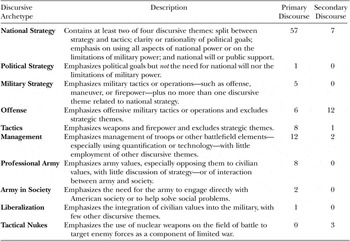
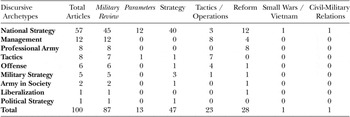
To understand more generally the orientation of army discourses, I examined the individual cases to see which discursive themes tended to appear together. I identified nine frequent combinations of discursive themes. For instance, if an article emphasized at least two of these four discursive themes—the split between strategy and tactics, the clarity or rationality of political goals, an emphasis on using all aspects of national power or on the limitations of military power, and the requirement for national will or public support—I considered this a discourse of national strategy. Table 4 describes the nine different discourses and shows how many authors in the sample use them. The table also shows that some discourses appeared in articles as secondary components of the main discourse.
Discursive Archetypes in Military Journals

The numbers in the table are the percentage of articles in the sample that use a given discursive archetype. Sample size is 100. Not all articles have a secondary discourse, so that column does not equal 100.
The national-strategy discourse is deployed in a majority of the cases—fifty-seven—while the next-most-frequent discourse is management, in twelve cases. Again, the national-strategy discourse is not limited to the articles whose subjects were strategy: under the topic of army reform, the national-strategy discourse is used in nearly half of the cases (see Table 5). Even under tactics and operations, Table 5 shows, the national-strategy discourse predominates in three cases. It is worth noting that under the subject of tactics and operations, there is no single dominant discourse, with different articles deploying discourses of management, tactics (focusing on firepower), and offense. As well, not all of the officers' unofficial discourses fit neatly into a discursive archetype. As I note above, some articles have a primary discourse as well as elements of another archetype as a secondary discourse. In other cases, authors include themes seemingly at odds with their primary discourse.
Frequency of Discursive Archetypes by Article Subject

The numbers in the table represent the total number of articles in the sample corresponding to a given discursive archetype.
An example of national-strategy discourse can be found in an article on strategy by Wesley K. Clark, the future commander of NATO's war over Kosovo, but in fall 1975 a captain just out of the U.S. Army's Command and General Staff College. Clark argues that American strategy in Vietnam was “ad hoc . . . adopted covertly, almost without deliberation.”Footnote 57 After reviewing Cold War history, Clark highlights three criteria for deployment of military forces:
First, coercive pressures must be applied as directly as possible to secure the objectives of the commitment; second, limits must be carefully constructed to avoid the impression of weakness; and third, coercion must have a logically attainable conclusion.Footnote 58
Using military force properly, in the service of rationally constructed objectives—rather than as a substitute for other elements of political power—will not only aid military forces in the field, Clark argues, but ensure that the public will understand and support the effort. This is the essence of the national-strategy archetype.
This national-strategy discourse is so prevalent that officers also use it to discuss reform and tactics. In an article on French tactical doctrine during World War I, the writer stresses that, to determine if a tactical doctrine succeeded, we must understand “its strategic and political backdrop.”Footnote 59 The author will not consider military tactics or operations in a vacuum. Similarly, in an article on the potential of facing nuclear, biological, or chemical weapons on the battlefield, the officer stresses the rationality and clarity of civilian strategy, as well as the national will: “While policy precludes our first use of lethal and incapacitating chemical agents, we have made known the national decision to maintain the capability to retaliate in kind, and we hope that our resolve to retaliate will deter any use of such chemical agents by an aggressor.”Footnote 60 These stand in stark contrast to the 1976 manual, which explains how to win tactical engagements, irrespective of national policy.
At least one discursive archetype comports with the 1976 manual. Management discourse, though it ranks far behind national strategy, is the second-most-used discourse—especially in articles concerning logistics or important details of tactical engagements. Officers employing this discourse typically explain how to apply computers or new management techniques to deal with such things as the control of airspace, information, intelligence, or cost control. Few of these articles tie tactics to larger issues of politics. For example, one lieutenant colonel stresses training and techniques for combat in urban areas by using a formula instead of emphasizing human elements or political objectives: “NT (UrbS) + CICn = MOUT [military operations on urbanized terrain].”Footnote 61 This kind of equation was the exception rather than the rule in these unofficial discourses; authors were far more likely to focus on political and moral aspects of warfare.
The evidence in this section shows that civilian and internal discourses had, by the beginning of the 1970s, diverged from the army paradigm. However, the divide during this period between the president and Congress, and along partisan or regional lines, made it unlikely that civilians could unite under a single discourse.Footnote 62 Most army officers also appear to have defected from the Vietnam-era paradigm. Their unofficial discourses focused on the importance of history and on national strategy, both of which were essentially neglected by the 1976 manual.
In the following sections, I examine the process that produced the 1976 manual, the backlash that followed it, and how reformers inside and outside the institution slowly influenced the discourses of key army leaders, ultimately transforming the army paradigm.
TRANSFORMING THE ARMY PARADIGM, 1973–1982
Had the army's 1976 capstone doctrinal manual followed the contours of unofficial discourses, it likely would have emphasized the separation of strategy and tactics, the limitations of military power, the need for clarity of civilian objectives, and the requirement for a national will to fight—and it would have used historical examples to illustrate these points. As the previous comparison of field manuals shows, this came later, in the 1982 version of FM 100-5, Operations. Instead, the 1976 manual focused on the management of men and weapons to kill enemy troops while on the defensive; it was silent on the lessons of history and the political context of war.
The 1976 revision of FM 100-5 was written by a group of officers led by General William E. DePuy, the first commander of the U.S. Army's Training and Doctrine Command (TRADOC), from 1973 to 1977.Footnote 63 I do not have space to analyze the influences on the thinking of DePuy and his circle of aides.Footnote 64 But DePuy seems to have been driven by longstanding concerns about how the army trains soldiers for war, a belief that the 1973 Arab-Israeli War showed modern battle to be too lethal to risk offensive action, and suspicions that the American government and public would not provide the resources necessary to win in Europe.Footnote 65 Given these assumptions, the most the army could hope for was to prevail in defensive engagements. Because of DePuy's belief that the modern battlefield was sui generis and his pessimism about public support, the 1976 capstone field manual made no references to military history, focused on how to move soldiers into battle against the enemy's strengths rather than weaknesses, and was silent on the larger strategic context of war.
Why did the 1976 manual fail, while the 1982 version endured? We cannot assume that this was inevitable. Both manuals were approved by the army chief of staff, thus bearing the support of the highest level of the institution. As we will see, TRADOC, and especially DePuy's successor, General Donn A. Starry, defended Active Defense for at least two years despite the backlash from below and outside. But this agitation by a diverse policy network influenced key leaders like Starry to open the process of doctrine writing to a range of voices. While the pace of change was slow, these dissenters managed to shift the discourses of Starry and his doctrine writers, resulting in the transformation of the paradigm.Footnote 66
External and Internal Backlash Against the 1976 Manual
Reaction against DePuy's manual was swift and strong, inside and outside the army. Soon after the publication of the 1976 version of FM 100-5, Operations, a Senate aide wrote a penetrating assault on the doctrine that circulated widely and was eventually published in Military Review.Footnote 67 The aide, William S. Lind, attacked FM 100-5 on several fronts. The most important was his complaint that the doctrine focused on destroying head-on the main attack of Soviet forces by throwing men and matériel from flanks and reserves into defensive positions. Lind advocated instead an “indirect approach,” where the fighting force aims to outmaneuver the quantitatively superior opponent by penetrating areas of weakness, assaulting soft targets like command-and-control nodes, and eroding the enemy's will to fight.Footnote 68
Lind also condemned the 1976 manual's implication that the modern battlefield had no antecedents, arguing that the writers should have examined history closely to understand how an outnumbered force can win on a highly lethal field of battle. He claimed that support for his argument lay not just in the example of German blitzkrieg operations during World War II but in recent history in the example of the Israeli army's rally against numerically superior Arab forces driven by its maneuver doctrine.Footnote 69 This was far different from DePuy's analysis, which saw the Yom Kippur War as an example of how lethal modern weaponry had become and how dangerous it would be to mount an attack. Lind argued that the Soviets had enough rear echelons to ensure that the initial conflict could not be decisive. The result of DePuy's emphasis on killing frontline forces and his inattention to history, according to Lind, was a doctrine that risked losing the war in the service of winning the first battle.Footnote 70
Lind was one of four civilian defense intellectuals who persistently criticized the army between 1977 and 1981.Footnote 71 His emphasis on maneuver warfare was similar to that of Edward N. Luttwak, who worked with Lind and a small circle of civilians to pressure the armed services and the Reagan administration for reform, and Steven L. Canby, an army reservist with whom Luttwak formed a consultancy.Footnote 72 Canby shared the maneuver advocates' arguments but went further in emphasizing how air and ground forces working together could exploit the opponent's discontinuities and “shatter the cohesion of the defense.”Footnote 73
This idea of attacking the enemy's ability to react to battlefield events was borrowed from the fourth key civilian critic, John R. Boyd, a retired U.S. Air Force colonel. Boyd had developed a briefing on the nature of military strategy that showed the theoretical and historical bases for an emphasis on the indirect approach. The best way to defeat an opponent, Boyd argued, is not to destroy individual fighters but to attack the cycle within which the enemy makes decisions. A force that can decrease the time between its observations and actions, or increase the opponent's time, will confuse the enemy and degrade its war-fighting capacity.Footnote 74
Boyd argued that one of the most effective ways to generate this confusion is to attack not sequentially—weakening the enemy through defense and then moving to offense, as the 1976 manual envisioned—but simultaneously.Footnote 75 This concept was diametrically opposed to the army paradigm, and it does not appear to have been prevalent in officers' unofficial discourses in the mid-1970s. Boyd also contended that the war effort could be enhanced by strengthening the national will of friends and allies.Footnote 76 This was similar to Canby's contention that the erosion of the enemy's national will could prove decisive.Footnote 77 In this sense Boyd and Canby did not see military operations simply as a combination of tactics. They saw them as part of securing the goals directed by national strategy.
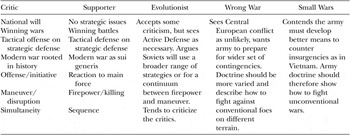
Table 6 shows the discursive themes of critics and supporters of the 1976 operations manual. Because not all critics and supporters shared the same themes, the table indicates that there were other types of criticisms from inside and out: some wanted a focus on how to fight small wars (“Small Wars”), while others saw the army manual as too focused on Europe (“Wrong War”).Footnote 78 The “Evolutionist” argument basically accepted Active Defense but held that the Soviets would not fight as the manual envisioned, either because they had already shifted their operational approach or because they would soon do so in reaction to the new manual.Footnote 79 Those who used this discourse tended not to attack the doctrine but to suggest additional tactics.
Discourses and Themes in Debate Over FM 100-5, Operations (1976)

The first two columns compare key discursive themes of the civilian critics and supporters of Active Defense and show how they clashed. The three columns on the right show the less-common critiques of the 1976 manual.
The most prominent discursive themes from the civilian critics Lind, Luttwak, Canby, and Boyd stand in stark contrast to those of the army capstone doctrine and its supporters. If we compare the themes in Table 6 to the discussion of the 1982 manual above, we find that all of the civilian critics' discursive themes were incorporated in some fashion into AirLand Battle. Of the seven themes I identify as among the most important features of civilian criticism, three of them were common in army officers' writings during the 1970s: national will, the division between strategy and tactics, and history. A fourth, the emphasis on winning wars instead of battles, is implied by the discursive archetype of national strategy that I show was common in military writings. The three other civilian discursive themes—offense, maneuver, and simultaneity of attack and defense—appear to have been minority themes among officers in the mid-1970s. I show below how reformers' discourses penetrated the army leadership.
The Backlash Opens TRADOC to Influences from Below and Outside
How did some of the unofficial discourses of army officers, and the civilian critics, became the basis of the new institutional paradigm? This was not a case of civilian authorities demanding changes. Instead, between 1977 and 1981, civilian critics outside government worked with army officers—in some cases directly, in others by disseminating their ideas—in order to influence the discourses of army leaders. Harry G. Summers Jr., a colonel at the Army War College, contended that the civilian reformers pushed the army to pay attention to issues of strategy rather than simply to battlefield tactics.Footnote 80 Jeffrey S. McKitrick and Peter W. Chiarelli did not see a direct influence on any particular area of the paradigm, but they argued that reformers sparked a climate of innovation in the late 1970s.Footnote 81 Lind, for his part, was disappointed that the army did not adopt all of his ideas wholesale, but acknowledged the crucial interactions between lower-level army officers and civilian reformers.Footnote 82 While the result of this pressure was not an immediate overturning of the Active Defense doctrine, the process slowly transformed the paradigm.
One of the most important parts of this process was the influence of mid-level officers and outside critics on the discourse of General Donn A. Starry, who was involved in doctrine development throughout the 1970s. Starry had written much of the Active Defense doctrine under DePuy. Soon after FM 100-5 was published, Starry took DePuy's place as commander of TRADOC. Starry therefore had a personal interest in supporting Active Defense, as well as a professional one: as TRADOC leader, he was in charge of disseminating the capstone doctrine. However, the backlash against the manual and the lack of support from mid-level officers led Starry to open himself and TRADOC up to a range of critical discursive themes. Slowly, his discourse changed, and along with it came the overhaul of the paradigm.
Some of the changes came from direct contact with critics. Indeed, Starry corresponded and had face-to-face meetings with civilian critics throughout his tenure. As well, he and his colleagues followed closely the attempts by outside reformers to shape the internal debate over Active Defense.Footnote 83 Because of the backlash, Starry became determined to achieve consensus around the 1982 revision and was open to ideas from both inside and outside the army.Footnote 84 While Starry sometimes cast his as a sales job, he also acknowledged that his aim was to broaden the influences on doctrine: TRADOC personnel invited concepts from the army at large, hosted a range of officers at Fort Leavenworth to discuss future doctrine, and traveled to brief officers in the field.Footnote 85
Starry also assigned a deputy to forge consensus on doctrine, not just within the army but outside it as well. His choice for this position, Donald R. Morelli, pressed Starry to answer the critics in the 1982 revision of FM 100-5.Footnote 86 Starry credited Morelli with taming the civilian defense intellectuals by forcing them to “tell us what to do better,” as well as changing some of their minds.Footnote 87 However, Morelli did not just meet civilian critics to sell them on the army way; these critics were invited to participate in the process of development and even revision. As Morelli recalled, “We didn't agree with everything all of these people or many of the people in the Army said. But we certainly took into account all their thoughts. And I remember spending one whole day out at Leavenworth with Bill Lind and the authors, sitting around a table, going over this draft, page by page.”Footnote 88
So the broad dissatisfaction with the 1976 revision—inside and out—compelled TRADOC to listen to critics. This led to significant shifts in Starry's discourse, and then in official papers and doctrine. When the army began publishing new ideas about maneuver warfare in the early 1980s, the civilian reformers were not fully satisfied, but they did believe that they had pushed the army toward a new way of war. Luttwak even claimed that “whole paragraphs” of his work were showing up in army publications.Footnote 89
Still, direct pressure from civilian critics did not bear immediate results. Despite Starry's receptivity to outside ideas and interest in consensus, he often dismissed criticism by saying the 1976 manual was misunderstood, or by lamenting “our inability to explain things as clearly as we might have.”Footnote 90 As well, he held some civilian critics in low regard.Footnote 91 Starry reserved his greatest antipathy for Canby, complaining that he was “just plain vague and confused and confusing” and scribbling this sarcastic note to an aide, asking for a brief response to Canby's request to be involved in the revision of FM 100-5: “Write a nice letter. Tell him ‘Thanks for your interest in Natl Defense, but you've already screwed us up enough, we don't need any more of your stupid ideas.’ Be nice!”Footnote 92 This suggests that Starry was reluctant to change solely because of outside pressure, though I show throughout this section that his discourse slowly shifted toward that of Canby and other critics.
Despite Starry's defensiveness, junior officers within the TRADOC orbit acknowledged in articles that the civilian critics played a major role in stirring dissent against the presumptive paradigm. For instance, Anthony M. Coroalles, a captain who worked on ideas about combat at Fort Leavenworth, and Richard Hart Sinnreich, who would play a key role in developing principles of maneuver warfare, each referred to the civilian critics while castigating the 1976 manual.Footnote 93 Indeed, Coroalles directly cited all four writers in separate footnotes, suggesting that by the end of 1981 the Leavenworth brain trust was intimately familiar with the specifics of their arguments.Footnote 94 The fact that Coroalles's article, “Maneuver to Win,” was highlighted on the cover of Military Review suggests that by fall 1981 the institution accepted many of the principles of maneuver warfare and the legitimacy of the civilian critique.
Some officers argued that they came to value maneuver warfare, not through the intervention of critics, but from their own studies of history. However, the officers most directly involved with the writing of the manual had studied closely the civilian critics—even if they claimed to find them wanting.Footnote 95 Huba Wass de Czege, the lead writer of the 1982 version of FM 100-5, argued that Boyd's approach to maneuver was oversimplified and that Boyd himself recognized that other methods might be applied to winning modern wars.Footnote 96 Wass de Czege contended that civilian critics set up a false dichotomy between firepower and maneuver, when one or the other—or different combinations of the two—would be required, depending on the situation on the ground.Footnote 97 Two other officers on Wass de Czege's writing team, Clyde J. Tate and L. D. Holder, gave army critics more credit, contending that “fresh concepts have been elaborated in criticizing and defending current ideas.”Footnote 98
The accounts from officers involved in the process suggest that there was at least indirect influence from civilian critics. While this was important, I show below how officers at TRADOC gradually adopted the discursive themes of their critics: some shifts occurred early, and these shifts sparked further changes. Over time, the result was a new paradigm.
Themes of History and National Strategy Collide with Active Defense
Many of the dozens of articles debating Active Defense in the years after its debut criticized its conception of modern war as somehow outside of history.Footnote 99 Officers, in private correspondence to Starry, also stressed the relevance and endurance of principles and historical events.Footnote 100 This comports with my analysis of unofficial army discourses between 1972 and 1976, which shows that officers commonly emphasized the lessons of history. This is important; as we will see, the discursive theme of history forced doctrine writers to seek continuity between the imperatives of modern warfare and the army's traditional principles of war.
Starry did not fully share DePuy's conviction that the modern battlefield rendered military history or principles of war irrelevant. However, he initially tried to use historical examples to defend and disseminate the 1976 manual.Footnote 101 He also warned historians that while the past might yield insights into modern war, it might also mislead them into ignoring lessons from recent events like the Yom Kippur War.Footnote 102 In addition to this contention that new technology threw past experience into question, Starry held that changes in society made the past less relevant. He argued that the rise of Great Society initiatives ate into the potential defense budget, so that the army could not count on the massive amounts of firepower required to win on such a destructive battlefield. He also argued it was not clear that the entire nation and its economy could be mobilized as it had been in the past. In earlier conflicts, like World War II, the army could afford to lose the early battles before the United States cranked up its industrial might. But, with conscription ended and the government focusing on domestic programs, Starry felt the army would not be given the resources necessary to lose early battles and still recover to destroy the enemy.Footnote 103
However, during his reign at TRADOC, Starry became sensitive to the concerns of those seeking a greater emphasis on history. He urged educators to integrate more historical study into their curricula, and he established the Combat Studies Institute at Fort Leavenworth to conduct historical research useful to doctrine developers.Footnote 104 This commitment to historical study meant that TRADOC could not simply label the modern battlefield as fundamentally new. Doctrine developers would be compelled to consider continuities between modern conflict, history, and the army's traditional principles of war. As we will see, this would lead Starry and his team to try to find greater opportunities for the offense.
The 1976 manual, in addition to running afoul of officers' unofficial theme of the importance of history, also neglected to mention the political context within which the army fights. This ran contrary to the national-strategy discourse that, as I discussed previously, was so prevalent among officers in the first part of the decade. FM 100-5 did not consider the separation of strategy and tactics or the need to apply other elements of national power to win wars. Instead, Active Defense focused on the army winning the first battle—even if it meant committing reserves that would normally have been held back for a counterattack to defeat the enemy.
Starry's discourse, from 1974 to at least the first half of his tenure at TRADOC, similarly divorced tactics from national goals. He tended not to speak of winning “the first battle” but “first battles,” softening somewhat Lind's accusation that the army was in danger of losing succeeding engagements. However, he did argue that if the first battle was lost there might not be a second one.Footnote 105 More important, he spoke as if these battles were discrete events, each one fought under the same conditions of unprecedented lethality—rather than adding up to a whole that would be governed by national strategy.Footnote 106
Elsewhere in the army, however, officers emphasized political context and defeating enemies rather than achieving stalemate.Footnote 107 Richard Hart Sinnreich argued that his fellow cadets at West Point in the early 1970s—including Wass de Czege, the lead writer of the 1982 version of FM 100-5—were at least as concerned with the broader context of war as with how to fight.Footnote 108 He recalled that Alexander M. Haig's staff at NATO reacted negatively to the 1976 manual due to the lack of attention to how battles add up to victory.Footnote 109 Later, during Starry's tenure, a paper prepared by the Office of the U.S. Army Deputy Chief of Staff for Operations and Plans stressed,
The active defense is not the means to win the last battle on the European battlefield. The Army must understand that the active defense is the way we initially fight outnumbered and win the first battle, but that we must continually seek to go over to the attack to destroy the enemy.Footnote 110
In order to combat criticism and focus on the larger context of war, the army in 1978 released FM 100-1, The Army, which was not a TRADOC product but was written at the U.S. Army War College.Footnote 111 For this reason, perhaps, it was not bound to the concepts enumerated in FM 100-5. The new field manual situated the army within the larger national-security apparatus. While FM 100-1 did portray the army as charged with achieving political goals, it stressed—as did the unofficial national-strategy discourse—that the army was just one arm of the state, and that winning wars required other elements of national power, as well as “a coherent national strategy.”Footnote 112 This division of the elements of power suggested that the army and the civilian leadership might not operate under the same logic. This potentially allowed the army to justify an offensive orientation despite the U.S. and NATO policy of defending Western Europe.
In response to the complaints that the 1976 version of FM 100-5 was ahistorical, FM 100-1 also reproduced the nine principles of war that had been a part of past manuals. The second principle, “Offensive,” made clear how battles are won.
The defensive may be forced on the commander as a temporary expedient while awaiting an opportunity for offensive action. . . . Even on the defensive, the commander seeks opportunities to seize the initiative and achieve decisive results by offensive action.Footnote 113
This principle throws into question the Active Defense and suggests that to realign army doctrine with current philosophy, doctrine developers would have to find greater opportunities for offense—regardless of the lethality of the modern battlefield. In this sense, the prevalent discursive themes of the importance of history and national strategy sparked a rapid erosion of some of the foundations of the presumptive paradigm. From there, as we will see in the next section, the doctrine was overturned as Starry and other officers sought to emphasize offense.
From History and Principles of War to a Focus on the Offensive
Starry's discourse had, earlier in his career, included the theme of offense and initiative. But he seems to have downplayed that theme between his time as a lead writer of the 1976 manual through the middle of his command at TRADOC. In a 1974 message to DePuy, Starry did recommend that Active Defense include “the imperative of eventually seizing the single advantage the defender lacks—initiative, in an attack scaled to destroy the attacking echelon before the next echelon can gain the battle.”Footnote 114 Four years later, as he tried to build consensus around FM 100-5 in the face of what he knew was skepticism about Active Defense, Starry acknowledged that winning would require taking the initiative. However, during this period he saw opportunities for offense on the modern battlefield as very limited—and potentially “suicidal.”Footnote 115
Why would Starry, who stressed that the offense wins, continually warn against taking the initiative? There seem to be three key reasons, all of which interacted: the lethality of modern war, the reduced national will for war, and the existence of Soviet rear echelons that would overwhelm a U.S. counterattack. After the Yom Kippur War, Starry agreed with DePuy that the nature of the battlefield had changed. Modern war was so lethal, he argued before the manual was written, that “exposed elements will be destroyed unless the hostiles have been destroyed, suppressed,” or otherwise inhibited.Footnote 116 Convinced that the only way to “fight outnumbered and win” was to meet the enemy head-on with as much firepower as possible, he implored army commanders to internalize the new doctrine so they could defeat the main attack before reinforcements arrived.Footnote 117 This meant not learning how to think on the fly but instead training for the likely battle, acting “automatically,” and getting it right the first time.Footnote 118
Starry also implied that his reticence stemmed from his reading of American will. With domestic political turmoil and no clear U.S. national-security policy, army doctrine had to be kept simple and be based on the assumption there would be no national mobilization for war.Footnote 119 Because of the manpower and firepower required for the defense—including the commitment of reserve forces that would normally be held back for a counterattack—Starry was skeptical that the army would be granted enough resources to take the fight to the enemy.Footnote 120 Even after his discourse had shifted toward maneuver warfare, Starry saw national priorities as preventing the possibility of an offensive—and, he implied, winning.Footnote 121
The nature of modern war and the lack of resources, combined with the fact that the Soviets possessed large echelons that they could send forward to reinforce the main attack, fueled Starry's emphasis on firepower and attrition.Footnote 122 Starry argued that the army's capacity for mobility, its lethal weapons systems, and its well-trained troops and commanders could—even on the defensive—completely destroy the Soviets' first echelon, compel it to retreat into Eastern Europe, or confuse the attackers. “The only way we will ever be able to get the Soviets' attention is to pile on and kill a lot of the bastards early,” he argued to a general who apparently saw the manual as too focused on the defensive.Footnote 123 The key was to grind down the frontline forces before succeeding echelons could arrive.Footnote 124
It is crucial to note that Starry's sequential view of operations led him to prioritize frontline attrition through defense: even if it were necessary to win on the offense—either to finish killing the enemy's troops or to damage its command-and-control infrastructure—the enemy's attacking force must be destroyed or weakened first. In a rejoinder to the deputy chief of staff for operations and plans, whose aides pushed for greater attention to offense, Starry cautioned, “It makes no sense to . . . penetrate various defensive lines of, let's say, a first-echelon Soviet army, and then find ourselves staring into the face of a fresh, unattrited, mobile second-echelon Army or even front.”Footnote 125 But instead of trying to attack the second echelon either first or concurrently, which he would later embrace, Starry stressed in early 1978 the need to see where the second echelon was moving—not in order to attack it, but as a clue to where the first echelon would try to break through.Footnote 126
However, throughout 1978, Starry began to acknowledge the critics' perception that the 1976 field manual was defensive—even if he disagreed. So he sought in a sense to informally change how the doctrine was interpreted. He implored Fort Leavenworth to focus on teaching offense because it “is the thing we explained least well in 100-5,” and he told an old friend who criticized the lack of attention to indirect warfare that he was keeping notes on the debate over the manual so he could correct the areas of misunderstanding.Footnote 127
Starry also maintained during this period that the Active Defense was consistent with the army's belief in the “spirit of the offensive.”Footnote 128 However, there seems to be little support for his assertion. The 1976 manual did have some language echoing Boyd's stress on rapid attacks and disrupting enemy cohesion, but the primary purpose of the offense is to destroy enemy forces.Footnote 129 More telling, the manual's image of the battle was one of a sequence from defense to offense, where the army so weakens the main-force attack with its firepower that it can later shift to the offense and destroy the remaining enemy force.Footnote 130 So while Starry was literally correct to say the manual included the offensive, it is understandable that officers would interpret the doctrine as stating that the defense would essentially win. The offensive blow would come only after the opponent had been rendered ineffective.
While Starry in this way tried to informally advance the requirement for offense, he soon shifted other components of his discourse—such as the emphasis on firepower, attrition, and the sequence of offensive and defensive action—in order to accommodate the offensive. This would essentially align TRADOC's image of the army's core missions and capabilities with that of the growing number of critics inside and outside the institution.
Attention to the Offensive Sparks Emphasis on Maneuver and Simultaneity
In December of 1978, Starry told the deputy chief of staff for operations and plans that he no longer believed the outnumbered side could win by destroying frontline forces. Reconsidering the Israeli case, Starry came to believe that the key to winning lay not in destroying the main attack but by sapping its power through attacks on succeeding echelons—either before or concurrently with the frontline defensive battle. The logic of his case is crucial to understanding how he came to adopt themes of maneuver and simultaneity. Starry followed the theme of the offensive by noting that U.S. troops must attack or counterattack, but cautioned that “we have more armies echeloned against us than the Israelis ever had.”Footnote 131 In the 1973 war between Israel and the Arab states, Starry said, the Syrian second echelons “pooped out,” allowing the Israelis to go on the offensive. Because the Soviet reinforcements would not collapse on their own, Starry argued, the key would be not just to defend against the enemy frontline but to delay the second echelon as well.
Note, in this letter, written long before the 1982 manual was conceived, that Starry's elevation of the theme of the offensive led him to consider not just the direct sources of frontline strength but their indirect sources—the succeeding echelons. If the army could somehow attack them at the same time as it countered the main breakthrough, then the defending troops would have a far greater chance to seize the initiative and win on the offense.
This shift to emphasizing the offensive was not the only factor in Starry's consideration of how to attack the rear echelons. Another influence was the growing interest in the modernization of atomic arms, including tactical nuclear weapons (those employed against enemy troops rather than population or government centers).Footnote 132 Tactical nuclear weapons could not realistically be used against the enemy's first echelon, he wrote to the deputy chief of staff, Edward C. Meyer. While he did not fully explain his reasons, he implied they were driven by the fact that the war would begin on allied soil. The West Germans would never approve a nuclear release on their own territory, and any attack near the frontlines would endanger NATO forces perhaps as much as they would the enemy. Therefore, tactical nuclear weapons are “probably a second-echelon weapon,” he said.Footnote 133
Still, it is important not to assume that the only solution was deep targeting of rear echelons. Before he arrived at this concept, Starry was looking to give his frontline troops greater opportunities to go on the offensive. After adopting or at least elevating the discursive theme of the offensive, Starry turned his attention to deep targeting—for which battlefield nukes were well suited. This did not result in an immediate emphasis on maneuver and simultaneity; indeed, Starry acknowledged at the end of 1978 that he was not sure what to do about the second echelons.Footnote 134 But this marked a turning point in Starry's thinking about how to win when outnumbered: from defense to attack, from front to rear. This change led Starry, relatively conservative about doctrinal matters, to shift his unofficial discourse toward that of the army's biggest critics. This was crucial to the transformation of the paradigm.
Two participants in the process of developing the 1982 version of FM 100-5 contend that Starry was pushed to make the doctrine more offensive and more maneuver-oriented through relatively direct intervention. William R. Richardson, who before supervising the 1982 version of FM 100-5 worked in the deputy chief of staff's office, says he lobbied his boss on the need to make army doctrine more offense-minded.
He even drafted a letter that Edward C. Meyer—who in fall 1979 would become chief of staff—sent to Starry, arguing that at the very least the next manual would have to counter the perception that it ignored offense.Footnote 135
While Richardson and other analysts portray this as a key moment in the transformation of the paradigm, Starry had, at least six months before, in his December 1978 message to Meyer, adopted the discursive theme of the offensive.Footnote 136 By that time Starry had directed his doctrine developers to “add more offense” to concept papers on the future battlefield.Footnote 137 Neither Richardson nor Meyer's 1979 letter include references to maneuver and the indirect approach, discursive themes Starry had basically adopted by that time. Still, Starry was very cautious, arguing against the idea “that maneuver will solve all.”Footnote 138
A second event that some analysts see as crucial to the process of changing the army's conception of its core missions and capabilities was the analysis of the nuclear battlefield conducted by the Army Field Artillery School at Fort Sill, Oklahoma.Footnote 139 In December 1979, a team charged with combat developments presented to Starry a concept for using tactical nuclear weapons to target echelons deep in the rear simultaneously with the main battle. This would not simply delay reserve troops from joining the fight. Because command-and-control and other support systems were located in the rear, deep nuclear attacks could substantially degrade the combat power of frontline troops.Footnote 140 In an article published just after this Nuclear Systems Program Review, officers from Fort Sill used Boyd's discourse, arguing that an indirect assault on soft targets in the rear would disrupt the enemy's attack and “wrest the initiative from the attacker.”Footnote 141 Morelli, who was at the Fort Sill meeting, saw this as a moment that clarified the promise of maneuver warfare.Footnote 142
I do not dispute the importance of the Fort Sill review in clarifying these concepts, but Morelli does allow that he had joined Starry's staff just days before the presentation. What he did not witness, but Starry's records show, is that the TRADOC commander had long since shifted his discourse to include simultaneity and the indirect approach. In a February 1979 eyes-only message to Meyer, Starry said he better understood how to attack the enemy's rear-area reserves than he did a few months earlier.Footnote 143 More telling was a message about the changes in army ideas about tactical nuclear weapons that Starry wrote two months later to General Jack N. Merritt, the Fort Sill commander. Starry shifted to the theme of maneuver over firepower in explaining that the primary objective was not to destroy but to “disrupt” the second echelon before it could join the main attack.Footnote 144 Just as important was Starry's sense that the attack would have to be not just deep, but early as well, to degrade the ability of these echelons to reach the frontline battle.Footnote 145 This shows that Starry was already shifting away from a theme emphasizing the sequence of operations (first defense, then offense) and toward a theme stressed by his critics: simultaneously attacking multiple echelons. This would prevent the enemy from mounting an effective, overwhelming assault—even when national strategy was essentially defensive.
The timing of Starry's discursive shifts indicates that the Field Artillery School's review did not drive his move toward maneuver and simultaneity. The evidence shows that not only had Starry already shifted his discourse, but junior officers at Fort Sill also were using themes of maneuver, indirect attack, and simultaneity before that December meeting. Paul Cate, a major at Fort Sill, argued in a December 1978 Military Review article against the frontal attack on enemy troops and in favor of the “indirect approach.”Footnote 146 Richard Hart Sinnreich, the doctrine developer who was at Fort Sill at the time, stressed in another article the principles of maneuver warfare, contending that initiative should be directed not toward the destruction of troops but “the coherence of the attack.”Footnote 147 More important, he advanced the simultaneity of offense and defense, arguing that counterattack should be taught as part of instruction on defensive tactics.
So before the Fort Sill review, officers across the board supported the civilian critics' discourse—and even the critics themselves. Merritt, the Fort Sill commander, had long been exposed to the civilian discourse, having in the early 1970s written a paper for the National Security Council based on ideas developed by Boyd.Footnote 148 More telling, Sinnreich's article, published before the December meeting, lauded the civilian critics and their arguments. He charged that the major debate over doctrine had, to that point, taken place outside the army. He also attacked Starry's previous claim that the movement against Active Defense was based on critics' misreading of the manual. “Dissatisfaction on the scale currently besetting Army tactical doctrine cannot reasonably be dismissed as ‘misunderstanding,’” he said.Footnote 149
This evidence shows that these officers in TRADOC's orbit, along with Starry, were using themes of maneuver and simultaneity of offense and defense well before the December 1979 presentation on the nuclear battlefield. While it is not possible to determine the precise origin of these agents' discourses, the porous institutional boundaries and weakness of the paradigm allowed civilian discourses to penetrate and interact with those inside the institution. This process was not the inevitable outcome of an internal review process; it was several years in the making. This is not to say that the review was insignificant. Morelli said it made Starry confident, at the very least, about what he did not want in the doctrine: the idea that the new approach was how to find and destroy rear-area targets.Footnote 150 He and Starry sought instead a concept indicating which of those targets would most wear down the enemy's combat power, and when and how to attack those targets.
Starry Voices Support for Indirect Warfare
The Fort Sill review does appear to have emboldened Starry to stress, in public speeches rather than just internal memos, new themes like the indirect approach. In February 1980, Starry delivered a briefing that could have been penned by Boyd. He explained to assembled officers that there were two theories on how to combat the key challenge, the Soviet second echelon. The first was to destroy troops and tanks; however, it was difficult to find those targets, and the enemy could easily replace a few tanks or troops.Footnote 151 The second approach, which Starry embraced, shows the fundamental shift in his unofficial discourse:
The other theory says destroy the command posts, communications means, and logistical sinews and you really disrupt the enemy. It makes sense when you consider that one or two fuel tankers destroyed will immobilize 10 or more tanks. One or two command or communications centers may immobilize a whole brigade—90 tanks. . . . It happened to us in World War II in Third Army. It happened to the Japanese in the Pacific in that same war.Footnote 152
Here Starry clearly advocates the indirect approach and implies simultaneity of defense and offense—while emphasizing lessons of history.
Throughout 1980, Starry continued to press these themes. In March, Starry would declare, “The basic strategy of the U.S. Army is maneuver and firepower-based force destruction and disruption.”Footnote 153 Several months after that he stressed the need for simultaneous attacks to disrupt or destroy rear echelons and gain the initiative.Footnote 154 Lind would not have approved of this balance of firepower and destruction, but the TRADOC discourse had shifted substantially, redefining the missions and capabilities of the institution. Paradigm transformation would not be far behind.
More than two years before the new manual was published, therefore, Starry was using a discourse very close to that of Active Defense critics, stressing the simultaneity of offensive assaults on enemy weaknesses in the service of the frontline defense. Although these themes emerged in part through the army's consideration of nuclear doctrine, they were not tied to it. Starry's adoption of these themes occurred through interaction with a range of civilians and officers. Starry also ensured that the work of his aides followed this discourse.Footnote 155 Official publications, consolidating the new conception of the army's core missions and capabilities, would follow.
Consolidating a New Way of War
In March 1981, Starry wrote and distributed TRADOC Pamphlet 525-5, which, along with an article in Military Review, officially outlined the army's new way of war, AirLand Battle. The key to future conflict, the pamphlet said, was “early initiative of offensive action by air and land”—even if the overall strategy was defensive.Footnote 156 Such a deep attack would aim for “command control, service support, softer targets,” with the intention not to destroy (though there would be plenty of destruction) but “to disrupt the enemy timetable, complicate command and control, and frustrate his plans, thus weakening his grasp on the initiative.”Footnote 157
What emerges is a perception of the battlefield in which the goal of collapsing the enemy's ability to fight drives us to unified employment of a wide range of systems and organizations on a battlefield which, for corps and divisions, is much deeper than that foreseen by current doctrine.Footnote 158
In summation, the pamphlet reads, this “simultaneous attacking of echelons becomes key to the primary objective of the AirLand Battle: to win, not just to avert defeat.”Footnote 159 This pamphlet was issued months before Starry left TRADOC, setting the terms for the paradigm that would be consolidated with the publication of FM 100-5, Operations, a year later.
Pamphlet 525-5 used the discursive themes advanced by the civilian critics of Active Defense (listed in Table 6), except for the requirement that civilian authorities ensure national will. I do not have space here to explain the entire process that made public support an official tenet, but, as I mention above, it was a feature of officers' unofficial discourses in the early 1970s.Footnote 160 This theme became part of the official paradigm through networking across institutional boundaries, with a range of civilians and army personnel developing ideas about the separation of tactical and strategic levels of war.Footnote 161 The army was to be charged with winning conflict on land—but only if the government first delivered the support of the people.
This concept was first codified by Fort Leavenworth's rewrite of FM 100-1, The Army, toward the end of 1980. In a late draft of that field manual, writers made two moves that “radically altered” earlier versions: the division of tactical and strategic levels, and making public support the tenth principle of war.Footnote 162 The army's chief of staff deleted public support as a principle, apparently due to its political sensitivity.Footnote 163 However, the final version of FM 100-1 incorporated the requirement of national will into several principles of war. For instance, the first principle of war, “The Objective,” not only tasks commanders with directing operations toward attainable ends, it admonishes civilian leaders to make sure they clearly define their political goals and to understand whether military power can achieve them.Footnote 164 The principle of “Simplicity” went even further, sharply challenging civilian authorities:
If the American people are to commit their lives and resources to a military operation, they must understand the purpose which is to be achieved. Political and military objectives and operations must therefore be presented in clear, concise, understandable terms: simple and direct plans and orders cannot compensate for ambiguous and cloudy objectives.Footnote 165
The army's new paradigm thus challenged civilian officials and the American public to take responsibility for war. This echoed the unofficial discourses of officers at the beginning of the 1970s, which excoriated Vietnam-era leaders for waging war without a commitment to winning.
The capstone doctrinal manual released in 1982, FM 100-5, would include most themes advanced by the civilian critics of Active Defense. While it formally consolidated a new army paradigm, this discourse was well established by early 1981. The work that remained, codifying the specifics of how the army would fight, was not trivial, but it followed from the paradigm that officers had forged over the decade after the debacle in Vietnam.
When the new manual was released, its writers drew sharp contrasts between AirLand Battle and Active Defense, implicitly condemning the earlier doctrine despite stressing continuity between the two manuals.Footnote 166 AirLand Battle redefined the army's conception of its core missions and capabilities, requiring—irrespective of strategic posture—offensive action and simultaneity of deep attack and frontline battles. Just as important, it tied the rational development of national policy and the assurance of public support to the war effort. While this paradigm did not legally bind civilians, it shaped U.S. foreign policy in two ways. One was through emboldening army officers to, at least implicitly, challenge civilians to enumerate their goals as well as to clearly explain how military power could accomplish them. The second way was through the acceptance by a significant portion of the civilian defense community that military power could not solve all problems and that the government would have to ensure public support the next time it went to war. Starry later credited these tenets with limiting the U.S. war aims in Operation Desert Storm and making success—military and political—far more likely.Footnote 167
CONCLUSION
My examination of the unofficial discourses of U.S. Army officers as well as the processes of developing the 1976 and 1982 manuals shows that army transformation was not directed from the outside or from the top. Although it was possible for an influential general to try to impose his will, many of William E. DePuy's changes did not last. Instead, the paradigm that was built in the early 1980s and endured for decades largely followed the unofficial discourses of mid-level agents, which had shifted during the latter part of the Vietnam War. Other changes, like the adoption of the indirect approach and the simultaneity of offensive and defensive operations, occurred for two reasons. The backlash inside and out opened doctrine developers to the critics' discursive themes, and these themes logically implied further discursive shifts. Morelli believed Starry to have led this process, but he allowed that “there were a lot of people who had been thinking along these same kind of lines.”Footnote 168 The key, my evidence shows, was how junior officers and outsiders influenced Starry to think in these ways.
Therefore, it was not orders from above but the micropolitical shifts lower down that helped to overturn Active Defense and shaped the new paradigm. As well, while the emerging paradigm shared much with the civilian critics' discourses, it did not simply follow these outside influences. For example, the army would see firepower and attrition not as dichotomous but as points on a continuum, with both being necessary to the conduct of operations.Footnote 169 So there was a range of influences from inside and out, rather than one entity imposing a new paradigm. As for why the presumptive paradigm of 1976 failed and the 1982 capstone doctrine endured, I have shown that AirLand Battle more closely followed the unofficial discourses of mid-level officers as they existed in the early 1970s. The new paradigm helped to unify the institution.
I suggest with this article a research program through which we may be able to understand why—despite the expectations of government officials, officers, and scholars alike—the army now embraces counterinsurgency warfare and nation-building. Such a project would investigate not just the efforts of reformers in the 2000s but look back several decades to understand whether and how officers' unofficial discourses shifted over time, and to trace the efforts of civilian and army reformers to change the discourses of their leaders. This study would indicate areas where unofficial army discourses were altered, perhaps subtly—for instance, toward the army's need to involve itself in social and political issues abroad, as well as its relaxation of the demand for national will to be guaranteed by civilian leaders before deploying troops.
Early moves in these directions may have eroded the army's dominant paradigm, leading reform-minded agents at the middle level to try to institutionalize new discourses. Analyzing these micropolitical movements over a long time period can help to pinpoint moments when we see new thinking about the army's core missions and capabilities, as well as what precisely is different. We can also potentially understand what kinds of interventions—formal, informal, transinstitutional—were required for a new discourse to take hold and become institutionalized as doctrine. This is crucial if we wish to understand not just why army doctrine has changed but also how it might develop in the future.
This research program should help to advance the study of institutions more generally. It shows that the insights derived from a variety of organizations and contexts can illuminate the causes of stability and change in institutions of national security. This suggests that the growing literatures of historical institutionalism and American political development can supplement, or in some cases supplant, approaches found in the international-relations literature. This project also indicates three areas to which analysts of political change can and should attend. The first is the potential of ideas to structure institutions, as well as to transform them. The second is the role of mid-level actors in political change. Because they are crucial to reproducing the institutional paradigm, these agents may also have the power to shift it and even to overhaul it. The third is the importance of alliances between actors across institutional boundaries. These informal interactions may create and develop discourses to rival the institutional paradigm, build a broadly based consensus for change, and help to press authorities to change their ideas and official policies. While I have acknowledged the differences between militaries and other bureaucratic organizations, this approach could shed light on the process of stability and change not only in government agencies but also in political movements and policy regimes.