Chloroscombrus chrysurus Linnaeus, 1766 (Figure 1) is found in the Atlantic Ocean, in the west between the USA (43°N) and Uruguay (34°S) and the east between Mauritania (20°N) and Angola (13°S). This species lives in marine, brackish, tropical and subtropical waters, over soft bottoms of the continental shelf at a maximum depth of 55 m, also forming schools near the surface. The genus Chloroscombrus has two species, chrysurus and orqueta, Jordan & Gilbert, 1883, (Pacific Bumper). Neither has been adequately studied, and they may prove to be conspecific. In this area they have never been cited.
Specimen of Chloroscombrus chrysurus caught in the Gulf of Cadiz.

MATERIAL EXAMINED
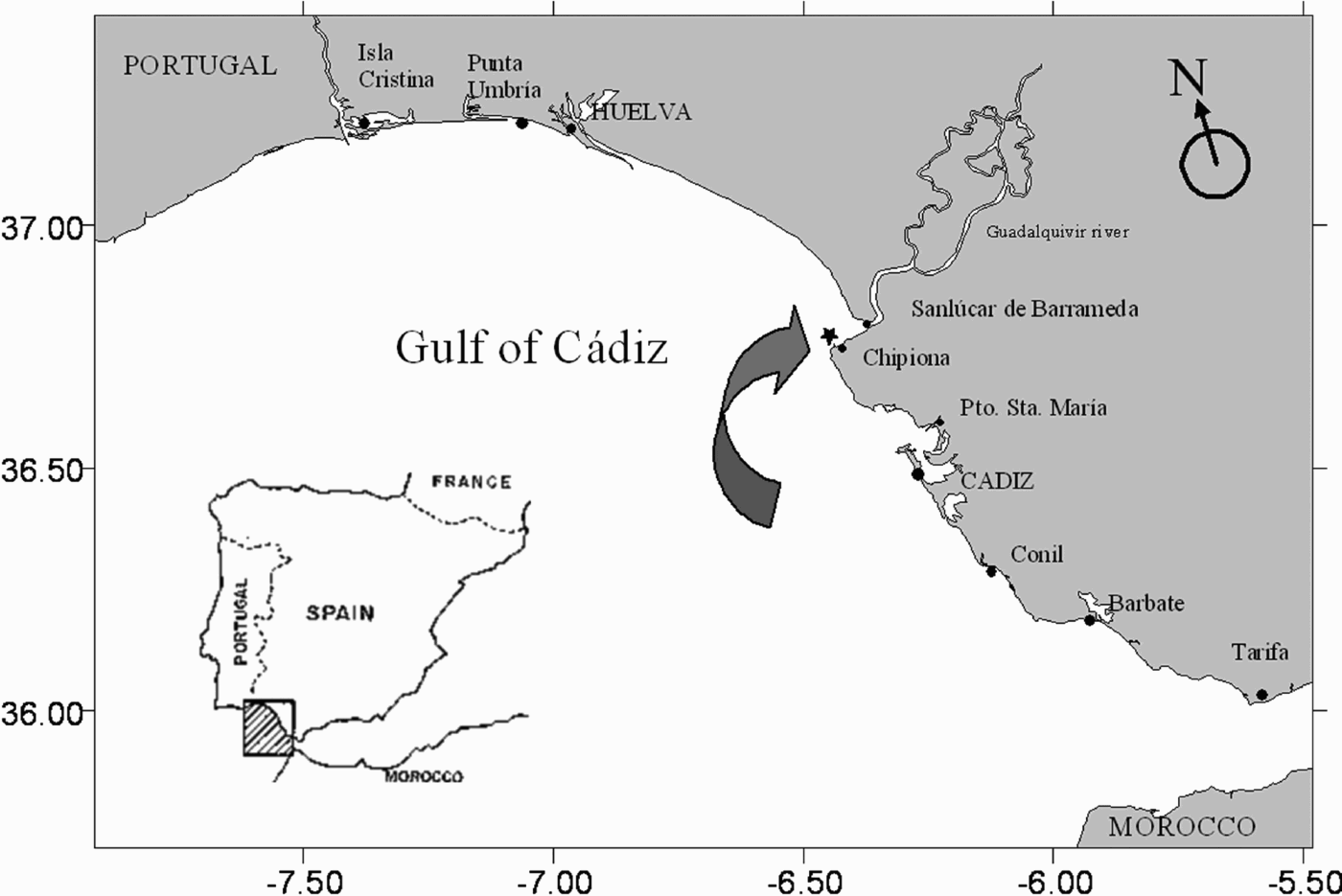
During January 2006, a specimen of Atlantic Bumper, Chloroscombrus chrysurus was caught by a local fisherman from the port of Chipiona (Figure 2) with a specific trammel net targetting Dicologlossa cuneata, Moreau, 1881, at a depth of 15 m and located at about 36°46′N 6°26′E. It was frozen until identification. Measurements were taken according to FAO procedures (Agger et al., Reference Agger, Bagge, Hansen, Hoffman, Holden, Kesteven, Knudsen, Raitt, Saville and Williams1974).
Map of the Gulf of Cadiz where the specimen was caught.

DIAGNOSIS
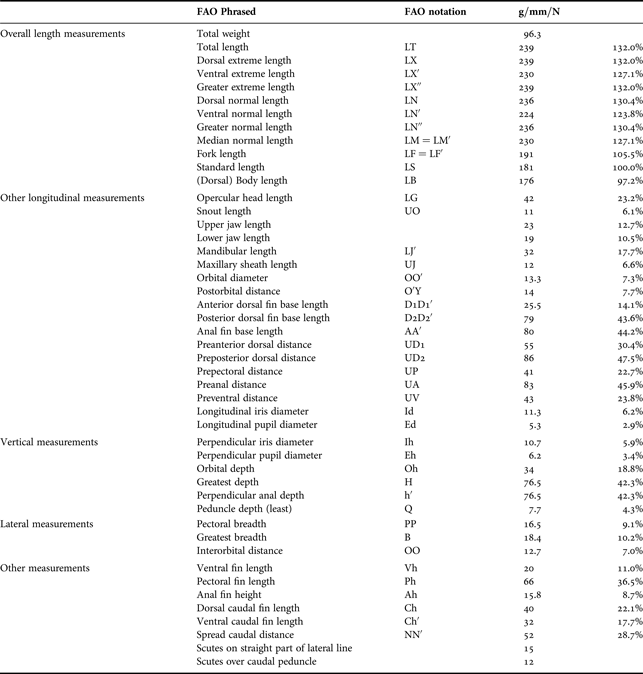
The good condition of the fish sample allowed us to identify it as Chloroscombrus chrysurus. Measurements according to FAO (units in mm) and distinctive characters were coincident with those given by Smith-Vaniz (Reference Smith-Vaniz and Carpenter2002) and the data are summarized in Table 1. The main diagnostic features were the following: deep, oval and very compressed body; snout is short, small eye with slight adipose eyelid, and small and oblique mouth; the body and the head are dark above and silvery on sides and belly. It has a black saddle spot on upper part of caudal peduncle. Pectoral and caudal fins are yellow and ventral fins are white. Two dorsal fins can be observed, the first with eight spines, the second with one spine and 27 soft rays. Upper lobe of caudal fin is longer than lower. Pectoral fin has 20 rays, ventral fin seven, and there are two anal spines and a second anal with one spine and 27 soft rays. Gill rakes on upper limb are 11, and 32 on lower limb. Over straight part of lateral line there are 15 scutes, and over caudal peduncle 12. Total weight was 96.3 g and total length 239 mm. Sex and maturity could not be established due to bad condition of internal organs.
Morphometric and meristic data of the specimen.

DISTRIBUTION AND HYPOTHESES
The most northern quote in the eastern Atlantic was in the Mauritanian coast at 25°N 17°W (Hureau, Reference Hureau1991). This point is far away from the catch area of our specimen. The ocean current system that exists between both zones could explain with difficulty the displacement of this individual. Juveniles may be found offshore associated with scyphozoan jellyfish; Aurelia aurita, Linnaeus, 1758, (Tolley, Reference Tolley1987) and Drymonema dalmatinum, Haekel, 1880, (Williams et al., Reference Williams, Bunkley-Williams, Lilyestrom, Larson, Engstrom, Ortiz-Corps and Timber2001) both common in the Atlantic Ocean. It has also been cited as the most abundant fish consort with Chrysaora quinquecirrha, Desor, 1848, and Stomolophus meleagris, L. Agassiz, 1862, (Purcell & Arai, Reference Purcell and Arai2001). The association between jellyfish and Atlantic Bumpers could be one of the possible reasons for occurrence at this latitude. The transport of larvae by water ballast tanks in vessels may be considered as another explanation.
Another recent record of Selene dorsalis Gill, 1862, a subtropical fish, in the Gulf of Cadiz (Juarez et al., Reference Juárez, Silva and Gil2006) has been described. These records could be the consequence of warming of the North Atlantic and therefore of the northward extensions of the ranges of the warm waters' fish species (Stebbing et al., Reference Stebbing, Turk, Wheeler and Clarke2002). This process of warming makes possible the survival of subtropical carangid species in waters of the Gulf of Cadiz.
ACKNOWLEDGEMENTS
Our thanks to the fishermen of the fishing boat ‘Virginia Primera’, for the collection of the specimen and hence making possible this new record for the ichthyofauna in the Gulf of Cadiz.