Introduction
Conditional strategies can control two or more alternative phenotypes within a single species whose fitness depends on the status or competitive ability of the individual (Gross Reference Gross1996). Male dimorphism in morphology is common in Coleoptera with horns, and is associated with alternative reproductive behaviours in some species (Eberhard Reference Eberhard, Blum and Blum1979, Reference Eberhard1982; Siva-Jothy Reference Siva-Jothy1987; Emlen Reference Emlen1994; Rasmussen Reference Rasmussen1994; Yamane et al. Reference Yamane, Okada, Nakayama and Miyatake2010). Regarding the seasonal activities of beetles, Eberhard (Reference Eberhard1982) observed that minor males of the horn beetle Podischnus agenor (Oliver) (Coleoptera: Scarabaeidae) were often active earlier in the season and showed greater dispersal than major males. Similarly, minor males of Japanese Allomyrina dichotoma (Linnaeus) (Coleoptera: Scarabaeidae) arrived earlier in the day than major males at sap sites, where these fed and copulated with females (Siva-Jothy Reference Siva-Jothy1987). Major males usually have a competitive advantage owing to their larger morphology, while minor males avoid direct combat with major males but compensate for their inferior fighting abilities by, e.g., sneaking into nests to gain access to females (Emlen and Nijhout Reference Emlen and Nijhout2000). Early activity of minor males may be explained by food deprivation in the developing larvae of Onthophagus taurus (Schreber) (Coleoptera: Scarabaeidae), which leads to the early eclosion of small adults (Shafiei et al. Reference Shafiei, Moczeck and Nijhout2001). However, Hardersen et al. (Reference Hardersen, Macagno, Sacchi and Toni2011) revealed that in Lucanus cervus (Linnaeus) (Coleoptera: Lucanidae), individuals with larger mandibles emerged early in the season. This finding suggests the handicap principle; these individuals may be exposed to developmental constraints due to early eclosion. Unfortunately, empirical studies regarding early activity of minor males remain limited. Therefore, seasonal activities associated with male dimorphism in beetle species should be examined in greater detail.
Members of the genus Copris Geoffroy (Coleoptera: Scarabaeidae) are tunnelling dung beetles that construct underground nests beneath or near their food source (Halffter and Edmonds Reference Halffter and Edmonds1982). Sexual dimorphism is striking in this genus; all males bear a single, curved head horn and often also bear prothoracic horns, whereas females have only rudimentary horns. Some species exhibit male dimorphism in horn size (Eberhard and Gutiérrez Reference Eberhard and Gutiérrez1991; Sugiura et al. Reference Sugiura, Yamaura and Makihara2007; Pizzo et al. Reference Pizzo, Citeroni, Mazzone, Dellacasa and Palestrini2015; Akamine Reference Akamine2016a; Kerman et al. Reference Kerman, Roggero, Rolando and Claudia2018). However, behaviours associated with this dimorphism and its adaptive aspects have received little attention. Direct and indirect evidence that long horns confer a competitive advantage comes from observations of only two species. Males of Copris lunaris (Linnaeus) use their horns in combat (Halffter and Edmonds Reference Halffter and Edmonds1982; Klemperer Reference Klemperer1983). In C. acutidens Motschulsky, more major males than minor males stayed with females in nests when experimentally kept together under breeding conditions (Akamine Reference Akamine2016b).
The only behaviour associated with male horn dimorphism is the nest-staying behaviours of male C. acutidens under breeding conditions, which is dependent on both male size and context. Minor males stay in nests with females for longer periods than do major males in the absence of a rival male. Conversely, major males stay in nests for longer periods in the presence of a rival male than in the absence of a rival male. Alternative behaviours of minor males to avoid direct combat with major males have never been documented in Copris species. Early activity of minor males without developmental constraints can be tested for C. acutidens because, unlike P. agenor and L. cervus, the activities of adults of this species differ between the reproductive period (when adult beetles start to become active after overwintering) and the nonreproductive period (when a new generation of adults emerges with the parents in autumn).
Copris acutidens is a common species in Japanese forests inhabited by large mammals, especially Cervus nippon Temminck (Artiodactyla: Cervidae). This beetle shows stark dimorphism; i.e., males bear a head horn and two pairs of prongs that extend from the centre and edges of the prothorax (Supplementary Fig. 1), while females lack this large ornamentation. Previous studies have revealed a discontinuous dimorphic pattern in allometric scaling relationships in male head horns in this species (Akamine Reference Akamine2016a). In central Japan, adult beetles C. acutidens are active from the end of April to November, with two activity peaks separated by a trough in midsummer (Nomura Reference Nomura1998; Akamine and Sato Reference Akamine and Sato2011a). The May–June peak is smaller and corresponds to the reproductive period, whereas the larger September–October peak corresponds to the feeding (nonreproductive) period of the progeny emerging from pupae with parents (Otani Reference Otani, Mitani and Imamori1987). Once the new adult beetles have fed, these overwinter underground from December to the following April (cold season). The beetles become active and reproductive from the end of April (the start of the warm season). Beetles of this species have two reproductive seasons in their life cycle of approximately two years (Otani Reference Otani, Mitani and Imamori1987). Female beetles of this genus are polyandric because multiple copulations are a prerequisite for oocyte maturation (Halffter Reference Halffter, Choe and Crespi1997). Females care for their brood balls in nests for more than two months until their adult progeny emerge (Mizuta Reference Mizuta, Iwata, Furukawa and Yasumatu1959; Halffter and Edmonds Reference Halffter and Edmonds1982; Imamori Reference Imamori1985), which is important for offspring survival (Tyndale-Biscoe Reference Tyndale-Biscoe1984; Halffter et al. Reference Halffter, Huerta and López-Portillo1996). Females construct nests by themselves, but males often cooperate with female partners in nesting behaviour by digging a tunnel underground and bringing dung for their progeny. Major males of the genus Onthophagus Latreille provide more food than minor males, whereas two male morphs of the genera Phanaeus MacLeay (Coleoptera: Scarabaeidae) and Copris contribute similar amounts of food (Cook Reference Cook1988; Rasmussen Reference Rasmussen1994; Hunt and Simmons Reference Hunt and Simmons1998; Akamine Reference Akamine2016b). Males do not cooperate further with females after provisioning the tunnel with dung, but these do sometimes stay in the nest for more than a month (Halffter and Edmonds Reference Halffter and Edmonds1982; Akamine and Sato Reference Akamine and Sato2011b).
This study was conducted to determine differences in activities between minor male and major male morphs of the dung beetle C. acutidens during the reproductive period and to examine the size distribution of reproductive males that were observed in the field remaining in nests. The activities of male morphs distinguished by a threshold value of body size were compared with the activities of male morphs distinguished by horn length.
Materials and methods
Study site and insect trapping
A field investigation was conducted on the northern side of Mount Takamado in the city of Nara, Japan (34º40′N, 135º51′E). Nara Park, including Mount Takamado, is densely populated with more than 1500 Cervus nippon (Tatsuzawa et al. Reference Tatsuzawa, Fujita and Ito2002). A total of 15 pitfall traps, each baited with 50 g of Cervus nippon dung, were set at 100 m intervals throughout the forest from the end of April to November 2001. The traps were placed 2–5 times per month and were maintained for four days per trap setting when possible (sometimes for two or three days owing to bad weather conditions). The sex and size of collected C. acutidens beetles were recorded. Sex ratios (ratio of number of active males to females) were calculated according to the number of captured beetles per 10 days (sex ratio per 10 days) and the accumulated number of captured beetles up to each 10 days (accumulated sex ratio). The prothoracic width of all beetles (as an indicator of body size) and length of the head horn (linear distance from the base of the head to the apex of the head horn) of all males were measured under a microscope with a micrometer eyepiece. The allometric scaling relationship between horn length and body size of males was then analysed using the models of Eberhard and Gutiérrez (Reference Eberhard and Gutiérrez1991) and Kotiaho and Tomkins (Reference Kotiaho and Tomkins2001). Males were categorised as major or minor by estimating the threshold value (switch point value) of body size or horn length. Behaviour was assessed for each morph.
Nest observations
Between May and July 2001, underground nests were located in the field by the presence of disturbed dung or soil, or holes in the ground near 175 dung pads. The nests of C. acutidens were excavated and first classified according to the presence of a single male, a single female, or a male–female pair within nests. The nesting index was then calculated as follows: 1, no dung; 2, burying dung; 3, making a dung cake; 4, caring for a brood ball containing an egg; 5, caring for a brood ball containing a developing larva. Nests that contained a male–female pair and/or had a nesting index of 3–5 were classified as reproductive nests. To examine the size distribution of reproductive males that stayed in the nest, horn length and prothoracic width of males staying with females in nests were measured as described above, and the size distribution of these males was compared with that of males captured by dung-baited pitfall traps during the same period.
Statistical analyses
Seasonal changes in the horn length of males and body sizes of males and females per 10 days were analysed using the Kruskal–Wallis test. The models of Eberhard and Gutiérrez (Reference Eberhard and Gutiérrez1991) and Kotiaho and Tomkins (Reference Kotiaho and Tomkins2001) were used to distinguish the two male morphs. The first model is common between two models and tests the presence of relationship between horn length and body size expressed as a simple allometric relationship as follows:
 $$\ln {\rm{ }}\left( Y \right){\rm{ }} = {\rm{\alpha} _0} + {\rm{\alpha} _1}\ln {\rm{ }}\left( X \right){\rm{ }} + {\rm{\alpha} _2}\ln \;\left( {{X^2}} \right){\rm{ }} + {\varepsilon}$$
where Y is horn length, X is body size, αi is the regression coefficient, and ε is the random component with normal distribution and a mean of zero. Values of α2 that differ significantly from zero indicate a more complex relationship. Further analysis was conducted using the following equation in the Eberhard and Gutiérrez (Reference Eberhard and Gutiérrez1991) models:
 $$Y \!= \!{\rm\beta _0} + {\rm\beta _1}X + {\rm\beta _2}\left( {X \!- \!{X_0}} \right)D + {\rm\beta _3}D + {\rm{\varepsilon}}$$
where X 0 is the threshold or switch point value, D = 0 if X < X 0 and 1 otherwise, and βi is the regression coefficient.
The optimal value of X 0 was determined to obtain the maximum value of adjusted R 2 calculated using SPSS Statistics, version 19 (IBM, Tokyo, Japan). Equation (2) in Kotiaho and Tomkins (Reference Kotiaho and Tomkins2001) models was modified to substitute Y with X and X with Y. In equation (2), if β3 was significantly different from zero using the optimal switch point value, the dimorphism was judged as discontinuous at X 0 in the Eberhard and Gutiérrez (Reference Eberhard and Gutiérrez1991) models and at Y 0 in the Kotiaho and Tomkins (Reference Kotiaho and Tomkins2001) models, respectively. If β3 was not significantly different from zero, the slope parameter β2 was judged to identify a continuous dimorphic pattern when the value of β2 was significantly different from zero.
To test whether seasonal activities differed between the two male morphs, a generalised linear model was developed using R, version 3.5.1 (R Development Core Team 2018) with a gamma distribution, in which the day of capture (counted from the first day of the investigation) was included as the dependent variable and male morphs were included as a covariate. To clarify seasonal changes in sex ratios, a generalised linear model with a binomial distribution was developed, in which the accumulated sex ratio or sex ratio per 10 days was included as the dependent variable and each period per 10 days was included as a covariate.
Results
The number of beetles recovered in pitfall traps increased from the end of April (days 1–10) to May–June (days 11–40) and then decreased in early July (days 41–50) (Supplementary Figs. 2–3). The number of male beetles recovered started to increase again by early August (days 51–60), whereas the number of female beetles increased again later in August (days 61–70). The second increase, during which the number of beetles doubled, occurred on days 61–70 for both males and females. Therefore, as suggested in a previous study (Otani Reference Otani, Mitani and Imamori1987), I classified days 1–60 and 61–100 as two separate periods, hereafter referred to as “former” and “latter” periods, for the analyses below.
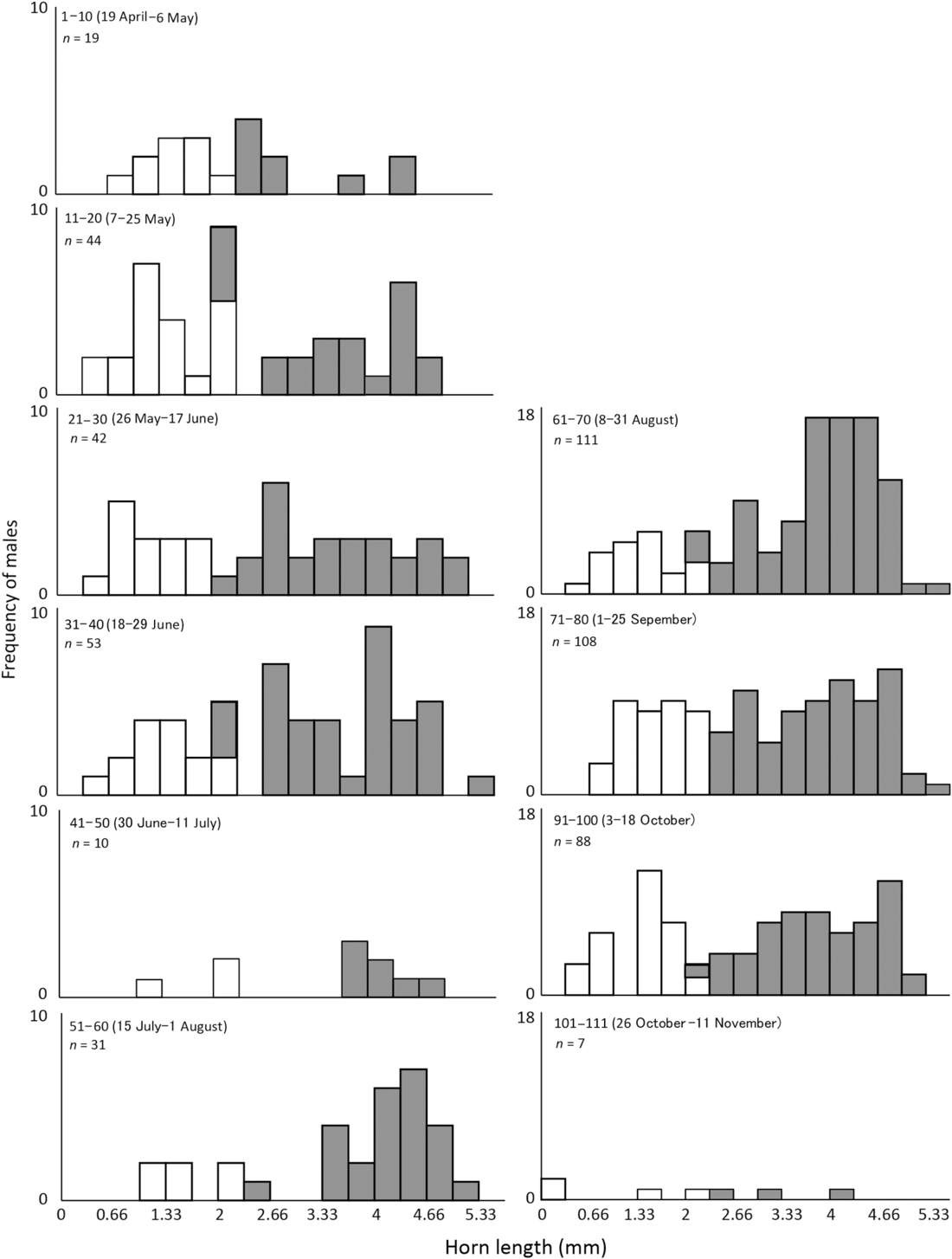
There were no significant differences in the distributions of female body size per 10 days during either period (Kruskal–Wallis test; former period: χ2 = 6.99, P > 0.05; latter period: χ2 = 5.15, P > 0.05) (Supplementary Fig. 2). In contrast, there were significant differences in the distributions of male horn size per 10 days (Kruskal–Wallis test; former period: χ2 = 44.6, P < 0.001; latter period: χ2 = 10.4, P < 0.05) (Fig. 1) as well as male body size per 10 days (Kruskal–Wallis test; former period: χ2 = 20.9, P < 0.001; latter period: χ2 = 10.1, P < 0.05) (Supplementary Fig. 3) during both periods.
Seasonal changes in horn length in male Copris acutidens per 10 days. White and grey bars show minor and major males, respectively. Minor and major males were distinguished using the Kotiaho and Tomkins (Reference Kotiaho and Tomkins2001) models.

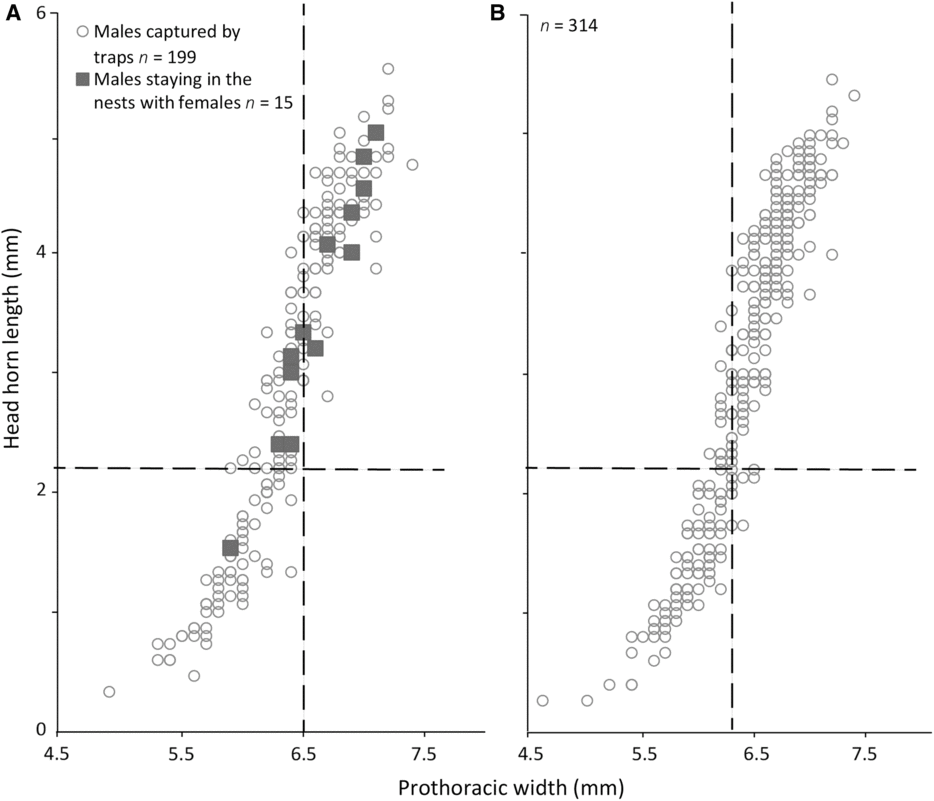
The allometric scaling relationship between prothoracic width (body size) and male head horn length in each period was analysed using the models of Eberhard and Gutiérrez (Reference Eberhard and Gutiérrez1991) and Kotiaho and Tomkins (Reference Kotiaho and Tomkins2001) (Fig. 2). Calculated using equation (1), the coefficient α2 was significantly different from zero during each period (former period: α2 = −9.8 ± 1.9, t = −5.3, P < 0.001; latter period: α2 = −7.8 ± 1.3, t = −5.9, P < 0.001).
Allometric scaling relationships between prothoracic width (as an indicator of body size) and head horn length. A, former period; B, latter period. Dashed lines show switch point values for body size and horn length in each period calculated using the models of Eberhard and Gutiérrez (Reference Eberhard and Gutiérrez1991) and Kotiaho and Tomkins (Reference Kotiaho and Tomkins2001). Grey squares in the former period show the allometric scaling relationship between prothoracic width and head horn length in males staying with females in nests.

In the Eberhard and Gutiérrez (Reference Eberhard and Gutiérrez1991) models, the switch point values of body size with the best fit were 6.5 mm during the former period and 6.3 mm during the latter period. Using equation (2) with each switch point value, the coefficient β3 was significantly different from zero during each period (former period: β3 = 0.60 ± 0.07, t = 8.11, P < 0.001; latter period: β3 = 0.75 ± 0.06, t = 12.9, P < 0.001). In the Kotiaho and Tomkins (Reference Kotiaho and Tomkins2001) models, the switch point values of horn length with the best fit were 2.2 mm during the former period and 2.2 mm during the latter period. Using equation (2) with each switch point value, the coefficient β3 was also significantly different from zero during two periods (former period 2001: β3 = −0.19 ± 0.03, t = −6.71, P < 0.001; latter period: β3 = −0.21 ± 0.02, t = −9.36, P < 0.001). Thus, both models showed a discontinuous scaling relationship between body size and head horn length in male C. acutidens during each period (Fig. 2).
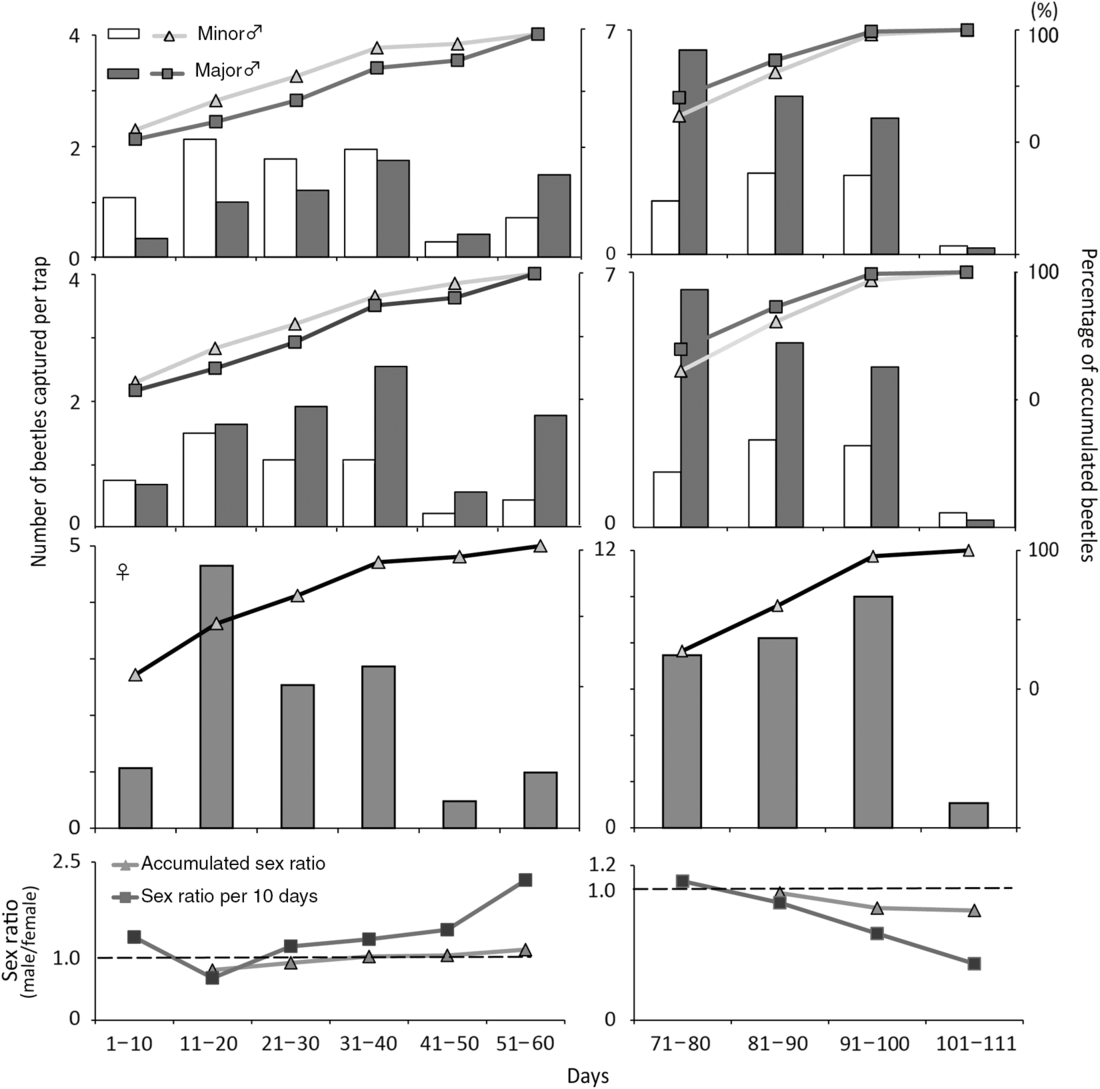
In the generalised linear model for day of capture, there was a significant difference in deviance between the fit models that included two male morphs distinguished by horn length as a covariate and a null model during each period (former period: χ2 = 2.84, P < 0.01; latter period: χ2 = 1.86, P < 0.05) (Figs. 1, 3). Similarly, in the generalised linear model for day of capture, there was a significant difference in deviance between the fit models that included two male morphs distinguished by body size as a covariate and null models during each period (former period: χ2 = 3.86, P < 0.001; latter period: χ2 = 1.94, P < 0.05) (Fig. 3 and Supplementary Fig. 3). Thus, seasonal activities differed between the two male morphs in both periods. During the former period, for male morphs distinguished either by body size or horn length, minor males and major males were the most abundant on days 11–20 and 31–40, respectively. Among males captured during the former period, approximately 67% of minor males and 45% of major males were captured in the first half (first 30 days) of the period, indicating that minor males became active earlier than major males during the former period (Fig. 3). In contrast, during the latter period, for male morphs distinguished by body size or horn length, minor and major males were the most abundant on days 11–20 and 1–10, respectively. Furthermore, among males captured during the latter period, approximately 60% of minor males and 70% of major males were captured in the first half (first 20 days) of the period, indicating that major males became active earlier than minor males during the latter period (Fig. 3).
Seasonal changes in the numbers of each male morph per 10 days (bar graphs), the percentage of accumulated beetles of each male morph per 10 days (line graphs) captured during each period, and sex ratios during each period. Top and middle – seasonal changes in activities of two male morphs distinguished by body size and horn length, respectively. White bars and triangles: minor males; grey bars and squares: major males. Bottom – squares: sex ratio per 10 days; triangles: accumulated sex ratio; dashed lines: sex ratio = 1.

During the former period, females were the most abundant on days 11–20; approximately 65% of females were captured during the first half (first 30 days) of the period (Fig. 3). During the latter period, females were the most abundant on days 91–100 (Fig. 3).
In the generalised linear model for accumulated male:female sex ratio, there was no significant difference in deviance between the null and fit models in each period (former period: χ2 = 3.45, P > 0.05; latter period: χ2 = 3.05, P > 0.05). In contrast, in the generalised linear model for sex ratio per 10 days, there was a significant difference in deviance between the null and fit models in each period (former period: χ2 = 7.3, P < 0.01; latter period: χ2 = 8.25, P < 0.05). During the former period, the sex ratio per 10 days increased from 0.67 to 2.2, indicating a change from female-biased early in the period (on days 11–20) to male-biased later in the period (on days 51–60), and the accumulated sex ratio showed a moderately similar tendency to increase from female-biased to almost one (0.79–1.12) (Fig. 3). In contrast, during the latter period, the sex ratio per 10 days decreased from almost one to female-biased (1.07–0.44), and accumulated sex ratio showed a similar tendency to decrease from almost one to slightly female-biased (0.99–0.85) (Fig. 3).
Of the observed nests, seven contained a single male or female and had a nesting index of 1 or 2; nine contained a single female and had a nesting index of 3–5; and 15 contained a male–female pair and had a nesting index of 1–5. In morphs distinguished by body size, there was no significant difference in the proportion of minor (n = 6) and major (n = 9) males excavated from nests in the field and proportion of minor (n = 114) and major (n = 89) males captured using dung-baited pitfall traps during the same period (Fisher test; P > 0.05) (Fig. 2). In contrast, in morphs distinguished by horn length, the proportion of minor (n = 1) and major (n = 14) males excavated from nests in the field significantly differed the proportion of minor (n = 69) and major (n = 130) males captured using dung-baited pitfall traps during the same period (Fisher test; P < 0.05) (Fig. 2).
Discussion
In this study, the activities of adult C. acutidens were investigated over one season. As in previous studies (Nomura Reference Nomura1998; Akamine and Sato Reference Akamine and Sato2011a), the activities of beetles had two peaks, separated by a trough in midsummer. The activities of both male morphs during the former period clearly differed from those during the latter period. Seasonal change in sex ratio (male-biased sex ratio late in the former period and female-biased sex ratio late in the latter period) seems to reflect a well-known behaviour of C. acutidens; most males abandon the nest earlier than females, whereas females care for the brood balls until the progeny emerge. Therefore, April to July (days 1–60) and August to November (days 61–100) were considered to correspond to the reproductive period and the nonreproductive period, respectively. Of nests observed during the reproductive period in this study, approximately 18% were colonised by C. acutidens. This would not be considered a low colonisation rate, given that it was noted in a previous report that colonisation rates of dung pats experimentally placed in a temperate region inhabited by three large tunneller dung beetles were 40–82% (Huerta et al. Reference Huerta, Anduaga, López-Portillo and Halffter2010). In the reproductive nests, more major males than minor males stayed in nests with females when the morphs were distinguished by horn length, whereas there was no difference in the proportion of minor and major males that stayed in nests with females when the morphs were distinguished by body size. The latter result is contradictory to the results of a study of C. acutidens, which found that more major males than minor males of morphs distinguished by horn length stayed in nests with females when these were experimentally kept together under breeding conditions (Akamine Reference Akamine2016b). Even when both males had the same body size, major males with longer horn were more likely to stay with females in nests (Akamine Reference Akamine2016b). In addition, it also contradicts the results of most studies of horn beetles if it is assumed that males staying in nests with females have a higher likelihood of reproductive success. Thus, these results are consistent with the report of Kotiaho and Tomkins (Reference Kotiaho and Tomkins2001); i.e., for many Onthophagus species, the use of switch point based on body size or horn length to distinguish between male morphs may produce different results.
Interestingly, regardless of whether the morphs were distinguished by body size or by horn length, earlier pattern of activity was observed for minor males during the reproductive period in this study. The earlier activity of minor males matches observations for P. agenor (Eberhard Reference Eberhard1982) and A. dichotoma (Siva-Jothy Reference Siva-Jothy1987). In this study, females were the most active early in the reproductive period, as were minor males. Thus, when minor males were the most abundant during the reproductive period, the sex ratio was biased toward female, indicating that minor males were the most active when competition was the weakest (Emlen and Oring Reference Emlen and Oring1977; Kvarnemo and Ahnesjö Reference Kvarnemo and Ahnesjö1996; Weir et al. Reference Weir, Grant and Hutchings2011) and these could avoid direct combat with major males. However, this female-biased sex ratio in the early period contrasts the previous study that P. agenor females were not the most active early in the season (Eberhard Reference Eberhard1982). Thus, major males C. acutidens were likely required to be the most active in the middle of the period although more than half of the females (65%) were active early in the period. Unlike in O. taurus (Shafiei et al. Reference Shafiei, Moczeck and Nijhout2001), developmental constraints are not evident in C. acutidens because the new beetles emerge during the nonreproductive period. Instead, the activity of major males from the middle of the period may be explained by the nature of oocyte maturation in Copris species, for which copulation with several males is a prerequisite (Halffter Reference Halffter, Choe and Crespi1997). In other words, the ejaculation tactics of the two male morphs due to differences in sperm competition risk (Parker Reference Parker1990) may explain the activity of major males from the middle of the period, assuming that males staying in nests with females have a higher likelihood of reproductive success.
In 62% of cases studied for which females mated multiple times, the last males to copulate sired > 75% of the offspring; only rarely did the first males to mate have greater siring success than did the last males to mate (Simmons and Siva-Jothy Reference Simmons, Siva-Jothy, Moller and Birkhead1998; Simmons Reference Simmons, Shuker and Simmons2014). Furthermore, there is often a trade-off between sexually selected traits and primary sexual characteristics, such as characteristics of genitalia and testes (Simmons et al. Reference Simmons, Tomkins and Hunt1999, Reference Simmons, Emlen and Tomkins2007; Simmons and Kotiaho Reference Simmons and Kotiaho2002; Simmons and Emlen Reference Simmons and Emlen2006; Yamane et al. Reference Yamane, Okada, Nakayama and Miyatake2010); sperm competition risk should favour insemination of females by smaller amount of sperm from major males than from minor males. Therefore, becoming active early in the period, albeit providing the opportunity to be first to copulate, may be rather costly for major males of C. acutidens even after taking into account female bias (Dewsbury Reference Dewsbury1982; Nakatsuru and Kramer Reference Nakatsuru and Kramer1982; Wedell et al. Reference Wedell, Gage and Parker2002).
Females of C. acutidens start nesting behaviour equally with both male morphs, which employ the strategy of providing the same amount of dung under breeding conditions (Akamine Reference Akamine2016b). Klemperer (Reference Klemperer1983), referring to unpublished data, stated that C. lunaris males push and attempt to overturn their opponents using horns in a limited space. Under breeding conditions, more major males C. acutidens expelled minor rival males from nests with females; however, male fighting behaviour using horns has not been observed in this species (Akamine Reference Akamine2016b). In other words, a female that has just started nesting with a minor male that was active early in the season would be preferred by major males and may be more beneficial to them because major males can usually nest with females even from the middle of the season. Thus, major males would ensure paternity owing to their longer horns without suffering the opportunity cost for being the first males to copulate.
Minor males, however, might not be complete losers. In males of multiple mating species, repeatedly inseminating females in a postcopulatory process, such as mating until eggs are laid, can be a mechanism of increasing paternity (Simmons and Siva-Jothy Reference Simmons, Siva-Jothy, Moller and Birkhead1998). In most Copris species, females take several days to lay their eggs; these make a brood ball in which these lay one egg per day. In the dung beetle Canthon cyanellus LeConte (Coleoptera: Scarabaeidae), the likelihood of paternity for the last male to mate is higher for males that have previously mated than for virgin males (Favila et al. Reference Favila, Nolasco, Chamorro-Florescano and Equihua2005; Chamorro-Florescano and Favila Reference Chamorro-Florescano and Favila2009). Under breeding conditions, minor males of C. acutidens stayed in the nest with females for longer than major males when each male was kept with a female, and major and minor males occasionally co-occurred in a nest. Sometimes, it was the minor male that stayed in nests when both males were experimentally kept together (Akamine Reference Akamine2016b).
Therefore, adapting the alternative behaviour of becoming active early in the reproductive period might help minor males ensure paternity by mating first and gaining additional opportunities by nesting with females for longer periods of time. In other words, as minor males are always subject to higher sperm competition risk, minor males should have greater ejaculate expenditure (Parker Reference Parker1990). However, early activity of minor males does not always ensure paternity, nor does it directly indicate the effect of horn length. Therefore, this behaviour might be observed regardless of whether the morphs differ in body size or horn length.
This study investigated the seasonal activities of C. acutidens in a single population over a period of just one year (but see Supplementary Fig. 4 for reference purpose only). Observations of behaviour in more than one population of this or more species over several years as well as of patterns ensuring paternity in multiple-mating species are warranted to elucidate typical patterns of early activity of minor males of this genus. In addition, this study did not examine whether minor males had greater dispersion than major males, as reported in previous studies (Eberhard Reference Eberhard1982; Yamane et al. Reference Yamane, Okada, Nakayama and Miyatake2010). Thus, the extent of dispersal during the reproductive period as well as temporal variation in the dispersal of both male morphs remains unknown. Future investigations using capture–recapture methods and experimental approaches are required.
Acknowledgements
This work was supported in part by a Grant-in-Aid for Young Scientists from the Japan Society for the Promotion of Science (15K21412).
Supplementary material
To view supplementary material for this article, please visit https://doi.org/10.4039/tce.2019.55.