Introduction
Although not explicitly mentioned in Article 416-bis of the Italian penal code, which established the crime of membership of an ‘associazione mafiosa’ (mafia-type organisation), the extortion of protection money, known as ‘il pizzo’, is customarily and universally acknowledged to be a typical – probably the most typical – mafia activity. The mafia is a ‘business of private protection’, as characterised by the subtitle of a well-known book by Diego Gambetta on the Sicilian Mafia (Reference Gambetta1993). Its members are described as ‘entrepreneurs of violent protection’ by Raimondo Catanzaro, whose analysis is in some ways rather different (Reference Catanzaro1994, 144). The emphasis on the importance of extortion is explained by the essential part that protection payments play in the survival and reproduction of individual mafia groups. These criminal groups are not in reality monolithic organisations within which every single activity can be traced back to the drive and authority of one boss, as some films and fictional accounts might suggest. Similarly, the income deriving from criminal activity is not all channelled into the hands of the boss, nor is it equally distributed among the members. In some activities, such as drug trafficking, mafiosi gamble and win – or lose – on their own account, while in others, such as extortion, there is more of a community aspect and the proceeds are used to address the shared needs of the group: provision of a wage for associates, payment for lawyers, support for the families of members who are in prison, and so on. Extortion-related activity is thus essential more for the operation and reproduction of mafia groups than for the accumulation of individual wealth.
The mechanism of extortion and protection can take various forms. The most basic, and also most prevalent in the collective imagination, consists of the forced extraction from the trader of a regular payment, made in exchange for little or nothing from the mafia member: permission to continue pursuing some form of economic activity in that territory. In this regard, other research specifically devoted to the theme of extortion has illustrated the multiplicity of methods that mafiosi use to extract resources from businesses (La Spina Reference La Spina2008, Reference La Spina2013; Di Gennaro and La Spina Reference Di Gennaro and La Spina2010; Arcidiacono, Palidda, and Avola Reference Arcidiacono, Palidda and Avola2016). Given the variety of forms that extortion can take, and especially in view of its illegal and therefore covert nature, research in this area is neither straightforward nor without some degree of risk. Clearly, the customary techniques employed by the social researcher have come up against some major constraints. Institutional intercession, especially by agencies fighting the mafia, is a general problem for research into the mafias (Mete Reference Mete2016), and is particularly marked in this area. To put this another way, the risk is that our assessment of the phenomenon of extortion is dominated and limited by what the activity of the magistracy and the forces of order uncovers. As a result, with the exception of some projects already mentioned that have limited the scope of their enquiry to particular territories and only to extortion of a monetary nature, and have incorporated many documentary sources and used a variety of analytical methods, the assessments available on the phenomenon of extortion are of limited reliability (La Spina and Lo Forte Reference La Spina and Lo Forte2006).
While acknowledging the complexity of the topic and the inherent limits to what can be known about it, this article sets out the main outcomes of an original research initiative on the theme of extortion, undertaken with traders in the Palermo area. The next section provides an overview of how the research was pursued in the field, with particular attention to the principal changes that affected the local context and the battle against racketeering in the five years between the two direct surveys. The third section presents the main findings on the opinions of respondents as regards the nature of extortion and its distribution in the Palermo area. This is followed by consideration of the ‘to pay or not to pay’ dilemma and the personal and collective consequences of the decision made, starting from the responses provided by traders. The subsequent section focuses on potential solutions to the extortion issue, and the role in this battle that the traders attribute to groups and institutions. In the concluding section the main results of the empirical analysis are highlighted, and linked to the most important changes in both the phenomenon of extortion and the forces ranged against it, both of the state and from grass-roots social movements. This article thus contributes to the general academic debate on the phenomenon of extortion and on the anti-mafia movement, and in particular analyses the activities of one element within this, the Comitato Addiopizzo, which in the mid-2000s contributed a new anti-mafia mechanism: critical anti-extortion consumption. While there have been many other articles and books on this topic, the originality of this article’s approach lies in its empirical nature and approach to gathering information, which is innovative and arguably more productive.
Conducting research on extortion in Palermo
An enquiry into extortion was carried out in particular areas of Palermo and its hinterland at two different points, first in 2007 and then in 2012. In each case a structured questionnaire was administered to traders and shop managers, and on each occasion the survey activity was driven by two intentions: education, and research. The campaign to distribute and then collect the questionnaires was undertaken in collaboration with the Comitato Addiopizzo, and specifically with its schools group.Footnote 1 In both 2007 and 2012, hundreds of students from more than 20 schools (elementary, middle and upper) were involved in the fieldwork, and embraced this unusual research technique. Each time, the young – sometimes very young – ‘researchers’ collected more than 800 questionnaires: a large enough number to ensure the representativeness of the sample, and therefore the acceptable reliability of the results.Footnote 2 Aside from the questionnaires, the children and young people who went round Palermo’s shops brought home something less tangible but rather more valuable: accompanied by their teachers and the activists of the Comitato Addiopizzo, they explored the streets of their own neighbourhoods, which they go through daily, from a different viewpoint. This new perspective was attempting to combine the two strands of the struggle against the mafias: the movements, on this occasion the Comitato Addiopizzo, and the state, represented in this case by the educational system (Mete Reference Mete2015).
While the research had good outcomes in terms of its educational aims in the schools, arguably the results in terms of raising awareness were equally satisfying. The use of children and young people to administer questionnaires might have seemed a weak point of the research design, but in fact proved to be one of its strengths.Footnote 3 Given the sensitivity of the topic, the use of practised researchers might well have increased the customary level of trader mistrust, with knock-on effects on the rate of missing responses (refusals and uncompleted forms), and consequently a lower quality and overall reliability of the information collected. Instead, using young people from the district, accompanied by their teachers, allowed the problems inherent in research on an illegal and covert phenomenon, which people are often reluctant to talk about even with their own relatives, to be kept within acceptable limits. Although it did not allow for great depth in the assessment of traders’ opinions, nor in the exploration of interesting but sensitive aspects of the issue, the research design and its implementation in the field meant that valuable information could be amassed on the opinions of a substantial number of Palermo’s traders and business people about extortion. It is of course the case that the findings from the two research campaigns are not ‘reality’, any more than what the respondents said on that particular occasion through the questionnaire, which in any case is never a neutral filter. Analysis of the traders’ opinions revealed some things that might seem unremarkable and others, as we will see, that were more novel and interesting.
During the five years between the first and second sets of results, there were many changes in Palermo as regards racketeering and the antiracket movement. Palermo’s first antiracket association, Libero Futuro, was set up in 2007, and during the five-year period this built up its presence in the city to the point of becoming one of its most vibrant elements. In 2010, in the wake of Libero Futuro, the ‘Comitato dei professionisti liberi’ came into being: this has united independent professionals who oppose extortion. In addition, during this period the decision by Sicily’s branch of Confindustria (Confederation of Italian Industry) to expel any of its members who made protection payments was first made clearer and then permanent. The Comitato Addiopizzo made some changes, increasing the number of traders and consumers taking part in the ‘pago chi non paga’ campaign (in which people commit to buying from traders who are not paying for protection), broadening its scope, and consolidating its original activities, such as the festival of critical anti-extortion consumption. Just as in the ranks of the anti-racketeering social movement, many things changed for Cosa Nostra: for a range of reasons, and above all because of the effectiveness of repressive action taken by the magistrates and forces of order, it has currently seemed to be experiencing a crisis or, at the very least, to be adopting a strategy of going underground (Cisterna Reference Cisterna2009; Scaglione Reference Scaglione2013). All in all, therefore, there seems to have been increased awareness among both Palermo’s citizens and its traders about the phenomenon of extortion, and at the same time an apparently increased tendency to rebel against it, at exactly the moment when the criminal groups appear to be in greater difficulty over managing this traditional and crucially important business activity.
There was no attempt in either survey to achieve territorial representativeness in selecting the traders for involvement: the pattern was much more random, largely reflecting the geographical location of the schools that were involved in the project. Many areas were covered by both the surveys, while others were only involved in one. Overall, the territorial overlap between the two samples was moderate, with more than 50 per cent of those surveyed relating to the same territory: this of course did not mean that the traders who responded were the same ones as before. It is important to bear this issue in mind, because this is the principal factor in determining the significance of the comparison between the results from the two different phases of the research. The differences between the opinions of traders involved in 2007 and in 2012 could be attributed to, among other factors, the shift in the climate of opinion noted in Palermo over those five years, or instead simply to the different composition of the sample. Obviously, the effects of a changing climate of opinion and those of a different sample composition are not mutually exclusive, and these factors could have combined with varying impact.
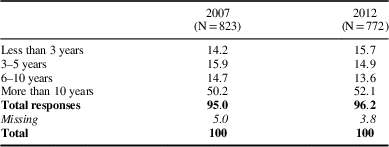
The territorial location of the two samples has been the most important variable to consider in relation to the issue of how much they can be compared, although not the only one. Less important, but still significant, is the issue of sample composition in relation to the number of years that businesses had been trading. In this, as Table 1 shows, the two samples were on the whole fairly similar. It can be seen that in both 2007 and 2012 an absolute majority of the respondents said that their businesses had more than ten years of commercial activity behind them.
‘How long has this business been open?’ (2007 and 2012, %)

One further general factor regarding the sample characteristics was the percentage of missing responses. In comparison to 2007, the rate of non-response in 2012 was lower, although not by much; this may reflect the fact that the questions had been formulated with a view to minimising the upset or offence to respondent sensitivities. It might also, or instead, indicate that the sensitivities of traders on this topic have changed over the five years between the two surveys.
Opinions on extortion
The issue of protection payments is above all an issue of collective action: if tomorrow morning all traders and business people decided together not to pay, the days of the extortioners would be numbered. However, that sort of decision assumes both a high level of mutual trust and effective coordination of individual action. Trust and the ability to act together in pursuit of an objective, which in this case is both individual and collective, depend in turn on the conditions in which action is carried out. These conditions are material, such as, on one side, the existence and strength of a criminal group and, on the other, the state’s ability to respond, and are also ‘symbolic’, relating to the pervasiveness of particular beliefs on the matter. These latter conditions in fact have more influence than the former over the actual behaviour of individuals, be they ordinary citizens, traders, or even mafiosi. In other words, what counts more in the decision that traders have to make, when faced with a demand for money, is what they believe about the capability and brutality of the criminal group, rather than the actual capacity and willingness of mafiosi to mete out violence. Similarly, what individuals believes their fellow traders will do – how many will pay, and how much, and how many will refuse – will carry more weight than what they actually do. For these reasons, alongside the others, it appears to be of crucial importance in the battle against extortion that the opinions and perceptions of traders on the whole phenomenon are reported: although it might seem strange, it appears to be more important and helpful to know about people’s opinions and social representations than to know about actual behaviour.
In this regard, the traders were asked in both surveys whether they actually knew of acts of intimidation or damage that had taken place during the previous year in their district. It is well known that these acts can be seen as indications of ongoing extortion, taking on different meanings depending on the particular case. A large number of intimidatory acts to the detriment of a trader’s colleagues and their shops is certainly not very reassuring, and can encourage the belief that there is a real danger, to their own business activity as well.
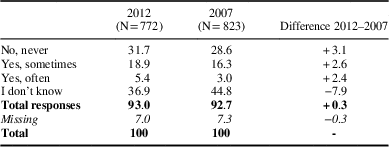
As can be seen in Table 2, and specifically from the column on the right, there were no marked differences between 2007 and 2012 in the spread of opinions that respondents expressed on this issue. Probably the most interesting feature is the low proportion (between 3 and 5 per cent) of traders who stated that in their district acts of intimidation or damage had occurred ‘often’ during the previous year. Moreover, the people who said they had no real idea about this formed a strikingly high proportion of each sample: 45 per cent in 2007, and 37 per cent in 2012. These figures can be interpreted in different ways: traders are reluctant to give a view, and take refuge in the comfortable ‘don’t know’ category; they think that acts of intimidation and damage might be kept secret by the victims, and therefore they are happening but not heard about; or they are entirely honest when they say that they do not know what is happening in their area as regards extortion, because it is not something that they give much attention to. Finally, about three in ten respondents said that they were not aware of any acts of intimidation in their own neighbourhood over the previous year.
‘In your quarter, during the last year, have business people or traders been subjected to acts of intimidation or damage?’ (2007 and 2012, %)

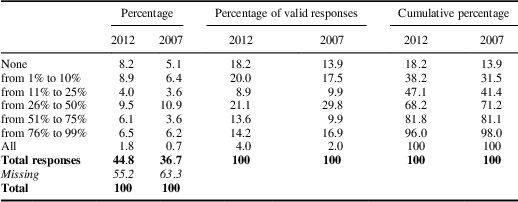
It is well known that even where peace rules there is no guarantee that the territory is free from extortion. Setting aside the observable phenomena such as scorched shutters, explosions at night and newspaper articles reporting an official complaint, the traders were therefore also asked if they had any idea as to how many traders operating in their area were paying protection money. The exact wording was as follows: ‘in your opinion, in your quarter, out of 100 businesses how many are making regular protection payments?’ Respondents could give any number between nought and one hundred. Use of this device allowed the thorniest aspect of protection payments to be approached without addressing it head-on. If traders had instead been asked directly whether they paid protection money, it is highly likely that there would have been a drastic drop in both the number of respondents and the degree of honesty of the related response.
Even though it was phrased in terms of the conduct of other traders in the area rather than that of the respondents themselves, the question on paying protection money was the least effective, in the sense that it had the highest rates of missing responses: 63 per cent of the traders contacted left it blank in 2007, and ‘only’ 55 per cent in 2012 (see Table 3). The rate of response thus improved between the two surveys but remained low, which is an indication that the question was deemed too invasive and indelicate in relation to what people were prepared to say, even on an anonymous basis. Obviously, it is also possible that those who did not respond really had no precise idea about how widespread payments were, and therefore rightly declined to answer rather than make a random guess. In 2012 the proportion of those who said that no one paid protection money went up by a few percentage points (to 18.2 per cent, from 13.9 in 2007), while all the other measures registered mild differences. In any case, both surveys recorded very divergent opinions among the traders who responded, suggesting that they had no standard viewpoint on the pervasiveness of extortion.
‘In your opinion, in your quarter, out of 100 businesses how many are making regular protection payments?’ (%, 2007 N=823; 2012 N=772)

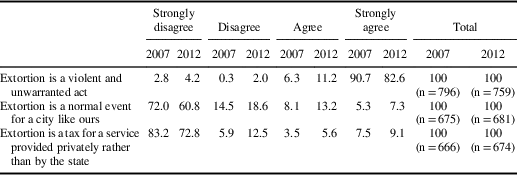
A similar tactic to that used to elicit opinion on the extent of extortion was employed to obtain an idea of what the traders thought about its actual nature. In 2007 a direct approach was used to ask the question about what extortion is, by offering respondents three statements and asking them to rate the extent of their agreement with each one: ‘extortion is a violent and unwarranted act’; ‘extortion is a normal thing for a city like ours’; and ‘extortion is essentially a tax levied for a service provided by the private sector rather than by the state’. The outcomes from this formulation were much as one might have expected: very few people made any excuse for extortion; a few more, but still not many, thought it was ‘a normal event’; only about 10 per cent considered protection payments to be a public service, but provided privately rather than by the state. In 2012, people were asked not for their own opinions on extortion, but what they thought was the prevailing opinion among their colleagues. With this new formulation the rate of response to each question changed, although not by much (see Table 4).
‘According to you (2007 version)/According to most of your trading or business colleagues (2012 version), how true are the following statements?’ (2007 and 2012, %)

Judging from the response rates, which were higher in 2012 than in 2007 (bearing in mind that the total sample size in 2007 was 823 individuals and 772 in 2012), reformulation of the question seems to have had the intended result. There were also small proportional changes in relation to the nature of the responses: there was a small increase in those who considered extortion to be a violent and unwarranted act; fewer people said that extortion was a normal phenomenon for the Palermo area; and, similarly, there was a drop in the percentage of respondents who viewed protection payments as a service offered privately, as an alternative to the state. Although we have already noted that comparability between 2007 and 2012 is not perfect, because of the different composition of the two samples as well as the altered formulation of this question, the picture encourages a degree of optimism. Over five years, in fact, the opinions that could be interpreted as excusing the phenomenon of extortion had lost significant ground.
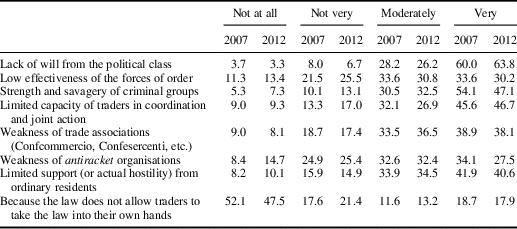
If we set aside the stereotypes whereby extortion is the outcome of an ugly clash between an isolated entrepreneur and a mafia member who threatens to resort to violence, it is clear that the extortion of protection payments is a complex phenomenon whose distribution and continued existence relate to multiple causes. In order to explore what traders thought about this, they were asked to what extent they agreed with a series of statements on the reasons why nobody had yet managed to eradicate it. As with the issues already discussed, there were no particularly marked differences between the two surveys over the perceived reasons for the persistence of extortion (see Table 5). This consistency can be interpreted as confirmation of the essential validity of the results from the two enquiries. The only significant difference related to the role of the antiracket social movement, whose weakness was held to be a less serious reason in 2012 than five years earlier. While it is not possible to establish a firm causal connection, this difference can probably be attributed to the strengthening of Palermo’s anti-racketeering front during the intervening period. Despite these encouraging signs, there remains much to be done when about 75 per cent of respondents decided that it was either ‘very’ or ‘moderately’ true that no one had yet succeeded in eradicating extortion because of the ‘limited capacity of traders for coordination and joint action’. Otherwise, ‘lack of will from the political class’ continued to be seen as the first and most important reason for the persistence of extortion, followed by the ‘strength and savagery of criminal groups’. On this latter point, the second survey recorded a slight drop in the level of concern expressed by traders. This can probably be related to the actual weakening that Cosa Nostra, and especially its wing dedicated to extortion activity, experienced during this period, not least because of anti-mafia activism and the effectiveness of action by the agencies charged with fighting it. The other serious problems perceived by the traders surveyed as further obstacles on the road towards the definitive eradication of extortion were the weakness of the trade associations, viewed as neither sufficiently motivated nor effective in conducting this battle, and the very limited support from ordinary residents. On these last two issues, there were no particularly marked changes between 2007 and 2012. The campaigns and initiatives promoted during this period by the Comitato Addiopizzo, and by other actors active on the anti-racketeering front, including state institutions, do not therefore seem to have had any significant impact on traders’ perceptions about the contributions from trade associations and ordinary residents. Finally, there was no real change in the worrying proportion of traders, about 30 per cent of the sample, who thought (either ‘very much’ or ‘moderately’) that the problem of extortion could not be solved because they were not free to take the law into their own hands. Quite apart from the imaginable consequences of this option for the maintenance of law and public order, it should be noted that the significant level of agreement with this statement indicates a profound mistrust of state institutions, including those that are directly and specifically involved in the battle with the mafias. Moreover, in both 2007 and 2012 a high and unchanged 63 per cent of respondents identified the ‘limited effectiveness of the forces of order’ as one of the factors in the persistence of extortion.
‘If extortion has not yet been eliminated in our city, how important are the following factors?’ (2007 and 2012, %)

To pay or not to pay?
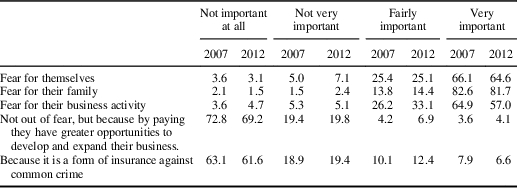
The factors that have so far prevented the problem of extortion being resolved, according to traders, are complex and various; this complexity can also be seen in the reasons why a trader might be willing to pay protection money to mafiosi. In a substantial simplification of the issue, a further question listed five motives, the same in each survey, that might persuade someone to give in to the demand for payment (see Table 6). Traders were asked to rank each motive’s degree of importance in persuading the victim to pay. Except for some small variations, the picture that emerged in 2012 was much the same as in 2007: first of all, people acquiesce out of fear of the potential consequences for their own family, then out of fear for themselves, and finally because of the possible negative consequences for business activity (destruction, damage, drop in customers, loss of confidence of banks and suppliers, and so on). Two other motives seemed entirely marginal: greater opportunities for developing the business, and because protection payments were a form of private insurance against common crime. The low importance attributed to these last two factors probably lies, on the one hand, in the awareness that such attitudes are socially unattractive, and, on the other, in the peculiarities of the range of entrepreneurs reached through the questionnaire: for the most part, this consisted of traders and small business people for whom relationships with mafiosi seldom developed into positive-sum games, unlike the situation for large businesses.
‘There are many reasons why traders make protection payments. In your view, how important are the following reasons?’ (2007 and 2012, %)

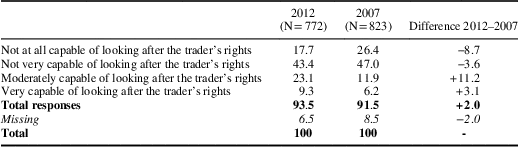
As already mentioned, a trader’s decision to give in to or resist a potential request for protection payments depends on many factors: the extent to which they think the threat is serious and concrete, what choices they have, what they believe will happen if they refuse, what they think will happen to their customers, suppliers, banks, and so on. Among these, one of the most important factors is surely the credibility and trustworthiness of state institutions in looking after the business person who reports an extortioner. In this case too, what influences the trader to make payments is not so much the actual repressive and punitive capabilities of the state, but more the beliefs that the trader holds about these. Because of this, a question was included in both questionnaires to explore beliefs in the effectiveness of state institutions in relation to the battle against racketeering. A specific hypothetical situation was put forward, involving a trader who reported an extortioner, and the question asked about the extent to which state institutions might be capable of looking after them (see Table 7).
‘If you imagine that a trader now decides to report their extortioner, to what extent do you think state institutions are capable of looking after the rights of this trader (by arresting the extortioner, holding them in prison for a long time, and guaranteeing the safety of the trader and their family)?’ (2007 and 2012, %)

Overall, the opinions expressed on the actual capacity of state institutions to look after traders who reported someone were not encouraging: only a third of the sample said that this was either ‘good’ or ‘adequate’, while ‘not at all’ and ‘hardly’ together accounted for about 60 per cent. However, when the 2012 figures are compared with those for 2007, an overall reduction in scepticism can be noted: the percentages for ‘not very’ and ‘not at all capable’ went down, while those for ‘moderately’ and ‘very capable’ increased. The 2 per cent increase in respondents (up to 93.5 per cent in 2012 from 91.5 in 2007) also offered a small indication that talking about extortion and its reporting was no longer such an absolute taboo.
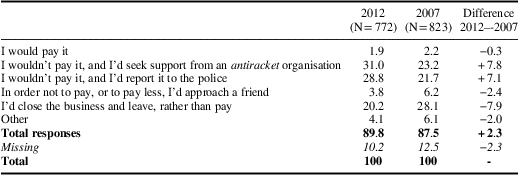
Very similar considerations apply in regard to another taboo that has proved somewhat persistent, in spite of the anonymous nature of the survey: the crucial question about how traders would react when faced with a request for protection money. This was formulated in the subtlest way possible, like the others already discussed, in order to minimise the chance of consideration of this sensitive issue being blocked. It was phrased in hypothetical terms, and offered five alternative responses ranging from acquiescence towards the extortioners (‘I would pay it’) to total rejection (‘I wouldn’t pay it, and I’d report it to the police’), with intermediate answers that provided some degree of ambivalence (see Table 8). First of all, there was a more satisfactory response rate in this case too, at about 90 per cent and showing a small increase between 2007 and 2012. The percentage of people who said that if faced with an extortion request they would pay was clearly very small, at 2 per cent: this could be as a result of self-selection in the construction of the sample (it being more likely that the refusals to complete the questionnaire came from the traders who were most ‘compromised’ in the racketeering), or could be related to perceptions of social acceptability (in that everyone knows that making protection payments is not a good thing, and that people doing this would be reluctant to admit it even anonymously). A higher percentage applied to the option of approaching a ‘friend’ for assistance in avoiding, or at least moderating, the request for payment. The proportion of traders in the two categories expressing complete rejection of potential demands for payment was by contrast much larger, for reasons that may have included self-selection of the sample and social acceptability, as mentioned earlier. ‘I wouldn’t pay it, and I’d seek support from an antiracket organisation’, put together with ‘I wouldn’t pay it, and I’d report it to the police’, together accounted for about 45 per cent of the responses in 2007 and 60 per cent in 2012. Bearing in mind the warnings already given about validity and the constraints on comparability of the two surveys, we can still discern from these responses a noticeable improvement in the attitudes of the traders surveyed. This improvement is also reflected in the decreased proportion of people saying that they would be inclined to close the business and move it (and in effect themselves) elsewhere, rather than make protection payments. Despite this decrease over the five-year period, the numbers who might choose to leave, at 20 per cent, remained a significant proportion of the sample.
‘If they asked you to pay protection money …’ (2007 and 2012, %)

When the responses to the question just discussed are cross-referenced with the years a business had been open, some additional details emerge. For example, those traders managing a business that had been open for less than three years seemed to be the least disposed to reporting extortioners to the forces of order, as well as being the most inclined to approach a ‘friend’ in order to avoid or reduce protection payments. Finally, when faced with a demand for protection money this same group of respondents, probably because of their weaker links with the area and customer base, proved to be the most definite about closing the business and leaving.
An end to extortion
While the reasons for the persistence of extortion are both many and varied, the actions that can be taken to fight it effectively, and ultimately to achieve its definitive eradication, are equally varied. These range from the field of straightforward repression and police action (strengthening of control over the area; arrest of extortioners; criminal sentencing), to the financial and business world (financial support and compensation for potential damage caused by extortion; creation of an organised antiracket business network; establishment of preferential channels for access to credit), to the political and cultural arena in the wider sense (establishment of a culture of respect for the law that rewards rather than ostracises people who decide to reject racketeering; local, regional and central political bodies that are aware of the issue of extortion). These and other actions addressed at fighting extortion are undertaken by many different governmental, political, economic and social actors. In some cases, for example the role of the forces of order and the magistrates in determining the criminal responsibility of individuals, these actors have exclusive responsibilities. More often, however, anti-extortion activity, especially its most effective elements, is the product of joint work by a range of actors. This is the case for the support network that is established around the trader who intends to report an extortioner. This network consists of the antiracket social movement and the different manifestations of state bodies involved in different phases of the procedure: the first articulation of the complaint, its formalisation with the police or magistrates, protection for the trader, their legal support, and in due course the procedure for compensation for the harm experienced (Grasso Reference Grasso2010; La Spina and Militello Reference La Spina and Militello2016).
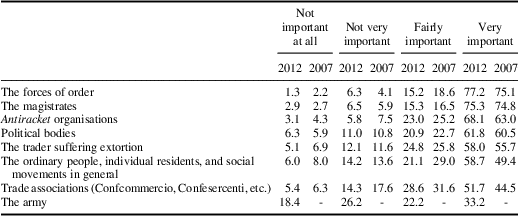
In order to explore traders’ opinions on the importance that various types of actor have in moving the battle against extortion forward, a question that had been tried out in 2007 was repeated in the 2012 survey, with one small addition relating to the role of the army. Using the usual four-step scale that goes from ‘not important at all’ to ‘very important’, people were asked to rank eight different categories of governmental, political, business and civil society actors. In relation to 2007, the differences were not very marked: ‘fairly’ and ‘very important’ accounted for between 75 and 90 per cent for all eight categories (see Table 9). On this issue, traders’ opinions seemed to be fairly clear: an effective battle against extortion needs everybody to contribute, from the magistrates and the forces of order (who were accorded the greatest importance) to the political bodies, and to the antiracket social movement. A more modest value (around 82 per cent in both 2007 and 2012 for both ‘very’ and ‘fairly important’), but still high and definitely not to be disregarded, was given to the importance of the role of the trader suffering extortion in the battle against racketeering. This figure could be interpreted as reflecting changes in the cultural climate, in which the silence of the victim of extortion can now no longer be justified, thanks to the safeguards and guarantees provided by anti-racketeering legislation, the commitment of state institutions, and progress made by the antiracket social movement. Having once been a helpless victim at the mercy of much greater forces – both mafia and anti-mafia – the trader emerges from this survey not as a bit-part player or, even worse, a spectator, but as a proactive and decisive actor in the construction of the future, both his/her own and that of society.
‘In your view, how important is action by each of the following categories in order to defeat the phenomenon of extortion?’ (2007 and 2012, %)

If we compare the responses in 2007 more closely with those in 2012, the only two noteworthy differences relate to the importance attributed to ordinary residents and social movements in general (for whom ‘very important’ rises to 58.7 per cent from 49.4), and to trade associations (up to 51.7 per cent from 44.5). Both these increases indicate a greater emphasis on the responsibilities of non-governmental actors in the battle against racketeering, in line with developments in Palermo and Sicily in recent years. Further confirmation of this can be seen in the increase of 5.1 per cent in the ‘very important’ ranking for the antiracket social movement, and especially in the low importance attributed to the army, a long way below the average for the other seven categories. In summary, setting aside the rhetoric, traders think that extortion should not be addressed as primarily a public order issue, but by working on the pressures that affect the system of possibilities and constraints that they have to face when they are plagued by the mafia and need to decide whether to work with the state, or to continue paying quietly.
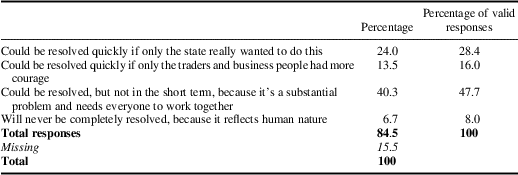
The need for efforts against the mafia and extortion to be orchestrated can also be seen in the responses to an additional question only introduced in 2012. The traders were asked to predict when and how a definitive solution to the problem of extortion in the Palermo area might be reached. The question was not intended to test traders’ prophetic abilities, but rather to discover their attitudes – whether optimistic or pessimistic – towards the end of extortion. The belief that extortion will soon be eradicated, or the view that it will have to be dealt with in the long term, does in fact have implications for the actual decisions that traders have to make in the short term. In other words, if people believe that the battle against extortion is on the point of being won, their rejection of demands for payment might well be firmer and more radical. On the other hand, if they think that the battle is a long way from over, and its outcome uncertain, they would be more likely to adopt survival strategies. Overall, although there were glimmers of hope, it could not be said that optimism prevailed among the traders surveyed (see Table 10). While it is true that only 8 per cent of respondents endorsed the belief that the extortion issue is unsolvable because prevarication and violence are inherent in human nature, it is also true that almost 50 per cent regarded the issue as too big and deeply rooted to think that it could be solved once and for all in the short term. For this reason, as we have seen earlier, a similar percentage of the sample believed that all the different sorts of actors involved in the extortion problem needed to work together. However, the group of optimists was not as small as one might have thought, although we are talking about ‘conditional’ optimists, in the sense that they thought the objective was in reach only if ‘the state really wanted this’ (28.4 per cent) or, to a lesser degree, if ‘traders and business people had more courage’ (16 per cent). Overall, therefore, it can be confirmed that extortion is a complex issue, and that there would need to be a hard-fought battle for it to be eradicated from Palermo’s economy and society. However, it is not an irremediable problem: it ‘only’ needs the state and traders to fight it with determination, and together.
‘Do you think that the issue of extortion in Palermo …’ (2012, N=772)

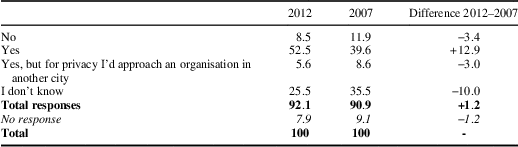
In this picture, extortion is a serious problem that could nevertheless be solved if determination (political, governmental, civil and business) and the right approach could only be found so that this could be pursued to its conclusion. In view of this, the surveys included questions that were intended to investigate in more concrete terms the willingness of traders to break out of the cage of omertà that they sometimes ended up inside. In the knowledge that this topic was a very delicate one, they were asked whether they would approach the antiracket social movement ‘if in need’. The question used in the 2012 survey added specific mention of the antiracket association Libero Futuro, set up since 2007, to the bodies that the trader might approach. As a result, the two surveys are not entirely comparable on this issue. Despite this, and in fact in view of the change in formulation of the question, the comparison between the results is particularly interesting (see Table 11). In comparison to 2007, the rate of non-response by traders was a little lower in 2012, indicating that in general the question ‘works’; the proportion of those who had no opinion on the matter (or did not want to give one) clearly fell (–10 per cent); and finally, there were drops in the percentages both of those saying they would not approach the antiracket movement (–3.4 per cent) and of those who said that for privacy reasons they would go elsewhere (–3 per cent). In 2007 there had been a somewhat hazy picture, with only 40 per cent willing to approach a Palermo organisation, 12 per cent who rejected the idea, and a significant 35 per cent who hid behind an ambiguous ‘I don’t know’: however, five years later, and after much had happened on the city’s anti-racketeering front, the picture had become much clearer.
‘In Palermo there are the antiracket organisation Libero Futuro (added in 2012 questionnaire) and an FAI [Federazione antiracket italiana] office. Would you approach these if in need?’ (2007 and 2012, %)

Conclusions
This article has presented the main outcomes from a research project on extortion in Palermo. Besides the information gathered and summarised in the tables, its principal originality probably lies in the choice of its underlying methodology. There have been other pieces of research on extortion based on administering questionnaires to traders, mounted by local councils, activists in the anti-mafia movement, trade and business organisations, and researchers, but all these ran up against the mistrust and tentativeness of respondents that can reasonably be expected over an issue such as extortion. The principal reason for this common shortcoming in research on the topic relates to the ‘distance’ that traders perceived between themselves and the people undertaking the research and, most concretely, those responsible for distributing and collecting the questionnaires. Consequently, not even the firmest guarantee of anonymity has had much impact on the rates of response, which have usually been very low.Footnote 4 Bearing this in mind, the combination of educational aims and research objectives, by turning children and young people from local schools (accompanied by their teachers) into researchers, enabled the traders’ defences to be partially relaxed and thus made them more cooperative.
As regards the research content, analysis of the responses by traders gives a very uneven picture. In other words, the traders’ opinions on different aspects of the phenomenon of extortion were fairly heterogeneous, and there is therefore no commonly held conception about the phenomenon, its causes and its potential solutions. Some traders appeared resigned, and ready to abandon the area if they encountered difficulties, while others by contrast described themselves as more combative and unwilling to surrender. Although comparison between the surveys in 2007 and 2012 has to be handled with caution, as has been stressed several times, over five years some tangible developments in traders’ attitudes towards extortion have become apparent. For example, the percentage of those saying they would be willing to report extortioners increased, and there was a rise in the importance attributed to individual traders in this battle. The element that gave the most cause for hope was the increased trust shown towards state institutions: compared to the past, they were represented as more able to provide effective protection for the trader who had to report extortion. It seemed therefore that there had been a positive change in shared beliefs and confidence in governmental action, which is the real precondition for the definitive eradication of this phenomenon. As is very often the case with other issues, during the period under consideration change was pushed forward by the enthusiasm of a social movement – the Comitato Addiopizzo – and by its ability to break the customary mould.
Translated by Stuart Oglethorpe
(stuart.oglethorpe@gmail.com)
Acknowledgements
I would like to thank all the children and young people from Palermo’s schools who distributed the questionnaire: without them, this research would not have been possible. I would also like to thank their teachers, who went with them around Palermo, and the traders who decided to respond to a questionnaire on an uncomfortable topic. Special thanks go to the Comitato Addiopizzo, and in particular to its ‘gruppo scuola’ and my friends and colleagues Marcella Alletti, Nino Di Gregorio, Ugo Forello, Vittorio Greco, Carlo Madonia, Anna Santoro and Francesca Vannini Parenti, with whom this research was undertaken.
Vittorio Mete is Assistant Professor in Political Sociology in the Department of Social and Political Sciences at the University of Florence, where he teaches ‘Sociology of Leadership’. His recent publications include: ‘Origine ed evoluzione di un insediamento “tradizionale”. La ’Ndrangheta a Reggio Emilia’, in Mafie del Nord. Strategie criminali e contesti locali, ed. R. Sciarrone, Rome: Donzelli, 2014; ‘La costruzione istituzionale delle politiche antimafia. Il caso dello scioglimento dei consigli comunali’, Stato e Mercato, 3/2016.