INTRODUCTION
Irrigation schemes in the Sahel provide farmers with a reliable water-supply that is highly valued in a region with scarce and unreliable rainfall (Connor et al., Reference Connor, Comas, Macpherson and Mateos2008). Rice (Oryza sativa) production in these schemes is one of the most important activities, with 50 000 ha being cultivated in Senegal (SAED, 2007). Among the decisions farmers have to take, choosing between double and single cropping and, more specifically, selecting the sowing date are among the most critical (le Gal and Papy, Reference le Gal and Papy1998; Poussin et al., Reference Poussin, Wopereis, Debouzie and Maeght2003).
In Sahelian rice production, temperature affects two processes critically: the length of the growing cycle and spikelet sterility, induced by either heat or cold stress (Dingkuhn and Miezan, Reference Dingkuhn and Miezan1995). High temperatures (>35 °C) at anthesis result in decreased pollen production and poor dehiscence of anthers, leading to poor pollen shed and fewer pollen grains intercepted by the stigma. Overall, this leads to a decrease in spikelet fertility (Endo et al., Reference Endo, Tsuchiya, Hamada, Kawamura, Yano, Ohshima, Higashitani, Watanabe and Kawagishi-Kobayashi2009; Prasad et al., Reference Prasad, Boote, Allen, Sheehy and Thomas2006). Jagadish et al. (Reference Jagadish, Muthurajan, Oane, Wheeler, Heuer, Bennett and Craufurd2010) showed that there were genotypic differences in heat tolerance at anthesis, originating from differences in protein expression. Stress due to low temperatures is caused by floodwater temperatures below 20 °C around booting stage. It induces spikelet sterility that increases sharply with decreasing temperature resulting in complete sterility at 15 °C (Shimono et al., Reference Shimono, Hasegawa, Moriyama, Fujimura and Nagata2005). Genotypes appear to have similar critical low temperatures for spikelet sterility (Dingkuhn et al., Reference Dingkuhn, Sow, Samb, Diack and Asch1995).
Surveys among farmers in the Senegal river valley have revealed that farmers are aware of the relation between low temperatures and yield decline in the wet season (Haefele et al., Reference Haefele, Wopereis and Donovan2002), and that they tend to respect the optimal sowing date, with an average sowing date of 4 August in 2004 (Diagne, Reference Diagne2006). Wassmann et al. (Reference Wassmann, Jagadish, Heuer, Ismail, Redona, Serraj, Singh, Howell, Pathak and Sumfleth2009) show that rice production will be significantly influenced by climate change. Predictions from downscaling global circulation models indicate that an increase in surface temperatures of 1.5–3 °C can be expected by 2030 in the Sahel (Boko et al., Reference Boko, Niang, Nyong, Vogel, Githeko, Medany, Osman-Elasha, Tabo, Yanda, Parry, Canziani, Palutikof, van der Linden and Hanson2007; Jury and Whitehall, Reference Jury and Whitehall2010). Given the sensitivity of rice to both high and low temperatures at critical stages, which drives a potential yield reduction, both the sowing window and varietal preferences may alter in the coming decades.
Genotypes developed from inter-specific crosses O. sativa × O. glaberrima (NERICA) for upland conditions have good potential yield (Dingkuhn et al., Reference Dingkuhn, Jones, Johnson and Sow1998), and their performance was stable across upland sites in West Africa (Sanni et al., Reference Sanni, Ariyo, Ojo, Gregorio, Somado, Sanchez, Sie, Futakuchi, Ogunbayo, Guei and Wopereis2009). Similarly, lowland NERICA genotypes have been developed (Rodenburg et al., Reference Rodenburg, Diagna, Oikeh, Futakuchi, Kormawa, Semon, Akintayo, Cisse, Sie, Narteh, Nwilene, Diatta, Sere, Ndjiondiop, Youm and Keya2006) and subsequently released in Sahelian countries (Sie et al., Reference Sie, Kabore, Dakou, Dembele, Segda, Bado, Ouedraogo, Thio, Ouedraogo, Moukoumbi, Ba, Traore, Sanou, Ogunbayo and Toulou2007). To date, information is lacking on the yield potential of lowland NERICA genotypes under irrigated conditions, and their ability to cope with the highly variable Sahelian climate. In Sahelian environments, farmers need varieties which they can rely on to perform well under a wide range of conditions. Gauch and Zobel (Reference Gauch and Zobel1997) developed an elegant method using an additive main effect and multiplicative interactions (AMMI) approach where the interaction term of the analysis of variance is analysed using principal components to assess genotype × environment interactions (G × E). Their tools aid breeders in determining which genotype wins in which environment, enabling selection for specific environments, and in screening genotypes for their likelihood of being affected by G × E interactions.
This study focused on evaluating the effect of different sowing dates on new rice genotypes, and how these varieties are adapted to possible changes in temperature that could influence the rice production system.
MATERIALS AND METHODS
Site description
Field experiments were conducted between February 2006 and July 2007 at Ndiaye (16°11′N; 16°15′W) and Fanaye (16°32′N; 15°11′W) in Senegal. Both are experimental research stations of the Africa Rice Center (AfricaRice). Ndiaye is in the Senegal river delta, 35 km inland, and Fanaye is in the middle of the Senegal river valley, 150 km inland. For a detailed description of the physical and chemical properties of the soils see Bado et al. (Reference Bado, De Vries, Haefele, Wopereis and N’ Diaye2008) and De Vries et al. (Reference de Vries, Rodenburg, Bado, Sow, Leffelaar and Giller2010).
Climate
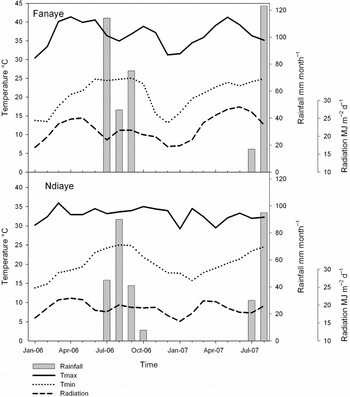
Climate at both sites is typically Sahelian: a nine-month dry period followed by a short wet season, with large fluctutations in temperature (Figure 1). Meteorological data were recorded using an Onset Hobo© weather station, installed in a rice field next to the experiments. All instruments were mounted at 2 m above the soil. Hourly data were recorded, from which minimum and maximum temperatures, cumulative total global radiation and total rainfall were derived on a daily basis. Between March and July, solar radiation and maximum temperatures are higher at Fanaye than in Ndiaye. The highest temperature observed in Fanaye was 46 °C on 19 May 2007, while in Ndiaye it was 44 °C on 16 June 2007. Between November 2006 and March 2007, minimum temperatures were lower in Fanaye than in Ndiaye. In Ndiaye, the lowest temperature recorded was 11 °C on 27 January 2007, while at Fanaye it was 8 °C on 8 January 2007. Rice is grown by farmers twice a year, from February to June in the hot, dry season and from August to November in the wet season.
Weather in Fanaye (top) and Ndiaye (bottom) between January 2006 and August 2007: monthly mean maximum (full line) and minimum (dotted line) temperatures (°C), solar radiation (dashed line) (MJ m−2d−1) and monthly rainfall (mm month−1).

Sowing date experiments
A set of sowing date experiments was conducted at the two sites: for 15 consecutive months an experimental set of five varieties was sown on the 15th day of each month. The experiments were sown in randomized complete blocks and replicated three times. Each plot, comprising one variety, measured 5 × 5 m and was bunded so that it could be irrigated and drained independently. Each sowing date was treated as an individual experiment, although consecutive sowing date experiments were adjacent. The first experiment was sown on 15 February 2006 and the crops of the last sowing dates were harvested at 27 and 28 August 2007 for Ndiaye and Fanaye, respectively.
Genotypes and crop management
Five genotypes were compared: (i) Sahel 108 (IR 13240-108-2-2-3), the most popular short-duration variety in the region; (ii) IR64, as an international control variety; (iii) WAS161-B-9-2, an interspecific cross between IR64 (O. sativa) and TOG 5681 (O. glaberrima), back-crossed four times with IR64 and released in The Gambia and Burkina Faso (Sie et al., Reference Sie, Kabore, Dakou, Dembele, Segda, Bado, Ouedraogo, Thio, Ouedraogo, Moukoumbi, Ba, Traore, Sanou, Ogunbayo and Toulou2007); (iv) ITA344, a medium-duration variety, newly released in Senegal as Sahel 208; and (v) IR32307-107-3-2, a short-duration variety, newly released in Senegal as Sahel 159, and used by farmers in Mali.
Apart from the differing sowing dates, management was kept as uniform as possible between the experiments and conformed with local recommendations to ensure optimal growing conditions. Seeds were soaked in water for 48 h to ensure homogeneous and rapid germination, after which the seeds were sown in a seedbed. Twenty-one days after sowing, the seedlings were transplanted at 2–3 plants per hill at 0.2 × 0.2 m distance. When the seedlings had recovered from transplanting shock, they were thinned to two plants per hill. The plots were kept weed-free by frequent hand-weeding. All crops were fertilized uniformly with nitrogen (N) and phosphorous (P) in the form of urea and diammonium phosphate (DAP). Urea was broadcast in three splits: 42 kg N ha−1 at the beginning of tillering, 60 kg N ha−1 at panicle initiation and 30 kg N ha−1 at heading stage, and DAP was broadcast at transplanting (21 kg P ha−1 and 18 kg N ha−1). The total rate of fertilizer application was 150 kg N ha−1 and 21 kg P ha−1, which is the recommended rate for a dry season crop. Urea was broadcast into a 0.05 m layer of water. No significant pest or disease damage was observed. After transplanting, the water level in the plots was raised from 0.05 m to 0.15 m at booting stage. Two weeks before estimated maturity, the plots were drained to ensure homogeneous ripening of the crop.
Measurements
Flowering was recorded as the day when 50% of the plants flowered; maturity was noted as the day when 80% of the plants were mature. At maturity, an area of 2 × 3 m in the centre of the plot was harvested; straw and grain were separated and weighed. Moisture content of the grains was determined, and grain yield was corrected to 14% moisture content. Harvest index (HI) was calculated as (dry) grain yield divided by total above-ground dry biomass. Yield components were determined from a separate sample of 0.4 × 0.4 m. From the sample all spikelets were counted to obtain the number of spikelets m−2; filled and unfilled spikelets were separated and counted to obtain the percentage fertile and sterile spikelets. Grains were weighed to determine the 1000-grain dry matter weight.
Statistical analysis
A one-way analysis of variance (ANOVA) was carried out to assess yield, growing cycle duration, sterility, HI, 1000-grain weight and spikelets m−2 for each experiment. To analyse the effects of sowing date, site and genotype, an unbalanced ANOVA was performed, using only sowing dates that gave some yield. Inclusion of the zero values would violate the assumptions of homogeneous variance error across variety × sowing date combinations in the ANOVA. To further analyse the performance of the different varieties in different environments, an additive main effect and multiplicative interactions (AMMI) analysis was performed, as described by Gauch and Zobel (Reference Gauch and Zobel1997). AMMI combines ANOVA (with additive parameters) and principal component analysis (PCA) (with multiplicative parameters) into a single analysis. A principal components model is fitted to the residuals from the ANOVA and the resulting scores, called the I (for interaction) PCA scores, along n axes, are calculated for both the genotypes and environments. When constructing the ANOVA table, AMMI assumes that the replicates arise from the use of a randomized block design within each environment. In the AMMI analysis, the model for phenotypic performance X of genotype j tested in environment i can be expressed as:

where μ = grand mean; ei = additive effect of environment i; gj = additive effect of genotype j; λn = eigenvalue of PCA axis n; αin = ith genotype PCA score for PCA axis n; γjn = jth environment PCA score for PCA axis n; θij = residual. The performance, Xij, can vary with the objective of the study, usually grain yield or growing cycle duration. We treated each experiment as an environment. This resulted in 23 environments: 14 in Fanaye and 9 in Ndiaye. In both 2006 and 2007, sowing took place in February, March and April. These sowing dates were used to assess the effect of different sowing years. A factorial design with year, site, sowing date and genotype as factors was used. For all analyses, the software package GenStat 11th edition (VSN international) was used.
RESULTS
Yield
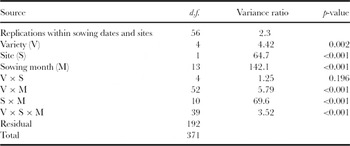
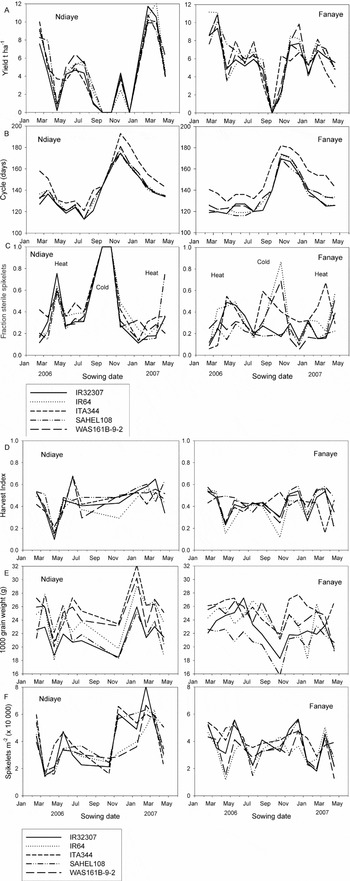
Variation in yield between sowing dates was large (Figure 2A). The largest yield at Ndiaye (12.2 t ha−1) was obtained with IR64 sown in March 2007, while some sowing dates resulted in complete crop failure. At Fanaye, IR64 sown in February 2006 gave the largest yield of 11.2 t ha−1. The ANOVA, using only non-zero values, showed that the principal effects and interactions of sowing date, site and variety were highly significant (p < 0.001), except for the variety × site interaction (Table 1). Yield was significantly different between cultivars for 11 of the 14 sowing dates in Fanaye and for only two of the 11 sowing dates when yield was obtained in Ndiaye (data not shown). Averaged over all experiments, including crop failures, IR64, WAS161 and SAHEL 108 yielded 5.1 t ha−1 grain, ITA344 followed with 4.9 t ha−1 and IR32307 with 4.7 t ha−1. Due to the more frequent crop failures at Ndiaye, overall average grain yield at Fanaye was larger, 6.0 versus 4.0 t ha−1. At both sites the overall pattern was similar, with peak harvests recorded in experiments sown in March and April. However, there were some striking differences between the two locations: sowing in September, October and December resulted in crop failure in Ndiaye, while the only crop that failed in Fanaye was sown in September, and the December sowing resulted in high yields (7–10 t ha−1). Between the sowing dates of March and April, yield was most sensitive to sowing date: averaged over both years and sites each day delay in sowing after 15 March resulted in a loss of 140 kg ha−1.
Analysis of variance for all sowing dates with non-zero values for yield using an unbalanced design.

A Grain yield (t ha−1); B cycle duration (days); C Fraction sterile spikelets (−); D Harvest index (−); E 1000-grain weight (g); F spikelets (103 m−2) from 15 subsequent sowing date experiments with five varieties (IR32307, IR64, ITA344, Sahel 108 and Was161 B-9–2) at Ndiaye (left) and Fanaye (right) in Senegal between February 2006 and April 2007.

Length of growing cycle
Both in Fanaye and Ndiaye, the crop duration was longest with sowing in October and November, whereas June and July resulted in the shortest duration (Figure 2B). In Ndiaye, the duration varied from 113 days for four varieties sown in July to 193 days for ITA344 sown in November. In Fanaye, Sahel 108 sown in May and June had the shortest cycle of 116 days, while ITA344 sown in October had the longest cycle of 182 days. Sowing in July and September resulted in the same duration at both sites for four varieties, whereas sowing in June and August resulted in small differences (3–8 days) between the varieties at both sites. In Ndiaye, variety IR32307 had its shortest duration of 139 days averaged over all sowing dates; ITA344 had an average duration of 150 days. In Fanaye, Sahel 108 had the shortest duration (131 days), and IR32307 took 134 days to mature, whereas ITA344 had the longest duration of 150 days, the same as in Ndiaye. Although overall IR32307 had the shortest duration, it responded differently in Ndiaye and Fanaye. In the experiments sown from April to June in Fanaye, it had the second longest duration. Overall, the duration increase between sowing in August and November was 53 days for all varieties and at both sites.
Spikelet sterility
Spikelet sterility can be induced by both high (>35 °C) and low (<20 °C) temperatures. Both occurred in this experiment (Figure 1 and 2C). The effect of genotype on sterility was significant (p < 0.05) in 6 out of 12 cases in Ndiaye, and in 8 out of 14 cases in Fanaye (data not shown).
In Ndiaye, there were peaks in sterility when the crop was sown in April, September and October. There was a large difference in sterility between sowing in April 2006 and 2007. In 2006 all varieties had more than 57% sterile spikelets, whereas in 2007 only variety Sahel 108 was affected with 76% sterility (p < 0.001; s.e.d. = 6%). All spikelets of all varieties were sterile after sowing in September and October. ITA344 had a higher percentage of sterile spikelets than other varieties for two sowing dates: June 2006 (p = 0.095) and January 2007 (p <0.05; s.e.d. = 6%). The longer duration cycle of ITA344 is a likely cause.
Sterility had less impact in Fanaye and complete sterility was never observed. The peaks in percentage sterile spikelets were observed in the same months as in Ndiaye. ITA344 had the largest proportion of sterile spikelets, on average 35%, followed by IR64 (31%), while Sahel 108 had the fewest sterile spikelets (19%; p < 0.001; s.e.d. = 2.2%). Only in July and November 2006, and January and April 2007, no significant differences were found between genotypes. For all other sowing dates significant differences between genotypes were observed.
Yield components
Differences in HI between varieties were significant (p < 0.05) for 4 of 11 sowing dates in Ndiaye and 6 of 14 sowing dates in Fanaye (Figure 2D). In cases of crop failure, no HI could be calculated. In Fanaye the average HI was 0.42 and the maximum value was 0.59. In Ndiaye, the average HI was 0.45 and the maximum 0.68, obtained by ITA344 sown in June. The ranking between the varieties was similar at both sites. Overall, the largest HI (0.49) was recorded for Sahel 108, and the smallest for IR64 (0.41; s.e.d. = 0.08).
The ranking between genotypes in 1000-grain weight was constant over sowing dates (Figure 2E), although between sowing dates, the weight varied from 18.7 g to 32.1 g in Ndiaye and from 15.8 g to 28.1 g in Fanaye. In Fanaye, 1000-grain weight decreased up to sowing in October, after which it increased, although the January 2007 sowing of IR64 was an exception with a very small 1000-grain weight of 18.5 g. Varieties ITA344 and WAS161 had on average the largest 1000-grain weight, 25.4 and 24.7 g, respectively, while Sahel 108 had the smallest 1000-grain weight of 21.6 g (s.e.d. = 1.6). The varieties differed significantly in 1000-grain weight in Ndiaye for 6 out of the 12 sowing dates and in Fanaye for 10 out of 14 sowing dates.
In Ndiaye the most spikelets m−2 were recorded in February 2007: 8.0 × 10⁴, the fewest were 1.3 × 10⁴ m−2 (Figure 2F). In Fanaye, the maximum was markedly lower (5.6 × 10⁴ m−2), while the minimum was similar (1.2 × 10⁴ m−2). The maximum spikelet density coincided with the greatest yields in Ndiaye. On average, ITA344 had the most spikelets per unit area (4.1 × 10⁴ m−2), followed by Sahel 108 (4.0 × 10⁴ m−2), IR32307 (3.8 × 10⁴ m−2), while IR64 and WAS161 both had 3.3 × 10⁴ m−2 (p < 0.001; s.e.d. = 1.6 × 10³ m−2).
Genotype × environment interactions
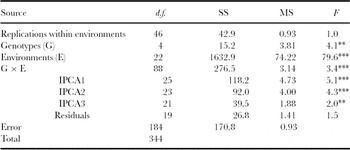
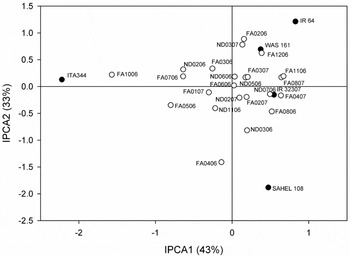
The results of the AMMI analysis show that all effects were highly significant (p < 0.01), except for the replicates within environments effect (Table 2). The effect of the factor ‘environment’ was by far the most important, accounting for 84.8% of the variation (sum of squares), ‘genotype’ accounted for 0.8% and their interaction for 14.4%. Of the variation not explained by regular ANOVA, i.e. the G × E interaction, the principal component axis IPCA1 explained 43%, IPCA2 33% and IPCA3 14%. Together they explained 90% of the G × E interaction, and it was not deemed necessary to increase the number of IPCAs.
Results from the ANOVA of the AMMI model.

**: p < 0.01; ***: p < 0.001.
SS: Sum of squares; MS: Mean sum.
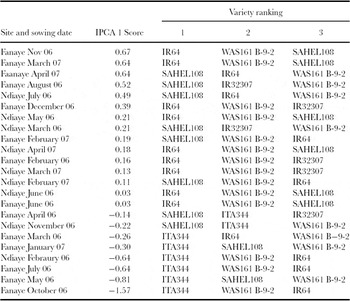
The greater the IPCA score of a genotype in a given environment, the better its performance in that environment. The more IPCA scores of a genotype approximate to zero, averaged across environments, the more constant a genotype performs across environments. High IPCA scores for environments indicate a strong G × E interaction. Genotypes can be compared on the basis of mean yield over environments using their IPCA1 score as a measure for stability. In the bi-plot of IPCA1 versus IPCA2 (Figure 3), the genotype closest to the origin is the most stable across environments, i.e. IR32307 followed by WAS161. Variety ITA344 was well adapted to the environment of Fanaye in October 2006, but less so to other environments, similarly Sahel 108 had low general adaptation, but was suited to Fanaye in April 2006. Of the environments, Fanaye in June 2006 was situated almost in the origin, with a weak potential for G × E interactions, while the two adjacent sowing dates, May 2006 and July 2006 were relatively far from the origin, indicating that the G × E potential interaction was highly dynamic with sowing date. No significant correlations between measured traits (crop cycle duration, HI, spikelet sterility and 1000-grain weight) and IPCA scores were found. Averaged over all experiments, the AMMI model predicted for IR64 and WAS161 the largest average yields of 7.8 and 7.7 t ha−1, respectively. The cultivar ranking based on absolute IPCA1 scores was WAS161 (0.37), Sahel 108 (0.47), IR32307 (0.55), IR64 (0.83) and ITA344 (2.23). Given the comparable yield of IR64 and WAS161, the latter was the best variety in these environments based on its yield stability, i.e. it has a high general adaptability. When the rankings of the best three yielding varieties are compared for each environment (Table 3), WAS161 was the second best yielding variety in 14 out of 23 cases. However, it never gave the best yield. Variety ITA344 was the best yielding variety in environments with relatively high negative IPCA1 scores, of which five out of six were in Fanaye. Variety ITA344 was the genotype with the longest cycle duration, which can explain its specific adaptability to certain environments. The experiment sown in October in Fanaye had the largest IPCA1 score (−1.57), while sowing dates in June at both Ndiaye and Fanaye had small IPCA 1 scores of 0.03. This indicates that varietal testing is more reliable in the latter two environments than in the first, and that it is difficult to recommend a specific cultivar for October sowing in Fanaye.
IPCA1 scores for all site and sowing date combinations used in the AMMI analysis. Ranking of first three varieties for each environment is based on yield estimate by the AMMI model.

Biplot of two principal component axes: IPCA1 v. IPCA2. IPCA scores for grain yield are shown for five genotypes (closed circles), with genotype names adjacent to circles, and for 23 environments (open circles) with environment codes adjacent to circles: Nd = Ndiaye, Fa = Fanaye. First two digits after site indicate sowing month, second two digits indicate sowing year.

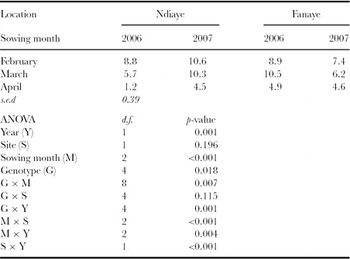
The effect of different years was assessed in an ANOVA using the sowing dates February, March and April of 2006 and 2007 at both sites. The principal effects were significant except for the effect of site, all two-way interactions were significant (p < 0.01), except for the genotype × site interaction (Table 4). In both years, yield decreased at later sowing dates, halving between February and April sowing. There was a significant year × site interaction (p < 0.001). In 2006, yields in Ndiaye were higher compared to 2007, while in Fanaye the opposite trend was observed. Differences in solar radiation are a likely cause of the variation in yield.
Rice grain yield (t ha−1), averaged over genotype, at two locations, Ndiaye delta, and Fanaye middle of Senegal river valley, in two years, sown at three successive months in 2006 and 2007. Analysis of variance (ANOVA) of the factors described above and their interactions.

DISCUSSION
Rice yield
We found that rice yield varied strongly with sowing date in this Sahelian environment, in accordance with earlier studies (Dingkuhn and Sow, Reference Dingkuhn, Sow, Miézan, Wopereis, Dingkuhn, Deckers and Randolph1997; Poussin et al., Reference Poussin, Wopereis, Debouzie and Maeght2003). There was strong variation in yield of the tested varieties which was sensitive to sowing date, especially around sowing time for the wet season crop (July–August), which is the main cropping season for rice in the Sahel. The experimental results show that peak yields are recorded when sowing takes place in March; July is another good sowing month. This coincides with the dry (March) and wet (July) season sowing as recommended practice in the Senegal River valley. However, farmers often sow later in the wet season, and risks of yield loss or failure are high, e.g. sowing in September. Advancing the dry season sowing to February is necessary for successful double-cropping. In an earlier study at the same sites, Dingkuhn and Sow (Reference Dingkuhn, Sow, Miézan, Wopereis, Dingkuhn, Deckers and Randolph1997) found that the potential yield of IR64 at Ndiaye amounted to 10.8 t ha−1, and was obtained when the crop was sown in February. In our study, IR64 yielded 12.2 t ha−1 when sown on the 15 March 2007 in Ndiaye. Although a relatively old cultivar was used, it yielded more than those found in recent studies on peak yields with new plant type or ‘super’ hybrid cultivars in Asia (Katsura et al., Reference Katsura, Maeda, Lubis, Horie, Cao and Shiraiwa2008; Zhang et al., Reference Zhang, Tang, Zou, Li, Qin, Yang, Chen, Xia and Peng2009). The lowland NERICA variety WAS161 had a peak yield of 10.9 t ha−1 when sown in March 2006 in Fanaye. High levels of solar radiation are a likely cause of this phenomenon.
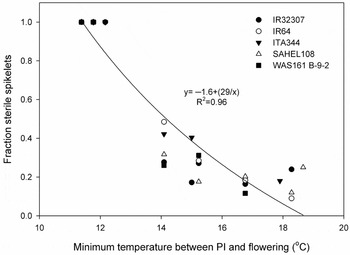
Crop cycle duration shows a similar variability with sowing date, in accordance with previous research (Sie et al., Reference Sie, Dingkuhn, Wopereis and Miezan1998). The weather conditions were representative for the climate at both sites, and results could be interpreted as valid for the climatic conditions in the Senegalese and Mauritanian Sahelian zone (Dingkuhn, Reference Dingkuhn1995). Over the course of the year different factors, such as heat and cold stress affect rice yield in different ways. Low temperatures decrease development rate, increasing growing cycle duration, which can have a positive effect on yield because of increased biomass production and a longer grain-filling period (demonstrated by November sowing in Fanaye). Temperatures below 20 °C around booting stage cause spikelet sterility, e.g. September sowing in Fanaye. High solar radiation interception pushed yields at both sites to above 10 t ha−1 when the crop was sown in February and March, but sowing in April resulted in an average decrease of 4.7 t ha−1. This can partly be explained by the spikelet sterility (30–75%) and partly by the growing cycle duration, which was reduced by 7.4 and 3.7 days in Ndiaye and Fanaye, respectively. In most experiments there were significant differences between varieties, which may be due to differences in the day of anthesis or panicle initiation or differences in timing of flowering. Prasad et al. (Reference Prasad, Boote, Allen, Sheehy and Thomas2006) showed that O. glabberima cultivar CG14 had an anthesis peak early in the morning and hence escaped heat stress. Detailed measurements of the genotypes used in this study could reveal whether this effect determines sensitivity to heat stress in a similar way. Cold-induced sterility can be explained by the minimum air temperature between panicle initiation and flowering (Figure 5). It decreases from 100% at 12 °C to maximum 45% at 15 °C. Shimono et al. (Reference Shimono, Hasegawa, Moriyama, Fujimura and Nagata2005) found a similar relationship using water temperature, with a ceiling of 100% sterility at 15 °C. Hence in our case, floodwater probably buffered 3 °C. In a recent paper we have shown that it is possible to reduce the depth of standing water in a rice field to save irrigation water (de Vries et al., Reference de Vries, Rodenburg, Bado, Sow, Leffelaar and Giller2010). In combination with this study we can conclude that an increase in temperature of 3 °C will match the buffering capacity of floodwater, making it possible to save irrigation water while the risk for cold-induced sterility remains at the present level.
Yield components
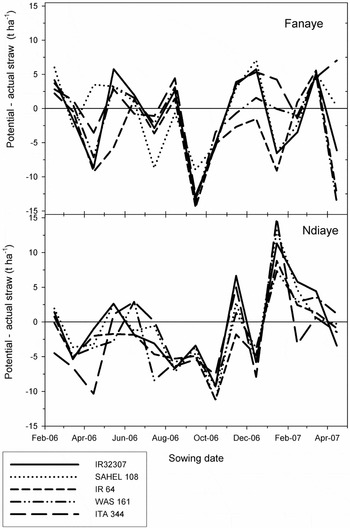
The differences in yields between varieties can be explained by differences in yield components. Low HIs coincided with small 1000-grain weight in April and October, resulting in poor yields. High HIs (>0.55) were measured at Ndiaye in June in varieties ITA344 and WAS161, which recorded the largest 1000-grain weights; the fraction of sterile spikelets was largest for ITA344, and as a result WAS161 gave the highest yield. Poor yields can either be the cause of sink or source limitation. To further investigate whether the crop was limited by source or sink size, potential straw mass was compared with actual measured straw, as an indicator of source size. Potential straw mass was determined as potential grain yield/HIoptimum – potential grain yield. Potential grain yield is an indicator of sink size, and determined by grain weight × number of spikelets per unit area × sterility percentage. HIoptimum was set at 0.5, as described by Mann (Reference Mann1999). In Figure 4, the results of the differences between potential straw and measured straw are shown; when the difference is positive it indicates source limitation, and negative differences suggest sink limitation. Between July and October, yield was limited by strength of the sink at both Ndiaye and Fanaye, with the exception of August in Ndiaye. In 2007 in Ndiaye, yield was limited by the size of the source. The average absolute difference can be used as an indicator of genotype stability, a balance between source and sink strength indicating a more stable genotype. In this experiments it was smallest for WAS 161 (4.1) followed by Sahel 108 (4.3), IR 64 (4.4), ITA344 (4.7) and IR32307 (5.0), confirming the results of the AMMI analysis.
Difference between potential straw (calculated as potential grain yield/optimum HI – potential grain yield. Potential grain yield was determined as grain weight × number of spikelets per unit area × percentage sterile spikelets) and actual measured straw for five varieties sown at 15 consecutive dates at Fanaye and Ndiaye, Senegal.

Genotype × environment interactions
The effect of environment was larger than the effect of the G × E interaction or genotype, accounting for 85%, 14% and 1% of the variation, respectively (Table 2). In a study comprising different tropical and subtropical sites in Asia, Jing et al. (Reference Jing, Spiertz, Hengsdijk, van Keulen, Cao and Dai2010) found that, although the factors had the same order, the variation due to environment was less (72%), the G × E accounted for less variation (9%), but the genotype component was more important (8%), compared with our study. Four of the five cultivars were of the same maturity type, i.e. short duration, decreasing the variability among the cultivars. The NERICA cultivar WAS161 resulted from four backcrosses with IR64, so in theory they are 94% genetically similar, thus reducing the overall genetic variability of this study. Variety IR32307 was the genotype with the shortest duration, whereas ITA344 was the one with the longest. Hence, IR32307 is in some cases a resource-efficient option: reduced duration hence reduced time of cultivation, without yield loss, e.g. sowing at both sites in November, February and March. Variety WAS161, genetically close to IR64, was more stable in its performance than its parent, expressed in IPCA1 scores of 0.37 and 0.83 for WAS161 and IR64, respectively. It shows the advantage of this lowland NERICA cultivar over its recurrent parent. The most popular short-duration variety Sahel108 had a low IPCA1 score (0.47). Yield stability is an important trait, appreciated by farmers, notably in environments where annual variation is large and when management is sub-optimal so that the full genetic potential is not realized. Neither PCA1 nor PCA2 was significantly correlated to measured crop traits. An explanation could be that different traits were most determining for yield at different sowing dates.
Variety IR32307 had different growing cycle duration when sown in Ndiaye and Fanaye in February and March. Both sites are almost at the same latitude; hence day-length could not have been a factor. In this period, maximum temperatures were higher in Fanaye, above the maximum for development of 36 °C (Yin, Reference Yin1996), which may have lead to the observed increase in crop cycle duration.
Projected temperature change effects
The projected increase in temperatures by 1.5–3 °C will have a serious impact on the present rice cropping system in the Senegal River Valley. The sensitive period for cold sterility is between panicle initiation and onset of flowering. The minimum temperatures below 19 °C in the sensitive stage, using sowing dates during which no heat stress occurred, are plotted in Figure 5. It is possible that minimum temperatures will increase from 12 to 15 °C, reducing cold sterility from 100% to less than 45%, irrespective of genotype. Hence, the risks for complete crop failure will be eliminated. Moreover, the increase in temperature will increase potential yield and postpone the ultimate planting date in the wet-season of 15 August to later in the year. The farmers will have more time to prepare for the season, which they now often lack (Diagne, Reference Diagne2006). On the other hand with the same rise in temperature, heat-induced sterility will become more frequent, forcing farmers to plant their dry-season crop either in January or February, with a yield penalty on delay of sowing. Varietal improvement could improve heat tolerance, but there is less genetic variation for cold tolerance (Dingkuhn, Reference Dingkuhn1995). The risk of cold sterility has a critical period of several weeks (Figure 5), whereas the risk of heat sterility is a matter of hours, when the flowers open at anthesis. In this study, these precision data were not recorded. Another consequence of the rise in temperature is an increase in development rate at sub-optimal temperatures, and similarly a decrease in development in the supra-optimal temperature range. As a consequence, planting around December could result in a shorter crop cycle duration, but planting in May in a longer duration. In the Senegal River Valley, timing of management operations and timely availability of inputs are important reasons for large yield-gaps (Haefele et al., Reference Haefele, Wopereis and Donovan2002; Poussin et al., Reference Poussin, Diallo and Legoupil2006), which stresses the necessity for other stakeholders in the rice production chain to adjust to the cropping calendar. Changes in planting date and growing cycle duration will affect timing of management operations and peak demand of inputs by farmers. Similarly, harvests could be delayed and supply of rough rice by farmers to traders affected.
Relation between the minimum temperature between panicle initiation (PI) and flowering stage (°C) and fraction of sterile spikelets for five varieties, grown during months in which no heat stress occurred.

CONCLUSION
From this study, we conclude that rice yield is very sensitive to sowing date in the Sahelian environment of the Senegal River. The newly introduced cultivars have a better general adaptability than existing ones, thereby decreasing the risk for yield loss for farmers. Spikelet sterility reduced sink size, constraining yield when the crop was sown between August and October. A rise in minimum temperature will decrease the risk of spikelet sterility thus widening the planting window, which could lead to an improvement of timing of crop management to close yield-gaps. Moreover, the complete rice production chain could be affected, and would have to adjust to new periods of supply of rice and demand of inputs by farmers. For a sound analysis of the consequences of an increase in temperature it is necessary to use dynamic models that simulate the feedback between different temperature-related processes.
Acknowledgements
The first author is grateful to the Dutch Directorate General for International Cooperation (DGIS) for funding part of this research. Support by the Africa Rice Center (AfricaRice) is gratefully acknowledged. We thank Jac Thissen and an anonymous reviewer for their helpful comments on the statistical analysis, and Mandieye Top and Malick Sarr for excellent technical assistance.