Introduction
English is becoming the default language of knowledge construction and dissemination (Kuteeva & McGrath, Reference Kuteeva and McGrath2014; Zheng & Gao, Reference Zheng and Gao2016; Fuentes & Gómez Soler, Reference Fuentes and Gómez Soler2018). However, English as a monolingual and mono-rhetorical means of disseminating knowledge may maximize its ‘Tyrannosaurus rex’ side (Tardy, Reference Tardy2004; Espinet et al., Reference Espinet, Izquierdo and Garcia–Pujol2015; Zheng & Gao, Reference Zheng and Gao2016). The use of English as an Academic Lingua Franca (EALF) is depicted as hegemonic, totalitarian, colonial and imperialistic, silencing other academic traditions, imposing Anglophone ideologies of norms and rhetorical conventions, and controlling other academic territories (Phillipson, Reference Phillipson1992; Bennett, Reference Bennett2013). It is claimed that an orientation towards the norms and rhetorical conventions of the Anglo-Saxon discourse demotes non-English languages, cultures and rhetorical conventions (Tardy, Reference Tardy2004; Espinet, Izquierdo & Garcia–Pujol, Reference Espinet, Izquierdo and Garcia–Pujol2015), disadvantages non-native English-speaking scholars and their scholarship (Flowerdew, Reference Flowerdew, Paltridge and Starfield2013; Zheng & Gao, Reference Zheng and Gao2016), erodes alternative forms of knowledge construction (Martín–Martín, Reference Martín–Martín2005; Bennett, Reference Bennett2011), and reduces intellectual, cultural and epistemological diversity (Tardy, Reference Tardy2004; Bennett, Reference Bennett2011).
Although the trend of English as a lingua franca in the humanities is widely discussed (see Bocanegra–Valle, Reference Bocanegra–Valle2014; Kuteeva & McGrath, Reference Kuteeva and McGrath2014; Zheng & Gao, Reference Zheng and Gao2016), there are few data-driven studies concerning the language choice of non-native English speakers in periphery countries. In the current paper I focus on multilingual humanities scholars in non-native English-speaking countries such as Spain and South Korea, and ascertains the language in which they are publishing their research, and their motivations for doing so. Multilingual scholars refer to non-native English scholars who can use either English or their mother tongues in research communication. I examine the longitudinal evolution of their language choice and the reasons behind it.
Methods
To exclude the impact of disciplinary differences on language choice (Kuteeva & Airey, Reference Kuteeva and Airey2014), I limit the scope of the current investigation to Translation Studies, a plurilingual discipline in humanities. Given the inter-lingual nature of Translation Studies, scholars may write up their articles in either of the two languages involved. Scholars in two countries, namely Spain and South Korea, were included. Both are active in this domain, as reflected in the early establishment of Translation Studies as an independent academic discipline, a large number of translation programs, and numerous publications of relevant journals.
Data collection was completed in two phases. In the first phase, data on the publication language of scholarly articles by Spain-based and Korea-based scholars were collected. Since authors’ names do not always reveal their nationalities, the institutions they are affiliated with were taken into account. Three periods were selected to sketch the longitudinal evolution of language choice in the two countries, 1999–2001, 2006–2008, and 2013–2015.
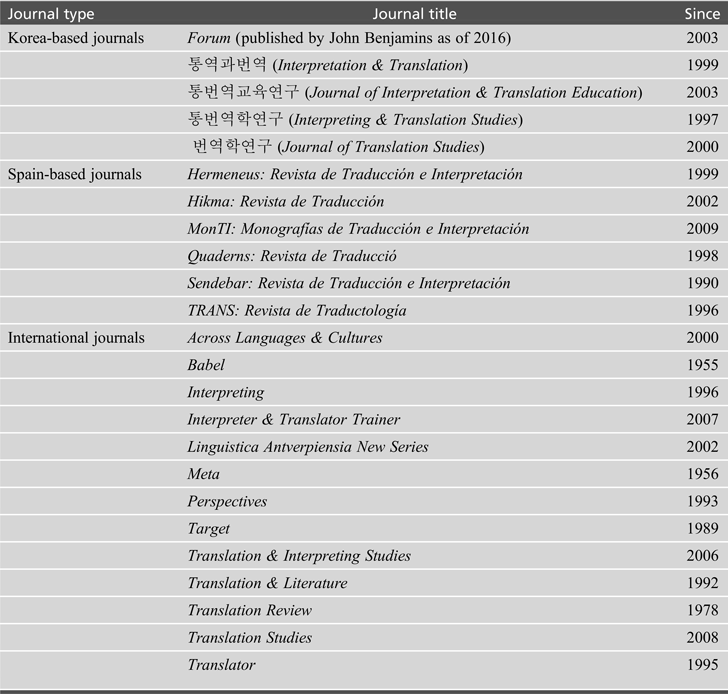
The data were sourced from two categories of journals (see Table 1), including both mainstream international and domestic peripheral journals (see Salager–Meyer, Reference Salager–Meyer2014). The mainstream international journals included 13 journals indexed in the SSCI (Social Sciences Citation Index) or A&HCI (Arts and Humanities Citation Index) databases. Eleven local journals were selected, including five Korea-based journals (about 45% of all academic Translation Studies journals in Korea) and six Spain-based journals (about 46% of all academic Translation Studies journals in Spain). The criteria for selection were that the selected journals should have an influential status in the KCI (Korea Citation Index) or its Spanish versions.
A list of the 24 journals

Journal language policies would not have been a factor that impacted scholars’ language choice. Scholars may have chosen to publish their research in either English or the local language. If they had written up their articles in English, they may have submitted them to international journals or local ones because all journals publish English articles (Meta accepts English and French articles). If they had written up their articles in the local language, they may have submitted them to the local journals because they have a bilingual language policy, accepting articles in the local language alongside those in English. This is true except for Forum, which became an international journal as of 2016 and publishes articles in English or French.
In the second phase, an online survey was completed by 34 Spain-based and 11 Korea-based authors to explore the reasons of language choice. The questionnaire items were based on the literature on publication motivations (Gentil & Séror, Reference Gentil and Séror2014; Muresan & Pérez–Llantada, Reference Muresan and Pérez–Llantada2014; Zheng & Gao, Reference Zheng and Gao2016; Fuentes & Gómez Soler, Reference Fuentes and Gómez Soler2018). It consisted of two sections, the first one concerned with participants’ personal details, and the second one with their publication motivations. To avoid possible bias favouring English or the local language, only those who published in both English and their local languages were selected as participants. This was done by tracing the scholars’ publication records.
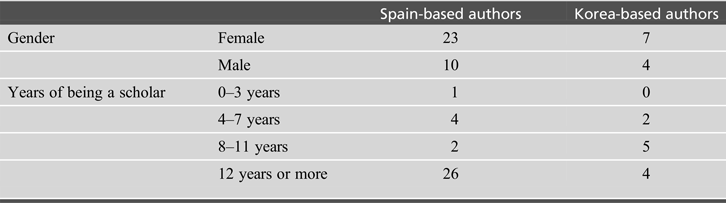
In total, 94 scholars (69 Spain-based scholars and 25 Korea-based scholars) were selected as participants. The number of participants from the two countries was uneven because there are many fewer scholars who publish both in the local language and in English in Korea. A web link to the survey was distributed via email. 34 scholars in Spain and 11 in Korea responded. The response rate of 49% and 44%, respectively, is acceptable. To date, the literature on survey research has not reached a consensus on the standard for a minimally acceptable response rate (Fowler, Reference Fowler2002). The data from one scholar who uses English as the mother tongue were removed. After data cleaning, data from 33 Spain-based scholars and 11 Korea-based scholars were used (see Table 2).
Personal details of the participants

Results and discussion
Language selection in research publication is usually impacted by a series of factors, including disciplinary expectations, national or institutional policies, language competence, research networks (center vs. periphery), and individual ideological factors (Gentil & Séror, Reference Gentil and Séror2014; Zheng & Gao, Reference Zheng and Gao2016; Fuentes & Gómez Soler, Reference Fuentes and Gómez Soler2018). In this section, I report on and discuss the findings.
The local language is the dominant choice
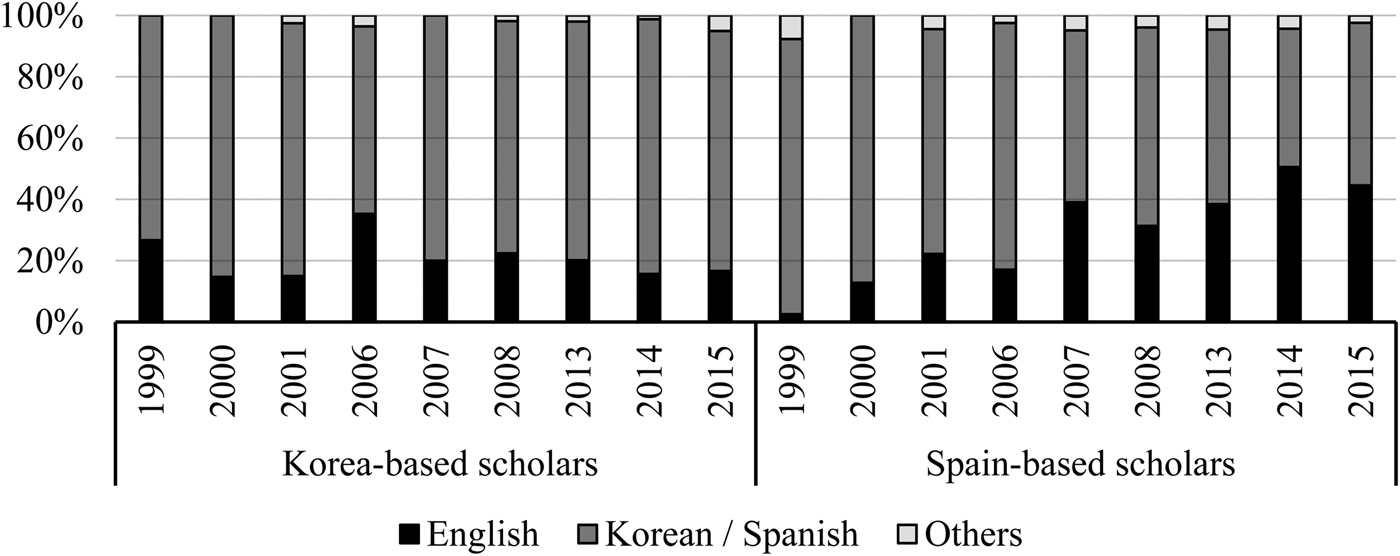
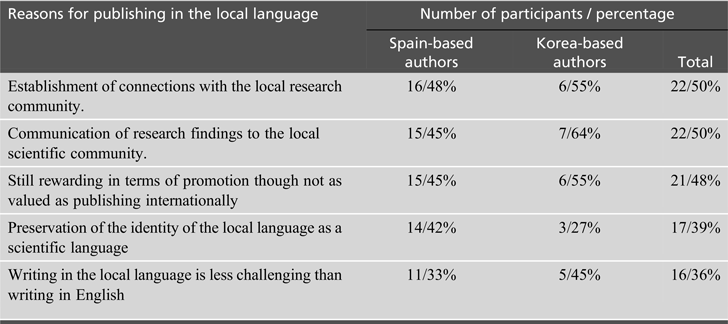
Figure 1 indicates that the local language is generally the most frequently selected language for research publication, particularly in South Korea where more than two-thirds of the articles are published in the local language. The reasons for publishing in the local languages are presented in Table 3.
The publication language of articles by Korea- and Spain-based scholars

Reasons for publishing in the local language

One reason for publishing in the local language relates to the fact that scholars need to establish and maintain connections with the local research community. 50% of the participants agree that they need to publish in local languages to connect themselves with local researchers. This is because they are more involved in local research activities and networks than in international ones (Salager–Meyer, Reference Salager–Meyer2014).
Ideological factors also play a role. 50% of the participants believe that publishing in the local language can help them communicate their research findings to the local scientific community. 39% of the participants admit that publishing in the local language can preserve its status as a scientific language in terms of local research norms, rhetorical conventions and forms of knowledge construction. One of the participants commented that:
Cultural and linguistic diversity must be promoted; the use of a single language can lead to a reductionist look of the world.
This finding that Translation Studies scholars publish in the local language to keep its identity as a scientific language and take it as their responsibility to communicate their research to the local scientific audience is consistent with the literature (see Linder & De Sterck, Reference Linder and De Sterck2016).
Another factor is related to research assessment policies. 48% of the participants think that publishing in the local languages can also help them to achieve professional promotion. For humanities and social sciences scholars, they can achieve promotion by publishing in either domestic journals or international journals, although publishing in the latter is valued more (Lee & Lee, Reference Lee and Lee2013; Salager–Meyer, Reference Salager–Meyer2014). Therefore, they may choose to publish in the local languages.
Besides non-linguistic factors, there are also linguistic impediments. As can be seen in Table 3, 36% of the participants believe that writing in the local language is less challenging than writing in English. Language competence is one of the major barriers faced by scholars in Spain and South Korea who want to publish their articles in English. Compared with privileged scholars who use English as their mother tongue, Spain- and Korea-based scholars are disadvantaged because they speak English as a foreign language. The ability of Spanish and Korean scholars to use English as an academic language in producing rhetorical and argumentative discourse is not as strong as their Anglophone counterparts (Cho, Reference Cho2009; Moreno et al., Reference Moreno, Rey–Rocha, Burgess, López-Navarro and Sachdev2012; Salager–Meyer, Reference Salager–Meyer2014). To publish in English, scholars in the two countries may rely on language editors. This is not an acceptable solution because it takes a long time to complete a satisfactory manuscript. As mentioned by one of the participants, publishing in the local language ‘takes less time and effort’.
The linguistic difficulties faced by humanities scholars who want to publish in English are even greater considering the nature of humanities studies. Unlike scientific domains which have more universal rhetorical moves and rely more on facts or data, the rhetorical structures found in humanities articles are more culture-specific and are very demanding in terms of convincing language and rhetorical skills (Connor, Reference Connor1996). It is believed that Anglophone and non-Anglophone scholars in the same discipline may produce articles with quite different rhetorical features (Ingvarsdóttir & Arnbjörnsdóttir, Reference Ingvarsdóttir and Arnbjörnsdóttir2013).
The rhetorical conventions found in Spanish and English research articles are quite different (see Moreno, Reference Moreno1997; Martín–Martín, Reference Martín–Martín2005). The same is true for such distant cultures as the case of Korea and North America because each has its own intellectual traditions (see Nisbett, Reference Nisbett2003; Hu & Cao, Reference Hu and Cao2011). Due to such differences, Spain- and Korea-based scholars may transfer the rhetorical features of their mother tongues to their English writing, resulting in low-quality academic discourse which might be seen as inferior by their Anglophone peers. Equally possible, if they resort to translators, the huge rhetorical differences between Korean or Spanish and English pose serious challenges.
The use of English is on the rise
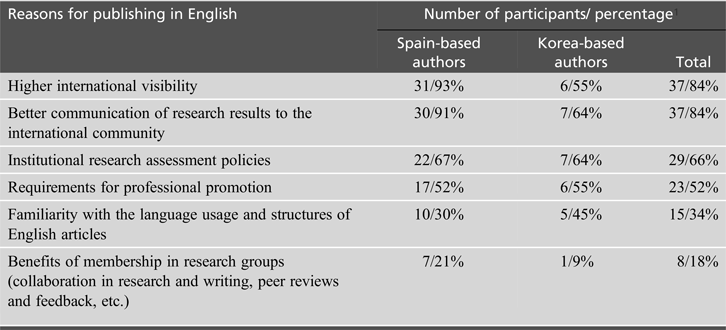
Figure 1 indicates that while the percentage of English articles has remained stable in Korea diachronically, the use of English for research publication is experiencing an increase in Spain, where almost half of the publications were in English in 2014 and 2015. This echoes a previous claim that 50% of the articles in the domain of Translation Studies are published in English, making it the most widely used language in research dissemination in the field, although many scholars still write and publish in their mother tongue (Agost, Reference Agost2015). The reasons for publishing in English are presented in Table 4.
Reasons for publishing in English

Table 4 shows that more participants in Spain believe that publishing in English means higher visibility and better dissemination of research results to the international community than those in Korea (93% and 91%, respectively, compared with 55% and 64%). This finding is consistent with that of Bocanegra–Valle (Reference Bocanegra–Valle2014). This is particularly true in Spain, since more Spain-based scholars take this viewpoint than Korea-based scholars. As one Spain-based participant commented:
I started writing mostly in English in 2010. As you may see in Google Scholar, my citations rose consistently ever since.
The same participant also expressed the view that publishing in local languages means dissemination of research to only the local readership and no access to the international community, which may lead to the risk of reinventing the wheel. Therefore, reaching a wider readership in the international community and obtaining international recognition and citation may explain why the use of English for research publication is increasing, particularly in Spain.
Moreover, research assessment and promotion exercises may also explain why Spanish scholars are publishing more in English. In Table 4, both Spain-based and Korea-based scholars believe that the two factors have affected their language choice in academic publication. The Spanish research assessment and promotion system gives priority to publications in international journals which are mostly written in English over Spanish publications (Muresan & Pérez–Llantada, Reference Muresan and Pérez–Llantada2014). As one Spain-based participants expressed:
Most indexed journals in my discipline publish in English, and I am assessed on the number of articles in indexed journals.
Another Spain-based scholar commented:
It was the beginning of my career and I was not aware of the importance of English in my academic career. Now I only publish in English.
According to Lee and Lee (Reference Lee and Lee2013), in South Korea, humanities and social sciences scholars seeking promotion can publish either in journals indexed in the SSCI or A&HCI, which accept English articles, or in journals found in the Korea Citation Index (KCI), which accepts mostly Korean articles. The impact of research assessment policies on the privileging of English as the language of research dissemination among multilingual scholars is also felt in other countries such as China, as found in one recent study by Zheng & Guo (Reference Zheng and Guo2018).
Highly specialized networking may be another reason why Spain-based scholars are more productive in English publications than their Korean counterparts (21% compared with 9%), as reflected in Table 4. According to the website of the European Society for Translation Studies, there are about 15 Spain-based research groups specializing in different branches of Translation Studies, for example, Process of Acquisition of Translation Competence and Evaluation (PACTE), Mediation and Interpretation: Research in the Social Area (MIRAS), and Translation and Audiovisual Media (TRAMA), to name a few. Such networking may increase Spain-based scholars’ chances of publishing in international journals because members can collaborate on research and writing, receive rhetorical and language support, and obtain assistance in responding to feedback from journal referees (Curry & Lillis, Reference Curry and Lillis2010). The associations of Korea-based scholars, for example, Korean Association of Translation Studies, Korean Society of Conference Interpretation, Ewha Research Institute for Translation Studies, etc., are based on a general research direction or an institution and are less specialized, which may not promote collaboration and mutual support as efficiently as their Spanish counterparts.
Familiarity with the language usage and structure of English articles is also partially responsible for the increasing number of English articles by Spain-based scholars. Table 4 shows that a higher proportion of Korea-based scholars (45%) reported confidence in writing in English compared with Spain-based scholars (30%). This is not consistent with Table 3, where more Korea-based scholars reported difficulties in writing in English than Spain-based scholars (33%). The academic performance of Spain-based scholars in the international community is better than that of Korea-based scholars (Li, Reference Li2015). This may be attributed to their familiarity with the features of EALF. Although English is spoken as a foreign language in Spain, Spain-based scholars have experienced the Bologna process initiated by the European Commission in 2007 to promote researcher mobility, transnational knowledge flows and academic internationalization through bi-literacy in both English and Spanish (Muresan & Pérez–Llantada, Reference Muresan and Pérez–Llantada2014). An increasing number of scholars, though bilingual, are more familiar with the organization and structures of English research articles (Bocanegra–Valle, Reference Bocanegra–Valle2014). By contrast, Korea-based scholars have not gone through the same experiences of bi-literacy and their command of academic English is comparatively weak compared with their Spanish counterparts (Cho, Reference Cho2009). It would be worth exploring further in the future why the percentage of English articles by Korea-based scholars has remained stable while that of their Spanish counterparts keeps rising and whether different degrees of familiarity with the language usage and structure of English articles have played a role.
Conclusion and implications
This study suggests that both the local language and English are used by Spain- and Korea-based scholars in knowledge dissemination. While the local language is still the most frequently selected language for research publication, the use of English is on the rise, particularly in Spain. Considering such factors as national research assessment and promotion policies, language competence, research networks and individual ideological aspects, I have also attempted to explain the reasons.
The concurrent use of English and the local language in research publication is consistent with the ecology of multilingualism, linguistic diversity, or coexistence of international English and local languages in presenting and disseminating knowledge (Skutnabb–Kangas & Phillipson, Reference Skutnabb–Kangas, Phillipson, Creese, Martin and Hornberger2008). Such an ecology represents a way to strike a balance between criticizing EALF as linguistic and ideological imperialism and taking it for granted that English is the only legitimate language for knowledge dissemination. This compromise is in favour of multilingualism as a source of richness and treating different research traditions as complementary imperatives (House, Reference House2003; López–Navarro, Moreno & Ángel Quintanilla, Reference López-Navarro, Moreno and Ángel Quintanilla2015). From the perspective of Fitzsimons (Reference Fitzsimons2000), promoting multilingualism represents a pluralistic vision of globalization where local languages and cultures thrive, contributing to a diversified world, instead of a unitary vision where a new social order is created to unify the world and consequently some cultures are dominant over others. Schluer (Reference Schluer2014) also believes that maintaining and promoting academic multilingualism seems to be a more recommendable solution than ‘English only’.
To encourage and maintain a sustainable coexistence of English and local languages, two proposals can be made. Firstly, national research assessment and promotion policies need to be changed to place equal emphasis on publications in local languages and English. Scholars can decide in which language they should disseminate their findings depending on the nature of their research, conventions of their disciplines, and intended audience, instead of being driven by the pressure to maximize the reward. Secondly, scholarly journals may consider presenting papers in both English and local languages to promote their coexistence, for example, in the form of bilingual abstracts, key words and extended summaries, or parallel presentation of papers through translations (Agost, Reference Agost2015; Zheng & Gao, Reference Zheng and Gao2016).
 XIANGDONG LI is Associate Professor of Applied Linguistics and Translation Studies at Xi'an International Studies University, China. His research interests include English as a lingua franca, English for specific purposes, curriculum design, didactics, and assessment. His most recent articles can be found in Across Languages and Cultures, Journal of Multilingual and Multicultural Development, Perspectives, Babel, Revista Española de Lingüística Aplicada, Translation and Interpreting Studies, and The Interpreter and Translator Trainer. Email: xiangdong813@gmail.com