Quantitative sociolinguistic study of adverbs has been limited, and much of the comparative work that has been undertaken on English has focused solely on morphological variation of the suffix -ly (Aijmer, Reference Aijmer, Rohdenburg and Schlüter2009; Algeo, Reference Algeo2006; Biber, Johansson, Leech, Conrad, & Finegan, Reference Biber, Johansson, Leech, Conrad and Finegan1999; Opdahl, Reference Opdahl2000). This work addresses the lacuna by examining a facet of adverb placement in two varieties of English using data from large, socially stratified corpora of vernacular English (described herein). In this study, I examine the adjacent placement of adverbs with respect to a finite auxiliary verb, as shown in (1):
(1)
a. Postauxiliary adverb position
They will probably move on (T/r)Footnote 1
b. Preauxiliary adverb position
They probably will move on
Forms such as (1b) are said to be allowed in British EnglishFootnote 2 only if there is stress on the auxiliary verb; in North American English, variability between (1a) and (1b) is said to be possible, regardless of stress (Swan, Reference Swan2001:26–27).
Previous work (described herein) has been contradictory on regional differences, though it has indicated that there are linguistic correlates conditioning adverb position. In general, social categories of the speaker and vernacular speech have not been examined. In this study, therefore, I explore the phenomenon in relation to both linguistic and social factors, rather than in different genres or in different periods. I examine spoken, vernacular data from two varieties of English: York, England, and Toronto, Canada.
Despite the claims of categorical behavior in British English, variability in adverb placement is attested in the corpora from both locations. Examples (2) and (3) illustrate the alternation between competing variant forms from both Toronto and York English, respectively. Note that each speaker demonstrates the variation with the same subject, the same adverb, and the same finite auxiliary.
(2) Toronto (T/é)
a. It potentially might get into the ground water
b. It might potentially escape
(3) York (Y/$)
a. I probably would have felt a bit lonely
b. I would probably travel there
The spoken nature of the corpora allowed a review of the recordings to determine the presence or absence of stressed auxiliaries in the UK data. I listened to all preauxiliary adverb tokens from York, and I coded each impressionistically for stress, based on loudness and length. In only one case was the auxiliary stressed. Therefore, it was immediately apparent that this variability is neither region-exclusive nor related solely to stress.Footnote 3 Thus, the first goal of this study was to identify the genuine correlates of variability in the two dialects. As I will demonstrate, adverb placement has stronger linguistic than social correlates, such as the type of auxiliary phrase, the lexical auxiliary, and the type of adverb. The varietal differences are frequency-related, rather than categorical. Given, then, that adverb placement is primarily correlated with linguistic factors, the second goal of the study was to determine how the syntax of adverb placement accounts for the pattern of variation.
In the next section, I describe the environments in which variable adverb placement is possible, and I present some previous findings. After describing the methodology, I present the results of the quantitative analyses. In the discussion section, I demonstrate that current syntactic proposals cannot account for the variation seen here, and I propose a new element to the analysis of the underlying mechanisms at work in the grammar of this phenomenon, namely, a postsyntactic stage of the process, which interacts with contraction.
PREVIOUS RESEARCH
Adverb placement has been studied empirically in English in both British and North American data. Different studies have taken different approaches (Table 1), varying both in terms of the type of material examined and the strategy for selecting auxiliaries and adverbs. Previous studies have mainly focused on written data, and they have found linguistic correlates of adverb placement that have included lexical auxiliary, type of adverb, and genre of text.
Approach by author to data extraction for adverb placement

Jacobson (Reference Jacobson1975) created a written- and spoken-language corpus composed of a stratified sample of data from the United States across a variety of genres. In his analysis of spoken material, Jacobson (Reference Jacobson1975:137) found statistically significant differences between the various auxiliaries, with should, at 67 percent, having the highest rate of preauxiliary adverbs and haveFootnote 4 and be, both at approximately 24 percent, having the fewest. In addition, he found significant differences between adverbs. For instance, the adverb never occurred before the auxiliary only 4.5 percent of the time, whereas the adverb certainly was placed before the auxiliary in 56.6 percent of its occurrences (Jacobson, Reference Jacobson1975:163). However, he treated negation (not/n't) as a form of adverbial modification (Reference Jacobson1975:86–87).Footnote 5 Jacobson (Reference Jacobson1975:109) noted a tendency for preauxiliary adverbs in general to occur more frequently in newspaper prose than in other genres.
Taking up the topic of newspaper style in British and North American English, Granath (Reference Granath2002) conducted a study of adverb placement in the two varieties using written data from 1961 and 1996, but she found region-based differences only in the earlier data. She found that postauxiliary position (as in (1a)) was strongly preferred in both varieties, at rates of over 90 percent. Moreover, she observed that modal adverbs (e.g., probably) were more likely than temporal adverbs (e.g., usually) to occur in preauxiliary position in both varieties and at both periods. To further explore genre-based variability in adverb placement, Hsieh and Wagner (Reference Hsieh and Wagner2008) examined data from a variety of text types in the Corpus of Contemporary American English. They also found that postauxiliary position was more common overall, though rates of preauxiliary position were highest in newspapers, at 31 percent. However, they noted that “substantial amounts of data from non-news speech are needed” (Hsieh & Wagner, Reference Hsieh and Wagner2008:2).
METHODOLOGY
The corpora
The data examined in the present study are extracted from the Toronto English Archive (Tagliamonte, Reference Tagliamonte2006) and the York English Corpus (Tagliamonte, Reference Tagliamonte and Poussa2002). Both corpora, each containing approximately two million words, consist of sociolinguistic interviews (and are thus spoken, vernacular data) collected by in-group community members. Speakers interviewed in both corpora were born in each city and still resided there at the time of the interview. The Toronto English Archive (henceforth, Toronto) data was collected in that city (in Ontario, Canada) from 2003 to 2006; the York English Corpus (henceforth, York) was collected from 1996 to 2003 in the city of the same name in northern England. In order to examine the grammar of speakers after they had reached a point at which their role in advancing change had mostly stabilized,Footnote 6 I only included speakers aged 17 years and older (see Labov, Reference Labov2001:454). Not all speakers produced utterances containing tokens within the variable context. In the Toronto data, interviews with 127 speakers contained the variable context. In York, interviews with 89 speakers contained the variable context.
In addition to the collection of the interview (i.e., linguistic) data, demographic information about each speaker was also available, including the speaker's age, sex, occupation, education, and, often, the birthplace of the speaker's parents. Both the original recordings and an orthographic transcription of each interview were available. Thus, these corpora allow an analysis of both internal (linguistic) and external (social) independent variables over apparent time. Furthermore, as these two corpora were collected using the same methodology (sociolinguistic interviews by in-group community members), they allow a comparison across the two varieties in a way that corpora composed of different types of data may not (Cheshire, Reference Cheshire2007:161).
The variable context
In order to adhere to the principle of accountability (Labov, Reference Labov1972:72), it was important to examine what adverb positions and which types of adverbs were appropriate for inclusion in the study. I discuss each of these topics in turn.
The variability shown in (1) is not possible in all circumstances (Quirk, Greenbaum, Leach, & Svartvik, Reference Quirk, Greenbaum, Leach and Svartvik1985:494), even in North American English. In clauses with negation, the position of the adverb with respect to a negated auxiliary determines whether or not the adverb occurs within the scope of negation, and thus positional differences with negation result in meaning differences, as the following example illustrates (from Quirk et al., Reference Quirk, Greenbaum, Leach and Svartvik1985:494, italics mine):
(4)
a. She really hadn't delighted her audience.
b. She hadn't really delighted her audience.Footnote 7
According to Quirk et al. (Reference Quirk, Greenbaum, Leach and Svartvik1985:494), the adverb in (4a) emphasizes the lack of delight, whereas in (4b), the adverb mitigates the lack of delight. Thus, the preauxiliary position with negation (as in (4a)) is not part of the putative prohibition on preauxiliary adverbs in British English. Another environment that allows preauxiliary adverbs in both varieties is ellipsis. When a finite auxiliary occurs without a lexical verb because of ellipsis, the adverb occurs invariablyFootnote 8 before the auxiliary in both varieties (Granath, Reference Granath2002:27; Hseih & Wagner, Reference Hsieh and Wagner2008:2), with normal stress and intonation:
(5) Is anyone likely to go?
a. Mary probably will
b. Mary will, probably
c. *Mary will probably
An adverb can occur in what appears to be the postauxiliary position after ellipsis, as in (5b), but the stress on the adverb and/or comma intonation required before the adverb indicates that the adverb is not part of the auxiliary/verb phrase. Without the comma intonation, as in (5c), the adverb is not grammatical after the auxiliary. When ellipsis results in an auxiliary phrase consisting of multiple auxiliaries with an elided main verb or with do, the adverb can, at least in principle, occur after the finite auxiliary, though these cases seem to require stress on the adverb, suggesting they are also exceptional:
(6)
a. We would never have
b. I've never done
In cases where there is more than one auxiliary without ellipsis, more than two positions are possible for the adverb. The adverb can occur immediately adjacent to a finite auxiliary, as in (7a) and (7b), or after a subsequent auxiliary, as in (7c) and (7d).
(7)
a. That still would have been smouldering
b. That would still have been smouldering
c. That would have still been smouldering
d. That would have been still smouldering (T/p)
Previous studies by Jacobson (Reference Jacobson1975), Granath (Reference Granath2002), and Hsieh and Wagner (Reference Hsieh and Wagner2008) included cases such as (7a) and (7b), but Jacobson (Reference Jacobson1975) also included those in (7c) and (7d). Recent syntactic accounts of adverb behavior (e.g., Ernst, Reference Ernst2002:324–325) have argued that adverbs that occur after a second auxiliary (i.e., the adverbs in (7c) and (7d)) have a different scope to those that occur immediately adjacent to the finite auxiliary. Thus, the cases in (7c) and (7d) were initially excluded from my analysis, though I return to cases such as (7c) in the discussion section.
Syntactic accounts (Cinque, Reference Cinque1999; Ernst, Reference Ernst2002) also posit that adverbs occurring in other positions are outside the variable context defined here. For instance, adverbs that occur before the subject are generally considered to be topicalized and are thus distinct from adverbs in the immediate vicinity of the finite auxiliary (Ernst, Reference Ernst2002:411). Similarly, adverbs that occur at the end of a clause, after comma intonation, are not part of the auxiliary phrase (Ernst, Reference Ernst2002:15). Therefore, adverbs occurring before the subject or at the end of a clause were also excluded from this study. Finally, in cases of auxiliary inversion, as in (8), the adverb and the auxiliary are not adjacent, making them a different context from the variability demonstrated in (1).
(8) Have they really arrived?
Thus, optionality in adverb placement with respect to an auxiliary only occurs when the adverb is adjacent to a finite, non-negated auxiliary in a declarative sentence with canonical word order. The dependent variable is the position of the adverb relative to the finite auxiliary; it has two values: preauxiliary and postauxiliary. As I will demonstrate, the preauxiliary position is the one that is more in need of elucidation. Thus, all tables and charts are presented with rates of adverbs in preauxiliary position.
Extracting the data
Based on the manageable number of instances of modal auxiliaries in the corpora, an inventory of all adverbs appearing with those auxiliaries was possible. Using AntConc (Anthony, Reference Anthony2008) and the text files of the two corpora, I extracted all instances of the “central” modals: can, could, may, might, must, should, will, and would, as defined by Quirk et al. (Reference Quirk, Greenbaum, Leach and Svartvik1985:151).Footnote 9 I then reviewed each of these extracted occurrences and identified cases where an adverb occurred either before or after an auxiliary.Footnote 10 More than 100 different adverbs occurred in an appropriate context across the two corpora. Most of the adverbs occurred infrequently, and the majority of them appeared only once. It is claimed (Ernst, Reference Ernst2002:325,passim) that manner adverbs (such as slowly or carefully) are restricted to postauxiliary position, but, for the sake of thoroughness, I did not exclude them at the data collection stage. However, as expected, manner adverbs occurred categorically in postauxiliary position and were thus excluded from the present analysis.
As I will discuss extensively, the placement of adverbs when a modal collocates with perfective have (e.g., could have) is crucial to an understanding of the phenomenon more generally. It was useful, therefore, to examine adverb position with respect to perfective have, both when it occurs with modals (e.g., Mary could have been here) and without a modal (e.g., Mary has been here). However, it was necessary to use a different approach to data collection for have than I used for the modals, as an examination of each of the many tens of thousands of instances of have, has, and had was impractical. Using word frequency lists drawn from the corpora, I identified 12 adverbs that were reasonably frequent (over 100 occurrences per corpus): actually, always, certainly, eventually, maybe, often, obviously, never, probably, really, sometimes, and still. Footnote 11 I then extracted collocations of have (in all its forms, including has and had) with these adverbs.Footnote 12
Independent variables and speaker information
Following Jacobson (Reference Jacobson1975), I investigated the role of several linguistic variables. First, I considered the finite lexical auxiliary itself (have [in all its finite forms], can, could, may, might, must, should, will, and would). Based on Jacobson's (Reference Jacobson1975) findings, it was expected that should would occur most frequently with preauxiliary adverbs and have least frequently. I compare my results to his in the next section. I also examined a related variable: the form of the auxiliary phrases as a whole. In other words, I looked at whether the auxiliary occurred alone, or whether it was followed by another auxiliary, such as the Perfect, Passive, Progressive, or some combination of the three, as shown in (9).
(9) Multiple auxiliaries
a. I really could have died. (Y/^)
b. And they had obviously been out celebrating. (Y/K)
There are some restrictions on combinations. For instance, it is not possible for a form of have, which already marks perfect aspect, to be followed by another perfect auxiliary.Footnote 13
Additionally, I examined the role of the adverbs. The low frequency of most of the individual adverbs required the use of categories of adverbs, rather than lexical adverb, as factors. The adverbs were grouped into two types, using Ernst's (Reference Ernst2002) terms for the categories: functional (including adverbs of frequency and duration, such as always, eventually, often, never, sometimes, still) and predicational (e.g., actually, certainly, maybe, often, obviously, probably). Hoye (Reference Hoye1997:284) argued that modal auxiliaries and adverbs act as a unit to express modality. This raises the question of whether the adverb type and lexical verb variables are independent of each other. In a cross-tabulation (not shown here), I reviewed the data for interaction between auxiliary and adverb and found none. The auxiliaries in both locations showed the same pattern: a higher frequency of occurrence of predicational, rather than functional, adverbs generally.Footnote 14 Although I do not claim that the choice of an individual adverb is entirely independent of the choice of an auxiliary, I believe that the relationship between adverb type and auxiliary is sufficiently limited to allow them to be considered together in a multivariate analysis for the variable of adverb placement.
Finally, Jacobson (Reference Jacobson1975:47) examined the role of the subject. I also considered subject, coding for person and number of personal pronouns (e.g., first singular, third plural), as well as other types of pronouns (e.g., indefinite, relative) and noun phrases. As many of the individual categories (e.g., relative pronouns) were infrequent, I ultimately grouped subject into two categories: pronoun versus noun phrase. Jacobson (Reference Jacobson1975:47) included cases of conjunction such as in (10a), but excluded those with a zero subject (as in (10b)):
(10)
a. C. may know [that] but still will make [a big meal] (T/3)
b. Probably would have done a hell-of-a-lot better (T/w)
However, I find that both of these cases are ambiguous, as the elided subject could occur either before or after the adverb when the adverb occurs before the auxiliary, as shown here in (11):
(11)
a. C. may know [that] but shestill she will make [a big meal]
b. Iprobably I would have done a hell-of-a-lot better
Although it is possible these cases are part of the variable context, they may also be adverbs in topicalized position and thus fall outside it. Thus, these contexts were excluded from the analysis.Footnote 15 In a cross-tabulation (not shown here), I confirmed that subject type and auxiliary were not collinear; that is, all auxiliaries occurred with both pronominal and full noun phrase subjects.
As this study was the first to examine social correlates of the variation in two dialects, I identified possible extralinguistic variables based on previous work on other variables using these two corpora (e.g., Tagliamonte, Reference Tagliamonte and Poussa2002, Reference Tagliamonte2006): sex (male or female), age (17–39, 40–69, or 70–92 years), education (up to compulsory or more than compulsory),Footnote 16 and region (Toronto or York).
RESULTS
Distributional analysis
I conducted a distributional analysis of all variables, both social and linguistic, keeping the two regions separate. However, as I will demonstrate, the only social variable selected as statistically significant in the multivariate analysis was region. In this section, therefore, I present only the distributional analysis results for the linguistic correlates, separated by region. To allow a comparison with Jacobson's (Reference Jacobson1975) findings, I begin by looking at individual auxiliary. I then examine the structure of the auxiliary phrase. These analyses revealed some infrequent contexts and some invariant contexts, all of which were excluded from subsequent analyses, including the multivariate analyses.
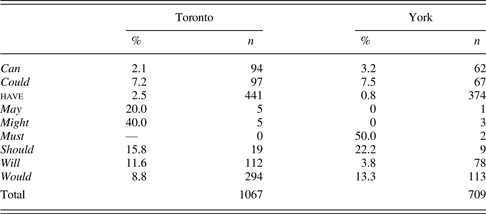
The overall rate of preauxiliary adverbs is low in both locations: 6.1 percent in Toronto (N = 1067) and 4.4 percent in York (N = 709). Table 2 shows the rate of preauxiliary adverbs by lexical auxiliary (ordered alphabetically).
Rates of preauxiliary adverbs by auxiliary
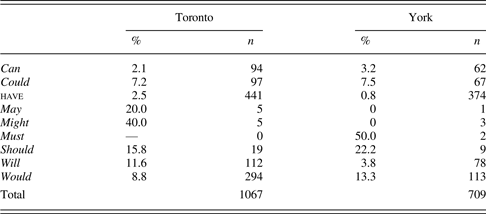
It is immediately apparent that should, must, might, and may are very infrequent in the corpora in general. This low frequency makes generalizations about these auxiliaries problematic, and they have been treated differently from the other auxiliaries, as I will discuss. Leaving aside the extremely infrequent might, must, and may (occurring less than five times in either corpus), these results are similar to Jacobson (Reference Jacobson1975:137); the verb with the highest rate of preauxiliary adverb placement is should, though the very low number of cases urges caution in interpretation. Also in keeping with the North American results from Jacobson (Reference Jacobson1975:137), have has the lowest rate of preauxiliary adverbs; I will explore the details of this result. The rates found here are notably lower than those found in Jacobson (Reference Jacobson1975:137),Footnote 17 but the results of his study are not directly comparable, given the more narrow definition of the variable context that I have used, including the separation that I have maintained between affirmative and negative contexts.Footnote 18
Turning to the structure of the auxiliary phrase, over 90 percent of the tokens in each corpus consist of a single (i.e., lone) auxiliary, as in (12). However, more than one auxiliary is certainly possible, as seen in (13).
(12) Single auxiliary
a. I would always say it to anybody (Y/L)
b. a woman could still teach after she married (T/5)
(13) Multiple auxiliaries
a. I really could have died. (Y/^)
b. And they had obviously been out celebrating. (Y/K)
c. I have always been interested in sport. (T/P)
d. It would never be planned. (T/ä)
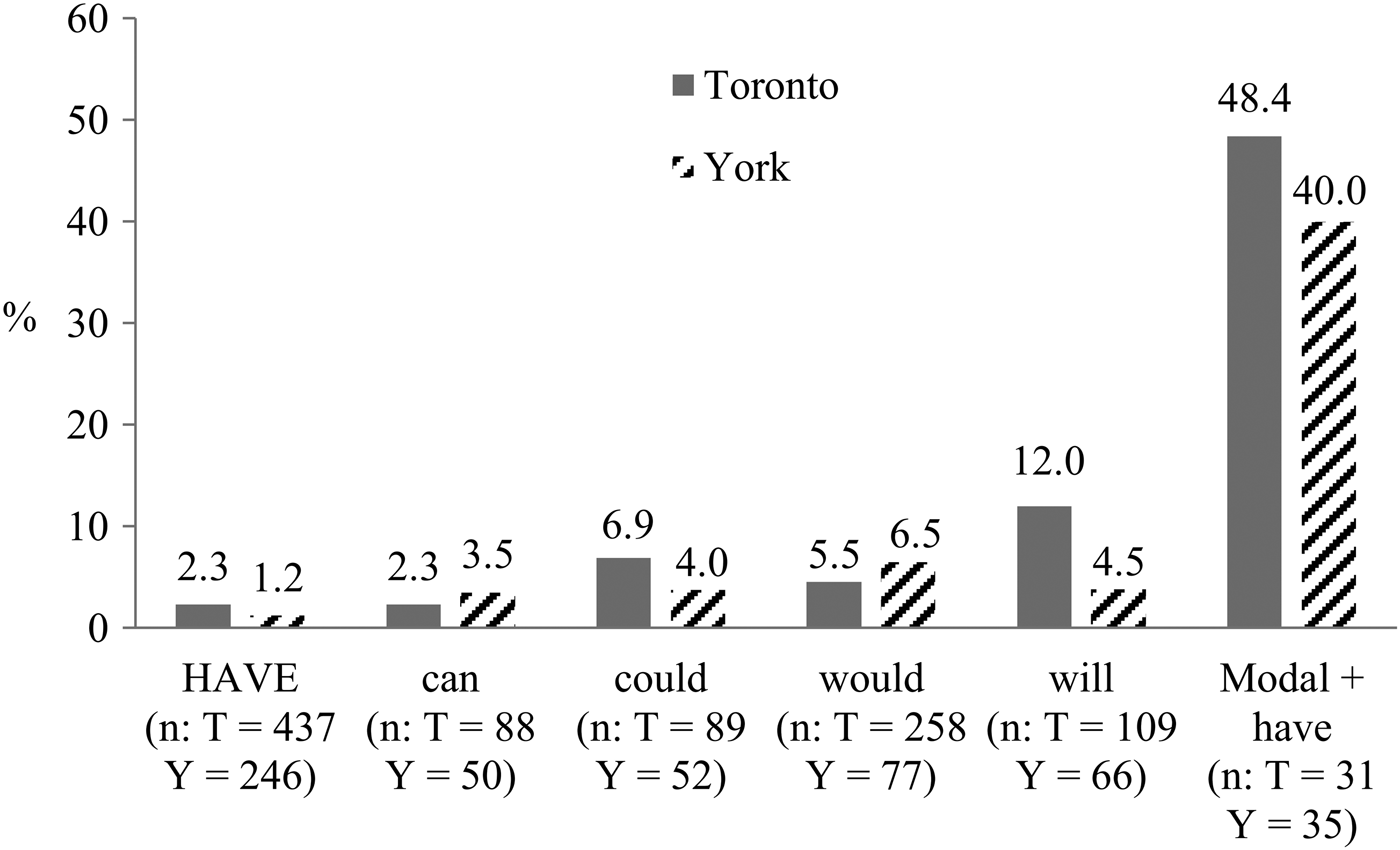
The results in the cases such as those in (13) are striking. When the finite auxiliary was followed by a form of be (as in (13b)–(13d)), the adverb never occurred before the auxiliary in York (n = 29), and there was only one case of preauxiliary adverb placement in Toronto (n = 19).Footnote 19 However, in cases where a modal auxiliary was followed by the perfect auxiliary (i.e., modal + have, as in (13a)), adverbs occurred before the finite auxiliary at much higher rates in both corpora, at 48 percent (n = 31) in Toronto and 40 percent (n = 35) in York.
Given the limited variability that occurs in the context of finite auxiliaries + be, these cases have been excluded from the rest of the analysis. Furthermore, the four infrequent auxiliaries, namely, must, might, may, and should were also excluded from the analysis when they occurred alone (i.e., not in the form modal + have). With these cases removed, 1012 tokens remained for Toronto and 675 tokens remained for York. Figure 1 shows the rates of preauxiliary adverbs by lexical auxiliary/auxiliary structure for these remaining tokens; the lexical auxiliaries listed in Figure 1 are the cases in which there is only a single auxiliary (as in (12)). For the reasons already discussed, as modal + have is a case of multiple auxiliaries, only adverbs before or after the finite auxiliary were included in this calculation.
Rates of preauxiliary adverb by auxiliary/phrase structure.
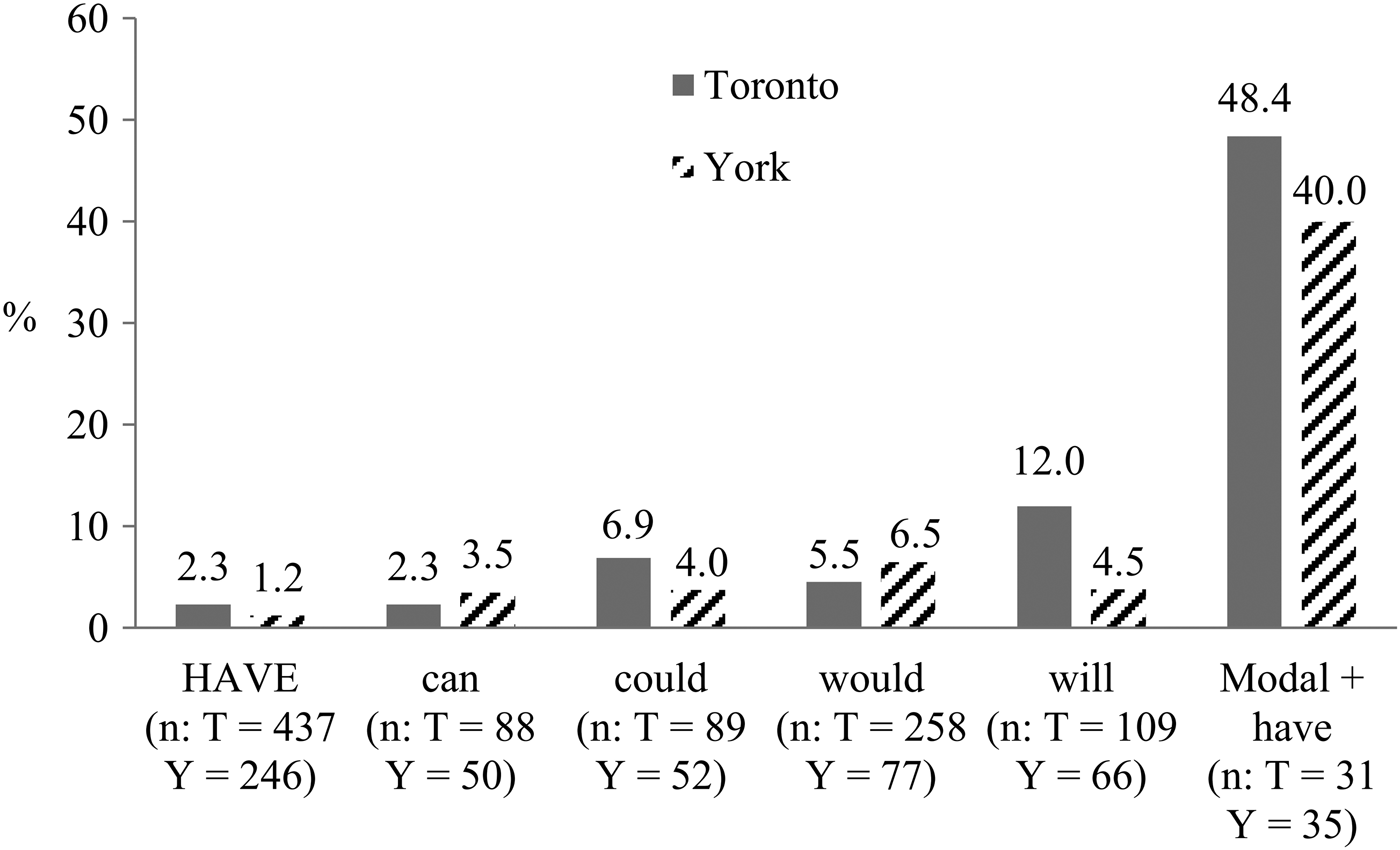
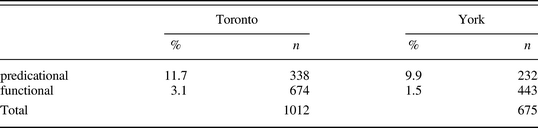
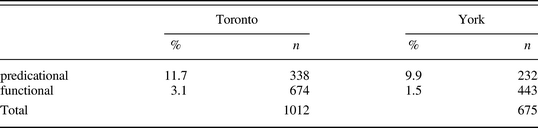
Table 3 displays the rate of preauxiliary adverbs by adverb type. Functional adverbs (e.g., sometimes, often) are less likely than predicational adverbs (e.g., maybe, probably, actually) to appear before the finite auxiliary. These results are in keeping with the findings of Granath (Reference Granath2002:29), who found a similar correlation between adverb type and position with respect to auxiliary.
Rate of preauxiliary adverb by adverb type
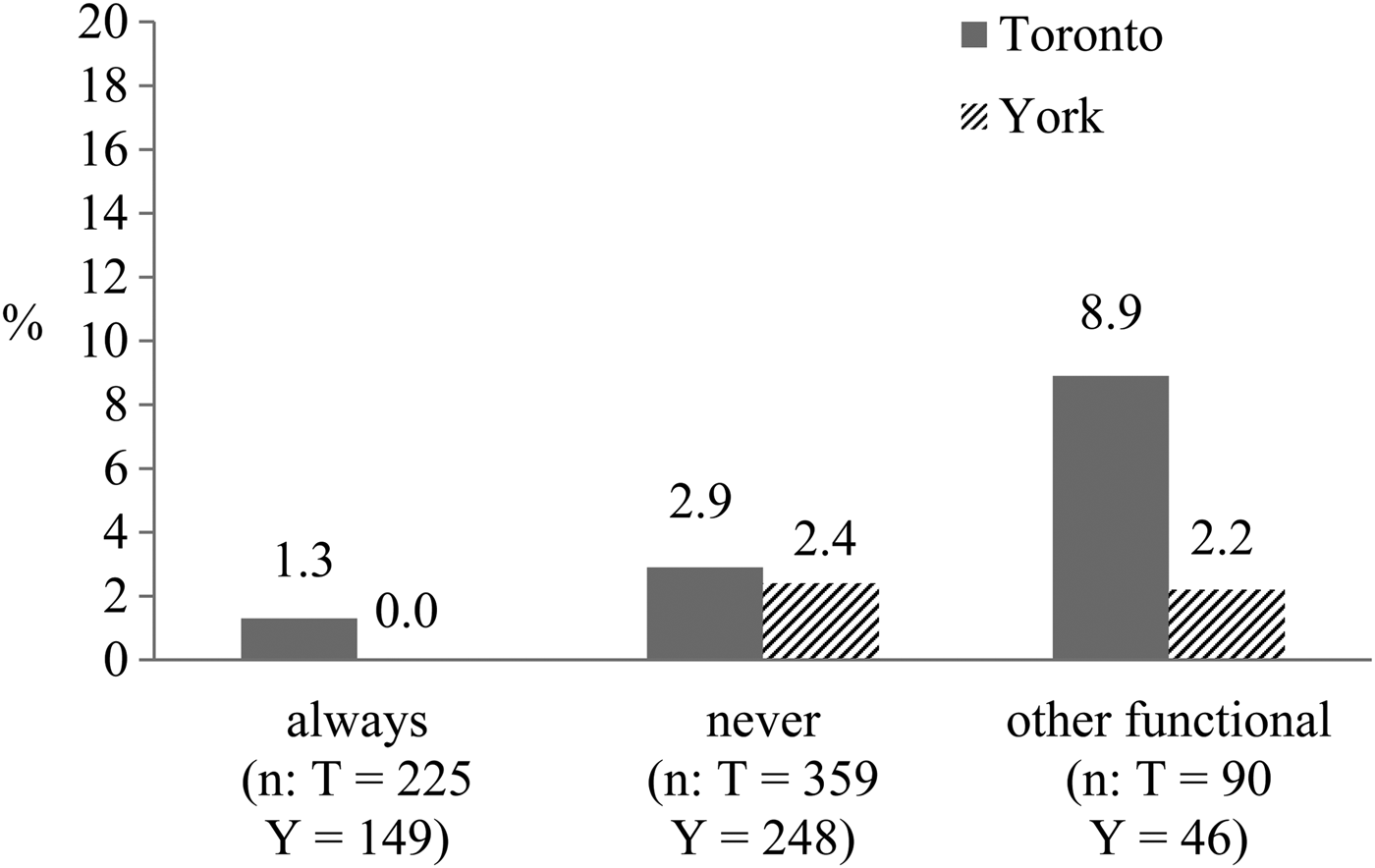
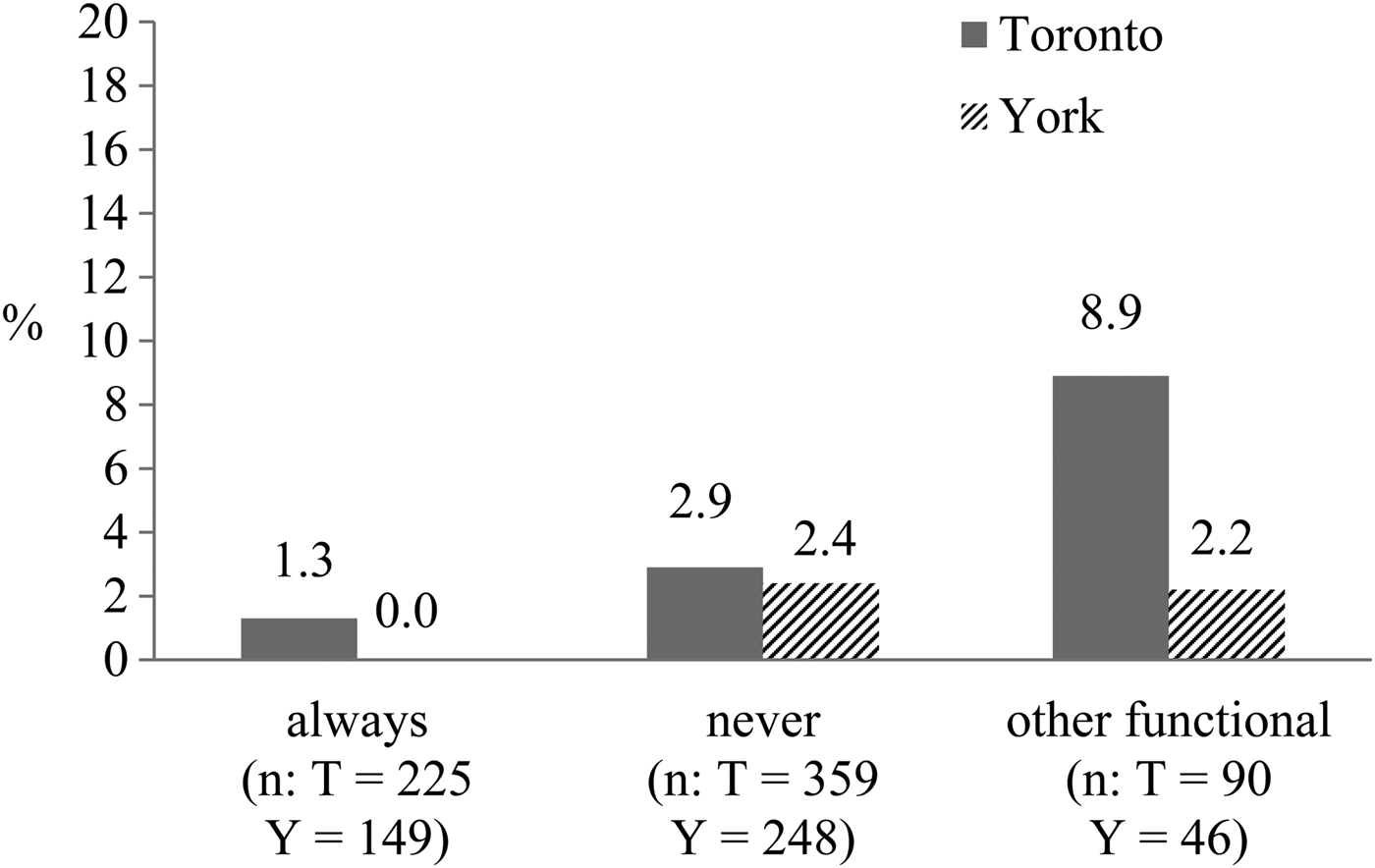
Two of the functional adverbs, always and never, were frequent enough (i.e., over 100 tokens per corpus) to examine individually. The occurrences of these two adverbs were separated from the remaining functional adverbs (e.g., still, sometimes, often); the rates of preauxiliary adverbs for all three categories are displayed in Figure 2. Separating these two adverbs from the rest reveals some interesting patterns. First, in the York data, the adverb always occurs categorically after auxiliaries. In Toronto, always occurs very infrequently in preauxiliary position, but, unlike in York, it does occur occasionally before the auxiliary.Footnote 20 The rates for never are similar in both locations: less than 3 percent. However, the rates in Toronto (8.5 percent) are higher for the other functional adverbs than in York (2.1 percent), suggesting this adverb type is a locus of difference between the varieties.
Rate of preauxiliary occurrence by adverb/adverb type.
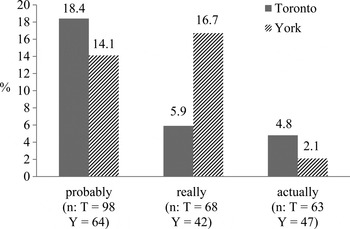
Similarly, there are interesting patterns for the three most common predicational adverbs, namely, actually, really, and probably (over 40 occurrences each per corpus), as shown in Figure 3. The contrast between really and probably is notable, with probably occurring before the auxiliary more commonly in Toronto than in York, and really occurring before the auxiliary more commonly in York than in Toronto.Footnote 21
Rate of preauxiliary placement for selected adverbs by location.

These patterns raise the question of whether the distributions seen in this section are the result of adverb-auxiliary collocations. Fortunately, the multivariate analysis process allows these relationships to be disentangled to determine the respective roles of auxiliary and adverb.
Multivariate analyses
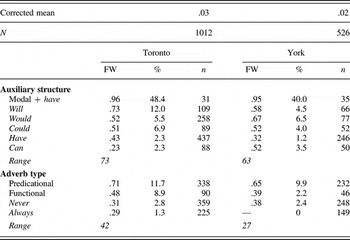
In this section, I discuss a series of multivariate analyses conducted using GoldVarb X (Sankoff, Tagliamonte, & Smith, Reference Sankoff, Tagliamonte and Smith2005). To establish whether or not the two regions are statistically significantly different for this variable, the first multivariate analysis included only the linguistic variables and region. Auxiliary structure, adverb type, and region were selected as statistically significant in this first analysis, with the linguistic variables demonstrating a stronger effect than region, a finding in keeping with Granath (Reference Granath2002) and with studies of the relationship between social and linguistic variables in general (e.g., Preston, Reference Preston1991). However, as there was a region-based difference, I subsequently conducted a second round of multivariate analyses, examining the two regions separately. In the analysis of York, I excluded always because it occurs categorically in postauxiliary position. The results of these two analyses are presented in Table 4.Footnote 22
Multivariate analysis of factors for the selection of preauxiliary adverb position

Note: Factor groups not selected as statistically significant in either location: subject type, speaker age, speaker sex, speaker education.
The overall input value in both locations is extremely small, as is expected from the low overall rates of preauxiliary placement. Type of subject was not statistically significant, nor were any of the examined social factors in either region (speaker age, speaker sex, or speaker education). The lack of social correlates suggests that this variable is primarily a linguistic phenomenon, though an examination of other social characteristics might reveal a correlation not seen here.
In both locations, the auxiliary structure has the strongest effect, with modal + have strongly favoring preauxiliary position, whereas have and can generally disfavor it, though more discussion is warranted. In Toronto, will also strongly favors the preauxiliary position, followed by would. In York, will and would both favor preauxiliary position, though their ordering is the reverse of that in Toronto. The auxiliaries can and could appear to be operating similarly to each other in York. In Toronto, in contrast, can and could behave differently from each other, with could being more similar to would than can.
Adverb type is statistically significant in both locations. The relative strength of this factor group and the hierarchy within the factor group is consistent in the two locations. Predicational adverbs (e.g., maybe, probably, actually) favor preauxiliary position. Functional adverbs (e.g., sometimes, often) are a more disfavoring environment in York than in Toronto. Finally, always and never are particularly disfavoring environments in both locations, as suggested previously by the distributional analysis.
The results demonstrate that adverb placement with respect to an auxiliary in spoken data is very similar between the two communities. The results can be summarized as follows:
1. The adverb generally occurs after the finite auxiliary rather than before it;
2. speakers generally avoid adverbs immediately before the auxiliary have regardless of whether it occurs alone or after a modal;
3. lexical auxiliary plays a role in both regions; and
4. aside from the categorical (postauxiliary) placement of always in York, adverb type operates the same way in the two communities.
Thus, the variation seen in adverb placement with respect to an auxiliary follows a pattern observed in other studies comparing British and North American data, summed up by Tottie (Reference Tottie, Rohdenburg and Schlüter2009:342):
[D]ifferences between American and British grammar . . . are rarely categorical. As a rule, they can be expressed as proportions or probabilities. We might say that, most of the time, American and British speakers have the same grammars, with the same inventory of forms and the same rules, but that the application of the rules differs between varieties.
DISCUSSION
Clearly, there are lexical/semantic effects, both in terms of the adverb and the auxiliary. However, we see a three-way distinction in both varieties: [modal + have]–modal–have. If only modal meaning or lexical effects were at work, we would expect the modal + have forms to occur with preauxiliary adverbs at rates similar to the single modal forms (e.g., could have would occur with preauxiliary adverbs at the same rate as could alone), but this is not the case. Furthermore, in constructions in which the finite auxiliary is followed by something other than have (i.e., modal + Progressive, as in should be going) preauxiliary adverbs are extremely rare, suggesting that the mechanism at work is related to have, rather than related to the complexity of auxiliary phrase. In this section, I examine several syntactic approaches, and I show that none of them can explain the variability seen, suggesting that this phenomenon is not wholly syntactic. I then briefly outline some postsyntactic processes that may be involved in the variability.
Syntactic explanations
I begin by briefly presenting the syntactic structures proposed by Ernst (Reference Ernst2002:309–385) for the forms under study here, including the assumption that Modal, or Perfect when no Modal is present, moves to Tense (data based on (1)).
(14) Single modal with adverb
a. Adverb in postauxiliary position (They will probably move)
[TP They willi [ModalP probably t i [PredP move]]]
b. Adverb in preauxiliary position (They probably will move)
[TP They probably willi [ModalPt i [PredP move]]]
The structures in (14) have a single auxiliary and thus there are only two positions at which the adverb can adjoin (for the environments studied here): above Modal/Perf (whichever head is present) or above Tense. However, in cases with more than one auxiliary, there are three possibilities for adverb adjunction, as shown in (15) and (16).
(15) Modal + have with adverb in postauxiliary position (They could probably have moved)
a. Option 1: adverb adjoined above Modal head
[TP They couldi [ModalP probably t i [PerfP have [PredP moved]]]]
b. Option 2: adverb adjoined above Perf head
[TP They couldi [ModalPt i [PerfP probably have [PredP moved]]]]
(16) Modal + have with adverb in preauxiliary position (They probably could have moved)
[TP They probably couldi [ModalPt i [PerfP have [PredP moved]]]]
In the case of a modal auxiliary followed by the perfect auxiliary (e.g., They could have moved), the adverb can adjoin immediately above the Perf head (15b), immediately above the Modal head (15a) or above the Tense head (16). As with the case of a lone auxiliary, as in (14), the only structure that yields a preauxiliary adverb is adjunction above Tense. If the adverb adjoins above either the Modal head or the Perf head, the adverb will still appear after the finite auxiliary in the surface form because the Modal head raises to Tense. This fact, that the only structure allowing an adverb to appear before the auxiliary is the one in which an adverb occurs above Tense, is a crucial point, and I return to it in a moment.
Ernst (Reference Ernst2002) did not address the issue of how the choice of adjunction location operates (i.e., how a speaker decides it is the right moment in a derivation to adjoin the adverb, when more than one position is possible). We could, as a starting point, assume that the adverb can be adjoined randomly, subject to certain semantic constraints (Ernst, Reference Ernst2002:4–5). However, this predicts that, for cases where there is only one auxiliary (e.g., We could go or They may arrive), the rate of preauxiliary adverbs should be roughly the same as the rate of postauxiliary adverbs, as a speaker could randomly adjoin the adverb either before or after the auxiliary. However, the rate of preauxiliary adverb placement is far lower than 50 percent in the data studied here and is consistent with Quirk et al. (Reference Quirk, Greenbaum, Leach and Svartvik1985:126), who also noted a preference for postauxiliary placement. A more reasonable conclusion is that the postauxiliary position is a default position, and thus the structures in which an adverb adjoins above Modal or Perf (rather than above Tense) are the default structures (i.e., (14a) and (15) are the default structures). Thus, in order to explain the results, it is necessary to explain the mechanism behind a choice to adjoin above Tense, and further, why it should be more common to adjoin an adverb above Tense with modal + have than when there is only a single auxiliary. Given that the derivation cannot “look ahead”Footnote 23 to anticipate that the form will ultimately be modal + have, the complexity of the auxiliary phrase in and of itself does not provide a mechanism to allow the derivation to delay adjunction in the syntax.
Perhaps there is something inherently different about the modal + have forms? Ernst (Reference Ernst2002:333) treated modal + have as noncompositional semantically, stating that modal + have “does not represent the perfective but instead indicates past time.” Syntactically, however, he still posited two heads: Modal and Perf. In addition to the structures given in (15) and (16), Ernst (Reference Ernst2002:380–381) posited an optional movement of Perf to Modal to form a single head, though there is still an obligatory raising of Modal to Tense, meaning they are ultimately separated again. However, under this analysis, there is an additional possible position for adverbs with the same meaning: adverbs occurring after have in modal + have. That is, cases such as (7c) and (17) may be a result of the movement of Perf around the adverb.
(17) They'd have probably jumped over top (Y/9)
Although the placement of an adverb after a nonfinite auxiliary is usually associated with a scope difference, when Perf movement has taken place, the meaning is preserved. Therefore, adverbs occurring after have, such as the case of (17) could be part of the variable context. To test this, I included cases such as (17) as valid instances of postauxiliary placement and recalculated the rates of pre- and postauxiliary adverbs. However, the inclusion of tokens in which the adverb occurs after modal + have (e.g., (17)) does not bring the rate of preauxiliary adverbs into line with the rates of preauxiliary adverbs when the modal occurs alone. The rate of preauxiliary adverb placement for modal + have with the cases like those in (17) is still over 30 percent, well above the rates for single modals, which are generally under 10 percent. The difference between a single auxiliary and modal + have stands, even with an expanded variable context.
This account cannot explain the placement of an adverb above Tense more frequently in certain contexts than others. Biberauer and Richards (Reference Biberauer, Richards and Boeckx2006:39) referred to some syntactic variation as “true optionality” and described these cases as “when the grammar doesn't mind.” Biberauer and Richards (Reference Biberauer, Richards and Boeckx2006:62) argued that, as long as all the syntactic requirements are met, it is possible to achieve the same end by different structural means and appeal to what they call “the conceptually dubious notion of competing grammars.” However, Biberauer and Richards (Reference Biberauer, Richards and Boeckx2006) did not attempt to explain various rates of the occurrence of any phenomena, only the presence of the variation. Although the case in question here seems to be a case of “true optionality,” speakers are demonstrating the orderly heterogeneity seen in variation phenomena. This is not random variation; it is patterned variation, and it is in need of an explanation. In the absence of a mechanism that allows adverbs to move within the syntactic derivation, it is reasonable to assume that there is a postsyntactic operation that moves the adverb from its default position below Tense to one above it.Footnote 24 The process does not require the syntax to look ahead, but rather allows an adjustment by a speaker after the derivation is complete.
Postsyntactic processes
As outlined in the introduction, one of the goals of this study was to determine how the syntax yielded the variation; that goal has been achieved, albeit by determining that at least some of the variability is outside the syntax. However, the question now arises as to what factors might be at work in a postsyntactic process. Ultimately, the proposals in this section would need an investigation beyond the scope of this paper to confirm or refute them, but I present some observations with a view to providing some direction for future work.Footnote 25
Ernst (Reference Ernst2002:31–33, 226–234) described effects of prosodic Weight (e.g., stress or more syllables makes something heavier) and Directionality principles that allow adverbials to occur in a different surface position than where they might normally be expected to appear. In English, these effects explain variability in adverbials such as the permissibility of both They worked for my brother on Sunday and They worked on Sunday for my brother (Ernst, Reference Ernst2002:232). However, these mechanisms cannot explain the variability seen here. First, Ernst (Reference Ernst2002:441) stated that single-word adverbs are less likely than phrases to be moved and the adverbs studied here are all of the single-word variety, making their movement less likely under Ernst's account.Footnote 26 Furthermore, Ernst (Reference Ernst2002:226–234) posited movement to the right as a result of Weight and Directionality, rather than allowing a movement to the left.Footnote 27 As demonstrated, however, the occurrence of an adverb to the right of the auxiliary appears to be the default case; what is needed is to explain the rates of occurrence of adverbs to the left of the auxiliary, thus leftward movement would seem to be necessary to describe the phenomena observed here. Moreover, even if leftward movement of the adverb were possible, assuming (as Ernst did) that the adverb (i.e., not the auxiliary) is what moves, Weight alone cannot explain the distribution seen. If the explanation for the greater frequency of preauxiliary adverb position with modal + have (e.g., She probably would have gone) is a relative lack of weight of an adverb compared to modal + have, then we would expect adverbs to occur more commonly before the auxiliary whenever more than one auxiliary was present, including Perfect + Progressive (e.g., they had been celebrating) or Perfect + Passive (e.g., I have been given gifts). However, the data show that only the modal + have cases occurred with higher rates of preauxiliary adverbs. Therefore, some other mechanism must be involved in the process.
Positing that the auxiliary rather than the adverb moves is also problematic. As the default position for the auxiliary is before the adverb (i.e., postauxiliary adverb position is the default, e.g., She has probably left), the auxiliary would have to be moved rightward to get the exceptional preauxiliary position. Although it might be possible to explain that stressed auxiliaries move rightward because they are heavy (which would be consistent with the claim about stressed auxiliaries in Swan, Reference Swan2001), it does not explain the unstressed cases. Furthermore, the issue of the difference in treatment of modal + have versus the other cases of multiple auxiliaries cannot be overcome by a movement of the auxiliary any more than by the movement of the adverb.
In order to explain the correlation of adverb position with lexical auxiliary and the higher frequency of preauxiliary adverbs with modal + have, I return to some previous observations about have. Speakers use adverbs immediately before have at lower rates than before modals, both when have occurs alone (e.g., We have gone) and when it occurs after a modal (e.g., We would have gone). There is a well-known propensity for forms of have (including has/had) to be reduced/contracted (Quirk et al., Reference Quirk, Greenbaum, Leach and Svartvik1985:131), and reduction/contraction of English auxiliaries is generally considered to be a postsyntactic process (Kaisse, Reference Kaisse1983:95). Therefore, I explore contraction/reduction as a possible explanation of the behavior seen here.
Although full contraction of have (in any form) is only possible following a vowel, reduced forms with schwa (e.g., [əv]) are possible after consonants (MacKenzie, Reference MacKenzie2013:6–7), and thus it is possible to have a reduction after a modal.Footnote 28 There is a similarity between the pattern of contraction/reduction and that seen for adverb placement. That is, the pattern of preference in adverb placement with have seems to be highly compatible with contraction/reduction of have. In a situation where have is the only (and thus finite) auxiliary (e.g., I have thought about it), there is a strong preference for placement of the adverb in postauxiliary position (i.e., after have). The choice of postauxiliary position also allows a speaker to exploit contraction/reduction of have with the subject by creating the required subject-auxiliary adjacency. An example is given here, where the postauxiliary placement of probably creates adjacency between the subject pronoun we and the auxiliary have:
(18) We've probably closed a dozen Scout groups (Y/a)
The postauxiliary adverb position does not require contraction/reduction, merely permits it. Thus, postauxiliary adverb position with have in (18) allows, but does not force, contraction. However, a preauxiliary position in (18) would prevent subject-auxiliary adjacency, and thus contraction/reduction with the subject would not be possible.
In contrast to have as a finite auxiliary (as in (18), where postauxiliary position is strongly preferred), in the cases of modal + have, adverb placement before the auxiliary, as illustrated in (19), occurs about 40 percent of the time:
(19) They probably could have afforded a bigger home (T/é)
Note that the adverb placement in (19) permits have to occur in a position in which reduction (to a form generally transcribed as could've, coulda, or could of) is common (Frank & Jaeger, Reference Frank and Jaeger2008:5).Footnote 29 Of course, it is also possible to have reduction after an adverb (e.g., They could probably've afforded a bigger house), which would allow contraction/reduction to occur with a postauxiliary adverb in modal + have forms. However, previous analyses of the reduced forms (e.g., Kayne, Reference Kayne1997, on could of) are suggestive of a form that is undergoing reanalysis, with modal + have perhaps now being considered a unit, at least in some cases.
If contraction/reduction is partly responsible for the way adverbs are positioned, we might also expect that the mechanism would operate similarly on all auxiliaries that can contract. We would expect lower rates of preauxiliary adverb use with all auxiliaries that can contract, including will and would. Footnote 30 As Figure 1 shows, the opposite is true for the data here; will and would occur with preauxiliary adverbs more commonly than some auxiliaries that cannot be contracted, such as can. However, this is not insurmountable counterevidence. MacKenzie (Reference MacKenzie2013) demonstrated that contraction and reduction across different auxiliaries arise from more than one process, at least in North American English, and that some processes will apply to certain combinations of subject + auxiliary combinations but not others. Moreover, the process must be more complex than merely whether contraction is possible or not, as the results here have demonstrated that the auxiliary itself and the type of adverb (functional or predicational) play a role, as well as the genre effects seen in other studies.
Based on the parallels between contraction/reduction and adverb placement, it is possible to sketch a picture of the postsyntactic mechanism that creates preauxiliary adverb position. The default position for adverb placement with respect to auxiliary is after the finite auxiliary (e.g., I will never go or She could probably finish it). As part of a postsyntactic process that also considers the lexical auxiliary and the type of adverb, the adverb may be moved leftward to preauxiliary position when it facilitates contraction (e.g., when it allows could've), but avoided when it impedes contraction (i.e., when the adverb intervenes between a pronoun and have).Footnote 31
CONCLUSIONS
This study examined adverb placement with respect to a finite auxiliary in two varieties of English: Toronto, Canada, and York, England. It is the first investigation of the phenomenon to focus on spoken, vernacular data, though the results are generally in keeping with previous work on written data (e.g., Granath, Reference Granath2002; Jacobson, Reference Jacobson1975). Adverb position did not significantly correlate with any of the social variables studied here (age, sex, or education of speaker) in either community. Although there is a statistically significant relationship between variety (Toronto or York) and use of preauxiliary adverbs, with the Canadian usage rate being slightly higher, the patterns of variation show remarkable similarities. Although the behavior of individual auxiliaries is not identical in the two regions, the general patterns hold in both York and Toronto English, with preauxiliary adverbs occurring at rates below 10 percent overall. Adverbs occur very infrequently before the auxiliary have (less than 3 percent), and at rates between 3 and 12 percent for single modals (e.g., could, will ). When the modal is followed by have, however, the rate of preauxiliary adverb placement is over 30 percent in both regions. Furthermore, as Jacobson (Reference Jacobson1975) and Granath (Reference Granath2002) found, the type of adverb is also correlated with adverb position. Specifically, functional adverbs, such as often, occur less frequently before the auxiliary than do predicational adverbs, such as probably, with a slightly higher rate of preauxiliary functional adverbs in the Toronto data and categorical (postauxiliary) placement of always in York. In order to elucidate this similar, cross-dialectal behavior, I then examined several syntactic proposals for adverb placement. I demonstrated that the mechanism for preauxiliary adverb placement appears to be part of a postsyntactic process, which considers adverb and auxiliary type and which operates in conjunction with contraction/reduction. An investigation of the postsyntactic variation hypothesis would be a fertile area for future work.