Introduction
Idiopathic sudden sensorineural hearing loss (SNHL), defined as SNHL greater than 30 dB occurring in at least 3 contiguous audiometric frequencies over 72 hours or less,Reference Hughes, Freedman, Haberkamp and Guay 1 is a disease of unknown aetiology. Hyperbaric oxygen therapy has been used to treat idiopathic sudden SNHL since 1979.Reference Goto, Fujita, Kitani, Kanno, Kamei and Ishii 2 Although not recognised as a standard treatment modality for sudden SNHL, hyperbaric oxygen therapy has been shown to provide significant additional benefit when used in combination with steroid therapy for idiopathic sudden SNHL.Reference Fujimura, Suzuki, Shiomori, Udaka and Mori 3 The outcomes of idiopathic sudden SNHL are significantly better if hyperbaric oxygen therapy is combined with conventional treatment modalities.Reference Topuz, Yigit, Cinar and Seven 4
Various prognostic factors have been evaluated for their capacity to predict recovery from idiopathic sudden SNHL, including age, presence of dizziness, degree of early-stage hearing loss, type of hearing loss, time interval between onset of symptoms and treatment, and concomitant systemic disease such as diabetes mellitus or hypertension.Reference Oh, Lee, Park, Kim, Chung and Kim 5 – Reference Schreiber, Agrup, Haskard and Luxon 7 However, limited information is available on the prognosis when idiopathic sudden SNHL is treated with hyperbaric oxygen therapy and steroids.
This study examined the associations between prognostic factors and successful improvement in idiopathic sudden SNHL patients treated with hyperbaric oxygen therapy and intravenous steroids.
Materials and methods
Patients
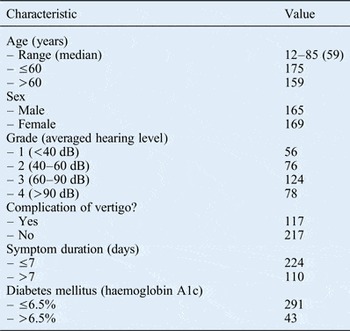
A total of 334 patients were treated for idiopathic sudden SNHL at Shizuoka Saiseikai General Hospital, Japan, over a 5-year period between 2010 and 2014. All patients were treated with intravenous steroids and hyperbaric oxygen therapy. Patients with hearing loss lasting more than 30 days or with fluctuating hearing loss, and those aged less than 10 years, were excluded. In total, 165 male and 169 female patients with idiopathic sudden SNHL were treated at our institution between 2010 and 2014. The median age at diagnosis was 59 years (range, 12–85 years). Patients were classified according to whether they were aged 60 years or less (n = 175) or more than 60 years (n = 159).
Treatment protocol
Hyperbaric oxygen therapy was applied at a pressure of 2.0 atm for 60 minutes once daily for 10 days. Intravenous steroids were started at the beginning of hyperbaric oxygen therapy. The steroid used was hydrocortisone (400 mg/body weight, tapered over 10 days).
Audiometric evaluation
All patients underwent audiogram tests on the 1st day of treatment and after treatment. Mean hearing levels at 250, 500, 1000, 2000 and 4000 Hz were calculated for each frequency. The audiograms were divided into four groups based on the degree of hearing loss (grade 1, less than 40 dB; grade 2, 40–60 dB; grade 3, 60–90 dB; and grade 4, more than 90 dB), according to the grading system established by the Ad Hoc Committee of the Japanese Ministry of Health, Labour and Welfare.Reference Kanzaki, Taiji and Ogawa 8 The initial averaged five-frequency hearing levels were as follows: grade 1 (n = 56), grade 2 (n = 76), grade 3 (n = 124) and grade 4 (n = 78).
Hearing improvement
Hearing level improvement was evaluated after treatment by comparing the audiogram results obtained on the 1st day of treatment with the post-treatment results. The results were compared for each frequency. The hearing level at one month after initiation of treatment was considered to be fixed, and hearing improvement was classified as better improvement, good improvement, fair improvement, or no change or deterioration, as per the criteria proposed by the Ad Hoc Committee of the Japanese Ministry of Health, Labour and Welfare (Table I).Reference Kanzaki, Taiji and Ogawa 8 The cure rate was defined as the proportion of patients with better improvement, and the improvement rate was defined as the proportion of patients with better, good or fair improvement.
Criteria for hearing recovery in idiopathic sudden sensorineural hearing loss*

* As proposed by the Ad Hoc Committee of the Japanese Ministry of Health, Labour and Welfare. †Arithmetic mean of hearing levels at five frequencies (250–4000 Hz).
The clinical characteristics of the patients are shown in Table II.
Patients’ demographic and clinical characteristics*

Data represent numbers of patients unless indicated otherwise.
* In those with idiopathic sudden sensorineural hearing loss treated with hyperbaric oxygen therapy and intravenous steroids (n = 334).
Data analysis
We analysed the initial averaged five-frequency hearing level, patient age, interval between onset of symptoms and treatment, the complication of vertigo, and coexisting diabetes mellitus (glycated haemoglobin of more than 6.5 per cent, as per the National Glycohemoglobin Standardization Program). The averaged five-frequency hearing level is separated into four grades.
Fisher's exact test was used to compare outcomes for the different parameters. A p value of less than 0.05 was considered to be statistically significant. The data were analysed with Stata software, version 11 (Stata, College Station, Texas, USA).
Results
Hearing improvement rate
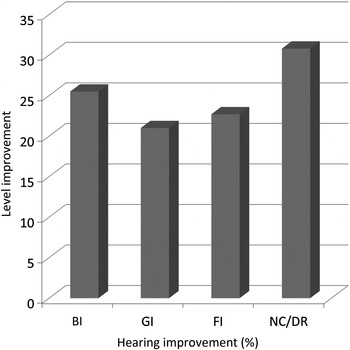
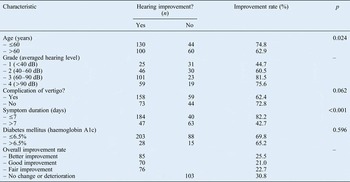
The distribution of patients according to hearing improvement classification was as follows: 25.5 per cent (n = 85) achieved better improvement, 21.0 per cent (n = 70) showed good improvement, 22.7 per cent (n = 76) showed fair improvement, and 30.8 per cent (n = 103) showed no change or deterioration (Figure 1). The overall improvement rate, including the fair improvement group, was 69.2 per cent. The hearing improvement rates are shown in Table III.
Overall hearing improvement outcomes in patients with idiopathic sudden sensorineural hearing loss (n = 334). BI = better improvement; GI = good improvement; FI = fair improvement; NC/DR = no change or deterioration


Initial grade of hearing loss
The improvement rate varied with the degree of hearing loss at the first visit. Improvement rates were 44.7 per cent in patients with grade 1 hearing loss, 60.5 per cent in patients with grade 2 hearing loss, 81.5 per cent in patients with grade 3 hearing loss and 75.6 per cent in patients with grade 4 hearing loss, respectively (Figure 2).
Hearing improvement outcomes according to initial hearing level (grades 1–4 hearing loss). BI = better improvement; GI = good improvement; FI = fair improvement; NC/DR = no change or deterioration

Age
Patients aged 60 years or less showed a high hearing improvement rate of 74.8 per cent. This was significantly greater than that in patients aged more than 60 years, who showed a hearing improvement rate of 62.9 per cent (Figure 3).
Hearing improvement outcomes according to age (60 years or less vs more than 60 years). Y = years; BI = better improvement; GI = good improvement; FI = fair improvement; NC/DR = no change or deterioration

Initial treatment timing
In total, 224 patients (67.1 per cent) presented to our hospital within 7 days of symptom onset. We divided the patients into 2 groups according to whether they were treated within 7 days or less or more than 7 days after onset of idiopathic sudden SNHL. The improvement rates were: 82.2 per cent in patients who received their initial treatment within 7 days of symptom onset, 49.3 per cent in those treated within 14 days, 37.0 per cent in those treated within 21 days, and 19 per cent in those treated 22 or more days after symptom onset. The improvement rate was significantly higher in patients who received their initial treatment within 7 days of symptom onset than in those who received the initial treatment 8 or more days later (p < 0.001; Figure 4).
Hearing improvement outcomes according to interval between symptom onset and treatment (7 days or less vs more than 7 days). BI = better improvement; GI = good improvement; FI = fair improvement; NC/DR = no change or deterioration

Complication of vertigo
In 117 patients (35.0 per cent) in whom vertigo was present, the hearing improvement rate was 62.4 per cent, which was not significantly different from that in the patients without vertigo (p = 0.062; Figure 5). The vestibular function test was not performed routinely.
Hearing improvement outcomes according to complication of vertigo. BI = better improvement; GI = good improvement; FI = fair improvement; NC/DR = no change or deterioration

Diabetes mellitus
Forty-three patients (12.9 per cent) had diabetes mellitus; however, their improvement rate was not significantly different from that of patients without diabetes mellitus (p = 0.596; Figure 6).
Hearing improvement outcomes according to presence of diabetes mellitus (DM). BI = better improvement; GI = good improvement; FI = fair improvement; NC/DR = no change or deterioration

Discussion
There are no published guidelines for the evaluation or management of sudden SNHL.Reference Rauch 6 There have been several reports of hyperbaric oxygen therapy being used, with different options and durations in the treatment of idiopathic sudden SNHL. There is still no universally accepted approach for routine clinical application and effectiveness in these patients.Reference Fujimura, Suzuki, Shiomori, Udaka and Mori 3 , Reference Dundar, Gumus, Ay, Yetiser and Ertugrul 9 , Reference Muzzi, Zennaro, Visentin, Soldano and Sacilotto 10 In the present study, we showed that the combination of intravenous steroids and hyperbaric oxygen therapy significantly improved the hearing outcome in patients with idiopathic sudden SNHL, regardless of the initial hearing level. We did not compare outcomes between patients treated with systemic steroids alone and those treated with intravenous steroids and hyperbaric oxygen therapy. However, there have been some reports showing that hyperbaric oxygen therapy is as effective as medical treatment in idiopathic sudden SNHL.Reference Ersoy, Tuzuner, Demirci, Cengiz and Caylan 11 – Reference Psillas, Ouzounidou, Stefanidou, Kotsiou, Giaglis and Vital 13 Pezzoli et al. reported that untreated patients had a spontaneous mean (± standard deviation) improvement of only 5.0 ± 11.4 dB, with hearing in many patients remaining unchanged.Reference Pezzoli, Magnano, Maffi, Pezzoli, Marcato and Orione 12 Mean improvement was significantly better in patients treated with hyperbaric oxygen therapy than in controls (p = 0.0133).
Hearing improvement rates are influenced by various prognostic factors, including age and concomitant systemic disease (e.g. hypertension or diabetes mellitus), as discussed elsewhere.Reference Capuano, Cavaliere, Parente, Damiano, Pezzuti and Lopardo 14 We investigated five prognostic factors with regard to the hearing improvement rate in patients with idiopathic sudden SNHL. The improvement rate in those aged 60 years or less was significantly higher than the natural recovery rate, which was previously reported.Reference Mattox and Simmons 15 The improvement rate in cases with accompanying vertigo was higher than that reported elsewhere.Reference Lee, Lee, Kang, Lee and Lee 16 This difference could be because we included all subjective symptoms of vertigo in addition to the objective findings of nystagmus or decreased vestibular function. Therefore, it is important to consider the affected ear and degree of vertigo when conducting a vestibular function test. We analysed the improvement rate with respect to time of treatment initiation. A significant difference was detected between the two groups in terms of hearing improvement rate. The rate was significantly lower in cases treated 7 days after onset of symptoms than in those treated within 7 days, which is consistent with data from other reports.Reference Fujimura, Suzuki, Shiomori, Udaka and Mori 3 , Reference Ersoy, Tuzuner, Demirci, Cengiz and Caylan 11 , Reference Capuano, Cavaliere, Parente, Damiano, Pezzuti and Lopardo 14 Many patients who failed to regain their hearing received their initial treatment 7 days or more after symptom onset.
-
• This study describes 334 idiopathic sudden sensorineural hearing loss patients treated with hyperbaric oxygen therapy and intravenous steroids
-
• Associations between prognostic factors and successful improvement were investigated
-
• Hyperbaric oxygen therapy with intravenous steroids may improve hearing if performed early
An important aim of this study was to evaluate whether the presence of diabetes mellitus related microvascular disease contributed to the outcome in patients with idiopathic sudden SNHL. Pure tone hearing thresholds were compared between patients with and without hyperglycaemia. Improvement rates were not significantly different between patients with hyperglycaemia and the controls. The presence of diabetes mellitus was not seen to be an adverse prognostic factor in patients with idiopathic sudden SNHL treated with hyperbaric oxygen therapy and intravenous steroids. We may have to consider whether the patient has any diabetes mellitus related risk factors before choosing hyperbaric oxygen therapy with steroids for idiopathic sudden SNHL. Hyperbaric oxygen therapy appears to have a significant additional therapeutic effect when combined with intravenous steroids for idiopathic sudden SNHL, particularly in patients with diabetes mellitus.
Conclusion
This paper reports on patients with idiopathic sudden SNHL treated with hyperbaric oxygen therapy and intravenous steroids at our institution. Compared with the previous data, our results suggest that hyperbaric oxygen therapy has a significant additional effect when used in combination with intravenous steroids for idiopathic sudden SNHL. However, our study population was small, so randomised, double-blind studies are needed to compare hyperbaric oxygen therapy with other modalities in the treatment of this condition. A meta-analysis of the efficacy of hyperbaric oxygen therapy is also required.