INTRODUCTION: RIGHTS, HERITAGE STUDIES, AND WORLD HERITAGE
Heritage studies today not only cover the study of things and places but also the study of interconnected processes, people, and politics. Footnote 1 This, in turn, prompts research to explore new avenues to capture the shifting dynamics at both local and global levels, including significant global “arenas” such as the World Heritage Committee. Footnote 2 We utilize event ethnography as a means of exploring such complexity, capturing a range of situated conservations taking place around growing articulation of human rights in the World Heritage system. This leads us to conclude that such intergovernmental heritage arenas may in fact be far more dynamic than often depicted. Formal dialogues, pre-arranged decisions, and orchestrated public events rarely reveal the full picture of the multiple negotiations and conversations taking place beneath the headlines. Such realities prompt an emergent, rather than static, reading of the World Heritage Committee, which has often been judged according to the texts and other formal outcomes. Footnote 3
Since its early days, the United Nations Education, Scientific and Cultural Organization (UNESCO) has long promoted and informed human rights discussions from general awareness to specific discussions, not least in the realms of its core mandates in terms of education and cultural rights. Footnote 4 Still, despite the prominence of UNESCO’s statutory commitment, human rights were not explicitly referenced in the wording of the 1972 Convention Concerning the Protection of the World Cultural and Natural Heritage (World Heritage Convention), and the specific articulation of human rights by practitioners, and policymakers in the world heritage context has only recently emerged. Footnote 5
There has been a long-standing scholarly interest in heritage and human rights informed by international law, heritage studies, anthropology, and other disciplinary perspectives, Footnote 6 and multiple debates about cultural rights and the sometimes tense relationship between culture and human rights. From debates about cultural values challenging human rights to cultural rights challenging heritage practices, the theoretical, political, and practical implications are considerable. Footnote 7 The relevance of the full range of human rights is increasingly becoming clear. Such pertinence is not only limited to the cultural arena but also concerns the full range of individual and collective human rights making up international human rights standards.
Today, such recognition has spurred a growing interest in human rights and world heritage (encompassing both cultural and natural heritage systems and outcomes), further motivated by a spectrum of scholarly and practical concerns. Footnote 8 This growing body of literature makes it abundantly clear that the heritage and rights intersection is complex. Footnote 9 Scholars and civil society representatives, for example, question whether or not central institutions have effectively integrated or mainstreamed rights in the production of an authorized heritage discourse, raising a number of theoretical and practical questions about how human rights and world heritage standards relate to each other.
In 2011, the world heritage advisory bodies, Footnote 10 together with the International Council on Monuments and Sites (ICOMOS) Norway started an initiative to explore rights-based approaches to heritage management—called “Our Common Dignity.” Footnote 11 In parallel, a number of researchers and practitioners started exploring these intersections in relation to specific cases and conflicts. Thus, while there is a long-standing anthropological interest in human rights, just as there are multiple well-established strands of culture, heritage, and human rights debates, a distinct conversation has emerged, which is worthy of attention in its own terms. In 2011, Farida Shaheed, the then UN special rapporteur in the field of cultural rights, reported on the interrelationships between heritage and cultural rights, with a focus on the rights to take part in cultural life, enjoy one’s own culture, and to maintain and develop cultural heritage. Footnote 12 These separate, but interrelated, debates have moved beyond a sole focus on cultural rights to consider access to cultural heritage as a human right. Footnote 13
Focusing on protected area governance for nature conservation, for example, Gonzalo Oviedo and Tatjana Puschkarsky outline the International Union for Conservation of Nature’s (IUCN) new “conservation paradigm” that links rights with traditional knowledge and community stewardship in achieving biodiversity objectives. Footnote 14 Reflecting on the “limits of heritage,” Rosemary Coombe and Melissa Baird also discuss the IUCN’s moves to incorporate rights within governance frameworks and provide a reminder that the tentative, but important, advances in world heritage on the rights of Indigenous peoples are only one part of the full scope of rights concerns. Footnote 15 Calling for the adoption of “rights-based” approaches to heritage practice on the basis of paradigm shifts that pose heritage as cultural practice, William Logan points to the lack of adequate practitioner awareness of the links between cultural heritage conservation and human rights as an obstacle requiring attention. Footnote 16 Stener Ekern and his colleagues track the progress of recognition of “community” and rights within UNESCO and world heritage, pointing to the diversity behind simple references to “human rights” and the need for additional inter-disciplinary study. Footnote 17 While they survey the dilemmas and contested outcomes that arise from consideration of world heritage and human rights, they also find optimistic possibilities in the ability of world heritage work to reinforce (rather than violate) human rights.
Other researchers, working within specific world heritage settings, have contributed valuable critical questioning about the usefulness of “rights” as a means of drawing attention to issues of heritage and social justice. Footnote 18 This article specifically explores the topic of human rights within the context of the work of the World Heritage Committee at its annual session (meeting). It forms part of the multi-sited research on the ways in which human rights are considered within world heritage, with a focus on the Asia-Pacific region. Footnote 19 An important premise of this work is that in order to understand the multiple world heritage contexts in which human rights are respected, violated, or simply overlooked, it is necessary to complement country and case study analyses with an examination of the work of UNESCO’s World Heritage Committee and the diverse actors that contribute to its annual meeting. It is equally based on the assumption that human rights are vernacularized, suggesting the relevance of a grounded approach to how rights are being expressed, articulated, and employed in different ways.
This article particularly seeks to address the epistemological and methodological implications of approaching the World Heritage Committee as a point of departure to understand global heritage and rights dynamics and builds on an “event ethnography” undertaken by the authors to understand how rights discourse appeared in multiple contexts during the World Heritage Committee’s session in Bonn in June–July 2015. Whereas much debate and analysis is understandably concerned with formal decision-making processes and the final outcomes of the Committee’s deliberations, we seek to demonstrate the significance of taking into account a wider range of informal dynamics and situated conversations. In fact, we argue that this shift in epistemology allows for a complementary emergent and dynamic reading of what takes place within and constitutes the Committee.
WHY LOOK FOR RIGHTS AT THE WORLD HERITAGE COMMITTEE SESSION?
In many respects, the deliberations and diplomatic displays at the annual World Heritage Committee session are distant from the “on-the-ground” realities experienced in specific countries. Footnote 20 However, a closer look reveals the importance of understanding the system as multi-sited, including an interrogation of the roles of the Committee and its influence on the articulation and representation of human rights. The World Heritage Committee is the decision-making body responsible for the implementation of the 1972 World Heritage Convention, often tagged as UNESCO’s “flagship” treaty. Footnote 21 World heritage decisions include the designation of places as world heritage properties, the valorization of some heritages and not others, and the application of international normative standards for the care of places or “properties” designated because of their values to nature and/or culture. These pose significant hurdles and opportunities for rights holders and consequences that are experienced beyond the performance space of the World Heritage Committee session.
The World Heritage Committee is constituted by the provisions of the World Heritage Convention and is comprised of 21 elected member states. In 2015, the Committee was chaired by Germany, and its members included Algeria, Colombia, Croatia, Finland, Germany, India, Jamaica, Japan, Kazakhstan, Lebanon, Malaysia, Peru, Philippines, Poland, Portugal, Qatar, Republic of Korea, Senegal, Serbia, Turkey, and Vietnam. Footnote 22 While the size and composition of these delegations vary, they are typically headed by the permanent delegate to UNESCO and comprise diplomatic staff, senior bureaucrats in relevant national institutions, and natural and cultural heritage experts. The agenda for the annual sessions is similar each year and includes reporting on the progress on various identified priorities and programs, several days of review of the state of conservation of a selection of world heritage properties (including those on the List of World Heritage in Danger), new inscriptions to the World Heritage List, and consideration of the budget.
The Secretariat to the World Heritage Committee is provided by UNESCO. The Secretariat comprises staff from UNESCO’s Paris headquarters (including legal advisors and staff responsible for media, logistics, financial management, and so on), led by the director of the World Heritage Centre. UNESCO is generally also represented at the opening of the session by its director-general and other senior officials. Various types of technical/professional advice and reports are provided by three “advisory bodies”: the IUCN, the International Centre for the Study of the Preservation and Restoration of Cultural Property, and ICOMOS. Footnote 23 This structure of states parties, committee/Secretariat, and advisory bodies gives the world heritage system its common characterization as a “three-legged stool” and highlights the constrained space available for communities, non-governmental organizations (NGOs) and civil society in general. Footnote 24
There are currently 193 states parties to the World Heritage Convention (UNESCO member states that have ratified the convention; out of a current possible total of 195), so the annual session includes a large contingent of observer delegations (from the states parties), seated in the rows behind the World Heritage Committee delegations in alphabetical order. This growing mélange of “other observers” includes media, representatives of NGOs, and researchers. Such observers must apply in advance to attend and can only speak if they have made a prior arrangement with the Secretariat and have the agreement of the chairperson.
The work of UNESCO is identified within critical heritage studies as epitomizing the operation and problems of an international authorized heritage discourse and is often portrayed as essentially monolithic, Eurocentric, and conservative, adapting only when needed to retain its authorizing capability. Footnote 25 Yet UNESCO itself is not “just one thing” due to its diverse array of sectors, programs, offices, national commissions, and partners. Closer scrutiny reveals that it is anything but monolithic and can be internally inconsistent in its ideologies and degree of centralized activity. Footnote 26 It is often the case that the portrait drawn of UNESCO by critical heritage scholars mainly refers to the normative discourse and mechanisms established within UNESCO’s culture sector and, in particular, the implementation of the World Heritage Convention. Decisions within the framework of the Convention are not taken by UNESCO itself but, rather, by the World Heritage Committee—a space populated predominantly by representatives of states (generally diplomats), UNESCO staff, and the heritage “experts” that provide a needed veneer of technical knowledge. Footnote 27
World heritage is therefore a common focus of critical heritage studies, providing researchers with an entry point for understanding global heritage processes and phenomena. Studies that focus on the World Heritage Committee range from the role of state politics and diplomacy to the multi-sited nature of international organizations. Based on observations of its decision-making processes, social scientists have pointed to trends such as the politicization of its decision making, Footnote 28 the opportunities for cultural diplomacy, Footnote 29 the construction and contested role of technical expertise, Footnote 30 and the hurdles posed by Eurocentrism and related notions of universality. Footnote 31 While our research is knowingly backgrounded by these portrayals, our specific positionalities have enabled a sharpened focus on rights issues. This article reflects not only on specific outcomes in relation to human rights but also on our perceptions about the complexity of the World Heritage Committee’s sessions and the world heritage field more broadly, including possible avenues of change. In particular, we challenge assumptions that the visibility and the diplomatic sensitivity of world heritage render it useless for activism and hinders innovation, suggesting instead that the World Heritage Committee sessions are not only sites of diplomatic maneuvering but also equally a space where shifts are made in language and concepts that can have considerable, if slow-moving, effects. Finally, and importantly, in the views of many actors, world heritage needs urgent help to better account for the impacts on rights of many kinds. Footnote 32
Our overall research methodology focused on four dimensions of human rights that are of particular concern for heritage conservation. These include rights to consultation and participation, land and resource rights, livelihood and development rights, and the rights of Indigenous peoples. While this frame obviously abbreviates the full spectrum of human rights, it enabled the research to focus on some common themes and problems, building on the work of a number of academics and practitioner scholars working in natural and cultural heritage. Footnote 33 It also allowed us to “follow the issue,” exploring how it was addressed or articulated during both formal (officially recorded) and less formal components of the session.
Christoph Brumann and David Berliner have summarized the perspectives of anthropologists working “on the ground” at various world heritage sites, mapping the influences of globalization, international governance cultures, and neoliberal capitalism. Footnote 34 These begin to break down the sense of separateness between the Committee’s work and the sites themselves. There is a growing band of social science researchers attending the World Heritage Committee’s session each year, each with different research interests and resulting portrayals of what the World Heritage Committee “is” and what it “does.” Researchers are given reasonably free access to the different facets of the meeting and, in some ways, have become part of the annual encounter. Footnote 35
Such studies have enabled certain perceptions of the World Heritage Committee to be developed, as will be discussed further below. For example, Brumann has depicted the Committee as an “arena” and describes heritage researchers that provide insight to world heritage along a spectrum of believers, atheists, and agnostics. Footnote 36 Lynn Meskell has written extensively on emblematic cases and described patterns of pacting behavior, contributing to the understanding of the session as a space where larger alliances can be advanced (such as Brazil, Russia, India, China, and South Africa, the so-called BRICS countries, and their cooperation across a variety of multilateral contexts). Footnote 37 Together, Meskell and Brumann comment on the importance of observing the work of the Committee, noting the limited academic analyses of UNESCO’s orientations and outcomes, which rely only on the outward communications and documents. They have argued that many studies “tend to be anecdotal and rhetorical, sometimes lacking a full understanding of the actual players, processes and politics that currently shape the organization, for instance by routinely ascribing agency to UNESCO in its undifferentiated entirety.” Footnote 38
The risk of representing complex Committee dynamics in simplistic or superficial terms raises questions of methodology and focus. Individual case studies or decisions are used at times to draw over-generalizations about the workings of the Committee and UNESCO as a whole, while other analyses are based on formal documents, without digging deeper. There is no doubt about the usefulness of a well-structured analysis of texts. Footnote 39 However, there are other examples that rely on simplistic graphs that show the number of properties within the large “UNESCO regions” and charge world heritage with well-worn faults of Eurocentrism and imbalances without much ability to explain why such trends persist. This is also seen in the interesting and much-cited statistics about how many times the Committee now “overturns” the more cautious recommendations of its advisory bodies when inscribing new properties on the World Heritage List, which are frequently interpreted without sufficient understanding of the players and their roles. Footnote 40
The anthropological study of multilateral organizations is a growing field. Footnote 41 Through ethnographic research at the World Heritage Committee, heritage studies scholars have contributed to this broader field, bringing alternative approaches to the forefront. Recent ethnographic inquiries that have focused on the World Heritage Committee are summarized by Meskell and Brumann, who have worked individually with world heritage using ethnographic and (non-participant) observation methods. Footnote 42 Part of this work has focused substantially on questions about how geopolitical alliances shape outcomes of the World Heritage Committee’s work, particularly when issues of national prestige or economic interests are involved. Based on observations of the Committee sessions held between 2011 and 2014, Enrico Bertacchini and colleagues have described pacting behavior involving various groupings, including regional alliances and the BRICS group of states. Footnote 43 Careful tracking and numerical analysis of data derived from ethnographic work at the World Heritage Committee sessions, together with data drawn from documentary records, have allowed a longer time frame to be analyzed. Footnote 44 Luke James has accompanied ethnographic observation with the analysis of semi-structured interviews of a range of diplomatic and other actors to discern the role of technical and professional “expertise” in the system, Footnote 45 and Tim Winter discusses the ways in which the World Heritage Committee can be understood as an opportunity and a platform for cultural diplomacy. Footnote 46
In the work of these researchers, the purposes of ethnographic research is to learn “out” from world heritage as well as understanding what takes place “inside.” Some researchers have sought to conceptualize the Committee using spatial categories, such as Brumann’s idea of the “arena” Footnote 47 and the description by James and Winter of the annual session as a “locale … whereby that very sense of place is in part constituted through, dependent upon, and structured around particular forms of knowledge and expertise.” Footnote 48 In our work, the configurations of space are also important – for example, like all “other observers” in Bonn, we were not able to directly access national delegations in the plenary room, in contrast to our relatively free access to events that occurred in other, less formal spaces. In addition to conceptualizing the Committee using both spatial or “gaming” metaphors (such as “playing field’), we suggest that it should be considered as an embedded event in a wider temporal frame where a number of interactions, situated conversations, and intersections of relational dynamics are as important as the sense of place and spatial dynamics that they entail. In the remainder of this article, we argue for the role of the Committee’s session as a nodal point in a wider set of dynamics that shape discourse and contested and emerging issues.
EVENT ETHNOGRAPHY AT THE THIRTY-NINTH SESSION OF THE WORLD HERITAGE COMMITTEE
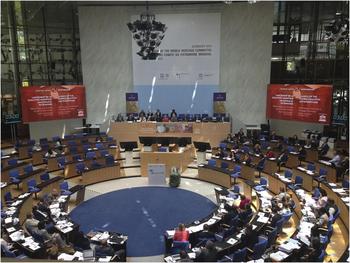
The annual session of the World Heritage Committee is held in a different location each year, with the host country providing the chairperson. In 2015, the World Heritage Committee took place in the Bundeshaus in Bonn, which housed the German federal parliament until it was moved to Berlin in 1999. The session itself spans approximately 10 days of formal meetings. It is common for one or more “working groups” to be established by the World Heritage Committee for the duration of the session, and countless other events take place in the breaks and in the mornings/evenings (presentations and panels; launches and exhibitions; dinners, cocktails, and other social events; tours and cultural performances). Footnote 49 As “other observers,” we were required to sit upstairs, giving a perfect aerial view of the proceedings in the main plenary meeting space (see Figure 1).
The Thirty-Ninth World Heritage Committee’s Session Met in the Former Plenary Chamber of the German Bundestag (1992–99) in Bonn, Germany, from 28 June to 8 July 2015 (photo courtesy of the authors).

Viewing the entire event—or at least as much of it as our team of two could cover—was supplemented by an analysis of the World Heritage Committee documents, participant observation in informal settings and interviews with various actors. Approximately 1,000 people typically attend the World Heritage Committee session each year, although there are predictable peaks and troughs in attendance, and the room is always most packed when the consideration of nominations to the World Heritage List occurs. Footnote 50 We were able to watch the Committee proceedings, and attend the working group sessions, as well as combing through the thousands of pages of documents produced for the Committee’s work. All of the documents presented for consideration by the Committee are available in advance via the Internet (in English and French), and the sessions are live streamed via the World Heritage Centre’s website, enabling an additional global audience of unknown size.
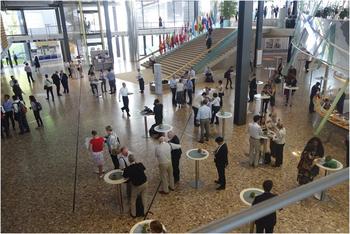
Our methodological approach involved a combination of interviews, informal conversations, participation in side events, and participant and non-participant observation before, during, and after the Committee’s session. For example, we attended the NGO workshop organized by World Heritage Watch, which was held prior to the commencement of the Committee session, and, once the session began, our selection of items and events to follow was based on a review of the Committee’s agenda and papers for rights-related aspects (see Figure 2). Footnote 51
The Session Spaces Include Break-Out Rooms for Working Groups and Side Events as well as for Meals and Refreshments—All Places Where Important Exchanges Take Place (photo courtesy of the authors).

Ethnographic work of this kind is not without its methodological complexities and limitations, yet it also raises interesting opportunities. Footnote 52 An important dimension concerned our own positionality based on past and present direct engagements Footnote 53 —something that overlapped with, but also challenged, Brumann’s distinctions between agnosticism, heritage belief, and heritage atheism. Footnote 54 We have each been involved in various applied aspects of world heritage work, including the Our Common Dignity initiative, Footnote 55 and have made presentations at World Heritage Committee side events and out-of-session working groups on this and related subjects for the past few years. We recognize that this ethnographic exploration raises epistemological—even ontological—questions about the nature of the Committee and how to approach it as a research object. For example, it is ethnographically evident that conversations of multiple types other than the officially recorded interventions by the twenty-one-member Committee, the advisory bodies, and other states parties are influential and important. Yet, although such conversations are clearly structuring in terms of the main outcomes, they are rarely documented and remain invisible in the online streaming. This prompts the need for alternative routes of empirical investigation.
Indeed, if we only address the formal recordings and written references to human rights, the results are sparse. Without adequate attention to the situated nature of all of the conversations taking place (as argued below), the resulting portrayal may easily become shallow. Official Committee language and decisions feature timid language on rights and greater comfort with applying the vague notions of “community,” with little hint of the more in-depth situated conversations that could only be accessed away from the plenary room and its cameras. These included, for example, meetings between national delegations and advisory bodies discussing specific human rights issues and possible responses. Such conversations, we suggest, are not only interesting and important, but they are also crucial to making sense of official outcomes. How states parties lobby, and the Committee ultimately deliberates, on specific rights issues may largely be framed in advance.
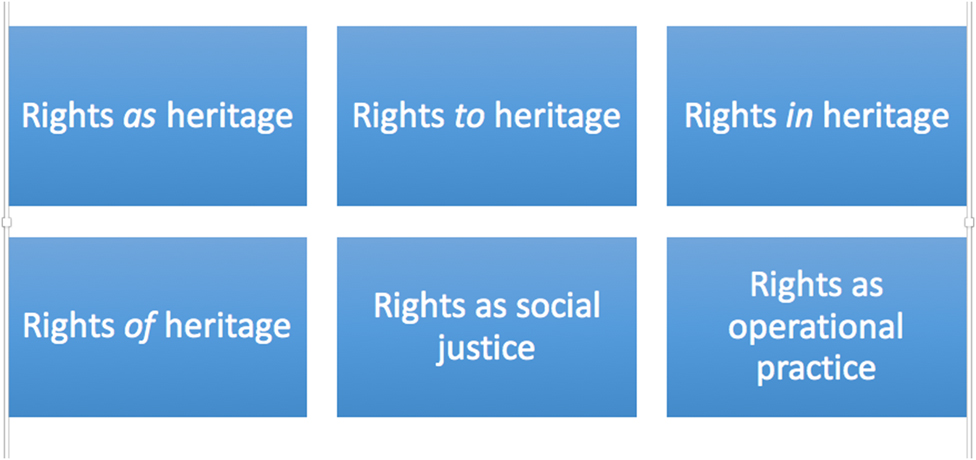
Furthermore, our event ethnography revealed an interesting diversity of rights and heritage articulations. We have elsewhere described this through a “grounded” typology of six different forms of rights and heritage articulations. Footnote 56 These range from considering rights as a matter of social justice to considering rights as a new dimension of operational practice or even as a form or theme for heritagization (see Figure 3). Three cases, described in the remaining parts of this article and informed by our event ethnography, illustrate this diversity.
Framing Rights at the World Heritage Committee Session (from Larsen and Buckley Reference Larsen, Buckley and Larsen2018).

CASE STUDY 1: REFERRAL OF THE NOMINATION TO THE WORLD HERITAGE LIST OF THE KAENG KRACHAN FOREST COMPLEX INSCRIPTION (THAILAND)
One of the central roles of the World Heritage Committee involves deliberations on specific site nominations to the World Heritage List, which is considered by many to be the key event during the lengthy sessions. These portions of the session attract large delegations and mass media attention. Researchers often perceive the consideration of nominations by the World Heritage Committee as key events that can illustrate deeper-lying dynamics, much like certain strands of anthropology may take key events as expressions of underlying societal principles. Footnote 57 Advisory body evaluations and the ensuing debate by Committee members on draft decisions and recommendations are interpreted as the moment where, in theory, nominations are judged according to, and, thus, interpreted as signs of, global standards. Yet, as we argue, official documents are opaque in terms of the extent to which they adequately reflect the underlying dynamics. While formal decisions obviously matter over informal undocumented talks, the latter are not without significance.
Historically, only a few evaluations and state of conservation reports make direct reference to rights concerns. Therefore, the evaluation of the nomination of Kaeng Krachan in Thailand by the IUCN, and the ensuing Committee discussion, illustrates a new development in practice. Footnote 58 The IUCN text that was presented to the Committee featured a specific “community” heading and listed communications on human rights issues received from the United Nations (UN) and civil society organizations. The nomination process was complex, not only in terms of the mosaic of conservation areas (including three parks and a sanctuary) but also in terms of its social and human rights contexts. The claims to citizenship by the Karen, an ethnic minority, and the right to live and practice customary livelihoods in the park areas, were contrasted with the histories of eviction, their official classification as illegal immigrants, and the disappearance of activists. Footnote 59
The IUCN’s evaluation considered that, while offering considerable potential, the inscription of this property would be premature until the rights concerns had been resolved. This was possibly the first case where rights concerns resulted in a formal decision to delay inscription in the World Heritage List. In the Committee’s deliberations, debate considered whether to delete reference to “free prior and informed consent” (FPIC) in the draft decision. The Portuguese delegate argued for its retention, stating that “human rights must be present in our work,” Footnote 60 while the Vietnamese delegate proposed its omission, commenting that the World Heritage Committee should not need to do that as it “was not Geneva and the Human Rights Council.” Footnote 61 The Human Rights Committee resolved to request the state party to address concerns raised by the UN High Commissioner for Human Rights and called for a “participatory process to resolve rights and livelihoods concerns and to reach the widest possible support of local communities.” Footnote 62 While the exchanges ultimately led to the omission of FPIC from the decision text, it also demonstrated the diversity of opinion within the Committee as well as the various regional alliances.
To fully understand the significance of the scripted exchanges requires understanding their broader context. First, the human rights context of the people and parks that interface in Thailand has a long and well-documented history preceding the World Heritage Committee’s deliberations. Second, such concerns were increasingly raised by local, national, and international activists during the nomination and evaluation process, leading to specific communications and interaction between IUCN members, Karen organizations, and international human rights organizations. Third, the issues include land and resource rights as well as disappearance/recognition and fundamental citizenship rights. Fourth, the very existence of the exchange reflected changes in the making. From 2012, an IUCN internal reflection of its evaluation processes had resulted in greater attention to rights, the establishment of a “community” heading in the format of the evaluation report, more focused dialogue, and the development of social expertise. Footnote 63 Accordingly, there were early and ongoing conversations with the Thai authorities about the rights issues associated with this nomination and a shared willingness to put into place a road map with inputs from the UN Office of the High Commissioner on Human Rights. Footnote 64
This case scenario illustrates that deliberations in the World Heritage Committee cannot be understood outside these wider interactions before, during, and after the Committee’s session where the formal decisions are made. Rather than reflecting coherent Committee positioning, the decision to call for action on these rights issues reflects other conversations, protests, and critiques by domestic Karen and human rights organizations. Without documentation, negotiations, and domestic and international pressure, it is unlikely that the Committee’s calls for addressing these issues would have occurred. Indeed, the discussion of Kaeng Krachan in Bonn was followed by the re-nomination of Phong Nha Ke Bang, Vietnam, which faced some similar rights concerns but without any calls for remedial action. Footnote 65 In this sense, the Committee’s decisions can be understood as particular nodal points, or “composites” of multiple intersecting contextual conversations and actors, far beyond the 21 elected member states engaged in the formalities of decision making.
CASE STUDY 2: REVISING THE OPERATIONAL GUIDELINES FOR WORLD HERITAGE
The Operational Guidelines for the Implementation for the World Heritage Convention (Operational Guidelines) are often interpreted as expressions of policy, and their authoritative language is assumed to represent world heritage politics. Of course, the very name “guidelines” indicates a particular techno-policy measure with little constraint, Footnote 66 yet, in the world heritage context, this constitutes a core policy framework even if only aiming to “facilitate implementation” and “setting forth procedure.” Footnote 67 A central role of the World Heritage Committee is the revision and adoption of the Operational Guidelines, which constitute its policy standards and the processes for how the Committee, advisory bodies, and states parties will “operate” in relation to the Convention’s requirements. In nature conservation and cultural heritage generally, there has been a huge growth in the reliance on “guidance culture” to simplify and codify principles and good practice, and the Operational Guidelines have been revised countless times to enable the system to “change with the times.” As a consequence, it is not surprising that rights advocates—like others working on every conceivable issue relating to world heritage—look to the development of guidance materials and revisions of the Operational Guidelines to effect needed improvements in rights practices. It is therefore valuable to examine such changes and see what it takes to shift the “rules” in order to understand the changing premises for official guidance on human rights-related matters.
In 2015, the revised Operational Guidelines were adopted, and, among other changes, text was added that requires states parties to increase participation and demonstrate that FPIC, which is central to global Indigenous rights standards and claims, was obtained in nomination processes. Footnote 68 Although considered to be a partial response by Indigenous rights advocates, these changes were nonetheless a significant breakthrough in steering the processes of nominating properties to the World Heritage List in the direction of consent-based practice. An analysis of the adopted wording in the Operational Guidelines points to recent advances in language on FPIC (drawn in this case from the United Nations Declaration on the Rights of Indigenous Peoples [UNDRIP]); however, a different gaze is needed to capture the factors that enabled these Guidelines to be adopted. Footnote 69
First, the inclusion of wording for FPIC reflects a cautious strategy to advance long-standing conversations on Indigenous rights. Meskell and Logan have described the fate of the proposal in 2000–01 to establish a World Heritage Indigenous Peoples Committee of Experts as an example of Committee reticence, Footnote 70 and a result of the fact that recommendations from a 2012 Expert Meeting on World Heritage and Indigenous Peoples had not been taken up. Footnote 71 The revisions to the Operational Guidelines adopted in 2015 fell short in some respects, raising concerns for Indigenous rights organizations about the risk of diluting collective rights to consent alone. Yet the new wording departed from the previous Committee’s reticence to develop an explicit policy on Indigenous rights, providing measures to recognize and involve Indigenous peoples (as opposed to the more generalized provisions for “communities” or, worse, the wording on “stakeholders” that was already in place).
Second, the “Working Group on the Operational Guidelines” is a good example of the many significant conversations that occur outside of the main Committee’s space. The Working Group involved unrecorded conversations that involved a broad spectrum of state party representatives and other observers. The Working Group is a formal Committee mechanism; however, its debates seem more spontaneous, diverse, and even chaotic compared to the carefully scripted and framed position statements delivered by diplomats in the formal plenary space. Contrary to ideas of separation between Committee members and civil society, the discussions about the Operational Guidelines revealed a fluid engagement and familiarity with non-Committee members and civil society actors. Indigenous advocacy organizations, for example, had repeated conversations with the advisory bodies and states parties that were supportive of Indigenous rights in other UN fora.
A concern expressed in several informal conversations prior to and during the Working Group deliberations was whether FPIC would be adopted for all stakeholders (the initial proposal), diluting its significance as a collective right of Indigenous peoples. Footnote 72 The Working Group also created space for inputs from a member of the UN Permanent Forum on Indigenous Issues. Such discussions helped to clarify the international law dimension and to build coherence with decisions undertaken in other international processes. Assumptions about hard lines and invisible walls of diplomacy based on official procedures did not reflect the observed reality in this space, and a number of state party officials were ready to engage informally and support the new wording. Observer states delegates were able to participate on an equal basis with Committee delegations, and the advisory body representatives were able to offer their reflections and suggest possible solutions. Whereas states parties may have had diplomatic bottom lines to follow, there was considerable room for maneuvering. Observing such processes helps to provide an understanding of the levels of flexibility and on-the-spot negotiations taking place, the ability of the well-organized actors to have an impact (including civil society), and the significant influences of the Working Group’s chair and Secretariat.
Third, ethnographic attention reveals a spectrum of grounded positions in relation to rights issues, which were expressed more clearly and openly within the Working Group. These ranged from concerns over the concept of “community” in general to positions that challenged or supported the very notion of Indigenous peoples and rights. Understanding these positions reveals more about the real diversity of perspectives within the World Heritage Committee, and an array of shifting opinions, contradictions, and diplomatic bottom lines that were not easily predictable given that most of the participating member states had already adopted UNDRIP. Of possible importance here was the experience of diplomats in other human rights fora, which posed a contrast to the view that the growing role of diplomats in leading world heritage delegations has resulted in a loss of regard for “expertise” and a greater sense of protection for national sovereignty.
In summary, rather than interpreting the Operational Guidelines as a sign of world heritage policy (with or without teeth), we draw attention to the process of negotiating the text as revelatory of the broader social field, multiple conversations, and positionalities that make up the Committee and its session dynamics. While the World Heritage Convention can be criticized for limiting decision-making power to the select club of states parties that make up the Committee, the Working Group’s mechanism illustrates the interlinked processes of formal and informal interactions. While such fluid negotiation remains partial, contingent, and limited to informal interaction, it nonetheless constitutes another example that challenges the image of the Committee as an entirely closed space, allowing for a more emergent reading of the Committee’s action.
CASE STUDY 3: INSCRIPTION OF SITES OF JAPAN’S MEIJI INDUSTRIAL REVOLUTION IN THE WORLD HERITAGE LIST
The final case from Bonn that helps to examine the multiple readings of the World Heritage Committee’s work concerns the inscription of the “[s]ites of Japan’s Meiji industrial revolution: iron and steel, shipbuilding and coal mining.” Footnote 73 While the session had many contentious issues, it is perhaps this inscription that dominated the informal discussions, speculations, and general atmosphere more than others. Since it invites consideration of rights legacies and heritage, it was something of an “elephant in the room” and was present in all of the participants’ discussions. Despite this significance, the issue is only minimally recorded in the official summaries and reports.
Japan’s nomination consisted of a series of 23 industrial sites that demonstrate the transfer and rapid processes of industrialization from the West over a 50-year period from the mid-nineteenth century to 1910. Footnote 74 When it was submitted in 2014, this nomination immediately triggered objections from the Republic of Korea because seven of the 23 sites had been sites of forced labor of Korean and Chinese workers during the Japanese colonial period (1910–45), in violation of their human rights. Footnote 75 Media reports estimated that 57,900 Koreans were forced to work in these industrial complexes and that many had lost their lives at these places. The Hashima Under Sea Coal Mine was considered particularly notorious for its harsh conditions. Footnote 76
In media reports prior to the World Heritage Committee’s session in Bonn, the Republic of Korea and China claimed that places of such history should not be elevated through world heritage recognition, especially given the lack of an agreed resolution of the grievances of the Korean victims. Footnote 77 The Republic of Korea’s Foreign Minister Yun Byung-se, facing mounting domestic pressures about these issues, was quoted as saying: “I believe Japan’s attempt to list those facilities as UNESCO World Heritage runs counter to the founding spirit of [UNESCO’s] Convention … which is designed to protect heritage with universal values.” Footnote 78
The Republic of Korea’s Foreign Ministry is reported to have proposed that Japan withdraw the sites in question or that Japan present them separately as a “negative listing” equivalent to the recognition of the Nazi concentration camp of Auschwitz-Birkenau in Poland. Footnote 79 Japan’s position was not publicly stated but was unlikely to have been favorable to these proposals. In our discussions with various participants, it was pointed out that the thematic purpose and historical periods that were the subject of the nomination had occurred earlier and, therefore, did not coincide with these contested histories. The Japanese media characterized the action by the Republic of Korea as politicizing the nomination and that the “diplomatic tug-of-war” could be “clouding the true value of the sites.” Footnote 80
When submitted in 2014, the nomination was accepted by UNESCO and was sent to ICOMOS for evaluation in the usual manner. In 2015, the recommendation of ICOMOS to inscribe the nominated sites on the World Heritage List was released prior to the thirty-ninth session of the World Heritage Committee. The only reference made to the controversy was the recommendation by ICOMOS that interpretation of each component should allow “an understanding of the full history of each site.” Footnote 81 In the weeks prior to the Committee’s session, diplomatic activity by and between these states sought to gain wider international support and to avoid a direct conflict at the World Heritage Committee. Both countries were members of the 21-member World Heritage Committee and, therefore, equally able to participate in the decision and discussion against a backdrop of other geopolitical tensions in east Asia.
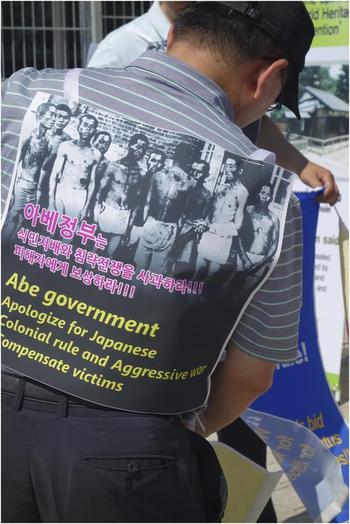
Arriving in Bonn, it was clear to many participants that this matter would be among the most difficult to resolve. The chairperson took an active involvement, and the decision was rescheduled time and again to allow private discussions and negotiations to continue. Outside, near the entrance to the building, Korean activists held a daily stall, and distributed printed materials, with titles such as “Stolen Country, Abducted People: The History of Japan’s Annexation of Korea and Korea’s Compulsory Mobilization”; “We Want to Know the Full History of ‘Sites of Japan’s Meiji Industrial Revolution: Kyushu-Yamaguchi and Related Areas’”; “Historical Truth in Danger! We Want Full History to Be Reflected”; “Is It Right to Inscribe Sites of Japan’s Meiji Industrial Revolution on UNESCO World Heritage List?”; “Wake Up! UNESCO; Wake Up! World; Wake up! Mankind”; “We Oppose Japan’s Bid for World Heritage Status for Its Forced Labor Sites” (see Figure 4). Footnote 82 A lunchtime side event was hosted by the Sites of Conscience and the Korean Center for Historical Truth and Justice on the topic of “World Heritage Sites of Conscience and their Value for the Future.” This session was not focused specifically on Japan’s Meiji Industrial sites Footnote 83 - but its relevance to the week’s formal decision-making processes was not missed by anyone. Tensions were evident, and both Japan and the Republic of Korea had large diplomatic delegations in Bonn, as well as considerable media attention. However, most conversations took place behind closed doors.
Korean Protesters outside the World Heritage Committee’s Session Venue (photo courtesy of the authors).

Finally, on 5 July 2015, an agreed consensus was reached. The chairperson proposed that the draft decision be adopted without change, other than the insertion of a footnote to provide a link to the summary record of the meeting, which would contain a statement from Japan (to which both Japan and Korea had agreed). The chairperson announced that the Republic of Korea and Japan would each make brief statements following the adoption of the decision and that no other interventions would be invited. Footnote 84 The Japanese statement briefly acknowledged that
there were a large number of Koreans and others who were brought against their will and forced to work under harsh conditions in the 1940s at some of the sites, and that, during World War II, the Government of Japan also implemented its policy of requisition. Japan is prepared to incorporate appropriate measures into the interpretive strategy to remember the victims such as the establishment of information center. Footnote 85
The rights issues for this inscription particularly concerned the interpretation and presentation of world heritage properties. Complex rights claims associated with history and deeply felt grievances were tangled together with issues of state sovereignty, present-day diplomatic tensions in East Asia, and the issue of whether places could be valued for some parts of their history while failing to recognize others. The implications therefore stretch beyond the two key states involved in this case.
The case also demonstrates the limitations of viewing the World Heritage Committee according to the documents and plenary meeting interventions alone, since the issues that were at play in this case were almost invisible in those ways. Nevertheless, these issues were overwhelmingly present and important for the session participants through the continued conversations, protests, media coverage, and speculation by many about the possible outcomes and ripples in the future. Opportunities to discuss matters with a wide range of participants before, during, and after the decisions illustrate the benefits of the event ethnography approach.
CONCLUDING REMARKS
What does such multiplicity mean for the significance of human rights? Is the glass half empty or half full in terms of the World Heritage Committee’s action on human rights? Rights language is increasingly appearing in the Committee’s context, yet, overall, it is fragmented in terms of how, when, for whom, and what rights issues are identified and how they are being addressed and responded to institutionally. Footnote 86 In particular, this stands in contrast to the sophistication of long-standing human rights debates in wider UNESCO fora. As the world heritage community pursues introspection and policy change, much emphasis has been placed on the fragmented nature of rights recognition. Footnote 87 Yet this article also shows the involvement of civil society actors and others in a different light, as entities crafting and negotiating alternatives as well as being engaged in multiple conversations on both site-specific and policy-level issues.
Indeed, the flipside of the fragmented picture is a multitude of moments and ways through which rights and heritage issues intersect in the World Heritage Committee. Such diversity is not a marginal affair but, rather, involves key issues ranging from prominently discussed nomination dossiers and inter-state conflict to landmark revisions in the Operational Guidelines. The event ethnography approach, without being exhaustive, allows an exploration of new conversations and sites of significance within the central institution of the world heritage system—the World Heritage Committee—and also fundamentally concerns how global heritage policy and institutions are understood.
Epistemological questions thus follow ontological questioning about what in fact makes up the World Heritage Committee and how rights are currently constructed and articulated. The three examples we briefly outlined above demonstrate how formal dialogues, pre-arranged decisions, and orchestrated public events cannot reveal the full picture of what takes place. This, we argue, prompts the need for an emergent, rather than a static, reading of the Committee, which is too often judged only on the public face of the UNESCO machinery. Indeed, if attention to wider conversations is not included, one may miss the main action in terms of emerging practices, new normative developments, and other game-changing dynamics. Official Committee deliberations are not merely the playgrounds for diplomatic power but are also equally situated in a web of multiple and longer-standing conversations and relationships. The rights concerns evoked here are just one example of rapidly evolving issues with a mix of incremental change, contextual dynamics, and multiple micro-processes of negotiation that make up the Committee. As we have sought to demonstrate, the annual World Heritage Committee’s session and its thousands of delegates is multi-layered and provides opportunities not only for diplomacy but also for advocacy and shifts in approaches, illustrated here by the topic of rights. The yearly session is not just one monolithic event but also a space whose boundaries are being re-negotiated.
The word “committee” in its etymological sense comes from the Latin word “committere,” which means “to unite, connect.” Whereas the World Heritage Committee (together with its rights practices and histories of decision making) is often interpreted as a united set of (hegemonic) values, elite-driven organizational mechanisms, and conservative practices, we suggest a far more dynamic and emergent reading of Committee politics and policymaking over time. This article does not set out to defend the often-noted presence of conservative heritage politics, but rather aims to provide an analysis that is sensitive to and capable of capturing dynamism, complexity, and change in the making.
ACKNOWLEDGEMENTS:
Fieldwork for this research was generously supported by the Swiss Network for International Studies.