


Introduction
Major depressive disorder (MDD) is one of the most prevalent and disabling disorders; with an estimated lifetime prevalence of 16% (Kessler et al., Reference Kessler, Aguilar-Gaxiola, Alonso, Chatterji, Lee and Ormel2009), it is currently the leading cause of disability worldwide (World Health Organization, 2015). Efficacious treatments for MDD exist, including psychotherapeutic interventions and anti-depressant pharmacotherapy (National Institute for Health and Clinical Excellence, 2012). However, in pharmacotherapy the magnitude of the placebo effect is estimated to be larger than the specific effect of the anti-depressant medication (about 70–80%; Kirsch et al., Reference Kirsch, Deacon, Huedo-Medina, Scoboria, Moore and Johnson2008; Rief et al., Reference Rief, Nestoriuc, Weiss, Welzel, Barsky and Hofmann2009). The greater the placebo effect, the lower the treatment efficacy in anti-depressant trials (Bridge et al., Reference Bridge, Birmaher, Iyengar, Barbe and Brent2009) and the more difficult it becomes to differentiate between the effect of a specific treatment and a placebo effect (Rutherford and Roose, Reference Rutherford and Roose2013). It is presumed that expectancies play an important part in the placebo effect in pharmacotherapy, and researchers try to limit the effect of expectancies to reduce placebo responses. The consent procedure for trials assessing anti-depressant medication influences patients’ expectations through information on, for example, the study design and the effectiveness of the medication and placebo in previous studies (Rutherford and Roose, Reference Rutherford and Roose2013). Expectancies are also thought to generally influence the reduction of symptoms observed in psychiatric treatments (see Cuijpers et al., Reference Cuijpers, Karyotaki, Weitz, Andersson, Hollon and van Straten2014; Khan and Brown, Reference Khan and Brown2015).
Positive expectations play an important role, especially in MDD, because less positive treatment expectations predict a poorer response to psychotherapy and pharmacotherapy (Kirsch, Reference Kirsch2005; Rutherford and Roose, Reference Rutherford and Roose2013). In a study comparing four different treatment conditions for MDD (cognitive behaviour therapy, interpersonal therapy, imipramine as an anti-depressant, and placebo), expectation of improvement was associated with a greater reduction in depression scores at the end of the 16-week trial (Sotsky et al., Reference Sotsky, Glass, Shea, Pilkonis, Collins and Elkin1991). Because patients with MDD seem to be particularly responsive to expectancy effects (Kirsch and Low, Reference Kirsch and Low2013), it is important to consider these effects in psychotherapy studies using patients with MDD. Even though expectancies can intensify treatment effects in clinical practice, they pose a difficulty in clinical studies. To be able to differentiate between the effects of a specific treatment and expectancy, studies should aim at limiting patients’ expectancy and the intensity of therapeutic contact in clinical trials (Rutherford and Roose, Reference Rutherford and Roose2013)
Online studies are increasingly being adopted in psychotherapy research. Treatments delivered online or in a self-help format offer accessible and low-intensity interventions plus the opportunity to treat patients who usually go untreated due to the large treatment gap and the reluctance of patients to undergo face-to-face therapy (Gandjour et al., Reference Gandjour, Telzerow and Lauterbach2004; Kohn et al., Reference Kohn, Saxena, Levav and Saraceno2004; Mohr et al., Reference Mohr, Ho, Duffecy, Baron, Lehman and Jin2010). Self-help and internet interventions, even without therapist contact, have been found to be effective in the reduction of symptoms of depression (Andersson and Cuijpers, Reference Andersson and Cuijpers2009; Salkovskis et al., Reference Salkovskis, Rimes, Stephenson, Sacks and Scott2006; Van't Hof et al., Reference Van't Hof, Cuijpers and Stein2009). Self-help and internet interventions may even be as efficacious as guided psychotherapies and anti-depressants (Cuijpers et al., Reference Cuijpers, Berking, Andersson, Quigley, Kleirboer and Dobson2013; Van't Hof et al., Reference Van't Hof, Cuijpers and Stein2009), but more trials are needed to confirm this. Although online studies are criticized as having questionable validity due to the lack of a formal diagnosis (Hancock, Reference Hancock2007), online administration of measures of depression has been shown to be equivalent to paper-and-pencil administration (Alfonsson et al., Reference Alfonsson, Maathz and Hursti2014; Holländare et al., Reference Holländare, Andersson and Engström2010; Weigold et al., Reference Weigold, Weigold and Russell2013), and the possibility of a participant simulating a diagnosis is considered low (Moritz et al., Reference Moritz, Van Quaquebeke, Hauschildt and Jelinek2012).
Expectations about the outcome of a treatment study can be shaped by the clinical trial itself (Swartzman and Burkell, Reference Swartzman and Burkell1998). The information given to the participants as to the context and purpose of a treatment study is essentially a process of setting prognostic expectations. Therefore, even in an intervention without therapist contact, the participants’ expectations of the treatment outcome and the degree of symptom improvement could be influenced by the information given about the intervention.
In the present study, assessments were conducted online in the framework of an anonymous randomized controlled trial to reach participants outside the traditional health care system. To the best of our knowledge, so far no study has tested expectancy effects in the framework of an online treatment. In this study, we set two different frames that we hypothesized would elicit different outcome expectancies in participants. Half of the participants randomly received the information that they were taking part in a study testing the effectiveness of different self-help therapy techniques (a treatment study), and the other half received the information that they were taking part in a study on cognition (a cognition study) but would be given self-help material at the end of the survey as an incentive for participation. All participants, not just those in the cognition study, received a self-help manual. They were randomly allocated to receive either a mindfulness manual or a progressive muscle relaxation manual (see below). We hypothesized that the participants in the condition framed as an explicit intervention trial (treatment framing) would show greater symptom improvement than the participants in the cognition framing condition.
Method
This study was part of a larger study examining the effects of different framing conditions and cognitive biases (hypercorrection and overconfidence) as well as the effects of self-guided relaxation and mindfulness training on symptomatology in samples with different psychiatric disorders. In addition to the measures reported here, additional questionnaires on psychopathology as well as general knowledge questions were included; these will be reported elsewhere. The study was conducted online using random allocation (for details, see below).
Participants
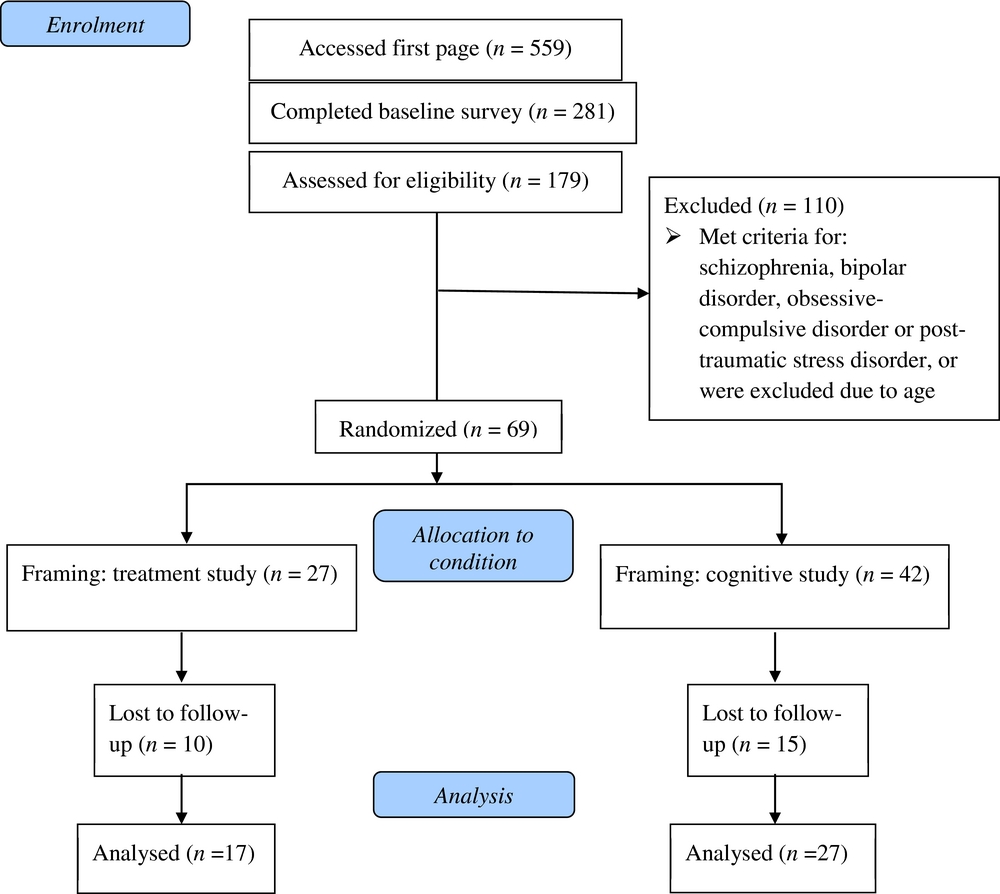
Former patients from our hospital who had given consent to participate in subsequent studies were contacted for participation via email. Participants were also recruited through disorder-specific discussion forums. The following inclusion criteria applied: age between 18 and 65 years, consent to participate in two anonymous internet-based surveys that were scheduled 6 weeks apart, and a verified diagnosis of depression. Participants were excluded from the present study if they had a comorbid diagnosis of schizophrenia, bipolar disorder, post-traumatic stress disorder, or obsessive-compulsive disorder (for a flow chart of the study, see Fig. 1). A total of 179 participants reported a confirmed diagnosis of major depression. After excluding participants who did not meet the inclusion criteria, 69 participants remained. According to the participants, their diagnosis of major depression had been established by a psychiatrist (42.3%), a psychotherapist (38%), or any other physician (18.3%). On average, participants stated they were moderately impaired by their depressive affect (mean = 4.17, range from 0 = hardly at all to 8 = very severely disturbing or disabling), and about half affirmed loss of interest (43.9%), according to the Web Screening Questionnaire (see below).
CONSORT diagram

Participants were randomized according to framing [treatment study vs cognition study (1:1)] via an automated filter function in the survey program. However, the number of treatment arms were not fully balanced as randomization was conducted according to date of participation at the end of the baseline survey but exclusion of participants was conducted manually, blind to results, after randomization. To verify the truthfulness of the answers, we checked whether participants made the same responses across all items on the psychopathological questionnaires (see below); no cases of inconsistency were found.
Framing
To set two different frames for the study, the baseline assessment was introduced in two different ways. In the treatment framing condition, the information on the study was titled ‘Study on the Effectiveness of Therapeutic Relaxation Techniques in Individuals With and Without Psychiatric Disorders’. In this condition, participants were told that they were taking part in a study to test the effectiveness of new therapeutic relaxation techniques that were supposed to bring more relaxation and calmness into everyday life, with no side-effects expected. In the cognition framing condition, the title was as follows: ‘Study on Decision-Making Related to Common Knowledge Questions’. Here, participants were informed that they were taking part in a study on differences in decision-making related to common knowledge questions over time. As an incentive for answering common knowledge questions and questions to test cognitive biases, they would receive one of two programs they could use autonomously. To sum up, in the treatment framing condition the focus was on the therapeutic intervention, whereas neither the term ‘therapeutic intervention’ nor an expected positive effect was mentioned in the cognition faming condition. In both framing conditions, participants knew they would be approached for reassessment after 6 weeks and were asked to practise the exercises in the meantime. In the treatment framing condition, it was explicitly stated that participants would be asked to tell about their experiences with the exercises.
Self-help manuals
We prepared a mindfulness manual and a relaxation self-help manual as PDF files, both accompanied by audio files. Mindfulness-based treatments have become an effective and very popular form of treatment in psychotherapy in MDD and lead to large symptom reductions (Hofmann et al., Reference Hofmann, Sawyer, Witt and Oh2010; Strauss et al., Reference Strauss, Cavanagh, Oliver and Pettman2014). The mindfulness manual consisted of 15 pages and included an introduction to the concept of mindfulness and its effectiveness that explained that mindfulness can lead to emotional stability and prevent relapse in psychiatric disorders and also provided 10 exercises. Progressive muscle relaxation (PMR), according to Jacobson, is a standard relaxation procedure that consists of two antagonistic phases. Successively, muscle groups are first tightened and then deliberately relaxed. The PMR manual consisted of three pages describing the background and rationale of this approach and also provided exercises and answers to potential questions that might arise when practising PMR.
Questionnaires
The Center for Epidemiologic Studies-Depression Scale (CES-D; Hautzinger and Bailer, Reference Hautzinger and Bailer1993) is a 20-item questionnaire that assesses depressive symptoms. It has good internal consistency and a short-term retest reliability of r = .81. It is highly correlated with other measures of depression, for example, the Beck Depression Inventory (Beck et al., Reference Beck, Ward, Mendelson, Mock and Erbaugh1961). It is filled out as part of the Paranoia-Obsession-Depression-Scale (POD), which also incorporates items from the Paranoia Checklist (PCL; Freeman et al., Reference Freeman, Garety, Bebbington, Smith, Rollinson and Fowler2005) and the Obsessive-Compulsive Inventory-Revised (OCI-R; Foa et al., Reference Foa, Huppert, Leiberg, Langner, Kichic, Hajcak and Salkovskis2002). The POD has been employed in previous online studies, and its test–retest reliability is excellent for the three subscales (Moritz et al., Reference Moritz, Ramdani, Klass, Andreou, Jungclaussen and Eifler2014). Individuals are asked to rate the current severity of their symptoms on a 5-point Likert scale ranging from 0 (not at all) to 4 (extremely).
The Web Screening Questionnaire (WSQ; Donker et al., Reference Donker, van Straten, Marks and Cuijpers2009) consists of 15 items aimed at screening for the most common psychiatric disorders. Two items assess the two core symptoms of depression. The item on negative affect states: ‘Circle a number from the scale below to show how much you are troubled by feeling miserable or depressed’ and must be answered on a scale from 0 (= hardly at all) to 8 (= very severely disturbing or disabling). The item on loss of interest asks: ‘Do you experience a loss of interest and/or pleasure in most things, like work, hobbies and other things you usually enjoy?’ and should be answered with either ‘yes’ or ‘no’. The WSQ shows acceptable to good sensitivity (Donker et al., Reference Donker, van Straten, Marks and Cuijpers2009).
Procedure
The online baseline survey started with one of the two introductions (treatment or cognition framing). Participants were informed that they would receive one self-help manual after the baseline measurement and a different manual after the post-assessment. The inclusion as well as exclusion criteria were summarized. Participants who did not approve the electronic informed consent were automatically excluded. The baseline assessment consisted of the following parts: demographic variables, medical history (e.g. psychiatric diagnosis and current psychotherapeutic status), assessment of psychopathology, and a question on the truthfulness of the responses. The study was anonymous; no IP (Internet Protocol) addresses were stored. The participants were, however, asked for their email address to allow the matching of baseline and post-assessment data. Immediately after completion of the baseline assessment, individuals received a link for downloading either the mindfulness or the PMR manual (random allocation).
Six weeks after the baseline assessment, all participants were re-contacted via email for participation in the post-assessment. In cases where participants failed to fill out the post-assessment, a maximum of two reminders were sent. The post-assessment consisted of the following parts: introduction, request for email address, questionnaire on psychopathology (POD only), evaluation of the respective manual (for participants who indicated that they had read the manual) or reasons for not reading the manual (for participants who indicated that they had not read the manual), and validity of the responses. After completion of the post-assessment, participants received a link to download the second manual. The study was approved by the ethics committee of the German Psychological Society (DGPs). The trial was registered at the ISRCTN registry (trail registration number: ISRCTN86762253).
Strategy of data analysis
We computed several sets of repeated measures analyses of variance (ANOVA) with the framing condition (treatment, cognition) as the between-subject factor and with time (baseline, post) as the within-subject factor in order to measure the effect of the framing on our primary outcome (depression as measured with the CES-D). Because both mindfulness training and PMR are based on the assumption that practice of the exercises is pivotal to mastering the technique and experiencing symptom improvement, we computed a strict per protocol analysis with completers (i.e. participants who completed both baseline and follow-up assessments) who in addition reported having both read the manual and practised the exercises. As we were also interested in the effect of framing alone, regardless of the practice the participants engaged in, a second per protocol analysis involving all completers was computed. In order to consider data from all participants with available baseline data, intention-to-treat analyses (ITT; data on all subjects enrolled in the study who met the inclusion criteria) were computed. For the ITT analyses, we adopted two strategies. First, we adopted the last-observation-carried-forward (LOCF) method to avoid the possible bias of non-random drop-outs. Because ITTs with LOCF lead to conservative results and in keeping with research suggesting that linear mixed models (LMM) yield higher power to detect group differences while utilizing all available data (Gueorguieva and Krystal, Reference Gueorguieva and Krystal2004), we adopted LMMs as a second strategy. Because of the small sample size, we used the restricted maximum likelihood estimation (REML). To evaluate change over time across conditions, we computed a model with the interaction term framing condition (treatment vs cognition) × time (baseline vs post) as the parameter estimates of interest. Assumptions for the repeated measures ANOVA were tested for both per protocol samples. No outliers were detected, and depression scores were roughly normally distributed in both groups at both time points (p > .05) as assessed by the Shapiro–Wilk test. Effect sizes for ANOVA results were expressed as partial eta square, whereby ηpartial 2 ≈ .01 indicates a weak effect, ηpartial 2 ≈ .06 a medium effect, and ηpartial 2 ≈ .14 a strong effect. For all statistical tests, an alpha level of α = .05 (two-sided) was applied.
Results
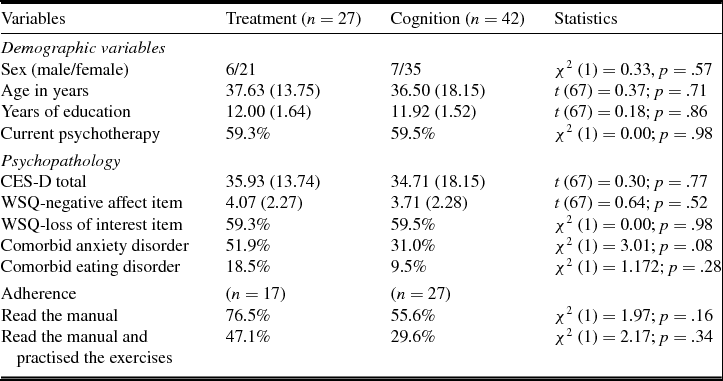
For baseline demographic or psychopathological characteristics, no between-condition (treatment vs cognition framing) differences emerged (see Table 1). Test–retest reliability for the CES-D was high (r = .87).
Baseline differences and adherence to intervention for the two conditions by frequency or means (SD)

Treatment = study framed as treatment study; Cognition = study framed as cognition study; CES-D = Center for Epidemiological Studies Depression Scale with 0 (= not at all) to 4 (= extremely); WSQ = Web Screening Questionnaire.
Completion and attrition
The difference in completion between the treatment framing condition (63%) and the cognition framing condition (64%) was not significant, χ2 (1) = 0.01, p = .91. Completers and non-completers did not differ on any of the psychopathological or demographic variables (p values > .05). The majority of the completers read the manual. Of these, approximately half (57.1%) stated that they had practised the exercises occasionally. No participant stated that they had practised the exercises regularly. No differences between conditions emerged for adherence (see Table 1). Participants who did and participants who did not complete the post-assessment did not differ on any of the sociodemographic (age, gender, education, current treatment status) or psychopathological (depression, comorbid anxiety, or eating disorder) variables in either the treatment study or the cognition study framing condition (p values > .05). A total of 44 participants remained for the per protocol analyses (completers). For the strict per protocol analysis, which only included participants who had read the manual and practised the exercises, 16 participants (treatment condition: n = 8; cognition condition: n = 8) remained.
Per protocol analysis
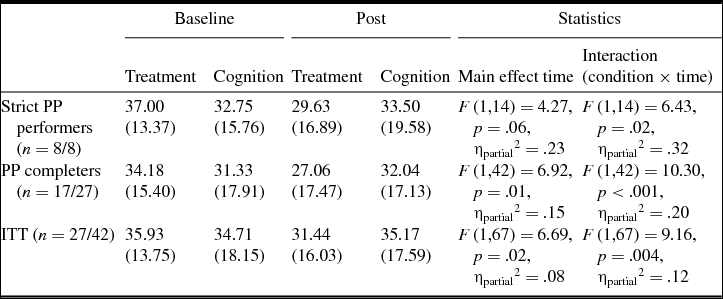
A repeated measure ANOVA with framing condition (treatment vs cognition) as the between-subject factor and time (baseline, post) as the within-subject factor was conducted to compare scores on the CES-D. In the conservative per protocol analysis of participants who had read the manual and practised the exercises, neither the main effect for condition (framing) nor time (p values > .09) reached significance. However, the interaction of time × framing became significant (see Table 2). Simple effects showed that depressive symptoms were significantly reduced in the treatment framing condition (t (7) = 2.92, p = .02) but not in the cognition framing condition (t (7) = 0.38, p = .72).
Mean (SD) for the primary outcome measure: CES-D total at baseline and post-assessment

n = Treatment/Cognition; CES-D = Center for Epidemiological Studies Depression Scale; PP: per protocol analyses; PP completers: all participants who completed both the baseline and post-assessments; PP performers: all participants who read the manual and practised the exercises; ITT: intention to treat analysis.
Subsidiary per protocol and ITT analyses
For the second per protocol analysis of all completers using the repeated measures ANOVA, the main effect of condition (framing) was not significant (p > .92). In this completer per protocol analysis, a significant main effect for time that was modified by an interaction for framing condition × time emerged. Again, simple effects revealed that a significant reduction in depressive symptoms occurred in the treatment framing condition, t (16) = 4.23, p = .001, whereas no significant reduction was found in the cognition framing condition, t (26) = 0.44, p = .67. A similarly strong effect appeared when computing the intention to treat analysis with the LOCF procedure (see Table 2). Again, simple effects revealed a significant reduction from baseline to post-assessment in the treatment framing condition, t (26) = 3.60, p = .001, but not in the cognition framing condition [t (41) = −.44, p = .66].
Computing a linear mixed model using the REML led to similar results. The main effect for time [F (1,40.84) = 8.57, p = .006] was qualified by framing condition, yielding an interaction of time × framing condition that became significant, F (1,40.84) = 9.58, p = .004.
Adherence
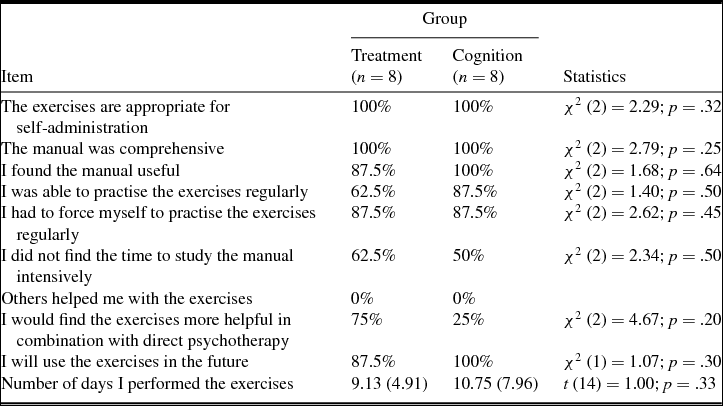
To explore a possible relationship between adherence and symptom changes on the CES-D, Pearson correlations for each condition were computed for all participants who had read the manual and practised the exercises at least once. No significant correlations could be found in the cognition framing condition between number of practice days and improvement for the CES-D (r = .08, p = .85). In the treatment condition, however, a trend emerged (r = −.67, p = .07). Further exploratory analyses showed that participants in both conditions practised the exercises equally often [t (14) = 0.49, p = .15], and there were no differences in participants’ assessment of the manuals (see Table 3). Thus, we tentatively suggest that the two framing conditions did not lead to differing perceptions of the manuals or motivation to practise the exercises.
Subjective assessment of self-help manuals

Percentage endorsement (i.e. fully agree to somewhat agree) or mean (SD) for number of days participants reported regularly practising the exercises. Treatment = study framed as treatment study; Cognition = study framed as cognition study.
Discussion
The purpose of this study was to examine whether the effects of an online-delivered self-help treatment in patients with MDD are larger when the study is framed as a treatment study vs a study of cognitive function with no explicitly stated purpose of improving symptoms. Thus, the study was designed to test whether providing individuals with different information as to the rationale of the study would impact outcome (Swartzman and Burkell, Reference Swartzman and Burkell1998).
Due to the low adherence rate, results have to be interpreted cautiously. Our results are in line with studies examining the expectancy and placebo effects in psychotherapy and pharmacotherapy (Kirsch et al., Reference Kirsch, Deacon, Huedo-Medina, Scoboria, Moore and Johnson2008; Rief et al., Reference Rief, Nestoriuc, Weiss, Welzel, Barsky and Hofmann2009; Sotsky et al., Reference Sotsky, Glass, Shea, Pilkonis, Collins and Elkin1991) because symptom improvement depended on the condition participants were allocated to. We found significantly stronger improvements in participants who were informed that they were taking part in a treatment trial compared with those who were told they were taking part in a cognitive study with only a treatment manual offered as an incentive. The effects were confirmed for both types of per protocol analyses (participants who had practised the exercises and all completers) and were reproduced in two different ITTs (LOCF and linear mixed model) with moderate to large effect sizes. This could indicate that the received information had a substantial influence on symptom reduction. Interestingly, no differences were found in the acceptance of the approach or in the treatment adherence between the two framing conditions. Generally, adherence was low, but it did not differ between the groups. In both conditions, participants stated that they had practised the exercises equally often, possibly suggesting that the difference in improvement between the two groups was not due to differing perceptions of the manuals or motivation to practise. Exploratory analyses testing the effect of practice on symptoms change yielded a trend for the treatment framing condition as to the association between number of practice days and symptom reduction. This tentatively suggests that only if participants believe they are receiving an effective intervention will their symptoms improve more strongly with practice.
Due to the small sample size and the low adherence rate, we advise replicating our results using larger samples. In particular, possible differences in adherence in the two framing conditions should be replicated, as the lack of an effect could also be due to a lack of power. Furthermore, it is possible that this effect is specific for MDD and does not extend to other psychiatric disorders. As Kirsch and Low (Reference Kirsch and Low2013) suggest, patients with MDD are especially responsive to expectancy effects.
The present study had strengths and weaknesses. Among the strengths is that, to the best of our knowledge, this is the first online study to test the impact of information given to depressive participants on treatment outcome. If the results are replicated, it would suggest that the improvement in treatment outcomes, which are due to framing the study as an intervention study, could be similarly affected in every online study on depression. Future online studies testing the effects of self-help approaches could specifically test and also use this effect. Another strength is that depression scores according to the CES-D of those participants who completed the post-assessment dropped about seven points to scores that are just above the cut-off for depression (Radloff, Reference Radloff1977). No changes were observed in the cognitive study framing condition. This indicates that the framing of a study alone can be almost strong enough to change depressive symptoms from clinical to merely critical scores.
Furthermore, a number of limitations should be addressed in future research. First, about one-third of the participants failed to complete the post-assessment and only about half of the participants who read the manual stated that they had practised the exercises. As we relied on subjective reports only, it is possible that some participants did read the manual and practise the exercises but did not fill out the post-assessment. Therefore, we were not able to differentiate between non-adherence and non-completion. Moreover, we did not use objective data, such as log data, to assess adherence but relied on our participants’ subjective responses. The low completion and adherence rates limit the validity of the results. However, they are in line with online treatments in patients with anxiety or depression (range: 66–97%; Spek et al., Reference Spek, Cuijpers, Nyklícek, Riper, Keyzer and Pop2007) and psychological internet interventions in MDD without therapist contact (de Graaf et al., Reference De Graaf, Huibers, Riper, Gerhards and Arntz2009). Measures such as setting up regular reminders as well as interaction with a clinician or peers enhance adherence (Kelders et al., Reference Kelders, Kok, Ossebaard and Van Gemert-Pijnen2012).
Despite the need to raise adherence, with our study design it would not have been feasible to incorporate these measures. Participants who had received the instructions for the cognition study could have shifted their focus to the intervention, possibly resulting in symptom changes due to an expectancy effect. Therefore, the information given for the cognitive condition would have seemed implausible and probably would have reduced the expectancy effect.
Second, it is possible that certain individuals did not agree to participate in the study depending on the information they were given about the study. Possibly, individuals who did not consent might have had different attributes depending on the framing condition they were in. This may be an influence on our results that we cannot fully control for. However, an indication that this may not be true is supported by the fact that participants who did not complete the post-assessment did not differ from those who completed the post-assessment in either of the conditions. Furthermore, the problem of missing information about those participants who do not agree to participate in treatment studies holds for any intervention study.
Third, participants’ expectancies were not directly measured. Therefore, it remains unclear whether the change in outcome was indeed due to changed expectancies. Although it would be useful to incorporate expectancy questionnaires such as the credibility/expectancy questionnaire (Devilly and Borkovec, Reference Devilly and Borkovec2000), in our study it would have been problematic for the reasons stated above.
Fourth, all data were collected online and diagnostic status was not formally verified by a clinician. Even though scores from self-report questionnaires do not replace expert-rated scales, they have the advantage of countering expectancy effects of raters. In our study the scores were similar to results from previous online studies using the CES-D in patients with a confirmed diagnosis of depression and mild to moderate symptoms (Fledderus et al., Reference Fledderus, Bohlmeijer, Pieterse and Schreurs2012). According to self-reports on the WSQ, participants were, on average, moderately impaired by their negative affect, and the test–retest reliability of the CES-D was high. This further supports the validity of the diagnosis in this sample. Participants did not receive any payment for the study in order to discourage participants with questionable motives for participating. Conversely, online studies have been increasingly used and accepted as a complementary research tool and offer the opportunity to reach a more representative sample of participants with MDD, including those who are not (yet) seeking face-to-face treatment (Gosling et al., Reference Gosling, Vazire, Srivastava and John2004).
Fifth, even though the study was conducted online and the participants received the self-help documents online, the study did not incorporate guided therapy or online exercises. Thus, our results may not be generalizable to more sophisticated internet interventions.
Conclusion
In summary, to the best of our knowledge the present study was the first trial to test the effects on treatment outcome of giving participants different information about the purpose of the study. Due to the low adherence rate, interpretations can only be made very cautiously. Our study offers the first evidence that participants who believed they were testing the effectiveness of an intervention showed greater improvements in their symptoms of depression than participants who believed they were taking part in a study examining change in cognitions over time. Future research on self-help interventions, including internet interventions, should attempt to replicate these results and should explicitly test the effect of the framing information not only on the outcome but also on participants’ expectancies. A better understanding of the expectancy effect inherent in providing therapeutic interventions can have two positive effects. First, it can help differentiate between expectancy and ‘real’ treatment effects in intervention studies, which can improve our understanding of the effectiveness of treatments. Second, it can support the enhancement of expectancies in clinical practice and the explicit use of the induction of expectancies for better treatment outcomes, possibly across different treatments.
Acknowledgements
None.
Financial support: None.
Ethics statement: All authors have abided by the Ethical Principles of Psychologists and Code of Conduct as set out by the APA. The study was approved by the ethics committee of the German Psychological Society (DGPs; reference: SM 09_2012).
Conflicts of interest: Barbara Cludius, Johanna Schröder and Steffen Moritz have no conflicts of interest with respect to this publication.



Comments
No Comments have been published for this article.