Introduction
The greenbug, Schizaphis graminum (Rondani) (Hemiptera: Aphididae), is a serious pest of small grain cereals, sorghum and turfgrasses in the USA (Hill, Reference Hill1987; Blackman & Eastop, Reference Blackman, Eastop, van Emden and Harrington2007). It causes direct damage through toxic secretions which produce yellow and brown lesions around the feeding sites as well as by transmitting a virus species (unassigned in the family Luteoviridae), which causes barley yellow dwarf and cereal yellow dwarf diseases (Lapierre & Signoret, Reference Lapierre and Signoret2004). The greenbug's pest status is exacerbated by resistance to organophosphate and carbamate insecticides (Sloderbeck et al., Reference Sloderbeck, Chowdhury, Depew and Buschman1991; Shufran et al., Reference Shufran, Wilde and Sloderbeck1996, Reference Shufran, Wilde, Sloderbeck and Morrison1997), and development of the ability to colonize and damage previously resistant cereal crops (Porter et al., Reference Porter, Burd, Shufran, Webster and Teetes1997).
The aphid is of Palaearctic origin and is recorded as a pest of sorghum in Russia (Radchenko & Lychagina, Reference Radchenko and Lychagina2003) and wheat in Saudi Arabia (Alsuhaibani, Reference Alsuhaibani1996) and Pakistan (Aslam et al., Reference Aslam, Razaq, Ahmad, Fahemm and Akhter2004). It has also sporadically caused severe problems in the Kenya highlands (Walker, Reference Walker1954). In Europe, it is present, but is not a major cereal pest, in Greece (Tsitsipis et al., Reference Tsitsipis, Katis, Margaritopoulos, Lykouressis, Avgelis, Gargalianou, Zapras, Perdikis and Papapanayiotou2007), Serbia (Tomanovic et al., Reference Tomanovic, Kavallieratos, Stary, Petrovic-Obradovic, Athanassiou and Stanisavljevic2008), Spain (Juan Nieto Nafría, personal communication) and Italy (Sebastiano Barbagallo, personal communication).
In the UK, S. graminum had, until the present study, never been recorded. However, other Schizaphis species had been found but were considered to be rare, with little known of their taxonomy and biology (Stroyan, Reference Stroyan1984); the scientific literature is based on very few specimens. The taxonomy of Schizaphis is uncertain and mainly based on host plant data as morphological identification is very difficult. There are two Schizaphis species found in the UK, Schizaphis agrostis Hille Ris Lambers and Schizaphis holci Hille Ris Lambers that are morphologically very similar to S. graminum and have even been classed as subspecies by Stroyan (Reference Stroyan1984). They are, even so, considered to be host-specific on Agrostis species (bent grasses) and H. lanatus L. (Yorkshire fog grass), respectively, and are not known to attack cereals (Hill, Reference Hill1987). They are both thought to be monecious and holocyclic and limited information available about them suggests that the males of S. agrostis are winged, while those of S. holci are wingless (Hille Ris Lambers, Reference Hille Ris Lambers1947; Stroyan, Reference Stroyan1984; Blackman & Eastop, Reference Blackman and Eastop2006). S. graminum is monoecious and holocyclic with winged males in cold temperate climates but anholocyclic where winters are warm enough for survival of the mobile stages (Blackman & Eastop, Reference Blackman and Eastop2006). Aphids flying throughout the UK have been monitored using 12.2 m tall suction-traps (Macaulay et al., Reference Macaulay, Tatchell and Taylor1988) of the Rothamsted Insect Survey, RIS, since 1965 (Taylor, Reference Taylor1986; Harrington &Woiwod, Reference Harrington and Woiwod2007). Until 1987, there were very few records of Schizaphis spp. in these samples, after which numbers increased significantly, especially after the year 2000.
Even though no outbreaks of any Schizaphis species have so far been recorded from any crops in the UK, it is clearly important to investigate taxonomic relationships to the US greenbug and to draw attention to the increase in abundance of what has been considered a rare aphid genus in the UK, in order to assess the possibility that they may sooner or later become crop pests in the UK. Morphometric analyses and mitochondrial DNA gene and nuclear DNA intron sequence analyses were used to clarify the identity of individuals of UK Schizaphis, together with experimentation on host preference, life cycle and life history.
Materials and methods
Aphids studied
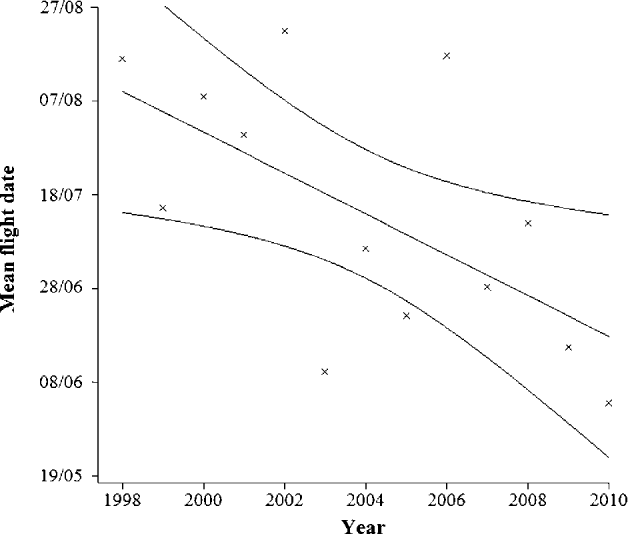
Insects were collected using 12.2 m high RIS suction-traps at 14 sites around the UK (fig. 1). The traps sample air at 0.75 m3 s−1 and run continuously (Macaulay et al., Reference Macaulay, Tatchell and Taylor1988). Aphid samples were taken daily during the ‘aphid season’ – from early April to mid-November – and weekly at other times. The trend over time for the mean flight date at the Rothamsted trap (years 1998–2010) was examined using regression analysis with year as the explanatory variable.
The network of suction traps across the UK.

For the morphometric analyses described below, the aphids from suction traps were compared with specimens of S. agrostis, S. graminum and S. holci from the collection of the Natural History Museum, London (NHML).
Aphids were also collected from H. lanatus from the fields around Rothamsted Research, Hertfordshire, UK, and from a site near Luton, Bedfordshire, UK. Two clones (=asexual lineages, although their genetic fidelity was not tested using high resolution molecular markers sensu Loxdale et al., Reference Loxdale, Vorwerk and Forneck2013) were established and used for experimental work in the study. They originated from a single asexual (parthenogenetic) female collected from H. lanatus at Rothamsted on 2 June 2010 (Clone A; denoted UK_AX1 and UK_AX2 in the molecular analyses) and from a single asexual female collected from H. lanatus at Luton on 25 June 2010 (Clone L1; denoted UK_L1X1 and UK_L1X2 in the molecular analyses). Both lineages were reared on H. lanatus at 18 °C and a photoperiod of 16:8 (L:D) hours. No aphids were found locally on Agrostis spp.
Host choice
Clones A and L1 were tested for their preference for three potential hosts: (i) H. lanatus (the host from which the aphid was collected in the field); (ii) Agrostis stolonifera (creeping bent, a potential host for S. agrostis); and (iii) Hordeum vulgare (barley, cv. ‘Saffron’).
The three plant species were sown in the same pot (12.7 cm diameter), near the edge, at equal distances from the centre and between themselves. H. lanatus and A. stolonifera plants were two weeks old and barley was one week old when the experiment was performed. Even then, barley was a larger plant compared with the other two. In order to equalize the quantity of plant material, four to five plants of H. lanatus and A. stolonifera were used, but only one barley plant. A piece of filter paper (12.5 cm diameter) was used to cover the soil and the aphids (ten adult apterae of one clone per pot) were released at the centre of the pot. Eight replicates were done for Clone A and seven replicates for Clone L1. They were then scored after 24 h, 48 h and 7 days. Numbers of adults and nymphs were recorded on each host and the nymphs were removed after every scoring. Each pot was kept isolated inside a perforated plastic bag, and all the bagged pots were kept at 18 °C, 16:8 (L:D) hours.
Rate of increase
Twenty adult aphids of each clone (A and L1) were placed individually on plants (either H. lanatus or barley) and left to reproduce. One of their first-born progeny was allowed to reach adulthood and reproduce. Plants were covered individually with a plastic cylinder with openings covered with fine mesh for ventilation. The progeny were counted daily and removed with a fine paintbrush. The intrinsic rate of increase r m was calculated for each aphid using the formula of Wyatt & White (Reference Wyatt and White1977).
Life cycle category
For each clone (A and L1), ten fourth-instar nymphs (generation G0) were transferred from the long-day cultures (18 °C, 16:8 [L:D] hours) to short-day conditions (14 °C, 10:14 [L:D] hours) individually on H. lanatus leaves in ampoules (Austin et al., Reference Austin, Tatchell, Harrington and Bale1991). Their five first-born progeny (G1) were isolated and allowed to reach adult stage and reproduce. At this point, five late-born G1 were isolated from the G0 parents and reared to adulthood and their morph (winged or wingless asexuals, winged males and wingless sexual females, i.e., oviparae) assessed. The five first-born progeny of the G1 (i.e., the G2) were allowed to reach adulthood and their morph assessed. At the same time as the first-born G2 reached adulthood, five late-born G2 were isolated and reared to adulthood and their morph assessed. This regime was used to discern whether or not the clones produced oviparae (sexual females) and males (Mittler & Gorder, Reference Mittler and Gorder1991).
Sexual morphs were identified at the adult stage, males from their genitalia, oviparae from their characteristic swollen hind tibiae with scent plaques. The H. lanatus leaves in the ampoules were changed as needed throughout the study.
Morphometric analyses
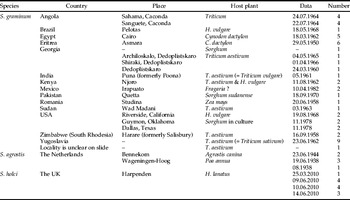
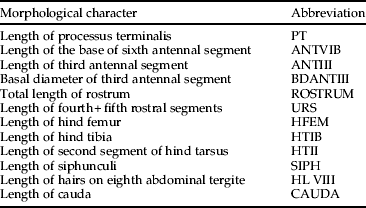
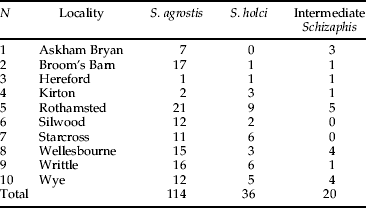
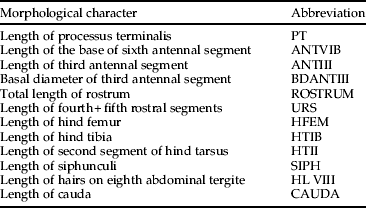
Aphids were mounted on conventional glass slides using the method of Martin (Reference Martin1983). Measurements were made of 238 alate specimens: 68 from the NHML collection (table 1) and 170 collected in 2007 and 2011 from ten suction-traps in the UK. These years were selected because of the especially high abundance of Schizaphis spp. collected. Eleven morphological characters, generally used in taxonomy of Aphidinae, and of the S. graminum group in particular (Stroyan, Reference Stroyan1984; Fargo et al., Reference Fargo, Inayatullah, Webster and Holbert1986; Heie, Reference Heie1986; Inayatullah et al., Reference Inayatullah, Webster and Fargo1987; Rubin-de-Celis et al., Reference Rubin-de-Celis, Gassen, Callegari-Jacques, Valente and Oliveira1997; Blackman & Eastop, Reference Blackman and Eastop2006) were measured for each specimen. These characters with their abbreviations are given in table 2.
Collection information for Schizaphis species samples used in morphometric analysis.

Morphological characters used and their abbreviations.
The length of the longest hair on abdominal tergite VIII (HL VIII) was included in the measured character list as it is known to be a useful character for separation of wingless (apterous) females of S. agrostis from S. holci, but it was not used in the multivariate analyses other than as an independent variable to justify groupings. The measurements were done according to Ilharco & van Harten (Reference Ilharco, van Harten, Minks and Harrewijn1987) and Blackman & Eastop (Reference Blackman and Eastop2006) using a Zeiss Axioskop microscope fitted with a microscope camera and the program InSight ver. 1.14.4 (DeltaPix, Maalov, Denmark). The mean value and its standard deviation (SD) for each morphological character were calculated.
Patterns of morphometric variation were analyzed using two multivariate statistical approaches (Tabachnick & Fidell, Reference Tabachnick and Fidell2006) with ten variables, excluding HL VIII, which was used as an independent character for separation of suction-trapped Schizaphis spp. in the canonical discriminant analysis (CDA). Principal component analysis (PCA) assesses components of the total of variation among all specimens by calculating a linear combination of the variables that explains the maximum amount of total variation, and then iteratively calculates new combinations to explain any residual variation. This procedure does not assume any a priori groupings. CDA operates on the mean values for groups defined prior to analysis, effectively providing linear combinations of variables that best summarize differences between classes. PCA and CDA were based on the correlation matrix of the coefficients (Tabachnick & Fidell, Reference Tabachnick and Fidell2006; Abdi & Williams, Reference Abdi and Williams2010). Using CDA, the individuals were divided into six groups: (i) S. holci from H. lanatus; (ii) S. agrostis from Agrostis and Poa; (iii) S. graminum from hosts in countries outside the UK; (iv) 114 suction-trapped specimens from the UK identified as S. agrostis (HL VIII up to 0.021 mm, see table 9); (v) 36 identified as S. holci (HL VIII 0.026–0.048 mm); and (vi) 20 individuals with intermediate values of this character (HL VIII 0.022–0.025 mm). Means of each variable were compared using a one-way analysis of variance (ANOVA). F-values and Wilks’ Lambda were computed for each variable to determine the overall between-group differentiation. The analyses were performed using the software packages GenStat ver. 12 (Payne et al., Reference Payne, Murray, Harding, Baird and Soutar2009) and Past ver. 2.16 (Hammer et al., Reference Hammer, Harper and Ryan2001).
One male of S. agrostis (labeled as a cotype, an old term for syntype – a member of a type series in which no holotype or lectotype has been designated) collected on Agrostis alba, 15 males from the two clones of S. holci reared in laboratory conditions at Rothamsted, and 41 suction-trapped males of unidentified Schizaphis species were compared by measuring ultimate rostral segment (URS) and HTII and preparing a bivariate plot.
DNA sequence analyses
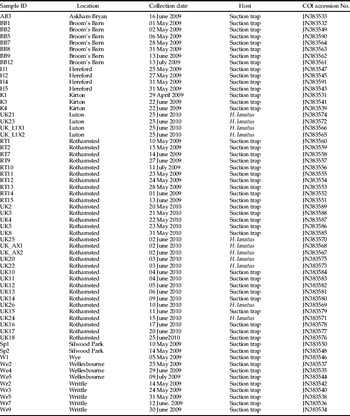
DNA sequences were obtained from 61 alate specimens of Schizaphis collected in the UK in 2009 and 2010, 50 from suction traps and 11 from Holcus (table 3). Genomic DNA was extracted from single aphids using the prepGEM™ Insect DNA extraction kit (ZyGEM Corp. Ltd, Hamilton, New Zealand) according to the manufacturer's instructions, except the volume of the extraction mix was reduced by 50% (20 μl). Aphids stored in 95% ethyl alcohol were rinsed twice with 100 μl sterile distilled, deionized water before extraction. A 640 bp fragment of the mtDNA cytochrome c oxidase subunit I (COI) gene was polymerase chain reaction (PCR) amplified from all aphids using the primers LepF (5′-ATTCAACCAATCATAAAGATATTGG-3′) and LepR (5′-TAAACTTCTGGATGTCCAAAAAATCA-3′) (Hajibabaei et al., Reference Hajibabaei, Janzen, Burns, Hallwachs and Hebert2006). A 640 bp fragment of the nDNA cytochrome c (CytC) gene was PCR amplified from four aphids (based on their close relatedness to US biotypes) using the primers cytC-C-5′ (5′-AAGTGTGCYCARTGCCACAC-3′) and cytC-B-3′ (5′-CATCTTGGTGCCGGGGATGTATTTCTT-3′) (Palumbi, Reference Palumbi, Hillis, Moritz and Mable1996). This product contained intron regions which were used in phylogenetic analyses. The reaction conditions were: 25 μl volume; 10 ng template DNA; 20 mM Tris-HCl, pH 8.4; 50 mM KCl; 0.2 mM dNTPs; 2.5 mM MgCl2; 20 pmol of each primer; and 1.5 U GoTaqDNA polymerase (Promega, Madison, WI, USA). An MJ PTC-100 Thermal Controller was used with the following program steps: (i) 96 °C 3 min (denaturation); (ii) 94 °C 30 s; (iii) 50 °C 30 s (annealing); (iv) 72 °C 1 min (extension); (v) cycle to step 2, 34 times; (vi) 72 °C 5 min; (vii) 4 °C hold. The presence of PCR regions of correct size was determined using standard 1.5% agarose gel electrophoresis (Sambrook et al., Reference Sambrook, Fritsch and Maniatis1989).
UK samples of Schizaphis used in DNA sequence analyses with COI accession numbers for DNA sequences submitted to GenBank.

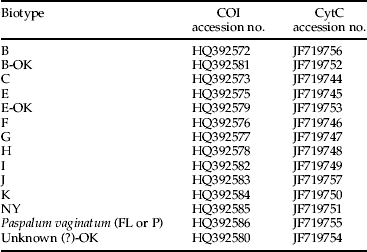
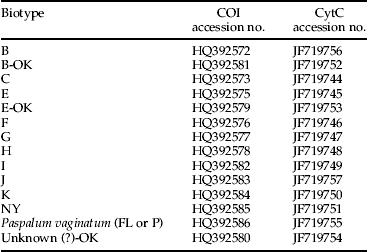
PCR products were directly purified using the Wizard® SV Gel and PCR Clean-Up System (Promega). DNA sequences for both positive and negative strands were obtained using BigDye™ (Applied Biosystems, Foster City, CA, USA) terminated reactions with an ABI 3700 DNA Analyzer at the Recombinant DNA/Protein Resource Facility, Oklahoma State University, Stillwater, Oklahoma, USA. Each DNA region was subjected to 4–5× coverage and nucleotide sequences were assembled with SeqMan in the LaserGene™ version 8.0 (DNASTAR, Madison, WI, USA) package. Sequences were then aligned by the ClustalW method (Thompson et al., Reference Thompson, Higgins and Gibson1994) using MegAlign in the LaserGene™ software package. Default alignment parameters were used; gap penalty 15.0, gap length penalty 6.66, delay divergent sequences 30% and DNA transition weight 0.5. Phylogenetic analyses were conducted using the MEGA5 statistical software package (Tamura et al., Reference Tamura, Peterson, Peterson, Stecher, Nei and Kumar2011). Maximum likelihood (ML) method with 1000 bootstraps was used based on the Tamura & Nei (Reference Tamura and Nei1993) model, with uniform substitution rates among sites, all sites (gaps and/or missing data) used, and the ML heuristic method Nearest-Neighbour-Interchange. Included in the analyses were COI and CytC sequences from S. graminum collected in the USA (Shufran et al., Reference Shufran, Burd, Anstead and Lushai2000; Shufran, Reference Shufran2011; Shufran & Puterka, Reference Shufran and Puterka2011) (table 4). DNA sequences were submitted to GenBank with accession numbers JN383531–JN383591 (COI) (table 3) and JN383592–JN383595 (CytC).
GenBank accession numbers of DNA sequences of specimens of US S. graminum biotypes used in analyses (Shufran, Reference Shufran2011; Shufran & Puterka, Reference Shufran and Puterka2011).
Results
Suction traps and field collections
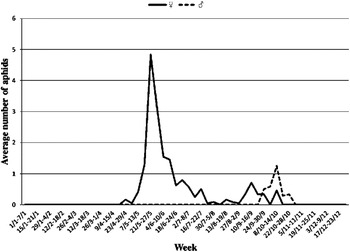
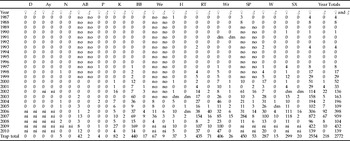
Table 5 shows the numbers of female and male aphids identified as Schizaphis spp. caught in the UK RIS suction-traps for the years 1987–2010. From the beginning of the operation of the trap network (1964) until 1987 only nine such individuals were found. Since then numbers have increased dramatically. Apart from the most northern traps in Dundee and Ayr, the aphids were caught throughout the UK in all the remaining 12 traps but numbers were much higher in the south. Fig. 2 shows the total caught in the Rothamsted suction trap each week, averaged for the years 1987–2010. Peak flight occurred in late May and the males appeared in late September. The mean flight date at the Rothamsted trap has become earlier in recent years (fig. 3, F 1,11=6.85, P<0.05; for years 1998–2010).
Phenology curve showing the total number of female and male aphids identified as Schizaphis spp. caught in the Rothamsted suction trap averaged for every week for the years 1987–2010.

Mean flight date of female and male aphids identified as Schizaphis spp. caught in the Rothamsted suction trap for the years 1998–2010.

Numbers of female and male aphids identified as Schizaphis spp. caught in the UK suction traps for the years 1987–2010. ni, not yet identified; no, trap not operating; dm, data missing due to trap not operating for part of the year or malfunctioning, for trap names see fig. 1.

The fields around Rothamsted were searched in June and July 2010 and 2011. One location near Luton was also searched in June 2010. Aphids of the genus Schizaphis were only found on H. lanatus and not on Agrostis nor any other grass. No ant attendance was observed.
Host choice
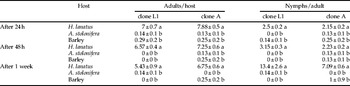
The aphids showed a clear preference for the host on which they were found in the field and reared on in the laboratory (H. lanatus) (table 6). Thirty minutes after their release, aphids moved towards or onto H. lanatus (A. Kati, personal observation). For Clone A, only one adult was found on A. stolonifera and it produced five nymphs during one week. Only two adults were found on barley and they produced 16 nymphs during one week. For Clone L1, only one adult was found on A. stolonifera and produced two nymphs during one week. Only two adults were found on barley and they produced eight nymphs during one week.
Mean (±SE) of clones A and L1 S. holci adults present on each host and nymphs produced per adult on each of the three host plants after 24 h, 48 h and 1 week. Means followed by the same letter within the same section in a column are not significantly different (P>0.05; paired student's t test).

An attempt to culture the clones on barley in a no-choice experiment failed. A very small number of aphids survived and produced very few progeny but the population soon died out. Aphid feeding caused chlorosis both on H. lanatus and barley.
Rate of increase
The average total number of progeny produced by each adult was 36.8 and 37.1, the mean intrinsic rate of increase for clones A and L1 on H. lanatus was 0.223 and 0.215, respectively.
On barley, only two out of 20 Clone A adults reproduced and their first-born progeny reached adulthood and produced seven and eight nymphs, respectively. A third one reproduced, but its first-born did not. The rest produced no progeny and were either not found after a few days or found dead. Two out of 20 Clone L1 adults reproduced and their first-born progeny reached adulthood and produced seven and 23 nymphs, respectively. The rest produced no progeny and were either not found after a few days or found dead. Owing to the very small number of aphids surviving and reproducing on barley, the mean intrinsic rate of increase was not calculated.
Life cycle category
Both Clones A and L1 produced males and oviparae. The first-born G1 were virginoparae and the late-born G1 virginoparae and males. The first-born G2 were oviparae, whereas the late-born G2 were oviparae and males (fig. 4). Most males possessed narrow sclerotized thoraxes with no wing buds or with rudimentary wing buds or deformed wings. No fully winged males were produced.
The production of sexual morphs of S. holci under short-day conditions.

Morphometric analyses
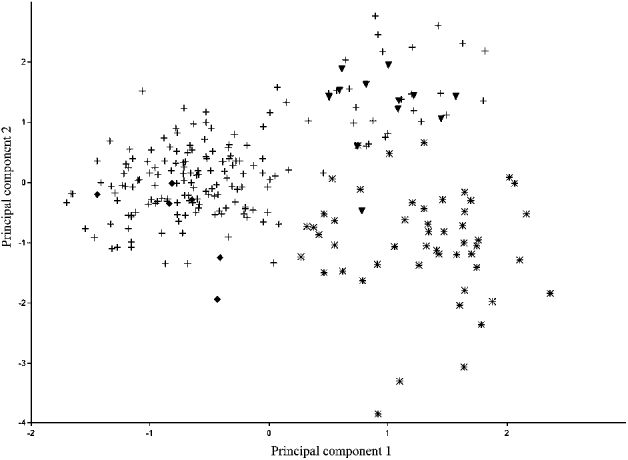
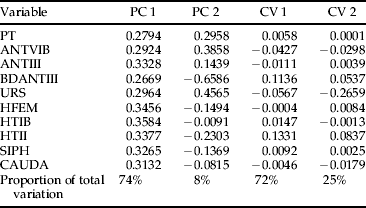
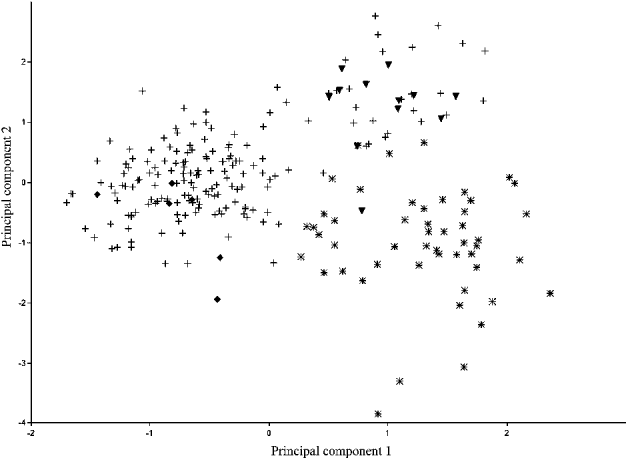
Contributions of the ten variables to the first two principal components (PCs), accounting for 82% of total variation, are given in table 7. PC 1 (74% of total variation) reflects generalized body size (contributions by all variables are positive and of approximately the same magnitude). The main contributors to PC 2 (8% of total variation) were URS, ANTVIB and BDANTIII as these variables had large positive or large negative coefficients. A plot of PC 1 against PC 2 shows a clear separation between S. graminum and all remaining Schizaphis samples (host plant-collected S. agrostis, and S. holci and all Schizaphis from suction-trap samples) (fig. 5; table 7). The Schizaphis individuals from suction-traps formed two loose clusters, with individuals of host plant-collected S. agrostis and S. holci located within each of these clusters.
PC ordination of 238 alate individuals of Schizaphis spp. based on the analysis of ten morphological variables, onto the first and second principal axes (Table 7). Symbols: S. graminum (*), S. holci from Holcus (▾), S. agrostis from Agrostis and Poa (⧫), Schizaphis individuals from UK suction-traps (+).
Proportion of contribution and variable coefficients of first two eigenvectors (PCs) for PCA and total sample standardized canonical coefficients for CDA in alatae of the Schizaphis spp. (n=238). Variable names are defined in table 2.
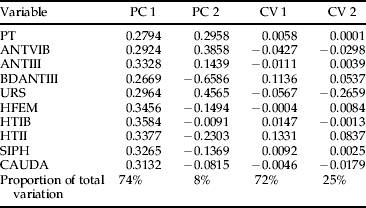
Using CDA the individuals were divided into six groups. PCA results provided a sufficient basis for allocating alatae collected from host plants to three of these groups; S. holci from Holcus, S. agrostis from Agrostis and Poa, and S. graminum from hosts in countries outside the UK. Alatae trapped in the UK were allocated to three groups on the basis of measurements of HL VIII (see the Materials and methods section). The first and second canonical variates (CVs) explained 72% and 25% of the total variation, respectively (table 7). The variables contributing most to CV 1 were BDANTIII and HTII (large positive coefficient) and URS and ANTVIB (large negative coefficient). The variables contributing most to CV 2 were HTII (positive) and URS (negative). Alatae of S. graminum were distinguished from all other remaining individuals by their much higher scores on CV 1 in combination with high scores on CV 2 (fig. 6). Trapped and host-collected S. agrostis had low scores on CV 1 and high scores on CV 2. Both trapped and host-collected S. holci had intermediate scores between S. graminum and S. agrostis on CV 1, while they had low scores on CV 2. Most of the trapped Schizaphis with intermediate values of the hair length character HL VIII grouped with trapped and host plant-collected S. agrostis. Group centroids of trapped and host-collected S. agrostis were close to each other and were clearly separated from group centroids of all remaining groups. The group centroid of trapped intermediate Schizaphis was close to group centroids of trapped and host-collected S. agrostis. It seems that most, if not all, of the individuals of the intermediate group belonged to S. agrostis, which was by far the commoner of the two Schizaphis species occurring in the suction-traps (table 8).
CDA of 238 alate individuals of Schizaphis spp. based on the analysis of ten morphological variables; specimens projected onto the first and second canonical axes (Table 7). Symbols: S. graminum individuals and their group centroid (*), S. holci individuals from Holcus and their group centroid (▾), trapped S. holci individuals and their group centroid (●), trapped intermediate Schizaphis individuals and their group centroid (■), S. agrostis individuals from Agrostis and Poa and their group centroid (⧫), trapped S. agrostis individuals and their group centroid (+).

Collection information for trapped Schizaphis spp. samples used in the study (n=170).
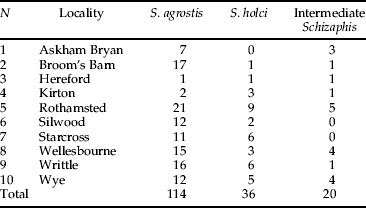
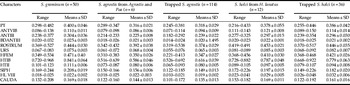
Examination of the raw data (table 9) showed that ranges of measurements of morphological variables mostly overlapped. Alatae of S. agrostis were smaller than either S. graminum or S. holci, as indicated by characters closely correlated with general size (ANT III, HTIB), and much of the difference between S. agrostis and the other two species is accounted for by this overall size difference.
Measurements of morphological characters of alate females of the Schizaphis spp. (measurements given in mm). Variable names are defined in table 2.

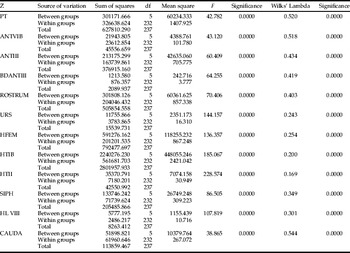
The one-way ANOVA for each morphological character of the S. graminum group revealed the most influential variables for morphometric discrimination to be HFEM, HTIB, HTII and URS as they had smaller Wilks’ Lambda and higher F-values (table 10), which indicate a greater difference between group means.
Results of one-way ANOVA for each morphological character of alatae of Schizaphis spp. Variable names are defined in table 2.

Best discrimination between S. graminum and S. agrostis+ S. holci was with URS, HTIB and HTII (and HL VIII). A good two-character discrimination between alatae of S. graminum and host plant-collected and suction-trapped S. agrostis+ S. holci was achieved in bivariate plots of URS versus HTII and URS versus HTIB (figs 7 and 8).
Bivariate plot of the lengths in mm of URS versus second segment of hind tarsus (HTII) for alatae of Schizaphis spp. (n=238). Symbols: S. graminum (*), S. holci from Holcus (▾), trapped S. holci (●), trapped intermediate Schizaphis individuals (■), S. agrostis from Agrostis and Poa (⧫), trapped S. agrostis (+).

Bivariate plot of the lengths in mm of URS versus HTIB for alatae of Schizaphis spp. (n=238). Symbols: S. graminum (*), S. holci from Holcus (▾), trapped S. holci (●), trapped intermediate Schizaphis individuals (■), S. agrostis from Agrostis and Poa (⧫), trapped S. agrostis (+).

In the bivariate plot of URS versus HTII for males (fig. 9), suction-trapped (i.e., fully alate) Schizaphis individuals were separated from laboratory reared S. holci males (apterous or brachypterous with incompletely developed wings). The alate male cotype (syntype) of S. agrostis grouped with suction-trapped Schizaphis individuals. Based on this and because S. agrostis is reported to have alate males and S. holci apterous ones, all suction-trapped males are likely to be S. agrostis.
Bivariate plot of the lengths in mm of URS versus second segment of hind tarsus (HTII) for males of Schizaphis spp. (n=57). Symbols: S. holci reared in laboratory condition (⧫), trapped Schizaphis individuals (▲), cotype of S. agrostis from A. alba (■).

DNA sequence analysis
In total, 538 bases were obtained from the COI region for each of the 61 individuals tested from the UK. The number of bases was less than 640 because both the 5′ and 3′ ends were trimmed to eliminate ambiguities. The UK and US specimens had COI sequence identities ranging from 95.4% to 100.0%. Two UK specimens (UK13 and RT7) had identical COI sequences with US S. graminum Biotypes C, E-OK and I. US Biotypes C, E and E-OK had 99.8% sequence identities (i.e., only differed by one base) with 28 UK specimens. Within the UK, specimens with identical sequences were found both within and between years (2009 and 2010), and both in suction traps and on H. lanatus (table 11).
UK Schizaphis spp.: samples with identical (100% identity) mtDNA COI sequences. The taxonomic clade determined by ML analysis (fig. 10) is shown in relation to each identical sequence group. Samples with * were also identical to the US biotypes C, E-OK and I.

The COI sequences of UK and US Schizaphis individuals were also compared by ML analysis and plotting of a consensus tree (fig. 10). The four US mtDNA COI haplotypes (I, II, III and H) are shown in fig. 10. The US biotypes with haplotypes II, III and H stood alone and their clades did not include any UK specimens.
Maximum likelihood tree of mtDNA COI sequences from specimens representative of S. graminum US biotypes (in bold) and specimens collected from the UK during 2009 and 2010.

A sister clade to H (UK Clade E) was well supported (99% bootstrap support) by six specimens collected at Rothamsted Research. These specimens were similar to H in that they were the most divergent of the UK samples. All UK specimens in UK Clade E had identical sequences and 95.9–96.5% and 96.3–96.8% sequence identities to US biotypes and the rest of the UK specimens, respectively. Five apterous specimens of US Biotype H preserved on slides in the NHML collection were re-examined and found to have URS/HTII ratio in the range of 0.77–0.89, which is characteristic of apterae of S. agrostis.
US Haplotype III grouped in its own clade outside of all UK specimens (fig. 10). Haplotype III biotypes had sequence identities of 96.1–98.5% with UK specimens. Haplotype II S. graminum from the US also formed a unique clade with no UK members and with sequence identities of 96.5–98.7%. Askham Bryan 3 and Broom's Barn 5 formed their own clade (UK Clade D) between the Haplotype II clade and the large clade containing Haplotype I and the majority of UK specimens (UK clades A, B and C).
There was 57% bootstrap support for the remainder of the tree, i.e., containing Haplotype I and UK specimens designated as clades A, B and C (fig. 10). Within this large clade, there was 44% bootstrap support for placement of 13 specimens with identical COI sequences as a sister clade to the rest of the group, and this was designated as UK Clade C. The topology of rest of the dendrogram was even less certain and contained the specimens that were most closely related to one another with COI sequence identities of 99.4–100%. UK Clade A was the best-supported clade in this part of the tree with 57% bootstrap support. Two subclades containing only UK specimens were located within UK Clade A. The US biotypes with Haplotype I grouped loosely together and within this group. Hereford 2 and 4 formed their own small subclade with 66% bootstrap support. UK clades A, B and C all included specimens from Holcus.
In total, 518 bp of the nDNA CytC were obtained from samples UK13, RT7, H2 and H4. UK13 and RT7 were chosen for nDNA CytC intron sequencing because they had identical COI sequences to US S. graminum. H2 and H4 were chosen because they had 99.8% sequence identities to US biotypes C, E-OK and I, and because of their position in the dendrograms, i.e., H2 and H4, were a subclade within a larger clade that contained the US sorghum biotypes (C, E, I and K) (fig. 10). UK13 and RT7 had identical CytC sequences to US S. graminum Biotypes C, E, E-OK, I and K. H2 and H4 had identical CytC intron sequences to each other; however, they differed from the remaining US biotypes with sequence identities ranging from 97.5% to 99.8%. Based on CytC intron sequence identity, H2 and H4 were most closely related to US biotypes (99.8% identity) NY, F, G, ?-OK and H. Biotype J had the least sequence identity with H2 and H4 (97.5%); however, Biotype J had 99.4% identity with UK13 and RT7. The coding regions of the CytC gene were conserved. All CytC base substitutions occurred in the introns and none in the coding regions.
Discussion
The results from the host choice and life history studies performed on the Schizaphis species found in the UK on H. lanatus suggest that the species involved was actually S. holci and hence unlikely to be a threat to crops. Nevertheless, even though S. holci did not show preference for barley as a host and did not establish a single colony on it, a few adults did start to feed and reproduce on it. This may be an indication that the aphid has the potential to switch hosts and colonize barley. It is conceivable that, as the experimental clones were collected from H. lanatus and apterae transferred to new experimental hosts, host-plant conditioning led to preference for H. lanatus as, in the wild, it would usually be alatae that effect host transfer.
The two UK S. holci lineages were shown to go through sexual reproduction under short-day conditions and produce fully apterous males and males with various states of brachyptery, but none with fully formed wings. This agrees with Hille Ris Lambers’ (Reference Hille Ris Lambers1947) and Stroyan's (Reference Stroyan1984) observations that males of S. holci are wingless, although very few specimens were examined by them and hence this may be misleading. It would be useful to search for males on H. lanatus in autumn to see whether wingless and brachypterous males of S. holci are produced under natural conditions. The same authors stated that males of S. agrostis are winged. Winged males were caught in the suction traps in autumn, and morphometric study indicated that these were S. agrostis, although S. agrostis could not be found in the field during a search of the Rothamsted grounds. Males of S. graminum are also winged (Webster & Phillips, Reference Webster and Phillips1912). No ant attendance was observed even though Stroyan (Reference Stroyan1984) stated that S. holci is usually attended by ants.
Based on morphometric investigation it is clear that the Schizaphis spp. trapped in the UK are mostly S. agrostis and S. holci, with S. agrostis being the most abundant in the years 2007 and 2011 according to those specimens so far examined. No individuals of S. graminum were found. However, only a small proportion of the trapped Schizaphis individuals have so far been examined using the techniques here described.
Schizphis graminum has never been found on crops in the UK, but it is clearly important to be alert for it. This study has provided the first morphometric analysis to facilitate discrimination of this species from its close relatives and is especially useful in the case of alate individuals for which no host plant information is yet available, such as those specimens collected by suction-trapping. Rather than undertaking a full morphometric analysis involving ten characteristics, it should be possible to establish the identity of most alate Schizaphis individuals in the UK by measuring the two characters URS and HTII or URS and HTIB and plotting their positions on the bivariate plots in figs 7 and 8 and thus ascertain presence or absence of S. graminum. The plot of URS versus HTII gives a clearer result than the plot of URS versus HTIB, but because suction-trapped aphids have often lost their hind tarsi, the plot of URS versus HTIB may be the only possibility. For measurement of URS, HTIB and HTII, it is necessary to prepare slides, as only HTIB can be measured accurately on whole, unmounted specimens, i.e., those not prepared on glass slides for microscopical examination.
Out of 62 specimens collected in the UK, only two collected at Rothamsted (RT7 and UK13) had identical mtDNA COI coding sequences and nDNA CytC intron sequences to specimens found in the US studies. As these two specimens had mtDNA and nDNA intron sequences identical to US biotype C, it is probable that they were S. graminum. Therefore, the specimen collected in the trap at Rothamsted on 14 June 2009 would represent the first record of S. graminum in the UK, and a second collection occurred at the same location on 6 June 2010.
Other individuals differed to varying extents from US biotypes of S. graminum (fig. 10). Whether these were different species cannot be determined based on COI sequences alone, but when taken together with the results of morphometric analysis certain conclusions are possible. ‘UK Clade E’ grouped apart from all other UK specimens as a sister group to the rare US Biotype H, and when apterae of this biotype on previously prepared slides were re-examined they were found to have morphological characteristics of S. agrostis, although this species has not hitherto been recognized as occurring in the USA. Probably then the six specimens comprising ‘UK Clade E’ are S. agrostis. UK Clades A, B and C all included specimens collected from Holcus, so are almost certainly S. holci. If so, the nesting of US Haplotype I within this grouping argues for a close affinity between this haplotype, which is characteristic of the sorghum-adapted form of S. graminum, and S. holci. However, this was not supported by the results of the morphometric analysis. The relationships in this part of the cladogram are in any case rather weakly supported, and several authors (e.g., Zhang & Hewitt Reference Zhang and Hewitt1996; Hurst & Jiggins Reference Hurst and Jiggins2005) have drawn attention to the problems of relying on COI sequences for studying inter-species relationships.
As S. graminum is known from southern Europe, including Spain, Italy and Greece, it is possible that individuals might at times reach the UK. Establishment is expected to be increasingly likely as the UK climate warms (Harrington et al., Reference Harrington, Fleming and Woiwod2001). On the other hand, species that were rare and therefore possibly overlooked are now becoming more abundant under the changes in temperature and climate (Hullé et al., Reference Hullé, Coeur d'Acier, Bankhead-Dronnet and Harrington2010), which may be the case for S. holci and S. agrostis. The two putative S. graminum specimens from Rothamsted had identical sequences to the sorghum Biotype C, which was found to be more tolerant of temperature extremes than Biotype B (Harvey & Hackerott, Reference Harvey and Hackerott1969; Harvey, Reference Harvey1971; Wood & Starks Reference Wood and Starks1972). So far, it remains unknown whether the cereal varieties grown in the UK are suitable hosts for S. graminum from central or southern Europe.
In conclusion, to date, there have been no reports of S. graminum attacking cereal crops in the UK. As shown in the present study, based on morphometric analyses, field searches and experimentation, the majority of the Schizaphis individuals collected in suction-trap samples are likely to be S. agrostis and S. holci. We have shown that S. holci is unlikely to colonize barley, but cannot rule this possibility out. Nonetheless, the finding of two individuals in the UK which match precisely the COI and CytC of S. graminum raises concerns over a possible threat to crops. Alternatively, the COI and CytC sequences currently used to identify S. graminum are not completely reliable in distinguishing species. Even if the Schizaphis found in the UK are not S. graminum sensu stricto, the possibility of this species spreading from other parts of Europe remains a concern. S. agrostis and S. holci have, until now, been considered rare in the UK. Their remarkable population build up in recent years remains unexplained, although perhaps their previous rarity, despite their very abundant host plants, is more surprising.
Acknowledgements
Barbara Driskel (USDA-ARS) conducted the DNA extraction, PCR and DNA purification. We thank Paul Brown (NHML) for the loan of specimens and Hugh Loxdale for his helpful comments on the manuscript. A.K. was supported by a USDA-ARS Specific Cooperative Agreement to Rothamsted Research. S.B. was supported by the Rothamsted International Fellowship scheme. The Rothamsted Insect Survey is a BBSRC-supported National Capability. USDA is an equal opportunity provider and employer.