

Introduction
Language crossing and stylization are often discussed as a pair. In Rampton's (Reference Rampton1995) seminal work on crossing, he argues that linguistic stylizing is a type of crossing because they both use language to make sense of social relationships, a connection he continues to make in more recent work on the topic (e.g. Rampton Reference Rampton2009, Reference Rampton2011; Charalambous & Rampton Reference Charalambous and Rampton2010). Building on work on code-switching, Rampton (Reference Rampton1995) defines crossing as the use of language that does not straightforwardly belong to a speaker, such as when an Anglo Londoner uses Punjabi words. Rampton (Reference Rampton1995) draws on Bakhtin to define stylization. Bakhtin defines it as “an artistic representation of another's linguistic style, an artistic image of another's language” (1981:362). He further theorizes that the stylizer “casts a special light over the stylized language” (1981:362), meaning that some elements of the language are highlighted while others are set aside and that this act of choosing linguistic elements to portray someone or some group serves to make comment on that which is being represented. Rampton (Reference Rampton1995) builds on Bakhtin's definition by linking it to the idea of artful performance in which the recipient becomes spectator. Though use of another's language is central to both crossing and stylizing, the difference, Rampton (Reference Rampton2009) claims, is that crossing brings up issues of linguistic ownership and entitlement that stylization does not.
In his data sets, the distinction may be somewhat straightforward. Anglo youth using Punjabi words on the playground is, at least at the face of it, different than Indian youth stylizing their parents' Indian accents among each other. The ideology that it is acceptable to make fun of a group one belongs to creates a low-risk environment for the stylizing (Chun Reference Chun2001). The episodes in which the same youth direct similar stylizations at immigrant, English as a Second Language learners complicates Rampton's assertion that no one would accuse the students of using language they had no rights to. While Rampton and others (eg. Jaspers Reference Jaspers2006; T. Rahman Reference Rahman2009; Mason Carris Reference Mason Carris2011) have argued that stylizing is a means for members of politically disadvantaged groups to resist the social order, there is also literature on the topic that uses the term “mock” rather than “stylized” to highlight the pejorative motives of this type of language use.
Chun (Reference Chun2004) argues that the comedian Margaret Cho's use of exaggerated Korean and general Asian-accented English is interpreted by audiences as legitimate mockery. Much like the students in Rampton's study, she is able to use the accent to make social commentary precisely because she has a familial and historical link to it. When using the accent, she is portraying her own family. Cho's stylizations of other groups, that she does not claim membership in, are left unexamined in Chun's work, however. There is no mention of her use of gay male speech or white woman speech in the same stand-up routine. Similarly, Coupland (Reference Coupland2001, Reference Coupland2007) examines the stylization of Welsh-accented English by a Welsh disc jockey, but does not examine the same disc jockey's “playful forays” into other accents, such as American English.
By contrast, there is a wide body of literature on linguistic stylization (sometimes using the term “performance”) that bases its definition on the mismatch between the ethnicity of the speaker and the language variety being used, creating a stronger link with crossing and its issues of language ownership and linguistic authenticity. The out-group use of words or phrases that are associated with a particular group are often used as evidence that an utterance is a stylization. For example, Kiesling (Reference Kiesling2001) argues that an Arab college student is performing blackness when he says, “know what I'm sayin'” on the basketball court. Reyes (Reference Reyes2005) makes similar interpretations when Asian high-school students use the words “aite” and “na mean” (for the more standard “alright” and “know what I mean”) since she claims these are part of African-American Vernacular English (AAVE). Chun (Reference Chun2001) also interprets Korean-American college students' use of “big booty,” when describing a girl one liked, to be a reference to African-Americanness due to the stereotypical physical preferences of African-American men. These researchers do not account for the possibility that the participants may perceive themselves as legitimate users of the expressions, and do not view them a representation of another group. For example, using “aite” and “na mean” may be as much about representing oneself as young, hip, and urban as it is “an artistic image” of blackness, which is evident in the way that the urban Asian teens who use the terms give explicit instruction to suburban Asian teens about how to use them to better fit in at their Asian community center (Reyes Reference Reyes2005).
Since Rampton's (Reference Rampton1999) special issue on linguistic styling in the Journal of Sociolinguistics, several claims have been made about the function and meaning of crossing and stylizing. These claims treat crossing and stylizing as though they are inherently interconnected and even inseparable concepts (e.g. Rampton Reference Rampton2009; Bucholtz Reference Bucholtz2011a). Claims about their functions range from mocking social groups (Ronkin & Karn Reference Ronkin and Karn1999; Hill Reference Hill2008) and preserving social hierarchy (Bucholtz Reference Bucholtz1999; Kiesling Reference Kiesling2001) to disrupting (Rampton Reference Rampton1995, Reference Rampton2006) or resisting (J. Rahman Reference Rahman2007; Mason Carris Reference Mason Carris2011) social order.
In addition to Charalambous & Rampton's (Reference Charalambous and Rampton2010) distinction drawn along ethnic lines, a handful of scholars have attempted to separate the two concepts. For example, Bucholtz (Reference Bucholtz2011b) claims that some of the white students in her study switched between nonstylized (“unperformed,” in her terms) and stylized AAVE, indirectly making a distinction between crossing (unperformed AAVE) and stylizing that is not linked to the speaker's ethnicity or their perceived right to the language. The lack of discussion of how one identifies the difference makes it difficult to know how utterances were classified, and if they had the same meaning for the participants.
In order to evaluate these claims, it is imperative that we are certain of what we are examining. The study reported in this article contributes to our understanding of the anatomy of stylizations. The central question that drives this research is: How do speakers not only use a language that ideologically belongs to someone else, but how do they do so artistically so that a representation of that someone else is built? To answer this question, the current study draws from 270 hours of data recorded from a local radio program, using interactional discourse analysis and acoustic analysis to compare a single disc jockey's exaggerations of ethnically salient accents (stylizations) with his more mundane use of reported speech. The analyses demonstrate the difficulty in identifying what counts as stylizing, something that tends to be left to researchers' intuitions. Additionally, the link between reported and stylized speech places stylizations in an analytical category distinct from that of crossing and its issues of language ownership and speaker authenticity. I argue the more pertinent questions are those of speaker agency and responsibility.
Reported speech and stylizations
Reported speech is the revoicing of a previous utterance, belonging to someone else, in another context (Voloshinov Reference Voloshinov, Matejka and Pomorska1971). While there has been much scholarship on reported speech, its connection to linguistic stylization has been left largely unexplored. It has been noted that dialectical features are sometimes used in reporting speech (e.g. Buttny Reference Buttny1997; Guenthner Reference Guenthner1998; Bolden Reference Bolden2004), but little more has been said about how dialect is done or if using it makes instances of speech reported with it different from those without it.
Bucholtz (Reference Bucholtz1999) argues that her participant, “Brand One,” a regular user of cross-racial African-American Vernacular English (CRAAVE), reports the speech of an African-American acquaintance through the use of AAVE but does not use CRAAVE when reporting his own speech. Cutler (Reference Cutler1999) found that white hip-hop artists who are actively engaged in the music scene do not use AAVE features in reported speech of African-American competitors but sometimes do in reported speech of their own past utterances. CRAAVE users have also been observed using exaggerated white speech in reporting speech of whites who do not identify with hip-hop culture (Cutler Reference Cutler2003).
In the strictest sense of the term, the data examined in the current study are not reported speech, as there was not a previous utterance to report. The utterances examined here, rather, are cases of fictitious, or hypothetical, quotations (Buttny & Williams Reference Buttny and Williams2000). Following Buttny & Williams (Reference Buttny and Williams2000) I am treating the cases of hypothetical quotation as analytically similar to cases of reported speech. This is plausible under the framework of reported speech as a constructed dialogue (Tannen Reference Tannen2007). Tannen claims that reported speech, or constructed dialogue in her terms, is as creative as any dialogue in fiction writing and that all quotations are constructed to create scenes in a play “peopled by characters who take on life and breath” (2007:103). Similarly, Buttny (Reference Buttny1997) describes reported speech as a resource to “create a portrait” of another. In Goffmanian terms the speaker can be said to be emitting, or animating, talk but attributing those words to some other figure (Goffman Reference Goffman1981). It may be that the emitter/animator (the physical speaker) is also the author of the utterance and that s/he is attributing it to some (known or unknown, real or hypothetical) third party or that s/he is repeating something actually authored by the figure to establish a principal, or stance.
Conversation analysts have produced detailed documentation of the technical makeup of reported speech. They have built an understanding of how an utterance comes to be interpreted as reported and how the animation of several characters are kept separate. Couper-Kuhlen (Reference Couper-Kuhlen1998) has argued that the prosodic elements of reported speech play a major role in the design of reported speech. She notes that participants who do successful reported speech make use of what she calls stylized prosody, marked rhythm and volume, and if these are not employed there is often misunderstandings and a need for repair following the reported speech. Likewise, Guenthner (Reference Guenthner1998) claims that speakers use prosodic and voice-quality features to set reported speech apart from typical speech. Tannen (Reference Tannen2007) also reports that constructed dialogue is marked by pitch. There seems to be a general agreement, across various types of discourse analysis, that prosody is a crucial element in the production of reported speech.
Developing an empirically grounded understanding of the discursive and linguistic design of stylizations, in comparison to what we already know about reported speech, allows us to better identify stylizations and explore their social significance. The study reported here uses both interactional discourse analysis and acoustic analysis to compare two cases of linguistic stylization with two cases of more mundane reported speech. After an overview of the radio program from which the data was collected, I demonstrate that reported speech and stylizations occur within the same conversational pattern in this data set. I continue with a description of my acoustic methods and an analysis that demonstrates further similarity in their acoustic makeup. The findings support the claim that, in conversations in which ethnicity has been made relevant by the disc jockey or his co-participants, stylized speech and reported speech are closely connected.
The current study
The program, Bob and Brian in the morning, is a local, morning radio talk show syndicated in several Wisconsin cities, as well as broadcast online, but based in Milwaukee, Wisconsin (USA). It airs from early to mid-morning Monday through Friday. The show is designed and marketed as entertainment, rather than informative. The named disc jockeys, Bob Madden and Brian Nelson, have been working together at their current station for over twenty years, as well as for several years previous in other American locations. In 2008 the program was the top rated FM morning show in the Milwaukee area (Kirchen Reference Kirchen2008) and their opening jingle continued to make this claim through the duration of the recordings.
The data set includes 270 hours of recordings. The recordings begin in February 2007 and continue through August 2010. Within these recordings, I have identified 748 segments that include one or more turns containing talk in which the disc jockeys temporarily put on linguistic features that do not straightforwardly belong to their typical speech repertoire and can intuitively be understood as artistic representations of someone else. These stylizations index a wide range of identities, including movie characters, such as the Napoleon Dynamite character from the movie of the same name; regional styles, such as southern American; and social class, such as a “union guy”. Stylizations linked to ethnicity make up just over one fourth of the data (190 segments) and are the focus of the current study. In this article, I examine the speech of one of the disc jockeys.
This study includes four conversational segments from the program, selected primarily because the same disc jockey was the first to stylize or report speech in each. The first two, “Fire” and “Six cars,” include what I refer to as mundane reported speech because it does not include the use of linguistic features that audibly differ from the disc jockey's surrounding talk. The second two conversational segments, “Mr. Sushi” and “iPod,” include talk that intuitively is heard as deviating from the disc jockey's surrounding talk. When listening to the program there is a clear difference between the two sets of conversational segments, but I show through the data that they are not so obviously distinct.
Analysis
The goal of this study is to build an understanding of how stylized language is designed by the speaker to be understood as an artistic representation of someone else and if it differs in any way from instances when someone else's speech is reported but not exaggerated. The analysis demonstrates that in both types of talk the speaker uses a similar bundle of interactional and acoustic resources. I begin by demonstrating that the conversational sequences in which stylizations and reported speech occur are not distinct in the current data. I then establish that stylization and reported speech are also acoustically similar, and conclude by arguing that the most appropriate research questions concerning stylization involve issues of speaker responsibility rather than linguistic ownership.
Talk as another: Discursively alike
Each of the conversational segments contains a turn in which Bob speaks as someone other than himself. The first two segments under examination involve ethnically salient stylizations and the second two do not—the disc jockey instead uses mundane reported speech. The conversational segments follow the same general pattern in all four cases.
a. Making ethnicity relevant
b. Negotiating the meaning of said ethnicity (optional)
c. Providing an optional quotative marker
d. Reporting speech of another
e. Co-participants “chiming-in,” or also giving voice to the figure (Couper-Kuhlen Reference Couper-Kuhlen1998)
In the excerpt below, Brian is reading a letter from a listener about a place he found to get good sushi in Milwaukee. The disc jockeys are in the process of deciding if they should say the name of the restaurant on the air when Bob elicits Eric's (the show's producer) opinion about the quality of the restaurant, referring to him as “Mr. Sushi.” Eric then refers to himself with the nickname in line 31. The naming makes Japanese ethnicity relevant to the conversation, opening a space for the stylization that follows. In line 39 Bob produces the first stylized Japanese accent and Brian quickly chimes in with the same in line 40.
(1) Mr. Sushi

Bob first makes evident that a space has been opened up for stylizing by suggesting that Eric should have some “character voice” (line 37) and then, when the framing does not immediately lead to a stylization, suggests how that voice should sound in line 39. Bob uses a quotative marker, “Mr. Sushi say,” to introduce the stylization, foreshadowing the linguistic makeup of the stylization in the process with the use of elongated vowels and subject/verb disagreement. There is no evident misunderstanding or need for repair, suggesting that the social imagination of what Mr. Sushi should sound like is shared among the group prior to the stylization. Brian quickly chimes in (Couper-Kuhlen Reference Couper-Kuhlen1998), following Bob's stylization with his own, similar stylizing. Eric reacts with laughter and eventually also chimes in (line 45).
The second example is an extract where the participants negotiate the meaning more elaborately. In the following example, though the ethnicity of “West German” is named directly early on, there is some disagreement about what meaning is imagined to be associated with it and there are several turns of interactional work among Bob, Brian, and Carrie (the program's newscaster) before it is worked out and the stylized German is introduced. They are discussing going to the Apple store to window shop for iPods when Carrie acknowledges (prior to the transcript) that she has never been to the Apple store. Bob, a known avid consumer of Apple products, explains how going into the store makes him feel. This example is prototypical of the ethnically salient stylizations on this radio program. While some cases rely on a more elaborate negotiation of meaning, they follow the same basic pattern.
(2) iPod

The description of the store as West German in line 10 does not alone display meaning but others in the conversation quickly orient to the store as laughable after Carrie names it “Dieter's” in line 11. Particularly because Carrie has already established that she has never been to the Apple store, her naming functions to establish an imagined, laughable version of it. Eric indicates, through his laughter (Glenn Reference Glenn2003), that he understands her reference and affiliates with it. Bob also indicates his agreement when he modifies the Apple store from “some West German” to “dieter type store.” It should be noted that “West German” and “Dieter” are not conflicting images. Naming the store Dieter's works to give more detail to the imagination of how the Apple store feels. It connects it the store to the comically minimalist Dieter character created by Mike Meyers for Saturday Night Live.Footnote 1 However, the imagination of “West German” as “Dieter” is not immediately shared and Brian produces his own concept in line 14.
(3) iPod

Brian demonstrates that while he sees the store as unusual or out of the ordinary, he is less aligned with viewing the store as laughably Dieter-like when he states, “it's a little 1984ish isn't it,” and elaborates with his claim that there is nothing there that is for sale, that it is just a big white room (line 17). He is likely referring to George Orwell's novel Nineteen eighty four and perhaps to the book's famous Room 101. After this talk, though, the rather serious, and political, metaphor is set aside in favor of the more light-hearted comparison of the store to a museum and the iPod to the Hope Diamond. Bob's images are more aligned with Carrie's, but there is still evidence that there is interactional work being done to sort out exactly what the two are imagining. In overlap with Brian's description of the store as a “big white room,” Bob begins several attempts at describing the store, which would have been unnecessary had he accepted wholesale Brian or Carrie's metaphors.
It is relevant that he is competing for the floor with Carrie, who has never been to the store. Carrie, in lines 22 and 24, works to create her jocular image by characterizing the store as having “stuff you can't see but you can buy.” Bob, when he gains the floor in line 28, reports that “they use a lot of space for a very small item,” refining the images that would characterize the store as a West German, Dieter-type store. In the next several turns, Carrie and Bob work together to create the museum metaphor, and established a shared understanding. Once their shared imagining of “West German” as Mike Meyer's Dieter character is established and the two of them have successfully incorporated the big white room as a museum space, a place is opened for the stylization that follows (line 45) as well as Carrie's chiming-in during the subsequent turn. In the next section, I provide an analysis of the stylizations themselves but first continue with an analysis to demonstrate that the two cases of reported speech that do not include stylization follow the same sequential pattern as those that do.
In the Fire example we can identify the same basic pattern. First, (a) an ethnicity is made relevant, (b) meaning of that ethnicity is negotiated, (c) a quotative marker introduces (d) reported speech and (e) others chime-in with their own versions of the reported speech. Carrie mentions, after reading a news story about fires in California, that there have been wild fires in Portugal as well, making the ethnicity Portuguese relevant to the conversation. She continues by attempting to describe a photograph she has seen of women fighting the fires in Lisbon. When Bob reports the hypothetical speech of the women in the photo he does not include linguistic elements that would be linked to Portuguese (or to the gendered category “women”).
(4) Portuguese fire

There are several turns of talk about the photograph before Bob finds the story and reads it on the air. The talk works to develop an understanding among themselves (and likely for their audience) of what type of women are in the photograph. Once the image of “women with sticks” and in “flower pot hats” has been established as contrary to the image of someone who could be or should be fighting fire, Bob speaks as one of them, as evidenced by his quotative “and said,” in line 23. Despite the similarity between this and the previous two examples, there is no audible use of linguistic features that would be linked to the ethnic category “Portuguese” or the gendered category “women.” Carrie then chimes in, offering her own version of the reported speech of the women fighting fires in Portugal, also absent of ethnic or gendered markers (bolded in lines 24 and 25).
In the final example, Six cars, the talk prior to the stylization works to create the idea that the animated figure is similar to, rather than different from, the disc jockeys. Carrie has just finished reading a news story about a man who was sentenced to six months in jail for having six cars parked in his own driveway. Carrie, Bob, and Brian spend some time discussing the absurdity of this (not shown in the transcript below), as they can recall times when several cars have been parked in their own families' driveways. After Carrie provides the information that the judge has offered to suspend the sentence if the defendant, Zaidi, agrees to not violate the rule against having six cars in his driveway, there are turns expressing surprise (line 95) and lack of understanding (line 98) before Bob speaks as Zaidi in line 103. When Bob reports Zaidi's hypothetical talk to the judge, he does not include elements outside of his own typical repertoire to do so.
(5) Six cars

Bob does not introduce the talk as Zaidi with a quotative maker but does use the address term “your honor” to indicate he is speaking as the defendant. Like the Fire example above, Bob could have used linguistic features during this reported speech to stylize a character, but does not. The framing of a Middle Eastern meaning has already begun with the naming of the defendant and it would not have been surprising on this program had a stylization taken shape. The speech could also have been stylized as southern American, as it was mentioned twice earlier in the conversation that the story took place “down in Georgia.” Bob does not add Middle Eastern or southern features to his talk, yet it is clear to the others in the conversation that Bob is not speaking as himself in lines 103–106. Finally, Brian and Carrie each chime-in with their own version of Zaidi's speech, also without linguistic elements that could be linked to Middle Eastern or Southern stereotypes.
In the first two examples the disc jockey uses linguistic elements that are intuitively recognized as outside his typical way of speaking and create a clear distinction between himself and the character being created through the talk. It is not apparent, from the sequence itself, how the other disc jockeys (or the listening audience) come to make this interpretation. Sequentially, the examples of stylized speech and reported speech are the same. They each include a framing of the talk as belonging to another by making the situation, the figure, or both somehow “othered.” Quotative markers to introduce the talk were optional in both types of talk. Finally, in each of these conversations other disc jockeys chimed-in with their own versions of the talk. To this point, the analysis suggests a strong link between reported speech and stylized talk, which also bears itself in the acoustic analysis.
Acoustic methods
Several parameters were examined in order to gain a summative idea of how the disc jockey designed his talk to be understood as an animation of someone else. Static and dynamic pitch, intensity (loudness), articulation rate, vowel quality, and vowel duration were measured for the disc jockeys' typical talk, reported talk, and stylized talk. These parameters were chosen based on past literature on reported speech and stylization as well as elements noted in the transcription process. All measurements were taken in PRAATFootnote 2 using the built-in algorithms.
The research findings that demonstrate the fundamental role of pitch and intensity in marking reported speech has already been discussed above and a small group of studies have also examined the role of pitch in professional impersonations. Zetterholm (Reference Zetterholm2002a) found that when two professional impersonators performed various famous people, they both either raised or lowered their mean fundamental frequency (pitch) in order to more closely match their target in each case. She found similar results when studying one impersonator performing two targets (Zetterholm Reference Zetterholm2002b). Additionally, Blomberg, Elenius, & Zetterholm (Reference Blomberg, Elenius; and Zetterholm2004) and Zetterholm (Reference Zetterholm2007) found that with training and practice, a professional impersonator can achieve a mean fundamental frequency remarkably close to the target.
While the studies by Zetterholm and her colleagues compared mean fundamental frequencies, I have chosen to follow methods similar to those employed by Couper-Kuhlen and her colleagues, as discussed in the previous section on reported speech, because it gives a more robust picture of how pitch is used. Pitch range was measured by taking both the pitch minimum and pitch maximum of each utterance and rounding to the nearest whole number. Dynamic pitch was measured by first taking a periodicity reading and then hand correcting. The hand correcting was important as other people's laughter is sometimes in overlap with the turn in question and can sometimes be edited out of the fundamental frequency measurements. In some of the utterances, overlap with another speaker's talk or laughter is too great to be hand-edited out, and neither pitch measurements, nor intensity were accurate and so were not included in the analysis. Occasionally, when part of an utterance was free of overlap, the partial utterance was measured. Intensity was measured by taking the mean decibel measure of an utterance and rounding to the nearest tenth of a decibel.
Articulation rate was measured following Jacewicz, Fox, O'Neill, & Salmons (Reference Jacewicz, Fox, O'Neill and Salmons2009). Pauses measurable over 0.2 seconds were subtracted from the overall duration of the utterance, and utterances under five syllables were not measured. Measurements were rounded to the nearest hundredth of a second. While, Jacewicz and colleagues (Reference Jacewicz, Fox, O'Neill and Salmons2009) focused primarily on fluent speech, I counted false starts, hesitations, and repetitions, as well as both between and intra-word laugh tokens that were part of the utterance because it is just as likely that participants notice and respond to these utterances as those that are more fluent.
Vowels are perhaps the most common units for phoneticians to examine when looking at linguistic stylizations, and studies have demonstrated that they are an important element to their design. Shilling-Estes (Reference Shilling-Estes1998) measured the mean values of the first and second formants (F1 and F2) of the nucleus in the dipthong ɑ to compare performance of “high tider” vowels and nonstylized vowels. F1 and F2 are measures of vowel quality. The former is a measure of height and the later of backness. She found that the stylized diphthong was higher than the nonstylized diphthong in the same linguistic environments. While the stylized vowel was higher than the nonstylized vowel, both vowels were raised before voiced obstruents. In other words, the stylization was accurate and consistent but exaggerated. Evans (Reference Evans, Long and Preston2002) also measured F1 and F2 of typical and stylized West Virginia vowels and found that the stylized back vowels were greatly fronted in comparison to the speaker's typical vowels and in general, according to Evans, resembled Southern vowels consistently.
I follow the same basic methods employed by these studies. The vowel quality and durations were measured and plotted with a combination of PRAAT and NORM.Footnote 3 Only vowels after stops were selected for measurement for ease of comparison. Vowels affected by /r/ coloring or nasalization were then eliminated due to the inaccuracy of their F1 and F2 measurements (Ladefoged Reference Ladefoged2003). The F1 and F2 of a stable point in the vowel were measured using PRAAT and hand corrected when necessary. The most common reason for hand correcting was due to PRAAT missing a faint F1. The average position of the vowel with one standard deviation for both high and backness was then plotted.
Jacewicz, Salmons, & Fox (Reference Jacewicz, Salmons; and Fox2007) argue that vowel duration is affected by regional dialect, and Chun (Reference Chun2004) has noted that, at least impressionistically, it as an element in stylization. To measure vowel duration, I followed Jacewicz and colleagues (Reference Jacewicz, Salmons; and Fox2007), who measured vowel duration by visually locating the vowel onset and offset, using a waveform for reference. While they then automatically measured the vowel duration in Matlab, I was able, due to a smaller number of tokens, to manually measure vowel duration in PRAAT.
Bob's typical talk
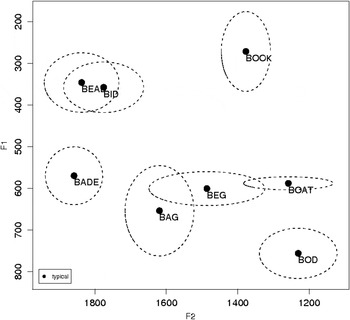
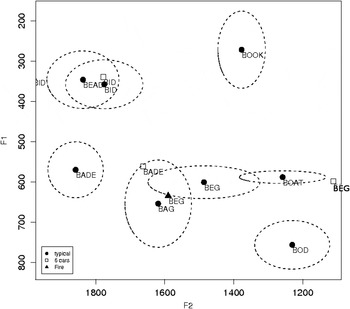
In Bob's typical disc-jockey talk, he exhibits features consistent with the North Inland Dialect of the United States (Labov, Ash, & Boberg Reference Labov, Ash and Boberg2006) and his vowel space, represented in Figure 1 below, includes elements of the Northern Cities Vowel Shift (Labov et al. Reference Labov, Ash and Boberg2006). We see this particularly strong in his production of the BAG vowel, æ as it is sometimes produced in overlap with the BEG vowel, ɛ, suggesting that Bob “BAG raises” at least some of the time. Upon closer examination, it is evident that the raising occurs in the words “bag” and “bagpipe,” in line with the prevelar raising found in the North Inland Dialect spoken in southeastern Wisconsin (Purnell Reference Purnell2008). Additionally his ɛ is backed in comparison to canonical American English. His speech is also marked by a monthologization of the BOAT vowel, /ʊ to, another stereotypical feature of Wisconsin speech (Purnell Reference Purnell, Preston and Nieldieski2010).
Mean vowel formant values in Bob's typical vowels.

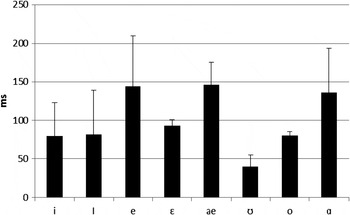
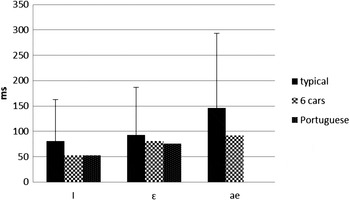
In addition to his vowel targets, the duration of his vowels also, generally speaking, conforms to what we know about North Inland speakers. Jacewicz and colleagues (Reference Jacewicz, Salmons; and Fox2007) found that the vowels of Wisconsin speakers average 144 ms in the environments b_dz and b_ts. Bob's vowels (N = 63) average 114 ms but were measured in a greater variety of environments. All vowels were preceded by stops, following Jacewicz and colleagues (Reference Jacewicz, Salmons; and Fox2007) but were followed by a wider variety of consonants. The average length of each measured vowel can be seen in Figure 2 below.
The average vowel durations of Bob's typical vowels.

Additionally, his articulation rate is typical of Wisconsin speakers. Jacewicz and colleauges (Reference Jacewicz, Salmons; and Fox2007) found that Wisconsin speakers have an average articulation rate of 5.41 syllables per second, compared to 4.81 for North Carolina speakers. The average measure of Bob's articulation rate when speaking in his typical disc-jockey voice was calculated at 5.55 (with a median of 5.21) syllables per second over 128.5 seconds of nonconsecutive talk.
Comparing reported and stylized talk
Both Bob's stylized speech and his reported speech differ in subtle and obvious ways from his typically projected disc-jockey talk. As discussed in the previous section, reported speech and stylized speech are similar in at least three ways: (i) they are both understood by co-participants to be the animating of some speaker other than the current physical speaker; (ii) they are both framed to emphasize the otherness portrayed in the speech that follows; and (iii) they both are followed by chiming-in where other participants produce their own version of the reported or stylized talk. The following analysis demonstrates that the two activities are also acoustically similar. In both sets of talk (stylized and reported) the disc jockey manipulates vowel characteristics and pitch but does not alter his intensity.
Pitch
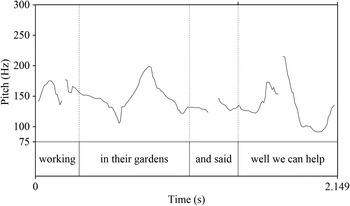
Speakers manipulate pitch in complex ways to design their talk to be understood as reported speech. Bob's typical pitch range is 90–223 Hz (range = 133Hz). Bob's reported speech in Fire was measured at 90–216 (range = 126 Hz), and his reporting in Six cars was measured at 75–149Hz (range = 74 Hz). Bob used low pitch as part of the design of his reported speech in Six cars, but did not holistically manipulate pitch in Fire. Klewitz & Couper-Kuhlen (Reference Klewitz and Couper-Kuhlen1999) found that speakers tend to raise (but sometimes lower) their pitch at the start of utterances of reported speech and an examination of the dynamic pitch of the reported utterance in Fire corroborates this finding. In the utterance “well we can help,” there is a large jump in pitch before a dramatic fall.
Dynamic pitch trace in Fire.

This suggests that there may be several ways in which speakers use pitch to design their talk as belonging to someone else. The Six cars example does not contain a dramatic rise or fall in pitch, but the monotone, low pitch of the utterance does appear to be part of the design. Similarily, an examination of the pitch range alone does not reveal the use of pitch in the reported speech in Fire.
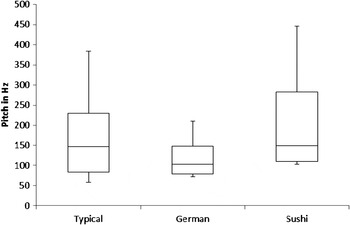
Bob employs the same sorts of resources in his stylized talk. The overall pitch range of Bob's typical talk across conversations was measured at 90–223 Hz (range = 133 Hz). The stylized iPod talk was measured with an average range of 79–153 Hz (range = 74 Hz) and stylized Mr. Sushi at 69–435 Hz (range = 366 Hz). His iPod talk tends to be spoken at a narrower, lower, pitch than his typical talk, while his Mr. Sushi talk has a broader range and reaches a higher pitch than his typical talk.
Bob's typical and stylized pitch ranges.

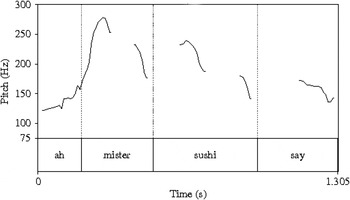
An examination of the dynamic pitch in the Mr. Sushi stylization reveals that much like in Klewitz & Couper-Kuhlen's (Reference Klewitz and Couper-Kuhlen1999) work on conversational quotations and in the Fire case discussed above, the speaker raises his pitch at the beginning of each stylized utterance but allows it to fall as the talk goes on. This suggests that although the high pitch is not maintained throughout the stylization, it does play a central role in the design of it.
Dynamic pitch in Mr. Sushi.

Intensity
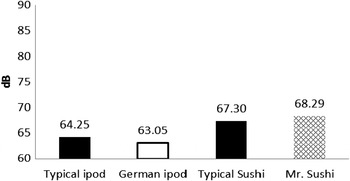
Intensity did not play a role in designing either the stylized talk or the reported speech. It should first be noted that each of the conversations were recorded on separate dates and the quality of the recordings vary, so in order to determine if Bob is manipulating the intensity (loudness) of his voice during any of the talk, each can only be compared to typical talk in the same conversation. The typical talk in iPod was measured to have an average intensity of 64.25 decibels (median = 63.96, st. dev. = 1.8), and the stylization was measured to have an average intensity of 62.69 decibles (median = 63.16, st. dev. = 1.44). The chart below demonstrates that the stylizations were spoken at an intensity comparable to the typical talk in the conversation, suggesting that intensity (loudness) was not an element of Bob's design of his talk as representing some other group.
Intensity of Bob's typical and stylized talk.

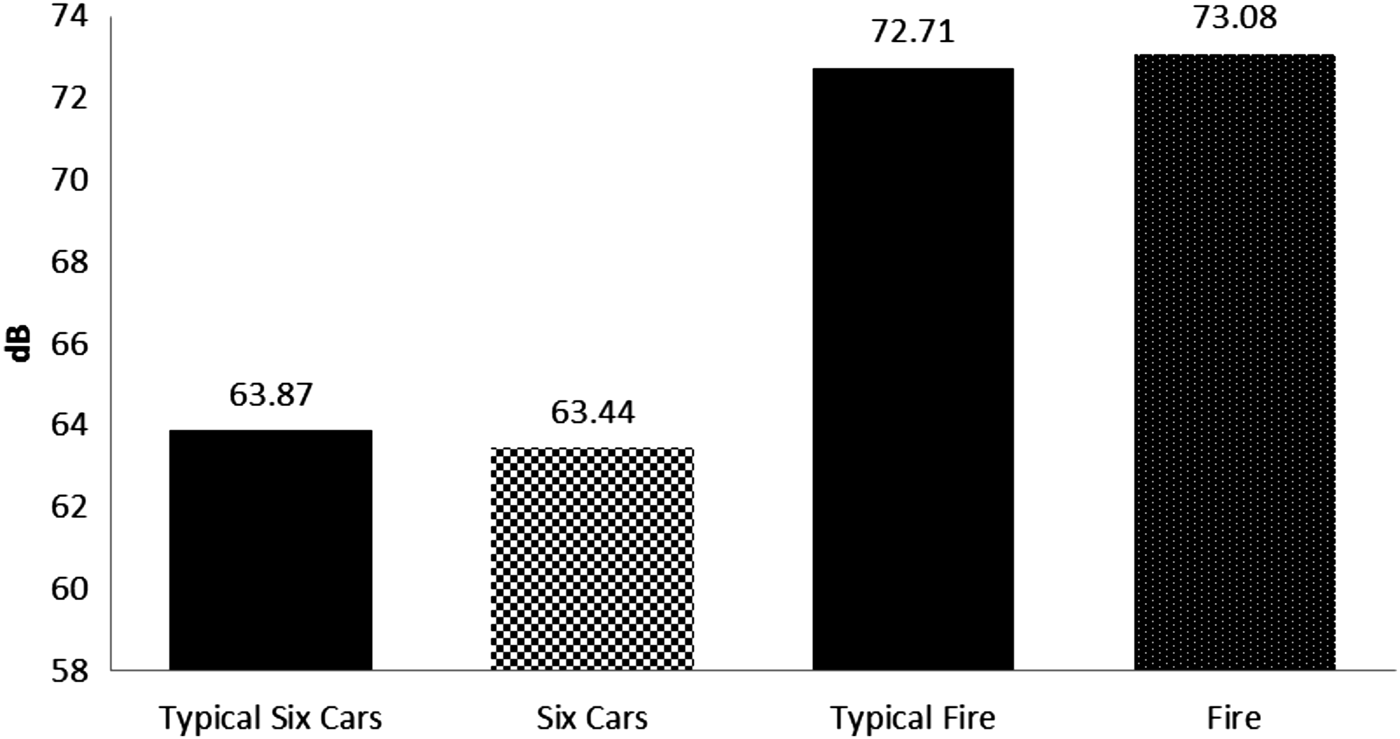
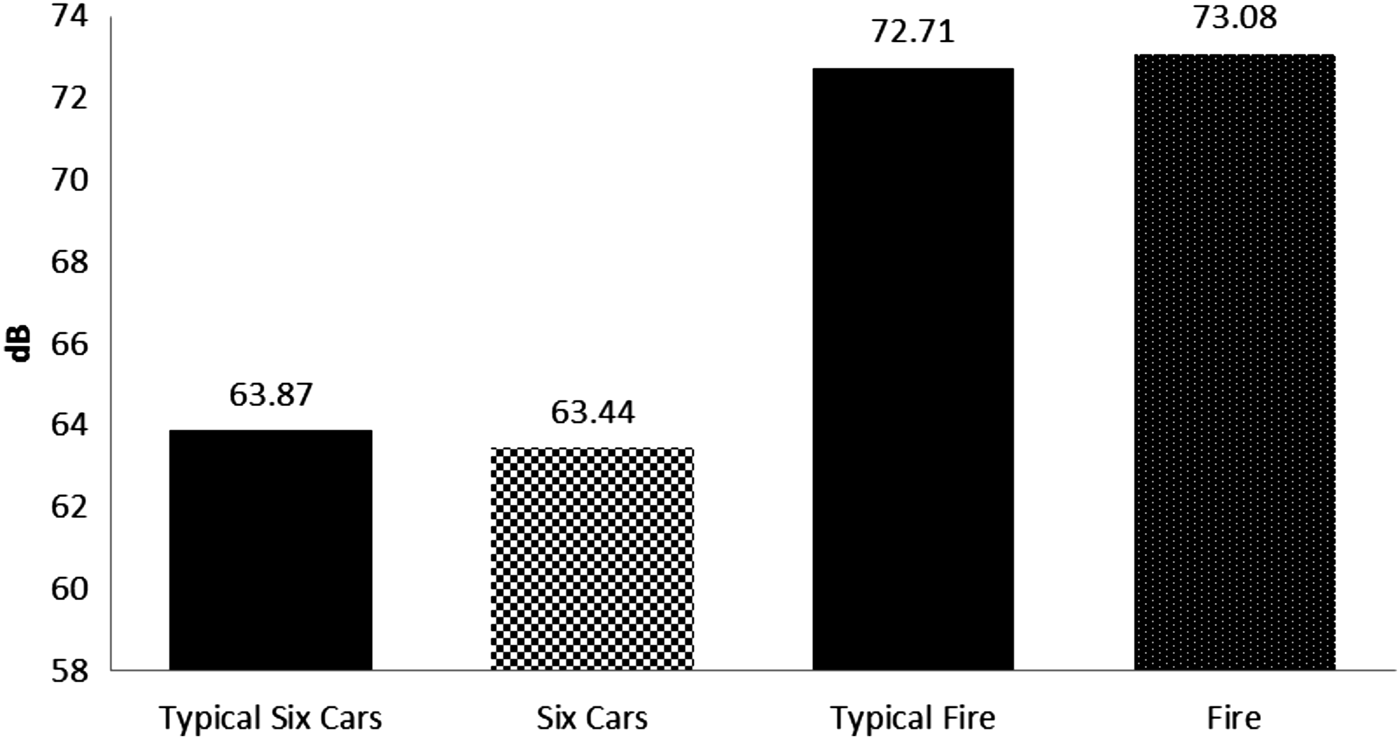
The typical talk in the Mr. Sushi conversation was measured to have an average intensity of 67.56 decibels (median = 68.80, st. dev. = 4.65) and the stylized talk was measured to have an average intensity of 68.30 decibels (median = 68.15, st. dev. = 2.17). Bob's typical talk in the Six cars conversation averaged 63.87 decibels (median = 64.05, st. dev. = 1.08) and the reported speech was spoken at 63.44 decibels. The typical talk in the Fire conversation averaged 72.71 decibels (median = 72.74, st. dev. = 0.70). The chart below demonstrates visually that the reported utterances were spoken at intensities comparable to the surrounding talk, suggesting that it also was not a part of the design of reported speech.
Intensity of Bob's typical talk and reported speech.
Articulation Rate
Articulation rate plays a part in Bob's stylized talk but not in his reported speech. The utterances spoken in his typical disc-jockey voice are most often measured between 4.5 and 6.0 syllables per second over 128 seconds of nonconsecutive talk. His iPod stylization was measured to have an average articulation rate of 4.89 (median = 4.86, st. dev. = 1.33) syllables per second over 10.7 seconds of nonconsecutive talk. Bob's Japanese stylization has an average articulation rate of 3.73 (median of 3.50, st. dev. = 1.33) syllables per second over 10.1 seconds of nonconsecutive talk. We can conclude, then, that Bob's Japanese talk has a different median value, and is spoken slower, than his typical talk, but his German does not. Figure 8 below demonstrates visually the variation.
Articulation rate of Bob's typical and stylized talk.

It is also evident that articluation rate is not part of his reported speech. Each of the single utteraces of reported speech examined fall squarly within his typical range, suggesting that, in these cases, articulation rate was not used as a resource for designing talk as reported speech, but was sometimes used as a resource for developing an artistic representation of another.
Articulation rate of Bob's typical talk and reported speech.

Vowels
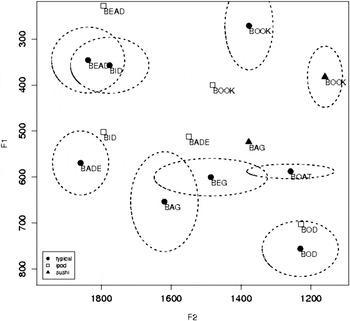
As discussed above, vowel quality has been studied in relation to stylized speech, but less so in relation to reported speech. In line with the literature discussed above, Bob does a variety of things with his vowels when stylizing and, perhaps surprisingly, employs similar techniques in his reported speech. The chart below represents the means of Bob's vowels, with the ellipsis representing one standard deviation. It demonstrates that vowel height is regularly manipulated in Bob's stylized utterances, meaning that Bob tends to move his tongue higher or lower in his mouth when producing these vowels than is typical for him. In Bob's iPod stylization, Bob manipulates his high front vowels, BEAD /i/ and BID /ɪ/, so that they are more distinct than in his typical talk, creating a greater variance in their height. He raises his BAG vowel higher than his BEG vowel. He also lowers his high back vowel, BOOK, /ʊ/ in both his iPod and Mr. Sushi stylizations. Bob's Mr. Sushi talk demonstrates that there is some level of consistency in the stylization. Three times during the stylization he says the word “good,” and the vowel is lowered and is backed each time.
Mean formant values of Bob's typical and stylized vowels.

In Bob's reported speech, vowel quality also played a role in designing the talk as belonging to another speaker. Vowel height does not appear to be an important feature but backness does. Each of the vowels that are manipulated in these cases—ɪ (BID) in Fire and ɛ (BEG) in Six cars—are vowels effected by the Northern Cities Vowel Shift (Labov et al. Reference Labov, Ash and Boberg2006), though Bob does not evidence that these vowels have been affected by the shift in his typical speech. Bob's typical pronunciation of “can” is kin (not unusual for American casual speech), and he does not deviate from this in his reported speech of the Portuguese women fighting fire. He articulates his BID vowel, ɪ, in a more front position, meaning that his tongue is closer to the front of his mouth than in his typical production of the vowel. This creates a greater distinction between the two high front vowels than in his typical speech. Also, he articulates his BEG vowel, ɛ, further back, perhaps making it sound more stereotypically Wisconsin than his own speech.
Mean formant values of Bob's typical and reported vowels.

Vowel duration also plays a role in Bob's design of reported speech. Typically, Bob's high vowels are shorter than his mid or low vowels. In reported speech, he maintains this difference but also consistently shortens each analyzed vowel in both conversations.
Average duration of Bob's typical and reported vowels.

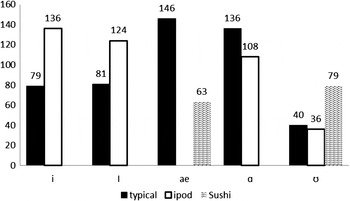
Bob also manipulates vowel duration in his stylized speech. Rather than shortening his high vowels, as he did to design his reported speech, he lengthens them in both the German and Japanese stylizations. He increases the duration of the BOOK vowel, ʊ, which is a particularily short vowel in his typical speech to nearly double the expected duration. The mid vowels and low vowels are shortened in both German and Japanese, more consistent with what we observe in the instances of reported speech.
Average duration of Bob's typical and stylized vowels.

To summarize this section, an acoustic analysis of one disc-jockey's typically projected talk, his reported speech and his stylization of a German iPod sales associate and of Mr. Sushi reveal that the same linguistic resources are employed in both types of talk. Reported speech and stylized speech alike rely on manipulation of dynamic and static pitch as well as vowel quality and duration. In this data set neither relied on intensity and only one (stylized) utterance relied on articulation rate.
Summary and conclusion
The current study sets out to build an empirically based description of linguistic stylization or talk that is an artistic representation of another's linguistic style (Bakhtin Reference Bakhtin1981). I used both interactional analysis and acoustic analysis to examine turns of talk I had previously identified as either exaggerations of ethnically salient language varieties (stylizations) or reported speech without overt linguistic exaggerations. The analysis demonstrates that structurally there is little difference between stylizations and mundane reported speech in the talk of the disc jockey studied here. His stylizations are designed to be heard as the talk of someone other than the current speaker. Rather than taking place during points of interactional ritual (greetings, thank you's, etc.), as is the case in Rampton's data (Reference Rampton1995, Reference Rampton2006), the disc jockey uses reported speech as the vehicle for his stylizations. This suggests that as speaker, the disc jockey displays a lack of ownership of the linguistic varieties he is putting on and is making this self-assessment available to his listeners in the design of his talk. In this way, the stylized utterances may be heard not as his own talk, but as an animation of someone else's talk.
Similarly, we see this same general practice in other findings on comedic talk, particularly Chun's (Reference Chun2007) analysis of Margaret Cho's stand-up routine, J. Rahman's (Reference Rahman2007) analysis of African-American narrative comedians (such as Richard Pryor), and Furukawa's (Reference Furukawa2007) analysis of Hawaiian stand-up comedy, although this is not the focus of any of these studies. As Chun shows, while Cho can claim ownership to the stylized Korean she uses in the stylizations in her comedic routines,Footnote 4 she clearly signals through reported-speech markers (such as quotatives and pitch changes) that she is speaking as her mother or as an Asian teen when she uses it. Rahman argues that the comedians manipulate the American English ɑ diphthong to build the various characters that populate their narratives. The comedians stylize both stereotypical white (using a fronted diphthong) and stereotypical African-American talk (using a monophthong) through these characters. Similarly, the Hawaiian comedians analyzed by Furukawa put on Filipino, Pidgin, and white accents to create characters in their routines. The technique of embedding stylizations in the talk of a (fictive or real) caricature, such as what we see in the disc-jockey talk examined in the current study, and the stand-up comedy examined elsewhere, is not merely a means to implicitly secure social permission to use the out-group language, but it also functions to present social commentary as belonging to someone else and, therefore, distance the actual speaker from responsibility for that commentary, which is similar to what we know about the function of more mundane uses of reported speech.
Goffman's (Reference Goffman1974) theory of speaker roles has been a useful construct for understanding how speakers design their talk to limit their responsibility. When speaking as someone else, the responsibility for the talk is seen to reside outside of the speaker. In the case of the disc jockey in the current study (and comedians examined elsewhere) the responsibility for the words lies not with the speaker who is merely the animator, or sounding agent, but with the figure being portrayed, or the principal to whom the words are attributed (Goffman Reference Goffman1974). By using reported speech, the animator attempts to deflect responsibility for the content (and the linguistic makeup) of the talk. Recent empirical work on reported speech has made similar arguments. Bergmann (Reference Bergmann1993) argues that reported speech is a technique used to gain social permission to gossip and tell dirty jokes that would otherwise be out of character for the speaker. Johansen (Reference Johansen2011) argues that teens use reported speech in narratives told to parents in an attempt to deflect responsibility for their inappropriate actions onto some other party. Mason Carris (Reference Mason Carris2011) concludes that Spanish speakers use stylizations of Anglo accents, embedded within reported speech of whites using Spanish, to comment on the linguistic status of Spanish in America. They do so indirectly, she argues, because they cannot to do so by more direct means. In the same way, I look to my data and question what it is the disc jockeys are able to say by stylizing. Are they deflecting responsibility for some action in the talk or for the talk itself? And, if so, are they successful at this deflection? Distanced from their co-participants by the radio medium, when and how might the stylizer be held accountable? My data suggest that the disc jockeys, themselves, do some local accounting—either self-selected or within their small group.
Additionally, the data demonstrates that the disc jockeys do not use stylization randomly, whenever it could be a relevant addition to reported speech. In the Six cars segment examined above, Bob does not include Middle Eastern or American Southern dialect features in his reported speech of Zaidi, despite the fact that both identities were made salient earlier in the talk. His manipulation of style is more subtle, sounding more typically Wisconsin than Bob's surrounding talk. Additionally, the disc jockeys overtly express solidarity with the protagonist of the news story by commenting that the entire scenario he is involved in sounds absurd. Employing linguistic resources to highlight the difference between themselves and Zaidi would have been contrary to their affiliation with Zaidi and with the rest of their talk in this segment.
Conversely, in the iPod segment, in which Bob (and Carrie) stylize a “West German” accent, they are disaffiliating with the Apple store. While there is not space here to do a thorough analysis of the social commentary made through the stylization, the German-accented talk in the iPod conversation creates a caricature that allows Bob to link the iPod to the Hope Diamond and make comments about its (and its manufacturer's) social dogma without giving up his position as an avid consumer of them. The use of the iconic Saturday Night Live character Dieter allows the disc jockeys to employ a familiar American stereotype of an aloof, elitist Germanness. The stereotype was reflected not just in the content of the talk but also in the choice of linguistic features.Footnote 5 His talk links the iPod to social elitism but since it is done through the reported speech of a stylized fictional character, he is also able to distance his own consumerism from the critique. Hill & Irvine (Reference Hill and Irvine1993) argue that the thicker an animation, the less participants are invited to see through to the actual physical speaker, creating a more effective “thinning of responsibility.” That thinning is necessary in this case, as Bob is making a claim that is contrary to his real-life actions. Reported speech is one layer of the animation and the addition of stylization is another.
In conclusion, scholarship on stylization has focused on its relationship to crossing, based on the salient mismatch of language and speaker. Conclusions have therefore centered on its contribution to ethnic relationships and linguistic ownership. The studies in this area have concluded, in one way or another, that the use of language that is ideologically out-group pushes the boundaries of in-group/out-group status and renegotiates the perceived right to use language. I argue that we should push the limitations of our research questions to consider the possibility that ethnically salient stylizations are a resource for speakers to make social commentary that is not primarily about ethnicity.
Appendix: Transcription conventions
The following transcription conventions are based on Jefferson (Reference Jefferson, Atkinson and Heritage1984) transcription notations.
- (.)
pause timed at less than 0.2 seconds
- (0.5)
pause indicated in tenths of a second
- .hh
inbreath
- hh
outbreath
- (( ))
description of nonvocal communication
- wha-
cutoff of a word
- hi:
a colon after a letter indicates a stretch of that sound
- ( )
inaudible utterance
- (guess)
transcriber's best understanding of the utterance
- .
fall in tone at the end of a word; does not indicate a sentence
- ?
rise in tone at the end of a word; does not indicate a question
- under
speaker emphasis of sound, word, or phrase
- ↑ ↓
a rise or fall in intonation, marked before a sound
- CAPS
loud volume
- W(h)ord
(h) within a word indicates within speech laughter
- °shh°
quiet talk
- > fast <
fast talk
- <slow>
slow talk
- =
broken utterance that was interrupted by another speaker
- [ ]
overlap