In the United States, surgical site infections (SSIs) affect 1%–5% of patients undergoing ∼16 million operations annually, and SSIs are estimated to add 7 additional days to the hospital stay and $3,000–$29,000 to the cost of care.Reference Anderson1 Less well quantified are the burdens to the patient and the family in indirect costs, anxiety and depression, and time away from presurgical activities.
New information on the microbiome and published clinical studies have been informative in addressing key questions related to surgical site infections (SSIs): What is the source of the organisms causing SSIs? Are the organisms causing SSIs present at the incision site preoperatively? If the microbiome is the source of SSIs, will increasing control of the microbiome lead to progressive declines in rates of SSI?
The term microbiota is commonly used to describe the community of microorganisms (bacteria, yeasts, and viruses) that colonize the skin, nasal passages, throat, vagina, and gastrointestinal tract. The term microbiome defines the total aggregate of microbial genes located at a specific part of a person’s body. In this review, I use the term microbiome for both. Because many species of the microbiome cannot be cultured using standard methods, investigators have used new techniques to identify microbial genes to study the microbiome.
The number of bacteria
A perspective on the importance of the microbiome relates to numbers: on the human body, we have ∼3 × 10¹³ human cells. However, on our skin and mucous membranes, we have an estimated 3.8 × 10¹³ microorganisms—a somewhat greater number of microbes than human cells.Reference Sender, Fuchs and Milo2 One review estimates that the aggregate of microbial genes outnumbers human genes by a factor of 1,000.Reference Grice3 It is now recognized that the community of microbes and their genes can influence the outcome of the interaction between a person and microbes. Specifically, the same genus and species can cause serious infections in some patients or become “neutral” colonizing bacteria in others. Some suggest abandoning the term pathogen,Reference Casadevall and Pirofski4 focusing instead on the specific response to the interaction between a person and microbes.
On the skin, each bacterium, yeast, and virus of the microbiome has a preferred location on the body, depending on local moisture and distribution of sebaceous glands or hair follicles. If the skin is injured, an infection may result, often due to the organisms living nearby on that part of the skin. Without the protection of the skin barrier, nearby organisms that are part of the local skin microbiome can invade the deeper layers of the skin and soft tissue below. In surgery, the integrity of the skin is disturbed by the incision, posing a small risk of infection; thus, organisms living in harmony in the skin near the incision can cause an SSI.
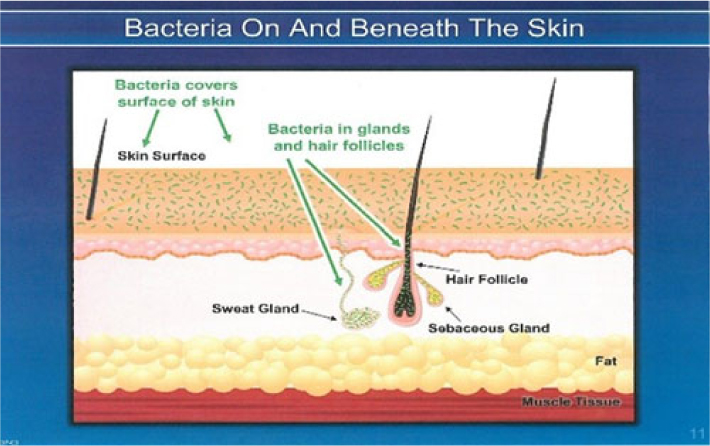
At the time of surgery, the skin near the incision is prepared with an antiseptic regimen designed to reduce the number of bacteria there. However, no current skin preparation regimen will kill all the bacteria on the surface (epidermis) nor kill the organisms residing in the sweat glands or sebaceous glands in the layer below (dermis) (Fig. 1). Better skin preparation regimens might incrementally reduce the microbiome of the epidermis, and if organisms in the dermis are shown to cause SSIs, new skin preparation regimens that enter the dermis might be clinically important.
The sweat glands help regulate temperature, and the sebaceous glands provide sebum which lubricates the top layers of skin and provides a waterproof surface. Importantly, bacteria of the microbiome reside not only on the skin surface (epidermis) but also on the hair follicles and in both sweat glands and sebaceous glands (dermis).

My hypothesis in this review is that if clinicians control the microbiome perioperatively, they might prevent SSIs. Specifically for clean surgery, if we can control the microbiome of the skin and nasal passages, we can greatly reduce SSI rates. Conversely, if we fail to control the microbiome, a surgical patient may develop an SSI. Prior to surgery, efforts to control the patient’s microbiome include chlorhexidine showers to reduce the burden of staphylococcal and other bacterial counts on the skin; topical nasal antibacterial agents to “decolonize” the nares of Staphylococcus aureus; and the best skin antiseptic preparation regimens just prior to the incision. To reduce the burden of infectious organisms in general, intravenous antibiotics are often administered preoperatively to achieve a high blood and subcutaneous tissue concentration at the time of the incision.
Skin microbiome as the key source for SSIs after clean surgery
In 2010, Darouiche et al reported a study comparing 2 alternative skin preparation regimens for reducing SSIs. No other variable changed. In a study at 6 hospitals, 849 patients were randomized to receive a povidone–iodine antisepsis regimen (the standard at that time) versus a chlorhexidine–alcohol skin preparation regimen. Within 30 days of surgery, SSIs occurred in 16.1% of cases assigned to the standard povidone–iodine group versus 9.5% of cases assigned to the chlorhexidine–alcohol group. The use of a chlorhexidine–alcohol skin preparation regimen was linked to a 40% incremental reduction of all SSIs resulting from reducing the microbiome of the skin at the area of the incision.Reference Darouiche, Wall and Itani5 In a confirmatory study among 1,147 patients undergoing caesarian section delivery, those assigned randomly to the chlorhexidine–alcohol preparation group had a relative risk of a SSI of 0.55 (95% Cl, 0.30–0.90) compared with those who received iodophor. Thus, reducing the microbiome with a better preparatory regimen incrementally reduced all SSIs by 45%.Reference Tuuli, Liu and Stout6 These 2 studies confirm the critical role of the skin microbiome in SSIs.
The 40%–45% reduction in SSIs after better controlling the microbiome of the skin with a topical chlorhexidine–alcohol regimen was an incremental improvement above that expected with a povidone–iodine application. Although there are no clinical trials of povidone–iodine versus placebo control in surgical patients, some insight into the initial value of povidone–iodine treatment can be gleaned from the study by Gravett et al.Reference Gravett, Sterner and Clinton7 That team performed a prospective, randomized clinical study of 500 consecutive patients entering the emergency room with traumatic lacerations requiring sutures. Half of the group had a wound irrigation with normal saline without scrubbing, and half had a 60-second wound irrigation and scrubbing with 1% povidone–iodine.
Of the 201 povidone–iodine wounds followed up, 11 became infected (5.4%). Of the 194 control wounds followed, 30 became infected (15.5%) (P < .01). Thus, in that study, approximately two-thirds of possible infections expected with a saline wash only were eliminated with a povidone–iodine skin preparation regimen, and a residual of one-third remained.
If similar data were applied to general surgery patients, that is, if povidone–iodine skin preparation already prevented two-thirds of infections, then removing an incremental 40% of the remaining one-third with a switch to a chlorhexidine–alcohol skin preparation would be an absolute removal of an additional 13% (40% times one-third residual). The absolute remaining proportion of wounds still not controlled with chlorhexidine–alcohol would be one-third (33%) minus 13% or 20%. This rough estimate based on clinical trials suggests that 80% of potential SSIs can currently be eliminated with better control of the microbiome of the skin. Even if povidone–iodine reduced total SSIs by only one-third, the 40% reduction of the remaining two-thirds (27%) plus the 33% already controlled by povidone–iodine would imply a 60% control currently with a better skin preparation regimen alone.
In a 2010 report by Bode et alReference Bode, Kluytmans and Heiman8 of a clinical trial in preoperative nasal carriers of S. aureus using either nasal mupirocin ointment plus chlorhexidine soap versus nasal placebo, the rates of S. aureus SSI infection were 3.4% versus 7.7%, respectively. The relative risk was 0.42 (95% CI, 0.23–0.75). Thus, almost 60% of S. aureus SSIs were prevented with current control of the microbiome of the nares and skin. The effect was more pronounced for deep surgical infections with a risk ratio of 0.21 (95% CI, 0.07–0.62). Because S. aureus SSIs represent ∼25% of SSIs, an additional ∼10% of all SSIs could be controlled with nasal mupirocin.
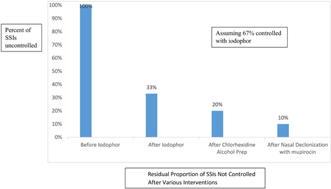
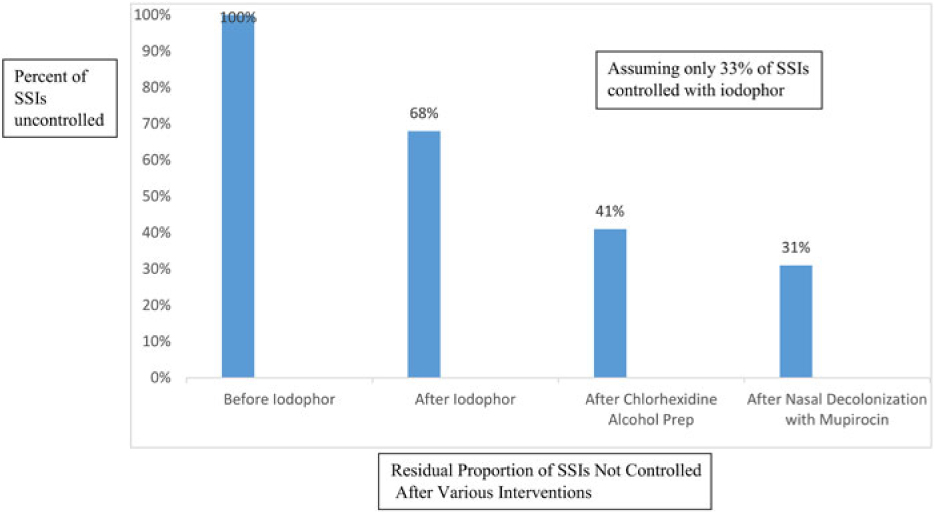
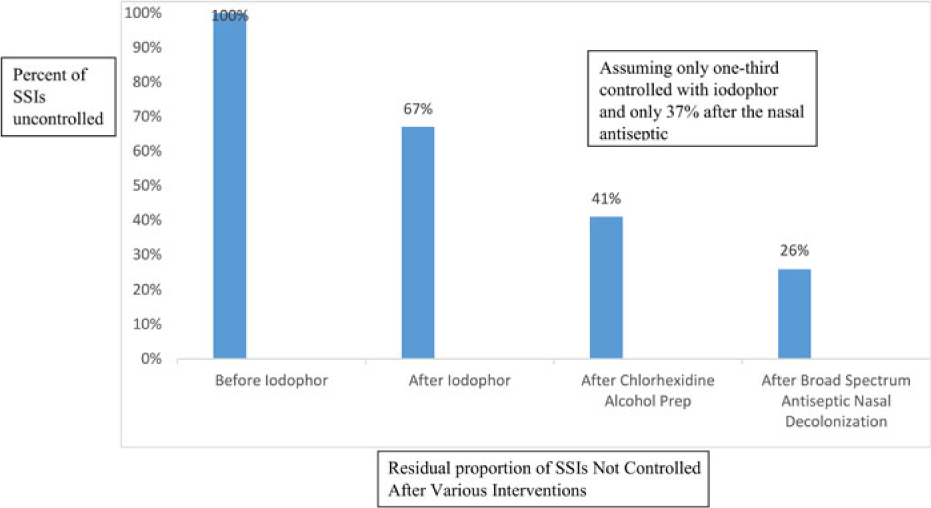
These improvements were incremental to a baseline with use of an iodophor skin preparation regimen; it is reasonable to examine the impact of incremental chlorhexidine improvement plus incremental nasal decolonization (∼10% of all SSls) after accounting for the effect of the iodophor skin preparation regimen (Figs. 2 and 3). Even assuming that iodophor would decrease SSIs by only 33% rather than 67%, the reduction of SSIs would be substantial. With the incremental improvement in controlling the microbiome, ∼71%–90% of SSIs have been eliminated. Control of the microbiome is control of the patient’s own microflora, the endogenous bacteria.
Assuming that 67% of surgical infections had already been controlled with iodophor, the 40% incremental improvement with the chlorhexidine–alcohol preparation regimen would drop the residual SSIs to 20%. After nasal decolonization with mupirocin, there was a 60% reduction of S. aureus SSIs, leading to a ∼10% reduction further in residual SSIs.

Assuming that only 33% of surgical infections had been controlled with iodophor, the 40% incremental improvement with chlorhexidine–alcohol preparation regimen would drop the residual SSIs uncontrolled to 41%. After nasal decolonization with mupirocin, there was a 60% reduction of S. aureus SSIs, leading to a ∼10% further reduction in residual SSIs.

An expanded role of the nares in SSIs
Recently, 2 studies examined the use of a broad-spectrum topical nasal antiseptic administered only once just prior to the surgical incision and then 3 times daily postoperatively. The goal was to examine the rates of SSI in the following 90 days. Both studies were before-and-after cohorts in orthopedic patients, and the use of the nasal antiseptic reduced total SSIs by 73% and 78.5%, respectively. Neither study used preoperative mupirocin.Reference Mullen, Wieland and Wieser9, Reference Bostian, Dietz and Frye10 In the study by Mullen et al,Reference Mullen, Wieland and Wieser9 during the baseline period, 400 patients underwent spine surgery with or without hardware, and in the subsequent intervention period, 673 patients received the topical antiseptic postoperatively for 5–7 days after discharge. The operative team was also “actively encouraged” to use the intranasal antiseptic, and 71%–94% complied. The primary outcome was S. aureus SSI, which showed rates of 1.76 per 100 at baseline and 0.33 per 100 for the intervention period for an 81% reduction.Reference Mullen, Wieland and Wieser9 The all-cause SSI rate was reduced by 73%. In the study by Bostian et al,Reference Bostian, Dietz and Frye10 all patients had total knee or total hip replacements, with 527 patients in the baseline period and 293 in the intervention period. The nasal antiseptic was given to patients for 2 weeks postoperatively. The all-cause infection rates were 1.50 per 100 cases in the baseline period and 0.34 per 100 cases in the intervention period, a 78.5% reduction.Reference Bostian, Dietz and Frye10
We now consider the best-case and worst-case scenarios with the broad-spectrum topical nasal antiseptic regimens pre- and postoperatively. If 67% of residual SSIs were controlled with iodophor and an incremental reduction of 40% from chlorhexidine–alcohol treatment, plus the additional incremental control of ∼75% with the nasal antiseptic regimen, the residual SSI rate would fall to 5% (Fig. 4). On the other hand, if we expect the residual SSI rate to be only 41% after chlorhexidine–alcohol preparatory treatment and we assume only a 37% incremental reduction (half that shown in the study) with the addition of a nasal antiseptic regimen, the new residual rate of uncontrolled SSIs would be 26% (Fig. 5).
Assuming an effect of 67% for iodophor followed by a further 40% reduction of residual SSIs with chlorhexidine–alcohol skin preparation, if a broad-spectrum nasal antiseptic were applied (no mupirocin), a 75% reduction in residual SSIs would leave only 5% of SSIs uncontrolled.

Assuming an effect of only 33% for iodophor followed by a 40% reduction of residual SSIs with chlorhexidine–alcohol skin preparation regimen, if a broad-spectrum nasal antiseptic were applied (no mupirocin), a further 75% reduction in residual SSI, would leave 10% of SSIs uncontrolled.

These recent studies emphasize the role of the nasal microbiome in controlling SSIs beyond targeting S. aureus. The profound effect of a primarily postoperative intervention for SSIs is surprising. More work is needed to understand how and exactly when this effect is occurring. Currently, with incremental improvement in controlling the microbiome, ∼70%–95% of SSIs can be eliminated.
Mapping the microbiome of the skin: a marker organism, Propionibacterium acnes
If a marker species such as Propionibacterium acnes prefers to reside at a specific body site, one might expect that surgery on that site but not others would be overrepresented with SSIs due to P. acnes. Such microbiological information would corroborate the concept of the microbiome as the source of SSIs.
Identifying the genes of the bacterial microbiome at specific locations is a much more sensitive approach than cultures of organisms. Among the findings are that S. aureus is common to all areas of the skin but especially so in the axilla, groin, the webs of toes—areas of high humidity. Additionally, the upper back and upper chest are disproportionately colonized with Propionibacterium acnes, an anaerobic, rod-shaped organism that prefers an environment with high concentrations of sebaceous glands. This species, implicated in acne, uses the sebum produced by sebaceous glands to grow and to metabolize to free fatty acids that help bind the organism to the upper back and upper chest. If the local microbiome is the source of SSIs, one might expect that infection near the shoulder would show this marker organism more often than infections after knee or hip surgery that involve incisions over body surfaces where sebaceous glands and P. acnes are not so prevalent.
Shoulder surgery
In that respect, it is of interest is to examine the bacterial causes of prosthetic joint infections. Whereas S. aureus and coagulase-negative staphylococci accounted for 43%–83% of SSIs after joint implants in one review, 24% of infections of shoulder joint prostheses were caused by P. acnes, the organism living near the incision site for that operation.Reference Tande and Patel11 This bacterium is commonly found in shoulder prosthetic joint infections but rarely found in infections after hip or knee joint replacement surgery (0% reported in the review). This organism is useful in the study of SSIs because it is a marker organism that is not as ubiquitous as coagulase-negative staphylococci. Corroborating findings include the fact that up to 51%–56% of infections after rotator cuff surgery of the shoulder are caused by P. acnes.Reference Levy, Fenollar and Stein12, Reference Athwal and Cofield13
In addition to the link of the microbiome near the shoulder and subsequent SSIs with P. acnes, supportive microbiological data exist on similar patients with shoulder surgery. Sethi et alReference Sethi, Sabetta, Stuek and Miller14 examined the frequency of P. acnes in 57 patients undergoing primary shoulder arthroscopy. Most patients (58%) were undergoing rotator cuff repair. Positive skin cultures for P. acnes were found in 10.5% of patients before the incision and after the skin preparation, and the rate was as high as 31.9% at closure. Also, 56% of patients had at least 1 positive culture, and no infections were noted.Reference Sethi, Sabetta, Stuek and Miller14 Matsen et alReference Matsen, Butler-Wu and Carofino15 found P. acnes in 76% of skin not included in the preparatory regimen and an intraoperative rate of positive cultures in a dermal layer of 55% in another patient group. Similar to Sethi et al,Reference Sethi, Sabetta, Stuek and Miller14 Saltzman et alReference Saltzman, Marecek and Edwards16 found a 7% rate of P. acnes cultures after the chlorhexidine–alcohol skin preparation regimen.
The marker organism nearby accounts for a significant proportion of SSIs observed in both rotator cuff shoulder repair and SSIs after prosthetic shoulder replacement. Apparently, this organism is not well controlled with existing antiseptic preparatory agents because the organism resides below the epidermis in the dermis layer of the skin. Thus, it is already present at the surgical site before the incision.
Sabetta et alReference Sabetta, Rana and Vadasdi17 followed up with a study of the efficacy of topical benzoyl peroxide on the reduction of P. acnes cultures during shoulder surgery. They recognized that P. acnes resides in the sebaceous glands, that the chlorhexidine–alcohol skin preparation was inadequate for eliminating the organism at the time of surgery, and that benzoyl peroxide (BPO), commonly used to treat acne, penetrates below the epidermis into the pilo-sebaceous duct. They hypothesized that BPO would incrementally reduce the burden of P. acnes beyond the effect of the chlorhexidine–alcohol regimen.Reference Sabetta, Rana and Vadasdi17 In this study, a 5% BPO solution was administered topically twice daily preoperatively and on the morning of surgery in 5 total doses.
Of the 50 patients studied, most (68%) underwent rotator cuff repair. Before the skin preparation regimen, 16% of the surgical sites treated with BPO had positive cultures for P. acnes versus 32% of surgical sites with positive cultures on the skin of the deltoid on the untreated arms (P = .0001). The axillae were positive in 8% of BPO-treated arms versus 28% of the untreated arms (P = .013). After the skin preparation regimen with 3 applications of 2% chlorhexidine gluconate, 6.25% of samples had positive cultures for P. acnes.
The BPO application reduced preoperative skin preparation cultures by ∼50% compared with the control arm. After adding the chlorhexidine-alcohol preparation regimen, a further reduction of positive cultures for P. acnes was obtained: from 16% on the deltoid to 6% and from 32% in the axilla to 6%. These study results confirm the dermis as the primary source of P. acnes. BPO (a drug that penetrates the pilo-sebaceous gland microbiome) reduced the rate of positive culture for P. acnes below a baseline and also below the rate observed after a skin preparation regimen. The skin preparation regimen does not reach the dermis layer of the skin where the sebaceous glands reside (harboring P. acnes). However, the efficacy of BPO in reducing SSIs has not been tested.
Spine surgery
The upper back skin adjacent to the spine is also a site where P. acnes resides. In a study by Richards and EmaraReference Richards and Emara18 of 489 patients operated on for correction of scoliosis, 23 developed delayed SSIs. Propionobacterium acnes was positive in specimens obtained at the time of instrumentation removal from 12 of the 23 patients (53%). In another study, Sampedro et alReference Sampedro, Huddleston and Piper19 cultured the spinal implants of 22 patients with SSIs among 112 subjects, and they detected P. acnes in 56% and 45% of cultures of tissue and sonicate fluid, respectively. In a third microbiological study, Shiono et alReference Shiono, Ishii and Nagai20 sent specimens for culture during spine correction surgery for scoliosis (N = 80): P. acnes was recovered in 15 specimens, and Propionobacterium spp were recovered in another 9 specimens.Reference Shiono, Ishii and Nagai20 These data further support the concept that local flora at the site of the incision harbor the bacteria that cause a large proportion of SSIs. The study by Shiono et alReference Shiono, Ishii and Nagai20 also shows that organisms are present even after skin preparation and soon after incision.
In a review of infections following operations on the central nervous systems, Walcolt et alReference Walcott, Redjal and Coumann21 state, “Bacteria penetrate the wound at the time of the initial surgical exposure. It is likely that most wound infections are the result of direct contamination with the local microbiome.” The subtitle of their article is “Deconstructing the Myth of the Sterile Field.”Reference Walcott, Redjal and Coumann21 The implication is that surgeons do their best to minimize the number of bacteria at the incision site; it is as clean as possible but never sterile, given the microbiome.
Recently, Ackermann et alReference Ackermann, Liu and Zbinden22 reported their series of 13 cases of Propionibacterium avidum total hip joint replacement infections. This organism differs from P. acnes in that it is not associated with sebaceous glands but rather with sweat glands and moist parts of the body near the groin. Notably, 85% of their infected patients had had total hip replacements. The organism resides near the hip, and a disproportionate number of these cases was linked to hip but not shoulder or knee surgery.
Heart surgery
Support corroborating the critical role of local flora in SSIs comes from microbiological studies of heart surgery patients. Tarmmelin et alReference Tammerlin, Hambraeus and Stahle23 prospectively studied a cohort of 65 adults undergoing elective coronary artery bypass grafting with or without concomitant valve replacement. They focused on the source and route of transmission of a marker organism, methicillin-resistant Staphylococcus epidermidis (MRSE), in the surgical wound.
Preincision cultures of the sternum and legs (vein donor site), air cultures in the operating room, cultures of hands of operating room staff after the initial scrub, and wound cultures just before closing were examined. Patients with MRSE on the sternal skin had a higher rate of MRSE in the wound than those with no MRSE on the sternal skin (RR, 2.4; 95% confidence interval [CI], 1.43–4.10). Recovery of MRSE in the air during the operation or on the hands of the scrubbed team was not linked to finding MRSE in the wound. The significance of sternal skin as the source of MRSE wound contamination was supported by fingerprinting the organisms using pulsed-field gel electrophoresis: 3 of 4 traceable isolates originated from the sternal skin at the incision site.
Another study of coagulase-negative staphylococci during cardiac operations in modern operating rooms conducted in Sweden was published in 2010. Bitkover et alReference Bitrover, Marcusson and Ransjo24 cultured all persons in the operating room, the patients’ sternal wounds, and the air, focusing on coagulase-negative staphylococci. They used pulsed-field electrophoresis to fingerprint these isolates. Among 20 operations studied, 6 wound isolates could be traced: 3 to the patient’s sternal skin, 1 each to the patient’s groin, the surgeon’s nose, the surgeon’s arm and forehead, and the assistant’s nose. None were traced to the operating room air, but 3 operating room air cultures could be traced to the scrubbed operating room staff.
More recently, Mansson et alReference Mansson, Hellmark, Sundquist and Soderquist25 hypothesized that S. epidermidis sequence types linked to prosthetic joint infections might be found in the laminar airflow during prosthetic joint surgery. They did not find such a link. In extensive air samples during 17 total knee or total hip replacements (N = 735 isolates), the most frequent isolate in the air was micrococcus (N = 303) followed by coagulase-negative staphylococci (N = 217), but only 32 of the 217 (15%) coagulase-negative staphylococci were S. epidermidis, the most common coagulase-negative staphylococci causing periprosthetic joint infections (PJIs). Importantly, they did not find that the S. epidermidis isolates from the air matched the sequence type commonly found to cause PJls (multidrug-resistant strain 2 and strain 215). All but 1 of the S. epidermidis strains recovered were susceptible to methicillin, whereas most of the isolates from PJI were methicillin resistant. Mansson et al “did not find evidence for intra-operative PJIs airborne transmission of nosocomial S. epidermidis strains.”Reference Mansson, Hellmark, Sundquist and Soderquist25
Discussion
Current data support the concept that control of the microbiome is linked to reduced SSIs. Studies of marker species such as P. acnes after shoulder and back spinal surgery show an overrepresentation of this species, which preferentially resides in the shoulder and back skin area. Current skin preps fail to kill all organisms on the epidermis and do not penetrate below to the dermis where P. acnes resides. More recent studies using S. epidermidis fingerprinting show the skin of the sternum to be the key site of sternal wound infections after CABG, and studies of the air for S. epidermidis show that species causing SSIs can be found primarily on the patient, less commonly to the OR team, but not in the air. In a separate study, those S. epidermidis species found in the air are distinct from those causing PJIs.
This perspective and review has several limitations. I made estimates of the initial povidone–iodine skin preparation influence on SSIs to examine best- and worst-case scenarios. A substantial number of subjects was lost to follow-up. I used the two-thirds reduction found in the traumatic laceration trialReference Gravett, Sterner and Clinton7 and then examined the effect if only one-third (half of the effect) were seen in SSIs. Similar to 2 very recent studiesReference Mullen, Wieland and Wieser9, Reference Bostian, Dietz and Frye10 showing that three-fourths of infections could be eliminated with a single preoperative regimen and subsequent postoperative nasal decolonization regimen with a topical antiseptic, I also used half of that figure as a worst-case scenario. The Mullen study included an operating room team component with the nasal antiseptic treatment, and the Bostian study was reported only in abstract form (so far). Both studies were retrospective (before-and-after) cohorts, and prospective cohorts or clinical trials may not support such a high reduction of SSIs.
Two lines of evidence support the microbiome as the source of almost all SSIs: data on the reduction of SSIs following the use of alternative skin preparation regimens and separate nasal decolonization studies, and the corroborating studies of the microbiome’s geography of the skin and disproportionate SSIs following incisions at the corresponding sites. The mapping of the microbiome and links to SSIs following joint implant surgery, minor shoulder surgery, spine surgery, and open-heart surgery are all consistent. In the latter, colonization of the sites preoperatively and separate studies of infections at those sites support the local microbiome as the source of SSIs.
Herein, I also introduced the concept of the residual uncontrolled proportion of SSIs. With each incremental improvement, there is a corresponding reduction in uncontrolled infections. Using current data and various assumptions, we can estimate that ∼5%–30% of SSIs are uncontrolled and need to be addressed and that 70%–95% of SSIs are currently controlled.
The key conclusions from a review of the literature is that control of the microbiome will do much to minimize SSIs and that perioperative failure to control the microbiome can lead to SSI. Future work should examine the role of the oral cavity in SSIs, the nares as a key contributor to SSIs beyond the role of S. aureus, and the role of postoperative control of the microbiome of the nares in further controlling SSIs.
Acknowledgments
Thanks to Barbara Briley for excellent administrative assistance as I prepared the manuscript.
Financial support
No financial support was provided relevant to this article.
Conflicts of interest
The author has been an expert witness in a products liability law suit. Neither the product nor its activity are discussed in this review.