Introduction
Waring (Reference Waring1917), in his study of ‘Martinez lower Eocene’ mollusks from the Simi Hills in Ventura County, southern California, named Ficus plectatus, based on only the imperfect holotype. He assigned this gastropod an early Eocene age, but this pre-dated modern biostratigraphic information. Since 1917, no worker had reported finding this rare species anywhere else in the northeast Pacific. In recent years, however, a few additional specimens of Waring’s species were collected from upper lower Paleocene (upper Danian Stage) strata in southern California and Baja California, Mexico. These new specimens have good to excellent preservation and can be identified with certainty as the harpid neogastropod Oniscidia Mörch, Reference Mörch.1852, an extant genus. Placement of Waring’s species in Oniscidia is significant because it is the earliest unequivocal harpid.
In addition to taxonomically updating Waring’s species, this paper better describes and illustrates it, and provides updated information concerning its geologic age, depositional environment, and habitat preference. This paper also presents the first inventory of the known fossil representatives of Oniscidia and includes their geologic ranges and geographic occurrences. This inventory provided the basis for determining the paleobiogeography of Oniscidia and correlating its distribution with global paleoclimate events.
Stratigraphic information
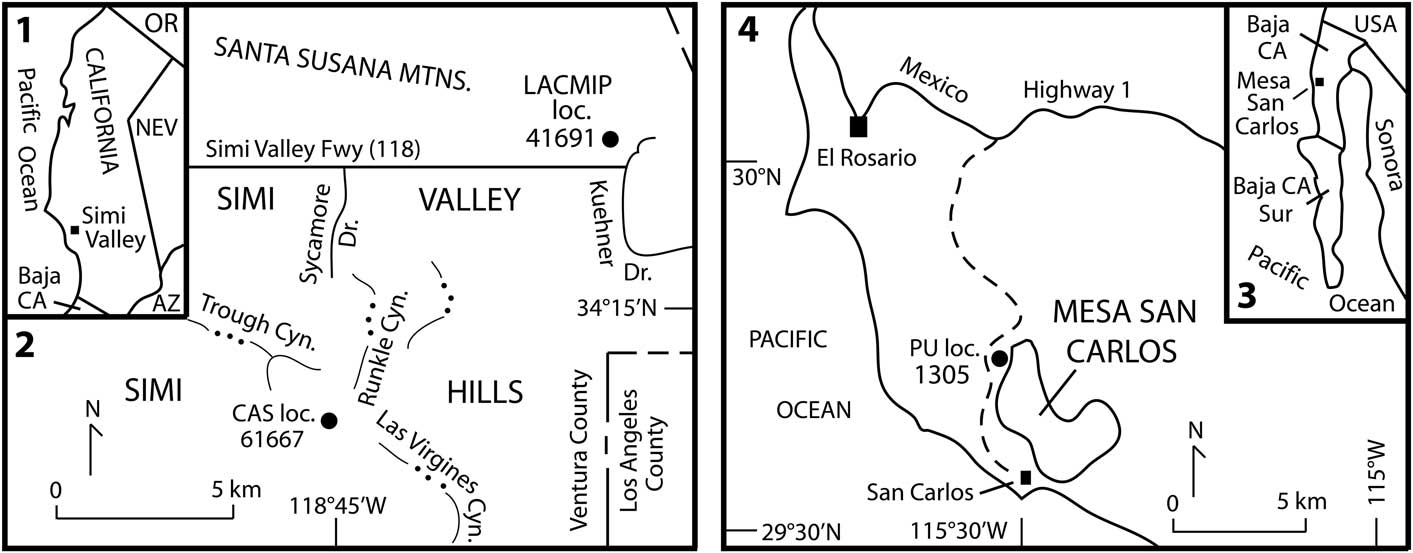
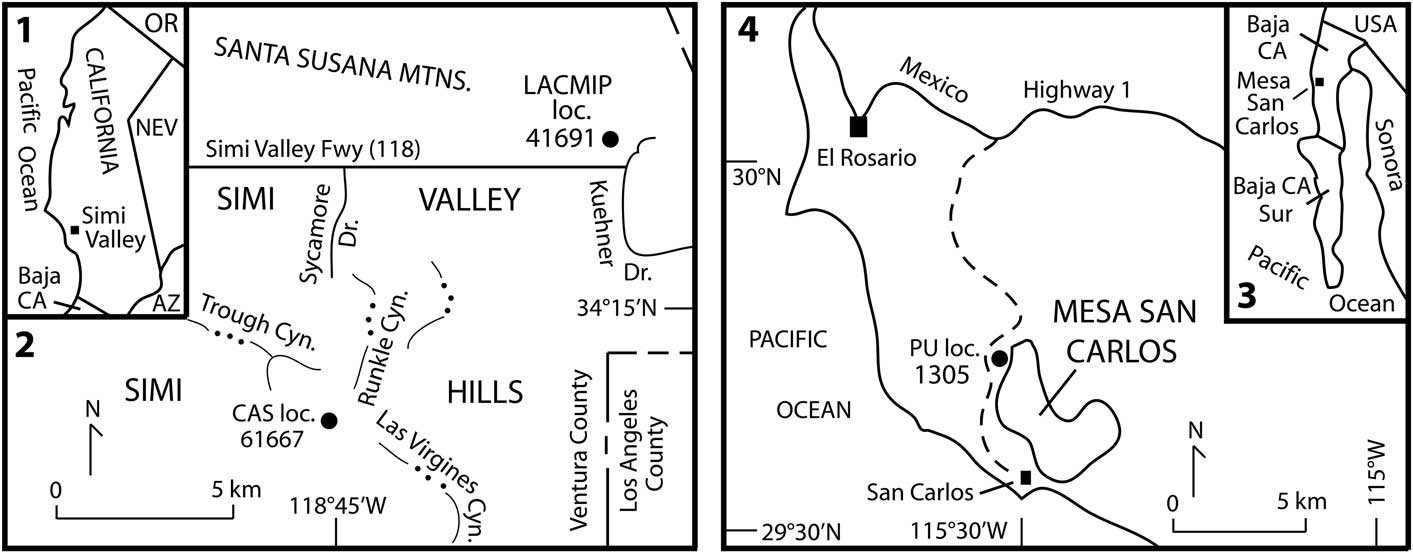
Oniscidia plectata (Waring, Reference Waring1917) is known from three areas: Simi Valley, Simi Hills, and Mesa San Carlos (Fig. 1.1–1.4). Geospatial coordinates of these localities are given in the Appendix.
Maps of localities of Oniscidia plectata (Waring, Reference Waring1917). (1) Regional outline of California indicated by boxed area; (2) map showing location of the two localities (black dots) in the Simi Valley area, southern California; (3) regional outline of Baja California, Mexico indicated by boxed area; (4) map showing location of the locality (block dot) in the Mesa San Carlos area, northern Baja California, Mexico.
Simi Valley
Oniscidia plectata is from LACMIP loc. 41691 in the lower part of the Santa Susana Formation, Simi Valley, Ventura County, southern California (Fig. 1.1, 1.2). This specimen is from a thin, poorly exposed Turritella-rich storm bed consisting of mollusks, arthropods, and bivalve-bored petrified wood that all underwent relatively short-distance, post-mortem transport, probably by turbidity currents emanating from inner-shelf depths. The immediately underlying and overlying strata consist of gray siltstone. This locality contains abundant specimens of Turritella peninsularis qualeyi Saul, Reference Saul1983 and Turritella peninsularis Anderson and Hanna, Reference Anderson and Hanna1935. Turritella reversa Waring, Reference Waring1917 is also present, along with a moderately diverse molluscan fauna. Based on known concurrent molluscan-stage ranges, this fauna is of late early Paleocene (late Danian) age (Squires et al., Reference Squires, Lipman and Nyborg2017).
Simi Hills
The holotype of Oniscidia plectata (Waring) is from CAS loc. 61667 in the Simi Hills, Ventura County, southern California (Fig. 1.1, 1.2). Waring (Reference Waring1917) listed the mollusks found at this locality and referred to them erroneously as ‘Martinez’ species of ‘early Eocene’ age. The type locality of O. plectata plots in upper lower Paleocene (upper Danian Stage) strata mapped as the Las Virgenes Sandstone (Squires, Reference Squires1981).
Mesa San Carlos
Oniscidia plectata is from PU loc. 1305 in the lower part of the Sepultura Formation, on the northwest flank of Mesa San Carlos in Baja California (Fig. 1.3, 1.4). This specimen is one of five specimens that Paredes-Mejia (Reference Paredes-Mejia1989) reported, and it has the best preservation. The formation at this locality is 130 m thick, and abundant fossils are in lensoidal beds of fine- to medium-grained, poorly sorted, greenish-gray glauconitic sandstone. The fossiliferous beds are interpreted to be localized storm-surge accumulations containing shells transported from shallower water areas and with redeposition in deeper marine environment (Paredes-Mejia, Reference Paredes-Mejia1989, p. 99–100). He reported, furthermore, that Turritella peninsularis and Turritella reversa co-occur at locality PU 1305. These two Turritella species co-occur elsewhere (see above) in deposits of late early Paleocene (late Danian) age.
Materials and methods
Specimens from three major museums were used. A polymer replica of an IGM specimen from Baja California was prepared by the staff of IGM. This replica, as well as the southern California specimens, are stored at LACMIP. Morphologic terms are from Cox (Reference Cox1960). Superspecific classification is based on Bouchet (Reference Bouchet2014).
Repositories and institutional abbreviations
California Academy of Sciences (CAS), San Francisco, USA; Instituto de Geología (IGM), Universidad Nacional Autónoma de México, México City, MÉX; Natural History Museum of Los Angeles County (LACMIP), Invertebrate Paleontology, Los Angeles, California, USA; Leland Stanford Junior University (LSJU), now Stanford University, Palo Alto, California, USA; Purdue University (PU), West Lafayette, Indiana, USA.
Systematic paleontology
Class Gastropoda Cuvier, Reference Cuvier1797
“Order” Neogastropoda Wenz, Reference Wenz1938
Superfamily Muricoidea Rafinesque, Reference Rafinesque1815
Family Harpidae Bronn, Reference Bronn1849
Remarks
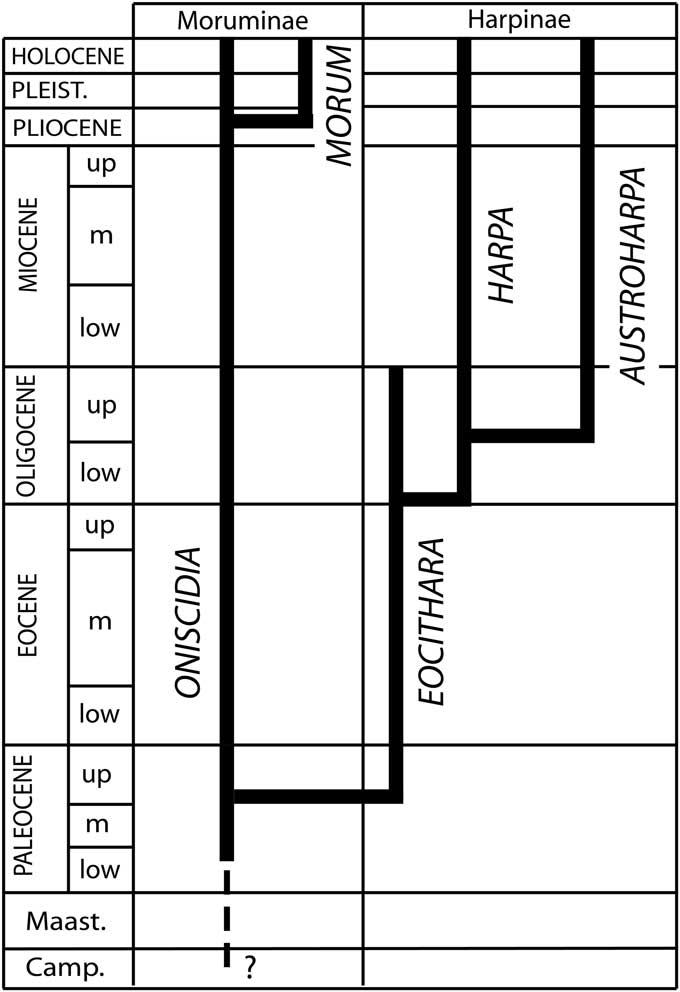
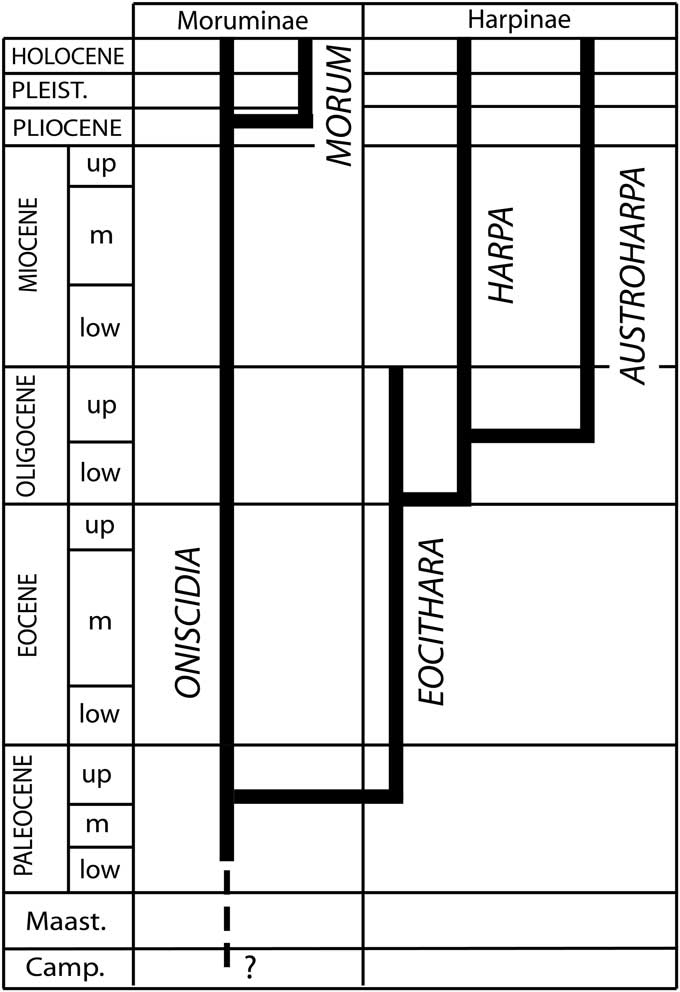
Prior to the anatomical studies by Hughes (Reference Hughes1968) and Hughes and Emerson (Reference Hughes and Emerson1987), there was unsettled familial placement of members of this group of gastropods. Harpidae is now known to consist of two subfamilies: Moruminae Hughes and Emerson, Reference Hughes and Emerson1987 and Harpinae Bronn, Reference Bronn1849. There are five genera: Harpa Röding, Reference Röding1798; Morum Röding, Reference Röding1798; Oniscidia Mörch, Reference Mörch.1852; Eocithara Fischer, Reference Fischer1883; and Austroharpa Finlay, Reference Finlay1931. The subfamily placement and geologic range of each genus are shown in Figure 2.
Stratophenic interpretation of subfamilies and genera of Harpidae. Geologic range information sources: herein for Oniscidia; Hughes and Emerson (Reference Emerson1968) for Morum; Merle and Pacaud (Reference Merle and Pacaud2004) for Eocithara, Harpa, and Austroharpa.
Subfamily Moruminae Hughes and Emerson, Reference Hughes and Emerson1987
Genus Oniscidia Mörch, Reference Mörch.1852
Type species
Oniscia cancellata Sowerby, G.B., I (Reference Sowerby1825, pl. 233, figs. 1–3), by monotypy (Mörch 1852, p. 111); extant, western Pacific. Oniscidia has a feminine ending.
Diagnosis
Shell moderately lightweight and triangularly ovate, protoconch conical, spire extended, subsutural collar common, spiral ribs pervasive, cancellate sculpture very common, columellar shield well developed and with or without tubercules, aperture narrow, siphonal fasciole moderately weak, outer lip varix with denticles on interior side and commonly on exterior side.
Remarks
The name “Oniscidia Sow.” first appeared in Swainson (Reference Swainson1840, p. 299, fig. 66c), who gave a description and illustration, both of which apply to Morum onicus Linnaeus, Reference Linnaeus1767, the type species of Morum. It seems likely that Swainson intended to use the name Oniscia Sowerby, Reference Sowerby1825, which is a junior synonym of Morum, because, in the “index” section of his article, Swainson (Reference Swainson1840, p. 414) only listed Oniscia. There was enough subsequent confusion, however, concerning the taxonomic status of Oniscidia to justify a ruling (Opinion 1040) by the ICZN (1975, p. 139). The outcome was that Oniscidia Swainson, Reference Swainson1840 is deemed to be “an incorrect subsequent spelling for Oniscia Sowerby.” In addition, it was ruled that Oniscidia Mörch, Reference Mörch.1852 is an official generic name. Mörch used Oniscidia cancellata Sowerby, G.B., I., Reference Sowerby1825 as the type species, which encompasses harpid species characterized by their triangularly ovate shape, extended spire, and cancellate sculpture. For additional discussions and comments concerning the complicated taxonomic history of Oniscidia Swainson (Reference Swainson1840), the reader is referred to Dall, (Reference Dall1909, p. 67), Dodge (Reference Dodge1956, p. 267), Woodring (Reference Woodring1959, p. 202), MacNeil and Dockery (Reference MacNeil and Dockery1984, p. 112), Hughes and Emerson (Reference Hughes and Emerson1987, p. 357), and Vokes (Reference Vokes1998, p. 17).
Taxonomic inconsistencies regarding Oniscidia Mörch and Morum have continued to modern times. Some workers (e.g., Dance and Poppe, Reference Dance and Poppe1999; Merle and Pacaud, Reference Merle and Pacaud2004) recognized only Morum. Other workers (e.g., Beu, Reference Beu1976; Emerson, Reference Emerson1981, Reference Emerson1990; Vokes, Reference Vokes1998) used Oniscidia as a subgenus of Morum. Only a few workers (e.g., MacNeil and Dockery, Reference MacNeil and Dockery1984; Garvie, Reference Garvie2013) used Oniscidia as a separate genus.
Oniscidia Mörch differs from Morum by having a more lightweight shell that is cylindrical/tubular, much more extended (never fat) spire, much narrower spire angle, subsutural collar, much finer axial and spiral sculpture (no broad nodular spiral bands), cancellate sculpture very common, better developed siphonal fasciole, and presence of denticles on outer lip varix exterior.
Oniscidia differs from Eocithara by having a subsutural collar, granules on the columellar shield, more closely spaced axial ribs with interspaces not smooth, stronger spiral ribs which can be cancellate or finely nodose, shorter siphonal fasciole, thicker outer lip, and presence of denticles on outer lip varix exterior and interior.
Oniscidia differs from Harpa by having a shell that is not glossy, much less inflated last whorl, subsutural collar, much less widely spaced axial ribs and being neither flat nor smooth, spiral ribs present and can be cancellate, columellar shield present, much shorter and less-developed siphonal fasciole, much narrower aperture, and thicker outer lip with varix bearing denticles.
Onisicidia differs from Austroharpa by having a thicker shell that is neither as inflated nor nearly smooth, subsutural colar, much thicker axial ribs, non-bulbous protoconch not bulbous, less-developed siphonal fasciole, and thicker outer lip with stronger denticles.
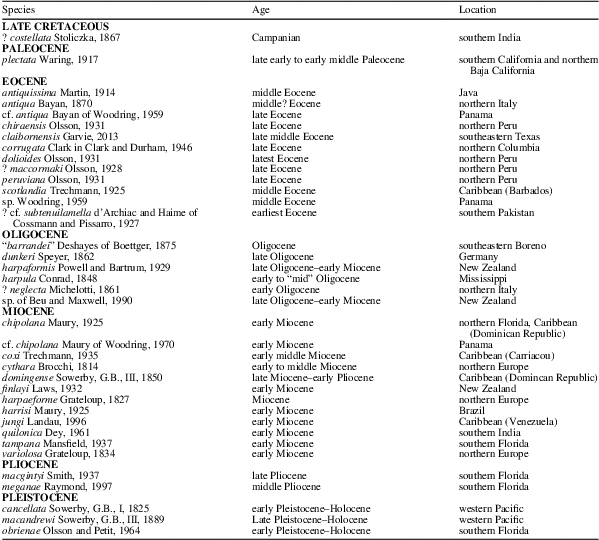
Known fossil species of Oniscidia are listed in Table 1. Based on the comments by Dall (Reference Dall1909, p. 69), the earliest representative of this genus is questionably Oniscidia costellata (Stoliczka, Reference Stoliczka1867, p. 63, pl. 5, figs. 9, 9a, 9b), from an Upper Cretaceous deposit south of Aryalur (Arialoor), southern India. Stoliczka’s sketches are not as clearly revealing as they could be, but his species has some Oniscidia features: long aperture, outer lip varix whose interior is denticulate, a produced siphonal canal that is recurved, prominent axial ribs, and spiral ribs. Dall (Reference Dall1909) noted that Stoliczka’s species does have a more extended spire than later representatives of this genus, but its spire height is similar to the extant Oniscidia cancellata (Sowerby, Reference Sowerby1825) and Oniscidia macdonaldi (Emerson, Reference Emerson1981). Stoliczka’s species does have a narrower spire angle than most species of Oniscidia, but the spire angle of the extant Oniscidia matthewsi (Emerson, Reference Emerson1967) is similar. Additional specimens of Stoliczka’s species might establish positively that it is the earliest fossil record of Oniscidia. Using the information from Sundaram et al. (Reference Sundaram, Henderson, Ayyasami and Stilwell2001, figs. 3, 5), this species is most likely from the Upper Cretaceous (Campanian) Sillakkudi Formation.
Age and geographic distribution of fossil Oniscidia species.

Symbol: ? = tentative assignment of species to Oniscidia.
“Scala cf. subtenuilamella” d’Archiac and Haime, Reference D’Archiac and Haime1854, illustrated by Cossmann and Pissarro (Reference Cossmann and Pissarro1927, p. 75, pl. 7, fig. 20), questionably belongs to Oniscidia. This specimen is part of a diverse assemblage of mollusks described by Cossmman and Pissarro (Reference Cossmann and Pissarro1927) and determined to be of earliest Eocene age from the Lakhara Formation (part of the Ranikot Group) in southern Pakistan (Merle et al., Reference Merle, Pacaud, Métais and Welcomme2014). The specimen resembles Oniscidia by having strong axial ribs, which are swollen posteriorly, and a subsutural collar. The anterior part of the last whorl is missing; therefore, this potential new species can only be questionably assigned to Oniscidia.
Reports of early Paleocene ‘harpids’ are extremely rare. Furon in Furon and Kouriatchy (Reference Furon and Kouriatchy1948, p. 107, pl. 9, figs. 8, 9) reported “Oniscia” chavani from Paleocene (Danian) deposits found in Togo and Ivory Coast of West Africa. Chabaglian (Reference Chabaglian1959, p. 152, pl. 2, figs. 3, 4) also reported this small-sized species (~20 mm height) from Paleocene deposits in Senegal, Africa. Merle and Pacaud (Reference Merle and Pacaud2004, p. 84) assigned chavani to Morum, but chavani has neither the diagnostic tubular/cylindrical shape nor the nodular spiral bands of Morum. Furon’s species differs from an Oniscidia by having round-shouldered whorls, a narrower and much longer pillar, very weak axial ribs, much less twisted anterior part of the columella, and very close spacing of thin axial ribs. Furon’s species resembles Eocithara (Refluharpa) lamellifera (Tate, Reference Tate1889, p. 149, pl. 6, fig. 2; Rehder, Reference Rehder1973, p. 235, pl. 207, figs. a–f) from middle Miocene beds at Muddy Creek, southern Australia.
Adegoke (Reference Adegoke1977, p. 208, pl. 31, figs. 21, 22) illustrated two specimens, one of which is incomplete, of what he identified as Oniscidia sp. aff. O. chavani (Furon) from Paleocene deposits in Nigeria, West Africa. Adegoke’s specimens differ from an Oniscidia by having a round-shouldered last whorl, much narrower and more constrained inner lip, and no indication of an outer lip varix. His assessment that his specimens resemble strongly a pseudolivine gastropod is correct, even though a pseudolivine groove is not discernable.
Reports of two additional species are not included in Table 1. One is Morum (Herculea) caracole (Anderson, Reference Anderson1928) of late Eocene age from Columbia. It is a nomen dubium because of its very poor preservation. The second species is Morum (Herculea) charanalense Olsson, Reference Olsson1931 of early Oligocene age from Peru. It is most likely an Eocithara.
Oniscidia plectata (Waring, Reference Waring1917) n. comb.
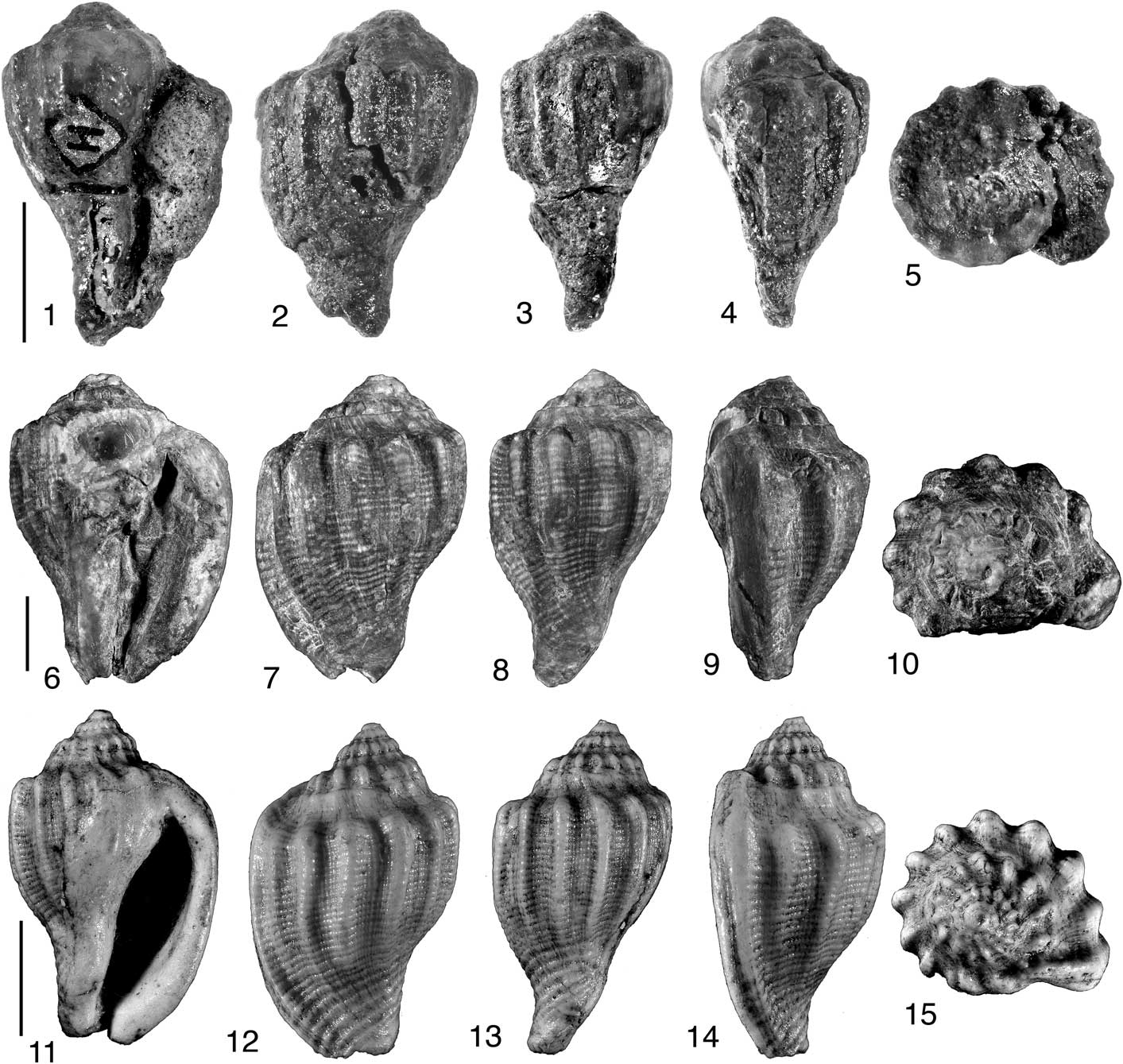
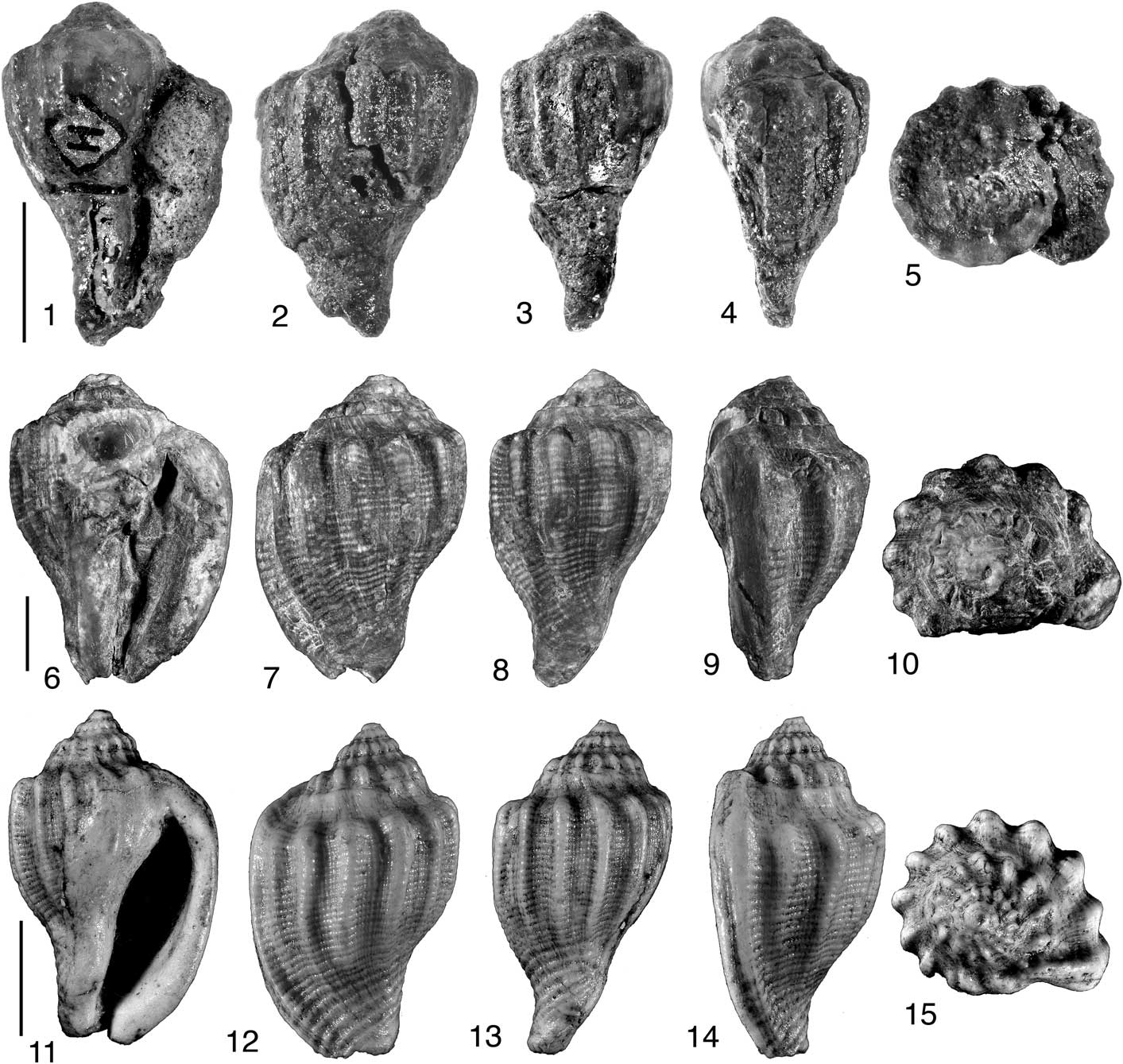
Oniscidia plectata (Waring, Reference Waring1917) n. comb., upper lower Paleocene: (1–5) apertural, abapertural, left lateral, right lateral, and apical views of holotype CAS 61667.05, from CAS loc. 61667 in the Las Virgenes Sandstone, Simi Hills, southern California; (6–10) apertural, abapertural, left lateral, right lateral, and apical views of hypotype LACMIP 14758, from LACMIP loc. 41691 in the lowermost part of Santa Susana Formation, Simi Valley, southern California; (11–15) apertural, abapertural, left lateral, right lateral, and apical views of plastohypotype IGM 4521, from IGM loc. 1305 in the lower part of Sepultura Formation, Mesa San Carlos, Baja California, Mexico. All scale bars represent 10 mm.
1917 Ficus plectatus Reference WaringWaring, p. 83, pl. 12, fig. 8.
1988 Harpa n. sp. Reference Zinsmeister and Paredes-MejiaZinsmeister and Paredes-Mejia, pl. 2, figs. 16, 17.
1989 Harpa n. sp. Reference Paredes-MejiaParedes-Mejia, p. 363, pl. 15, figs. 13–16.
Holotype
CAS 61667.05 (formerly LSJU 153), CAS loc. 61667 (Las Virgenes Sandstone); 23.8 mm height, diameter 15.8 mm. Waring (Reference Waring1917) did not designate a holotype, but according to the CAS records, “it is clear from his description and label that he had only one specimen, so it becomes [the] holotype by monotypy” (i.e., ICZN, 1999, p. 79, art. 73.1.2).
Hypotypes
LACMIP 14758, LACMIP loc. 41691 (lower part of Santa Susana Formation); 28.6 mm height, 20.4 mm diameter; IGM 4521, PU loc. 1305 (lower part of Sepultura Formation); 40.5 mm height, 25.5 mm diameter.
Diagnosis
Shell size medium. Last whorl with ~11 strong, smoothish axial ribs extending to pillar. Spiral ribs cover shell with micro-cancellate texture, but spiral ribs much weaker than axial ribs. Columellar callus weak, not very extensive. Outer lip varix interior not denticulate.
Occurrence
Upper lower Paleocene (upper Danian), southern California and Baja California, Mexico.
Description
Shell size medium (up to 40.5 mm height, 25.5 mm diameter, same specimen), triangularly ovate. Height/diameter ratio 1.4–1.6; teleoconch widest where outer lip makes prominent deflection adaxially. Spire angle 94–112°. Spire moderately low. Protoconch missing. Teleoconch up to 4.5 whorls (incomplete); strongly shouldered and upper part of last whorl flat sided. Suture covered by thin collar, becoming taller, especially on dorsal side of last whorl and in vicinity of posterior end of outer lip. Base (neck) constricted. Axial sculpture (costae) more prominent than spiral sculpture; costae becoming increasingly prominent but less numerous with increasing size of shell: 15–16 on ante-penultimate whorl, 14–15 on penultimate whorl, and 10 to 12 (not counting varix) on last whorl. Axial costae present on moderately shallow ramp, have swollen (noded) terminations at shoulder, continue across most of face of last whorl and gradually narrow before becoming weak to obsolete on base. Only tips of costae exposed on penultimate and ante-penultimate whorls. Axial costae slightly prosocline near suture and orthocline or slightly opisthocline across most of face of last whorl. Axial costae tend to align with those on previous whorl, especially on spire whorls. Spiral ribs mainly confined to interspaces, which become wider on successive whorls. Interspaces on upper spire whorls narrower or same width as axial ribs; interspaces on penultimate whorl approximately same width or wider than axial ribs; interspaces on last whorl two to three times wider than axial costae ribs. On uppermost spire whorls, spiral ribs missing or obsolete; on penultimate whorl and shelf of last whorl, spirals small and very closely spaced, creating micro-cancellate sculpture at intersections with growth lines. On last whorl, spirals can cross axial costae and increasingly so toward base of shell, where spirals noticeably increase in size, especially on dorsal side of shell. Aperture high and moderately narrow. Columellar lip callused, becoming thin posteriorly where axial costae covered by callus, but show through somewhat on parietal area of callus; columellar callus extending to anterior end of shell. Columellar lip without folds. Outer lip varix smooth, flat, wide, and high (extending to slightly posterior of suture). Outer lip interior smooth. Siphonal fasciole (twisting) moderately distinct. Anterior end of shell recurved. Growth line prosocline at suture, orthocline across most of face of last whorl, and strongly prosogyral near anterior end.
Remarks
The examined material consists of three specimens, including the holotype. They show collectively a range in preservation from moderately poor to excellent, with the Sepultura Formation specimen having the best preservation. This species has the morphologic characteristics of Oniscidia and is its earliest unequivocal record. Waring’s species is most similar to Oniscidia bruuni (Powell, Reference Powell1958, p. 80–81, pl. 11, fig. 5; Glass and Foster, Reference Glass and Foster1987, p. 67, figs. 1, 28–29), which is a rare species found living today in southeast Australia, New Zealand, and New Caledonia (Emerson, Reference Emerson1990, p. 148–149, figs. 10, 11). Oniscidia bruuni is unlike other modern-day species because it lacks cancellate sculpture. Oniscidia plectata differs from O. bruuni by having more obvious spiral sculpture.
A specimen of Harpa? n. sp., reported by Zinsmeister (Reference Zinsmeister1974, p. 156, pl. 17, figs. 13, 14) from the middle Santa Susana Formation (Selandian = ‘Martinez Stage’), north of Meier Canyon, south side of Simi Valley in Ventura County, somewhat resembles O. plectata, but there are important differences. Unlike O. plectata, the outer lip on the Meier Canyon specimen is not thickened, and the posteriormost part of its aperture is near the middle of the last whorl rather than near the suture. Zinsmeister (Reference Zinsmeister1983, pl. 4, fig. 29) reported this same specimen to be the west coast Cretaceous species Cancellaria crassa Waring (Reference Waring1917, p. 66, pl. 9, fig. 5), a homonym (non Nomland, Reference Nomland1917, Pliocene, California) renamed by Hanna (Reference Hanna1924, p. 160) as Cancellaria simiana.
Discussion
Habitat preference
Detailed information about the inferred in situ habitats of fossil Oniscidia is lacking. It is necessary to rely, therefore, on what little is known about the habitats of living species. Based on rare, live-collected specimens of cancellate species formerly referred to as Morum, Oniscidia is known to be mostly found in depths of 250–360 m (Dance and Emerson, Reference Dance and Emerson1967; Hughes and Emerson, Reference Hughes and Emerson1987; Emerson, Reference Emerson1990). Although a few living species of Oniscidia are found in depths of 25–30 m (Emerson, Reference Emerson1990), most species have been collected from subtidal sediments, predominantly in relatively deep, offshore water (Hughes and Emerson, Reference Hughes and Emerson1987). The rarity of most of the living species of Oniscidia suggests, furthermore, that they prefer a deep-water existence (Dance and Poppe, Reference Dance and Poppe1999). Oniscidia specializes probably in preying on crabs (Hughes and Emerson, Reference Hughes and Emerson1987).
Specimens of Oniscidia plectata all occur in turbidite-generated, siltstone-enclosed storm deposits associated with very abundant shallow-marine mollusks. Specimens of O. plectata are rare, whereas most of the other mollusks are common to abundant. The silty environment, rarity of O. plectata specimens, and preference for deep water of living species of Oniscidia are suggestive that O. plectata lived most likely in outer sublittoral depths where muds and silts accumulated. The associated shallow-marine mollusks underwent post-mortem transport into the living space of O. plectata. At LACMIP loc. 41691 in Simi Valley, it is likely that the turbidites likewise ‘invaded’ the living space of raninid crabs and spiny lobsters (Squires et al., Reference Squires, Lipman and Nyborg2017), which probably lived in the deeper water community inhabited by O. plectata.
Emerson (Reference Emerson1990, p. 149) reported that the standard condition in the majority of extant Indo-Pacific Oniscidia species (formerly placed in Morum) is non-planktotrophy, whereas Bouchet (Reference Bouchet2002) reported the opposite and maintained that planktotrophy is the standard condition and non-planktotrophy is a derived character state present in only a few species.
In contrast to Oniscidia, the cylindrical/nodose shells of Morum are commonly found in shallow depths. The mode of development of Morum has been observed in only Morum oniscus (Linnaeus, Reference Linnaeus1767), which has a paucispiral protoconch and non-planktotrophic development (Hughes and Emerson, Reference Hughes and Emerson1987).
Paleobiogeographic considerations
Oniscidia and Eocithara are the only harpids known to have a Paleocene and/or Eocene fossil record. The late early Paleocene occurrence of O. plectata in southern California and Baja California is the unequivocal FAD (First Appearance Datum) of this genus. It is also the only occurrence of Oniscidia in western North America previous to the modern-day appearance of Oniscidia veleroae (Emerson, Reference Emerson1968) at Isla del Coco, an oceanic island west of Costa Rica in the eastern tropical Pacific (Emerson, Reference Emerson1968; Keen, Reference Keen1971).
The FAD of Eocithara is Thanetian in Greenland (Merle and Pacaud, Reference Merle and Pacaud2004). In the northeast Pacific, Eocithara occurs in lower Eocene (‘Capay Stage’) strata in Washington and Baja California Sur, Mexico (Weaver and Palmer, Reference Weaver and Palmer1922; Squires and Demetrion, Reference Squires and Demetrion1992) and in middle Eocene (“Domengine Stage”) strata in central and southern California (Vokes, Reference Vokes1937; Squires, Reference Squires1984).
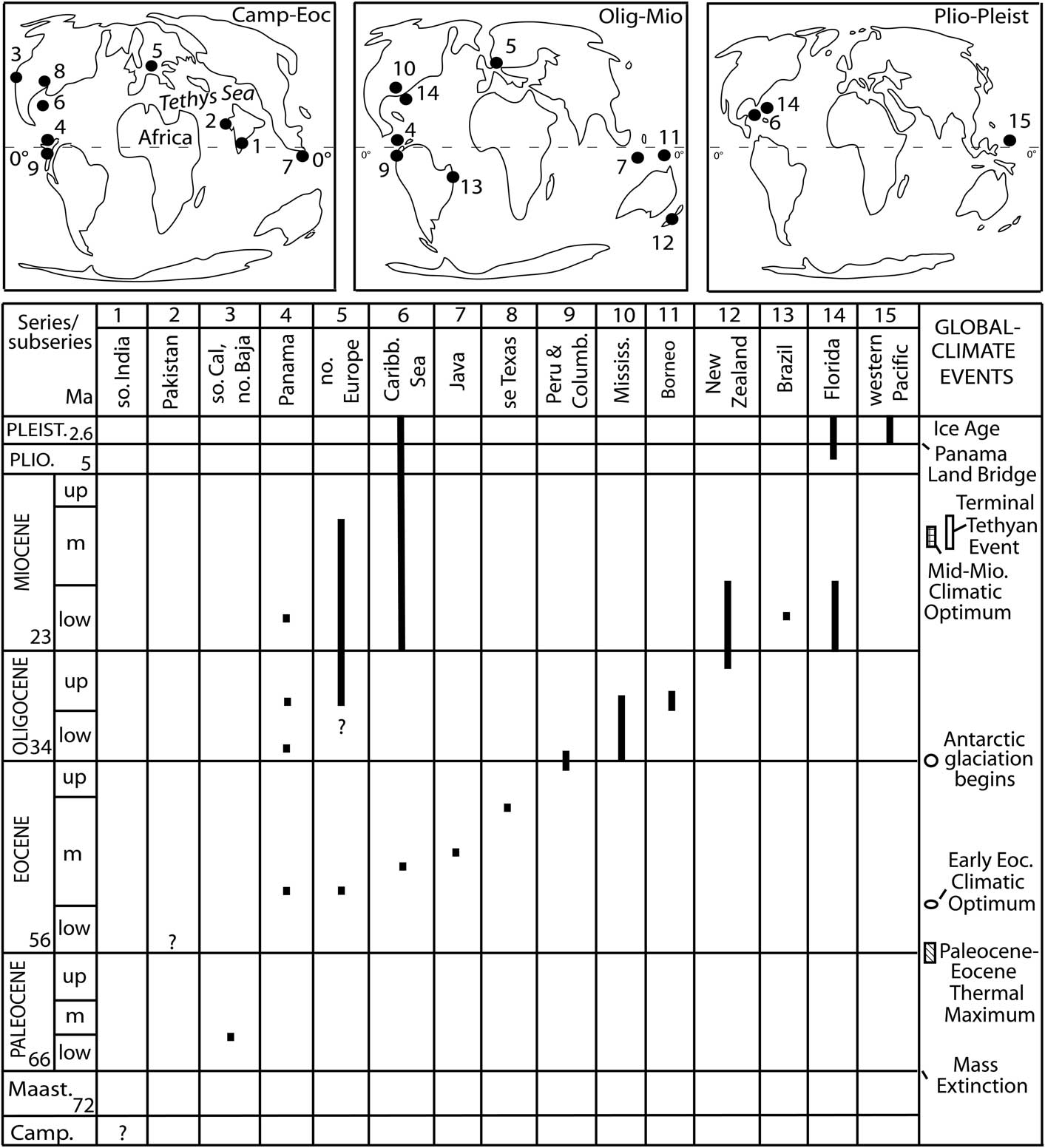
During the Paleocene and Eocene, the southern California and Baja California region was situated in a Tethyan-influenced, warm-temperate to subtropical province characterized by thermophilic mollusks (Squires, Reference Squires2003). It is likely, therefore, that Oniscidia reached southern California and Baja California via west-trending equatorial currents emanating from the Old World Tethys Sea (Fig. 4). The distribution of Oniscidia, however, is unlike that of the shallow-marine nearshore gastropods that originated in the Old World Tethys Sea region. These particular gastropods diversified during warm times, especially during the Paleocene (PETM), early Eocene (EECO), and middle Eocene (Squires, Reference Squires1987), as well as the early Miocene and early middle Miocene (MMCO) (Fig. 4). As discussed earlier, it is likely that Oniscidia was not a shallow-marine nearshore dweller. It preferred to live in subtidal offshore depths, which would have inherently been slightly cooler. Although Oniscidia seems to have virtually ‘disappeared’ from the fossil record, or was diminished greatly during warm times, it was present, most likely, in adjacent, deeper waters. During cool-ocean times, therefore, Oniscidia diversified somewhat.
Geologic ranges of Oniscidia species plotted in increasing chrono-stratigraphic order, and their global paleobiogeographic distribution based on data in Table 1. Global-climate events from Gradstein et al. (Reference Gradstein, Ogg, Schmitz and Ogg2012). Numbers at top of columns refer to geographic regions plotted on global maps. Land-mass positions from Smith et al. (Reference Smith, Smith and Funnel1994). Question mark indicates tentative assignment of species to Oniscidia.
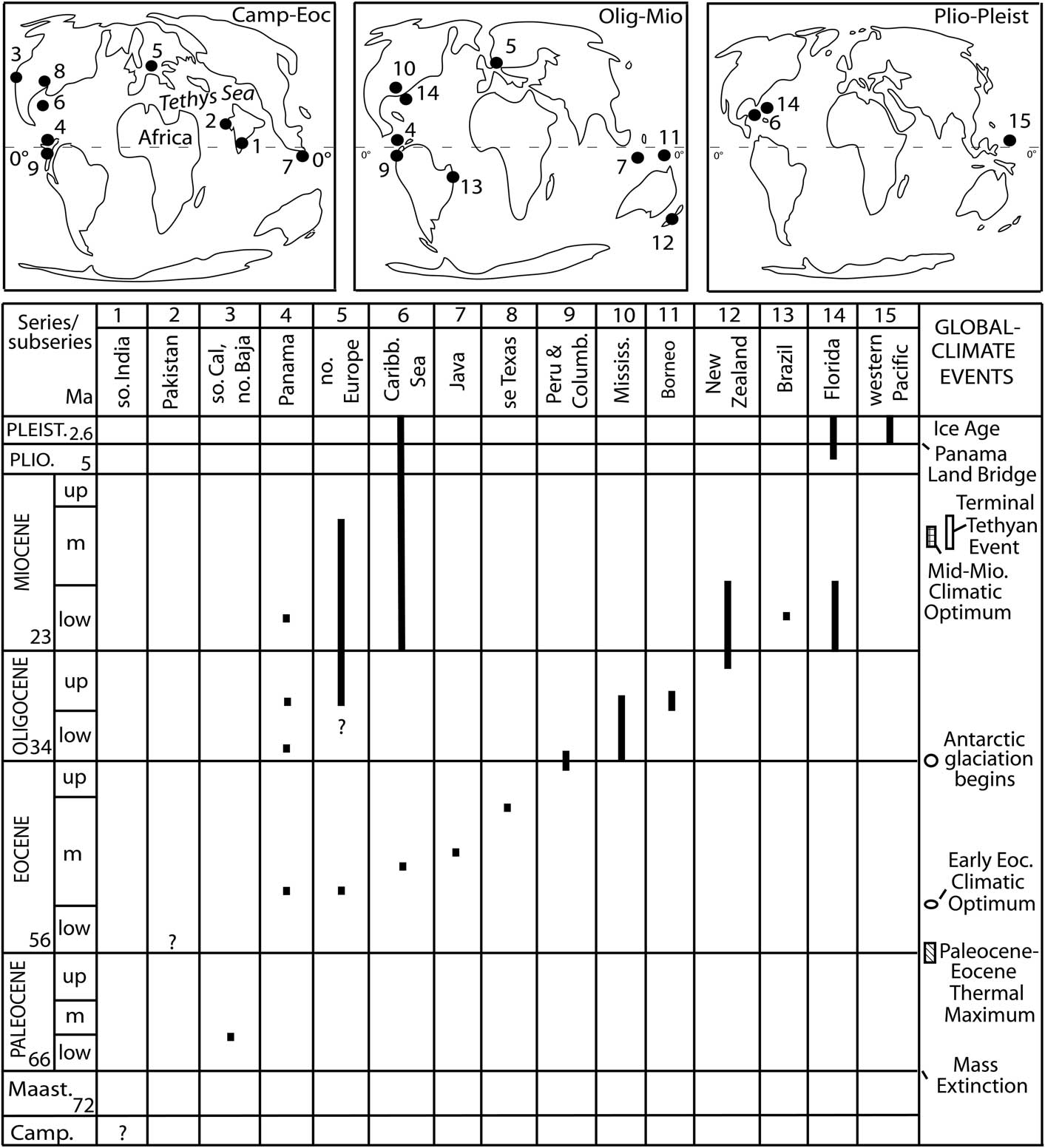
As depicted in Figure 4, Oniscidia was moderately widespread in the early Miocene, with occurrences in northern Europe, southwest India, New Zealand, the Caribbean Sea region, and Florida. The closure of the western Tethys seaway (TTE) in the middle Miocene severely curtailed the distribution of Oniscidia. Starting in the late Miocene and continuing into the Pliocene, Oniscidia became restricted to the Caribbean Sea region and Florida. In the Pleistocene, Oniscidia dispersed into the western Pacific and, to a lesser degree, into the central Pacific. Formation of the Panama Land Bridge at the end of the Pliocene (Leigh et al., Reference Leigh, O’Dea and Vermeij2013) would have impeded dispersal of Oniscidia from the Caribbean region into the west coast of North America. Intermittent marine connections between the Pacific and Atlantic sides of the land bridge probably continued between these two areas, however, during high sea levels in middle interglacial times (Beu, Reference Beu2001). Oniscidia has about 30 living species, found mostly in the western Pacific (especially in Taiwan and the Philippine Islands) and, to a lesser degree, in the Caribbean Sea, western Atlantic, and South Africa and Madagascar regions (Dance and Poppe, Reference Dance and Poppe1999).
The long distances involved for the dispersals of Oniscidia into the central Pacific argue for planktotrophic larvae. Although Emerson (Reference Emerson1990) interpreted that the modern-day distribution of Oniscidia, which is largely restricted to continental margins and large islands, represents the relicts (remnants) of the ancient tropical Tethyan seaway, Bouchet (Reference Bouchet2002) rejected this model of vicariance events. He interpreted that the recent distribution of Oniscidia is the result of planktonic dispersal of larvae.
The biogeographic history of tridacnine bivalves (Harzhauser et al., Reference Harzhauser, Mandic, Pillar, Reuter and Kroh2008) is similar to that of Oniscidia. The lineages of both groups are rooted in the Paleogene of the Old World Tethys Sea, and starting in the late Oligocene and early Miocene, they both dispersed eastward and eventually became elements of the western Pacific region.
Acknowledgments
M. Perrilliat and the staff at IGM provided a replica of a specimen from the Sepultura Formation. D. Morris and the staff at Oviatt Library-Interlibrary Loan of California State University, Northridge obtained some copyrighted journal papers. A.G. Beu (New Zealand Geological Survey, Lower Hutt) and L.T. Groves (Malacology Department, Natural History Museum of Los Angeles County) provided key references. T.J. DeVries (Burke Museum of Natural History and Culture, University of Washington, Seattle, Washington) shared his knowledge of South American Neogene mollusks. J. DeMouthe (CAS) and A. Hendy (LACMIP) facilitated loans. T.J. DeVries and L.T. Groves critically reviewed the manuscript and gave valuable comments.
Appendix
Oniscidia plectata localities:
CAS loc. 61667 (= LSJU loc. 2697 = Waring’s [1917, fig. 3] loc. 4). 34°13.3'68''N, 118°44'16.25''W, near head of Las Virgenes Canyon, Simi Hills, Ventura County, southern California, Calabasas 7.5 minute quadrangle (1952). Collector: H. Hannibal, June 3, 1910. Las Virgenes Sandstone (upper lower Paleocene [upper Danian]).
LACMIP loc. 41691. 34°17'02''N, 118°40'01''W, north side of Simi Valley; Santa Susana 7.5 minute quadrangle (photorevised, 1969), Ventura County, southern California. Collectors: P.J. Lipman, J. Lipman, and R.L. Squires, Fall, 2015 (a temporary locality no longer accessible because of development and now covered by landscaping). Lower Santa Susana Formation (upper lower Paleocene [upper Danian]).
PU loc. 1305. 29°42'10.45''N, 115°29'21.51''W, northwestern flank of Mesa San Carlos, Baja California. Collector: L. Paredes-Mejia, late 1980s, lower Sepultura Formation, (upper lower Paleocene [upper Danian]).