This article examines the impact of China's entry into the World Trade Organization (WTO) and of increasing competition in the Chinese automotive market on Chinese sub-national governments' industrial policies. It asks how these have influenced joint ventures (JVs) between regional state-owned enterprises and global automakers. It further explores the operational strategies that can be employed by sub-national governments in emerging economies to counterbalance open market forces and protect local industries.
As a latecomer to the global scene, the Chinese automotive industry serves as an interesting case for investigating the delicate interplay of rules at the international, national and sub-national levels. At the international level, China's accession to the WTO in 2001 reformulated the way that the country implements tariff regulations and liberalization measures. The WTO compelled the Chinese central government to lift more than 7,000 trade barriers, and pressured for increasing market access for foreign companies as well as equal treatment of foreign and domestic businesses. At the national level, the central government has consciously guided the developmental path of the automotive sector ever since it implemented the country's seventh five-year plan in 1986. In recent decades, the central government has created a framework of market and non-market rules for sub-national governments and global automakers by setting ownership regulations, local content regulations, taxation policy and corporate laws. At the sub-national level, provincial and municipal governments have selectively implemented WTO policies and central government regulations in ways that they hoped would promote a successful automotive industry. Fragmented and competitive dynamics are more salient in the automotive sector than in the other parts of the Chinese economy, as sub-national governments own automakers and attempt to create regional champions.
In examining the interplay of these rules in the automotive industry, I argue that China's membership of the WTO ironically empowers sub-national governments in two ways. First, it allows the sub-national governments to continue to pursue their own industrial policies by limiting the central government's ability to implement interventionist measures at the local level. Second, China's WTO membership enables sub-national governments to introduce liberalizing measures as they see fit in order to promote their regional economic goals. I demonstrate my argument by examining the role of sub-national governments in creating favourable market and non-market conditions for automotive joint ventures between state-owned enterprises (SOEs) and global automakers. Specifically, I perform an in-depth case study of the Beijing Hyundai Motor Company (BHMC), a joint venture between the Beijing Automotive Industry Holding Company (BAIHC) – an SOE run by the Beijing municipal government – and the South Korean-based Hyundai Motor Company. As the first automotive joint venture in China's post-WTO era, the BHMC exemplifies how sub-national governments can implement international and national regulations in ways that best promote their joint venture brands. This article explains the BHMC's astronomical rise, as it became China's second-largest automotive manufacturer in the span of three years, from 2002 to 2005. This achievement is astonishing given Hyundai's late entry into the Chinese market, its initially weak brand recognition in China, and BAIHC's weak market position at the beginning of the joint venture.
Conventional market explanations cite three factors as instrumental in the BHMC's success: China's entry into the WTO, Hyundai's entry into the Chinese market coinciding with the expansion of the country's passenger car market, and Hyundai's management strategies. I find that these approaches do not adequately explain why the BHMC outperformed its competitors in terms of market share, given that all producers were facing the same market conditions. This article highlights the role the Beijing municipal government played in creating favourable market conditions for the BHMC during its initial operation phase, the period when the government generally does the most to help a foreign partner settle into the market.
Throughout this case study, I emphasize two main arguments. First, China's sub-national governments can selectively adopt their own protectionist or liberalizing measures that deviate from the wholesale liberalizing measures that the WTO imposes on the central government. I characterize this practice as fragmented liberalization, a system through which sub-national governments discriminately apply WTO or central government regulations to promote their local JV partner. Second, multinational companies are not necessarily the main drivers of economic liberalization in China, as many scholars have suggested. Instead, foreign partners within sub-national joint ventures foster fragmented liberalization and often support protectionism. I begin by delineating the characteristics of the Chinese automotive market and explaining my theoretical framework of fragmented liberalization. I then explain BHMC's fast growth and discuss how the Beijing government and its protégé, the BAIHC, selectively implemented WTO regulations to support the BHMC's success within the framework of fragmented liberalization.
Fragmented Liberalization: Industrial Policy beyond the Nation-State
In view of its potential to create jobs and build industrial capacity, the automotive industry remains one of the most strategic elements of national economic development. It is not an overstatement to say that no country has succeeded in building an automotive industry without government involvement in industrial policy. China is no exception. Following the “developmental state” models of Japan and South Korea, the Chinese central government set the automotive sector as a pillar industry in its seventh five-year plan (1986–1990) and has guided the development of the industry ever since.Footnote 1
China's automotive development, however, differs from that of Japan and South Korea, in that it highlights roles played by sub-national governments.Footnote 2 First, Chinese bureaucratic and industrial structures are extremely fragmented compared to those of Japan and Korea. Historically, Mao Zedong's “self-reliance” (zili gengsheng, 自力更生) policy during the Cultural Revolution in the 1960s implored each province to build at least one automotive factory as an import-substitution measure. This policy, however, failed to emphasize actual productivity or economies of scale. It created extremely splintered market conditions, with 130 automakers and 2,000 to 3,000 parts manufactures in China during the late 1980s.Footnote 3 In these conditions of extensive local autonomy, some sub-national governments served as “local developmental states” that created regional champions, while other governments plunged into stagnation.Footnote 4
Second, while Japan and South Korea were closed to foreign automakers, China's reform-minded leaders, including Zhao Ziyang 赵紫阳 and Zhu Rongji 朱镕基, invited foreign automakers to consolidate the country's fragmented and inefficient automotive industry beginning in 1984.Footnote 5 To ensure that China benefitted from its relationships with multinational corporations (MNCs), the central government required foreign automakers to form a joint venture with a maximum of 50 per cent ownership to be shared with no more than two Chinese SOEs. Such ownership regulations not only affected the pattern of market competition, but also restricted global firms' options regarding two of their most important business strategies – the mode and the timing of their entry into the market. Thus, the new tide of reform created an “obligated embeddedness” for foreign automakers, whose integration into the existing political and industrial structure of a given region depended partly on their Chinese partners' actions.Footnote 6
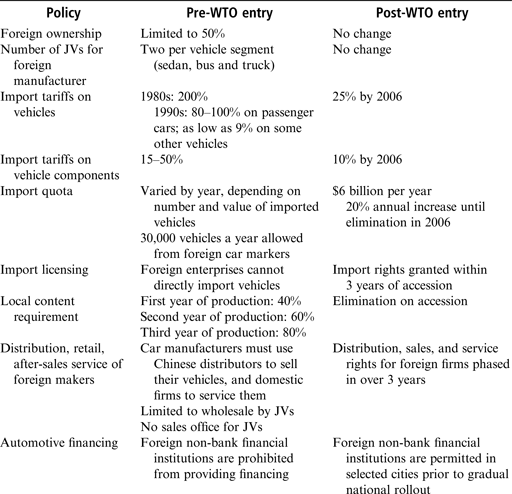
Another tide of reform came with China's entry into the WTO in 2001, which was hailed as a significant step forward in opening China's market and curbing government practices that placed foreign firms at a competitive disadvantage. By entering the WTO, China was obliged to revise various regulations in compliance with WTO standards. Most significantly, the WTO's Trade-Related Investment Measures (TRIMs) prevented China from implementing non-tariff barriers – such as export subsidies, local content requirements, and separate regulations for domestic and imported products (see Table 1).
International Context: The Chinese Automotive Market Before and After WTO Entry

Source: Compiled by the author from Holweg, Luo and Oliver (Reference Holweg, Luo and Oliver2005) and Noble, Ravenhill and Doner (Reference Noble, Ravenhill and Doner2005).
Through its membership negotiations with the WTO, the Chinese central government maintained control over the key issues regarding Foreign Direct Investment (FDI) flow in the automotive sector. First, ownership requirements remained intact, which heavily restricted foreign partners' operational strategies by precluding them from using traditional market penetration tools, such as export and equity investment. Second, joint venture operation and key automotive components projects (e.g. engine motors, anti-locking breaking systems and safety airbags) required approval from the two most influential divisions in China's cabinet – the State Economic and Trade Commission and the State Development Planning Commission.Footnote 7 In addition, China still imposed import tariffs – averaging 10 per cent for vehicle components and 25 per cent for assembled vehicles – even after six years of WTO membership. Assemblers and parts-makers were prohibited from marketing their products solely under their global brand names and were required to stamp the name of the local manufacturer or joint venture partner on all their products. In other words, China's central government reserved the right to assume an active role in shaping the developmental trajectory of the automotive sector.
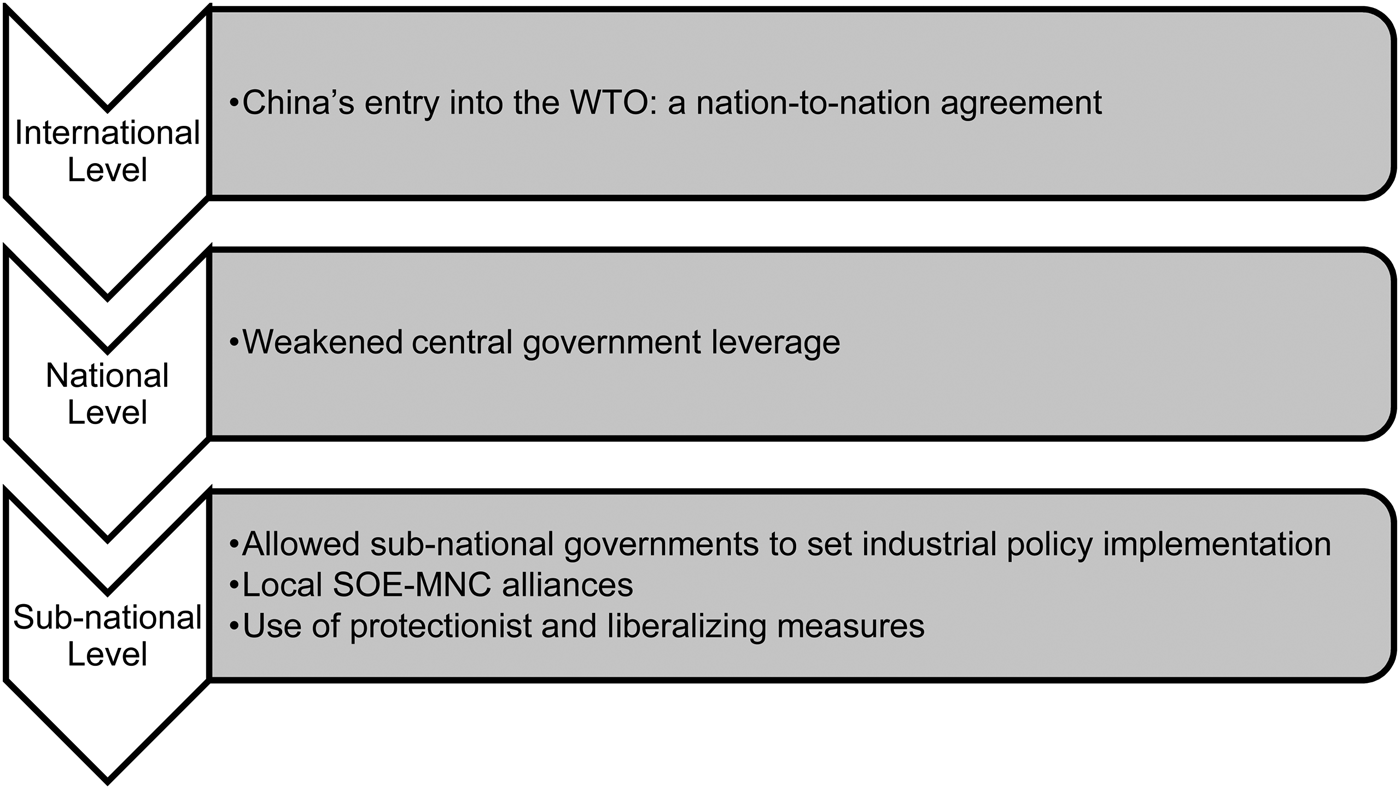
Scholars have offered many insights about the negotiation process between the WTO and the Chinese central government, but the resilience of China's sub-national governments has received less attention. Yasheng Huang has detailed how the central government introduced foreign investors to help reverse the country's trend toward extensive local autonomy and regain power over the regions.Footnote 8 Yukyung Yeo and Margaret Pearson have highlighted the central government's efforts to keep a firm grip on the centralized regulatory structure.Footnote 9 However, these approaches are relatively silent on how China's WTO membership has affected the balance between national centralization and sub-national autonomy in the country. I argue that China's WTO membership has, ironically, given the country's sub-national governments a newfound autonomy to selectively adopt protectionist or liberalizing measures at the sub-national level.
Under such conditions, local governments manipulate public policy to ensure favourable market conditions and attract foreign partners, since foreign companies can furnish SOEs (and thus local governments) with technology and capital. I describe this process as fragmented liberalization, where sub-national governments selectively adopt measures of liberalization and protectionism rather than wholly adopting liberalizing measures imposed by the WTO on the central government (see Figure 1). I also argue that MNCs are not necessarily the main drivers of liberalization, as many scholars have assumed.Footnote 10 Instead, foreign joint venture partners have fostered fragmented liberalization in China partly because the joint venture formation rules inevitably pit regional joint ventures against each other, rather than promoting competition between domestic firms and foreign firms. Moreover, due to Chinese sub-national governments' extensive local autonomy and the law that requires foreign automakers to enter into joint venture partnerships, nonmarket factors such as political bargains and coalitions at the national and sub-national levels have shaped China's automotive industry.Footnote 11
Theoretical Framework: Fragmented Liberalization
Setting the Empirical Puzzle: Navigating China at “Hyundai Speed”
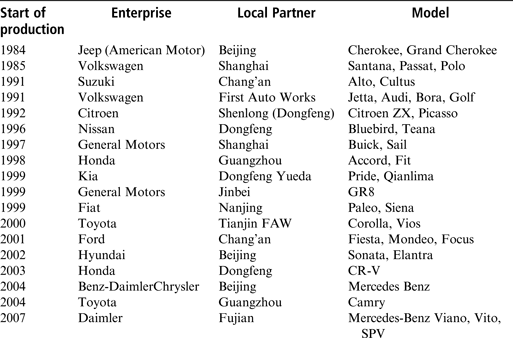
As early as 1983, automotive companies were among the first foreign investors to make inroads into China to vie for market share in the world's potentially largest automotive market. However, not all major global automakers survived to establish a presence in the country.Footnote 12 South Korea's national champion, Hyundai Motor, joined other global automakers and cautiously entered China in April 2002. It formed a 50:50 joint venture with the BAIHC with a registered capital of RMB1.8 billion (US$217 million). Given China's proximity and market potential, Hyundai's entry into China was surprisingly late. Nevertheless, the latecomer BHMC outdid most of its competitors, jumping from ranking 11th in 2003 to 2nd in 2005 in terms of unit sales (see Table 2). BHMC manufactured Hyundai's best-selling car, the Sonata, within 64 days of opening the production line and sold 100,000 Sonatas within the first 17 months of starting production, a feat that took Shanghai-GM 30 months. Within a year of starting operations, the BHMC contributed to 37 per cent of Beijing's industrial growth in 2003, in a clear contrast to Beijing's previously failed joint venture with the American Motor Company (AMC), discussed later in this article.Footnote 13 In 2003, Chinese media coined the term “Hyundai speed” to hail Hyundai's unprecedented pace of auto production and market penetration.Footnote 14 This is an outstanding achievement, given BHMC's position as a latecomer in the market with weak brand power and BAIHC's relatively minor position among joint ventures. It is also remarkable considering that automakers from Europe, the US and Japan already dominated the Chinese market (see Table 3).
BHMC's Market Share and Rank in the Chinese Automotive Market, 2002–2010
Source: Hyundai internal document released July 2011.
China's Major Joint Venture Automotive Assemblers, 2007
Source: Compiled by the author from press releases, company websites and auto industry yearbooks.
Conventional market-oriented explanations cite three factors as instrumental in Hyundai's success in China. The first factor is Hyundai's opportune timing of market entry in 2002, when the demand for passenger vehicles took off in China. However, this does not explain how the growing demand for passenger cars translated into the demand for Hyundai cars. The second factor is Hyundai's global management experience and operating strategies from its previous ventures in emerging countries like India.Footnote 15 However, instead operating as a wholly owned enterprise – as Hyundai does in India and the US – Hyundai operates in China as a joint venture with a Chinese SOE.Footnote 16 The third factor is China's entry into the WTO in 2001, which subsequently curbed government practices that put foreign firms at a competitive disadvantage.Footnote 17 Yet this does not adequately explain why the BHMC outperformed its competitors in terms of market share, given that all producers were facing the same market conditions. Overall, market explanations fail to capture how the locus of industrial policy often lies in the hands of sub-national governments and how China's entry into the WTO opened the door for sub-national governments to adopt protectionist and liberalizing measures.Footnote 18
Recognizing the politicized nature of the automotive sector, Eric Thun explains BHMC's success by pointing to Beijing's prior experience with the AMC. He argues that the failure with the AMC prompted Beijing's leadership to develop new political and economic incentives vis-à-vis its new joint venture partner, Hyundai, and to undertake a laissez-faire approach by granting Hyundai huge leeway in its operations.Footnote 19 However, Thun's approach misses the dynamics of how sub-national governments have found ways to continue local protectionism even after China entered the WTO and how sub-national governments strategically choose to use liberalizing schemes. In other words, Beijing's laissez-faire approach to Hyundai is not the result of incapacity as Thun suggests, but the result of strategic choice.
Explaining BHMC's Success: Fragmented Liberalization at the Sub-National Level
China's de facto decentralization has enabled the country's sub-national governments to play a major role in enforcing WTO rules and the Chinese central government's regulations.Footnote 20 The Beijing municipal government was especially proactive in supporting BHMC as a way to revamp its automotive industry. To better understand how the Beijing government and its protégé SOE (BAIHC) assisted BHMC's development, it is important to first explore the history of the BAIHC and the formation of its partnership with Hyundai.
Established in 1958 as a SOE of the Beijing municipal government, the BAIHC reigned as one of China's leading light truck producers. The BAIHC became a pioneer in 1983 by forming China's first joint venture, Beijing Jeep Corporation (BJC), with the AMC to produce the Jeep Cherokee for the Chinese market.Footnote 21 However, without any precedents to serve as guidance, this joint venture soon failed and became “a symbol of conflicting interests, hidden charges, miscommunication and an unattained goal.”Footnote 22 The BJC failed to target the mass market for its sports utility vehicles and struggled through the 1990s, producing only 15,000 to 20,000 vehicles.
With BJC, the Beijing city government and the BAIHC displayed weak leadership by failing to aggressively promote Jeep sales or adeptly manage BAIHC's fragmented organizational structure.Footnote 23 Instead, they followed an import-substitution strategy by pressing the AMC to follow local content regulations and to build indigenous parts suppliers. However, the AMC was more interested in importing a kit containing all parts needed to assemble a vehicle – a complete knock-down.Footnote 24 It informally changed the requirements of local content without properly executing written contracts. Beijing's underdeveloped heavy industry base and the scarce number of Chinese parts suppliers further complicated the enforcement of local content regulations.Footnote 25 The BJC struggled in providing the minimum wage requirements for its employees, and its contributions to the local economy were meagre.Footnote 26
Despite being China's mecca of politics and culture, Beijing was unable to match Guangdong and Shanghai in terms of industrial development. The failure was particularly bitter for Beijing's city leaders since Beijing had several features that were conducive to the growth of future passenger vehicle market – including a topography of plains and plateaus, the highest number of driver's licence holders in China, and a 100 per cent increase in GDP during the late 1990s. Beijing also represented a large segment of corporate and government demand for automobiles, accounting for 15 per cent of total automotive consumption in China during that period.Footnote 27
To rejuvenate the anaemic BAIHC, the Chinese central government considered merging it with a central government–owned automaker, First Auto Works (FAW).Footnote 28 Immediately prior to the merger, the Beijing leadership desperately sought a different partner to revamp the BAIHC and help it obtain a share of the fast-growing passenger car market. However, due to a Chinese government restriction that all foreign automakers were limited to a maximum of two joint ventures, Beijing found its options for a joint venture partner limited to Hyundai and Toyota. Hyundai appeared to be the perfect partner for targeting China's booming middle class with its mid-sized sedans (e.g. Sonata and Avante XD).
The timing of Beijing's invitation could not have been more serendipitous for Hyundai, because the company was looking to enter the Chinese market as part of its global strategy. Despite the geographic proximity between Korea and China, as well as China's market potential, Hyundai had delayed its entry because of China's protected market environment, strict regulations on foreign partners, and the weak management of most existing Chinese enterprises. Toyota's failed bid with the Shanghai Automotive Industry Corporation (SAIC) in the mid-1990s and Peugeot's failure with the Guangzhou Automotive Industry Corporation in 1997 served as further deterrents. Somewhat dubious of its chances in China in light of these many obstacles, Hyundai instead elected to expand in other emerging markets like Turkey (1993) and India (1996), with ambitions of becoming the world's fifth-largest automaker by 2010.Footnote 29
Though temporarily routing its capital elsewhere, Hyundai maintained its interest in China and signed a US$6 million contract in September 1994 with the Wuhan Wantong Automotive Company to launch a knock-down assembly factory for mini-bus production. However, China's numerous trade barriers on automotive imports limited Hyundai's exports to China to 10,000 automobiles per year.Footnote 30 To buttress its China operation, Hyundai sought a politically strong and adequately capitalized partner like BAIHC that could 1) mitigate concerns about unpredictability of the Chinese market; 2) offer strong bargaining power vis-à-vis the central government; and 3) help overcome the disadvantages of late entry into the market.Footnote 31
Micro-level opportunity: BAIHC's failure and revamped partnership choice
The failure of the BJC and the rumoured merger between the BAIHC and FAW compelled Beijing's municipal leadership to dedicate itself to the success of a second partnership and ask for support from the central government. The central government opted to revamp Beijing's ailing automotive industry by cancelling BAIHC's merger with FAW and participating in all stages of Beijing's partnership with Hyundai, from initial negotiations throughout the final approval stage. In April 2001, vice-premier of the state council, Wu Bangguo 吴邦国, organized a meeting in Beijing between Chung Mong-koo, Hyundai's president, and Jia Qinglin 贾庆林, secretary of the Communist Party of China Beijing municipal committee and a member of the Political Bureau of the Central Committee.Footnote 32 Their prompt negotiation to establish a 30-year contract joint venture was astonishing compared to SAIC–Volkswagen's four years of preparatory meetings.Footnote 33 The building of Hyundai's factory and start-up of operations followed at similarly unprecedented speed.
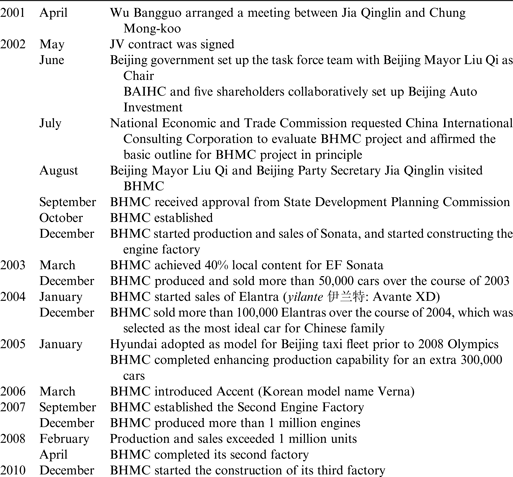
Following the central government's initiative, the Beijing municipal leadership endeavoured to expedite the actualization of the joint venture. In May 2002, the Beijing Party Secretary directed the Hyundai project task force team (qiche gongye lingdao xiaozu, 汽车工业领导小组) chaired by Beijing Mayor Liu Qi 刘淇 to expedite administrative procedures and grant the requisite approval for BHMC to commence operations.Footnote 34 In addition, Beijing's Development and Reform Commission provided extensive support for land purchases, infrastructure development and personnel hiring. Hyundai purchased the Beijing Qingxing Light Truck Automobile factory in Shunyi 顺义 – 170 acres of land and infrastructure valued at RMB160 billion – at a reduced price of RMB50 billion.Footnote 35 Hyundai also received assistance in recruiting advanced engineers and skilled technicians from China.Footnote 36 Such preferential treatment towards joint ventures is not an unusual occurrence, but the degree to which Beijing assisted Hyundai is notable when juxtaposed to its prior relationship with the AMC. This increased government support enabled the BHMC to begin construction quickly in June 2002 and produce its first model within 65 days (see Table 4). The remarkable speed of Hyundai's operation is more apparent when comparing it with Toyota's joint venture experience with Tianjin Automotive Company – an ordeal that lasted more than seven years from initial negotiations to production.Footnote 37
Beijing-Hyundai Motor Company, 2001–2010
Source: Compiled by the author from various sources.
Beijing's municipal leadership adopted two additional measures to help Hyundai settle in the Chinese market. The first measure involved protectionism – promoting Hyundai's model for Beijing's taxi fleet change preceding the 2008 Beijing Olympics. This case demonstrates that China's entry into the WTO has not prevented sub-national governments from navigating through WTO regulation loopholes to continue local protectionism. The second measure was more of a liberalizing move – allowing Hyundai to transplant its suppliers from South Korea to China and abandoning the goal of developing indigenous companies. This was possible due to China's elimination of local content requirements under the WTO's TRIMs.
Local protectionism with Beijing's characteristics: the taxi-changing plan
In addition to providing Hyundai with administrative support, the Beijing leadership decided to follow other regional joint ventures' strategies for success by using internal protectionism to favour locally produced goods and locally based companies. In the automotive sector, several cases have shown that regional protectionism is conducive to joint venture success.Footnote 38 SAIC-Volkswagen and Dongfeng-Citroen in Wuhan strongly encouraged local goods and companies. When SAIC-Volkswagen started operations in 1985, the Shanghai government not only purchased much of the output for government use (including as taxis and municipal vehicles), but also imposed a surcharge on sales to support a new fund for local parts supplier development.Footnote 39
In a similar fashion, sub-national governments devised various ways to directly and indirectly manipulate consumer purchases and thereby promote locally based joint ventures. In the 1990s, the Shanghai government charged a RMB10,000 (US$1,500) licence fee for its joint venture partner Volkswagen's products while charging RMB80,000 to RMB100,000 (US$12,000 to US$15,000) for other vehicle models.Footnote 40 As a result, Volkswagen seized half of the Chinese market for passenger cars. In 1999, the city of Wuhan in Hubei province granted special tax relief to residents who purchased locally made Citroen-Fukang models while imposing surcharges of up to RMB70,000 on those who purchased non-Fukang cars.Footnote 41 SAIC-Volkswagen models, for example, cost twice as much in Hubei province because of government-imposed “Relief Fund for Enterprises in Great Difficulty (tekun qiye jiekun jijin, 特困企业解困基金).”Footnote 42 Such non-tariff barriers of local protectionism were prevalent in the 1990s.
Under such circumstances, the Beijing municipal government and the BAIHC wanted to follow Shanghai and Wuhan's success in using internal protection to create favourable market conditions for Hyundai. The Beijing government's commitment to support BHMC was apparent from the very first month of Sonata's production in December 2002, when the Beijing government purchased all 2,000 units produced: taxi companies, the Beijing city government and the police purchased 600, 500 and 300 units, respectively. Another sign of Beijing's commitment came during the city's taxi fleet change prior to hosting the 2008 Olympic Games. By 2002, a majority of taxis operating in Beijing – including Tianjin Xiali, Citroen Fukang, and Volkswagen Jetta – had reached the end of their six-year life spans. Expecting increased tourism and media coverage, the municipal government mandated that all 70,000 of the city's taxis be replaced by 2007, with a renewal rate of 20 to 30 per cent a year. The announcement spurred major automobile makers to vie for the largest taxi market in China, accounting for 8 per cent of the country's 780,000 taxis in 2002.Footnote 43
The Beijing municipal government recognized the taxi renewal mandate as a propitious opportunity for Hyundai's launch in China. Even before Hyundai Sonata's debut in the market, Liang Jianwei 梁建伟, the director of the taxi management division under the Beijing communication bureau, announced the mid-sized Sonata as the government's first choice for its standard taxi model.Footnote 44 Such official remarks revealed Beijing's preference for Hyundai models and signalled new competition for domestic automakers. Liang's statement provoked fierce objections and sparked controversy among other automakers. Ultimately, the taxi management division was commissioned to draft a new standard for taxi models that would not restrict vehicle brands. All vehicle makers and models were to have equal opportunity to enter the taxi market so long as they satisfied government standards. However, the government still maintained considerable leeway to manipulate these supposed standards.Footnote 45
The 1,500 existing taxi companies in Beijing were free to choose any of the approved models. As a result, major competitors lobbied taxi operators to purchase their models. Chery Automobile – based in Wuhu 芜湖, Anhui province – arranged holiday tours for Beijing drivers in Wuhu in mid-September 2002 to feature its Eastar model. SAIC-Volkswagen unveiled the new Santana 3000 model at the Beijing Auto Show and heavily promoted its in-car equipment, including an updated global positioning system. Even with these added features, the Santana 3000 was marketed at RMB30,000 less than the retail price of a Sonata. SAIC-Volkswagen promoted excursions for Beijing taxi companies to visit Shanghai and other cities where Santana 3000 were widely deployed as taxis.Footnote 46 Li Hongbao, an official with SAIC-Volkswagen's north China sales and service centre, disclosed that some carmakers paid for leaders of Beijing taxi companies to travel to the 2004 Olympic Games in Athens.Footnote 47 However, a number of Beijing taxi firms were not able to “freely” choose what model they wanted because the municipal government controlled their management licences. Ongoing internal debates hampered the Beijing government for more than two years following the announcement of the updated taxi standard.Footnote 48
Eventually, the Beijing municipal government and the BAIHC abandoned their plans to choose only the Sonata for Beijing taxis. From 2005 to 2007, Beijing adopted Hyundai models for 60.5 per cent of its taxi fleet change, which amounted to 34,251 units. Although the use of the Hyundai model for taxis did not directly influence consumer purchases, the increased exposure of Hyundai vehicles affirmed its position in the Chinese market and demonstrated the Beijing leadership's commitment to support BHMC. Executives from other joint ventures commented that since most joint ventures had relied on similar strategies, they could not criticize Beijing's protectionist practices.Footnote 49
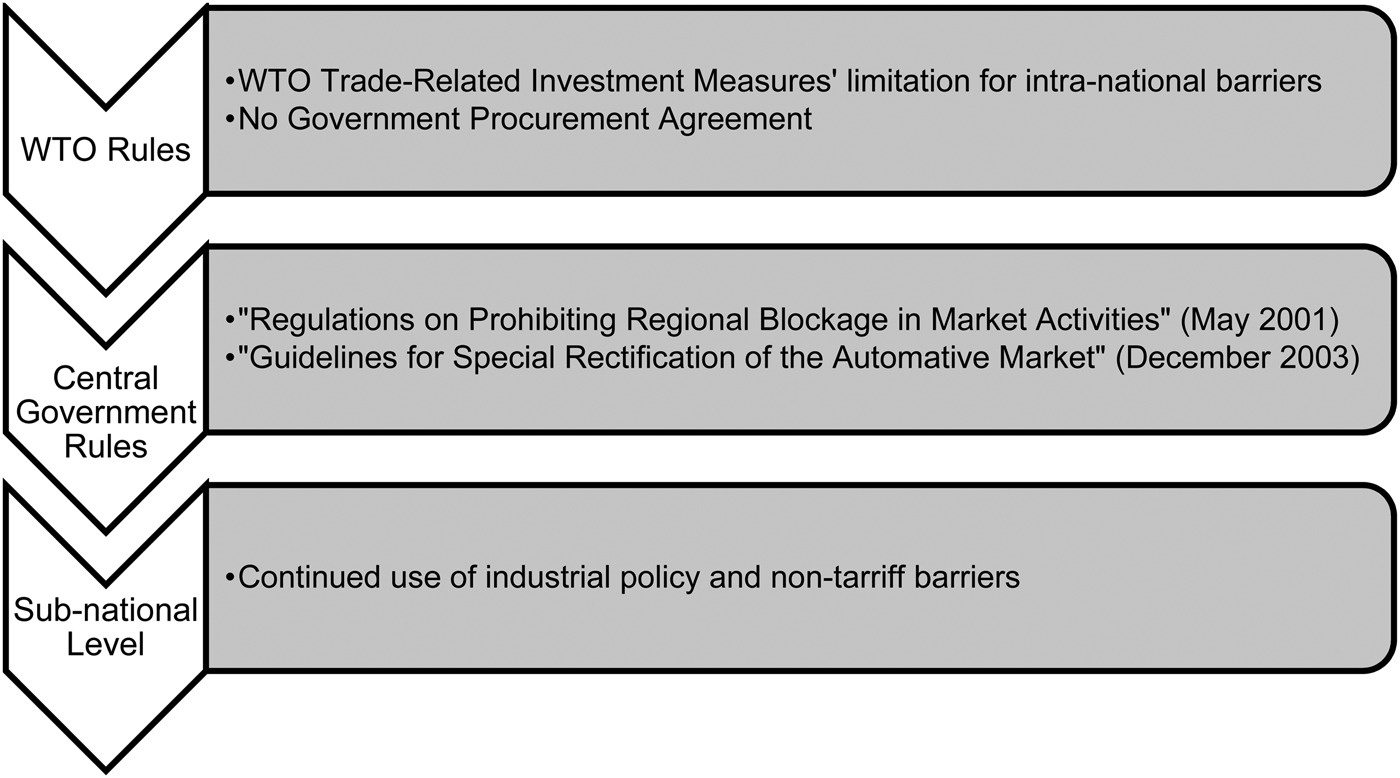
Beijing's policy of supporting locally produced vehicles demonstrates how sub-national governments selectively apply national regulations at the sub-national level and navigate through possible loopholes in WTO regulations (Figure 2). At the international level, TRIMs and the WTO's non-discrimination principle (Article III:4 of GATT) do not speak directly to local protectionism. According to those rules, China cannot maintain separate regulations for domestic and imported products once foreign goods are in the Chinese market. However, the rules do not directly control cases where high intra-national barriers (rather than inter-national barriers) hamper the entry of non-Beijing goods into the Beijing market. At the national level, the central government has enacted several legal provisions to combat regional protectionism and anti-competitive behaviour since 1980. Most recently, in 2003, nine government bodies – including the Ministry of Commerce, Ministry of Transportation, State Administration of Taxation, and State Administration for Industry and Commerce – collectively issued “Guidelines for Special Rectification of the Automotive Market” to counterbalance local protectionism in the automotive industry. However, the central government often turns a blind eye to the implementation of such legal provisions in order to support the development of certain local industries, or perhaps because it lacks the capacity to implement nationwide regulations. Ultimately, Beijing's municipal government was able to get away with implementing partial local protectionism for Hyundai in its own city. By proactively opening the city's taxi market to the BHMC, Beijing's leadership protected its preferred local firm from competing joint ventures and manipulated the domestic distribution of vehicles.
China's Local Protectionism since Joining the WTO
The promotion of locally made goods is not only in the regional government's interest, but also in the foreign partner's interest. Hyundai had internal debates over using Sonata as a taxi fleet vehicle, worrying about the depreciation of its brand image.Footnote 50 Yet it came to an agreement to support the taxi fleet upgrade plan and became one of the major beneficiaries of tacit protectionism and fragmented liberalization in China. China's distinctive pattern of encouraging intra-national competition between regional joint ventures rather than competition between foreign and domestic companies motivates foreign companies to support protectionism rather than pushing for further economic liberalization.
Beijing's taxi fleet change is an especially significant example, since China has not signed the WTO's Government Procurement Agreement (GPA), which would open the door for fair competition when foreign companies bid to supply goods and services to China's government. More than two-thirds of American states and all sub-central entities in the European Union are covered under the GPA. Given that government procurement accounts for about 10 to 15 per cent of GDP in most countries, China's refusal to sign the GPA provides huge leeway for the country's sub-national governments to create arrangements that serve their own interests. The United States and other GPA parties have demanded that China include sub-national entities and certain SOEs in China's GPA, but these demands have not included SOEs in purely commercial activities – such as automakers.Footnote 51 Therefore, the automotive industry will not be included in the GPA even after China signs it, and regional governments will maintain significant leeway in their dealings with automakers.
Macro-level opportunity: WTO membership and bandwagoning to Hyundai's supplier networks
BHMC's supplier network development and sourcing strategy allow us to examine how WTO membership has changed conditions in China, sometimes in unexpected ways. Developing countries tend to use local content requirements as non-tariff barriers and follow an import-substitution strategy by requiring foreign companies to purchase or use inputs of domestic origin. International organizations, particularly the WTO, have strongly attacked these policies because they create barriers to the operations of foreign businesses, but policy makers in developing countries continue to be firm believers in their potential benefits. In the automotive industry, success largely depends on developing a broad network of firms and suppliers. One automobile consists of more than 20,000 parts and 70 per cent of a car's value-added lies in components, compared to only 10 to 15 per cent in assembly. Recognizing the importance of developing indigenous parts suppliers, as early as the 1980s the Chinese central government implemented a schedule of strict local content requirements. Under this arrangement, each joint venture faces severe penalties if it does not meet a localization content rate of 40 per cent in the first year of production, 60 per cent in the second year, and 80 per cent by the third year. However, the drive for quick localization and utilization of Chinese parts has often hampered the level of vehicle quality and the overall health of joint ventures, as illustrated in the case of BJC, the arrangement between Beijing's SOE (BAIHC) and the AMC.
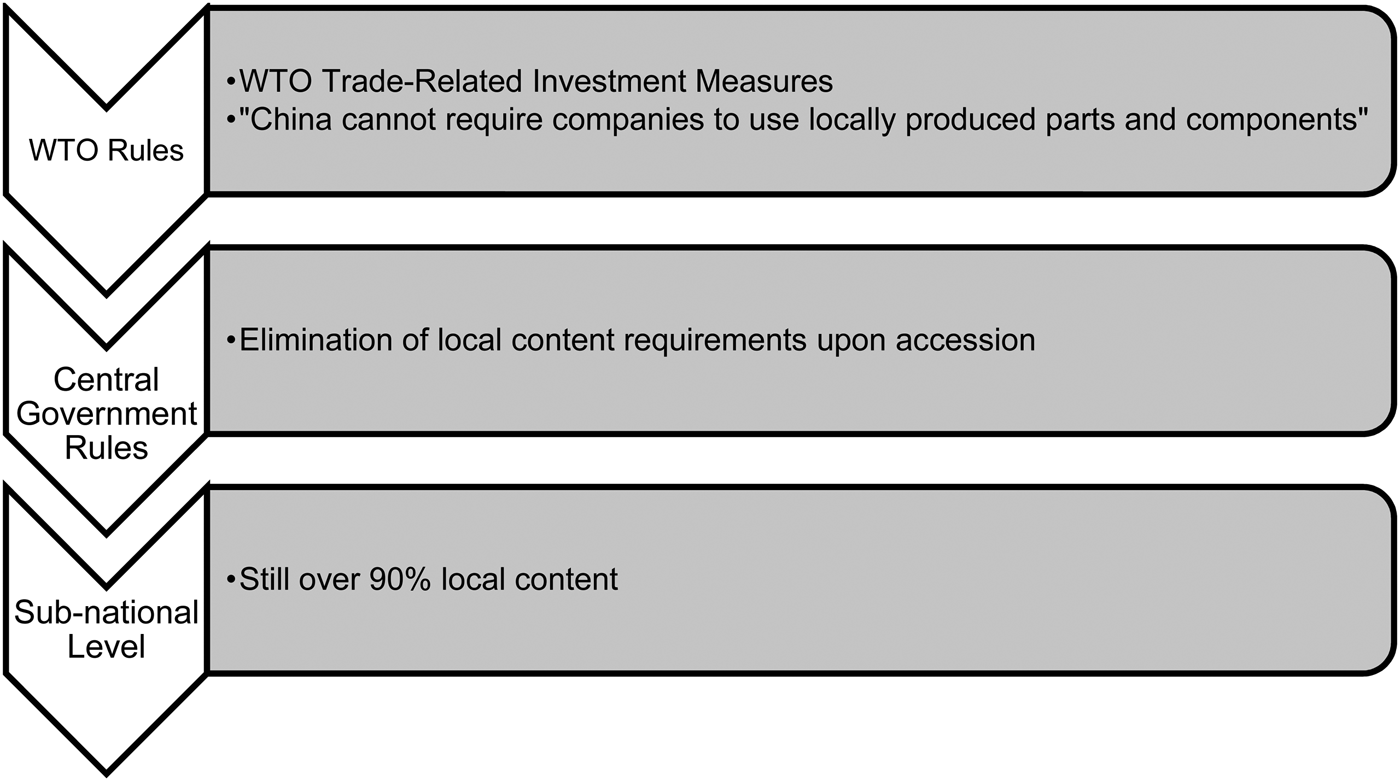
Based on its experience with BJC, the BAIHC learned about the drawbacks of strict local content regulations, and thus shifted strategies to grant Hyundai greater autonomy to organize local supplier networks. In practice, this meant bypassing indigenous firms that had been the focus of earlier development efforts in favour of suppliers from other regions or from the foreign partner's home country. Utilizing outside resources is more effective than adopting the institutional changes involved in cultivating similar resources at home. The BAIHC opted to rely initially on Hyundai's existing Korean-based supplier networks in order to expedite Hyundai's adjustment to China, avoiding the weaknesses in BAIHC's fragmented intra-firm structure. The BAIHC was able to take this course of action without receiving much political criticism for abandoning the goal of developing indigenous companies, because the WTO's TRIMs and GATT Article XI:1 allowed for the elimination of local content requirements. The removal of these requirements allows companies to make parts-sourcing strategy decisions based on business-related reasons rather than the political and legal conditions in China (see Figure 3).
Local Content and Supplier Network since China's WTO entry
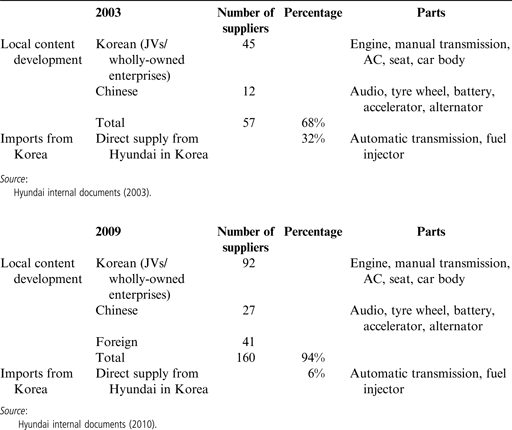
Despite the removal of local content requirements, Hyundai achieved 68 per cent localization by the end of 2003, which increased to 94 per cent by the end of 2009 (see Table 5). It is important to note, however, that this increasing localization reflects the increasing presence of Korean suppliers operating in China rather than parts produced by indigenous Chinese companies. For example, Hyundai brought its most important subsidiary, Hyundai Mobis Automotive Parts Company, to China, and Mobis established five manufacturing operations in Beijing, Shanghai, and Jiangsu to supply the BHMC with 100 per cent of the Sonata's core parts.Footnote 52 Mobis's presence in China not only contributed greatly to the high localization rate without impairing parts quality, but also enabled Hyundai to establish a strong modular operation in order to reduce production costs. This arrangement generated profits within the Hyundai group without ensuring much profit sharing for the BAIHC. Given Hyundai's intimate working relationships with assemblers and suppliers in South Korea, receiving permission to replicate home supplier networks was a significant factor in the company's ability to expedite its adjustment in China without compromising quality.
Composition of BHMC Suppliers in 2003 and 2009
Source: Hyundai internal documents (2010).
Sourcing from Mobis also satisfied political needs in Hyundai Motor's business operations. The president of Hyundai Motor, Chung Mong-koo, owns more shares in Mobis than in Hyundai, which strengthens Mobis' influence on Hyundai's sourcing decisions.Footnote 53 This arrangement is different from the case with General Motors, which has an arms-length relationship with its supplier firms. GM does not restrict its sourcing to Delphi, a GM-spinoff supplier company that is now an independent firm. However, the relationship between Hyundai Motor and Mobis creates an obligation for Hyundai to use its parts-producing subsidiaries instead of focusing on Chinese partners' in-group suppliers.Footnote 54
Same Bed, Different Dreams: Increasing Tension over Sourcing in the Second Phase of Joint Venture Operation
The Beijing municipal government's use of protectionist measures in its taxi procurement and liberalizing measures in its supplier network development contributed to BHMC's “success at Hyundai speed” in the Chinese market. Yet such arrangements tilt the balance of power between joint venture partners in favour of the foreign partner as the joint venture operation matures. A foreign partner's increasing power in joint venture operations is almost inevitable in view of the foreign company's control over sales, purchasing, technology transfer, production and quality control. Better management skills, more competitive models, and pricing and creative marketing strategies have become increasingly indispensable in strengthening a joint venture's position in the world's largest automotive market. Competitive market forces have pressured global automakers to introduce updated technology and models in China in a timely fashion.
Meanwhile, the Chinese partner in an automobile joint venture typically contributes less effort towards developing its own products, but fully shares in the benefits of increased market sales. However, the asymmetrical power distribution within joint ventures has created a sense of crisis for SOEs as they are squeezed by economic forces from above and below. From above, the central government has heavily criticized SOEs for staggering behind foreign competitors and failing to develop national or regional champions of independent models after two decades of government support. From below, private Chinese automakers like BYD and Geely have fared well with their indigenous models.Footnote 55 The BAIHC lies at the centre of attention partly due to its close proximity to the central government. In response to bureaucratic pressure, the BAIHC has striven to develop its independent models and parts companies. This effort has bred increasing tension between the joint venture partners concerning BHMC's sourcing strategy, as more than 90 per cent of parts are supplied by Hyundai's suppliers.Footnote 56 Given that 70 per cent of a vehicle's total value consists of the cost of parts, the BAIHC was concerned that Hyundai would gain a majority of the joint venture's profit. Annual decreases in vehicle retail prices of 7 to 10 per cent heightened the BAIHC's apprehension, as it could lose more revenue through this depreciation.Footnote 57
Such tension prompted the leaders of the BAIHC and Hyundai to cease major corporate decisions for the 2007–2008 fiscal year.Footnote 58 This was a brutal blow to their partnership as 50:50 joint venture formations require consensus from both sides for important decisions over management, personnel and investment. The BAIHC even established its own parts company called Beijing Hainachuan in August 2007.Footnote 59 The intense internal conflicts reflected directly on BHMC's market performance in 2007 and 2008, when it plummeted from second to ninth in terms of unit sales in China. Facing this economic downturn, both joint venture partners realised the damaging results of arguing over localization and sourcing. In early 2009, both partners acknowledged the integral role each plays in the successful maintenance of joint venture operations. For the Beijing city government, the BHMC helps propel the economy, especially after the Beijing Capital Iron and Steel Group relocated to another city. Similarly, Hyundai's Chinese operation risks failure without the cooperation of its Chinese partner.Footnote 60 As such, even though both sides have “different dreams” about the role of joint ventures in developing indigenous Chinese suppliers, joint venture ownership requirements in the auto operations offer them no other choice but to maintain the partnership.
Conclusion
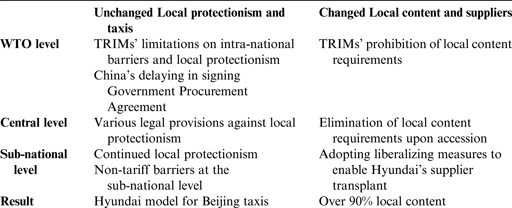
BHMC's extraordinary rise was possible because the Beijing municipal government utilized fragmented liberalization – selectively adopting both protectionist and liberalizing measures to favour its local joint venture with Hyundai (see Table 6). At the micro-level, the failure of the Beijing's previous joint venture with AMC and the threat of a merger between BHMC and with FAW created sufficient political urgency for Beijing municipal leaders to guard their own SOE. This urgency prompted the Beijing government and the BAIHC to leverage public policy to ensure favourable market conditions for Hyundai. At the macro-level, China's entry into the WTO bestowed new autonomy on the Beijing municipal government – not only to adopt local protectionist policies in government procurement, but also to provide Hyundai with huge leeway to bring its own supplier networks into China.
Fragmented Liberalization and BHMC
On the local protectionism front, the Beijing municipal government used its control of taxi companies to create demand for Hyundai cars. It was able to circumvent the central government's effort to create an integrated market in the automotive sector, and to navigate through the limits of WTO rules that only control inter-national barriers and not intra-national barriers. The continued practice of local protectionism demonstrated what had not changed since China's entry into the WTO and what kinds of developmental strategies were available to sub-national governments in a global economy.
In terms of developing local suppliers, the BAIHC relied heavily on Hyundai's supplier network in order to expedite Hyundai's adjustment to China and the revival of the automotive industry in Beijing. Empowered by the WTO rules that prohibit local content requirements, Beijing was able to allow the full transplanting of Hyundai's Korean suppliers without receiving much political criticism for failing to nurture indigenous companies. This strategy coincided well with Hyundai's ability to draw on its existing relationships with suppliers. The unexpected increase in the localization rate of Hyundai's part production in China, despite the removal of local content requirements, proves that WTO membership has affected China, but in a counterintuitive way. The BHMC case study also demonstrates that multinational corporations are not, as many scholars have assumed, necessarily the main drivers of liberalization in China. In fact, foreign partners within sub-national joint ventures foster fragmented liberalization in the country.
The implications of this research extend beyond the sectoral scope of the automotive industry and the national boundaries of China. The automotive sector served as an ideal case to evaluate the developmental path of emerging economies, the role of the state in transforming a country's industrial structure, and the economic integration of local entities into global production networks.Footnote 61 First, the BHMC case study exemplifies how China promoted a local industry sector while inviting FDI into different regions. This developmental path is situated between Mexico's total reliance on FDI and subsequent “dependent development,” and Japan and Korea's relative closure to FDI-oriented development.Footnote 62 Thus, the automotive sector provides unique insight as to China's developmental path, with its emphasis on non-market factors and political influences at the sub-national level. Second, the case study reveals the impact of external actors on China's domestic economic development from the host country perspective and the impact of foreign corporations in joint venture with governments at various levels. China's regulations regarding automotive industry ownership force foreign automakers to embed themselves into the country's existing configuration of industrial and government institutions. Furthermore, different dynamics are brought to bear by the national origins of the FDIs, or the particular conditions of the sub-national governments. As such, this BHMC case study demonstrates what operational strategies are available in emerging economies and how they interact with the power and authority of the FDI recipient. Lastly, by explaining the delicate interplay of rules at the international, national and sub-national levels, this study highlights how WTO rules have perversely granted China's sub-national governments greater autonomy in engaging in subtle anti-competitive practices at the regional level. In a decentralized and fragmented market like China, sub-national level compliance explains the course of liberalization better than national-level compliance.