Introduction
Apart from a few attempts at representative sampling (Dietrich et al. Reference Dietrich, Stofer, Scheidegger, Frei, Groner, Keller, Roth and Steinmeier2000) or near-complete census of small populations (Granbo Reference Granbo1999; Scheidegger Reference Scheidegger2003), conservation assessments of lichen species have usually been based on subjective interpretations of scattered and methodologically heterogeneous data (Thor Reference Thor1995). However, even if datasets of anecdotal observations (herbarium specimens), national mapping surveys and biodiversity inventories are extensive (e.g. Thor Reference Thor1998) and might seem cost-effective to use (Hedenäs et al. Reference Hedenäs, Bisang, Tehler, Hamnede, Jaederfeldt and Odelvik2002), assessment quality remains dependent on the representativeness of the data (Scheidegger & Goward Reference Scheidegger2002; Edwards et al. Reference Edwards, Cutler, Geiser, Alegria and McKenzie2004). This is also true for the current IUCN Red List criteria using quantitative measurements of population size, distribution and trend (Standards and Petitions Working Group 2006), which effectively reduce many types of uncertainty, but not data bias, i.e. systematic over- or under-recording (Regan et al. Reference Regan, Colyvan and Burgman2002).
Two main types of data bias are obvious in conservation assessments of lichen species. First, rare species may be overlooked due to their inconspicuousness (notably microlichens; Scheidegger & Goward Reference Scheidegger, Goward, Nimis, Scheidegger and Wolseley2002; Hallingbäck Reference Hallingbäck2007) or their specific, unexplored habitats (Lõhmus Reference Lõhmus2003; Hallingbäck Reference Hallingbäck2007). Second, even large declines in frequent species may remain undetected due to the absence of standard measures of abundance. These errors in lichen datasets have not, so far, been evaluated owing to the generally infrequent use of representative sampling schemes and, probably also because earlier knowledge has been regarded as insufficient due to the extent, rather than the methods, of data-collecting. Consequently, though the need to improve conservation assessments is clear (Scheidegger & Goward Reference Scheidegger, Goward, Nimis, Scheidegger and Wolseley2002; Hallingbäck Reference Hallingbäck2007), there is no explicit understanding of how this might be achieved.
In this paper, we show how a standardized lichen inventory, initially aimed at describing the effects of forest management at the community and species levels, contributed to conventional databases that were used simultaneously while updating a previous national Red List in Estonia (Randlane Reference Randlane1998). As examples, we use two conspicuous Cladonia species of conservation concern, which inhabit similar, common and relatively well studied substrata. Cladonia parasitica (Hoffm.) Hoffm. is red-listed as Near Threatened in Finland, Sweden and Norway (Rassi et al. Reference Rassi, Alanen, Kanerva and Mannerkoski2001; Gärdenfors Reference Gärdenfors2005; Kålås et al. Reference Kålås, Viken and Bakken2006), while C. norvegica Tønsberg & Holien is suggested to be sensitive to clear-cutting (Kuusinen et al. Reference Kuusinen, Stenroos and Ahti1989) and is included into the European Community Red List of macrolichens (Serusiaux Reference Serusiaux1989). Both species inhabit downed (i.e. either felled or fallen) dead wood (Santesson et al. Reference Santesson, Moberg, Nordin, Tønsberg and Vitikainen2004), a substratum greatly reduced in intensively managed forests in Fennoscandia (Siitonen Reference Siitonen2001), as well as in Estonia (Lõhmus et al. Reference Lõhmus, Lõhmus, Remm and Vellak2005).
Previous knowledge of these species appears relatively good. Macrolichens have been extensively explored and may be considered well-studied in boreal Europe as a whole (Trass & Randlane Reference Trass and Randlane1994; Zavarzin et al. Reference Zavarzin, Katerina, Kotlov, Sokolova, Balashova and Zavarzin1999; Santesson et al. Reference Santesson, Moberg, Nordin, Tønsberg and Vitikainen2004). In addition to extensive herbarium material (Randlane et al. Reference Randlane, Saag and Suija2001), a special meta-analysis of forest lichen inventories has been compiled in Estonia, with the frequencies calculated for the 195 macrolichen species recorded in forests (Lõhmus Reference Lõhmus2003). Additions of new species to the national list have been infrequent and related mainly to revision of taxa difficult to identify (e.g. Tõrra & Randlane Reference Suija, Leppik, Randlane and Thor2007) or those only recently described (Suija et al. Reference Suija, Lõhmus and Jüriado2007a). Amongst substrata, the proportion of rarely recorded species was the lowest for wood-inhabiting lichens, suggesting that under-recording is not a major problem (Randlane et al. Reference Randlane, Saag and Suija2001). Therefore, given also their international status indicated above, it seemed reasonable to accept both species in Estonia as being threatened. Cladonia parasitica has been classified as Vulnerable, on the basis of three old localities, (Randlane Reference Randlane1998), and probably Regionally Extinct (Randlane & Saag Reference Randlane and Saag1999), while C. norvegica was first registered in Estonia in 1999 and has been found only in six other localities during the last ten years (Halonen et al. Reference Halonen, Kukwa, Motiejūnaitė, Lõhmus and Martin2000; databases of the lichen herbaria of the University of Tartu and of the Eurouniversity in Tallinn).
Material and Methods
A field survey of lichen species composition and substratum use was carried out in 46 forest and 46 clear-cut stands in mainland Estonia in 2006–2007 (Fig. 1). The stands represented: (1) four groups of forest site types (sensu Lõhmus Reference Lõhmus1984)—dry boreal forests (mostly Vaccinium vitis-idaea-type) dominated by Scots pine (Pinus sylvestris), and mixed stands of meso-eutrophic (mostly Oxalis-type), eutrophic boreo-nemoral (mostly Aegopodium-type) and swamp forests; (2) four types of management—old-growth (most trees 100–180 years old, coniferous >125 years old; stand age up to at least 300 years), mature (65–95 years' old) semi-natural forests (both recently thinned and unthinned), and clear-cuts (usually 3–7 years post cut) with and without retention of trees. The stands were situated in clusters with the four types of management of one forest type as close to each other as possible (usually within 20 km); if present, different forest types were also studied within the same landscapes. The old-growth stands were those least affected by human activity (such areas are rare in Estonia, e.g. Lõhmus Reference Lõhmus2002) while the other treatments were selected randomly in the surrounding landscape. For each site type, there were five (in swamp forests) or six (in other site types) clusters.
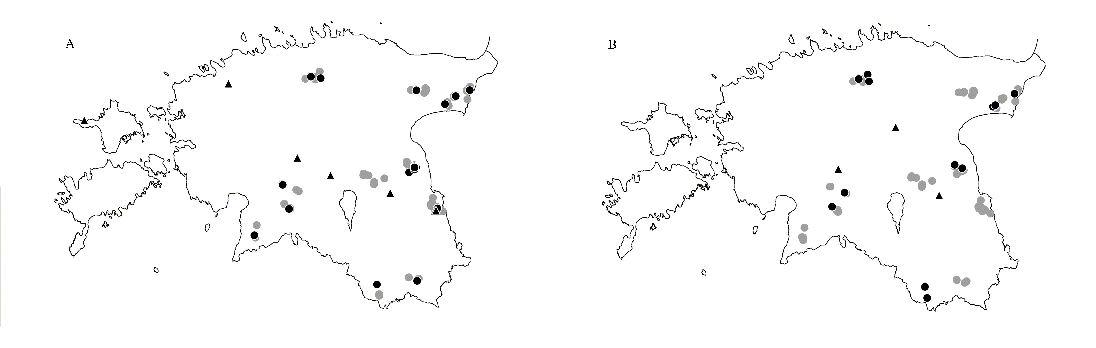
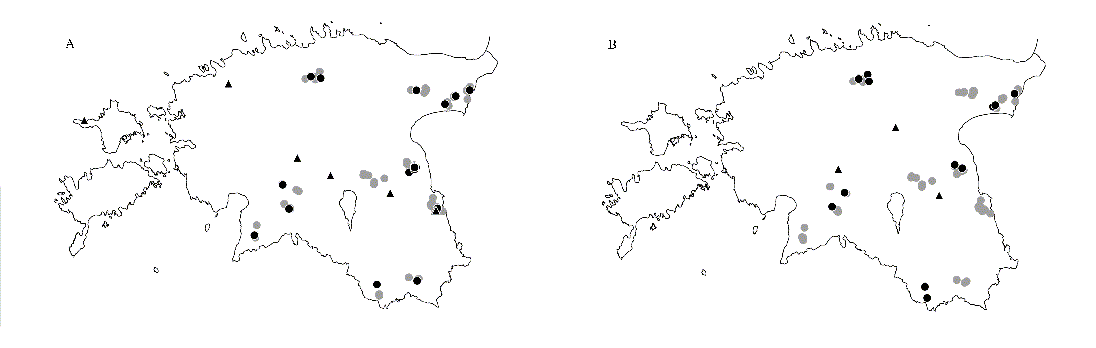
Localities (●) of Cladonia norvegica (A) and C. parasitica (B) found during the inventory of 92 forest and clear-cut stands in Estonia. Stands without records ( ); previously known localities (▴).
The methodological principles followed Hunter & Webb (Reference Hunter and Webb2002). In each stand (a fixed 2-ha area) a 4 h inventory of lichens and lichenicolous fungi from all substrata was carried out by P. L. The frequency (a five-point scale for general purposes or common species, but for rare species each individual record was listed separately) and substratum types inhabited for each species were listed, and the number of species added to the list was noted at 30 min intervals. A ‘record’ means the occurrence of a species on one substratum entity (such as a tree or a stump).
Specimens collected for further identification are deposited in the lichenological herbarium of the Natural History Museum of the University of Tartu (TU). All specimens identified as C. norvegica in the field had red spots on the basal squamules (and sometimes also inside the podetia); the negative Pd-reactions in all the 23 specimens were later confirmed in the laboratory. Thin layer chromatography (TLC; Orange et al. Reference Orange, James and White2001) was used to test for thamnolic acid in each specimen of C. parasitica. Similarly, the earlier collections in TU (three old specimens and one collected by J. Motiejūnaitė in 2006 of C. parasitica and five of C. norvegica) were checked, and one old specimen of C. parasitica was found to be misidentified.
Results
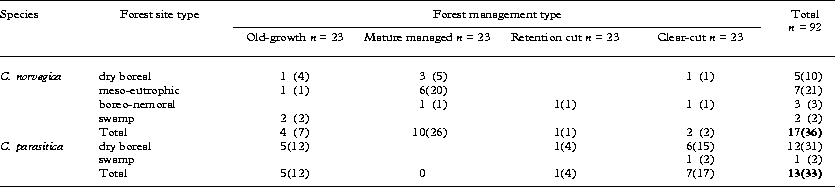
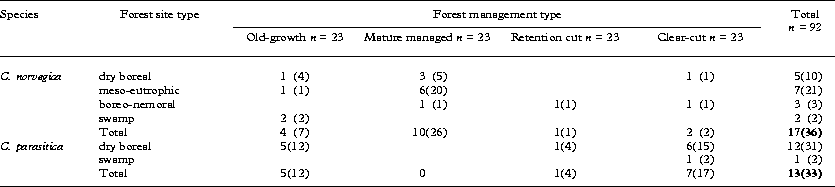
The inventory of 92 stands revealed 13 new localities with a total of 33 records of C. parasitica and 17 localities with 36 records of C. norvegica (Fig. 1; Table 1). Cladonia parasitica was found almost exclusively in dry boreal old-growth forests and clear-cuts (Table 1), always on well-decayed pine wood: downed trunks (25 records in nine stands), cut stumps (six records in three stands) and standing dead trees (two records in the only cut area in the swamp type). Cladonia norvegica was registered in all studied forest and management types, but most often in mature meso-eutrophic forests (Table 1). This species grew mostly on the decayed wood of Scots pine and Norway spruce (Picea abies): downed trunks (18 records in seven stands) and stumps (six natural and one cut stump in six stands); and also on the bark of the living conifers (six records in five stands) and occasionally on birch (Betula spp.) (the bark of three living trees; one windthrow and decayed wood of a cut stump). Forty of the 43 downed trees inhabited by C. norvegica or C. parasitica had fallen naturally (even in the cut areas) and only two records of C. parasitica were from woody debris less than 10 cm diameter.
The number of inhabited stands (total number of records in parentheses) of Cladonia norvegica and C. parasitica among forest and management types in mainland Estonia. For each site type×management type combination, six or (in swamp forests) five 2-ha stands were studied
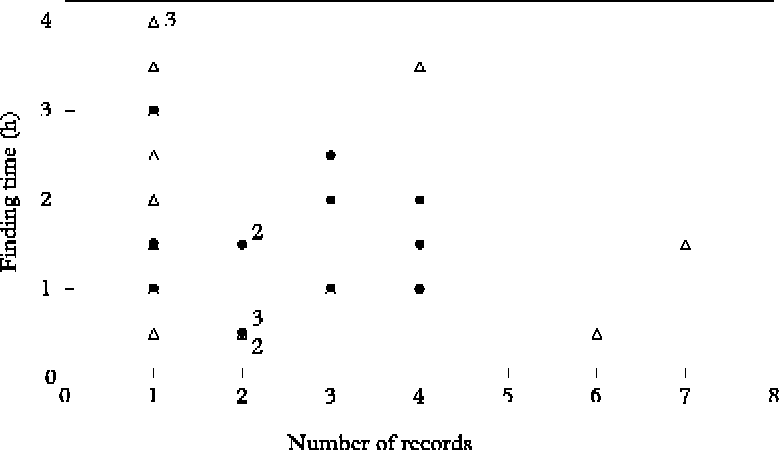
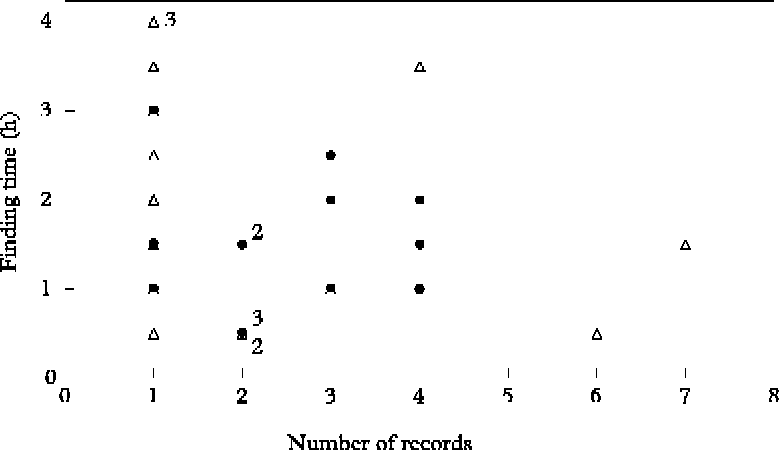
The average number of records per inhabited stand was 2·5 for C. parasitica and 2·1 for C. norvegica (maximum four and seven records, respectively) in four hours. On average, it took 1·5 hours of inventory to discover C. parasitica and 2 hours for C. norvegica so that the time was not clearly related to the local abundance in either species (Fig. 2). However, both species were more difficult to detect in old-growth stands: the average discovery time for C. parasitica was 1·1 hours (range 0·5–1·5 hours) in clear-cuts and 2·2 hours (1·5–3) in old-growth stands, for C. norvegica, it was 1·7 (at least 0·5) hours in managed stands and 3·5 (at least 2·5) hours in old-growth stands.
The time to detection in relation to the total number of records in 4 hours in 2 ha stands for Cladonia norvegica (▵; n = 17 stands) and C. parasitica (●; n = 13 stands). Numbers indicate the number of stands with the same result.
Discussion
The two species examined were more frequent among our c. 8000 records for Cladonia species in the present survey than in the previous herbarium (c. 10 000 specimens in TU) or conservation inventory data from Estonia by an order of magnitude. Macrolichens in general may be seriously under-recorded in Europe (see also Motiejūnaitė Reference Motiejūnaitė2005). We discuss below, the possible reasons for this under-recording, and show how our standard research design and protocol allow us to evaluate the status of the species against the quantitive criteria of the IUCN Red List (Standards and Petitions Working Group 2006), which could not be used prior to our study.
These relatively conspicuous species have probably been previously overlooked because of an unfortunate combination of factors related to their specific habitats and low local abundance versus habitat bias and insufficient duration of former inventories. In addition C. norvegica was described relatively recently (Tønsberg & Holien Reference Tønsberg and Holien1984) and may still be misidentified (Motiejūnaitė Reference Motiejūnaitė2005). The habitat bias was strong because the species appeared to be concentrated in old clear-cuts (C. parasitica) or mature managed forests (C. norvegica), the first of which are not in the focus of conservation inventories and neither are popular locations for yielding casual observations. In fact, C. parasitica was present in each treeless clear-cut of the dry boreal type and C. norvegica in each mature forest of the meso-eutrophic type sampled. Moreover, discovering the few individuals during a search for all lichen species (see Fig. 2) in a 2-ha area required, on average, 1·5–2 hours, while past inventories have usually been shorter (e.g. Jüriado Reference Jüriado, Paal and Liira2003; Suija et al. Reference Suija, Lõhmus and Jüriado2007b). We also argue that the number of quantitative studies (see also Cáceres et al. Reference Cáceres, Lücking and Rambold2008), rather than the share of rarely recorded species among all species, indicates the state of knowledge of a lichen flora. For wood-inhabiting lichens in Estonia, the first criterion revealed inadequate coverage (Lõhmus Reference Lõhmus2003), while the latter suggested at least a satisfactory situation (Randlane et al. Reference Randlane, Saag and Suija2001).
A simple analysis of herbarium data (e.g. Hedenäs et al. Reference Hedenäs, Bisang, Tehler, Hamnede, Jaederfeldt and Odelvik2002), now including our material, might suggest a significant population increase for the two species studied. This is very unlikely given trends in quantities of dead wood in, and age composition, of the Estonian forests (Lõhmus Reference Lõhmus2002; Lõhmus et al. Reference Lõhmus, Lõhmus, Remm and Vellak2005). This illustrates the dangers in assuming uniformity of data collection methods and aims when comparing the numbers of former records. Rather, our data suggest an absence of significant recent trends because both species were well established in environments created by modern forest management. Even though C. norvegica underwent a temporal decline in clear-cut stands (Table 1; see also Kuusinen et al. Reference Kuusinen, Stenroos and Ahti1989), it was obviously able to invade the next forest generation soon enough to have strongholds in mature managed forests (see also Lõhmus and Lõhmus Reference Lõhmus and Lõhmus2008) where it inhabited both dead wood and the trunk bases of living trees. The relatively dense mature stands may be favoured due to their moist microclimate because C. norvegica was less frequent in old-growth forests with a more open canopy. For C. parasitica, the importance of cut areas (in addition to dead wood-rich old forests) seems to have been unnoticed by European lichenologists (cf. Purvis et al. Reference Purvis, Coppins, Hawksworth, James and Moore1992; Arup et al. Reference Arup, Ekman, Kärnefelt and Mattsson1997; Thor & Arvidsson Reference Thor and Arvidsson1999), even though this species is known to be common on exposed fence rails in North America (Brodo et al. Reference Brodo, Sharnoff and Sharnoff2001). The occurrences in the cuts in Estonia could not originate from the pre-cut stands because the species was never found in mature managed forests. However, the occupied cut stumps were well decayed and might often have originated from older thinnings. Cladonia parasitica was clearly confined to the dry boreal pine forests; the only exceptional site being in a cut swamp stand at the edge of such a pine forest, where it inhabited the well exposed standing dead trunks. Hence, in Estonia this species seems to be restricted to dry semi-open or open areas with an abundant supply of decayed pine wood.
The recorded habitat requirements and frequencies of the two species can be used to roughly estimate their national population sizes, given that (1) the records (interpretable as cryptogam individuals for the IUCN criteria; Hallingbäck Reference Hallingbäck2007) obtained in 4 hours represent minimum abundances and (2) there is no obvious reason why the estimated frequencies should not apply to non-sampled stands of similar type and management regime (with the exception of old-growth forests, which were purposefully biased towards the most natural fraction). Underestimation is particularly likely for C. norvegica because an unknown fraction of individuals of this species may lack the red spots, which we used as the basic field identification criterion (Kuusinen et al. Reference Kuusinen, Stenroos and Ahti1989; Timdal Reference Timdal1989). Both species were present in the whole geographical range studied; C. norvegica has been previously collected also from Hiiumaa Island in the west (Fig. 1). Hence, we can consider the area of extrapolation to be most, if not all, of the Estonian land area. Following Lõhmus et al. (Reference Lõhmus, Kohv, Palo and Viilma2004) and Lõhmus (Reference Lõhmus2002) for the site-type and age distribution of the forests, the key areas for C. parasitica are c. 70 000 ha of cut stands (5–20 years post cut) of dry boreal type. This area, given the 58% occupancy of the 2-ha cuts sampled with 2·5 records per site, is likely to host tens of thousands of individuals. The key areas for C. norvegica are mature forests (70–100 years, cover >0·5 Mln ha) of which the most favourable, meso-eutrophic site type, encompasses 16%. Given its occurrence in low numbers across the whole gradient of site and management types studied, it is rather safe to estimate the national population of C. norvegica at >100 000 individuals. Hence, neither species would qualify under the IUCN criteria C (<10 000 mature individuals) or D (<1000 mature individuals; Standards and Petitions Working Group 2006). Moreover, given that a population viability analysis (criterion E) is unavailable, the geographic range criterion (B) cannot be met (our data confirm neither strong fluctuations nor severe fragmentation of the populations) and that strong recent declines are unlikely (see above), the inventory results effectively restrict the Red List evaluation to category A3—the expected trend. A possible future threat to C. parasitica is a significant reduction in dead-wood volumes in clearcuts due to biofuel extraction (cf. Caruso Reference Caruso2008), and we propose it to be Near Threatened. There are no such threats for C. norvegica and this species appears to be one of Least Concern in Estonia.
We conclude that lichen conservation assessments based on herbaria and anecdotal observations alone are extremely unreliable. Even though these sources provide some insight into historical trends and are invaluable for archiving the records of extremely rare or poorly known taxa, basic data for most species should be obtained using representative sampling (see also Hunter & Webb Reference Hunter and Webb2002), preferably with a stratification of habitats or geographical regions (Scheidegger & Goward Reference Scheidegger, Goward, Nimis, Scheidegger and Wolseley2002). Clearly, some additional effort should be put into keeping a strict methodology; this would be highly cost-effective in terms of data quality, particularly if all species and substrata are described during the same inventories. The fieldwork in this study lasted c. 400 h and, although considerable additional time must be devoted to species identification (depending on taxa included), we will have data of similar quality to those described here for hundreds of species. In extensive regions or habitat types, such as forests, and notably for the conservation assessments of most microlichens, alternative methods may simply not exist.
We thank T. Ahti for checking some specimens of Cladonia parasitica, and C. Scheidegger and G. Thor for their constructive comments on the manuscript. The study was supported by the Estonian Science Foundation (grants 6457 and 7402) and the European Union through the European Regional Development Fund (Centre of Excellence) FIBIR.