Vancomycin-resistant Enterococcus (VRE) strains are among the most common multidrug-resistant organisms (MDRO) responsible for healthcare-associated infections (HAIs). Reference Werner, Coque and Hammerum1–Reference Weiner, Webb and Limbago3 VRE bacteremia is associated with significant morbidity and mortality. Reference DiazGranados, Zimmer, Klein and Jernigan4,Reference Song, Srinivasan, Plaut and Perl5 Current infection control guidelines recommend active surveillance, screening, and contact precautions to control and prevent the spread of VRE in hospitals. Reference Muto, Jernigan and Ostrowsky6,Reference Siegel, Rhinehart, Jackson and Chiarello7 However, the effectiveness of these enhanced VRE control measures is unclear, particularly in endemic settings. Reference Harris, Pineles and Belton8–Reference Morgan, Kaye and Diekema10 Recently, some studies have examined the effects of relaxing or discontinuing aspects of a VRE control program. Reference Lemieux, Gardam and Evans11–Reference Johnstone, Shing and Saedi16 However, information about this possibility is limited for Asian countries, despite the high burden of VRE in this area.
On May 2010, our hospital diminished VRE screening for transferred patients from other healthcare facilities. In this study, we evaluated the impact of the VRE screening policy change on the incidence of HA-VRE bacteremia in an endemic setting. In addition, we assessed the impact of VRE screening changes on the transmission dynamics of VRE in the hospital using molecular analyses of VRE blood isolates collected before and after the policy change.
Methods
Study setting and design
We conducted a retrospective time-series analysis to evaluate the impact of the screening policy change on the incidence of HA-VRE bacteremia at the Samsung Medical Center, a 1,989-bed tertiary-care referral center in Seoul, Republic of Korea. It has 128 intensive care unit (ICU) beds, and ˜300 solid-organ transplantations and ˜200 autologous and allogeneic stem-cell transplantations are performed there every year. The study population included all patients admitted between January 1, 2006, and December 31, 2014. The incidence of HA-VRE bacteremia and molecular epidemiologic characteristics of VRE blood isolates were compared before and after the implementation of different screening policies.
Infection prevention and control policies for VRE
Between January 2006 and April 2010, all admitted patients transferred from other healthcare facilities were screened for VRE carriage via a rectal swab or stool culture. However, as the prevalence of VRE in Korea increased, the number of VRE-colonized patients detected by active screening in our hospital dramatically increased and the lack of isolation rooms became a very serious problem. In May 2010, a hospital infection control committee decided to discontinue universal VRE screening. Instead, it was recommended to maintain the original screening practices only for high-risk units including the hemato-oncology ward, pediatric ward, and medical ICUs. During the entire study period, the use of contact isolation among VRE patients was maintained and isolation practices for other multidrug-resistant organisms were not changed. In 2012, our hospital performed targeted interventions in ICUs to reduce central-line–associated bloodstream infections, and in September 2013, daily chlorhexidine bathing (CHB) was initiated in ICUs.
Data definitions and collection
A HA-VRE bacteremia case was defined if VRE bacteremia was identified ≥3 days after hospital admission. The incidence of monthly HA-VRE bacteremia cases was calculated as the number of HA-VRE bacteremia cases per 1,000 patient days per month. A subsequent episode of VRE bacteremia occurring in the same patient >14 days after a prior episode of VRE bacteremia was considered a new bacteremia case. Enterococci other than E. faecium and E. faecalis were excluded from the analysis. The data were divided into 2 periods: a baseline period between January 2006 and April 2010, when universal VRE screening cultures were performed, and the intervention period between May 2010 and December 2014, when universal VRE screening was discontinued. The first month after the screening policies were changed was included in the intervention period. For patients with HA-VRE bacteremia, demographic characteristics including age, gender, unit of occurrence, stay in the ICU, and clinical outcome were obtained through medical record review.
Bacterial isolates and molecular analysis
Vancomycin-resistant E. faecium (VREF) blood isolates collected at Samsung Medical Centre from January 2006 to December 2009 and from January 2011 to December 2014 were used in the molecular analysis. Because the VRE screening policy was changed in 2010, blood isolates collected during 2010 were excluded from the analysis. If VREF blood isolates were repeatedly isolated from a single patient during the entire study period, only the first bacteremia isolate was used for molecular analysis. Species identification and antimicrobial susceptibility testing were performed using an automated VITEK 2 system (bioMérieux, Marcy-l’Étoile, France) according to the manufacturer’s protocol. Multilocus sequence typing (MLST) and pulsed-field gel electrophoresis (PFGE) were performed for analyses of clonal relationships between VREF blood isolates. MLST was performed by PCR for seven housekeeping genes (adk, atpA, ddl, gdh, gyd, purK, and pstS), and all amplicons were sequenced. The sequences were compared with those of alleles recorded in the MLST database (http://pubmlst.org/efaecium) and sequence types were determined. For PFGE typing, whole-cell DNA was digested with SmaI restriction enzyme (TaKaRa) and separated using a CHEF DR II system (Bio-Rad, Hercules, CA). The isolates were categorized into the same PFGE pulsotype group based on >80% similarity.
Statistical analysis
The statistical analysis was performed using SAS version 9.4 software (SAS Institute, Cary, NC). An independent t test was used to compare the incidence rates of HA-VRE bacteremia between the 2 periods. Segmented autoregression analysis of interrupted time series was conducted to estimate the impact of VRE screening policy change on the incidence of HA-VRE bacteremia. This analysis outputs changes in level and or slope that follow an intervention. A change in level in the outcome after the intervention represents an abrupt intervention effect. A change in slope is defined by an increase or decrease in the slope of the segment after the intervention compared with the segment preceding the intervention and represents a gradual change in the value of the outcome during the segment. We analyzed the effect of the screening policy change on the incidence of HA-VRE bacteremia at the entire hospital level and at the hospital unit level (ie, hemato-oncology department and ICUs). P values <.05 were considered statistically signficant.
Results
Incidence of HA-VRE bacteremia before and after screening policy change
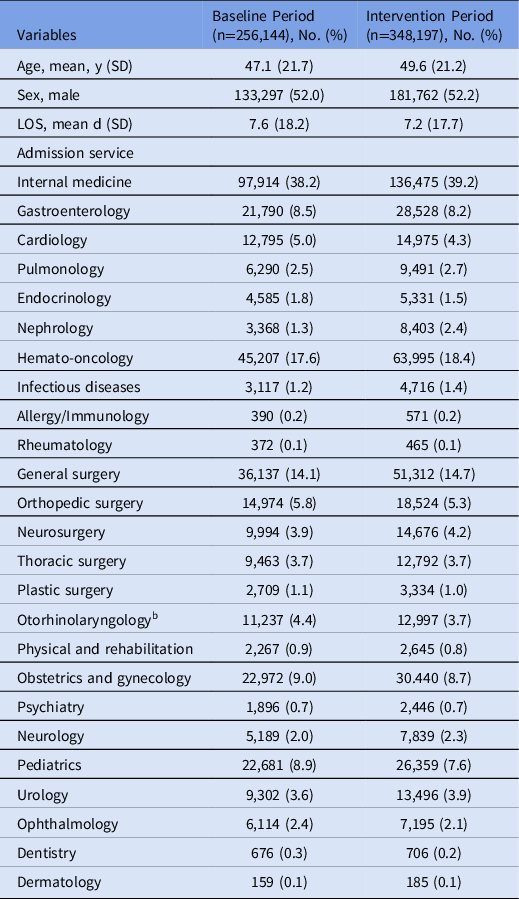
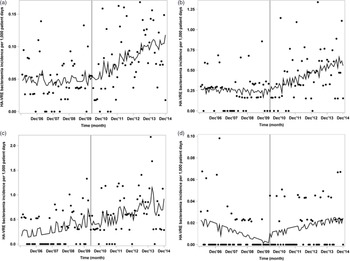
The demographic characteristics of patients admitted to the hospital during the study periods are shown in Table 1. After VRE screening policy change, although there were no significant changes of level or slope in the incidence of HA-VRE bacteremia at the hospital level (Fig. 1 and Supplementary Table 1 online), the incidence of HA-VRE bacteremia significantly increased (Table 2). For the hemato-oncology department, a significant change in slope between periods (change in slope, 0.007; 95% CI, 0.001–0.013; P = .02) as well as the increase in the incidence rates were observed. For ICUs, although no significant changes in slope in the incidence of HA-VRE bacteremia were observed, a similar increasing trend was observed and the incidence rates of HA-VRE bacteremia doubled compared with the baseline period. When analyzing the trend of general wards excluding ICUs and the hemato-oncology department (non-ICU and non–hemato-oncology population), although a slope change was observed, we detected no significant differences in the incidence rate of HA-VRE bacteremia between the 2 periods (Table 2).
Demographic Features of Patients Admitted to the Hospital Between the 2 Periods

Note. LOS, length of hospital stay per patient; SD, standard deviation.
a Unless otherwise indicated.
b Includes head and neck surgeries.
Incidence of HA-VRE bacteremia before and after screening policy change. (a) Entire hospital, (b) hemato-oncology department, (c) ICUs, and (d) non–hemato-oncology departments and non-ICUs. Dot indicates observed value and line indicates predicted value. The horizontal solid line indicates the time of the screening policy change.

Incidence of HA-VRE Bacteremia Between the 2 Periods

Note. HA, healthcare-associated; VRE, vancomycin-resistant Enterococcus; CI, confidence interval; HO, hemato-oncology; ICUs, intensive care units.
a By t test.
Patients with HA-VRE bacteremia
During the study period, 364 HA-VRE bacteremia cases were identified in 360 patients (113 patients in the baseline period and 247 patients in the intervention period). The demographic characteristics of patients with HA-VRE bacteremia were similar for the 2 study periods, based on median age [baseline (57.32 years) versus intervention (56.34 years)], sex [proportion of males; baseline (62.8%) vs intervention (62.3%)], and occurrence of bacteremia in the ICU [baseline (38.9%) vs intervention (49.0%)]. In each study period, 54.9% and 63.2% of patients with HA-VRE bacteremia were hemato-oncology patients. Regarding clinical outcomes, the 30-day mortality rates in patients with HA-VRE bacteremia were similar between periods: 48.7% (baseline period) and 50.6% (intervention period).
Molecular analysis of VRE blood isolates before and after screening policy change
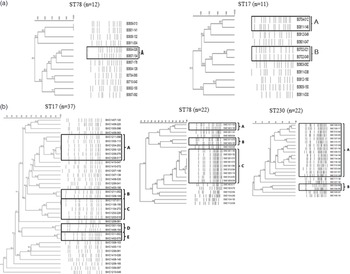
In total, 191 VREF isolates were tested: 41 isolates collected from 2006 to 2009 and 150 VREF blood isolates collected from 2011 to 2014. All isolates contained the vanA gene. Supplementary Figure 2 (online) shows the distribution of sequence types among VREF blood isolates collected according to year. PFGE was performed in a total of 104 VREF blood isolates belonging to the major sequence types in each period (Fig. 2). After the screening policy change, clonally related VREF strains among blood isolates belonging to major sequence types increased from 26.1% (6 of 23) to 59.3% (48 of 81) (Fig. 2).
Genetic relationship of VREF blood isolates between two periods using pulsed-field gel electrophoresis. The predominant sequence types for each period were (a) ST78 (n = 12) and ST17 (n = 11) in the baseline period and (b) ST17 (n = 37) followed by ST78 (n = 22) and ST230 (n = 22) in the intervention period. The outline rectangles indicate isolates with the cutoff level >80% (clonally related VREF strains).

Discussion
The incidence of HA-VRE bacteremia increased significantly over the study periods, and this increase was mainly driven by high-risk populations (hemato-oncology patients and ICU patients). In particular, in the hemato-oncology department, a significant change in slope was observed. We additionally performed the analyses of the change in the incidence of VRE acquisition in clinical specimens between the 2 periods. Following the screening policy change, VRE acquisition rates in clinical specimens significantly increased: 0.09 versus 0.145 per 1,000 patient days (P < .01). A significant change in slope between the 2 periods at the hospital level was also observed: change in slope, 0.0028 (95% CI, 0.0012–0.0044; P < .01).
Severely immunocompromised patients with hemato-oncological malignancies are at higher risk of developing VRE bacteremia than other patient groups. Reference Zaas, Song, Tucker and Perl17,Reference Alevizakos, Gaitanidis, Nasioudis, Tori, Flokas and Mylonakis18 Although the hospital infection control committee had recommended maintaining VRE screening in high-risk units, the frequency of VRE screening in the hemato-oncology department has gradually decreased, as in other general wards. ICU patients are also a well-known high-risk population for invasive VRE infection. Reference Chen, Chuang, Wang, Sheng, Chen and Chang19 In our study, although no significant changes in slope in the incidence of HA-VRE bacteremia in ICUs were observed, the incidence rates of HA-VRE bacteremia doubled compared with the baseline period. Although the original VRE screening policy at admission in ICUs was maintained during the study period, after the policy change, undetected VRE-positive patients hospitalized in the general wards might have been transferred to the ICUs, which could have resulted in the similar effect as the reduction of VRE screening in ICUs.
In the molecular analysis, an increase in diversity in the sequence type distributions was observed after the policy change, which may indicate that new VRE clones emerged and spread in Korean hospitals during the study period and that some of them were introduced into our hospital through interhospital transfer. In addition, clonally related VREF strains among blood isolates belonging to major sequence types (STs) increased from 26.1% (6 of 23) to 59.3% (48 of 81) after the screening policy change. Because contact isolation of VRE patients continued during the study period, this result suggests that the discontinuation of VRE screening may increase nosocomial outbreaks of VRE bacteremia through undetected VRE colonizers. However, because this study was retrospective, not all the VRE blood isolates were included for the molecular analysis. Therefore, a selection bias for the VRE blood isolates may have occurred.
Our study had several limitations. First, this study was performed in a single center; thus, our study findings may be difficult to generalize to other hospital settings. In this study, only data in 2006–2014 were included for analysis. The reason for this is that the Middle East respiratory syndrome (MERS) outbreak in our hospital in 2015 put the hospital in emergency operations for months and even caused partial closure; infection control was further strengthened thereafter. Including data from 2015 might have introduced a bias to our analysis. Unmeasured confounders including changes to hand hygiene, environmental cleaning, and several interventions implemented in ICUs may have influenced these results. In addition, the change in screening policy was not uniformly applied.
Nonetheless, the study had certain strengths. We included comprehensive data collected over a 9-year period, and this study design was appropriate for assessing long-term effects of intervention. Furthermore, this study reflects real situations in Asian countries where resources may be limited for implementation of full screening and isolation. After the policy change, the number of VRE screening tests performed in our hospital decreased by 66.6% and the VRE-positive patient days decreased for 2 consecutive years. However, because the isolation rate of VRE in clinical specimens has increased, the VRE-positive patient days has gradually increased and has reached the level of the preintervention period. Although evaluating costs and benefits of the changed VRE screening policies was beyond the scope of this study, we found that the relaxation of VRE screening might be cost saving in the aspect of screening costs. However, this policy change could lead to an increase in HA-VRE bacteremia incidence rates, particularly in high-risk populations. Therefore, in settings with limited infection control resources, targeted VRE screening for high-risk patients might be a feasible option.
In conclusion, the incidence of HA-VRE bacteremia increased significantly after VRE screening policy change, and this increase was mainly driven by high-risk patient populations such as patients in the hemato-oncology department and ICUs. When planning VRE control programs in hospitals, different approaches that consider the risk for severe VRE infection in patients may be required. Further studies are required regarding the optimal approach for VRE control in various healthcare settings.
Acknowledgments
Data analysis and interpretation were supported by Statistics and Data Center, Research Institute for Future Medicine, Samsung Medical Center.
Financial support
This work was supported by the National Research Foundation of Korea (NRF) grant funded by the Korea government (MSIP No. 2019R1C1C1005204).
Conflicts of interest
All authors report no conflicts of interest relevant to this article.