Introduction
In recently proposed alternative dimensional models of personality disorder (PD), such as the alternative model of personality disorders (AMPD) in the Diagnostic and Statistical Manual of Mental Disorders – Fifth Edition (DSM-5; Skodol et al., Reference Skodol, Clark, Bender, Kruegar, Morey, Verheul and Oldham2011) and the proposed International Classification of Diseases-11th Revision (ICD-11; World Health Organization, 2018), impairments in self and interpersonal functioning define the presence and severity of a PD. A primary goal of this reformulation is to address the long-standing problem of high comorbidity across traditional PD diagnostic types (e.g. borderline PD; Cacciola, Rutherford, Alterman, McKay, & Mulvaney, Reference Cacciola, Rutherford, Alterman, McKay and Mulvaney1998; Chmielewski, Clark, Bagby, & Watson, Reference Chmielewski, Clark, Bagby and Watson2015; Markon, Chmielewski, & Miller, Reference Markon, Chmielewski and Miller2011; Regier et al. Reference Regier, Narrow, Clarke, Kraemer, Kuramoto, Kuhl and Kupfer2013), which reflects the substantial interrelatedness among variants of personality pathology (Widiger & Rogers, Reference Widiger and Rogers1989; Wright et al., Reference Wright, Thomas, Hopwood, Markon, Pincus and Krueger2012).
A reformulation of PD is supported by research showing that most pathological personality features can be grouped together under one general factor (Sharp et al., Reference Sharp, Wright, Fowler, Frueh, Allen, Oldham and Clark2015; Wright, Hopwood, Skodol, & Morey, Reference Wright, Hopwood, Skodol and Morey2016) and that the severity of personality impairment—reflected in self-interpersonal functioning—rather than the presence of typology is a better prognostic predictor (Hopwood, Reference Hopwood2011; Parker et al., Reference Parker, Both, Olley, Hadzi-Pavlovic, Irvine and Jacobs2002). By placing self-interpersonal impairment at the core of personality pathology, novel dimensional models offer a transformative paradigmatic shift in the conceptualization of PD. However, the neurobiology of self-interpersonal impairment in PD remains largely uninvestigated. As PDs have historically been considered difficult disorders to treat due to their complex clinical presentation (Ekselius, Reference Ekselius2018), delineating the neural correlates of self-interpersonal impairment will contribute to the uncovering of biomarkers that cut across traditional boundaries of PD diagnoses and may be used prospectively to improve treatment outcomes (Marceau, Meuldijk, Townsend, Solowij, & Grenyer, Reference Marceau, Meuldijk, Townsend, Solowij and Grenyer2018). Additionally, such an investigation is in line with the National Institute of Mental Health (NIMH) Research Domain Criteria (RDoC) initiative, which proposes a dimensional neuroscience-based research framework for the study of psychopathology (Insel et al., Reference Insel, Cuthbert, Garvey, Heinssen, Pine, Quinn and Wang2010). Similar to the rationale underlying the DSM-5 Alternative Model and proposed ICD-11 dimensional reformulations of PD, the RDoC initiative acknowledges the limitations associated with categorical psychiatric taxonomy with respect to a failure to capture pertinent underlying neurobiological mechanisms. The RDoC serves as a research framework to study the underlying neural mechanisms of dysfunction associated with multiple systems and processes, including social processes relevant to the perception and understanding of the self and others, which intersect with the DSM-5 Alternative Model and proposed ICD-11 model for PD. Neurobiological research on self and interpersonal dysfunction as conceptualized in these alternative models could help to bring advancements in PD nosology in line with the RDoC framework and increase understanding of RDoC constructs pertinent to social processes.
Resting-state functional magnetic resonance imaging (rs-fMRI) is a powerful method used to investigate neuroimaging biomarkers of psychiatric illness. Rs-fMRI quantifies intrinsic, low-frequency oscillations in the blood-oxygen level-dependent (BOLD) signal, and offers an advantage over task-based fMRI, the latter of which produces results that are dependent on task selection and have historically been inconsistent (van Zutphen, Siep, Jacob, Goebel, & Arntz, Reference van Zutphen, Siep, Jacob, Goebel and Arntz2015). In PD research, rs-fMRI has been most used to explore the default mode network (DMN), which is comprised of a set of functionally integrated structures that cross the brain's midline and lateral regions (Uddin, Reference Uddin2015). The DMN is strongly implicated in self-referential processing, including introspection (Buckner, Andrews-Hanna, & Schacter, Reference Buckner, Andrews-Hanna and Schacter2008), reflection on one's own thoughts and feelings (Whitfield-Gabrieli & Ford, Reference Whitfield-Gabrieli and Ford2012) and social cognitive interaction (Li, Mai, & Liu, Reference Li, Mai and Liu2014). Two regions within the DMN—the MPFC and temporal−parietal junction (TPJ; comprised of the superior temporal sulcus (STS), supramarginal gyrus, and angular gyrus)—are strongly implicated in theory of mind (Saxe & Kanwisher, Reference Saxe and Kanwisher2003) and mentalization (Bateman & Fonagy, Reference Bateman and Fonagy2004). As such, the MPFC and TPJ are collectively referred to as the core mentalization network (Van Overwalle & Vandekerckhove, Reference Van Overwalle and Vandekerckhove2013), which is a prime candidate for the investigation of self-interpersonal impairment in PD.
Rs-fMRI research on PD has frequently focused on borderline personality disorder (BPD), which is the most well understood PD from a neurobiological perspective (Ruocco & Carcone, Reference Ruocco and Carcone2016). BPD is associated with core impairment in self-interpersonal functioning, also referred to as disturbed relatedness (Sanislow et al., Reference Sanislow, Grilo, Morey, Bender, Skodol, Gunderson and McGlashan2002). Meta-analyses of rs-fMRI in BPD converge on hyperactivation in the medial prefrontal cortex (MPFC)/ACC, (Amad, Radua, Vaiva, Williams, & Fovet, Reference Amad, Radua, Vaiva, Williams and Fovet2019; Visintin et al., Reference Visintin, De Panfilis, Amore, Balestrieri, Wolf and Sambataro2016), but patterns of activation in the posterior DMN are more divergent (Amad et al., Reference Amad, Radua, Vaiva, Williams and Fovet2019; Visintin et al., Reference Visintin, De Panfilis, Amore, Balestrieri, Wolf and Sambataro2016; Wolf et al., Reference Wolf, Sambataro, Vasic, Schmid, Thomann, Bienentreu and Wolf2011). Laterally, patterns of hypoactivation in temporal regions of the DMN have emerged (Visintin et al., Reference Visintin, De Panfilis, Amore, Balestrieri, Wolf and Sambataro2016), as well as lower mean overall connectivity (Quattrini et al., Reference Quattrini, Pini, Pievani, Magni, Lanfredi, Ferrari and Rossi2019). Task-based fMRI findings in BPD of higher MPFC activation during social exclusion (Wrege et al., Reference Wrege, Ruocco, Euler, Preller, Busmann, Meya and Walter2019), and lower TPJ connectivity during theory of mind processing (ONeil et al., Reference ONeil, D'Souza, Samson, Carballedo, Kerskens and Frodl2015) are consistent with the core mentalization deficits observed among individuals with BPD (Fonagy & Luyten, Reference Fonagy and Luyten2009). Outside of the DMN, rs-fMRI and task-based fMRI studies have identified substantial disruptions in the frontolimbic circuit in BPD (Ruocco & Carcone, Reference Ruocco and Carcone2016), converging on the orbitofrontal cortex, dorsolateral prefrontal cortex (DLPFC), and amygdala (Díaz-Marsá et al., Reference Díaz-Marsá, Carrasco, López-Ibor, Moratti, Montes, Ortiz and Lopez-Ibor2011; Dudas et al., Reference Dudas, Mole, Morris, Denman, Hill, Szalma and Voon2017; New et al., Reference New, Hazlett, Buchsbaum, Goodman, Mitelman, Newmark and Siever2007; Silbersweig et al., Reference Silbersweig, Clarkin, Goldstein, Kernberg, Tuescher, Levy and Stern2007; Visintin et al., Reference Visintin, De Panfilis, Amore, Balestrieri, Wolf and Sambataro2016). Indeed, BPD is often conceptualized as a disorder of emotion dysregulation, and limbic system abnormalities have been proposed as candidate endophenotypes of BPD (Ruocco, Amirthavasagam, & Zakzanis, Reference Ruocco, Amirthavasagam and Zakzanis2012). Moreover, central executive network (CEN) and salience network (SAL) abnormalities have been identified (Doll et al., Reference Doll, Sorg, Manoliu, Wöller, Meng, Förstl and Riedl2013; Quattrini et al., Reference Quattrini, Pini, Pievani, Magni, Lanfredi, Ferrari and Rossi2019) and correlated with self-interpersonal traits such as metacognitive ability and interpersonal aggression in BPD (Quattrini et al., Reference Quattrini, Pini, Pievani, Magni, Lanfredi, Ferrari and Rossi2019).
Although rs-fMRI PD research has predominantly been carried out on BPD, the results of studies on other PDs and PD traits point to common abnormalities across four networks: DMN, frontolimbic, SAL, and CEN. Indeed, rs-fMRI studies on antisocial personality disorder (ASPD; Jiang et al., Reference Jiang, Shi, Liao, Liu, Wang, Shen and Shen2017), obsessive−compulsive personality disorder (OCPD; Coutinho, Goncalves, Soares, Marques, & Sampaio, Reference Coutinho, Goncalves, Soares, Marques and Sampaio2016; Lei et al., Reference Lei, Huang, Li, Liu, Fan, Zhang and Rao2020), and narcissistic (Feng et al. Reference Feng, Yuan, Geng, Gu, Zhou, Wu and Luo2018) and avoidant PD traits (Bauml et al. Reference Bauml, Baumann, Avram, Bratec, Breeman, Berndt and Sorg2019), have observed disturbances in functional connectivity (FC) within these four networks. This apparent overlap in neural network dysfunction may be explained by common underlying symptom dimensions that cut across PD diagnoses. Self-interpersonal impairment across PD diagnoses may contribute to a significant degree of shared variance in FC in these four networks, a hypothesis that has yet to be explored in a PD sample using a cross-cutting measure of personality impairment. In fact, there is a clear paucity of research that explores the dimensional neurobiology of PD, as fMRI has almost exclusively been used to characterize the neural underpinnings of specific PD diagnoses, despite the potential of dimensional, neuroscience-based research to illuminate the neurobiology of PD (Koudys, Traynor, Rodrigo, Carcone, & Ruocco, Reference Koudys, Traynor, Rodrigo, Carcone and Ruocco2019).
In the present study, we investigated interconnections within the DMN, frontolimbic, SAL, and CEN using resting-state functional connectivity (rsFC), which estimates the degree of functional coupling between neural regions by quantifying the temporal correlation in BOLD signal and permitting the visualization of connectivity between nodes of a network, which is consistent with the notion that psychiatric illness involves a disruption of network neurocircuitry (Morris & Cuthbert, Reference Morris and Cuthbert2012). We studied a sample of patients with a PD, at minimum carrying a diagnosis of BPD, but also other comorbid PDs, and a healthy control group. First, we compared the PD and healthy control groups in the strength of connectivity within these networks to examine potential disruptions in rsFC. Second, we used a dimensional measure of personality functioning to investigate associations of rsFC with Criterion A self and interpersonal impairments, and examined potential differential associations across the DMN, frontolimbic, SAL, and CEN. In an exploratory manner, we investigated the extent to which variation in rsFC in the PD group is explained by dimensional personality impairment as compared to the Borderline Symptom List – 23 Item (BSL-23; Bohus et al., Reference Bohus, Kleindienst, Limberger, Stieglitz, Domsalla, Chapman and Wolf2009), a measure of BPD symptom severity, which is based on the DSM conceptualization of BPD and other BPD-specific symptoms (Kleindienst, Jungkunz, & Bohus, Reference Kleindienst, Jungkunz and Bohus2020). First, we hypothesized that patients with PD would show rsFC differences from healthy controls within the DMN/core mentalization, frontolimbic, SAL, and CEN networks. Second, we hypothesized that self-interpersonal impairment would be associated with patterns of rsFC within the DMN/core mentalization network, given the self-other processes that this more narrowly delineated network supports.
Materials and methods
Participants
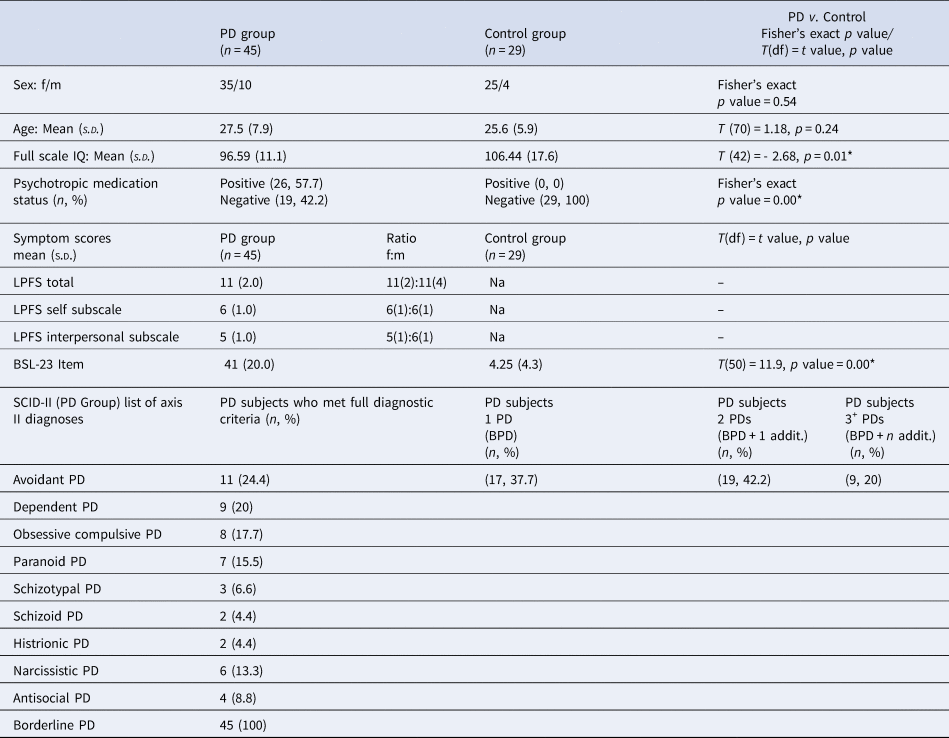
Data from 74 participants were used (45 PD, 29 HC; Table 1). To determine eligibility, all participants completed a clinical interview with a licensed psychiatrist or psychology trainee under the supervision of a licensed psychiatrist. The interview consisted of a semi-structured psychodiagnostic assessment, and sociodemographic and symptom measures. Patients with PD were recruited from a 12-week inpatient treatment program at the Psychiatric University Hospital of Basel in Switzerland. All patients met criteria at minimum for BPD according to the Diagnostic and Statistical Manual of Mental Disorders – Fourth Edition – Text Revision (DSM-IV-TR; American Psychiatric Association, 2000), as well as a number of other PDs. HC participants were recruited via community advertisements, and were not permitted to have a current or lifetime DSM-IV-TR psychiatric disorder, which was assessed during the interview. Patients and controls were assessed using the Structured Clinical Interview for DSM-IV-TR Axis II Personality Disorders (SCID-II) – German Version (Wittchen, Zaudig, & Fydrich, Reference Wittchen, Zaudig and Fydrich1997) and the Structured Clinical Interview for DSM-IV (SCID-1) – German Version (Wittchen et al., Reference Wittchen, Zaudig and Fydrich1997). Diagnoses were assigned after clinical information was reviewed at a consensus meeting. Additional exclusion criteria for all participants included the presence of acute psychotic symptoms or intoxication, dementia, neurological disorders, and standard MRI safety contraindications. All participants were capable and provided informed consent to participate. Additional details on procedures are available elsewhere (Wrege et al., Reference Wrege, Ruocco, Euler, Preller, Busmann, Meya and Walter2019).
Demographic and diagnostic data

Measures
DSM-5 alternative model of personality disorders (AMPD), levels of personality functioning scale (LPFS)
The levels of personality functioning scale (LPFS; Bender, Morey, & Skodol, Reference Bender, Morey and Skodol2011) is a dimensional, clinician rated tool that operationalizes Criterion A of the DSM-5 AMPD, which is comprised of impairments in self (identity and self-direction) and interpersonal (empathy and intimacy) functioning, with initial research suggesting good reliability and validity (Morey, Reference Morey2017; Zimmermann et al., Reference Zimmermann, Benecke, Bender, Skodol, Schauenburg, Cierpka and Leising2014, Reference Zimmermann, Böhnke, Eschstruth, Mathews, Wenzel and Leising2015), and a high degree of intercorrelation between the self and interpersonal functioning scales, which is consistent with the notion that personality functioning is best represented as a single dimension (Bender et al., Reference Bender, Morey and Skodol2011; Morey, Reference Morey2017). Using a five-point scale ranging from 0 (no impairment) to 4 (extreme impairment), participants received a clinician-rated dimensional score on each of the four LPFS scales: identity, self-direction, empathy, and intimacy (Bender et al., Reference Bender, Morey and Skodol2011). Identity and self-direction scores were summed to create a score representing ‘self impairment’, and empathy and intimacy scores were summed to create a separate score for ‘interpersonal impairment’. Total raw scores represented the sum of self and interpersonal impairment. Ratings used in the present analysis were made by a licensed psychiatrist and were compared against a group of three independent raters. Kappa values indicated excellent inter-rater reliability for the self, interpersonal, and total scores, as demonstrated by 84.9, 82.6, and 79.6% agreement, respectively.
Borderline symptom list-23 (BSL-23)
All participants completed the Borderline Symptom List-23 (BSL-23; Bohus et al., Reference Bohus, Kleindienst, Limberger, Stieglitz, Domsalla, Chapman and Wolf2009), a self-report consisting of items representative of typical BPD symptoms, and which are rated on a scale of 0 (not at all) to 4 (very strong). The BSL-23 has demonstrated good psychometric properties as observed by high internal consistency (Chronbach's alpha = 0.935–0.969), and discriminant validity (mean effect size = 1.13 when discriminating BPD from Axis I disorders; Bohus et al., Reference Bohus, Kleindienst, Limberger, Stieglitz, Domsalla, Chapman and Wolf2009). Cronbach's alpha for scores in the present study was 0.94 indicating excellent internal consistency.
fMRI data acquisition
Participants were not permitted to consume alcohol or drugs for three days prior to the scan (excluding nicotine) and completed a breathalyzer test and urine toxicology screen prior to scanning. Some participants in the PD group were taking psychotropic medications (see online Supplementary Table S1). MR data were obtained using a 3 T MRI scanner (Siemens Magnetom Prisma, Erlangen, Germany) and a 20-channel phased array radiofrequency head coil. All participants underwent a 5:08 min resting-state MRI scan using an axial echo planar imaging sequence, TR/TE = 1800/28 ms; 35 interleaved slices; slice thickness = 3.5 mm; 0.5 mm interslice gap; flip angle = 82°; FoV = 224 × 224 mm2; inplane image matrix = 64 × 64 resulting in a 3,5 × 3,5 × 3,5 mm3 resolution; 168 measurements; bandwidth 2442 Hz/Px. A high-resolution structural T1 scan was acquired using a sagittal three-dimensional magnetization-prepared rapid acquisition gradient echo (3D-MPRAGE). Participants were instructed to relax, close their eyes, and to not fall asleep for the duration of the scan.
fMRI data preprocessing
Data were preprocessed using CONN Functional Connectivity Toolbox (Whitfield-Gabrieli & Nieto-Castanon, Reference Whitfield-Gabrieli and Nieto-Castanon2012). The first three functional volumes from each scan were discarded to account for T2 equilibration effects. Preprocessing included participant motion estimation and correction via realignment of the time series using a six rigid-body parameter, unwarping of the time series to reduce susceptibility-distortion-by-movement interaction (Andersson, Hutton, Ashburner, Turner, & Friston, Reference Andersson, Hutton, Ashburner, Turner and Friston2001), co-registration of functional and structural images using a rigid-body transformation (Ashburner et al., Reference Ashburner, Barnes, Chen, Daunizeau, Flandin, Friston and Phillips2013), gray matter/white matter/CSF segmentation, normalization of images to Montreal Neurologic Institute (MNI) space, resampling into 2 mm3 isotropic voxels, functional outlier detection of movement greater than 0.9 mm or global mean intensity change of more than 5 s.d., and smoothing with a 6 mm full-width at half-maximum kernel. Participant-specific connectivity maps were produced in the first-level analysis after denoising was applied using the principle component-based noise correction method ‘CompCor’ (Behzadi, Restom, Liau, & Liu, Reference Behzadi, Restom, Liau and Liu2007). Motion scrubbing was used to remove outlier scans identified during preprocessing (Power, Barnes, Snyder, Schlaggar, & Petersen, Reference Power, Barnes, Snyder, Schlaggar and Petersen2012). A linear detrending term was applied. All preprocessed scans were band pass filtered at 0.008–0.09 Hz. t tests revealed no significant differences between the PD and HC group in either mean t [72] = 0.89, p two−sided = 0.37, or maximum head motion t [72] = 1.45, p two−sided = 0.15.
Region of interest definition
Evidence-based a priori regions of interest (ROIs) were selected to examine within-network rsFC in the DMN/core mentalization, frontolimbic, SAL, and CEN (online Supplementary Table S2). DMN/core mentalization ROIs were selected with a focus on dividing the MPFC into dorsal and ventral regions with functional specialization in mentalizing (Amodio & Frith, Reference Amodio and Frith2006). The anterior parahippocampal gyrus was selected due its association with affective-related processing, as opposed to the visual-related posterior region (Aminoff, Kveraga, & Bar, Reference Aminoff, Kveraga and Bar2013).
Functional connectivity analysis
Between-group differences in rsFC within the networks of interest were identified in the second-level ROI-to-ROI analyses in the CONN Toolbox. Effects represent the bivariate temporal correlation of each source ROI with every other target ROI within the network of interest (Whitfield-Gabrieli & Nieto-Castanon, Reference Whitfield-Gabrieli and Nieto-Castanon2012). The between-group analyses statistically controlled for significant differences in IQ and medication status between the PD and HC groups.
Within-group analyses explored relationships between rsFC in the PD group and (a) LPFS scores, and (b) BSL-23 scores, while controlling for medication status and sex. Then, more specific associations between frontolimbic rsFC and the LPFS self and interpersonal subscale scores were explored using a multivariate F test to first identify any effects among the self and interpersonal subscales on rsFC. Post hoc tests were used to explore simple main effects.
All results were considered significant if they survived correction for multiple comparisons at a threshold of p < 0.05 after applying a false discovery rate correction (FDR) (Benjamini & Hochberg, Reference Benjamini and Hochberg1995). A Bonferroni correction was applied to post hoc tests by dividing alpha = 0.05 by six, for each of the pairwise comparisons examined (i.e. each of the two separate LPFS subscores across each of the three bivariate connectivity patterns that resulted from the omnibus F test), resulting in a significance threshold of p = 0.008.
Results
Descriptive data
Table 1 contains demographic and diagnostic information. Significant differences in IQ and medication status were found between the PD and HC group. The two groups did not significantly differ in age or sex ratio. Among PD participants, a relatively equivalent representation of Clusters A and C diagnoses was observed, with Cluster B being the most common (i.e. all participants met criteria for BPD).
Correlations between LPFS and BSL-23 scores
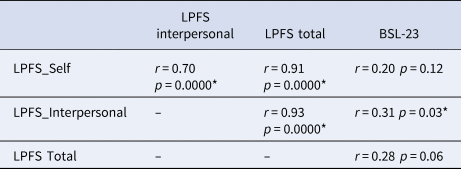
Correlations between the LPFS total and subscale scores, and the BSL-23 scores were explored via a correlation matrix using R statistical software (R Core Team, 2013). Pearson's correlation coefficients and significance values (alpha = 0.05) were calculated (see Table 2).
Pearson's R correlation matrix: BSL-23 self-report and LPFS self, interpersonal, and total scores

LPFS - Levels of Personality Functioning Scale; BSL-23 – Borderline Symptom List – 23.
* indicates statistical significance at p < 0.05.
Between group differences in rsFC
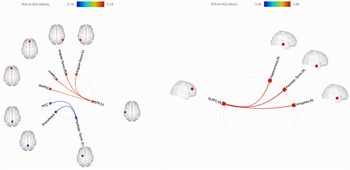
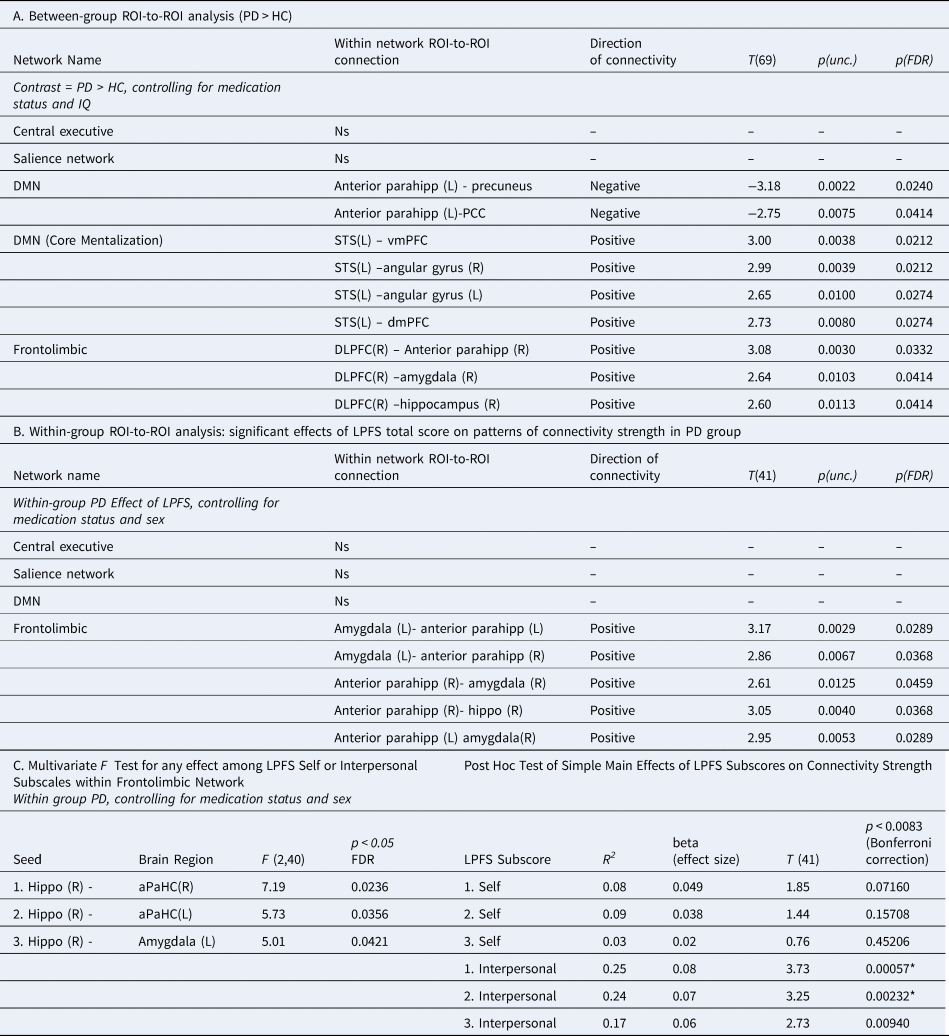
Between-subject ROI-to-ROI effects are displayed in Table 3 (Section A) and Fig. 1left and right. Within the DMN, underconnectivity of the left anterior parahippocampal gyrus with the precuneus/PCC was observed in PD participants compared to controls. In contrast, within the core mentalization network, overconnectivity within the TPJ (i.e. the left STS with the bilateral angular gyrus), and of the left STS with the dmPFC and vmPFC, was observed. Within the frontolimbic network, relative to controls, PD participants displayed right lateralized overconnectivity of the DLPFC with three closely interconnected limbic areas: anterior parahippocampal gyrus, amygdala, and hippocampus. There were no significant between-group differences in SAL or CEN rsFC. Statistically controlling for sex did not change the results.
Significant between-group differences in ROI-to-ROI connectivity within the DMN (left) and frontolimbic network (right). DMN – default mode network; dmPFC – dorsomedial prefrontal cortex; dlPFC – dorsolateral prefrontal cortex; vmPFC – ventromedial prefrontal cortex; STS – superior temporal sulcus; PCC – posterior cingulate cortex; parahipp – parahippocampal.

ROI-to-ROI analyses

aPaHC, anterior parahippocampal gyrus; DLPFC, dorsolateral prefrontal cortex; dmPFC, dorsomedial prefrontal cortex; DMN, default mode network; Hippo, hippocampus; LPFS, Levels of Personality Functioning Scale; Parahipp, parahippocampal gyrus; PCC, posterior cingulate cortex; STS, superior temporal sulcus; vmPFC, ventromedial prefrontal cortex.
ROI-to-ROI functional connectivity and the LPFS total score
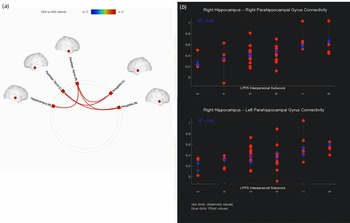
Table 3 (Section B) and Fig. 2a display the effect of LPFS total score on rsFC within the PD group. LPFS total scores were associated exclusively with intralimbic connectivity. Specifically, positive associations between LPFS total score and rsFC were observed between (a) left amygdala and bilateral anterior parahippocampal gyri, (b) right amygdala and bilateral anterior parahippocampal gyri, and (c) right anterior parahippocampal gyrus and right hippocampus. When sex was not controlled for, the association between LPFS total score and right amygdala−right parahippocampal gyrus connectivity was no longer significant [T(42) = 2.41, pFDR = 0.114]. LPFS total score was not associated with connectivity in the DMN, SAL, or CEN.
A: Significant effect of LPFS total score on ROI-to-ROI connectivity within the PD group. B: post hoc test demonstrating significant effect of LPFS Interpersonal subscale score on hippocampal−parahippocampal connectivity strength. parahipp – parahippocampal; LPFS- Levels of Personality Functioning Scale.

LPFS self and interpersonal scores and intralimbic rsFC in PD
The results are displayed in Table 3 (Section C) and Fig. 2b. After correcting for multiple comparisons, positive associations were observed between the LPFS interpersonal subscale and connectivity of the right hippocampus with the bilateral anterior parahippocampal gyri and between the right hippocampus and left amygdala.
Exploratory pairwise comparisons of the empathy and intimacy interpersonal components, revealed that empathy, but not intimacy scores, were associated with right hippocampus−bilateral anterior parahippocampal gyrus connectivity [right hippocampus−right parahippocampal gyrus: T[41] = 3.82, beta = 0.13, R 2 = 0.26, p = 0.0004; right hippocampus−left parahippocampal gyrus: T[41] = 3.39, beta = 0.12, R 2 = 0.25, p = 0.001]. The self subscale was not associated with any connectivity patterns when controlling for sex.
Notably, when sex was not controlled for, one additional effect on connectivity between the medial frontal cortex and right hippocampus [F(2,41) = 4.62, pFDR = 0.0426] was observed, which was associated with the LPFS self subscore (T[42] = −2.33, beta = −0.058, R 2 = 0.12, p = 0.025) as opposed to the interpersonal subscore (T[42] = −0.31, beta = −0.007, R 2 = 0.00, p = 0.76), and was present in male (T[7] = −3.34, beta = −0.11, R 2 = 0.62, p = 0.01) but not in female PD participants (T[32] = −1.09, beta = −0.035, R 2 = 0.04, p = 0.28).
BSL-23 scores and rsFC in PD
No significant associations between BSL-23 scores and rsFC within any of the four networks investigated were identified in PD subjects (online Supplementary Table S3).
Discussion
DMN and frontolimbic circuitry alterations in PD v. controls
Partially consistent with our first hypothesis, disruptions in rsFC in the DMN/core mentalization, and frontolimbic networks in PD subjects, compared to controls, but not in the SAL and CEN, were found. Regarding the disruptions in DMN connectivity in PD subjects, DMN underconnectivity of the precuneus/PCC with the left parahippocampal gyrus was found, and parallels other work showing that the precuneus is a salient hub across PD categories (Coutinho et al., Reference Coutinho, Goncalves, Soares, Marques and Sampaio2016; Kunisato et al., Reference Kunisato, Okamoto, Okada, Aoyama, Nishiyama, Onoda and Yamawaki2011; Lei et al., Reference Lei, Zhong, Liu, Jin, Zhou, Xi and Yi2017; Tang, Jiang, Liao, Wang, & Luo, Reference Tang, Jiang, Liao, Wang and Luo2013; Yang et al., Reference Yang, Cun, Du, Yang, Wang, Wie and Qiu2015; Zhu et al., Reference Zhu, Tang, Zhang, Li, Tang, Li and Wang2017). Further, we found that within the DMN, core mentalization hyperconnectivity in PD participants converged on STS connectivity with the angular gyrus (i.e. TPJ connectivity), and with the dorsal and ventral MPFC. These findings are also consistent with our hypothesis of altered mentalization neurocircuitry in PD, and consistent with prior reports of mentalization deficits across PDs (Bateman & Fonagy, Reference Bateman and Fonagy2004; Drozek & Unruh, Reference Drozek and Unruh2020; Newbury-Helps, Feigenbaum, & Fonagy, Reference Newbury-Helps, Feigenbaum and Fonagy2017) and the functional specialization of the left STS in theory of mind processing (Beauchamp, Reference Beauchamp2015). Moreover, previous work has demonstrated a social-cognitive-related functional subdivision of the medial frontal cortex, whereby more superior regions are associated with action monitoring, self-knowledge, person perception, and mentalizing, and ventral regions with outcome monitoring (Amodio & Frith, Reference Amodio and Frith2006). Our findings of disruptions in both dmPFC and vmPFC connectivity therefore suggest a possible neural correlate of broad social-cognitive deficits in PD pertaining to a number of these mentalization abilities.
Further, and also in line with our hypothesis, our findings of frontolimbic hyperconnectivity are consistent with previous studies that have found resting-state (Baczkowski et al., Reference Baczkowski, van Zutphen, Siep, Jacob, Domes, Maier and van de Ven2017) and task-based fronto-amygdala disruptions (Schulze & Roepke, Reference Schulze, Roepke, Mulert and Shenton2014) in BPD and Cluster C PDs, and in trait narcissism (Feng et al., Reference Feng, Yuan, Geng, Gu, Zhou, Wu and Luo2018), although the direction of findings across studies has varied, possibly as a result of the use of different statistical approaches. The current findings are specific to the DLPFC, and are therefore rooted in disruptions within the cognitive, model-based emotion control system in PD, rather than more implicit medial frontal-based control system (Etkin, Büchel, & Gross, Reference Etkin, Büchel and Gross2015); hyperconnectivity of the DPLFC with the amygdala suggests an abnormal association between the explicit emotional control system and amygdala-based emotional reactivity (Etkin et al., Reference Etkin, Büchel and Gross2015), and may be reflective of the chronic state of hyperarousal observed across PDs (Ruocco & Carcone, Reference Ruocco and Carcone2016), which may require more frequent or prolonged frontal executive regulation. In all, these findings mirror a recently published study on the NIMH RDoC, which demonstrated substantial transdiagnostic overlap of DSM-5 PD symptoms onto two RDoC domains -Social Processes and Arousal and Regulatory Systems (Koudys et al., Reference Koudys, Traynor, Rodrigo, Carcone and Ruocco2019), both of which are rooted in mentalization and frontolimbic circuitry.
Criterion A self-interpersonal impairment and intralimbic connectivity
To our knowledge, this is the first study to examine biomarkers of dimensional, Criterion A self-interpersonal impairment in PD, which is a strength of the study. In light of this investigation, we show that instead of being associated with DMN connectivity as originally hypothesized, impairment across self and interpersonal functioning in PD is correlated solely with greater intralimbic connectivity strength of the parahippocampal gyrus with the hippocampus and amygdala. These findings are supported by previous work showing abnormal FC of the hippocampal/parahippocampal gyrus with the amygdala in BPD (Cullen et al., Reference Cullen, Vizueta, Thomas, Han, Lim, Camchong and Schulz2011; Krause-Utz et al., Reference Krause-Utz, Winter, Schriner, Chiu, Lis, Spinhoven and Elzinga2017; Salvador et al., Reference Salvador, Vega, Pascual, Marco, Canales-Rodríguez, Aguilar and Pomarol-Clotet2016). Further, amygdala−hippocampal connectivity has been associated with childhood trauma (Fan et al., Reference Fan, Pestke, Feeser, Aust, Pruessner, Böker and Grimm2015), fear conditioning (Kruse, León, Stalder, Stark, & Klucken, Reference Kruse, León, Stalder, Stark and Klucken2018), and with personality traits observed across PDs, including impulsivity (Westlund Schreiner et al., Reference Westlund Schreiner, Klimes-Dougan, Mueller, Nelson, Lim and Cullen2019), and sensitivity to punishment during the anticipation of an aversive event (Hahn et al., Reference Hahn, Dresler, Plichta, Ehlis, Ernst, Markulin and Fallgatter2010), which highlights the emotion-related function of these structures.
Moreover, within the two specific interpersonal domains of empathy and intimacy, we show that only deficits in empathy are associated with rsFC, and more specifically with connectivity of the right hippocampus and bilateral parahippocampal gyrii. Relatedly, another study found that compared to controls, BPD participants who were classified as having unresolved attachment trauma showed less activation of the parahippocampal gyrus while providing narrative reports of attachment-activating interpersonal scenes (Buchheim et al., Reference Buchheim, Erk, George, Kachele, Kircher, Martius and Walter2008), which speaks to the involvement of the parahippocampal gyrus in interpersonal processing. In a similar regard, in individuals with schizotypal PD, reduced parahippocampal−precuneus rsFC has been found, and associated with levels of suspiciousness (Zhu et al., Reference Zhu, Tang, Zhang, Li, Tang, Li and Wang2017), again suggesting an interpersonal functional specialization of the parahippocampal gyrus.
The hippocampus and parahippocampal gyrus maintain dense anatomical connections with each other and the neocortex, and support problem-solving by allowing one to make flexible associative inferences based on previously stored declarative memories (Eichenbaum, Reference Eichenbaum2000), as well as to imagine personally relevant future events (Schacter, Addis, & Szpunar, Reference Schacter, Addis, Szpunar, Hannula and Duff2017). In the presence of interference, which may be cognitive or emotional, the parahippocampal gyrus is implicated in the maintenance of information about stimulus familiarity (Eichenbaum, Reference Eichenbaum2000). Taken together, the hippocampal structures appear to play a substantial role in emotional decision-making via flexible updating based on prior experience. Indeed, in controls, the parahippocampal gyrus activates during trial-by-trial suspicion about another person's trustworthiness, and is therefore involved in rational interpersonal updating (Bhatt, Lohrenz, Camerer, & Montague, Reference Bhatt, Lohrenz, Camerer and Montague2012). We hypothesize that the ability to engage in flexible, rational interpersonal updating may be impaired or require more reserve in individuals with PD, who often experience emotional interference via a chronic state of hyperarousal (Ruocco & Carcone, Reference Ruocco and Carcone2016; Sharp, Reference Sharp2016). As a result, individuals with PD may display increasing connectivity of the interference-mediating parahippocampal gyrus with other limbic structures, which may be compensatory (i.e. adaptive) or pathological (i.e. leading to greater interpersonal impairment). Given our correlational analysis, the present results suggest an association between parahippocampal over connectivity and the broad limitations in empathy that are frequently observed across PD diagnoses. In future, a causative analysis approach could investigate whether parahippocampal disruptions are a correlate, a cause, or a consequence of the empathy deficits observed in PD.
Personality impairment v. BPD symptom severity and connectivity
The present study failed to find a significant association between the BSL-23 and rsFC in any of the four networks investigated, suggesting that a dimensional formulation of personality disorder based on self-interpersonal impairment may capture more variance in rsFC than a severity measure based on typology-specific symptoms.
Limitations
Although the largest percentage of participants in the present study had two categorical PD diagnoses (42.2%), all participants had a diagnosis of BPD and were recruited as part of a study in which BPD was an eligibility criterion (see Wrege et al., Reference Wrege, Ruocco, Euler, Preller, Busmann, Meya and Walter2019). As such, these results should be replicated in more diverse diagnostic PD samples so as to further interrogate the suggestion that the neural correlates of self-interpersonal dysfunction cut across DSM-5 PD categories. Although our analysis failed to find any associations between rsFC and BPD-specific symptoms, and instead, found that rsFC is associated with typology-independent self-other impairment, replicating this analysis in a large sample comprised of a more balanced representation of Cluster A, B, and C diagnoses will further support the proposition that the current findings are not specific to BPD. Additionally, a more balanced sample in this respect would facilitate explorations of these associations both within and across diagnostic categories.
Further, to extend the current findings and contribute to the development of RDoC-based research on personality disorder, future research could recruit participants with a range of personality psychopathology, from subthreshold to severe levels of personality dysfunction, consistent with the RDoC initiative's aim to elucidate the neurobiology of social processes across a spectrum of functioning (Insel et al., Reference Insel, Cuthbert, Garvey, Heinssen, Pine, Quinn and Wang2010). The findings of the present study are most pertinent to the RDoC matrix's Perception and Understanding of the Self and Others constructs, which is subsumed under the Social Processes domain. Pending future interrogation across a fulsome range of personality functioning, the interconnections of the parahippocampal gyrus may be further considered for their potential relevance to these RDoC constructs.
Second, our sample consisted of mostly female participants, and future work with a more sex-representative sample is needed to generalize and follow up on our preliminary finding of a relationship between the LPFS self subscore and right hippocampal−medial prefrontal connectivity in male participants. Despite the preliminary nature of this finding, previous studies have found sex-differentiated structure (e.g. Persson et al., Reference Persson, Spreng, Turner, Herlitz, Morell, Stening and Soderlund2014; van Eijk et al., Reference van Eijk, Hansell, Strike, Couvy-Duchesne, de Zubicaray, Thompson and Wright2020) and right-lateralized function of the hippocampus in males (Frings et al., Reference Frings, Wagner, Unterrainer, Spreer, Halsband and Schulze-Bonhage2006; Persson et al., Reference Persson, Herlitz, Engman, Morell, Sjolie, Wikstrom and Soderlund2013). Further, a recent animal study demonstrated that social memory is regulated by hippocampal−medial prefrontal connectivity (Phillips, Robinson, & Pozzo-Miller, Reference Phillips, Robinson and Pozzo-Miller2019), and in humans, sex differences in social cognition have been demonstrated when transcranial direct current stimulation is applied to the medial PFC (Adenzato et al., Reference Adenzato, Brambilla, Manenti, De Lucia, Trojano, Garofalo and Cotelli2017). Indeed, it is plausible that personality self-functioning may be supported by a sexually dimorphic neurobiological architecture.
Finally, although a strength of the present study was that our PD sample was comprised of an inpatient population, presumptively maximizing any existing between-group differences, in contrast to other work (Doll et al., Reference Doll, Sorg, Manoliu, Wöller, Meng, Förstl and Riedl2013; Quattrini et al., Reference Quattrini, Pini, Pievani, Magni, Lanfredi, Ferrari and Rossi2019), we did not find disruptions in the SAL or CEN, which may have been due to our substantially larger sample size reflecting a true lack of differences. Alternatively, this inconsistency may be due to the differing statistical approaches used across studies.
Conclusions
We identified differences in intrinsic rsFC in PD patients compared to controls in the DMN/core mentalization and frontolimbic networks. Further, in our PD sample, we revealed that connectivity between limbic structures is associated with self-interpersonal impairment, suggesting that disturbances in intralimbic connectivity may contribute to personality impairment regardless of diagnostic typology. In particular, connectivity of the parahippocampal gyrus emerged as a preliminary biomarker of interpersonal but not self-impairment, despite the strong correlation between these scales and prior suggestions that they form a single dimension of impairment. The pattern of findings could be interpreted as individuals with PD being prone to recall negative emotional memories in the context of a chronic state of hyperarousal, interfering with the ability to make rational interpersonal updates. Future work may begin to explore the prognostic utility of these findings. Importantly, these findings contribute to the integration of novel reformulations of PD with the NIMH RDoC initiative.
Supplementary material
The supplementary material for this article can be found at https://doi.org/10.1017/S0033291721002865.
Acknowledgements
This study was supported by clinical funding of UPK. The study was approved by the Ethics Committee for Northwestern/Central Switzerland (EKNZ) and by the Federal Office of Public Health. JMT is supported by a Canadian Institutes for Health Research (CIHR) Fellowship award. ACR is supported by the University of Toronto Scarborough Research Excellence Faculty Scholar award.
Conflict of interest
None of the authors have any conflicts of interest.
Ethical standards
The authors assert that all procedures contributing to this work comply with the ethical standards of the relevant national and institutional committees on human experimentation and with the Helsinki Declaration of 1975, as revised in 2008.