One of the most remarkable projects in the history of science in recent decades was the edition of The Mathematical Papers of Isaac Newton, which appeared in eight massive volumes from Cambridge University Press. It was hailed in reviews and elsewhere from the start of its publication, but examination of some details of the edition arouses concerns, which are the subject of this essay. The recent death of the editor, D.T. Whiteside (1932–2008), stimulated recall of these issues; I aired most of them in 1971 in an essay review of volume 4, which is reprinted below.
By way of introduction, it deserves underscoring that no vast team of researchers was involved in this edition. It was mainly the work of Whiteside, with some help from Adolf Prag (1906–2004) (acknowledged from volume 3) and Michael Hoskin (1930–) (for volumes 1–6). Especially striking was the speed with which the first seven volumes came out: 1967, 1968, 1969, 1971, 1972, 1974 and 1976, with the last volume in 1981. Whiteside did not explain in detail the assistance received from his colleagues, but Prag seems to have served mainly as a first reader and commentator to the Newton manuscripts already transcribed, and compiler of the name indexes. The responsibilities of Hoskin, formerly his doctoral supervisor, lay largely in obtaining funding for Whiteside to carry out his research, improving his status within Cambridge University (for many years he was there as Hoskin's research assistant), and dealing with the press.Footnote 1 On the edition itself, he helped with aspects of proofreading, including preparation of the diagrams for publication (volume 4, p. vi).Footnote 2
Whiteside reproduced five or six folios of the manuscripts in each volume, and in preparation of my review of volume 4 I compared them with their rendition in the edition. I was surprised at the liberty (as I saw it) that he had taken with two folios, with little or no explicit discussion. Recently I checked the plates in the other seven volumes, and the points now to be made amount to an extension of this review.
One main reason for active intervention on the part of an editor concerns the layout of a complicated original folio; in the case of the Leibniz Sämtliche Schriften und Briefe (currently eight series, 1923–, now Akademie Verlag), this task can sometimes be quite a nightmare!Footnote 3 In his introduction to the Newton edition Whiteside noted the need to modify the layout of folios to fit the printed page (volume 1, p. xii). In September 1971, in letters written in courteous response to my review, he stressed to me that he was preparing ‘an edition’ (Whiteside's emphasis) of the manuscripts; that he found it difficult to envisage their layout in print when writing out the text (he did not use a typewriter); and that by way of following Newton's apparent intentions, he usually omitted Newton's own cancellations. (By contrast, in my own editing of manuscripts, I have often reproduced cancellations when they were legible, as they can be historically illuminating.Footnote 4) So Whiteside rearranged a folio to fit the printed page, such as volume 6, p. 430, on optics, or volume 4, p. 400, with some omissions, on cubics. He also explained some details of the handling of the displayed folios, and stated that he never saw the plates in proof.Footnote 5
On the handling of text, Whiteside's micro-corrections are quite acceptable: for example, of algebraic slips by Newton (volume 4, p. 400, on orbits, or volume 8, p. 90, on the brachistochrone). But other aspects of his editorial work are more worrying. He made substantial reductions of text, or diminution to a footnote summary, concerning Newton on the frustum of a solid of revolution (volume 6, p. 462), in a treatment of logarithms (volume 2, p. 186), and in a scholium on the calculus (volume 4, p. 240). Some of the silences are presumably deliberate; for example, over a table on musical temperament on the miscellany folio at volume 1, p. 466. But certain omissions appear to occur by editorial oversight: three lines on spherical triangles (volume 4, p. 128), and the end of an analysis of the trifolium (volume 7, p. 666).
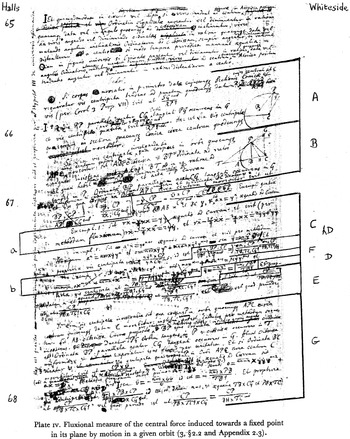
The folio of main concern is at volume 6, p. 590. It shows part of an interesting text in which Newton pondered upon the orbits that a particle might follow under the action of a central force that was not necessarily inverse-square (Figure 1). It has attracted attention before; there was a partial transcription with commentary in 1891 by W.W. Rouse Ball,Footnote 6 and a nearly complete transcription in 1962 by the Halls, who omitted the short passages a and b because Newton seems to have cancelled them.Footnote 7 Understandably, these authors took the text to be a continuous and connected narrative, but apparently Whiteside did not agree, for he broke it up into three categories. In Figure 1, passages A and G were transcribed as contiguous texts on this problem and given en face English translations (volume 6, pp. 588–593, and followed by a concluding paragraph from the next folio); but passages B and C–F were relegated to an appendix and not translated (pp. 598, 599), with the rest of the folio left out completely. Further, C–F were handled as if to the following alarming instructions: take the text of C down to ‘id est’, interpolating from below the boxed formula D at the place indicated; then use some of the partly cancelled end E of Newton's paragraph from ‘(ob datum’; then go back to F, the apparently cancelled ‘Exempl. 2’; and mark as cancelled only the first paragraph of C.
Cambridge University Library, Additional Manuscripts 3965.2, folio 5 recto, and its renditions.

Is this editorship or butchery? Editors should surely give prime concern to a manuscript in the state in which they find it, however incomplete or corrupt that might be; indeed, they should communicate such pitfalls and inadequacies to the reader in some detail. In modern editions of manuscripts with which I am familiar or have even taken part,Footnote 8 the tendency is towards pedantry over the texts, culminating in the Gesamtausgabe of the Czech polymath Bernard Bolzano (1969–, Frommann (Holzboog) Verlag), where the status of literally every letter in a personal manuscript note full of abbreviations can be determined th[ro]ug]h a de[nse] th[ick]et of ita[lic]isatio[n]s and squ[a]r[e] bracke[t]s[.]
In the introduction to the edition, Whiteside seemed to be of like mind, for he stressed the need for ‘accurate transcription’ of words and symbols, and noted the need to modify the layout of folios to fit the printed page (volume 1, pp. x–xiv); similarly, he stated in the volume containing Figure 1 that ‘faithfulness to the manuscript originals here reproduced is our chief concern’ (volume 6, p. x). Nevertheless, the extent of his intervention at times surely transgressed the role that an editor should adopt when handling texts. Despite his claims of fidelity, Whiteside seems to have played Newton in the sense of taking a manuscript, or a related group of them, to some next stage of preparation. For example, without the plate no reader could guess from volume 6 that such an apparently integral text existed at all, in contrast to its handling by Rouse Ball and the Halls.Footnote 9 Again, he explained to me one of his omissions in volume 4 thus: ‘the draft section is not quoted in [the] footnote because it just seemed trivial to me’. While it is quite admissible for a historian of Newton to form such a view, an editor of his manuscripts is surely not permitted to take the corresponding action.
There is no reason to think that Whiteside handled the folios reproduced as plates differently from the rest. So the issues raised here apply throughout the edition, especially when a miscellany of short texts on the same theme is gathered together. But then one must conclude that, as a presentation of the manuscripts in the form that Newton left to us, his edition is not reliable.
The edition is curious in other ways, too. For all that Whiteside was rather parsimonious in his descriptions of his handling of manuscripts, he provided quite extensive essays on Newton's procedures in specific contexts prior to the presentation of the pertinent manuscripts.Footnote 10 He was also generous in his information about the broader contexts of Newton's various mathematical interests, but here a problem of information retrieval arises for the reader. Often that kind of information is supplied in extensive footnotes at the bottoms of one or several pages (for example, on Indian trigonometry in volume 2 at p. 232, or on Fermat and others on number theory in volume 4 at pp. 95–97). However, the volumes have no subject indexes, so there is no obvious means of finding these sources: the tables of contents of the volumes are detailed, but they do not flag the occurrence of such lengthy footnotes. This is very frustrating; for example, I am sure that somewhere in the edition there is such a footnote about the history of spirals, but where is it? It would have been preferable if Whiteside had consigned the information most distant from Newton to his own history of (Newtonian) mathematics, outside the edition.
In its current form, to be fully useful the edition needs a comprehensive subject index, which was indeed promised at some stages (volume 2, dust jacket,Footnote 11 and volume 4, p. x); it would probably make a short book of its own (or an online computer file). Without such a facility, the vast treasury of historical commentary that the edition contains will remain little used. The situation could be somewhat improved if the edition were made available in some electronically searchable form. In the world of Newton scholarship, as elsewhere, the current development of computing is generally making information retrieval for the interested scholar easier. The current online Newton Project will (as I understand it) eventually make all of Newton's manuscripts available on the Internet. And, among other developments of this kind, the editors of the Euler Opera omnia (1911–, now with Birkhäuser Verlag) intend, I gather, to publish his notebooks in a facsimile edition only on the Internet instead of the four paper volumes that were originally planned. Other developments of this kind could be mentioned.
Online access to Whiteside's edition is a challenge for the future. Below is a response from the past. As it appeared in a then-new German history-of-science journal that did not long endure, it is virtually unknown.Footnote 12 So it may bear this reprint as an assessment of general issues of editing.
D.T. Whiteside (ed.), The Mathematical Papers of Isaac Newton. Volume IV 1674–1684. Cambridge: Cambridge University Press, 1971. xxxii+678 pages. £18 ($55).
With the publication of the volume under review, Dr D.T. WHITESIDE achieves the formal halfway point in his current eight-volume edition of the mathematical papers of ISAAC NEWTON. But in personal terms more than half of his work must now be completed, for most of the detailed location, organization and initial understanding of the manuscripts involved must have been done before any of them were prepared for printing.
This remark provokes some reflections on the nature and scope of a project of this size. Only when one has actually prepared manuscripts for publication oneself, perhaps, does the sheer magnitude of such a task begin to become comprehensible. The actual location of the relevant manuscripts, probably held in several different places, can be a lengthy task, and the excitement of their discovery may be tempered by the realization of their incompleteness, disorder or illegibility. The process of systematization must then follow; rather like solving a jigsaw puzzle without knowing the picture, it brings especial satisfaction when sheets from different sources are restored to their original ordering and disclose an achievement or pattern of thought by the historical figure in question which was previously unknown to his successors.
And after that the grind really begins. Sheet by sheet, word by word, symbol by symbol; a rendition has to be made, and is handicapped continually by lost sheets, unclarities, illegibilities, mistakes and omissions in the surviving sheets, and points of historical interpretation rendered all the more difficult by the hasty execution of the manuscript. These problems lead to a growing pile of footnotes and introductory essays, and the historical task turns out primarily to be not so much the clarification of the manuscript but something much more difficult; the reconstruction of unclarities that were operative at the time of their composition. The only major reward at this stage of the work is the discovery of pleasing and perhaps important points of fine detail in the arguments; otherwise this leads only to hours and hours of toil and frustration. Much of the work is devoted to trivia, which are all the more annoying not only because they are unworthy in themselves of the effort involved but also because the reader will probably not appreciate or even understand them, and because mistakes are bound to be made here and there anyway. The end product is the edition intended, but an edition tainted and even marred for the author by scatterings of taunting compromises in the rendition of manuscript, and haunting uncertainties about the content of commentary.
Of course, I do not know if WHITESIDE's own view of his project corresponds with this construction; but his volumes show evidence of all these stages in their preparation and indeed of still further difficulties, since he indicates his own editorial treatment of the manuscripts to a degree of detail finer than most other comparable editions and even includes a parallel translation into English (and a slightly more modern mathematical symbolism) of the most important of NEWTON's Latin manuscripts. Looking through the four volumes available to date, many incidental features enhance the impression already created by the general editorial mastery. The rendition of the diagrams is magnificent, especially when WHITESIDE supplements NEWTON's brief sketches with the additional points and lines required by the text, or even attempts a three-dimensional construction of a configuration of which NEWTON drafted only a two-dimensional section. The knowledge of the secondary literature is impressively extensive, and not only concerning NEWTON and his time; historians interested in many other periods will find citations and remarks here of relevance to their own work. (Footnote (70) on pages 95–97 here is very striking.) They must also admire WHITESIDE's consideration in citing works so fully, with titles of both article and journal normally given in full and followed by locations in subsequent republications and editions. Similarly they will welcome the extensive information on manuscript collections of NEWTON's contemporaries.
But, of course, there are inherent and unavoidable limitations. The first editor of NEWTON's manuscripts was an old man called I. NEWTON, who went through all his papers during his final years, burned those which he deemed unsuitable for posterity, and preserved those which would show himself to his successors in the form in which he wished to be seen. Thus the surviving manuscripts do not always contain the true genesis of his ideas. Further, they do not present a picture of the development of mathematics in the later seventeenth century; they are the personal writings of one man who during the decade covered by this volume lost his earlier ambition to publish, and, partly due to the death of friends, moved fully into the state of loneliness from which he was never to escape.
These are important factors in the interpretation of NEWTON's thought, for they affect the materials on which historians have to work. This fourth volume covers the fourth decade of NEWTON's life (1674–1684), when his interest in mathematics became steadily more interrupted by researches into chemistry, optics and especially dynamics and astronomy, which were to lead to the Principia of 1687. Thus we find no major essays in this volume of the kind that have appeared in its predecessors; but I have found several texts here of more interest than WHITESIDE's description of them (page xi: ‘largely jejune [and] unforthcoming’) might suggest. Divided into three parts, the volume contains the following subjects, in order: finite differences, number theory (in which NEWTON did not appear to be comfortable), and plane and spherical trigonometry; pure and analytical geometry; and fluxional calculus and infinite series, developed at length in two projected but uncompleted general treatises, ‘Geometria Curvilinia’ and ‘Matheseos Universalis Specimina’. Personally I found this last part the most interesting, for it includes in the first treatise a presentation by NEWTON of his fluxional calculus (see especially pages 425 to 429). The degree of lack of understanding of the foundations of his system is remarkable. The definitions are trivial, the axioms hardly less so; the closest that NEWTON comes to explaining the central foundational question of limits and the interpretation of infinitesimals is his old question-begging story of ‘ratio of … nascent parts … as they vanish by defluxion’ (page 427). The ahistorians who, impregnated by Weierstrassian orthodoxies, automatically transplant them into earlier periods, should look at the loose or even false arguments in this draft treatise; for example, at the place where, as WHITESIDE remarks on page 490, ‘without prior warning or explanation’ (and, one may guess, without posterior understanding) NEWTON takes the fluxion of an infinitesimal increment and regards it as an orthodox quantity. Of course, one has seen such infelicities in the earlier volumes.
As usual, the standards of printing and design are of the highest, and the book seems poised to emulate its predecessors by winning publication awards. There appear to be few printing errors, mostly omitted letters; perhaps the most significant that I noticed was the absence from the first line of footnote (33) on page 31 of ‘3)’ (presumably; the coefficients of f and g in the next line should be 2/9 and −4/81 respectively, thus vindicating the next term ‘1/81 (−5A+60B+30C−4D)’). Plate III opposite page 400 shows a sheet whose text appears in a rearranged form on pages 399–400; this is an example of the editorial treatment that is necessary, and an explanatory remark to the plate would have been helpful to the reader. The bottom line of the sheet shown in Plate IV opposite page 604 does not seen to have been rendered on page 610. Presumably this is editorial policy, for the sheet reproduced in Plate I opposite page 128 contains a phrase and two sentences which are neither rendered nor mentioned on pages 124 and 126. Both sentences were cancelled by NEWTON; the latter reappears a few lines later as ‘Prop. 17’, having been ousted from its previous position as ‘Prop. 16’ by an intermediate new ‘Prop. 16’. Some additional remarks in footnote (28) on page 128 might have been appropriate, especially as WHITESIDE does consider Newtonian cancellations in his footnotes and in fact quite often incorporates them in his main text.
Newtonian scholarship is unfortunately now extensive enough to have created its own lunatic fringe (which receives a deservedly sarcastic remark from WHITESIDE on page 282); and only a portion of it is of a calibre sufficient to earn the attention of future generations. WHITESIDE's edition is so impressive that it can only earn the incomprehension of his contemporaries, in that it seems unlikely that anyone apart from himself and his assistants in publication has really read his volumes to the extent of achieving a full and deep understanding of them. Thus it is of especial importance that libraries continue to purchase them and build up a complete set for the future; for a possible deterrent factor for librarians is that the price of the present volume has been raised by about one-third to fifty-five dollars. Part of the increase must be due to its length, because it is at least seventy pages longer than the others; but mainly it is caused by inflation and rising costs. Yet for a volume of such typographical and intellectual magnificence, the new price is still remarkably cheap; and in an age when quality of manufacture and intellect both become steadily rarer and even offend the modern dogmas of industrial organization and educational reform, one must hope that projects like this one, unfashionably superb and eternally significant, receive the support that they deserve.