Nomenclature
- OXY
-
inertial coordinate system
- R
-
relative range
-
 $\lambda$
-
line-of-sight angle
-
$\gamma$
-
path angle
- V
-
speed
- a
-
normal acceleration
- A
-
attack missile
- D
-
defence missile
- T
-
aircraft


1.0 Introduction
In modern air-combat scenarios, it is critical to protect aircraft from attacks. For example, an aircraft may be attacked by hostile missiles during aerial reconnaissance or while carrying combat materials and personnel injured on the battlefield [Reference Yan and Lyu1]. Aircraft have major disadvantages against attack missiles in terms of flight speed and manoeuverability [Reference Zhao, Huang, Yan and Yang2, Reference Zhang, Yan, Huang, Che and Wang3]. In most cases, an aircraft can use passive defence measures to avoid threats, such as by dropping chaff missiles, but this may not always be effective, even if the aircraft has sufficient flight speed and manoeuverability, due to the constraints of its load or constraints related to the flight mission [Reference Weiss, Shima, Castaneda and Rusnak4, Reference Garcia, Casbeer, Fuchs and Pachter5]. Guidance is required to produce the commands to guide a flight vehicle to move a specified trajectory, and, if required, optimises a specific performance [Reference Han, Hu and Xin6, Reference Han, Shin, Hu, Tsourdos and Xin7]. Thus, one alternative is for the aircraft to launch missiles to actively defend itself. In these cases, a guidance law is required that can comprehensively consider the trajectories of both the aircraft and the attack missile to ensure the safety of the former.
Due to its general effectiveness, active defence has been widely studied in the context of defending aircraft. On the premise that the guidance law of an attack missile is a linear law that is known, Shima [Reference Shima8] derived a cooperative guidance law between the defence missile and the aircraft by linearising the equation of their relative motions. Shaferman et al. [Reference Shaferman and Shima9] proposed a multimode adaptive defence missile guidance law by estimating its parameters using a set of filters. However, this method requires selecting an appropriate combination of the guidance law and the relevant parameters of the defence missile from a known and finite set. The size of this set depends on the number of filters, and this limits the application of this guidance law in engineering practice. Prokopov et al. [Reference Prokopov and Shima10] designed three optimal schemes for guiding active defence according to the cooperative modes of the defence missile and the aircraft. These schemes reduce the high-order equation of motion to a first-order dynamic equation with a zero-effort miss formulation, which simplifies the derivation of the guidance law. However, these studies have all been based on optimal control theory, the design of which requires estimating the remaining flying time
 ${t_{go}}$
, and the accuracy of this estimation directly affects the accuracy of the attack.
To protect aircraft, defence missiles need to intercept attack missiles; to attack aircraft, attack missiles need to evade this interception. This is essentially a differential game problem. Some studies have thus used differential game theory to solve the problem of active aircraft defence. For example, using the theory of linear quadratic differential games, Perelman et al. [Reference Perelman, Shima and Rusnak11] examined the game problem involving an attack missile, a defence missile and an aircraft. The original equation of state was reduced by using the terminal projection method, and the closed-loop analytical expression of each guidance strategy was given. On this basis, Saurav et al. [Reference Saurav, Kumar and Maity12] designed a linear quadratic differential game-based guidance law with an angle constraint to improve the interception-related performance of the defence missile. Given that the extent of control of the linear quadratic differential game-based guidance law may exceed the set boundary, Rubinsky et al. [Reference Rubinsky and Gutman13] designed a bounded differential game-based guidance law from the perspective of the attack missile. Based on differential game theory, the work described in Refs. [Reference Naiming, Qilong and Jun14] and [Reference Qilong, Naiming, Longxu and Haiqi15] developed optimal guidance schemes for the attack missile, the defence missile and the aircraft, and the feasible area of interception of the defence missile was analysed according to the aircraft’s manoeuvering modes. However, these methods are all fully or partially based on the assumption of linearisation, and they thus have certain limitations. As with optimal guidance schemes, differential game-based guidance laws require estimation of
 ${t_{go}}$
, and the accuracy of this estimation again directly influences that of the attack. In addition, as a result of the comprehensive performance index used in its design, the miss distance of the linear quadratic differential game-based guidance law may not be able to reach the appropriate minimum. Weight-related parameters in the performance index are also difficult to determine.
If the attack missile, defence missile and aircraft are abstracted as points in space, the lines connecting them will form a triangle. One feasible guidance strategy is for the defence missile to control itself to be in the line of sight (LOS) of the aircraft, the defence missile and the attack missile so that this triangle is reduced to a straight line. Then, as the attack missile approaches the aircraft, it will be intercepted by the defence missile. Shima et al. [Reference Ratnoo and Shima16] proposed a guidance law based on the LOS constraint that included an expression for the acceleration of the attack missile. However, in practice, it is difficult for the defence missile to determine the acceleration of the attack missile. Yamasaki et al. [Reference Yamasaki, Balakrishnan and Takano17] claimed that the guidance command of the defence missile is proportional to two parameters. The first is the difference between the LOS angle formed between the defence missile and the attack missile, and the second is the speed of the defence missile relative to that of the attack missile. For an active defence scenario in which an aircraft launches a defending missile as a counter weapon against an incoming attacking missile, Ratnoo et al. [Reference Ratnoo and Shima18] proposed an LOS guidance strategy for the defending missile. Their results demonstrated that the attacker pays the maximum penalty for an evasive manoeuver from the defender if the defender adopts LOS guidance.
Sliding mode control (SMC) has been widely used for designing guidance laws because of its good adaptability and robustness against parametric uncertainty and external disturbances [Reference Liu, Liu, Yan, Liu and Yin19]–[Reference Liu, Yan, Liu, Dai, Yan and Xin21]. Liu et al. [Reference Liu, Yan, Zhang, Dai and Yan22] designed an impact time control guidance law based on equivalent sliding mode control method with a field-of-view constraint for anti-ship missiles, and this scheme requires no assumption of small angle approximation. By using the three-dimensional kinematic equation set constructed in a rotating coordinate system, Shin et al. [Reference Shin, Tsourdos and Li23] designed a finite-time SMC-based guidance law to nullify the LOS angular rate at the interception time. For the terminal guidance problem of missiles intercepting manoeuvering targets in the three-dimensional space, Song et al. [Reference Song and Song24] studied the design of guidance laws for non-decoupling three-dimensional engagement geometry based on the SMC theory. Sinha et al. [Reference Sinha and Kumar25] made use of the advantages of the super-twisting algorithm to propose a leader–follower cooperative guidance law for intercepting non-manoeuvering targets. This can obtain the time of expected attack in the case of a large lead angle.
Importantly, the above research on active aircraft defence was conducted under the assumption that the flight speed and manoeuverability of the defence missile are superior to those of the attack missile, which imposes stringent requirements on the actuator and the production cost of the defence missile. In this study, we examined the problem of active aircraft defence with the following considerations: (1) we sought to improve the probability of aircraft survival by accurately intercepting a fast, highly manoeuverable, and expensive attack missile using a slow, weakly manoeuverable, and cheap defence missile; (2) we used active defence scenarios to design a cooperative guidance law based on a SMC method that converges quickly and is highly robust.
Based on this research background, we designed an active defence cooperative guidance (ADCG) law based on the LOS constraint with a low speed ratio. This uses a nonlinear integral sliding surface and an improved reaching law to ensure that the directions of the LOS of the attack missile, the defence missile, and the aircraft are in a straight line at the time of interception to protect the aircraft. The main contributions of this paper can be summarised as follows.
1. An active defence cooperative guidance law based on the LOS constraint is proposed; in contrast to previous research [Reference Ratnoo and Shima16]–[Reference Ratnoo and Shima18], this considers an active defence scenario in which the flight speeds of the defence missile and the aircraft are lower than that of the attack missile. The defence missile simultaneously uses information about the movement of the attack missile, the defence missile and the aircraft to protect the aircraft during flight.
2. In contrast to previous research [Reference Liu, Yan, Zhang, Dai and Yan22] and [Reference Liu, Yan, Zhang, Liu and Yan26], the ADCG law is formulated based on a nonlinear integral sliding surface by using an improved reaching law. This improves the closed-loop error dynamic of the guidance system such that the guidance command features no chattering, and it enables the system to reach the sliding surface from any initial position in a finite time.
The remainder of this paper is organised as follows: Section 2 addresses the problem of active defence in the longitudinal plane in the terminal guidance stage; the design of the guidance law is outlined in Section 3, and a stability analysis is given in Section 4; comparative simulation studies are presented in Section 5, and conclusions are drawn in Section 6.
2.0 Problem description
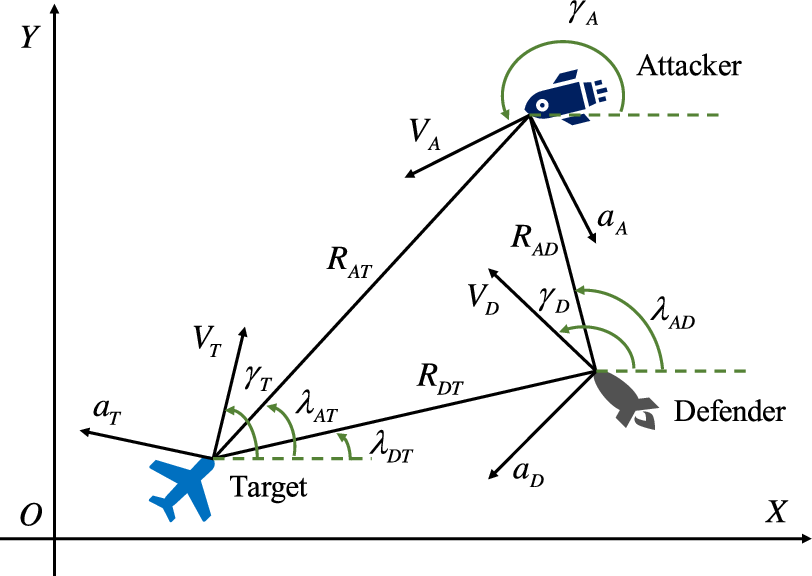
To accurately analyse a confrontation involving an attack missile (A), a defence missile (D) and an aircraft (T) and solve for the guidance law of the defence missile, the relative motions of all three need be modeled and analysed. This relationship is shown in the longitudinal plane in the terminal guidance stage in Fig. 1.
Engagement geometry.

In Fig. 1, OXY represents the inertial coordinate system. The relative ranges of movement of the attack missile, the defence missile, and the aircraft are denoted by
 ${R_{AT}}$
,
 ${R_{AD}}$
, and
 ${R_{DT}}$
, respectively, and their LOS angles are denoted by
 ${\lambda _{AT}}$
,
 ${\lambda _{AD}}$
, and
 ${\lambda _{DT}}$
.
 ${V_i}({i = T,D,A})$
represents their speeds,
 ${a_i}({i = T,D,A})$
represents their normal accelerations, which are perpendicular to the directions of their respective speeds, and
 ${\gamma _i}({i = T,D,A})$
represents their path angles.
As shown in Fig. 1, the relative motions of the attack missile, defence missile, and aircraft under the LOS system can be expressed as:
 \begin{align}{\dot R_{AT}} = {V_A}\cos\!\left( {{\gamma _A} - {\lambda _{AT}}} \right) - {V_T}\cos\!\left( {{\gamma _T} - {\lambda _{AT}}} \right)\end{align}
 \begin{align}{\dot R_{AD}} = {V_A}\cos\!\left( {{\gamma _A} - {\lambda _{AD}}} \right) - {V_D}\cos\!\left( {{\gamma _D} - {\lambda _{AD}}} \right)\end{align}
 \begin{align}{\dot R_{DT}} = {V_D}\cos\!\left( {{\gamma _D} - {\lambda _{DT}}} \right) - {V_T}\cos\!\left( {{\gamma _T} - {\lambda _{DT}}} \right)\end{align}
 \begin{align}{R_{AT}}{\dot \lambda _{AT}} = {V_A}\sin\!\left( {{\gamma _A} - {\lambda _{AT}}} \right) - {V_T}\sin\!\left( {{\gamma _T} - {\lambda _{AT}}} \right)\end{align}
 \begin{align}{R_{AD}}{\dot \lambda _{AD}} = {V_A}\sin\!\left( {{\gamma _A} - {\lambda _{AD}}} \right) - {V_D}\sin\!\left( {{\gamma _D} - {\lambda _{AD}}} \right) \end{align}
 \begin{align}{R_{DT}}{\dot \lambda _{DT}} = {V_D}\sin\!\left( {{\gamma _D} - {\lambda _{DT}}} \right) - {V_T}\sin\!\left( {{\gamma _T} - {\lambda _{DT}}} \right) \\[-7pt] \nonumber \end{align}
where their speeds satisfy
 ${V_T} \lt {V_D} \lt {V_A}$
. As noted, the aircraft and the defence missile are slower than the attack missile.
The kinematics of the attack missile, defence missile, and aircraft in the inertial coordinate system can be expressed as:
 \begin{align}{\dot X_i} = {V_i}\cos\!{\gamma _i}{\rm{ }}({i = A,D,T})\end{align}
 \begin{align}{\dot Y_i} = {V_i}\sin\!{\gamma _i}{\rm{ }}({i = A,D,T}){\rm{ }} \\[-7pt] \nonumber\end{align}
Assuming that they all have an ideal autopilot and manoeuvering dynamics with upper bounds of manoeuverability,
 \begin{align}{\dot \gamma _i} = \frac{{{a_i}}}{{{V_i}}}\!({i = A,D,T})\end{align}
 \begin{align}\left| {{a_i}} \right| \le a_i^{\max } \\[-7pt] \nonumber \end{align}
where
 $a_i^{\max }\!({i = A,D,T})$
represents the upper bound of their respective manoeuverability, satisfying
 $a_T^{\max } \lt a_D^{\max } \lt a_A^{\max }$
. In other words, in comparison with the attack missile, the aircraft and the defence missile have inferior manoeuverability.
We also assume that the speeds of the attack missile, defence missile, and aircraft remain unchanged, which means that
 ${a_i}({i = A,D,T})$
changes only their directions. Thus, the derivatives of Equations (4)-(5) can be obtained as:
 \begin{align}{\ddot \lambda _{AD}} = - \frac{{2{{\dot R}_{AD}}{{\dot \lambda }_{AD}}}}{{{R_{AD}}}} - \frac{{{a_D}\cos\!\left( {{\gamma _D} - {\lambda _{AD}}} \right)}}{{{R_{AD}}}} + \frac{{{a_A}\cos\!\left( {{\gamma _A} - {\lambda _{AD}}} \right)}}{{{R_{AD}}}}\end{align}
 \begin{align}{\ddot \lambda _{AT}} = - \frac{{2{{\dot R}_{AT}}{{\dot \lambda }_{AT}}}}{{{R_{AT}}}} + \frac{{{a_A}\cos\!\left( {{\gamma _A} - {\lambda _{AT}}} \right)}}{{{R_{AT}}}} - \frac{{{a_T}\cos\!\left( {{\gamma _T} - {\lambda _{AT}}} \right)}}{{{R_{AT}}}} \\[-10pt] \nonumber\end{align}
where
 ${a_A}\cos\!\left( {{\gamma _A} - {\lambda _{AD}}} \right)$
represents the component of acceleration of the attack missile normal to the LOS of
 ${R_{AD}}$
, and
 ${a_T}\cos\!\left( {{\gamma _T} - {\lambda _{AT}}} \right)$
represents that of the aircraft normal to the LOS of
 ${R_{AT}}$
.
Based on Equation (10), we assume that there are upper bounds
 $\Delta _{AD}^{\max }$
and
 $\Delta _{AT}^{\max }$
for
 ${\Delta _{AD}} = {a_A}\cos\!\left( {{\gamma _A} - {\lambda _{AD}}} \right)/{R_{AD}}$
and
 ${\Delta _{AT}} = {a_T}\cos\!\left( {{\gamma _T} - {\lambda _{AT}}} \right)/{R_{AT}}$
, respectively, and we regard
 ${\Delta _{AD}}$
and
 ${\Delta _{AT}}$
as their respective external disturbances or uncertainties. Then,
 \begin{align}\left| {{\Delta _{AD}}} \right| \le \Delta _{AD}^{\max }\end{align}
 \begin{align}\left| {{\Delta _{AT}}} \right| \le \Delta _{AT}^{\max } \\[-10pt] \nonumber\end{align}
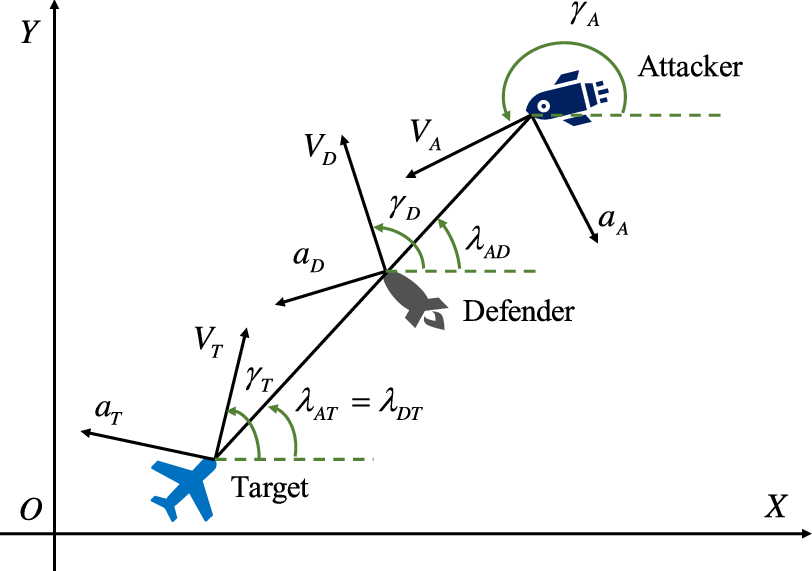
To protect the aircraft from the attack missile, the defence missile needs to accurately intercept it. Regardless of how it is guided, once the defence missile has been launched, it must fly toward the attack missile. In the face of an attack missile with dual advantages of speed and manoeuverability, we propose an optimal interception scenario based on the LOS constraint. In this system, the LOS angles of the attack missile, the defence missile, and the aircraft are on the same straight line, as shown in Fig. 2. The defence missile is positioned between the attack missile and the aircraft such that it can intercept the attack missile and protect the aircraft.
Ideal engagement geometry.

In these circumstances, the relationship of relative motion among the three at the interception time can be described as:
 \begin{align}{\lambda _{AT}}\!\left({{t_f}}\right) = {\lambda _{DT}}\!\left({{t_f}}\right) = {\lambda _{AD}}\!\left({{t_f}}\right)\end{align}
where
 ${t_f}$
indicates the interception time.
Therefore, the guidance objective of the defence missile can be summarised as follows: By designing the guidance command
 ${a_D}$
, the attack missile, defence missile and aircraft must satisfy
 ${\lambda _{AT}}\!\left({{t_f}}\right) = {\lambda _{DT}}\!\left({{t_f}}\right) = {\lambda _{AD}}\!\left({{t_f}}\right)$
at the interception time to ensure the active defence of the aircraft.
Remark 1. As shown in Fig. 2, the guidance objective is formulated by simultaneously using information about the aircraft, attack missile and defence missile. It is designed to restrict the LOS of all three to ensure that the defence missile is always located in the mutual LOS during the flight, which also reflects the concept of cooperative guidance.
3.0 Design of active defence cooperative guidance law
To satisfy the guidance objective stated in Equation (15), the state variables
 ${x_1} = {\lambda _{AD}} - {\lambda _{AT}}$
and
 ${x_2} = {\dot \lambda _{AD}} - {\dot \lambda _{AT}}$
are selected to obtain the following guidance system:
 \begin{align} \left\{ \begin{array}{l} \boldsymbol{x}=[x_{1}\ \ x_2]^T =\big[\lambda_{AD}-\lambda_{AT}\ \ \dot{\lambda}_{AD}-\dot{\lambda}_{AT}\big]^T\\\\[-7pt]y = \lambda_{AD}-\lambda_{AT}\\\end{array}\right. \end{align}
Based on Equations (11) and (12), we can obtain
 \begin{align}{{\dot x}_2} &= {{\ddot \lambda }_{AD}} - {{\ddot \lambda }_{AT}}\nonumber\\[3pt] &= - \frac{{2{{\dot R}_{AD}}{{\dot \lambda }_{AD}}}}{{{R_{AD}}}} - \frac{{{a_D}\cos\!\left( {{\gamma _D} - {\lambda _{AD}}} \right)}}{{{R_{AD}}}} + \frac{{{a_A}\cos\!\left( {{\gamma _A} - {\lambda _{AD}}} \right)}}{{{R_{AD}}}} \nonumber\\[3pt] &\ \ +\frac{{2{{\dot R}_{AT}}{{\dot \lambda }_{AT}}}}{{{R_{AT}}}} - \frac{{{a_A}\cos\!\left( {{\gamma _A} - {\lambda _{AT}}} \right)}}{{{R_{AT}}}} + \frac{{{a_T}\cos\!\left( {{\gamma _T} - {\lambda _{AT}}} \right)}}{{{R_{AT}}}}\end{align}
This can be rewritten as
 \begin{align}{{\dot x}_2} &= {{\ddot \lambda }_{AD}} - {{\ddot \lambda }_{AT}} \nonumber\\[3pt] & = f(\boldsymbol{x},t) + b(t){a_D} + d(t)\end{align}
where
 \begin{align}f({\boldsymbol{x},t}) = - \frac{{2{{\dot R}_{AD}}{{\dot \lambda }_{AD}}}}{{{R_{AD}}}} + \frac{{2{{\dot R}_{AT}}{{\dot \lambda }_{AT}}}}{{{R_{AT}}}}\end{align}
 \begin{align}b(t) = - \frac{{\cos\!\left( {{\gamma _D} - {\lambda _{AD}}} \right)}}{{{R_{AD}}}}\end{align}
 \begin{align}d(t) = \frac{{{a_A}\cos\!\left( {{\gamma _A} - {\lambda _{AD}}} \right)}}{{{R_{AD}}}} - \frac{{{a_A}\cos\!\left( {{\gamma _A} - {\lambda _{AT}}} \right)}}{{{R_{AT}}}} + \frac{{{a_T}\cos\!\left( {{\gamma _T} - {\lambda _{AT}}} \right)}}{{{R_{AT}}}} \\[-7pt] \nonumber \end{align}
Assumption 1.
 $d(t)$
represents the external disturbance or uncertainty of the system in Equation (18), and is related to the manoeuvering of the aircraft and the attack missile. It is assumed that
 $d(t)$
can be measured directly, and
 $\left| {d(t)} \right| \le {D_{\max }}$
, where
 ${D_{\max }}$
represents the upper bound of the external disturbance or uncertainty in the system.
Based on Equations (15) and (16), we define the following nonlinear integral sliding surface to improve the property of the closed-loop error dynamic:
 \begin{align}\sigma = {x_2} + \int\limits_0^t \!{\Big( {{K_P}si{g^{{\alpha _1}}}\left( {{x_1}} \right) + {K_V}si{g^{{\alpha _2}}}\left( {{x_2}} \right)} \Big)dt} \end{align}
where
 ${K_V} = \omega _n^2$
and
 ${K_P} = 2\xi {\omega _n}\!\left( {{\omega _n} \gt 0,0 \lt \xi \lt 1} \right)$
represent adjustable control gains related to the sliding surface, and
 $\Delta (x) = {x^2} + {K_V}x + {K_P}$
is a Hurwitz polynomial. The nonlinear power function is
 $si{g^\alpha }({\cdot}) = |{\cdot}|^\alpha {\mathop{\rm sgn}} ({\cdot})$
, and
 $0 \lt {\alpha _1} \lt 1,{\alpha _2} = 2{\alpha _1}/\left( {1 + {\alpha _1}} \right)$
.
Then, taking the derivative of Equation (22) with respect to time yields
 \begin{align}\dot \sigma = {\dot x_2} + {K_p}si{g^{{\alpha _1}}}\left( {{x_1}} \right) + {K_V}si{g^{{\alpha _2}}}\left( {{x_2}} \right)\end{align}
The dynamic quality of the reaching motion of the sliding surface can be guaranteed by using reaching law [Reference Shtessel, Taleb and Plestan27, Reference Qian and Yi28]. In a typical reaching law, there is a single reaching speed. Although the reaching speed of the exponential reaching law is high, chattering in the system is significant when it approaches the sliding surface. Although the power reaching law decreases this chattering to a certain extent, its rate of convergence is too low when the system is far from the sliding surface, and this results in a long reaching process. To overcome the deficiencies of the typical reaching law, we propose an improved reaching law as:
 \begin{align}\dot \sigma = - \varepsilon |\sigma {|^p}{\mathop{\rm sign}\nolimits} (\sigma ) - kf(\sigma )\end{align}
where
 $p \in \left( {0,1} \right)$
,
 $\varepsilon ,k \in {{\mathbb R}^ + }$
, and
 $f(\sigma )$
is a nonlinear function defined as
 $$f(\sigma ) = \left\{ {\matrix{
\sigma \hfill & {|\sigma |\, \le q} \hfill \cr
{{\rm{sign}}(\sigma )} \hfill & {|\sigma |\, > q} \hfill \cr
} } \right.$$
where
 $q \in {{\mathbb R}^ + }$
.
Combining Equation (23) with Equation (24), and substituting them into Equations (17) and (18) yields
 \begin{align}\dot \sigma & = - \varepsilon |\sigma {|^p}{\mathop{\rm sign}\nolimits} (\sigma ) - kf(\sigma ) \nonumber\\[3pt] & = {{\dot x}_2} + {K_p}si{g^{{\alpha _1}}}\left( {{x_1}} \right) + {K_V}si{g^{{\alpha _2}}}\left( {{x_2}} \right) \nonumber\\[3pt] &= f(\boldsymbol{x},t) + b(t){a_D} + d(t) + {K_p}si{g^{{\alpha _1}}}\left( {{x_1}} \right) + {K_V}si{g^{{\alpha _2}}}\left( {{x_2}} \right)\end{align}
Thus, the ADCG command
 ${a_D}$
can be expressed as:
 \begin{align}{a_D} = \frac{{ - \varepsilon |\sigma {|^p}{\mathop{\rm sign}\nolimits} (\sigma ) - kf(\sigma ) - f(\boldsymbol{x},t) - d(t) - {K_p}si{g^{{\alpha _1}}}\left( {{x_1}} \right) - {K_V}si{g^{{\alpha _2}}}\left( {{x_2}} \right)}}{{b(t)}}\end{align}
Remark 2. As is shown in Equation (25), the improved reaching law consists of a power reaching term
 $ - \varepsilon |\sigma {|^p}{\mathop{\rm sign}\nolimits} (\sigma )$
and a modified exponential reaching term
 $ - kf(\sigma )$
. A nonlinear function
 $f(\sigma )$
is introduced to the exponential reaching term; this can limit the amplitude when
 $|\sigma | \gt q$
, and it is used to reduce the amplitude of the guidance command. When
 $|\sigma | \le q$
, the state of the system approaches the sliding surface in an asymptotic process owing to the simple exponential approach, and this may not be attainable within a finite time. Therefore, a power reaching term is added to guarantee that the state of the system can reach the sliding surface in a finite time. In addition, because of the variable speed of the reaching performance of the power reaching term and the asymptotic characteristic of the exponential reaching term, the proposed reaching law can be used to reduce chattering in the guidance command.
Remark 3. The improved reaching law can ensure that the system has good reaching performance regardless of whether the state of the system is far from or close to the sliding surface. This can reduce chattering, and it is accessible within a finite time. This means that the state of the system can reach the sliding surface from any initial position within a finite time.
4.0 Stability analysis
Lemma 1. [
Reference Lian Fu29
] If, in the differential equation
 $f(x) = {y^\prime } + p(x)y + q(x){y^n}$
(
 $n\in \mathbb{R}^{+}$
is an arbitrary real number),
 $f(x) = aq(x){e^{ - n\int p (x)dx}}$
(
 $a \in \mathbb{R}$
is an arbitrary real number), the general solution of the differential equation is
 $y = u(x){e^{ - \int p (x)dx}}$
, where
 $u(x)$
is determined by the separable variable equation
 ${u^\prime }(x) = \left( {a - {u^n}(x)} \right)\!q(x){e^{(1 - n)\int p (x)dx}}$
.
Lemma 2. [ Reference Bhat and Bernstein30 ] For the following n-order system,
 \begin{align}\left\{ \begin{array}{l}{{\dot y}_1} = {y_2}\\ \\[-7pt] \vdots \\ \\[-7pt] {{\dot y}_{n - 1}} = {y_n}\\ \\[-7pt] {{\dot y}_n} = u\end{array} \right.\end{align}
if
 $\Delta (x) = {x^n} + {K_n}{x^{n - 1}} + \cdots + {K_2}x + {K_1}$
is a Hurwitz polynomial with
 ${K_1},{K_2}, \cdots ,{K_n} \gt 0$
, then the n-order system can be stabilised in a finite time under the action of the control input
 $u$
in Equation (29).
 \begin{align}u = - {K_1}{{\mathop{\rm sig}\nolimits} ^{{\psi _1}}}\!\left( {{y_1}} \right) - {K_2}{{\mathop{\rm sig}\nolimits} ^{{\psi _2}}}\!\left( {{y_2}} \right) - \cdots - {K_n}{{\mathop{\rm sig}\nolimits} ^{{\psi _n}}}\!\left( {{y_n}} \right)\end{align}
where
 \begin{align}\begin{array}{l}{\psi _{i - 1}} = \dfrac{{{\psi _i}{\psi _{i + 1}}}}{{2{\psi _{i + 1}} - {\psi _i}}}(i = 2,3, \cdots ,n),{\psi _n} = \psi ,{\psi _{n + 1}} = 1\\ \\[-7pt] \varsigma \in (0,1),\psi \in (1 - \varsigma ,1)\end{array}\end{align}
Theorem 1. The nonlinear sliding surface σ can reach equilibrium,
 $\sigma = 0$
, within a finite time
 ${t_{\sigma 0 \to 0}}$
from any initial position
 ${\sigma _0}$
under the action of reaching law in Equation (24), and
 \begin{align}{t_{{\sigma _0} \to 0}} = \frac{1}{{k(p - 1)}}\ln \left( {\frac{{\dfrac{\varepsilon }{k}}}{{{q^{1 - p}} + \dfrac{\varepsilon }{k}}}} \right) + \frac{{(1 + k)}}{{\varepsilon (1 - p)}}\left( {\sigma _0^{1 - p} - {q^{1 - p}}} \right)\end{align}
Proof: The proof process can be divided into two steps. First, we prove the existence and accessibility of the improved reaching law in Equation (25). Second, we prove that the nonlinear sliding surface σ can reach equilibrium
 $\sigma = 0$
from any initial position
 ${\sigma _0}$
under the action of the improved reaching law in a finite time.
Step 1. Based on Equation (24), we can obtain
 \begin{align}\sigma \dot \sigma &= \sigma \!\left( { - \varepsilon |\sigma {|^p}{\mathop{\rm sign}\nolimits} (\sigma ) - kf(\sigma )} \right) \nonumber\\[3pt] &= - \varepsilon |\sigma {|^{p + 1}} - kf(\sigma )\sigma \end{align}
According to Equation (25), since
 $f(\sigma)$
is a piecewise nonlinear function, we classify and discuss the positive and negative forms of Equation (32).
Case 1. When
 $|\sigma | \le q$
, we can obtain
 \begin{align}\sigma \dot \sigma = - \varepsilon |\sigma {|^{p + 1}} - k{\sigma ^2} \le 0 \\[-29pt] \nonumber \end{align}
The equality holds if and only if
 $\sigma = 0$
.
Case 2. When
 $|\sigma | \gt q$
,
 \begin{align}\sigma \dot \sigma = - \varepsilon |\sigma {|^{p + 1}} - k|\sigma | \le 0 \\[-29pt] \nonumber \end{align}
The equality holds if and only if
 $\sigma = 0$
.
Thus,
 $\sigma \dot \sigma \le 0$
is established (the equality holds if and only if
 $\sigma = 0$
). Based on the existence and accessibility conditions of the sliding-mode reaching law for continuous systems [Reference Chalanga, Kamal, Fridman, Bandyopadhyay and Moreno31], it is easy to demonstrate that the proposed reaching law can ensure that the nonlinear sliding surface reaches equilibrium.
Step 2. We now classify and discuss the convergence time of the sliding surface based on Equation (25).
Case 1. When
 $0 \le \sigma \le q$
and
 $0 \lt p \lt 1$
, the reaching law can be expressed as
 \begin{align}\dot \sigma + k\sigma + \varepsilon {\sigma ^p} = 0 \\[-20pt] \nonumber\end{align}
Based on Lemma 1, the general solution of Equation (35) can be presented as
 \begin{align}\sigma = u\exp \!\left(\! { -\! \int k {\rm{d}}t} \right)\end{align}
where u is determined by the variable separation in Equation (37).
 \begin{align}{u^\prime } = \left( {0 - {u^p}} \right)\varepsilon \exp\! \left( {(1 - p)\int k {\rm{d}}t} \right)\end{align}
Solving Equation (37) yields
 \begin{align}u = {\left( {c - \frac{\varepsilon }{k}\exp\!((1 - p)kt)} \right)^{\frac{1}{{1 - p}}}}\end{align}
By substituting Equation (38) into Equation (36), we can obtain
 \begin{align}{\sigma ^{1 - p}} = c\exp\!((p - 1)kt) - \frac{\varepsilon }{k}\end{align}
When
 $t = 0$
and
 $\sigma = q$
, the constant c can be obtained as
 \begin{align}c = {q^{1 - p}} + (\varepsilon /k)\end{align}
Therefore, based on Equation (39), the time needed by the nonlinear sliding surface to converge from
 $\sigma = q$
to
 $\sigma = 0$
can be described as
 \begin{align}{t_{q \to 0}} = \frac{1}{{k(p - 1)}}\ln \left( {\frac{{\dfrac{\varepsilon }{k}}}{{{q^{1 - p}} + \dfrac{\varepsilon }{k}}}} \right)\end{align}
Case 2. When
 $q \le \sigma \le {\sigma _0}$
and
 $0 \lt p \lt 1$
, the reaching law can be expressed as
 \begin{align}\dot \sigma = - \varepsilon {\sigma ^p} - k \\[-20pt] \nonumber \end{align}
The homogeneous equation corresponding to Equation (42) can be expressed as
 \begin{align}\dot \sigma + \varepsilon {\sigma ^p} = 0\end{align}
Thus, σ can be expressed as
 \begin{align}\sigma = {[(\! - \varepsilon t + c)(1 - p)]^{\frac{1}{{1 - p}}}}\end{align}
Let c be a function of time t. We take the derivative of the above formula with respect to time to obtain
 \begin{align}c(t) = - k\left( {\frac{{{\sigma ^{1 - p}}}}{{1 - p}} + {c^\prime }} \right)\end{align}
where
 ${c^\prime } \in {\mathbb R}$
is a constant number.
Combining Equations (44) with (45), we obtain
 \begin{align}\sigma = {\left[ {\left( { - \varepsilon t - k\left( {\frac{{{\sigma ^{1 - p}}}}{{1 - p}} + {c^\prime }} \right)} \right)(1 - p)} \right]^{\frac{1}{{1 - p}}}}\end{align}
That is,
 \begin{align}\frac{{(1 + k){\sigma ^{1 - p}}}}{{1 - p}} = - \varepsilon t + {c^{\prime \prime }}\end{align}
where
 $c'' = - k{c^\prime } \in {\mathbb R}$
is a constant number.
If
 $\sigma = {\sigma _0}$
when
 $t = 0$
, we can obtain
 \begin{align}{c^{\prime \prime }} = \frac{{(1 + k)\sigma _0^{1 - p}}}{{1 - p}}\end{align}
According to Equation (47), when
 $0 \lt p \lt 1$
, the time needed for convergence from
 $\sigma = {\sigma _0}$
to
 $\sigma = q$
is
 \begin{align}{t_{{\sigma _0} \to q}} = \frac{{(1 + k)}}{{\varepsilon (1 - p)}}\left( {\sigma _0^{1 - p} - {q^{1 - p}}} \right)\end{align}
Thus, in combination with Equations (41) and (49), the time needed for the sliding surface to move from any initial state
 $\sigma = {\sigma _0}$
to equilibrium
 $\sigma = 0$
is
 \begin{align}{t_{{\sigma _0} \to 0}} &= {t_{{\sigma _0} \to q}} + {t_{q \to 0}} \nonumber\\[3pt] &= \frac{1}{{k(p - 1)}}\ln \left( {\frac{{\dfrac{\varepsilon }{k}}}{{{q^{1 - p}} + \dfrac{\varepsilon }{k}}}} \right) + \frac{{(1 + k)}}{{\varepsilon (1 - p)}}\left( {\sigma _0^{1 - p} - {q^{1 - p}}} \right)\end{align}
Therefore, the sliding surface in Equation (22) can reach equilibrium
 $\sigma = 0$
from any initial state
 $\sigma = {\sigma _0}$
in a finite time under the proposed reaching law in Equation (24). Theorem 1 has thus been proved.
Theorem 2.
When the sliding surface in Equation (22) reaches equilibrium,
 $\sigma = 0$
,
 ${x_1}$
and
 ${x_2}$
converge to zero in a finite time to ensure that the scenario involving the attack missile, defence missile and aircraft satisfies
 ${\lambda _{AT}}\!\left({{t_f}}\right) = {\lambda _{DT}}\!\left({{t_f}}\right) = {\lambda _{AD}}\!\left({{t_f}}\right)$
at the interception time. This in turn implies that the active defence of the aircraft can be ensured.
Proof. Once the sliding surface in Equation (22) reaches equilibrium,
 $\sigma = 0$
, we can obtain
 \begin{align}\sigma = {x_2} + \int\limits_0^t \!{\left( {{K_p}si{g^{{\alpha _1}}}\!\left( {{x_1}} \right) + {K_V}si{g^{{\alpha _2}}}\!\left( {{x_2}} \right)} \right)dt} = 0\end{align}
Taking the derivative of Equation (51) with respect to time yields
 \begin{align}\dot \sigma = {\dot x_2} + {K_p}si{g^{{\alpha _1}}}\!\left( {{x_1}} \right) + {K_V}si{g^{{\alpha _2}}}\!\left( {{x_2}} \right) = 0\end{align}
Then,
 \begin{align}{\dot x_2} = - {K_p}si{g^{{\alpha _1}}}\!\left( {{x_1}} \right) - {K_V}si{g^{{\alpha _2}}}\!\left( {{x_2}} \right)\end{align}
Because
 ${\dot x_1} = {x_2}$
, and
 ${K_p}$
,
 ${K_V}$
,
 ${\alpha _1}$
, and
 ${\alpha _2}$
are positive real numbers, we can use Lemma 2 to demonstrate that
 ${x_1}$
and
 ${x_2}$
can converge to zero in a finite time once the sliding surface in Equation (22) reaches equilibrium,
 $\sigma = 0$
, and
 ${\lambda _{AT}}\!\left({{t_f}}\right) = {\lambda _{DT}}\!\left({{t_f}}\right) = {\lambda _{AD}}\!\left({{t_f}}\right)$
can be established. Theorem 2 has thus been proved.
5.0 Simulation-based analysis
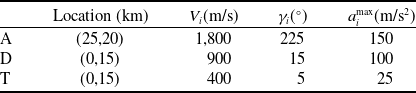
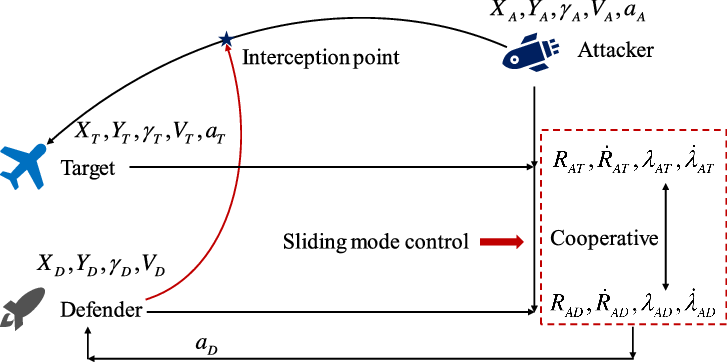
A block diagram of a simulation of the proposed ADCG law is shown in Fig. 3. To analyse the feasibility of the proposed guidance law, the initial conditions for the simulation of the attack missile, defence missile, and aircraft are set as shown in Table 1.
Initial conditions

Block diagram of the simulation.

In all simulations, we assume that the attack missile attacks the aircraft under the action of the proportional navigation guidance (PNG) law in Equation (54). To verify the applicability of the ADCG law, four cases were simulated: different aircraft manoeuvering modes, different attack/defence missile speed ratios, different reaching laws applied to the ADCG law, and a robustness analysis of the ADCG law. The parameters of the guidance law in Equations (27) and (54) are shown in Table 2. To quantitatively analyse the advantages of the ADCG law, the energy consumed by the defence missile during interception is defined as
 $J = \int\limits_0^t {{a_D}^2dt} $
.
 \begin{align}{a_A} = N\!\left| {{{\dot R}_{AT}}} \right|{\dot \lambda _{AT}} \nonumber \\[-30pt] \end{align}
Guidance parameters

5.1 Different aircraft manoeuvering modes
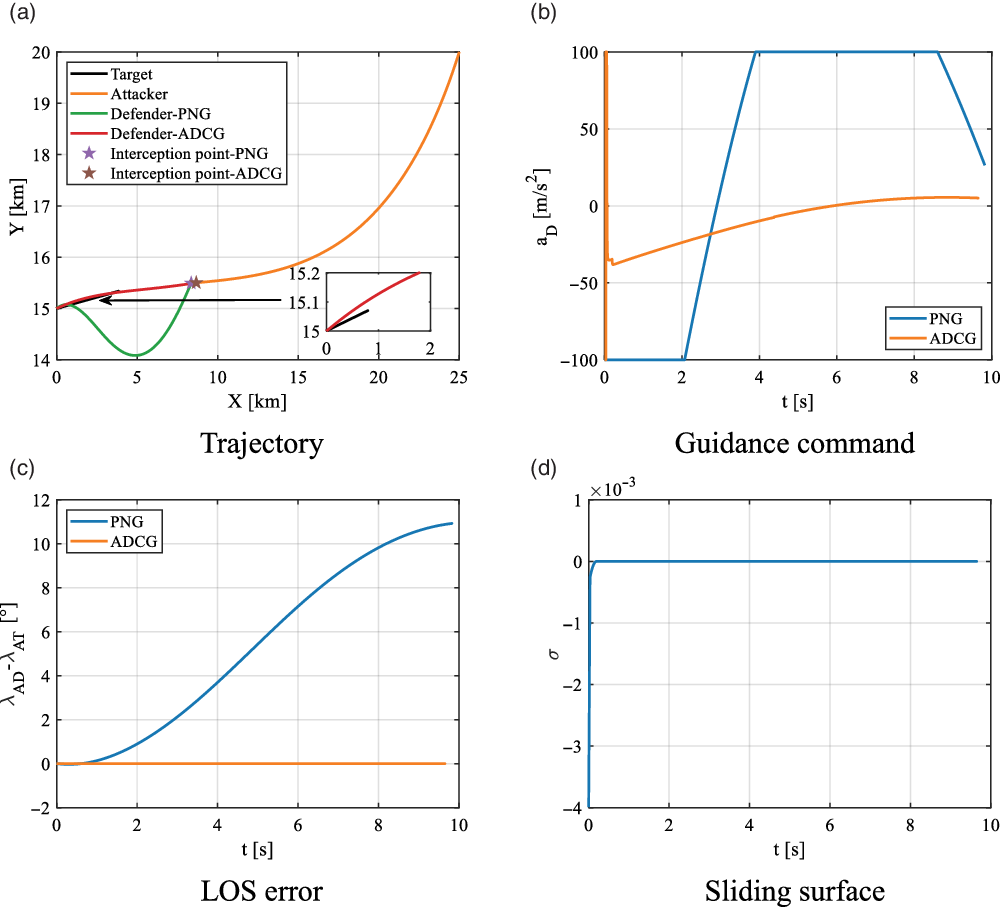
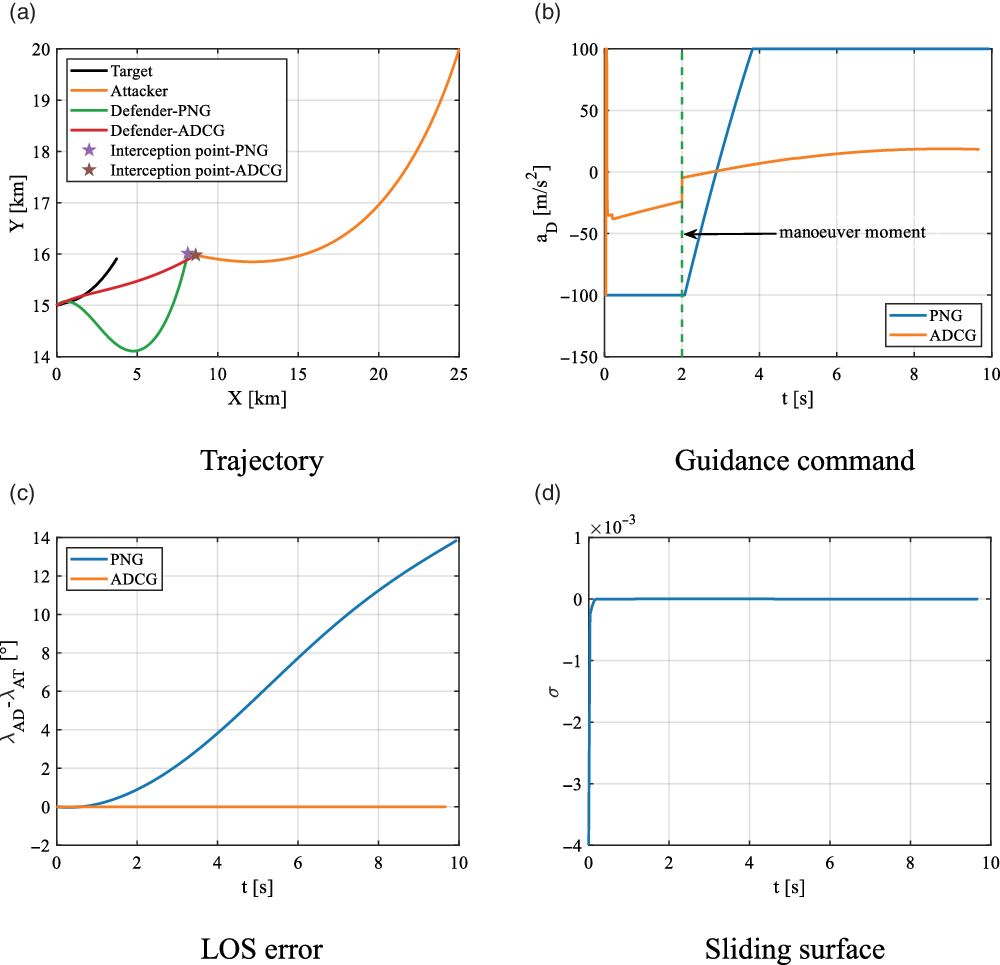
In this subsection, we report the simulation of an aircraft moving with uniform speed and one performing a bang-bang manoeuver. In the two scenarios, the PNG and ADCG laws are used for comparative analysis. The results are shown in Tables 3–4 and Figs 4–5.
Analysis of aircraft at uniform speed

Analysis of the aircraft adopting the bang-bang manoeuvering mode

Results for the aircraft moving at a uniform speed.

Results of the aircraft adopting the bang-bang manoeuvering mode.

When the aircraft moves at a uniform speed along the initial heading direction, the PNG law is the optimal mode of attack for the attack missile [Reference Shima and Golan32]. Table 3 shows that both the ADCG and the PNG laws can be used to intercept the attack missile to protect the aircraft, but the former yields better interception of the attack missile. Compared with the PNG law, the interception time of the attack missile when using the ADCG law is 0.174s shorter, the interception accuracy is 48.64% higher, and the distance between the aircraft and the attack missile increases by 382.7m. Moreover, the defence missile consumes 4.7622×10⁴ less energy when the ADCG law is used.
As shown in Fig. 4(a), when the ADCG law is used, the defence missile always moves along the LOS of the attack missile, defence missile and aircraft, and its trajectory appears to be smooth with a small curvature. Figure 4(b) shows that when the ADCG law is used, the guidance command of the defence missile briefly saturates in the initial stage of interception, and then it gradually and smoothly decreases until the interception time of the attack missile. When the PNG law is used, the guidance command of the defence missile is saturated most of the time, and this significantly burdens to its actuator. Figure 4(c) shows that because information on the relative motion of the attack missile and the aircraft is simultaneously used by the defence missile, the value of
 ${\lambda _{AT}} - {\lambda _{AD}}$
is always close to zero, and the ideal interception by the defence missile can be ensured throughout the process of terminal guidance. Because the PNG law uses only unidirectional information between the attack and the defence missiles,
 ${\lambda _{AT}} - {\lambda _{AD}}$
increases with the guidance time, and it cannot realise ideal interception. According to Fig. 4(d), the sliding surface quickly converges to become close to zero, and there is no obvious chattering.
The bang-bang manoeuver is the optimal manoeuver for the aircraft to avoid danger [Reference Shinar and Steinberg33]. Assuming that the aircraft has only one manoeuvering command switch, it uses the bang-bang manoeuvering mode at an acceleration of 20m/s2 when the attack missile flies for 2s. As is shown in Table 4, when the aircraft uses the bang-bang manoeuver, the advantage of the ADCG law in terms of the interception of the attack missile is more prominent. Compared with the PNG law, the ADCG law used by the defence missile shortens the interception time by 0.273s, improves its accuracy by 61.15%, and increases the distance of between the aircraft and the attack missile by 587.3m. The defence missile also consumes 4.8209×10⁴ less energy in this case.
Figure 5(a) shows that the defence missile is always on the LOS of the attack missile and the aircraft when the ADCG law is used. Figure 5(b) shows that when the defence missile uses the PNG law, the guidance command is saturated for the first two seconds, then exhibits a relationship of linear change with time, and finally reaches saturation, which imposes a significant burden on the actuator of the defence missile. When the ADCG law is implemented, the guidance command of the defence missile is briefly saturated at the beginning, but then the saturation smoothly decreases. When t=2s, a jump in the guidance command occurs as the aircraft’s manoeuvering mode is changed, and it then changes smoothly. Figure 5(c) shows that even if the aircraft uses the bang-bang manoeuver when applying the ADCG law, the value of
 ${\lambda _{AT}} - {\lambda _{AD}}$
remains close to zero, and the entire process of terminal guidance can ensure an optimal interception scenario. Figure 5(d) shows that the sliding surface quickly and smoothly converges to become close to zero.
5.2 Different attack/defence missile speed ratios
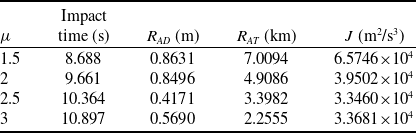
The simulation-based analysis in the previous section shows that, compared with the PNG law, the ADCG law has significant advantages in protecting the aircraft from an attack missile. In this section, we examine the performance of the ADCG law in terms of intercepting the attack missile at different ratios of its speed with respect to that of the defence missile,
 $\mu = {V_A}/{V_D}$
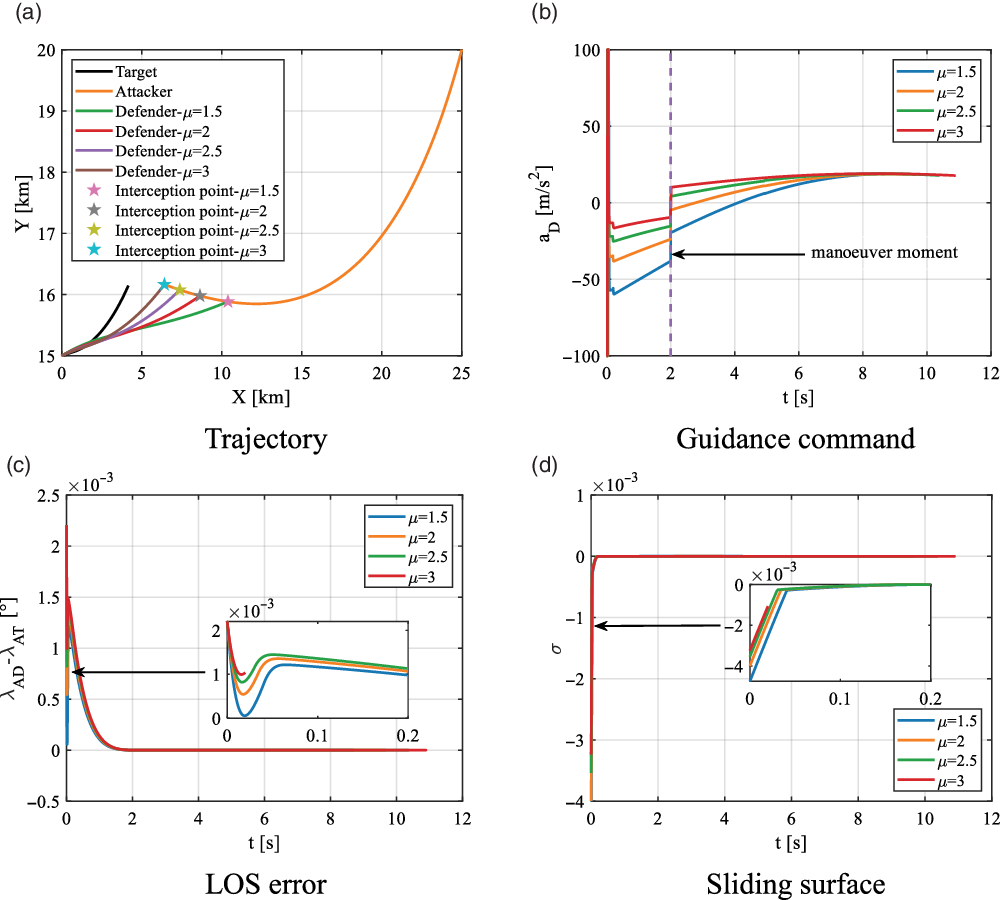
. We assume that the aircraft uses the bang-bang manoeuvering mode. The results of this simulation are shown in Table 5 and Fig. 6.
Analysis of different values of μ

Results of different values of
 $\mu $
.

As shown in Table 5, the defence missile can intercept the attack missile at different speed ratios to protect the aircraft using the ADCG scheme. Figure 6(a) shows that the defence missile always flies along the LOS of the attack missile, defence missile, and aircraft with a small ballistic curvature and a smooth trajectory. Figure 6(b) shows that, under the action of the ADCG law, the guidance command of the defence missile changes smoothly without obvious chattering. Figure 6(c) shows that because information on the relative motions of the attack missile and the aircraft is simultaneously used by the defence missile, the value of
 ${\lambda _{AT}} - {\lambda _{AD}}$
is always close to zero, and it is guaranteed to meet the constraint of ideal interception during the entire stage of terminal guidance. Figure 6(d) shows that the sliding surface quickly converges to become close to zero under different speed ratios without obvious chattering.
5.3 Using different reaching laws in the ADCG law
To verify the superiority of the improved reaching law when applied to the ADCG law, we conducted comparative simulations using a constant reaching law (CRL) and an exponential reaching law (ERL) to design the guidance laws. The corresponding guidance laws were designed as follows.
-
ADCG law based on CRL:
 \begin{align}{a_D} = \frac{{ - {\varepsilon _1}{\mathop{\rm sign}\nolimits} (\sigma ) - f(\boldsymbol{x},t) - d(t) - {K_p}si{g^{{\alpha _1}}}\!\left( {{x_1}} \right) - {K_V}si{g^{{\alpha _2}}}\!\left( {{x_2}} \right)}}{{b(t)}}\\[-30pt] \nonumber\end{align}
-
ADCG law based on ERL:
 \begin{align}{a_D} = \frac{{ - {\varepsilon _2}{\mathop{\rm sign}\nolimits} (\sigma ) - {k_1}\sigma - f(\boldsymbol{x},t) - d(t) - {K_p}si{g^{{\alpha _1}}}\!\left( {{x_1}} \right) - {K_V}si{g^{{\alpha _2}}}\!\left( {{x_2}} \right)}}{{b(t)}} \\[-30pt] \nonumber\end{align}
The guidance parameters in Equations (55) and (56) were set to
 ${\varepsilon _1} = {\varepsilon _2} = 0.01$
and
 ${k_1} = 0.1$
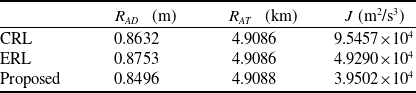
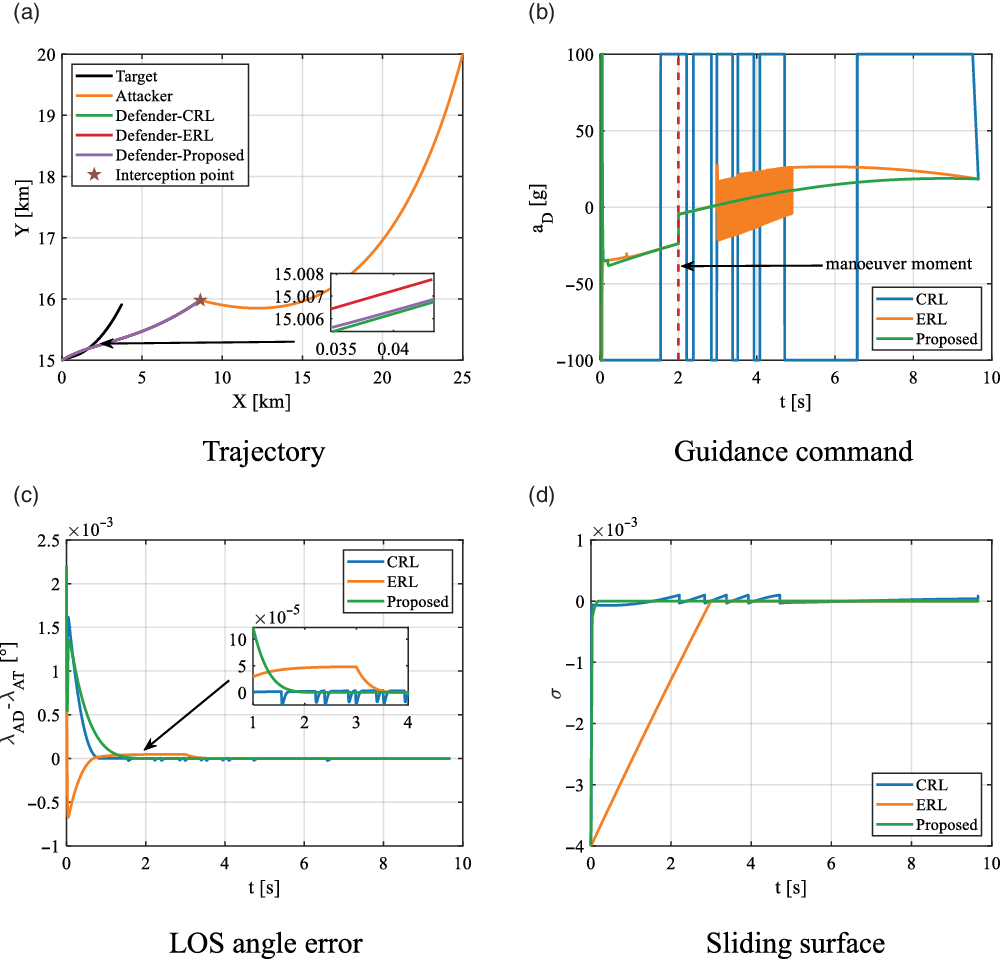
, and we assumed that the defence missile used the bang-bang manoeuvering mode. The results are shown in Table 6 and Fig. 7. Table 6 shows that the defence missile intercepts the attack missile under the action of different reaching laws to protect the aircraft. However, the improved reaching law has higher interception accuracy than the CRL and ERL. Figure 7(a) shows that the use of different reaching laws yields no significant differences in the trajectory of the defence missile. Figure 7(b) shows that the improved reaching law weakens chattering in the guidance command to reduce the burden on the actuator of the defence missile. Figure 7(c) shows that
 ${\lambda _{AT}} - {\lambda _{AD}}$
is always close to zero, so the defence missile is guaranteed to satisfy the conditions of ideal interception during the entire stage of terminal guidance. However, the improved reaching law increases the speed of convergence, and the change is smoother. Figure 7(d) shows that, compared with the CRL and ERL, the improved reaching law converges to become close to zero more quickly, and there is no obvious chattering.
Analysis of different reaching laws

Results of different reaching laws.

5.4 Monte Carlo simulations
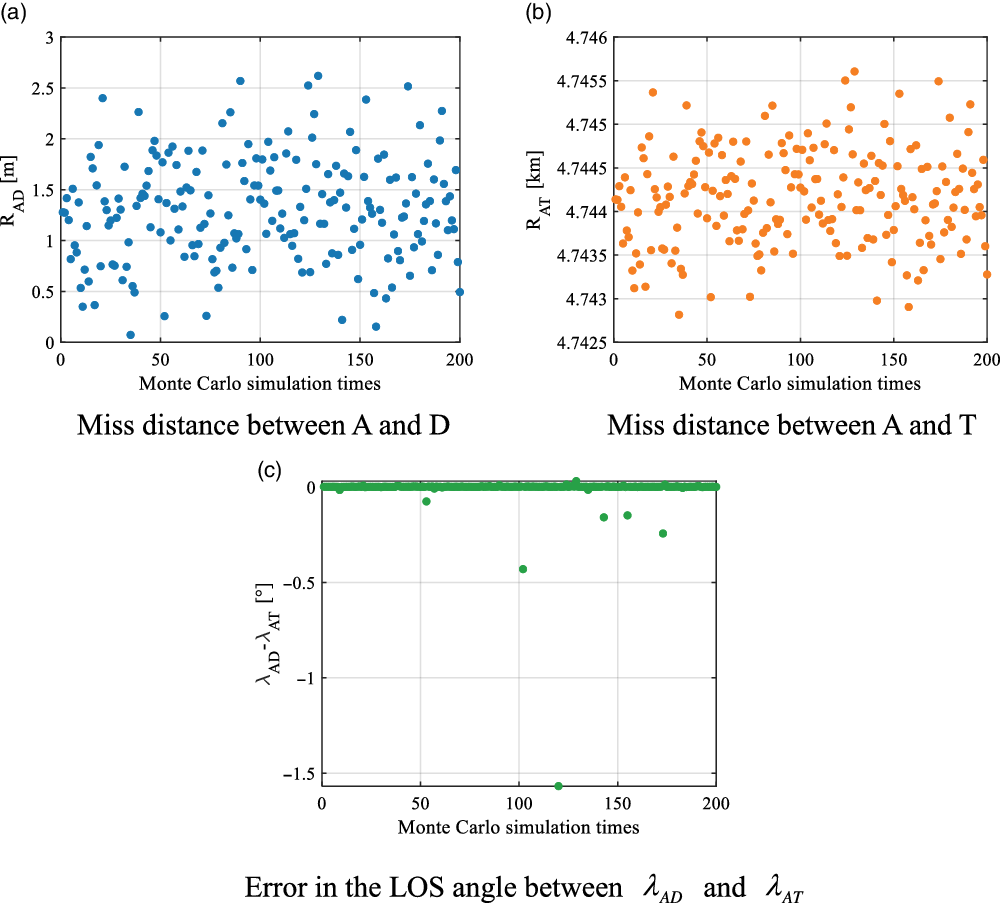
To further verify the robustness of the proposed guidance system, we ran 200 Monte Carlo simulations of the trajectory set by the proposed guidance system in the presence of measurement errors, and we statistically analysed the results. The aircraft was again assumed to have used the bang-bang manoeuvering mode. The simulations were conducted supposing that errors in the measurement of the relative speeds of
 ${\dot R_{AT}}$
and
 ${\dot R_{AD}}$
obey a Gaussian distribution, with a mean of zero and a variance of 1m/s, and that
 ${\dot \lambda _{AT}}$
and
 ${\dot \lambda _{AD}}$
obey a Gaussian distribution with a mean of zero and a variance of 0.01rad/s. The results are shown in Fig. 8.
Results of Monte Carlo simulations.

The data of the Monte Carlo experiment show that the average miss distances of the attack missile relative to the defence missile and the aircraft are 1.3001m and 4.7442 km, respectively, and the standard deviations are 0.2559 m and 0.2995 km. This meets the interception accuracy requirements to ensure the safe flight of the aircraft. Moreover, the average error of
 ${\lambda _{AD}} - {\lambda _{AT}}$
is -0.0116°, with a standard deviation of 0.0137°. This can ensure optimal interception. Thus, the proposed ADCG law is highly robust in the presence of errors and noise.
6.0 Conclusion
To address the problems of using a cheap and low-speed airborne defence missile with low manoeuverability to accurately intercept a fast and expensive attack missile with high manoeuverability to protect the safety of an aircraft, an ADCG law is proposed based on SMC method and the concept of the LOS constraint. The main conclusions can be summarised as follows.
(1) The proposed guidance law can ensure that the defence missile always moves in the line of LOS between of the aircraft and the attack missile so that the safety of the aircraft can be guaranteed.
(2) A defence missile guided by the ADCG law can effectively intercept the attack missile under different attack/defence missile speed ratios, showing great value in engineering practice.
(3) Compared with other guidance laws, the ADCG law shows great advantages in terms of convergence speed and robustness in the presence of errors and noise.
Acknowledgments
The authors appreciate the financial support from the National Natural Science Foundation of China (NSFC) (Grant No. 62173274), the Shanghai Aerospace Science and Technology Innovation Fund (Grant No. SAST2020-004), the Natural Science Foundation of Shaanxi Province (Grant No. 2020JQ-219) and the Natural Science Basic Research Plan in Shaanxi Province of China (Grant No. 2020JC-19).
Conflicts of interest
The authors declare that they have no known competing financial interests or personal relationships that could have appeared to influence the work reported in this paper
Supplementary material
To view supplementary material for this article, please visit https://doi.org/10.1017/aer.2022.62.