Introduction
In spring 1955, G. L. Toole, cashier for the Upper Darby National Bank, in suburban Philadelphia, published a pair of articles in the American Banker newspaper detailing his bank’s successful experience developing and operating a charge account credit service—forerunner to today’s modern credit card. The program allowed consumers to shop at a variety of local merchants using a single bank-sponsored credit plan, which they repaid at the end of each month. The plan was called Charge-Rite. “Sure, the name can be called corny,” Toole conceded, “but it refers to the service it represents, is short, phonetic, and kind of easy to remember.” Toole’s bank began Charge-Rite in 1953, and by early 1955 the bank had processed more than $750,000 in local credit transactions. After enduring high start-up costs, Charge-Rite was generating modest profits, and the future looked bright. “At my bank,” Toole explained, “We believe charge account banking will develop into one of the most successful of our services.” Toole was not alone. After detailing the success of charge account banking plans across the country, American Banker associate editor Otto C. Lorenz gushed in November, “where else could the banker invest … and get such handsome returns in dollars, not to mention good will?”Footnote 1
The charge account plans described by Toole and praised by Lorenz were, at first glance, an unlikely innovation for bankers to pursue during the early-postwar decades. In the wake of the Great Depression and the New Deal-era banking reforms that followed, the American commercial banking industry was structurally and culturally predisposed toward a custodial obsession with safety, not an entrepreneurial spirit of risk-taking. Most commercial bankers, whose primary function was meeting the financial needs of businesses, were deeply suspicious of direct consumer lending. When bankers did lend to consumers in the 1950s, they did so for purchases with concrete collateral, like automobiles and appliances; for those with firm government guarantees, like Federal Housing Administration Title I loans; or, in the best circumstances, both. They did not finance casual shopping. The cautious conservatism exhibited by most commercial bankers has, in turn, come to define their industry in the view of later scholars, who either lament the fall from this idyll of postwar stability or mock postwar bankers for drumming up consumer accounts with free toasters and steak knives.Footnote 2
Nevertheless, for a small cohort of bankers, the industry’s marble-pillared traditionalism was too confining. Consumption was self-evidently the pulsing heart of the postwar economy. Financial institutions that catered to consumers, like credit unions and savings and loans, were growing quickly at commercial banking’s expense. If commercial banks wanted a part of this future, self-described “progressive” bankers like Toole believed, they would need to shake the industry’s stodginess and find innovative ways to serve consumer markets.Footnote 3
Scholars need to better understand this history of early-postwar financial innovation. Historians and other scholars focus too much attention on the 1970s as a moment of rupture, when the forces of untamed inflation, technological change, and political deregulation combined to rapidly undermine the long financial stability of the postwar decades.Footnote 4 Instead, the emergence of these early bank cards demonstrates that from the beginning of the postwar years, entrepreneurial bankers pursued opportunities to serve customers beyond the strict confines of the era’s financial-regulatory system, and in doing so put constant pressure on the boundaries of that system.
This is not to say that Toole and his peers were bent on the destruction of the New Deal banking reforms. Just the opposite. Even as bankers pursued financial innovation in the early postwar years, they remained constrained by the era’s regulatory barriers and the habits of thought these barriers encouraged.Footnote 5 Specifically, although bankers were eager to facilitate consumption, they could not yet imagine marketing their new credit products directly to consumers. Instead, the postwar political and regulatory structure led charge account bankers toward a set of business strategies focused on retailers, not consumers, and toward an inherently antimonopoly politics that was pro-small business rather than being pro-consumer.Footnote 6 Charge account banking was a business service designed to help small retailers compete with the credit practices—and overcome the market power—of expanding department stores. Bankers used the plans to deepen business relationships with merchants, who bore the costs of charge account plans, while keeping the primarily female consumers who used the plans at arms length. The political economy of banking, which sharply limited individual banks’ geographic markets, also allowed charge account bankers to form a collaborative innovation community, since their plans did not directly compete. As these firms worked together to achieve profitability through the 1950s, they adopted many of the features that would later define today’s credit card systems, and in so doing pushed the banking industry to embrace unsecured consumer lending.
Scholars of postwar financial innovation have dismissed or ignored charge account banking plans and other product innovations pursued by commercial bankers in the 1950s, looking elsewhere for the origins of today’s consumer credit systems. With their merchant—rather than consumer—focus, charge account banking plans certainly looked different than the credit card programs that firms, like Bank of America, would later develop. Nevertheless, charge account banking was a first step toward the unsecured, direct consumer lending that would define the economy’s later drift toward unbridled finance, even if, in the 1950s, charge account bankers could not have imagined they were on that path.Footnote 7
Retail Credit and Banking Markets
At the turn of the twentieth century, the application of mass-production techniques to consumer-goods manufacturing and of efficient management techniques to retail marketing laid the groundwork for new credit technologies that would facilitate mass purchasing. In this period, the country underwent what contemporaries termed a “credit revolution,” in which firms developed new forms of retail credit to sell the bounty of goods to working- and middle-class consumers. The first was installment lending, in which, for a reasonable down payment and a series of equal weekly or monthly payments over a fixed period thereafter, primarily working-class consumers could buy expensive durable goods, such as radios and sewing machines, without paying the full cost upfront. The second credit innovation was the charge account, through which mostly elite consumers enjoyed a fixed line of credit that they repaid at the end of each month. Charge accounts were a high-status evolution of traditional retail book credit, scaled up and systematized in the nation’s bustling department stores. Both forms of credit helped ensure steady consumer demand, allowing, as historian Louis Hyman argues, “consumers to buy more, retailers to sell more, and manufacturers to make more, all at lower prices.”Footnote 8
The turn-of-the-century retail innovations created economic value for consumers, but they also threatened smaller, less efficient merchants, feeding a robust retail antimonopolism. In the 1910s and 1920s, small-town shopkeepers and corner merchants began organizing to combat the “destructive competition” of their new high-volume, low-price rivals. As Laura Phillips Sawyer and Marc Levinson have shown, small retailers won political allies with calls for “fair competition” in the 1920s and 1930s, culminating in New Deal legislation, such as the Robinson-Patman Act (1936) and the Miller-Tydings Act (1937), designed to curtail the market power of large retail firms. After World War II, antimonopolism persisted as a powerful political force; retail firms continued to negotiate the appropriate boundaries of market competition through the political process.Footnote 9
Similar antimonopoly impulses had long structured the American commercial banking industry, based not only on new commercial and managerial efficiencies but also on enduring distrust of financial concentration. Before the Great Depression, most states enforced unit banking laws that restricted banks to a single banking office. By limiting the industry’s geographic scope, unit banking was meant to ensure that individual financial institutions were deeply tied to the communities that they served and that credit was widely available for small proprietors in those communities. This feature of the system was also its profound flaw. As the banking failures of the 1920s and 1930s clearly demonstrated, unit banking, wholly dependent on local economies, was systematically unstable. Instead of remaking this system during the New Deal, however, Congress preserved unit banking. It backstopped the industry with federal deposit insurance and imposed new limits on financial industry competition. Continued geographic restrictions, new price controls, and new limitations on services all worked in theoretical harmony to preserve a marketplace of small competitors by constraining destructive market forces.Footnote 10
New Deal reformers were not unremitting enemies of financial innovation. To facilitate economic recovery, policymakers such as Rolf Nugent and Leon Henderson developed the Federal Housing Administration Title I loan program, which used federal insurance to incentivize bankers to make loans for home improvements, convincing many banks to finally adopt installment lending. This ounce of innovation, however, was soon balanced by a pound of conservatism. World War II, and the huge government debt it generated, allowed bankers to buy government bonds profitably on their own account. Reconversion, in turn, assured bankers safe opportunities in business investment. By the postwar era, conservatism reigned.Footnote 11
While the war helped entrench bankers’ prudential caution, government intervention in retail credit markets during the war pressured retailers to innovate. In an effort to direct the nation’s financial resources toward wartime production and to constrain inflationary consumer spending, Franklin D. Roosevelt’s administration imposed federal limits on consumer credit use in April 1942. These wartime controls restricted both charge accounts, which consumers paid off every month, and installment lending, which consumers paid in fixed installments over time. They also required retailers to closely monitor their customers’ credit spending. Payment card technology—embossed metal plates integrated with mechanical accounting and billing systems—simplified compliance for large retailers. Retailers also experimented with new modes of granting credit to circumvent controls. Revolving credit, for example, gave consumers a fixed credit limit, like a charge account, but allowed them to pay over time, like installment credit. For many retailers, wartime credit controls linked revolving credit and payment card technologies, while charge accounts, which remained more widespread, also increasingly relied on card-based accounting and billing systems.Footnote 12
After the war, large retailers gradually transitioned from fixed charge accounts to flexible revolving credit, a transition often reflected in practice but not terminology. Many retailer and bank “charge account” plans featured revolving credit, while some remained strictly charge accounts that had to be repaid monthly. Likewise, although the term “credit card” would come to be associated with revolving credit, in the 1950s its use was ambiguous. What ultimately held these types of credit together was the status attached to them. “Charge accounts” were for respectable people; they were not the installment credit of the working class.
With federal credit controls still in effect at the end of the war, credit quickly moved to the center of postwar retail politics. Retail trade groups, such as the National Retail Dry Goods Association (NRDGA), fought federal policymakers’ efforts to make credit controls a permanent feature of postwar economic management. Instead, retail and financial industry groups portrayed consumer credit as a private path to prosperity, in direct opposition to the statism of the New Deal. Nevertheless, as it forged a united front with other trade groups and beat back direct economic controls, the NRDGA also had to diffuse the tensions credit threatened to create within its own industry. For the large retailers that had invested in efficient but expensive credit systems during the war, the best way to maximize their investments was to promote credit heavily afterward. To forestall new political agitation against such destructive competition, throughout the late 1940s and early 1950s the retail trade press urged small merchants to likewise adopt charge accounts to drive sales volume. By doing so, small retailers could simultaneously counter the renewed growth of chain retailers, which sold goods at a discount and did not offer credit, and department stores, which made credit central to their postwar expansion.Footnote 13
Small retailers, however, recognized that prioritizing credit simply introduced one more business challenge that complicated their position vis-à-vis their larger, more efficient rivals. Credit was a strain on small merchants’ already limited capital, and small retailers could not turn to secondary markets or government lending programs to mitigate their credit risks. Unlike installment sales contracts, which could be resold to finance companies, charge account credit and its revolving cousin were indeterminate and thus not resalable. For small merchants, the convenient credit offered by their larger competitors and promoted by their trade association smacked of unfair competition and excessive market power, and came as many of these small firms struggled to gain space in the nation’s new shopping centers and to compete against department stores’ new branch units. Small retailers continued to mobilize politically to address these perceived injustices, fueling an ongoing political critique, from both conservative and liberal antimonopoly tradition of the dominance of big business in the postwar era.Footnote 14
Some small bankers, closely attuned to the business challenges facing their small-merchant customers, were trying to puzzle out possible business solutions to retailers’ credit-granting problem. Small firms in both industries recognized that retail credit was a permanent feature of the marketplace, and bankers who counted struggling small merchants among their customers saw an opportunity to help these firms meet the new pressures of postwar retailing. “As far back as 1946,” G. L. Toole recalled, “our top men were seeking a way to assist the many local merchants who sought help [meeting] the competition of credit buying offered by center city merchants.” The solution, for Upper Darby’s “top men” and other bankers, was not immediately obvious. Although New Deal credit programs had nudged bankers into consumer fields, like home improvement, automobile, and durable goods financing, these lines of business were still mediated by direct sales firms, such as auto dealers or appliance retailers. Most commercial bankers had little retail experience beyond making business loans to retailers.Footnote 15
The Origins of Charge Account Banking
As bankers and small retailers collectively wrestled with the question of how to meet the credit competition of center city merchants and other large credit-granting firms in their local markets, two banks initiated charge account plans in the expanding suburbs of New York City, which would serve as the impetus and inspiration for charge account banking’s nascent expansion. The first was the brainchild of John C. Biggins, an executive at the Flatbush National Bank of Brooklyn. After the war, New York City’s downtown department stores began to build branches in Brooklyn, offering charge accounts and competing directly with Flatbush Bank’s merchant customers. Biggins’s retail customers needed to offer convenient credit too, but doing so was expensive and risky. “The number of merchants who have been knocked out of business by supplying their own credit is enormous,” Biggins explained. “Charg-It,” a plan for “providing the small storekeeper with a credit arrangement that wasn’t a losing proposition for everyone concerned,” was Biggins’s answer.Footnote 16 In essence, Biggins hoped to consolidate the lending activities of small merchants within the bank, so that a customer could shop at a variety of local retailers using bank credit, while the bank would pay merchants for the goods purchased and assume the bookkeeping costs and credit risk.
Prior scholarly accounts of Biggins’s plan claim it operated within a four-block radius of the Flatbush bank, but I have found no contemporary evidence to substantiate these claims.Footnote 17 Rather, Charg-It got its first trial not in Brooklyn but in Bay Shore, New York, a growing bedroom community linked to New York City by the Long Island Rail Road. While Biggins was perfecting Charg-It, Flatbush Bank was acquired by the larger Manufacturer’s Trust.Footnote 18 Manufacturer’s executives considered implementing Biggins’s plan across New York City but ultimately chose not to, perhaps because Charg-It would have competed with the charge account plans of the larger bank’s department store customers. Instead, Biggins tested his plan in the suburbs in partnership with the First National Bank and Trust of Bay Shore. First National had a long-standing correspondent relationship with Manufacturer’s Trust, although Biggins may also have licensed the plan independently of his position with the bank. In any case, the program was small; a 1946 ad listed eleven participating merchants clustered on Bay Shore’s Main Street. “Charg-It will give you the advantages of a department store charge account in your favorite local stores,” one ad promised, offering new suburban residents an incentive to do their shopping in town instead of downtown.Footnote 19
In Bay Shore, Biggins initiated what would become a common strategy for banks instituting charge account plans: uniting local merchants to keep consumers’ shopping dollars within the community. When Biggins relocated to the Paterson Savings and Trust Company, in suburban New Jersey, he brought Charg-It with him. Paterson merchants also competed with New York department stores, as well as with new suburban shopping centers such as the Paramus Mall. Charg-It offered Paterson retailers a “vital community service” by keeping business local. “You can shop in your own neighborhood,” a Paterson Savings ad promised, and “Charg-It [at] stores and receive the same credit courtesy available [at] the biggest stores in the city.”Footnote 20
While Biggins designed Charg-It to help small retailers compete with department stores, the plan had a critical weakness: ultimately, it was less convenient than department store charge accounts. By the late 1940s, most department stores had adopted charge-plates, embossed metal cards, which, as part of integrated accounting and billing systems, enabled department stores to monitor and control individuals’ credit purchases at their stores. For consumers, the card was a means of identification and the medium of credit. Meanwhile, Charg-It combined a card, which identified the consumer, and credit scrip, which were paper certificates equal to the consumer’s preestablished credit limit. Scrip was a powerful control device, because consumers could never use more credit that they had been granted, and they only received new scrip when they paid off their outstanding Charg-It balances. However, scrip, which was only issued in denominations of $1 or more, was a source of considerable consumer annoyance: purchases inevitably did not come out in round figures. And, as Toole, whose bank consciously chose not to adopt a scrip-based credit plan observed, “there is a certain stigma attached to the carrying of scrip.” Charge accounts were a marker of class status, and scrip was just not classy.Footnote 21
Historians credit Biggins with leading the banking industry’s early shift into retail lending, but his industry quickly rejected the scrip solution. To make charge account banking viable, bankers instead looked to emulate the credit practices of department stores. One alternative was the similarly named “Charge-It” plan, announced in May 1952 by Franklin National Bank, also of suburban Long Island. Charge-It, Franklin National executive Edward Donohue claimed, developed from a conference that bank executives hosted to consider how the firm’s merchant customers could better promote their businesses. There, community retailers argued that their most pressing need was to offer charge account services. As they contemplated how to help these firms, Franklin executives decided that if department stores were the threat, they should also be the model. “In order to make this program completely acceptable to the ultimate consumer,” Donohue observed, “we could not change habits; we would have to emulate exactly the technique and methods of department stores.” Franklin National made the card both the form of identification and credit medium, so that consumers would experience charge account purchasing at their local merchant exactly as they would at a department store.Footnote 22
With merchants on board, the problem Franklin National executives faced was how to entice and enroll creditworthy consumers. In a model that later charge account programs would widely adopt, Franklin executives built Charge-It on established relationships between the bank’s idealized customer, “Mrs. Housewife,” and the merchants she patronized. Under the plan, Mrs. Housewife applied for a bank charge card through a participating merchant with which she already had a credit relationship. The bank performed its own credit check later, but by relying on its merchant partners to sign-up customers, the bank embedded Charge-It within existing relationships between merchants and consumers, relying on these established bonds of trust to anchor the program.
Assuming everything checked out, the bank issued Mrs. Housewife a charge card embossed with her husband’s name and their account number, and she could then shop as she would at a local department store. When wishing to make a purchase, she handed the retailer her card, and if the advertisements are any indication, proudly exclaimed, “Please Charge It!” The retailer, duly impressed, completed a sales slip with the details of the purchase and imprinted the embossed card on the slip, which Mrs. Housewife signed. If the purchase was above $10, or some similar predetermined limit, the merchant also called the bank to confirm Mrs. Housewife’s account was in good standing. As far as Mrs. Housewife was concerned, the transaction ended there, and she could simply take her goods. Every month the bank consolidated Mrs. Housewife’s account and mailed her a bill containing carbon copies of all her sales slips. She would pay her bill in full each month, without paying interest.Footnote 23
Behind Mrs. Housewife’s transaction was a second series of transfers between the merchant and the bank, which hid the mechanisms and—more importantly—the costs of her charge account from view. At the end of the business day, Franklin National’s merchant-customers consolidated all their charge account sales slips and transferred them to the bank. The bank then credited each merchant’s account for the full value of all these purchases, less a fixed percentage called the merchant discount. For Franklin National, the discount was 5 percent. Thus, if Mrs. Housewife bought a $10 pair of shoes, the bank paid the merchant $9.50, with the remaining 50 cents accruing to the bank to cover the costs of issuing the credit and carrying the risk of lending to Mrs. Housewife.Footnote 24 Merchants also often paid fees to join the charge account plan, to rent the imprinter that recorded the customer’s information on the sales slip, and to participate in advertising tie-ins with the bank.
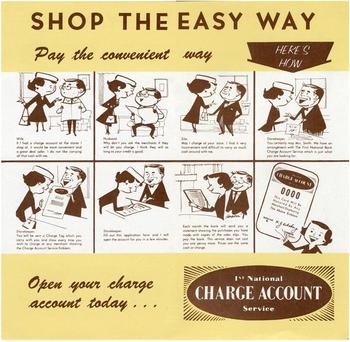
As Donohue’s invocation of “Mrs. Housewife” suggests, bankers designed their charge account plans to facilitate female-led family consumption. Charge account bankers imagined their market as white, female, and married. Toole’s customer was “Mrs. John Shopper”; other bankers preferred plain “Mrs. Shopper.” This new banking service, charge account advertisements suggested, made wifely tasks like family shopping and budgeting more convenient, consolidating small purchases into one monthly bill. They also emphasized safety. In the First National Bank of Kalamazoo advertisement (Figure 1), Mrs. Smith does “not like carrying all that cash around with me,” and feels that “a charge account … would be more convenient and a great deal safer.” Her husband approves, a necessary step since the family’s credit would be in his name. In this way, charge account bankers promoted the wholesome abundance and familial safety that Elaine Tyler May argues was central to family life in the Cold War era, while their charge account products operated in distinct contrast to male modes of credit, like automobile loans and durable goods purchases.Footnote 25
Brochure for the First National charge account service.
Note: “First National Charge Account Service Shoppers Guide,” First National Bank and Trust of Kalamazoo Clipping File, Kalamazoo Public Library (ca. mid-1950s). Published with permission of PNC Bank, N.A.

Building a Collaborative Innovation Community
When Charg-It and Charge-It emerged in the early 1950s, the business and banking press hailed the plans as an important new banking service that promised to aid small retailers in their struggle against department store competition. Clearly reflecting the narratives employed by Biggins and Donohue, Business Week, Banking, and other outlets portrayed charge account banking as a product imbued with small-business antimonopoly politics. Franklin National’s “Charge-It” plan could “support private enterprise at the small retailer level,” and even “stem the disappearance of the small store which finds it difficult to compete with the large units opening branches in suburban areas.” As charge account banking developed and spread, bankers held tightly to these narratives. Sharing their own origin stories at industry conferences and in the banking trade press throughout the 1950s, bankers inevitably repeated the politically coded founding story first articulated by Franklin National’s Edward Donohue: banks initiated charge account plans to help their small-merchant customers compete with department store credit plans. One Florida banker even compared his bank’s plan to the Small Business Investment Act (1958), because both provided direct aid to small retailers competing against the market power of larger firms.Footnote 26
The praise Charg-It and Charge-It received in the business and banking press was one of several converging currents that drove a wave of banks to initiate charge account plans in the early 1950s. First, the end of the Korean conflict and its associated federal credit controls cleared the way for a significant expansion in consumer borrowing. In this market, charge account plans, in addition to promoting antimonopolistic altruism, promised to generate significant revenues—as high as 20 percent, American Banker estimated in October 1952. The potential for profits was further promoted by firms, such as Addressograph and Diebold, manufacturing credit-processing equipment, and by charge account bankers such as Biggins and Donahue, whose banks were marketing franchise arrangements to prospective charge account bankers. Whether they signed with an established plan or developed one on their own, at least ninety-one banks initiated charge account plans by the end of 1953, leading Donohue to declare confidently, “‘charge accounts for banks,’ is here to stay.”Footnote 27
Hidden by Donohue’s optimism were the impending difficulties each individual bank would face as they brought their new charge account plans to market. High equipment and supplies costs, difficulty enrolling merchants and consumers, inexperience managing retail credit accounts, and regulatory interference would all challenge firms as they sought to tailor charge account banking to the needs of their specific communities. Rather than confront these challenges alone, charge account bankers and their industry allies quickly formed informal and formal networks to promote charge account plans, determine and share best practices, and develop new profit-making strategies. Such cooperation was possible because, within the geographically segmented financial system, charge account bankers did not directly compete with each other.Footnote 28
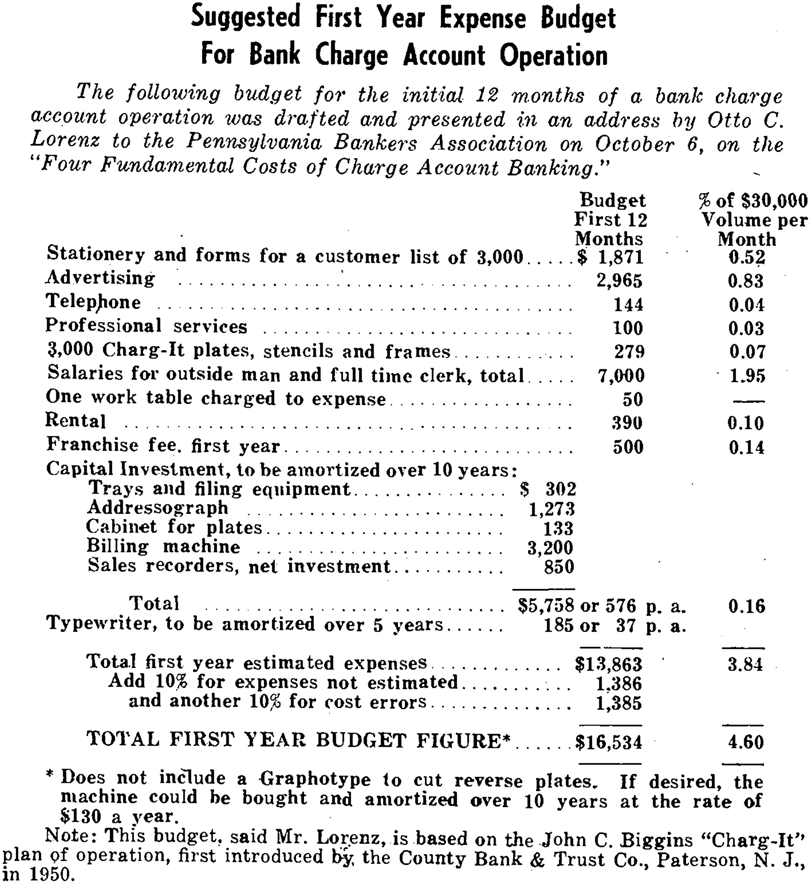
Leading the promotional campaign was American Banker editor Otto Lorenz, a veteran of the industry’s expansion into installment lending in the 1930s, who viewed charge account banking as the postwar generation’s next big innovation.Footnote 29 Lorenz promoted charge account banking through multipage quarterly reports in American Banker, which detailed volume, expense, and profit statistics as well as commentary on plan management provided by Lorenz and practicing charge account bankers. The sample budget below (Figure 2) is typical of the kind of material bankers could expect from Lorenz’s columns. Through his reports, Lorenz effectively constructed the industry, forging a community of practitioners—who he lovingly called his “pioneers”—and giving them a virtual space to compete and test new ideas. He also sought to explain the new plans to uninitiated bankers in terms they could understand, relying on established banking concepts, like letters of credit and accounts receivable factoring, to link unfamiliar consumer credit with familiar banking practices.Footnote 30
Suggested first year charge account budget based on Biggins’s “Charg-It” plan.
Note: From American Banker, October 30,© 1953 SourceMedia Inc. All rights reserved. Used by permission and protected by the Copyright Laws of the United States. The printing, copying, redistribution, or retransmission of this Content without express written permission is prohibited.

Such explanations were necessary, because when Lorenz began his quarterly reports in June 1953, the methods and measures of charge account banking were entirely fluid. Lorenz and his readers worked to define what activities and expenses bankers needed to account for, and through these measures determine what elements would make the new programs viable and profitable.Footnote 31 Was the size of a bank’s “trading area” a factor in charge account success?Footnote 32 What was the best way to report delinquency data (so as not to scare off likely adopters)?Footnote 33 How much of the bank’s overhead should the charge account program be accountable for? By reporting and analyzing the strategies used by exemplary performers and using such information to critique the practices of underperforming firms, Lorenz and his contributors crafted an ongoing proscriptive guide to charge account banking, one intended explicitly to entice more bankers to adopt the plans in their markets.
Some skeptical bankers, however, were critical of American Banker’s glowing coverage of charge account programs, especially in the early 1950s when the leading “pioneer” firms were eagerly franchising charge account systems. Lorenz, though, would not be dissuaded. “We are also accused of ‘selling’ charge account banking. Perhaps we are,” he admitted. Nevertheless, “we believe that this new banking service serves a community need—that is it is a powerful goodwill instrument for the bank and that it brings a great flow of collateral benefits when well and profitably operated.”Footnote 34 Lorenz’s belief, and the information gathering it inspired, ultimately gave bankers like Toole the resources necessary to pursue charge account banking without licensing another bank’s program. Budget targets (like those in Figure 2), accounting principles, explanations of plan management procedures, and Lorenz’s enthusiastic boosterism all served to open charge account banking to a wider number of firms and to guide bankers over the early shoals their plans inevitably encountered.
In addition to constructing a community through Lorenz’s American Banker columns, charge account bankers cooperated directly to solidify innovation within their banks and spread their innovative practices to the industry as a whole. They did so first through informal personal networks and then within a new national trade association that grew from those contacts. “Prior to March, 1954,” one banker recalled, “many of us … had been exchanging ideas and discussing problems, both through correspondence and during personal visits to each other’s offices.”Footnote 35 That March, at the American Bankers Association’s National Installment Credit Conference in Chicago, a panel on bank charge account plans, sponsored by the equipment firm Danvers Manufacturing Company, provided the spark for twenty-four banks from thirteen states to form the Charge Account Bankers Association (CABA). Founded to “promote generally the interest of charge account banking,” CABA functioned as a clearinghouse of information on bank card plans, where, “as each new problem developed,” they were “discussed at length, always resolved, and a new procedure was born.” Through annual conferences and frequent late night phone calls between overworked bankers, the programs of CABA banks cohered around a common set of features and practices, more closely resembling Franklin National’s attempts to emulate department store practices than Biggins’s scrip plan (Biggins did not join CABA).Footnote 36 After charge account plans found stable footing, moreover, CABA became something of a self-regulatory institution, promulgating standards for charge account banking programs to assure nervous bank management, suspicious bank supervisors, and other stakeholders that the seemingly risky credit plans were, in fact, operating on a safe, sound basis.
Indeed, as Lorenz and CABA members tried to encourage their industry peers by assuring them that charge account banking was simply an extension of existing banking practices, they simultaneously sought to convince bank supervisory authorities that the plans should not be held to the same regulatory standards as traditional banking. Rather, bankers argued that their novel service should be evaluated like the retail firms they were emulating, which were not subject to the strict accounting and oversight imposed on banks. These arguments were most pressing when it came to charge-offs—the mandated delinquency period after which banks had to write nonperforming loans off their books—and state interest rate limits—which strictly curtailed rates on bank loans but usually did not extend to retail credit. “We have been examined four times—once by F.D.I.C., twice by State, and once by Clearing House,” one banker complained. Expressing frustration at prevailing banking standards, he continued, “We believe 90 day charge off is impractical on retail charge accounts. I know of no retailer who acts so soon.” To help educate bank supervisors, who continued to enforce exacting standards throughout the 1950s, Lorenz urged CABA to create guidelines for charge account write-offs that supervisors could then apply. CABA published rules for delinquency in 1959, which some examiners agreed to follow, while others retained more stringent installment lending standards. “Some banks,” Lorenz reported, “had unhappy management” as a result.Footnote 37
As retailers shifted from charge accounts to revolving credit through the 1950s, bankers wanted to match this transition and with it the interest charges retailers were permitted to assess on their revolving accounts. States, however, uniformly restricted the rates banks could charge on loans of money, often between 6 percent and 12 percent, while allowing slightly higher rates on installment loans, like those for automobiles. Meanwhile, retailers’ revolving credit plans fell under a legal exemption to usury laws called the time–price doctrine and were largely unregulated. Even when states specifically regulated retail credit sales, such transactions carried higher rates than were otherwise allowed for money loans. In New York, for instance, the state’s Retail Sales Act (1960) permitted retailers to charge 1.5 percent a month (18 percent annualized) on unpaid revolving credit balances. At that same time, the Personal Loan Clause of the New York Banking Act restricted interest to 6 percent per year.Footnote 38
Over the long term, state interest rate restrictions would be the most important and contested regulatory barrier bankers faced, and an important site for political conflict over bank credit card plans. However, in the 1950s, regulatory and supervisory negotiations happened out of sight, without public pronouncements or political conflict. At the national level, the comptroller of the currency determined Franklin Square’s Charge-It sales slips were valid legal documents, but refused to comment on whether charge accounts were a legitimate banking function or to issue any other public statement. State authorities were also largely silent. The one exception was the Division of Banks of the Department of Commerce of the State of Ohio, which made it clear that it would not allow bank charge account programs. “This office does not look with favor on this type of financing by banks,” the state’s superintendent of banks wrote on April 24, 1959, perhaps because the five banks in the state that had begun charge account plans in 1953 discontinued them soon after.Footnote 39
Although Ohio represented an extreme case, a heavy cloud of uncertainty nevertheless hung over charge account banking by the mid-1950s. Most plans tended to lose money for several years before turning modest profits; about half of the firms that jumped into the field in 1953 did not wait around long enough to turn the corner.Footnote 40 These banks’ losses stemmed from inexperience developing, staffing, and promoting retail-related services, while some bankers—sold on the merits of charge account banking by aggressive equipment salesmen—bought more processing equipment, carbon forms, and card imprinters than was appropriate for their markets. Over the next several years, the charge account banking “fraternity” endured a slow attrition. Few new banks started plans, likely as much a consequence of the booming business climate that prevailed from 1954 to 1957, which ensured safe, profitable outlets for bank funds, as of the jaundiced eye many bankers still cast on direct consumer lending.Footnote 41
The industry, though, followed the retail lending experiments closely. California’s giant Bank of America, which had drafted but then shelved a “BankAmerica Charge-It Plan” in 1953, watchfully waited on the sidelines.Footnote 42 Other bankers continued to read Lorenz’s columns and to visit, explore, and enjoy the hospitality of their CABA peers. If charge accounts were at all likely to develop into a successful service, as practitioners like Toole predicted, their competitors did not want to be left behind.
The Merchant Approach
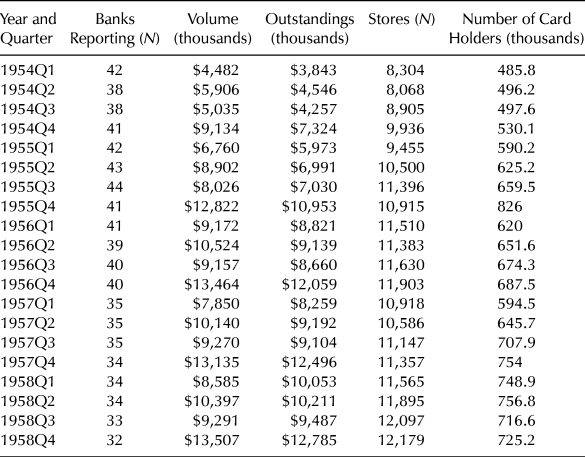
The charge account banking plans that remained grew significantly in the 1950s, with the “pioneers” making gains in accounts, credit volume, and over-all profits (Table 1). As importantly, through Lorenz’s columns and CABA gatherings, early practitioners solidified their merchant-centered model of unsecured retail credit. The merchant approach, rooted in commercial bankers’ business-lending expertise and wrapped rhetorically in antimonopoly retail politics, seemed to offer bankers not only profitable retail lending opportunities but also conduits to deepen business relationships with member merchants. Nevertheless, the merchant approach had limits, too. Bankers’ choice to place the costs of charge accounts entirely on their merchant partners restricted their programs’ potential reach, while the geographic boundaries of commercial banking placed spatial limits on charge account plans. Moreover, although bankers came as saviors, by inserting themselves into the eddies of retail politics, they often met forceful and unexpected resistance.Footnote 43
Growth of charge account banking plans, 1954–1958

Note: Compiled from American Banker’s quarterly charge account banking reports. All figures as reported (not adjusted for inflation).
Charge account plans, bankers were eager to point out, offered a host of benefits to participating merchants. The first should have been obvious. As the Pan American Bank of Miami, Florida, explained in a brochure, “Mr. Merchant: Here’s a New Avenue of Revenue!”; its Charge Plan “enables the local merchant to offer his customers a charge-account service comparable to that of a large department store … and actually costs the consumer less!” In case Miami merchants were unclear on the full advantages of such a service, Pan American explained further that its plan would increase their base of potential customers, increase sales, and ultimately generate higher profits. Merchants received immediate cash for all their charge account sales, the bank continued, and did not risk any credit losses. Charge account plans also decreased bookkeeping, personnel, postage, and supply costs, bankers claimed, while allowing merchants to focus on what they did best—merchandising. Summing up these advantages, the Florida National Bank of Orlando explained that its “F.N.B. Charge Plan Acts as the Credit, Accounting, Bookkeeping, and Collection Departments, And Actually costs participating merchants and professional men, and their customers less.”Footnote 44
Merchants would have to pay for these services, of course, and they did so through the merchant discount. Discounts are effectively interest in reverse, paid upfront instead of over time. Bankers thought of charge accounts as they did their other installment credit arrangements; they were purchasing a debt contracted between the merchant and the consumer, discounting the debt to cover the bank’s costs and provide the bank’s profit. The discount, in this way, compensated the bank for the time it took to collect the balance, the cost of administering the account, and the risk associated with the transaction. Importantly, bankers purchased these contracts on a nonrecourse basis, meaning if customers failed to pay their debts, the bank could not pass the losses back to the retailer. Put another way: bank charge account plans saved Mrs. Housewife the hassle of writing small checks for her monthly purchases, and the bank assumed the risk that the big check she wrote at the end of the month would not bounce. Assuming this risk, and with it the cost of tying up capital in outstanding consumer loans, was the core of charge account bankers’ larger effort to help merchants competitively offer credit.
Initially, merchant discounts were high. While Biggins claimed his Charg-It plan “doesn’t cost” consumers “a penny more” than purchasing with cash, merchants handed over 8 percent of their Charg-It sales. Franklin National’s plan was less expensive, charging merchants 5 percent on thirty-day charge purchases and 6 percent on sixty-day charges. Indeed, as plans later allowed consumers to spread their charge account payments over thirty, sixty, or ninety days, many banks raised the merchant discount on longer charges instead of assessing the consumer an interest charge. Lorenz tried to convince banks to push these discounts even higher, arguing that merchants needed to pay the full cost of this helpful credit service. In reality, banks would eventually reduce their merchant discounts, first by rebating merchants if they met certain sales volume targets, and later across the board as banks relied more on consumer interest payments for revenues. Still, in charge account banking, consumers borrowed and retailers paid the interest.Footnote 45
For many bankers, especially smaller banks eager to win local market share, the relationships charge account plans generated with merchant customers brought subsidiary benefits that could be as important as their interest income. Participating merchants opened and maintained checking accounts at their charge account bank, in which the bank deposited the merchant’s daily sales. These accounts, which by law paid no interest, served as a direct funding source for bankers’ outstanding charge account loans; or, as Lorenz argued: “The charge account banking business finances itself.” Further, by deepening existing merchant relationships and creating new ones, charge accounts enabled banks to promote other services, including commercial and mortgage loans, to their merchant customers.Footnote 46
Although bankers imagined charge accounts as a mutually beneficial service that allowed them to cultivate close relationships with community retailers, they were surprised to find many retailers undecided on the merits of charge account banking. “Strange as it may seem,” Franklin Square’s Donohue remarked, “the merchant requires a good deal of education in this program.” One problem for banks was that the merchant was getting a good deal of education from their trade publications, but not of a character favorable to banks. “Granting credit on credit cards issued by others is a mistake,” Credit World bluntly warned its readers in September 1953.Footnote 47 Many merchants, understandably hung up on the high cost, doubtlessly agreed. The fees charged by banks, argued NRGDA’s Credit Management Division Manager A. L. Trotta, were significantly higher than the cost of managing an in-house credit department. For efficient department stores, credit cost averaged about 2 percent of charge volume versus the 5 percent asked by banks. Bankers, of course, disputed these figures, and tried to convince merchants that offering credit would increase their average sales over and above the cost of the discount. For merchants without existing credit departments, Trotta conceded, a bank’s charge plan might be an appealing alternative to the initial investment in equipment and personnel, but the merchant would need to promote credit purchases, turning potential cash sales into 5 percent markups.Footnote 48
High merchant discounts also restricted the types of retailers banks could target for charge account services to those who likewise charged high markups on their merchandise. Clothing and shoe stores, which competed directly against expanding department stores, were obvious targets. Drug stores and hardware stores also often joined charge account plans, as well as gas and service stations. Florists and photographers too were often represented, as well as optometrists and dentists. In some small towns, local department stores also joined charge account plans, but they often negotiated much lower merchant discounts, giving the bank high sales volume but little added profit.Footnote 49
More often, department stores, with their own established credit plans, were unlikely prospects for charge account banking, as were discount stores that offered low prices and no credit. Grocers, especially supermarkets that sold on low margins, were also unlikely to adopt bank card plans in the 1950s. An in-depth analysis performed by the Department of Agriculture in 1960 suggested that the first grocery store to join a bank plan might increase its profit if the store pulled sufficient business away from its competitors. This opportunity for profit, however, would likely draw in all of the city’s other grocers. The benefits of gaining new customers would be eliminated. Worse, all the grocers would be stuck paying high merchant discounts to banks, costs that would either reduce profits or lead to higher consumer prices. This was exactly the kind of credit trap retailers were eager to avoid.Footnote 50
High costs were just one reason retailers resisted charge account programs; they also worried about banks intervening in their relationships with customers. Instead of returning to the store each month to settle their accounts, and perhaps make additional purchases, customers paid off their charge accounts at the bank or by mail, costing the smaller store valuable foot traffic. Merchants also feared that by sending their accounts to the bank, they would lose their customers to competitors in the bank’s charge plan. Some banks, like Marine Midland Corporation, a banking group in upstate New York, tried to counter this fear by enrolling only one type of retailer in a particular location, like a new shopping plaza. Some merchants took matters into their own hands, sending their more troublesome credit accounts to the bank, while keeping their prompt-paying customers for themselves.Footnote 51
Throughout the 1950s, the retail trade press remained suspicious of bankers’ retail credit plans, and many of the concerns expressed when banks rushed into the field in 1953 continued to be repeated throughout the decade. The same spirit of independent proprietorship that fueled retailers’ impulse toward antimonopoly also led them to resist what one writer in Women’s Wear Daily called banks’ “long-range … campaign to establish themselves as the principal source for all types of credit.”Footnote 52 In spite of these on-going tensions, banks nevertheless succeeded in convincing merchants to join their plans. Between June 1953 and November 1958, the number of merchants accepting bank charge plans rose from 5,000 to 12,000, or from about 170 to about 360 merchants for each reporting bank. Merchants wanted to offer credit; although charge account banking had drawbacks, these plans allowed merchants to participate in the private credit economy without investing heavily in the infrastructure necessary to do so on their own.
Through the 1950s, bankers also made good on their promises to unite merchants into local shopping communities, a process often manifested in the spatial strategies banks adopted to serve their specific local markets. Some charge account plans were geared toward preserving and revitalizing downtown shopping. Of the seventy-four merchants listed in the directory of the Industrial Savings and Trust of Muncie, Indiana, with identifiable locations, fifty-four were clustered within four blocks of the main downtown intersection, where the bank too had its offices. In small towns, especially, where the spread of automobile ownership placed local merchants in competition with large stores in nearby cities, charge accounts offered a way to keep retail business local. After explaining how the new four-lane highway created “the tendency … for the ladies to go to Indianapolis to shop,” Columbus, Indiana, banker J. Irwin Miller explained to a Congressional hearing how, thanks to the bank’s charge account plan, “by and large, business … stays in Columbus.”Footnote 53
Other banks adopted a suburban strategy for their charge account plans. Merchants who moved into the nation’s gleaming new shopping centers were often short on capital, and funding consumer credit was an unwelcome burden. Bank charge plans allowed these merchants to band together and create shopping center-wide credit services for their customers. Charge account plans that emphasized suburban shopping, however, threatened downtown merchants. As one Credit World author frantically warned, “banks all over the country are sponsoring new consolidated ‘charge account’ services, the single purpose of which is to get people to buy in the neighborhood instead of going ‘downtown.’” In any case, the geographic diversity of charge account plans suggests that the programs were flexible and could be adapted to different retail environments, even as, like the banking industry more broadly, the service was geographically confined by regulation.Footnote 54
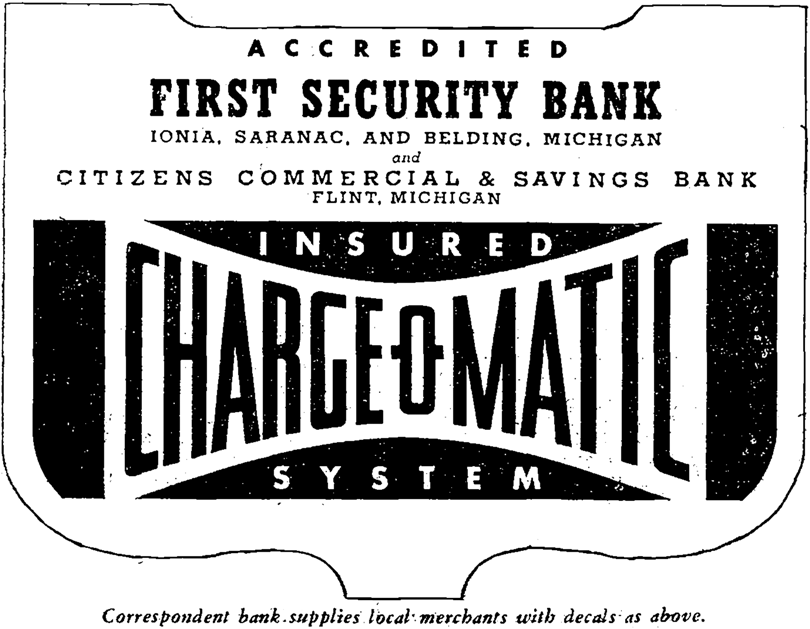
Geography, moreover, was not an insurmountable barrier. In a preview of later networking strategies adopted by banks in the 1960s, some charge account bankers experimented with interchange, where banks in communities separated by geographic regulations participated in the same card plan. The first interchange system originated in 1955 when five small banks in rural Michigan approached the larger Citizens Commercial and Savings Bank of Flint, which operated a charge account plan called “Charge-O-Matic” (Figure 3). As a Citizens Commercial executive explained to American Banker in May 1956, the smaller banks wanted to offer charge account plans in their towns but feared they would not be able to generate the necessary volume to make the plans profitable. Citizens Commercial had long-standing correspondent banking relationships with the banks, and its executives, sensing an opportunity to profitably deepen these ties, devised a cooperative interchange system that would enable them to offer charge accounts in their communities. First, the small banks recruited merchants in their towns, and the merchants in turn recommended consumers to participate in the plan. The small correspondent banks—later called agent banks—then handled the merchant side of the business, collecting charge slips each day, taking floor limit calls, and crediting merchant accounts for consumer purchases. Merchants, in turn, opened checking accounts with their local agent bank, and the agent bank also earned a portion of the merchant discount on each local charge account transaction. Citizens Commercial handled the consumer side, collecting the consolidated merchant slips from each small bank, billing the consumers, and retaining the interest they paid on their accounts. “Will it work?” the Citizens Commercial executive asked rhetorically. In May 1956, “it [was] a little too soon to know.”Footnote 55
Charge-O-Matic ad. Published with permission of the Huntington National Bank.
Note: Note the cobranding: both First Security Bank, the smaller firm, and Citizens Commercial, the larger, are listed on the decal. Charles E. Groover, “Citizens Commercial, Flint, Mich., Offers New Service to Correspondent Banks; Based on Charge Account Banking,” American Banker (May 29, 1956).

The banks that experimented with “correspondent charge account plans” in the 1950s did so to capitalize on their investments in managerial expertise and credit processing equipment and to expand the geographic reach of their plans beyond their immediate markets. For instance, both Citizens Commercial and the First National Bank and Trust of Kalamazoo, which began the second such plan in 1957, were located in Michigan, a state that limited branch banking to within a 25-mile radius of a bank’s primary office. Correspondent plans incorporated merchants and consumers from outside the card-issuing banks’ geographically restricted market areas, increasing transaction volume and lowering individual transaction costs. Still, bankers were careful to root their correspondent plans within their agent banks’ communities, relying on cross-branding to ensure that the agent bank was the prominent local face of the plan in their markets. While Citizens Commercial claimed its plan covered a 100-mile radius, in the small towns serviced by Charge-O-Matic, the program’s emblem carried the agent bank’s name in bold letters. Cardholders also received their Charge-O-Matic cards in a letter from the agent bank. The small community banks thus maintained local relationships with merchants and consumers, and added income as well.Footnote 56
The Consumer Question
Although bankers had a strong sense of the spatial dimensions of their markets and how they would serve the need of merchants, they were slow to grapple with and understand the place of consumers within their charge account plans. Today, scholars think of card-issuing banks as intermediaries between cardholders and merchants in the same way they are intermediaries between depositors and borrowers. In the 1950s, banks did not yet see the credit card relationship this way. Instead, charge account plans ran directly through merchants. Banks relied on their merchant partners to promote charge account banking to their customers. Enrolling consumers was the first step, illustrated above by a cartoon promoting the First National Bank and Trust of Kalamazoo’s Charge Account Service (see Figure 1). Mrs. Smith, who feels a charge account would be “more convenient” than cash, approaches a shopkeeper who mediates the entire process of enrolling in the bank’s charge account program. Banks’ reliance on merchants did not end there. At every subsequent transaction, when the consumer chose between cash, check, or credit, bankers needed merchants to promote their plans.Footnote 57
Merchant discretion was an enduring problem for charge account bankers. Marine Midland Corporation executive Douglas A. Freeth confronted it directly in a lengthy memo, “What’s Wrong with Midland Charge Plan?” Five of Marine Midland’s subsidiary banks had adopted charge account banking in the 1950s and all were losing money. For Freeth, “the heart of the whole problem” was “the host of merchants, of all sizes, who do not realize the value of credit selling or know how to accomplish it.” Without sufficient merchant buy-in, the Midland banks could not generate enough sales volume to cover their fixed costs. To increase charge volume, bank personnel had to sell merchants on the virtues of the Midland Charge plan and convince merchants to sell charge accounts to consumers. “We need to stimulate, through merchants, more card holders and increased card usage,” Freeth concluded. “Such a result will not just happen. It must be made to happen—by selling—hard!” Other charge account bankers echoed this sentiment. Throughout the 1950s they uniformly argued that bankers needed to convince merchants to sell on credit, not convince consumers to buy.Footnote 58
Bankers’ understanding of the role of merchants was a direct reflection of how banks understood consumers. First, because bankers crafted their charge account plans to help merchants in their communities, they were often unable to see consumers as individuals to whom they could sell directly. While they imagined using charge account plans to gain new merchant-customers in the 1950s, bankers seldom discussed how charge accounts could lead to new consumer deposits or generate new consumer loans. This blind spot is not surprising, since in their other lines of consumer credit, most banks tended to work through intermediaries, such as car dealers for auto loans, instead of selling credit directly to consumers. In a larger sense, most bankers in the 1950s did not feel that they could make an all-out direct pitch to consumers. As Freeth concluded in his report, “an individual’s attitude toward debt and his paying habits are not easily predetermined or readily changed.” Other bank card promoters agreed. Recall Edward Donohue’s exhortation that “we could not change habits.” Instead, bankers needed to build their charge account plan on the relationships that already existed, first between consumers and merchants, and then between merchants and the bank.Footnote 59
The constructed identity of their ideal charge account customers—Mrs. Housewife—also influenced bankers’ approach to customer solicitation. Bank offices were largely male spaces and charge account banking was self-consciously a “fraternity.” Bank executives worked within a hierarchy of social and gendered divisions that made men comfortable; merchants and bank tellers served female customers, while bankers dealt with other men. They would never be comfortable, to put it plainly, soliciting other men’s wives.
Still, just because bankers did not feel they could solicit consumer participation directly did not mean that consumers were not active agents in the growth of charge account banking. After all, it was the desire by small merchants to meet the demands of their customers for credit facilities that drove the development of charge account banking in the first place. As long as consumers were borrowing while the retailer paid the interest—and as long as the costs of the system remained hidden from consumers through a pricing mechanism that weighed heavily on merchants—consumers continued to pressure retailers to take their new bank cards. For Pan American Bank in Miami, “each customer [was] an ambassador of good will and usually demand[ed] new merchants … inquire and join this service.” Merchants, though, seldom appreciated this consumer arm-twisting. As Raymond Alm, a Marine Midland executive working independently of Freeth, discovered after surveying his bank’s merchant partners: “Most of these merchants did not need (or desire) this bank service, but joined the plan in order to retain present customers who might wish to use the bank charge card in their stores.”Footnote 60
Bankers did increasingly rely on consumer interest payments to produce revenue, slowly adopting revolving credit features that allowed consumers to carry their purchases over time by paying an interest charge on their outstanding monthly balances. In October 1953, Lorenz reported that only a fifth of charge account bank plans incorporated revolving credit, “surely an omission of major magnitude.” As charge account bankers gained more experience, and reported this experience to Lorenz, he urged bankers that were not matching their peers in terms of income and profits to adopt revolving credit “both as a means of increasing volume and as another source of valuable income.” His advice was often very direct: “We would recommend a careful study of No. (17),” a bank employing revolving credit, “to Bank No. (19),” a bank which did not, “where additional income is obviously very much needed.” By August 1958, nearly 60 percent of charge account banking plans utilized revolving credit.Footnote 61
Bankers, though, were not sure how to talk about or promote this credit feature, because, as Raymond Alm found, consumers still had significant reservations about retail credit. In addition to surveying Marine Midland’s merchant customers, Alm also surveyed the bank’s inactive cardholders “to determine their reaction to the charge plan and their reasons for not using this service more often.” Alm was struck by a paradox. He found that 31.2 percent of inactive cardholders claimed they did not like to use credit, while only 9.8 percent reported they did not use charge accounts. Alm considered this “an obvious inconsistency.” Was it? Perhaps consumers in the throes of postwar abundance chafed at the insecurities caused by credit use and attendant indebtedness. Perhaps they were still culturally predisposed to abhor what in practice was a typical feature of modern economic life. For Alm and Marine Midland, the solution to this consumer resistance was simply not to talk about credit. “The economy and convenience of only one bill a month should be emphasized,” Alm wrote, “thus creating the image that the bank is performing a billing service, not a credit service.” To affect this image, Marine Midland renamed their Midland Shopper Credit Service the Midland Charge Plan. The bankers who oversaw Charge-It, Charge-Rite, and Charge-O-Matic had long since adopted this strategy.Footnote 62
Conclusion: An Accounting
In 1958 Bank of America and Chase Manhattan, the first and second largest banks in the United States, respectively, entered the charge account business, and eager bankers deluged Lorenz with questions. They wanted to know if they, too, should begin offering charge accounts, and why, after all, had so many banks dropped out of the business over the past few years. Lorenz resented these inquiries. Through his relentless promotion of charge account banking over the past half-decade, he felt he had clearly demonstrated the viability of charge account programs, and through such demonstrations, the necessity for bankers to break the confines of their marble-clad imaginations and embrace progressive methods of granting credit. “Charge account banking stands on its own feet,” Lorenz retorted. “It is profitable.”Footnote 63
Lorenz, though, likely did not yet realize that Chase and Bank of America were offering two very different types of charge account plans. While Chase pursued a conventional merchant-focused strategy in New York City, Bank of America, which operated a statewide branch network in California and had long pursued consumer-focused banking, instead bypassed merchants and mailed millions of unsolicited credit cards to its current customers. Both banks suffered large and unexpected losses, but Bank of America allocated many program expenses to other divisions of the firm, making the plan appear profitable by the early 1960s. On the other hand, Chase Manhattan’s rigorous accounting convinced its executives that early losses would only get worse. The bank quickly fled the business.Footnote 64 By the time Bank of America began licensing its BankAmericard program in 1966—a strategy familiar to Biggins and Donahue—the consumer-focused “credit card” was replacing the charge account in the banking industry’s retail-credit imagination.
Bank of America’s success over Chase has eclipsed the history of charge account banking, and with it scholarly understanding of early postwar financial innovation. Charge account banking was the distinct product of the postwar financial regulatory system and the politics of retail antimonopolism that undergirded it. Bankers developed their charge account plans within the confines of a political economy designed to constrain their firms’ geographic reach, which ultimately enabled them to cooperate and innovate together. In doing so, however, they forged a path toward unsecured retail lending that would soon become crowded with larger banks.
Though beyond the immediate scope of this article, charge account banks were nevertheless active participants in this transition. Douglas Freeth, who surveyed Midland’s Shoppers Charge Plan in 1962, led the consortium of bankers who formed the Interbank Card Association in 1966, the nationwide rival to Bank of America’s BankAmericard. Interbank members eventually issued cards under the brand Master Charge (not, of course, Master Credit).Footnote 65 The First National Bank of Omaha, a member of the 1953 wave of charge account banks,Footnote 66 was the defendant in a series of federal cases that led eventually to the Marquette decision (1978), in which the Supreme Court determined that a nationally chartered bank could assess interest on credit card accounts based on the laws of the state in which it was located.Footnote 67 The case law First of Omaha’s lawyers developed through the 1970s served as the foundation for banks to construct regional and then nationwide credit card plans, and eventually to engage in regulatory arbitrage by locating these plans in states like South Dakota and Delaware. Securitization followed immediately thereafter.Footnote 68
This endgame, though, is just the fragment of a longer story, which is as much about banks conforming to the postwar political economy as circumventing it. After all, when Bank of America set out to build a national credit card network in 1966, the firm remained confined within the state of California. To cross state lines, the bank’s executives adopted interchange agreements like those first developed by Citizens Commercial. Even as the BankAmericard network expanded nationally, geographic regulatory restrictions assured that the banks joining the system still signed up merchants and issued cards in their communities. Local embeddedness remained an essential feature of bank credit card plans into the 1970s. Most bankers continued to judge the success of their card programs by the consumer and merchant relationships they generated, not simply by the interest income they produced.
The economic shocks of the 1970s certainly compelled bankers, merchants, and consumers to all alter their strategies in ways that remade the financial economy in the United States. The trends now characterized as financialization, however, were fundamentally endogenous to the postwar political economy. Universal bank credit cards, this essay argues, emerged from the efforts of bankers like G. L. Toole to promote progressive banking that conformed to the postwar regulatory system, even as their credit card plans pressed against some of the system’s ideological boundaries. That such advocacy was a first step toward today’s world of disembedded consumer borrowing and unbound financial institutions was a consequence that Toole, Lorenz, and their peers could scarcely have imagined and would have desperately sought to avoid.