

Introduction
Studies over the past several decades have demonstrated that indigenous economic networks in Southeast Asia were integral components of the wider Eurasian interactions. The important processes through which these intermediary regions transformed foreign ideas according to local needs and discarded those that were not considered relevant to specific situations have also been highlighted. Moreover, it has been acknowledged that Southeast Asian polities sometimes dictated, through military power or diplomatic manoeuvring, the flow of goods, peoples, and technologies across Asia. These aspects have been examined by scholars such as Wolters (Reference Wolters1982), Kulke (Reference Kulke1990), Manguin (Reference Manguin, Ray and Salles1996), Jacq-Hergoualc’h (Reference Jacq-Hergoualc’h2002), Glover and Bellwood (Reference Glover and Peter2004) and Hall (Reference Hall2011).
However, works that deal with interactions between South Asia and China before the sixteenth century often neglect the contributions of the indigenous cultural practices, local economic networks, and the political aspirations of Southeast Asian rulers and chieftains to those interactions. Emphasis instead is placed on the impact of ‘Indian’ or ‘Chinese’ civilisation upon this so-called intermediary region. For instance, during the first half of the twentieth century, scholars associated with the Greater India Society in India highlighted the influences of Indic culture on Southeast Asia without giving due credit to the local socio-political dynamics, indigenous technological innovations, and the vibrant trading networks that stimulated and sustained intra-Asian interactions until the arrival of the European commercial enterprises (Leiberman Reference Lieberman2003: 6–12).
While the impact of Indic and Sinitic elements in the development of statecraft and the transformation of social organisations in Southeast Asian societies cannot be denied, the use of terms such as ‘Indianisation’ or ‘Sinicisation’ fails to do justice to the complex relationships that existed between Southeast Asia and South Asia on one hand, and between Southeast Asia and the Chinese dynasties on the other. De Casparis (Reference de Casparis1983: 18–19), commenting on the shortcomings in the idea of the ‘Indianisation’ of Southeast Asia, remarked that South Asia and maritime Southeast Asia had a “complicated network of relations, both between the various parts of each of the two great regions and between the two regions themselves.”Footnote 1 Southeast Asia’s interactions with Chinese dynasties and regions of what is present-day China were equally complex, especially given the fact that parts of mainland Southeast Asia occasionally witnessed military invasions by Chinese polities and the subsequent imposition of Sinitic political systems and cultural traditions.
Indeed, the notion of Southeast Asia as merely an intermediary is itself problematic. It seems to have been taken for granted that the region was always a transit zone for commercial and cultural interactions between South Asia and China. In some cases it was undoubtedly a stopover for ships, as well as for itinerant merchants and monks. However, it is also clear that Southeast Asia had its own networks of exchange and its engagement with Chinese dynasties was often independent of their interactions with the polities in South Asia. The exchanges between Southeast Asia and South Asia with respect to Brahmanism, for example, were evidently not a part of the wider South Asia-China interactions.
Scholars writing on ancient interactions between South Asia and China have, in fact, never fully examined the role of Southeast Asia in these exchanges. P. C. Bagchi, the most renowned scholar of ancient India-China intercourse and a member of the Greater India Society, for example, writes ([1944] Reference Bagchi2008: 25) “[F]or over one thousand years, the entire Indo-Chinese peninsula and the islands of the Indian archipelago were all practical purposes a Greater India. Indian colonisers had set up flourishing kingdoms. Indian culture permeated the people of the country. Regular lines of communication by sea connected these kingdoms with India on one hand and with China on the other.” For Bagchi, these Indian ‘colonisers’ of Southeast Asia dictated commercial and Buddhist traffic between South Asia and China. Xinru Liu (Reference Liu1988), another leading scholar of early India-China exchanges, has very little to say about the maritime routes or the Southeast Asian agency in her work Ancient India and Ancient China: Trade and Religious Exchanges, AD 1–600.
This present article attempts to demonstrate the complex and distinct roles the maritime regions of Southeast Asia played in the wider history of interactions between South Asia and China. The first part focuses on the role of maritime Southeast Asia within the changing patterns of commercial exchanges between South Asia and China until about the mid-fifteenth century. The second section deals with the maritime transmission of Buddhism through Southeast Asia. The purpose of separating the issues into two distinct sections, even though there are overlaps in the commercial and Buddhist exchanges, is to underscore a key difference. While maritime Southeast Asia played an active role in facilitating and dictating the commercial activity between South Asia and China, its contribution to the transmission of Buddhist ideas to China, I argue, was limited. Indeed, unlike its multi-layered involvement in the flow of goods between South Asia and China, there is little evidence that Southeast Asia was a staging ground for the Buddhist doctrines entering China through the maritime route. Counter-intuitively, it seems, the vibrant long-distance Buddhist exchanges between South Asia and China during the fifth and sixth centuries may have actually facilitated the spread of Buddhism into several regions of maritime Southeast Asia. The multi-dimensional and distinct roles of maritime Southeast Asia demonstrated below allows us to not only better comprehend the complexities of the early history of South Asia-China interactions, but also conceptualise the patterns of long-distance maritime exchanges in the Bay of Bengal and South China Sea regions before the arrival of the European commercial enterprises.
The idea of multiple, unique yet interlocking, ‘circuits’ as outlined by Chaudhuri (Reference Chaudhuri1985) and Abu-Lughod (Reference Abu-Lughod1989), is one way to conceptualise the patterns of interactions in this region (Fig. 1). According to the models formulated by Chaudhuri and Abu-Lughod, there were two overlapping circuits between South Asia and China that converged in Southeast Asia. Geographical contours, monsoon winds, and the pattern of segmented trade facilitated the flow of people and goods between these two circuits. Linked to the Persian Gulf and the Mediterranean Sea through other circuits and networks, these two circuits formed part of the larger Eurasian interactions.
Circuits of interactions in Asia. (After Chaudhuri Reference Chaudhuri1985; illustration by Inspiration Design House, Hong Kong)
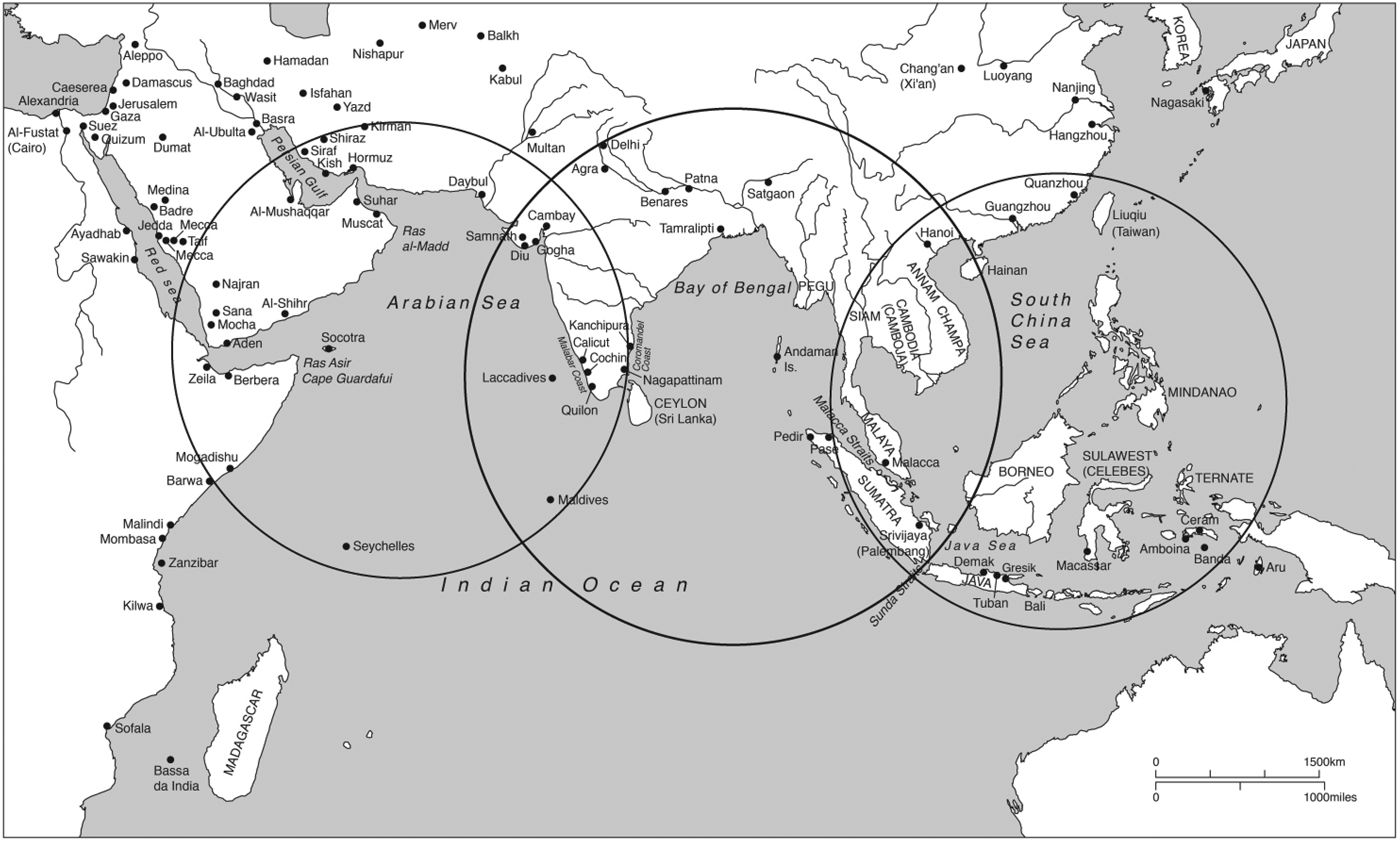
Within these two circuits there were several types of networks that connected South Asia and China, including 1) networks of exchanges among the polities skirting the Bay of Bengal; 2) networks that connected the areas around the South China Sea; and 3) networks of direct exchanges between South Asia and China. These were not exclusively maritime or overland networks. With links to rivers and overland routes, these networks usually incorporated the hinterlands as well as the coastal regions. Commercial goods and Buddhist beliefs circulated through these connected yet self-contained networks. While on some occasion commodities and ideas dispersed across multiple networks within the circuits, there were instances when they may have originated and only spread through a single network without permeating other existing networks. Additionally, the network of direct exchanges between South Asia and China was not necessarily ‘segmented.’ Although ships may have transited through or changed in Southeast Asia, the destination of itinerant traders, missionaries, and diplomats was either the South Asian or the Chinese coast.Footnote 2 The existence of such multiple networks could explain, as the paper contends, the multifaceted and seemingly uneven role of Southeast Asia in the maritime interactions between South Asia and China.
Southeast Asia and the Maritime Trade Between South Asia and China
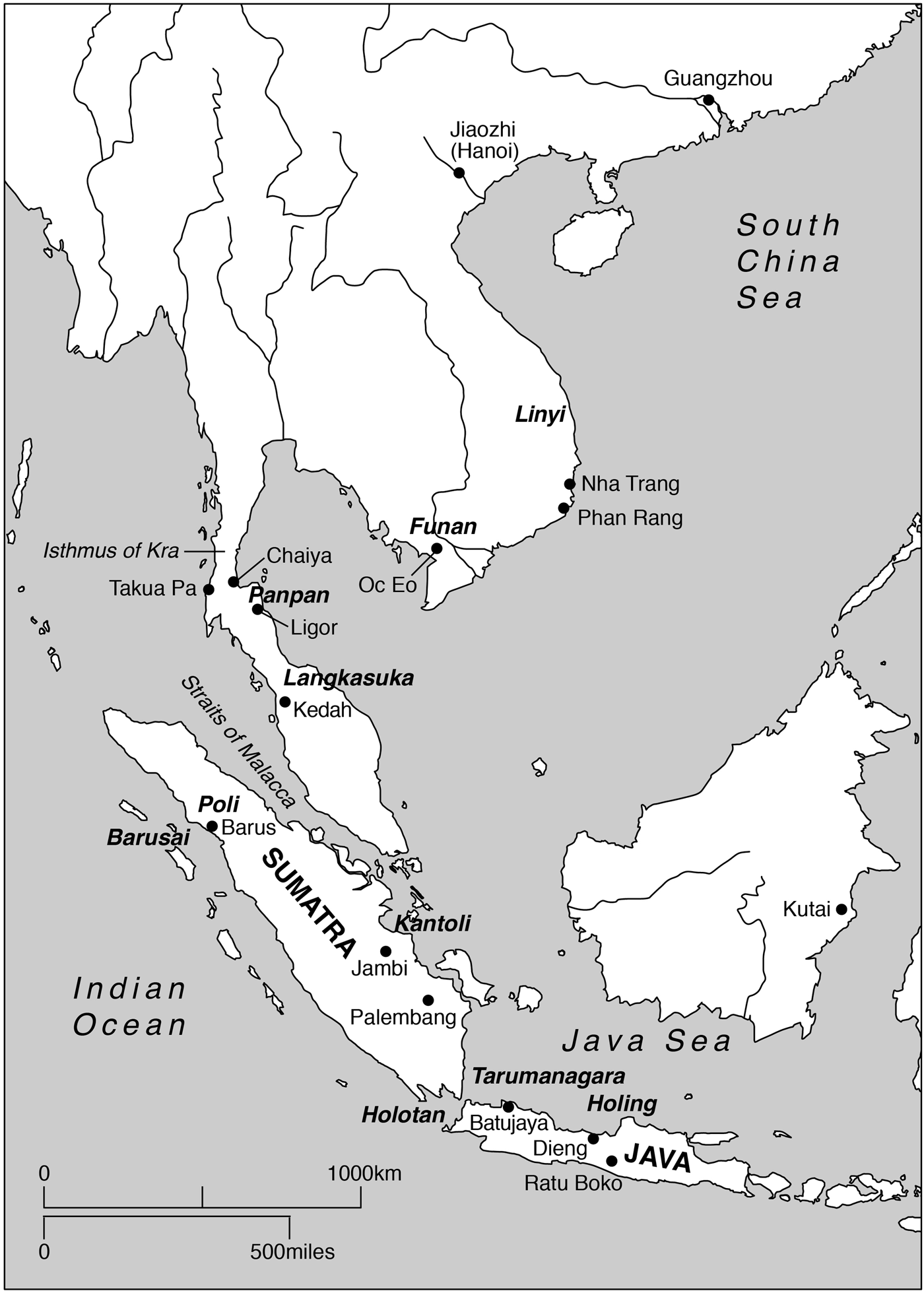
While the focus of this article is on maritime connections, it should be noted that Southeast Asia connected South Asia and China by both overland and sea routes, or a combination of the two. Wind patterns, geographical terrain, navigational knowledge, and the existence of port facilities dictated the specific passages through which merchants, monks, and others travelled between the two regions. While the overland roads passed through upland Southeast Asia (i.e. present-day Myanmar), the sea route prior to the fifth century included the narrow strip of land across the Isthmus of Kra that had to be crossed to reach what are present-day Cambodia and Vietnam before proceeding further to the coastal regions of China. Later, navigation through the Straits of Malacca made it possible for ships to sail directly to the Chinese coast. Traders, ships, and polities from Southeast Asia facilitated the exchange of goods and the movement of people. Often the Southeast Asian polities also controlled the diplomatic exchanges between the courts in China and South Asia, and introduced their local produce and products into these cross-regional trading networks (Fig. 2).
Early Southeast Asian ports and polities. (Illustration by Inspiration Design House, Hong Kong)
Until about the mid-fifteenth century, four broad phases of trade between South Asia and China through Southeast Asia can be discerned from archaeological and textual sources. The first phase, prior to the middle of the first millennium BC, involved the vast maritime networks of Austronesians as well as the trade in cowries through Myanmar. The second phase was triggered by the emergence of urban centres in the Gangetic region of South Asia in the sixth century BC and subsequently fostered by the expansion of commercial activity in the Indian subcontinent. The emergence of the Funan polity in Southeast Asia, the establishment of Kuṣāṇa empire in South Asia, and the incorporation of southern China into the Chinese empire seems to have contributed to the formation of new networks of exchange after the first century AD, which constitutes a third phase. Finally, the naval raid by the South Indian Cōḷa kingdom (c. 850–1279) on Śrīvijaya in 1025 marked the beginning of a fourth phase that lasted until the Ming court’s ban on foreign commerce in the mid-fifteenth century. Each of these phases and the relevant role and contribution of Southeast Asia are outlined below.
Phase 1: The Austronesians and the Early Commercial Networks (Prior to Sixth Century BC)
Maritime networks constituted by mariners from Southeast Asia likely connected the coastal regions of South Asia and China as early as the Neolithic. Peter Bellwood (Reference Bellwood, Bellwood, Fox and Tryon1995, Reference Bellwood, Glover and Bellwood2004) and Wilhelm G. Solheim (Reference Solheim2006) have argued for the existence of extensive Neolithic migratory and trading networks of Southeast Asian inhabitants that stretched from the coastal regions of China to Madagascar in the Indian Ocean. The two scholars differ, however, on the origins, nature, and composition of these early networks. Bellwood has proposed that the Austronesians from Taiwan were responsible for colonising the islands of Borneo, Sumatra and Java, as well as the Malay Peninsula by the second or first millennium BC. “Madagascar was probably only reached in the mid-first millennium AD”, he writes (2004: 31).
Solheim’s proposal is more controversial. The “Nusantao” people, Solheim (Reference Solheim2006: 56) argues, who consisted of Austronesian and non-Austronesian speakers, started establishing their maritime trading networks beginning sometime around 5000 BC. Originating from eastern Vietnam, this Nusantao Maritime Trading Network comprised “four lobes” or “sub-areas” and covered the vast region from Japan to Madagascar.
Even though Bellwood and Solheim differ on the specifics and origins of the early Southeast Asian networks, it is clear that networks of maritime interactions originating in Southeast Asia connected and integrated various regions of the Indian Ocean during the Neolithic. Important archaeological evidence to support this argument comes from ceramics discovered in southern India. The carved paddle beating technique, where a small wooden plank is used by potters to give shape to pottery before firing, found in South Indian ceramic tradition was imported, V. Selvakumar (Reference Selvakumar, Pierre-Yves, Mani and Wade2011: 207) contends, from Southeast Asia “either through the land via eastern India in the Neolithic period or through the coast route of Bengal or by overseas.” Selvakumar (Reference Selvakumar, Pierre-Yves, Mani and Wade2011: 213) also suggests that the technique may have reached South Asia as part of the long-distance trading activity.
The existence of another early trading network that connected South Asia, Southeast Asia, and China is evidenced by the discovery of cowries originating from the Maldives in the Indian Ocean in Assam, Myanmar, Yunnan, and the Yellow River Valley of China. The trade in cowries, through the interconnected maritime-overland routes that linked the Indian Ocean region to the hinterlands of Shang China via northeast India and Myanmar, can be traced back to the second millennium BC. Often used as currency, these cowries circulated widely in South Asia, parts of Southeast Asia, including Pegu (in present-day Myanmar) and Siam (present-day Thailand), in addition to the Yunnan region and the Shang cities of China (Yang Reference Yang2004: 305). The trade in cowries continued, as Hans Ulrich Vogel (Reference Vogel1993) has demonstrated, into the first millennium AD.
In sum, long-distance commercial activities between South Asia and China through Southeast Asia were already taking place prior to the first millennium BC. There were also smaller networks of exchange during this time between South and Southeast Asia on one hand and between Southeast Asia and China on the other. While the spread of the Southeast Asian carved paddle technique of making pottery may have been passed on to southern India through the former network, the bronze-casting traditions from Gansu and Sichuan regions might have entered mainland Southeast Asia through the latter (Higham Reference Higham, Glover and Bellwood2004). Thus from this early phase several overlapping networks of varying distances and covering distinct regions seem to have connected South Asia, Southeast Asia, and China.
Phase 2: Urbanisation and Long-Distance Commercial Activity (Sixth Century BC to First Century AD)
In the sixth century BC, the Gangetic region in South Asia witnessed population growth and widespread urbanisation. Commercial networks within India, both along the coastal regions and in the hinterland, developed rapidly, contributing to the wider diffusion of manufactured goods and religious ideas. One key feature of this so-called ‘second urbanisation’ phase (the first being in the Indus Valley), was the connection between urban development, the expansion of trade routes, and the spread of religious ideas (Thapar Reference Thapar2002: 139–173). The Jātaka stories about the Buddha’s previous births and other literary works of the period reveal increased commercial activity within India and also networks of trade with a distant place called Suvarṇabhumī, generically identified as Southeast Asia (Ray Reference Ray1994).
Archaeological evidence indicates that by the third century BC, ports and markets in South Asia had emerged as important destinations for Greek and Roman goods (Ray Reference Ray1994: 48–86). The Bactria-Gandhāra region (in present-day Afghanistan and Pakistan) and the Coromandel coast (in the south-western region of India), for example, developed into leading centres for inter-continental commerce. These networks of trade that connected the Mediterranean world to the coastal regions of South Asia gradually became integrated with the Bay of Bengal and South China Sea circuits, infusing new commodities into the networks of commercial exchanges between South Asia and China.
Parts of Southeast Asia and China also witnessed rapid agricultural and economic expansions during this phase. In China, the political unification by the Qin state in 221 BC resulted in the standardisation of currency, weights, as well as the building of roads and bridges. The subsequent Western Han (206 BC – AD 9) period saw political stability, the improvement of infrastructure, and an increase in foreign trade. These developments were accompanied by military expansions by the Han empire into Central Asia and present-day Vietnam. In several regions of Southeast Asia agricultural developments contributed to the growth in internal and external commerce (Hall Reference Hall1985, Reference Hall2011). In fact, by the third century BC, some of these regions were not only importing foreign luxury items such as semiprecious stone and glass beads from South Asia, but also manufacturing them for local consumption and export to China.
Based on archaeological finds in Thailand and Vietnam, Bellina and Glover (Reference Bellina, Glover, Glover and Bellwood2004) have suggested that early commercial exchanges between Southeast Asia and South Asia can be divided into two distinct phases. The first phase covered the period from about the fourth century BC to the second century AD, when there were “regular but less intense” contacts. The goods frequently exchanged between the two regions included glass and stone beads and ornaments, bronze containers, rouletted ceramic wares, and stamped wares. The second phase extended from the second to the fourth century AD, which was marked by “a lesser diversity but greater quality of goods” coming from South Asia. Many of the locally-made ceramics in Southeast Asia were inspired by South Asian models and while “glass and stone beads still came from India”, the local manufacturing “in an Indian tradition”, Bellina and Glover (Reference Bellina, Glover, Glover and Bellwood2004: 80) argue, is “beyond doubt.”
In the second century BC, commodities originating from South Asia were also reaching the coastal regions of Han China. These included items such as semi-precious stones, glass beads and gold jewellery, many of which have been found in tombs belonging to Western Han elites in Hepu 合浦, Guangxi Province (Wu 2006). These goods were perhaps not all a result of the direct commercial network between South Asia and China. Rather, some may have been transported through Southeast Asia’s export networks to Han China. As Glover and Bellina (Reference Glover, Bellina, Manguin, Mani and Wade2011: 40–41) have suggested, glassware and semi-precious ornaments found in Southeast Asia were sometimes manufactured locally with the help of South Asian craftsmen.
The maritime-overland route through which cowrie from the Maldives reached China via Myanmar also witnessed increased commercial interactions during the second half of the first millennium BC. The first Chinese dynastic history known as Shiji 史記 (Records of the Grand Historian) reports a Han emissary named Zhang Qian 張騫 (167?–114 BC) who saw goods from the Shu蜀 region (present-day Sichuan Province) sold in the markets of Bactria. Upon enquiries, he found that these commodities had reached the region through ‘Shendu’ 身毒.Footnote 3 While the exact mechanism and the early routes for these networks are not known, the existence of this vast Eurasian trading system before the Common Era, of which the circuits linking South Asia, (both upland and maritime) Southeast Asia, and China formed major components, is corroborated by both archaeological and textual evidence during this phase.
Phase 3: State Formations and the Expansion of Commercial Networks (First–Eleventh Century AD)
Prior to the first century AD, polities in Southeast Asia and China seem to have rarely participated in the long-distance commercial interactions outlined above. Itinerant traders working along inter-connected networks which either spanned vast regions or were limited to specific local areas directed most of the commercial activity. This changed with the establishment of the Kuṣāṇa and Gupta empires in South Asia, along with the Southeast Asian polities of Funan (centred in present-day southern Vietnam and southern Cambodia) and Śrīvijaya (a poly-centric polity that included Palembang in southern Sumatra, Java, and extended to the Isthmus of Kra region), and the commercial interests of some of the southern Chinese kingdoms. While Funan was the key player in the maritime commerce between South Asia and China during the first half of the first millennium AD, Śrīvijaya dominated the trading activity from about the seventh to the eleventh century. Both these Southeast Asian polities also pursued diplomatic relations with rulers in South Asia and China seemingly to augment their participation in and control over the long-distance maritime activity.
The Funan polity, which emerged in the first century AD, controlled several ports in the Malay Peninsula and attracted commercial specialists from South Asia and diplomats from the Chinese court. The port of Oc Eo seems to have been one of the main centres for long-distance commerce under the Funanese polity. Archaeological evidence not only indicates the presence of commodities imported from South Asia, but also goods originating in China and even Rome (Hall Reference Hall1985: 59–60; Higham Reference Higham2002; Manguin Reference Manguin, Glover and Bellwood2004: 291–92, 298–300). According to a local myth, recorded in Chinese sources, Funan was ruled by a nāgī princess named Liuye 柳葉 (Liv Yi), who submitted to, and eventually married a seafaring ‘foreigner’ called Huntian/Hunkui 混塡/混潰 (Kauṇḍinya?) because she was unable to defend herself against his magical bow (Pelliot Reference Pelliot1903: 245–46; Vickery Reference Vickery2003: 101–107).Footnote 4 Sometime in the third century AD, Funan is noted to have expanded its territories under a ruler named Fan[shi]man 范師蔓, who built large ships and conquered several neighbouring polities. Then, during the reign of Fan[shi]man’s nephew Fan Zhan 范旃, Funan reportedly sent an embassy to Tianzhu. The embassy met a Tianzhu ruler, whose kingdom was located in the vicinity of the river Ganges. This Tianzhu ruler responded to the diplomatic mission by sending envoys to Funan bearing four Bactrian horses as gifts (Liang shu 54: 798–99).
The arrival of the embassy from Tianzhu in Funan coincided with a mission to the Southeast Asian polity from the Wu kingdom (AD 229–280) in China. Indeed, these two missions seem to have met in Funan and the diplomats from the Wu kingdom, Kang Tai 康泰 and Zhu Ying 朱應, reportedly enquired about the customs of Tianzhu from their South Asian counterparts, whose names are rendered as Chen 陳 and Song 宋 (Liang shu 54: 798–99). The diplomat from the court of Wu kingdom also toured various dependencies of Funan and noted the Indic influences that had already started permeating the local society.Footnote 5 The purpose of this Chinese mission to Funan, as Vickery (Reference Vickery2003: 112) explains, “was to explore a maritime route through Southeast Asia to acquire valued products from India and the Middle East at a time when the Wu dynasty in southeastern China was cut off by rival kingdoms from traditional overland routes.”
Indeed, during the third and fourth centuries, the commercial interactions between South and Southeast Asian seems to have been more vibrant than those taking place between South Asia and China, a fact that can be discerned from the Chinese records about the presence of South Asian settlements at Southeast Asian ports. Also by this time, cultural and political elements had become intimately intertwined with mercantile exchanges, resulting in the use of political and religious ideas originating in South Asia by the rulers of Funan and other emerging Southeast Asian polities to shape and legitimise their authority. It was this process of adaptation of South Asian ideas that has been described as the ‘Indianisation’ of Southeast Asia by scholars such as Cœdès (Reference Cœdès1968).
Commercial activity between South and Southeast Asia grew further during the reigns of Gupta rulers in north India, and under the Pallavas (fourth-ninth centuries) and Pandyas (sixth-tenth centuries) in south India. The emergence of new polities in Southeast Asia, and the agricultural and economic developments in southern China (Liu Reference Liu, Pearce, Spiro and Ebrey2001) were also key factors in the growth of maritime commerce in the Bay of Bengal and South China Sea circuits. These commercial activities were further catalysed by the development of shipbuilding and the shipping industry in Southeast Asia. Merchants and Buddhist monks travelling between South Asia and China were often noted to have done so on Southeast Asian ships known as ‘Kunlun bo’ 昆侖舶.Footnote 6 Additionally, because Southeast Asian ports provided facilities for repairing ships, they developed into important centres of transit trade. This gave Southeast polities (as well as traders and pirates), such as Śrīvijaya, significant control over the maritime trade between the Chinese coast and ports elsewhere in the Indian Ocean.
Within this wider Indian Ocean commercial network, Śrīvijaya and the Cōḷas on the Coromandel coast, because of their port facilities and powerful navies, became the leading trans-shipment centres and beneficiaries of the lucrative transit trade. Both polities wanted to maintain control over the flow of goods into and out of Song China, the leading consumer market in the world in the tenth century. It was because of this rivalry that Śrīvijayan rulers and traders might have tried to manipulate the commercial and diplomatic relations between the Cōḷa kingdom and the Song court. This interference has been proposed as the main reason for the massive naval attack by the Cōḷa kingdom on the Śrīvijayan ports in AD 1025. The successful Cōḷa naval expedition resulted in the opening of direct maritime channels between Song China and the Coromandel coast (Sen Reference Sen, Kulke, Kesavapany and Sakhuja2009) and the decline of Sumatra as the focal point of maritime commerce in the South China Sea circuit (Hall Reference Hall2011).
A final point must be added to the discussion of commercial interactions between South Asia and China during this phase. As noted above, the two circuits that connected South Asia to China were also linked to circuits of trade and interactions to the west that extended to the Persian Gulf and the Mediterranean Sea. Starting from the late seventh century, commercial activity within these circuits became more integrated and vibrant due to the active participation of traders from the Persian Gulf. Mostly Arab and Persian Muslims, these traders increased their share in Indian Ocean commerce during the eighth century: (Tibbetts Reference Tibbetts1979). One of the main reasons for their success was the network of Muslim diasporic settlements that had spread to the ports in South Asia, Southeast Asia and the coastal regions of China (Wink [1990] Reference Wink1999). Because of the active participation by these traders and their diasporic networks, maritime commercial exchanges between South Asia and China increased and diversified significantly, ushering in, according to some scholars, an “early age of commerce” in Asia from the ninth century (Wade Reference Wade2009).
Phase 4: The Era of Merchant Guilds (Eleventh to mid-Sixteenth Centuries)
The advent of Arab Muslim trading networks eventually led to a change in the pattern of maritime trade in the Indian Ocean by the tenth century. Chaudhuri (Reference Chaudhuri1985: 39) argues that the earlier pattern of single, long-distance voyages across the Indian Ocean was discontinued in favour of shorter, segmented voyages. Another important development after the tenth century was the increased influence of merchant guilds comprising Arab, Tamil, Gujarati, or eventually Chinese and Bengali traders, all of whom used Southeast Asian ports as their primary bases, in Indian Ocean commerce. Christie (Reference Christie1998) sees an “Asian trade boom” between the tenth and thirteenth century, which not only resulted in the greater involvement of South Asian merchant guilds, including the Tamil Maṇigrāmam and Ayyāvoḷe associations in the commercial activities in the Bay of Bengal and South China Sea (Abraham Reference Abraham1988), but also the emergence of new Southeast Asian merchant associations known as baṇigrāma in the Java region. These baṇigrāmas functioned with court support and were responsible for collecting domestic taxes. Some of the members of these associations were foreigners settled in Southeast Asia (Christie Reference Christie1998: 361–369).
Indeed, foreign traders in Java not only profited from long-distance commercial activity, but also seemed to benefit from the fact that some of the polities allowed them to collect and share revenue from the local population. An inscription dated to AD 927 from eastern Java, for example, records that foreign merchants, including those from southern India, Sri Lanka, and Myanmar were in charge of collecting taxes (Christie Reference Christie and Hutterer1977, Reference Christie1998; Hall Reference Hall1985: 236).
After the Cōḷa raid on Śrīvijaya in AD 1025, a Tamil merchant guild was established at Quanzhou, the flourishing port in coastal China. However, unlike in Southeast Asia, the presence of Tamil and other South Asian guilds in China was limited; with most traders preferring to operate from their existing bases in Southeast Asia. The Cōḷa raid also eventually led to the decline of Sumatra as the main conduit for the above trade between China and the Persian Gulf. In the thirteenth century, its place was taken by the island of Java, where the Majapahit rulers (AD 1293–c.1500) supported the existing maritime interactions and promoted trade with both China and South Asia. Java also became an important participant in long-distance trade by supplying indigenous goods, especially black pepper and safflower dye. In fact, as Christie (Reference Christie1998: 369; Reference Christie and Ray1999) points out, Java gradually displaced south India as the main supplier of these two South Asian exports to the Chinese market.
In the twelfth and thirteenth centuries, Chinese merchants, who were previously absent in Indian Ocean trade, began establishing their own diasporic communities and merchant guilds at Southeast Asian ports. Similar to other foreign traders, the Chinese eventually also took on the role of tax collectors in Java (Christie Reference Christie1998: 369) and became involved in Indian Ocean commerce. The entry of Chinese traders into the shipping and trading networks of the South China Sea and the Bay of Bengal circuits had significant impact on the patterns of maritime commerce between China and South Asia. Traders from China were able to make direct trips to the South Asian coast, a fact witnessed by Ibn Baṭṭūṭa in the fourteenth century (Sen Reference Sen2011: 59).
These direct voyages, however, lasted no more than two centuries. After peaking during the voyages of admiral Zheng He 鄭和 (AD 1371–1433), who, between 1405 and 1433, led seven expeditions to various ports of the Indian Ocean, the direct commercial voyages of ships and traders from coastal China to South Asia ceased when the Ming court banned Chinese merchants from sailing to foreign ports to trade. As a consequence, many Chinese seafaring merchants started settling in Southeast Asia, from where they frequented Ming ports as ‘foreigners’. Records in the Ming shilu 明實錄 (Veritable Records of the Ming Dynasty) suggest that after the ban, Chinese merchants from Java started operating two distinct trading networks between China and South Asia. While one of these networks maintained commercial relations with Bengal and the Coromandel coast in South Asia, the other network focused on trade with the coastal regions of China (Sen Reference Sen2011: 65–66). At the same time, traders from Bengal started frequenting Sumatra and the Malay Peninsula in larger numbers to sell cotton textiles (Deyell Reference Deyell2010: 90–91), some of which were re-exported to China (Ray Reference Ray1993), presumably by the Chinese traders based in Southeast Asia. Thus not only did commercial exchanges between South Asia and China continue after the Ming ban, the position of maritime Southeast Asia as an important conduit seems to have been restored.
The above discussion indicates that the maritime regions and polities of Southeast Asia played a significant role in facilitating commercial exchanges between China and South Asia. This role was not limited to relaying goods between the two regions through various ports, but also included active participation in establishing, fostering, and sometimes controlling the networks that connected China and South Asia. Additionally, several regions of maritime Southeast Asia served as bases for diasporic merchant groups from South Asia and later China. One key aspect of Southeast Asia’s contribution to the commercial exchanges between China and South Asia must be re-emphasised here. From at least the third century BC onwards, South Asian goods were copied and manufactured in Southeast Asia and then exported to markets in China. The same seems to be true of South Asian textiles that were exported and re-exported through the three interconnected networks between South Asia and China during the later periods. With regard to pepper, on the other hand, the Indonesian islands, as noted above, replaced South Asia as the main exporter of the commodity to China. Given the complexities of commercial connections and competitions, it should not be presumed, without first examining the Southeast Asia evidence, that South Asia was the source of goods described as ‘Indian’ in Chinese sources, even for items considered main exports of South Asia. Neither does the presence of such goods in Chinese markets necessarily indicate a direct commercial link between South Asia and China.
Maritime Southeast Asia and the Spread of Buddhism
After the first century AD, as noted above, commercial activity between South Asia and China through maritime regions of Southeast Asia started growing rapidly. The establishment of the Kuṣāṇa empire, which extended from the Pamir Mountains in Central Asia to the Gangetic regions of India, was one of the early facilitating factors in this intensification of commercial exchanges. Sogdian and other Central Asian merchants became intimately involved and would have benefited considerably due to their access to the major overland and maritime routes between South Asia and China. The fact that these merchants also contributed to the transmission of Buddhist ideas can be discerned, for example, from the biography of the Sogdian monk Kang Senghui 康僧會 (d. AD 280). Kang’s ancestors reportedly lived in Tianzhu and engaged in commercial activities. His father, a seafaring trader, migrated to Jiaozhi 交趾 (present-day northern Vietnam), where Senghui grew up. It is not clear where he became a Buddhist monk, but Kang Senghui eventually reached Jiankang 建康 (present-day Nanjing), the capital of the Wu kingdom, in AD 247. In China, Kang was closely associated with the Wu ruler Sun Quan 孫權 (r. AD 222–252) and actively proselytised Buddhism in southern China (Gaoseng zhuan T. 2059: 325a–326b).
The mention of Jiaozhi here is noteworthy. This region was occupied by the Han empire in 111 BC and subsequently settled by Chinese immigrants. It was not only closely linked to the maritime networks in the South China Sea circuit, some scholars believe that it was also connected to South Asia by the overland routes through Yunnan and Myanmar (Li Reference Li, Cooke, Tana and Anderson2011). In AD 159 and AD 161 tributary missions from Tianzhu are reported to have reached the Han court through Jiaozhi (Hou Hanshu 88: 2922; Wang Reference Wang1958: 28). This report is perhaps an indication of the presence of a foreign merchant community in Jiaozhi to which Kang Senghui’s father might have belonged.
Although some scholars have argued about the presence of Buddhism in Jiaozhi as early as the second century AD (Nguyen Reference Hinh1990), the evidence for monastic communities in northern Vietnam and elsewhere in the maritime regions of Southeast Asia before the fourth century remains inconclusive.Footnote 7 This is similar to the situation in Central Asia where, as Zürcher (Reference Zürcher, Idema and Zürcher1990) has pointed out, evidence for the earliest monastic institutions dates only from the fourth century, when Buddhism had already taken roots in several regions of China. Thus, according to Zürcher, the spread of Buddhist ideas through the overland route was in the form of ‘long-distance’ rather than an India-Central Asia-China ‘contact’ transmission. The lack of evidence in maritime Southeast Asia suggests a similar pattern of ‘long-distance’ transmission of Buddhism directly from South Asia to China through the maritime channels.Footnote 8 It is possible, albeit speculative, that Kang Senghui, after his parents passed away when he was in his teens, went to South Asia, became a monk there, and then reached Nanjing through Jiaozhi.
Funan seems to have been one of the earliest Southeast Asian polities to establish Buddhist interactions with the Chinese court. The records concerning the mission from the Wu kingdom do not mention the existence of Buddhism in Funan. Rather, it is only in AD 484, when Funan sent an embassy to the Southern Qi 南齊 (AD 479–502) court in China seeking military help against Linyi 林邑, that we find the first report of Buddhism in maritime Southeast Asia. It comes from a member of the Funan delegation, a Tianzhu monk named Najiaxian 那迦仙 (Nāgasena?), whom had previously lived in China.
On behalf of the king of Funan, Nāgasena presented Buddhist artefacts and reported to the Chinese ruler about the popularity of the Brahmanical deity Śiva in Funan and also noted the existence of Buddhism in the Southeast Asian polity (Nan Qi shu 58: 1014–1017; Pelliot Reference Pelliot1903: 257–61). Shortly thereafter, another monk from Funan called Sengjiapoluo 僧伽婆羅 (Saṃghapāla? d. AD 524) arrived in China and became a disciple of the Indian monk Qiunabatuoluo 求那跋陀羅(Gunabhadra? d. AD 468). A few years later, around AD 503, a third monk from Funan named Mantuoluo[xian] 曼陀羅仙 (Mandra[sena]?) went to the Liang court to present Sanskrit texts (Wang Reference Wang, Joas and Klein2010). There is also a record of a Chinese monk called Baoyun 寶雲 who was asked by Emperor Wu of the Liang dynasty to go to Funan in AD 538 to procure the hair relic of the Buddha (Fozu tongji T. 2035: 351b1). However, none of these records, including Nāgasena’s report, indicates the primacy of Buddhism vis-à-vis Brahmanism in Funan or anywhere else in maritime regions of Southeast Asia prior to the fifth century. By this time, Buddhism had witnessed significant development in both northern and southern regions of China.
The Buddhist exchanges between Funan and the Chinese courts were taking place when the Southeast Asian polity was in decline and several Buddhist monks of South and Central Asian origins had already arrived in China through the maritime route. This included a Bactrian (Yuezhi 月支) monk named Zhi Jiangliangjie 支畺梁接, who reached Jiaozhou in AD 255, the Central Asians (Xiyu 西域) Liang Qianglouzhi 梁強婁至 and Zhi Fafang 支法防, who arrived at Guangzhou in AD 281 and between AD 362 and AD 365 respectively, and the Jibin 罽賓 (indicating the area around Kaśmīr, Gandhāra, and Tokharistan) monk Tanmoyeshe 曇摩耶舍 (Dharmayaśas?, fl. fifth century), who reached Guangzhou between AD 397 and AD 401.Footnote 9
Also several decades before Nāgasena’s mission, the Chinese monk Faxian had returned from South Asia by the maritime route. Faxian reports that he first travelled from the eastern Indian port city of Tāmralipti to Sri Lanka sometime in AD 411, and then boarded a mercantile ship that was heading to Southeast Asia (Fig. 3). Faxian changed ships in Yepoti 耶婆提, most likely on the island of Sumatra, and eventually reached the shores of northeast China. There are several notable aspects in Faxian’s journey that are indicative of the vibrant, yet perilous nature of maritime networks in the fifth century (Sen Reference Sen2011). It is apparent from this record, for instance, that there was a major shift in the shipping lanes between South Asia and China. The islands of Java and Sumatra in the Indonesian Archipelago and Kedah on the Malay Peninsula had already or were at least beginning to replace Oc Eo and other Funan ports as the main centres of maritime trade. This shift supports the argument that during the fifth century, when Nāgasena’s mission reached China, Funan was losing control over many of its dependencies (Hall Reference Hall1985: 73–74).
Itinerary of Chinese monk Faxian. (Illustration by Inspiration Design House, Hong Kong)

Also significant is the fact that in AD 411–412, when Faxian reached Yepoti, he did not find much evidence of Buddhism in the region. “In this country,” he writes about Yepoti, “the heretical teaching of Brahmanism flourished and there was almost no trace of Buddhism” (Gaoseng Faxian zhuan T. 2085: 866a14–15; trans. by Li Reference Li and Li2002: 211). Faxian’s statement and the Chinese records on Funan, discussed in the previous section, indicate that Brahmanism may have made inroads into the transit regions of maritime Southeast Asia before Buddhism in any substantial way penetrated these places. It is possible that during the fifth century, due to increased maritime exchanges between South Asia and China, Buddhist ideas started filtering into the coastal regions of Southeast Asia more rapidly.
Indeed, the fifth century witnessed a significant increase in the number of Buddhist monks of South and Central Asian origin travelling to China by the maritime route. According to He Fangyao’s 何方耀 (2008: 55) calculation there were 25 such monks who arrived in China between AD 420 and AD 479. One of these monks, Qiunabamo 求那跋摩 (Guṇavarman? 367–431) from Jibin, may have played a significant role in introducing Buddhism to the Javanese royalty (Pachow Reference Pachow1958). Similar to Faxian, Guṇavarman first travelled to Sri Lanka and then boarded a ship for Southeast Asia. After reaching Java sometime before AD 424, Guṇavarman was welcomed by the local ruler and his mother. The biography of Guṇavarman in Gaoseng zhuan (T. 2059: 340b6–11) says that the king and his mother received the “five precepts” from the monk and converted to Buddhism. The king later built a vihāra for Guṇavarman and sought his input in governing the kingdom. The Chinese biographies of Guṇavarman note that when Emperor Wen (r. AD 424–453) of the [Liu] Song dynasty (AD 420–479) came to know about the monk’s reputation, he ordered the governor of Jiaozhou to invite him to Nanjing. Sources are inconsistent about special envoys being sent to Java to fetch Guṇavarman and how the monk eventually reached Nanjing in the first lunar month of 431 (Gaoseng zhuan T. 2059: 340b12–18; Chu sanzang ji ji T. 2145: 104b13–14; Stache-Rosen Reference Stache-Rosen1973: 10–13).
During the first half of the sixth century, the propagation of Buddhism by Emperor Wu (r. AD 502–549) of the Liang dynasty continued to sustain Buddhist interactions between China and South Asia through the maritime channels. Soon after he ascended to the throne, Emperor Wu dispatched a delegation of 82 people to bring an image of the Buddha from Middle Tianzhu. This delegation returned to China in AD 511 by the maritime route (Fozu tongji T. 2035: 349a3–12). As noted above, he also sent envoys to Funan to bring Buddhist relics to China. This interest in Buddhist artefacts by Emperor Wu seems to have triggered various embassies from South and Southeast Asian polities that presented Buddhist relics to the Chinese court: the kingdom of Panpan 槃槃 presented Buddhist relics to Emperor Wu in AD 528 and AD 534; Dandan 丹丹offered a tooth relic and a Buddha image in AD 528; and in AD 540 Funan sent a gift an image of the Buddha and Buddhist texts (Xin Tang shu 222c: 6300–6306).Footnote 10
By the end of Emperor Wu’s reign, China had already emerged as one of the leading centres of Buddhism. The Chinese monk Falin 法琳 (AD 572–640) reports that already during the Northern Wei period (AD 386–534) there were in north China 47 “great state monasteries,” 839 monasteries built by royalty and the elite, and more than 30,000 Buddhist temples had been constructed by commoners (Gernet Reference Gernet and Verellen1995: 4). In south China, on the other hand, there were 2846 monasteries and 82,700 monks during the Liang dynasty (Ch’en Reference Ch’en1964: 136). The construction of these monasteries, the building of the massive Yungang and Longmen cave complexes, and the growing population of Buddhist clergy in China required religious paraphernalia including relics, sculptures, and texts. There would have also been a demand for artists and craftsmen familiar with Buddhist style and practices.
Almost at the same time, around the middle of the fifth century, the Nālandā Mahāvihāra was established in present-day Bihar state in India. The institution became a leading propagator of Buddhist teachings outside South Asia and attracted students from other regions of Asia. The demand for Buddhist paraphernalia and artisans in China and the corresponding emergence of Nālandā as a centre for Buddhist learning and propagation greatly increased the Buddhist traffic between South Asia and China. All the regions in between must have, as a consequence, come into contact with Buddhist preachers, pilgrims, artefacts, and artisans more frequently and in larger numbers than any time prior to the fifth and sixth centuries.
The upsurge in maritime commerce during this period, as mentioned above, might have also facilitated the Buddhist traffic through the sea routes. The intimate relationship between commercial activity and the spread of Buddhism has now been demonstrated by several scholars who have discussed the reciprocity that developed between merchants and the Buddhist community (Heitzmann Reference Heitzman, Kennedy and Possehl1984; Liu Reference Liu1988; Prapod Reference Assavavirulhakarn2010; Ray Reference Ray1994). Merchants often donated part of their wealth for the upkeep of monks and monasteries. The latter, on the other hand, not only provided spiritual support to the merchants, but sometimes also fulfilled the practical needs of itinerant traders by giving access to health care and lodging facilities. Some of the early evidences for Buddhism in maritime Southeast Asia outlined below are, in fact, associated with itinerant traders.
The fifth-sixth century was also a period of political transition in maritime Southeast Asia. The decline of Funan resulted in the formation of new polities in Southeast Asia. To legitimise their authority and form their own political identity, the rulers of some of these polities might have opted for Buddhism instead of Brahmanical doctrines that seem to have prevailed in Funan. The fact that the Chinese dynasties, almost at the same time, were also using Buddhism for political purposes would have been apparent to the rulers of these new Southeast Asian polities. This common interest in employing Buddhism for political goals might explain the gifts to the Chinese court by the kingdoms of Panpan and Dandan, the former dependencies of Funan, both of which might have gained access to the Buddhist artefacts from the traders who were arriving in Southeast Asia in larger numbers.
Given these developments, it is not surprising that the earliest conclusive evidence for the presence and practice of Buddhism in the transit regions of maritime Southeast Asia comes from the fifth and sixth centuries and is associated with seafaring merchants. One piece of evidence is a Sanskrit inscription found in Kedah in present-day Malaysia (Fig. 4). Commissioned by a person named Buddhagupta, the inscription also has an engraved image of a stupa. The three-line inscription offers prayers to the Buddha and records of Buddhagupta as the “great sea-captain” (Skt. mahānāvika) and a resident of Raktamṛttika, which scholars usually identify as the Southeast Asian polity called Chitu 赤土in later Chinese sources (Jacq-Hergoualc’h Reference Jacq-Hergoualc’h2002: 216).
Sites associated with Early Buddhism in Southeast Asia, fifth to early-seventh centuries. (Illustration by Inspiration Design House, Hong Kong)

Most of the other early Buddhist inscriptions in maritime Southeast Asia were also found in the Kedah region. These include the Cherok Tokum inscription, the Kampong Sugai Mas inscription, and the Bukit Meriam inscription. Based on these inscriptions, Jacq-Hergoualc’h (Reference Jacq-Hergoualc’h2002: 207–221) concludes that, “there existed in South Kedah in the fifth century communities or a community, indigenous or foreign, that was practicing Buddhism.” Buddhist statues, made of stone and bronze, votive tablets and stupas dating from the fifth to the seventh centuries have been discovered along the east coast of the Malay Peninsula as well. These are of diverse styles, indicating links between Southeast Asia and several regions of South Asia and the presence of different forms of Buddhism. These images date from the period when one of the important features of Buddhist art in China was the heightened impact of the Gupta style. Some scholars have suggested that these Indic influences might have been transmitted to China from Southeast Asia, particularly through Funan (Howard Reference Howard2008). However, given the decline of Funan and the fairly recent introduction of Buddhism to the region, it is likely that such influences might have reached China directly from South Asia. In fact, as Woodward (Reference Woodward2005) points out, some of the early Buddhist images in Southeast Asia might have been brought to the region by those travelling between South Asia and China. For example, the sixth-century stone image of the Buddha found in the Si Mahosot district of Thailand was, according to Woodward (Reference Woodward2005: 43), “a reminder that a significant component of Southeast Asian Buddhist culture rose from the passage of monks between India and China.”
Similar to the pattern of maritime trade between South Asia and China outlined above, the Buddhist exchanges and transmissions most likely also took place through the three interconnected networks within the Bay of Bengal and South China Sea circuits. In other words, the location of Southeast Asian ports between South Asia and China did not necessarily mean that they were major staging centres for Buddhist doctrines and ideas entering China before the sixth century. Buddhist beliefs seem to have initially reached China directly, carried by merchants and monks who used Southeast Asian ports as transit points.
The emergence of the Śrīvijayan polity in the seventh century, a polity that gradually formed its own dependencies and developed into one of the important centres of Mahāyāna Buddhism, changed to some extent this role of Southeast Asia as a mere transit point for the Buddhist exchanges between South Asia and China. Palembang, possibly the capital of Śrīvijaya, attracted Chinese and Indian monks, who are known to have learned Sanskrit and studied Buddhist philosophy from local teachers. The Chinese monk Yijing 義淨 (AD 635–713), for example, studied in Palembang for six months on his way from Tang China to Nālandā. Later, in AD 1012, Atiśa, originally a prince from eastern India, studied in Śrīvijaya under a Buddhist monk named Dharmakīrti. After about thirteen years in Southeast Asia, he returned to India and was recognised as one of the most prominent monks in South Asia. Based at the Vikramaśīla Monastery before he was invited to visit Tibet in AD 1040, Atiśa is said to have carried with him the oldest surviving Buddhist commentary from Southeast Asia known as Durbodha āloka, composed by his teacher Dharmakīrti (Chattopadhyaya [1967] Reference Chattopadhyaya1996: 84–95).
More information about the importance of Śrīvijaya as a centre for Buddhist learning and a key link between the Buddhist communities of China and South Asia comes from Yijing’s works. Yijing provides details about several Chinese monks who passed through, studied, and/or decided to settle down in the Southeast Asian polity. Those who passed through Śrīvijaya on their way to the Buddhist sites in South Asia included Zhihong 智弘, who travelled to Nālandā sometime between AD 671 and AD 695, and, at about the same time, Wuxing 無行 passed through the region on his way to Nāgapaṭṭiṇam on the Coromandel coast, onwards to Sri Lanka, and then ultimately to Nālandā. Yijing also reports of monks who were unable to complete their journey to South Asia and died in Śrīvijaya, including two monks from Korea (Da Tang Xiyu qiufa gaoseng zhuan T. 2066: 8a20–9c20).
Additionally, Yijing mentions monks from China who, like him, stayed in Śrīvijaya for a longer duration to study Sanskrit or engage in translation activity. A monk named Dajin 大津 lived in Śrīvijaya for several years, studied Sanskrit texts, and learned the local language (‘Kunlun yu’ 昆侖語). In AD 691, he was entrusted by Yijing, during his second stay in Śrīvijaya, to take some of his writings to China for the Tang emperor (T. 2066: 10a28–b12). Two years earlier, monks Zhengu 貞固, Huaiye 懷業, Daohong 道宏 and Falang 法朗 had accompanied Yijing to Śrīvijaya for his second sojourn in the region, which turned out to be over six years. According to Yijing, these four monks assisted him in his translation activity (T. 2066: 10b14–12b11).
Despite living in Śrīvijaya for several years, Yijing does not provide in-depth information about the monastic institutions in the region. There are a few sporadic references about local Buddhist practices, but mostly in the context of comparing the Buddhist rituals in South Asia with other places. He does mention, in one of his translations (Genben shuo yiqieyou bu baiyi jie mo 根本說一切有部百一羯磨 [Mūlasarvāstivāda ekaśtakarman?] T. 1453), the importance of Śrīvijaya for Chinese monks planning to travel to South Asia. Yijing writes, “if a Chinese priest wishes to go to the West in order to hear (lectures) and read (the original), he had better stay here one or two years and practice the proper rules and then proceed to Central India” (T. 1453: 477c26–28; trans. by Takakusu [1896] Reference Takakusu1982: xxxiv).
The rulers of Śrīvijaya, one of whom supported Yijing’s journey to South Asia, maintained close diplomatic ties with imperial courts in South Asia and China. They are also known to have given donations to Buddhist institutions in Nālandā, Bodhgayā, and Nagāpaṭṭiṇam, and presented Buddhist artefacts as gifts to the Chinese emperors. In AD 1003, for instance, the Śrīvijayan ruler requested the Song Emperor Zhenzong 真宗 (r. AD 997–1022) to provide the name for a newly-constructed Buddhist temple in Śrīvijaya (Song shi 489: 14089). These interactions of the Śrīvijayan rulers with South Asian kings and Buddhist institutions on one hand, and the Chinese court on the other, demonstrate the overlapping yet distinct networks of interactions and exchanges between South Asia and China.
Until about the ninth century, the larger Buddhist network connecting South Asia and China continued to function and was also instrumental in the spread of Tantric doctrines. Connecting the Bihar-Bengal region under the Pāla empire (AD 750–1174) with Sri Lanka, Java, Tang China, and Tibet, the Tantric network facilitated the spread of new Buddhist ideas, iconographies, and texts all the way to Korea and Japan. Several Tantric monks, including Jin’gangzhi 金剛智 (Vajrabodhi? 661–732), travelled from South Asia to Tang China and popularised these new teachings. They also attracted students from Java, Korea, and Japan. A crucial role was played by Bukong 不空 (Amoghavajra, d. AD 774), who may have gone to China with his master Vajrabodhi. In AD 741, shortly after the death of his master, Amoghavajra made a trip to Sri Lanka on a Kunlun ship and passed by the island of Java. In Sri Lanka, he was welcomed by the king and his ministers and studied with a Sri Lankan monk named Puxian 普賢 (Samantabhadra, d.u.). He also collected and read several other Tantric texts he found in the region. Additionally, some of his disciples learned the Tantric coronation rites known as the Five Divisions (wubu fa 五部法/ wubu guanding 五部灌頂). Amoghavajra and his disciples returned to China in AD 746 (Song Gaoseng zhuan T. 2061: 712b26–c13; Sen, forthcoming).
Textual and archaeological evidence suggest that the island of Java had developed into an important centre of Tantric Buddhism in Southeast Asia by the eighth century. Inscription and architectural remains from Ratu Boko in central Java, for example, point to the presence of monks from the Abhyagiri Monastery in Sri Lanka and the practice of Mahāyāna including Tantric teachings in the region during the late eighth century (Miksic Reference Miksic1993–94; Sundberg Reference Sundberg2004; Sundberg and Girbel Reference Sundberg and Giebel2011; Sen, forthcoming). Around the same time, we find a Javanese monk called Bianhong 辨弘 (fl. late eighth century) studying in Tang China under Amoghavajra’s student Huiguo 慧果 (AD 746–805). It has been suggested that the ideas Bianhong brought back to Java might have influenced the design of Borobudur (Woodward Reference Woodward2009).Footnote 11
The Buddhist traffic between South India and China declined after the ninth century. One reason for this was the development of various indigenous schools of Buddhism in China, which started charting their own doctrinal paths with little need for input from South Asia. Subsequently, the smaller, self-contained, networks of exchange, both new and pre-existing, became more vibrant throughout the Buddhist world in Asia. The Buddhist networks within the Bay of Bengal circuit, for instance, developed their own unique features, with close linkages between Sri Lanka and Southeast Asia. After the eleventh century, these networks became intimately associated with Theravada/Pali Buddhism drawing together Sri Lanka and various mainland and maritime polities of Southeast Asia. Other parts of South Asia were linked to Tibet, where Tantric Buddhism became the dominant feature. In the South China Sea circuit, on the other hand, the spread of Chinese diasporic communities beginning in the twelfth or thirteenth century resulted in the diffusion of Chinese religious ideas to Southeast Asia, which included the spread of the popular Guanyin cult. And while on some rare occasions Buddhist monks continued to travel between South Asia and China, the larger network of Buddhist interactions connecting the two regions had essentially ceased to exist by the thirteenth century.
Conclusion
The role of Southeast Asia in connecting early South Asia and China was multifaceted and complicated. It played an active part in the commercial relations, but a relatively subtle one with regard to the early transmission of Buddhist ideas from South Asia to China. Southeast Asian trading networks, ships, and polities facilitated the transportation of goods and assisted in the voyages of merchants and religious preachers between the two regions. At the same time, Southeast Asian polities also actively maintained their own relationships with kingdoms in South Asia on one hand and the Chinese dynasties on the other hand. By controlling the flow of goods between the South China Sea and the Bay of Bengal circuits, polities in Southeast Asia often asserted their importance in trans-regional commerce. This is apparent in the role played by Śrīvijaya in the relationship between Song China and the Cōḷa kingdom on the Coromandel coast.
The contribution of Southeast Asia to the Buddhist intercourse between India and China was strikingly different. Unlike some of the oasis states of Central Asia (such as Khotan, Turfan, and Dunhuang), which developed into important centres for the transmission of Buddhist ideas, texts, and art forms to China, the maritime regions of Southeast Asia, specifically those that were on the trade routes between South Asia and China, do not seem to have aggressively participated in relaying Buddhist ideas. Indeed, while Buddhist ideas and goods may have circulated in these regions, the ports and politics of maritime Southeast Asia were not staging grounds or significant sites of mediation for the Buddhist discourse between China and South Asia prior to the sixth century. In fact, as argued here, Buddhist ideas and art forms might have penetrated these sites due to direct exchanges between South Asian and Chinese Buddhist communities during the fifth and sixth centuries. Whether any discourse on Buddhism took place between Chinese and South Asian monks in places such as Sumatra and Java during the later periods is also not certain. Neither the records of Yijing nor any other sources are explicit about this. Thus, it seems, maritime Southeast Asia was not uniformly a critical site of mediation between South Asia and China.
The distinct role of Southeast Asia in China-South Asia interactions until the sixteenth century underscores a number of geo-political complexities. Southeast Asian polities formed their distinctive relationships with regions in the Bay of Bengal and with the Chinese dynasties not only because of their geographical locations, but also due to the commercial considerations of local merchants and the political needs of the ruling classes. These factors affected the nature, intensity, and scope of exchanges between South Asia and China through Southeast Asia. At the same time, long-distance interactions between South Asia and China could also impact and bring about changes within Southeast Asian polities and societies.
Not examined in this article are issues such as the role of maritime Southeast Asia in the diplomatic interactions between South Asia and China as well as the vibrant Islamic exchanges in the Bay of Bengal and South China Sea circuits. Detailed examination of these topics would most likely confirm the above-mentioned pattern of interconnected yet independent networks of exchange that facilitated, in varying degrees, diplomatic and, as seen from Ibn Baṭṭūṭa’s records, Islamic exchanges between South Asia, Southeast Asia, and China. The role of Southeast Asia in such exchanges and even for those that took place during the later colonial period, when opium trade between South Asia and China exerted considerable impact on the maritime regions of Southeast Asia, could be studied with these complex patterns and distinctions in mind.
Acknowledgements
I would like to thank Prasenjit Duara, Christian Lammerts, Geoff Wade, and the anonymous reviewers for their comments and suggestions at various stages of writing. Research for the article was undertaken at the Nalanda-Sriwijaya Centre, Institute of Southeast Asian Studies (ISEAS), Singapore, where Tony Reid first proposed the need to examine the historical role of Southeast Asia in connecting South Asia and China. I am also thankful to Amb. K. Kesavapany, the former director of the ISEAS, for encouraging research that placed Southeast Asia in a broader, intra-Asian, context. The National Endowment for the Humanities and the Institute of Southeast Asian Studies provided funding for research and writing phases.
Abbreviation in the references
T. Taishō shinshū daizōkyō 大正新修大蔵経 [Taishō-era new edition of the Buddhist canon, 100 volumes], edited by Takakusu Junjirō 高楠順次郎, Watanabe Kaikyoku 渡辺海旭, et al. 1924–1925. Tokyo: Taishō issaikyō kankōkai.



