


Introduction
Crop wild relatives (CWRs) are wild plant taxa that are genetically related to domesticated crops and represent an invaluable source of traits for crop improvement (Maxted et al. Reference Maxted, Ford-Lloyd, Jury, Kell and Scholten2006). These traits, including resistance to pests and diseases, drought tolerance, and adaptability to marginal environments, are critical for enhancing crop performance, especially under changing climatic conditions (Maxted et al. Reference Maxted, Hawkes, Ford-Lloyd and Williams1997, Reference Maxted, Kell and Brehm2014; Hajjar and Hodgkin Reference Hajjar and Hodgkin2007; Heywood et al. Reference Heywood, Casas, Ford-Lloyd, Kell and Maxted2007; Prohens et al. Reference Prohens, Gramazio, Plazas, Dempewolf, Kilian, Díez, Fita, Herraiz, Rodríguez-burruezo, Soler, Knapp and Vilanova2017). CWRs encompass a wide range of plant groups, including human food and beverages, fodder and forage crops, medicinal and aromatic plants, condiments, ornamentals, forestry species, and plants used for oil and fibre production (Heywood et al. Reference Heywood, Casas, Ford-Lloyd, Kell and Maxted2007). The gene pool concept (Harlan and De Wet Reference Harlan and De Wet1971) and the taxon group concept (Maxted et al. Reference Maxted, Ford-Lloyd, Jury, Kell and Scholten2006) are widely used to determine the relative closeness of crops to their wild relatives for utilization in breeding programmes, as closer relatives are generally more likely to ease of gene introgression. However, the application of advanced molecular breeding techniques has significantly increased the potential for effective and targeted use of a broad range of CWR in modern breeding programmes (Tanksley and McCouch Reference Tanksley and McCouch1997; Ford-Lloyd et al. Reference Ford-Lloyd, Schmidt, Armstrong, Barazani, Engels, Hadas, Hammer, Kell, Kang, Khoshbakht, Li, Long, Lu, Ma, Nguyen, Qiu, Ge, Wei, Zhang and Maxted2011).
Northeast Africa (Figure 1) is a centre of diversity for many crops and their wild relatives, such as sorghum and teff (Vavilov Reference Vavilov1926; Smith and Frederiksen Reference Smith and Frederiksen2000). This region comprises Djibouti, Eritrea, Ethiopia, Somalia, South Sudan and Sudan, covering approximately 4,388,570 km2, and is home to an estimated 209.3 million people (World Bank 2023). The region’s diverse geography generates a wide range of environmental conditions, influencing patterns of biodiversity and endemism, human settlement, and diverse agricultural potential (Friis et al. Reference Friis, Thulin, Adsersen and Buerger2005), while also supporting a rich and often endemic CWR diversity. The region’s elevational range and climatic gradients have fostered exceptional botanical diversity, encompassing numerous native cereals, pulses, vegetables, forage species and fruit trees (Davis et al. Reference Davis, Heywood and Hamilton1994). This diversity includes a high degree of intra-crop variation and significant levels of endemism, shaped by the region’s heterogeneous landscapes (Edwards Reference Edwards, Engels, Hawkes and Worede1991; Nyssen et al. Reference Nyssen, Poesen, Moeyersons, Deckers, Haile and Lang2004; Darbyshire et al. Reference Darbyshire, Kordofani, Farag, Candiga and Pickering2015). Within the Horn of Africa, Djibouti, Eritrea, Ethiopia and Somalia, botanical richness is especially notable, with over 1,330 plant species, or approximately 24% of the region’s flora being endemic (Friis et al. Reference Friis, Thulin, Adsersen and Buerger2005). Ethiopia and Eritrea are also globally recognized as centres of crop domestication and diversity, such as coffee and sorghum (Vavilov Reference Vavilov1926; Maxted and Vincent Reference Maxted and Vincent2021), highlighting the region’s historic and ongoing significance in global agricultural development. This floristic richness continues into Sudan and South Sudan, where nearly 4,000 plant species have been documented (Darbyshire et al. Reference Darbyshire, Kordofani, Farag, Candiga and Pickering2015), further highlighting the region’s value for biodiversity conservation and crop genetic resource management.
Map of Northeast Africa showing Djibouti, Eritrea, Ethiopia, Somalia, South Sudan and Sudan.

Djibouti suffers harsh climatic conditions, including extremely high temperatures (up to 45°C), erratic annual rainfall (100–150 mm) and sandy, unstable soils unsuitable for rainfed agriculture, which significantly constrain agricultural productivity. Consequently, the country produces only small quantities of vegetables, fruits and date palms, with the majority of food needs met through imports (Mullen Reference Mullen1988; Dirir and Aden Reference Dirir and Aden2024).
Agriculture is the primary source of livelihood in Eritrea, employing approximately 70% of the population, most of whom are small-scale farmers. The sector is dominated by rainfed production, with staple crops including sorghum, millet and sesame. Irrigated agriculture is less common but supports the cultivation of bananas, onions, tomatoes and cotton. Despite these activities, the country continues to face persistent challenges in achieving food security (Rena Reference Rena2007; Habtom Reference Habtom2020).
Ethiopia is widely recognized for its exceptional crop diversity, cultivated across a broad range of agroecological zones. Major crop groups include cereals, pulses, oilseeds, vegetables, root and tuber crops, and perennial species such as enset, coffee, chat, hops and various fruit trees (Central Statistical Agency 2015). In the northern regions, staple crops include teff, wheat and barley (Corbeels et al. Reference Corbeels, Shiferaw and Haile2000), while maize and enset are predominant in the south (Olango et al. Reference Olango, Tesfaye, Catellani and Pè2014).
Somalia remains a predominantly pastoralism agriculture, and the farmers engaging in cultivation face increasing risks of losing locally adapted seed varieties suited to the harsh climate (Manzelli et al. Reference Manzelli, Pileri, Lacerenza, Benedettelli and Vecchio2007). Farming practices include rainfed agriculture in arid areas and irrigation along the Jubba and Shabelle rivers. Major food crops include maize and sorghum, while commercial crops such as sugarcane, sesame, bananas, grapefruit and rice are primarily cultivated in the Southern regions (So Reference So2010).
South Sudan has an estimated 70% of its land suitable for agriculture, although much of it remains covered by forests, shrubs and uncultivated vegetation. Key agricultural products include coffee, tea, grains, vegetables and various forest products. Despite its substantial agricultural potential, productivity remains low due to poor infrastructure, limited access to technology and inadequate agricultural inputs (Diao et al. Reference Diao, You, Alpuerto and Folledo2012; Caruso et al. Reference Caruso, Khadka, Petrarca and Ricciuti2017).
Sudan has approximately 40% of its land covered by pasture and forests, while around 33% is classified as cultivable. However, only about 21% is actively cultivated, predominantly under rainfed systems, and overall agricultural productivity remains low (UNEP 2007). Major crops include cereals (sorghum, millet and wheat), groundnuts, vegetables, sugarcane and gum arabic derived from Acacia senegal (L.) Willd (Osman and Ali Reference Osman and Ali2021).
Food security, plant breeding and crop genetic resources
Ensuring access to sufficient, safe and nutritious food remains one of the most pressing global challenges of the 21st century, particularly in low- and middle-income regions (McGuire Reference McGuire2015; Cole et al. Reference Cole, Augustin, Robertson and Manners2018). This challenge is exacerbated by a range of differential factors, such as climate change, armed conflicts and political instability, arising from years of regional and civil unrest. In Northeast Africa, for example, protracted conflicts in Sudan, South Sudan, Ethiopia, Eritrea and Somalia have severely disrupted agricultural production, food distribution systems and natural ecosystems. The use of toxic chemical agents, military activity and unsustainable land management practices have degraded biodiversity and weakened ecosystem resilience (Dudley et al. Reference Dudley, Ginsberg, Plumptre, Hart and Campos2002).
While globally crop production increased significantly during the 20th century, this progress came partially at the cost of a dramatic reduction in crop genetic diversity, the foundation of agricultural resilience and innovation. Ironically, modern plant breeding, which has focused on a narrow range of high-yielding varieties that replace inherently diverse landraces, has contributed to this erosion. This loss is particularly concerning in sub-Saharan Africa, where food insecurity and poverty remain widespread. In this context, CWRs represent a critical, yet underutilized, resource for enhancing food security and agricultural sustainability (Montenegro De Wit Reference Montenegro De Wit2017).
Globally, an estimated 50,000–60,000 CWR species have been identified, with approximately 10,740 considered to have potential value for food security (Maxted and Kell Reference Maxted and Kell2009). Despite their importance, CWR conservation efforts remain insufficient, particularly in developing countries, where significant knowledge gaps persist regarding the diversity, distribution and ecological status of CWR. These gaps hinder effective conservation planning and limit the integration of CWR into crop improvement programmes (Dansi et al. Reference Dansi, Vodouhè, Azokpota, Yedomonhan, Assogba, Adjatin, Loko, Dossou-aminon and Akpagana2012). Traditional agricultural knowledge plays a vital role in the conservation and use of CWR. For generations, smallholder farmers have relied on deep ecological understanding to select, adapt and cultivate crops suited to their environments (Montenegro De Wit Reference Montenegro De Wit2017). In Mexico, for example, farmers maintain both wild and cultivated maize varieties side by side to encourage cross-pollination and preserve genetic diversity (Maxted and Kell Reference Maxted and Kell2009). Similar practices have been observed among small-scale farmers in Ethiopia and Sudan, based on fieldwork and prior research, where traditional knowledge has contributed to the development of climate-resilient crop varieties adapted to local conditions (Hilger et al. Reference Hilger, Lewandowski, Winkler, Ramsperger, Kageyama and Pilipavičius2015).
Despite their immense food security and economic value, CWR are increasingly threatened by human-induced pressures, including urban expansion, habitat destruction, invasive species, mining and the conversion of natural landscapes into agricultural land (Ford-Lloyd et al. Reference Ford-Lloyd, Schmidt, Armstrong, Barazani, Engels, Hadas, Hammer, Kell, Kang, Khoshbakht, Li, Long, Lu, Ma, Nguyen, Qiu, Ge, Wei, Zhang and Maxted2011). Among these, climate change poses the most pervasive and severe threat, endangering the long-term survival of CWR taxa and the genetic diversity they hold (Maxted and Kell Reference Maxted and Kell2009; Castañeda-Álvarez et al. Reference Castañeda-Álvarez, Khoury, Achicanoy, Bernau, Dempewolf, Eastwood, Guarino, Harker, Jarvis, Maxted, Müller, Ramirez-villegas, Sosa, Struik, Vincent and Toll2016). Without immediate and coordinated conservation efforts, the loss of CWR globally and specifically in Northeast Africa could undermine global food security and the capacity of agricultural systems to adapt to future environmental challenges. Recent work by Aldow et al. (Reference Aldow, Magos Brehm, Kordofani, Abdoul‐latif and Maxted2023), Aldow et al. (Reference Aldow, Magos Brehm, Kordofani, Abdoul-Latif and Maxted2024), Aldow et al. (Reference Aldow, Magos Brehm, Gaisberger, Fremout and Maxted2025a), Aldow et al. (Reference Aldow, Magos Brehm, Gaisberger and Maxted2025b) and Aldow et al. (Reference Aldow, Magos Brehm and Maxted2025c) has significantly advanced the understanding of CWR diversity, distribution and conservation needs in Northeast Africa. Together, these studies provide a comprehensive baseline for identifying priority taxa, assessing conservation gaps and anticipating future distribution shifts under climate change. Building on this foundation, the present strategic plan integrates robust scientific evidence with input from key stakeholders, including agricultural ministries, policymakers and conservation practitioners, to guide coordinated national and regional action. Its overarching aim is to ensure that the genetic resources of CWR are effectively conserved and strategically utilized to support future food and nutritional security in the face of escalating environmental challenges. As climate change, habitat degradation and increasing demands on agricultural systems continue to erode natural populations of CWR, establishing a coherent and evidence-based framework for CWR conservation is essential for safeguarding these resources. This strategic plan therefore provides the foundation needed to integrate CWR diversity into long-term crop improvement and climate-adaptation strategies across Northeast Africa.
This study aims to develop a coordinated strategic action plan (SAP) for the conservation and use of CWR in Northeast Africa, building on priority taxa, conservation gaps and future distribution patterns through species distribution modelling (SDM). The work is timely given accelerating habitat loss, climate change impacts and declining genetic diversity, all of which threaten the persistence of CWR and the vital traits they provide for crop improvement and food security.
Summary of CWR conservation action plan for Northeast Africa
The CWR conservation action plan for Northeast Africa addresses the conservation actions required to sustain native and naturalized CWR taxa in the region.
Vision and objectives
Vision
To support a resilient agricultural future for Northeast Africa, based on the conservation and sustainable use of the region’s unique CWR. This vision recognizes the essential role of CWR in sustaining food and livelihood security across a region characterized by arid and semi-arid climates, high climate variability, and recurrent drought. It does so by safeguarding and mobilizing CWR diversity associated with the region’s major food crops, such as sorghum, millet, sesame and cowpea. The plan aims to enhance the productivity, adaptive capacity and long-term resilience of locally bred crop varieties. Through coordinated regional action, Northeast Africa can strengthen its ability to respond to intensifying environmental pressures and ensure that its agricultural systems remain viable for future generations.
Objectives
To strengthen the conservation and use of CWR in the region, the plan aims to:
• Develop national CWR conservation plans adapted to the agricultural systems of Northeast African countries.
• Strengthen in situ and ex situ conservation by focusing on different habitats across Northeast Africa and improving representation of CWR in regional genebanks.
• Promote policy integration and cross-border cooperation across shared agroecological zones and transboundary landscapes.
• Improve regional data collection and sharing through harmonized taxonomic standards and coordinated databases.
• Support training and partnerships with universities, research institutes and agricultural stakeholders in Northeast Africa.
• Enhance public outreach and funding mobilization focused on the role of CWR in food-crop resilience under climate stress.
• Integrate CWR diversity into pre-breeding and breeding for climate-resilient food crops central to regional food security.
• Build institutional capacity for CWR science within national agricultural and environmental agencies across the region.
Methodology
This SAP for the conservation and sustainable use of CWR in Northeast Africa was developed using evidence generated through a series of complementary analyses. Detailed methodologies and results relating to the compilation and prioritization of the regional CWR inventory and the conservation gap analysis have been published previously (Aldow et al. Reference Aldow, Magos Brehm, Kordofani, Abdoul‐latif and Maxted2023, Reference Aldow, Magos Brehm, Kordofani, Abdoul-Latif and Maxted2024, Reference Aldow, Magos Brehm, Gaisberger and Maxted2025b), while the SDM analysis is reported in a manuscript currently under review (Aldow et al. Reference Aldow, Magos Brehm, Gaisberger, Fremout and Maxted2025a). Therefore, this section provides a concise overview of the analytical approaches used and describes how the resulting evidence was integrated to inform the development of the SAP.
Compilation of the regional CWR inventory
The regional CWR inventory was compiled through a structured, multi-step process. First, the indexes of national floras for each country in Northeast Africa were scanned to identify families containing cultivated crops. Second, the resulting floristic lists were combined into a single regional checklist. Third, genera were matched against the global crop genera list of Kell (Reference Kell2016), which incorporates crop genera included in Annex I of the International Treaty on Plant Genetic Resources for Food and Agriculture (ITPGRFA; FAO 2009), the global list of major and minor food crops (Groombridge and Jenkins Reference Groombridge and Jenkins2002) and crops from Northeast Africa with production data in FAOSTAT (FAO 2021). Finally, taxa belonging to genera without associated crops were removed from the combined checklist, producing a refined regional inventory of CWR.
The floristic checklist included both native and introduced taxa. Taxon names were compiled by scanning and extracting names from flora volumes for each country, ensuring comprehensive coverage of regional botanical diversity. A detailed description of the compilation, taxonomic validation and development of the regional CWR inventory is provided in Aldow et al. (Reference Aldow, Magos Brehm, Kordofani, Abdoul‐latif and Maxted2023).
Prioritization of CWR taxa
Prioritized taxa were identified using two criteria: (1) the economic importance of the related crops, based on FAOSTAT valuation data (FAO 2021), and (2) the utilization potential of each CWR, assessed using the gene pool concept (Harlan and De Wet Reference Harlan and De Wet1971) or, where gene pool information was unavailable, the taxon group concept (Maxted et al. Reference Maxted, Scholten, Codd and Ford-Lloyd2007). A serial prioritization approach was applied, first filtering taxa according to crop economic value and then ranking the remaining taxa by utilization potential to produce the final prioritized CWR inventory for Northeast Africa. The complete prioritization framework, including the criteria and supporting data, has been described in detail by Aldow et al. (Reference Aldow, Magos Brehm, Kordofani, Abdoul‐latif and Maxted2023).
Occurrence data and spatial cleaning
Occurrence records were obtained from the Global Portal on Plant Genetic Resources (Genesys 2024), the Global Biodiversity Information Facility (GBIF 2024) and additional national sources. Data cleaning followed the recommendations of Magos Brehm et al. (Reference Magos Brehm, Kell, Thormann, Gaisberger, Dulloo and Maxted2017), including removal of duplicates, correction of coordinate errors and exclusion of cultivated records. These procedures were applied consistently across all the selected priority inventory taxa.
The occurrence data were subsequently used to assess the geographic distribution, conservation coverage and potential climatic suitability of the priority CWR taxa. Detailed procedures for data compilation, validation and spatial cleaning are reported in the relevant published studies (Aldow et al. Reference Aldow, Magos Brehm, Gaisberger and Maxted2025b).
Conservation gap analysis
Conservation gaps were assessed using the ecogeographic and complementarity framework described by Parra-Quijano et al. (Reference Parra-Quijano, Draper and Iriondo2003), Rodrigues et al. (Reference Rodrigues, Andelman, Bakarr, Boitani, Brooks, Cowling, Fishpool, da Fonseca, Gaston, Hoffmann, Long, Marquet, Pilgrim, Pressey, Schipper, Sechrest, Stuart, Underhill, Waller, Watts and Yan2004), Langhammer et al. (Reference Langhammer, Bakarr, Bennun, Brooks and Valentine2007) and Maxted et al. (Reference Maxted, Scholten, Codd and Ford-Lloyd2007). The geographic distributions of priority CWR taxa were evaluated in relation to the existing protected areas (PAs) and the availability of ex situ in genebanks.
The analysis was used to identify taxa with inadequate representation in PAs, limited ex situ conservation or deficiencies in both conservation systems. The results were integrated to identify priority taxa and geographic areas requiring enhanced in situ conservation, ex situ collection or coordinated complementary conservation measures. Detailed methods, indicators and results of the conservation gap analysis are presented in Aldow et al. (Reference Aldow, Magos Brehm, Gaisberger and Maxted2025b). In this SAP, the findings were used to establish conservation priorities and inform the proposed strategic actions.
Species distribution modelling (SDM)
Current and future potential distributions of selected priority CWR taxa were modelled using MaxEnt (Phillips et al. Reference Phillips, Anderson and Schapire2006). The modelling results were used to identify potential changes in suitable habitat, areas of projected habitat loss or gain, and locations where future climatic conditions may affect the long-term conservation of priority CWR taxa.
A detailed description of the model calibration, environmental predictors, spatial validation procedures, climate change scenarios and model evaluation is provided in a manuscript currently under review (Aldow et al. Reference Aldow, Magos Brehm, Gaisberger, Fremout and Maxted2025a). Therefore, only the findings relevant to the development of the SAP are summarized in the present manuscript.
Integration of evidence and development of the SAP
The results from the regional CWR inventory, prioritization, occurrence data analysis, conservation gap assessment and SDM were synthesized to identify the principal taxonomic, geographic and conservation priorities for Northeast Africa. The combined evidence was used to identify gaps in in situ and ex situ conservation, assess potential climate-related risks and determine priority actions for improving the conservation and sustainable use of CWR.
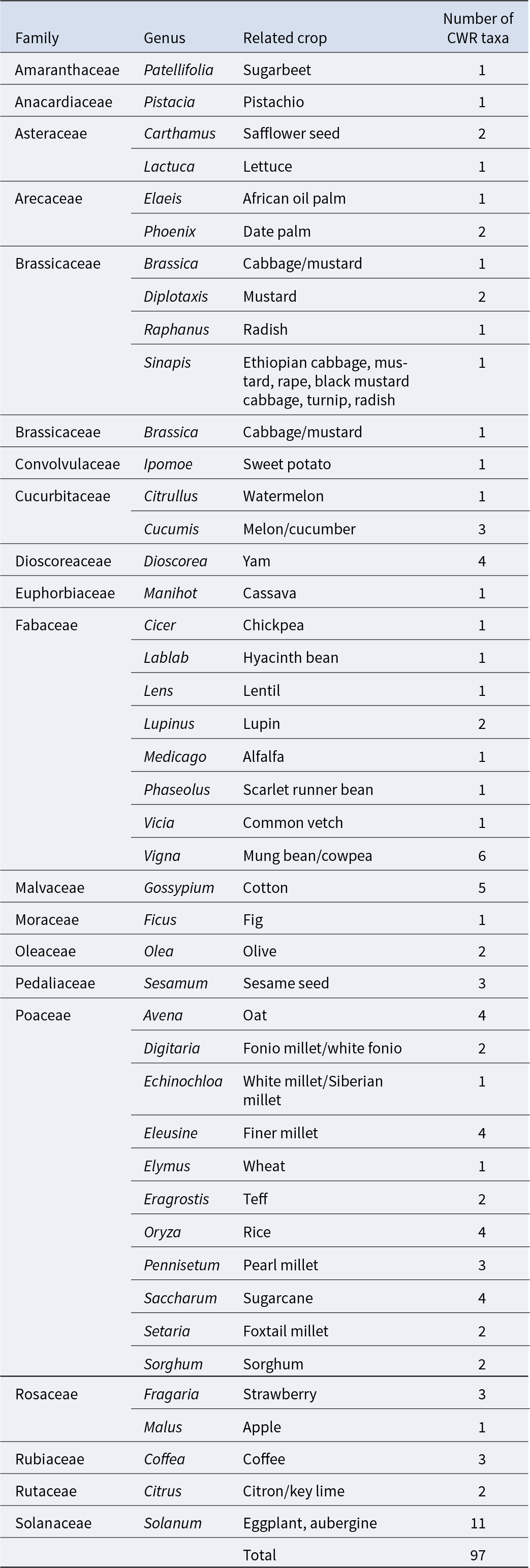
The proposed strategic objectives and actions were developed by considering the analytical findings alongside regional conservation needs, institutional capacity, data availability and opportunities for collaboration. The actions were organized according to key thematic areas, including inventory and information management, in situ conservation, ex situ conservation, climate change adaptation, capacity development, policy integration, sustainable use and regional cooperation (Table 1).
The number of families, genera, related crops and number of CWR in each genus in Northeast Africa’s priority CWR inventory

Expert contribution and review
Experts from Sudan and Djibouti were consulted throughout the development of this SAP and contributed to the review and interpretation of the regional CWR inventory and conservation findings. Their knowledge of national floras, CWR diversity, conservation priorities and institutional contexts supported the identification of country-specific considerations and the development of recommendations that are relevant, practical and regionally appropriate.
Expert input was used to review the accuracy and applicability of the findings, identify potential gaps or inconsistencies, and assess the feasibility of the proposed conservation actions. Their contributions helped ensure that the SAP reflects both the available scientific evidence and national perspectives from the region.
Results and discussions
Regional CWR checklist, prioritization and inventory
Initially, a regional checklist of 1,020 CWR taxa was compiled and then prioritization based on conservation value and extinction risk. The final prioritized inventory list contained 19 families, 44 genera, 15 priority crop species and 97 priority CWR taxa. The taxa names were validated, synonyms removed and cross-referenced with international taxonomic standards such as the International Plant Names Index (https://www.ipni.org/) and the World Checklist of Vascular Plants (https://powo.science.kew.org/) (Aldow et al. Reference Aldow, Magos Brehm, Kordofani, Abdoul‐latif and Maxted2023). The final inventory list is summarized in Table 2, and the full list is included in Supplementary Information Table S1.
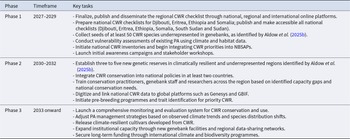
Proposed implementation timeline (5-year roadmap)

Conservation gap analysis
Analysis of 4,551 occurrence records from 57 of the 97 priority CWR taxa revealed several regional hotspots of diversity. High concentrations of occurrences were found in the Central Region of Eritrea extending towards the Ethiopian border, along with additional areas in other parts of Northeast Africa.
Within PA, Ethiopia contained the highest number of documented CWR occurrences. However, only 40 taxa were represented within existing PA, with Solanum campylacanthum Hochst. ex A. Rich. being the most frequently recorded taxon.
Ex situ analysis identified 1,295 accessions representing 52 taxa conserved in genebanks. Despite this, only 8% of these taxa were represented by more than 50 accessions, indicating substantial gaps in ex situ conservation coverage (Aldow et al. Reference Aldow, Magos Brehm, Gaisberger and Maxted2025b).
These findings indicate that, despite the presence of priority CWR taxa within existing PA and genebank collections, substantial gaps remain in both in situ and ex situ conservation. The results provide an evidence base for identifying priority taxa and geographic areas requiring targeted conservation action in the region.
Species distribution modelling (SDM)
A total of 4,551 occurrence records were initially collated. After data cleaning, 2,281 records were retained for 16 CWR taxa out of the 97 prioritized taxa. The remaining 81 taxa were excluded due to either a complete absence of records or insufficient data for reliable SDM. Models were calibrated using bioclimatic and soil variables and projected to 2,041–2,070 conditions under 3 climate scenarios (SSP1-2.6, SSP3-7.0, SSP5-8.5) and five general circulation models.
The mean current suitable habitat area across all taxa was 625,584 km2, representing 14.3% of the region. Taxon responses varied substantially. Sorghum purpureosericeum showed a net expansion relative to current climatic conditions under all scenarios, whereas Ficus palmata, Olea europaea subsp. cuspidata and Avena abyssinica were projected to lose more than 50% of suitable habitat under SSP5-8.5. Species-rich areas in the Ethiopian highlands are expected to lose 6–8 taxa under SSP1-2.6 and 6–9 taxa under SSP3-7.0 and SSP5-8.5.
Recommendations for active conservation
National conservation planning
National conservation planning enables countries to identify and prioritize their own CWR using the guidance provided in An Interactive Toolkit for CWR Conservation Planning (Magos Brehm et al. Reference Magos Brehm, Kell, Thormann, Gaisberger, Dulloo and Maxted2017). This approach supports the identification of conservation gaps and ensures that national actions are aligned with climate change projections, extinction risk assessments and global frameworks such as the FAO Global Plan of Action. This process is particularly important for countries that currently lack a national checklist and priority list, specifically Djibouti, Ethiopia, Eritrea and Somalia.
Key actions include:
• Ecogeographic data collation: Strengthen national datasets by digitizing fieldwork records, herbarium and genebank records and linking them to global biodiversity and plant genetic resources databases to improve accessibility, support long-term data management and facilitate future conservation assessments.
• Address identified conservation gaps: Conduct targeted collection of priority CWR taxa that are currently underrepresented or absent from ex situ collections and strengthen conservation measures in geographic areas identified as having inadequate representation in genebanks and PA network.
• Model climate vulnerability: Evaluate species’ vulnerability to climate change using SDM to inform long-term conservation strategies.
• Map species distributions: Use SDM outputs to identify potential species distributions and guide targeted field surveys of underexplored areas, including northern Somalia, Djibouti and eastern Sudan (Aldow et al. Reference Aldow, Magos Brehm, Kordofani, Abdoul-Latif and Maxted2024).
• Assess extinction risk: Apply the International Union for Conservation of Nature (IUCN) Red List Categories and Criteria to evaluate extinction risk at global and regional levels for endemic and native species.
• Align national and regional priorities: Harmonize national actions with regional strategies and global commitments such as the FAO Global Plan of Action (FAO 2010).
Strengthen in situ and ex situ conservation systems
Establishing climate-resilient PA Expanding PA using climate projections and SDM is essential for the long-term CWR. This approach targets future suitable habitats, restores degraded sites and engages local communities through incentive-based mechanisms such as pilot Payment for Ecosystem Services (PES) schemes.
Key actions include:
• Assess PA management: Evaluate and enhance the effectiveness of existing PAs to actively conserve CWR in situ populations.
• Design climate-informed PA: Focus on climatically identified resilient regions such as Bale, Arsi, Southern Darfur and parts of Somalia.
• Rehabilitating nonfunctional PA: Prioritize the restoration and effective management of currently nonfunctional PA, particularly in Somalia where information on PA status is limited, to enhance their ecological viability.
• Designate genetic reserves: Establish genetic reserves in areas of high endemism and projected habitat loss, as highlighted by Aldow et al. (Reference Aldow, Magos Brehm, Gaisberger and Maxted2025b).
• Habitat restoration: Collaborate with indigenous and local communities’ knowledge to restore degraded PA (Stevens et al. Reference Stevens, Eghenter, Fitzsimons, Goradze, Ironside, Mellis, Nitah, Parling, Reyes, Tabanao, Stevens, Hay-Edie, Miranda Larrea, Ramos and Pathak Broome2024).
• Incentivize conservation: Implement PES that reward communities for maintaining CWR habitats, reducing pressures and monitoring priority sites (Wunder Reference Wunder2015).
Seed banking and backup conservation Seed banking of high-risk and underrepresented species and diversity within species is vital for safeguarding genetic diversity against climate-driven loss, habitat degradation and other factors. Safety duplication and enhanced metadata further improve accessibility and utility for future breeding and conservation efforts.
Key actions include:
• Target high-risk species: Focus on species projected to lose more than 30% of their range by 2070.
• Prioritize underrepresented taxa: Focus collecting efforts on taxa with no existing genebank accessions or fewer than 20 documented accessions (Table S1). Ecogeographic Land Characterization maps should be used to guide sampling and capture genetic and ecogeographic diversity within taxa.
• In situ backup sampling: Ensure that CWR populations conserved in situ are adequately sampled, and that representative material is conserved and made available through designated national ex situ conservation facilities. This would provide a secure backup of in situ populations and facilitate access for research, crop improvement and other potential uses.
• Ensure safety duplication: Secure backup collections in regional and global repositories such as the Svalbard Global Seed Vault and the International Centre for Agricultural Research in the Dry Areas (ICARDA).
• Enhance metadata quality: Improve accessions’ information that describes each accession to support future breeding, research and conservation planning.
Policy integration and cross-border cooperation
Integrating CWR conservation into national biodiversity, food security and environmental policy frameworks and strengthening cross-border collaboration is essential for achieving coordinated, long-term conservation across Northeast Africa. Effective policy mainstreaming ensures that CWR conservation is embedded within national development agendas, while regional cooperation supports the management of shared genetic resources and transboundary ecosystems.
Key actions include:
• Policy mainstreaming: Incorporate CWR conservation into National Biodiversity Strategies and Action Plans (NBSAPs).
• Global alignment: Strengthen alignment with international frameworks, including the Convention on Biological Diversity, the FAO Global Plan of Action, the ITPGRFA and UN Sustainable Development Goals (CBD 1992; FAO, IFAD and WFP 2015). This includes promoting the effective implementation of the Standard Material Transfer Agreements (FAO 2006) and establishing clear legal mechanisms for access and benefit-sharing to ensure that, where genetic resources of the 97 priority taxa are utilized (e.g., in breeding programmes outside the region), fair and equitable benefits are shared with the countries and local communities of origin.
• Regional collaboration: Promote intergovernmental cooperation to support the implementation of national and regional CWR conservation strategies, including coordinated management of shared CWR zones in transboundary areas such as the Ethiopia–Somalia–Sudan borderlands.
Data collection and sharing
Targeted fieldwork and integrated data systems are essential for improving knowledge of poorly documented CWR and areas, supporting evidence-based conservation planning and enhancing global data accessibility through platforms such as Genesys and GBIF (Magos Brehm et al. Reference Magos Brehm, Kell, Thormann, Gaisberger, Dulloo and Maxted2017). Strengthening data quality and connectivity will enable countries in Northeast Africa to better identify conservation gaps, monitor population trends and contribute to global genetic resource initiatives.
Key actions include:
• Prioritize under-documented taxa: Focus fieldwork on species with fewer than 30 known records (Table S1). New collections should generate high-quality data, including collector name, collection date, sampling method, precise GPS coordinates, population-level information (e.g., population size and structure), and detailed ecological and phenological data such as altitude, aspect, flowering stage and fruiting stage (Maxted et al. Reference Maxted, Slagerem, Riham, Guarino, Ramanatha and Reid1995; Castañeda et al. Reference Castañeda, Kell, Eastwood, Maxted, Guarino and Goldberg2011).
• Community-based data science: Use participatory tools such as mobile applications (e.g., iNaturalist) to enable local botanists and community members to report species occurrences, phenology, population trends and threats. All submitted records must be verified by experts before inclusion in the regional CWR database.
• Develop regional databases: Establish a comprehensive regional database of CWR populations and create mechanisms to link it effectively with national databases. The SPGRC regional database of the Southern African Development Community (https://spgrc.org.zm/regional-data-base) provides a strong model for standardized documentation and coordinated data sharing, and similar training and capacity-building initiatives would strengthen documentation systems across the region.
• Enhance global connectivity: Integrate regional and national data with global platforms such as Genesys and the GBIF to improve visibility and accessibility.
Training and partnerships
Building strong technical capacity and fostering regional collaboration are essential for effective CWR conservation. Strengthened skills, shared expertise and coordinated partnerships will enable countries in Northeast Africa to implement conservation actions more efficiently and sustainably.
Key actions include:
• Host targeted workshops: Organize training for researchers (e.g., species identification, data recording, crop breeding), PA staff (e.g., monitoring techniques, species recognition) and joint IUCN Red List workshops (https://www.iucnredlist.org/resources/workshops).
• Strengthen national and regional networks: Enhance collaboration among seed banks, universities, PA managers, national authorities and plant breeders.
• Foster institutional partnerships: Collaborate with organizations such as the IUCN and the FAO to facilitate technical support, capacity development and data sharing initiatives.
• Mainstream CWR in higher education: Integrate CWR conservation and use into university curricula (e.g., University of Khartoum and Addis Ababa University, particularly within agriculture and plant sciences) to train future conservationists and plant breeders.
Public outreach and funding mobilization
Raising public awareness and securing sustainable funding are critical to the long-term success of CWR conservation. These efforts help build public support and ensure financial viability.
Key actions include:
• Awareness campaigns: Launch targeted campaigns to highlight the role of CWR in food security, climate resilience and ecosystem health.
• Economic valuation: Conduct a study to quantify the potential economic value of the 97 CWR to strengthen the case for sustained national and international funding.
• Mobilize funding: Secure financing through climate adaptation and biodiversity programmes, such as the Green Climate Fund (https://www.greenclimate.fund/) and FAO.
Integrating CWR into breeding and climate adaptation strategies
In the context of climate change, integrating CWR into national breeding programmes offers a promising pathway to enhance crop resilience. These wild counterparts of cultivated crops possess valuable traits that can help address local agricultural challenges and support climate adaptation. Each country in Northeast Africa should identify priority CWR based on its unique agroecological needs and climate vulnerabilities.
Systematic approaches for countries To effectively harness the adaptive potential of CWR, countries can adopt a structured, stepwise approach:
• Trait identification: Identify key adaptive traits in priority CWR that align with national climate adaptation and food security goals.
• Strategic prioritization: Prioritize CWR based on their genetic potential, availability in genebanks or natural populations, and relevance to major food crops. This ensures that breeding programmes focus on species with the highest potential impact on national agricultural resilience.
Breeding integration To effectively harness adaptive traits from CWR, breeding programmes must adopt advanced tools and strategies that accelerate trait introgression and cultivar development.
Key actions include:
• Employ pre-breeding programmes: Use pre-breeding pipelines to introgress adaptive traits from CWR into elite crop lines, creating intermediate materials that breeders can readily use.
• Utilize genomic selection and CRISPR-Cas9: Apply modern breeding technologies, such as genomic selection, marker-assisted selection and CRISPR-Cas9 gene editing, to accelerate trait transfer, improve precision and shorten breeding cycles.
• Develop climate-resilient cultivars: Produce improved, climate-resilient cultivars tailored for national release and farmer adoption, ensuring that new varieties meet the practical needs and preferences of local farming communities.
Monitoring and evaluation Long-term success in CWR utilization depends on robust monitoring systems and inclusive stakeholder engagement.
Key actions include:
• Performance monitoring: Track the performance of CWR-derived varieties across diverse agroecological zones in the region to assess their adaptability, stability and contribution to climate resilience.
• Participatory breeding: Implement participatory breeding approaches to ensure cultivars meet the practical needs and preferences of local farming communities.
Addressing infrastructure and institutional capacity for CWR conservation
Sustainable conservation and utilization of CWR require strengthened institutional capacity across key domains.
• Genebank infrastructure: Strengthen regional genebank capacity by upgrading seed storage facilities, including rehabilitating existing infrastructure, installing solar-powered cold rooms in areas with unreliable electricity, and improving data-management and regeneration systems. Restoring damaged genebanks (such as those in Sudan) and establishing new facilities in Somalia and South Sudan are essential for expanding regional coverage and safeguarding genetic diversity.
• Emergency backup: Urgently relocate existing CWR collections or safety duplicates to secure facilities such as Svalbard or ICARDA whenever conflict or instability threatens their preservation, recognizing that many countries in the region, including Eritrea, Ethiopia, Sudan, Somalia and South Sudan, face ongoing or recurrent conflict that places genebank infrastructure at continual risk.
• Quality management systems: Implement robust quality assurance frameworks through Genebank Operations and Advanced Learning workshops (https://hdl.handle.net/10568/123950) to ensure compliance with international standards and promote continuous improvement in genebank performance.
The implementation of this SAP for CWR in Northeast Africa would be led by the institutions assigned to manage genetic resources, biodiversity conservation and agricultural research within each country. In Ethiopia, this includes the Ethiopian Biodiversity Institute, the Ethiopian Institute of Agricultural Research and the national genebank; in Sudan, the Agricultural Research Corporation and the Higher Council for Environment and Natural Resources hold comparable responsibilities; in Eritrea, the Ministry of Agriculture and the Department of Environment oversee crop genetic resources and PA; and in Somalia, Djibouti and South Sudan, agricultural and environment ministries, together with emerging national research centres, are expected to lead CWR-related activities. These institutions are supported by universities conducting floristic and ecological research, as well as the Intergovernmental Authority on Development, which facilitates regional coordination. As institutional structures vary across the region, the roadmap is designed to be adapted by national stakeholders, who are best placed to identify the specific agencies responsible for each action.
Conclusion
This regional SAP provides a comprehensive and forward-looking framework for the conservation and sustainable use of CWR in Northeast Africa. By integrating robust scientific evidence, regional priorities and stakeholder perspectives, it outlines practical and coordinated steps to safeguard CWR diversity and harness their potential for climate-resilient agriculture.
Its successful implementation will require sustained political commitment, strong cross-border collaboration, enhanced institutional capacity and long-term investment in conservation and breeding systems. Protecting these genetic resources is essential not only for ensuring regional food and nutritional security, but also for contributing to global efforts to adapt agriculture to a rapidly changing climate.
Supplementary material
The supplementary material for this article can be found at https://doi.org/10.1017/S1479262126100847.



 Open access

