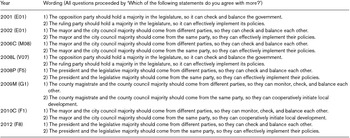
Taiwan's Election and Democratization Study (TEDS) surveys started in 2001 and are intended to provide the data necessary for understanding various aspects of Taiwanese democracy. One of these aspects is voters’ motives for ticket-splitting, defined as voting for candidates from different parties in an election that decides offices for different branches of government. In varying years, the TEDS survey has therefore included, with minor variations, the following question.
Which of the following statements do you agree with more? 1) The president and the legislative majority should come from different parties, so they can check and balance each other. 2) The president and the legislative majority should come from the same party, so they can effectively implement their policies. (TEDS2012; see Appendix 1 for related questions from all TEDS surveys).Footnote 1
The inclusion of this question has inspired studies that attempt to determine the relationship between what can be called ‘preference for checks and balances’ and ticket-splitting behavior in Taiwan (e.g., Wu and Wang, Reference Wu and Wang2003; Wu, Reference Wu2008; Yu, Reference Yu2004; Yu et al., Reference Yu, Huang and Hsiao2010).
Primarily drawing on the survey methodology literature, we argue that due to the problematic aspects of the question, the results do not measure what is intended, and therefore could cloud the findings of studies that utilize these results. Furthermore, problematic survey design notwithstanding, ‘preference for checks and balances’ is a suboptimal concept for understanding voters’ motives for ticket-splitting. We propose, instead, operationalizing preferences based on Fiorina's spatial model, which, as we discuss below, more clearly links a tractable psychological motive to ticket-splitting behavior. We call this measure the policy-balancing index (PBI).
Our paper is organized into two sections as follows. In the first section, we begin by briefly reviewing the relevant literature, from US politics, on voters’ motives for ticket-splitting. We then discuss the problems with the TEDS question, focusing on survey methodology and the need for conceptual clarity. In the second section, we propose our alternative operationalization, the PBI, derived from Fiorina's spatial model, and then test it using the TEDS 2012 data. Among other things, we find that respondents with a higher PBI are significantly more likely to cast split tickets.
Voters’ motives for ticket-splitting
Our curiosity toward ticket-splitting is an extension of our attempts to understand the formation of divided governments (e.g., Alesina and Rosenthal, Reference Alberto and Rosenthal1995; Burden and Kimball, Reference Burden and Kimball1998; Cox and Kernell, Reference Cox, Kernell, Cox and Kernell1991; Cutler, Reference Cutler1988; Fiorina, Reference Fiorina, Cox and Kernell1991, Reference Fiorina1992, Reference Fiorina1996; Jacobson, Reference Jacobson1990, Reference Jacobson1991; Kelly, Reference Kelly1993; Mayhew, Reference Mayhew1991; Thurber, Reference Thurber1991a, Reference Thurber1991b). As individual-level determinants go, a split ticket, cast for whatever reason, is the most immediate cause of a divided government. As Fiorina (Reference Fiorina1992) argues, although many factors potentially explain the formation of divided governments, vote choice patterns cannot be ignored in the analyses.
The numerous explanations found in the US politics literature for ticket-splitting can be categorized into two main camps based on whether the causal mechanism they posit is purposive or accidental (Garand and Lichtl, Reference Garand and Lichtl2000; Sigelman et al., Reference Sigelman, Wahlbeck and Buell1997). According to the purposive-action camp, the act of split-ticket voting occurs when voters want a certain outcome associated with divided government and attempt to achieve it through their ballots.
Two prominent views within this camp are those of Fiorina and Ladd, the latter of which is now often subsumed under the former. According to Fiorina (Reference Fiorina1992, Reference Fiorina1996), split-ticket voting occurs because voters may wish to moderate policy outcomes by electing a divided government. His model assumes that voters expect policy outcomes to be ‘a weighted average of the positions of the parties that control each institution’ (Fiorina, Reference Fiorina1992: 400). As he argues, in an election marked by a Democrat-Republican (two-party) race at both the executive and the legislative level, voters have four possible platforms to choose from: DD, DR, RD, RR (with the first letter indicating the party of the executive, and the second indicating the majority party in the legislature). The four outcomes exist in a policy spectrum ranging from most Democratic to most Republican, and voters will select the platform closest to their ideal point. Under this spatial model, ticket-splitting occurs when the voter's ideal point is closer to either of the divided-control platforms than it is to either of the unified-control platforms.
Ladd (Reference Ladd1989, Reference Ladd1990), on the other hand, speculates that the observed trend toward divided government is facilitated in part by the public's preference for checks and balances, ingrained in American political philosophy. He refers to this as ‘cognitive Madisonianism’. As per the US Constitution, in order to avoid abuse of power by the government and to protect the rights of the American people, the power of the government is divided into different branches, forming a system of checks and balances. This long-standing tradition, Ladd (Reference Ladd1989: 4) argues, has made Americans much more receptive toward divided governments as a new form of checks and balances than are their counterparts in other democracies. He cites in support several surveys in which the majority of respondents responded favorably to questions intended to measure how receptive they were to divided government (Ladd, Reference Ladd1989, Reference Ladd1990). Different from Fiorina's argument, in which ticket-splitting stems from the voters’ instrumental calculus, Ladd's posited motive is an intrinsic one based on long-standing political attitudes.
The two variants, now often conflated, have been subject to empirical testing. As is to be expected, the dependent variable in these studies is almost always the behavior of ticket-splitting. However, due to the fuzziness of concepts and definitions that comes with the growth of a field, as well as the differing methodologies and constraints on data that result from this, the independent variables derived from various relevant theories differ among studies. Generally speaking, two common methodological approaches can be identified.
First, there are those based on Fiorina's spatial model. These derive different hypotheses from the model and subject them to tests (e.g., Born, Reference Born1994; Carsey and Layman, Reference Carsey and Layman2004; Garand and Lichtl, Reference Garand and Lichtl2000; Lacy and Paolino, Reference Lacy and Paolino1998). For example, one of Fiorina's (Reference Fiorina1992: 400) hypotheses is that ‘ticket-splitters will be concentrated among those voters whose preferred positions lie between those of the two parties’. Based on this, studies model voter moderation as an independent variable (e.g., Alvarez and Schousen, Reference Alvarez and Schousen1993; Born, Reference Born1994; Garand and Lichtl, Reference Garand and Lichtl2000). By extension, scholars could also test Fiorina's hypothesis that the more polarized the two parties in the election are, the greater the incidence of ticket-splitting (Fiorina, Reference Fiorina1992: 400), by modeling the voter's perception of party polarization as an independent variable (e.g., Carsey and Layman, Reference Carsey and Layman2004; Garand and Lichtl, Reference Garand and Lichtl2000). The PBI, which we propose using in Taiwanese electoral studies, belongs to this camp.
Second, there are those that rely on survey data intended to directly demonstrate the preference for checks and balances (e.g., Garand and Lichtl, Reference Garand and Lichtl2000; Lewis-Beck and Nadeau, Reference Lewis-Beck and Nadeau2004; Sigelman et al., Reference Sigelman, Wahlbeck and Buell1997; Smith et al., Reference Smith, Brown, Bruce and Overby1999). Instead of modeling voter preferences in relation to the ideological or policy positions of parties, these works examine the relationship between self-reported preferences and manifested behavior. Self-reported preferences, however, are often difficult to use given the often unwieldy nature of survey questions. The primary subject of our discussion, the TEDS question mentioned in our introduction, is one such example.
‘Preference for Checks and Balances’ in TEDS: An Unsatisfactory Operationalization
There is a lack of agreement among scholars on the best practice for measuring the preference for checks and balances. Most of these debates center on tradeoffs in survey design (Carsey and Layman, Reference Carsey and Layman2004: 544; Geer et al., Reference Geer, Carter, McHenry, Teten and Hoef2004: 51, especially fn. 3; Lacy and Paolino, Reference Lacy and Paolino1998: 1195–96; Lewis-Beck and Nadeau, Reference Lewis-Beck and Nadeau2004: 99–100; Smith et al., Reference Smith, Brown, Bruce and Overby1999: 747). A particularly significant issue is whether or not questions should include priming, and, if so, how? — And to what degree? These debates notwithstanding, the TEDS questions violate certain aspects of survey methodology, thereby lowering the validity of the data. First, the TEDS questions are double-barreled, resulting in respondent uncertainty. Second, the phrasing of the TEDS questions, combined with the fact that the survey is a post-election survey, introduces an endogeneity problem. We discuss these in turn.
Double-barreled question
A double-barreled question is one in which preference regarding two items is asked, but only one response is allowed (Bakken, Reference Bakken and Orme2008; Bassili and Scott, Reference Bassili and Scott1996; Gideon, Reference Gideon and Gideon2012; Lupia, Reference Lupia, Sniderman and Highton2011). This can be as simple as when two preferences are asked in conjunction, or as complex as when one preference is conditioned upon another preference. Consider the two alternatives from the TEDS2012 question:
1) The president and the legislative majority should come from different parties, so they can check and balance each other. 2) The president and the legislative majority should come from the same party, so they can effectively implement their policies.
This question first asks for preference regarding a factual state of being: whether or not the government is divided; then asks for preference regarding a conceptual state that is neither entirely dependent on, nor completely independent from the first state: whether checks and balances should exist between the executive and legislature.
The choices are clear to the respondent who prefers a divided government for the sake of the executive and legislative branches checking each other's power, and the respondent who prefers a unified government for the sake of policy efficacy. However, what if the respondent prefers a divided government, but not because of policy efficacy? – Or if the respondent prefers checks and balances, not through divided government, but through, for instance, judicial empowerment? There are clearly more states of being than the two the respondents are allowed to choose from. Bakken (Reference Bakken and Orme2008: 11) argues that a double-barreled question is fine ‘if the researcher wants to know only the incidence of the joint occurrence of the two conditions’, but, he adds, ‘respondents [must] follow the logic in answering the question’. This necessary assumption, of course, is indefensible. There is no way we can determine the rule by which the respondent arrived at his decision (Bakken, Reference Bakken and Orme2008; Gideon, Reference Gideon and Gideon2012). Did he respond to the first part of the question or the second part? – Or did he somehow combine the two conditions? – If so, how were they weighted?
The point here is that a double-barreled question introduces too many uncertainties into the respondent's answer, simply rendering invalid whatever results are obtained. Yes, we are most likely capturing to some degree respondents’ preferences of checks and balances, but without a standard of comparability between the answers, it is, as Lupia so effectively illustrates (Reference Lupia, Sniderman and Highton2011: 38), akin to attempting to estimate citizens’ preferences toward abortion ‘by asking some respondents whether they favor or oppose abortion in particular circumstances and asking others whether they favor or oppose a continuation of the morning's weather’.
Post-election survey artifacts and the problem of endogeneity
Even if we assume that the TEDS question clearly measures respondents’ preferences for checks and balances, the way it is asked, combined with the fact that the TEDS survey is conducted post-election, presents a potential problem of endogeneity. With certain exceptions, the TEDS surveys are conducted within the first two months following elections. As a post-election survey, it often encounters problems on questions that are affected by the respondents’ party identification. Given that the function of elections is to determine winners and losers, it is well within expectations that questions measuring preferences for different aspects of government rights and responsibilities are heavily colored by how the respondent's preferred party fared in the election. In other words, the results are likely to capture respondents’ party preferences instead of whatever intrinsic preferences the questions are intended to measure.
The likelihood of this occurring for our current case, preference for checks and balances, is quite high. A recent study demonstrates this. As Yu et al. (Reference Yu, Huang and Hsiao2010: 3) posit, the concept of checks and balances:
may be perceived as a way to rationalize power struggle and party dominance by rank-and-file party supporters in new democracies [such as Taiwan, where party lines are often split along deep, social cleavages]. Intuitively, party supporters tend to prefer a unified government under her preferred party's full control. Divided government is preferred only when her preferred party has lost the previous legislative/presidential election and thus she hopes her party can gain control in the other branch of the government so as to check and balance the opponent party.
They find support for their hypothesis in data from TEDS2008L and TEDS2008P (the post-legislative election survey and the post-presidential election survey). These surveys examine whether respondents changed their position on preferences for checks and balances after Ma Ying-jeou (the pan-blue candidate) defeated Frank Hsieh (the pan-green candidate) in the presidential election, and they find that after the presidential election, respondents who identified as pan-blue were more likely than those who identified as independents in both surveys to change their preferences from balancing to non-balancing, whereas the opposite was the case for those who identified as pan-Green.
The phrasing of the question in itself was not responsible for introducing the endogeneity. If the question could be presented to the respondent in a vacuum, it would be fine. The problem is that the priming power of salient contextual variables is not accounted for. Disregarding these factors, the question, instead of asking respondents their intrinsic preferences for checks and balances, effectively asks them their preferences for checks and balances given the state of the government most salient to them at the moment, which, given the post-election timing of the survey, is most likely to be the government-elect.
This is generally not an insurmountable issue for survey design. For example, Smith et al. (Reference Smith, Brown, Bruce and Overby1999) asked respondents their preferences for checks and balances for two hypothetical situations – if Bob Dole wins, and if Bill Clinton wins.Footnote 2 This creates four subgroups from the respondents, one of which contains respondents whose preferences for checks and balances overrides their party preferences, that is, those who preferred divided government under both conditions. However, this is difficult to accomplish in a post-election survey, as presenting hypotheticals regarding historical events whose outcomes are already known creates a cognitive strain for respondents.
Lack of internal coherence and external differentiation
Most importantly, concerns about TEDS survey methodology notwithstanding, ‘preference for checks and balances’ itself is a suboptimal concept because it lacks internal coherence and external differentiation, two of the seven attributes that, according to Gerring (Reference Gerring1999), make a concept good. As Gerring explains, coherence is ‘the sense in which the attributes that define the concept, as well as the characteristics that actually characterize the phenomena in question, “belong” to one another’ (Reference Gerring1999: 373). Differentiation, the ‘flip side’ of coherence, is a requisite of it – only by differentiating between fundamentally different concepts can we then meaningfully work with the resulting conceptually coherent building blocks.
As noted earlier, preference for checks and balances is used in the literature to refer to both Fiorina's policy-balancing hypothesis and Ladd's ‘cognitive Madisonianism’. In the works we reviewed, we find that while vague relations are sometimes drawn between the two arguments (e.g., Smith et al., Reference Smith, Brown, Bruce and Overby1999; Wu, Reference Wu2008; Yu, Huang, and Hsiao, Reference Yu, Huang and Hsiao2010), there have been no attempts to discern in detail the differences between them (Garand and Lichtl, Reference Garand and Lichtl2000; Sigelman et al., Reference Sigelman, Wahlbeck and Buell1997; Smith et al., Reference Smith, Brown, Bruce and Overby1999; Yu, Reference Yu2004). In fact, the concepts have become so blurred that some papers use ‘cognitive Madisonianism’ when referring to Fiorina's argument without once mentioning Ladd (Garand and Lichtl, Reference Garand and Lichtl2000: 175; Wu and Wang, Reference Wu and Wang2003: 86).
At face value, preference for checks and balances, as a concept, appears to be internally coherent. After all, both those who prefer policy moderation through divided government and those who respond by saying that they prefer checks and balances can surely be said to prefer checks and balances. However, closer examination shows otherwise. As noted above in the literature review, under Fiorina's spatial model-based policy-balancing hypothesis, a split ticket indicates preference for either of the two divided government arrangements situated along the modest range of the policy spectrum (Fiorina, Reference Fiorina1992). This can be said to be a preference for ‘balancing’, but it should be more concretely understood as preferring a set of policy outcomes most likely to be produced by that government arrangement. So to speak, the policy balancer does not care about the governmental arrangement, only the resultant policies. Policy outcomes are real, with clear substantive consequences. Preference for the divided government that brings about such consequences is an instrumental one.
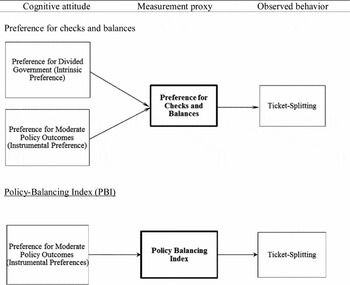
On the other hand, Ladd (Reference Ladd1989: 4), by citing US voters’ ‘two centuries of experience with a political philosophy and attendant institutions that raise checked-and-divided governmental authority to a lofty status as an instrument for preserving individual liberty’, suggests that there is an intrinsic preference for checks and balances that has been socialized into US political culture. He then, however, continues by discussing ‘[setting] the two parties’ views of government's proper role more actively in . . . creative tension’, suggesting that there is an instrumental motive for balancing the two parties’ behavioral tendencies. Lewis-Beck and Nadeau (Reference Lewis-Beck and Nadeau2004: 105–6) do a particularly thorough job of identifying the different motives within Ladd's cognitive Madisonianism, identifying an institutional component and a policy component, which roughly correspond to our intrinsic and instrumental components, respectively. Figure 1 illustrates Fiorina's ‘preference for checks and balances’ in relation to that of Ladd and the relation of each to ticket-splitting behavior.
Relationship between preference for checks and balances, policy-balancing index, and ticket-splitting

Preference for checks and balances clearly lacks the ability to differentiate between two fundamentally different concepts, instrumental and intrinsic motives. This has significant practical implications. Keep in mind that we are trying to answer a question: Why do voters cast split tickets? There is a difference between preferring, in principle, a divided government in and of itself, and preferring balanced policymaking because it leads to a more acceptable policy outcome or one that results in more benefits. As an explanatory variable, the catch-all ‘preference for checks and balances’ cannot differentiate between the two types of preferences above and therefore cannot provide a satisfactory explanation.
In the preceding paragraphs, we discussed three problematic aspects of ‘preference for checks and balances’. In the remainder of this paper, primarily drawing upon the work of Carsey and Layman (Reference Carsey and Layman2004), we explore an alternative measure based on Fiorina's spatial model of policy-balancing, which, as we show below, provides a clearer answer regarding ticket-splitting because it operationalizes only one concept.
PBI: an alternative conceptualization
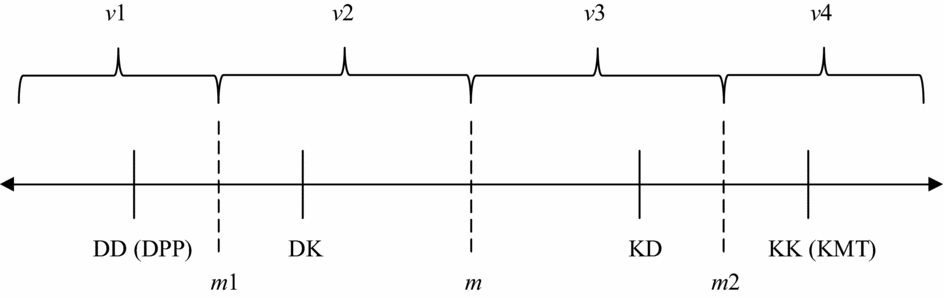
As explained above, Fiorina's policy-balancing hypothesis (Reference Fiorina1992) is a spatial model of vote choice that assumes voters will select from four governmental arrangements the one most likely to produce the policy outcomes they prefer.
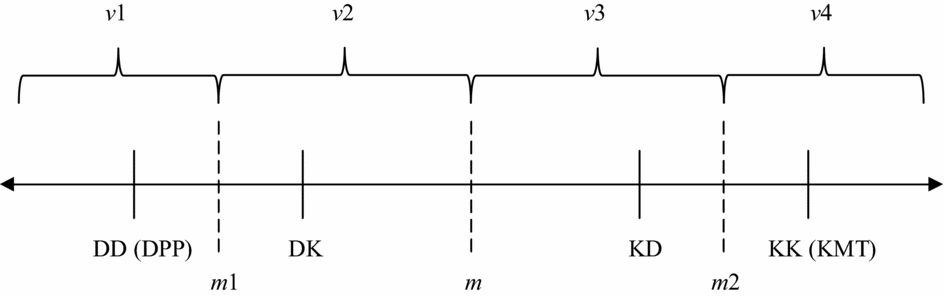
Ticket-splitting occurs when the voter's ideal point lies somewhere between midpoints m1 and m2 (v2+v3). Voters who are more extreme than either of these points (v1+v4) will cast straight tickets. From his idealized model, Fiorina derives three hypotheses (Reference Fiorina1992: 400), two of which are relevant to our present endeavor.Footnote 3
(1) Ticket-splitters will be concentrated among those voters whose preferred positions lie between those of the two parties. (2) The more polarized the parties, the greater the incidence of ticket-splitting.
Both are readily apparent from Figure 2. The key elements in Fiorina's model, as Carsey and Layman (Reference Carsey and Layman2004, 541–2) state in more specific terms, are ‘(1) the ideological location of the voter relative to his or her perception of locations of the two parties, and (2) the voter's perception of the ideological distance, or polarization, between the two parties’.
Spatial model for ticket-splitting
Source: Adapted from Fiorina (Reference Fiorina1992: 400).
Given that, the following data are needed to construct the PBI:Footnote 4 (1) the respondent's ideological position on a given policy spectrum, (2) the respondent's perception of the Kuomintang's (KMT’s) ideological position on the same policy issue, and (3) the respondent's perception of the Democratic Progressive Party's (DPP’s) ideological position on the same policy issue. TEDS2012 contains the data for the ideological position regarding Taiwan's political status and regarding social welfare policies. We use the former for our index. The relevant questions (M1, M1a, M1b) are phrased as follows.
Sometimes people will talk about the question of unification with China or Taiwan independence. Some people say that Taiwan and China should unify as soon as possible. Others say that Taiwan should declare independence as soon as possible. Still others have opinions between these two positions. If the independence-as-soon-as-possible position is represented by 0, and the unify-as-soon-as-possible position is represented by 10, which position do you occupy? (Respondent is shown a card with a spectrum of eleven positions from 0 to 10.)
What position do you think the (KMT/DPP) occupies? (Respondent is shown the same card.)
Taking the results from the three survey questions, we obtain our PBI, a number ranging from negative five to positive five, using the equation below.
 \begin{equation*}
|RIDEOL - CLOSER| - |RIDEOL - (KIDEOL{\rm } + {\rm }DIDEOL)/2|
\end{equation*}
for which:
• RIDEOL: respondent's ideological position;
• KIDEOL: respondent's perception of KMT ideological position;
• DIDEOL: respondent's perception of DPP ideological position;
• CLOSER: ideological position of party perceived by respondent to be closer to his own ideological position (closer of KIDEOL or DIDEOL to RIDEOL).
The PBI is a representation of (a) the distance between the ideological position of the respondent and what he perceives to be that of his preferred party relative to (b), the distance between the ideological position of the respondent and what he perceives to be the ideological mid-point between the parties. The higher one's PBI, the more likely one is, based on Fiorina's spatial model, to engage in ticket-splitting. A positive number (a>b) means that the respondent is more moderate (i.e. is farther from his preferred party than from what he perceives as moderate), making the respondent more likely to cast a split ticket; conversely, a negative number (a<b) means that the respondent is less moderate (i.e. is closer to his preferred party than to what he perceives as moderate), making the respondent more likely to cast a straight ticket.
In addition to the effect of voter moderation, the PBI captures the effect of perceived party polarization; that is, holding voter position constant, perceived party polarization increases the PBI. As the PBI is an operationalization of an instrumental policy-balancing model, the less a respondent perceives there to be a difference between the two parties, the less he should feel a need to achieve a moderate policy outcome by splitting his ticket (the lower his PBI). Constructed as such, the PBI captures the voter's instrumental calculus, key to Fiorina's model.
At this point in the discussion, it is pertinent to highlight the fact that there is more than one way to operationalize Fiorina's spatial model (e.g., Born, Reference Born1994; Garand and Lichtl, 2001; Burden and Kimball, Reference Burden and Kimball1998). For example, to be completely faithful to Fiorina's model, one would obtain the PBI by calculating the values of m1 and m2 to determine whether the respondent falls into v1, v2, v3, or v4. Faithfulness to an idealized model, however, is not necessarily optimal. Despite a respondent being able to roughly conceptualize policy positions along a scale when asked, his perception of these positions is likely to be more amorphous on election day. Respondents near the m1 and m2 points, therefore, are more likely to waver between casting a straight and a split ticket than those further along their respective spectrums. In other words, not all respondents within the same block are alike; a v2 closer to m1 might be more similar to a v1 than to a v2 who is closer to m. In comparison, our operationalization accounts for degrees of moderation and should better reflect reality.
All considered, PBI is preferable to ‘preference for checks and balances’ as an explanatory variable because it avoids the problematic aspects of survey methodology identified above. First, while PBI is a proxy index composed of reported attitudes, the questions are straightforward, with the answer scale presented to respondents as a visual aid. Second, being constructed from self-reported policy positions that are not tied to election outcomes, PBI avoids the artifact likely to be introduced by asking directly about checks and balances post-election. Finally, as Figure 1 illustrates, PBI attempts to capture a much more definite attitude compared to the preference for checks and balances.
Before proceeding to our statistical analysis, it is imperative to note that we do not include data on ‘preference for checks and balances’ in any of our models below because statistical analysis cannot offer insight into any of our arguments regarding PBI's superiority to ‘preference for checks and balances’. Most importantly, for example, the incommensurability between responses introduced by double-barreled questioning invalidates the data, and therefore renders results from any statistical analysis, whether standalone or compared to the PBI, meaningless.
PBI in action
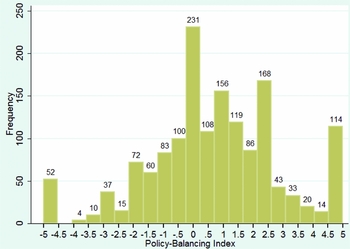
Using the method presented in the section above, we constructed the PBI of respondents to the TEDS2012 survey. The resulting index of 1,525 respondents contains values ranging from –5 to 5, with mean of 0.728 and standard deviation of 2.251. The distribution of the index is presented in Figure 3.
Distribution of policy-balancing index, TEDS2012 (Q: M1)

A two sample t-test shows a statistically significant but substantively small difference in the respondents’ PBI – when differentiated based on our dependent variable, voting behavior coded as having cast a straight or a split ticket in the 2012 Taiwanese presidential and legislative electionsFootnote 5 (1,309 total tickets; 1,007 straight (82.28%); 232 split (17.72%)). Both ranging the full spectrum from –5 to 5, straight-ticket voters have a mean of 0.936 and standard deviation of 2.216, while the split-ticket voters have a mean of 0.540 and standard deviation of 2.133. This substantively small difference between the two groups in this basic comparison is not necessarily discouraging, as ticket-splitters only constitute a small portion of total voters.
To better examine the PBI's explanatory power, we attempt to see if it obtains the expected results in a full model of ticket-splitting behavior. As discussed, PBI should have a positive influence on the likelihood of casting a split ticket. Aside from our primary explanatory variable, the voter's PBI, included in our models are eight control variables that have been demonstrated by prior research to influence political behavior. (Details of the relevant questions and the scale scores for all the variables are presented in Appendix 2.)
Three of these variables are basic sociodemographic variables commonly included as controls in studies of ticket-splitting. First, we include gender, which is related to one's likelihood of participating in political activities (Rosenstone and Hansen, Reference Rosenstone and Hansen1993). Second, we account for the voter's age, widely regarded as a significant determinant of political behavior. The accumulation of political knowledge and experience over time, as well as different environmental factors at each stage of life, are recognized as being highly likely to affect one's political preferences. Specifically, younger voters would have had less time to solidify their party and policy preferences, and are therefore more likely to split their tickets (Born, Reference Born1994; Garand and Lichtl, Reference Garand and Lichtl2000). Third, we include the voter's level of education, divided into a categorical ranking of ‘primary school and below’, ‘junior high school’, ‘high or vocational school’, and ‘some college and above’. Prior research (Beck et al., Reference Beck, Baum, Clausen and Smith1992; Keith et al., Reference Keith, Magleby, Nelson, Orr, Westlyr and Wolfinger1992) demonstrates that voters with higher levels of education have more sophisticated political judgment. More specific to our study, it has been shown that Taiwanese voters with at least a college education, compared to those holding only a junior high school diploma, are more likely to vote for the same party across different elections (Wu, Reference Wu2008). Related, we control for political knowledge based on seven questions in the TEDS2012 survey (G1-G7). In addition to the discussion above regarding age and education, Garand and Lichtl (Reference Garand and Lichtl2000) find that preference for checks and balances only manifested in ticket-splitting behavior among those with a high degree of political knowledge.
Two of the remaining variables – ethnicity and Taiwanese-Chinese consciousness – are interrelated, and are highly salient political factors which cannot be omitted from any analysis of Taiwanese politics (Hsieh, Reference Hsieh2005). It is generally accepted that there are four ethnic groups in Taiwan – the Taiwanese-Minnan, the Taiwanese-Hakka, the aboriginal groups, and the mainland Chinese. We set the aboriginal groups as missing because they have their own electoral system for legislative elections. Ethnicity has long been a salient issue in Taiwan political life, and it is also a significant variable determining people's political attitudes and voting behavior. The primary significance of this variable is the difference in attitudes between Taiwanese and mainlanders (Moody, Reference Moody1992; Shyu, Reference Shyu1998; Watchman, Reference Watchman1994). While this difference has gradually weakened, ethnicity today is often reflected in an individual's Taiwanese-Chinese consciousness. As is common with surveys in Taiwan, respondents are asked whether they identify as ‘Taiwanese’, ‘Chinese’, or ‘both’. Related to these variables is preference regarding Taiwan's political status, that is, the island's independence from or unification with China, which, unsurprisingly, plays an extremely significant role in Taiwanese politics (Huang and Wu, Reference Huang and Wu2000; Wu and Wang, Reference Wu and Wang2003). Typically, this preference is controlled for. However, we do not include it as a standalone independent variable due to concerns of multicollinearity, as it constitutes the basic components of our PBI. Finally, the location of the respondent's residence, categorized into four geographical regions, attempts to capture political attitudes stemming from one's upbringing that the other controls are unable to.
Our final control variable, party identification, is considered in Taiwanese electoral studies to be the most significant determinant of voting behavior in general, and of ticket-splitting more specifically (Chen and Yu, Reference Chen and Yu2001; Wu and Wang, Reference Wu and Wang2003; Yu, Reference Yu2004).
We control for these variables and test the relationship between the respondent's PBI and his likelihood of ticket-splitting in the 2012 presidential and legislative elections by conducting logit analysis in Stata 11.2. As a comparative exercise, we ran two models, with the first (Model I) including only our control variables and the second (Model II) adding PBI.
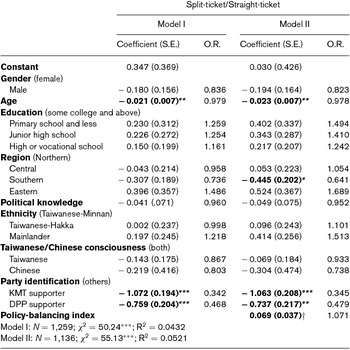
It is clear from Table 1 that the difference between the two models is very slight. Substantively, two of the control variables – age and party identification – reached statistical significance in both models, with the relationships of both variables with ticket-splitting running in the expected directions. First, we find that increase in age lowers the likelihood of ticket-splitting, corroborating prior suggestions that an individual's party identification becomes entrenched over time, thereby decreasing the appeal of a split ticket. Second, compared to those not identifying as either a KMT or a DPP supporter (i.e., those identifying with a minor party or those without a party identification), those who do are significantly less likely to split their tickets. Once again, this supports our general understanding that partisan identifiers are less likely to split their tickets. Our contextual control variable, region of residence, reached statistical significance in model II, (and was close in model I), indicating that respondents living in the south are more likely to split their tickets than are those living in the north. Statistically, the two models are very similar as well. For the control variables reaching significance in both models, as well as a few others, there is almost no difference between the coefficients, standard errors, and odds ratios found in the two models.
Estimates of logit models of ticket-splitting behavior in 2012

Notes: Cell entries are unstandardized regression coefficients, standard errors (SE), and odds ratios (OR). † p<.1, *p<0.05; **p<0.01; ***p<0.001; two-tailed test of significance.
Most importantly, in model II, we see that PBI, which we propose as an alternative concept for studies of individual-level motives for ticket-splitting, demonstrates a significant positive relationship with ticket-splitting (coefficient = 0.069; standard error = 0.037; odds ratio = 1.071). This result supports hypotheses drawn from Fiorina's spatial model of policy-balancing. Those who prefer moderate policy outcomes (i.e. m1<RIDEOL<m2) and perceive enough of a policy difference between the two parties are more likely to split their tickets than are those who occupy a polarized position (i.e. RIDEOL<m1 or RIDEOL>m2) or those who do not perceive a significant difference between the two parties.
Conclusion
In this study, we argue that the TEDS questions measuring the preference for checks and balances violate two principles of survey methodology: (1) they are double-barreled, and (2) they face an endogeneity problem. Furthermore, these problems notwithstanding, the concept of preference for checks and balances is suboptimal because it cannot differentiate between two fundamentally different behavioral motives: an intrinsic preference for divided governments in and of themselves, and an instrumental preference for policy-balancing such that policy outcomes are more favorable. We then demonstrate an application of the PBI using data from the TEDS2012 survey. We find respondents with a higher PBI, as expected based on Fiorina's spatial model of ticket-splitting, to be more likely to split their tickets. Also in agreement with our expectations, we find control variables age and partisanship to both negatively influence ticket-splitting.
In addition to contributing to studies of individual-level motives for ticket-splitting, we hope to use our case to make a broader point regarding the attention we as researchers pay to what is indisputably the most fundamental component of survey-based research: respondent cognition. As Lupia asks, ‘How do political scientists know?’ How do respondents react when they are presented with a question? How does the question, as a stimulus, travel through the respondent's brain until it ultimately manifests as a response? How does all of this affect what we are actually measuring? There is a wealth of literature, especially from psychology and marketing, that explores these questions. Political science as a field has recently begun to explore this area. For example, in 2008, the American National Election Studies (ANES) carried out a thorough examination of its questions to ensure that their phrasing corresponded to what is considered ‘best practice’ by the survey research community (Lupia, Reference Lupia, Sniderman and Highton2011). For a field of study so heavily reliant on survey data, we would benefit from undertaking a similar endeavor for the TEDS questions. By highlighting the problems with the questions regarding preference for checks and balances, we hope to demonstrate the need to do so on a broader basis.
About the authors
Ted Hsuan Yun Chen is a Ph.D. student in the Department of Political Science at Pennsylvania State University. He is currently interested in the interaction between audience costs and leader types, and how it impacts international interaction. He has previously published in the Journal of Contingencies and Crisis Management.
Tzu-Ping Liu is a student in the Ph.D. Program of the Department of Political Science, University of California at Santa Barbara. His current research interests are public opinion, electoral systems, and quantitative methodologies. His articles have been published in Journal of Electoral Studies and East Asia.
Chung-li Wu is a research fellow at the Institute of Political Science, Academia Sinica, Taiwan. He received his Ph.D. in Political Science from the University of New Orleans in 1997. His current research interests are American politics, comparative politics, urban and minority politics, electoral studies, and judicial politics. He is the author of articles published in Party Politics, China Quarterly, Parliamentary Affairs, Japanese Journal of Political Science, Journal of Black Studies, Asian Survey, Issues and Studies, and other professional journals.
Questions for preference for checks and balances

Appendix 2: Survey questions and coding of variables
Vote choice in the presidential election. ‘Which ticket did you vote for?’ (1 = Tsai Ing-wen and Su Jia-chyuan [DPP]; 2 = Ma Ying-jeou and Wu Den-yih [KMT])
Vote choice in the legislative election. ‘In this legislative election, which candidate did you vote for?’ (1 = KMT; 2 = others; 3 = DPP)
Gender. Respondent's gender (1 = male; 2 = female)
Age. Respondent's age measured in years (20 to 92)
Education. Respondent's level of educational attainment measured on a four-tier scale (1 = primary school and below; 2 = junior high school; 3 = high or vocational school; 4 = some college and higher)
Region. The geographical location of respondent's residence (1 = northern [Keelung City, Taipei City, New Taipei City, Taoyuan County, Hsinchu City, Hsinchu County, Miaoli County]; 2 = central [Taichung City, Changhua County, Nantou County]; 3 = southern [Yunlin County, Chiayi City, Chiayi County, Tainan City, Kaohsiung City, Penghu County]; 4 = eastern [Yilan County; Hualien County; Taitung County])
Political knowledge. (1) ‘Who is the current president of the United States?’ (2) ‘Who is the current premier of our country?’ (3) ‘What institution has the power to interpret the constitution?’ (4) ‘Which of these persons was the finance minister before the recent election? 01 Jiang Yi-huah; 02 Chen Chun (Sean Chen); 03 Mao Chi-kuo; 04 Lee Sush-der’ (5) ‘What was the current unemployment rate in Taiwan as of the end of last year? 01 2.3%; 02 4.3%; 03 6.3%; 04 8.3%’ (6) ‘Which party came second in terms of seats in the Legislative Yuan? 01 Kuomintang; 02 Democratic Progressive Party; 03 People First Party; 04 Non-Partisan Solidarity Union’ (7) ‘Who is the current secretary-general of the United Nations? 01 Kofi Anan; 02 Kurt Waldheim; 03 Ban Ki-Moon; 04 Boutros Boutros-Ghali’ (1 = correct; 0 = wrong; 0 = I know but can't remember [the name]; 0 = refuse to answer; 0 = don't know)
Ethnicity. Ethnic background of respondent's father (1 = Taiwanese-Minnan; 2 = Taiwanese-Hakka; 3 = mainlander)
Taiwanese/Chinese consciousness. ‘In our society, some people say they are Taiwanese, some people say they are Chinese, and some people say they are both Taiwanese and Chinese. Do you think you are Taiwanese, Chinese, or both?’ (1 = Taiwanese identification; 2 = both; 3 = Chinese identification)
Party identification. ‘Among the main political parties in our country, including the Kuomintang, Democratic Progressive Party, New Party, People First Party, and Taiwan Solidarity Union, do you think of yourself as close to any particular political party?’ [If answering ‘yes’] ‘Which party is that?’ Those who classify themselves as independents are asked the following question: ‘Do you think of yourself as being a little closer to one of the political parties than the others?’ [If yes] ‘Which party do you feel closest to?’(1 = KMT; 2 = others [including independents]; 3 = DPP)
Preference for checks and balances. ‘Which of the following two statements do you agree with more? (1) The president and the legislative majority should come from different parties so they can check and balance each other; or, (2) The president and the legislative majority should come from the same party so the president's agenda can be effectively implemented.’ (1 = The president and the legislative majority should come from different parties so they can check and balance each other; 2 = The president and the legislative majority should come from the same party so the president's agenda can be effectively implemented)
Policy-balancing index. Sometimes people will talk about the question of unification with China or Taiwan independence. Some people say that Taiwan and China should unify as soon as possible. Others say that Taiwan should declare independence as soon as possible. Still others have opinions between these two positions. If the independence-as-soon-as-possible position is represented by 0, and the unify-as-soon-as-possible position is represented by 10, which position do you occupy? (Respondent is shown a card with a spectrum of eleven positions from 0 to 10.) What position do you think the (KMT/DPP) occupies? (Respondent is shown the same card.)