INTRODUCTION
Cassava (Manihot esculenta Crantz spp. esculenta) is the only one of 98 species of Manihot that is of economic importance, and three subspecies are known: M. esculenta Crantz ssp. esculenta, ssp. flabellifolia and ssp. peruviana (Mueller Argoviensis) (Allem et al. Reference Allem, Mendes, Salomão and Burle2001). Cassava culture has contributed to food security and improved the living conditions of millions of people since it was introduced into tropical Africa and Asia from South America and has become a staple crop (FAO 2010).
Wild species of Manihot grow naturally in central and northern Brazil. For this reason, it is believed that central Brazil might be the domestication centre of the species (Allem Reference Allem1994). Molecular phylogenetic studies have been used to understand the relationship between wild Manihot species and the origin of the cultivated species (M. esculenta spp. esculenta). Molecular and DNA sequence analyses have revealed high levels of similarity between the M. esculenta spp. esculenta and the M. esculenta Crantz ssp. flabellifolia (Pohl) (Fregene et al. Reference Fregene, Vargas, Ikea, Angel, Tohme, Asiedu, Akoroda and Roca1994; Roa et al. Reference Roa, Maya, Duque, Tphme, Allem and Bonierbale1997; Olsen & Schaal Reference Olsen and Schaal1999, Reference Olsen and Schaal2001; Colombo et al. Reference Colombo, Second and Charrier2000). However, information obtained from morphological data (Allem Reference Allem1994, Reference Allem, Hillocks, Thresh and Bellotti2002), microsatellite markers and single nucleotide polymorphisms (SNPs) has confirmed that the cultivated species was domesticated from M. esculenta ssp. flabellifolia only and not from multiple sources of different species (Olsen Reference Olsen2004).
Wild species are of interest to breeding programmes because desirable characteristics have been identified in these species, such as resistance to post-harvest physiological deterioration (PPD) (Manihot walkerae Croizat), drought tolerance (Manihot glaziovii Muell. Arg., Manihot catingae Ule. and Manihot carthaginensis (Jacq.) Mull. Arg.), high protein content (Fregene et al. Reference Fregene, Morante, Sánchez, Marin, Ospina, Barrera, Gutierrez, Guerrero, Bellotti, Santos, Alzate, Moreno and Ceballos2006; Akinbo et al. Reference Akinbo, Labuschagne and Fregene2012) and resistance to the cassava green mite, mealy bug and whitefly (M. esculenta ssp. flabellifolia) (Carabalí et al. Reference Carabalí, Bellotti, Montoya Lerma and Fregene2010). However, the low germplasm variability for certain traits in M. esculenta spp. esculenta makes it impossible to generate sufficient genetic diversity or select for many of the traits mentioned above. For example, protein content has been shown to vary considerably from 57·5 to 83·1 g/kg (Chavez et al. Reference Chávez, Sánchez, Jaramillo, Bedoya, Echeverry, Bolaños, Ceballos and Iglesias2005) and from 9·5 to 64·2 g/kg (Ceballos et al. Reference Ceballos, Sánchez, Chávez, Iglesias, Debouck, Mafle and Thome2006). During analysis of M. esculenta ssp. flabellifolia, M. esculenta ssp. peruviana and Manihot tristis, protein content in these species was found to be c. 180 g/kg (CIAT 2003). Akinbo et al. (Reference Akinbo, Labuschagne and Fregene2012) identified progeny with protein content >115 g/kg and dry matter >550 g/kg when evaluating F1 progeny from the cross between cultivated species and M. esculenta ssp. flabellifolia.
In the Neotropics, the agronomic characteristics of sustained growth and drought tolerance favour the occurrence of pests. Consequently, large losses in productivity are caused by whitefly (Hemiptera: Aleyrodidae) (Carabalí et al. Reference Carabalí, Bellotti, Montoya Lerma and Fregene2010). The susceptibility of cassava to whitefly is increased because it is cultivated in marginal, nutrient-poor soils, which exposes the crop to several types of stress (Calatayud et al. Reference Calatayud, Polania, Seligmann and Bellotti2002). Considering the high cost of pesticides and the risk of environmental contamination, the development of resistant varieties may be an important strategy in controlling the disease because it keeps the whitefly population at low levels and reduces productivity losses (Carabalí et al. Reference Carabalí, Bellotti, Montoya Lerma and Fregene2010). Therefore, genetic resistance is still the main component of control and resistant genes originating from wild cassava species can have an important role in providing durable resistance.
In general, successful crosses have been performed between M. esculenta ssp. flabellifolia and M. esculenta spp. esculenta (Akinbo et al. Reference Akinbo, Labuschagne and Fregene2012). However, care must be taken when crossing subspecies to avoid contamination with pollen from other plants. Nassar (Reference Nassar2010) and Nassar et al. (Reference Nassar, Bomfim, Chaib, Abreu and Gomes2010) reported that small insects can enter the fabric bags that protect the flowers and pollinate them with the pollen from other plants, which then becomes an undesirable exogenous pollen source.
Another limiting factor for cassava hybridization is the presence of apomixis in the genus Manihot. Apomixis is characterized by the presence of an embryo that has not been formed by the union of the pollen spermatic nucleus and the oosphere (Bashaw Reference Bashaw, Fehr and Hadley1980; Carneiro & Dusí Reference Carneiro and Dusí2002). Thus, seeds from the controlled crosses between species of Manihot may have arisen from a dubious genetic origin. However, molecular markers can generate information about genetic identity, gene frequencies, diversity, phylogeny and paternity of genotypes, and can be used to confirm the genetic origin of seeds derived from controlled crosses between cassava varieties. Therefore, the use of molecular markers to identify plants from crosses is highly important, so that hybrids from undesirable crosses can be identified and discarded in the F1 generation (Schuck et al. Reference Schuck, Biasi, Mariano, Lipski, Riaz and Walker2011).
Currently, microsatellite markers, also known as simple sequence repeats (SSRs), are a reliable tool that can be used for genetic profiling and genotype identification because of their high polymorphism, co-dominant inheritance, usability and reproducibility (Oliveira et al. Reference Oliveira, Pádua, Zucchi, Vencovsky and Vieira2006; Kalia et al. Reference Kalia, Rai, Kalia, Singh and Dhawan2011). SSRs allow the collection of data in an accurate, less expensive, simpler and faster way than traditional methods of morphological analysis. Furthermore, the use of SSR for confirming the paternity of hybrids has been used for several plant species (Weiler et al. Reference Weiler, Brugnara, Bastianel, Machado, Schifino-Wittmann, Souza and Schwerz2009; Schuck et al. Reference Schuck, Biasi, Mariano, Lipski, Riaz and Walker2011).
The present study aimed to develop F1 hybrids from the cross between M. esculenta spp. esculenta and M. esculenta ssp. flabellifolia and to confirm paternity using microsatellite markers to optimize the efficiency of the cassava breeding programme. Identification of true hybrids in the early stage of the selection process has been shown to be a very useful tool as undesirable F1 plants (uncontrolled pollinated) can be identified and discarded, leading to significant savings in resources, particularly time and space.
MATERIALS AND METHODS
Plant material
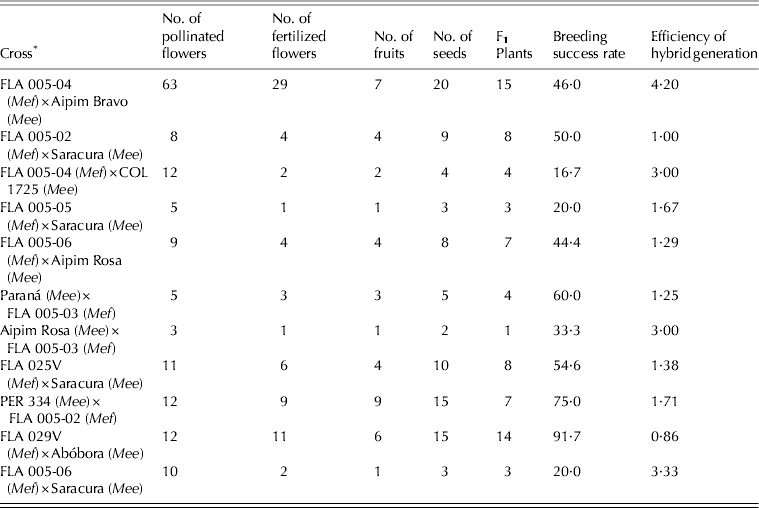
One hundred and fifty-eight crosses were performed between seven varieties of the subspecies M. esculenta ssp. flabellifolia and nine varieties of the subspecies M. esculenta spp. esculenta (Table 1). These varieties were chosen because they flower abundantly. The crosses were carried out at Embrapa Cassava and Fruit, (Embrapa Mandioca e Fruticultura) Cruz das Almas, Brazil (12°48′S and 39°06′W, 220 m asl). Entries were planted as single rows with spacing of 2·0 × 2·0 m between plots and plants. The crosses were performed during the hottest period of the day (from 12:00 to 14:00 h), when the pistillate flower opens and stigmas are most receptive. Before and after crossing, pistillate flowers were covered with fabric bags to avoid contamination with exogenous pollen. The same fabric bags that were used for pollination were left in the field to gather the fruits that burst at maturity. After c. 60 days, the seeds obtained from the crosses were identified and germinated to generate the hybrid plants.
Crosses performed and the number of interspecific hybrids obtained from crosses between M. esculenta ssp. esculenta and M. esculenta ssp. flabellifolia

* Mef: Manihot esculenta ssp. flabellifolia; Mee: Manihot esculenta ssp. esculenta.
The M. esculenta ssp. flabellifolia genotypes FLA005, FLA025V and FLA029V were donated by Embrapa Genetic Resources and Biotechnology (Embrapa Recursos Genéticos e Biotecnologia); FLA005-02, FLA005-03, FLA005-04, FLA005-05 and FLA005-06 plants were generated using seeds from the FLA005 accession by open pollination among unrelated individuals. The other varieties of M. esculenta spp. esculenta (COL 1725, Paraná, PER334, Aipim Bravo, Abóbora, Aipim Rosa e Saracura) were obtained from the Active Germplasm Bank of Embrapa Cassava and Fruit (Banco Ativo de Germoplasma da Embrapa Mandioca e Fruticultura – BAG-Mandioca, Cruz das Almas, Brazil).
DNA extraction
Young cassava leaves were harvested and stored long-term at −80 °C. Genomic DNA was extracted based on the procedure described by Ferreira & Grattapaglia (Reference Ferreira and Grattapaglia1998). DNA quantification was carried out on an agarose gel (1·0% w/v) by comparing the fluorescent intensity of the sample stained with ethidium bromide (1·0 mg/ml), relative to a dilution series of Lambda DNA (Invitrogen, Carlsbad, CA, USA) as a standard of known concentration.
Microsatellite amplification
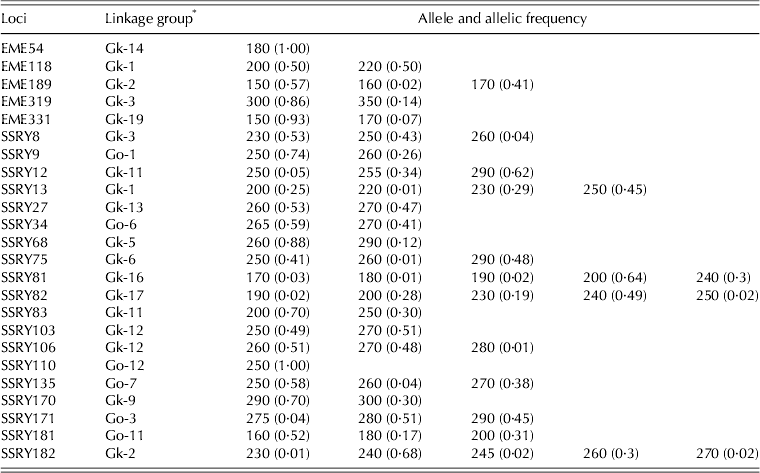
Twenty-four microsatellite markers that are distributed along the cassava link groups according to genetic maps of the culture were used in DNA amplification (Okogbenin et al. Reference Okogbenin, Marin and Fregene2006; Kunkeaw et al. Reference Kunkeaw, Yoocha, Sraphet, Boonchanawiwat, Boonseng, Lightfoot, Triwitayakorn and Tangphatsornruang2011) (Table 2). The reactions were performed in a total volume of 15 μl containing 10 ng of genomic DNA, 1 × buffer, 2·5–3·0 mM of MgCl2, 0·2 mM of dNTPs, 0·2 μM of each primer and 1 unit of Taq DNA polymerase enzyme.
Microsatellite loci used for the characterization of parents and interspecific hybrids between M. esculenta ssp. esculenta and M. esculenta ssp. flabellifolia, as well as the size (bp) and allelic frequency observed (in parenthesis)
* Gk and Go: location in the linkage maps according to Kunkeaw et al. (Reference Kunkeaw, Yoocha, Sraphet, Boonchanawiwat, Boonseng, Lightfoot, Triwitayakorn and Tangphatsornruang2011) and Okogbenin et al. (Reference Okogbenin, Marin and Fregene2006), respectively.
Polymerase chain reaction (PCR) cycling consisted of 94 °C for 5 min, followed by 30 cycles of 94 °C for 1 min (annealing temperature according to each SSR primer) for 1 min and 72 °C for 2 min, with a final extension at 72 °C for 5 min, on a PTC-100 thermal cycler (MJ Research, Inc., Watertown, MA, USA). After cycling, fragments were electrophoresed on a 3% agarose 1000 gel (Invitrogen, Carlsbad, CA, USA) at 0·45 Volts/mm, considering the reduction of labour compared with polyacrylamide gel and the good resolution of DNA fragments as small as 10 base pairs (bp) in size. The 50-bp ladder (New England Biolabs, Inc., Beverly, MA, USA) was used as a molecular weight standard to estimate the size of microsatellite alleles.
Data analysis
Based on estimates of allele frequencies of the microsatellites in the cassava genotypes (parents and hybrids), the following information was obtained: (1) observed heterozygosity (Ho), which was calculated directly from the sample genotype frequencies; (2) polymorphic information content (PIC), which was collected according to Botstein et al. (Reference Botstein, White, Skolnick and Davis1980),  $PIC = 1 - \left( {\sum\nolimits_{i = 1}^k {\,p_i^2}} \right) - \sum\nolimits_{i = 1}^{k - 1} {\sum\nolimits_{\,j = i + 1}^k {2p_i^2 p_j^2}} $, where k is the number of alleles and p i and p j are the frequencies of alleles i and j, respectively; (3) frequency of null alleles at each locus (r), which was collected according to Brookfield (Reference Brookfield1996) using the estimator r = (He−Ho)/(1+He); (4) probability of exclusion (PE), which refers to the probability of excluding false paternity and is calculated by locus (Q L) according to
 $\scale 96%{Q_L\! =\! \sum\nolimits_i {\,p_i} (1 - p_i )^2 \!- \!1/2\sum\nolimits_i {\sum\nolimits_{\,j \ne i} {\,p_i^2}} p_j^2 (4 - 3p_i - 3p_j )$, which is generalized for all loci such as Q = 1 − ПL(1−Q L), where p i and p j are the allelic frequencies of i and j in the population, and Q is the probability that at least one locus in the system permits the exclusion of one of the probable parents; and (5) the probability of identity (PI), which is the probability that two randomly selected individuals in the population have an identical genotype (Paetkau et al. Reference Paetkau, Waits, Clarkson, Craighead, Vyse, Ward and Strobeck1998),
 $PI = \displaystyle{{n3(2a_2^2 - a_4 ) - 2n^2 (a_3 + 2a_2 ) + n(9a_2 + 2) - 6} \over {(n - 1)(n - 2)(n - 3)}}$, where n is the number of samples, a i is given and
 $\sum\nolimits_j {\,p_j^i} $, where p j is the frequency of the jth allele calculated per locus multiplied by all loci.
Likelihood ratios (LR) of putative parents v. alternative parents (AP) considering the observed allele frequencies (OAFs) were calculated from the microsatellite genotypes. The likelihood of the female parent alleles having the putative parents was estimated for the identification of the parents of an unknown individual, according to Bowers & Meredith (Reference Bowers and Meredith1997).
Discriminant analysis of principal components (DAPCs)
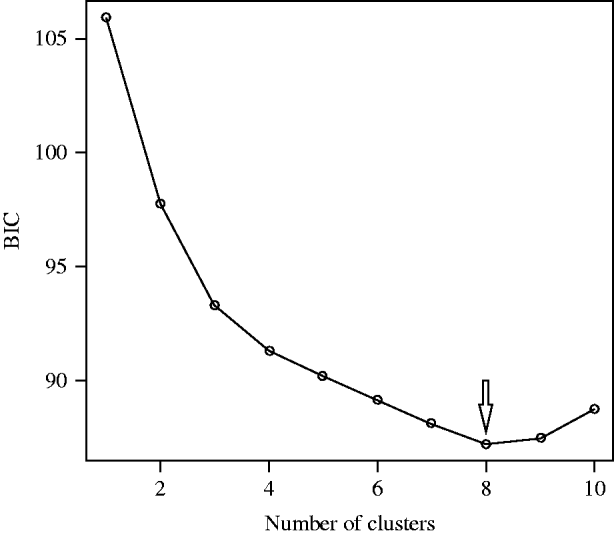
DAPCs, which are available in the package adegenet for R version 2.11 (R Development Core Team 2010), was used to define groups of hybrids and parents of cassava because this technique does not require an a priori definition of genetic groups (Jombart et al. Reference Jombart, Devillard and Balloux2010). Successive K-means clustering and Bayesian information criterion (BIC) were used to determine the number of groups in which the K with the lowest BIC value represented the number of groups that were most likely for the data set being analysed. However, in the presence of genetic clines (a particular type of continuous variation) or hierarchical structure, the BIC values may decrease after the true K value is identified. Thus, the reduction of BIC values was visually analysed to identify the value of K for which the BIC values were only slightly reduced (Jombart et al. Reference Jombart, Devillard and Balloux2010). K values from 1 to 10 were tested with 10 runs for each K. After the number of groups was defined, the principal component analysis (PCA) axes were retained and explained more than 90% of the total data variance.
RESULTS
Crossability between M. esculenta ssp. esculenta and M. esculenta ssp. flabellifolia
A large discrepancy in the number of pollinated flowers, which ranged from 3 (Aipim Rosa × FLA005-03) to 63 (FLA005-04 × Aipim Bravo) was observed because of differences in flowering synchrony between the two species. In the majority of crosses, the species M. esculenta ssp. flabellifolia was used as the pollen receptor. However, in three crosses (Paraná × FLA005-03, PER334 × FLA005-0 and Aipim Rosa × FLA005-03), the M. esculenta ssp. flabellifolia was used as the pollen donor because the flowering was not synchronized with varieties of M. esculenta (Table 1).
The breeding success rate (% of fertilized flowers v. pollinated flowers) varied from 16·7% (FLA005-04 × COL 1725) to 91·7% (FLA 029V × Abóbora) and averaged 46·5%. However, the efficiency of generating hybrid plants (number of F1 plants v. number of pollinated flowers) between M. esculenta ssp. esculenta and M. esculenta ssp. flabellifolia varied from 0·86 (FLA029V × Abóbora) to 4·2 (FLA005-04 × Aipim Bravo) pollinated flowers for each generated plant. On average, two pollinations were necessary for each of the hybrid plants that were generated (Table 1).
Microsatellite information
An imbalance was observed in the distribution of allele frequencies for most microsatellite loci, except for SSRY103, SSRY27, SSRY181 and SSRY34 (Table 2). Many rare alleles were derived from both M. esculenta ssp. esculenta and M. esculenta ssp. flabellifolia (data not shown).
Most of the evaluated microsatellite loci demonstrated polymorphism between the available parents and hybrids, except for the loci SSRY110, SSRY54 and EME118, which were eliminated from the paternity analysis. Thus, the number of alleles varied from 2 (SSRY103, SSRY170, SSRY27, SSRY68, EME 331, EME 319, SSRY83 and SSRY9) to 5 (SSRY81, SSRY82 and SSRY182), with an average of 2·7 alleles per locus (Table 2).
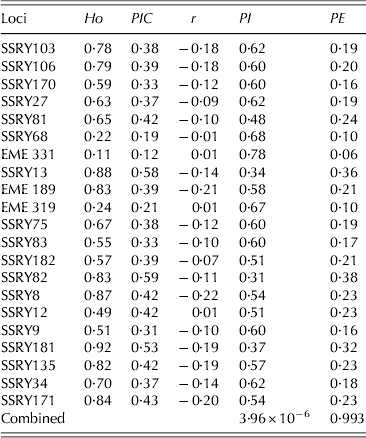
Ho varied from 0·11 (EME331) to 0·92 (SSRY181), and the information content per locus (PIC) varied from 0·12 (EME331) to 0·59 (SSRY82) with an average of 0·38 (Table 3). Ho was greater than expected for 17 of the 21 loci that were analysed (Table 3). This excess of homozygous loci may have been caused by the fixation of heterozygous plants through vegetative propagation. In contrast, Ho was lower than expected for loci SSRY12 and EME 331.
Ho, PIC, frequency of null alleles (r), PE and PI obtained by microsatellite analyses in interspecific hybrids of cassava
Kinship analysis
The uneven distribution of allele frequencies was accompanied by a high probability of obtaining identical profiles for the majority of the loci (PI > 0·51), where the number of alleles varied from 3 to 5 (Table 2). The high PI (0·51) of locus SSRY182, even with the five alleles of the analysed genotypes, is due to an uneven distribution of the allele frequency (Table 2). However, the loci with lower PIs (SSRY82, SSRY13, SSRY181 and SSRY81) tended to present the highest number of alleles (three to five) and had a distribution of allele frequency in higher number of classes. Observations of the PI values indicate that loci SSRY82, SSRY13 and SSRY181 are the most informative and that EME 319, SSRY68 and EME331 are the least informative alleles for paternity analyses. The PE varied from 0·06 (EME331) to 0·38 (SSRY82) and averaged 0·21. However, the combined PE for the 21 SSR loci was 0·99, which is sufficient to determine the paternity of interspecific hybrids of cassava with good discriminatory power (Table 3).
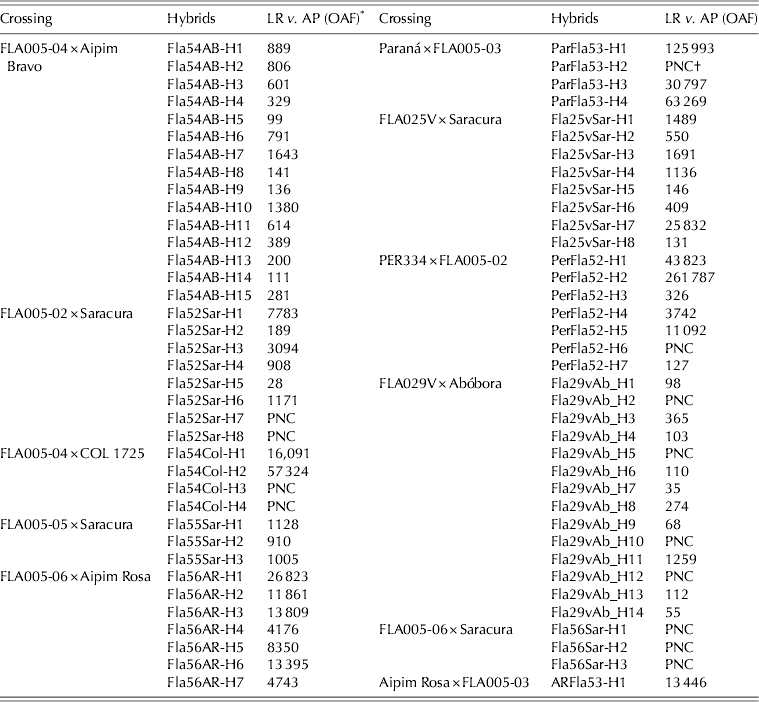
Of the 74 evaluated hybrids, 0·82 had their paternity confirmed using microsatellite markers (Table 4). In 0·11 of the cases, maternity was confirmed but not paternity. The opposite (i.e. paternity confirmed but not maternity) was not observed in the present study. No hybrid that resulted from the cross between FLA005-06 and Saracura was confirmed as a progeny of the cross.
Parentage analysis of interspecific hybrids between M. esculenta ssp. esculenta and M. esculenta ssp. flabellifolia
* LR v. AP (OAF): cumulative product of 21 SSRs loci of the LR of parent 1 × 2, in each crossing, v. AP (OAF).
† PNC: parentage not confirmed.
Other crosses produced four (FLA029V × Abóbora), two (FLA005-02 × Saracura and FLA005-04 × COL 1725) and one (Paraná × FLA005-03 and PER334 × FLA005-02) hybrid with unidentified paternity (Table 4).
Images resulting from the electrophoretic run showed the presence of marks that did not belong to any of the parents, which indicates that these individuals were not produced from their respective crosses.
Grouping of genotypes
Twenty principal components were kept in the analysis during the preliminary stage of data processing, which altogether explained > 90% of the total genetic variation. Figure 1 shows the presence of a hierarchical structure in the genotypes and illustrates the process of selecting the optimal number of groups. In the K-means clustering, the sharpest initial fall, according to the BIC, was when K = 8 (Fig. 1).
Number of clusters as a function of the BIC values. The inflection point shows the optimal number of clusters in this set of parent and hybrids of cassava that were determined by analysis of 21 microsatellite loci.
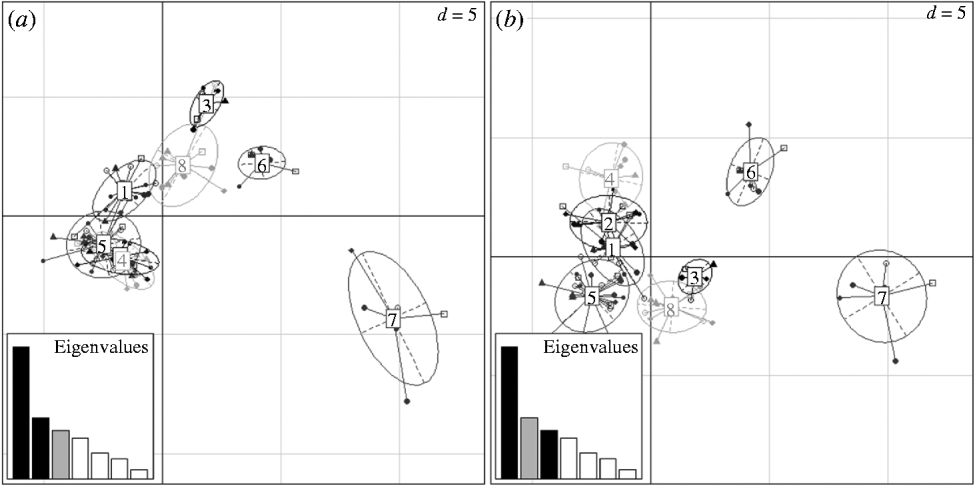
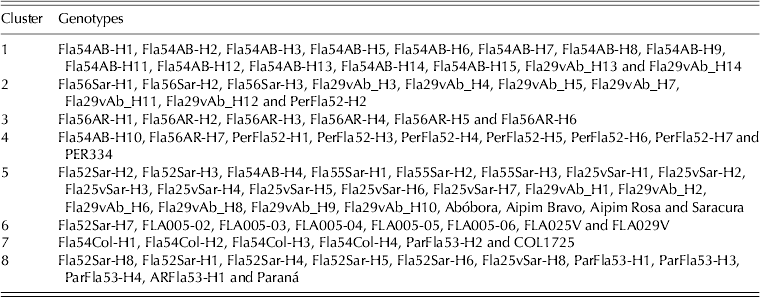
Visual analysis of the scatter plots from the first principal components of the DAPC indicates the presence of eight genetically related clusters (Fig. 2 and Table 5). Figure 2 shows the parents and hybrids of the cassava analysed in the present study using the three main axes of the PCA. The two first principal components (Fig. 2a) demonstrate a greater separation of clusters 1, 3, 6, 7 and 8, while clusters 2, 4 and 5 were not clearly differentiated. Clusters 2, 4 and 5 were formed by the parent species Saracura, Abóbora, PER334 and Aipim Bravo and by their hybrid derivatives (Table 5). Additionally, analysis of the first and third principal components (Fig. 2b) shows further differentiation of clusters 2, 4 and 5, which is probably due to the potential identification of linear combinations of alleles in other loci of microsatellites that are more polymorphic and found in these genotypes. Generally, the species M. esculenta ssp. flabellifolia was grouped into a single cluster (eight) with hybrid Fla52Sar-H7. The parents of M. esculenta were grouped into the following four clusters: PER334 (Cluster 4); Abóbora, Aipim Bravo, Aipim Rosa and Saracura (Cluster 5); COL 1725 (Cluster 7); and Paraná (Cluster 8).
Representation of genetic relatedness between progenitors and hybrids among M. esculenta ssp. esculenta v. M. esculenta ssp. flabellifolia obtained by DAPC. Scatterplots show (a) the first two and (b) the first and third principal components of the DAPC. Points represent genotypes of progenitors and cassava hybrids are labelled inside their 95% inertia ellipse. Labels from 1 to 8, according to Table 5.
Clusters carried out by DAPC
Cluster 1 consisted of 15 hybrids from the crosses between FLA 005-04 × Aipim Bravo and FLA 029V × Abóbora. However, Cluster 2 contained 10 hybrids from the following three crosses: FLA 005-06 × Saracura, FLA 029V × Abóbora and PER 334 × FLA 005-02. Six other hybrids from the cross between FLA 005-06 × Aipim Rosa were assigned to Cluster 3. The first three clusters were formed by hybrids that were relatively more diverse than the parents.
In Cluster 4, in addition to the parent PER334, six hybrids from the cross between this parent and FLA005-02 and two hybrids resulting from the cross between FLA005-04 × Aipim Bravo and FLA005-06 × Aipim Rosa were observed. The largest group (Cluster 5) comprised four parents of M. esculenta ssp. esculenta and two other hybrids of FLA005-02 × Saracura, one hybrid of FLA005-04 × Aipim Bravo, three hybrids of FLA005-05 × Saracura, seven hybrids of FLA025V × Saracura and six hybrids of FLA029V × Abóbora. In this cluster, the hybrids tended to display a molecular pattern that was closer to the parents of M. esculenta ssp. esculenta.
Cluster 7 contained four hybrids of FLA005-04 × COL 1725 and one hybrid between Paraná and FLA005-03 and the parent COL 1725. The last group (Cluster 8) contained five hybrids of FLA005-02 × Saracura, one hybrid of FLA025V × Saracura, three hybrids of Paraná × FLA005-03, and one hybrid of Aipim Rosa × FLA005-03 and the variety Paraná.
DISCUSSION
Analysis of interspecific crosses
Some authors have remarked that conventional breeding of cassava is an ineffective means of generating the technological solutions required for crop improvement to meet the needs of small farmers and commercial production in the tropics (Jennings & Iglesias Reference Jennings, Iglesias, Hillocks, Thresh and Bellotti2002; Kawano Reference Kawano2003). Therefore, breeders have recently become interested in genes that are present in the wild relatives to increase the variation of some traits of agronomic importance to cassava, such as resistance to pests and diseases, protein and dry matter content, and tolerance to cold temperatures, drought and PPD. However, according to Nassar (Reference Nassar2003a) and Akinbo et al. (Reference Akinbo, Labuschagne and Fregene2010), the resulting infertile cassava from crosses between wild relatives and cassava is a limiting factor for extensive use of this breeding strategy.
Interspecific hybrids of cassava with M. glaziovii, Manihot neusana and Manihot anomala were obtained by Nassar (Reference Nassar1989, Reference Nassar1995) by means of controlled crosses, albeit with a low success rate. Recently, Nassar et al. (Reference Nassar, Bomfim, Chaib, Abreu and Gomes2010) evaluated the compatibility of the species Manihot pilosa, M. glaziovii, Manihot reptans and Manihot cearulescens in crosses with M. esculenta. The results demonstrated that compatibility, even at a low level, between M. esculenta ssp. esculenta v. M. pilosa and M. glaziovii resulted in the creation of 2 and 1·5% interspecific hybrids, respectively. These observations demonstrate that the compatibility barriers between cassava and some wild species of Manihot evolved recently and can be broken.
Akinbo et al. (Reference Akinbo, Labuschagne and Fregene2010) recommended that embryo rescue be used to generate interspecific hybrids of cassava because it can reduce the dormancy and viability of the seeds efficiently. However, although the number of seeds obtained in the present study was reduced to allow for more precise estimation of the germination rate of the hybrids, variations of 47% (PER 334 × FLA005-02) to 100% (FLA005-04 × COL 1725, FLA005-05 × Saracura, and FLA005-06 × Saracura) were observed, with an average germination rate of 81%, without the need for the implementation of treatments to break dormancy.
Additionally, to confirm the genetic origin of plants from controlled crosses, it is important to ensure that this method, along with additional methods, can be employed successfully for the production of hybrid seeds. Morphological descriptions of the leaf lobe, the presence of stem nodes, flower disc colour, and fruit shape and colour are used to identify interspecific hybrids in controlled crosses between cassava and wild Manihot, such as M. glaziovii, Manihot pseudoglaziovii, Manihot aesculifolia, M. pilosa, Manihot dichotoma, Manihot pohlii, M. neusana and M. anomala (Nassar Reference Nassar2007).
Morphological traits, such as germination type, can be used to identify the hybrids from crosses between M. esculenta and M. esculenta ssp. flabellifolia. M. esculenta ssp. flabellifolia seedlings are generated through hypogeal germination and the cotyledons serve as a body of reserves for early seedling development, while seed germination of M. esculenta ssp. esculenta is epigeal, and the cotyledons are foliaceous and photosynthetic (Pujol et al. Reference Pujol, Muhlen, Garwood, Horoszowski, Douzery and Mckey2005). However, this morphological trait is of no use for identifying hybrid genotypes, since they may have either germination type. Thus, molecular tools may be used to overcome these difficulties and to identify true hybrids rapidly.
Efficiency of SSR markers
The number of alleles observed in the present study, ranging from 2 to 5 with an average of 2·7 alleles per locus, is considered low because of the genetic nature of the evaluated genotypes, which were generated from biparental crosses between a few genotypes. Raji et al. (Reference Raji, Anderson., Kolade, Ugwu, Dixon and Ingelberecht2009) observed that the number of alleles per locus varied from 2 to 10 with an average of 4·55 per locus while evaluating a set of 20 SSR expressed sequence tags (ESTs) in 40 varieties of M. esculenta ssp. esculenta, two interspecific hybrids of M. esculenta ssp. esculenta v. M. tristis, and four species of Manihot. However, analysis of microsatellites arranged in non-genic regions revealed a much larger number, with averages ranging from 8·6 (Guo et al. Reference Guo, Wang, Zhou and Zhang2006) to 9·0 alleles per locus (Fregene et al. Reference Fregene, Suárez, Mkumbira, Kulembeka, Ndedya, Kulaya, Mitchel, Gullberg, Rosling, Dixon, Dean and Kresovich2003).
The low number of alleles was reflected in the PIC values, which ranged from 0·12 to 0·59, with an average of 0·38. Even using SSRs derived from ESTs, which naturally have lower polymorphism compared with genomic SSRs, the average PIC values observed in the work of Raji et al. (Reference Raji, Anderson., Kolade, Ugwu, Dixon and Ingelberecht2009) were well above the values observed in the present study (0·55), presumably due to the analysis of several genotypes with high genetic diversity.
For most loci (0·85), the PIC estimates are below 0·50, which are considered uninformative according to Botstein et al. (Reference Botstein, White, Skolnick and Davis1980). Only the loci SSRY181, SSRY13 and SSRY82 had PIC values above 0·50. This can be explained by evaluating genetic material with a narrow genetic base. Only 11 different parent backgrounds (Aipim Bravo, Abóbora, COL 1725, Paraná, PER 334, Aipim Rosa, Saracura, FLA025V, FLA029V and FLA005 progeny) were used in the crosses. This can be confirmed by the analysis of a germplasm set with a broad genetic base, in which the loci SSRY103, SSRY182, SSRY9 and SSRY181 display a higher number of alleles and Ho (Asare et al. Reference Asare, Galyuon, Sarfo and Tetteh2011) when compared with the present study.
A probability value of complete identity of 3·96 × 10−6 guarantees that the individual identity of each cassava hybrid, which is the probability of two genotypes being the same by chance, is 1 in 252 000. Thus, even though the probability reported in the present study is lower than the value observed by Torres-Dini et al. (Reference Torres-Dini, Bennadji, Cabrera, Centurion, Resquin and Balmelli2011) while evaluating Eucalyptus clones using microsatellite markers for certification, in which the PI for all loci was 5·43 × 10−9 and the probability of two individuals being the same by chance was 1 in 184 000 000, a high resolution power was observed in the present study and the paternity of the cassava hybrids were determined effectively.
Confirmation of kinship
Regarding the paternity confirmation of the hybrids with microsatellite markers, the paternity of the presumed parents involved in the cross was not confirmed in 0·55 of the crosses (6 in 11 progeny). In all progenies, a higher number of hybrids were observed with confirmed maternal origin when compared with paternal origin. Only in the cross between Paraná × FLA005-03 was the paternity of the ParFla53-H2 hybrid of both the paternal and maternal parents not confirmed. The exchange of seeds at harvest or handling during drying and storage may explain why paternity was not confirmed. However, in most of these situations, it was not possible to determine the paternity of the male parent, which suggests contamination by exogenous pollen during the handling of the crosses or a failure in identification at the time of seed collection and planting.
According to Nassar (Reference Nassar2010) and Nassar et al. (Reference Nassar, Bomfim, Chaib, Abreu and Gomes2010), small insects of the Coleoptera order can carry large amounts of pollen from flowers of one plant to another and therefore play an important role in creating crosses between cassava varieties. This means that a large number of exogenous gametes are transferred to the female flower, similar to manual crosses. Díaz et al. (Reference Díaz, De La Rosa, Rallo, Muñoz-Díez, Trujillo, Barranco, Martìn and Belaj2007) also observed pollination by exogenous pollen carried by insects in olive trees; the exogenous pollen were allowed through the two types of pollination bags used (plastic and Tyvek).
An identical genotype to the female parent of the Fla52Sar-H7 hybrid (FLA005-02) was observed in the present study, which indicates that apomictic seeds exist in the M. esculenta spp. flabellifolia. In cassava, apomixis is an interesting alternative that can be used for full propagation of a genotype by seeds instead of using manioc cuttings, which can easily be contaminated with pathogens. However, this phenomenon is highly dependent on the species and evaluated genotype and is not predictable because of variations in environmental conditions. Facultative apomixis was discovered in the wild species M. dichotoma, M. neusana and M. glaziovii (Nassar Reference Nassar1985; Reference Nassar2003b). However, apomixes are undesirable when specifically trying to generate inter-specific hybrids.
In allogamous species, the possibility of exogenous crosses is high due to the efficient pollination by wind or pollinating insects that fly long distances. In the case of cassava, paternity was not confirmed in 0·18 of the cases using microsatellite analysis, which suggests that culture pollinators brought exogenous pollen to the controlled crosses. Even with the care taken while performing controlled crosses, it appears that the fabric bags used to protect flowers can be penetrated by small insects and can introduce unwanted fertilization.
Paternity analysis using microsatellite markers is one of the more reliable applications of molecular markers and the present results confirm this, since the paternity exclusion (PE) for the 21 loci was very high (0·993). Moreover, at this stage (F1 hybrids) there is no other kind of analysis more reliable than those using information directly from the parental DNA. However, the origin of the unidentified alleles from hybrids with unconfirmed paternity cannot be determined. Therefore, these hybrids may be used in subsequent generations, but with pedigree not fully known, being treated as half-sib progeny in which one does not know the male parents.
Grattapaglia et al. (Reference Grattapaglia, Ribeiro and Rezende2004) demonstrated that 0·29 of Eucalyptus offspring analysed by paternity testing using SSRs were derived from crosses between parents that did not belong to the block of crosses. In addition, a lower proportion (0·14) of crosses from the pollen of plants from outside of the seed orchard was observed in Eucalyptus when isoenzymes were used as marker loci (Campinhos et al. Reference Campinhos, Peters-Robinson, Bertolucci and Alfenas1998).
The findings reported in the present study indicate that apomictic seeds may appear in the development of interspecific hybrids between M. esculenta ssp. esculenta and M. esculenta ssp. flabellifolia. These seeds should be eliminated in subsequent breeding steps because they are not a new genotype. Furthermore, the use of microsatellites allowed for efficient verification of the parent genotypes. In addition, microsatellites can be used for the verification of parent genotypes during any step of the process, ranging from seeds to adult plants. This is a competitive advantage for breeding programmes because it allows the elimination of apomictic plants or plants that do not belong to the determined cross because they can be detected at the beginning of breeding.
Grouping of hybrids
DAPC was used to investigate the distribution pattern of molecular polymorphism in parents and hybrids of cassava. The maintenance of 20 principal components enabled the model to explain > 90% of the total genetic variation. The definition of the number of PCs that should be retained in the analysis is a point of discussion that may reduce the power in dimensionality of the data. Many studies suggest the use of components that retain > 80% of genetic variance. In the context of the DAPC, it is necessary to define a balance between discriminatory power and the stability of the genotype attributions in each cluster. Thus, the analysis of 20 PCs ensures sufficient statistical power to assess the genetic structure of cassava genotypes.
Eight clusters were selected to represent genetic variation of the hybrids and parents of cassava based on the BIC. According to Jombart et al. (Reference Jombart, Devillard and Balloux2010), the type of population structure influences the accuracy of the method with respect to defining the number of clusters. Inferences in structured populations in the island model are more accurate than in continuous populations, which appears to be the case for the parents and hybrids of cassava. However, even when the real K is not identified, the number of inferred groups is generally very close to the true value.
According to Jombart et al. (Reference Jombart, Devillard and Balloux2010), DAPC may be useful for a wide variety of organisms independently of ploidy and the rate of genetic recombination because the methodology is independent of any type of population genetics and therefore free of assumptions about the Hardy–Weinberg equilibrium (HWE) or linkage disequilibrium. Even in relation to the Bayesian grouping approaches, the DAPC has the advantage of allowing the generation of a graphical representation of the kinship between the formed groups.
Prospects for cassava breeding programmes
Although the use of wild species for breeding has been performed to enhance traits that are not present or are present with low variability in the gene pool of M. esculenta ssp. esculenta, the cross between improved varieties of cassava with wild relatives also promotes the introduction of undesirable genes, such as those related to lower harvest indices and lower root yields (Ojulong et al. Reference Ojulong, Labuschangne, Herselman and Fregene2008). However, the negative and low magnitude correlation between resistance to whitefly v. root yield (−0·06) and dry matter content (−0·08) (Akinbo et al. Reference Akinbo, Labuschagne and Fregene2010) in the RC1 progenies have demonstrated that it is possible to introduce genes for pest resistance from M. esculenta ssp. flabellifolia without causing losses in root yield, dry matter and harvest index.
In hybridizations with M. esculenta ssp. flabellifolia, Akinbo et al. (Reference Akinbo, Labuschagne and Fregene2012) identified promising F1 hybrids of cassava with increased protein content (>112·5 mg/g) and dry matter (>550 g/kg). Thus, although the results of studies aimed at obtaining interspecific hybrids of cassava are relatively scarce and even contradictory, this strategy has good potential for application and use to improve cassava. In addition, undesirable correlations between the traits with agronomic importance can be overcome by the use of backcrosses with the recurrent parent to optimize the use of wild relatives of the cassava for culture improvement.
The authors thank Generation Challenge Programme (GCP) and Brazilian Agricultural Research Corporation (Empresa Brasileira de Pesquisa Agropecuária – Embrapa) for financial support (Grants GCP G305.09 and 02.06.01.007.00). The authors gratefully acknowledged support through fellowship to L.J.V. and L.F.Q.T.F. from Coordination for the Improvement of Higher Education Personnel (Coordenação de Aperfeiçoamento de Pessoal de Nível Superior – CAPES), to Fundação de Amparo à Pesquisa da Bahia – FAPESB) and to Conselho Nacional de Desenvolvimento Científico e Tecnológico – CNPq).