



1 Introduction
1.1 The main results
In this paper, we propose a new geometric model for the centre of small quantum groups. It is given by the cohomology of certain affine Spaltenstein varieties. The main results of the paper are the following.
Let
${\check G}$
 be a quasi-simple, connected, simply connected algebraic group. Fix
$\zeta \in \mathbb {C}$
 to be a root of unity of order
$\ell $
 . We assume that
$\ell $
 is odd, greater than the Coxeter number and coprime to the determinant of the Cartan matrix of
${\check G}$
 . Let
$\mathrm {u}_\zeta $
 be the small quantum group. It is a finite-dimensional subalgebra of the Lusztig quantum group
$\mathrm {U}_\zeta $
 . We denote by
$Z(\mathrm {u}_\zeta )$
 the centre of
$\mathrm {u}_\zeta $
 . The adjoint action of
$\mathrm {U}_\zeta $
 on itself preserves
$Z(\mathrm {u}_\zeta )$
 . It factorizes through the quantum Frobenius map and yields an action of
${\check G}$
 on
$Z(\mathrm {u}_\zeta )$
 . The study of the centre
$Z(\mathrm {u}_\zeta )$
 as well as the subspace of
${\check G}$
 -invariant elements in it has captured a lot of attention recently; see, e.g., [Reference Lachowska and Qi30], [Reference Lachowska and Qi31].
To study the centre, we consider several module categories related to
$\mathrm {u}_\zeta $
 . Let
${\check {\Lambda }}$
 be the weight lattice for
${\check G}$
 . Let
$\mathrm {u}_\zeta \text{-}\mathrm {mod}^{\check {\Lambda }}$
 be the category of finite-dimensional
$\mathrm {u}_\zeta $
 -modules equipped with a
${\check {\Lambda }}$
 -graded structure that is compatible with the
${\check T}$
 -action on
$\mathrm {u}_\zeta $
 . It admits a deformation, studied in [Reference Andersen, Jantzen and Soergel1], which we now describe. Let
$\mathfrak {U}_\zeta $
 be the De Concini-Kac quantum group. The centre of
$\mathfrak {U}_\zeta $
 contains the ring of regular functions
$\mathbb {C}[{\check G}^*]$
 on the Poisson dual group
${\check G}^*$
 of
${\check G}$
 and the specialization of
$\mathfrak {U}_\zeta $
 at
$1\in {\check G}^*$
 is the small quantum group
$\mathrm {u}_\zeta $
 by [Reference De Concini and Kac19], [Reference De Concini, Kac and Procesi20]. Hence, the algebra
$\mathfrak {U}_{\zeta }^t=\mathfrak {U}_\zeta \otimes _{\mathbb {C}[{\check G}^*]} \mathbb {C}[{\check T}]$
 is a deformation of
$\mathrm {u}_\zeta $
 .
Let S be the completion of
$\mathbb {C}[{\check T}]$
 at
$1\in {\check T}$
 . Andersen-Jantzen-Soergel introduced in [Reference Andersen, Jantzen and Soergel1] the category
$\mathfrak {U}^t_\zeta \text{-}\mathrm {mod}^{\check {\Lambda }}_S$
 of
${\check {\Lambda }}$
 -graded
$\mathfrak {U}_{\zeta }^t$
 -modules over S, which can be viewed as a deformation of
$\mathrm {u}_\zeta \text{-}\mathrm {mod}^{\check {\Lambda }}$
 . The category
$\mathfrak {U}^t_\zeta \text{-}\mathrm {mod}^{\check {\Lambda }}_S$
 of
${\check {\Lambda }}$
 -graded
$\mathfrak {U}_{\zeta }^t$
 -modules over S is a deformation of
$\mathrm {u}_\zeta \text{-}\mathrm {mod}^{\check {\Lambda }}$
 . We will study both the centres
$Z(\mathfrak {U}^t_\zeta \text{-}\mathrm {mod}^{\check {\Lambda }}_S)$
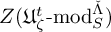 and
$Z(\mathrm {u}_\zeta \text{-}\mathrm {mod}^{\check {\Lambda }})$
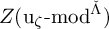 . They carry natural actions of the lattice
$\ell {\check {\Lambda }}$
 . There is a canonical isomorphism
$Z(\mathrm {u}_\zeta \text{-}\mathrm {mod}^{\check {\Lambda }})^{\ell {\check {\Lambda }}}=Z(\mathfrak {u}_\zeta )^{{\check T}}$
 .
Now, let us introduce the main objects on the geometric side. Let G be the Langlands dual group of
${\check G}$
 and let T be the dual torus of
${\check T}$
 . Let
${{\mathcal {G}}{\mathfrak {r}} }$
 be the affine Grassmannian of the group G. We consider the
$\mathbb {G}_m$
 -action on
${{\mathcal {G}}{\mathfrak {r}} }$
 by loop rotation. Let
${{\mathcal {G}}{\mathfrak {r}} }^\zeta $
 be the fixed-point locus of the cyclic subgroup
$\mu _\ell \subset \mathbb {G}_m$
 generated by
$\zeta $
 . Let
$\gamma _\ell =s\otimes t^\ell $
 , where s is a regular element in the Lie algebra of T. We consider the affine Spaltenstein variety
${}^0{{\mathcal {G}}{\mathfrak {r}} }^\zeta _{\gamma _\ell }$
 , which is the closed ind-subscheme of
${{\mathcal {G}}{\mathfrak {r}} }^\zeta $
 consisting of points x such that
$\gamma _\ell $
 belongs to the radical of the Lie algebra of the stabilizer of x in
$G(\mathbb {C}(\!(t)\!))$
 . Note that
${}^0{{\mathcal {G}}{\mathfrak {r}} }^\zeta _{\gamma _\ell }$
 is a disjoint union of the Spaltenstein subvarieties
${}^0\!{{\mathcal {F}}\ell }^{\omega }_{\ell ,\gamma _\ell }$
 of the partial affine flag manifold
${{\mathcal {F}}\ell }^{\omega }_{\ell }$
 for the loop group
$G(\mathbb {C}(\!(t^\ell )\!))$
 of type
$\omega $
 . The space
${}^0{{\mathcal {G}}{\mathfrak {r}} }^\zeta _{\gamma _\ell }$
 inherits a
$T(\!(t^\ell )\!)$
 -action coming from the left multiplication on
${{\mathcal {G}}{\mathfrak {r}} }$
 . The cohomology of
${}^0{{\mathcal {G}}{\mathfrak {r}} }^\zeta _{\gamma _\ell }$
 is T-equivariantly formal and satisfies the so-called GKM (Goresky–Kottwitz–MacPherson) condition. Thus the cohomology ring
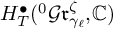
$H^{\bullet }_T({}^0{{\mathcal {G}}{\mathfrak {r}} }^\zeta _{\gamma _\ell },\mathbb {C})$
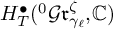 admits a combinatorial description, see Lemma 2.7. Further, let
$W_{\ell ,{\mathrm {ex}}}=W\ltimes \ell {\check {\Lambda }}$
 be the extended affine Weyl group and
$W_{\ell ,{\mathrm {af}}}=W\ltimes \ell {\check Q}$
 be the affine Weyl group. The space
$H^{\bullet }_T({}^0{{\mathcal {G}}{\mathfrak {r}} }^\zeta _{\gamma _\ell },\mathbb {C})$
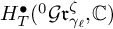 has a left
$W_{\ell ,{\mathrm {ex}}}$
 -action, with the action of the lattice
$\ell {\check {\Lambda }}$
 induced by the
$T(\!(t^\ell )\!)$
 -action and the action of the finite Weyl group W induced by some monodromy operators. For a component of
${}^0{{\mathcal {G}}{\mathfrak {r}} }^\zeta _{\gamma _\ell }$
 isomorphic to the affine flag variety
${{\mathcal {F}}\ell }_\ell $
 , the corresponding cohomology also has a right
$W_{\ell ,{\mathrm {af}}}$
 -action given by the Springer correspondence.
Recall that S is the completion of
$\mathbb {C}[{\check T}]$
 at
$1$
 . We identify it with the completion of
$H^{\bullet }_T(\mathrm {pt})$
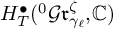
 with respect to the augmentation ideal. Let
$H^{\bullet }_T({}^0{{\mathcal {G}}{\mathfrak {r}} }^\zeta _{\gamma _\ell },\mathbb {C})_{\hat 0}$
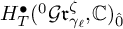 be the corresponding completion of
$H^{\bullet }_T({}^0{{\mathcal {G}}{\mathfrak {r}} }^\zeta _{\gamma _\ell },\mathbb {C})$
 . The first main result of our paper is the following.
Theorem A (Theorem 4.1)
-
(a) There is an S-algebra isomorphism $\mathbf {a}: H^{\bullet }_T({}^0{{\mathcal {G}}{\mathfrak {r}} }^\zeta _{\gamma _\ell },\mathbb {C})_{\hat 0}\overset {\sim }\to Z(\mathfrak {U}_\zeta ^t\text{-}\mathrm {mod}^{\check {\Lambda }}_S).$

-
(b) The isomorphism $\mathbf {a}$
specializes to an algebra embedding
$H^{\bullet }({}^0{{\mathcal {G}}{\mathfrak {r}} }^\zeta _{\gamma _\ell },\mathbb {C})\hookrightarrow Z(\mathrm {u}_\zeta \text{-}\mathrm {mod}^{\check {\Lambda }})$
, which restricts to an embedding
$H^{\bullet }({}^0{{\mathcal {G}}{\mathfrak {r}} }^\zeta _{\gamma _\ell },\mathbb {C})^{\ell {\check {\Lambda }}}\hookrightarrow Z(\mathrm {u}_\zeta )^{\check T}.$




The morphism
$\mathbf {a}$
 and its specialization are compatible with the direct sum decomposition of the cohomology according to the connected components of
$^0{{\mathcal {G}}{\mathfrak {r}} }^\zeta _{\gamma _\ell }$
 and the decomposition of
$Z(\mathrm {u}_\zeta \text{-}\mathrm {mod}^{\check {\Lambda }})$
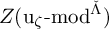 according to the blocks. Further, we conjecture that the embeddings in Theorem A are isomorphisms, see Conjecture 4.2.
Our second goal is to compare the isomorphism
$\mathbf {a}$
 with an algebra homomorphism from the cohomology of
${{\mathcal {G}}{\mathfrak {r}} }^\zeta $
 to the centre of
$\mathrm {U}_\zeta $
 . Indeed, we may identify the
${\check G}$
 -invariants in
$Z(\mathrm {u}_\zeta )$
 with the intersection
$Z(\mathrm {U}_\zeta )\cap \mathrm {u}_\zeta $
 , see (3.10). We have the following theorem.
Theorem B (Theorem 4.13)
-
(a) There is an algebra homomorphism $\mathbf {c}:H^{\bullet }({{\mathcal {G}}{\mathfrak {r}} }^\zeta ,\mathbb {C})\to Z(\mathrm {U}_\zeta ),$
whose image is contained in
$Z(\mathrm {u}_\zeta )^{\check G}$
. -
(b) There is a commutative diagram of algebra homomorphisms
The map $\mathbf {a}$
is W-equivariant. The morphisms are compatible with the block decompositions.


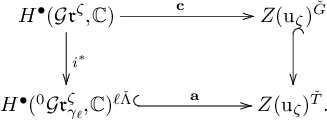

Note that the image of
$i^\ast $
 lands in the
$W_{\ell ,{\mathrm {ex}}}$
 -invariant part of
$H^{\bullet }({}^0{{\mathcal {G}}{\mathfrak {r}} }^\zeta _{\gamma _\ell },\mathbb {C})$
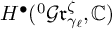 . In type A, we show that
$i^\ast $
 maps surjectively onto this part in Corollary 2.10. Thus, in this case, any element
$x\in H^{\bullet }({}^0{{\mathcal {G}}{\mathfrak {r}} }^\zeta _{\gamma _\ell },\mathbb {C})^{W_{\ell ,{\mathrm {ex}}}}$
 is of the form
$i^*(y)$
 for some
$y\in H^{\bullet }({{\mathcal {G}}{\mathfrak {r}} }^\zeta ,\mathbb {C})$
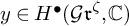 , hence
$\mathbf {a}(x)=\mathbf {c}(y)$
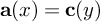 belongs to
$Z(\mathrm {u}_\zeta )^{\check G}$
 because the diagram commutes. In other words, there is an embedding

We propose the following conjecture (for arbitrary type), which is an extension of a previous conjecture of Bezrukavnikov-Qi-Shan-Vasserot for the principal block case in type A.
Conjecture A (Conjecture 4.2 and Conjecture 4.16)
The embedding
$\mathbf {a}:H^{\bullet }({}^0{{\mathcal {G}}{\mathfrak {r}} }^\zeta _{\gamma _\ell },\mathbb {C})\hookrightarrow Z(\mathrm {u}_\zeta \text{-}\mathrm {mod}^{\check {\Lambda }})$
 is an isomorphism. Moreover, it restricts to isomorphisms

In a forthcoming work [Reference Bezrukavnikov, Boixeda Alvarez, Shan and Vasserot9], we will prove the isomorphism
$H^{\bullet }({}^0{{\mathcal {G}}{\mathfrak {r}} }^\zeta _{\gamma _\ell },\mathbb {C})^{W_{\ell ,{\mathrm {ex}}}}\cong Z(\mathrm {u}_\zeta )^{\check G}$
 in type A. Our third main result is an explicit formula for the dimension of the left-hand side.
Theorem C (Theorem 2.12)
Denote by h the Coxeter number of G, by r its rank and by
$e_1,\dots ,e_r$
 the exponents of the Weyl group W. Then we have

In particular, if Conjecture A is true, this gives an explicit formula for the dimension of
$Z(\mathrm {u}_\zeta )^{\check G}$
 . In type A, this formula is compatible with the conjecture in [Reference Lachowska and Qi31], see Remark 2.13.
1.2 Ingredients of proofs
The proof of Theorem A uses some localization properties of the deformed S-linear category
$\mathfrak {U}^t_\zeta \text{-}\mathrm {mod}^{\check {\Lambda }}_S$
 introduced in [Reference Andersen, Jantzen and Soergel1]. By loc. cit., this category is generically semi-simple, and when localizing the deformation algebra S at height-one prime ideals generated by the root vectors, it is equivalent to the corresponding category for a rank-one subgroup of G. The centre in the rank-one case can be computed explicitly. The centre of the category
$\mathfrak {U}_\zeta ^t\text{-}\mathrm {mod}^{\check {\Lambda }}_S$
 is the intersection, inside the generic centre, of its localizations at height-one prime ideals. We obtain in this way a GKM-type description of the centre of
$\mathfrak {U}_\zeta ^t\text{-}\mathrm {mod}^{\check {\Lambda }}_S$
 , which matches the GKM-type description of the equivariant cohomology of
${}^0{{\mathcal {G}}{\mathfrak {r}} }^\zeta _{\gamma _\ell }$
 .
The proof of Theorem B consists of two parts. The first one is to construct the morphism
$\mathbf {c}$
 , and the second one is to show that
$\mathbf {c}$
 fits into the commutative diagram in the theorem. To do this, the deformation arguments in the proof of Theorem A cannot be applied, and we need new material.
The construction of
$\mathbf {c}$
 uses the quantum Harish-Chandra isomorphism. More precisely, we first give an algebraic description of the ring
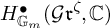
$H^{\bullet }_{\mathbb {G}_m}({{\mathcal {G}}{\mathfrak {r}} }^\zeta ,\mathbb {C})$
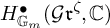 following [Reference Bezrukavnikov and Finkelberg10]. More precisely, for any closed subscheme Y inside an affine scheme X, let
$\mathbb {C}[\widetilde {N}_Y(X)]$
 be the Rees algebra associated with the ideal
$I_Y$
 , and let
$\mathbb {C}[N_Y(X)]$
 be its specialization at
$\hbar =0$
 , i.e., the function ring of the normal cone of Y inside X. We show that the ring
$H^{\bullet }_{\mathbb {G}_m}({{\mathcal {G}}{\mathfrak {r}} }^\zeta ,\mathbb {C})$
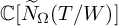
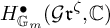 is isomorphic to
$\mathbb {C}[\widetilde {N}_\Omega (T/W)]$
 for a certain subscheme
$\Omega $
 inside
$T/W$
 , up to some completion. Similarly, we show that the Harish-Chandra homomorphism
$\mathbb {C}[{\check T}/W]\to Z(\mathrm {U}_{\hat \zeta })$
 to the centre of the Lusztig quantum group
$\mathrm {U}_{\hat \zeta }$
 completed at the parameter
$\zeta $
 extends to an algebra homomorphism
$\mathbb {C}[\widetilde {N}_\Omega (T/W)]\to Z(\mathrm {U}_{\hat \zeta })$
 . Then, specializing the parameter to
$\zeta $
 and analyzing the image of certain central elements introduced by Drinfeld, we show that this map produces a morphism
$\mathbb {C}[N_\Omega (T/W)]\to Z(\mathrm {u}_\zeta )^{\check G}$
 . Comparing with the presentation of the ring
$H^{\bullet }_{\mathbb {G}_m}({{\mathcal {G}}{\mathfrak {r}} }^\zeta ,\mathbb {C})$
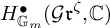 above, we get the map
$\mathbf {c}$
 . There is also a geometric approach to constructing
$\mathbf {c}$
 in the case of principal blocks, which is indicated in Appendix B.
The map
$\mathbf {a}$
 uses a deformation argument; the map
$\mathbf {c}$
 relies on the Harish-Chandra homomorphism and cannot be easily deformed. One needs a new ingredient to prove the commutativity of the diagram. Our proof uses a module category of a hybrid version of the quantum group at roots of unity, which provides a bridge between representations of Lusztig’s quantum group
$\mathrm {U}_\zeta $
 and the category
$\mathrm {u}_\zeta \text{-}\mathrm {mod}^{{\check {\Lambda }}}$
 . This hybrid quantum group first appeared in the work of Gaitsgory [Reference Gaitsgory21], with a view to extending the Kazhdan-Lusztig equivalence between perverse sheaves on
${{\mathcal {G}}{\mathfrak {r}} }$
 and representations of
$\mathrm {U}_\zeta $
 to a derived equivalence between perverse sheaves on
${{\mathcal {F}}\ell }$
 and the category
$\mathcal {O}$
 for the hybrid quantum group. We study some basic properties of this category, which allow us to compare the hybrid category
$\mathcal {O}$
 ,
$\mathrm {u}_\zeta \text{-}\mathrm {mod}^{{\check {\Lambda }}}$
 and
$\mathrm {rep}(\mathrm {U}_\zeta )$
 . Next, we give an algebra embedding
$\mathbf {b}: H^{\bullet }_T({{\mathcal {G}}{\mathfrak {r}} }^\zeta ,\mathbb {C})_{\hat 0}\to Z(\mathcal {O}^{{\mathrm {hb}}}_{\zeta ,S}).$
 Since both
$\mathbf {b}$
 and
$\mathbf {c}$
 are based on the Harish-Chandra homomorphism, we can compare them. In some sense, the category
$\mathcal {O}^{{\mathrm {hb}}}_{\zeta , S}$
 plays the role of a deformation of (an enlargement of) the category
$\mathrm {rep}(\mathrm {U}_\zeta )$
 . This fact allows us to make the link to the map
$\mathbf {a}$
 , which is also constructed by a deformation argument.
For Theorem C, we first obtain an upper bound for the dimension of
$H^{\bullet }({{\mathcal {F}}\ell }_\gamma ,\mathbb {C})^{W_{\mathrm {ex}}}$
 , where we abbreviate
$\gamma =\gamma _1$
 , which corresponds to the centre of a principal block, see Proposition 2.9. The inequality is an equality in type A. Using this upper bound, a theorem of Boixeda Alvarez and Losev yields an isomorphism of right W-modules
$H^{\bullet }({{\mathcal {F}}\ell }_\gamma ,\mathbb {C})^{W_{\mathrm {ex}}}=\mathbb {C}[{\check {\Lambda }}/(h+1){\check {\Lambda }}]$
 . Then, using a formula of Sommers, we compare
$H^{\bullet }({{\mathcal {F}}\ell }_\gamma ,\mathbb {C})^{W_{\mathrm {ex}}}$
 and the cohomology of an elliptic affine Springer fibre, as well as their parabolic versions involving affine Spaltenstein varieties to obtain the main result.
1.3 Plan of the paper
The plan of the paper is the following. In Section 2 we introduce the fixed-point set
${{\mathcal {G}}{\mathfrak {r}} }^\zeta $
 of the
$\mu _\ell $
 -action on the affine Grassmannian
${{\mathcal {G}}{\mathfrak {r}} }$
 by loop rotation in Lemma 2.1. Then we relate the Rees algebra
$\mathbb {C}[\widetilde {N}_\Omega (T/W)]$
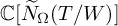 to the equivariant K-cohomology ring
$K_{\mathbb {G}_m}({{\mathcal {G}}{\mathfrak {r}} })$
 in Lemma 2.3 and to the equivariant cohomology ring
$H^{\bullet }_{\mathbb {G}_m}({{\mathcal {G}}{\mathfrak {r}} }^\zeta ,\mathbb {C})$
 in Proposition 2.5. Finally, we consider the affine Spaltenstein fibre
${}^0{{\mathcal {G}}{\mathfrak {r}} }^\zeta _{\gamma _\ell }$
 associated to a topologically nilpotent element
$\gamma _\ell $
 of the form
$\gamma _\ell =s\otimes t^\ell $
 , where
$s\in \mathfrak {t}$
 is regular semi-simple. We describe a cell decomposition in Lemma 2.6, give a GKM presentation of
$H^{\bullet }_T({}^0{{\mathcal {G}}{\mathfrak {r}} }^\zeta _{\gamma _\ell },\mathbb {C})$
 in Proposition 2.8 and describe the affine Weyl group invariants
$H^{\bullet }({}^0{{\mathcal {G}}{\mathfrak {r}} }^\zeta _{\gamma _\ell },\mathbb {C})^{W_{\ell ,{\mathrm {ex}}}}$
 in Theorem 2.12.
In Section 3, we introduce the Lusztig, De Concini-Kac, hybrid and small quantum groups
$\mathrm {U}_\zeta $
 ,
$\mathfrak {U}_\zeta $
 ,
$\mathrm {U}_\zeta ^{\mathrm {hb}}$
 ,
$\mathrm {u}_\zeta $
 and the corresponding module categories
$\mathrm {rep}(\mathrm {U}_\zeta )$
 ,
$\mathfrak {U}_\zeta ^t\text{-}\mathrm {mod}^{\check {\Lambda }}_S$
 ,
$ \mathcal {O}_{\zeta ,S}^{{\mathrm {hb}}}$
 and
$\mathrm {rep}(\mathrm {u}_\zeta )$
 . We describe their centres, present the Harish-Chandra homomorphism for
$Z(\mathrm {U}_\zeta )$
 , the Poisson dual group description of
$Z(\mathfrak {U}_\zeta )$
 and the relationship between
$Z(\mathrm {u}_\zeta )$
 and
$Z(\mathrm {U}_\zeta )$
 in Section 3.2. In Section 3.3, we collect several results on the module categories of these quantum groups. In particular, we introduce and study the exact restriction functors

The main point is the diagram (3.20), which provides the link between the hybrid category
$\mathcal {O}$
 ,
$\mathrm {u}_\zeta \text{-}\mathrm {mod}^{{\check {\Lambda }}}$
 and
$\mathrm {rep}(\mathrm {U}_\zeta )$
 .
Section 4 contains the main results of this paper, which relate the centres of the quantum groups to the cohomology of affine Springer (or Spaltenstein) fibres. In Section 4.1 we construct the algebra homomorphism
$\mathbf {a}: H^{\bullet }({}^0{{\mathcal {G}}{\mathfrak {r}} }^\zeta _{\gamma _\ell },\mathbb {C})^{\ell {\check {\Lambda }}}\to Z(\mathrm {u}_\zeta )^{\check T}$
 in Theorem 4.1, using the GKM description of both sides mentioned above. In Section 4.2 we construct, in Proposition 4.8, an algebra homomorphism
$\mathbf {b}:H^{\bullet }_T({{\mathcal {G}}{\mathfrak {r}} }^\zeta ,\mathbb {C})_{\hat 0}\to Z(\mathcal {O}^{{\mathrm {hb}}}_{\zeta ,S})$
 using the Harish-Chandra homomorphism. In Section 4.3 we first construct an algebra homomorphism
$\mathbf {k}[N_{{\Omega }}(T/W)]\to Z(\mathrm {u}_\zeta )^{\check G}$
 in Proposition 4.10, using again the Harish-Chandra homomorphism. It yields the algebra homomorphism
$\mathbf {c}:H^{\bullet }({{\mathcal {G}}{\mathfrak {r}} }^\zeta ,\mathbb {C})\to Z(\mathrm {u}_\zeta )^{\check G}$
 given in Corollary 4.11. In Section 4.4, using the natural embedding of
$\mathrm {rep}(\mathrm {U}_\zeta )$
 into
$\mathcal {O}^{{\mathrm {hb}}}_{\zeta ,S}$
 and its left adjoint functor, we first produce a morphism
$Z(\mathcal {O}^{{\mathrm {hb}}}_{\zeta , S})\to Z(\mathrm {rep}(\mathrm {U}_\zeta ))$
 . In Proposition 4.12, we show that
$\mathbf {b}$
 , composed with this morphism is equal to
$\mathbf {c}$
 composed with the specialization map on the cohomology. Finally, we prove Theorem 4.13, which compares
$\mathbf {a}$
 and
$\mathbf {c}$
 , using
$\mathbf {b}$
 and the fact that both
$\mathbf {a}$
 and
$\mathbf {b}$
 are deformed.
1.4 Perspectives
Most of the results in this paper have counterparts in positive characteristic. Let k be the algebraic closure of the finite field
$\mathbb {F}_p$
 for a good prime p. We replace the small quantum group
$\mathrm {u}_\zeta $
 by the restricted enveloping algebra of
${\check G}$
 or, equivalently, by the Frobenius kernel
$LG_1$
 over k, and the category
$\mathrm {u}_\zeta \text{-}\mathrm {mod}^{\check {\Lambda }}$
 by the category
${\check G}_1{\check T}\text{-}\mathrm {mod}$
 of
${\check G}_1{\check T}$
 -modules. We further replace
$\mathfrak {U}_\zeta ^t\text{-}\mathrm {mod}^{\check {\Lambda }}_S$
 by the S-deformed version
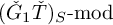
$({\check G}_1{\check T})_S\text{-}\mathrm {mod}$
 of
${\check G}_1{\check T} \text{-}\mathrm {mod}$
 defined in [Reference Andersen, Jantzen and Soergel1], where S is the completion of
$k[\mathfrak {t}]$
 at zero and
$\mathfrak {t}$
 is the Lie algebra of the torus T. Then:
-
(1) there is an S-algebra isomorphism $\mathbf {a}: H^{\bullet }_T({}^0{{\mathcal {G}}{\mathfrak {r}} }^{\mu _p}_{\gamma _p},k)_{\hat 0}\overset {\sim }\to Z(({\check G}_1{\check T})_S \text{-}\mathrm {mod})$
that specializes to an inclusion
$H^{\bullet }({}^0{{\mathcal {G}}{\mathfrak {r}} }^{\mu _p}_{\gamma _p},k)\hookrightarrow Z(\mathrm {u}_p \text{-}\mathrm {mod}^{\check {\Lambda }})$
, -
(2) there is an algebra homomorphism $\mathbf {c}:H^{\bullet }({{\mathcal {G}}{\mathfrak {r}} }^{\mu _p},k)\to Z(\text {Dist}({\check G}_k)),$
where
$\text {Dist}({\check G}_k)$
is the distribution algebra of
${\check G}_k$
, -
(3) there is a positive-characteristic analogue of the map $\mathbf {b}$
above, so that one can check a positive-characteristic analogue of Theorem B.





We will come back to this elsewhere. The results proved in this paper suggest that the Koszul dual of the category of
$\mathrm {u}_\zeta $
 -modules should have a geometric construction in terms of microlocal perverse sheaves attached to the affine Springer fibre. This is the subject of an ongoing project of the first two authors with McBreen and Yun.
1.5 Notation
Let
$\mathbf {k}$
 be an algebraically closed field of characteristic zero. Unless stated otherwise, we will assume
$\mathbf {k}=\mathbb {C}$
 . For a
$\mathbf {k}$
 -algebra A, let
$Z(A)$
 be its centre, and
$A \text{-}\mathrm {Mod}$
 ,
$A \text{-}\mathrm {mod}$
 be the categories of all left A-modules and all finitely generated ones. The centre
$Z(\mathcal {C})$
 of a category
$\mathcal {C}$
 is the endomorphism ring of the identity functor. Basic properties of the centre are recalled in Appendix A.
Given a lattice
$\Lambda $
 , a
$\Lambda $
 -graded
$\mathbf {k}$
 -vector space is a
$\mathbf {k}$
 -vector space M equipped with a decomposition
$M=\bigoplus _{\mu \in \Lambda } M_\mu $
 . For any
$\Lambda $
 -graded
$\mathbf {k}$
 -algebra A, by a
$\Lambda $
 -graded A-module we mean an A-module in the category of
$\Lambda $
 -graded
$\mathbf {k}$
 -vector spaces. Let
$A \text{-}\mathrm {mod}^\Lambda $
 be the category of
$\Lambda $
 -graded finitely generated A-modules. For any set X, let
$\mathrm {Fun}(X,A)=\prod _{x\in X}A$
 be the ring whose product is the pointwise multiplication of functions.
For any complex variety X with an action of a complex linear group G, let
$H_G^{\bullet }(X)$
 and
$H^G_{\bullet }(X)$
 be the G-equivariant cohomology and G-equivariant Borel-Moore homology of X with coefficients in
$\mathbf {k}$
 . We write
$H^{\bullet }_G$
 for the G-equivariant cohomology of a point. Let
$R_G$
 be the representation ring of G tensored with
$\mathbf {k}$
 . We have obvious identifications
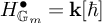
$H^{\bullet }_{\mathbb {G}_m}=\mathbf {k}[\hbar ]$
 and
$R_{\mathbb {G}_m}=\mathbf {k}[q^{\pm 1}]$
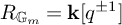 , where q is the linear character and
$\hbar $
 is its first Chern class. For any commutative ring R, let
$\mathrm {Vect}(R)$
 be the category consisting of the free R-modules of finite rank.
Let e be a positive integer. Let
$q_e=q^{1/e}$
 be a formal variable and
$\zeta $
 a primitive
$\ell $
 -th root of unity. Fix
$\zeta _e=\zeta ^{1/e}$
 in
$\mathbf {k}^{\times }$
 . We write

We may identify the ring
$\mathcal {A}$
 with
$\mathbf {k}[\mathbb {G}_a]$
 and view
$\mathbf {A}$
 as an extension of the ring
$\mathbf {k}[\mathbb {G}_m]$
 . Let
$\mathbf {A}_{\hat \zeta }$
 be the completion of
$\mathbf {A}$
 at the point
$q_e=\zeta _e$
 and
$\mathcal {A}_{\hat 0}$
 be the completion of
$\mathcal {A}$
 at
$\hbar =0$
 . More generally, for any module M over
$\mathbf {A}$
 or
$\mathcal {A}$
 , let
$M_{\hat \zeta }$
 or
$M_{\hat 0}$
 be the completion at
$q_e=\zeta _e$
 or at
$\hbar =0$
 . The assignment
$q_e=\zeta _e+\hbar $
 yields canonical isomorphisms
$\mathbf {A}_{\hat \zeta }=\mathcal {A}_{\hat 0}=\mathbf {k}[[\hbar ]].$
 Finally, we set

1.6 Relation with other works
In finite type A, it was conjectured by Khovanov, and proved by Brundan and Stroppel in [Reference Brundan15], [Reference Stroppel39], that the centre of a regular block of a parabolic category O is isomorphic to the cohomology ring of a Springer fibre. Conjecture A may be viewed as an affine analogue of the Khovanov conjecture. Both proofs in [Reference Brundan15], [Reference Stroppel39] rely on some combinatorial results on the centre of degenerate cyclotomic Hecke algebras, proved in [Reference Brundan14]. These results have no analogue in our setting.
The centre
$Z(\mathrm {u}_\zeta )$
 has been studied from an algebraic point of view by Lachowska and Qi in [Reference Lachowska and Qi30], [Reference Lachowska and Qi31]. They give a conjecture for its dimension in type A. Conjecture A may be viewed as a generalization of their conjecture. See Remark 2.13 for details.
The preprint [Reference Boixeda Alvarez and Losev12] was made public while we were writing our paper. The connection with our work is explained in §2.3.3. According to our work and [Reference Boixeda Alvarez and Losev12], in type A Conjecture A would follow from the equality
$\mathbf {a}(H^{\bullet }({}^0{{\mathcal {G}}{\mathfrak {r}} }^\zeta _{\gamma _\ell },\mathbb {C})^{\ell {\check {\Lambda }}})=Z(\mathrm {u}_\zeta )^{\check T}.$

After our paper was written, we were informed by Lachowska, Hemelsoet and Kivinen that they have independently proved Theorem C, motivated by Conjecture A that we announced earlier.
Our proof of Theorem B suggests that the cohomology ring
$H^{\bullet }({{\mathcal {G}}{\mathfrak {r}} }^\zeta )$
 should be isomorphic to the centre of the category
$\mathcal {O}^{{\mathrm {hb}}}_\zeta $
 of the hybrid quantum group. This has been proved by Q. Situ after our work was finished. See Remark 4.9 for details.
2 Cohomology of
$\zeta $
-fixed points in affine Grassmannians

2.1 Affine Grassmannians and
$\zeta $
-fixed points

2.1.1 Root data
Let G be a connected complex quasi-simple algebraic group over
$\mathbb {C}$
 , with maximal torus T, Borel subgroup B, opposite Borel subgroup
$B^-$
 and root datum
$(\mathrm {X}^\ast (T), \mathrm {X}_\ast (T), \Phi , {\check \Phi })$
 . Let N and
$N^-$
 be the unipotent radicals of B and
$B^-$
 , respectively. Let r be the rank of G and h its Coxeter number. Let
$G_{\mathrm {sc}}$
 be the simply connected cover of G and
$T_{\mathrm {sc}}$
 its maximal torus. Let
${\check G}$
 be the Langlands dual group of G, defined over the field
$\mathbb {C}$
 . Let
${\check T}$
 be the dual torus and
${\check B}$
 the corresponding Borel subgroup. Let
$\mathfrak {g}$
 ,
$\mathfrak {b}$
 ,
$\mathfrak {t}$
 be the Lie algebras of G, B, T. Let
$\Phi _{\mathrm {af}}$
 and
$\Phi _{\mathrm {re}}=\Phi \oplus \mathbb {Z}\delta $
 be the sets of affine roots and affine real roots, where
$\delta $
 is the minimal positive imaginary root. Let
$\Sigma $
 and
$\Sigma _{\mathrm {af}}=\Sigma \sqcup \{\alpha _0\}$
 be the sets of simple finite and affine roots. Let
${\check \alpha }$
 denote the affine coroot associated with the affine root
$\alpha $
 . We abbreviate
${\check {\Lambda }}=\mathrm {X}_\ast (T)$
 ,
$\Lambda =\mathrm {X}^\ast (T)$
 and
$Q=\mathbb {Z}\Phi $
 ,
${\check Q}=\mathbb {Z}{\check \Phi }$
 . Let
$\langle -,-\rangle $
 be the canonical pairing on
$\Lambda \times {\check {\Lambda }}$
 . Set also
$P={\check Q}^*$
 and
${\check P}=Q^*$
 . Recall that
$Q\subset \Lambda \subset P$
 and
${\check Q}\subset {\check {\Lambda }}\subset {\check P}$
 . Let e be the order of the group
${\check {\Lambda }}/{\check Q}$
 . Let
$Z=Z(G)$
 ,
${\check Z}=Z({\check G})$
 be the centres and
$\pi _1=\pi _1(G)$
 ,
${\check \pi }_1=\pi _1({\check G})$
 the fundamental groups. We have

For any commutative ring R, we abbreviate

Let
$\mathfrak {t}$
 and
$\mathfrak {t}^*$
 be the
$\mathbb {Z}$
 -schemes whose sets of R-points are
$\mathfrak {t}_R$
 and
$\mathfrak {t}^*_R$
 . We will usually omit the subscript R, hoping it will not create any confusion. Let W be the Weyl group. We fix a W-invariant positive definite symmetric bilinear form
$(-,-)$
 on
$\mathfrak {t}_{\mathbb {R}}$
 such that
$({\check \alpha },{\check \alpha })=2$
 for each short coroot. We have
$({\check {\Lambda }},{\check {\Lambda }})\subset \frac {1}{e}\mathbb {Z}$
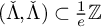 and
$({\check {\Lambda }},{\check Q})\subset \mathbb {Z}$
 . We may identify
$\alpha =2{\check \alpha }/({\check \alpha },{\check \alpha })$
 for each root
$\alpha $
 . We write
$\Sigma =\{\alpha _i\}$
 . Let
$a_{ij}$
 be the
$(i,j)$
 -th entry of the Cartan matrix of G. For any root
$\alpha $
 we set
$d_{\alpha }=(\alpha ,\alpha )/2$
 . We have
$\alpha _i=d_{\alpha _i}{\check \alpha }_i$
 and
$(\alpha _i,\alpha _j)=d_{\alpha _i}a_{ij}$
 . Let
${\check \rho }$
 be half the sum of the positive coroots and
$\theta $
 the highest root.
Let
$W_{\mathrm {af}}=W\ltimes {\check Q}$
 and
$W_{\mathrm {ex}}=W\ltimes {\check {\Lambda }}$
 be the affine Weyl group and the extended one. For each
$\mu \in {\check {\Lambda }}$
 , we write
$\tau _\mu =1\ltimes \mu $
 . The group
$W_{\mathrm {ex}}$
 acts on the lattice
${\check {\Lambda }}\oplus \mathbb {Z} \partial $
 by

for
$w\in W$
 and
$\lambda ,\mu \in {\check {\Lambda }}$
 . The dual action on
$\Lambda \oplus \mathbb {Z}\delta $
 is such that

for
$w\in W$
 ,
$\beta \in \Lambda $
 and
$\mu \in {\check {\Lambda }}$
 .
The group W acts on the torus T, hence on
$\mathbb {C}[T]$
 . When viewed as a function on T, we will denote the character
$\beta \in \Lambda $
 by the symbol
$e^\beta $
 . Similarly, for each cocharacter
$\lambda \in {\check {\Lambda }}$
 and each
$z\in \mathbb {C}^{\times }$
 we write
$z^\lambda $
 for the element
$\lambda (z)$
 in T. We have

The
$W_{\mathrm {ex}}$
 -action on
$\Lambda \oplus \mathbb {Z}\delta $
 yields a
$W_{\mathrm {ex}}$
 -action on
$T\times \mathbb {G}_m$
 such that

for
$w\in W$
 ,
$\mu \in {\check {\Lambda }}$
 ,
$t\in T$
 and
$z\in \mathbb {C}^{\times }$
 . Let

be the induced
$W_{\mathrm {ex}}$
 -action on the algebra
$\mathbb {C}[T\times \mathbb {G}_m]$
 .
Under the obvious identification
${\check {\Lambda }}\cong {\check {\Lambda }}+\partial $
 , the group
$W_{\mathrm {ex}}$
 acts on
${\check {\Lambda }}$
 by

for
$w\in W$
 ,
$\lambda ,\mu \in {\check {\Lambda }}$
 . For each affine real root
$\alpha +m\delta $
 let
$s_{\alpha +m\delta }$
 be the reflection in
$W_{\mathrm {af}}$
 relatively to the affine hyperplane

We have
$s_{\alpha +m\delta }=s_{\alpha }\tau _{m{\check \alpha }}$
 and
$s_{\alpha +m\delta }(\lambda )=\lambda -(\langle \alpha ,\lambda \rangle +m){\check \alpha }$
 for each
$\lambda \in {\check {\Lambda }}$
 . The
$\bullet $
 -action of
$W_{\mathrm {ex}}$
 on
${\check {\Lambda }}$
 is given by
$x\bullet \lambda =x(\lambda +{\check \rho })-{\check \rho }$
 for each
$x\in W_{\mathrm {ex}}$
 .
The sets of dominant coweights and restricted dominant coweights are

For each
$x\in W_{\mathrm {af}}$
 the coweight
$x\bullet 0$
 is dominant if and only if x is minimal in its coset in
$W\setminus W_{\mathrm {af}}$
 . For each
${\check \alpha }\in {\check Q}$
 let
$w_{\check \alpha }$
 be the minimal element in the coset
$W\tau _{\check \alpha }$
 . We get a bijection

where
$w\in W$
 is such that
$w\bullet {\check \alpha }$
 is dominant.
For each affine real root
$\alpha +m\delta $
 let
$U_{\alpha +m\delta }$
 be the unipotent root subgroup in
$G(\mathcal {K})$
 associated with the affine real root
$\alpha +m\delta $
 . It is the image of the group homomorphism

where
$n_{\alpha }:\mathbb {G}_a\to U_{\alpha }$
 is a fixed group isomorphism. Let
$\mathfrak {u}_{\alpha }$
 be the Lie algebra of
$U_{\alpha }$
 and
$e_{\alpha }\in \mathfrak {u}_{\alpha }\otimes \mathcal {K}$
 be the differential of
$n_{\alpha }$
 at 1.
2.1.2 Affine flag manifolds
Let
${{\mathcal {F}}\ell }= G(\mathcal {K} )/\mathcal {I}$
 denote the affine flag manifold, with
$\mathcal {I}$
 the usual Iwahori subgroup. For any subset
$J\subset \Sigma _{\mathrm {af}}$
 let
$P^J\subset G(\mathcal {K})$
 be the standard parahoric subgroup of type J and
$\mathfrak {p}^J$
 its Lie algebra. Let
${}^0P^J$
 be the pro-unipotent radical of
$P^J$
 and
${}^0\mathfrak {p}^J$
 its Lie algebra. Let
$G_J$
 be the Levi component and
$\mathfrak {g}_J$
 its Lie algebra. Let
$\Phi _{\mathrm {re}}^J$
 and
$\Phi _{{\mathrm {re}},J}$
 be the sets of all real affine roots that occur in
${}^0\mathfrak {p}^J$
 and in
$\mathfrak {g}_J$
 respectively. Let
$W_J\subset W_{\mathrm {af}}$
 be the subgroup generated by J and
$W^J_{\mathrm {af}}=W_{\mathrm {af}}/W_J$
 ,
$W^J_{\mathrm {ex}}=W_{\mathrm {ex}}/W_J$
 . The partial affine flag manifold of type J is the fpqc quotient
${{\mathcal {F}}\ell }^J=G(\mathcal {K} )/P^J$
 . It is an ind-scheme. The connected components of
${{\mathcal {F}}\ell }^J$
 are parametrized by the algebraic fundamental group
$\pi _1$
 of G. We have canonical identifications

where
$\pi _1$
 acts on
$W_{\mathrm {af}}$
 by Dynkin diagram automorphisms. Let
${{\mathcal {F}}\ell }^{J,\circ }$
 be the connected component of the base point
$P^J/P^J$
 . The set of fixed points for the left T-action on
${{\mathcal {F}}\ell }^J$
 is

If no confusion is possible we abbreviate
$\delta _x=\delta ^J_x$
 . We may also abbreviate
$\delta _\mu =\delta _{\tau _\mu }$
 for each weight
$\mu \in {\check {\Lambda }}$
 . If
$J=\Sigma $
 then
${{\mathcal {F}}\ell }^J={{\mathcal {G}}{\mathfrak {r}} }$
 is the affine Grassmannian and the set
$W^J_{\mathrm {ex}}$
 is identified with the lattice
${\check {\Lambda }}$
 . The set of T-fixed points in
${{\mathcal {G}}{\mathfrak {r}} }$
 is

2.1.3 The
$\ell $
-affine Weyl group

Recall that e is the order of the group
${\check {\Lambda }}/{\check Q}$
 , see §2.1.1. From now on we will assume that
$\ell \geqslant h$
 is prime to e and to
$3$
 if G contains a component of type
$G_2$
 . Let
$\mu _\ell \subset \mathbb {C}^{\times }$
 be the set of
$\ell $
 -th roots of unity and
$\zeta \in \mu _\ell $
 to be a primitive element. Let
$W_{\ell ,{\mathrm {af}}}=W\ltimes \ell {\check Q}$
 and
$W_{\ell ,{\mathrm {ex}}}=W\ltimes \ell {\check {\Lambda }}$
 be the
$\ell $
 -affine Weyl group and the
$\ell $
 -extended Weyl group. Let
$\Sigma _{\ell ,{\mathrm {af}}}=\{s_{\alpha +\ell m\delta }\,;\, s_{\alpha +m\delta }\in \Sigma _{\mathrm {af}}\}$
 . The fundamental
$\ell $
 -alcove in
$\mathfrak {t}_{\mathbb {R}}$
 is

Let
$\bar A_{\ell ,1}$
 be its closure. It is a fundamental domain for the action of
$W_{\ell ,{\mathrm {af}}}$
 on
$\mathfrak {t}_{\mathbb {R}}$
 . The facet of type J in
$\bar A_{\ell ,1}$
 is the subset

Let
$W_{\ell ,J}$
 be the subgroup of
$W_{\ell ,{\mathrm {af}}}$
 generated by J. We write
$W_{\ell ,{\mathrm {af}}}^{J}=W_{\ell ,{\mathrm {af}}}/W_{\ell ,J}$
 and
$W_{\ell ,{\mathrm {ex}}}^{J}=W_{\ell ,{\mathrm {ex}}}/W_{\ell ,J}$
 . We will abbreviate
$\ell {\check {\Lambda }}=W_{\ell ,{\mathrm {ex}}}^\Sigma .$
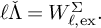 We consider the
$\bullet $
 -action of
$W_{\ell ,{\mathrm {ex}}}$
 on
${\check {\Lambda }}$
 . Let

Since
$\bar A_{\ell ,1}-{\check \rho }$
 is a fundamental domain for the
$\bullet $
 -action of
$W_{\ell ,{\mathrm {af}}}$
 on
$\mathfrak {t}_{\mathbb {R}}$
 , each coset in
$\Xi _{\mathrm {sc}}$
 is uniquely represented by an element in the set
$(\bar A_{\ell ,1}-{\check \rho })\cap {\check {\Lambda }}$
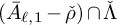 . Further, we have
$W_{\ell ,{\mathrm {ex}}}=W_{\ell ,{\mathrm {af}}}\rtimes \pi _{\ell ,1}$
 where
$\pi _{\ell ,1}\subset W_{\ell ,{\mathrm {ex}}}$
 is the subgroup stabilizing
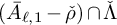
$(\bar A_{\ell ,1}-{\check \rho })\cap {\check {\Lambda }}$
 . The group
$\pi _{\ell ,1}$
 is canonically identified with
$\pi _1$
 , yielding a
$\pi _1$
 -action on
$\Xi _{\mathrm {sc}}$
 such that
$\Xi =\Xi _{\mathrm {sc}}/\pi _1$
 . Since the integer
$\ell $
 is prime to e, an easy computation yields
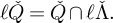
Hence, the
$\pi _1$
 -action on
$\Xi _{\mathrm {sc}}$
 is free. Given
$\omega $
 in
$\Xi _{\mathrm {sc}}$
 , let

where
$\omega $
 is viewed as an element in
${\check {\Lambda }}$
 . We abbreviate
$W_{\ell ,\omega }=W_{\ell ,J_{\omega }}$
 and
$W_{\ell ,{\mathrm {af}}}^{\omega }=W_{\ell ,{\mathrm {af}}}^{J_{\omega }}$
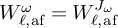 . We have

We define

Using (2.6) and the obvious group homomorphism
$W_{\ell ,{\mathrm {ex}}}\to W$
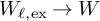 , we get

2.1.4 Fixed points
For any subset
$J\subset \Sigma _{\mathrm {af}}$
 , let
${{\mathcal {F}}\ell }^J_\ell $
 be the partial affine flag manifold with t replaced by
$t^\ell $
 . We have
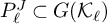
${{\mathcal {F}}\ell }^J_\ell =G(\mathcal {K}_\ell )/P^J_\ell $
 where
$P^J_\ell \subset G(\mathcal {K}_\ell )$
 is the parahoric subgroup of type J. Note that

For
$\omega \in \Xi _{\mathrm {sc}}$
 we abbreviate

Note that
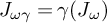
$J_{\omega \gamma }=\gamma (J_{\omega })$
 for any element
$\gamma \in \pi _1$
 , where
$\gamma $
 acts on
$\Sigma _{\mathrm {af}}$
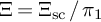
 through an automorphism of the affine Dynkin diagram. Hence, the partial affine flag manifold
${{\mathcal {F}}\ell }^{\omega }_\ell $
 depends only on the class of
$\omega $
 in the set
$\Xi =\Xi _{\mathrm {sc}}\,/\,\pi _1$
 . Let
${{\mathcal {G}}{\mathfrak {r}} }^\zeta $
 be the set of fixed points of the
$\mu _\ell $
 -action on
${{\mathcal {G}}{\mathfrak {r}} }$
 by loop rotation. By [Reference Riche and Williamson36, §4], we have the following.
Lemma 2.1.
${{\mathcal {G}}{\mathfrak {r}} }^\zeta =\bigsqcup _{\omega \in \Xi } {{\mathcal {F}}\ell }^{\omega }_\ell $
 and
$\pi _0({{\mathcal {G}}{\mathfrak {r}} }^\zeta )=\Xi _{\mathrm {sc}}$
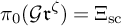 , where we choose a lifting of
$\omega $
 in
$\Xi _{\mathrm {sc}}$
 for each
$\omega $
 .
Proof. Let
$\omega _{\mathrm {sc}}$
 be a lifting of
$\omega $
 in
$\Xi _{\mathrm {sc}}$
 . By loc. cit., we have an isomorphism

The formula for
$\pi _0({{\mathcal {G}}{\mathfrak {r}} }^\zeta )$
 follows from (2.9) and the isomorphism
$\pi _0({{\mathcal {F}}\ell }^{\omega }_\ell )\cong \pi _1$
 .
2.2 The equivariant cohomology of affine Grassmannians
Given a G-variety X over
$\mathbb {C}$
 without odd cohomology, the equivariant cohomology group
$H^{\bullet }_G(X)$
 is a commutative
$\mathbf {k}$
 -algebra. Its spectrum is a
$\mathbf {k}$
 -scheme.
2.2.1 The deformation to the normal cone
Let A be a commutative
$\mathbf {k}$
 -algebra and let I be an ideal in A. Let
$\hbar $
 be a formal variable. We define
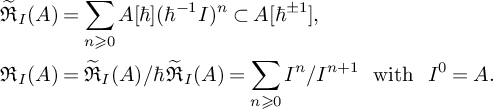
For
$X=\mathrm {Spec}(A)$
 and
$Y=\mathrm {Spec}(A/I)\subset X$
 , we write

The scheme
$\widetilde {N}_Y(X)$
 is the deformation of X to the normal cone of Y. The scheme
$N_Y(X)$
 is the normal cone. Note that
$\widetilde {N}_Y(X)$
 is a scheme over
$X\times \mathbb {G}_a$
 and
$N_Y(X)$
 is its fibre at
$0\in \mathbb {G}_a$
 .
2.2.2 The schemes
$\Omega $
and
$\Gamma $


Consider the
$\mathbf {k}$
 -scheme homomorphism

Let
$\Omega $
 be the scheme-theoretic preimage of the closed point
$1\in T/W$
 under the map
$[\ell ]$
 . Let
$\Omega _{\mathrm {sc}}=\Omega \times _{T/W}T_{\mathrm {sc}}/W$
 , where
$T_{\mathrm {sc}}\to T=T_{\mathrm {sc}}/\pi _1$
 is the obvious projection. We have
$\Omega \cong \Omega _{\mathrm {sc}}\,/\,\pi _1$
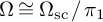 . Let
$\mathbf {C}=\mathbf {k}[\mathfrak {t}]/(\mathbf {k}[\mathfrak {t}]^W_+)$
 be the coinvariant ring. By (2.7) the group
$W_{\ell ,\omega }$
 is identified with the subgroup
$W_{\zeta ^{\omega }}$
 of W. Hence, it acts on the ring
$\mathbf {C}$
 . We define
$\Omega _{\omega }= \mathrm {Spec}(\mathbf {C}^{W_{\ell ,\omega }})$
 . For each
$\omega $
 we consider the closed point
$t_{\omega }=\zeta ^{2(\omega +{\check \rho })}$
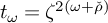 of the torus T. We have the following; see, e.g., [Reference Lachowska29, thm. 4.1].
Lemma 2.2.
-
(a) The set of closed points of $\Omega $
is
$\{Wt_{\omega }\,;\,\omega \in \Xi \}\cong \Xi $
. -
(b) $\Omega =\bigsqcup _{\omega \in \Xi }\Omega _{\omega }$
.



Let
$\Gamma $
 be the fibre product of schemes

The map
$T\to T/W$
 is
$t\mapsto t^\ell \,\text {mod}\, W$
 . The map
$T/W\to T/W$
 is
$[\ell ]$
 . We have

We can describe
$\Gamma $
 as follows. Consider the union of the graphs of the elements in W in
$T^2$
 . Let
$\widetilde \Gamma $
 be its preimage under the map
$T^2\to T^2$
 given by
$(z_1,z_2)\mapsto (z_1^\ell , z_2^\ell )$
 . Then
$\Gamma $
 is the image of
$\widetilde \Gamma $
 in
$T\times (T/W)$
 . The formal neighbourhood
$\Gamma _{\hat 1}$
 of
$\Gamma $
 along the fibre at
$1\in T$
 is a disjoint union

Each connected component
$\Gamma _{\hat \omega }$
 is isomorphic to
$\mathfrak {t}_{\hat 0}\times \Omega _{\omega }$
 . Let

be the vanishing ideals of
$\Omega $
 and
$\Gamma $
 . Let

be respectively the completions of the
$\mathcal {A}[T]$
 -algebra
$\mathbf {k}[\widetilde {N}_{\Gamma }(T\times T/W)]$
 at the point
$0\in \mathbb {G}_a$
 , its completion at
$(1,0)\in T\times \mathbb {G}_a$
 , and the completion of the
$\mathbf {k}[T]$
 -algebra
$\mathbf {k}[N_{\Gamma }(T\times T/W)]$
 at the point
$1\in T$
 .
2.2.3 The equivariant K-theory of the affine Grassmannian
We first recall a few facts about the equivariant K-theory of the affine Grassmannian. All results here are standard and can be found in [Reference Lam, Schilling and Shimozono33], for instance. For
$H=T\times \mathbb {G}_m$
 , T or
$\mathbb {G}_m$
 , let
$K^0_H({{\mathcal {G}}{\mathfrak {r}} })$
 be the H-equivariant
$0$
 -th K-cohomology group of the affine Grassmannian tensored with
$\mathbf {k}$
 . It can be realized as the limit in the category of
$R_H$
 -modules of the
$\mathbf {k}$
 -linear Grothendieck groups
$K_0^H(U)$
 of H-equivariant coherent sheaves over U, where U runs over the set of all finite unions of
$G(\mathcal {O})$
 -orbits in the thick affine Grassmannian of G. As a module over the ring
$R_H$
 , we have

where
$\mathscr {O}^x$
 is the structure sheaf of the finite-codimensional Schubert variety labelled by x. Recall that
${\check {\Lambda }}=W_{\mathrm {ex}}/W$
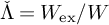 . For future use, we allow e-th roots of the element q in
$\mathbb {C}[T\times \mathbb {G}_m]$
 . Recall the rings
$\mathbf {A}$
 and
$\mathcal {A}$
 introduced in (1.1). Set

The
$W_{\mathrm {ex}}$
 -action on the ring
$\mathbb {C}[T\times \mathbb {G}_m]$
 in (2.3) extends to a
$W_{\mathrm {ex}}$
 -action on
$\mathbf {A}[T]$
 . The
$G(\mathcal {K})$
 -action on the affine Grassmannian by left multiplication yields a
$W_{\mathrm {ex}}$
 -action on the space
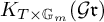
$K_{T\times \mathbb {G}_m}({{\mathcal {G}}{\mathfrak {r}} })$
 . This action is called the left action. It is compatible with the
$W_{\mathrm {ex}}$
 -action on the ring
$\mathbf {A}[T]$
 . The restriction to the
$T\times \mathbb {G}_m$
 -fixed point
$\delta _x\in {{\mathcal {G}}{\mathfrak {r}} }$
 yields a
$W_{\mathrm {ex}}$
 -equivariant map

In the rest of this section, except in Proposition 2.5, we will assume that the group G is simply connected. By [Reference Kostant and Kumar27], taking the product over all x yields an
$\mathbf {A}[T]$
 -algebra embedding

which takes the class
$[\mathscr {O}^0]$
 to the constant function
$1$
 . We view the set of maps
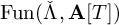
$\mathrm {Fun}({\check {\Lambda }}\,,\,\mathbf {A}[T])$
 as an
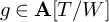
$(\mathbf {A}[T]\,,\,\mathbf {A}[T/W])$
 -bimodule such that

for
$x\in {\check {\Lambda }}$
 ,
$f\in \mathbf {A}[T]$
 ,
$g\in \mathbf {A}[T/W]$
 ,
$\psi \in \mathrm {Fun}({\check {\Lambda }}\,,\,\mathbf {A}[T])$
 . Here
${}^x\! g$
 is the twist of the function g by the left action of x on
$T/W\times \mathbb {G}_m$
 as in (2.4). The image of the map (2.14) is an
$(\mathbf {A}[T]\,,\,\mathbf {A}[T/W])$
 -subbimodule containing the constant function 1, see [Reference Kostant and Kumar27]. We consider the algebra homomorphism

Forgetting the T-action we also have a restriction map
$K_{\mathbb {G}_m}({{\mathcal {G}}{\mathfrak {r}} })\to \mathrm {Fun}({\check {\Lambda }}\,,\,\mathbf {A})$
 and an algebra homomorphism
$\mathbf {A}[T/W]\to K_{\mathbb {G}_m}({{\mathcal {G}}{\mathfrak {r}} })$
 . Recall that
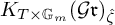
$K_{T\times \mathbb {G}_m}({{\mathcal {G}}{\mathfrak {r}} })_{\hat \zeta }$
 and
$K_{\mathbb {G}_m}({{\mathcal {G}}{\mathfrak {r}} })_{\hat \zeta }$
 are the completions at the point
$q_e=\zeta _e$
 . Recall also that we have identified
$\mathbf {A}_{\hat \zeta }$
 and the completion
$\mathcal {A}_{\hat 0}$
 of
$\mathcal {A}$
 at
$\hbar =0$
 , i.e., we have
$\mathbf {A}_{\hat \zeta }=\mathcal {A}_{\hat 0}=\mathbf {k}[[\hbar ]].$
 Let the closed subset
$\Gamma \subset T\times T/W$
 be as in (2.10). See §1.5 for details.
Lemma 2.3. Let G be simply connected.
-
(a) There is an algebra embedding $\mathbf {k}[\widetilde {N}_{\Gamma }(T\times T/W)]_{\hat 0}\to K_{T\times \mathbb {G}_m}({{\mathcal {G}}{\mathfrak {r}} })_{\hat \zeta }$
such that the composed map takes $f\otimes g$
to
$f\cdot {}^x\!g$
for each
$f\in \mathbf {k}[T]$
,
$g\in \mathbf {k}[T/W]$
and
$x\in {\check {\Lambda }}$
. -
(b) There is an algebra embedding $\mathbf {k}[\widetilde {N}_{{\Omega }}(T/W)]_{\hat 0}\to K_{\mathbb {G}_m}({{\mathcal {G}}{\mathfrak {r}} })_{\hat \zeta }$
such that the composed map takes g to ${}^x\!g(1)$
for each
$g\in \mathbf {k}[T/W]$
and
$x\in {\check {\Lambda }}$
.




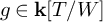




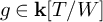

Proof. Let us concentrate on (a) because the proof of (b) is similar. We must check that the map (2.15) extends through the canonical embedding
$\mathbf {A}[T\times T/W]\to \mathbf {k}[\widetilde {N}_{\Gamma }(T\times T/W)]_{\hat 0}$
 to an algebra homomorphism
$\mathbf {k}[\widetilde {N}_{\Gamma }(T\times T/W)]_{\hat 0}\to K_{T\times \mathbb {G}_m}({{\mathcal {G}}{\mathfrak {r}} })_{\hat \zeta }$
 . To do that, we first note that the map (2.15) yields an algebra homomorphism

Recall that we write
$q_e=\zeta _e+\hbar $
 , see §1.5. Taking the specialization at
$\hbar =0$
 , we get a map

We claim that this map takes
$I_{\Gamma }$
 to
$\{0\}$
 . Further, the
$\mathbf {A}$
 -module
$K_{T\times \mathbb {G}_m}({{\mathcal {G}}{\mathfrak {r}} })$
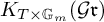 is free by (2.13).
Now, recall the following general fact. Let
$I\subset A$
 be an ideal and
$\widetilde I$
 be an A-module with a fixed isomorphism of A-modules
$I\to \widetilde I$
 such that
$x\mapsto \tilde x$
 . Let
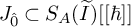
$S_A(\widetilde I)$
 be the symmetric algebra of the A-module
$\widetilde I$
 . Let
$J\subset S_A(\widetilde I)[\hbar ]$
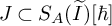 be the ideal generated by
$\{\hbar \tilde x-x\,;\,x\in I\}$
 and
$J_{\hat 0}\subset S_A(\widetilde I)[[\hbar ]]$
 its completion. There is an exact sequence

Recall that if
$0\to K\to M\to N\to 0$
 is a short exact sequence of modules over a commutative ring R and N is flat, then there is a short exact sequence
$0\to K^\wedge \to M^\wedge \to N^\wedge \to 0$
 of completed modules with respect to any ideal of R. Since
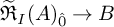
$\widetilde {\mathfrak {R}}_I(A)$
 is a flat
$\mathbf {k}[\hbar ]$
 -module, we have an exact sequence of completed modules

Now, let B be a
$\mathbf {k}[[\hbar ]]$
 -algebra that is torsion free over
$\mathbf {k}[[\hbar ]]$
 . Let
$f:A[[\hbar ]]\to B$
 be a morphism of commutative
$\mathbf {k}[[\hbar ]]$
 -algebras such that
$f(I)\subset \hbar B$
 . Then
$f(x)=\hbar g(x)$
 for some unique map
$g:I\to B$
 such that
$g(ax)=f(a)g(x)$
 for each
$a\in A$
 ,
$x\in I$
 . The maps f and g yield an algebra homomorphism

which factorizes through
$S_A(\widetilde I)[[\hbar ]]\,/\,J_{\hat 0}\to B$
 . Hence it yields a map
$\widetilde {\mathfrak {R}}_I(A)_{\hat 0}\to B$
 .
We apply this general construction to the map (2.16). The claim yields the desired morphism

Its composition with (2.14) is a map

Since the first projection
$\Gamma \to T$
 is flat, the left-hand side of (2.18) is flat over
$\mathbf {k}[T][[\hbar ]]$
 . Hence, to prove that (2.17) is injective, it suffices to prove that the localized morphism below is injective

Note that the left-hand side is

The injectivity follows.
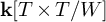
To prove the claim, note that the ideal
$I_\Gamma $
 of
$\mathbf {k}[T\times T/W]$
 is generated by the set
$\{f\otimes 1-1\otimes f\,;\,f\in [\ell ]^*\mathbf {k}[T/W]\}$
 and that
$\ell {\check {\Lambda }}$
 acts trivially on
$\mathbf {k}[T]$
 by (2.2).
2.2.4 The equivariant cohomology of
${{\mathcal {G}}{\mathfrak {r}} }$
and
${{\mathcal {G}}{\mathfrak {r}} }^\zeta $


Now, we consider the equivariant cohomology of partial affine flag manifolds. All results here can be found in [Reference Lam, Lapointe, Morse, Schilling, Shimozono and Zabrocki32, §4], for instance. Recall that

For each subset
$J\subset \Sigma _{\mathrm {af}}$
 the equivariant cohomology group
$H^{\bullet }_{T\times \mathbb {G}_m}({{\mathcal {F}}\ell }^J)$
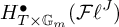 is a limit in the category of graded
$H^{\bullet }_{T\times \mathbb {G}_m}$
 -modules in the same way as the equivariant K-cohomology group considered above. Let
$[{{\mathcal {F}}\ell }^{J,x}]$
 be the fundamental class of the finite-codimensional Schubert variety labelled by the coset x in
$W^J$
 . We have

The
$G(\mathcal {K})$
 -action on
${{\mathcal {F}}\ell }^J$
 by left multiplication yields a
$W_{\mathrm {ex}}$
 -action on the cohomology space
$H^{\bullet }_{T\times \mathbb {G}_m}({{\mathcal {F}}\ell }^J)$
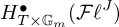 which will be referred to as the left action. The group
$W_{\mathrm {ex}}$
 acts also on
$H^{\bullet }_{T\times \mathbb {G}_m}({{\mathcal {F}}\ell })$
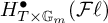 via the affine Springer action, see §2.3.3 for details. We will refer to this action as the right action. The group
$W_{\mathrm {ex}}$
 acts on

as in (2.2). The induced
$W_{\mathrm {ex}}$
 -action on
$\mathfrak {t}\times \mathbb {G}_a$
 is given by

The right action is
$H^{\bullet }_{T\times \mathbb {G}_m}$
 -linear and the left one is
$H^{\bullet }_{T\times \mathbb {G}_m}$
 -skew-linear.
The cup product by elements of
$H^{\bullet }_{T\times \mathbb {G}_m}$
 yields a graded ring homomorphism
$l:H^{\bullet }_{T\times \mathbb {G}_m}\to H_{T\times \mathbb {G}_m}^{\bullet }({{\mathcal {F}}\ell }).$
 The first
$T\times \mathbb {G}_m$
 -equivariant Chern classes of the line bundles
$\mathcal {L}(\lambda )=G(\mathcal {K})\times _{\mathcal {I}}\lambda $
 with
$\lambda \in \Lambda \oplus \mathbb {Z}\delta $
 yield a graded ring homomorphism
$r:H^{\bullet }_{T\times \mathbb {G}_m}\to H_{T\times \mathbb {G}_m}^{\bullet }({{\mathcal {F}}\ell }).$
 Note that
$\mathcal {L}(\delta )$
 is a trivial line bundle on
${{\mathcal {F}}\ell }$
 with first
$T\times \mathbb {G}_m$
 -equivariant Chern class
$\text {c}_1(\mathcal {L}(\delta ))=l(\hbar )$
 . Thus the tensor product
$l\otimes r$
 is a graded ring homomorphism that fits into the commutative diagram

The identification on the right-hand side is proved as in [Reference Bezrukavnikov and Finkelberg10, thm. 1], where a similar statement is given for the affine Grassmannian
${{\mathcal {G}}{\mathfrak {r}} }$
 . The lower map is the obvious one; the elements
$f_1,\dots ,f_r$
 are the homogeneous generators of the ring
$\mathbf {k}[\mathfrak {t}]^W$
 , and
$g_i$
 is a polynomial of degree
$\deg (g_i)=\deg (f_i)-1$
 . Let

be the pull-back of the diagonal of
$\mathfrak {t}/W$
 by the obvious projection
$\mathfrak {t}\times \mathfrak {t}\to \mathfrak {t}/W\times \mathfrak {t}/W$
 . The map
$l\otimes r$
 extends to a graded ring isomorphism

Under this identification, the left and right
$W_{\mathrm {ex}}$
 -actions on the right-hand side correspond to the left and right actions on
$\mathfrak {t}\times \mathfrak {t}\times \mathbb {G}_a$
 given by (2.19) fixing respectively the second and the first factor
$\mathfrak {t}$
 in the Cartesian product. The pull-back by the projection
${{\mathcal {F}}\ell }\to {{\mathcal {F}}\ell }^J$
 yields an isomorphism

see, e.g., [Reference Kumar28, cor. 11.3.14]. The invariants on the right-hand side are relative to the right action of
$W_J$
 on
$H_{T\times \mathbb {G}_m}^{\bullet }({{\mathcal {F}}\ell })$
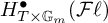 . The right
$W_{\mathrm {ex}}$
 -action on
$\mathfrak {t}\times \mathfrak {t}\times \mathbb {G}_a$
 preserves the closed subset
$\Delta \times \{0\}$
 . Hence
$W_{\mathrm {ex}}$
 acts on the scheme
$\widetilde N_\Delta (\mathfrak {t}\times \mathfrak {t})$
 . We deduce that there is a graded ring isomorphism

Note that if
$W_J\subset W$
 then
$\widetilde N_{\Delta }(\mathfrak {t}\times \mathfrak {t})/W_J=\widetilde N_{\Delta _J}(\mathfrak {t}\times \mathfrak {t}/W_J)$
 where
$\Delta _J\subset \mathfrak {t}\times (\mathfrak {t}/W_J)$
 is the image of
$\Delta $
 . For instance, in the special case
$W_J=W$
 we recover [Reference Bezrukavnikov and Finkelberg10, thm. 1].
Now, we consider the equivariant cohomology of
${{\mathcal {G}}{\mathfrak {r}} }^\zeta $
 . For each coset
$x\in W^J$
 , the restriction to the fixed point
$\delta _x$
 in
$({{\mathcal {F}}\ell }^J)^{T\times \mathbb {G}_m}$
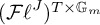 yields a map

Thus, for
$x\in {\check {\Lambda }}$
 , the restriction to
$\delta _x$
 yields maps

Let
$H_T^{\bullet }({{\mathcal {G}}{\mathfrak {r}} }^\zeta )_{\hat 0}$
 be the completion of the
$H_T^{\bullet }$
 -algebra
$H^{\bullet }_T({{\mathcal {G}}{\mathfrak {r}} }^\zeta )$
 at the point
$0\in \mathfrak {t}$
 , and
$H^{\bullet }_{T\times \mathbb {G}_m}({{\mathcal {G}}{\mathfrak {r}} }^\zeta )_{\widehat {0,0}}$
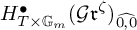 be the completion of the
$H^{\bullet }_{T\times \mathbb {G}_m}$
 -algebra
$H^{\bullet }_{T\times \mathbb {G}_m}({{\mathcal {G}}{\mathfrak {r}} }^\zeta )$
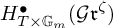 at the point
$(0,0)$
 in
$\mathfrak {t}\times \mathbf {k}$
 .
Lemma 2.4. Let G be simply connected. There are algebra isomorphisms

Proof. The deformation to the normal cone commutes with flat base change. We have

We have the following Cartesian square whose horizontal maps are scheme isomorphisms
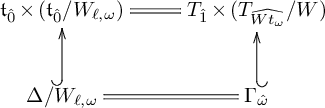
Here
$\Delta $
 is as in (2.20) and the group
$W_{\ell ,\omega }$
 acts on it through the right action. We deduce that

Thus, the partition (2.11) implies that

Using (2.21), we get a canonical ring isomorphism

The ind-scheme
${{\mathcal {G}}{\mathfrak {r}} }^\zeta $
 is equivariantly formal by (2.9). Hence, we have

Since
$H^{\bullet }_T({{\mathcal {G}}{\mathfrak {r}} }^\zeta )$
 is flat over
$H^{\bullet }_T$
 , we have

where both completions are with respect to the maximal ideal of the ring
$H^{\bullet }_T$
 , hence

Similarly, since
$\mathbf {k}[N_{\Gamma }(T\times T/W)]$
 is flat over
$\mathbf {k}[T]$
 , we have

hence

Thus, comparing (2.23), (2.24) and (2.25), we deduce that specializing (2.23) to the point
$\hbar =0$
 yields

In the next proposition, we remove the assumption that G is simply connected. Recall that

The following proposition is the main result of this section. It summarizes and completes the results above.
Proposition 2.5.
-
(a) There are unique algebra isomorphisms
(2.27) $$ \begin{align} \begin{aligned} &\mathbf{k}[\widetilde{N}_{\Gamma}(T\times T/W)]^{\oplus\pi_1}_{\widehat{1,0}}= H^{\bullet}_{T\times\mathbb{G}_m}({{\mathcal{G}}{\mathfrak{r}} }^\zeta)_{\widehat{0,0}},\\ &\mathbf{k}[N_{\Gamma}(T\times T/W)]^{\oplus\pi_1}_{\hat 1}= H^{\bullet}_T({{\mathcal{G}}{\mathfrak{r}} }^\zeta)_{\hat 0} \end{aligned} \end{align} $$
such that, under the decompositions (2.26), we have the following algebra isomorphisms
$$ \begin{align*} &\mathbf{k}[\widetilde N_{\Gamma_{\hat\omega}}(T\times T/W)]^{\oplus\pi_1}_{\widehat {1,0}}= H^{\bullet}_{T\times\mathbb{G}_m}({{\mathcal {F}}\ell}^{\omega}_\ell)_{\widehat {0,0}},\\ &\mathbf{k}[N_{\Gamma_{\hat\omega}}(T\times T/W)]^{\oplus\pi_1}_{\hat 1}= H^{\bullet}_T({{\mathcal {F}}\ell}^{\omega}_\ell)_{\hat 0}, \end{align*} $$
and the composed map
takes $f\otimes g$
to
$f\cdot {}^x\!g$
for each
$f\in \mathbf {k}[T]_{\hat 1}$
,
$g\in \mathbf {k}[T/W]$
and
$x\in {\check {\Lambda }}$
. -
(b) There are unique algebra isomorphisms
(2.28) $$ \begin{align} \mathbf{k}[\widetilde N_{{\Omega}}(T/W)]^{\oplus\pi_1}_{\hat 0}= H^{\bullet}_{\mathbb{G}_m}({{\mathcal{G}}{\mathfrak{r}} }^\zeta)_{\hat 0},\quad \mathbf{k}[N_{{\Omega}}(T/W)]^{\oplus\pi_1}= H^{\bullet}({{\mathcal{G}}{\mathfrak{r}} }^\zeta) \end{align} $$
such that, under the decompositions (2.26), we have the following algebra isomorphisms
$$ \begin{align*} \mathbf{k}[\widetilde N_{{\Omega}_{\omega}}(T/W)]^{\oplus\pi_1}_{\hat 0}= H^{\bullet}_{\mathbb{G}_m}({{\mathcal {F}}\ell}^{\omega}_\ell)_{\hat 0},\quad \mathbf{k}[N_{{\Omega}_{\omega}}(T/W)]^{\oplus\pi_1}= H^{\bullet}({{\mathcal {F}}\ell}^{\omega}_\ell), \end{align*} $$
and the composed map
takes g to ${}^x\!g(1)$
for each weight
$x\in {\check {\Lambda }}$
.





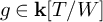






2.3 The equivariant cohomology of affine Springer fibres
2.3.1 Affine Springer fibres
Let
$({{\mathcal {F}}\ell }^J)^T$
 denote the fixed point set of the action of the torus T on the flag manifold
${{\mathcal {F}}\ell }^J$
 by left translations. The stabilizer in T of any point of an arbitrary 1-dimensional T-orbit E in any T-variety is the kernel of a character of T, which is uniquely determined up to integer multiples. We pick such a character
$\alpha _E$
 with minimal norm. It is unique up to a sign.
Fix an element
$\gamma $
 in
$\mathfrak {g}\otimes \mathcal {K}$
 . Let
${}^0\!{{\mathcal {F}}\ell }^J_\gamma $
 be the closed set of all
$x\in {{\mathcal {F}}\ell }^J$
 such that
$\gamma $
 belongs to the Lie algebra of the pro-unipotent radical of the stabilizer of x in
$G(\mathcal {K})$
 . Let
${{\mathcal {F}}\ell }^J_\gamma $
 be the closed set of all
$x\in {{\mathcal {F}}\ell }^J$
 such that
$\gamma $
 belongs to the Lie algebra of the stabilizer of x. Following the terminology of Borho-MacPherson [Reference Borho and MacPherson13], we may call
${}^0\!{{\mathcal {F}}\ell }^J_\gamma $
 an affine Spaltenstein fibre,
${{\mathcal {F}}\ell }^J_\gamma $
 an affine Steinberg fibre and
${{\mathcal {F}}\ell }_\gamma $
 an affine Springer fibre. Note that if
$\gamma $
 is topologically nilpotent then
${{\mathcal {F}}\ell }_\gamma ={}^0\!{{\mathcal {F}}\ell }^\emptyset _\gamma ={{\mathcal {F}}\ell }^\emptyset _\gamma $
 . From now on let
$\gamma _\ell =s\otimes t^\ell $
 , where
$s\in \mathfrak {t}$
 is regular semi-simple, and set
$\gamma =\gamma _1$
 . The torus T centralizes
$\gamma $
 ; thus, it acts on
$ {}^0\!{{\mathcal {F}}\ell }^J_\gamma $
 . Recall that
$({{\mathcal {F}}\ell }^J)^T=\{\delta _x\,;\,x\in W^J_{\mathrm {ex}}\}$
 .
Lemma 2.6.
-
(a) There is an isomorphism of ind-varieties ${}^0{{\mathcal {G}}{\mathfrak {r}} }^\zeta _{\gamma _\ell } =\bigsqcup _{\omega \in \Xi } {}^0\!{{\mathcal {F}}\ell }^{\omega }_{\ell ,\gamma _\ell }.$
-
(b) $({}^0\!{{\mathcal {F}}\ell }^J_\gamma )^{T}=({{\mathcal {F}}\ell }^J)^T=\{\delta _x\,;\,x\in W^J_{\mathrm {ex}}\}$
. -
(c) ${}^0\!{{\mathcal {F}}\ell }^J_\gamma \cap \mathcal {I}\delta _x$
is an affine space for each
$x\in W^J_{\mathrm {ex}}$
. -
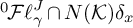
(d) ${}^0\!{{\mathcal {F}}\ell }^J_\gamma \cap N(\mathcal {K})\delta _x$
is an affine space for each
$x\in W^J_{\mathrm {ex}}$
. -
(e) Two points $\delta _x$
,
$\delta _y$
in
${}^0\!{{\mathcal {F}}\ell }^J_\gamma $
are joined by a 1-dimensional T-orbit in
${}^0\!{{\mathcal {F}}\ell }^J_\gamma $
if and only if we have
$y=s_{\alpha +m\delta }x$
for
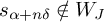
$\alpha $
such that
$s_{\alpha +n\delta }\notin W_J$
for all
$n\in \mathbb {Z}$
and for the integer
$m=m_{\alpha }$
given by (2.29) $$ \begin{align}m_{\alpha}=\max\{k\in\mathbb{Z}\,;\, w^{-1}(\alpha)+(k-\langle\alpha,\mu\rangle)\delta\notin\Phi^J_{\mathrm{re}}\}\end{align} $$
if $x=\tau _\mu w$
with
$\mu \in {\check {\Lambda }}$
and
$w\in W$
. There is a unique such orbit E. We have
$\alpha _E=\pm \alpha $
.










Proof. Any element
$\omega \in \Xi _{\mathrm {sc}}$
 is identified with an element in
${\check {\Lambda }}$
 . So the adjoint action by
$t^{\omega }$
 on
$\mathfrak {g}\otimes \mathcal {O}$
 yields a well-defined Lie subalgebra in
$\mathfrak {g}\otimes \mathcal {K}$
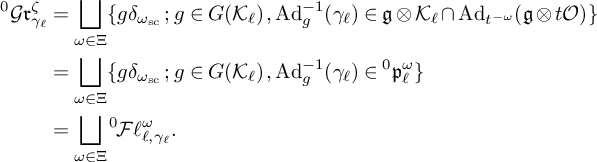
 . To prove (a), observe first that

Since
$\mathfrak {g}\otimes \mathcal {K}_\ell \cap \mathrm {Ad}_{t^{-\omega }}(\mathfrak {g})$
 is reductive, we deduce that

is the pro-unipotent radical of
$\mathfrak {p}^{\omega }_\ell $
 . Let
$\omega _{\mathrm {sc}}\in \Xi _{\mathrm {sc}}$
 be a lifting of
$\omega \in \Xi $
 . By (2.9), we have
Part (b) is obvious. Now, we concentrate on part (d). The Iwasawa decomposition gives

Intersecting this decomposition with
${}^0\!{{\mathcal {F}}\ell }_\gamma ^J$
 provides an affine paving of
${}^0\!{{\mathcal {F}}\ell }_\gamma ^J$
 . More precisely, choose an element
$n\in N(\mathcal {K})$
 . It is of the following form

Let
$x\in W_{\mathrm {ex}}$
 with
$x=\tau _\mu w$
 and
$w\in W$
 ,
$\mu \in {\check {\Lambda }}$
 . We have

where
$f_{\alpha }(t) $
 is a polynomial of degree
$>1+k_{\alpha }-\langle \alpha ,\mu \rangle $
 . Since
$\mathrm {Ad}_x^{-1}(\gamma )\in {}^0\mathfrak {p}^J$
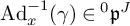 , we deduce that

Hence, there is an isomorphism

where the product is over all roots
$\alpha \in \Phi ^+$
 such that

The integer
$m_{\alpha }$
 is given by

This proves (d). To prove part (e), note that (2.2) yields

Hence the condition (2.32) is equivalent to
$x^{-1}s_{\alpha +m\delta }x\notin W_J$
 for all
$m\in \mathbb {Z}$
 . Now, the closure relation of the one-dimensional orbits in
${{\mathcal {F}}\ell }^J$
 is well-known, and
${}^0\!{{\mathcal {F}}\ell }^J_\gamma $
 is a union of T-orbits. Thus, we are reduced to describing which one-dimensional orbits in
${{\mathcal {F}}\ell }^J$
 are contained in
${}^0\!{{\mathcal {F}}\ell }^J_\gamma $
 . For each one-dimensional T-orbit
$L\subset {}^0\!{{\mathcal {F}}\ell }^J_\gamma $
 , there is a unique affine cell
$C_x={}^0\!{{\mathcal {F}}\ell }^J_\gamma \cap N(\mathcal {K})\delta _x$
 such that
$L=L\cap C_x\cong \mathbb {A}^1$
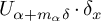
 . By (2.31), the intersection
$L\cap C_x$
 is of the form
$U_{\alpha +m_{\alpha }\delta }\cdot \delta _x$
 . Finally, the closure of
$U_{\alpha +m_{\alpha }\delta }\cdot \delta _x$
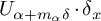 in
${}^0\!{{\mathcal {F}}\ell }^J_\gamma $
 is the same as its closure in
${{\mathcal {F}}\ell }^J$
 . It is equal to
$U_{\alpha +m_{\alpha }\delta }\cdot x\cup \{\delta _{s_{\alpha +m_{\alpha }\delta }x}\}$
 .
Finally, let us consider part (c). Fix an order

such that
$\alpha _i-\alpha _j+(m_i-m_j)\delta \notin \Phi _{\mathrm {re}}^+\ \text {if}\ i<j.$
 We have an isomorphism of affine spaces

For
$nx\in \mathcal {I} \delta _x$
 given by the image of
$(z_1,\dots ,z_r)$
 under the above map, we have

where
$f_k(z_1,\dots ,z_{k-1})$
 is a polynomial in
$z_1,\dots ,z_{k-1}$
 . Thus

whenever
$x^{-1}(\alpha _k)+(m_k+1)\delta \notin \Phi ^J_{\mathrm {re}}$
 . Since s is regular, we have
$\langle \alpha _k,s\rangle \neq 0$
 . Hence this equality determines
$z_k$
 uniquely. If
$x^{-1}(\alpha _k)+(m_k+1)\delta \in \Phi ^J_{\mathrm {re}}$
 , then
$z_k$
 can take any value. Thus
${}^0\!{{\mathcal {F}}\ell }^J_\gamma \cap \mathcal {I}\delta _x$
 is an affine space of dimension

2.3.2 The GKM presentation of
$H^{\bullet }_T({}^0{{\mathcal {G}}{\mathfrak {r}} }^\zeta _{\gamma _\ell })$

Let i be the obvious inclusion of
${}^0{{\mathcal {G}}{\mathfrak {r}} }^\zeta _{\gamma _\ell }$
 in
${{\mathcal {G}}{\mathfrak {r}} }^\zeta $
 . The ind-varieties
${}^0{{\mathcal {G}}{\mathfrak {r}} }^\zeta _{\gamma _\ell }$
 and
${{\mathcal {G}}{\mathfrak {r}} }^\zeta $
 are both equivariantly formal. Hence, using the localization theorem as in [Reference Goresky, Kottwitz and MacPherson23], the restrictions to the fixed-point subsets yield the following commutative diagram of algebra embeddings

We cannot apply the GKM method to get a presentation of the cohomology group
$H^{\bullet }_T({{\mathcal {G}}{\mathfrak {r}} }^\zeta )$
 . To do so, we must consider the
$T\times \mathbb {G}_m$
 -action. However we can apply it to the cohomology group
$H^{\bullet }_T({}^0{{\mathcal {G}}{\mathfrak {r}} }^\zeta _{\gamma _\ell })$
 . To do that, we first consider the connected components of
${}^0{{\mathcal {G}}{\mathfrak {r}} }^\zeta _{\gamma _\ell }$
 separately. Recall the integer
$m_{\alpha }$
 in (2.29).
Lemma 2.7. For each element
$\omega \in \Xi $
 there is an
$H^{\bullet }_T$
 -algebra isomorphism

and an
$H^{\bullet }_{T\times \mathbb {C}^{\times }}$
 -algebra isomorphism

Proof. The proof is similar to the proof of [Reference Goresky, Kottwitz and MacPherson23, §9.4], using the results in Lemma 2.6. The isomorphism is given by the restriction to the fixed points. Note that loc. cit. uses homology, while we consider cohomology. See also [Reference Kivinen26] for more details.
From Lemmas 2.6 and 2.7 we get the following.
Proposition 2.8. There is an
$H^{\bullet }_T$
 -algebra isomorphism

Proof. Use the following identifications of
$W_{\ell ,{\mathrm {ex}}}$
 -sets

the decomposition in Lemma 2.6 and the following equivalences

2.3.3 Affine Weyl group symmetries of
$H^{\bullet }_T({}^0{{\mathcal {G}}{\mathfrak {r}} }^\zeta _{\gamma _\ell })$

The
$G(\mathcal {K}_\ell )$
 -action on
${{\mathcal {G}}{\mathfrak {r}} }^\zeta $
 gives rise to the left
$W_{\ell ,{\mathrm {ex}}}$
 -action on
$H^{\bullet }_T({{\mathcal {G}}{\mathfrak {r}} }^\zeta )$
 . Similarly, the
$T(\mathcal {K}_\ell )$
 -action on
${}^0{{\mathcal {G}}{\mathfrak {r}} }^\zeta _{\gamma _\ell }$
 yields an
$\ell {\check {\Lambda }}$
 -action on
$H^{\bullet }_T({}^0{{\mathcal {G}}{\mathfrak {r}} }^\zeta _{\gamma _\ell })$
 . We claim that this action extends to a
$W_{\ell ,{\mathrm {ex}}}$
 -action on
$H^{\bullet }_T({}^0{{\mathcal {G}}{\mathfrak {r}} }^\zeta _{\gamma _\ell })$
 again called the left action. Indeed, under the restriction to fixed points

the left
$W_{\ell ,{\mathrm {ex}}}$
 -action on
$H^{\bullet }_T({{\mathcal {G}}{\mathfrak {r}} }^\zeta )$
 is given by the following rule

Here the map
$f\mapsto {}^xf$
 is the
$W_{\ell ,{\mathrm {ex}}}$
 -action on
$H^{\bullet }_T=\mathbf {k}[\mathfrak {t}]$
 dual to (2.5). Similarly, under the restriction

the left
$\ell {\check {\Lambda }}$
 -action on
$H^{\bullet }_T({}^0{{\mathcal {G}}{\mathfrak {r}} }^\zeta _{\gamma _\ell })$
 is given by

By Proposition 2.8, this
$\ell {\check {\Lambda }}$
 -action extends uniquely to a
$W_{\ell ,{\mathrm {ex}}}$
 -action on
$H^{\bullet }_T({}^0{{\mathcal {G}}{\mathfrak {r}} }^\zeta _{\gamma _\ell })$
 such that (2.34) holds, proving the claim. The element
$\gamma _\ell $
 is homogeneous. Hence, both ind-schemes
${{\mathcal {G}}{\mathfrak {r}} }^\zeta $
 and
${}^0{{\mathcal {G}}{\mathfrak {r}} }^\zeta _{\gamma _\ell }$
 are cohomologically pure by [Reference Goresky, Kottwitz and MacPherson22, cor. 1.3]. Note that loc. cit. deals with homology, but the result is the same in cohomology. We deduce that their T-equivariant cohomology is T-equivariantly formal. Thus, we have

The left
$W_{\ell ,{\mathrm {ex}}}$
 -actions on
$H^{\bullet }_T({{\mathcal {G}}{\mathfrak {r}} }^\zeta )$
 and
$H^{\bullet }_T({}^0{{\mathcal {G}}{\mathfrak {r}} }^\zeta _{\gamma _\ell })$
 are
$H^{\bullet }_T$
 -skew-linear. Thus, they specialize to
$W_{\ell ,{\mathrm {ex}}}$
 -actions on the cohomology spaces
$H^{\bullet }({{\mathcal {G}}{\mathfrak {r}} }^\zeta )$
 and
$H^{\bullet }({}^0{{\mathcal {G}}{\mathfrak {r}} }^\zeta _{\gamma _\ell })$
 . The restriction

commutes with the left
$W_{\ell ,{\mathrm {ex}}}$
 -action. By formality, it specializes to the restriction

which is also
$W_{\ell ,{\mathrm {ex}}}$
 -equivariant. For each subset
$S\subset W_{\ell ,{\mathrm {ex}}}$
 , we write
$H^{\bullet }({}^0{{\mathcal {G}}{\mathfrak {r}} }^\zeta _{\gamma _\ell })^S$
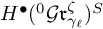 for the space of S-invariants with respect to the left action. The left
$W_{\ell ,{\mathrm {af}}}$
 -action on
$H^{\bullet }({{\mathcal {G}}{\mathfrak {r}} }^\zeta )$
 is trivial, because it comes from the left action of the neutral connected component of
$G(\mathcal {K}_\ell )$
 . Hence
$i^*$
 maps into the space
$H^{\bullet }({}^0{{\mathcal {G}}{\mathfrak {r}} }^\zeta _{\gamma _\ell })^{W_{\ell ,{\mathrm {af}}}}$
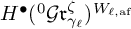 . The connected components of
${{\mathcal {G}}{\mathfrak {r}} }$
 are parametrized by the group
$\pi _1$
 , hence the algebras
$H^{\bullet }({{\mathcal {G}}{\mathfrak {r}} }^\zeta )$
 and
$H^{\bullet }({}^0{{\mathcal {G}}{\mathfrak {r}} }^\zeta _{\gamma _\ell })$
 are both
$\pi _1$
 -graded. The canonical inclusion
$\pi _1\subset W_{\ell ,{\mathrm {ex}}}$
 recalled in §2.1.3 yields an action of the group
$\pi _1$
 by algebra automorphisms on
$H^{\bullet }({{\mathcal {G}}{\mathfrak {r}} }^\zeta )$
 and
$H^{\bullet }({}^0{{\mathcal {G}}{\mathfrak {r}} }^\zeta _{\gamma _\ell })$
 . Since
$W_{\ell ,{\mathrm {ex}}}=W_{\ell ,{\mathrm {af}}}\rtimes \pi _1$
 , the algebra
$H^{\bullet }({}^0{{\mathcal {G}}{\mathfrak {r}} }^\zeta _{\gamma _\ell })^{W_{\ell ,{\mathrm {af}}}}$
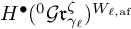 is preserved by the
$\pi _1$
 -action, and the map
$i^*$
 is a
$\pi _1$
 -equivariant algebra homomorphism

In particular, it takes
$H^{\bullet }({{\mathcal {G}}{\mathfrak {r}} }^\zeta )^{\pi _1}$
 into
$H^{\bullet }({}^0{{\mathcal {G}}{\mathfrak {r}} }^\zeta _{\gamma _\ell })^{W_{\ell ,{\mathrm {ex}}}}$
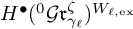 .
The group
$W_{\mathrm {ex}}$
 also acts on
$H^{\bullet }({{\mathcal {F}}\ell }_\gamma )$
 via the affine Springer action defined by G. Lusztig in [Reference Lusztig34]. We will use the description of the Springer action given in [Reference Goresky, Kottwitz and MacPherson23, §14.4]. More precisely, under restriction to the fixed points, this action is given by

We will refer to the Springer action as the right action. To avoid confusion, we will write
$(a_x)y^{-1}$
 instead of
$y(a_x)$
 . The left and right actions commute with each other. They both preserve the cohomological grading. The right action is
$H^{\bullet }_T$
 -linear and the left one is
$H^{\bullet }_T$
 -skew-linear.
From now on and until the end of Proposition 2.11, we focus on the component
$J=\emptyset $
 , and safely remove
$\ell $
 in the discussion.
Proposition 2.9.
-
(a) $\dim H^{\bullet }({{\mathcal {F}}\ell }_\gamma )^{W_{\mathrm {ex}}}\leqslant (h+1)^r$
. -
(b) $\dim H^{\bullet }({{\mathcal {F}}\ell }_\gamma )^{W_{\mathrm {ex}}}= (h+1)^r$
in type A.


Proof. We first concentrate on part (a). We will prove the equivalent statement

where the left-hand side is the dimension of the space of coinvariants in the Borel-Moore homology group for the left action. We may assume that the group G is simply connected, because the terms of the inequality do not depend on the fundamental group. Then
${\check {\Lambda }}$
 is the coroot lattice
${\check Q}$
 . For each affine element
$x\in W_{\mathrm {ex}}$
 we consider the affine space
$C_x={{\mathcal {F}}\ell }_\gamma \cap \mathcal {I}\delta _x$
 . From the proof of Lemma 2.6 we deduce that

Hence, for each affine reflection
$s_i$
 we have

We consider the equivalence relation on
$W_{\mathrm {ex}}$
 such that

We have

Let
$\overline {C_x}$
 be the closure of
$C_x$
 in
${{\mathcal {F}}\ell }_\gamma $
 , and
$b_x=[\overline {C_x}]$
 be its fundamental class in
$H_{\bullet }({{\mathcal {F}}\ell }_\gamma )$
 . Then
$\{b_x\,;\, x\in W_{\mathrm {ex}}\}$
 is a basis of
$H_{\bullet }({{\mathcal {F}}\ell }_\gamma )$
 such that
$b_y=b_x$
 in
$H_{\bullet }({{\mathcal {F}}\ell }_\gamma )_{W_{\mathrm {ex}}}$
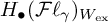 whenever
$y\sim x$
 . Let
$M\subset W_{\mathrm {ex}}$
 be the set of all elements that are minimal in their
$\sim $
 -class. We deduce that

We are reduced to giving an upper bound for the integer
$\sharp M$
 . For each
$x\in W_{\mathrm {ex}}$
 let
$A_x=x^{-1}(A_1)$
 where

We write
$\langle \alpha ,A_{x^{-1}}\rangle =\langle x^{-1}(\alpha ),{\check \rho }\rangle /h$
 for each
$\alpha \in \Lambda $
 . We use the same convention as in (2.5):

Note that

Pick an element
$x\in M$
 . From (2.36) we deduce that

Write
$x^{-1}=w^{-1}\tau _\mu $
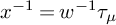 with
$w\in W$
 and
$\mu \in {\check {\Lambda }}$
 . By (2.2) and (2.37) we have

First, assume that
$i\neq 0$
 . If
$x^{-1}(\alpha _i)\in E_x$
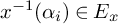 then
$x^{-1}(\alpha _i)\in (\Phi ^+-\delta )\sqcup \Phi ^-$
 . Hence, either
$w^{-1}(\alpha _i)\in \Phi ^+$
 and
$\langle \alpha _i,\mu \rangle =1$
 , or
$w^{-1}(\alpha _i)\in \Phi ^-$
 and
$\langle \alpha _i,\mu \rangle =0$
 . Hence
$\langle \alpha _i,A_{x^{-1}}\rangle <0$
 in both cases. Similarly, if
$x^{-1}(\alpha _i)\in -E_{s_ix}$
 , then
$\langle \alpha _i,A_{x^{-1}}\rangle>0$
 . Therefore, the computation above and (2.38) yield

On the other hand, if
$\langle \alpha _i,A_{x^{-1}}\rangle \geqslant 0$
 then (2.38) yields either
$w^{-1}(\alpha _i)\in \Phi ^+$
 and
$\langle \alpha _i,\mu \rangle \leqslant 0$
 , or
$w^{-1}(\alpha _i)\in \Phi ^-$
 and
$\langle \alpha _i,\mu \rangle \leqslant -1$
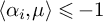 . Hence, in both cases we have
$\langle \alpha _i,A_{x^{-1}}\rangle>-1$
 .
Now, assume that
$i=0$
 . If
$x^{-1}(\alpha _0)\in E_x$
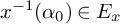 then
$x^{-1}(\alpha _0)\in (\Phi ^+-\delta )\sqcup \Phi ^-$
 . Hence, either
$w^{-1}(\alpha _0)\in \Phi ^++\delta $
 and
$\langle \alpha _i,\mu \rangle =2$
 , or
$w^{-1}(\alpha _0)\in \Phi ^-+\delta $
 and
$\langle \alpha _i,\mu \rangle =1$
 . Hence
$\langle \alpha _0,A_{x^{-1}}\rangle \in (-1,0)$
 in both cases. Similarly, if
$x^{-1}(\alpha _0)\in -E_{s_0x}$
 , then
$\langle \alpha _0,A_{x^{-1}}\rangle \in (0,1)$
 . Therefore, the computation above and (2.38) yield

On the other hand, if
$\langle \alpha _0,A_{x^{-1}}\rangle \geqslant 0$
 then (2.38) yields either
$w^{-1}(\alpha _0)\in \Phi ^++\delta $
 and
$\langle \alpha _0,\mu \rangle \leqslant 2$
 , or
$w^{-1}(\alpha _i)\in \Phi ^-+\delta $
 and
$\langle \alpha _0,\mu \rangle \leqslant 1$
 . Hence, in both cases we have
$\langle \alpha _0,A_{x^{-1}}\rangle>-1$
 .
Therefore, the case-by-case computations above imply that

Hence, from (2.37) we deduce that

Recall that
$(h+1) A_1$
 is a fundamental domain for the action of
$W_{h+1,{\mathrm {af}}}$
 on
$\mathfrak {t}_{\mathbb {R}}$
 . Hence, we have

We deduce that

Thus, we have
$\sharp M \leqslant (h+1)^r$
 .
Now we prove part (b). Since this dimension formula was obtained independently by another argument in [Reference Boixeda Alvarez and Losev12], see Proposition 2.11, we will be brief. The diagonal coinvariant ring is
$DR=\mathbf {k}[\mathfrak {t}\times \mathfrak {t}]/I_+$
 , where
$I_+$
 is the ideal generated by homogeneous diagonal W-invariants of positive degrees. In [Reference Haiman24, prop. 3.6], Haiman proved that this ring has dimension
$(h+1)^r$
 . We now use the graded Double Affine Hecke algebra (GDAHA) action on the equivariant Borel-Moore homology of
${{\mathcal {F}}\ell }_\gamma $
 and
${{\mathcal {F}}\ell }$
 considered in [Reference Varagnolo and Vasserot41] and [Reference Oblomkov and Yun35]. By definition, it commutes with the pushforward by the closed immersion
$i:{{\mathcal {F}}\ell }_\gamma \to {{\mathcal {F}}\ell }$
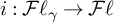 .
We claim that, using this representation, the construction of Carlsson and Oblomkov defined in [Reference Carlsson and Oblomkov16, thm. 7.1] yields a representation of
$DR$
 on
$H_{\bullet }({{\mathcal {F}}\ell }_\gamma )$
 and
$H_{\bullet }({{\mathcal {F}}\ell })$
 that commutes with
$i_\ast $
 . Hence, the image of
$i_\ast $
 is a
$DR$
 -submodule. Let
$[G/B]$
 be the fundamental class corresponding to
$G/B$
 in
$H_{\bullet }({{\mathcal {F}}\ell })$
 . Since
$G/B\subset {{\mathcal {F}}\ell }_\gamma $
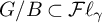 , the class
$[G/B]$
 belongs to the image of
$i_\ast $
 . Further, by [Reference Carlsson and Oblomkov16, thm. 7.1], the map

is injective. Hence, the
$DR$
 -submodule in
$H_{\bullet }({{\mathcal {F}}\ell })$
 generated by
$[G/B]$
 has dimension
$(h+1)^r$
 . We deduce that
$\dim i_*(H_{\bullet }({{\mathcal {F}}\ell }_\gamma ))\geqslant (h+1)^r$
 . By taking the duals and identifying the dual of the Borel-Moore homology groups
$H_{\bullet }({{\mathcal {F}}\ell }_\gamma )$
 ,
$H_{\bullet }({{\mathcal {F}}\ell })$
 with the cohomology groups
$H^{\bullet }({{\mathcal {F}}\ell }_\gamma )$
 ,
$H^{\bullet }({{\mathcal {F}}\ell })$
 , we deduce that

Since the left
$W_{\mathrm {ex}}$
 -action on
$H^{\bullet }({{\mathcal {F}}\ell })$
 is trivial, we have

But by part (a), we know that
$\dim H^{\bullet }({{\mathcal {F}}\ell }_\gamma )^{W_{\mathrm {ex}}}\leqslant (h+1)^r$
 . Thus, we have

To prove our claim, by taking the duals, it is enough to prove that the formulas in [Reference Carlsson and Oblomkov16] yield a
$DR$
 -action that commutes with the restriction
$H^{\bullet }({{\mathcal {F}}\ell })\to H^{\bullet }({{\mathcal {F}}\ell }_\gamma )$
 . To do this, using the equivariant formality, we relate the
$DR$
 -action to the GDAHA-action on the equivariant cohomology spaces
$H^{\bullet }_{U}({{\mathcal {F}}\ell })$
 and
$H^{\bullet }_{U}({{\mathcal {F}}\ell }_\gamma )$
 , where
$U\subset T\times \mathbb {C}^{\times }$
 is a one-parameter subgroup that fixes
$\gamma $
 up to a scalar multiple and
$\mathbb {C}^{\times }$
 is the loop rotation.
The GDAHA-action commutes with the restriction map
$H^{\bullet }_{U}({{\mathcal {F}}\ell })\to H^{\bullet }_{U}({{\mathcal {F}}\ell }_\gamma )$
 , see, e.g., [Reference Oblomkov and Yun35]. To compare the
$DR$
 -action with the GDAHA-action, we must explicitly identify the latter. The GDAHA-action is generated by the operators
$x_i$
 of multiplication by first Chern classes of line bundles associated with affine simple roots
$\alpha _i\in \Sigma _{\mathrm {af}}$
 , by a modified version of the Lusztig
$W_{\mathrm {af}}$
 -action and by a further symmetry
$\rho $
 that comes from the action of the extended affine Weyl group which is not contained in
$W_{\mathrm {af}}$
 .
The action of a simple reflection
$s_i$
 in
$W_{\mathrm {af}}$
 , viewed as an element of the GDAHA, is related to the standard action
$\bar s_i$
 that permutes the
$x_j$
 ’s as in [Reference Carlsson and Oblomkov16, (5.12), (6.11)], i.e., we have

where
$\nu $
 is the action of the central parameter of the GDAHA. The
$DR$
 -action is defined in [Reference Carlsson and Oblomkov16, §7.1] using the GDAHA-action of elements
$\psi _i$
 ,
$\rho $
 in the extended affine Weyl group defined in [Reference Carlsson and Oblomkov16, §5.1]. In [Reference Carlsson and Oblomkov16] the element
$\gamma $
 is elliptic and the central parameter is
$\nu =m/n$
 where m, n are relatively prime integers depending on the choice of
$\gamma $
 . In our case
$\gamma $
 is split, corresponding to
$\nu =1$
 and
$m=n$
 . In both cases, the formula (2.40) holds. Checking that the
$DR$
 -action on
$H^{\bullet }({{\mathcal {F}}\ell })$
 descends to
$H^{\bullet }({{\mathcal {F}}\ell }_\gamma )$
 reduces to checking that the operators
$s_i$
 and
$\rho $
 descend. This follows from the definition of the GDAHA-action, as mentioned above. This can also be checked by a direct computation using the GKM presentation of both sides of
$H^{\bullet }_{U}({{\mathcal {F}}\ell })\to H^{\bullet }_{U}({{\mathcal {F}}\ell }_\gamma )$
 using Lemma 2.7. For instance, the action of
$\rho $
 on the GKM presentation is given by the conjugation by an element in the extended affine Weyl group and it also preserves the relations in Lemma 2.7.
The proof above shows that in type A, we have
$i^*(H^{\bullet }({{\mathcal {F}}\ell }))=H^{\bullet }({{\mathcal {F}}\ell }_\gamma )^{W_{\mathrm {ex}}}$
 . We obtain the following
Corollary 2.10. In type A, the pull-back by the inclusion
$i: {{\mathcal {F}}\ell }_\gamma \to {{\mathcal {F}}\ell }$
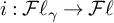 in cohomology yields a surjective map
$i^\ast : H^{\bullet }({{\mathcal {F}}\ell })\to H^{\bullet }({{\mathcal {F}}\ell }_\gamma )^{W_{\mathrm {ex}}}.$

Using Proposition 2.9, Boixeda Alvarez and Losev proved the following stronger result.
Proposition 2.11. Assume that
${\check G}$
 is simply connected. We have
$H^{\bullet }({{\mathcal {F}}\ell }_\gamma )^{W_{\mathrm {ex}}}= \mathbf {k}[{\check {\Lambda }}/(h+1){\check {\Lambda }}]$
 as
$W_J$
 -modules for the right action. In particular, the dimension is
$(h+1)^r$
 .
Proof. If
$W_J\subset W$
 this is [Reference Boixeda Alvarez and Losev12, thm. 1.2]. The general case follows from [Reference Boixeda Alvarez and Losev12, thm. 1.1]. More precisely, using Procesi bundles, the authors introduce a bimodule
$B_1$
 over the
$\mathbf {k}$
 -algebra
$H:=\mathbf {k}[\mathfrak {t}\times \mathfrak {t}^*]\rtimes W$
 such that
$H^{\bullet }({{\mathcal {F}}\ell }_\gamma )^{W_{\mathrm {ex}}}=(B_1\otimes _H\mathbf {k}_{triv})^*$
 as
$W_{\mathrm {ex}}$
 -modules for the right action on
$H^{\bullet }({{\mathcal {F}}\ell }_\gamma )^{W_{\mathrm {ex}}}$
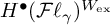 and they prove that
$B_1\otimes _H\mathbf {k}_{triv}= \mathbf {k}[{\check {\Lambda }}/(h+1){\check {\Lambda }}]$
 as a W-module in [Reference Boixeda Alvarez and Losev12, §6.2]. Here
$\mathbf {k}_{triv}$
 is the trivial one-dimensional module over H. We must check that we also have
$B_1\otimes _H\mathbf {k}_{triv}= \mathbf {k}[{\check {\Lambda }}/(h+1){\check {\Lambda }}]$
 as a
$W_J$
 -module if
$W_J\not \subset W$
 . This is proved as in [Reference Boixeda Alvarez and Losev12, prop. 6.6] in the case
$W_J\subset W$
 , using the construction of finite-dimensional representations of the rational Cherednik algebra in [Reference Varagnolo and Vasserot41] and its identification in terms of the torsion group
${\check {\Lambda }}/(h+1){\check {\Lambda }}$
 in [Reference Sommers38, thm.7.3] instead of the construction in [Reference Berest, Etingof and Ginzburg8].
Let
$e_1,\dots ,e_r$
 be the exponents of the group W. We will prove the following.
Theorem 2.12. Assume that
${\check G}$
 is simply connected. We have

Remark 2.13. In type
$SL_{r+1}$
 it is conjectured in [Reference Lachowska and Qi31] that

For
$G=PSL_{r+1}$
 the formula (2.41) gives

2.3.4 Relation with the Lusztig elliptic Springer fibres
Let
$\gamma \in {\mathfrak g}\otimes \mathcal {K}$
 be an arbitrary regular semi-simple element. Fix a proper subset
$J\subset \Sigma _{\mathrm {af}}$
 . Let
${{\mathcal {F}}\ell }^J_\gamma $
 and
${}^0\!{{\mathcal {F}}\ell }^J_\gamma $
 be the affine Steinberg and Spaltenstein fibres at
$\gamma $
 as in §2.3.1. Let
$1_J$
 ,
$\varepsilon _J$
 be the trivial and signature idempotents in
$\mathbf {k} W_J$
 . The cohomology of
${}^0\!{{\mathcal {F}}\ell }^J_\gamma $
 is given by the following proposition. Set
$d_J=\dim {{\mathcal {F}}\ell }-\dim {{\mathcal {F}}\ell }^J$
 .
Proposition 2.14. There is a commutative diagram

where
$i^*$
 is the restriction and
$p_*$
 is the Gysin map. The map
$q_*$
 restricts to a graded vector space isomorphism from the space
$H^{\bullet }({{\mathcal {F}}\ell }_\gamma )\cdot \varepsilon _J$
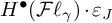 of anti-invariants for the right
$W_J$
 -action to
$H^{\bullet }({}^0\!{{\mathcal {F}}\ell }^J_\gamma )[-2d_J].$

Proof. The proof uses a sheaf-theoretic interpretation of the affine Springer representation, which goes back to the work of G. Lusztig. We will use Yun’s approach, see, e.g., [Reference Yun42, §2.3]. We have the following commutative diagram of stacks with Cartesian squares

where
$B_J=G_J\cap \mathcal {I}$
 and
$\mathfrak {n}_J$
 is the nilpotent radical of its Lie algebra. The map
$q_2$
 maps
$xP^J/P^J$
 to the image of
$\mathrm {Ad}_x^{-1}(\gamma )$
 in
$\mathfrak {g}_J$
 for each
$x\in G(\mathcal {K})$
 . The map
$q_1$
 is defined similarly. By base change, we have

The map
$\pi _1$
 is semi-small. Thus the complex
$(\pi _1)_!(\underline {\mathbf {k}})$
 is semi-simple and contains the direct summand
$(i_1)_!(\underline {\mathbf {k}})[-2d_J]$
 . Thus, by base change, the projection onto this direct summand yields a map

Note that the right-hand side is equal to
$H^{\bullet }({{\mathcal {F}}\ell }^J_\gamma ,(i_2)_!(\underline {\mathbf {k}}))[-2d_J]$
 , which is the same as
$H^{\bullet }({}^0\!{{\mathcal {F}}\ell }^J_\gamma )[-2d_J].$
 Further, the Springer theory for the group
$G_J$
 yields an algebra homomorphism

which maps the sign idempotent to the projection to the direct summand

So the map
$q_*$
 satisfies the properties in the proposition.
Let
$\text {ht}(\alpha )$
 be the height of a root
$\alpha $
 . Let
$e_{\alpha }\in \mathfrak {g}$
 be a non-zero root vector of weight
$\alpha \in \Phi $
 . Assume that
$(h,n)=1$
 . G. Lusztig has defined for each positive integer n a regular semi-simple element
$l_n$
 such that
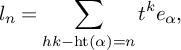
where the sum is over all pairs
$(k,\alpha )\in \mathbb {Z}\times \Phi $
 as above. Assume that
${\check G}$
 is simply connected. Then
$l_n$
 is known to be elliptic and, by [Reference Sommers38, thm. 7.3], we have

as
$W_J$
 -modules for the right action. We will abbreviate
$\gamma '=\gamma ^{\prime }_1=l_{h+1}$
 . Let
$\gamma =ts$
 as before. From Propositions 2.11, 2.14 and (2.42) we deduce the following.
Corollary 2.15. Assume that
${\check G}$
 is simply connected. We have
$H^{\bullet }({}^0\!{{\mathcal {F}}\ell }_\gamma ^J)^{W_{\mathrm {ex}}}=H^{\bullet }({}^0\!{{\mathcal {F}}\ell }_{\gamma '}^J)$
 as
$W_J$
 -modules for the right action.
We can now complete the proof of Theorem 2.12.
Proof of Theorem 2.12
We set
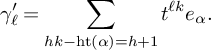
First, assume that
$(h,\ell )=1$
 . A regular semi-simple element
$a\in \mathfrak {g}\otimes \mathcal {K}$
 is said to be homogeneous of slope
$d/m\in \mathbb {Q}$
 if
$s^da(t)$
 and
$a(s^mt)$
 are
$G(\mathcal {K})$
 -conjugate for any
$s\in \mathbb {C}^{\times }$
 . By [Reference Oblomkov and Yun35, cor. 5.4.5], if a,
$a'$
 have the same slope, then
$H^{\bullet }({{\mathcal {G}}{\mathfrak {r}} }_a)\cong H^{\bullet }({{\mathcal {G}}{\mathfrak {r}} }_{a'})$
 . The regular semi-simple elements
$t^{-1}\gamma ^{\prime }_\ell $
 and
$l_{(h+1)\ell -h}$
 are elliptic and homogeneous of slope
$\ell (h+1)/h-1$
 . Hence, we have
$H^{\bullet }({{\mathcal {G}}{\mathfrak {r}} }_{t^{-1}\gamma ^{\prime }_\ell })\cong H^{\bullet }({{\mathcal {G}}{\mathfrak {r}} }_{l_{(h+1)\ell -h}})$
 . Let
$e_1^J,\dots ,e_j^J$
 be the exponents of the group
$W_J$
 . By [Reference Sommers38, prop. 6.1], we have

We deduce that

Since
${\check G}$
 is simply connected, we have
${\check \rho }\in {\check {\Lambda }}$
 . Further, the action of the element
$(z^{-\ell {\check \rho }},z^h)$
 in
$T\times \mathbb {G}_m$
 takes
$\gamma ^{\prime }_\ell $
 to
$z^{(h+1)\ell }\gamma ^{\prime }_\ell $
 . Hence
$\gamma ^{\prime }_\ell $
 is fixed by the
$\mu _\ell $
 -action by loop rotation, and we may consider both projective varieties
${}^0{{\mathcal {G}}{\mathfrak {r}} }_{\gamma ^{\prime }_\ell }$
 and
${}^0{{\mathcal {G}}{\mathfrak {r}} }_{\gamma ^{\prime }_\ell }^\zeta $
 . Since
$(h,\ell )=1$
 , the
$\mu _\ell $
 -action on
${}^0{{\mathcal {G}}{\mathfrak {r}} }$
 by loop rotation extends to a
$\mathbb {G}_m$
 -action which preserves
${}^0{{\mathcal {G}}{\mathfrak {r}} }_{\gamma ^{\prime }_\ell }$
 . By [Reference Goresky, Kottwitz and MacPherson22, thm. 1.2], the variety
${}^0{{\mathcal {G}}{\mathfrak {r}} }_{\gamma ^{\prime }_\ell }$
 has a
$\mathbb {G}_m$
 -equivariant affine paving. Therefore, the Grothendieck group
$K_{\mathbb {G}_m}({}^0{{\mathcal {G}}{\mathfrak {r}} }_{\gamma ^{\prime }_\ell })$
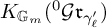 is free as an
$R_{\mathbb {G}_m}$
 -module, the Chern character yields isomorphisms of
$\mathbf {k}$
 -vector spaces

and for any closed subgroup
$H\subset \mathbb {G}_m$
 , we have

Thus, the localization theorem in K-theory implies that

Next, from Lemma 2.6(a) we deduce that

The same proof with
$\gamma _\ell $
 replaced by
$\gamma ^{\prime }_\ell $
 implies that

Thus, Corollary 2.15 implies that

From (2.43), (2.44) and (2.45) we deduce that if
$(h,\ell )=1$
 then

Now, we claim that the integer
$\dim H^{\bullet }({}^0{{\mathcal {G}}{\mathfrak {r}} }^\zeta _{\gamma _\ell })^{W_{\ell ,{\mathrm {ex}}}}$
 is a polynomial in
$\ell $
 . Thus the equality (2.46) holds for any
$\ell $
 . To prove the claim, recall first that

Since the dimension of
$H^{\bullet }({}^0{{\mathcal {F}}\ell }^{\omega }_{\ell ,\gamma _\ell })^{W_{\ell ,{\mathrm {ex}}}}$
 does not depend on
$\ell $
 , we must check that for each subset
$J\subset \Sigma _{\mathrm {af}}$
 , the cardinality of the set
$\{\omega \in \Xi \,;\,J_{\omega }=J\}$
 is a polynomial in
$\ell $
 . We have
$\Xi _{\mathrm {sc}}\cong \bar A_{\ell ,1}\cap {\check {\Lambda }}$
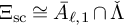 and
$\pi _1$
 acts freely on
$\Xi _{\mathrm {sc}}$
 with the quotient equal to
$\Xi $
 , see §2.1.3. Hence, it is enough to check that the cardinality of the set

is a polynomial in
$\ell $
 . This number is given by the Ehrhart polynomial of the interior of the face of type J of the alcove (which is an integral polytope), proving the claim.
3 Quantum groups and their representations
From now on we assume
${\check G}$
 to be quasi-simple, connected and simply connected. Thus, we have
$\Lambda =Q$
 ,
${\check {\Lambda }}={\check P}$
 and
$\pi _1={\check P}/{\check Q}=\mathrm {X}^*({\check Z})=\mathrm {Hom}({\check Z},\mathbb {G}_m)$
 . We abbreviate
$d_i=d_{{\check \alpha }_i}$
 .
3.1 Quantum groups
3.1.1 Quantum groups
Let q be a formal variable. We abbreviate
$q_i=q^{d_i}$
 for each i. Let the field
$\mathbf {F}$
 be as in (1.1), with the integer e equal to the order of the group
${\check {\Lambda }}/{\check Q}$
 , see §2.1.1. The quantum group
$\mathscr {U}_q$
 associated with
${\check G}$
 is the
$\mathbf {F}$
 -algebra generated by
$E_i$
 ,
$F_i$
 ,
$K_\lambda $
 for
$i\in I$
 ,
$\lambda \in {\check {\Lambda }}$
 , subject to the quantum Chevalley relations and

Let
$\mathscr {U}_q^+$
 ,
$\mathscr {U}_q^0$
 ,
$\mathscr {U}_q^-$
 be respectively subalgebras generated by
$E_i$
 ’s,
$K_\lambda $
 ’s,
$F_i$
 ’s. Multiplication yields a canonical isomorphism of vector spaces
$\mathscr {U}_q^-\otimes \mathscr {U}_q^0\otimes \mathscr {U}_q^+= \mathscr {U}_q.$
 Given any weight
$\mu \in {\check {\Lambda }}$
 , let

be the algebra homomorphism taking
$K_\lambda $
 to
$q^{(\lambda ,\mu )}$
 for each
$\lambda \in {\check {\Lambda }}$
 .
3.1.2 Integral forms
For each
$m\in \mathbb {Z}$
 and
$n\in \mathbb {N}$
 we introduce the following elements in
$\mathscr {U}_q^0$


Let
$E_i^{(n)}$
 and
$F_i^{(n)}$
 denote the quantum divided powers
$E_i^{n}/[n]_{q_i}!$
 and
$F_i^{n}/[n]_{q_i}!$
 where
$[n]_{q_i}!=[n]_{q_i}[n-1]_{q_i}!\cdots [2]_{q_i}!$
 and
$[n]_{q_i}=(q_i^{n}-q_i^{-n})/(q_i-q_i^{-1})$
 . We have a chain of
$\mathbf {A}$
 -subalgebras of
$\mathscr {U}_q$


defined as follows:
-
• $\mathfrak {U}_q$
is the De Concini-Kac quantum group. It is generated by
$E_i,\ F_i,\ K_\lambda $
for
$i\in I$
,
$\lambda \in {\check {\Lambda }}$
, -
• $\mathrm {U}_q^{{\mathrm {hb}}, n}$
is generated by
$E_i^{(n)},\ F_i,\ K_\lambda $
for
$i\in I$
,
$\lambda \in {\check {\Lambda }}$
,
$n>0$
, -
• $\mathrm {U}_q^{{\mathrm {hb}}, b}$
is generated by
$E_i^{(n)},\ F_i,\ K_\lambda ,\ \left [\!\begin {smallmatrix}K_i;m\\ n\end {smallmatrix}\!\right ]_{q_i}$
for
$i\in I$
,
$\lambda \in {\check {\Lambda }}$
,
$n>0$
,
$m\geqslant 0$
, -
• $\mathrm {U}_q$
is the Lusztig quantum group. It is generated by
$E_i^{(n)},\ F_i^{(n)}, K_\lambda $
for
$i\in I$
,
$\lambda \in {\check {\Lambda }}$
,
$n>0$
.


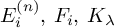





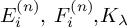


We call
$\mathrm {U}_q^{{\mathrm {hb}},b}$
 and
$\mathrm {U}_q^{{\mathrm {hb}},n}$
 the hybrid quantum groups. We may abbreviate
$\mathrm {U}_q^{\mathrm {hb}}=\mathrm {U}_q^{{\mathrm {hb}},n}$
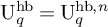 . We have the triangular decompositions

where

and
$\langle \cdots \rangle $
 means the algebra generated by
$\cdots $
 . Note that
$\zeta $
 and
$\zeta _e$
 are both primitive
$\ell $
 -th roots of unity. For each
$\mathbf {A}$
 -algebra
$A_q$
 above, let the
$\mathbf {k}$
 -algebra
$A_\zeta =\mathbf {k}\otimes _{\mathbf {A}} A_q$
 be the specialization to
$q_e=\zeta _e$
 . Explicitly, this yields the Lusztig, De Concini-Kac and hybrid quantum groups
$\mathrm {U}_\zeta $
 ,
$\mathfrak {U}_\zeta $
 and
$\mathrm {U}_\zeta ^{\mathrm {hb}}$
 . In each case, for
$A=A_q$
 or
$A_\zeta $
 we have a triangular decomposition
$A=A^-\otimes A^0\otimes A^+$
 . We abbreviate
$A^\leqslant =A^-A^0$
 and
$A^\geqslant =A^0A^+$
 . The algebra homomorphism
$\varepsilon _\mu $
 yields the algebra homomorphisms

3.2 Centres
3.2.1 The centre of
$\mathscr {U}_q$

We consider the
$\circ $
 -action of W on
$\mathscr {U}_q^0$
 by algebra automorphisms such that

The Harish-Chandra map is an
$\mathbf {F}$
 -algebra isomorphism

such that the following diagram commutes, see, e.g., [Reference Tanisaki40, §1.2],

where
$\varepsilon $
 is the co-unit. Write

We have the
$\mathbf {F}$
 -algebra isomorphisms

Here the
$\circ $
 -action of W on
${\check T}$
 is the Weyl group action centred at
$q^{2{\check \rho }}$
 , while the W-action on
${\check T}$
 is the usual one. Composing the Harish-Chandra map with (3.2) we get an isomorphism

3.2.2 The centre of
$\mathfrak {U}_\zeta $

The centres of the
$\mathbf {A}$
 -algebras
$\mathfrak {U}_q$
 (the De Concini-Kac quantum group) and
$\mathrm {U}_q$
 (=the Lusztig quantum group) are

The Harish-Chandra centre of
$\mathfrak {U}_\zeta $
 is the subalgebra of
$Z(\mathfrak {U}_\zeta )$
 given by

The map (3.3) yields the Harish-Chandra isomorphisms

The inverse Harish-Chandra homomorphism for
$\mathfrak {U}_q$
 is the map

The inverse Harish-Chandra homomorphism for
$\mathfrak {U}_\zeta $
 is the map

For each positive coroot
${\check \alpha }\in {\check \Phi }^+$
 there are coroot vectors
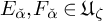
such that
$E_{{\check \alpha }_i}=E_i$
 and
$F_{{\check \alpha }_i}=F_i$
 . The Frobenius centre is the
$\mathbf {k}$
 -subalgebra
$Z_{\mathrm {Fr}}$
 of
$Z(\mathfrak {U}_\zeta )$
 generated by the subset

According to De Concini-Kac-Procesi [Reference De Concini, Kac and Procesi20], the Frobenius and the Harish-Chandra centres are related as follows. We will use the presentation given in [Reference Tanisaki40, prop. 1.6] to which we refer for more details. Set
${\check N}^-=[{\check B}^-,{\check B}^-]$
 and
${\check N}=[{\check B},{\check B}]$
 . We consider the Poisson dual group

The composition of the morphism [Reference Tanisaki40, (1.37)]

with the GIT quotient of
${\check G}$
 by conjugation is identified with the map
$\kappa : {\check G}^\ast \to {\check T}/W$
 taking
$(n_1,t,n_2)$
 to the W-orbit of the semi-simple part of
$n_2t^2n_1^{-1}$
 . Following [Reference Tanisaki40, prop. 1.6] we consider the following commutative diagram

where the vertical maps are
$\mathbf {k}$
 -algebra isomorphisms, and the left lower map is the obvious inclusion which takes
$f(e^{\ell \lambda })$
 to itself and the right lower map takes
$f(e^{\ell \lambda })$
 to
$\kappa ^*f(e^{2\lambda })$
 . Note that
$\mathbf {k}[{\check T}/W]$
 and
$\mathbf {k}[e^{\ell \lambda }\,;\,\lambda \in {\check {\Lambda }}]^W$
 are replaced in loc. cit. by
$\mathbf {k}[e^{2\lambda }\,;\,\lambda \in {\check {\Lambda }}]^W$
 and
$\mathbf {k}[e^{2\ell \lambda }\,;\,\lambda \in {\check {\Lambda }}]^W$
 because our convention for the map (3.6) differs from [Reference Tanisaki40, (1.23)] by a factor 2. Further, we have

The obvious inclusion
$Z(\mathfrak {U}_q)\subset Z(\mathrm {U}_q)$
 specializes to a map
$Z(\mathfrak {U}_\zeta )\to Z(\mathrm {U}_\zeta )$
 . Composing these maps with (3.5) and (3.6), we get the inverse Harish-Chandra homomorphisms for
$\mathrm {U}_q$
 and
$\mathrm {U}_\zeta $


The inverse Harish-Chandra homomorphism
$\mathbf {k}[{\check T}/W]\to Z(\mathrm {U}_\zeta )$
 factorizes through the restriction
$\mathbf {k}[{\check T}/W]\to \mathbf {k}[{\check \Omega }]$
 . The map
$Z(\mathfrak {U}_\zeta )\to Z(\mathrm {U}_\zeta )$
 is the composition of the restriction
$\mathbf {k}[{\check G}^\ast \times _{{\check T}/W}{\check T}/W]\to \mathbf {k}[\{1\}\times {\check \Omega }]$
 and the inverse Harish-Chandra homomorphism
$\mathbf {k}[{\check \Omega }]\to Z(\mathrm {U}_\zeta )$
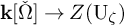 .
3.2.3 The centre of
$\boldsymbol{\mathrm {u}_\zeta} $

The small quantum group
$\mathrm {u}_\zeta $
 is the image of the obvious map
$\mathfrak {U}_\zeta \to \mathrm {U}_\zeta $
 from the De Concini-Kac quantum group to the Lusztig one. It is isomorphic to the specialization
$\mathfrak {U}_\zeta \otimes _{Z_{\mathrm {Fr}}}\mathbf {k}$
 with respect to the character of
$Z_{\mathrm {Fr}}$
 such that

Let
$U({\check {\mathfrak g}})$
 be the enveloping algebra of
${\check {\mathfrak g}}$
 . The quantum Frobenius map is the algebra homomorphism

The Hopf adjoint action of the Lusztig quantum group
$\mathrm {U}_\zeta $
 on itself preserves the small quantum group
$\mathrm {u}_\zeta $
 . When restricted to the centre
$Z(\mathrm {u}_\zeta )$
 , this action factorizes through
$U({\check {\mathfrak g}})$
 . Hence, there is a
${\check G}$
 -action on
$Z(\mathrm {u}_\zeta )$
 . We have

Indeed, since
$Z(\mathrm {U}_\zeta )=(\mathrm {U}_\zeta )^{\mathrm {ad}\mathrm {U}_\zeta }$
 we have

where the second isomorphism follows from the fact that the distribution algebra of
${\check G}$
 is isomorphic to the Hopf quotient of
$\mathrm {U}_\zeta $
 by
$\mathrm {u}_\zeta $
 .
3.2.4 The centre of
$\mathfrak {U}_\zeta ^b$

Consider the obvious restrictions

We define the following algebras

The
$\mathbf {k}$
 -algebra
$\mathfrak {U}_\zeta ^b$
 is isomorphic to the image of the De Concini-Kac quantum group under the obvious map
$\mathfrak {U}_\zeta \to \mathrm {U}_\zeta ^{{\mathrm {hb}}}$
 to the hybrid quantum group. The surjection
$\mathfrak {U}_\zeta \to \mathfrak {U}_\zeta ^b$
 yields an algebra homomorphism
$Z(\mathfrak {U}_\zeta )\to Z(\mathfrak {U}_\zeta ^b)$
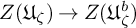 which factorizes as follows

We call the map

given by the composition of
$\mathbf {k}[{\check B}^-\times _{{\check T}/W}{\check T}/W]\to Z(\mathfrak {U}_\zeta ^b)$
 above with the obvious map

the inverse Harish-Chandra homomorphism for
$\mathfrak {U}_\zeta ^b$
 . We may also consider the image
$\mathrm {U}_\zeta ^{\frac {1}{2}}$
 of the hybrid quantum group
$\mathrm {U}_\zeta ^{{\mathrm {hb}}, b}$
 in the Lusztig quantum group
$\mathrm {U}_\zeta $
 and the image
$\mathfrak {U}_\zeta ^n$
 of
$\mathfrak {U}_\zeta $
 in
$\mathrm {U}^{{\mathrm {hb}},b}_\zeta $
 . We have the triangular decompositions

We write
$\mathfrak {U}^\sharp _\zeta =\mathfrak {U}_\zeta ^t$
 ,
$\mathfrak {U}_\zeta ^b$
 or
$\mathfrak {U}_\zeta ^n$
 with
$\sharp =\mathfrak {t}$
 ,
$\mathfrak {b}$
 or
$\mathfrak {n}$
 .
3.3 Representations
We consider the completions of
$\mathbf {k}[{\check T}]$
 and
$\mathbf {k}[{\check B}^-]$
 at
$1$


We may abbreviate
$S=S^t$
 and
$\mathbf {k}=S\,/\,\mathfrak {t} S$
 . The assignment
$K_\lambda \mapsto e^\lambda $
 yields an algebra homomorphism

By an S-algebra R we will mean a commutative, Noetherian S-algebra with structure morphism

Unless specified otherwise, we will also assume that R is a local integral domain with fraction field K, and residue field F. We will be mainly interested in the case
$F=\mathbf {k}$
 .
3.3.1 Module categories
First, let
$A=\mathrm {U}_\zeta $
 ,
$\mathrm {U}^\leqslant _\zeta $
 or
$\mathrm {U}^\geqslant _\zeta $
 . A
${\check {\Lambda }}$
 -graded A-module
$M=\bigoplus _{\mu \in {\check {\Lambda }}}M_\mu $
 is integrable if for any
$m\in M$
 , we have
$E_i^{(r)}m=0=F_i^{(r)}m$
 for r large enough, and if

Let
$\mathrm {rep}(A)$
 be the category of integrable finite-dimensional modules.
A finite-dimensional representation of
${\check G}$
 is the same as a finite-dimensional representation of
$U({\check {\mathfrak g}})$
 . Hence, the pullback by the quantum Frobenius map yields an exact functor, called the Frobenius twist,

Thus, the category
$\mathrm {rep}(\mathrm {U}_\zeta )$
 of the Lusztig quantum group is a tensor category over the tensor category
$\mathrm {rep}({\check G})$
 . Let
$\mathrm {rep}(\mathrm {u}_\zeta )$
 be the category of all finite-dimensional modules of the small quantum group
$\mathrm {u}_\zeta $
 . By [Reference Arkhipov and Gaitsgory6] we have an equivalence of categories from
$\mathrm {rep}(\mathrm {u}_\zeta )$
 to the de-equivariantization of the category
$\mathrm {rep}(\mathrm {U}_\zeta )$
 which can be written as follows

We will not define here the meaning of de-equivariantization or of the tensor product of categories above. We refer to [Reference Davydov, Etingof and Nikshych18, §2.2] for details.
Next, let
$A=\mathrm {U}^{{\mathrm {hb}}}_\zeta $
 or
$\mathfrak {U}^\sharp _\zeta $
 . Recall that
$A^0=\mathbf {k}[{\check T}]$
 and that S is a completion of
$A^0$
 via the inclusion
$\iota :A^0\to S$
 . For each
$\mu \in {\check {\Lambda }}$
 , the automorphism
${}^{\tau _\mu }(-)$
 of
$A^0$
 in §2.1.1 extends to an automorphism of S such that
${}^{\tau _\mu }\!f(t)=f(\zeta ^\mu t)$
 for each
$f\in S$
 ,
$t\in {\check T}$
 . We have
$fa=a\,{}^{\tau _\mu }\!f$
 for each homogeneous element
$a\in A$
 of weight
$\mu $
 and each
$f\in A^0$
 . Following [Reference Andersen, Jantzen and Soergel1, §§1.4, 2.3], we define

to be the category of
${\check {\Lambda }}$
 -graded
$(A, R)$
 -bimodules M such that M is finitely generated over
$A\otimes R$
 and
$M_\mu \subset M$
 is an R-submodule killed by all elements of
$A\times R$
 of the form

The right R-action on any object yields a ring morphism
$R\to Z( A \text{-}\mathrm {mod}^{\check {\Lambda }}_R)$
 , i.e., the category
$A \text{-}\mathrm {mod}^{\check {\Lambda }}_R$
 is R-linear. Applying the base change
$-\otimes _SR$
 to morphisms yields a functor

We will also use the following categories:
-
• $\mathrm {u}_\zeta \text{-}\mathrm {mod}^{\check {\Lambda }}=\mathfrak {U}_\zeta ^t \text{-}\mathrm {mod}^{\check {\Lambda }}_{\mathbf {k}}$
is the category of the
${\check {\Lambda }}$
-graded finite-dimensional
$\mathrm {u}_\zeta $
-modules, i.e., the finite-dimensional modules on which the action of the
$K_\lambda $
’s comes from a
${\check {\Lambda }}$
-grading. Indeed, by (3.11) we have
$\mathfrak {U}_\zeta ^t=\mathfrak {U}_\zeta \otimes _{Z_{\mathrm {Fr}}}\mathbf {k}[{\check T}]$
, hence
$\mathfrak {U}_\zeta ^t\otimes _{\mathbf {k}[{\check T}]}\mathbf {k}=\mathrm {u}_\zeta $
, and by (3.17) an object of
$\mathfrak {U}_\zeta ^t \text{-}\mathrm {mod}^{\check {\Lambda }}_{\mathbf {k}}$
is the same as a
$\mathfrak {U}_\zeta ^t$
-module with a trivial action of
$\mathbf {k}[{\check T}]$
. -
• $\mathcal {O}^{{\mathrm {hb}}}_{\zeta ,R}\subset \mathrm {U}^{{\mathrm {hb}}}_\zeta \text{-}\mathrm {mod}^{\check {\Lambda }}_R$
is the full subcategory of modules with a locally unipotent
$\mathrm {U}_\zeta ^+$
-action. -
• $\mathcal {O}^{{\mathrm {hb}},b}_\zeta $
is the category of finitely generated
$\mathrm {U}^{{\mathrm {hb}}, b}_\zeta $
-modules with integrable
$\mathrm {U}_\zeta ^\geqslant $
-action.










We abbreviate
$\mathcal {O}^{\mathrm {hb}}_\zeta =\mathcal {O}^{{\mathrm {hb}}}_{\zeta ,\mathbf {k}}$
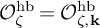 . The following lemma is obvious.
Lemma 3.1. The restriction from
$\mathrm {U}^{{\mathrm {hb}},b}_\zeta $
 to
$\mathrm {U}^{{\mathrm {hb}}}_\zeta $
 yields an equivalence of categories
$\mathcal {O}^{{\mathrm {hb}},b}_\zeta \cong \mathcal {O}^{\mathrm {hb}}_\zeta $
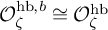 .
3.3.2 Standard and simple modules
If
$A=\mathrm {U}^{\mathrm {hb}}_\zeta $
 or
$\mathfrak {U}^\sharp _\zeta $
 and
$\mu \in {\check {\Lambda }}$
 , let
$R_\mu $
 be the
${\check {\Lambda }}$
 -graded
$(A^0,R)$
 -bimodule such that

We may view
$R_\mu $
 as an
$(A^\geqslant , R)$
 -bimodule under the projection
$A^\geqslant \to A^0$
 . We define

We describe the standard and simple modules case by case.
-
• If $A=\mathrm {U}^{\mathrm {hb}}_\zeta $
(=the hybrid quantum group) we write
$\mathrm {M}(\mu )_R=\Delta ^A(\mu )$
. It is a deformed Verma module in
$\mathcal {O}^{{\mathrm {hb}}}_{\zeta ,R}$
. We have
$\mathrm {M}(\mu )_R= \mathfrak {U}^-_\zeta \otimes R_\mu $
as
$A^\leqslant $
-module. If
$R=F$
is a field then
$\mathrm {M}(\mu )_F$
has a unique simple quotient
$\mathrm {E}(\mu )_F$
. The set
$\{\mathrm {E}(\mu )_F\,;\,\mu \in {\check {\Lambda }}\}$
is a complete non-redundant list of representatives of isomorphism classes of simple modules in
$\mathcal {O}^{{\mathrm {hb}}}_{\zeta ,F}$
. We abbreviate
$\mathrm {M}(\mu )=\mathrm {M}(\mu )_{\mathbf {k}}$
and
$\mathrm {E}(\mu )=\mathrm {E}(\mu )_{\mathbf {k}}$
. -
• If $A=\mathfrak {U}_\zeta ^t$
we write
$\Delta (\mu )^t_R=\Delta ^A(\mu )$
. It is a deformed baby Verma module in
$\mathfrak {U}_\zeta ^t \text{-}\mathrm {mod}^\Lambda _R$
. We have
$\Delta (\mu )^t_R= \mathrm {u}^-_\zeta \otimes R_\mu $
as
$A^\leqslant $
-module. If
$R=F$
is a field, the module
$\Delta (\mu )^t_F$
has a unique simple quotient
$\mathrm {L}(\mu )^t_F$
. The set
$\{\mathrm {L}(\mu )^t_F\,;\,\mu \in {\check {\Lambda }}\}$
is a complete non-redundant list of simple objects in
$\mathfrak {U}_\zeta ^t \text{-}\mathrm {mod}^\Lambda _F$
. -
• If $A=\mathfrak {U}_\zeta ^b$
we write
$\Delta (\mu )^b_R=\Delta ^A(\mu )$
. We have
$\Delta (\mu )^t_R=\Delta (\mu )^b_R\otimes _{S^b}S^t$
because
$\mathfrak {U}_\zeta ^t=\mathfrak {U}_\zeta ^b\otimes _{S^b}S^t$
. We have
$\Delta (\mu )^b_R= \mathfrak {U}^-_\zeta \otimes R_\mu $
as
$A^\leqslant $
-module. If
$R=F$
is a field, the module
$\Delta (\mu )^b_F$
has a unique simple quotient
$\mathrm {L}(\mu )^b_F$
. The set
$\{\mathrm {L}(\mu )^b_F\,;\,\mu \in {\check {\Lambda }}\}$
is a complete non-redundant list of simple objects in
$\mathfrak {U}_\zeta ^b \text{-}\mathrm {mod}^\Lambda _F$
. -
• If $A=\mathrm {U}_\zeta $
(=the Lusztig quantum group) and
$\mu \in {\check {\Lambda }}^+$
, let
$\mathrm {V}(\mu )$
be the maximal quotient of the Verma module
$\Delta ^A(\mu )$
which belongs to
$\mathrm {rep}(\mathrm {U}_\zeta )$
, see [Reference Andersen, Polo and Wen2, §1.14]. It is the Weyl module. It has a unique simple quotient
$\mathrm {D}(\mu )$
. The set
$\{\mathrm {D}(\mu )\,;\,\mu \in {\check {\Lambda }}^+\}$
is a complete non-redundant list of representatives of isomorphism classes of simple modules in
$\mathrm {rep}(\mathrm {U}_\zeta )$
. -
• If $A=\mathrm {u}_\zeta $
(=the small quantum group) then
$\Delta ^A(\mu )=\Delta (\mu )_{\mathbf {k}}^t$
is a baby Verma module in
$\mathrm {rep}(\mathrm {u}_\zeta )$
. We abbreviate
$\Delta (\mu )=\Delta (\mu )^t_{\mathbf {k}}$
and
$\mathrm {L}(\mu )=\mathrm {L}(\mu )_{\mathbf {k}}^t$
for each restricted dominant weight
$\mu \in {\check {\Lambda }}^+_\ell $
. The set
$\{\mathrm {L}(\mu )\,;\,\mu \in {\check {\Lambda }}^+_\ell \}$
is a complete non-redundant list of simple objects in
$\mathrm {rep}(\mathrm {u}_\zeta )$
.





















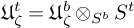
















In all cases, a simple module contains a cyclic weight vector killed by the positive part of the triangular decomposition. This yields a classification of the simple modules, see [Reference Andersen, Jantzen and Soergel1], [Reference Andersen, Polo and Wen2], [Reference De Concini, Kac and Procesi20] or [Reference Situ37] for details. By definition, see, e.g., [Reference Andersen, Polo and Wen2], the Weyl module
$\mathrm {V}(\mu )$
 is the specialization of a module over the
$\mathbf {A}$
 -algebra
$\mathrm {U}_q$
 . To avoid confusion, we may write
$\mathrm {V}(\mu )_\zeta $
 for the Weyl module over
$\mathrm {U}_\zeta $
 and
$\mathrm {V}(\mu )_q$
 for the Weyl module over
$\mathrm {U}_q$
 . We may also write
$\mathrm {D}(\mu )_\zeta =\mathrm {D}(\mu )$
 . Thus
$\mathrm {D}(\mu )_1$
 is the simple
${\check G}$
 -module with highest weight
$\mu $
 .
3.3.3 Deformation of the quantum parameter
Recall that
$\mathbf {A}_{\hat \zeta }$
 is the completion of
$\mathbf {A}$
 at
$q_e=\zeta _e$
 and that we identify
$\mathbf {A}_{\hat \zeta }=\mathbf {k}[[\hbar ]]$
 via the assignment
$q_e=\zeta _e+\hbar $
 . In particular, any
$\mathbf {k}[[\hbar ]]$
 -module can be viewed as an
$\mathbf {A}$
 -module via the canonical map
$\mathbf {A}\to \mathbf {A}_{\hat \zeta }$
 . We will need
$\mathbf {k}[[\hbar ]]$
 -linear versions of the
$\mathbf {k}$
 -categories considered above.
The first one is the category
$\mathrm {rep}(\mathrm {U}_{\hat \zeta })$
 of integrable
$\mathrm {U}_q$
 -modules which are free of finite rank over
$\mathbf {k}[[\hbar ]]$
 . We view it as a deformation of the category
$\mathrm {rep}(\mathrm {U}_\zeta )$
 whose generic point is the semi-simple
$\mathbf {F}$
 -category
$\mathrm {rep}(\mathscr {U}_q)$
 of integrable finite-dimensional
$\mathscr {U}_q$
 -modules. Let
$\mathrm {V}(\mu )_{\hat \zeta }$
 be the Weyl module in
$\mathrm {rep}(\mathrm {U}_{\hat \zeta })$
 .
The second category is a deformation of
$\mathcal {O}^{\mathrm {hb}}_{\zeta ,R}$
 . Recall that
$\mathfrak {U}_q^0=\mathbf {A}[{\check T}]$
 . Let
$S[[\hbar ]]$
 be the completion of
$\mathbf {A}[{\check T}]$
 at the point
$(t,q_e)=(1,\zeta _e)$
 . Fix any
$S[[\hbar ]]$
 -algebra R with structure morphism

The assignment
$K_\lambda \mapsto e^\lambda $
 yields an algebra homomorphism
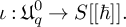
We consider the full subcategory

of those modules with locally nilpotent
$\mathrm {U}_q^+$
 -action. Let
$\mathrm {M}(\mu )_R$
 be the Verma module in
$\mathcal {O}^{{\mathrm {hb}}}_{q,R}$
 . We have

The algebra
$\mathrm {U}^{\mathrm {hb}}_q$
 receives an obvious map from
$\mathfrak {U}_q$
 that takes the centre
$Z(\mathfrak {U}_q)$
 to
$Z(\mathrm {U}^{\mathrm {hb}}_q)$
 . Hence, the algebra
$\mathbf {A}[{\check T}/W]$
 acts on
$\mathrm {M}(\mu )_R$
 via a character
$\chi _{q,\mu }$
 of
$\mathbf {A}[{\check T}/W]$
 under the inverse Harish-Chandra homomorphism
${\mathbf {h}\mathbf {c}}^{-1}$
 in (3.5). For each root
$\alpha $
 , we abbreviate

If
$R=F$
 is a field, we consider the set

Lemma 3.2. If
${\check \Phi }_F=\emptyset $
 , then the category
$\mathcal {O}^{{\mathrm {hb}}}_{\zeta ,F}$
 is semi-simple.
Proof. We must check that if
${\check \Phi }_F=\emptyset $
 , then the Verma modules
$\mathrm {M}(\mu )_F$
 are irreducible. By [Reference De Concini and Kac19, prop. 1.9], the Shapovalov formula implies that
$\mathrm {M}(\mu )_F$
 is irreducible whenever
$(K_{\check \alpha })^2\zeta ^{2(\mu +{\check \rho },{\check \alpha })+2m}\neq 1$
 in F for each root
$\alpha $
 and each positive integer m. This follows from the condition
$h_{\alpha }\neq 0$
 .
3.3.4 Compatibilities
In this section we compare the various module categories introduced above. First, observe that for
$\sharp =t,n$
 or b, the algebra
$\mathfrak {U}_\zeta ^\sharp $
 is a central extension of the small quantum group
$\mathrm {u}_\zeta $
 . By base change and forgetting the
${\check {\Lambda }}$
 -grading, we get the specialization functor

Next, we have the following.
Lemma 3.3.
-
(a) There is a right-exact functor $\mathrm {R}_{\mathrm {hb}}^t: \mathcal {O}_{\zeta ,S}^{{\mathrm {hb}}}\to \mathfrak {U}_\zeta ^t \text{-}\mathrm {mod}^{\check {\Lambda }}_S$
. It maps standards to standards. -
(b) There is a right-exact functor $\mathrm {R}_{\mathrm {hb}}^{\mathrm {u}}: \mathcal {O}^{\mathrm {hb}}_\zeta \to \mathrm {rep}(\mathrm {u}_\zeta )$
. It maps standards to standards.


Proof. There is an obvious embedding

We claim that each object
$M\in \mathcal {O}_{\zeta ,S}^{{\mathrm {hb}}}$
 is finitely generated over
$(\mathfrak {U}_\zeta ^b,S)$
 . Hence, the restriction yields an exact functor

Composing it with base change

we get the functor

The functor
$\mathrm {R}_{\mathrm {hb}}^t$
 maps standards to standards.
To prove the claim, observe that, since M is a finitely generated
$\mathrm {U}_\zeta ^{\mathrm {hb}}$
 -module over which
$\mathrm {U}_\zeta ^+$
 acts locally unipotently, it admits a finite filtration
$0=M_0\subset M_1\subset \dots \subset M_n=M$
 such that
$M_i/M_{i-1}$
 is a quotient of a Verma module
$\mathrm {M}(\mu _i)_S$
 . Moreover
$\mathrm {R}_{\mathrm {hb}}^b(\mathrm {M}(\mu _i)_S)=\Delta (\mu _i)^b$
 and the restriction functor is exact. Thus
$\mathrm {R}_{\mathrm {hb}}^b(M)$
 also has such a filtration. Since standard modules are finitely generated, so are their quotients and finite extensions of them.
Part (a) is proved. Part (b) is proved in a similar way. By (3.13), the restriction yields a functor

Composing it with the specialization functor
$\mathrm {R}_n^{\mathrm {u}}$
 we get the functor

The pullbacks by the obvious maps
$\mathrm {U}_\zeta ^{{\mathrm {hb}},b}\to \mathrm {U}_\zeta $
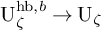 and
$\mathrm {U}_q^{{\mathrm {hb}},b}\to \mathrm {U}_q$
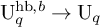 yield exact functors

Lemma 3.4.
-
(a) $\mathrm {R}_{\mathrm {U}}^{\mathrm {hb}}:\mathrm {rep}(\mathrm {U}_\zeta )\to \mathcal {O}^{\mathrm {hb}}_\zeta $
has a left adjoint
$\mathrm {I}^{\mathrm {U}}_{\mathrm {hb}}$
. The counit
$\varepsilon :\mathrm {I}^{\mathrm {U}}_{\mathrm {hb}}\circ \mathrm {R}_{\mathrm {U}}^{\mathrm {hb}}\to 1$
is invertible. -
(b) $\mathrm {I}^{\mathrm {U}}_{\mathrm {hb}}(\mathrm {M}(\mu ))=\mathrm {V}(\mu )$
if
$\mu \in \Lambda ^+$
and 0 otherwise. -
(c) $\mathrm {R}_{\mathrm {U}}^{\mathrm {hb}}:\mathrm {rep}(\mathrm {U}_{\hat \zeta })\to \mathcal {O}^{{\mathrm {hb}}}_{q,\mathbf {k}[[\hbar ]]}$
has a left adjoint
$\mathrm {I}^{\mathrm {U}}_{\mathrm {hb}}$
. The counit
$\varepsilon :\mathrm {I}^{\mathrm {U}}_{\mathrm {hb}}\circ \mathrm {R}_{\mathrm {U}}^{\mathrm {hb}}\to 1$
is invertible.








Proof. The ind-completions
$\mathrm {Ind}\mathrm {rep}(\mathrm {U}_\zeta )$
 ,
$\mathrm {Ind}\mathcal {O}^{\mathrm {hb}}_\zeta $
 of the categories
$\mathrm {rep}(\mathrm {U}_\zeta )$
 ,
$\mathcal {O}^{\mathrm {hb}}_\zeta $
 are locally finitely presentable. The category
$\mathrm {Ind}\mathrm {rep}(\mathrm {U}_\zeta )$
 consists of all integrable
$\mathrm {U}_\zeta $
 -modules. The category
$\mathrm {Ind}\mathcal {O}^{\mathrm {hb}}_{\zeta ,R}$
 consists of all
${\check {\Lambda }}$
 -graded
$(\mathrm {U}^{\mathrm {hb}}_\zeta ,R)$
 -bimodules with a locally unipotent
$\mathrm {U}_\zeta ^+$
 -action. The functor
$\mathrm {R}_{\mathrm {U}}^{\mathrm {hb}}$
 extends to a restriction functor
$\mathrm {Ind}\mathrm {rep}(\mathrm {U}_\zeta )\to \mathrm {Ind}\mathcal {O}^{\mathrm {hb}}_\zeta $
 which preserves filtered colimits and small limits. Thus, it admits a left adjoint
$\mathrm {I}^{\mathrm {U}}_{\mathrm {hb}}$
 by the adjoint functor theorem. The restriction from
$\mathrm {U}^{{\mathrm {hb}},b}_\zeta $
 to
$\mathrm {U}^\geqslant _\zeta $
 and the equivalence
$\mathcal {O}^{{\mathrm {hb}},b}_\zeta \cong \mathcal {O}^{\mathrm {hb}}_\zeta $
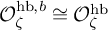 in Lemma 3.1 yield a functor

The composed functor

is the obvious restriction. Its left adjoint is the composed functor
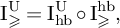
where
$\mathrm {I}^{\mathrm {hb}}_{\geqslant }:\mathrm {Ind}\ \mathrm {rep}(\mathrm {U}_\zeta ^\geqslant )\to \mathrm {Ind}\mathcal {O}^{\mathrm {hb}}_\zeta $
 is the induction functor such that
$\mathrm {I}^{\mathrm {hb}}_{\geqslant }(\mathbf {k}_\mu )=\mathrm {M}(\mu )$
 for each
$\mu \in {\check {\Lambda }}$
 . Being the left adjoint of the restriction
$\mathrm {R}_{\mathrm {U}}^\geqslant $
 , the functor
$\mathrm {I}_\geqslant ^{\mathrm {U}}$
 takes the one-dimensional
$\mathrm {U}_\zeta ^\geqslant $
 -module
$\mathbf {k}_\mu $
 to the maximal integrable quotient of the Verma module. This is the Weyl module
$\mathrm {V}(\mu )$
 if
$\mu \in {\check {\Lambda }}^+$
 and 0 otherwise, see [Reference Andersen, Polo and Wen2, §1.14]. This proves part (b).
We claim that the functor
$\mathrm {I}^{\mathrm {U}}_{\mathrm {hb}}$
 maps
$\mathcal {O}^{\mathrm {hb}}_\zeta $
 into
$\mathrm {rep}(\mathrm {U}_\zeta )$
 , proving the first statement in part (a). The claim is a consequence of part (b) and of the right exactness of the functor
$\mathrm {I}^{\mathrm {U}}_{\mathrm {hb}}$
 . Next, we prove the second part of (a). It is enough to check that the functor
$\mathrm {R}_{\mathrm {U}}^{\mathrm {hb}}$
 is fully faithful. To do that, we consider the obvious maps, see (3.1), (3.13),

They decompose the functor
$\mathrm {R}_{\mathrm {U}}^{\mathrm {hb}}$
 as the composition of the following restrictions

The functor
$\mathrm {R}_{1/2}^{\mathrm {hb}}$
 is fully faithful. We claim that the functor
$\mathrm {R}_{\mathrm {U}}^{1/2}$
 is also fully faithful, proving the lemma. To prove this, we consider the restriction functors

By (3.16), for any objects
$M,N\in \mathrm {rep}(\mathrm {U}_\zeta )$
 we have

Similarly, by definition of the algebra
$\mathrm {U}_\zeta ^{\frac {1}{2}}$
 , for any objects
$M',N'\in \mathrm {rep}(\mathrm {U}_\zeta ^{\frac {1}{2}})$
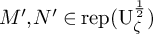 we have

Since the restriction
$R_G^B$
 is fully faithful, setting
$M'=\mathrm {R}_{\mathrm {U}}^{1/2}(M)$
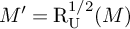 and
$N'=\mathrm {R}_{\mathrm {U}}^{1/2}(N)$
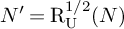 , we deduce that
$\mathrm {R}_{\mathrm {U}}^{1/2}$
 is also fully faithful.
The first part of (c) is proved as the first part of (a). The second one follows from (a) and Nakayama’s lemma.
Let
$\mathrm {R}_{\mathrm {U}}^{\mathrm {u}}$
 be the restriction along the obvious embedding
$\mathrm {u}_\zeta \subset \mathrm {U}_\zeta $
 . We have the following diagram

3.3.5 The Steinberg module
For all categories of A-modules above, we define the Steinberg module to be

We will abbreviate
$\mathrm {St}^\sharp _R=\mathrm {St}^{\mathfrak {U}^\sharp _\zeta }$
 in
$\mathfrak {U}^\sharp _\zeta \text{-}\mathrm {mod}^{\check {\Lambda }}_R$
 , where
$\sharp =t,n$
 or b as above. The functors in (3.20) map Steinberg modules to Steinberg modules.
Lemma 3.5. The Steinberg module is projective in the categories
$\mathrm {rep}(\mathrm {U}_\zeta )$
 ,
$\mathfrak {U}^\sharp _\zeta \text{-}\mathrm {mod}^{\check {\Lambda }}_R$
 and
$\mathrm {rep}(\mathrm {u}_\zeta )$
 .
Proof. For
$A=\mathrm {U}_\zeta $
 ,
$\mathfrak {U}_\zeta ^t$
 ,
$\mathrm {u}_\zeta $
 this is a consequence of the strong linkage principle, see [Reference Andersen, Polo and Wen2], [Reference Andersen, Jantzen and Soergel1]. For
$A=\mathfrak {U}_\zeta ^b$
 , we have
$\mathrm {St}_R^b=\mathfrak {U}_\zeta ^b\otimes _{\mathfrak {U}_\zeta ^t} \mathrm {St}_R^t.$
 The induction functor
$\mathfrak {U}_\zeta ^b\otimes _{\mathfrak {U}_\zeta ^t}-$
 is left adjoint to the restriction functor
$\mathfrak {U}_\zeta ^b \text{-}\mathrm {mod}^{\check {\Lambda }}_R\to \mathfrak {U}_\zeta ^t \text{-}\mathrm {mod}^{\check {\Lambda }}_R$
 , which is exact. Thus it maps projective modules to projective ones. We deduce that
$\mathrm {St}_R^b$
 is projective.
3.3.6 Projective modules
We consider each of the module categories above separately. First, note that the category
$\mathrm {rep}(\mathrm {U}_\zeta )$
 has enough projectives by [Reference Andersen, Polo and Wen3, §9].
Next, let the triple
$(R,K,F)$
 be as above and consider the projective objects in
$\mathfrak {U}^\sharp _\zeta \text{-}\mathrm {mod}^{\check {\Lambda }}_R$
 . All Hom-groups in
$\mathfrak {U}^\sharp _\zeta \text{-}\mathrm {mod}^{\check {\Lambda }}_R$
 are finitely generated over R. Thus, since R is a local ring, the Krull-Schmidt property holds in
$\mathfrak {U}^\sharp _\zeta \text{-}\mathrm {mod}^{\check {\Lambda }}_R$
 . Hence, for each
$\mu \in {\check {\Lambda }}$
 , the module
$\mathrm {L}(\mu )_F^\sharp $
 has unique projective covers
$\mathrm {P}(\mu )_R^\sharp $
 and
$\mathrm {P}(\mu )_F^\sharp $
 in
$\mathfrak {U}^\sharp _\zeta \text{-}\mathrm {mod}^{\check {\Lambda }}_R$
 and
$\mathfrak {U}^\sharp _\zeta \text{-}\mathrm {mod}^{\check {\Lambda }}_F$
 respectively. The adjunction property

implies that
$\mathrm {P}(\mu )_R^\sharp \otimes _RF$
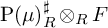 is projective in
$\mathfrak {U}^\sharp _\zeta \text{-}\mathrm {mod}^{\check {\Lambda }}_F$
 . The Krull-Schmidt property implies further that

The modules
$\mathrm {P}(\mu )_R^\sharp $
 with
$\mu \in {\check {\Lambda }}$
 form a non-redundant set of representatives of indecomposable projective objects in
$\mathfrak {U}^\sharp _\zeta \text{-}\mathrm {mod}^{\check {\Lambda }}_R$
 .
Now we consider the projective objects in
$\mathcal {O}^{{\mathrm {hb}}}_{\zeta ,R}$
 . The category
$\mathcal {O}^{{\mathrm {hb}}}_{\zeta ,R}$
 does not have enough projectives. Projective objects only exist in truncated categories. For each weight
$\nu \in {\check {\Lambda }}$
 , let
$\mathcal {O}^{{\mathrm {hb}},\leqslant \nu }_{\zeta ,R}$
 be the full subcategory consisting of objects M such that
$M_\mu =0$
 if
$\mu \not \leqslant \nu $
 . Any object in
$\mathcal {O}^{{\mathrm {hb}}}_{\zeta ,R}$
 belongs to a subcategory
$\mathcal {O}^{{\mathrm {hb}},\leqslant \nu }_{\zeta ,R}$
 for some weight
$\nu $
 . For each
$\mu \in {\check {\Lambda }}$
 , we consider the
$(\mathrm {U}_\zeta ^{\mathrm {hb}},R)$
 -bimodule

Lemma 3.6.
-
(a) The functor $\mathrm {Hom}_{(\mathrm {U}_\zeta ^{\mathrm {hb}},R)}(\mathrm {Q}(\mu )_R\,,\,-):\mathcal {O}^{{\mathrm {hb}}}_{\zeta ,R}\to \mathrm {Vect}_{\mathbf {k}}$
is exact. -
(b) For each $\nu \geqslant \mu $
, there is a quotient
$\mathrm {Q}(\mu )_R^{\leqslant \nu }$
of
$\mathrm {Q}(\mu )_R$
, which is projective in
$\mathcal {O}^{{\mathrm {hb}},\leqslant \nu }_{\zeta ,R}$
. It maps onto the simple module
$\mathrm {E}(\mu )_F$
and admits a finite filtration by Verma modules.



Proof. For any
$N\in \mathcal {O}^{{\mathrm {hb}}}_{\zeta ,R}$
 , by (3.19), the module
$\mathrm {R}_{\mathrm {hb}}^b(N)$
 belongs to the category
$\mathfrak {U}_\zeta ^b \text{-}\mathrm {mod}^{\check {\Lambda }}_R$
 , in which
$\mathrm {P}_R^b(\mu )$
 is projective. The obvious adjunction yields a natural isomorphism

This proves part (a).
Next, by the PBW theorem, the functor
$\mathrm {U}_\zeta ^{\mathrm {hb}}\otimes _{\mathfrak {U}_\zeta ^b}-$
 is exact. The module
$\mathrm {P}^b(\mu )_R$
 admits a finite filtration by the standard modules of the form
$\Delta ^b(\lambda )_R$
 . The proof is as in [Reference Andersen, Jantzen and Soergel1, §§2.13-16]. So
$\mathrm {Q}(\mu )_R$
 admits a finite filtration by modules of the form
$\mathrm {U}_\zeta ^{\mathrm {hb}}\otimes _{\mathfrak {U}_\zeta ^b}\Delta ^b(\lambda )_R$
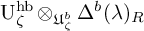 . Further, the quotient of
$\mathrm {U}_\zeta ^{{\mathrm {hb}},\geqslant }$
 by the two-sided ideal generated by the augmentation ideal of the subalgebra
$\mathfrak {U}^{b,\geqslant }_\zeta $
 is isomorphic to
$\mathrm {U}^+_1$
 . So we have an R-linear isomorphism

We deduce that

where the
$\mathrm {U}^{{\mathrm {hb}},\geqslant }_{\zeta }$
 -action in the right-hand side is given by (3.21). Since
$\mathrm {U}^+_1$
 is unipotent,
$\mathrm {U}_\zeta ^{\mathrm {hb}}\otimes _{\mathfrak {U}_\zeta ^b}\Delta ^b(\lambda )_R$
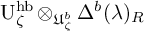 admits a filtration by Verma modules of highest weights
$\lambda +\ell \beta $
 with
$\beta \in Q^+$
 , with
$\mathrm {M}(\lambda )_R$
 appearing only once as a quotient. So
$\mathrm {Q}(\mu )_R$
 has a filtration by Verma modules. Moreover,
$\Delta _R^b(\mu )$
 is a quotient of
$P_R^b(\mu )$
 , so
$\mathrm {Q}(\mu )_R$
 surjects onto
$\mathrm {M}(\mu )_R$
 , which surjects onto
$\mathrm {E}(\mu )_F$
 . Finally, since
$\mathrm {Ext}^1(\mathrm {M}(\lambda )_R, \mathrm {M}(\lambda ')_R)=0$
 unless
$\lambda '> \lambda $
 , the module
$\mathrm {Q}(\mu )_R$
 admits a unique quotient
$\mathrm {Q}(\mu )_R^{\leqslant \nu }$
 in
$\mathcal {O}^{{\mathrm {hb}},\leqslant \nu }_{\zeta ,R}$
 , which is filtered by Verma modules appearing in the filtration of
$\mathrm {Q}(\mu )_R$
 with highest weight
$\leqslant \nu $
 . We have, for any
$N\in \mathcal {O}^{{\mathrm {hb}},\leqslant \nu }_{\zeta ,R}$
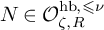 ,

So
$\mathrm {Q}(\mu )_R^{\leqslant \nu }$
 is projective in
$\mathcal {O}^{{\mathrm {hb}},\leqslant \nu }_{\zeta ,R}$
 .
Note that the
$\mathrm {U}_\zeta ^{\mathrm {hb}}$
 -module
$\mathrm {Q}(\mu )_R$
 does not belong to the category
$\mathcal {O}^{{\mathrm {hb}}}_{\zeta ,R}$
 .
Corollary 3.7.
-
(a) The unit $\eta :1\to \mathrm {R}_{\mathrm {U}}^{\mathrm {hb}}\circ \mathrm {I}^{\mathrm {U}}_{\mathrm {hb}}$
is surjective. -
(b) The category $\mathcal {O}^{\mathrm {hb}}_\zeta $
is a module category over the tensor category
$\mathrm {rep}(\mathrm {U}_\zeta )$
. The functors
$R^{\mathrm {U}}_{\mathrm {hb}}$
,
$I^{\mathrm {U}}_{\mathrm {hb}}$
commute with tensor product with objects in
$\mathrm {rep}(\mathrm {U}_\zeta )$
.



Proof. To prove part (a), it is enough to show that
$\eta (N): N\to \mathrm {R}_{\mathrm {U}}^{\mathrm {hb}}\circ \mathrm {I}^{\mathrm {U}}_{\mathrm {hb}}(N)$
 is surjective for any
$N\in \mathcal {O}^{{\mathrm {hb}},\leqslant \nu }_{\zeta }$
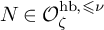 . Note that by Lemma 3.4, the surjectivity holds when N is a Verma module. Since
$\mathrm {Q}(\mu )^{\leqslant \nu }$
 has a finite filtration by Verma modules, by the Five Lemma, the morphism
$\eta (\mathrm {Q}(\mu )^{\leqslant \nu })$
 is also surjective. Finally, any object
$N\in \mathcal {O}^{{\mathrm {hb}},\leqslant \nu }_{\zeta }$
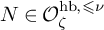 is a quotient of a finite direct sum of
$\mathrm {Q}(\mu )^{\leqslant \nu }$
 ’s; thus,
$\eta (N)$
 is always surjective.
Now, we prove claim (b). The algebra
$\mathscr {U}_q$
 is a Hopf algebra, and
$\mathfrak {U}_q$
 ,
$\mathrm {U}^{{\mathrm {hb}},b}_q$
 ,
$\mathrm {U}_q$
 are Hopf subalgebras. So it makes sense to tensor objects in
$\mathrm {rep}(\mathrm {U}_\zeta )$
 and those in
$\mathcal {O}^{\mathrm {hb}}_\zeta $
 ; we obtain again objects in
$\mathcal {O}^{\mathrm {hb}}_\zeta $
 . The functor
$R_{\mathrm {U}}^{\mathrm {hb}}$
 commutes with tensor product. Now, let us consider the functor
$\mathrm {I}^{\mathrm {U}}_{\mathrm {hb}}$
 .
Any morphism

factorizes through the map
$\eta (M)$
 because
$\varphi $
 decomposes as

Now, for any
$N\in \mathrm {rep}(\mathrm {U}_\zeta )$
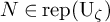 , apply this to
$L= \mathrm {I}^{\mathrm {U}}_{\mathrm {hb}}(M)\otimes N$
 and the surjective map

we obtain a surjective map

Apply
$\mathrm {I}^{\mathrm {U}}_{\mathrm {hb}}$
 and Lemma 3.4. We get a surjective map

We claim that this map is invertible. Let K be its kernel and
$I_K$
 be the injective hull of K in
$\mathrm {rep}(\mathrm {U}_\zeta )$
 . We must show that
$K=0$
 . To do this, we apply the functor
$\mathrm {Hom}_{\mathrm {U}_\zeta }(-,I_K)$
 and obtain the short exact sequence

By adjunction, the second map is identified with the map

which is an isomorphism, because
$\mathrm {R}_{\mathrm {U}}^{\mathrm {hb}}$
 commutes with
$-\otimes N^\ast $
 . We deduce that the second map in the short exact sequence is an isomorphism. Thus
$\mathrm {Hom}_{\mathrm {U}_\zeta }(K,I_K)=0$
 . Hence
$K=0$
 . So
$\mathrm {I}^{\mathrm {U}}_{\mathrm {hb}}(\psi )$
 is an isomorphism.
3.3.7 The
$\pi _1$
-gradings

Let
$\mathrm {rep}(\mathrm {U}_\zeta )'$
 be the full subcategory of
$\mathrm {rep}(\mathrm {U}_\zeta )$
 consisting of the modules M such that the weight subspace
$M_\lambda $
 vanishes for all
$\lambda \in {\check {\Lambda }}\setminus {\check Q}$
 . Since
$\pi _1=\mathrm {X}^*({\check Z})$
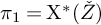 , the category
$\mathrm {rep}(\mathrm {U}_\zeta )$
 is equivalent to the category of
$\pi _1$
 -graded objects in
$\mathrm {rep}(\mathrm {U}_\zeta )'$
 . Thus, there is a decomposition
$Z(\mathrm {rep}(\mathrm {U}_\zeta ))=Z(\mathrm {rep}(\mathrm {U}_\zeta )')^{\oplus \pi _1}$
 . Hence, the obvious map
$Z(\mathrm {U}_\zeta )\to Z(\mathrm {rep}(\mathrm {U}_\zeta )')$
 yields a canonical map

Composing this map with the inverse Harish-Chandra homomorphism (3.8) we get an algebra homomorphism

In a similar way we define algebra homomorphisms

3.3.8 Central characters and blocks
We consider the central characters

of the standard modules
$\Delta (\mu )^\sharp _S$
 ,
$\mathrm {M}(\mu )_S$
 and
$\mathrm {V}(\lambda )_\zeta $
 , respectively, for
$\mu \in {\check {\Lambda }}$
 ,
$\lambda \in {\check {\Lambda }}^+$
 . Under the isomorphism
$Z_{\mathrm {HC}}=\mathbf {k}[{\check T}/W]$
 the central character
$\chi _{\zeta ,\lambda }$
 is identified with the point
$W(\zeta ^{2(\lambda +{\check \rho })})$
 in
${\check T}(\mathbf {k})/W$
 . The products of the central characters of all standard modules yield the maps

Similarly, for
$q_e=\zeta _e+\hbar $
 the central characters of the modules
$\mathrm {M}(\mu )_{S[[\hbar ]]}$
 and
$\mathrm {V}(\lambda )_{\hat \zeta }$
 yield the maps

Taking the product over all
$\mu $
 and
$\lambda $
 , we get the maps

The map
$\chi _{\hat \zeta }$
 is injective, because the category
$\mathrm {rep}(\mathrm {U}_{\hat \zeta })$
 is generically semi-simple, see §3.3.3. The map
$\chi ^{\mathrm {hb}}_{\hat \zeta }$
 is also injective, because the category
$\mathcal {O}^{{\mathrm {hb}}}_{q,F}$
 is semi-simple by Lemma 3.2 and
$Z(\mathcal {O}^{{\mathrm {hb}}}_{q,S[[\hbar ]]})\subset Z(\mathcal {O}^{{\mathrm {hb}}}_{q,F})$
 if F is the fraction field of
$S[[\hbar ]]$
 .
Let the algebra A be either
$\mathrm {U}_\zeta $
 ,
$\mathrm {u}_\zeta $
 ,
$\mathrm {U}^{{\mathrm {hb}},b}_\zeta $
 ,
$\mathrm {U}^{{\mathrm {hb}}}_\zeta $
 or
$\mathfrak {U}_\zeta ^\sharp $
 . Hence A receives a map from
$\mathfrak {U}_\zeta $
 which takes the Harish-Chandra centre
$Z_{\mathrm {HC}}$
 to the centre of A. The algebra
$Z_{\mathrm {HC}}$
 acts on the standard module
$\Delta ^A(\mu )$
 by the scalar multiplication with the character
$\chi _{\zeta ,\mu }^A$
 . Under the isomorphism
$Z_{\mathrm {HC}}=\mathbf {k}[{\check T}/W]$
 this central character is identified with the point
$W(\zeta ^{2(\mu +{\check \rho })})$
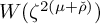 in
${\check T}(\mathbf {k})/W$
 . Hence, if the weights
$\mu $
 ,
$\mu '$
 do not belong to the same
$W_{\ell ,{\mathrm {ex}}}\bullet $
 -orbit, there are no non-trivial extensions between any homomorphic images of the standard modules of
$\Delta ^A(\mu )$
 and
$\Delta ^A(\mu ')$
 .
4 Centre and cohomology
In this section we relate the centre of the quantum groups to the cohomology of affine Springer fibres. To do so, we first fix a W-equivariant
$\mathbf {k}$
 -linear isomorphism
$\mathfrak {t}=\mathfrak {t}^*$
 . This yields the isomorphisms

Recall from §2.2.2 the
$[\ell ]$
 -th power map and the definition of the schemes
$\Omega $
 and
$\Gamma $
 . We have

This also yields scheme isomorphisms

Here, the subscript
$\widehat {1,0}$
 denotes the formal neighbourhoods at the points
$(1,0)$
 in
$T\times \mathbb {G}_a$
 and
${\check T}\times \mathbb {G}_a$
 respectively.
4.1 The centre of
$\mathfrak {U}_\zeta ^t$

We first concentrate on the centre of the algebra
$\mathfrak {U}_\zeta ^t$
 from (3.11). We will prove the following theorem.
Theorem 4.1.
-
(a) There is a commutative diagram of algebra homomorphisms
-
(b) The map $\mathbf {a}$
specializes to an algebra embedding $$ \begin{align*}\mathbf{a}:H^{\bullet}({}^0{{\mathcal{G}}{\mathfrak{r}} }^\zeta_{\gamma_\ell})\hookrightarrow Z(\mathrm{u}_\zeta \text{-}\mathrm{mod}^{\check{\Lambda}})\end{align*} $$
which restricts to an embedding $H^{\bullet }({}^0{{\mathcal {G}}{\mathfrak {r}} }^\zeta _{\gamma _\ell })^{\ell {\check {\Lambda }}}\hookrightarrow Z(\mathrm {u}_\zeta )^{\check T}.$




We propose the following conjecture:
Conjecture 4.2. The algebra embedding

is an isomorphism. As a consequence, it restricts to an isomorphism

Here the fact that the second isomorphism is a consequence of the first one follows from (4.11) below.
Remark 4.3. Since the map
$\mathbf {a}$
 in (a) is a ring isomorphism, it yields a bijection between the blocks of
$\mathfrak {U}_\zeta ^t \text{-}\mathrm {mod}^{\check {\Lambda }}_S$
 and the connected components of
${}^0{{\mathcal {G}}{\mathfrak {r}} }^\zeta _{\gamma _\ell }$
 . Let us briefly recall the block decomposition for the simply connected small quantum group
$\mathrm {u}_\zeta $
 . Note that [Reference Lachowska and Qi31] considered the adjoint small quantum group. For each restricted dominant weight
$\mu \in {\check {\Lambda }}^+_\ell $
 let
$\mathrm {rep}(\mathrm {u}_\zeta )^\mu $
 be the full subcategory of
$\mathrm {rep}(\mathrm {u}_\zeta )$
 generated by the simple modules
$\mathrm {L}(\mu ')$
 with
$\mu '\in W_{\ell ,{\mathrm {ex}}}\bullet \mu \cap {\check {\Lambda }}^+_\ell $
 . It is an indecomposable category that consists of all modules killed by some power of the character
$\chi _{\zeta ,\mu }$
 . Let
$\mathrm {u}_\zeta ^{\omega }\subset \mathrm {u}_\zeta $
 be the two-sided ideal such that
$\mathrm {rep}(\mathrm {u}_\zeta ^{\omega })=\mathrm {rep}(\mathrm {u}_\zeta )^{\omega }.$
 We have

The map
$\mathbf {a}:H^{\bullet }({}^0{{\mathcal {G}}{\mathfrak {r}} }^\zeta _{\gamma _\ell })^{\ell {\check {\Lambda }}}\to Z(\mathrm {u}_\zeta )^{\check T}$
 in (b) is compatible with the block decomposition, meaning that, under the decomposition
${}^0{{\mathcal {G}}{\mathfrak {r}} }^\zeta _{\gamma _\ell } =\bigsqcup _{\omega \in \Xi } {}^0\!{{\mathcal {F}}\ell }^{\omega }_{\ell ,\gamma _\ell }$
 in Lemma 2.6, it takes the summand
$H^{\bullet }({}^0\!{{\mathcal {F}}\ell }^{\omega }_{\ell ,\gamma _\ell })^{\ell {\check {\Lambda }}}$
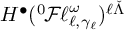 into
$Z(\mathrm {u}_\zeta ^{\omega })^{\check T}$
 . Note that the ring
$H^{\bullet }({}^0\!{{\mathcal {F}}\ell }^{\omega }_{\ell ,\gamma _\ell })^{\ell {\check {\Lambda }}}$
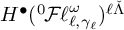 is indecomposable, although
$H^{\bullet }({}^0\!{{\mathcal {F}}\ell }^{\omega }_{\ell ,\gamma _\ell })$
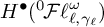 is not, since
${}^0\!{{\mathcal {F}}\ell }^{\omega }_{\ell ,\gamma _\ell }$
 is not connected.
4.1.1 The centre of
$\mathfrak {U}_\zeta ^t$

From now on, let
$\pi $
 , S, R, F, K be as in §3.3. We will abbreviate
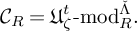
We first gather a few facts on the category
$\mathcal {C}_R$
 , most of which are proved in [Reference Andersen, Jantzen and Soergel1]. We will use the notation from the appendix. In particular
$\mathcal {P}_R$
 is the full subcategory of projective objects in
$\mathcal {C}_R$
 , we have the base change
$\mathcal {P}_S\to \mathcal {P}_R$
 ,
$M\mapsto M\otimes _SR$
 , and

Further
$\mathrm {Hom}_{\mathcal {C}_S}(M,N)$
 is projective over S whenever
$M\in \mathcal {P}_S$
 and N is projective over S. Hence, Lemmas A.1 and A.2 hold and we have an inclusion

For each root
$\alpha $
 , we abbreviate

If
$R=F$
 is a field, the set
${\check \Phi }_F$
 introduced in (3.18) is a root subsystem of
${\check \Phi }$
 . If R is a local ring with residue field F, we set
${\check \Phi }_R={\check \Phi }_F$
 and
${\check \Phi }_R^+={\check \Phi }^+\cap {\check \Phi }_R$
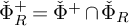 . Given
$\mu \in {\check {\Lambda }}$
 and
${\check \alpha }\in {\check \Phi }_R$
 , there is a unique integer
$n_{\alpha }(\mu )$
 such that, see [Reference Andersen, Jantzen and Soergel1, §6.1],

Let
$W_{\ell ,{\mathrm {af}}}^R\subset W_{\mathrm {af}}$
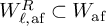 be the subgroup generated by the affine reflections
$s_{\alpha +m\ell \delta }$
 with
${\check \alpha }\in {\check \Phi }_R$
 and
$m\in \mathbb {Z}$
 . For each weight
$\mu \in {\check {\Lambda }}$
 , let
$\mathcal {C}_R^\mu $
 be the Serre subcategory of
$\mathcal {C}_R$
 generated by the baby Verma modules
$\Delta (\lambda )^t_R$
 with
$\lambda \in W_{\ell ,{\mathrm {af}}}^R\bullet \mu $
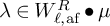 , and
$\mathcal {P}_R^\mu =\mathcal {P}_R\cap \mathcal {C}_R^\mu $
 . The categories
$\mathcal {C}^\mu _R$
 and
$\mathcal {P}_R^\mu $
 only depend on the class of the weight
$\mu $
 in
${\check {\Lambda }}/W^R_{\ell ,{\mathrm {af}}}$
 . They may not be indecomposable. We have

We define
$\alpha \downarrow \mu =\mu $
 whenever
$n_{\alpha }(\mu )=\ell $
 , and
$\alpha \downarrow \mu =\mu -n_{\alpha }(\mu ){\check \alpha }$
 whenever
$n_{\alpha }(\mu )\neq \ell $
 . Write
$\nu \preccurlyeq \mu $
 if there is a chain
$\nu =\mu _0,\mu _1,\ldots ,\mu _n=\mu $
 such that
$\beta _i\downarrow \mu _i=\mu _{i-1}$
 for some
$\beta _i\in \Phi ^+_R$
 . The strong linkage principle implies that

Hence, if
${\check \Phi }_F=\emptyset $
 the category
$\mathcal {C}_F$
 is semi-simple. For each
$\alpha \in \Phi ^+$
 we consider the S-algebra

Assume that
$R=S_{\alpha }$
 . The maximal ideal of R is generated by
$h_{\alpha }$
 . We have
${\check \Phi }_R^+=\{{\check \alpha }\}$
 . Set

The category
$\mathcal {C}_R^\mu $
 is generated by the set of modules
$\{\Delta (\mu _k)^t_R\,;\, k\in \mathbb {Z}\}$
 . We have
-
• if $n_{\alpha }(\mu )=\ell $
, then
$\mu _k=\mu $
for all k and
$\mathcal {P}_R^\mu $
is a sum of categories equivalent to
$\mathrm {Vect}(R)$
, -
• if $n_{\alpha }(\mu )\neq \ell $
, then
$\mu _{2k}=\mu +k\ell {\check \alpha }$
and
$\mu _{2k-1}=\mu +(k\ell -n_{\alpha }(\mu )){\check \alpha }$
for all k.




Let
$B_R$
 be the quotient of the path R-algebra of the quiver

modulo the following relations

Here
$1_k$
 is the idempotent at the vertex k. We have the following lemmas.
Lemma 4.4. Let
$R=S_{\alpha }$
 with
$\alpha \in \Phi ^+$
 such that
$n_{\alpha }(\mu )\neq \ell $
 . The category
$\mathcal {P}_R^\mu $
 is equivalent to the category of projective
$B_R$
 -modules. This equivalence takes the projective module
$\mathrm {P}(\mu _k)^t_R$
 to the
$B_R$
 -module
$B_R1_k$
 for each
$k\in \mathbb {Z}$
 .
Proof. Let R be an
$S_{\alpha }$
 -algebra. Then
${\check \Phi }_R^+\subset \{{\check \alpha }\}$
 and the maximal ideal of R is generated by
$h_{\alpha }$
 . By §A, the additive R-linear category
$\mathcal {P}_R^\mu $
 is equivalent to the category of all finitely generated projective modules M over the R-algebra

Let
$1_{k}$
 be the identity of
$\mathrm {P}(\mu _k)_R^t$
 . Then, we have
$M=\bigoplus _{k\in \mathbb {Z}}M1_{k}$
 for each M as above.
Let us first assume
$h_{\alpha }=0$
 and
$R=F$
 . By [Reference Andersen, Jantzen and Soergel1, §6.4], for all
$k\in \mathbb {Z}$
 we have exact sequences

We deduce that

Hence, up to a scalar, there are unique non-trivial morphisms

Moreover, we have
$i_{k+1}\circ i_k= j_{k}\circ j_{k+1}=0$
 and both
$j_{k}\circ i_k$
 and
$i_{k-1}\circ j_{k-1}$
 send the head of
$\mathrm {P}(\mu _k)_F^t$
 to its socle. Fix
$i_k$
 for all
$k\in \mathbb {Z}$
 and fix
$j_0$
 . There is a unique
$j_k$
 for each
$k\neq 0$
 such that
$j_{k}\circ i_k=i_{k-1}\circ j_{k-1}$
 for all
$k\in \mathbb {Z}$
 . Thus
$A(\mu )_F$
 is the F-algebra generated by
$1_k$
 ,
$i_k$
 ,
$j_k$
 modulo the relations (4.4).
Now, assume that
$h_{\alpha }\neq 0$
 . Then
$\Phi _K=\varnothing $
 ; hence the category
$\mathcal {C}_K^\mu $
 is semi-simple. We have

Given any element
$a\in A(\mu )_R$
 , let
$i^F_k$
 ,
$j^F_k$
 be a tuple of morphisms
$i_k$
 ,
$j_k$
 as above in the case
$R=F$
 that represents the residue of a in
$A(\mu )_F=A(\mu )_R\otimes _RF$
 . Since

we can pick

that lift the maps
$i^F_k$
 and
$j^F_k$
 . For any
$\lambda , \lambda '\in {\check {\Lambda }}$
 , the base change yields an injective map

We deduce that it is zero unless
$\lambda =\mu _k$
 and
$\lambda '=\mu _k, \mu _{k\pm 1}$
 and that

Now, write

By Nakayama’s lemma, the maps
$i_k$
 ,
$j_k$
 generate the free R-modules
$\mathrm {Hom}_{\mathcal {C}_R}(\mathrm {P}(\mu _k)_R^t,\mathrm {P}(\mu _{k+1})_R^t)$
 and
$\mathrm {Hom}_{\mathcal {C}_R}(\mathrm {P}(\mu _{k+1})_R^t,\mathrm {P}(\mu _k)_R^t)$
 , and
$\{1_k, x_k\}$
 ,
$\{1_k, y_k\}$
 are bases for the free R-module
$\mathrm {End}_{\mathcal {C}_R}(\mathrm {P}(\mu _k)_R^t)$
 . This yields a family of generators of
$A(\mu )_R$
 . We must compute the relations. Since
$x_k^F=y_k^F$
 , we have

So up to replacing
$j_k$
 by
$b_kj_k$
 , we may assume that
$b_k=1$
 . Composing both sides of (4.6) with
$i_{k-1}$
 , we get
$i_{k-1}j_{k-1}i_{k-1}=a_ki_{k-1}$
 . Composing both sides of (4.6) with
$i_k$
 , we get
$i_{k}j_{k}i_{k}=-a_{k}i_{k}$
 . We deduce
$a_ki_{k-1}=-a_{k-1}i_{k-1}$
 . Since
$i_{k-1}$
 generates the free R-module
$\mathrm {Hom}_{\mathcal {C}_R}(\mathrm {P}(\mu _{k-1})_R^t,\mathrm {P}(\mu _{k})^t_R)$
 , we have
$a_k=-a_{k-1}=(-1)^ka_0$
 . We claim that
$a_0\in h_{\alpha } R^{\times }$
 . Then, up to multiplying all
$i_k$
 ’s by an element in
$R^{\times }$
 , we get
$a_0=h_{\alpha }$
 , thus proving the relation

Now, we prove the claim. To do so, we consider the exact sequence

All the weights of
$\mathrm {P}(\mu _0)^t_R$
 are smaller than
$\mu _2$
 . Hence
$j_0(\Delta (\mu _2)^t_R)=0$
 and
$j_0$
 is the composed map

So
$x_0=j_0\circ i_0$
 is a morphism
$\mathrm {P}(\mu _0)^t_R\to \Delta (\mu _1)^t_R$
 . Its restriction to
$\Delta (\mu _1)^t_R$
 is an endomorphism of
$\Delta (\mu _1)^t_R$
 . It is the multiplication by an element
$a'\in R$
 . The base change

sends
$x_0$
 to
$(0, a')$
 . Similarly, the image of
$y_0$
 is of the form
$(a",0)$
 . We have

So it is enough to show that
$a'\in h_{\alpha } R^{\times }$
 , or equivalently
$a'\not \in h_{\alpha }^2 R$
 .
For this purpose, recall the contravariant duality functor
$\tau : \mathcal {C}_R\to \mathcal {C}_R$
 in [Reference Andersen, Jantzen and Soergel1, §4.5] whose specialization
$\tau _F:\mathcal {C}_F\to \mathcal {C}_F$
 fixes the simple module
$L(\lambda )^t_F$
 for all
$\lambda $
 . Since
$L(\lambda )^t_F$
 is both the socle and the head of
$\mathrm {P}(\lambda )^t_F$
 , it is also the socle and head of
$\mathrm {P}(\lambda )^{t,\tau }_F$
 . So there is an isomorphism
$\mathrm {P}(\lambda )^t_F\to \mathrm {P}(\lambda )^{t,\tau }_F$
 which is unique up to scalar. Since R is a complete local ring, this isomorphism lifts to an isomorphism
$\mathrm {P}(\lambda )^t_R\to \mathrm {P}(\lambda )_R^{t,\tau }$
 . Using such identifications, the contravariant duality
$\tau $
 yields an isomorphism

So
$i_0=j_0^\tau $
 up to a scalar in
$R^{\times }$
 . Hence
$i_0$
 vanishes on
$\Delta (\mu _0)^{t,\tau }_R$
 and it is the composed map

So
$x_0$
 factorizes as

where
$\phi $
 is the unique (up to scalar) map that specializes to
$\Delta (\mu _1)_F^{t,\tau }\to \Delta (\mu _1)_F^t$
 with image
$L(\mu _0)^t_F$
 . Note that the
$\mu _1$
 -weight spaces of
$\Delta (\mu _1)^{t,\tau }_R$
 and
$\Delta (\mu _1)^t_R$
 are both R, and the restriction of
$\phi $
 to both is multiplication by
$a'$
 . The Jantzen filtration on
$\Delta (\mu _1)_R^{t,\tau }$
 is

Since
$\Delta (\mu _1)^t_F$
 has length two, we have

Hence, the
$\mu _1$
 -weight space of
$\Delta (\mu _1)_R^{t,\tau }$
 is not contained in
$Z^2\Delta (\mu _1)_R^{t,\tau }$
 . Thus
$a'\not \in h_{\alpha }^2 R$
 . The claim is proved.
Lemma 4.5. Let
$R=S_{\alpha }$
 with
$\alpha \in \Phi ^+$
 .
-
(a) $ Z(\mathcal {C}_K)= \mathrm {Fun}({\check {\Lambda }},K)$
. The
$\lambda $
-th component is the central character of the module
$\Delta (\lambda )^t_K$
. -
(b) $ Z(\mathcal {C}_R)= \{ (a_\lambda )\in \mathrm {Fun}({\check {\Lambda }},R)\,;\, a_\lambda \equiv a_{\alpha \downarrow \lambda } \mathrm {mod} h_{\alpha }\}$
. -
(c) $ Z(\mathcal {C}_F)= Z(\mathcal {C}_R)\otimes _R F$
.





Proof. Since
${\check \Phi }_K=\varnothing $
 , the category
$\mathcal {C}_K$
 is semi-simple; hence we have

Let us concentrate on (b). For each integer k we consider the element

By Lemma 4.4, we have

Further, we have

An element in
$Z(\mathcal {C}_R^\mu )$
 is a tuple
$z=(z_k)$
 of morphisms
$z_k\in \mathrm {End}_{\mathcal {C}_R}(P(\mu _k)^t_R)$
 such that

Then we have

and the multiplication in the centre is given by

Since
$h_{\alpha }\neq 0$
 and R is a domain, the element z is uniquely determined by the tuple
$(a_k)$
 by (4.9). Thus the map
$Z(\mathcal {C}_R^\mu )\to R^{\mathbb {Z}}$
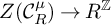 such that
$z\mapsto (a_k)$
 is an R-algebra embedding, whose image consists of the tuples
$(a_k)$
 such that
$a_k\equiv a_{k+1} \mathrm {mod} \ h_{\alpha }$
 for all k. To prove (c) it is enough to check that
$Z(\mathcal {C}_F)\subset Z(\mathcal {C}_R)\otimes _R F$
 . This is obvious because, by Lemma 4.4, an element in
$Z(\mathcal {C}_F^\mu )$
 is a tuple
$z=(z_k)$
 of morphisms
$z_k\in \mathrm {End}_{\mathcal {C}_F}(P(\mu _k)^t_F)$
 of the form
$z_k=a 1_k+b_k x_k$
 with
$a, b_k\in R$
 , and any such z is the specialization of an element of
$Z(\mathcal {C}_R^\mu )$
 .
Now, we consider the case
$R=S$
 .
Lemma 4.6. Let
$R=S$
 . We have
${\check \Phi }_S={\check \Phi }$
 . Further, the following hold.
-
(a) $ Z(\mathcal {C}_K)= \mathrm {Fun}({\check {\Lambda }},K)$
. The
$\lambda $
-th component is the central character of the module
$\Delta (\lambda )^t_K$
. -
(b) $ Z(\mathcal {C}_S)=\{ (a_\lambda )\in \mathrm {Fun}({\check {\Lambda }},S)\,;\, a_\lambda \equiv a_{\alpha \downarrow \lambda }\mathrm {mod} h_{\alpha },\ \forall \alpha \in \Phi ^+\}$
.




Proof. The endomorphisms of projective objects in
$\mathcal {C}_S$
 are torsion free over S and are the intersection of their localizations at all prime ideals associated with roots, see, e.g., [Reference Andersen, Jantzen and Soergel1, p. 8]. Hence, the centre
$Z(\mathcal {C}_S)$
 embeds in
$ Z(\mathcal {C}_K)$
 in the obvious way and Lemma A.2 implies that

Hence, Lemma 4.5 yields

the intersection being taken in
$\mathrm {Fun}({\check {\Lambda }},K)$
 via the obvious inclusions
$\mathrm {Fun}({\check {\Lambda }},S_{\alpha })\subset \mathrm {Fun}({\check {\Lambda }},K)$
 . Since
$S=\bigcap _{\alpha \in \Phi ^+} S_{\alpha }$
 , we recover Part (b) of the lemma.
Recall that

For each
$\omega \in \Xi $
 we set

Corollary 4.7. For each
$\omega \in \Xi $
 there is an S-algebra isomorphism
$Z(\mathcal {C}_S^{\omega })\to H^{\bullet }_T({}^0\!{{\mathcal {F}}\ell }_{\ell ,\gamma _\ell }^{\omega })_{\hat 0}$
 .
Proof. From (4.3) and Lemma 4.6 we deduce that

Further, we have

Thus, the lemma follows from Lemma 2.7.
4.1.2 Proof of Theorem 4.1
Part (a) follows from Lemma 2.6, the decomposition in (4.3) and Corollary 4.7. The map
$\chi _\zeta ^t$
 is injective because the category
$\mathcal {C}_K$
 is semi-simple by the strong linkage principle. Now, we prove (b). The ind-variety
${}^0{{\mathcal {G}}{\mathfrak {r}} }^\zeta _{\gamma _\ell }$
 is equivariantly formal. Hence, we have

Thus, the isomorphism
$\mathbf {a}$
 in (a) specializes to an isomorphism

Recall that for any S-algebra
$\mathrm {A}$
 that is finitely generated and projective as an S-module, we have

Applying this to the endomorphism algebra of a system of projective generators of
$\mathfrak {U}_\zeta ^t \text{-}\mathrm {mod}^{\check {\Lambda }}_S$
 , we get

The category
$\mathrm {u}_\zeta \text{-}\mathrm {mod}^{\check {\Lambda }}$
 is
$\ell {\check {\Lambda }}$
 -graded. Let
$\langle -\rangle $
 be the grading shift. We set

The
$\ell {\check {\Lambda }}$
 -graded category
$\mathrm {u}_\zeta \text{-}\mathrm {mod}^{\check {\Lambda }}$
 is equivalent to the
$\ell {\check {\Lambda }}$
 -graded category
$\mathrm {A} \text{-}\mathrm {mod}^{\ell {\check {\Lambda }}}$
 of all
$\ell {\check {\Lambda }}$
 -graded finite-dimensional
$\mathrm {A}$
 -modules. Since any element of
$Z(\mathrm {A})\cap \mathrm {A}[0]$
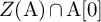 acts on any object in
$\mathrm {A} \text{-}\mathrm {mod}^{\ell {\check {\Lambda }}}$
 , we have an inclusion

The group
$\ell {\check {\Lambda }}$
 acts on the ring
$Z(\mathrm {u}_\zeta \text{-}\mathrm {mod}^{\check {\Lambda }})$
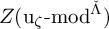 as in §A.3. The subring
$Z(\mathrm {A})\cap \mathrm {A}[0]$
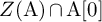 coincides with the ring of
$\ell {\check {\Lambda }}$
 -invariant elements, i.e.,

Forgetting the
$\ell {\check {\Lambda }}$
 -grading takes
$\mathrm {Q}$
 to a projective generator
$\bar {\mathrm {Q}}$
 of
$\mathrm {rep}(\mathrm {u}_\zeta )$
 with
$\mathrm {A}=\mathrm {End}_{\mathrm {u}_\zeta }(\bar {\mathrm {Q}})$
 . Thus

The group
${\check T}$
 acts on
$Z(\mathrm {u}_\zeta )$
 as in (3.10). Thus, we have

4.2 The centre of
$\boldsymbol{\mathcal {O}^{{\mathrm {hb}}}_{\zeta ,S}}$

The goal of this section is to prove the following proposition.
Proposition 4.8. There is a commutative diagram of algebra homomorphisms
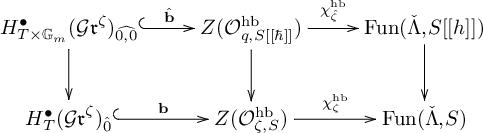
The composed maps
$\chi ^{\mathrm {hb}}_{\hat \zeta }\circ \hat {\mathbf {b}}$
 and
$\chi ^{\mathrm {hb}}_\zeta \circ \mathbf {b}$
 coincide with the restriction maps

in 2.3.2, up to a shift by
${\check \rho }$
 . In particular, they are injective.
Proof. By Proposition 2.5, to define the commutative diagram it is enough to construct the maps

Composing them with (2.27), we get the algebra homomorphisms

Now, we define the maps (4.12). The inverse Harish-Chandra isomorphism (3.24) yields an
$\mathcal {A}$
 -algebra homomorphism

The map (4.14) extends by
$S[[\hbar ]]$
 -linearity to an
$S[[\hbar ]]$
 -algebra homomorphism

We claim that (4.15) extends further to a map

Composing this map with the isomorphism (4.2) we get an algebra homomorphism

For any
$\mathbf {k}[[\hbar ]]$
 -algebra A that is torsion free as a
$\mathbf {k}[[\hbar ]]$
 -module, we have an inclusion

Thus, Lemma 3.6 implies that
$Z(\mathcal {O}^{\mathrm {hb}}_{q,S[[\hbar ]]})$
 is flat over
$\mathbf {k}[[\hbar ]]$
 and that

To prove the claim, by the same argument as in the proof of Lemma 2.3 we must check that (4.15) maps
$(I_{{\check \Gamma }})^{\oplus \pi _1}$
 into
$\hbar \,Z(\mathcal {O}^{{\mathrm {hb}}}_{q,S[[\hbar ]]})$
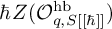 . To do so we specialize (4.15) to the point
$\hbar =0$
 . We get a map

Thus, we must check that the map (4.17) takes
$(I_{{\check \Gamma }})^{\oplus \pi _1}$
 to
$\{0\}$
 . Note that (4.17) factorizes through the inverse Harish-Chandra isomorphism (3.12) and the obvious map
$Z(\mathfrak {U}^b_\zeta )\to Z(\mathcal {O}^{\mathrm {hb}}_{\zeta ,S})$
 . Therefore the map (4.17) factorizes through the restriction
$\mathbf {k}[{\check T}\times {\check T}/W]^{\oplus \pi _1}_{\hat 1}\to \mathbf {k}[{\check \Gamma }]^{\oplus \pi _1}_{\hat 1}$
 , by definition of (3.12). Hence, it kills the ideal
$(I_{{\check \Gamma }})^{\oplus \pi _1}$
 , proving the claim.
We have defined the first map in (4.12). Using (4.16), the second map comes by specializing the first one. Now, we compare the composed maps
$\chi ^{\mathrm {hb}}_{\hat \zeta }\circ \hat {\mathbf {b}}$
 and
$\chi ^{\mathrm {hb}}_\zeta \circ \mathbf {b}$
 with the restriction maps. It is enough to consider the map
$\chi ^{\mathrm {hb}}_{\hat \zeta }\circ \hat {\mathbf {b}}$
 . The central character of the Verma module
$\mathrm {M}(\mu )_{S[[\hbar ]]}$
 in
$\mathcal {O}^{{\mathrm {hb}}}_{q,S[[\hbar ]]}$
 yields the map

such that
$g(t)\mapsto g(t^2q^{2(\mu +{\check \rho })})$
 . Thus, composing the map (4.15) with the
$Z(\mathcal {O}^{\mathrm {hb}}_{q,S[[\hbar ]]})$
 -action on
$\mathrm {M}(\mu )_{S[[\hbar ]]}$
 we get the map

By Lemma 2.3, the K-theoretic restriction to the point
$\delta _\mu $
 of the affine Grassmannian yields the map

Thus the composed map
$\chi ^{\mathrm {hb}}_{\hat \zeta }\circ \hat {\mathbf {b}}$
 coincides with the cohomological restriction
$\mathrm {res}$
 in Proposition 2.5 up to a shift by
${\check \rho }$
 . The maps
$\mathbf {b}$
 are injective because the restriction maps in (2.33) are injective.
Remark 4.9. In fact, the embedding of
$H^{\bullet }_T({{\mathcal {G}}{\mathfrak {r}} }^\zeta )_{\hat 0}$
 into
$Z(\mathcal {O}^{{\mathrm {hb}}}_{\zeta ,S})$
 is an isomorphism. A proof of this is given by Quan Situ in [Reference Situ37].
4.3 The centre of
$\boldsymbol{\mathrm {U}_\zeta }$

Proposition 4.10. There is an algebra homomorphism

that specializes to an algebra homomorphism

Proof. The inverse Harish-Chandra homomorphism (3.8) yields a map

Its fibre at
$\hbar =0$
 is the inverse Harish-Chandra homomorphism
$\mathbf {k}[{\check T}/W]\to Z(\mathrm {U}_\zeta )$
 . Recall that

We claim that
$\overline {\mathbf {h}\mathbf {c}}(I_{{\check \Omega }})\subset \hbar \,Z(\mathrm {U}_{\hat \zeta }).$
 Thus, by (4.2) the map (4.19) extends to an algebra homomorphism

Taking the fibre at
$\hbar =0$
 , we get the map
$\mathbf {c}$
 . To prove the claim, we compose (4.19) with the specialization to
$\hbar =0$
 . We get a map

Since
$Z(\mathrm {U}_q)$
 is
$\mathbf {A}$
 -flat, we have the inclusion

Thus, it is enough to check that (4.20) maps the ideal
$I_{\check \Omega }$
 to
$\{0\}$
 . To do so, we will prove that the inverse Harish-Chandra map
$\overline {\mathbf {h}\mathbf {c}}$
 takes the ideal
$I_{\check \Omega }$
 into
$\mathfrak {U}_{\hat \zeta }\cap \hbar \,\mathrm {U}_{\hat \zeta }.$
 This follows from the factorization of the map
$\overline {\mathbf {h}\mathbf {c}}$
 as the composition of a chain of maps

Now we prove that
$\mathbf {c}$
 maps into
$Z(\mathrm {u}_\zeta )^{\check G}$
 . To do so, by (3.10) it is enough to prove that

To do that, we use another construction of the inverse Harish-Chandra map using the universal R-matrix of
$\mathscr {U}_q$
 . For each dominant weight
$\mu \in {\check {\Lambda }}^+$
 , let
$\varphi _{\mu }$
 be the character of the Weyl module
$\mathrm {V}(\mu )_\zeta $
 and
$\psi _\mu $
 the character of the simple module
$\mathrm {D}(\ell \mu )_\zeta ={\mathrm {Fr}}^*(\mathrm {V}(\mu )_1)$
 . We consider the normalized characters that are defined as follows

The algebra
$\mathbf {k}[{\check T}/W]$
 is generated by the characters
$\varphi _\mu $
 , and the ideal
$I_{\check \Omega }$
 by the normalized characters
$\bar \psi _\mu $
 . Let R be the universal R-matrix of
$\mathscr {U}_q$
 . Given a finite-dimensional
$\mathrm {U}_q$
 -module M we define the element
$z_{q,M}\in \mathscr {U}_q$
 by

The subscript
$21$
 indicates the flip of the factors. The symbol
$\mathrm {Tr}_M$
 stands for the trace of M, viewed as a linear form on
$\mathrm {U}_q$
 . The notation above means applying the linear form
$\mathrm {Tr}_M$
 to the second factor of the element
$R_{21}R(1\otimes K_{2{\check \rho }})$
 in the completed tensor product
$\mathscr {U}_q\hat \otimes \mathscr {U}_q$
 . Since
$z_{q,M}$
 and
$\mathrm {Tr}_M$
 only depend on the character
$\varphi _M$
 of M, we may write
$z_{q,\varphi _M}=z_{q,M}$
 and
$\mathrm {Tr}_{\varphi _M}=\mathrm {Tr}_M$
 . The element
$z_{q,\mu }=z_{q,\bar \psi _\mu }$
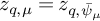 in
$\mathscr {U}_q$
 is well-defined. It was observed by Drinfeld that this element is central. The formula for R implies that
$z_{q,\mu }$
 belongs to
$Z(\mathrm {U}_q)$
 , see, e.g., [Reference Chari and Pressley17, §8.3]. Let
$z_{\hat \zeta ,\mu }$
 be its image in
$Z(\mathrm {U}_{\hat \zeta })$
 . We have

see, e.g., [Reference Baumann7, prop. 5]. To prove (4.21), we must check the following:

Recall that
$R=\Theta \cdot A$
 where
$\Theta $
 is the quasi-R-matrix. This quasi-R-matrix takes the following form

where the products run over all positive roots in a fixed order, and A is the linear operator such that

whenever
$v_i$
 is a weight
$\mu _i$
 element of an integrable
$\mathscr {U}_q$
 -module for each
$i=1,2$
 . We will write
$\ell \mid n$
 if and only if
$n\in (\ell \mathbb {N})^{{\check \Phi }^+}$
 . Write

We decompose accordingly
$z_{\hat \zeta ,\mu }=z_{\hat \zeta ,\mu }^{(\ell )}+z_{\hat \zeta ,\mu }^{(\ell ')}+z_{\hat \zeta ,\mu }^{(0)}.$
 Let
$\lambda _n$
 be the weight of the monomial
$E^n$
 and
$a_\lambda $
 be the projection to the weight
$\lambda $
 subspace. We have
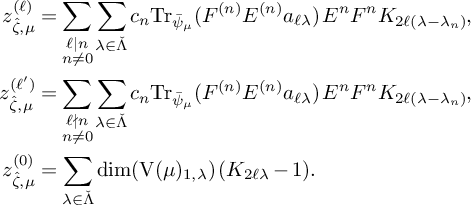
We deduce that
$z_{\hat \zeta ,\mu }^{(\ell )}$
 belongs to
$\hbar ^2\mathrm {U}_{\hat \zeta }$
 . Using (3.9) we deduce also that
$z_{\hat \zeta ,\mu }^{(\ell ')}$
 belongs to
$\hbar \,\mathfrak {U}_{\hat \zeta }$
 . Further
$z_{\hat \zeta ,\mu }^{(0)}$
 is the image of the normalized character
$\bar \varphi _\mu $
 by the map
$f(e^\lambda )\mapsto f(K_{2\ell \lambda })$
 . Since
$\bar \varphi _\mu $
 belongs to the square of the maximal ideal of 1 in
$\mathbf {k}[{\check T}]$
 , we deduce that
$z_{\hat \zeta ,\mu }^{(0)}$
 belongs to
$\hbar ^2\mathrm {U}_{\hat \zeta }$
 , proving the proposition.
Corollary 4.11. There is a commutative diagram of algebra homomorphisms
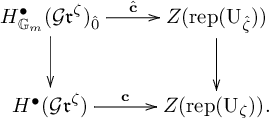
Proof. Composing the inverse Harish-Chandra homomorphism (4.19) with the map (3.22) yields an algebra homomorphism

By Proposition 4.10 it extends to an algebra homomorphism

Taking the fibre at
$\hbar =0$
 , we get the map
$\mathbf {c}$
 .
4.4 The compatibility theorem
In this section we put together the geometric constructions of the centres of
$\mathfrak {U}_\zeta ^t$
 ,
$\mathrm {U}_\zeta $
 and
$\mathcal {O}_{\zeta ,S}^{\mathrm {hb}}$
 . First, we compare the maps
$\mathbf {b}$
 and
$\mathbf {c}$
 .
Proposition 4.12. There are commutative diagrams of algebra homomorphisms
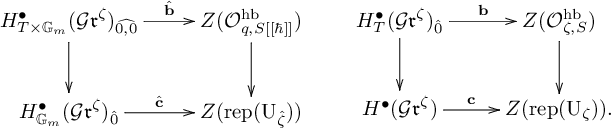
Proof. The left vertical maps in both diagrams are the specialization maps at 0 in
$\mathfrak {t}$
 . The right vertical maps are given by the composition of the specialization
$S\to \mathbf {k}$
 and
$Z(\mathrm {I}^{\mathrm {U}}_{\mathrm {hb}})$
 , where
$Z(\mathrm {I}^{\mathrm {U}}_{\mathrm {hb}})$
 denotes the maps associated with the quotient functors

as in (A.1). To prove the proposition, it is enough to prove that the following triangle commutes

where
$\hat {\mathbf {b}}$
 denotes the specialization of the map
$\hat {\mathbf {b}}$
 in the proposition. Note that the morphisms
$\mathbf {b}$
 ,
$\mathbf {c}$
 are defined via the maps

which are generically equal to the inverse Harish-Chandra map. We consider the following diagram
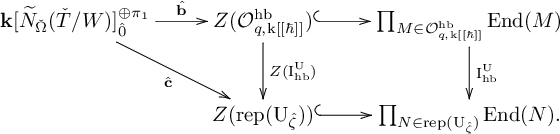
The right horizontal arrows are given by the action of the centre on the corresponding objects. The right square is commutative by (A.2). The external diagram commutes because both maps from
$\mathbf {k}[\widetilde N_{{\check \Omega }}({\check T}/W)]^{\oplus \pi _1}_{\hat {0}}$
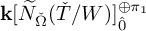 to
$\prod _{N\in \mathrm {rep}(\mathrm {U}_{\hat \zeta })}\mathrm {End}(N)$
 are generically given by the central action via the inverse Harish-Chandra map.
Now, let us proceed to the last main result of the paper. In Theorem 4.1 and Corollary 4.11 we constructed the ring homomorphisms

Recall that restriction yields a
$\pi _1$
 -equivariant ring homomorphism
$i^\ast : H^{\bullet }({{\mathcal {G}}{\mathfrak {r}} }^\zeta )\to H^{\bullet }({}^0{{\mathcal {G}}{\mathfrak {r}} }^\zeta _{\gamma _\ell })^{W_{\ell ,{\mathrm {af}}}}$
 , see (2.35). These maps together with the obvious embedding
$Z(\mathrm {u}_\zeta )^{\check G}\subset Z(\mathrm {u}_\zeta )^{\check T}$
 fit into a commutative diagram.
Theorem 4.13. There is a commutative diagram of algebra homomorphisms
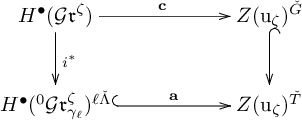
The map
$\mathbf {a}$
 is W-equivariant. The morphisms are compatible with the block decompositions.
Proof. We need to show
$\mathbf {a}\circ i^\ast =\mathbf {c}$
 . This will be given in several steps.
Step 1: We first construct a morphism
$\phi $
 such that the diagram (4.26) below commutes. By Theorem 4.1 and Proposition 4.8, we have a commutative diagram of S-algebras

Let
$Z(\mathcal {O}^{{\mathrm {hb}}}_{\zeta ,S})'$
 be the image of the map
$\mathbf {b}$
 . There is a unique algebra morphism
$\phi _S$
 that fits into the following commutative diagram

Now, we apply the base change functor
$-\otimes _S\mathbf {k}$
 to the diagram (4.25). By the equivariant formality of the ind-schemes
${{\mathcal {G}}{\mathfrak {r}} }^\zeta $
 and
${}^0{{\mathcal {G}}{\mathfrak {r}} }^\zeta _{\gamma _\ell }$
 , the restriction
$H^{\bullet }_T({{\mathcal {G}}{\mathfrak {r}} }^\zeta )\to H^{\bullet }_T({}^0{{\mathcal {G}}{\mathfrak {r}} }^\zeta _{\gamma _\ell })$
 specializes to the restriction
$H^{\bullet }({{\mathcal {G}}{\mathfrak {r}} }^\zeta )\to H^{\bullet }({}^0{{\mathcal {G}}{\mathfrak {r}} }^\zeta _{\gamma _\ell })$
 . Its image is contained in the
$\ell {\check Q}$
 -invariant part by (2.35). On the centre side, we have a morphism
$Z(\mathfrak {U}_\zeta ^t \text{-}\mathrm {mod}^{\check {\Lambda }}_S)\otimes _S\mathbf {k}\to Z(\mathrm {u}_\zeta \text{-}\mathrm {mod}^{\check {\Lambda }})$
 . Set
$Z(\mathcal {O}^{{\mathrm {hb}}}_\zeta )'=Z(\mathcal {O}^{{\mathrm {hb}}}_{\zeta ,S})'\otimes _S\mathbf {k}$
 and
$\phi =\phi _S\otimes _S\mathbf {k}$
 . The base change yields the following commutative diagram

Note that all the maps in the square above are
$\pi _1$
 -equivariant. Moreover, we have

Further, the image of
$\mathbf {a}$
 is contained in
$Z(\mathrm {u}_\zeta \text{-}\mathrm {mod}^{\check {\Lambda }})^{\ell {\check Q}}$
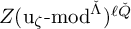 , whose
$\pi _1$
 -invariant part is
$Z(\mathrm {u}_\zeta \text{-}\mathrm {mod}^{\check {\Lambda }})^{\ell {\check {\Lambda }}}=Z(\mathrm {u}_\zeta )^{\check T}$
 by (4.11). So taking the
$\pi _1$
 -invariants we get

Step 2: In order to compare
$\phi \circ \mathbf {b}$
 with
$\mathbf {c}$
 , we will express
$\phi $
 in other terms. For this purpose, we first construct a morphism of functors

as follows. Recall the unit
$\eta : 1\to \mathrm {R}^{\mathrm {hb}}_{\mathrm {U}}\circ \mathrm {I}^{\mathrm {U}}_{\mathrm {hb}}$
 considered in Corollary 3.7. Composing both sides with
$\mathrm {R}^{\mathrm {u}}_b\circ \mathrm {R}^b_{\mathrm {hb}}$
 , we get a morphism

Since the composed morphism
$\mathfrak {U}^b_\zeta \to \mathrm {U}^{{\mathrm {hb}}}_\zeta \to \mathrm {U}_\zeta $
 factorizes through
$\mathfrak {U}^b_\zeta \twoheadrightarrow \mathrm {u}_\zeta \hookrightarrow \mathrm {U}_\zeta $
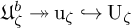 , we have an isomorphism of functors
$\mathrm {R}^{\mathrm {u}}_b\circ \mathrm {R}^b_{\mathrm {hb}}\circ \mathrm {R}_{\mathrm {U}}^{\mathrm {hb}}=\mathrm {R}^{\mathrm {u}}_{\mathrm {U}}$
 . So

yielding the morphism
$\xi $
 . The proof of the following lemma is postponed to the end of the section.
Lemma 4.14. For each projective module
$P\in \mathrm {rep}(\mathrm {u}_\zeta )$
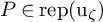 there is a module
$P^{\mathrm {hb}}$
 in
$\mathcal {O}^{\mathrm {hb}}_\zeta $
 such that
$\xi (P^{\mathrm {hb}})$
 is an isomorphism and both modules
$\mathrm {R}^{\mathrm {u}}_b\mathrm {R}^b_{\mathrm {hb}}(P^{\mathrm {hb}})$
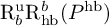 and
$\mathrm {R}^{\mathrm {u}}_{\mathrm {U}}\mathrm {I}^{\mathrm {U}}_{\mathrm {hb}}(P^{\mathrm {hb}})$
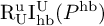 are isomorphic to P.
Choose P to be a projective generator of
$\mathrm {rep}(\mathrm {u}_\zeta )$
 . We will abbreviate
$P_b=\mathrm {R}^{\mathrm {u}}_b\mathrm {R}^b_{\mathrm {hb}}(P^{\mathrm {hb}})$
 and
$P_{\mathrm {U}}=\mathrm {R}^{\mathrm {u}}_{\mathrm {U}}\mathrm {I}^{\mathrm {U}}_{\mathrm {hb}}(P^{\mathrm {hb}}).$
 The conjugation by
$\xi (P^{\mathrm {hb}})$
 yields an algebra isomorphism
$c_\xi :\mathrm {End}(P_b)\to \mathrm {End}(P_{\mathrm {U}})$
 .
Step 3: Now, we show that the following diagram commutes

Here
$\mathrm {can}$
 ,
$\mathrm {can}_b$
 are the natural morphisms given by the action of the centre on objects in the corresponding categories. The commutativity of the right triangle in the diagram is given by the definition of
$c_\xi $
 .
Let us prove the commutativity of the left square. To achieve this, we use a deformation argument. Fix a module
$P_S$
 in
$\mathfrak {U}^t_\zeta \text{-}\mathrm {mod}^{\check {\Lambda }}_S$
 which specializes to the projective generator P. The proof of Lemma 4.14 (see below) implies that there is a module
$P_S^{\mathrm {hb}}$
 in
$\mathcal {O}^{\mathrm {hb}}_{\zeta ,S}$
 which specializes to
$P^{\mathrm {hb}}$
 and such that
$\mathrm {R}^t_b\mathrm {R}^b_{\mathrm {hb}}(P^{\mathrm {hb}}_S)$
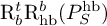 is isomorphic to
$P_S$
 . Thus we have the following diagram, which specializes to (4.27)

It is enough to prove that (4.28) commutes. This follows from the commutativity of the diagram (4.24).
Step 4: We show the diagram

commutes. Here
$\mathrm {can}_{\mathrm {U}}$
 is again the natural one given by the central action. It is injective because
$P_{\mathrm {U}}$
 is a projective generator for
$\mathrm {u}_\zeta \text{-}\mathrm {mod}$
 .
To this end, we decompose the diagram as follows

The upper square commutes by §A.2, the triangle commutes by Proposition 4.12 and the lower square commutes because
$\mathrm {R}^{\mathrm {u}}_{\mathrm {U}}$
 is a restriction functor.
Step 5: We can now complete the proof. Using subsequently Steps 4, 3 and 1, we get
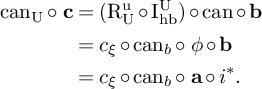
Now, since
$\xi (P^{\mathrm {hb}})$
 is a morphism of
$\mathrm {u}_\zeta $
 -modules, it intertwines the
$Z(\mathrm {u}_\zeta )$
 -action. Hence
$c_\xi \circ \mathrm {can}_b=\mathrm {can}_{\mathrm {U}}.$
 We deduce
$\mathrm {can}_{\mathrm {U}}\circ \,\mathbf {c}=\mathrm {can}_{\mathrm {U}}\circ \,\mathbf {a}\circ i^\ast .$
 But
$\mathrm {can}_{\mathrm {U}}$
 is injective, hence
$\mathbf {c}=\mathbf {a}\circ i^\ast $
 . The proof of the theorem is complete.
Proof of Lemma 4.14. The Steinberg module
$\mathrm {St}^{\mathrm {hb}}$
 in
$\mathcal {O}^{\mathrm {hb}}_\zeta $
 is the standard module
$\mathrm {M}(\ell {\check \rho }-{\check \rho })$
 . We first observe that the morphism

is invertible and that both
$\mathrm {R}^{\mathrm {u}}_b\mathrm {R}^b_{\mathrm {hb}}(\mathrm {St}^{\mathrm {hb}})$
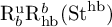 and
$\mathrm {R}^{\mathrm {u}}_{\mathrm {U}} I^{\mathrm {U}}_{\mathrm {hb}}(\mathrm {St}^{\mathrm {hb}})$
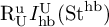 are isomorphic to the Steinberg module
$\mathrm {St}^{\mathrm {u}}$
 in
$\mathrm {rep}(\mathrm {u}_\zeta )$
 . To prove this, note that, for each
$M\in \mathcal {O}^{\mathrm {hb}}_\zeta $
 , the module
$\mathrm {I}^{\mathrm {U}}_{\mathrm {hb}}(M)$
 is the maximal quotient of M such that the
$\mathrm {U}^{\mathrm {hb}}_\zeta $
 -action on M lifts to a
$\mathrm {U}_\zeta $
 -action, and that
$\mathrm {R}^{\mathrm {u}}_{\mathrm {U}}\mathrm {I}^{\mathrm {U}}_{\mathrm {hb}}(M)=\mathrm {I}^{\mathrm {U}}_{\mathrm {hb}}(M)$
 as a vector space. On the other hand,
$\mathrm {R}^{\mathrm {u}}_b\mathrm {R}^b_{\mathrm {hb}}(M)$
 is canonically isomorphic to
$M\otimes _{\mathbf {k}[B^-]}\mathbf {k}$
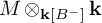 as a vector space. Thus
$\xi (M)$
 can be viewed as a surjective linear map

Under this identification, the morphism
$\xi (\mathrm {St}^{\mathrm {hb}})$
 is a surjective linear map

Since the Weyl module above is generated by a highest-weight vector
$v_{\ell {\check \rho }-{\check \rho }}$
 , modulo the subspace spanned by the elements
$xv_{\ell {\check \rho }-{\check \rho }}$
 where x is any monomial in the
$F_{\check \alpha }^{(n\ell )}$
 ’s with n a positive integer and
${\check \alpha }$
 a positive root, the map
$\xi (\mathrm {St}^{\mathrm {hb}})$
 is invertible.
Next, note that the categories
$\mathrm {rep}(\mathrm {u}_\zeta )$
 ,
$\mathfrak {U}^b_\zeta \text{-}\mathrm {mod}^{\check {\Lambda }}_S$
 ,
$\mathcal {O}^{\mathrm {hb}}_\zeta $
 are module categories over the tensor category
$\mathrm {rep}(\mathrm {U}_\zeta )$
 , with the action given by the tensor product. The functors
$\mathrm {R}^{\mathrm {u}}_b$
 ,
$\mathrm {R}^b_{\mathrm {hb}}$
 and
$\mathrm {R}^{\mathrm {u}}_{\mathrm {U}}$
 naturally commute with tensor products, because they are either the specialization or the pullback along some algebra homomorphisms. The functor
$I^{\mathrm {U}}_{\mathrm {hb}}$
 also commutes with tensor products by Corollary 3.7. From the description of the morphism
$\xi $
 above, we deduce that for each module
$V\in \mathrm {rep}(\mathrm {U}_\zeta )$
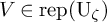 , the following diagram commutes

We deduce that the morphism
$\xi (Q)$
 is invertible for each direct summand Q of
$\mathrm {St}^{\mathrm {hb}}\otimes V$
 . The lemma follows because any projective module in
$\mathrm {rep}(\mathrm {u}_\zeta )$
 is a direct factor of
$\mathrm {St}^{\mathrm {u}}\otimes V$
 for some integrable
$\mathrm {U}_\zeta $
 -module V, see, e.g., [Reference Andersen, Polo and Wen3, rem. 4.7].
The image of
$i^\ast $
 is contained in the
$W_{\ell ,{\mathrm {af}}}$
 -invariant part of the target by (2.35). By Corollary 2.10, in type A the image of
$i^\ast $
 is indeed equal to
$H^{\bullet }({}^0{{\mathcal {G}}{\mathfrak {r}} }^\zeta _{\gamma _\ell })^{W_{\ell ,{\mathrm {ex}}}}$
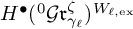 . Thus the theorem implies the following result.
Corollary 4.15. In type A, the morphism
$\mathbf {a}$
 restricts to an algebra embedding

The corollary above is motivated by a conjecture of Bezrukavnikov-Qi-Shan-Vasserot, which claims that, in type A, there should be an algebra isomorphism
$H^{\bullet }({{\mathcal {F}}\ell }_\gamma )^{\check {\Lambda }}\to Z(\mathrm {u}_\zeta ^0)$
 . We extend it to the following conjecture.
Conjecture 4.16. The morphism
$\mathbf {a}$
 restricts to an isomorphism

The centre of a category
This section is a short review of a few facts on categories linear over a commutative domain S. See [Reference Andersen, Jantzen and Soergel1] for more details. Let
$\mathbf {k}$
 be a field and S be a
$\mathbf {k}$
 -algebra that is a commutative Noetherian integral domain. Let K be the fraction field of S. All categories are assumed to be small and
$\mathbf {k}$
 -linear. All functors are
$\mathbf {k}$
 -linear. The centre
$Z(\mathcal {C})$
 of a category
$\mathcal {C}$
 is the endomorphism ring of the identity functor. An element
$z\in Z(\mathcal {C})$
 may be viewed as a tuple
$z=(z_M)$
 of compatible endomorphisms
$z_M\in \mathrm {End}_{\mathcal {C}}(M)$
 for each object M in
$\mathcal {C}$
 .
A.1
Let
$\mathcal {C}_S$
 be an abelian S-linear category,
$\mathcal {P}_S$
 be the full subcategory of all compact projective objects in
$\mathcal {C}_S$
 . Let
$\mathrm {P}_S$
 be a faithful set of objects in
$\mathcal {P}_S$
 , i.e., the functor
$\prod _{P\in \mathrm {P}_S}\mathrm {Hom}_{\mathcal {C}_S}(P,-)$
 is faithful. Consider the associative S-algebra

The multiplication is the opposite of morphism compositions in
$\mathcal {P}_S$
 . The S-algebra
$A_S$
 is locally unital and the set
$\{1_P\in \mathrm {End}_{\mathcal {C}_S}(P)\,;\,P\in \mathrm {P}_S\}$
 is a complete set of mutually orthogonal idempotents. We will assume that the category
$\mathcal {P}_S$
 is Schurian, i.e., the S-module
$1_P A_S1_Q$
 is projective of finite rank for all P, Q, and that the functor
$\bigoplus _{P\in \mathrm {P}_S}\mathrm {Hom}_{\mathcal {P}_S}(P,-)$
 is an equivalence from
$\mathcal {C}_S$
 to the category of all left
$A_S$
 -modules B such that
$B=\bigoplus _{P\in \mathrm {P}_S}1_P B$
 . Under this equivalence, the full subcategory
$\mathcal {C}^{fg}_S$
 of all compact objects of
$\mathcal {C}_S$
 is taken to
$A_S \text{-}\mathrm {mod}$
 , and the category
$\mathcal {P}_S$
 is taken to the category
$A_S$
 -
$\mathrm {proj}$
 of all projective modules in
$A_S \text{-}\mathrm {mod}$
 .
Lemma A.1. The restriction yields an S-algebra isomorphism
$Z(\mathcal {C}_S)\to Z(\mathcal {P}_S)$
 .
Proof. We must check that the obvious projection
$\prod _{M\in \mathcal {C}_S}\mathrm {End}_{\mathcal {C}_S}(M)\to \prod _{P\in \mathcal {P}_S}\mathrm {End}_{\mathcal {P}_S}(P)$
 restricts to an isomorphism of R-algebras
$\mathrm {Z}(\mathcal {C}_S)\to \mathrm {Z}(\mathcal {P}_S).$
 The projection restricts to an S-algebra morphism on the centres. To see it is an isomorphism, note that any object
$M\in \mathcal {C}_S$
 fits into an exact sequence

with
$P_0$
 ,
$P_1$
 projective. An element
$z\in \mathrm {Z}(\mathcal {P}_S)$
 gives endomorphisms
$z_{P_0}$
 ,
$z_{P_1}$
 intertwined by
$d_1$
 . So there exists a unique endomorphism
$z_M\in \mathrm {End}_{\mathcal {C}_S}(M)$
 such that
$d_0$
 intertwines
$z_{P_0}$
 and
$z_M$
 . This shows that an element in
$\mathrm {Z}(\mathcal {P}_S)$
 extends uniquely to an element in
$\mathrm {Z}(\mathcal {C}_S)$
 .
Now, let R be an S-algebra that is a commutative Noetherian integral domain. Let
$\mathcal {P}_R$
 be the idempotent completion of the R-linear category with the same set of objects as
$\mathcal {P}_S$
 and with the morphisms
$\mathrm {Hom}_{\mathcal {P}_R}(M,N)=\mathrm {Hom}_{\mathcal {P}_S}(M,N)\otimes _SR$
 . We write
$M\otimes _SR$
 for M viewed as an object of
$\mathcal {P}_R$
 . Since the category
$\mathcal {P}_S$
 is Schurian, the category
$\mathcal {P}_R$
 is Schurian as well. For each prime ideal
$\mathfrak {p}\subset S$
 , and for each S-module M, let
$S_{\mathfrak {p}}$
 and
$M_{\mathfrak {p}}$
 be the localizations of S and M at the ideal
$\mathfrak {p}$
 . The obvious embedding

yields the inclusions

Let
$\mathfrak {P}$
 be a set of prime ideals in S such that
$\mathrm {End}(M)=\bigcap _{\mathfrak {p}\in \mathfrak {P}}\mathrm {End}(M_{\mathfrak {p}})$
 for any object
$M\in \mathcal {P}_S$
 . For example, the set of all prime ideals of codimension one in S satisfies this condition. The following lemma holds.
Lemma A.2. We have
$Z(\mathcal {C}_S)=\bigcap _{\mathfrak {p}\in \mathfrak {P}}Z(\mathcal {P}_{S_{\mathfrak {p}}})$
 as S-subalgebras of
$Z(\mathcal {P}_K)$
 .
Proof. We have the following Cartesian diagram

where all the arrows are inclusions. The lower horizontal arrow is bijective, because

Thus, the top arrow is also bijective.
A.2
Let
$(D,E)$
 be a pair of adjoint functors with
$D:\mathcal {C}\to \mathcal {D}$
 and
$E:\mathcal {D}\to \mathcal {C}$
 . Assume further that the co-unit
$\varepsilon :ED\to 1$
 is invertible, i.e., the functor E is a quotient functor. Then, we have a map

Further, for each object
$M\in \mathcal {D}$
 the following square is commutative, where the horizontal maps are given by the action of the centre on M and
$E(M)$
 ,

A.3
Let
$\Lambda $
 be any abelian group. By a
$\Lambda $
 -graded category we mean a category
$\mathcal {C}$
 along with a collection of shift functors
$M\mapsto M\langle \lambda \rangle $
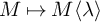 for each
$\lambda \in \Lambda $
 such that
$\langle 0\rangle =\mathrm {id}$
 , with isomorphisms of functors
$\langle \lambda \rangle \circ \langle \mu \rangle =\langle \lambda +\mu \rangle $
 for each
$\lambda $
 ,
$\mu $
 . If
$\mathcal {C}$
 is
$\Lambda $
 -graded, then the maps
$Z(\langle \lambda \rangle )\in \mathrm {End}(Z(\mathcal {C}))$
 as
$\lambda $
 varies in
$\Lambda $
 define an action of the group
$\Lambda $
 on
$Z(\mathcal {C})$
 by ring automorphisms.
A geometric approach to the map
$\mathbf {c}$

In this section we give another approach to defining the morphism

In order to be able to use Frobenius weights, we extend the previous setting and consider the groups and varieties above over both fields
$\mathbb {F}$
 and
$\mathbf {k}$
 , where
$\mathbf {k}=\bar {\mathbb {Q}}_l$
 and
$\mathbb {F}$
 is an algebraic closure
$\bar {\mathbb {F}}_q$
 of a finite field of characteristic p that is large enough and prime to l. Let
${}^0\mathcal {I}$
 be the pro-unipotent radical of the Iwahori group
$\mathcal {I}$
 . Let
$D^b_{m,{}^0\mathcal {I}}({{\mathcal {G}}{\mathfrak {r}} })$
 be the
${}^0\mathcal {I}$
 -equivariant derived category of mixed complexes of l-adic sheaves on the affine Grassmannian
${{\mathcal {G}}{\mathfrak {r}} }$
 . Let
$D^b_{m,IW}({{\mathcal {F}}\ell })$
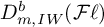 be the Iwahori-Whittaker derived category of mixed complexes of l-adic sheaves on the affine flag manifold
${{\mathcal {F}}\ell }$
 . Let
$(1/2)$
 denote half the Tate twist and
$\langle 1\rangle =[1](1/2)$
 . Forgetting the mixed structures we get the categories
$D^b_{{}^0\mathcal {I}}({{\mathcal {G}}{\mathfrak {r}} })$
 and
$D^b_{IW}({{\mathcal {F}}\ell })$
 . According to [Reference Bezrukavnikov and Yun11], there is an equivalence of categories

which intertwines
$(-1/2)$
 on the left-hand side with
$\langle 1\rangle $
 on the right-hand side. Since the cohomology of the affine flag manifold
${{\mathcal {F}}\ell }$
 is pure, we have a graded vector space morphism

Composing it with the degrading functor

we get a map

By [Reference Arkhipov, Bezrukavnikov and Ginzburg5] there is an equivalence of triangulated categories

Composing the maps in (B.3) and (B.4), we get an algebra homomorphism

One may also use the Kazhdan-Lusztig equivalence and the Kashiwara-Tanisaki localization theorem instead of [Reference Arkhipov, Bezrukavnikov and Ginzburg5] to define the map
$\mathbf {c}'$
 . One can check that
$\mathbf {c}'=\mathbf {c}|_{H^{\bullet }({{\mathcal {F}}\ell })}$
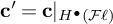 . We will not do it here.
Acknowledgement
The initial stage of this project was based on several discussions with Qi You. We would like to thank him for all the helpful discussions.



