Introduction
Delirium is a cognitive-behavioral syndrome seen in 11%–42% (Siddiqi et al., Reference Siddiqi, House and Holmes2006) of medically hospitalized, acutely ill individuals. It is associated with increased length of stay, cost, functional decline, institutionalization and death, even with treatment of the underlying associated illness(es) (Inouye, Reference Inouye2006; Siddiqi et al., Reference Siddiqi, House and Holmes2006) Although some delirious individuals recover, many have persistent delirium symptoms which are associated with poorer functional outcomes and death (Levkoff et al., Reference Levkoff1992; McCusker et al., Reference McCusker, Cole, Dendukuri, Han and Belzile2003; Kiely et al., Reference Kiely, Jones, Bergmann, Murphy, Orav and Macantonio2006; Speciale et al., Reference Speciale, Bellelli, Lucchi and Trabucchi2007; Kiely et al., Reference Kiely2009). Some delirium may be preventable, but once delirium develops, little is known about how to improve patient outcomes (Young and George, Reference Young and George2003). Delirious patients are also at increased risk for having geriatric syndromes, new acute illnesses and needing repeat hospitalizations (George et al., Reference George, Bleasdale and Singleton1997; Marcantonio et al., Reference Marcantonio2005). These geriatric syndromes can include falls, pressure sores, immobility, incontinence, malnutrition or weight loss, and dehydration (Fick and Forman, Reference Fick and Forman2000; Marcantonio et al., Reference Marcantonio2005; Speciale et al., Reference Speciale, Bellelli, Lucchi and Trabucchi2007; Lakatsos et al., Reference Lakatos2009). Behavioral symptoms, possibly resulting in restraint use or pulling out intravenous lines, can also accompany delirium and may be associated with increased length of hospital stay (Fick and Forman, Reference Fick and Forman2000; Saravay et al., Reference Saravay2004). However, there is sparse data on how often these complicating factors occur in delirium, and how they may impact ultimately on functional recovery.
We recently completed a prospective study on older medical in-patients with delirium. Consecutive medical admissions were actively screened for delirium. Delirious patients were followed throughout their hospitalization and information was collected on the occurrence of certain geriatric syndromes (e.g. falls, pressure ulcers, poor oral intake), other care issues (e.g. refusal of treatments or care, need for physical restraints or hospital security services), new neuroleptic medication use, and any additional diagnoses made after admission. A three month follow-up telephone interview was conducted on delirious patients who were discharged to the community from hospital, and information was collected on functional recovery as well as the need for re-hospitalizations or emergency room visits.
The objectives of the present study were to determine how often delirious individuals have certain geriatric syndromes, care issues or additional diagnoses made (after admission), and whether these are associated with poor functional recovery (defined by functional decline, need for new permanent institutionalization or death). It was hypothesized that the occurrence of geriatric syndromes, care issues or additional diagnoses would be associated with adverse functional recovery in delirious individuals.
Methods
One thousand two hundred and thirty five consecutive medical in-patients admitted to the London Health Sciences Centre (a tertiary care academic teaching hospital), in London, Ontario, Canada, who were 70 years of age or older, were screened for delirium, using a structured interview as previously described (Dasgupta and Brymer, Reference Dasgupta and Brymer2014). Eligible and consenting patients were screened every two days after enrollment, three times in total or until discharge (whichever occurred first), and classified as delirious if they met confusion assessment method criteria (Inouye et al., Reference Inouye, van Dyck, Alessi, Balkin, Siegal and Horwitz1990) for delirium. Exclusion criteria included lack of a willing caregiver or substitute decision maker, transfer to a non-medical unit within seven days of admission, admission solely for palliation or institutionalization, inability to communicate in English, pre-hospitalization long-term residence in a nursing home, complete dependence for ADLs (Fillenbaum, Reference Fillenbaum1978), transfers from other in-patient units, or enrollment in other intervention studies. For cognitively impaired participants (and all delirious participants), consent was required from both the participant and a substitute-decision maker. The study was approved by the Health Sciences Research Ethics Board of the University of Western Ontario.
As the primary purpose of this study was to assess indicators of poor recovery in delirious patients, participants could be approached more than once for the study if both of the following occurred: (i) a participant was admitted to hospital and discharged within 72 h and (ii) if the participant was not delirious during the initial admission. If this occurred, data from only one of the admissions was included in the dataset (the admission during which the participant was delirious, or the longer admission).
Three hundred and fifty five individuals were classified as being delirious and followed during their hospitalization. Delirious individuals were followed by the research assistant (RA) in hospital, every two days for the first week, bi-weekly for the subsequent two weeks, weekly thereafter for two months and monthly thereafter until study participants were discharged from hospital. Data were collected on demographics, baseline function using the OARS questionnaire (Fillenbaum, Reference Fillenbaum1978) on ADLs (eating, dressing, grooming, walking, transferring, bathing, toileting, and incontinence), whether there was history of a known neurodegenerative disorder (any one of dementia, Parkinson's disease, being on a cholinesterase inhibitor, possible mild cognitive impairment, traumatic brain injury or normal pressure hydrocephalus), baseline cognitive function, measured with the informant questionnaire of cognitive decline in the elderly, IQCODE (Jorm, Reference Jorm2004), co-morbidity using the cumulative illness rating scale (Parmalee et al., Reference Parmelee, Thuras, Katz and Lawton1995), and admitting diagnoses. Delirium severity was also measured using the memorial delirium assessment scale (MDAS) (Breitbart et al., Reference Breitbart, Rosenfeld, Roth, Smith, Cohen and Passik1997). Delirious individuals were interviewed to assess for delirium at each visit by the RA, using a structured interview, and their charts were also monitored for any new medications that were started, the occurrence of certain geriatric syndromes, behavioral issues affecting the provision of care (hereafter referred to as care issues) and any additional diagnoses made after the third day of admission. The RA also noted if any lap or limb restraints were applied, and if security or sitter services were present. If patients were readmitted within one week of discharge for the same diagnosis, because of inability to manage at home, data from the second admission was also collected (as a continuation of the first hospitalization) and included as part of the participant's hospital data.
The presence of certain geriatric syndromes was based upon whether they were noted to have been present in the hospital chart. All parts of the hospital chart were assessed including the orders section, the medication administration records, and clinical progress notes by all care providers. Data on the following syndromes was collected: (1) pressure sores (documentation of ulcers, skin breakdown or need for wound care consult); (2) decreased oral intake; (3) concerns about trouble swallowing and (4) in-hospital falls. The following care issues were assessed (chart documentation or if present when seen by the RA): (1) notes of patients refusing vital signs, investigations, treatments or other care; (2) use of physical limb or waist restraints (excluding bedrails, geri chairs or other tethering devices such as intravenous lines or foley catheters); (3) use of observational sitter services (sitters are ordered for safety concerns); (4) use of hospital security services (for safety concerns) and (5) use of new neuroleptic medications. The latter was felt to be another care issue as neuroleptic agents are often used for behavioral symptom management in delirium (Inouye, Reference Inouye2006). Information on any additional diagnoses made after the third day of admission was collected. In addition, during the follow-up interview (see below) data was collected on the occurrence of new falls, hospitalizations or visits to the emergency department since discharge from the index hospitalization.
The primary outcome was functional recovery status after delirium. Poor functional recovery was defined by any one of death, new long-term (permanent) institutionalization in a nursing home or functional decline (as defined below) either at discharge or at three months after discharge. If individuals were discharged to a long-term permanent institutional residence, or deceased during hospitalization, the primary outcome was collected directly from the chart. In London (Ontario), individuals can be discharged directly to a permanent residential institution (with twenty-four hour nursing care available; this occurs as a consequence of needing additional help that is unable to be provided through family and community supports), discharged to a non-institutional home (their own or residing with someone else), discharged to a retirement home (still considered community living as twenty four hour nursing care is not necessarily available), or discharged to a temporary facility (such as a rehabilitation institute or a respite institute, with the anticipation that the individual will eventually return to non-institutional community living). If individuals were discharged home, to a retirement home, or to a temporary institution (such as a rehabilitation or respite facility), a telephone interview was conducted three months after discharge, to collect information on current functional status and whether there were any repeat hospitalizations, falls or visits to the emergency department since discharge (this was also supplemented by hospital records). Telephone interviews were not done, if patients were re-admitted after the index hospitalization and subsequently deceased or discharged to a long-term permanent institution.
Functional status was measured during the follow-up interview, using the OARS questionnaire (Fillenbaum, Reference Fillenbaum1978) on ADLs (eating, dressing, grooming, walking, transferring, bathing, toileting, and incontinence). ADLs are graded on a scale from 0–2, with 0 being most dependent. Functional decline was defined as an individual experiencing either a full decline in the ability to perform an ADL (score decreasing from 2 to 0) or a partial decline in at least two ADLs (score decreasing by 1 point in at least 2 ADLs), compared to the individual's ability to perform ADLs prior to hospital admission (collected at the time of patient enrollment), as has been done in other studies (Marcantonio et al., Reference Marcantonio, Ta, Duthie and Resnick2002).
Statistical analysis
SAS version 9.3 was used for statistical analyses. Selected baseline characteristics of people who had a poor recovery were compared to those without a poor recovery using t-tests, or χ 2 tests, or Wilcoxon rank test (for length of stay). Full details of other baseline characteristics are presented in the original study (Dasgupta and Brymer, Reference Dasgupta and Brymer2014).
The independent variables were the four geriatric syndromes (falls, pressure ulcers, poor oral intake, or suspected aspiration), the five care issues (refusing treatments, need for restraints, use of sitter services, use of security services or new neuroleptic use) and whether any additional diagnoses were made after the first three days of admission. Univariable and multivariable analyses (controlled for five baseline variables) were performed between the independent variables and functional recovery status (dependent variable). The five baseline variables used in the multivariable analyses are those that were found to be associated with poor functional recovery in the original study (Dasgupta and Brymer, Reference Dasgupta and Brymer2014): increased age, lower baseline ADL score (higher scores indicating greater independence in performing ADLs), initial high MDAS scores (defined as the average of the first two MDAS scores or the first MDAS score if only one score was available), and the presence of either hypoxia or acute renal failure as an admitting diagnosis. Although other baseline variables were collected (including gender, presence of a neurodegenerative disorder, baseline cognitive ability, co-morbidity scores, duration of confusion, the presence of hypoactive symptoms, and severity of illness) these were not incorporated into the multivariable models, for this study, as they were not associated with poor functional recovery in the original study.
A sensitivity analysis was done excluding individuals who had deceased to see if this changed the associations. It was postulated that deceased individuals may have a shorter length of stay and therefore be less likely to exhibit some of the independent variables assessed. Combining new functional decline with permanent institutionalization was considered reasonable as both indicate greater functional impairment (permanent institutionalization being indicated when functional needs can no longer be supported by existing community services).
To assess if one or more of the independent variables were independently associated with recovery status, another multivariable analysis was conducted with forced inclusion of the five baseline variables and all the significantly associated (at the univariable level, at p < 0.05 level) independent variables, with sequential removal of variables if p > 0.05. However, the possibility of collinearity between many of these independent variables (e.g. between poor oral intake and pressure ulcers or suspected aspiration) was considered potentially problematic. Variance inflation factors (VIF’s) were calculated to assess for degree of collinearity.
Results
Of the 355 delirious patients enrolled, recovery status was known on 343 (96%) (see Figure 1 for further details of patient enrolment). At discharge, 54 (15%) had deceased and 86 (24%) were discharged to a permanent residential nursing home. Of the remaining 215 discharged to the community or a temporary rehabilitation or respite bed, recovery status at follow-up, was known in 202 (94%), at a median/mean (SD) of 103/121.4 (SD 81.7) days after discharge. At follow-up, ninety seven (48%) people had poor recovery: one deceased, 50 newly permanently institutionalized and 46 with ADL decline of at least two points. Therefore, the overall rate of poor recovery after delirium was 69% (or 237 out of 342 delirious patients with known follow-up status). The mean age of the sample was 84.5 years of age, with a significant amount of co-morbidity (Table 1).
Characteristics of included patients (delirious with follow-up recovery status known)

a P-values calculated using t-test, Wilcoxon two-sample test (for length of stay), or χ 2 test, comparing poor recovery to functional recovery groups.
bCumulative illness rating scale (CIRS) used to calculate co-morbidity.
cHistory of neurodegenerative disorder was classified as being present, if there was chart documentation of a past medical history of dementia (of any type), Parkinsons’ disease, normal pressure hydrocephalus, or presently being treated with a cholinesterase inhibitor.
dThe informant questionnaire of cognitive decline in the elderly (IQCODE) was obtained on all delirious individuals as another measure of cognition. The IQCODE score correlated with other variables, including age, having a history of a neurodegenerative disorder and baseline function or ADL score. It was dropped from the multivariable model as it did not qualify for inclusion in the original study (the P-value for IQCODE in the multivariable model exceeded 0.3).
eADL score was calculated using the OARS questionnaire (eating, dressing, grooming, walking, transferring, bathing, toileting and incontinence). ADLs are graded on a scale from 0–2, with 0 being most dependent.
fMean initial memorial delirium assessment scale (MDAS) scores, a measure of delirium severity, was calculated as the average of the first two MDAS readings after admission (as described in the original study, Dasgupta and Brymer, Reference Dasgupta and Brymer2014).
Enrolment of patientsa.
aDasgupta, M. and Brymer, C. (2014). Prognosis of delirium in hospitalized elderly: worse than we thought. Int J Geriatr Psychiatry, 29, 497–505.

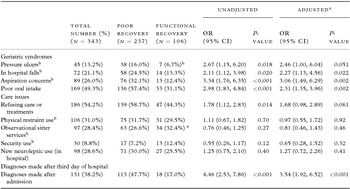
During their hospital stay (Table 2), the aforementioned geriatric syndromes occurred in the range of 13% (pressure ulcers) to 49% (poor oral intake) of delirious people. The presence of any one of the four geriatric syndromes evaluated was associated with poor recovery in univariable and multivariable analyses controlling for baseline factors (for pressure ulcers, the multivariable analysis yielded a trend towards significance, p = 0.051). Difficult care issues were also quite prevalent occurring in 9% (use of security services) to 54% (patients refusing care or treatments) of delirious people. Of the care issues measured, refusal of care or treatments by patients was associated with poor recovery, in the univariable analysis but not in the adjusted analysis. Other care issues (including need for security or sitter services, or the use of new neuroleptic medications) were not associated with recovery status.
Geriatric syndromes, other care issues and additional diagnoses in delirious individuals (with known recovery status)

aAdjusted for age, ADL score, initial MDAS score, presence of hypoxia or acute renal failure on admission.
bMissing data in one person.
Diagnoses made after the third day of admission were common occurring in 131 (38%) of delirious in-patients. The three most common diagnoses made, after the third day of admission were pneumonia, congestive heart failure, and colitis (in 22, 17 and 16 individuals respectively) and 68% of these new diagnoses were made within the first 15 days of hospital stay. Individuals with poor recovery had more than a fourfold increase in the odds of having additional diagnoses made after the third day of admission, in analyses controlling for baseline variables.
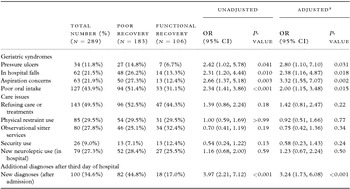
With the exclusion of deceased individuals, the results were not changed, except that refusing care or treatments was no longer significant at the univariable level (Table 3).
Geriatric syndromes, other care issues and additional diagnoses in delirious individuals (with known recovery status), excluding in-hospital deaths

aAdjusted for Age, ADL score, initial MDAS score, presence of hypoxia or acute renal failure on admission.
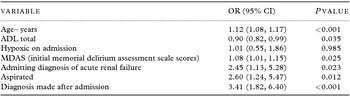
The presence of any one of four geriatric syndromes, refusing care, and having additional diagnoses made after the third day of admission were entered into a multivariable model with forced inclusion of baseline variables (age, ADL dependence, MDAS scores, admitting diagnosis of acute renal failure, and hypoxia). Only aspiration and the presence of an additional diagnosis remained independently associated with poor functional recovery (Table 4). Based on VIF's the extent of collinearity appeared negligible (VIF's for all the geriatric syndromes < 1.5).
Multivariable model for functional recovery forcing in baseline characteristics (age, ADL score, hypoxia on admission, initial MDAS score, admitting diagnosis of acute renal failure) and allowing entry of in hospital geriatric syndromes (entry & removal at the 5% level)

C = 0.807, Hosmer and Lemeshow. Goodness of fit χ 2= 8.495, p = 0.387.
Out of the 355 delirious patients, 215 (60.6%) were discharged back to the community or a temporary rehabilitation hospital. Individuals who were discharged from hospital but had poor recovery at the three month follow-up point were also more likely to have had a fall, been re-hospitalized or re-visited the emergency room after the index hospitalization (Table 5).
Post discharge events in individuals discharged to the community or rehabilitation facilitya

aFor repeat hospitalizations, emergency room visits and falls data was known on 192, 191, and 183 individuals respectively.
Discussion
This study focused specifically on a large cohort of delirious older medically ill patients. Delirium is well recognized as being a poor prognostic indicator in hospitalized individuals (McCusker et al., Reference McCusker, Cole, Dendukuri, Han and Belzile2003; Siddiqi et al., Reference Siddiqi, House and Holmes2006; Witlox et al., Reference Witlox, Eurelings, de Jonghe, Kalisvaart, Eikelenboom and van Gool2010), but not much is known about why delirious individuals do so poorly. Understanding why some delirious individuals recover functionally whereas others do not may help to improve outcomes in delirious patients.
In this study of delirious older medical in-patients the prevalence of geriatric syndromes or care issues was high, in the range of 8% to greater than 50% for some care issues. Falls, pressure ulcers, and the presence of behavioral issues (requiring restraints, or resulting in refusal of treatments such as intravenous lines) have been noted in other studies as well (Young and George, Reference Young and George2003; Marcantonio et al., Reference Marcantonio2005), and highlights the complexity and difficulty of providing care for, and managing delirious individuals. To our knowledge, this is the first study to examine the association between these syndromes or care issues and functional recovery after delirium.
As was hypothesized, a delirious individual who also had another geriatric syndrome, such as poor oral intake, swallowing concerns and falls was two to three times less likely to make a functional recovery, even when baseline variables were controlled for. These results are supported by a previous study on delirious individuals in the post-acute care setting (Anderson et al., Reference Anderson, Ngo and Marcantonio2012). In the latter study, delirium persistence was associated with the presence of geriatric syndromes such as falls, pressure ulcers, malnutrition, and aspiration. Given that persistent or longer lasting delirium is also associated with worse functional outcomes (McCusker et al., Reference McCusker, Cole, Dendukuri, Han and Belzile2003; Kiely et al., Reference Kiely, Jones, Bergmann, Murphy, Orav and Macantonio2006; Speciale et al., Reference Speciale, Bellelli, Lucchi and Trabucchi2007; Kiely et al., Reference Kiely2009), it follows that the presence of other geriatric syndromes in delirium may be associated with poorer functional outcomes, as is supported by the present study.
The co-existence of geriatric syndromes (such as cognitive impairment, incontinence, and falls) has been reported previously (Oliver et al., Reference Oliver, Fergus, Martin and McMurdo2004; Inouye et al., Reference Inouye, Studenski, Tinetti and Kuchel2007). Geriatric syndromes, including delirium, may have common risk factors and be particularly common in frail older adults. Hospitalized individuals with geriatric syndromes tend to have poorer functional outcomes in general (McCusker et al., Reference McCusker, Kakuma and Abrahamowicz2002), with or without delirium. This study would suggest that this also applies specifically to the delirious individual, and that the co-existence of a geriatric syndrome in the context of delirium, may indicate a greater burden of underlying frailty and may help to explain why some people recover functionally from delirium better than others. In the model where all the geriatric syndromes were included, only the presence of aspiration remained independently associated with poor functional recovery, which may indicate that aspiration concerns, in particular, are a particularly bad prognostic indicator in delirium compared to other geriatric syndromes. The effectiveness and functional benefit of interventions to prevent pressure ulcers, falls, aspiration, and poor oral intake in delirious persons, although certainly worth exploring, remains unknown.
Delirious individuals with poor recovery were more likely to have additional diagnoses made (after the third day of admission), fall after discharge, return to the emergency room or be re-admitted to hospital (if they were discharged to the community). This also suggests that delirious individuals at highest risk for poor functional recovery are also those most vulnerable to subsequent medical problems. Some of these additional problems themselves may make recovery less likely, and this may be one reason why some delirious individuals do so poorly, although this warrants further study. Another explanation for these findings is that there may be complexity of diagnosis or delayed recognition and subsequent treatment of medical problems, in delirious individuals, which may also contribute to the lower likelihood of recovery. This is also supported by the fact that two-thirds of new diagnoses made in hospital, were made within the first two weeks of admission, suggesting that the presence of delirium may make diagnosing other illnesses difficult, or that the presence of delirium itself may pre-dispose individuals to increased risk for subsequent medical problems.
The care issue that was associated with poor recovery was patient refusal of care or treatment, although this effect was no longer significant when baseline characteristics were controlled. The use of observational sitter services, hospital security services and physical restraints, although indicating potentially problematic behavioral symptoms (recognized by care providers), were not associated with worse functional recovery in delirious patients. The use of neuroleptic medications was also not associated with poor functional outcomes. These results are consistent with those from another observational study which also did not demonstrate a statistically significant increased risk of death in delirious in-patients treated with neuroleptics (Elie et al., Reference Elie, Boss, Cole, McCusker, Belzile and Ciampi2009). However, the safety of these medications in the short-term management of behavioral symptoms in delirious individuals still needs to be established through randomized controlled trials. The use of neuroleptics may be more common in hyperactive delirium, and another possibility for the lack of association with poor functional outcomes is that hyperactive delirious individuals may do better than hypoactive individuals. However, hypoactive delirium symptoms were not associated with poor functional recovery in this cohort, in the multivariable model, and therefore this appears to be an unlikely explanation.
In a prior study (Dasgupta and Brymer, Reference Dasgupta and Brymer2014), we assessed whether baseline characteristics (present within the first four days of admission) were associated with poor recovery. Characteristics associated with poor recovery included older age, baseline dependence for ADLs, presence of hypoxia, acute renal failure, and increased delirium severity (MDAS) scores. However, even individuals without these characteristics had a significant chance of poor recovery. This study extends findings from the first study by looking at possible mechanisms underlying poorer recovery. Continued susceptibility to certain geriatric syndromes or additional diagnoses made after the third day of admission, may contribute to poor functional recovery after an episode of delirium. Efforts that promote eating, ambulation, careful attention to pressure ulcer prevention, monitoring for other additional diagnoses (in addition to ensuring good oxygenation, hydration and renal function), may be some mechanisms to improve long-term outcomes for patients who experience an episode of delirium.
Limitations of this study include the fact that the geriatric syndromes studied were assessed solely through chart documentation. Although documentation of falls and the use of physical restraints are required, other syndromes such as poor oral intake are not and may have been incompletely captured in this study. In addition, formal swallowing studies were not done to document swallowing difficulties (although this may be difficult to do in delirious individuals). Given that documentation can be inconsistent, it is likely that the occurrence of these syndromes or care issues may have been underestimated by this study. Nonetheless, their prevalence was still found to be significant, highlighting the complexity of caring for delirious patients. It is unlikely that the association between certain syndromes and poor recovery was influenced by documentation practices as the documentation was done independently of assessment of recovery status, by different individuals, who were not involved in the conduct of the study in any way. The sample size is also another possible limitation to this study. The original sample size was calculated for developing a model, using up to seven baseline characteristics, to predict who was at highest risk of poor functional outcomes. Although this is the largest study on delirium prognosis in unselected medical in-patients, given the multiple factors possibly involved in functional recovery after delirium, it still may have been underpowered to assess all relevant variables, and may explain why the model did not find all the geriatric syndromes to be simultaneously associated with poor recovery. We did not look concurrently at a group of non-delirious individuals and this may be considered a limitation. Nonetheless the purpose of this study was specifically to try and understand which factors in delirium are associated with worse outcomes, and therefore, a concurrent group of non-delirious individuals was not included.
Conclusions
Geriatric syndromes and additional diagnoses made after admission, or repeat visits to hospital or falls after discharge are associated with poor functional recovery after delirium. Given the very poor functional prognosis of delirium, further study is required to identify predictors of poor functional recovery and whether intervening on these predictors can improve functional outcomes in delirious individuals.
Conflict of interest
None.
Author contributions
Monidipa Dasgupta: project conception, funding support, recruiting patients, training research assistant, acquisition of and analyzing data, access to and responsibility for data, drafting and final approval of manuscript.
Chris Brymer: recruiting patients, acquisition of data, drafting and final approval of manuscript.
Acknowledgments
This study was funded by a grant from the Physicians’ Services Incorporated. The authors gratefully thank L. Stitt for assistance with statistical support.